daohang fenxiangbox searchbox qikanlogonew daohangnew searchboxnew navrightzone footerzone zhuantixiangqing
Share

    Scan to share on WeChat or Moments

Use WeChat scan.
Share with WeChat friends or Moments

Intelligent Transportation

This issue compiles cutting-edge explorations in intelligent transportation, integrating multidisciplinary innovations to reshape future mobility and establish a safe, efficient, and green new ecosystem for smart transportation.
1 Journals
17 Articles
48 Downloads
87 Citations
Research Article

A forward-looking sequential asynchronous lane-change strategy for vehicle platoon under cloud-vehicle-road integrated architecture

Chain | Vol., Issue 1, 2025 | pp. 43-56
Traffic congestion and safety concerns pose major challenges in dense urban and highway networks, while vehicle platooning offers a promising solution by coordinating movements, reducing aerodynamic drag, and optimizing road utilization to enhance traffic efficiency and safety. Most existing multi-vehicle cooperative lane-change methods adopt a synchronous lane-change strategy, which could result in speed fluctuations and potential safety risks in dense traffic. To address these issues, this study proposes a forward-looking sequential asynchronous lane-change strategy, which dynamically computes the forward shift of vehicle trajectories using relative motion theory. Each following vehicle shifts its predecessor's trajectory forward by a calculated distance, ensuring lane changes occur precisely when the time headway (THW) to the preceding traffic vehicle (PTV) reaches a predefined threshold. Additionally, a spring-damper-based physical model is integrated to regulate longitudinal spacing, ensuring stable vehicle following dynamics. The proposed method is validated in CARLA simulations across various traffic densities, ranging from 2.5 to 10 veh/km/lane. Results show that it consistently outperforms the baseline synchronous strategy in lane travel time, speed fluctuation rate, and THW improvement. The best performance is observed at 5 veh/km/lane, where the proposed method reduces lane travel time by 7.5%, decreases speed fluctuation by 47.0%, and increases THW between the last platoon vehicle and the following traffic vehicle by 3.37 s compared to the baseline. These findings suggest that the proposed strategy could be a foundation for future advancements in cooperative driving, enabling more adaptive and resilient lane-changing behaviors in a cloud-vehicle-road integrated traffic environment.
DOI: 10.23919/CHAIN.2025.000007 Cited: 3 Download: 0
Research Article

High-dimensional traffic test scenario derivation for autonomous vehicles

Chain | Vol., Issue 4, 2024 | pp. 323-340
To enhance the testing efficiency of autonomous vehicles, it is essential to derive intelligent traffic test scenarios. Current methods face limitations such as reliance on subjective analysis and neglect of inter-element correlations. This study introduces Kalman particle filtering theory for high-dimensional traffic scenario derivation. By analyzing comprehensive energy fields in normalized scenes with various elements, we define benchmark scenes using field energy theory. Multi-level research is conducted on processing high-dimensional spatial element data, proposing a normative paradigm for weight allocation among scene elements. We perform generalized derivation by extending hierarchical elements based on offset values, meeting functional verification requirements. Simulation experiments comparing risk event detection, decision-making, and feedback behavior between the proposed method and actual driving data show a steering matching index of 0.92, a longitudinal speed matching index of 0.96, and an root mean squared error (RMSE) mean value of 0.06.
DOI: 10.23919/CHAIN.2024.100006 Cited: 2 Download: 0
Review

Pedestrian crossing intention prediction in the wild: A survey

Chain | Vol., Issue 4, 2024 | pp. 263-279
In real-world driving scenarios, understanding the intentions of pedestrians in real-time is critical for the built environment safety when operating intelligent vehicles on the roads. Pedestrians crossing the street is a common behavior that can easily lead to accidents. This paper presents a comprehensive review of the prediction of pedestrian crossing intentions, focusing on data, model structure, data representation, information extraction, prediction function, and associated models and challenges. The review highlights that data types, model generalization ability, and prediction uncertainty are key challenges on pedestrian crossing intention prediction. It identifies open challenges and opportunities for future research in pedestrian crossing intention prediction.
DOI: 10.23919/CHAIN.2024.000008 Cited: 6 Download: 0
Review

Quantum computing in intelligent transportation systems: A survey

Chain | Vol., Issue 2, 2024 | pp. 138-149
Quantum computing, a field utilizing the principles of quantum mechanics, promises great advancements across various industries. This survey paper is focused on the burgeoning intersection of quantum computing and intelligent transportation systems, exploring its potential to transform areas such as traffic optimization, logistics, routing, and autonomous vehicles. By examining current research efforts, challenges, and future directions, this survey aims to provide a comprehensive overview of how quantum computing could affect the future of transportation.
DOI: 10.23919/CHAIN.2024.000007 Cited: 25 Download: 1
Research Article

Predictive lane-changing control for platoon based on cloud control system in highway scenarios

Chain | Vol., Issue 1, 2024 | pp. 75-98
This research proposes a predictive lane-changing control system for platoon based on cloud control system (CPPLC), Which is designed to improve the safety, economy, and driving efficiency of a platoon. The system constructs a vehicle-cloud hierarchical control architecture, with the cloud as the decision-making layer, which collaboratively optimizes the longitudinal acceleration and lateral lane-changing decisions of the platoon based on a model predictive control framework to improve the comprehensive performance of platoon driving. The vehicle is the execution layer, which cooperates with the decision-making in the cloud to generate the platoon driving trajectory and carry out tracking control to ensure the safety of platoon driving. The proposed system is evaluated based on a joint simulation platform consisting of Sumo, Matlab/Simulink, and Trucksim, and the results show that the system can realize the improvement of the economy and driving efficiency while ensuring the safety compared with the conventional microscopic driving model.
DOI: 10.23919/CHAIN.2024.100001 Cited: 0 Download: 0
Perspective

CHAINS: CHAIN-based fusion safety system framework for intelligent connected vehicle

Chain | Vol., Issue 1, 2024 | pp. 2-45
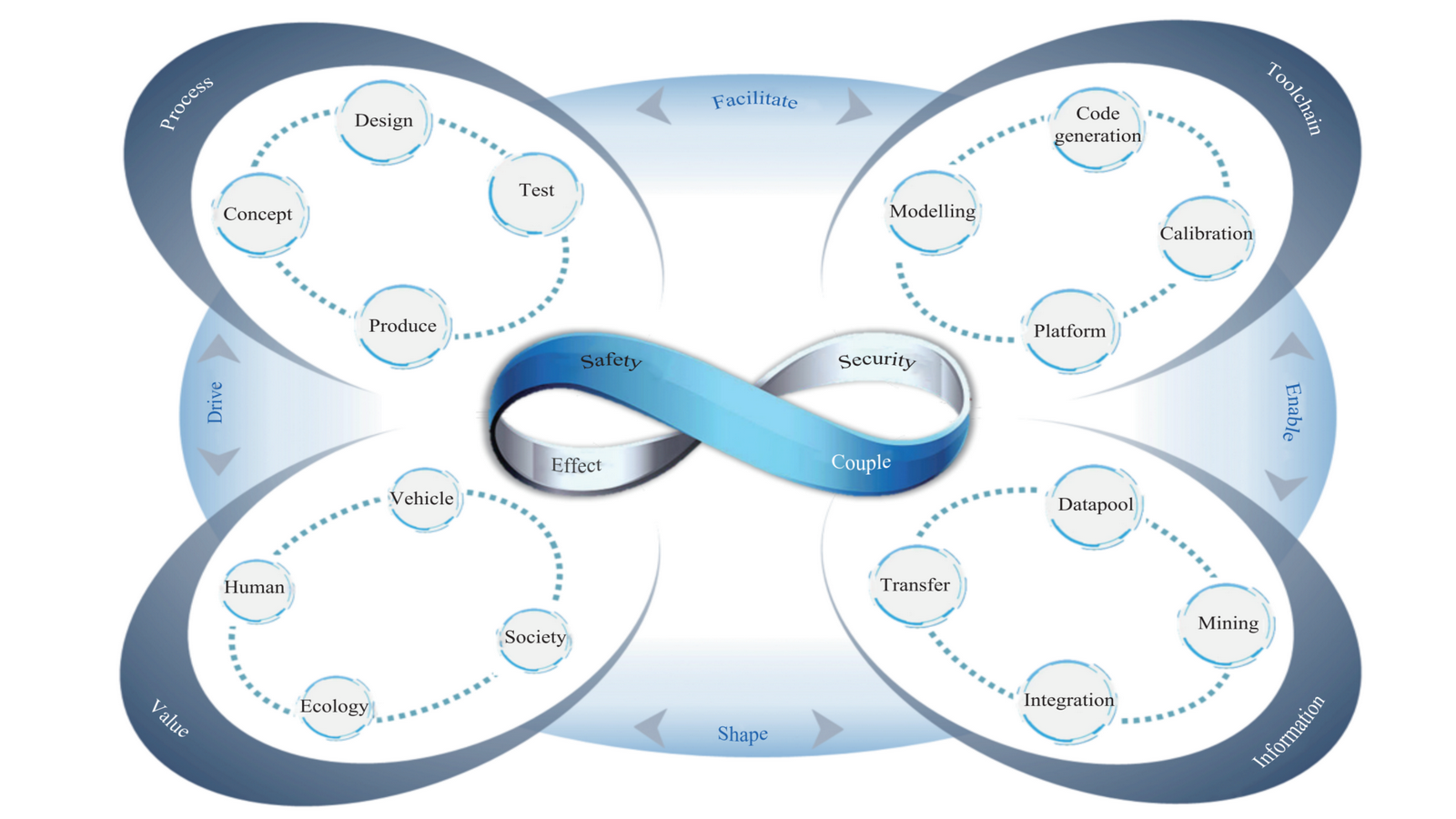
Intelligent connected vehicles, as the focus of the global automotive industry, are currently at a critical stage of large-scale commercialization. However, during the development process of vehicles from mechanical systems with limited functions to mobile intelligence with complex and multiple functions, the issues of functional safety, cybersecurity, and safety of the intended functionality are the main challenges of the industrialization of intelligent connected vehicles, including multiple safety risks such as hardware and software failures, insufficient performance in edge scenarios, cyber-attacks and data leakage. In this paper, the safety and security issues of intelligent connected vehicles, the challenges posed by emerging technology applications, and related solutions are systematically reviewed and summarized. A fusion safety system framework with the safety cube as the core of protection and control is proposed innovatively based on a field-vehicle-human safety interactional model, realizing stereoscopic, deep, and comprehensive safety protection through end-cloud collaboration. Meanwhile, an X-shaped fusion safety development process based on CHAIN is proposed. Through the empowerment of digital twin and AI technologies, it could approach interaction between physical entities and digital twin models and the automation of the development process, thereby satisfying the demands of fusion safety system design, intelligent development, rapid delivery, and continuous iteration. The fusion safety system framework and X-shaped development process proposed in this paper can provide important insight into intelligent transportation vehicles and systems' safety and security design and development.
DOI: 10.23919/CHAIN.2024.000006 Cited: 13 Download: 0
Perspective

Steering the future: Redefining intelligent transportation systems with foundation models

Chain | Vol., Issue 1, 2024 | pp. 46-53
At the intersection of artificial intelligence and urban development, this paper unveils the pivotal role of Foundation Models (FMs) in revolutionizing Intelligent Transportation Systems (ITS). Against the backdrop of escalating urbanization and environmental concerns, we rigorously assess how FMs—spanning large language models, vision-language models, large multimodal models, etc.—can redefine urban mobility paradigms. Our discussion extends to the potential of modular, scalable models and strategic public-private partnerships in facilitating seamless integration. Through a comprehensive literature review and theoretical framework, this paper underscores the significant role of FMs in steering the future of transportation towards unprecedented levels of intelligence and responsiveness. The insights offered aim to guide policymakers, engineers, and researchers in the ethical and effective adoption of FMs, paving the way for a new era in transportation systems.
DOI: 10.23919/CHAIN.2024.100003 Cited: 10 Download: 0

Collection Info

Type Single Journal
Articles 17
Journals 1
Published 2026-09-30

Source Journals

Chain