

CHAINS: CHAIN-based fusion safety system framework for intelligent connected vehicle AITranslate
Abstract AITranslate
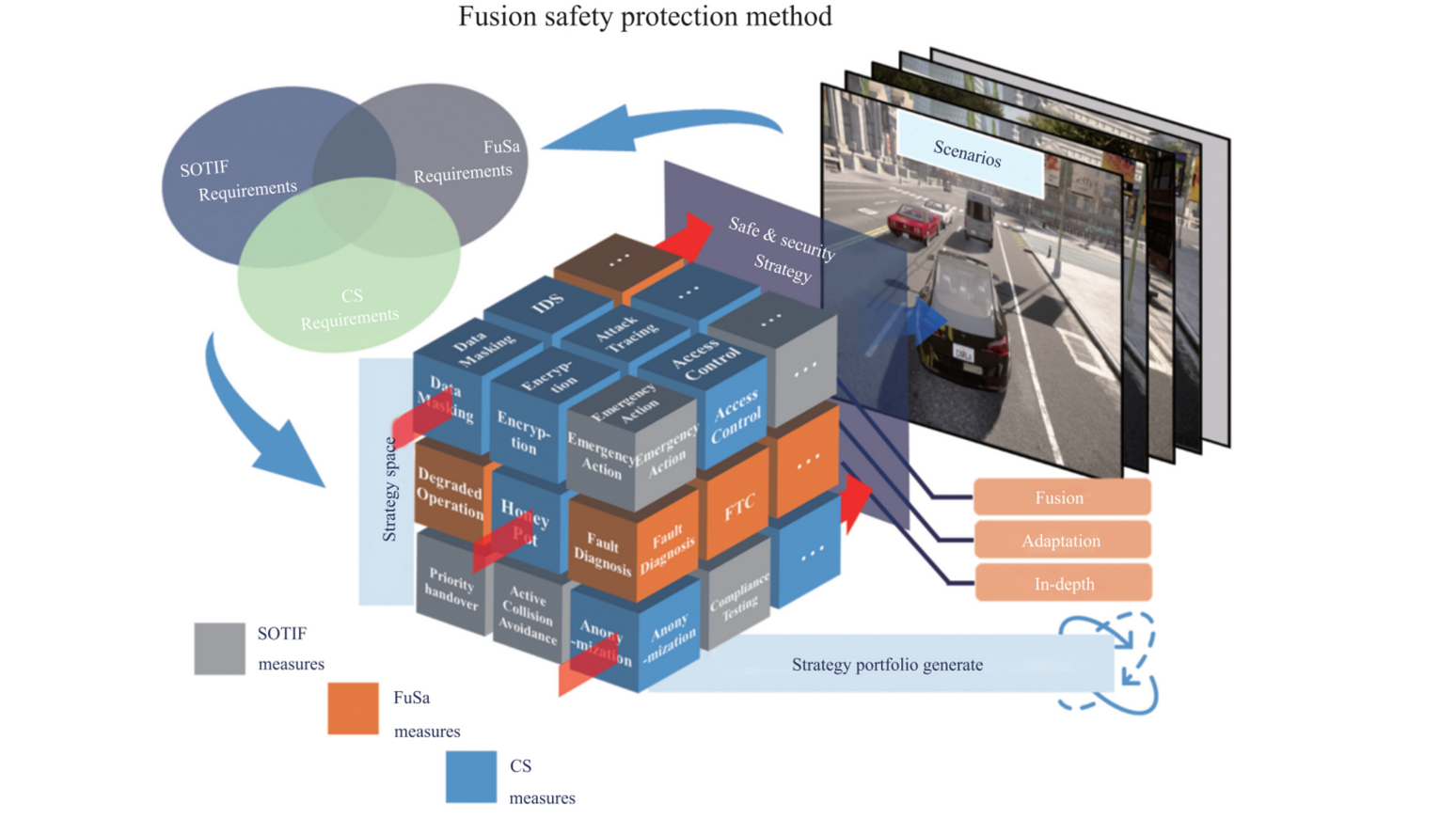
Intelligent connected vehicles, as the focus of the global automotive industry, are currently at a critical stage of large-scale commercialization. However, during the development process of vehicles from mechanical systems with limited functions to mobile intelligence with complex and multiple functions, the issues of functional safety, cybersecurity, and safety of the intended functionality are the main challenges of the industrialization of intelligent connected vehicles, including multiple safety risks such as hardware and software failures, insufficient performance in edge scenarios, cyber-attacks and data leakage. In this paper, the safety and security issues of intelligent connected vehicles, the challenges posed by emerging technology applications, and related solutions are systematically reviewed and summarized. A fusion safety system framework with the safety cube as the core of protection and control is proposed innovatively based on a field-vehicle-human safety interactional model, realizing stereoscopic, deep, and comprehensive safety protection through end-cloud collaboration. Meanwhile, an X-shaped fusion safety development process based on CHAIN is proposed. Through the empowerment of digital twin and AI technologies, it could approach interaction between physical entities and digital twin models and the automation of the development process, thereby satisfying the demands of fusion safety system design, intelligent development, rapid delivery, and continuous iteration. The fusion safety system framework and X-shaped development process proposed in this paper can provide important insight into intelligent transportation vehicles and systems' safety and security design and development.
KeyWords AITranslate
[1]Directorate-General for Internal Market, Industry, Entrepreneurship and SMEs (European Commission), and European Commission, "Commission implementing regulation (EU)," Accessed: July. 1, 2023 [Online]. Available: http://data.europa.eu/eli/reg_impl/2022/1426/oj.
[2]Federal Ministry for Digital and Transport, "Germany will be the world leader in autonomous driving," Accessed: July. 1, 2023 [Online]. Available: https://bmdv.bund.de/SharedDocs/EN/Articles/DG/act-on-autonomous-driving.html.
[3]NHTSA, "NHTSA issues first-ever proposal to modernize occupant protection safety standards for vehicles without manual controls," Accessed: July. 1, 2023 [Online]. Available: https://www.nhtsa.gov/press-releases/nhtsa-issues-first-ever-proposal-modernize-occupant-protection-safety-standards.
[4]European Union, "Commission Implementing Regulation (EU) 2022/1426 of 5 August 2022 laying down rules for the application of Regulation (EU) 2019/2144 of the European Parliament and of the Council as regards uniform procedures and technical specifications for the type-approval of the automated driving system (ADS) of fully automated vehicles (Text with EEA relevance)," Accessed: July. 1, 2023 [Online]. Available: https://op.europa.eu/en/publication-detail/-/publication/94bfefa8-24e9-11ed-8fa0-01aa75ed71a1.
[5]Ministry of Transport of the People's Republic of China, "Notice of the General Office of the Ministry of Transport on the issuance of the Guide for Safety Services of Autonomous Vehicle Transport (Trial Version)," Accessed: July. 1, 2023 [Online]. Available: https://xxgk.mot.gov.cn/jigou/ysfws/202312/t20231205_3962490.html.
[6]S. Yang, Z. Zhang, L. Zhang, H. Yu, K. Yang, and X. Liu, "CHAIN: Cyber hierarchy and interactional network," Etransportation, vol. 17, p. 100256, 2023.
[7]S. Yang, R. He, Z. Zhang, Y. Cao, X. Gao, and X. Liu, "CHAIN: Cyber hierarchy and interactional network enabling digital solution for battery full-lifespan management," Matter, vol. 3, no. 1, pp. 27–41, 2020.
[8]W. Deng, "Electrification and intelligent technology: The driving force of the future vehicle," Journal of Automotive Safety and Energy Efficiency, vol. 1, no. 3, pp. 179–189, 2010.
[9]International Organization for Standardization, "ISO 26262:2018 (en) road vehicles–Functional safety," Accessed: July. 1, 2023 [Online]. Available: https://www.iso.org/obp/ui/en/#iso:std:iso:26262:-1:ed-2:v1:en.
[10]H. Y. Ji, S. C. Cui, C. Sun, and J. M. Zhang, "Understanding of vehicles functional safety development process based on ISO 26262," Auto Electric Parts, no. 7, pp. 57–59, 2016.
[11]W. Cao, Z. Zhu, J. Nan, X. Zhang, Y. Zou, and Y. Cui, "Combined LKA and DYC control for electric vehicle with a domain-centralized E/E architecture based on software-defined networking," IEEE Transactions on Transportation Electrification, in press, doi: 10.1109/TTE.2023.3320262.
[12]I. Llatser, A. Geraldy, G. Jornod, and Y. Yang, "Poster: Safe V2X communication for cooperative automated driving,"2023 IEEE Vehicular Networking Conference (VNC), Istanbul, Turkiye, 2023, pp. 163–164.
[13]A. Corso, R. Moss, M. Koren, R. Lee, and M. Kochenderfer, "A survey of algorithms for black-box safety validation of cyber-physical systems," Journal of Artificial Intelligence Research, vol. 72, pp. 377–428, 2021.
[14]J. Wang, Y. Li, Z. Zhou, C. Wang, Y. Hou, L. Zhang, X. Xue, M. Kamp, X. Zhang, and S. Che, "When, where and how does it fail? A spatial-temporal visual analytics approach for interpretable object detection in autonomous driving," IEEE Transactions on Visualization and Computer Graphics, vol. 29, no. 12, pp. 5033–5049, 2022.
[15]G. Qin, X. H. Dong, L. Yang, W. Wang, Y. Xu, and Y. Wang, "Research on secure FOTA upgrade method for intelligent connected vehicle based on new domain controller architecture,"International Conference on Computer Communication and Network Security, Hohhot, China, 2022.
[16]A. Benslimane and J. Liu, Intelligent and Connected Vehicle Security, New York: River Publishers, 2022.
[17]P. Leijen and N. Kularatna, "Developing a monitoring system for Toyota Prius battery-packs for longer term performance issues,"2013 IEEE International Symposium on Industrial Electronics, Taipei, China, 2013, pp. 1–6.
[18]S. Jeong, B. Jeon, B. Chung, and H. K. Kim, "Convolutional neural network-based intrusion detection system for AVTP streams in automotive ethernet-based networks," Vehicular Communications, vol. 29, no. 100338, 2021.
[19]Upstream, "Automotive Cybersecurity & Data Management," Accessed: July. 1, 2023 [Online]. Available: https://upstream.auto/.
[20]C. Valasek and C. Miller, "Who’s behind the wheel? Exposing the vulnerabilities and risks of high tech vehicles," Accessed: July. 1, 2023 [Online]. Available: https://trid.trb.org/view/1370158.
[21]S. S. Albouq and E. M. Fredericks, "Lightweight detection and isolation of black hole attacks in connected vehicles,"2017 IEEE 37th International Conference on Distributed Computing Systems Workshops (ICDCSW), Atlanta, GA, USA, 2017, pp. 97–104.
[22]J. Ying, Y. H. Feng, Q. A. Chen, and Z. Mao, "GPS spoofing attack detection on intersection movement assist using one-class classification,"ISOC Symposium on Vehicle Security and Privacy (VehicleSec), San Diego, USA, 2023, pp. 1–8.
[23]S. Brady, "Tesla data breach affecting 75k people was ‘inside job’," Accessed: July. 1, 2023 [Online]. Available:https://www.just-auto.com/news/tesla-data-breach-affecting-75k-people-was-inside-job/.
[24]J. Coker, "Toyota reveals data leak of 300,000 customers," Accessed: July, 2023 [Online]. Available: https://www.infosecurity-magazine.com/news/toyota-data-leak-customers/.
[25]J. W. Sun, T. W. Zhang, X. F. Xie, L. Ma, Y. Zheng, K. J. Chen, and Y. Liu, "Stealthy and efficient adversarial attacks against deep reinforcement learning,"The Thirty-Fourth AAAI Conference on Artificial Intelligence, New York, USA, 2020, pp. 5883–5891.
[26]S. A. Abdelhameed, S. M. Moussa, N. L. Badr, and M. E. Khalifa, "The generic framework of privacy preserving data mining phases: Challenges & future directions,"2021 Tenth International Conference on Intelligent Computing and Information Systems (ICICIS), Cairo, Egypt, 2021, pp. 341–347.
[27]T. Skibik, A. P. Vinod, A. Weiss, and S. Di Cairano, "MPC with integrated evasive maneuvers for failure-safe automated driving,"2023 American Control Conference (ACC), San Diego, CA, USA, 2023, pp. 1122–1128.
[28]A. Palffy, J. F. Kooij, and D. M. Gavril, "Detecting darting out pedestrians with occlusion aware sensor fusion of radar and stereo camera," IEEE Transactions on Intelligent Vehicles, vol. 8, no. 2, pp. 1459–1472, 2022.
[29]Carsales, "Volvo recalls 750,000 cars over AEB fault," Accessed: July. 1, 2023 [Online]. Available: https://www.carsales.com.au/editorial/details/volvo-recalls-750000-cars-over-aeb-fault-123425/.
[30]International Organization for Standardization, "The categories of ISO 13849-1," Accessed: July. 1, 2023 [Online]. Available: https://www.byhon.it/the-categories-for-iso-13849/.
[31]T. Munaro and I. Muntean, "Early assessment of system-level safety mechanisms through co-simulation-based fault injection,"2022 IEEE Intelligent Vehicles Symposium (IV), Aachen, Germany, 2022, pp. 1703–1708.
[32]A. Peng, A. Netanyahu, M. K. Ho, T. Shu, A. Bobu, J. Shah, and P. Agrawal, "Diagnosis, feedback, adaptation: A human-in-the-loop framework for test-time policy adaptation,"in Proceedings of the 40th International Conference on Machine Learning, Honolulu, Hawaii, USA, 2023, pp. 27630–27641.
[33]N. Gerlin, E. Kaja, F. Vargas, L. Lu, A. Breitenreiter, J. C. Chen, M. Ulbricht, M. Gomez, A. Tahiraga, and S. Prebeck, "Bits, flips and RISCs,"2023 26th International Symposium on Design and Diagnostics of Electronic Circuits and Systems (DDECS), Tallinn, Estonia, 2023, pp. 140–149.
[34]X. Zhang, J. Tao, K. Tan, M. Töngren, J. M. G. Sanchez, M. R. Ramli, X. Tao, M. Gyllenhammar, F. Wotawa, N. Mohan, M. Nica, and H. Felbinger, "Finding critical scenarios for automated driving systems: A systematic mapping study," IEEE Transactions on Software Engineering, vol. 49, no. 3, pp. 991–1026, 2022.
[35]A. Adee, R. Gansch, and P. Liggesmeyer, "Systematic modeling approach for environmental perception limitations in automated driving,"2021 17th European Dependable Computing Conference (EDCC), Munich, Germany, 2021, pp. 103–110.
[36]J. De Villiers, G. Pavlin, A. Jousselme, S. Maskell, A. De Waal, K. Laskey, E. Blasch, and P. Cost, "Uncertainty representation and evaluation for modeling and decision-making in information fusion," Journal for Advances in Information Fusion, vol. 13, no. 2, pp. 198–215, 2018.
[37]G. Pappalardo, R. Caponetto, R. Varrica, and S. Cafiso, "Assessing the operational design domain of lane support system for automated vehicles in different weather and road conditions," Journal of Traffic and Transportation Engineering (English Edition), vol. 9, no. 4, pp. 631–644, 2022.
[38]T. Hirose, T. Sawaragi, H. Nomoto, and Y. Michiur, "Functional safety analysis of SAE conditional driving automation in time-critical situations and proposals for its feasibility," Cognition, Technology & Work, vol. 23, no. 4, pp. 639–657, 2021.
[39]X. Zhao, J. Sun, and M. Wang, "Measuring sociality in driving interaction," arXiv preprint arXiv:2306.13992, 2023, DOI: 10.48550/arXiv.2306.13992.
[40]M. Klischat, E. I. Liu, F. Holtke, and M. Althoff, "Scenario factory: Creating safety-critical traffic scenarios for automated vehicles,"2020 IEEE 23rd International Conference on Intelligent Transportation Systems (ITSC), Rhodes, Greece, 2020, pp. 1–7.
[41]Y. Forster, F. Naujoks, and A. Keinath, "How many participants are required for validation of automated vehicle interfaces in user studies," Information, vol. 12, no. 10, p. 410, 2021.
[42]K. Madala and M. Solmaz, Scenario-Based Risk Quantification Approach for Assuring Safety in Autonomous Vehicles, Illinois: SAE, 2023.
[43]D. Katare, D. Perino, J. Nurmi, M. Warnier, M. Janssen, and A. Y. Ding, "A survey on approximate edge AI for energy efficient autonomous driving services," IEEE Communications Surveys & Tutorials, vol. 25, no. 4, pp. 2714–2754, 2023.
[44]Z. T. Xu, R. Y. Wang, G. Balaji, M. Bundele, X. F. Liu, L. Liu, and T. Wang, "AlerTiger: Deep learning for AI model health monitoring at LinkedIn,"in Proceedings of the 29th ACM SIGKDD Conference on Knowledge Discovery and Data Mining, New York, NY, United States, 2023, pp. 5350–5359.
[45]V. Negri, A. Mingotti, R. Tinarelli, and L. Peretto, "Uncertainty and lack of information affecting the training of machine learning algorithms for fault prediction of cable-Joints,"2023 IEEE International Instrumentation and Measurement Technology Conference (I2MTC), Kuala Lumpur, Malaysia, 2023, pp. 1–5.
[46]L. Zhang, Q. Zhang, L. Shen, B. Yuan, X. Wang, and D. Tao, "Evaluating model-free reinforcement learning toward safety-critical tasks," Proceedings of the AAAI Conference on Artificial Intelligence, vol. 37, no. 12, pp. 15313–15321, 2023.
[47]K. C. Han, P. S. Bo, and U. Michiel, A Study on Estimation Tool of Occupant Injury Risk for Deriving Integrated Safety Scenarios, Illinois: SAE, 2023.
[48]T. Terzimehić, S. Barner, Y. G. Dantas, U. Schöpp, V. Nigam, and P. Ke, "Safety-aware deployment synthesis and trade-off analysis of Apollo autonomous driving platform,"2023 IEEE 20th International Conference on Software Architecture Companion (ICSA-C), L'Aquila, Italy, 2023, pp. 309–316.
[49]A. Abdulhamid, S. Kabir, I. Ghafir, and C. Lei, "An overview of safety and security analysis frameworks for the internet of things," Electronics, vol. 12, no. 14, p. 3086, 2023.
[50]B. Li, Y. Fu, S. L. Shang, Z. Z. Li, J. F. Zhao, and B. Wang, "Research on functional safety of battery management system (BMS) for electric vehicles,"2021 International Conference on Intelligent Computing, Automation and Applications (ICAA), Nanjing, China, 2021, pp. 267–270.
[51]B. Li, X. C. Wei, and Y. Fu, "Research on functional safety of drive motor system for electric vehicle,"2021 International Conference on Artificial Intelligence and Electromechanical Automation (AIEA), Guangzhou, China, 2021, pp. 84–87.
[52]M. Park, H. C. Koag, and H. S. Ahn, "Functional safety improvement of electric power steering system by using electronic stability control system,"2018 IEEE 27th International Symposium on Industrial Electronics (ISIE), Cairns, QLD, Australia, 2018, pp. 230–234.
[53]S. Chung and H. Lee, "Estimating desired yaw rate and control strategy analysis on developed air ESC system for performance evaluation,"15th International Conference on Control, Automation and Systems (ICCAS), Busan, Korea (South), 2015, pp. 2005–2010.
[54]Y. Tao, Y. Z. Li, and Y. H. He, "Research on methods of wamings for ADAS safety design method based on AHP,"2021 6th International Conference on Transportation Information and Safety (ICTIS), Wuhan, China, 2021, pp. 1332–1337.
[55]M. Yadav, D. Shankar, and T. Jose, "Functional safety for braking system through ISO 26262, operating system security and DO 254,"2020 AIAA/IEEE 39th Digital Avionics Systems Conference (DASC), San Antonio, TX, USA, 2020, pp. 1–8.
[56]M. Šik and J. Křivánek, "Survey of Markov chain Monte Carlo methods in light transport simulation," IEEE Transactions on Visualization and Computer Graphics, vol. 26, no. 4, pp. 1821–1840, 2018.
[57]G. Xie, G. Zeng, Y. Liu, J. Zhou, R. Li, and K. Li, "Fast functional safety verification for distributed automotive applications during early design phase," IEEE Transactions on Industrial Electronics, vol. 65, no. 5, pp. 4378–4391, 2017.
[58]Z. Gu, G. Han, H. Zeng, and Q. Zhao, "Security-aware mapping and scheduling with hardware co-processors for flexray-based distributed embedded systems," IEEE Transactions on Parallel and Distributed Systems, vol. 27, no. 10, pp. 3044–3057, 2016.
[59]G. Xie, Y. Chen, Y. Liu, Y. Wei, R. Li, and K. Li, "Resource consumption cost minimization of reliable parallel applications on heterogeneous embedded systems," IEEE Transactions on Industrial Informatics, vol. 13, no. 4, pp. 1629–1640, 2016.
[60]C. B. S. T. Molina, J. R. De Almeida, L. F. Vismari, R. I. R. Gonzalez, J. K. Naufal, and J. Camargo, "Assuring fully autonomous vehicles safety by design: The autonomous vehicle control (AVC) module strategy,"2017 47th Annual IEEE/IFIP International Conference on Dependable Systems and Networks Workshops (DSN-W), Denver, CO, USA, 2017, pp. 16–21.
[61]A. A. J. Zumalde, J. M. Secall, and J. B. C. Junior, "Comparative analysis on the impact of defensive programming techniques for safety-critical systems,"2009 Fourth Latin-American Symposium on Dependable Computing, Joao Pessoa, Paraiba, Brazil, 2009, pp. 95–102.
[62]K. Liu, X. Z. Zhang, W. Q. Kong, G. Hou, M. Watanabe, and A. Fukuda, "Interpolation-based multi-core bounded model checking of HSTM designs,"2019 6th International Conference on dependable systems and their applications (DSA), Harbin, China, 2020, pp. 25–36.
[63]A. Tashakori and M. Ektesabi, "Fault diagnosis of in-wheel BLDC motor drive for electric vehicle application,"2013 IEEE Intelligent Vehicles Symposium (IV), Gold Coast, QLD, Australia, 2013, pp. 925–930.
[64]H. Volos, "The case for replication-aware memory-error protection in disaggregated memory," IEEE Computer Architecture Letters, vol. 20, no. 2, pp. 130–133, 2021.
[65]S. Fürst and M. Bechter, "AUTOSAR for connected and autonomous vehicles: The AUTOSAR adaptive platform,"46th Annual IEEE/IFIP International Conference on Dependable Systems and Networks Workshop (DSN-W), Toulouse, France, 2016, pp. 215–217.
[66]P. M. Frank, "Fault diagnosis in dynamic systems using analytical and knowledge-based redundancy: A survey and some new results," Automatica, vol. 26, no. 3, pp. 459–474, 1990.
[67]K. Indu and M. Aswatha Kumar, "Electric vehicle control and driving safety systems: A review," IETE Journal of Research, vol. 69, no. 1, pp. 482–498, 2023.
[68]M. Singh and A. G. Shaik, "Incipient fault detection in stator windings of an induction motor using stockwell transform and SVM," IEEE Transactions on Instrumentation and Measurement, vol. 69, no. 12, pp. 9496–9504, 2020.
[69]D. Du and Z. Li, "Passive fault-tolerant control for discrete parameter system," IET Power Electronics, vol. 16, no. 12, pp. 1969–1983, 2023.
[70]Z. Hu, F. Zhang, and Z. Wei, "Research on fault tolerant strategy and reliability of steering-by-wire," International Journal of Modeling and Optimization, vol. 6, no. 2, pp. 106, 2016.
[71]C. Huang, F. Naghdy, and H. Du, "Fault tolerant sliding mode predictive control for uncertain steer-by-wire system," IEEE Transactions on Cybernetics, vol. 49, no. 1, pp. 261–272, 2017.
[72]Y. F. Wang, Y. Huang, and X. F. Han, "Research on verification method of safety integrity level based on Monte-Carlo,"2021 3rd International Symposium on Robotics & Intelligent Manufacturing Technology (ISRIMT), Changzhou, China, 2021, pp. 181–184.
[73]Y. Wang, Y. Wang, H. Qin, H. Ji, Y. Zhang, and J. Wang, "A systematic risk assessment framework of automotive cybersecurity," Automotive Innovation, vol. 4, pp. 253–261, 2021.
[74]T. Vogt, E. Spahovic, T. Doms, R. Seyer, H. Weiskirchner, K. Pollhammer, T. Raab, S. Rührup, M. Latzenhofer, C. Schmittner, M. Hofer, A. Bonitz, C. Kloibhofer, and S. Chlup, "A comprehensive risk management approach to information security in intelligent transport systems," SAE International Journal of Transportation Cybersecurity and Privacy, vol. 4, pp. 39–58, 2021.
[75]X. You, Y. Zhang, B. Li, X. Lv, and J. Han, "VDIF-M: Multi-label classification of vehicle defect information collection based on seq2seq Model,"in Mobile Computing, Applications, and Services, Cham Switzerland: Springer, 2019.
[76]I. Wagner and D. Eckhoff, "Technical privacy metrics: A systematic survey," ACM Computing Surveys (CSUR), vol. 51, no. 3, pp. 1–38, 2018.
[77]A. Alrawais, A. Alhothaily, B. Mei, T. Song, and X. Cheng, "An efficient revocation scheme for vehicular ad-hoc networks," Procedia Computer Science, vol. 129, pp. 312–318, 2018.
[78]S. Du and G. Ye, "IWT and RSA based asymmetric image encryption algorithm," Alexandria Engineering Journal, vol. 66, pp. 979–991, 2023.
[79]Z. H. Meng and Y. Wang, "Asymmetric encryption algorithms: Primitives and applications,"2022 IEEE 2nd International Conference on Electronic Technology, Communication and Information (ICETCI), Changchun, China, 2022, pp. 876–881.
[80]D. He, S. Zeadally, B. Xu, and X. Huang, "An efficient identity-based conditional privacy-preserving authentication scheme for vehicular ad hoc networks," IEEE Transactions on Information Forensics and Security, vol. 10, no. 12, pp. 2681–2691, 2015.
[81]C. Zhang, X. Xue, L. Feng, X. Zeng, and J. M, "Group-signature and group session key combined safety message authentication protocol for VANETs," IEEE Access, vol. 7, pp. 178310–178320, 2019.
[82]H. Tan and I. Chung, "Secure authentication and key management with blockchain in VANETs," IEEE Access, vol. 8, pp. 2482–2498, 2019.
[83]S. H. Abbas, W. A. K. Naser, and A. A. Kadhim, "Subject review: Intrusion detection system (IDS) and intrusion prevention system (IPS)," Global Journal of Engineering and Technology Advances, vol. 14, no. 2, pp. 155–158, 2023.
[84]I. Naqvi, A. Chaudhary, and A. Kumar, "A systematic review of the intrusion detection techniques in VANETS," TEM Journal, vol. 11, no. 2, pp. 900–907, 2022.
[85]S. Sharma and A. Kaul, "A survey on intrusion detection systems and honeypot based proactive security mechanisms in VANETs and VANET cloud," Vehicular Communications, vol. 12, pp. 138–164, 2018.
[86]A. Tomandl, K. P. Fuchs, and H. Federrath, "REST-Net: A dynamic rule-based IDS for VANETs,"2014 7th IFIP Wireless and Mobile Networking Conference (WMNC), Vilamoura, Portugal, 2014, pp. 1–8.
[87]M. Anand, S. P. Kumar, M. Selvi, S. S. Kumar, G. D. Ram, and A. Kannan, "Deep learning model based IDS for detecting cyber attacks in IoT based smart vehicle network,"2023 International Conference on Sustainable Computing and Data Communication Systems (ICSCDS), Erode, India, 2023.
[88]S. U. Sagong, R. Poovendran, and L. Bushnell, "Mitigating vulnerabilities of voltage-based intrusion detection systems in controller area networks," Arxiv Preprint Arxiv:1907.10783, 2019, DOI: 10.48550/arXiv.1907.10783.
[89]Y. Qi, G. Mai, R. Zhu, and M. Zhang, "EVKG: An interlinked and interoperable electric vehicle knowledge graph for smart transportation system," Transactions in GIS, vol. 27, no. 4, pp. 949–974, 2023.
[90]H. Ahmed, I. Traore, S. Saad, and M. Mamu, "Automated detection of unstructured context-dependent sensitive information using deep learning," Internet of Things, vol. 16, p. 100444, 2021.
[91]M. Ashraf, S. Rady, T. Abdelkader, and T. F. Gharib, "Efficient privacy preserving algorithms for hiding sensitive high utility itemsets," Computers & Security, vol. 132, p. 103360, 2023.
[92]L. Yu, L. Liu, and C. Pu, "Dynamic differential location privacy with personalized error bounds,"NDSS ’17, San Diego, USA, 2017, pp. 1–15.
[93]H. Y. Khdier, W. M. Jasim, and S. A. Aliesawi, "Deep learning algorithms based voiceprint recognition system in noisy environment," Journal of Physics: Conference Series, vol. 1804, no. 1, p. 012042, 2021.
[94]Z.-L. Liu, C.-F. Jia, and J.-W. Li, "Research on the format-preserving encryption techniques," Ruanjian Xuebao, vol. 23, no. 1, pp. 152–170, 2012.
[95]X. Luo, H. Wang, D. Wu, C. Chen, M. Deng, J. Huang, and X. S. Hu, "A survey on deep hashing methods," ACM Transactions on Knowledge Discovery from Data, vol. 17, no. 1, pp. 1–50, 2023.
[96]A. Acar, H. Aksu, A. S. Uluagac, and M. Conti, "A survey on homomorphic encryption schemes: Theory and implementation," ACM Computing Surveys (CSUR), vol. 51, no. 4, pp. 1–35, 2018.
[97]Y. Wang, L. Wang, M. Dong, J. Tang, M. Sun, R. Wang, M. Hu, and H. Zhang, "Image encryption and decryption system with clock controlled destruction,"2022 International Conference on Image Processing, Computer Vision and Machine Learning (ICICML), Xi’an, China, 2022, pp. 90–93.
[98]A. Alsobeh and A. Shatnawi, "Integrating data-driven security, model checking, and self-adaptation for IoT systems using BIP components: A conceptual proposal model,"in Proceedings of the 2023 International Conference on Advances in Computing Research (ACR’23), San Diego, USA, 2023, pp. 533–549.
[99]Q. Song, E. Engström, and P. Runeson, "Industry practices for challenging autonomous driving systems with critical scenarios," ACM Transactions on Software Engineering and Methodology, in press, 2023, DOI: 10.1145/3640334.
[100]M. Wӓschle, K. Wolter, K. Bause, M. Behrendt, and A. Albers, "Considering functional safety – Supporting the development of automated driving vehicles by the use of model-based systems engineering,"2022 17th Annual System of Systems Engineering Conference (SOSE), Rochester, NY, USA, 2022, pp. 275–280.
[101]L. Hu, X. Zhou, X. Zhang, F. Wang, Q. Li, and W. Wu, "A review on key challenges in intelligent vehicles: Safety and driver-oriented features," IET Intelligent Transport Systems, vol. 15, no. 9, pp. 1093–1105, 2021.
[102]D. Hulse and L. Irshad, "Using degradation modeling to identify fragile operational conditions in human- and component-driven resilience assessment,"2022 IEEE/AIAA 41st Digital Avionics Systems Conference (DASC), Portsmouth, VA, USA, 2022, pp. 1–10.
[103]Y. Poledna, F. Reway, M. F. Drechsler, W. Huber, C. Icking, and E. P. Ribeiro, "An open-source high-level fusion algorithm in ROS for automated driving applications,"2022 10th International Conference in Software Engineering Research and Innovation (CONISOFT), San José Chiapa, Mexico, 2022, pp. 174–181.
[104]S. Y. Alaba and J. E. Ball, "Deep learning-based image 3-d object detection for autonomous driving," IEEE Sensors Journal, vol. 23, no. 4, pp. 3378–3394, 2023.
[105]J. Breitenstein, J. A. Termöhlen, D. Lipinski, and T. Fingscheidt, "Systematization of corner cases for visual perception in automated driving,"2020 IEEE Intelligent Vehicles Symposium (IV), Las Vegas, NV, USA, 2020, pp. 1257–1264.
[106]H. Fan, F. Zhu, C. Liu, L. Zhang, L. Zhuang, D. Li, W. Zhu, J. Hu, H. Li, and Q. Kong, "Baidu Apollo EM motion planner," arXiv preprint arXiv:1807.08048, 2018, DOI: 10.48550/arXiv.1807.08048.
[107]C. Hu, H. Gong, and Y. He, "Data driven identification of international cutting edge science and technologies using SpaCy," PLoS One, vol. 17, no. 10, p. e0275872, 2022.
[108]T. Paul and K. Ueno, "Robust incremental logistic regression for detection of anomaly using big data,"2020 19th IEEE International Conference on Machine Learning and Applications (ICMLA), Miami, FL, USA, 2020, pp. 1167–1173.
[109]Y. Wang, J. Jiang, S. Li, R. Li, S. Xu, J. Wang, and K. Li, "Decision-making driven by driver intelligence and environment reasoning for high-level autonomous vehicles: A survey," IEEE Transactions on Intelligent Transportation Systems, vol. 24, no. 10, pp. 10362–10381, 2023.
[110]M. Ammour, R. Orjuela, and M. Basset, "A MPC combined decision making and trajectory planning for autonomous vehicle collision avoidance," IEEE Transactions on Intelligent Transportation Systems, vol. 23, no. 12, pp. 24805–24817, 2022.
[111]W. Shao, J. Li, and H. Wang, "Self-aware trajectory prediction for safe autonomous driving,"2023 IEEE Intelligent Vehicles Symposium (IV), Anchorage, AK, USA, 2023, pp. 1–8.
[112]J. Lu, Z. Peng, S. Yang, Y. Ma, R. Wang, Z. Pang, X. Feng, Y. Chen, and Y. Cao, "A review of sensory interactions between autonomous vehicles and drivers," Journal of Systems Architecture, vol. 141, p. 102932, 2023.
[113]H. Wang, X. Zhang, J. Li, B. Li, X. Gao, Z. Hao, J. Fu, Z. Zhou, and M. Atia, "Driving risk cognition of passengers in highly automated driving based on the prefrontal cortex activity via fNIRS," Scientific Reports, vol. 13, no. 1, p. 15839, 2023.
[114]J. Fu, X. Zhang, W. Yu, J. Li, M. M. Atia, H. Wang, C. Li, and Z. Hao, "Decoding passenger's EEG signals from encountering emergency road events,"2022 IEEE 25th International Conference on Intelligent Transportation Systems (ITSC), Macau, China, 2022, pp. 2214–2219.
[115]D. Humeniuk, F. Khomh, and G. Antoniol, "Ambiegen: A search-based framework for autonomous systems testing," Science of Computer Programming, vol. 230, p. 102990, 2023.
[116]S. Singhal, N. Jatana, K. Sheoran, G. Dhand, S. Malik, R. Gupta, B. Suri, M. Niranjanamurthy, S. N. Mohanty, and N. R. Pradhan, "Multi-objective fault-coverage based regression test selection and prioritization using enhanced ACO_TCSP," Mathematics, vol. 11, no. 13, p. 2983, 2023.
[117]G. Yang, M. Haque, Q. Song, W. Yang, and X. Liu, "Testaug: A framework for augmenting capability-based nlp tests," arXiv preprint arXiv:2210.08097, 2022, DOI: 10.48550/arXiv.2210.08097.
[118]D. Zhang, J. Sun, J. Wang, and R. Yu, "Real-time driving risk assessment based on the psycho-physical field," Journal of Transportation Safety & Security, vol. 16, no. 3, pp. 293–322, 2023.
[119]A. Fries, F. Fahrenkrog, K. Donauer, M. Mai, and F. Raisch, "Driver behavior model for the safety assessment of automated driving,"2022 IEEE Intelligent Vehicles Symposium (IV), Aachen, Germany, 2022, pp. 1669–1674.
[120]O. De Groot, L. Ferranti, D. Gavrila, and J. Alonso-Mor, "Scenario-based motion planning with bounded probability of collision," arXiv preprint arXiv:2307.01070, 2023.
[121]M. M. J. Samodro, R. D. Puriyanto, and W. Caesarendr, "Artificial potential field path planning algorithm in differential drive mobile robot platform for dynamic environment," International Journal of Robotics and Control Systems, vol. 3, no. 2, pp. 161–170, 2023.
[122]A. Arun, "A novel road user safety field theory for traffic safety assessment applying video analytics,"Ph.D. Dissertation, Queensland University of Technology, Brisbane, 2022.
[123]P. Franklin, "Risk assessment using information entropy,"2023 Annual Reliability and Maintainability Symposium (RAMS), Orlando, FL, USA, 2023, pp. 1–4.
[124]Z. Pang, Z. Chen, J. Lu, M. Zhang, X. Feng, Y. Chen, S. Yang, and Y. Cao, "A survey of decision-making safety assessment methods for autonomous vehicles," IEEE Intelligent Transportation Systems Magazine, vol. 16, no. 1, pp. 74–103, 2023.
[125]J. Feng, C. Wang, C. Xu, D. Kuang, and W. Zhao, "Active collision avoidance strategy considering motion uncertainty of the pedestrian," IEEE Transactions on Intelligent Transportation Systems, vol. 23, no. 4, pp. 3543–3555, 2020.
[126]A. Shoker, V. Rahli, J. Decouchant, and P. Esteves-Verissimo, "Intrusion resilience systems for modern vehicles,"2023 IEEE 97th Vehicular Technology Conference (VTC2023-Spring), Florence, Italy, 2023, pp. 1–7.
[127]D. Suo, J. E. Siegel, and S. E. Sarm, "Merging safety and cybersecurity analysis in product design," IET Intelligent Transport Systems, vol. 12, no. 9, pp. 1103–1109, 2018.
[128]C. Lin, D. Tian, X. Duan, J. Zhou, D. Zhao, and D. Cao, "3d-DFM: Anchor-free multimodal 3-d object detection with dynamic fusion module for autonomous driving," IEEE Transactions on Neural Networks and Learning Systems, vol. 14, no. 12, pp. 10812–10822, 2022.
[129]H. Martin, Z. Ma, C. Schmittner, B. Winkler, M. Krammer, D. Schneider, T. Amorim, G. Macher, and C. Kreiner, "Combined automotive safety and security pattern engineering approach," Reliability Engineering & System Safety, vol. 198, p. 106773, 2020.
[130]S. Dotsenko, H. Fesenko, O. Illiashenko, V. Kharchenko, V. Moiseenko, and L. Yermolenko, "Integration of security, functional and ecology safety management systems: Concept and industrial case,"2020 IEEE 11th International Conference on Dependable Systems, Services and Technologies (DESSERT), Kyiv, Ukraine, 2020, pp. 470–474.
[131]S. Numan, E. Gordon, K. Klaus, and D. Kristina, "Multi-sensor data fusion for real-time multi-object tracking," Engineering, Environmental Science, Computer Science, in press, doi: 10.3390/pr11020501.
[132]W. Liu, D. Anguelov, D. Erhan, C. Szegedy, S. Reed, C. Y. Fu, and A. C. Berg, "SSD: Single shot multibox detector," arXiv 2015, arXiv:1512.02325.
[133]M. Bojarski, D. D. Testa, D. Dworakowski, B. Firner, B. Flepp, P. Goyal, L. D. Jackel, M. Monfort, U. Muller, J. Zhang, X. Zhang, J. Zhao, and K. Zieba, "End to end learning for self-driving cars," ArXiv, 2016, vol. abs/1604.07316.
[134]C.-C. Wu, C.-W. Chen, C.-L. Lin, and C.-J. Yang, "Advanced organic light-emitting devices for enhancing display performances," Journal of Display Technology, vol. 1, no. 2, pp. 248–266, 2005.
[135]A. Jain, A. R. Kondapally, K. Yamada, and H. Yanak, "A neuro-symbolic approach for multimodal reference expression comprehension," arXiv preprint arXiv:2306.10717, 2023, DOI: 10.48550/arXiv.2306.10717.
[136]D. Wang, Y. Guo, S. Liu, Y. Zhang, W. Xu, and J. Xiao, "Haptic display for virtual reality: Progress and challenges," Virtual Reality & Intelligent Hardware, vol. 1, no. 2, pp. 136–162, 2019.
[137]J. Kim and D. Kum, "Collision risk assessment algorithm via lane-based probabilistic motion prediction of surrounding vehicles," IEEE Transactions on Intelligent Transportation Systems, vol. 19, no. 9, pp. 2965–2976, 2017.
[138]M. Nalini, "Intelligent devices, device management, and device security for cloud platforms," Convergence of Deep Learning and Internet of Things: Computing and Technology, Hershey, PA: IGI Global, 2023, pp. 1–22.
[139]L. Wang, Y. Ma, J. Yan, V. Chang, and A. Y. Zomay, "pipsCloud: High performance cloud computing for remote sensing big data management and processing," Future Generation Computer Systems, vol. 78, pp. 353–368, 2018.
[140]R. Beyar, L. Gruberg, D. Deleanu, A. Roguin, Y. Almagor, S. Cohen, G. Kumar, and T. Wenderow, "Remote-control percutaneous coronary interventions: Concept, validation, and first-in-humans pilot clinical trial," Journal of the American College of Cardiology, vol. 47, no. 2, pp. 296–300, 2006.
[141]B. Chen and H. H. Cheng, "A review of the applications of agent technology in traffic and transportation systems," IEEE Transactions on Intelligent Transportation Systems, vol. 11, no. 2, pp. 485–497, 2010.
[142]T. V. Nguyen, P. Shailesh, B. Sudhir, G. Kapil, L. Jiang, Z. Wu, D. Malladi, and J. Li, "A comparison of cellular vehicle-to-everything and dedicated short range communication,"2017 IEEE Vehicular Networking Conference (VNC), Turin, Italy, 2017, pp. 101–108.
[143]Y. P. Varshni, "Comparative study of potential energy functions for diatomic molecules," Reviews of Modern Physics, vol. 29, no. 4, p. 664, 1957.
[144]K. Reif, Brakes, Brake Control and Driver Assistance Systems, Weisbaden, Germany: Springer, 2014.
[145]G. M. Zago and E. P. De Freitas, "A quantitative performance study on CAN and CAN FD vehicular networks," IEEE Transactions on Industrial Electronics, vol. 65, no. 5, pp. 4413–4422, 2017.
[146]Y. Almalioglu, M. Turan, N. Trigoni, and A. Markham, "Deep learning-based robust positioning for all-weather autonomous driving," Nature Machine Intelligence, vol. 4, no. 9, pp. 749–760, 2022.
[147]M. Liebner, M. Baumann, F. Klanner, and C. Stiller, "Driver intent inference at urban intersections using the intelligent driver model,"2012 IEEE Intelligent Vehicles Symposium, Madrid, Spain, 2012, pp. 1162–1167.
[148]M. A. Van Staalduinen, F. Khan, V. Gadag, and G. Reniers, "Functional quantitative security risk analysis (QSRA) to assist in protecting critical process infrastructure," Reliability Engineering & System Safety, vol. 157, pp. 23–34, 2017.
[149]D. Zhang, G. Feng, Y. Shi, and D. Srinivas, "Physical safety and cyber security analysis of multi-agent systems: A survey of recent advances," IEEE/CAA Journal of Automatica Sinica, vol. 8, no. 2, pp. 319–333, 2021.
[150]Z. Lv, Y. Li, H. Feng, and H. Lv, "Deep learning for security in digital twins of cooperative intelligent transportation systems," IEEE Transactions on Intelligent Transportation Systems, vol. 23, no. 9, pp. 16666–16675, 2021.
[151]I. Errandonea, S. Beltrán, and S. Arrizabalaga, "Digital Twin for maintenance: A literature review," Computers in Industry, vol. 123, no. 103316, 2020.
[152]H. Cai, B. Xu, L. Jiang, and A. V. Vasilakos, "IoT-based big data storage systems in cloud computing: Perspectives and challenges," IEEE Internet of Things Journal, vol. 4, no. 1, pp. 75–87, 2016.
[153]K. T. Arun, "Software defined vehicle demands R&D overhauling," Accessed: Mar. 1, 2023 [Online]. Available: https://hindujatech.com/blog/software-defined-vehicle-demands-r-and-d-overhauling.
[154]A. Bernard and A. Fischer, "New trends in rapid product development," CIRP Annals, vol. 51, no. 2, pp. 635–652, 2002.
[155]N. G. Leveson, Engineering A Safer World: Systems Thinking Applied to Safety, Cambridge: The MIT Press, 2016.
[156]Globe Newswire, "Intelligent vehicle E/E architecture research report, 2022," Accessed: Mar. 12, 2024 [Online]. Available: https://www.globenewswire.com/news-release/2022/09/13/2515252/0/en/Intelligent-Vehicle-E-E-Architecture-Research-Report-2022.html.
[157]Collimator, "Model based design overview for system development," Accessed: Mar. 1, 2024 [Online]. Available: https://www.collimator.ai/post/model-based-development.
[158]C. Singh, N. S. Gaba, M. Kaur, and B. Kaur, "Comparison of different CI/CD tools integrated with cloud platform,"9th International Conference on Cloud Computing, Data Science & Engineering (Confluence), Noida, India, 2019, pp. 7–12.
[159]Z. Kozhirbayev and R. O. Sinnott, "A performance comparison of container-based technologies for the cloud," Future Generation Computer Systems, vol. 68, pp. 175–182, 2017.
[160]F. Tao and Q. Qi, "Make more digital twins," Nature, vol. 573, no. 7775, pp. 490–491, 2019.
[161]J. Zhou, P. Li, Y. Zhou, B. Wang, J. Zang, and L. Meng, "Toward new-generation intelligent manufacturing," Engineering, vol. 4, no. 1, pp. 11–20, 2018.
[162]I. Gräßler, D. Wiechel, D. Roesmann, and H. Thiele, "V-model based development of cyber-physical systems and cyber-physical production systems," Procedia Cirp, vol. 100, pp. 253–258, 2021.
[163]S. Mathur and S. Malik, "Advancements in the V-Model," International Journal of Computer Applications, vol. 1, no. 12, pp. 29–34, 2010.
[164]D. Sjödin, V. Parida, M. Palmié, and J. Wincent, "How AI capabilities enable business model innovation: Scaling AI through co-evolutionary processes and feedback loops," Journal of Business Research, vol. 134, pp. 574–587, 2021.
[165]X. Zhou, C. Chai, G. Li, and J. Sun, "Database meets AI: A survey, 2020," Accessed: Mar. 1, 2024 [Online]. Available: https://dbgroup.cs.tsinghua.edu.cn/ligl/papers/aidb.pdf.
[166]S. A. Seshia, D. Sadigh, and S. S. Sastry, "Toward verified artificial intelligence," Communications of the ACM, vol. 65, no. 7, pp. 46–55, 2022.
[167]P. Pataranutaporn, V. Danry, J. Leong, P. Punpongsanon, D. Novy, P. Maes, and M. Sra, "AI-generated characters for supporting personalized learning and well-being," Nature Machine Intelligence, vol. 3, no. 12, pp. 1013–1022, 2021.
[168]S. K. Singh, S. Rathore, and J. H. Park, "Blockiotintelligence: A blockchain-enabled intelligent IoT architecture with artificial intelligence," Future Generation Computer Systems, vol. 110, pp. 721–743, 2020.
[169]D. Maltoni and V. Lomonaco, "Continuous learning in single-incremental-task scenarios," Neural Networks, vol. 116, pp. 56–73, 2019.
[170]M. Rubert and K. Farias, "On the effects of continuous delivery on code quality: A case study in industry," Computer Standards & Interfaces, vol. 81, p. 103588, 2022.
Basic Information:
DOI:10.23919/CHAIN.2024.000006
Chinese Library Classification Number:
Citation Information:
Intelligent connected vehicles, as the focus of the global automotive industry, are currently at a critical stage of large-scale commercialization. However, during the development process of vehicles from mechanical systems with limited functions to mobile intelligence with complex and multiple functions, the issues of functional safety, cybersecurity, and safety of the intended functionality are the main challenges of the industrialization of intelligent connected vehicles, including multiple safety risks such as hardware and software failures, insufficient performance in edge scenarios, cyber-attacks and data leakage. In this paper, the safety and security issues of intelligent connected vehicles, the challenges posed by emerging technology applications, and related solutions are systematically reviewed and summarized. A fusion safety system framework with the safety cube as the core of protection and control is proposed innovatively based on a field-vehicle-human safety interactional model, realizing stereoscopic, deep, and comprehensive safety protection through end-cloud collaboration. Meanwhile, an X-shaped fusion safety development process based on CHAIN is proposed. Through the empowerment of digital twin and AI technologies, it could approach interaction between physical entities and digital twin models and the automation of the development process, thereby satisfying the demands of fusion safety system design, intelligent development, rapid delivery, and continuous iteration. The fusion safety system framework and X-shaped development process proposed in this paper can provide important insight into intelligent transportation vehicles and systems' safety and security design and development.
quote
| GB/T 7714-2015 | [1] Shichun Yang, Bin Sun, Haoran Guang, et al. CHAINS: CHAIN-based fusion safety system framework for intelligent connected vehicle[J]. Chain, 2024, 1(1): 2-45. DOI:10.23919/CHAIN.2024.000006. |
| MLA | [1] Shichun Yang, et al., "CHAINS: CHAIN-based fusion safety system framework for intelligent connected vehicle." Chain, vol. 1, no. 1, 2024, pp. 2-45, https://doi.org/10.23919/CHAIN.2024.000006. |
| APA | [1] Shichun Yang, Bin Sun, Haoran Guang, Rui Wang, Bowen Zheng, Weifeng Gong, Yu Wang, Yi Shi, Zexiang Tong, Lisheng Zhang, Kaiyi Yang, Xinhua Liu, Yaoguang Cao, Jun Li, & Yunpeng Wang. (2024). CHAINS: CHAIN-based fusion safety system framework for intelligent connected vehicle. Chain, 1(1), 2-45. https://doi.org/10.23919/CHAIN.2024.000006 |
| IEEE | [1] Shichun Yang, Bin Sun, Haoran Guang, Rui Wang, Bowen Zheng, Weifeng Gong, Yu Wang, Yi Shi, Zexiang Tong, Lisheng Zhang, Kaiyi Yang, Xinhua Liu, Yaoguang Cao, Jun Li, and Yunpeng Wang, "CHAINS: CHAIN-based fusion safety system framework for intelligent connected vehicle," Chain, vol. 1, no. 1, pp. 2-45, 2024, doi: 10.23919/CHAIN.2024.000006. keywords: {CHAIN;fusion safety;X-shaped development process;safety brain} |