

A forward-looking sequential asynchronous lane-change strategy for vehicle platoon under cloud-vehicle-road integrated architecture AITranslate
Abstract AITranslate
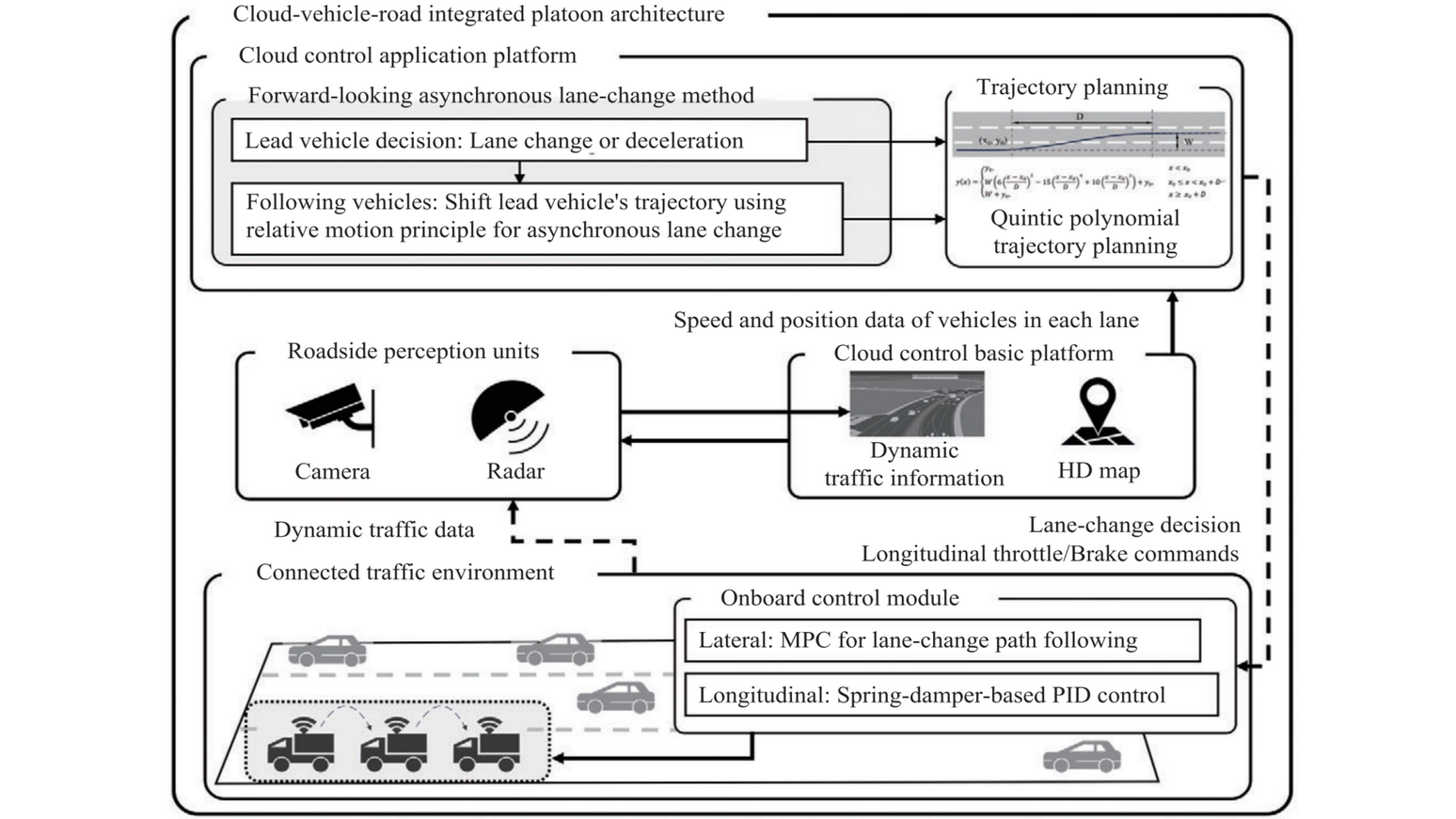
Traffic congestion and safety concerns pose major challenges in dense urban and highway networks, while vehicle platooning offers a promising solution by coordinating movements, reducing aerodynamic drag, and optimizing road utilization to enhance traffic efficiency and safety. Most existing multi-vehicle cooperative lane-change methods adopt a synchronous lane-change strategy, which could result in speed fluctuations and potential safety risks in dense traffic. To address these issues, this study proposes a forward-looking sequential asynchronous lane-change strategy, which dynamically computes the forward shift of vehicle trajectories using relative motion theory. Each following vehicle shifts its predecessor's trajectory forward by a calculated distance, ensuring lane changes occur precisely when the time headway (THW) to the preceding traffic vehicle (PTV) reaches a predefined threshold. Additionally, a spring-damper-based physical model is integrated to regulate longitudinal spacing, ensuring stable vehicle following dynamics. The proposed method is validated in CARLA simulations across various traffic densities, ranging from 2.5 to 10 veh/km/lane. Results show that it consistently outperforms the baseline synchronous strategy in lane travel time, speed fluctuation rate, and THW improvement. The best performance is observed at 5 veh/km/lane, where the proposed method reduces lane travel time by 7.5%, decreases speed fluctuation by 47.0%, and increases THW between the last platoon vehicle and the following traffic vehicle by 3.37 s compared to the baseline. These findings suggest that the proposed strategy could be a foundation for future advancements in cooperative driving, enabling more adaptive and resilient lane-changing behaviors in a cloud-vehicle-road integrated traffic environment.
KeyWords AITranslate
[1]Y. Huang, J. Du, Z. Yang, Z. Zhou, L. Zhang, and H. Chen, "A survey on trajectory-prediction methods for autonomous driving," IEEE Transactions on Intelligent Vehicles, vol. 7, no. 3, pp. 652–674, 2022.
[2]E. Lefeber, J. Ploeg, and H. Nijmeijer, "A spatial approach to control of platooning vehicles: Separating path-following from tracking," IFAC-PapersOnLine, vol. 50, no. 1, pp. 15000–15005, 2017
[3]Y. Zheng, S. E. Li, J. Wang, D. Cao, and K. Li, "Stability and scalability of homogeneous vehicular platoon: Study on the influence of information flow topologies," IEEE Transactions on intelligent transportation systems, vol. 17, no. 1, pp. 14–26, 2015.
[4]J. Hu, H. Wang, X. Li, and X. Li, "Modelling merging behavior joining a cooperative adaptive cruise control platoon," IET Intelligent Transport Systems, vol. 14, no. 7, pp. 693–701, 2020.
[5]S. Feng, Y. Zhang, S. E. Li, Z. Cao, H. X. Liu, and L. Li, "String stability for vehicular platoon control: Definitions and analysis methods," Annual Reviews in Control, vol. 47, pp. 81–97, 2019.
[6]J. Axelsson, "Safety in vehicle platooning: A systematic literature review," IEEE Transactions on Intelligent Transportation Systems, vol. 18, no. 5, pp. 1033–1045, 2017.
[7]J. Ni, J. Han, and F. Dong, "Multivehicle cooperative lane change control strategy for intelligent connected vehicle," Journal of Advanced Transportation, vol. 2020, pp. 1–10, 2020.
[8]J. Ossig, S. Cramer, A. Eckl, and K. Bengler, "Tactical decisions for lane changes or lane following: Assessment of automated driving styles under real-world conditions," IEEE Transactions on Intelligent Vehicles, vol. 8, no. 1, pp. 502–511, 2022.
[9]J. Hu, Y. Zhang, and S. Rakheja, "Adaptive lane change trajectory planning scheme for autonomous vehicles under various road frictions and vehicle speeds," IEEE Transactions on Intelligent Vehicles, vol. 8, no. 2, pp. 1252–1265, 2022.
[10]J. Wan, H. Liu, M. Xu, X. Yang, Y. Guo, and X. Wang, "Lane-changing tracking control of automated vehicle platoon based on MA-DDPG and adaptive MPC," IEEE Access, vol. 12, pp. 58078–58096, 2024
[11]G. Nie, B. Xie, H. Lu, and Y. Tian, "A cooperative lane change approach for heterogeneous platoons under different communication topologies," IEEE Transactions on Intelligent Transportation Systems, vol. 16, no. 1, pp. 53–70, 2022.
[12]D. Liu and G. -H. Yang, "Data-driven adaptive sliding mode control of nonlinear discrete-time systems with prescribed performance," IEEE Transactions on Systems, Man, and Cybernetics: Systems, vol. 49, no. 12, pp. 2598–2604, 2019.
[13]J. Xu, J. Zhang, R. Zhang, and T. Shen, "String stability guaranteed lane change maneuver for automated vehicles with vehicle-to-vehicle communication," IFAC-PapersOnLine, vol. 54, no. 10, pp. 330–335, 2021.
[14]S. Tsugawa, S. Kato, and K. Aoki, "An automated truck platoon for energy saving,"2011 IEEE/RSJ International Conference on Intelligent Robots and Systems, San Francisco, CA, USA, 25–30 September, 2011, pp. 4109–4114.
[15]H. C. -H. Hsu and A. Liu, "Kinematic design for platoon-lane-change maneuvers," IEEE Transactions on Intelligent Transportation Systems, vol. 9, no. 1, pp. 185–190, 2008.
[16]A. Falsone, B. Melani, and M. Prandini, "Lane change in automated driving: An explicit coordination strategy," The IEEE Control Systems Letters, vol. 7, pp. 205–210, 2023.
[17]J. E. Naranjo, C. Gonzalez, R. Garcia, and T. de Pedro, "Lane-change fuzzy control in autonomous vehicles for the overtaking maneuver," IEEE Transactions on Intelligent Transportation Systems (T-ITS), vol. 9, no. 3, pp. 438–450, 2008.
[18]M. Li, Z. Li, Y. Zhou, and J. Wu, "A cooperative energy efficient truck platoon lane-changing model preventing platoon decoupling in a mixed traffic environment," Journal of Intelligent Transportation Systems, vol. 28, pp. 1–15, 2022.
[19]Y. Ma, Q. Liu, J. Fu, K. Liufu, and Q. Li, "Collision-avoidance lane change control method for enhancing safety for connected vehicle platoon in the mixed traffic environment," Accident Analysis & Prevention, vol. 184, p. 106999, 2023.
[20]H. Wang, J. Hu, and Y. Feng, "Enhancing truck platooning mobility by cutting through traffic like a snake: Methodology and field test analysis,"2024 IEEE Intelligent Vehicles Symposium (IV), Jeju Island, Korea, Republic of, 02–05 June 2024, pp. 2277–2282.
[21]H. Wang, W. Hao, J. So, Z. Chen, and J. Hu, "A faster cooperative lane change controller enabled by formulating in spatial domain," IEEE Transactions on Intelligent Vehicles, vol. 8, no. 12, pp. 4685–4695, 2023.
[22]H. Wang, J. Lai, X. Zhang, Y. Zhou, S. Li, and J. Hu, "Make space to change lane: A cooperative adaptive cruise control lane change controller," Transportation Research Part C: Emerging Technologies, vol. 143, p. 103847, 2022.
[23]X. Duan, C. Sun, D. Tian, J. Zhou, and D. Cao, "Cooperative lane-change motion planning for connected and automated vehicle platoons in multi-lane scenarios," IEEE Transactions on Intelligent Transportation Systems, vol. 24, no. 7, pp. 7073–7091, 2023.
[24]K. Li, J. Li, X. Chang, B. Gao, and J. Pan, "Principle and typical application of cloud control system for intelligent networked vehicles," Journal of Automotive Safety and Energy Conservation, vol. 11, no. 3, pp. 261–275, 2020.
[25]K. Li, X. Chang, J. Li, Q. Xu, B. Gao, and J. Pan, "Cloud control system for intelligent and connected vehicles and its application," Automotive Engineering, vol. 42, no. 12, pp. 1595–1605, 2020.
[26]P. Sun, Y. Wang, P. He, X. Pei, M. Yang, K. Jiang, and D. Yang, "GCD-L: A novel method for geometric change detection in HD maps using low-cost sensors," Automotive Innovation, vol. 5, pp. 1–9, 2022.
[27]Y. Luo, Y. Xiang, K. Cao, and K. Li, "A dynamic automated lane change maneuver based on vehicle-to-vehicle communication," Transportation Research Part C: Emerging Technologies, vol. 62, pp. 87–102, 2016.
[28]L. Chu, J. Wang, Z. Cao, Y. Zhang, and C. Guo, "A human-like free-lane-change trajectory planning and control method with data-based behavior decision," IEEE Access, vol. 11, pp. 121052–121063, 2023.
[29]A. Mirbakhsh, J. Lee, and D. Besenski, "A spring-mass-damper-based platooning logic for automated vehicles," arXiv preprint arXiv:2209.00174, 2022.
[30]S. Xie, J. Hu, Z. Ding, and F. Arvin, "Cooperative adaptive cruise control for connected autonomous vehicles using spring damping energy model," IEEE Transactions on Vehicular Technology, vol. 72, no. 3, pp. 2974–2987, 2023.
[31]J. Ploeg, B. T. M. Scheepers, E. van Nunen, N. van de Wouw and H. Nijmeijer, "Design and experimental evaluation of cooperative adaptive cruise control,"14th International IEEE Conference on Intelligent Transportation Systems (ITSC), pp. 260–265, 2011.
Basic Information:
DOI:10.23919/CHAIN.2025.000007
Chinese Library Classification Number:
Citation Information:
Traffic congestion and safety concerns pose major challenges in dense urban and highway networks, while vehicle platooning offers a promising solution by coordinating movements, reducing aerodynamic drag, and optimizing road utilization to enhance traffic efficiency and safety. Most existing multi-vehicle cooperative lane-change methods adopt a synchronous lane-change strategy, which could result in speed fluctuations and potential safety risks in dense traffic. To address these issues, this study proposes a forward-looking sequential asynchronous lane-change strategy, which dynamically computes the forward shift of vehicle trajectories using relative motion theory. Each following vehicle shifts its predecessor's trajectory forward by a calculated distance, ensuring lane changes occur precisely when the time headway (THW) to the preceding traffic vehicle (PTV) reaches a predefined threshold. Additionally, a spring-damper-based physical model is integrated to regulate longitudinal spacing, ensuring stable vehicle following dynamics. The proposed method is validated in CARLA simulations across various traffic densities, ranging from 2.5 to 10 veh/km/lane. Results show that it consistently outperforms the baseline synchronous strategy in lane travel time, speed fluctuation rate, and THW improvement. The best performance is observed at 5 veh/km/lane, where the proposed method reduces lane travel time by 7.5%, decreases speed fluctuation by 47.0%, and increases THW between the last platoon vehicle and the following traffic vehicle by 3.37 s compared to the baseline. These findings suggest that the proposed strategy could be a foundation for future advancements in cooperative driving, enabling more adaptive and resilient lane-changing behaviors in a cloud-vehicle-road integrated traffic environment.
quote
| GB/T 7714-2015 | [1] Jingrui Huang, Keke Wan, Jing Chen, et al. A forward-looking sequential asynchronous lane-change strategy for vehicle platoon under cloud-vehicle-road integrated architecture[J]. Chain, 2025, 2(1): 43-56. DOI:10.23919/CHAIN.2025.000007. |
| MLA | [1] Jingrui Huang, et al., "A forward-looking sequential asynchronous lane-change strategy for vehicle platoon under cloud-vehicle-road integrated architecture." Chain, vol. 2, no. 1, 2025, pp. 43-56, https://doi.org/10.23919/CHAIN.2025.000007. |
| APA | [1] Jingrui Huang, Keke Wan, Jing Chen, Ji Zhou, Wei Zhong, & Bolin Gao. (2025). A forward-looking sequential asynchronous lane-change strategy for vehicle platoon under cloud-vehicle-road integrated architecture. Chain, 2(1), 43-56. https://doi.org/10.23919/CHAIN.2025.000007 |
| IEEE | [1] Jingrui Huang, Keke Wan, Jing Chen, Ji Zhou, Wei Zhong, and Bolin Gao, "A forward-looking sequential asynchronous lane-change strategy for vehicle platoon under cloud-vehicle-road integrated architecture," Chain, vol. 2, no. 1, pp. 43-56, 2025, doi: 10.23919/CHAIN.2025.000007. keywords: {asynchronous lane-change;vehicle platooning;intelligent connected vehicles (ICVs);spring-damper model;cloud-vehicle-road integrated architecture} |