ContentsFigures & Tables
With the rapid advancement of intelligent connected vehicles (ICVs) and autonomous driving technologies, vehicle platooning has garnered increasing attention [1, 2]. By enabling reduced inter-vehicle distances, platooning effectively shortens the overall convoy length, significantly lowering road space occupancy, improving traffic throughput, and alleviating congestion [3–6]. In intelligent driving and vehicle-road cooperative environments, platoon lane-changing behavior plays a critical role in optimizing traffic flow efficiency and ensuring driving safety [7]. A well-designed lane-change strategy can enhance road capacity and alleviate congestion, whereas improper lane-changing maneuvers may introduce collision risks and traffic disturbances [8, 9].
Most existing cooperative lane-change algorithms adopt a synchronous lane-change strategy, where a group of vehicles simultaneously executes a lane-change maneuver [10–13]. While this approach minimizes individual driving conflicts and enhances overall platoon efficiency in low-density traffic, it becomes problematic in high-density scenarios [14, 15]. Due to the challenge of finding sufficiently large lane-change gaps for an entire platoon, vehicles may be forced into abrupt braking or acceleration to avoid collisions with surrounding traffic, resulting in severe speed fluctuations and even new traffic bottlenecks [16, 17]. Moreover, synchronous lane-changing requires highly precise coordination between the platoon and its surrounding vehicles, reducing its adaptability to dynamic environments where unexpected obstacles or vehicles may suddenly appear [18].
To address these challenges, asynchronous lane-changing has emerged as a promising alternative. Several studies have explored asynchronous lane-changing in various contexts. Ma et al. [19] proposed a collision-avoidance lane-change control method for mixed traffic environments, leveraging multi-sensor fusion with a finite state machine (FSM) decision framework to enable autonomous lane-changing for following vehicles. Wang et al. [20–22] developed a snake-like lane-changing controller for truck platooning, employing a semi-trailer dynamic model and a spatial-domain trajectory planning algorithm to enhance platoon mobility. Duan et al. [23] further introduced an optimal control framework for cooperative lane-change motion planning in multi-lane scenarios, incorporating platoon reconfiguration and shape maintenance to improve adaptability. Their approach formulates collision avoidance constraints and optimizes lane-change execution using a weighted cost function that minimizes lane-change time and motion energy. Unlike synchronous approaches, asynchronous lane-changing staggers the lane-change timing across multiple vehicles, allowing each to dynamically adjust its maneuver based on the preceding vehicle's movement and available road space. This reduces mutual interference and enhances maneuver flexibility.
While current studies have provided valuable insights into asynchronous lane-change control in specific scenarios, such as mixed traffic conditions, heavy-duty vehicle platooning, and cooperative motion planning for connected and automated vehicle (CAV) platoons, there remains a need for a more generalized cooperative lane-change strategy applicable to intelligent connected vehicle platoons under diverse traffic conditions. Developing an effective asynchronous lane-change strategy requires addressing several key challenges:
(1) Determining appropriate lane-change initiation timing and intervals to ensure cohesive platoon coordination while avoiding excessive disruptions to traffic flow.
(2) Designing robust trajectory planning and speed control mechanisms to maintain platoon stability and reduce the risks of abrupt braking or potential collisions.
To contribute to this research area, this study introduces a forward-looking sequential asynchronous lane-change strategy to overcome the limitations of existing strategies. The proposed method leverages a cloud-vehicle-road integrated platoon architecture to facilitate real-time information sharing, equipping each vehicle with global environmental perception. Based on this global information, a relative-motion-based lane-change trajectory planning algorithm is designed, ensuring that each vehicle in the platoon initiates its lane-change maneuver sequentially when a predefined time headway (THW) condition is met. To maintain longitudinal platoon stability during lane changes, a spring-damper-based physical model is employed, where inter-vehicle distance adjustments are formulated as a spring-damping process, mitigating speed fluctuations and maintaining platoon cohesion.
The main contributions of this work are summarized as follows:
(1) Development of an intelligent lane-change decision-making architecture based on cloud-vehicle-road integration, enabling real-time vehicle state sharing (e.g., speed, position) to support globally optimized lane-change decisions.
(2) Proposal of a forward-looking, dynamic sequential asynchronous lane-change decision-making method, which leverages relative motion principles and a unified time headway condition to ensure smooth, continuous, and safe multi-vehicle lane changes.
(3) Introduction of a spring-damper-based longitudinal spacing control strategy to improve platoon stability during lane changes, mitigating acceleration/deceleration disturbances and reducing rear-end collision risks.
The remainder of this paper is structured as follows. Section 2 introduces the proposed methodology, including the cloud-vehicle-road integrated platoon architecture, the relative-motion-based trajectory planning method, and the spring-damper-based longitudinal spacing control strategy. Section 3 details the experimental setup, covering the simulation environment, evaluation metrics, and baseline algorithm used for comparison. Section 4 presents a comprehensive analysis of the experimental results, with a focus on traffic efficiency, driving smoothness, and safety performance. Finally, Section 5 summarizes the key findings and outlines potential directions for future research.
In a cloud-vehicle-road integrated architecture, vehicles continuously transmit real-time state information, including speed and position, via roadside infrastructure to the cloud. The cloud server aggregates, processes, and distributes the refined global traffic data to relevant vehicles [24, 25]. Moreover, recent advances in crowdsourced lane geometry detection enable real-time identification of multi-lane spatial constraints, further providing critical inputs for platoon-level trajectory coordination [26].
While cloud-vehicle-road integrated architectures provide a fundamental framework for intelligent traffic management, their application to multi-vehicle cooperative lane-changing remains underdeveloped. Most existing implementations focus on individual vehicle decision-making or synchronous lane-change strategies, which require a large and simultaneous lane-change gap for the entire platoon. However, such strategies are prone to traffic disruptions and are unsuitable for dense traffic scenarios. Moreover, conventional methods rely solely on onboard sensors, limiting their ability to anticipate lane-change opportunities in advance.
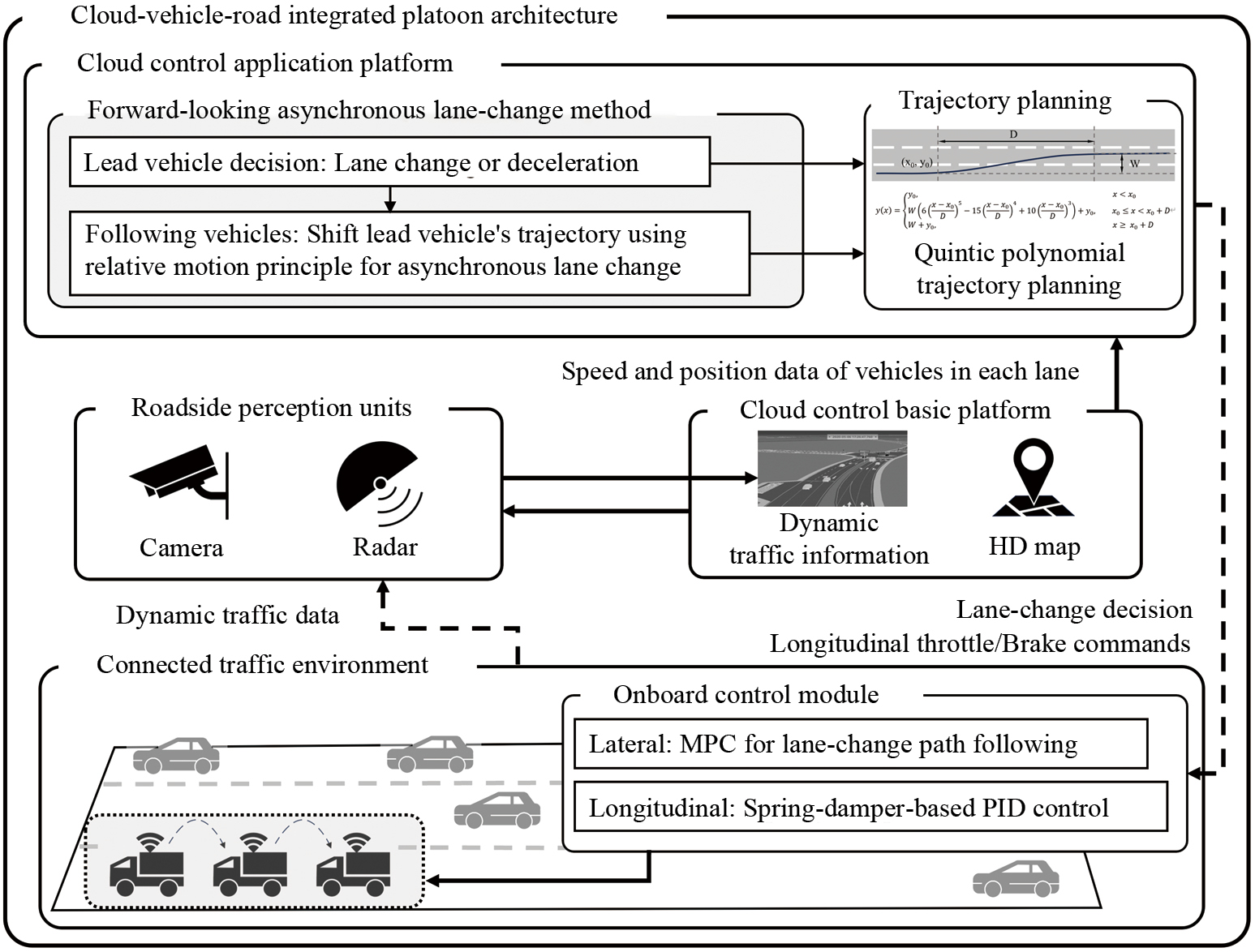
To overcome these limitations, this study develops a cloud-vehicle-road integrated platoon architecture, as depicted in Fig. 1. The proposed system integrates three key components—roadside perception units, a cloud control platform, and onboard communication terminals—to establish a closed-loop control mechanism. This architecture enables real-time traffic perception, cloud-based decision-making, and coordinated vehicle control through structured data flow, which is described as follows.
The roadside perception units, comprising millimeter-wave radar and cameras, monitor mixed traffic flow, including connected and conventional vehicles. Radar primarily detects vehicle velocities and inter-vehicle distances, while cameras provide lane-level positioning and object classification. The collected dynamic traffic data is transmitted via fiber-optic communication to the cloud control basic platform for fusion and processing.
In addition, the cloud control basic platform provides high-definition (HD) maps to assist roadside perception units in vehicle classification and lane-level perception, ensuring accurate identification of vehicles in each lane. By integrating data from multiple sensors, the cloud system constructs a comprehensive and dynamic traffic model that serves as the foundation for cooperative platoon control.
The cloud control basic platform integrates HD maps and real-time traffic data to construct a global traffic model, enhancing vehicle classification and lane-level perception. This processed data is then sent to the cloud control application platform, which executes the proposed forward-looking asynchronous lane-change strategy. The decision-making process follows these key steps:
(1) Lead vehicle decision: The lead vehicle dynamically determines whether to initiate a lane change or adjust its speed based on the time headway to the preceding traffic vehicle in the current lane and the surrounding traffic conditions. If the THW exceeds a predefined threshold and the maneuver meets safety constraints, a lane-change decision is executed. For brevity, the preceding traffic vehicle is hereafter referred to as preceding traffic vehicle (PTV).
(2) Following vehicle response: Once the lead vehicle initiates the lane-change process, each following vehicle adjusts its trajectory by shifting the starting point of the lead vehicle's trajectory forward by a dynamically computed shift distance. This shift distance is determined in real time based on the speed differential between vehicles, ensuring that each vehicle maintains a constant THW with the PTV upon entering the lane-change process. The detailed computation of the shift distance is presented in Section 2.2. Finally, a quintic polynomial trajectory is planned to achieve smooth lane change maneuvers.
Once the cloud control application platform completes decision-making and trajectory planning, it transmits lane-change commands and longitudinal acceleration control data to the intelligent connected vehicle platoon via V2X communication. The onboard communication terminals receive and interpret the cloud-based decisions, providing inputs for vehicle-level control execution. Each vehicle executes the lane-change maneuver through an onboard control module, which consists of:
(1) Lateral control: model predictive control (MPC) ensures smooth lane-change trajectory following.
(2) Longitudinal control: a spring-damper-based PID controller regulates inter-vehicle distances to maintain platoon stability.
This architecture allows the following vehicles to obtain motion state information for all surrounding vehicles, surpassing the limited perception range of onboard sensors. Moreover, when the lead vehicle initiates a lane change or deceleration, the following vehicles receive advance notifications, enabling proactive maneuvering. In this study's scenario, each vehicle in the platoon acquires real-time position and velocity data of all vehicles on the roadway through the cloud, providing enhanced situational perception and forward-looking traffic insights.
The information-sharing mechanism serves as the foundation for asynchronous lane-change decision-making. By leveraging global traffic information, vehicles can anticipate lane-change opportunities in advance, mitigating the limitations of onboard sensor perception and the delays associated with independent decision-making.
Leveraging the acquired global traffic data, this study develops a relative-motion-based lane-change trajectory planning method. The lane-change trigger condition is defined as follows: each vehicle in the platoon initiates a lane change sequentially when the time headway to the PTV reaches a predefined threshold.
On highways, vehicles in a steady-state condition can be approximated as moving at a constant velocity. As the platoon progresses, the lead vehicle detects a PTV ahead and determines whether a safe lane-change window is available. Specifically, it verifies whether the lead vehicle can maintain a safe THW with both the preceding and following vehicles in the target lane. If the safety condition is not met, the lead vehicle decelerates to match the speed of the PTV. Otherwise, when the THW between the lead vehicle and the PTV in the current lane reaches the safe lane-change THW, the lane-change trajectory is planned and executed.
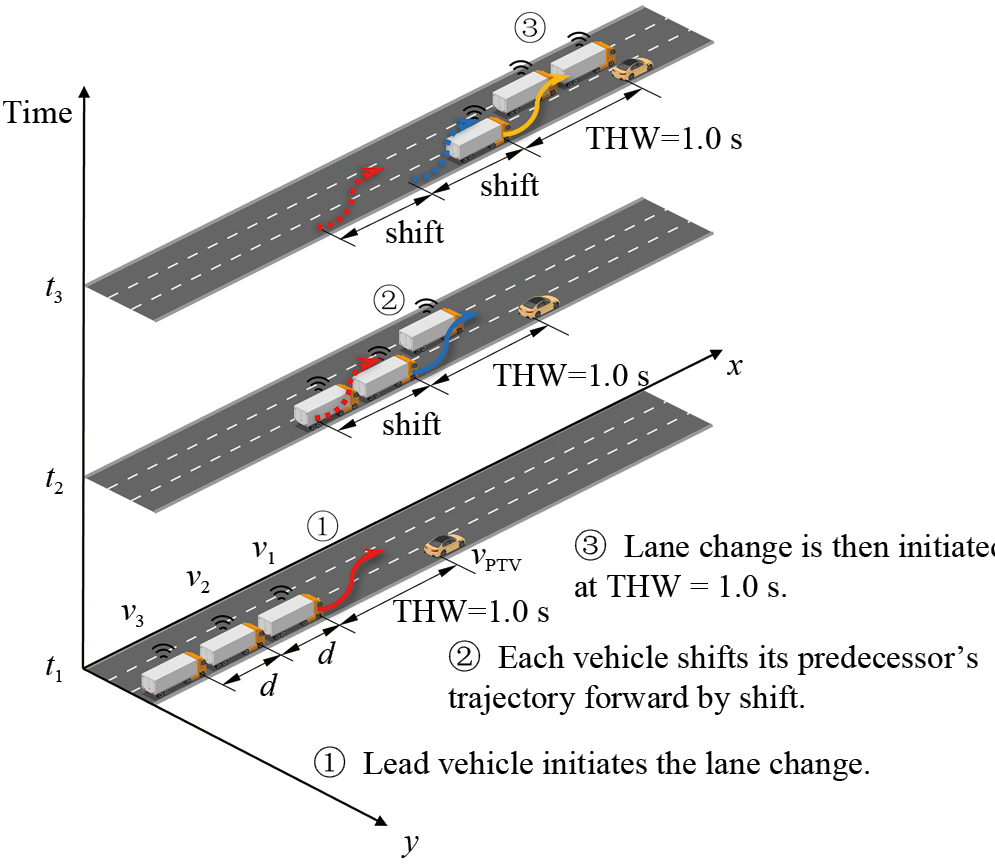
Once the lead vehicle initiates the lane-change maneuver, each following vehicle shifts the global trajectory of its preceding vehicle forward by a fixed shift distance and adopts it as its own lane-change trajectory. This ensures that all vehicles in the platoon initiate lane changes at the same THW relative to the PTV, achieving a sequential asynchronous lane-change process. This process is illustrated in Fig. 2.
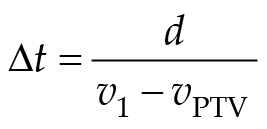
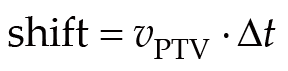
From the perspective of the PTV, the lane-change sequence follows a time-dependent shift mechanism. Taking the moment when the lead vehicle initiates the lane change as the starting point, the time required for the second vehicle to reach the same relative position as the original lead vehicle is given by Eq. (1):(1)where d represents the inter-vehicle spacing, v1 is the speed of the lead vehicle, and vPTV is the speed of the PTV. The shift distance is then calculated as Eq. (2):(2)
This fixed THW-triggered lane-change strategy ensures that vehicles enter the lane-change process in a consistent time sequence, avoiding conflicts caused by simultaneous lane changes. By carefully selecting the THW value, each vehicle maintains a safe time gap from the PTV, ensuring adequate reaction time for a safe and smooth lane change.
Building on the lane-change triggering mechanism, this study further establishes a mathematical model for lane-change trajectory planning. The objective is to generate a smooth lateral transition trajectory for each vehicle, ensuring a safe transition from the original lane to the target lane within a predefined duration while maintaining coordinated motion relative to adjacent vehicles.
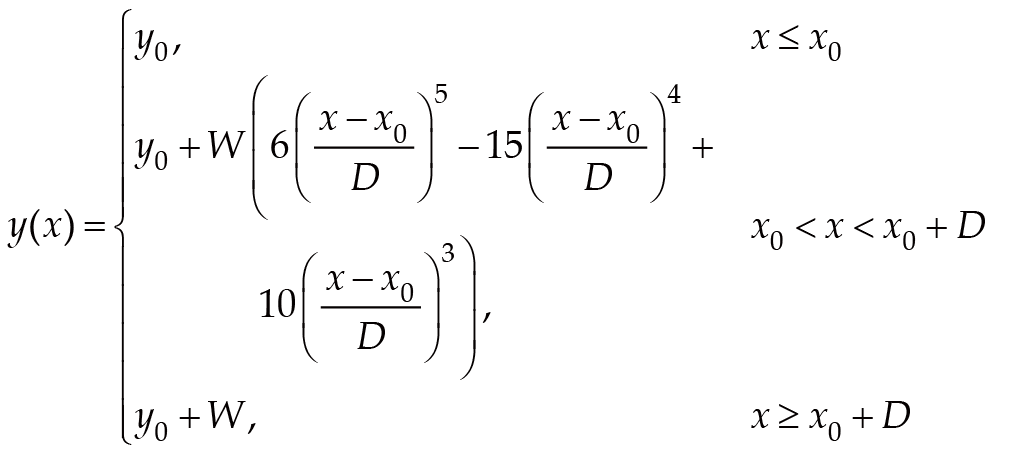
Considering that the centerlines of two adjacent lanes are separated by a fixed lane width W, each vehicle follows a quintic polynomial trajectory once the lane-change maneuver is triggered. The longitudinal travel distance is defined as D, while the lateral displacement corresponds to the lane width W. The lane-change trajectory is formulated as Eq. (3):(3)where x0 and y0 denote the starting position of the lane change, D=72 m represents the longitudinal lane-change distance, and W=3.5 m corresponds to the lateral lane width.
The quintic polynomial trajectory ensures a smooth lane-change process, eliminating abrupt acceleration changes that may induce passenger discomfort while satisfying lateral motion dynamic constraints [27, 28]. Simulation results demonstrate that this trajectory planning method enables a continuous and seamless lane-change transition, allowing platoon vehicles to complete their maneuvers under THW control in a sequential manner.
In summary, to ensure coordinated motion among vehicles undergoing lane changes, this study adjusts the trajectory of following vehicles based on the relative motion of the lead vehicle. When the lead vehicle initiates a lane change, each following vehicle references the trajectory of its preceding vehicle while incorporating real-time traffic conditions, including relative position and velocity, to shift its trajectory longitudinally. This adjustment enables vehicles to utilize the space vacated by their predecessors, ensuring a smooth and safe lane-change process.
By employing this relative-motion-based trajectory planning approach, the lane-change trajectories of cooperative vehicles form a spatially and temporally coherent sequence. The three vehicles in the platoon perform lane changes successively at different time intervals, with their lane-change trajectories aligned in parallel and shifted sequentially, ensuring both continuity and safety. Simulation results validate the effectiveness of the proposed trajectory planning strategy, demonstrating that vehicles initiate lane changes at the prescribed THW intervals, avoiding abrupt braking or acceleration and maintaining a stable and cohesive platoon operation.
To ensure stable longitudinal spacing within the platoon during lane-change maneuvers, this study employs a spring-damper-based car-following control model inspired by classical control theory [29, 30]. In this model, each following vehicle is modeled as a mass connected to its preceding vehicle via an equivalent spring-damper system, where only the preceding vehicle influences the following vehicle's motion.
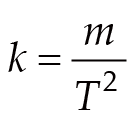
The equivalent spring stiffness coefficient k characterizes the rigidity of the desired inter-vehicle spacing. When the actual inter-vehicle distance exceeds the desired spacing, the following vehicle accelerates to close the gap. Conversely, if the gap becomes too small, the following vehicle decelerates to restore the desired spacing. The damping coefficient c is introduced to suppress relative motion oscillations. If the speed of the following vehicle deviates from that of the preceding vehicle, the damping force, proportional to the velocity difference, prevents excessive oscillations and stabilizes the inter-vehicle spacing.
According to second-order system dynamics (Fig. 3), given an oscillation period T, the equivalent spring stiffness is determined as Eq. (4):(4)
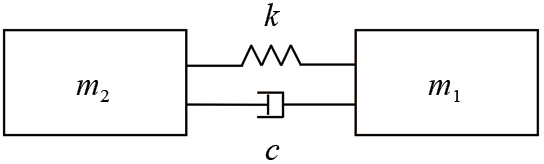
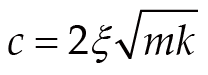
The critical damping ratio (ξ = 1) is ideal in theory. However, sensor delays and actuator lags in real-world vehicle control systems often cause response lag, making such systems prone to overshoot. This study addresses autonomous vehicle platooning with a 3-meter inter-vehicle gap, where even slight overshoot may result in dangerously close spacing or collisions. To ensure stable, non-oscillatory convergence, a damping ratio greater than one (ξ > 1) is required. After tuning and testing, ξ = 2 was selected as it effectively balances overshoot suppression and response time. Based on the relationship between the damping ratio and spring-damper system parameters, the required damping coefficient is given by Eq. (5):(5)where m represents the vehicle mass. Once k and m are determined, the critical damping coefficient c can be calculated. In this study, the selected vehicle parameters are as follows: an equivalent vehicle mass of m=1500 kg, a spring stiffness coefficient of k=37 500 N/m, and a damping coefficient of c=30 000 N·s·m–1.
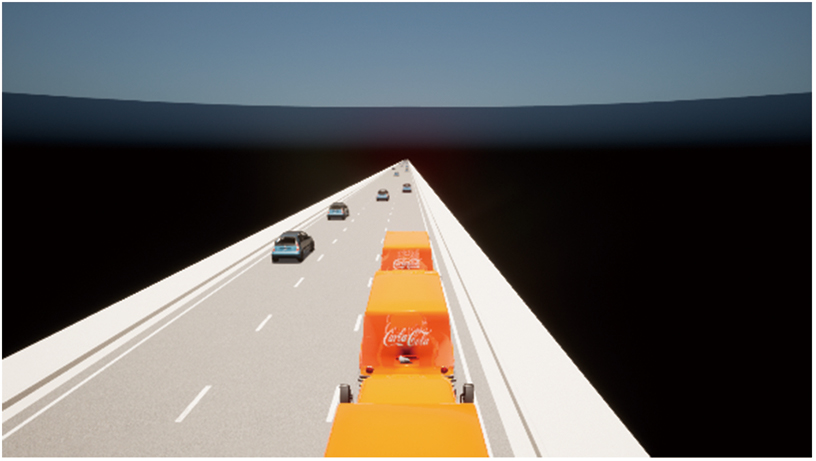
This study establishes a simulation environment using the open-source autonomous driving simulator CARLA 0.9.10, as is shown in Fig. 4. The experimental setup consists of a 1 km-long three-lane straight road, where multiple autonomous vehicles are deployed to simulate platoon lane-change scenarios.
All vehicles are equipped with idealized V2X communication interfaces, enabling information sharing within a cloud-vehicle-road integrated platoon architecture. Through CARLA's communication module, vehicles can exchange position and velocity data or receive global information from a centralized script functioning as the "cloud coordinator".
In the experiment, vehicles initially maintain uniform spacing along the main lane. A lane-change maneuver is triggered when a vehicle reaches the predefined time headway relative to the PTV. The traffic density is defined by the number of vehicles per kilometer per lane (veh/km/lane, hereafter abbreviated as veh/km/lane). To evaluate performance under different traffic densities, this study deploys varying numbers of vehicles per lane: 2.5 veh/km for sparse traffic, 5 veh/km and 7.5 veh/km for moderate traffic and 10 veh/km for congested traffic. All vehicles utilize identical vehicle dynamics models and controller parameters in the simulation to ensure consistency and fairness. The initial and target platoon velocity is set at 30 m/s, with an inter-vehicle gap of 3 m. To introduce heterogeneous surrounding traffic, randomly generated vehicles in the three lanes (from right to left) are assigned speeds of 20, 22, and 24 m/s, respectively. Each traffic scenario is independently simulated 10 times to reduce random variations, and the average results are reported.
To comprehensively assess the efficiency, stability, and safety of the proposed lane-change control strategy, the following key metrics are selected:
This metric quantifies the time required for a vehicle to traverse a 1 km test segment, serving as an indicator of traffic efficiency. A shorter travel time signifies a higher average speed, implying improved traffic flow. This study evaluates the average lane travel time of the entire platoon and compares performance across different control strategies.
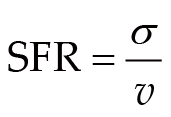
Speed fluctuation is quantified using the standard deviation of vehicle speed σ, which reflects the magnitude of acceleration and deceleration variations. A lower σ indicates smoother driving and better platoon stability. To facilitate comparison across different control strategies, the speed fluctuation rate (SFR) is calculated by Eq. (6):(6)where v is the mean vehicle speed, the SFR values of the three platoon vehicles are averaged for each test scenario to evaluate overall stability across different lane-change methods.
The safety performance of the proposed lane-change strategy is evaluated using two key indicators: inversed time to collision (TTC−1) of the lead vehicle and time headway of the last vehicle.
Time to collision (TTC) represents the estimated time before two vehicles would collide if their current trajectories remain unchanged. A higher TTC−1 indicates a shorter reaction time to a potential collision, reflecting a lower safety margin. In contrast, a lower TTC−1 value suggests that vehicles consistently maintain larger safety gaps, reducing collision risks. The mean TTC−1 value over the entire simulation is computed.
Similarly, THW measures the available time buffer before a rear-end interaction occurs between the last vehicle in the platoon and the following vehicle in the target lane. A higher THW indicates a larger safety gap, ensuring that the last vehicle can complete the lane change smoothly without impeding the following traffic. Unlike TTC−1, which captures critical collision risk moments, THW evaluates the sustained safety margin during lane changes. Smaller THW values in dense traffic may indicate a greater risk of forced braking and instability. The mean THW is recorded throughout the simulation period for different traffic densities and control strategies.
By combining TTC−1 and THW, this study provides a comprehensive safety assessment, considering both collision risk and platoon integration with surrounding traffic.
To assess the effectiveness of the proposed asynchronous lane-change decision-making method, this study compares it against a synchronous lane-change control strategy, which serves as the baseline. The synchronous lane-change strategy requires all vehicles within the platoon to execute a lane change simultaneously.
In the simulation setup, the synchronous control scheme is implemented as follows: when the lead vehicle reaches the designated lane-change trigger point, it immediately transmits a lane-change command to all vehicles in the platoon. Upon receiving the command, all vehicles initiate the lane-change maneuver simultaneously, following the predefined quintic polynomial trajectory detailed in Section 2.2. Unlike the proposed method, this baseline approach does not incorporate any staggered execution mechanism, meaning that all lane-change decisions rely solely on the lead vehicle's timing without utilizing global situational awareness.
In contrast, the proposed asynchronous lane-change method enables vehicles to leverage global traffic information and execute lane changes sequentially, with each vehicle initiating its maneuver according to a fixed time headway relative to the PTV.
Simulations are conducted under three traffic density scenarios—sparse (2.5 veh/km/lane), moderate (5 and 7.5 veh/km/lane), and congested (10 veh/km/lane)—for both control strategies. The key evaluation metrics—lane travel time, speed fluctuation rate, and inversed time to collision—are recorded and analyzed. The experiment primarily examines differences in traffic efficiency, driving smoothness, and safety performance between the two methods, as well as how changes in traffic density affect their relative effectiveness.
This section analyzes the experimental data to validate the effectiveness of the proposed forward-looking sequential asynchronous lane-change decision-making method and compares its performance against the synchronous lane-change method. The evaluation focuses on three key metrics: traffic efficiency, driving smoothness, and safety.
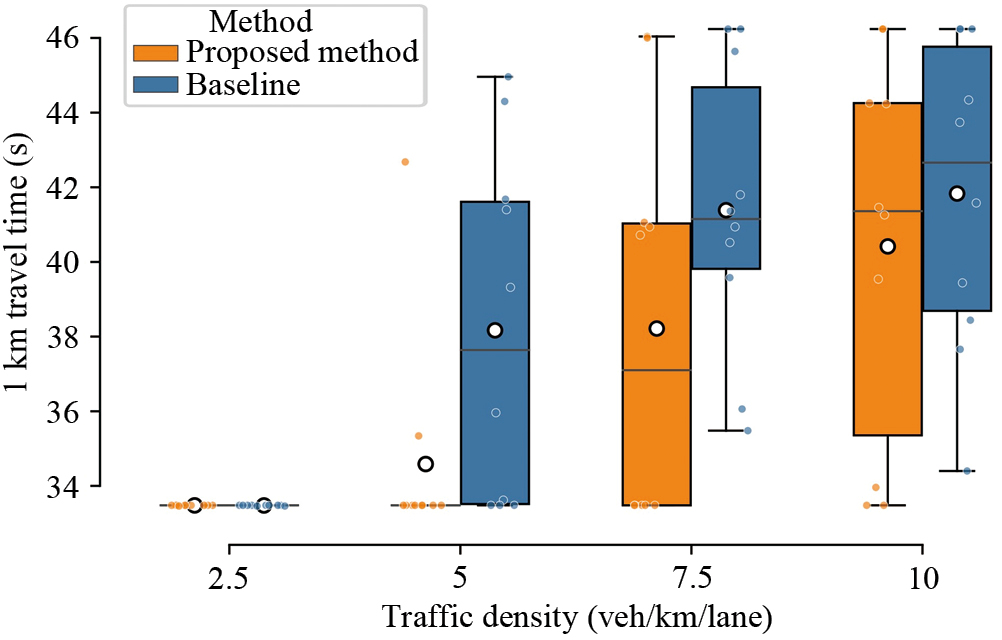
Traffic efficiency is assessed based on the average lane travel time over a 1 km test segment. The experiment evaluates lane travel time under different traffic densities for both the proposed and baseline synchronous lane-change methods. The results are summarized in Table 1 and Fig. 5.
The results indicate that, except for the low-density case (2.5 veh/km/lane), where traffic remains uncongested, the proposed method consistently outperforms the baseline method in terms of lane travel efficiency across all tested traffic densities.
The proposed method achieves the most significant improvement at a traffic density of 5 veh/km/lane, reducing travel time by 7.5%. This improvement is primarily due to the inherent limitations of synchronous lane-change strategies in denser traffic conditions. When all vehicles change lanes simultaneously, a larger lane-change gap is required. However, such gaps are difficult to find in scenarios with higher traffic density, leading to traffic bottlenecks and frequent braking, which further disrupt traffic flow. In contrast, the proposed asynchronous lane-change strategy reduces the minimum required lane-change gap, allowing vehicles to individually identify feasible lane-change opportunities even in congested environments. This ability to navigate through limited gaps more effectively contributes to higher overall traffic efficiency and a smoother traffic flow.
When the traffic density continues to grow, the performance improvement does not continue to increase as traffic density grows further. The reason is as follows. Figure 5 indicates that at higher traffic densities (7.5 and 10 veh/km/lane), both the proposed method and the baseline method experience a significant decline in lane-change feasibility, which reveals that at excessive traffic densities, lane-change gaps become extremely scarce, making it difficult for either method to complete lane changes effectively. As a result, frequent deadlock situations occur, where vehicles remain stuck in their lanes, unable to find an opening for lane changes. Since neither method can complete lane changes when such highly congested conditions arise, which is often in high traffic density, the performance gap between the two narrows, and the advantages of the proposed method become less pronounced.
To assess driving smoothness, this study calculates the SFR of three vehicles during both the lane-change process and the entire driving sequence. Table 2 presents the SFR values for different traffic densities under both the proposed method and the baseline algorithm.
The results indicate that except for the low-density scenario, where traffic remains free-flowing, the proposed method consistently achieves lower speed fluctuations across all tested traffic densities compared to the baseline.
This demonstrates that the asynchronous lane-change strategy enables vehicles to utilize smaller lane-change gaps to complete the maneuver, facilitating efficient navigation through dense traffic. The improvement can be attributed to the reduction of velocity disturbance amplification typically observed in synchronous lane-change schemes. In the baseline method, multiple vehicles initiate lane changes simultaneously, causing abrupt speed changes that propagate upstream through the traffic flow. This upstream propagation of velocity disturbances forces following vehicles to brake sharply, thereby increasing speed fluctuations [31]. In contrast, the asynchronous strategy staggers the timing of lane changes among vehicles, effectively distributing the maneuver demand over both time and space. This distribution alleviates the temporal density gradient and limits the upstream transmission of disturbances. Consequently, the need for sudden acceleration or braking to avoid traffic obstructions is significantly reduced, leading to smoother driving behavior and enhanced platoon stability.
As traffic density increases, the improvement in driving smoothness achieved by the proposed method does not continue to scale proportionally. At higher traffic densities (7.5 and 10 veh/km/lane), both methods frequently encounter situations where vehicles must decelerate sharply and are unable to execute lane changes for prolonged periods. Although the proposed method experiences these instances less frequently, the overall high traffic density leads to more comparable SFR values across multiple test runs. As a result, while the proposed method consistently outperforms the baseline, its relative advantage in driving smoothness becomes less pronounced compared to the scenario with 5 veh/km/lane.
The safety performance of the proposed lane-change decision-making method is evaluated using two key safety metrics: (1) inversed time to collision for the leading vehicle relative to the PTV in the current lane, assessing potential forward collision risk; (2) time headway for the last vehicle relative to the reartraffic vehicle in the current lane, evaluating the gap sufficiency for safe merging during the lane-change process.
To evaluate safety across different traffic conditions, this study computes the average TTC−1 over the entire 1 km travel distance under both the proposed method and the baseline synchronous lane-change strategy for traffic densities of 2.5, 5, 7.5, and 10 veh/km per lane. The results are presented in Table 3.
The results indicate that across all tested scenarios, the average TTC–1 values for the proposed method remain consistently below 0.2, comparable to those of the baseline method. This suggests that vehicles maintain a sufficient safety distance throughout the lane-change process, with no occurrences of extreme risk conditions. Therefore, the proposed method does not introduce any significant safety disadvantages compared to the baseline approach.
The THW of the last vehicle represents the time available for the last vehicle in the platoon before it reaches the rear vehicle in the current lane after a lane change. A higher THW value indicates a safer and smoother merging process, minimizing the risk of abrupt braking or near-collision situations. Table 4 presents the average THW across different traffic densities.
The results show that the proposed method consistently maintains a higher THW than the baseline approach, particularly in moderate and high-density traffic scenarios.
For low traffic density (2.5 veh/km/lane), both the proposed and baseline methods execute lane changes without obstruction due to the availability of ample lane-change opportunities. Consequently, the observed THW improvement of 0.81 s in the proposed method is primarily attributed to the additional platoon length shift before merging rather than enhanced merging efficiency.
In moderate traffic density (5 veh/km/lane), the proposed method benefits from its ability to utilize smaller lane-change gaps, allowing for more frequent lane changes compared to the baseline. By switching to less congested lanes earlier, vehicles accelerate forward, gradually increasing their gap with the rear vehicle in the target lane. This effect results in the greatest observed THW improvement (3.37 s), as vehicles continue to gain separation over the simulation period.
For higher traffic densities (7.5 and 10 veh/km/lane), increased congestion leads to lane-change bottlenecks for both methods, reducing the overall number of executed lane changes and thereby limiting THW improvements. As a result, the THW values between the two methods converge. However, the proposed method consistently maintains a slight advantage, as it requires a smaller lane-change gap than the baseline method, enabling lane changes even in highly congested conditions. This suggests that the asynchronous lane-change strategy allows vehicles to merge more smoothly, reducing the likelihood of cutting in too closely in front of rear vehicles in the target lane.
To further illustrate the impact of the proposed method, Fig. 6 presents a comparative analysis of vehicle speed, TTC–1, and THW between the proposed method and the baseline under a traffic density of 5 veh/km/lane in their duration of traversing 1 km. The velocity profiles (top row) reveal that the proposed method maintains a more stable platoon speed, whereas the baseline method experiences gradual acceleration due to delayed lane-change execution. The TTC–1 plots (middle row) indicate that the proposed method maintains a consistently low risk of collision, demonstrating its effectiveness in ensuring safety. Additionally, the THW curves of the last vehicle (bottom row) further indicate that the proposed method results in a larger minimum THW, reducing the likelihood of abrupt braking or unsafe interactions with the rear vehicle in the target lane.
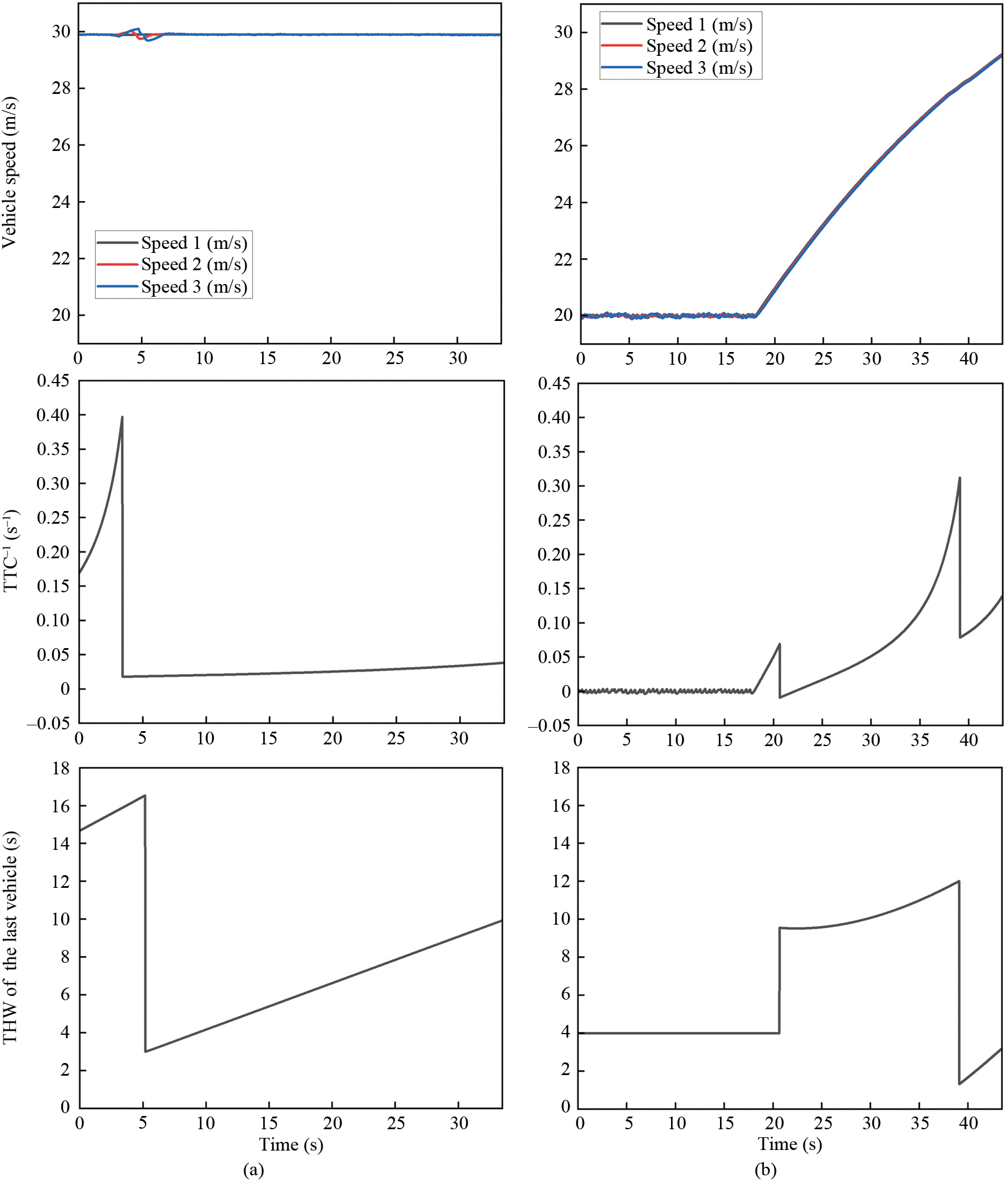
These results confirm that the proposed asynchronous lane-change strategy enhances traffic efficiency and contributes to smoother and safer lane-changing behavior, particularly in moderate-density traffic conditions.
In summary, the proposed forward-looking sequential asynchronous lane-change strategy demonstrates superior performance in terms of traffic efficiency and driving smoothness across all tested traffic densities. The most significant improvements are observed in the moderate-density scenario (5 veh/km/lane), where the method achieves optimal efficiency gains and stability enhancements. Additionally, the safety performance remains well within acceptable limits, indicating that the proposed approach can effectively enhance cooperative lane-change capabilities for intelligent connected vehicle platoons operating in complex traffic environments.
This study proposes a forward-looking sequential asynchronous lane-change strategy to enhance platoon lane-changing efficiency, smoothness, and safety. The key innovations include:
(1) Cloud-vehicle-road integrated platoon archi-tecture: A closed-loop system integrating roadside perception, cloud control, and onboard communication for real-time traffic perception and coordinated vehicle control. Unlike conventional architectures relying solely on onboard sensors or synchronous lane-changing, this system leverages HD maps, roadside sensing, and cloud-based trajectory planning to enhance lane-level perception and proactive maneuvering.
(2) Relative-motion-based trajectory planning: Each following vehicle dynamically shifts its trajectory based on relative position and velocity to the PTV, enabling adaptive lane changes while avoiding synchronization constraints.
(3) Spring-damper-based longitudinal control: A physics-based control model regulates inter-vehicle spacing, minimizing unnecessary acceleration and braking to enhance platoon stability during lane changes.
Simulation results confirm that the proposed method consistently outperforms the traditional synchronous lane-change strategy across all tested traffic densities. Specifically, under the optimal traffic density of 5 veh/km per lane:
(1) Traffic efficiency: Lane travel time decreases by 7.5%, enhancing maneuverability.
(2) Driving smoothness: Speed fluctuation is reduced by 47.0%, mitigating abrupt accelerations and braking.
(3) Safety enhancement: The THW between the last platoon vehicle and the following traffic vehicle increases by 3.37 s, ensuring safer merging and reducing rear-end risks.
These findings provide a new perspective on lane-change control for cooperative autonomous vehicle platoons and demonstrate the feasibility of the proposed strategy for improving lane-change coordination in intelligent transportation systems.
Future research will explore the method's feasibility and scalability. Although V2X-enabled, the method can be adapted to limited V2X infrastructure by integrating onboard perception (e.g., LiDAR, cameras, radar). Additionally, real-world vehicle experiments will be conducted to validate its robustness beyond simulations. Future work will also investigate the deployment density requirements of roadside units, the computational costs of cloud-based processing, and the limitations of V2X communication penetration. Furthermore, experiments will address the impact of communication latency on lane-change trigger timing and longitudinal control stability, enhancing the understanding of the trade-offs between communication delays and system performance.
This work was supported in part by the National Natural Science Foundation of China (No. 52172393), Science Fund for Creative Research Groups (No. 52221005), the National Key R&D Program of China (No. 2023YFB4301800) and Research and Development of Energy-efficient Driving Technology for Commercial Vehicle Platooning on Intelligent Highways with Vehicle-Road-Cloud Integration (No. 20242000385).
Y. Huang, J. Du, Z. Yang, Z. Zhou, L. Zhang, and H. Chen, "A survey on trajectory-prediction methods for autonomous driving," IEEE Transactions on Intelligent Vehicles, vol. 7, no. 3, pp. 652–674, 2022.
E. Lefeber, J. Ploeg, and H. Nijmeijer, "A spatial approach to control of platooning vehicles: Separating path-following from tracking," IFAC-PapersOnLine, vol. 50, no. 1, pp. 15000–15005, 2017
Y. Zheng, S. E. Li, J. Wang, D. Cao, and K. Li, "Stability and scalability of homogeneous vehicular platoon: Study on the influence of information flow topologies," IEEE Transactions on intelligent transportation systems, vol. 17, no. 1, pp. 14–26, 2015.
J. Hu, H. Wang, X. Li, and X. Li, "Modelling merging behavior joining a cooperative adaptive cruise control platoon," IET Intelligent Transport Systems, vol. 14, no. 7, pp. 693–701, 2020.
S. Feng, Y. Zhang, S. E. Li, Z. Cao, H. X. Liu, and L. Li, "String stability for vehicular platoon control: Definitions and analysis methods," Annual Reviews in Control, vol. 47, pp. 81–97, 2019.
J. Axelsson, "Safety in vehicle platooning: A systematic literature review," IEEE Transactions on Intelligent Transportation Systems, vol. 18, no. 5, pp. 1033–1045, 2017.
J. Ni, J. Han, and F. Dong, "Multivehicle cooperative lane change control strategy for intelligent connected vehicle," Journal of Advanced Transportation, vol. 2020, pp. 1–10, 2020.
J. Ossig, S. Cramer, A. Eckl, and K. Bengler, "Tactical decisions for lane changes or lane following: Assessment of automated driving styles under real-world conditions," IEEE Transactions on Intelligent Vehicles, vol. 8, no. 1, pp. 502–511, 2022.
J. Hu, Y. Zhang, and S. Rakheja, "Adaptive lane change trajectory planning scheme for autonomous vehicles under various road frictions and vehicle speeds," IEEE Transactions on Intelligent Vehicles, vol. 8, no. 2, pp. 1252–1265, 2022.
J. Wan, H. Liu, M. Xu, X. Yang, Y. Guo, and X. Wang, "Lane-changing tracking control of automated vehicle platoon based on MA-DDPG and adaptive MPC," IEEE Access, vol. 12, pp. 58078–58096, 2024
G. Nie, B. Xie, H. Lu, and Y. Tian, "A cooperative lane change approach for heterogeneous platoons under different communication topologies," IEEE Transactions on Intelligent Transportation Systems, vol. 16, no. 1, pp. 53–70, 2022.
D. Liu and G. -H. Yang, "Data-driven adaptive sliding mode control of nonlinear discrete-time systems with prescribed performance," IEEE Transactions on Systems, Man, and Cybernetics: Systems, vol. 49, no. 12, pp. 2598–2604, 2019.
J. Xu, J. Zhang, R. Zhang, and T. Shen, "String stability guaranteed lane change maneuver for automated vehicles with vehicle-to-vehicle communication," IFAC-PapersOnLine, vol. 54, no. 10, pp. 330–335, 2021.
S. Tsugawa, S. Kato, and K. Aoki, "An automated truck platoon for energy saving,"2011 IEEE/RSJ International Conference on Intelligent Robots and Systems, San Francisco, CA, USA, 25–30 September, 2011, pp. 4109–4114.
H. C. -H. Hsu and A. Liu, "Kinematic design for platoon-lane-change maneuvers," IEEE Transactions on Intelligent Transportation Systems, vol. 9, no. 1, pp. 185–190, 2008.
A. Falsone, B. Melani, and M. Prandini, "Lane change in automated driving: An explicit coordination strategy," The IEEE Control Systems Letters, vol. 7, pp. 205–210, 2023.
J. E. Naranjo, C. Gonzalez, R. Garcia, and T. de Pedro, "Lane-change fuzzy control in autonomous vehicles for the overtaking maneuver," IEEE Transactions on Intelligent Transportation Systems (T-ITS), vol. 9, no. 3, pp. 438–450, 2008.
M. Li, Z. Li, Y. Zhou, and J. Wu, "A cooperative energy efficient truck platoon lane-changing model preventing platoon decoupling in a mixed traffic environment," Journal of Intelligent Transportation Systems, vol. 28, pp. 1–15, 2022.
Y. Ma, Q. Liu, J. Fu, K. Liufu, and Q. Li, "Collision-avoidance lane change control method for enhancing safety for connected vehicle platoon in the mixed traffic environment," Accident Analysis & Prevention, vol. 184, p. 106999, 2023.
H. Wang, J. Hu, and Y. Feng, "Enhancing truck platooning mobility by cutting through traffic like a snake: Methodology and field test analysis,"2024 IEEE Intelligent Vehicles Symposium (IV), Jeju Island, Korea, Republic of, 02–05 June 2024, pp. 2277–2282.
H. Wang, W. Hao, J. So, Z. Chen, and J. Hu, "A faster cooperative lane change controller enabled by formulating in spatial domain," IEEE Transactions on Intelligent Vehicles, vol. 8, no. 12, pp. 4685–4695, 2023.
H. Wang, J. Lai, X. Zhang, Y. Zhou, S. Li, and J. Hu, "Make space to change lane: A cooperative adaptive cruise control lane change controller," Transportation Research Part C: Emerging Technologies, vol. 143, p. 103847, 2022.
X. Duan, C. Sun, D. Tian, J. Zhou, and D. Cao, "Cooperative lane-change motion planning for connected and automated vehicle platoons in multi-lane scenarios," IEEE Transactions on Intelligent Transportation Systems, vol. 24, no. 7, pp. 7073–7091, 2023.
K. Li, J. Li, X. Chang, B. Gao, and J. Pan, "Principle and typical application of cloud control system for intelligent networked vehicles," Journal of Automotive Safety and Energy Conservation, vol. 11, no. 3, pp. 261–275, 2020.
K. Li, X. Chang, J. Li, Q. Xu, B. Gao, and J. Pan, "Cloud control system for intelligent and connected vehicles and its application," Automotive Engineering, vol. 42, no. 12, pp. 1595–1605, 2020.
P. Sun, Y. Wang, P. He, X. Pei, M. Yang, K. Jiang, and D. Yang, "GCD-L: A novel method for geometric change detection in HD maps using low-cost sensors," Automotive Innovation, vol. 5, pp. 1–9, 2022.
Y. Luo, Y. Xiang, K. Cao, and K. Li, "A dynamic automated lane change maneuver based on vehicle-to-vehicle communication," Transportation Research Part C: Emerging Technologies, vol. 62, pp. 87–102, 2016.
L. Chu, J. Wang, Z. Cao, Y. Zhang, and C. Guo, "A human-like free-lane-change trajectory planning and control method with data-based behavior decision," IEEE Access, vol. 11, pp. 121052–121063, 2023.
A. Mirbakhsh, J. Lee, and D. Besenski, "A spring-mass-damper-based platooning logic for automated vehicles," arXiv preprint arXiv:2209.00174, 2022.
S. Xie, J. Hu, Z. Ding, and F. Arvin, "Cooperative adaptive cruise control for connected autonomous vehicles using spring damping energy model," IEEE Transactions on Vehicular Technology, vol. 72, no. 3, pp. 2974–2987, 2023.
 Top
Top