

A joint state and fault fusion estimation scheme for mobile robot localization with energy harvesting sensors AITranslate
Abstract AITranslate
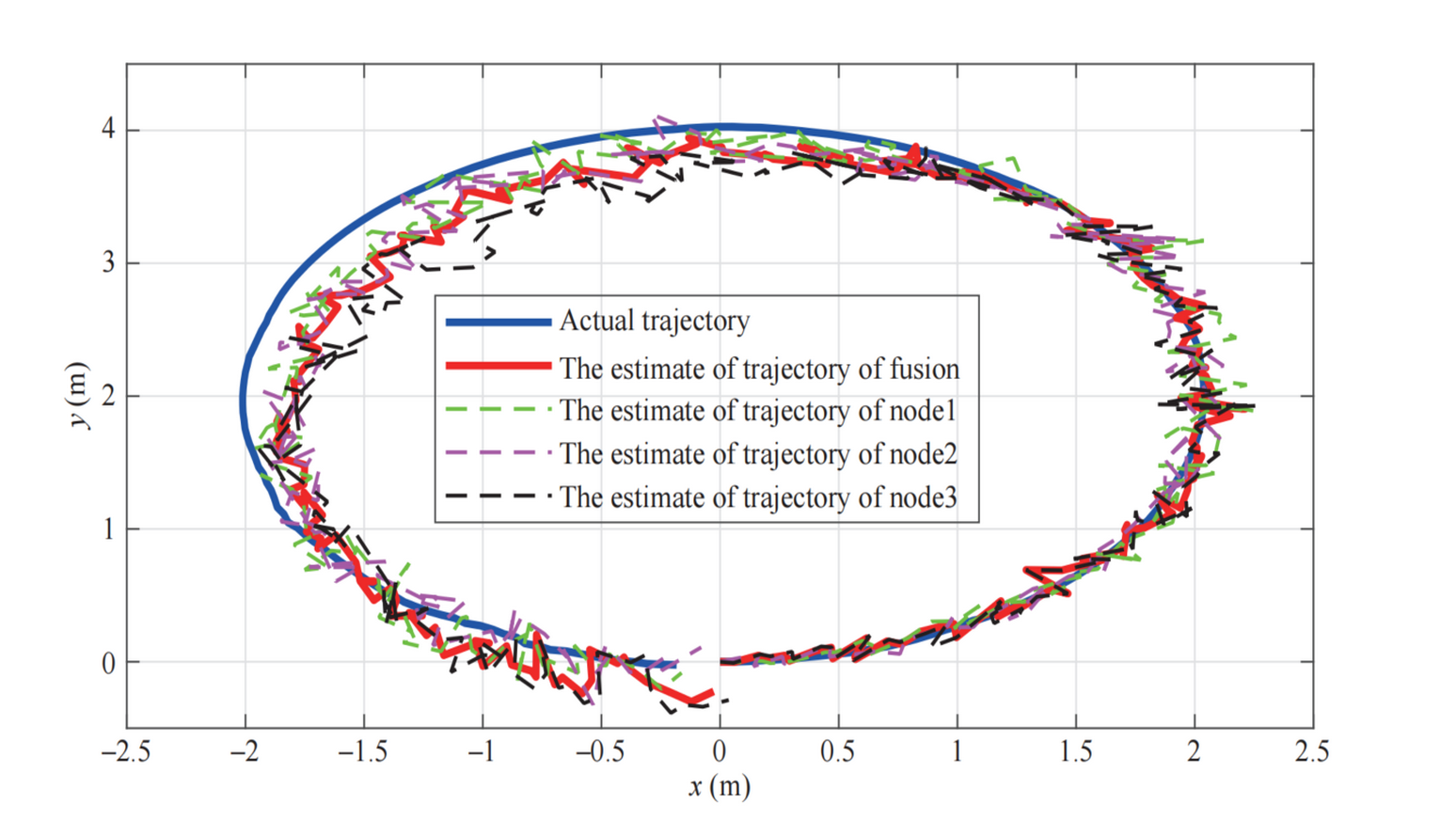
This study addresses the joint state and fault fusion estimation problem for mobile robot localization under the energy-harvesting sensors. Under such a circumstance, the sensors can harvest energy from the external environment and then consume an amount of energy when transmitting measurements to the corresponding estimator. Based on the energy harvesting mechanism's probability distribution, the probability of measurement loss is computed at each step. The main objective of this study is to tackle the mobile robot localization problem by designing local estimators for each sensor node, where the upper bound of the local estimation error covariance is guaranteed and then minimized by appropriately tuning the estimator parameters. Furthermore, the local estimates are fused using the covariance intersection (CI) fusion approach. Finally, a numerical experiment is presented to demonstrate the effectiveness of the proposed fusion estimation algorithm.
KeyWords AITranslate
[1]G. Calafiore, "Reliable localization using set-valued nonlinear filters," IEEE Transactions on Systems, Man, and Cybernetics-Part A: Systems and Humans, vol. 35, no. 2, pp. 189–197, 2005.
[2]R. P. Guan, B. Ristic, L. Wang, and R. Evans, "Monte Carlo localisation of a mobile robot using a doppler-azimuth radar," Automatica, vol. 97, pp. 161–166, 2018.
[3]R. Havangi, "Mobile robot localization based on PSO estimator," Asian Journal of Control, vol. 21, no. 4, pp. 2167–2178, 2019.
[4]Y. Lu and B. Shen, "Mobile robot localization under stochastic communication protocol," Kybernetika, vol. 56, no. 1, pp. 152–169, 2020.
[5]Q. Sun, Y. Tian, and M. Diao, "Cooperative localization algorithm based on hybrid topology architecture for multiple mobile robot system," IEEE Internet of Things Journal, vol. 5, no. 6, pp. 4753–4763, 2018.
[6]H. Dong, Z. Wang, S. Ding, and H. Gao, "Finite-horizon estimation of randomly occurring faults for a class of nonlinear time-varying systems," Automatica, vol. 50, no. 12, pp. 3182–3189, 2014.
[7]C. Huang, S. Coskun, X. Zhang, and P. Mei, "State and fault estimation for nonlinear systems subject to censored measurements: A dynamic event-triggered case," International Journal of Robust Nonlinear Control, vol. 32, no. 8, pp. 4946–4965, 2022.
[8]C. Huang, B. Shen, L, Zou, and Y. Shen, "Event-triggering state and fault estimation for a class of nonlinear systems subject to sensor saturations," Sensors, vol. 21, no. 4, p. 1242, 2021.
[9]X. Bu, H. Dong, Z. Wang, and H. Liu, "Non-fragile distributed fault estimation for a class of nonlinear time-varying systems over sensor networks: The finite-horizon case," IEEE Transactions on Signal and Information Processing over Networks, vol. 5, no. 1, pp. 61–69, 2019.
[10]C. Lo, J. P. Lynch, and M. Liu, "Distributed model-based nonlinear sensor fault diagnosis in wireless sensor networks," Mechanical Systems and Signal Processing, vol. 66. pp. 470–484, 2015.
[11]Z. Gao, X. Liu, and M. Z. Q. Chen, "Unknown input observer-based robust fault estimation for systems corrupted by partially decoupled disturbances," IEEE Transactions on Industrial Electronics, vol. 63, no. 4, pp. 2537–2547, 2016.
[12]J. Yan, C. Deng, W. Che, and X. Liu, "Fault estimation for cyber-physical systems with intermittent measurement transmissions via a hybrid observer approach," Journal of the Franklin Institute, vol. 361, no. 3, pp. 1497–1509, 2024.
[13]Y. Li, F. Zhang, D. Quevedo, V. Lau, S. Dey, and L. Shi, "Power control of an energy harvesting sensor of remote state estimation," IEEE Transactions on Automatic Control, vol. 62, no. 1, pp. 277–290, 2016.
[14]C. Ho and R. Zhang, "Optimal energy allocation for wireless communications with energy harvesting constraints," IEEE Transactions on Signal Processing, vol. 60, no. 9, pp. 4808–4818, 2012.
[15]E. Bitar, R. Rajagopal, P. Khargonekar, K. Poolla, and P. varaiya, "Bringing wind energy to market," IEEE Transactions on Power Systems, vol. 27, no. 3, pp. 1225–1235, 2012.
[16]A. Hentati, J. Frigon, and W. Ajib, "Energy harvesting wireless sensor networks with channel estimation: Delay and packet loss performance analysis," IEEE Transactions on Vehicular Technology, vol. 69, no. 2, pp. 1956–1969, 2020.
[17]M. Calvo-Fullana, C. Anton-Haro, J. Mathmoros, and A. Ribeiro, "Random access communication for wireless control systems with energy harvesting sensors," IEEE Transactions on Signal Processing, vol. 68, pp. 3961–3975, 2020.
[18]X. Bao, H. Liang, Y. Liu, and F. Zhang, "A stochastic game approach for collaborative beam-forming in SDN-based energy harvesting wireless sensor networks," IEEE Internet of Things Journal, vol. 6, no. 6, pp. 9583–9595, 2019.
[19]B. Shen, Z. Wang, D. Wang, J. Luo, H. Pu, and Y. Peng, "Finite-horizon filtering for a class of nonlinear time-delayed systems with an energy harvesting sensor," Automatica, vol. 100, pp. 144–152, 2019.
[20]J. Huang, D. Shi, and T. Chen, "Event-triggered state estimation with an energy harvesting sensor," IEEE Transactions on Automatic Control, vol. 62, no. 9, pp. 4768–4775, 2017.
[21]D. Ye and Y. Sang, "Optimal periodic DoS attack with energy harvester in cyber-physical systems," Neurocomputing, vol. 390, pp. 69–77, 2020.
[22]W. Song, Z. Wang, J. Wang, F. E. Alsaadi, and J. Shan, "Particle filtering for nonlinear/non-Gaussian systems with energy harvesting sensors subject to randomly occuring sensor saturations," IEEE Transactions on Signal Processing, vol. 69, pp. 15–27, 2020.
[23]A. Canedo-Rodriguez, V. Alvares-Santos, C. V. Reguerio, R. Iglesias, S. Barro, and J. Presedo, "Practicle filter robot localization through robust fusion of laser, WiFi, compass, and a network of external carneras," Information Fusion, vol. 27, pp. 170–188, 2016.
[24]L. Jetto, S. Longhi, and D. Vitali, "Localization of a wheeled mobile robot by sensor data fusion based on fuzzy logic adapted Kalman filter," Control Engineering Practice, vol. 7, no. 6, pp. 763–771, 1999.
[25]H. Zhu and M. Luo, "Hybrid robust sequential fusion estimation for WSN-assisted moving-target localization with sensor-node-position uncertainty," IEEE Transactions on Instrumentation and Measurement, vol. 69, no. 9, pp. 6499–6508, 2020.
[26]Z. Deng, P. Zhang, W. Qi, Y. Gao, and J. Liu, "The accuracy comparison of multisensor covariance intersection fuser and three weighting fusers," Information Fusion, vol. 14, no. 2, pp. 177–185, 2013.
[27]H. Geng, Y. Liang, and X. Zhang, "Linear-minimum-mean-square-error observer for multi-rate sensor fusion with missing measurements," IET Control Theory & Applications, vol. 8, no. 14, pp. 1375–1383, 2014.
[28]C. Ran and Z. Deng, "Robust fusion Kalman estimators for networked mixed uncertain systems with random one-step measurement delays, missing measurements, multiplicative noises and uncertain noise variances," Information Sciences, vol. 534, pp. 27–52, 2020.
[29]X. Feng, C. Wen, and J. H. Park, "Sequential fusion H∞ filtering for multi-rate multi-sensor time-varying systems-A Krein-space approach," IET Control Theory & Applications, vol. 11, no. 3, pp. 369–381, 2017.
[30]W. Yi, S. Li, B. Wang, R. Hoseinnezhad, and L. Kong, "Computationally efficient distributed multi-sensor fusion with multi-Bernoulli filter," IEEE Transactions on Signal Processing, vol. 68, pp. 241–256, 2019.
Basic Information:
DOI:10.23919/CHAIN.2025.000005
Chinese Library Classification Number:
Citation Information:
This study addresses the joint state and fault fusion estimation problem for mobile robot localization under the energy-harvesting sensors. Under such a circumstance, the sensors can harvest energy from the external environment and then consume an amount of energy when transmitting measurements to the corresponding estimator. Based on the energy harvesting mechanism's probability distribution, the probability of measurement loss is computed at each step. The main objective of this study is to tackle the mobile robot localization problem by designing local estimators for each sensor node, where the upper bound of the local estimation error covariance is guaranteed and then minimized by appropriately tuning the estimator parameters. Furthermore, the local estimates are fused using the covariance intersection (CI) fusion approach. Finally, a numerical experiment is presented to demonstrate the effectiveness of the proposed fusion estimation algorithm.
quote
| GB/T 7714-2015 | [1] Ruifeng Gao, Qingchi Qi, Peng Mei, et al. A joint state and fault fusion estimation scheme for mobile robot localization with energy harvesting sensors[J]. Chain, 2025, 2(1): 57-71. DOI:10.23919/CHAIN.2025.000005. |
| MLA | [1] Ruifeng Gao, et al., "A joint state and fault fusion estimation scheme for mobile robot localization with energy harvesting sensors." Chain, vol. 2, no. 1, 2025, pp. 57-71, https://doi.org/10.23919/CHAIN.2025.000005. |
| APA | [1] Ruifeng Gao, Qingchi Qi, Peng Mei, & Cong Huang. (2025). A joint state and fault fusion estimation scheme for mobile robot localization with energy harvesting sensors. Chain, 2(1), 57-71. https://doi.org/10.23919/CHAIN.2025.000005 |
| IEEE | [1] Ruifeng Gao, Qingchi Qi, Peng Mei, and Cong Huang, "A joint state and fault fusion estimation scheme for mobile robot localization with energy harvesting sensors," Chain, vol. 2, no. 1, pp. 57-71, 2025, doi: 10.23919/CHAIN.2025.000005. keywords: {energy harvesting sensors;state and fault estimation;mobile robot localization;fusion estimation} |