

Integrating digital twins and machine learning for advanced control in green hydrogen production AITranslate
Abstract AITranslate
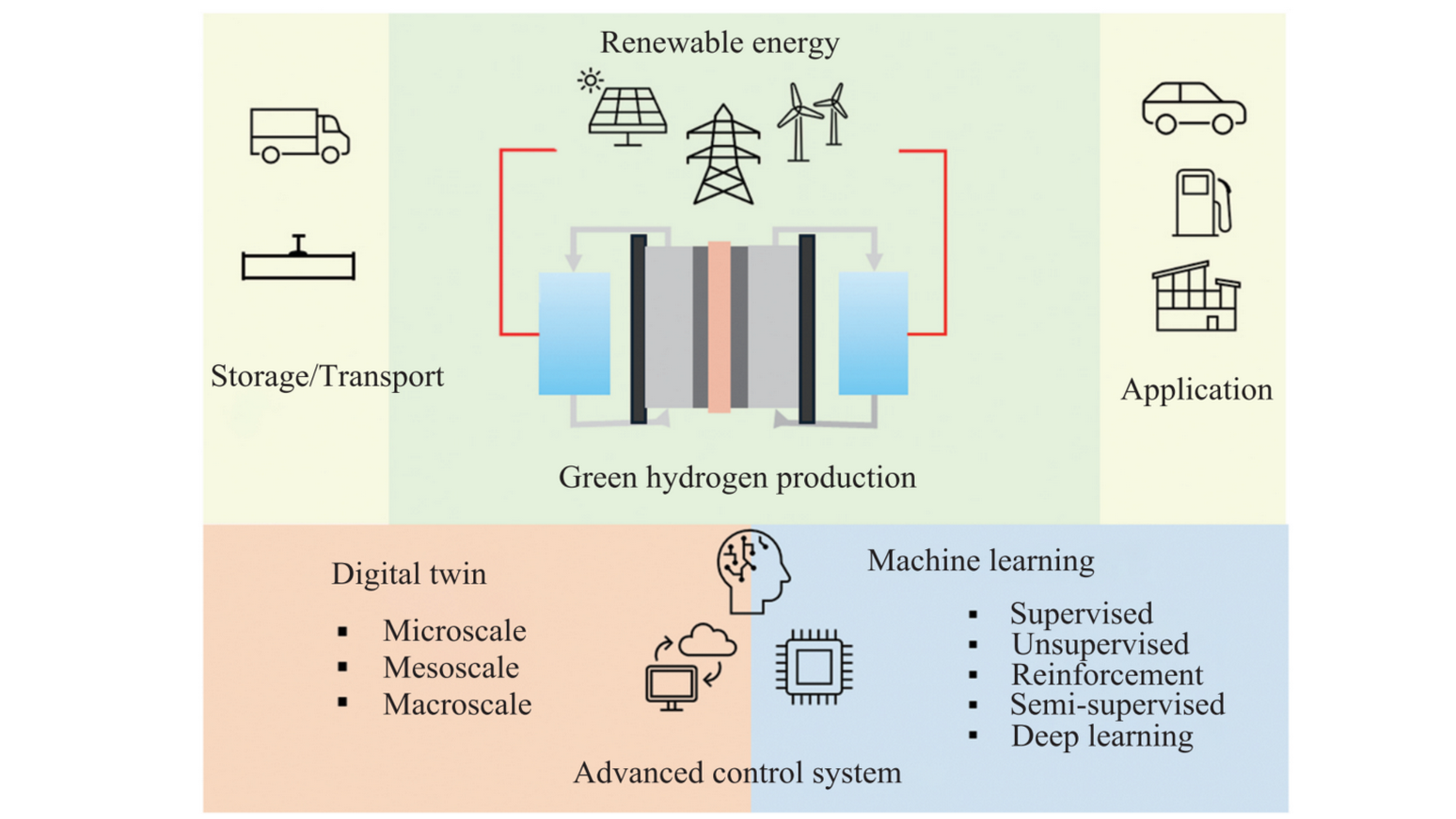
The successful reduction of carbon emissions in major sectors such as heavy industry and long-distance transport depends crucially on the ability to produce green hydrogen on a large scale. This involves generating hydrogen via water electrolysis, utilizing power sourced from renewable energies. However, persistent challenges, such as dynamic inefficiencies, material degradation, and renewable intermittency, demand a paradigm shift from static control strategies to adaptive, self-optimizing systems. This perspective argues that the synergistic integration of digital twins (DTs) and machine learning (ML) offers a transformative framework for real-time optimization, predictive maintenance, and resilient grid integration. By synthesizing physics-based modeling with data-driven intelligence, DT-ML systems enable closed-loop control architectures that dynamically adapt to operational uncertainties. We analyze the technical foundations of this integration, address critical barriers, and propose actionable pathways for stakeholders to accelerate the hydrogen economy's transition from promise to practice.
KeyWords AITranslate
[1]L. Li, J. Yang, R. Tan, W. Shu, C. J. Low, Z. Zhang, Y. Zhao, C. Li, Y. Zhang, and X. Li, "Large-scale current collectors for regulating heat transfer and enhancing battery safety," Nature Chemical Engineering, vol. 1, no. 8, pp. 542–551, 2024.
[2]X. Yang, W. Kong, G. Du, S. Li, Y. Tang, J. Cao, X. Lu, R. Tan, and G. Qian, "Synthesis of a yolk-shell nanostructured silicon-based anode for high-performance Li-ion batteries," Batteries, vol. 9, no. 9, p. 446, 2023.
[3]X. Tian, C. Ye, L. Zhang, M. K. Sugumar, Y. Zhao, N. B. McKeown, S. Margadonna, and R. Tan, "Enhancing membrane materials for efficient Li recycling and recovery," Advanced Materials, vol. 37, no. 5, p. 2402335, 2025.
[4]Y. Gan, M. Liu, R. Tan, C. Pan, L. Liu, S. Zhou, Z. Zou, G. Chen, L. Xian, and X. Cheng, "Flame-retardant crosslinked polymer stabilizes graphite-silicon composite anode for self-extinguishing lithium-ion batteries," Advanced Energy Materials, vol. 12, no. 45, p. 2202779, 2022.
[5]M. Zhang, R. Tan, M. Wang, Z. Zhang, C. John Low, and Y. Lai, "Hypercrosslinked porous and coordination polymer materials for electrolyte membranes in lithium‐metal batteries," Battery Energy, vol. 3, no. 2, p. 20230050, 2024.
[6]K. Chu, B. Weng, Z. Lu, Y. Ding, W. Zhang, R. Tan, Y. M. Zheng, and N. Han, "Exploration of multidimensional structural optimization and regulation mechanisms: Catalysts and reaction environments in electrochemical ammonia synthesis," Advanced Science, 2025, early view, p. 2416053, DOI 10.1002/advs.202416053.
[7]C. Shi, Z. Li, M. Wang, S. Hong, B. Hong, Y. Fu, D. Liu, R. Tan, P. Wang, and Y. Lai, "Electrolyte tailoring and interfacial engineering for safe and high-temperature lithium-ion batteries," Energy & Environmental Science, 2025, advance article, DOI 10.1039/D4EE05263C.
[8]Y. Feng, R. Tan, Y. Zhao, R. Gao, L. Yang, J. Yang, H. Li, G. Zhou, H. Chen, and F. Pan, "Insight into fast ion migration kinetics of a new hybrid single Li-ion conductor based on aluminate complexes for solid-state Li-ion batteries," Nanoscale, vol. 10, no. 13, pp. 5975–5984, 2018.
[9]R. Tan and J. Yong, "Scalable graphene current collectors for enhanced thermal management in batteries," Nature Chemical Engineering, vol. 1, no. 8, pp. 506–507, 2024.
[10]R. Tan, A. Wang, C. Ye, J. Li, D. Liu, B. P. Darwich, L. Petit, Z. Fan, T. Wong, and A. Alvarez‐Fernandez, "Thin film composite membranes with regulated crossover and water migration for long‐life aqueous redox flow batteries," Advanced Science, vol. 10, no. 20, p. 2206888, 2023.
[11]Y. Xia, M. Ouyang, V. Yufit, R. Tan, A. Regoutz, A. Wang, W. Mao, B. Chakrabarti, A. Kavei, and Q. Song, "A cost-effective alkaline polysulfide-air redox flow battery enabled by a dual-membrane cell architecture," Nature Communications, vol. 13, no. 1, p. 2388, 2022.
[12]A. Wang, R. Tan, D. Liu, J. Lu, X. Wei, A. Alvarez‐Fernandez, C. Ye, C. Breakwell, S. Guldin, and A. R. Kucernak, "Ion‐selective microporous polymer membranes with hydrogen‐bond and salt‐bridge networks for aqueous organic redox flow batteries," Advanced Materials, vol. 35, no. 12, p. 2210098, 2023.
[13]C. Ye, R. Tan, A. Wang, J. Chen, B. Comesaña Gándara, C. Breakwell, A. Alvarez‐Fernandez, Z. Fan, J. Weng, and C. G. Bezzu, "Long‐life aqueous organic redox flow batteries enabled by amidoxime‐functionalized ion‐selective polymer membranes," Angewandte Chemie International Edition, vol. 134, no. 38, p. e202207580, 2022.
[14]R. Tan, A. Wang, R. Malpass-Evans, R. Williams, E. W. Zhao, T. Liu, C. Ye, X. Zhou, B. P. Darwich, and Z. Fan, "Hydrophilic microporous membranes for selective ion separation and flow-battery energy storage," Nature Materials, vol. 19, no. 2, pp. 195–202, 2020.
[15]A. M. Oliveira, R. R. Beswick, and Y. Yan, "A green hydrogen economy for a renewable energy society," Current Opinion in Chemical Engineering, vol. 33, p. 100701, 2021.
[16]Z. Feng, G. Gupta, and M. Mamlouk, "Robust poly (p‐phenylene oxide) anion exchange membranes reinforced with pore‐filling technique for water electrolysis," Journal of Applied Polymer Science, vol. 141, p. e55340, 2024.
[17]S. Li, G. Liao, D. Bildan, Z. Feng, H. Cai, J. Han, Z. Xin, K. Liu, Q. Li, J. Shang, and T. X. Liu, "Performance enhancement for direct borohydride fuel cells through ternary Ru–Co–B oxide catalyst," International Journal of Hydrogen Energy, vol. 67, pp. 448–457, 2024.
[18]S. Li, Z. Xin, Y. Luo, J. Pan, G. Liao, Q. Li, Y. Sun, Z. Feng, and R. Tan, "Recent advances in the development of single-atom catalysts for oxygen evolution reaction," International Journal of Hydrogen Energy, vol. 82, pp. 1081–1100, 2024.
[19]F. Zhan, L. Huang, Y. Luo, M. Chen, R. Tan, X. Liu, G. Liu, and Z. Feng, "Recent advances on support materials for enhanced Pt-based catalysts: Applications in oxygen reduction reactions for electrochemical energy storage," Journal of Materials Science, vol. 60, no. 5, pp. 2199–2223, 2025.
[20]V. Venizelou and A. Poullikkas, "The effect of carbon price towards green hydrogen power generation," Renewable and Sustainable Energy Reviews, vol. 211, p. 115254, 2025.
[21]D. Li, J. Liu, X. Chen, Z. Feng, S. Wang, Y. Wang, N. Lin, J. Wu, and Y. Feng, "Regulation of coordinated nitrogen species for atomically dispersed Fe-N5 catalyst to boost electrocatalytic CO2-to-CO conversion," Applied Catalysis B: Environment and Energy, vol. 365, p. 124824, 2025.
[22]B. van der Zwaan, A. Fattahi, F. Dalla Longa, M. Dekker, D. van Vuuren, R. Pietzcker, R. Rodrigues, F. Schreyer, D. Huppmann, J. Emmerling, S. Pfenninger, F. Lombardi, P. Fragkos, M. Kannavou, T. Fotiou, G. Tolios, and W. Usher, "Electricity- and hydrogen-driven energy system sector-coupling in net-zero CO2 emission pathways," Nature Communications, vol. 16, no. 1, p. 1368, 2025.
[23]K. Hu, Y. Zhang, J. Zhu, J. Mai, G. Liu, M. K. Sugumar, X. Liu, F. Zhan, and R. Tan, "Nano-engineered catalysts for high-performance oxygen reduction reaction," Chinese Chemical Letters, vol. 35, no. 10, p. 109423, 2024.
[24]Z. Feng, G. Gupta, and M. Mamlouk, "A review of anion exchange membranes prepared via Friedel-crafts reaction for fuel cell and water electrolysis," International Journal of Hydrogen Energy, vol. 48, no. 66, pp. 25830–25858, 2023.
[25]Y. Luo, Y. Zhang, J. Zhu, X. Tian, G. Liu, Z. Feng, L. Pan, X. Liu, N. Han, and R. Tan, "Material engineering strategies for efficient hydrogen evolution reaction catalysts," Small Methods, vol. 8, no. 12, p. e2400158, 2024.
[26]S. K. Singh and A. K. Tiwari, "Solar-powered hydrogen production: Advancements, challenges, and the path to net-zero emissions," International Journal of Hydrogen Energy, vol. 84, pp. 549–579, 2024.
[27]Q. Li, W. Chen, Z. Liu, A. Guo, and S. Liu, "Control of proton exchange membrane fuel cell system breathing based on maximum net power control strategy," Journal of Power Sources, vol. 241, pp. 212–218, 2013.
[28]D. Li, S. Xie, J. Liang, B. Ma, J. Fu, J. Wu, Y. Feng, and Z. Feng, "Structure regulated CuSn alloy catalyst for selective electrochemical CO2-to-formate conversion at higher current densities," Separation and Purification Technology, vol. 340, p. 126545, 2024.
[29]S. Jin, Y. Cao, M. Burd, S. Tindale, Z. Feng, O. Green, P. Newell‐Price, V. Vicario‐Modroño, G. Mack, P. Sánchez‐Zamora, R. Gallardo‐Cobos, M. Spörri, N. El Benni, N. Alonso, S. Miškolci, S. Outhwaite, E. Hunter, and L. J. Frewer, "Farmer identities and permanent grassland management: Evidence from five European biogeographic zones," People and Nature, vol. 6, no. 6, pp. 2228–2245, 2024.
[30]Y. Bian, Y. Zhang, T. Wang, C. Yang, Z. Feng, K.-L. Goh, Y. Zhou, and M. Zheng, "Insights into the enzymatic synthesis of alcoholic flavor esters with molecular docking analysis," LWT, vol. 200, p. 116206, 2024.
[31]X. Chen, R. Zhang, Y. Mao, L. Zhong, P. Lin, Q. Deng, B. Zheng, H. Shen, Z. Feng, and H. Zhang, "Development of a toughened and antibacterial poly(lactide acid) (PLA) with preserved strength by elemental sulfur-based bio-renewable dynamically crosslinked elastomers," Chemical Engineering Journal, vol. 467, p. 143419, 2023.
[32]J. Mai, Y. Zhang, H. He, Y. Luo, X. Zhou, K. Hu, G. Liu, M. K. Sugumar, C. T. John Low, X. Liu, and R. Tan, "Metal-support interface engineering for stable and enhanced hydrogen evolution reaction," Materials Today Chemistry, vol. 38, p. 102079, 2024.
[33]L. L. Tian, J. Yang, M. Y. Weng, R. Tan, J. X. Zheng, H. B. Chen, Q. C. Zhuang, L. M. Dai, and F. Pan, "Fast diffusion of O2 on nitrogen-doped graphene to enhance oxygen reduction and its application for high-rate zn-air batteries," ACS Applied Materials & Interfaces Journal, vol. 9, no. 8, pp. 7125–7130, 2017.
[34]S. Li, Z. Xin, J. Han, Z. Feng, G. Liao, S. Wang, K. Liu, Q. Li, T. X. Liu, and M. Bayati, "Pt@Co-B catalyzed direct borohydride fuel cell anode: Rational design and performance evaluation," Ionics, vol. 30, no. 11, pp. 7213–7222, 2024.
[35]X. Li, Y. Zhao, Z. Feng, X. Xiang, S. Wang, X. Xie, and V. K. Ramani, "Ring-opening metathesis polymerization for the preparation of polynorbornene-based proton exchange membranes with high proton conductivity," Journal of Membrane Science, vol. 528, pp. 55–63, 2017.
[36]Z. Feng, G. Gupta, and M. Mamlouk, "Degradation of QPPO-based anion polymer electrolyte membrane at neutral pH," RSC Advances, vol. 13, no. 29, pp. 20235–20242, 2023.
[37]Y. Deng, Q. Qin, W. He, H. Guo, and J. Chen, "A highly efficient electrolysis system enabled by direct impedance matching between a charge migration triboelectric nanogenerator and series connected Electrolyzers," Energy & Environmental Science, vol. 18, pp. 2940–2948, 2025.
[38]C. Wang, Z. Feng, Y. Zhao, X. Li, W. Li, X. Xie, S. Wang, and H. Hou, "Preparation and properties of ion exchange membranes for PEMFC with sulfonic and carboxylic acid groups based on polynorbornenes," International Journal of Hydrogen Energy, vol. 42, no. 50, pp. 29988–29994, 2017.
[39]H. Lange, A. Klose, W. Lippmann, and L. Urbas, "Technical evaluation of the flexibility of water electrolysis systems to increase energy flexibility: A review," International Journal of Hydrogen Energy, vol. 48, no. 42, pp. 15771–15783, 2023.
[40]H. Hao, R. Tan, C. Ye, and C. T. J. Low, "Carbon‐coated current collectors in lithium‐ion batteries and supercapacitors: Materials, manufacture and applications," Carbon Energy, vol. 6, no. 12, p. e604, 2024.
[41]J. Yang, J. Hu, M. Weng, R. Tan, L. Tian, J. Yang, J. Amine, J. Zheng, H. Chen, and F. Pan, "Fe-cluster pushing electrons to N-doped graphitic layers with Fe3CFe hybrid nanostructure to enhance O2 reduction catalysis of Zn-air batteries," ACS Applied Materials & Interfaces Journal, vol. 9, no. 5, pp. 4587–4596, 2017.
[42]G. Liao, S. Li, Y. Luo, Z. Xin, Q. Li, R. Tan, K. Zhang, and Z. Feng, "Plasma-synthesized Ru-B double oxides catalysts for enhanced fuel cell performance," Journal of Alloys and Compounds, vol. 1013, p. 178599, 2025.
[43]Y. Luo, Y. Qiao, H. He, M. Chen, G. Liu, X. Liu, L. Pan, Z. Feng, and R. Tan, "Rapid synthesis of PtRu nanoparticles on aniline-modified SWNTs in EMSI engineering for enhanced alkaline water electrolysis," Journal of Power Sources, vol. 631, p. 236297, 2025.
[44]C. Xiang, K. M. Papadantonakis, and N. S. Lewis, "Principles and implementations of electrolysis systems for water splitting," Materials Horizons, vol. 3, no. 3, pp. 169–173, 2016.
[45]A. Badgett, M. Ruth, B. James, and B. Pivovar, "Methods identifying cost reduction potential for water electrolysis systems," Current Opinion in Chemical Engineering, vol. 33, p. 100714, 2021.
[46]J. Lai, R. Tan, H. Jiang, X. Huang, Z. Tian, B. Hong, M. Wang, and J. Li, "Development of an in situ polymerized artificial layer for dendrite‐free and stable lithium metal batteries," Battery Energy, vol. 3, no. 4, p. 20230070, 2024.
[47]D. Jang, W. Choi, H.-S. Cho, W. C. Cho, C. H. Kim, and S. Kang, "Numerical modeling and analysis of the temperature effect on the performance of an alkaline water electrolysis system," Journal of Power Sources, vol. 506, p. 230106, 2021.
[48]Z. Feng, S. Jin, H. Xiang, D. Li, S. Sun, H. Zhang, and Y. Chen, "Artificial intelligence-based optimization for ring-opening metathesis polymerization of proton exchange membrane," Journal of Polymer Research, vol. 30, art. no. 418, 2023.
[49]X. Tian, S. Zhou, H. Hao, H. Ruan, R. R. Gaddam, R. C. Dutta, T. Zhu, H. Wang, B. Wu, N. P. Brandon, and R. Tan, "Machine learning and density functional theory for catalyst and process design in hydrogen production," Chain, vol. 1, no. 2, pp. 150–166, 2024.
[50]J. Mao, Z. Li, J. Xuan, X. Du, M. Ni, and L. Xing, "A review of control strategies for proton exchange membrane (PEM) fuel cells and water electrolyzers: From automation to autonomy," Energy and AI, vol. 17, p. 100406, 2024.
[51]Z. Feng, J. Huang, S. Jin, G. Wang, and Y. Chen, "Artificial intelligence-based multi-objective optimisation for proton exchange membrane fuel cell: A literature review," Journal of Power Sources, vol. 520, p. 230808, 2022.
[52]Y. Zhao, M. Wang, J. Xuan, D. Chang, Z. Li, S. Wang, Y. Ou, X. Wang, and L. Xing, "Physics-based and data-driven hybrid modelling and optimisation of stirred-slurry reactors for CO2 capture via enhanced weathering of dolomite mineral," Carbon Capture Science & Technology, vol. 14, p. 100363, 2025.
[53]Z. Feng, I. Eiubovi, Y. Shao, Z. Fan, and R. Tan, "Review of digital twin technology applications in hydrogen energy," Chain, vol. 1, no. 1, pp. 54–74, 2024.
[54]M. M. Rathore, S. A. Shah, D. Shukla, E. Bentafat, and S. Bakiras, "The role of AI, machine learning, and big data in digital twinning: A systematic literature review, challenges, and opportunities," IEEE Access, vol. 9, pp. 32030–32052, 2021.
[55]M. Fahim, V. Sharma, T.-V. Cao, B. Canberk, and T. Q. Duong, "Machine learning-based digital twin for predictive modeling in wind turbines," IEEE Access, vol. 10, pp. 14184–14194, 2022.
[56]S. Alsaleh, A. Tepljakov, A. Kose, J. Belikov, and E. Petlenkov, "Reimagine lab: bridging the gap between hands-on, virtual and remote control engineering laboratories using digital twins and extended reality," IEEE Access, vol. 10, pp. 89924–89943, 2022.
[57]X. Wang, S. L. Clegg, and D. Di Tommaso, "Bridging atomistic simulations and thermodynamic hydration models of aqueous electrolyte solutions," The Journal of Chemical Physics, vol. 156, no. 2, p. 024502, 2022.
[58]S. Liu, Y. Lu, J. Li, D. Song, X. Sun, and J. Bao, "Multi-scale evolution mechanism and knowledge construction of a digital twin mimic model," Robotics and Computer-Integrated Manufacturing, vol. 71, p. 102123, 2021.
[59]P. C. Yang, A. Rose, K. R. DeMarco, J. R. D. Dawson, Y. Han, M. T. Jeng, R. D. Harvey, L. F. Santana, C. M. Ripplinger, I. Vorobyov, T. J. Lewis, and C. E. Clancy, "A multiscale predictive digital twin for neurocardiac modulation," J Physiology, vol. 601, no. 17, pp. 3789–3812, 2023.
[60]A. A. Ahmed, S. Sayed, A. Abdoulhalik, S. Moutari, and L. Oyedele, "Applications of machine learning to water resources management: A review of present status and future opportunities," Journal of Cleaner Production, vol. 441, p. 140715, 2024.
[61]M. Cerezo, G. Verdon, H. Y. Huang, L. Cincio, and P. J. Coles, "Challenges and opportunities in quantum machine learning," Nature Computational Science, vol. 2, no. 9, pp. 567–576, 2022.
[62]X. Wang, D. Quinn, T. S. Moody, and M. Huang, "ALDELE: All-purpose deep learning toolkits for predicting the biocatalytic activities of enzymes," Journal of Chemical Information and Modeling, vol. 64, no. 8, pp. 3123–3139, 2024.
[63]X. Li, Q. Zhan, B. Sun, H. Feng, Y. Zeng, H. Wang, X. Yang, and W.-Y. Yin, "Scientific machine learning enables multiphysics digital twins of large-scale electronic chips," IEEE Transactions on Microwave Theory and Techniques, vol. 70, no. 12, pp. 5305–5318, 2022.
[64]R. van Dinter, B. Tekinerdogan, and C. Catal, "Predictive maintenance using digital twins: A systematic literature review," Information and Software Technology, vol. 151, p. 107008, 2022.
[65]G. Shen, L. Lei, X. Zhang, Z. Li, S. Cai, and L. Zhang, "Multi-UAV cooperative search based on reinforcement learning with a digital twin driven training framework," IEEE Transactions on Vehicular Technology, vol. 72, no. 7, pp. 8354–8368, 2023.
[66]S. A. Cancemi, R. Lo Frano, C. Santus, and T. Inoue, "Unsupervised anomaly detection in pressurized water reactor digital twins using autoencoder neural networks," Nuclear Engineering and Design, vol. 413, p. 112502, 2023.
[67]Z. Sun, Y. Wang, and Z. Chen, "Fault diagnosis method for proton exchange membrane fuel cell system based on digital twin and unsupervised domain adaptive learning," International Journal of Hydrogen Energy, vol. 50, pp. 1207–1219, 2024.
[68]Y. Qi and M. S. Hossain, "Semi-supervised federated learning for digital twin 6G-enabled IIoT: A Bayesian estimated approach," Journal of Advanced Research, vol. 66, pp. 47–57, 2024.
[69]J. Lai, Z. Chen, J. Zhu, W. Ma, L. Gan, S. Xie, and G. Li, "Deep learning based traffic prediction method for digital twin network," Cognitive Computation, vol. 15, pp. 1748–1766, 2023.
[70]A. P. Renold and N. S. Kathayat, "Comprehensive review of machine learning, deep learning, and digital twin data-driven approaches in battery health prediction of electric vehicles," IEEE Access, vol. 12, pp. 43984–43999, 2024.
[71]Y. Song, Z. Chen, Y. Zhou, D. Fang, Y. Lu, R. Xiao, and D. Zeng, "Digital twins based on machine learning for optimal control of chemical looping hydrogen generation processes," International Journal of Hydrogen Energy, vol. 61, pp. 568–577, 2024.
[72]J. Li, W. Xie, H. Li, X. Qian, J. Shi, Z. Xie, Q. Wang, X. Zhang, and G. Chen, "Real-time hydrogen release and dispersion modelling of hydrogen refuelling station by using deep learning probability approach," International Journal of Hydrogen Energy, vol. 51, pp. 794–806, 2024.
[73]B. Zou, L. Zhang, X. Xue, R. Tan, P. Jiang, B. Ma, Z. Song, and W. Hua, "A review on the fault and defect diagnosis of lithium-ion battery for electric vehicles," Energies, vol. 16, no. 14, p. 5507, 2023.
[74]B. Zou, M. Xiong, H. Wang, W. Ding, P. Jiang, W. Hua, Y. Zhang, L. Zhang, W. Wang, and R. Tan, "A deep learning approach for state-of-health estimation of lithium-ion batteries based on a multi-feature and attention mechanism collaboration," Batteries, vol. 9, no. 6, p. 329, 2023.
[75]R. Tan, J. Yang, J. Zheng, K. Wang, L. Lin, S. Ji, J. Liu, and F. Pan, "Fast rechargeable all-solid-state lithium-ion batteries with high capacity based on nano-sized Li2FeSiO4 cathode by tuning temperature," Nano Energy, vol. 16, pp. 112–121, 2015.
[76]W. Wang, K. Yang, L. Zhang, S. Zhou, B. Ren, Y. Lu, R. Tan, T. Zhu, B. Ma, and S. Yang, "An end-cloud collaboration approach for online state-of-health estimation of lithium-ion batteries based on multi-feature and transformer," Journal of Power Sources, vol. 608, p. 234669, 2024.
[77]A. Aggarwal, M. Mittal, and G. Battineni, "Generative adversarial network: An overview of theory and applications," International Journal of Information Management Data Insights, vol. 1, no. 1, p. 100004, 2021.
[78]M. Tanjimuddin, P. Kannisto, P. Jafary, M. Filppula, S. Repo, and D. Hästbacka, "A comparative study on multi-agent and service-oriented microgrid automation systems from energy internet perspective," Sustainable Energy, Grids and Networks, vol. 32, p. 100856, 2022.
[79]S. Yang, H. Kim, Y. Hong, K. Yee, R. Maulik, and N. Kang, "Data-driven physics-informed neural networks: A digital twin perspective," Computer Methods in Applied Mechanics and Engineering, vol. 428, p. 117075, 2024.
[80]A. Hakiri, A. Gokhale, S. B. Yahia, and N. Mellouli, "A comprehensive survey on digital twin for future networks and emerging internet of things industry," Computer Networks, vol. 244, p. 110350, 2024.
[81]R. Biswas and U. Roy, "Mimicking photon source measurement with quantum digital twin: A framework for high-quality randomness," International Journal of Information Technology, Research and Applications, vol. 3, no. 1, pp. 26–34, 2024.
[82]Z. Lv, C. Cheng, and H. Song, "Digital twins based on quantum networking," IEEE Network, vol. 36, no. 5, pp. 88–93, 2022.
[83]S. Zheng, Z. Feng, Y. Lu, Y. Hua, and Z. Gao, "Impact of crosslinking in poly (naphthalene-co-terphenyl piperidinium) copolymer for anion exchange membrane fuel cells," Materials Today Communications, vol. 45, p. 112242, 2025.
Basic Information:
DOI:10.23919/CHAIN.2025.000003
Chinese Library Classification Number:
Citation Information:
The successful reduction of carbon emissions in major sectors such as heavy industry and long-distance transport depends crucially on the ability to produce green hydrogen on a large scale. This involves generating hydrogen via water electrolysis, utilizing power sourced from renewable energies. However, persistent challenges, such as dynamic inefficiencies, material degradation, and renewable intermittency, demand a paradigm shift from static control strategies to adaptive, self-optimizing systems. This perspective argues that the synergistic integration of digital twins (DTs) and machine learning (ML) offers a transformative framework for real-time optimization, predictive maintenance, and resilient grid integration. By synthesizing physics-based modeling with data-driven intelligence, DT-ML systems enable closed-loop control architectures that dynamically adapt to operational uncertainties. We analyze the technical foundations of this integration, address critical barriers, and propose actionable pathways for stakeholders to accelerate the hydrogen economy's transition from promise to practice.
quote
| GB/T 7714-2015 | [1] Zhiming Feng, Yue Luo, Da Li, et al. Integrating digital twins and machine learning for advanced control in green hydrogen production[J]. Chain, 2025, 2(1): 1-14. DOI:10.23919/CHAIN.2025.000003. |
| MLA | [1] Zhiming Feng, et al., "Integrating digital twins and machine learning for advanced control in green hydrogen production." Chain, vol. 2, no. 1, 2025, pp. 1-14, https://doi.org/10.23919/CHAIN.2025.000003. |
| APA | [1] Zhiming Feng, Yue Luo, Da Li, Jianxin Pan, Rui Tan, & Yi Chen. (2025). Integrating digital twins and machine learning for advanced control in green hydrogen production. Chain, 2(1), 1-14. https://doi.org/10.23919/CHAIN.2025.000003 |
| IEEE | [1] Zhiming Feng, Yue Luo, Da Li, Jianxin Pan, Rui Tan, and Yi Chen, "Integrating digital twins and machine learning for advanced control in green hydrogen production," Chain, vol. 2, no. 1, pp. 1-14, 2025, doi: 10.23919/CHAIN.2025.000003. keywords: {digital twins;machine learning;hydrogen production;water electrolysis} |