ContentsFigures & Tables
Addressing environmental and energy challenges is imperative in the contemporary global scenario, underscored by the escalating necessity for the adoption of renewable energy sources to drive sustainable development [1–5]. The strategic integration and deployment of renewable technologies are essential not only for minimizing global carbon emissions but also for significantly reducing carbon footprints, thereby mitigating the adverse impacts of climate change [5–9]. Moreover, the hydrogen industry, particularly in its synergy with the electric grid and complementary energy storage technologies such as large-scale redox flow batteries, plays a pivotal role [10–14]. This integration enhances grid resilience and facilitates the efficient storage and utilization of intermittent renewable energy, thereby accelerating the transition to a more sustainable energy infrastructure. Green hydrogen, generated through water electrolysis powered by renewable electricity, represents a viable approach for facilitating worldwide energy shifts, serving as a crucial source of renewable energy [15–20]. Crucial for achieving net-zero emissions, it demonstrates significant potential in decarbonizing sectors that are traditionally difficult to mitigate [21–23]. Its capabilities in clean electrochemical synthesis and potential for high-density energy storage make it a pivotal solution for advancing energy transition goals [24–28]. Moreover, its impact is profound, influencing a wide array of industries by enabling more sustainable production practices and advancing energy transition goals [29–33]. This technology facilitates decarbonization, bolsters energy security, and enhances grid stability during peak production periods [34, 35].
Despite its critical role in decarbonizing hard-to-abate sectors, green hydrogen production through water electrolysis encounters significant obstacles to broad adoption. Electrolyzers often function suboptimally when subjected to the variable energy inputs typical of solar and wind power, resulting in considerable energy losses and compromising overall efficiency [36, 37]. The operational demands of electrolysis systems, marked by high current densities and cyclic thermomechanical stresses, significantly accelerate the degradation of critical components such as electrocatalytic interfaces, polymer electrolyte membranes, and porous transport layers. This enhanced degradation pathway directly undermines operational longevity and increases lifecycle costs due to heightened maintenance needs [38–41]. Compounding these challenges is the intermittent nature of renewable energy sources, which introduces variability in hydrogen output, complicates grid integration, and raises operational costs [42–46]. These interconnected issues necessitate innovative control strategies that can synchronize dynamic energy inputs, reduce material wear, and stabilize production, tasks for which traditional static models and heuristic approaches are inadequately suited [47].
Traditional control strategies, which rely on static models or heuristic rules, often fall short when addressing dynamic challenges in complex systems. These methods lack the flexibility to adapt to the continuously changing conditions typical of such environments. Concurrently, The accelerated development of artificial intelligence (AI) has prompted its broad implementation throughout diverse fields [48–52]. As the push towards a low-carbon future gains momentum, the role involving sophisticated tools like DTs and machine learning (ML) becomes critical in optimizing the production processes involved in water electrolysis, thereby maximizing efficiency and scalability digital twin [53]. A DT is a precise virtual representation of a physical entity, system, or process. It utilizes sensor data and various other inputs to collect details on actual conditions, facilitating immediate monitoring and simulation. DTs allow for systems to be analyzed and optimized in their virtual representation, predicting how a product or process will perform. This capability is invaluable for making improvements, foreseeing potential issues, and testing scenarios without the risks and expenses associated with altering the physical counterpart. Additionally, DTs integrate diverse data inputs, including operational and environmental factors, to produce accurate simulations of complex systems. These models are adept at forecasting degradation and refining maintenance timelines, enhancing the design quality overall. Developments in internet of things (IoT) technology significantly boost the ability to collect real-time data across diverse industries, augmenting the capabilities of digital twins. This synthesis transforms digital twins into robust instruments for comprehensive analysis and strategic decision-making, effectively merging the tangible and virtual realms [54]. Further enriching this capability, ML algorithms analyze complex datasets to uncover patterns and predict outcomes. This analysis leads to more informed decisions and adaptive strategies that continually refine operational parameters based on system performance and environmental shifts. DTs and ML create a synergistic effect that transforms traditional operational frameworks into intelligent, self-optimizing systems [55]. These systems not only predict but also dynamically adapt to new challenges, marking a significant evolution in how industries manage and improve their operations and seamlessly bridging the gap between static planning and dynamic adaptation.
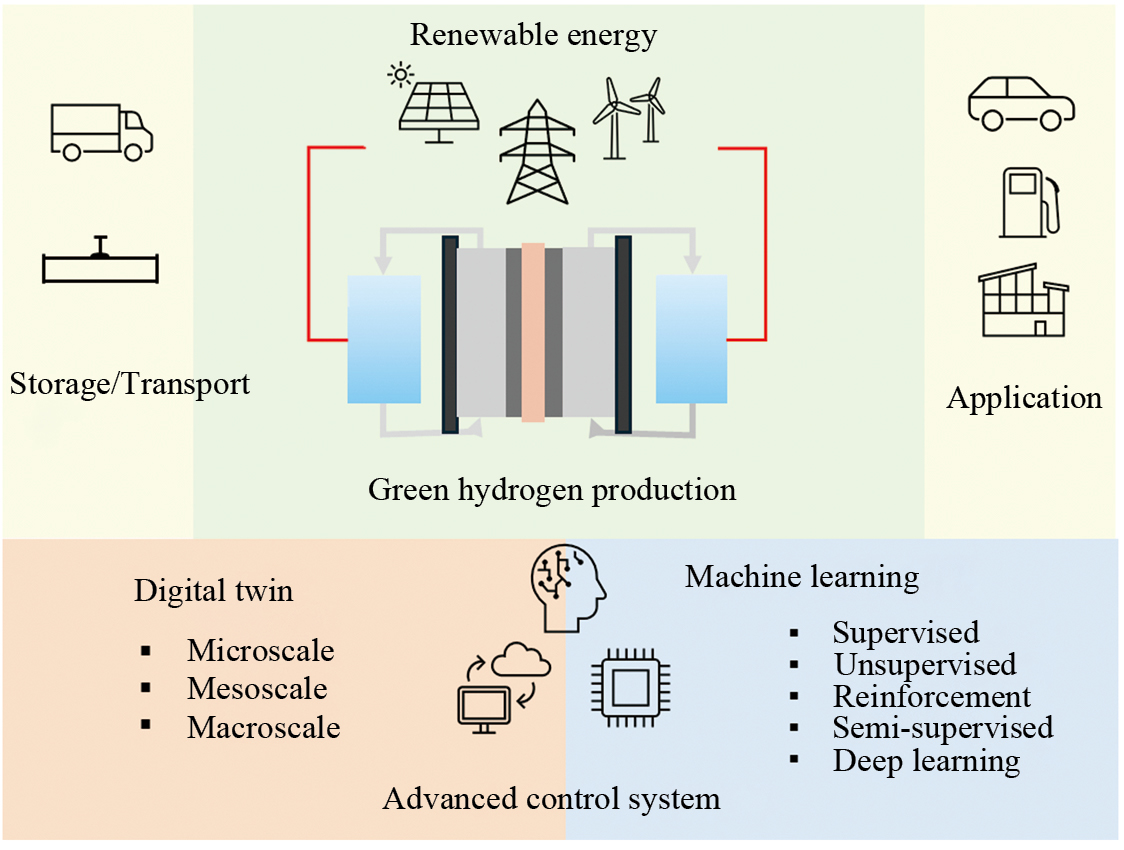
In this perspective, we highlight the integration of DTs and ML as a transformative approach to optimizing control processes in green hydrogen production, as is shown in Fig. 1. By harmonizing the dynamic virtual models provided by DTs with the predictive analytics capabilities of ML algorithms, this collaboration utilizes complex data sets for advanced decision-making. This integration forms a sophisticated closed-loop control system, where continuous refinements to simulations are driven by real-time data, enabling systems to autonomously learn, predict, and optimize. Such innovations are set to greatly improve the efficiency and productivity of hydrogen production.
Digital twins act as sophisticated multiscale virtual laboratories that critically bridge the gap between theoretical models and the practical demands of electrolyzer operations in green hydrogen production [56, 57]. By incorporating multiscale physics, real-time data, and predictive analytics, DTs are pivotal in simulating, monitoring, and optimizing processes across various spatial and temporal scales. This comprehensive approach ranges from atomic-level interactions to overarching system-wide thermodynamics, establishing DTs as crucial tools for advancing the efficiency and technological development of hydrogen production systems.
Digital twins exhibit functionalities that extend across various scales, from molecular to system-wide, offering in-depth insights and enhancements in operations [58]. The capability of these virtual models to simulate and operationalize systems from the microscale, detailing molecular or cellular interactions within materials and components, to the macroscale, encompassing the dynamics of entire processes, underscores their versatility [59]. This detailed modeling ensures that digital twins provide precise predictions and optimizations tailored to each specific level of interaction. Such granularity enhances the fidelity of simulations and boosts their applicability in real-time operational adjustments and strategic planning across diverse sectors.
At the microscale or molecular/electrode level, DTs offer precise simulations of electrochemical kinetics and catalyst behaviors, crucial for enhancing the performance and durability of electrochemical systems. These simulations include:
(1) Electrochemical kinetics: Utilizing the Butler-Volmer equation, DTs model charge transfer at the electrode-electrolyte interface. This modeling relates current density to overpotential and temperature, essential for understanding and optimizing electrode response to operational variations.
(2) Catalyst degradation: Through density functional theory (DFT) simulations, DTs can predict catalyst dissolution rates under high-voltage conditions. This predictive power is instrumental in selecting more robust materials, such as choosing between iridium and ruthenium oxides for proton exchange membrane water electrolyzers (PEMWE), thereby improving longevity and efficiency.
At the component level, DTs provide sophisticated simulations that address critical aspects such as the dynamics of gas bubbles and membrane hydration, each vital for optimizing the functionality and longevity of electrochemical systems. These simulations involve:
(1) Gas bubble dynamics: Computational fluid dynamics (CFD) models simulate gas bubble formation and transport in alkaline electrolyzers by solving the Navier-Stokes equations, identifying optimal electrode geometries (e.g., 3D porous nickel foams) to minimize bubble-induced resistance.
(2) Membrane hydration: DTs use finite element analysis (FEA) to track water diffusion across proton exchange membrane (PEM), correlating hydration levels with ionic conductivity and degradation. This information is critical for maintaining membrane efficiency and durability.
At the system level, DTs execute advanced simulations that are crucial for the holistic management and optimization of entire electrolyzer systems. These simulations address critical system-wide challenges and enhance operational efficiency through the meticulous modeling of various processes. Key areas of focus include:
(1) Thermodynamic balancing: DTs utilize energy and mass balance equations to manage heat across electrolyzer stacks, preventing hotspots and ensuring system reliability.
(2) Grid integration: DTs simulate responses to fluctuations in renewable energy supply, ensuring that the electrolyzers operate stably under intermittent solar and wind energy inputs, thus maintaining continuous and efficient hydrogen production.
DTs enhance their predictive accuracy and operational efficiency by assimilating real-time data from embedded sensor networks and testing various operational scenarios:
Digital twins leverage advanced data processing techniques to enhance decision-making accuracy and operational agility. These methods enable continuous model refinement and scenario testing, which are critical for adapting to dynamic operational environments. Key strategies include:
(1) Data fusion techniques: DTs enhance their predictive accuracy and operational efficiency by employing techniques such as Kalman filtering, which corrects model predictions by weighting sensor data against simulated values, reducing errors in voltage-current predictions. Bayesian Inference is also used to update model parameters probabilistically, enhancing predictive accuracy as operational data accumulates. External Data Streams integrate weather forecasts, grid electricity prices, and renewable energy availability (e.g., solar irradiance, wind speed).
(2) Scenario testing: DTs enable operators to test "what-if" scenarios without disrupting physical operations, such as simulating electrolyzer performance under hypothetical solar/wind profiles or during energy dips, accelerating innovation while minimizing risks.
In addressing scalability and degradation, digital twins play pivotal roles in both expanding electrolyzer capacities and enhancing component longevity. Through detailed modelling and virtual testing, DTs offer essential insights into system-wide scalability and targeted mitigation strategies for degradation. This includes:
(1) Scalability analysis: By modeling the impact of scaling electrolyzer capacities from megawatts to larger scales, digital twins help identify and address bottlenecks in heat dissipation or gas separation, which are crucial for large-scale deployment.
(2) Degradation mitigation strategies: DTs conduct virtual stress tests to predict component lifetimes under extreme conditions and compare the efficacy of maintenance protocols, such as pulsed operation versus constant current, in extending the lifespan of critical components.
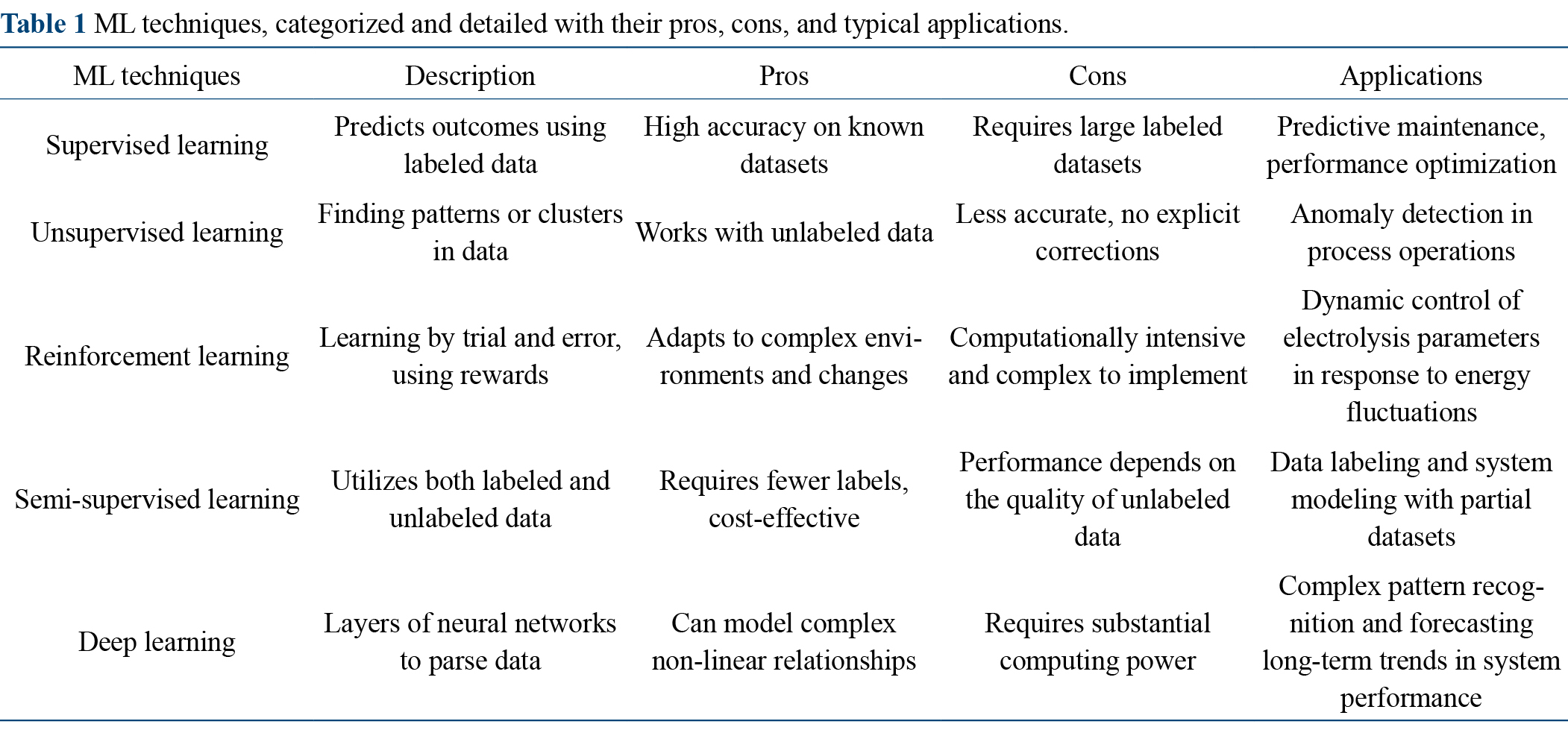
As a branch of artificial intelligence, machine learning develops algorithms capable of analyzing data to make predictions or informed decisions [60]. ML offers several advantages over other AI tools, particularly in its ability to identify complex patterns, adapt to new data, and improve performance over time without being explicitly programmed. Unlike rule-based AI systems, which rely on predefined logic, ML models can learn from large datasets, making them highly effective for predictive analytics and optimization in dynamic systems. This adaptability is especially valuable in scenarios where system behavior is influenced by multiple variables, as ML can uncover nonlinear relationships that traditional statistical methods might miss. Choosing machine learning for enhancement is particularly beneficial when dealing with large, multidimensional datasets, as it enables real-time decision-making, anomaly detection, and process optimization. In the context of digital twins, ML enhances predictive maintenance, optimizes operational parameters, and refines simulations based on continuously updated data, ultimately improving accuracy and efficiency in complex engineering applications. In industrial applications, ML techniques are used to improve efficiency, predict system failures, and optimize complex operations [61]. ML can be categorized into several types, each suited for different applications, summarized in the Table 1.
The table categorizes various ML techniques, outlining their descriptions, pros, cons, and typical applications. This provides a foundation for selecting the appropriate ML technique based on specific needs. The application of these methods in the field of green hydrogen production, particularly in enhancing the efficiency, reliability, and integration of water electrolysis systems with renewable energy sources, is discussed below.
Predictive maintenance: Supervised learning can be used to predict the failure of electrolyzer components, such as membranes, electrodes, or pumps, based on historical operational data. By recognizing patterns that precede failures, the system can alert operators to perform maintenance before a breakdown occurs, reducing downtime and maintenance costs.
Performance optimization: Supervised models can also optimize operational parameters for maximum efficiency based on input variables like temperature, pressure, and purity of input water. These models are trained on datasets where the outcomes are known, which allows them to make accurate predictions and adjustments.
Anomaly detection: In the electrolysis process, anomalies refer to unexpected deviations from normal operational behavior, which may indicate inefficiencies or potential faults. These anomalies can arise due to factors such as sensor inaccuracies, fluctuations in operating conditions, or gradual degradation of system components. Anomaly detection involves identifying these irregularities by analyzing data patterns, enabling early fault detection and system optimization. Unsupervised learning algorithms are particularly effective in this context, as they can recognize deviations without prior knowledge of specific fault conditions, helping to prevent failures and improve overall efficiency. These algorithms are ideal for detecting anomalies in the electrolysis process that might indicate inefficiencies or faults. These algorithms can identify data points that deviate from normal operational patterns, which might not be apparent and could lead to inefficiencies or potential failures.
Dynamic system control: Reinforcement learning is particularly useful in environments with high variability, like those powered by renewable energy sources. It can dynamically adjust operational parameters in real time, such as current density and voltage, to optimize hydrogen production efficiency as input power availability changes (due to variability in solar or wind energy generation). This helps in maintaining optimal performance without manual intervention.
Data labelling and system modelling: Semi-supervised learning can be employed when there are large amounts of operational data, but only some of the data points are labeled. This technique can be used to better model the water electrolysis process by using both labeled and unlabeled data to improve the accuracy of the predictive models used for both optimization and maintenance. The accuracy of semi-supervised learning in enhancing simulation models for water electrolysis is assessed through a combination of validation techniques. First, the model's predictions are compared against experimentally measured operational data to evaluate deviations and ensure consistency with real-world behavior. Performance metrics such as mean squared error (MSE), root mean squared error (RMSE), and R2 score are commonly used to quantify predictive accuracy. Additionally, cross-validation techniques help assess model generalizability by testing its performance on unseen data. For system optimization and maintenance, accuracy can also be evaluated by monitoring improvements in fault detection rates and efficiency predictions. By integrating both labeled and unlabeled data, semi-supervised learning enhances model robustness, leading to more reliable simulations of the electrolysis process.
Complex pattern recognition and forecasting: Deep learning models, particularly those involving neural networks, can be utilized to forecast long-term trends in system performance and to model complex relationships between operational parameters and system outputs [62]. These models are capable of handling multi-dimensional data and can predict outcomes like system efficiency or hydrogen production rates based on a wide range of inputs.
To maximize the benefits of ML techniques in green hydrogen production, integrating them with a DT of the water electrolysis system presents a substantial advancement. A DT, when enhanced with ML capabilities, becomes an exceptionally powerful tool for simulation, monitoring, and optimization [63]. This integrated system can simulate various operational scenarios, predict outcomes with high accuracy, and dynamically learn from real-time data to continuously improve the electrolysis process. The unique benefits of each ML technique address specific challenges within the water electrolysis context, significantly enhancing the capabilities of DTs to address operational challenges and provide tangible benefits.
Supervised learning utilizes historical data from electrolysis system sensors to predict future failures or maintenance needs. By analyzing patterns such as temperature fluctuations, pressure changes, or chemical concentrations that precede equipment failures, these algorithms enable the DT to anticipate and schedule maintenance before breakdowns occur, minimizing downtime and reducing operational costs [64].
Reinforcement learning is particularly effective in environments where operational parameters need constant adjustment based on fluctuating input conditions, such as variable renewable energy supplies. A DT equipped with reinforcement learning can dynamically adjust control settings in real time to optimize hydrogen production efficiency [65]. For example, it can modify electrolysis current density or water feed rates to adapt to changing power availability from solar or wind sources, ensuring optimal system performance under all conditions.
Anomaly detection using unsupervised learning presents a viable method for fault diagnosis in systems where obtaining labeled data is challenging or impractical. This approach involves creating a digital twin of the system to simulate a wide range of potential faults, which generates necessary training data without the high costs and complexities associated with real-world data collection [66]. By employing unsupervised domain adaptive learning, the method extracts domain-invariant features that accurately reflect both the simulated and actual operating conditions. This technique allows for the early identification and pre-emptive resolution of anomalies, thus enhancing system reliability and operational efficiency. Such a strategy is particularly advantageous in industries like hydrogen energy, where dynamic operational conditions and data limitations often hinder traditional diagnostic approaches [67].
Semi-supervised learning can leverage both labeled and unlabeled data to enhance the accuracy of the DT's simulations. This approach is particularly useful when comprehensive labeled data is scarce but abundant operational data is available. By enhancing simulation accuracy, the DT can provide more reliable decision support for operational planning and long-term strategic adjustments [68].
Deep learning can process vast amounts of complex data to simulate and predict system behavior under various hypothetical scenarios. This capability is crucial for strategic planning and risk management [69]. Scenario testing, which involves creating hypothetical future scenarios to test how systems react, serves as a powerful tool for assessing potential risks and opportunities. For instance, a DT utilizing deep learning can simulate the impacts of long-term environmental changes or new regulatory policies on hydrogen production [70]. This helps stakeholders make informed decisions regarding infrastructure investments and operational adjustments. Through scenario testing, organizations can forecast and prepare for potential risks before they materialize, thereby optimizing decision-making processes and enhancing business adaptability and competitiveness.
In practice, a DT of a green hydrogen production facility could integrate these ML techniques into a unified system. Data from IoT sensors monitoring the electrolyzer's operation feeds into ML models that analyze and predict system behavior [71]. The DT updates its simulations and predictions based on this continuous flow of real-time data, leading to an adaptive system that learns and evolves. This integrated system improves both operational efficiency and reliability while supporting the expansion of green hydrogen technologies to meet the growing demand for sustainable energy solutions.
As green hydrogen production advances, the synergy between DTs and ML technologies drives innovation, significantly improving efficiency and reliability. This combination enhances system performance, scalability, and addresses critical technical and socioeconomic challenges, ensuring sustainable and efficient hydrogen production.
The integration of reinforcement learning (RL)-driven adaptive control systems in digital twins facilitates dynamic adjustments of voltage and pressure settings in response to varying forecasts from renewable energy sources. This approach significantly enhances the efficiency of systems, particularly in scenarios where energy supply is inherently intermittent. Similarly, model predictive control (MPC) utilizes DT predictions in conjunction with rolling-horizon optimization techniques to stabilize hydrogen output during energy supply fluctuations [72]. This capability helps stabilize hydrogen output during energy supply fluctuations, minimizing disruptions and ensuring consistent production, thereby improving overall system reliability and efficiency.
Ensuring energy security is of paramount importance, encompassing not only the reliable supply of energy but also the critical aspects of energy recovery and safety [73–75]. Effective management and maintenance of energy systems are crucial to safeguard these elements [76]. Long short-term memory (LSTM) networks enhance system reliability by analyzing time-series sensor data to predict and mitigate catalyst degradation, enabling timely maintenance interventions. Additionally, generative adversarial networks (GANs) are utilized to create synthetic failure scenarios [77]. These models achieve high accuracy in anomaly detection, facilitating timely maintenance actions to prevent significant downtimes. Moreover, predictive maintenance directly enhances system safety by reducing the likelihood of sudden failures, detecting operational anomalies, and preventing hazardous conditions, such as overheating, pressure buildup, or hydrogen leakage. By identifying potential risks early, these AI-driven models contribute to safer and more resilient hydrogen production systems, reinforcing energy security through proactive system health management.
To bolster scalability and grid resilience, edge-cloud architectures deploy lightweight TinyML models on electrolyzers for sub-second operational control, while cloud-based DTs optimize long-term operational strategies. Moreover, the adoption of interoperable data standards such as OpenFMB and OPC UA frameworks seamless coupling of Electrolyzers with sustainable power grids and energy-storage systems, supporting efficient bidirectional energy flow [78].
One significant technical challenge is the misalignment between model predictions and real-time operational data. This discrepancy can significantly impair the accuracy and reliability of system forecasts and operational adjustments. To mitigate this issue, advanced methodologies such as hybrid Bayesian physics-informed neural networks (PINNs) can be employed. These networks incorporate domain-specific knowledge into the neural frameworks, thereby improving the congruence between simulated outcomes and actual performance metrics [79]. Moreover, the latency in processing real-time data presents a severe obstacle, especially in contexts requiring rapid adjustments such as grid-frequency stabilization. The delay in data handling may result in suboptimal decisions and potential system instabilities. Addressing this challenge requires deploying neuromorphic computing technologies to accelerate edge processing. These technologies enable machine learning models to deliver responses within extremely short time frames, thus facilitating prompt and effective operational responses essential for maintaining grid stability.
The substantial expenses involved in deploying DT technology limit its broader adoption, especially by small and medium-sized enterprises (SMEs). These costs stem from the complexity of integrating DT systems with existing infrastructure, the need for advanced technologies and equipment, the requirement for specialized expertise, and the continuous expenses associated with data management and analysis. To counteract this, the deployment of open-source platforms has proven pivotal. Such platforms provide SMEs with cost-effective access to sophisticated DT technologies, thereby democratizing the benefits of this innovation and broadening its applicability. Additionally, the challenge of regulatory fragmentation across different regions poses another substantial hurdle. This fragmentation can impede the seamless integration and operation of DT systems [80]. In response, the establishment of global alliances is essential. These alliances strive to harmonize safety standards and data-sharing protocols, facilitating cross-border collaboration and ensuring a standardized approach to the deployment and operation of DTs.
By addressing these challenges through strategic innovations and mitigations, the integration of DTs and ML not only propels green hydrogen production towards greater operational excellence but also sets a foundation for a sustainable, post-carbon energy landscape. This holistic approach underscores the transformative potential of these technologies in optimizing green hydrogen systems, making them more adaptable, efficient, and accessible globally.
The integration of DTs and ML in green hydrogen production presents a dynamic landscape for innovation, focusing on the advancement of co-design frameworks and the development of new benchmarking tools. A key future research direction involves the co-design of DT-ML frameworks that integrate quantum-mechanical models with federated learning for enhanced catalyst discovery. This approach promises to revolutionize catalyst development by leveraging the precision of quantum mechanics to predict material behaviors and the scalability of federated learning to optimize these predictions across multiple platforms. Such integration aims to facilitate rapid advancements in catalyst efficiency and sustainability, particularly in the optimization of materials that have not been fully realized using traditional methods.
Another significant research focus is the development of comprehensive benchmarking tools that measure adaptability to renewable energy fluctuations and interoperability within existing technological infrastructures [81]. These tools are critical for assessing the responsiveness of DTs to dynamic energy inputs and for ensuring seamless integration with diverse software systems and standards. By establishing robust metrics for adaptability and interoperability, researchers can better evaluate and improve the robustness and efficiency of hydrogen production processes.
Looking further ahead, the concept of quantum-DTs represents a transformative research direction, where DTs simulate catalyst-electrolyte interactions with quantum accuracy [82]. This precision enables the detailed modeling of interactions at the atomic level, thus providing unprecedented insights into the material processes that underpin electrolysis. The potential to accelerate the design and deployment of non-iridium-based catalysts through these simulations could significantly reduce costs and reliance on rare materials, thereby democratizing and expanding the accessibility of green hydrogen technology.
In addition, the development of autonomous hydrogen hubs is anticipated to be a major focus. These hubs would consist of self-organizing networks of electrolyzers, storage solutions, and distribution pipelines, all optimized via decentralized ML algorithms. This decentralization allows for real-time optimization based on local energy conditions and demand, thereby improving the performance and sustainability of hydrogen generation. Such systems would not only optimize energy use within each hub but also enable a more flexible, responsive infrastructure capable of adapting to market demands and technological changes.
Together, these future research directions and transformational initiatives highlight the evolving landscape of DT and ML technologies in green hydrogen production. By focusing on these hotspots, researchers and engineers can drive significant advancements in the efficiency, scalability, and sustainability of hydrogen as an essential element in worldwide energy strategies.
The integration of DTs and ML fundamentally transforms green hydrogen production into a highly adaptive and resilient process, well-suited to manage the inherent volatility associated with renewable energy sources. This technological fusion enables enhanced control and optimization, making hydrogen production not only more efficient but also more sustainable in the long run.
In addition to machine learning and digital twins, other key technologies contribute to improving green hydrogen production. Advanced electrolysis materials, including high-performance catalysts and ion-exchange membranes, enhance efficiency and durability, while automation and process control systems optimize operational parameters in real time [83]. Meanwhile, automated control systems allow real-time optimization of operating conditions, and effective integration with renewable energy sources ensures stable and cost-effective hydrogen production. Additionally, combining edge computing and IoT technologies enables immediate data processing and remote monitoring capabilities, enhancing reliability and responsiveness. With further advancements in AI, integration with Industry 4.0 technologies like industrial IoT (IIoT), smart automation, and predictive analytics will improve predictive maintenance, adaptive operational control, and decision-making efficiency. Human-machine interaction supported by AI interfaces, augmented reality (AR), and intelligent digital assistants will also become essential for efficient management and intervention within hydrogen production systems.
Overall, ongoing developments AI, combined with digital twin technology and other advanced methods, will enable more resilient, adaptive, and autonomous hydrogen production systems. Such integration will significantly support the achievement of global sustainability and energy security goals.
To fully realize this transformative vision, a collaborative and multi-disciplinary approach is essential:
Academic institutions must take the lead in pioneering interdisciplinary research that merges with electrochemistry, artificial intelligence, and systems engineering. This research will lay the foundational knowledge necessary to drive innovations in hydrogen production.
The industry sector should embrace open innovation models that facilitate the sharing of anonymized operational data. Such collaboration is crucial for training robust ML systems that can enhance the accuracy and efficiency of DTs.
Policymakers play a critical role by establishing funding mechanisms, such as hydrogen AI sandboxes, and crafting global standards that reduce risks associated with large-scale deployments of green hydrogen technologies.
By aligning these efforts across academia, industry, and policy-making spheres, green hydrogen could evolve from an emerging energy source into a cornerstone of a sustainable, post-carbon economy. This shift not only supports environmental goals but also promotes economic stability and energy security globally, underscoring the profound impact of integrating cutting-edge technologies in traditional energy sectors.
L. Li, J. Yang, R. Tan, W. Shu, C. J. Low, Z. Zhang, Y. Zhao, C. Li, Y. Zhang, and X. Li, "Large-scale current collectors for regulating heat transfer and enhancing battery safety," Nature Chemical Engineering, vol. 1, no. 8, pp. 542–551, 2024.
X. Yang, W. Kong, G. Du, S. Li, Y. Tang, J. Cao, X. Lu, R. Tan, and G. Qian, "Synthesis of a yolk-shell nanostructured silicon-based anode for high-performance Li-ion batteries," Batteries, vol. 9, no. 9, p. 446, 2023.
X. Tian, C. Ye, L. Zhang, M. K. Sugumar, Y. Zhao, N. B. McKeown, S. Margadonna, and R. Tan, "Enhancing membrane materials for efficient Li recycling and recovery," Advanced Materials, vol. 37, no. 5, p. 2402335, 2025.
Y. Gan, M. Liu, R. Tan, C. Pan, L. Liu, S. Zhou, Z. Zou, G. Chen, L. Xian, and X. Cheng, "Flame-retardant crosslinked polymer stabilizes graphite-silicon composite anode for self-extinguishing lithium-ion batteries," Advanced Energy Materials, vol. 12, no. 45, p. 2202779, 2022.
M. Zhang, R. Tan, M. Wang, Z. Zhang, C. John Low, and Y. Lai, "Hypercrosslinked porous and coordination polymer materials for electrolyte membranes in lithium‐metal batteries," Battery Energy, vol. 3, no. 2, p. 20230050, 2024.
K. Chu, B. Weng, Z. Lu, Y. Ding, W. Zhang, R. Tan, Y. M. Zheng, and N. Han, "Exploration of multidimensional structural optimization and regulation mechanisms: Catalysts and reaction environments in electrochemical ammonia synthesis," Advanced Science, 2025, early view, p. 2416053, DOI 10.1002/advs.202416053.
C. Shi, Z. Li, M. Wang, S. Hong, B. Hong, Y. Fu, D. Liu, R. Tan, P. Wang, and Y. Lai, "Electrolyte tailoring and interfacial engineering for safe and high-temperature lithium-ion batteries," Energy & Environmental Science, 2025, advance article, DOI 10.1039/D4EE05263C.
Y. Feng, R. Tan, Y. Zhao, R. Gao, L. Yang, J. Yang, H. Li, G. Zhou, H. Chen, and F. Pan, "Insight into fast ion migration kinetics of a new hybrid single Li-ion conductor based on aluminate complexes for solid-state Li-ion batteries," Nanoscale, vol. 10, no. 13, pp. 5975–5984, 2018.
R. Tan and J. Yong, "Scalable graphene current collectors for enhanced thermal management in batteries," Nature Chemical Engineering, vol. 1, no. 8, pp. 506–507, 2024.
R. Tan, A. Wang, C. Ye, J. Li, D. Liu, B. P. Darwich, L. Petit, Z. Fan, T. Wong, and A. Alvarez‐Fernandez, "Thin film composite membranes with regulated crossover and water migration for long‐life aqueous redox flow batteries," Advanced Science, vol. 10, no. 20, p. 2206888, 2023.
Y. Xia, M. Ouyang, V. Yufit, R. Tan, A. Regoutz, A. Wang, W. Mao, B. Chakrabarti, A. Kavei, and Q. Song, "A cost-effective alkaline polysulfide-air redox flow battery enabled by a dual-membrane cell architecture," Nature Communications, vol. 13, no. 1, p. 2388, 2022.
A. Wang, R. Tan, D. Liu, J. Lu, X. Wei, A. Alvarez‐Fernandez, C. Ye, C. Breakwell, S. Guldin, and A. R. Kucernak, "Ion‐selective microporous polymer membranes with hydrogen‐bond and salt‐bridge networks for aqueous organic redox flow batteries," Advanced Materials, vol. 35, no. 12, p. 2210098, 2023.
C. Ye, R. Tan, A. Wang, J. Chen, B. Comesaña Gándara, C. Breakwell, A. Alvarez‐Fernandez, Z. Fan, J. Weng, and C. G. Bezzu, "Long‐life aqueous organic redox flow batteries enabled by amidoxime‐functionalized ion‐selective polymer membranes," Angewandte Chemie International Edition, vol. 134, no. 38, p. e202207580, 2022.
R. Tan, A. Wang, R. Malpass-Evans, R. Williams, E. W. Zhao, T. Liu, C. Ye, X. Zhou, B. P. Darwich, and Z. Fan, "Hydrophilic microporous membranes for selective ion separation and flow-battery energy storage," Nature Materials, vol. 19, no. 2, pp. 195–202, 2020.
A. M. Oliveira, R. R. Beswick, and Y. Yan, "A green hydrogen economy for a renewable energy society," Current Opinion in Chemical Engineering, vol. 33, p. 100701, 2021.
Z. Feng, G. Gupta, and M. Mamlouk, "Robust poly (p‐phenylene oxide) anion exchange membranes reinforced with pore‐filling technique for water electrolysis," Journal of Applied Polymer Science, vol. 141, p. e55340, 2024.
S. Li, G. Liao, D. Bildan, Z. Feng, H. Cai, J. Han, Z. Xin, K. Liu, Q. Li, J. Shang, and T. X. Liu, "Performance enhancement for direct borohydride fuel cells through ternary Ru–Co–B oxide catalyst," International Journal of Hydrogen Energy, vol. 67, pp. 448–457, 2024.
S. Li, Z. Xin, Y. Luo, J. Pan, G. Liao, Q. Li, Y. Sun, Z. Feng, and R. Tan, "Recent advances in the development of single-atom catalysts for oxygen evolution reaction," International Journal of Hydrogen Energy, vol. 82, pp. 1081–1100, 2024.
F. Zhan, L. Huang, Y. Luo, M. Chen, R. Tan, X. Liu, G. Liu, and Z. Feng, "Recent advances on support materials for enhanced Pt-based catalysts: Applications in oxygen reduction reactions for electrochemical energy storage," Journal of Materials Science, vol. 60, no. 5, pp. 2199–2223, 2025.
V. Venizelou and A. Poullikkas, "The effect of carbon price towards green hydrogen power generation," Renewable and Sustainable Energy Reviews, vol. 211, p. 115254, 2025.
D. Li, J. Liu, X. Chen, Z. Feng, S. Wang, Y. Wang, N. Lin, J. Wu, and Y. Feng, "Regulation of coordinated nitrogen species for atomically dispersed Fe-N5 catalyst to boost electrocatalytic CO2-to-CO conversion," Applied Catalysis B: Environment and Energy, vol. 365, p. 124824, 2025.
B. van der Zwaan, A. Fattahi, F. Dalla Longa, M. Dekker, D. van Vuuren, R. Pietzcker, R. Rodrigues, F. Schreyer, D. Huppmann, J. Emmerling, S. Pfenninger, F. Lombardi, P. Fragkos, M. Kannavou, T. Fotiou, G. Tolios, and W. Usher, "Electricity- and hydrogen-driven energy system sector-coupling in net-zero CO2 emission pathways," Nature Communications, vol. 16, no. 1, p. 1368, 2025.
K. Hu, Y. Zhang, J. Zhu, J. Mai, G. Liu, M. K. Sugumar, X. Liu, F. Zhan, and R. Tan, "Nano-engineered catalysts for high-performance oxygen reduction reaction," Chinese Chemical Letters, vol. 35, no. 10, p. 109423, 2024.
Z. Feng, G. Gupta, and M. Mamlouk, "A review of anion exchange membranes prepared via Friedel-crafts reaction for fuel cell and water electrolysis," International Journal of Hydrogen Energy, vol. 48, no. 66, pp. 25830–25858, 2023.
Y. Luo, Y. Zhang, J. Zhu, X. Tian, G. Liu, Z. Feng, L. Pan, X. Liu, N. Han, and R. Tan, "Material engineering strategies for efficient hydrogen evolution reaction catalysts," Small Methods, vol. 8, no. 12, p. e2400158, 2024.
S. K. Singh and A. K. Tiwari, "Solar-powered hydrogen production: Advancements, challenges, and the path to net-zero emissions," International Journal of Hydrogen Energy, vol. 84, pp. 549–579, 2024.
Q. Li, W. Chen, Z. Liu, A. Guo, and S. Liu, "Control of proton exchange membrane fuel cell system breathing based on maximum net power control strategy," Journal of Power Sources, vol. 241, pp. 212–218, 2013.
D. Li, S. Xie, J. Liang, B. Ma, J. Fu, J. Wu, Y. Feng, and Z. Feng, "Structure regulated CuSn alloy catalyst for selective electrochemical CO2-to-formate conversion at higher current densities," Separation and Purification Technology, vol. 340, p. 126545, 2024.
S. Jin, Y. Cao, M. Burd, S. Tindale, Z. Feng, O. Green, P. Newell‐Price, V. Vicario‐Modroño, G. Mack, P. Sánchez‐Zamora, R. Gallardo‐Cobos, M. Spörri, N. El Benni, N. Alonso, S. Miškolci, S. Outhwaite, E. Hunter, and L. J. Frewer, "Farmer identities and permanent grassland management: Evidence from five European biogeographic zones," People and Nature, vol. 6, no. 6, pp. 2228–2245, 2024.
Y. Bian, Y. Zhang, T. Wang, C. Yang, Z. Feng, K.-L. Goh, Y. Zhou, and M. Zheng, "Insights into the enzymatic synthesis of alcoholic flavor esters with molecular docking analysis," LWT, vol. 200, p. 116206, 2024.
X. Chen, R. Zhang, Y. Mao, L. Zhong, P. Lin, Q. Deng, B. Zheng, H. Shen, Z. Feng, and H. Zhang, "Development of a toughened and antibacterial poly(lactide acid) (PLA) with preserved strength by elemental sulfur-based bio-renewable dynamically crosslinked elastomers," Chemical Engineering Journal, vol. 467, p. 143419, 2023.
J. Mai, Y. Zhang, H. He, Y. Luo, X. Zhou, K. Hu, G. Liu, M. K. Sugumar, C. T. John Low, X. Liu, and R. Tan, "Metal-support interface engineering for stable and enhanced hydrogen evolution reaction," Materials Today Chemistry, vol. 38, p. 102079, 2024.
L. L. Tian, J. Yang, M. Y. Weng, R. Tan, J. X. Zheng, H. B. Chen, Q. C. Zhuang, L. M. Dai, and F. Pan, "Fast diffusion of O2 on nitrogen-doped graphene to enhance oxygen reduction and its application for high-rate zn-air batteries," ACS Applied Materials & Interfaces Journal, vol. 9, no. 8, pp. 7125–7130, 2017.
S. Li, Z. Xin, J. Han, Z. Feng, G. Liao, S. Wang, K. Liu, Q. Li, T. X. Liu, and M. Bayati, "Pt@Co-B catalyzed direct borohydride fuel cell anode: Rational design and performance evaluation," Ionics, vol. 30, no. 11, pp. 7213–7222, 2024.
X. Li, Y. Zhao, Z. Feng, X. Xiang, S. Wang, X. Xie, and V. K. Ramani, "Ring-opening metathesis polymerization for the preparation of polynorbornene-based proton exchange membranes with high proton conductivity," Journal of Membrane Science, vol. 528, pp. 55–63, 2017.
Z. Feng, G. Gupta, and M. Mamlouk, "Degradation of QPPO-based anion polymer electrolyte membrane at neutral pH," RSC Advances, vol. 13, no. 29, pp. 20235–20242, 2023.
Y. Deng, Q. Qin, W. He, H. Guo, and J. Chen, "A highly efficient electrolysis system enabled by direct impedance matching between a charge migration triboelectric nanogenerator and series connected Electrolyzers," Energy & Environmental Science, vol. 18, pp. 2940–2948, 2025.
C. Wang, Z. Feng, Y. Zhao, X. Li, W. Li, X. Xie, S. Wang, and H. Hou, "Preparation and properties of ion exchange membranes for PEMFC with sulfonic and carboxylic acid groups based on polynorbornenes," International Journal of Hydrogen Energy, vol. 42, no. 50, pp. 29988–29994, 2017.
H. Lange, A. Klose, W. Lippmann, and L. Urbas, "Technical evaluation of the flexibility of water electrolysis systems to increase energy flexibility: A review," International Journal of Hydrogen Energy, vol. 48, no. 42, pp. 15771–15783, 2023.
H. Hao, R. Tan, C. Ye, and C. T. J. Low, "Carbon‐coated current collectors in lithium‐ion batteries and supercapacitors: Materials, manufacture and applications," Carbon Energy, vol. 6, no. 12, p. e604, 2024.
J. Yang, J. Hu, M. Weng, R. Tan, L. Tian, J. Yang, J. Amine, J. Zheng, H. Chen, and F. Pan, "Fe-cluster pushing electrons to N-doped graphitic layers with Fe3CFe hybrid nanostructure to enhance O2 reduction catalysis of Zn-air batteries," ACS Applied Materials & Interfaces Journal, vol. 9, no. 5, pp. 4587–4596, 2017.
G. Liao, S. Li, Y. Luo, Z. Xin, Q. Li, R. Tan, K. Zhang, and Z. Feng, "Plasma-synthesized Ru-B double oxides catalysts for enhanced fuel cell performance," Journal of Alloys and Compounds, vol. 1013, p. 178599, 2025.
Y. Luo, Y. Qiao, H. He, M. Chen, G. Liu, X. Liu, L. Pan, Z. Feng, and R. Tan, "Rapid synthesis of PtRu nanoparticles on aniline-modified SWNTs in EMSI engineering for enhanced alkaline water electrolysis," Journal of Power Sources, vol. 631, p. 236297, 2025.
C. Xiang, K. M. Papadantonakis, and N. S. Lewis, "Principles and implementations of electrolysis systems for water splitting," Materials Horizons, vol. 3, no. 3, pp. 169–173, 2016.
A. Badgett, M. Ruth, B. James, and B. Pivovar, "Methods identifying cost reduction potential for water electrolysis systems," Current Opinion in Chemical Engineering, vol. 33, p. 100714, 2021.
J. Lai, R. Tan, H. Jiang, X. Huang, Z. Tian, B. Hong, M. Wang, and J. Li, "Development of an in situ polymerized artificial layer for dendrite‐free and stable lithium metal batteries," Battery Energy, vol. 3, no. 4, p. 20230070, 2024.
D. Jang, W. Choi, H.-S. Cho, W. C. Cho, C. H. Kim, and S. Kang, "Numerical modeling and analysis of the temperature effect on the performance of an alkaline water electrolysis system," Journal of Power Sources, vol. 506, p. 230106, 2021.
Z. Feng, S. Jin, H. Xiang, D. Li, S. Sun, H. Zhang, and Y. Chen, "Artificial intelligence-based optimization for ring-opening metathesis polymerization of proton exchange membrane," Journal of Polymer Research, vol. 30, art. no. 418, 2023.
X. Tian, S. Zhou, H. Hao, H. Ruan, R. R. Gaddam, R. C. Dutta, T. Zhu, H. Wang, B. Wu, N. P. Brandon, and R. Tan, "Machine learning and density functional theory for catalyst and process design in hydrogen production," Chain, vol. 1, no. 2, pp. 150–166, 2024.
J. Mao, Z. Li, J. Xuan, X. Du, M. Ni, and L. Xing, "A review of control strategies for proton exchange membrane (PEM) fuel cells and water electrolyzers: From automation to autonomy," Energy and AI, vol. 17, p. 100406, 2024.
Z. Feng, J. Huang, S. Jin, G. Wang, and Y. Chen, "Artificial intelligence-based multi-objective optimisation for proton exchange membrane fuel cell: A literature review," Journal of Power Sources, vol. 520, p. 230808, 2022.
Y. Zhao, M. Wang, J. Xuan, D. Chang, Z. Li, S. Wang, Y. Ou, X. Wang, and L. Xing, "Physics-based and data-driven hybrid modelling and optimisation of stirred-slurry reactors for CO2 capture via enhanced weathering of dolomite mineral," Carbon Capture Science & Technology, vol. 14, p. 100363, 2025.
Z. Feng, I. Eiubovi, Y. Shao, Z. Fan, and R. Tan, "Review of digital twin technology applications in hydrogen energy," Chain, vol. 1, no. 1, pp. 54–74, 2024.
M. M. Rathore, S. A. Shah, D. Shukla, E. Bentafat, and S. Bakiras, "The role of AI, machine learning, and big data in digital twinning: A systematic literature review, challenges, and opportunities," IEEE Access, vol. 9, pp. 32030–32052, 2021.
M. Fahim, V. Sharma, T.-V. Cao, B. Canberk, and T. Q. Duong, "Machine learning-based digital twin for predictive modeling in wind turbines," IEEE Access, vol. 10, pp. 14184–14194, 2022.
S. Alsaleh, A. Tepljakov, A. Kose, J. Belikov, and E. Petlenkov, "Reimagine lab: bridging the gap between hands-on, virtual and remote control engineering laboratories using digital twins and extended reality," IEEE Access, vol. 10, pp. 89924–89943, 2022.
X. Wang, S. L. Clegg, and D. Di Tommaso, "Bridging atomistic simulations and thermodynamic hydration models of aqueous electrolyte solutions," The Journal of Chemical Physics, vol. 156, no. 2, p. 024502, 2022.
S. Liu, Y. Lu, J. Li, D. Song, X. Sun, and J. Bao, "Multi-scale evolution mechanism and knowledge construction of a digital twin mimic model," Robotics and Computer-Integrated Manufacturing, vol. 71, p. 102123, 2021.
P. C. Yang, A. Rose, K. R. DeMarco, J. R. D. Dawson, Y. Han, M. T. Jeng, R. D. Harvey, L. F. Santana, C. M. Ripplinger, I. Vorobyov, T. J. Lewis, and C. E. Clancy, "A multiscale predictive digital twin for neurocardiac modulation," J Physiology, vol. 601, no. 17, pp. 3789–3812, 2023.
A. A. Ahmed, S. Sayed, A. Abdoulhalik, S. Moutari, and L. Oyedele, "Applications of machine learning to water resources management: A review of present status and future opportunities," Journal of Cleaner Production, vol. 441, p. 140715, 2024.
M. Cerezo, G. Verdon, H. Y. Huang, L. Cincio, and P. J. Coles, "Challenges and opportunities in quantum machine learning," Nature Computational Science, vol. 2, no. 9, pp. 567–576, 2022.
X. Wang, D. Quinn, T. S. Moody, and M. Huang, "ALDELE: All-purpose deep learning toolkits for predicting the biocatalytic activities of enzymes," Journal of Chemical Information and Modeling, vol. 64, no. 8, pp. 3123–3139, 2024.
X. Li, Q. Zhan, B. Sun, H. Feng, Y. Zeng, H. Wang, X. Yang, and W.-Y. Yin, "Scientific machine learning enables multiphysics digital twins of large-scale electronic chips," IEEE Transactions on Microwave Theory and Techniques, vol. 70, no. 12, pp. 5305–5318, 2022.
R. van Dinter, B. Tekinerdogan, and C. Catal, "Predictive maintenance using digital twins: A systematic literature review," Information and Software Technology, vol. 151, p. 107008, 2022.
G. Shen, L. Lei, X. Zhang, Z. Li, S. Cai, and L. Zhang, "Multi-UAV cooperative search based on reinforcement learning with a digital twin driven training framework," IEEE Transactions on Vehicular Technology, vol. 72, no. 7, pp. 8354–8368, 2023.
S. A. Cancemi, R. Lo Frano, C. Santus, and T. Inoue, "Unsupervised anomaly detection in pressurized water reactor digital twins using autoencoder neural networks," Nuclear Engineering and Design, vol. 413, p. 112502, 2023.
Z. Sun, Y. Wang, and Z. Chen, "Fault diagnosis method for proton exchange membrane fuel cell system based on digital twin and unsupervised domain adaptive learning," International Journal of Hydrogen Energy, vol. 50, pp. 1207–1219, 2024.
Y. Qi and M. S. Hossain, "Semi-supervised federated learning for digital twin 6G-enabled IIoT: A Bayesian estimated approach," Journal of Advanced Research, vol. 66, pp. 47–57, 2024.
J. Lai, Z. Chen, J. Zhu, W. Ma, L. Gan, S. Xie, and G. Li, "Deep learning based traffic prediction method for digital twin network," Cognitive Computation, vol. 15, pp. 1748–1766, 2023.
A. P. Renold and N. S. Kathayat, "Comprehensive review of machine learning, deep learning, and digital twin data-driven approaches in battery health prediction of electric vehicles," IEEE Access, vol. 12, pp. 43984–43999, 2024.
Y. Song, Z. Chen, Y. Zhou, D. Fang, Y. Lu, R. Xiao, and D. Zeng, "Digital twins based on machine learning for optimal control of chemical looping hydrogen generation processes," International Journal of Hydrogen Energy, vol. 61, pp. 568–577, 2024.
J. Li, W. Xie, H. Li, X. Qian, J. Shi, Z. Xie, Q. Wang, X. Zhang, and G. Chen, "Real-time hydrogen release and dispersion modelling of hydrogen refuelling station by using deep learning probability approach," International Journal of Hydrogen Energy, vol. 51, pp. 794–806, 2024.
B. Zou, L. Zhang, X. Xue, R. Tan, P. Jiang, B. Ma, Z. Song, and W. Hua, "A review on the fault and defect diagnosis of lithium-ion battery for electric vehicles," Energies, vol. 16, no. 14, p. 5507, 2023.
B. Zou, M. Xiong, H. Wang, W. Ding, P. Jiang, W. Hua, Y. Zhang, L. Zhang, W. Wang, and R. Tan, "A deep learning approach for state-of-health estimation of lithium-ion batteries based on a multi-feature and attention mechanism collaboration," Batteries, vol. 9, no. 6, p. 329, 2023.
R. Tan, J. Yang, J. Zheng, K. Wang, L. Lin, S. Ji, J. Liu, and F. Pan, "Fast rechargeable all-solid-state lithium-ion batteries with high capacity based on nano-sized Li2FeSiO4 cathode by tuning temperature," Nano Energy, vol. 16, pp. 112–121, 2015.
W. Wang, K. Yang, L. Zhang, S. Zhou, B. Ren, Y. Lu, R. Tan, T. Zhu, B. Ma, and S. Yang, "An end-cloud collaboration approach for online state-of-health estimation of lithium-ion batteries based on multi-feature and transformer," Journal of Power Sources, vol. 608, p. 234669, 2024.
A. Aggarwal, M. Mittal, and G. Battineni, "Generative adversarial network: An overview of theory and applications," International Journal of Information Management Data Insights, vol. 1, no. 1, p. 100004, 2021.
M. Tanjimuddin, P. Kannisto, P. Jafary, M. Filppula, S. Repo, and D. Hästbacka, "A comparative study on multi-agent and service-oriented microgrid automation systems from energy internet perspective," Sustainable Energy, Grids and Networks, vol. 32, p. 100856, 2022.
S. Yang, H. Kim, Y. Hong, K. Yee, R. Maulik, and N. Kang, "Data-driven physics-informed neural networks: A digital twin perspective," Computer Methods in Applied Mechanics and Engineering, vol. 428, p. 117075, 2024.
A. Hakiri, A. Gokhale, S. B. Yahia, and N. Mellouli, "A comprehensive survey on digital twin for future networks and emerging internet of things industry," Computer Networks, vol. 244, p. 110350, 2024.
R. Biswas and U. Roy, "Mimicking photon source measurement with quantum digital twin: A framework for high-quality randomness," International Journal of Information Technology, Research and Applications, vol. 3, no. 1, pp. 26–34, 2024.
Z. Lv, C. Cheng, and H. Song, "Digital twins based on quantum networking," IEEE Network, vol. 36, no. 5, pp. 88–93, 2022.
 Top
Top