

Steering the future: Redefining intelligent transportation systems with foundation models AITranslate
Abstract AITranslate
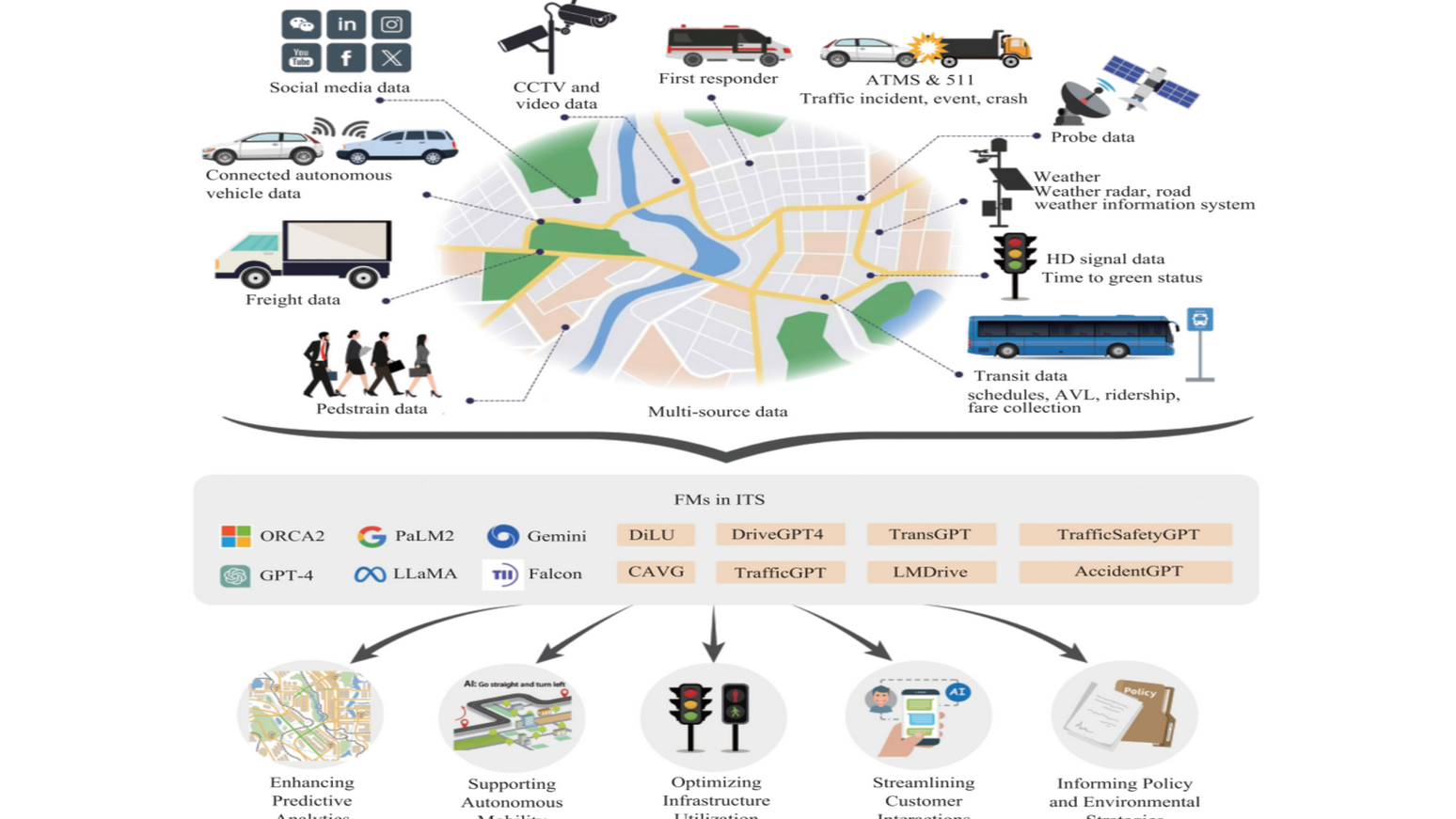
At the intersection of artificial intelligence and urban development, this paper unveils the pivotal role of Foundation Models (FMs) in revolutionizing Intelligent Transportation Systems (ITS). Against the backdrop of escalating urbanization and environmental concerns, we rigorously assess how FMs—spanning large language models, vision-language models, large multimodal models, etc.—can redefine urban mobility paradigms. Our discussion extends to the potential of modular, scalable models and strategic public-private partnerships in facilitating seamless integration. Through a comprehensive literature review and theoretical framework, this paper underscores the significant role of FMs in steering the future of transportation towards unprecedented levels of intelligence and responsiveness. The insights offered aim to guide policymakers, engineers, and researchers in the ethical and effective adoption of FMs, paving the way for a new era in transportation systems.
KeyWords AITranslate
[1]E. A. M. Van Dis, J. Bollen, W. Zuidema, R. van Rooij, and C. L. Bockting. "Chatgpt: Five priorities for research," Nature, vol. 614, no. 7947, pp. 224–226, 2023.
[2]F.-Y. Wang, Q. H. Miao, X. Li, X. G. Wang, and Y. L. Lin. "What does chatgpt say: The DAO from algorithmic intelligence to linguistic intelligence," IEEE/CAA Journal of Automatica Sinica, vol. 10, no. 3, pp. 575–579, 2023.
[3]Y. Liu, F. Y. Wu, Z. Y. Liu, K. Wang, F. Y. Wang, and X. B. Qu. "Can language models be used for real-world urban-delivery route optimization?" The Innovation, vol. 4, no. 6, p. 100520, 2023.
[4]M. Jin, S. Y. Wang, L. T. Ma, Z. X. Chu, J. Y. Zhang, X. M. Shi, P. Y. Chen, Y. X. Liang, Y.-F. Li, S. R. Pan, and Q. S. Wen, "Time-LLM: Time series forecasting by reprogramming large language models,"International Conference on Learning Representations (ICLR), Vienna Austria, May 7th, 2023.
[5]S. Y. Wang, Y. X. Zhu, Z. H. Li, Y. T. Wang, L. Li, and Z. B. He, "Chatgpt as your vehicle co-pilot: An initial attempt," IEEE Transactions on Intelligent Vehicles, vol. 8, no. 12, 4706–4721, 2023.
[6]D. Shah, B. Osi´nski, and S. Levine, "LM-Nav: Robotic navigation with large pre-trained models of language, vision, and action,"Conference on Robot Learning. PMLR, 2023, pp. 492–504.
[7]F.-Y. Wang, Y. L. Lin, P. A. Ioannou, L. Vlacic, X. M. Liu, A. Eskandarian, Y. S. Lv, X. X. Na, D. Cebon, and J. Q. Ma, et al."Transportation 5.0: The DAO to safe, secure, and sustainable intelligent transportation systems," IEEE Transactions on Intelligent Transportation Systems, vol. 24, no. 10, pp. 10262–10278, 2023.
[8]P. Wang, X. Wei, F. X. Hu, and W. J. Han, "TransGPT: Multi-modal generative pre-trained transformer for transportation," arXiv preprint arXiv:2402. 07233, 2023.
[9]S. Y. Zhang, D. C. Fu, Z. Zhang, B. Yu, and P. L. Cai. "TrafficGPT: Viewing, processing and interacting with traffic foundation models," arXiv preprint arXiv:2309. 06719, 2023.
[10]H. C. Liao, H. M. Shen, Z. N. Li, C. Y. Wang, G. F. Li, Y. M. Bie, and C. Z. Xu, "GPT-4 enhanced multimodal grounding for autonomous driving: Leveraging cross-modal attention with large language models," Communications in Transportation Research, vol. 4, p. 100116, 2023.
[11]O. Zheng, M. Abdel-Aty, D. D. Wang, C. Z. Wang, and S. X. Ding, "Trafficsafetygpt: Tuning a pre-trained large language model to a domain-specific expert in transportation safety," arXiv preprint arXiv:2307.15311, 2023.
[12]L. N. Wang, H. Jiang, P. L. Cai, D. C. Fu, T. Q. Wang, Z. Y. Cui, Y. L. Ren, H. Y. Yu, X. S. Wang, and Y. H. Wang, "Accidentgpt: Accident analysis and prevention from V2X environmental perception with multi-modal large model," arXiv preprint arXiv:2312. 13156, 2023.
[13]O. Zheng, M. Abdel-Aty, D. Wang, Z. J. Wang, and S. X. Ding, "Chatgpt is on the horizon: Could a large language model be all we need for intelligent transportation?" arXiv preprint arXiv:2303.05382, 2023.
[14]H. P. Du, S. Y. Teng, H. Chen, J. Q. Ma, X. Wang, C. Gou, B. Li, S. J. Ma, Q. H. Miao, and X. X. Na, et al., "Chat with chatgpt on intelligent vehicles: An ieee TIV perspective," IEEE Transactions on Intelligent Vehicles, vol. 8, no. 3, pp. 2020–2026, 2023.
[15]H. Chen, K. Yuan, Y. J. Huang, L. L. Guo, Y. L. Wang, and J. Chen, "Feedback is all you need: From chatgpt to autonomous driving," Science China Information Sciences, vol. 66, no. 6, pp. 1–3, 2023.
Basic Information:
DOI:10.23919/CHAIN.2024.100003
Chinese Library Classification Number:
Citation Information:
At the intersection of artificial intelligence and urban development, this paper unveils the pivotal role of Foundation Models (FMs) in revolutionizing Intelligent Transportation Systems (ITS). Against the backdrop of escalating urbanization and environmental concerns, we rigorously assess how FMs—spanning large language models, vision-language models, large multimodal models, etc.—can redefine urban mobility paradigms. Our discussion extends to the potential of modular, scalable models and strategic public-private partnerships in facilitating seamless integration. Through a comprehensive literature review and theoretical framework, this paper underscores the significant role of FMs in steering the future of transportation towards unprecedented levels of intelligence and responsiveness. The insights offered aim to guide policymakers, engineers, and researchers in the ethical and effective adoption of FMs, paving the way for a new era in transportation systems.
quote
| GB/T 7714-2015 | [1] Zhenning Li, Zhiyong Cui, Haicheng Liao, et al. Steering the future: Redefining intelligent transportation systems with foundation models[J]. Chain, 2024, 1(1): 46-53. DOI:10.23919/CHAIN.2024.100003. |
| MLA | [1] Zhenning Li, et al., "Steering the future: Redefining intelligent transportation systems with foundation models." Chain, vol. 1, no. 1, 2024, pp. 46-53, https://doi.org/10.23919/CHAIN.2024.100003. |
| APA | [1] Zhenning Li, Zhiyong Cui, Haicheng Liao, John Ash, Guohui Zhang, Chengzhong Xu, & Yinhai Wang. (2024). Steering the future: Redefining intelligent transportation systems with foundation models. Chain, 1(1), 46-53. https://doi.org/10.23919/CHAIN.2024.100003 |
| IEEE | [1] Zhenning Li, Zhiyong Cui, Haicheng Liao, John Ash, Guohui Zhang, Chengzhong Xu, and Yinhai Wang, "Steering the future: Redefining intelligent transportation systems with foundation models," Chain, vol. 1, no. 1, pp. 46-53, 2024, doi: 10.23919/CHAIN.2024.100003. keywords: {foundation models;intelligent transportation systems;urban mobility;artificial intelligence;autonomous vehicles} |