ContentsFigures & Tables
The advent of foundation models (FMs) in intelligent transportation systems (ITS) heralds a significant evolution in urban mobility, bringing us to the cusp of a new era dominated by advanced automation, increased efficiency, and unprecedented safety within urban transportation networks [1]. This integration of sophisticated models, including large language models (LLMs), vision-language models (VLFs), and large multimodal models (LMMs), plays a crucial role. Notably, the deployment of state-of-the-art models such as GPT-4, LLaMA, PaLM, and FLAN epitomizes this transformation. Their remarkable abilities in processing extensive datasets, comprehending complex linguistic nuances, and generating insightful outputs are reshaping ITS. These advancements enable the transformation of abundant data streams into actionable intelligence, ensuring transportation systems are more adaptable and responsive to the ever-changing urban environment [2].
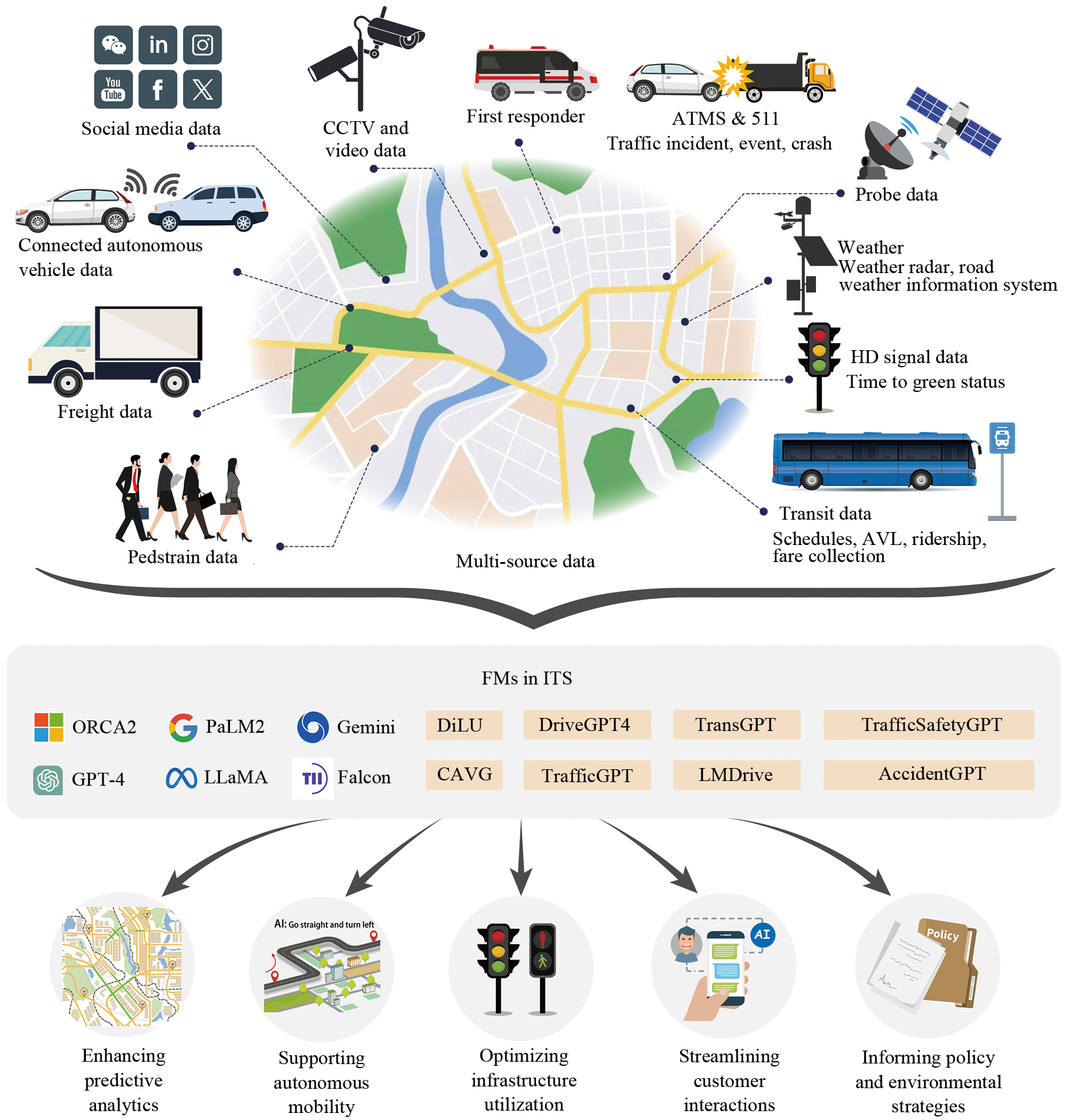
FMs transcend traditional data analytics by fostering a nuanced understanding of human language and contextual subtleties. This deep comprehension is pivotal in designing transportation solutions that seamlessly align with user needs. By refining algorithms for route optimization [3], enhancing the precision of traffic predictions [4], and facilitating smoother communication between vehicles and users [5], FMs significantly boost the operational efficiency of ITS. Furthermore, they enhance the reliability and safety of navigation systems [6], underscoring their invaluable contribution to urban transportation. The generative capabilities of FMs also play a transformative role by enabling the creation of detailed simulation environments [7]. These simulations are vital for the thorough testing and development of ITS applications, offering a sandbox for innovation and refinement. Together with their adaptive learning abilities, FMs drive the continuous evolution of ITS, ensuring it remains in step with the dynamic shifts in urban landscapes and traffic patterns. This evolution presents a resilient framework designed to overcome emerging challenges, highlighting the robust adaptability of FMs in ITS. This adaptability finds tangible expression through fine-tuning or retrieval augmentation generation techniques applied to LLMs, as epitomized by initiatives such as TransGPT [8], TrafficGPT [9], CAVG [10], TrafficSafetyGPT [11], AccidentGPT [12]. These endeavors effectively extend the transformative potential of FMs to diverse applications within the ambit of ITS, thus augmenting their efficacy and relevance within this critical domain.
However, the integration of FMs into ITS is accompanied by substantial challenges. Issues such as data privacy concerns, the complexity of model interpretability, and the substantial computational resources required pose significant obstacles. The ethical application of FMs is also critical, requiring rigorous oversight to prevent biases and guarantee fairness in algorithmic decision-making. Addressing these challenges necessitate a comprehensive strategy that balances technological innovation with ethical considerations, privacy protection, and resource efficiency.
This paper delves deep into the transformative potential of FMs in ITS, exploring their current applications, technological advancements, and the hurdles encountered in their integration. By charting a path forward for embedding these advanced AI technologies within transportation infrastructures, our analysis contributes to the broader discourse on harnessing AI to create safer, more efficient, and sustainable urban environments. Through this exploration, we emphasize the indispensable role of FMs in advancing ITS, advocating for a holistic strategy that melds technological potential with critical ethical, privacy, and resource considerations.
FMs have emerged as a transformative force in artificial intelligence, characterized by their vast data-driven learning capabilities that extend across multiple tasks without the need for task-specific programming. These models, primarily built on advanced neural network architectures like transformers, have significantly advanced the field by enabling deep understanding and generation of natural language, recognizing complex patterns, and providing insights that were previously unattainable with more narrowly focused AI models.
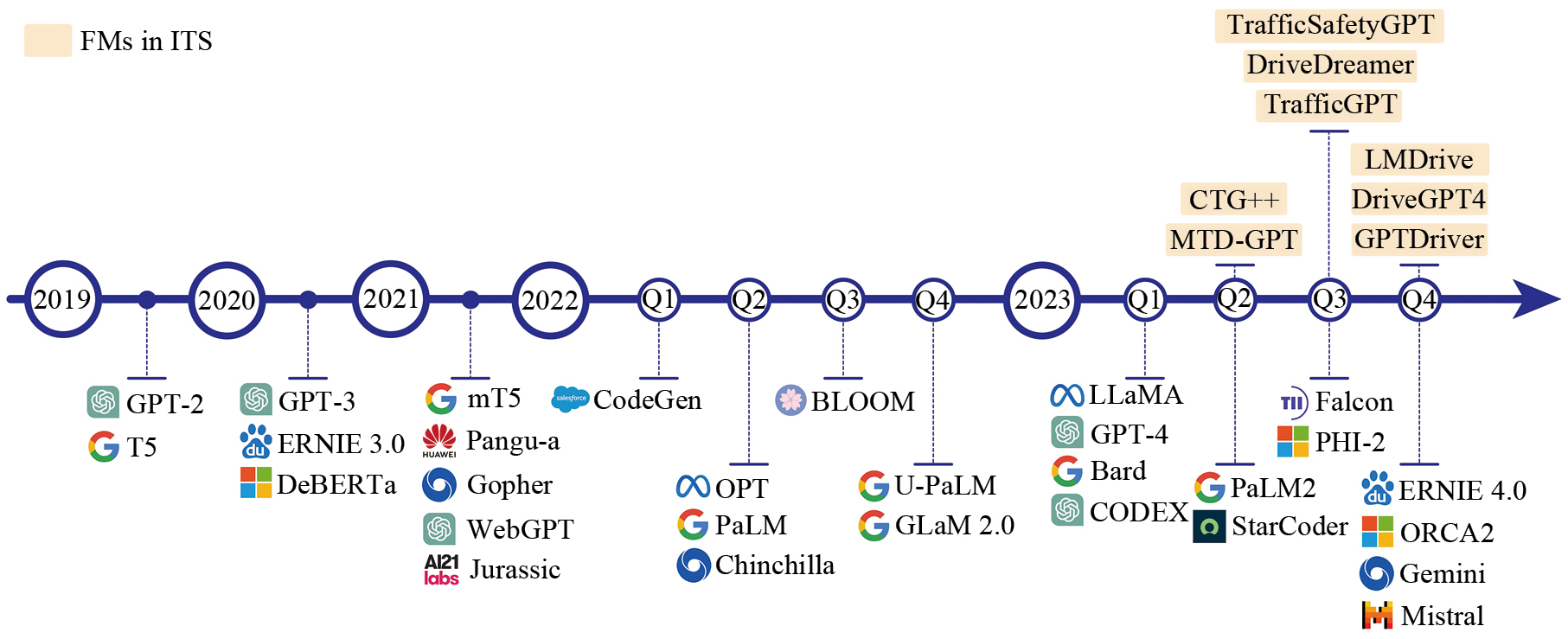
The evolution of FMs has been facilitated by notable computational advancements, including specialized hardware for parallel processing and the transformer architecture, which has become central to developing these models due to its efficiency in handling large-scale data. As illustrated in Fig. 1, the introduction of models such as GPT, BERT, and their successors (e.g., GPT-3, GPT-4, LLaMA, Bard, Claude2) has not only expanded the generative capabilities of AI but also led to a broader discussion about their potential and implications, especially as they begin to approach what are termed "frontier models". These models possess capabilities that could pose risks to public safety due to their powerful and potentially misusable nature, highlighting the necessity for careful consideration and regulation of their development and deployment.
FMs have been instrumental in a wide range of applications, from language translation and content generation to image classification and autonomous vehicle navigation, as shown in Fig. 2. Their ability to learn from vast amounts of unlabeled data using self-supervised learning methods marks a departure from traditional AI systems that required extensive, well-labeled datasets. This shift not only reduces the resources needed for training AI models but also enables a more flexible and broad application of AI across different domains. For example, language models like GPT-3 have demonstrated the ability to generate text, summarize bodies of text, and even assist in coding through applications like GitHub Copilot, showcasing the models’ inherent creativity and potential to enhance productivity significantly. Furthermore, FM's continuous learning capabilities during inference allow for the development of comprehensive outputs through carefully curated prompts, covering tasks such as language processing, visual comprehension, code generation, and human-centered engagement. Their impact extends into everyday products and services, improving user experiences and efficiency in various industries, including healthcare, finance, and customer support.
In summary, FMs represent a significant milestone in AI, offering a glimpse into a future where AI can learn more generally and operate across a multitude of domains and tasks, thereby driving innovation and transforming industries in ways previously unimaginable.
The pivotal role of FMs in the enhancement of predictive analytics within ITS marks a transformative leap in managing and planning urban mobility. These sophisticated models excel in assimilating a vast array of data sources, including historical traffic patterns, real-time vehicular flows, meteorological conditions, and even social media trends, to provide an integrated view of urban dynamics [9]. By leveraging this comprehensive data amalgamation, FMs offer unparalleled accuracy in forecasting traffic behaviors, predicting congestion points before they occur, and recommending the most efficient routes for travelers. This predictive prowess is instrumental not only in optimizing traffic flow and reducing travel times but also plays a crucial role in emergency response scenarios, where timely and accurate data can direct first responders more effectively.
In addition, FMs can identify areas of recurrent congestion, enabling city planners to make informed decisions about where to expand road capacity or enhance public transportation options. Furthermore, these models can simulate the impact of urban development projects on traffic patterns, offering a predictive lens through which to evaluate the efficacy of proposed changes to city layouts, road networks, and public transit systems. The integration of weather data into predictive analytics underscores another dimension of FMs’ utility [13]. By accounting for the impact of adverse weather conditions on traffic flow and vehicle performance, FMs can adjust their predictions and recommendations accordingly, enhancing the resilience of transportation systems against environmental challenges. Similarly, the analysis of social media feeds provides real-time insights into public sentiments and emerging events, which can significantly affect traffic conditions. This capability allows for the dynamic adjustment of traffic management strategies in response to large-scale public gatherings, protests, or city-wide celebrations, further illustrating the models’ adaptability and foresight.
In the realm of autonomous mobility, FMs stand at the forefront, redefining the capabilities of autonomous vehicles to navigate and understand their environments with unprecedented sophistication [14]. These advanced models imbue vehicles with the critical ability to discern and categorize myriad elements within their surroundings, a fundamental requirement for safe and informed navigation. This capability extends from recognizing static obstacles, such as road signs and barriers, to identifying dynamic entities, including pedestrians and other vehicles, ensuring a comprehensive situational awareness that is vital for the vehicle's decision-making processes.
The integration of natural language processing with computer vision within FMs allows for an in-depth interpretation of sensor data, offering a nuanced understanding of the vehicle's immediate environment [5]. This understanding is not limited to mere object recognition; it encompasses a contextual analysis within the scene, thereby furnishing autonomous vehicles with the insights needed to anticipate environmental changes and adapt their behavior in real-time. Such scene understanding is crucial for navigating through complex traffic patterns, varying road conditions, and unforeseen hazards, enhancing the vehicle's predictive capabilities.
Language-guided navigation emerges as a particularly innovative application of FMs, leveraging the models’ prowess in natural language understanding to interpret navigational commands and contextual information. This feature is especially pertinent in dynamic urban landscapes, where conditions can shift unpredictably, necessitating adjustments to pre-planned routes [15]. The ability of autonomous vehicles to process and act upon verbal instructions or textual data in real time significantly augments their navigational flexibility, enabling them to tackle complex urban challenges with improved accuracy and adaptability.
Furthermore, the concept of end-to-end driving encapsulates the ultimate goal of autonomous mobility, wherein vehicles autonomously manage the entire spectrum of driving tasks. Through FMs, vehicles access and learn from extensive driving data, thereby cultivating human-like decision-making skills and reflexes. This continuous learning and adaptation process underpins the vehicles’ capability to navigate diverse scenarios, from high-speed highway travel to the intricacies of city driving, with ever-increasing proficiency.
Optimizing infrastructure utilization through FMs is reshaping the strategic approach to transportation infrastructure planning and management. By harnessing both historical and real-time traffic data, FMs unlock the ability to discern intricate patterns and trends. This analytical prowess is instrumental in guiding the strategic development and optimization of road networks, ensuring the judicious placement of traffic signals, and designing pedestrian pathways to bolster safety and streamline traffic flow. Anticipating future traffic conditions and potential congestion points allows for the proactive design of infrastructure that adeptly mitigates upcoming traffic challenges, thereby facilitating smoother urban mobility.
Moreover, the application of FMs extends to the realm of infrastructure maintenance. Utilizing data from sensors integrated into the fabric of roadways and bridges, these models employ predictive analytics to foretell maintenance requirements. This preemptive maintenance strategy is pivotal in maintaining infrastructure in prime condition, significantly reducing the risk of accidents attributable to infrastructure deterioration and curtailing disruptions to traffic flow. This approach not only ensures the longevity of transportation assets but also contributes to the overall safety and efficiency of the transportation ecosystem.
In addition to maintenance, FMs are revolutionizing route optimization for emergency response vehicles. By analyzing real-time traffic conditions and predicting traffic patterns, FMs provide critical insights that enable dispatchers to determine the most expedient routes for emergency services. This optimization is crucial for enhancing the responsiveness of emergency interventions, ensuring rapid assistance is delivered when and where it is most needed. The capacity of FMs to predict and navigate around potential obstacles or traffic jams ensures that emergency vehicles can reach their destinations in the shortest possible time, thereby significantly improving outcomes in crisis situations.
The advent of FMs signifies a transformative shift in how user engagement strategies are conceptualized within ITS. These advanced algorithms are at the core of the next wave of chatbots and virtual assistants, ensuring users have instant access to comprehensive, multimodal travel information, alongside timely updates and customized service offerings. This progression in AI-enhanced customer service facilitates a more streamlined flow of essential information, substantially improving the quality of the travel experience. By delivering personalized guidance and swiftly resolving queries, these sophisticated systems significantly boost service accessibility and elevate user satisfaction across diverse user demographics. This evolution marks a move towards more dynamic, responsive, and personalized user interactions in the domain of intelligent transportation.
FMs represent a significant leap forward in transportation policy design, combining vast data interpretation with predictive analytics to offer a more dynamic, responsive approach to urban planning. By analyzing data from diverse sources, including legislative documents, public feedback, and environmental studies, FMs provide a holistic view of urban mobility challenges and opportunities. This capability enables policymakers to craft strategies that are not only scientifically sound but also resonate with public expectations and environmental goals. Furthermore, FMs’ ability to process and understand natural language data in real-time allows for the adaptation of policies to reflect emerging trends and societal shifts, ensuring that transportation systems are both efficient and sustainable. The integration of FMs into policy formulation marks a move towards more informed, adaptable, and inclusive urban development strategies, promising a future where transportation policies are continuously optimized to meet the evolving needs of cities and their inhabitants.
The successful integration of FMs into ITS necessitates a multifaceted approach to data management and computational efficiency. Interoperable data formats and protocols are essential for harmonizing the diverse data sources inherent to urban mobility, ranging from municipal traffic systems to private navigation apps. Federated learning emerges as a pivotal technology, allowing for the decentralized training of models across disparate data sources, enhancing privacy and security without compromising the richness of data insights. To address the computational demands of FMs, strategies such as model pruning, quantization, and knowledge distillation are instrumental in optimizing models for real-time ITS applications. Edge computing further mitigates latency issues by processing data closer to its source, striking a crucial balance between computational resource allocation and the timeliness of traffic management responses.
In the context of FMs into ITS, addressing data privacy and ethical considerations requires a multifaceted approach. Beyond the adoption of federated learning, which inherently enhances privacy by allowing model training on decentralized data, it's critical to implement robust data governance frameworks. These frameworks should include clear policies on data collection, consent, storage, and usage that comply with global data protection regulations like GDPR in Europe and CCPA in California. Furthermore, to mitigate risks associated with data bias and ensure ethical use of AI, we advocate for the establishment of ethics committees within organizations deploying FMs. These committees would oversee the development and deployment of models, ensuring they adhere to ethical AI principles and guidelines. Additionally, incorporating differential privacy techniques can further protect individual data within large datasets, making it difficult to identify personal information while still allowing for valuable insights to be extracted.
Technological solutions such as secure multi-party computation (SMPC) could also play a crucial role in safeguarding data during the model training phase. By enabling computations on encrypted data, SMPC ensures that sensitive information remains private, even from the model itself. Lastly, ongoing transparency and public engagement about how FMs are used and the data they process can help build public trust and ensure ethical considerations are prioritized. By adopting these methodologies, technologies, and policies, the integration of FMs into ITS can be both ethically responsible and privacy-preserving.
The integration of FMs into ITS encompasses a variety of challenges, including technological complexities, financial constraints, and organizational barriers. To navigate this intricate landscape, adopting modular and scalable models proves crucial, facilitating gradual enhancements and system adaptability. Moreover, fostering strategic partnerships between the public and private sectors is imperative to accelerate the deployment of advanced ITS solutions. Such collaborations can leverage the strengths of each sector, driving innovation and ensuring the development of systems that are equitable, accessible, and beneficial to all segments of society. Engaging a broad spectrum of stakeholders, including policymakers, technology providers, and end-users, is essential to create an environment of transparency and cooperation. This collective approach not only promotes inclusivity but also ensures that the deployment of ITS solutions is guided by principles of fairness and social responsibility, thereby maximizing their societal impact.
Integrating FMs with ITS presents an opportunity to significantly advance urban mobility through leveraging large-scale data analytics for comprehensive insights into traffic dynamics, environmental impacts, and user behavior. This integration promises to refine autonomous driving simulations with generative AI such as world model framework, making them more accurate and safer, while dynamic urban mobility plans could utilize real-time analytics for traffic and public transport optimization, reducing emissions and congestion. Personalizing commute recommendations based on user preferences and current conditions, alongside automating traffic regulation for real-time adjustments, highlights FMs’ potential to tailor urban mobility to individual and collective needs efficiently. The realization of these advancements calls for interdisciplinary research that merges data science, urban planning, and ethical AI principles, focusing on the societal, ethical, and environmental implications of deploying such technologies. Collaborative efforts across academia, industry, and government are essential to translate these research directions into scalable, equitable ITS applications, setting a new standard for smart urban transportation.
The integration of FMs into ITS marks a pivotal juncture in the evolution of urban mobility, promising to redefine the efficiency, safety, and sustainability of transportation networks. This convergence of advanced AI technologies with ITS infrastructure is not without its challenges, necessitating a concerted effort across technical, ethical, and regulatory domains to realize its full potential. As we stand on the brink of this transformative integration, the path forward demands a rigorous commitment to developing AI systems that are not only robust and reliable but also adhere to the highest standards of ethical practice.
Future research endeavors should prioritize the creation of AI models that are transparent, accountable, and designed with an inherent respect for privacy and data security. Concurrently, there is a pressing need for policies that not only support technological innovation but also ensure these advancements benefit society as a whole, safeguarding against biases and inequities. The cultivation of public trust and engagement emerges as a critical pillar in this endeavor, requiring transparent communication and inclusive dialogue with all stakeholders involved in the ITS ecosystem.
This paper has outlined the vast potential and the complex challenges of integrating FMs into ITS, advocating for a holistic approach that marries technological advancements with ethical integrity and policy support. As we navigate this promising yet intricate landscape, our collective efforts must be guided by a vision of a future where transportation systems are not just smarter and more efficient but are also equitable, accessible, and sustainable for all. The journey towards realizing the full promise of FMs in ITS is just beginning, and it beckons a multidisciplinary collaboration that spans beyond the confines of technology, embracing the broader societal implications of these innovations.
E. A. M. Van Dis, J. Bollen, W. Zuidema, R. van Rooij, and C. L. Bockting. "Chatgpt: Five priorities for research," Nature, vol. 614, no. 7947, pp. 224–226, 2023.
F.-Y. Wang, Q. H. Miao, X. Li, X. G. Wang, and Y. L. Lin. "What does chatgpt say: The DAO from algorithmic intelligence to linguistic intelligence," IEEE/CAA Journal of Automatica Sinica, vol. 10, no. 3, pp. 575–579, 2023.
Y. Liu, F. Y. Wu, Z. Y. Liu, K. Wang, F. Y. Wang, and X. B. Qu. "Can language models be used for real-world urban-delivery route optimization?" The Innovation, vol. 4, no. 6, p. 100520, 2023.
M. Jin, S. Y. Wang, L. T. Ma, Z. X. Chu, J. Y. Zhang, X. M. Shi, P. Y. Chen, Y. X. Liang, Y.-F. Li, S. R. Pan, and Q. S. Wen, "Time-LLM: Time series forecasting by reprogramming large language models,"International Conference on Learning Representations (ICLR), Vienna Austria, May 7th, 2023.
S. Y. Wang, Y. X. Zhu, Z. H. Li, Y. T. Wang, L. Li, and Z. B. He, "Chatgpt as your vehicle co-pilot: An initial attempt," IEEE Transactions on Intelligent Vehicles, vol. 8, no. 12, 4706–4721, 2023.
D. Shah, B. Osi´nski, and S. Levine, "LM-Nav: Robotic navigation with large pre-trained models of language, vision, and action,"Conference on Robot Learning. PMLR, 2023, pp. 492–504.
F.-Y. Wang, Y. L. Lin, P. A. Ioannou, L. Vlacic, X. M. Liu, A. Eskandarian, Y. S. Lv, X. X. Na, D. Cebon, and J. Q. Ma, et al."Transportation 5.0: The DAO to safe, secure, and sustainable intelligent transportation systems," IEEE Transactions on Intelligent Transportation Systems, vol. 24, no. 10, pp. 10262–10278, 2023.
P. Wang, X. Wei, F. X. Hu, and W. J. Han, "TransGPT: Multi-modal generative pre-trained transformer for transportation," arXiv preprint arXiv:2402. 07233, 2023.
S. Y. Zhang, D. C. Fu, Z. Zhang, B. Yu, and P. L. Cai. "TrafficGPT: Viewing, processing and interacting with traffic foundation models," arXiv preprint arXiv:2309. 06719, 2023.
H. C. Liao, H. M. Shen, Z. N. Li, C. Y. Wang, G. F. Li, Y. M. Bie, and C. Z. Xu, "GPT-4 enhanced multimodal grounding for autonomous driving: Leveraging cross-modal attention with large language models," Communications in Transportation Research, vol. 4, p. 100116, 2023.
O. Zheng, M. Abdel-Aty, D. D. Wang, C. Z. Wang, and S. X. Ding, "Trafficsafetygpt: Tuning a pre-trained large language model to a domain-specific expert in transportation safety," arXiv preprint arXiv:2307.15311, 2023.
L. N. Wang, H. Jiang, P. L. Cai, D. C. Fu, T. Q. Wang, Z. Y. Cui, Y. L. Ren, H. Y. Yu, X. S. Wang, and Y. H. Wang, "Accidentgpt: Accident analysis and prevention from V2X environmental perception with multi-modal large model," arXiv preprint arXiv:2312. 13156, 2023.
O. Zheng, M. Abdel-Aty, D. Wang, Z. J. Wang, and S. X. Ding, "Chatgpt is on the horizon: Could a large language model be all we need for intelligent transportation?" arXiv preprint arXiv:2303.05382, 2023.
H. P. Du, S. Y. Teng, H. Chen, J. Q. Ma, X. Wang, C. Gou, B. Li, S. J. Ma, Q. H. Miao, and X. X. Na, et al., "Chat with chatgpt on intelligent vehicles: An ieee TIV perspective," IEEE Transactions on Intelligent Vehicles, vol. 8, no. 3, pp. 2020–2026, 2023.
 Top
Top