

An efficient eco-driving strategy with a vehicle-cloud collaborative layered architecture for electric intercity buses AITranslate
Abstract AITranslate
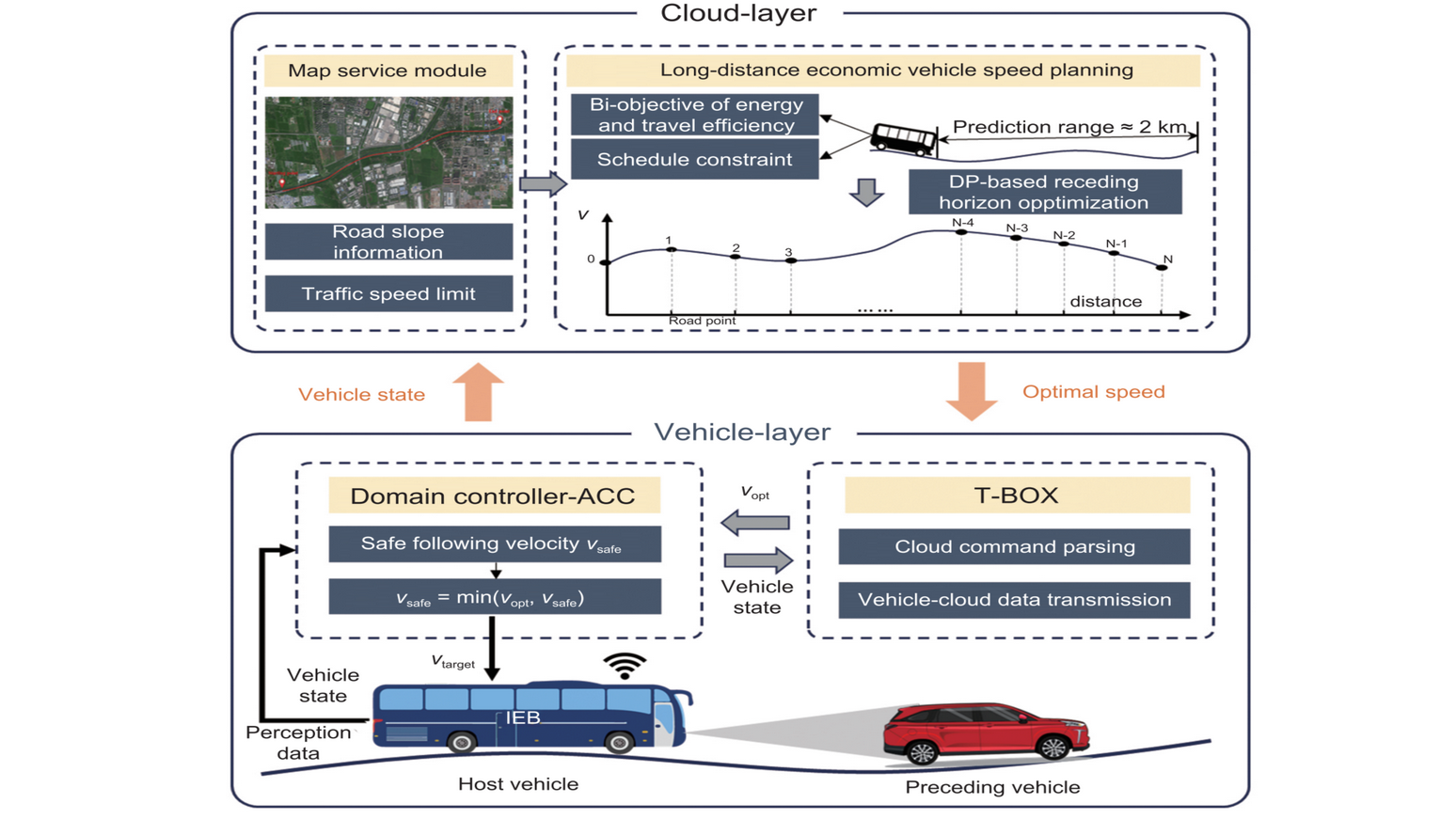
To enhance the energy and travel efficiency for electric bus routes, a cloud-supported efficient eco-driving control strategy based on a vehicle-cloud collaborative layered architecture is proposed in this paper. At the cloud layer, an efficient velocity planning model balancing energy consumption and travel time is constructed based on route map information and solved using the Dynamic Programming (DP) algorithm. At the vehicle layer, a safety-prioritized arbitration strategy is designed to switch decisions between the cloud-planned optimal velocity and the adaptive cruise control (ACC) car-following velocity to ensure driving safety. An experimental platform based on the vehicle-road-cloud collaborative architecture was constructed, and validation was conducted under real-world intercity road conditions. Experimental results demonstrate that the system exhibits favorable communication, real-time performance, and reliability. Compared with the ACC strategy, the proposed strategy increased average velocity by approximately 4.21% and reduced energy consumption by about 1.12% while ensuring operational punctuality.
KeyWords AITranslate
1.C. Pasquale, S. Sacone, S. Siri, and A. Ferrara, "Optimal Control of Electric Automated Buses in Intercity Lines: Scenario-Based Analysis of the Pareto-Optimal Solutions," IFAC-PapersOnLine 58, no. 10 (2024): 37–42, https://doi.org/10.1016/j.ifacol.2024.07.315.
2.Ó. García-Afonso, "Impact of Powertrain Electrification on the Overall CO2 Emissions of Intercity Public Bus Transport: Tenerife Island Test Case," Journal of Cleaner Production 412 (2023): 137365, https://doi.org/10.1016/j.jclepro.2023.137365.
3.A. Ozdagoglu, G. Z. Oztas, M. K. Keles, and V. Genc, "A Comparative Bus Selection for Intercity Transportation with an Integrated PIPRECIA & COPRAS-G," Case Studies on Transport Policy 10, no. 2 (2022): 993–1004, https://doi.org/10.1016/j.cstp.2022.03.012.
4.B. Gao, R. Mei, Y. Lu, et al., "Predictive Lane-Changing Control for Platoon Based on Cloud Control System in Highway Scenarios," CHAIN 1, no. 1 (2024): 75–98, https://doi.org/10.23919/chain.2023.000001.
5.L. Qi, J. Zhang, and X. Jiao, "Predecessor Speed Prediction-Based Predictive Cruise Control of Connected Autonomous Vehicle in Platoon with Multiple-Human-Driven-Vehicles," Control Engineering Practice 158 (2025): 106286, https://doi.org/10.1016/j.conengprac.2025.106286.
6.X. Li, J. Zhang, J. Xue, L. Qi, W. Tang, and X. Jiao, "Predictive Cruise Control for Connected Autonomous Vehicles Considering Communication Delay in Mixed Traffic," IFAC-PapersOnLine 58, no. 29 (2024): 172–177, https://doi.org/10.1016/j.ifacol.2024.11.139.
7.Z. Wang, R. Zhang, S. Niu, D. Zhang, and B. Gao, "Cloud-Based Energy-Efficient Predictive Cruise Control Accounting for Nonlinear Vehicle Dynamics on Highways," Energy 346 (2026): 139984, https://doi.org/10.1016/j.energy.2026.139984.
8.H. Gao, X. Zhang, X. Zeng, D. Yang, D. Song, and L. Zhou, "Predictive Cruise Control for Hybrid Electric Vehicles Based on Hierarchical Convex Optimization," Energy Conversion and Management 299 (2024): 117883, https://doi.org/10.1016/j.enconman.2023.117883.
9.S. Ma, C. Niu, M. Zhang, et al., "Edge-Cloud Collaboration-Driven Predictive Planning of Electric Vehicle Charging Load for Microgrids," Applied Energy 408 (2026): 127362, https://doi.org/10.1016/j.apenergy.2026.127362.
10.S. Li, H. Wang, and J. Hu, "Ecological Driving at an Actuated Signalized Intersection: A Practical Solution of Vehicle-Road-Cloud Integration System," Transportation Research Part C: Emerging Technologies 17 (2025): 105198, https://doi.org/10.1016/j.trc.2025.105198.
11.D. Wu, Q. Yuan, C. Du, F. Yan, and Y. Li, "Predictive Cruise Control for 4WD Electric Vehicle Based on Dynamic Weight Factors," Energy Reports 8 (2022): 237–246, https://doi.org/10.1016/j.egyr.2022.10.097.
12.P. Polverino, E. A. Adinolfi, and C. Pianese, "Target Speed Computation through Predictive Cruise Control for Vehicles Energy Consumption Reduction," Energy Conversion and Management 298 (2023): 117757, https://doi.org/10.1016/j.enconman.2023.117757.
13.Y. J. J. Heuts, J. J. F. Wouters, O. F. Hulsebos, and M. C. F. Donkers, "Modeling, Implementation and Experimental Verification of Eco-Driving on a Battery-Electric Heavy-Duty Vehicle," Applied Energy 390 (2025): 125782, https://doi.org/10.1016/j.apenergy.2025.125782.
14.S. Chen, Y. Huang, J. Zhang, X. Yu, Y. Lu, and D. Xuan, "Research on a Novel Multi-Agent Deep Reinforcement Learning Eco-Driving Framework," Energy 326 (2025): 136308, https://doi.org/10.1016/j.energy.2025.136308.
15.X. Sun, Y. Lu, Q. Wu, et al., "An Eco-Driving Strategy of Vehicle Comfort-Safety and Energy Efficiency Based on Deep Reinforcement Learning," Alexandria Engineering Journal 132 (2025): 252–263, https://doi.org/10.1016/j.aej.2025.10.040.
16.H. Gao, J. Leng, Y. Li, et al., "Predictive Slope Information Compression Using in Deep Reinforce Learning for Enhancing the Economic and Trip Efficiency of Battery Electric Vehicles," Journal of Energy Storage 146 (2026): 120049, https://doi.org/10.1016/j.est.2025.120049.
17.H. Tong, L. Chu, Y. Zhang, et al., "Towards Sustainable High-Speed Cruising: Optimizing Energy Efficiency of Plug-in Hybrid Electric Vehicle via Intelligent Pulse-and-Glide Strategy," Energy 311 (2024): 133412, https://doi.org/10.1016/j.energy.2024.133412.
18.Y. Liang, H. Dong, D. Li, and Z. Song, "Adaptive Eco-Cruising Control for Connected Electric Vehicles Considering a Dynamic Preceding Vehicle," eTransportation 19 (2023): 100299, https://doi.org/10.1016/j.etran.2023.100299.
19.C. Wang, Z. Yang, L. Zhu, and L. Zhang, "Learning-Augmented Hierarchical Control for Signal-Aware Safe Eco-Driving of Connected Autonomous Vehicles," Applied Energy 401 (2025): 126807, https://doi.org/10.1016/j.apenergy.2025.126807.
20.H. Chu, S. Dong, J. Hong, H. Chen, and B. Gao, "Predictive Cruise Control of Full Electric Vehicles: A Comparison of Different Solution Methods," IFAC-PapersOnLine 54, no. 10 (2021): 120–125, https://doi.org/10.1016/j.ifacol.2021.10.151.
21.S. Dong, X. Luo, Y. Zhang, Q. Liu, B. Gao, and H. Chen, "Computationally Efficient Predictive Cruise Control of Electric Vehicles with Nonsmooth System," Control Engineering Practice 164 (2025): 106466, https://doi.org/10.1016/j.conengprac.2025.106466.
22.Y. Li, C. Pan, J. Wang, Z. Li, J. Liang, and C. Cai, "Research on Energy Consumption Optimization of Predictive Cruise Control Considering the State of the Leading Vehicle," Energy 308 (2024): 132843, https://doi.org/10.1016/j.energy.2024.132843.
23.C. Ling, J. Peng, Y. Fan, Z. Wang, S. Yu, and C. Wu, "Safety-Awareness Enhanced Eco-Driving Strategy for Dual-Motor Electric Vehicle in Highway Scenarios Based on Improved Proximal Policy Optimization Algorithm," Energy 340 (2025): 139177, https://doi.org/10.1016/j.energy.2025.139177.
24.J. Huang, K. Wan, J. Chen, et al., "A Forward-Looking Sequential Asynchronous Lane-Change Strategy for Vehicle Platoon Under Cloud-Vehicle-Road Integrated Architecture," CHAIN 2, no. 1 (2025): 43–56, https://doi.org/10.23919/chain.2025.000007.
25.L. Yang, M. Yuan, Y. Liu, et al., "Optimization of Task Scheduling and Resource Allocation for Autonomous Vehicle Testing in Vehicle-Road-Cloud Collaborative Systems," Expert Systems with Applications 299 (2026): 129943, https://doi.org/10.1016/j.eswa.2025.129943.
26.Z. Li, Z. Cui, H. Liao, et al., "Steering the Future: Redefining Intelligent Transportation Systems with Foundation Models," CHAIN 1, no. 1 (2024): 46–53, https://doi.org/10.23919/chain.2024.100003.
27.Y. Liu, Z. Liang, W. Zhong, et al., "Multi-Objective Predictive Cruise Control for Electric Heavy-Duty Trucks Considering Fleet Battery Swapping under Cyber-Physical System," Energy 321 (2025): 135462, https://doi.org/10.1016/j.energy.2025.135462.
28.J. Lin, Y. Li, and H. Xiao, "Predictive Cruise Cloud Control Scheme Design on Notable Vehicles—Under the Perspective of Cyber-Physical Systems," IEEE Transactions on Intelligent Transportation Systems 25, no. 7 (2024): 6796–6810, https://doi.org/10.1109/tits.2023.3341834.
29.S. Li, K. Wan, B. Gao, R. Li, Y. Wang, and K. Li, "Predictive Cruise Control for Heavy Trucks Based on Slope Information under Cloud Control System," Journal of Systems Engineering and Electronics 33, no. 4 (2022): 812–826, https://doi.org/10.23919/jsee.2022.000081.
30.B. Gao, L. Wang, S. Li, et al., "Cloud-Based Predictive Adaptive Cruise Control Considering Preceding Vehicle and Slope Information," Journal of Systems Engineering and Electronics 35, no. 6 (2024): 1542–1562, https://doi.org/10.23919/jsee.2024.000108.
31.X. Li, R. Ma, Y. Guo, W. Wang, B. Yan, and J. Chen, "Investigation of Factors and Their Dynamic Effects on Intercity Travel Modes Competition," Travel Behaviour and Society 23 (2021): 166–176, https://doi.org/10.1016/j.tbs.2021.01.003.
32.D. Song, D. Bi, X. Zeng, and S. Wang, "Energy Management Strategy of Plug-In Hybrid Electric Vehicles Considering Thermal Characteristics," International Journal of Automotive Technology 24, no. 3 (2023): 655–668, https://doi.org/10.1007/s12239-023-0055-0.
Basic Information:
DOI:10.23919/CHAIN.2026.000011
Chinese Library Classification Number:
Citation Information:
To enhance the energy and travel efficiency for electric bus routes, a cloud-supported efficient eco-driving control strategy based on a vehicle-cloud collaborative layered architecture is proposed in this paper. At the cloud layer, an efficient velocity planning model balancing energy consumption and travel time is constructed based on route map information and solved using the Dynamic Programming (DP) algorithm. At the vehicle layer, a safety-prioritized arbitration strategy is designed to switch decisions between the cloud-planned optimal velocity and the adaptive cruise control (ACC) car-following velocity to ensure driving safety. An experimental platform based on the vehicle-road-cloud collaborative architecture was constructed, and validation was conducted under real-world intercity road conditions. Experimental results demonstrate that the system exhibits favorable communication, real-time performance, and reliability. Compared with the ACC strategy, the proposed strategy increased average velocity by approximately 4.21% and reduced energy consumption by about 1.12% while ensuring operational punctuality.
quote
| GB/T 7714-2015 | [1] Yue Wang, Weiliang Li, Honglei Qi, et al. An efficient eco-driving strategy with a vehicle-cloud collaborative layered architecture for electric intercity buses[J]. Chain, 2026, 3(2): 229-244. DOI:10.23919/CHAIN.2026.000011. |
| MLA | [1] Yue Wang, et al., "An efficient eco-driving strategy with a vehicle-cloud collaborative layered architecture for electric intercity buses." Chain, vol. 3, no. 2, 2026, pp. 229-244, https://doi.org/10.23919/CHAIN.2026.000011. |
| APA | [1] Yue Wang, Weiliang Li, Honglei Qi, Chen Li, Yanbo Lu, Kang Liu, Yaoyang Wang, Sichang Wei, & Bolin Gao. (2026). An efficient eco-driving strategy with a vehicle-cloud collaborative layered architecture for electric intercity buses. Chain, 3(2), 229-244. https://doi.org/10.23919/CHAIN.2026.000011 |
| IEEE | [1] Yue Wang, Weiliang Li, Honglei Qi, Chen Li, Yanbo Lu, Kang Liu, Yaoyang Wang, Sichang Wei, and Bolin Gao, "An efficient eco-driving strategy with a vehicle-cloud collaborative layered architecture for electric intercity buses," Chain, vol. 3, no. 2, pp. 229-244, 2026, doi: 10.23919/CHAIN.2026.000011. keywords: {cloud-supported;eco-driving;experimental verification;intercity electric bus} |