

A novel design of wheel-propeller based aerial-ground amphibious transportation platform AITranslate
Abstract AITranslate
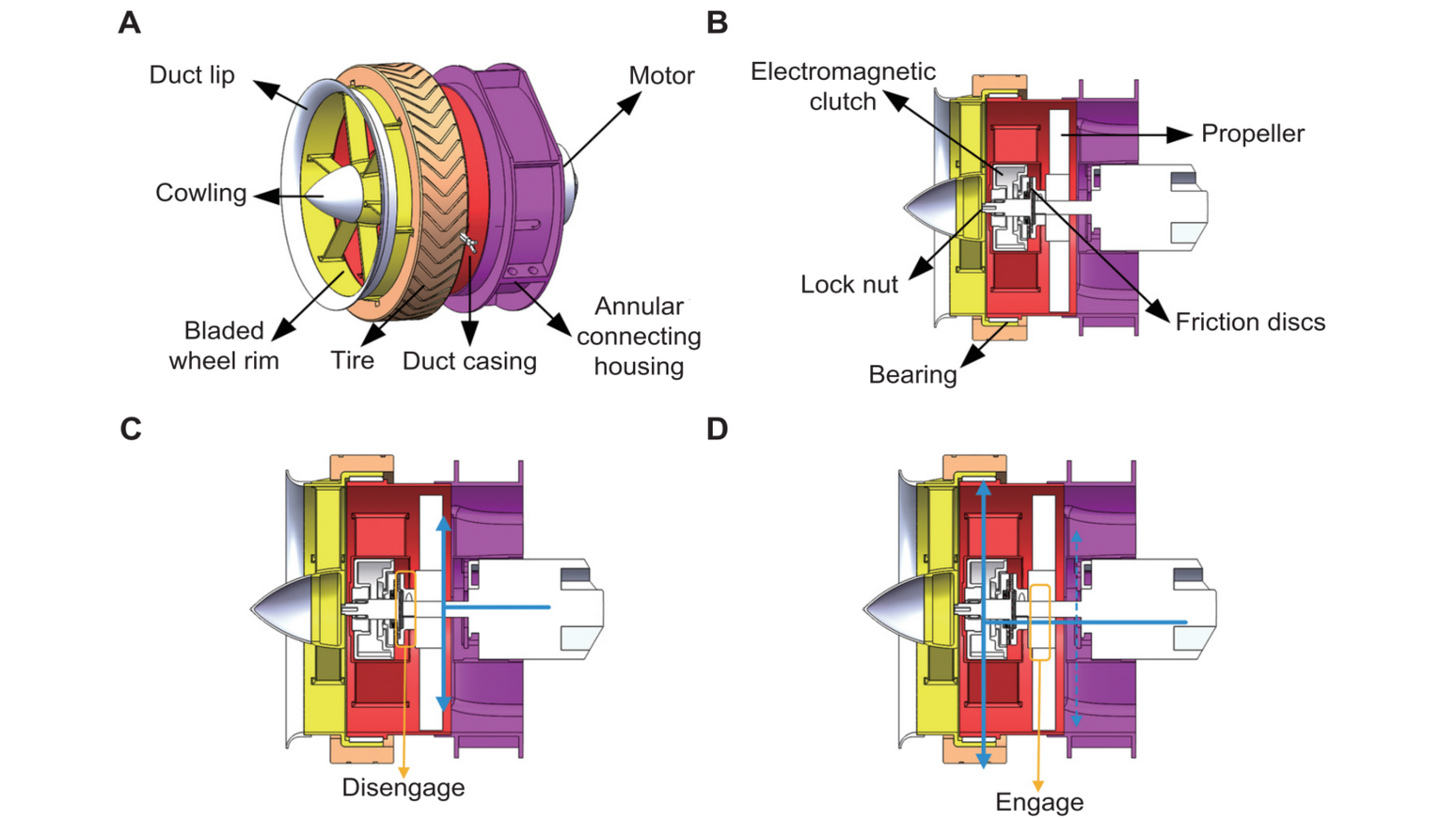
Benefiting from the synergistic integration of aerial agility and terrestrial endurance, aerial-ground amphibious platforms can effectively traverse unstructured environments, demonstrating considerable potential for emergency response and reconnaissance applications. However, most existing systems adopt a decoupled configuration, utilizing independent propulsion units for ground and aerial modes. Although this approach enables dual-domain operation, the duplicated actuators and transmission chains inevitably incur structural redundancy and additional mass, which reduce overall system integration and payload efficiency. To address these limitations, this paper proposes a novel aerial-ground amphibious platform based on an integrated wheel-propeller structure. In the proposed design, a single electric motor actuates both the wheel and ducted propeller through a shared powertrain, where an electromagnetic clutch selectively engages the transmission path to switch between terrestrial locomotion and aerial propulsion. Building upon this mechanism, an amphibious platform configuration incorporating eight-wheel-propeller units is developed. By establishing a dynamic simulation model of the platform, the dynamic response characteristics during the drive-to-fly transition were investigated. The results demonstrate the feasibility of the operational principle underpinning the platform. The research provides a feasible technical approach for lightweight and highly integrated aerial-ground platforms, laying the foundation for future experimental implementation.
KeyWords AITranslate
1.A. Fabris, S. Kirchgeorg, and S. Mintchev, "A Soft Drone with Multi-modal Mobility for the Exploration of Confined Spaces," in Proceedings of the IEEE International Symposium on Safety, Security, and Rescue Robotics (SSRR), 48–54, IEEE, 2021, https://doi.org/10.1109/SSRR53300.2021.9597683.
2.L. Quan, L. Han, B. Zhou, S. Shen, and F. Gao, "Survey of UAV Motion Planning," IET Cyber-Systems and Robotics 2, no. 1 (2020): 14–21, https://doi.org/10.1049/iet-csr.2020.0004.
3.K. Rajashekara, Q. Wang, and K. Matsuse, "Flying Cars: Challenges and Propulsion Strategies," IEEE Electrification Magazine 4, no. 1 (2016): 46–57, https://doi.org/10.1109/MELE.2015.2509901.
4.N. P. Hariram, A. Megalingam, and K. Sudhakar, "Flying Cars and Hyperloops: A Glimpse into the Future Sustainable Vehicles," Sustainable Energy Technologies and Assessments 75 (2025): 104196, https://doi.org/10.1016/j.seta.2025.104196.
5.A. Kasliwal, N. J. Furbush, J. H. Gawron, et al., "Role of Flying Cars in Sustainable Mobility," Nature Communications 10 (2019): 1555, https://doi.org/10.1038/s41467-019-09426-0.
6.A. T. Wick, J. R. Hooker, and C. H. Zeune, "Integrated Aerodynamic Benefits of Distributed Propulsion," paper presented at the 53rd AIAA Aerospace Sciences Meeting, Kissimmee, USA, January 5–9, 2015, https://doi.org/10.2514/6.2015-1500.
7.H. J. Terry Suh, X. Xiong, A. Singletary, A. D. Ames, and J. W. Burdick, "Energy-Efficient Motion Planning for Multi-Modal Hybrid Locomotion," in Proceedings of the 2020 IEEE/RSJ International Conference on Intelligent Robots and Systems (IROS), 7027–7033, IEEE, 2020, https://doi.org/10.1109/IROS45743.2020.9340761.
8.A. P. Cohen, S. A. Shaheen, and E. M. Farrar, "Urban Air Mobility: History, Ecosystem, Market Potential, and Challenges," IEEE Transactions on Intelligent Transportation Systems 22, no. 9 (2021): 6074–6087, https://doi.org/10.1109/TITS.2021.3082767.
9.H. Wei, B. Lou, Z. Zhang, B. Liang, F. Y. Wang, and C. Lv, "Autonomous Navigation for eVTOL: Review and Future Perspectives," IEEE Transactions on Intelligent Vehicles 9, no. 2 (2024): 4145–4171, https://doi.org/10.1109/TIV.2024.3352613.
10.G. Pan and M. S. Alouini, "Flying Car Transportation System: Advances, Techniques, and Challenges," IEEE Access 9 (2021): 24586–24603, https://doi.org/10.1109/ACCESS.2021.3056798.
11.N. Swaminathan, S. R. P. Reddy, K. RajaShekara, and K. S. Haran, "Flying Cars and eVTOLs–Technology Advancements, Powertrain Architectures, and Design," IEEE Transactions on Transportation Electrification 8, no. 4 (2022): 4105–4117, https://doi.org/10.1109/TTE.2022.3172960.
12.A. M. Stoll and J. Bevirt, "Development of eVTOL Aircraft for Urban Air Mobility at Joby Aviation," paper presented at the Vertical Flight Society 78th Annual Forum & Technology Display, Texas, USA, May 10–12, 2022, https://doi.org/10.4050/F-0078-2022-17528.
13.Q. Tan, X. Zhang, H. Liu, S. Jiao, M. Zhou, and J. Li, "Multimodal Dynamics Analysis and Control for Amphibious Fly-Drive Vehicle," IEEE/ASME Transactions on Mechatronics 26, no. 2 (2021): 621–632, https://doi.org/10.1109/TMECH.2021.3056095.
14.P. Marques, "Urban Air Mobility Aircraft -A fusion of Art and Technology," paper presented at the IEEE Aerospace Conference, Montana, USA, March 6–13, 2021.
15.A. Tagliabue, S. Schneider, M. Pavone, and A. Agha-mohammadi, "Shapeshifter: A Multi-Agent, Multi-Modal Robotic Platform for Exploration of Titan," in Proceedings of the IEEE Aerospace Conference, 1–13, IEEE, https://doi.org/10.1109/AERO47225.2020.9172739.
16.N. Pan, J. Jiang, R. Zhang, C. Xu, and F. Gao, "Skywalker: A Compact and Agile Air-Ground Omnidirectional Vehicle," IEEE Robotics and Automation Letters 8, no. 5 (2023): 2534–2541, https://doi.org/10.1109/LRA.2023.3256920.
17.M. Cao, X. Xu, S. Yuan, K. Cao, K. Liu, and L. Xie, "DoubleBee: A Hybrid Aerial-Ground Robot with Two Active Wheels," in Proceedings of the IEEE/RSJ International Conference on Intelligent Robots and Systems (IROSx), 6962–6969, IEEE, 2023, https://doi.org/10.1109/IROS55552.2023.10341984.
18.N. B. David, and D. Zarrouk, "Design and Analysis of FCSTAR, a Hybrid Flying and Climbing Sprawl Tuned Robot," IEEE Robotics and Automation Letters 6, no. 4 (2021): 6188–6195, https://doi.org/10.1109/LRA.2021.3077851.
19.A. Ramezani, P. Dangol, E. Sihite, A. Lessieur, and P. Kelly, "Generative Design of NU's Husky Carbon, A Morpho-Functional, Legged Robot," in Proceedings of the IEEE International Conference on Robotics and Automation (ICRA), 4040–4046, IEEE, 2021, https://doi.org/0.1109/ICRA48506.2021.9561196.
20.K. Peterson and R. S. Fearing, "Experimental Dynamics of Wing Assisted Running for a Bipedal Ornithopter," in Proceedings of the IEEE/RSJ International Conference on Intelligent Robots and Systems, 5080–5086, IEEE, 2011, https://doi.org/10.1109/IROS.2011.6095041.
21.K. Peterson, P. Birkmeyer, R. Dudley, and R.S. Fearing, "A Wing-Assisted Running Robot and Implications for Avian Flight Evolution," Bioinspiration & Biomimetics 6, no. 4 (2011): 046008, https://doi.org/10.1088/1748-3182/6/4/046008.
22.J. B. Richard, J. B. Frank, V. Ravi, G. I. Peter, and D. Q. Roger, "A Biologically Inspired Micro-Vehicle Capable of Aerial and Terrestrial Locomotion," Mechanism and Machine Theory 44, no. 3 (2009): 513–526, https://doi.org/10.1016/j.mechmachtheory.2008.08.008.
23.M. Zhao, T. Anzai, and T. Nishio, "Design, Modeling, and Control of a Quadruped Robot SPIDAR: Spherically Vectorable and Distributed Rotors Assisted Air-Ground Quadruped Robot," IEEE Robotics and Automation Letters 8, no. 7 (2023): 3923–3930, https://doi.org/10.1109/LRA.2023.3272285.
24.A. Kalantari and M. Spenko, "Modeling and Performance Assessment of the HyTAQ, a Hybrid Terrestrial/Aerial Quadrotor," IEEE Transactions on Robotics 30, no. 5 (2014): 1278–1285, https://doi.org/10.1109/TRO.2014.2337555.
25.Y. Zhang, Y. Qian, and W. Zhuge, "Unsettled Topics Concerning Flying Cars for Urban Air Mobility," SAE Research Report (2021): EPR2021011, https://doi.org/10.4271/EPR2021011.
26.K. Shi, Z. Jiang, L. Ma, L. Qi, and M. Jin, "MTABot: An Efficient Morphable Terrestrial-Aerial Robot with Two Transformable Wheels," IEEE Robotics and Automation Letters 9, no. 2 (2024): 1875–1882, https://doi.org/10.1109/LRA.2024.3349962.
27.J. Yang, Y. Zhu, L. Zhang, Y. Dong, and Y. Ding, "SytaB: A Class of Smooth-Transition Hybrid Terrestrial/Aerial Bicopters," IEEE Robotics and Automation Letters 7, no. 4 (2022): 9199–9206, https://doi.org/10.1109/LRA.2022.3190099.
28.A. Kalantari, T. Thomas, K. leon, et al., "Drivocopter: A Concept Hybrid Aerial/Ground Vehicle for Long-Endurance Mobility," IEEE Aerospace Conference, Montana, USA, March 1–10, 2020, https://doi.org/10.1109/AERO47225.2020.9172782.
29.E. Sihite, A. Kalantari, R. Nemovi, A. Ramezani, and M. Gharib, "Multi-Modal Mobility Morphobot (M4) with Appendage Repurposing for Locomotion Plasticity Enhancement," Nature communications 14, no. 1 (2023): 3323, https://doi.org/10.1038/s41467-023-39018-y.
30.A. T. Perry, P. J. Ansell, and M. F. Kerho, "Aero-Propulsive and Propulsor Cross-Coupling Effects on a Distributed Propulsion System," Journal of Aircraft 55, no. 6 (2018): 2179–2572, https://doi.org/10.2514/1.C034861.
31.N.V. Kornev and K. Matveev, "Complex Numerical Modeling of Dynamics and Crashes of Wing-in-Ground Vehicles," paper presented at the 41st Aerospace Sciences Meeting and Exhibit, Reno, USA, January 6–9, 2003, https://doi.org/10.2514/6.2003-600.
Basic Information:
DOI:10.23919/CHAIN.2026.000010
Chinese Library Classification Number:
Citation Information:
Benefiting from the synergistic integration of aerial agility and terrestrial endurance, aerial-ground amphibious platforms can effectively traverse unstructured environments, demonstrating considerable potential for emergency response and reconnaissance applications. However, most existing systems adopt a decoupled configuration, utilizing independent propulsion units for ground and aerial modes. Although this approach enables dual-domain operation, the duplicated actuators and transmission chains inevitably incur structural redundancy and additional mass, which reduce overall system integration and payload efficiency. To address these limitations, this paper proposes a novel aerial-ground amphibious platform based on an integrated wheel-propeller structure. In the proposed design, a single electric motor actuates both the wheel and ducted propeller through a shared powertrain, where an electromagnetic clutch selectively engages the transmission path to switch between terrestrial locomotion and aerial propulsion. Building upon this mechanism, an amphibious platform configuration incorporating eight-wheel-propeller units is developed. By establishing a dynamic simulation model of the platform, the dynamic response characteristics during the drive-to-fly transition were investigated. The results demonstrate the feasibility of the operational principle underpinning the platform. The research provides a feasible technical approach for lightweight and highly integrated aerial-ground platforms, laying the foundation for future experimental implementation.
quote
| GB/T 7714-2015 | [1] Peng Dong, Wantong Zhao, He Zou, et al. A novel design of wheel-propeller based aerial-ground amphibious transportation platform[J]. Chain, 2026, 3(2): 204-213. DOI:10.23919/CHAIN.2026.000010. |
| MLA | [1] Peng Dong, et al., "A novel design of wheel-propeller based aerial-ground amphibious transportation platform." Chain, vol. 3, no. 2, 2026, pp. 204-213, https://doi.org/10.23919/CHAIN.2026.000010. |
| APA | [1] Peng Dong, Wantong Zhao, He Zou, Rongze Yi, Cunhao Zhang, Haiying Lin, Huijun Yue, & Junbin Lai. (2026). A novel design of wheel-propeller based aerial-ground amphibious transportation platform. Chain, 3(2), 204-213. https://doi.org/10.23919/CHAIN.2026.000010 |
| IEEE | [1] Peng Dong, Wantong Zhao, He Zou, Rongze Yi, Cunhao Zhang, Haiying Lin, Huijun Yue, and Junbin Lai, "A novel design of wheel-propeller based aerial-ground amphibious transportation platform," Chain, vol. 3, no. 2, pp. 204-213, 2026, doi: 10.23919/CHAIN.2026.000010. keywords: {aerial-ground amphibious transportation platform;electromagnetic clutches;multimodal locomotion;wheel-propeller structure} |