

daohang fenxiangbox searchbox qikanlogonew daohangnew searchboxnew navrightzone footerzone zhuantixiangqing
Share

    Scan to share on WeChat or Moments

Use WeChat scan.
Share with WeChat friends or Moments

Next-Generation Green Transit

This special issue focuses on Next-Generation Green Transit and transportation-energy integration, gathering cutting-edge achievements in hydrogen energy, new energy power, and related fields. By integrating digital twin and AI technologies, it covers fuel cells, ammonia fuels, and battery recycling
1 Journals
9 Articles
1 Downloads
185 Citations
Review

Cutting-edge fabrication strategies and low-temperature sintering approaches for manufacturing solid oxide electrolysis cells

Chain | Vol., Issue 2, 2026 | pp. 152-186
Steam electrolysers are a key technology for high-efficiency hydrogen production, offering superior thermodynamic performance compared with liquid-water electrolysis when operated at elevated temperatures. Despite these advantages, their wider deployment remains constrained by manufacturing complexity, component cost, and stringent processing requirements for ceramic membranes, electrodes, and interconnect-related components. This mini-review provides a comprehensive assessment of fabrication strategies relevant to steam-electrolyser manufacturing, encompassing compression-based forming, colloidal processing, fibre- and ink-based deposition techniques, as well as physical vapour deposition. Particular attention is given to how electrode architecture, cell geometry, and interfacial compatibility influence viable processing routes and manufacturability, rather than device operation at the single-cell level. Emphasis is placed on solid-state ceramic membranes and electrodes based on gadolinium-doped ceria (GDC) and yttria-stabilised zirconia (YSZ), which remain central to current and emerging steam-electrolyser technologies. Because most scalable fabrication routes ultimately depend on controlled densification and microstructural optimisation of polycrystalline ceramics, the review critically examines low-temperature sintering mechanisms, including grain-boundary-activated densification, transient liquid-phase formation, and nano-powder engineering. Recent advances in single- and multi-element sintering aids are discussed, with co-doping strategies shown to reduce densification temperatures by several hundred degrees while preserving ionic conductivity and long-term stability. A quantitative techno-environmental analysis further demonstrates that reducing electrolyte sintering temperatures from 1,400℃ to 650℃–950℃ can lower energy consumption by 30%–55%, reduce fabrication costs, and significantly decrease CO2 emissions associated with manufacturing. By integrating fabrication methodologies with low-temperature processing chemistry in a steam-electrolysis–relevant context, this review highlights the key materials–process interactions governing manufacturability and identifies future research directions for scalable, durable, and economically competitive steam-electrolyser technologies.
DOI: 10.23919/CHAIN.2026.000009 Cited: 0 Download: 0
Review

Insights into electrified aviation: the pros and cons

Chain | Vol., Issue 1, 2026 | pp. 14-36
This study examines the feasibility of integrating advanced battery technologies into electrified propulsion systems for aviation as a pathway toward carbon emission reduction. While the successful deployment of battery-powered electric vehicles (EVs) has demonstrated the potential of electrification in sustainable mobility, the aviation sector presents distinct technical and operational challenges that require specialized engineering solutions. This work provides a comprehensive review of recent industrial developments and scholarly literature to evaluate the technological, environmental, and economic viability of electrified aircraft. Key performance limitations and energy density constraints associated with current lithium-based batteries are analyzed, along with their safety considerations and life cycle sustainability. In addition, the operational costs of battery-powered and hybrid-electric aircraft concepts are compared with those of conventional jet fuel-based systems. Recent progress in hybrid-electric propulsion architectures, emerging battery chemistries such as lithium-metal and lithium-sulfur, and future directions for propulsion system integration are also discussed. Overall, this study offers insights into sustainable aviation strategies and identifies critical research directions to accelerate the transition toward carbon-neutral flight.
DOI: 10.23919/CHAIN.2026.000002 Cited: 0 Download: 0
Review

Blockchain and IoT-driven sustainable battery recycling: Integration and challenges

Chain | Vol., Issue 2, 2025 | pp. 81-103
As a distributed ledger technology, blockchain demonstrates broad prospects in battery recycling due to its decentralized, transparent, and secure characteristics. However, practical implementation faces challenges including technical barriers, cost investments, regulatory adjustments, and data privacy protection. This paper comprehensively introduces blockchain applications in battery recycling, explaining its principles, advantages, and real-world deployment. It analyzes existing problems in current recycling systems, such as data fragmentation, inefficient reverse logistics, and regulatory failures. Furthermore, blockchain-IoT integration applications, including full lifecycle data management, intelligent monitoring, and logistics optimization, are discussed. Innovative business models are proposed, such as decentralized recycling platforms, data-driven frameworks, and sharing economy models. The importance of establishing unified industry standards is emphasized, along with an outlook on future development directions. Through systematic analysis, this study offers insights for researchers and practitioners and serves as a reference for promoting sustainable development in the battery recycling industry.
DOI: 10.23919/CHAIN.2025.000011 Cited: 9 Download: 1
Review

Visualization analysis of the tendency of key technology in fuel cell system for vehicle application: A review

Chain | Vol., Issue 1, 2025 | pp. 15-42
The key technologies of fuel cell systems have a great impact on their performance and lifetime. However, most of the current analyses in reviews only focus on a single system or one aspect of the technology. It is highly necessary to systematically analyze the new development and research trends of vehicular fuel cell systems. This paper proposes a quantitative and visual analysis based on bibliometrics to more intuitively reveal the research direction in this field. Key information on hydrogen/air subsystems, energy management strategies, and thermal management subsystems are analyzed by combining the literature analysis and technical discussion. In detail, the possible reasons behind the variations in the number of articles published within different periods of the subsystem are revealed. Then, through qualitative analysis of representative papers with high citations in different periods, the main research methods adopted by scholars in different periods are derived. Finally, the technology research trends of control methods that need to be addressed in the future are summarized for different subsystems. This paper provides a reference for researchers in the field to understand more clearly the current trends in the field and provide new ideas to break through the challenges of developing high-performance fuel cell systems.
DOI: 10.23919/CHAIN.2025.000002 Cited: 11 Download: 0
Perspective

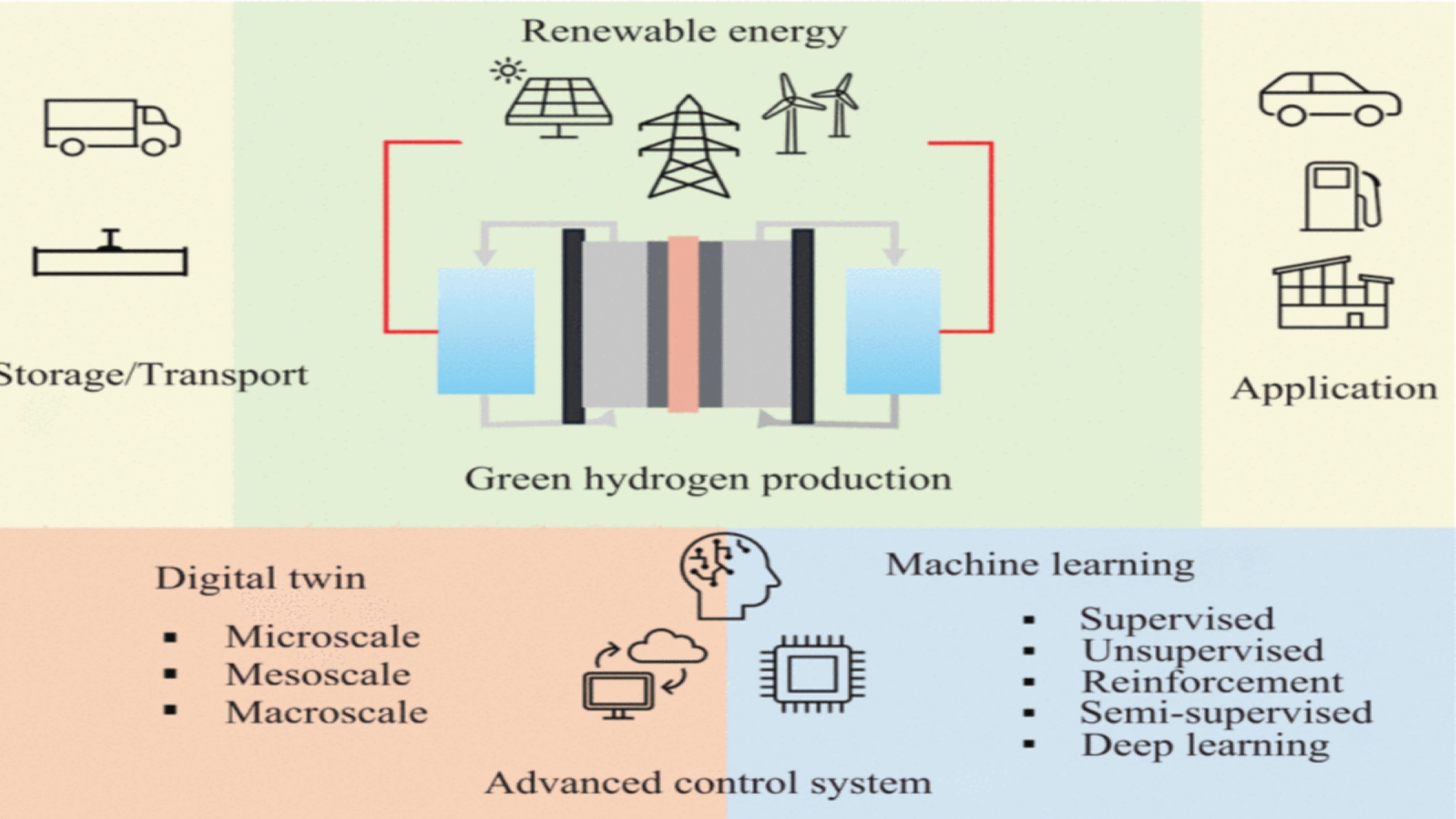
Integrating digital twins and machine learning for advanced control in green hydrogen production

Chain | Vol., Issue 1, 2025 | pp. 1-14
The successful reduction of carbon emissions in major sectors such as heavy industry and long-distance transport depends crucially on the ability to produce green hydrogen on a large scale. This involves generating hydrogen via water electrolysis, utilizing power sourced from renewable energies. However, persistent challenges, such as dynamic inefficiencies, material degradation, and renewable intermittency, demand a paradigm shift from static control strategies to adaptive, self-optimizing systems. This perspective argues that the synergistic integration of digital twins (DTs) and machine learning (ML) offers a transformative framework for real-time optimization, predictive maintenance, and resilient grid integration. By synthesizing physics-based modeling with data-driven intelligence, DT-ML systems enable closed-loop control architectures that dynamically adapt to operational uncertainties. We analyze the technical foundations of this integration, address critical barriers, and propose actionable pathways for stakeholders to accelerate the hydrogen economy's transition from promise to practice.
DOI: 10.23919/CHAIN.2025.000003 Cited: 44 Download: 0
Review

A survey of electric vehicles in sustainable systems: Environmental benefits, pattern analysis, and AI-driven operation methodologies

Chain | Vol., Issue 3, 2024 | pp. 177-202
The emergence of electric vehicles (EVs) is critical for reducing environmental impacts and advancing sustainable transportation. Despite the known benefits, the complexities of EV integration with urban systems, power infrastructure, and environmental policies remain in-sufficiently explored. This literature review seeks to fill these gaps by synthesizing recent research across three key domains: environmental impact and sustainability, pattern analysis and system science, and methodology and operation of EV systems. The focus is on how EV adoption impacts climate change, net-zero emissions, air pollution, power grid dynamics, and mobility patterns, along with evaluating the effectiveness of AI-driven methodologies in enhancing EV operation. We conducted a systematic literature review of top-tier publications from journals such as Nature, Science, and PNAS, covering environmental science, urban systems engineering, and operational research related to EVs. Our findings highlighted that while EVs have the potential to reduce greenhouse gas emissions and improve urban air quality significantly, their actual environmental benefits depend heavily on factors such as electricity generation sources and the lifecycle impacts of battery production. Furthermore, we identified patterns in EV integration that can inform infrastructure planning and revealed the efficacy of advanced computational techniques, particularly reinforcement learning, in optimizing EV operations. Our major contributions include a comprehensive overview of the environmental impacts of EVs, insights into the challenges and opportunities of integrating EVs into urban systems, and showcasing the potential of AI-driven methodologies to enhance EV operations, with significant implications for policymakers, urban planners, and researchers.
DOI: 10.23919/CHAIN.2024.000009 Cited: 10 Download: 0
Perspective

Ammonia fuel: A pathway for carbon-neutral of the transportation sector

Chain | Vol., Issue 2, 2024 | pp. 113-137
Global warming is the most significant challenge to society due to the increasing carbon dioxide level in the atmosphere nowadays. Accelerating the deployment of zero-carbon fuel is imperative in the transportation field, one of the major sources of carbon emissions. The effort on clean energy represented by hydrogen has been made by showing good breakthroughs in some applications; however, many technical and economic challenges exist for large-scale commercial applications. Ammonia, as another zero-carbon fuel, is an efficient storage and transportation medium for hydrogen component and shows greater application potential. Compared to hydrogen, ammonia has more mature storage and transportation technologies, superior related infrastructure, and a further systematic transportation network. In the review, the current mainstream technology routes of ammonia synthesis, the storage and transportation, and the future development trends are summarized. Carbon emissions and costs for the processes are brought into focus. Additionally, the combustion and emission generation mechanisms with technical routes for ammonia as a direct fuel are discussed. The current opportunities and challenges are then analyzed for ammonia as a zero-carbon fuel. The prospect of utilizing ammonia both as a direct fuel and a carrier for hydrogen in transportation is being explored, along with an architecture of the zero-carbon energy system for transportation based on the ammonia fuel.
DOI: 10.23919/CHAIN.2024.000005 Cited: 9 Download: 0
Mini Review

Machine learning and density functional theory for catalyst and process design in hydrogen production

Chain | Vol., Issue 2, 2024 | pp. 150-166
Hydrogen plays a vital role in achieving NetZero emissions as a carbon-free energy carrier. However, its production, especially green hydrogen generated from renewable sources, is hindered by low efficiency and limited yield, primarily due to the performance of the catalysts used. Developing efficient catalysts typically involves extensive experimental work and trial-and-error processes. For instance, screening for effective catalysts still heavily relies on human-lab-work, a process that is time-consuming. Facing this critical challenge, machine learning (ML) emerges as a promising solution. ML, a core component of data mining and analysis that uses statistical algorithms without explicit instructions, can rationalize the design of catalysts through the use of big data, including DFT results. This approach makes a significant shift from traditional trial-and-error approaches to more computationally driven strategies, offering a more effective path to uncovering vital methodologies for catalyst development. This review aims to capture and evaluate the impact of ML algorithms that have driven progress in catalyst research over the past three years. It presents an overview of the existing ML algorithms, exploring their specific functionalities, benefits, and limitations. Besides, this review also considers prospective solutions and future directions for applying ML to enhance the efficiency of green hydrogen production, particularly through electrochemical and biological processes.
DOI: 10.23919/CHAIN.2024.100004 Cited: 31 Download: 0
Mini Review

Review of digital twin technology applications in hydrogen energy

Chain | Vol., Issue 1, 2024 | pp. 54-74
Hydrogen energy is a clean and versatile energy carrier, increasingly recognized for its role in a sustainable energy future due to its clean and abundant energy production. Bridging the gap between potential and practicality, digital Twin (DT) technology emerges as a pivotal artificial intelligence tool, providing a virtual modelling platform that enhances the operation and integration of hydrogen energy into modern energy systems. This review firstly explores the multifaceted applications of DT technology across different stages of the hydrogen energy lifecycle, including production, storage, transport, and utilization. It commences with a detailed introduction to DT technology, elucidating its definition, core principles, and structural nuances, thus laying the groundwork for understanding its pivotal role in energy systems. The core of the review delves into the applications of DT technology in hydrogen energy, segmenting the discussion into production, storage, transport, and utilization processes. Specific focus is given to optimizing fuel cells and hybrid electric vehicles through DT models, along with the seamless integration of hydrogen systems with broader energy networks. It further dissects the working mechanism of DT, highlighting the key features that contribute to itsgrowing prominence in the energy sector.
DOI: 10.23919/CHAIN.2024.000001 Cited: 71 Download: 0

Collection Info

Type Single Journal
Articles 9
Journals 1
Published 2026-11-06

Source Journals

Chain