

Visualization analysis of the tendency of key technology in fuel cell system for vehicle application: A review AITranslate
Abstract AITranslate
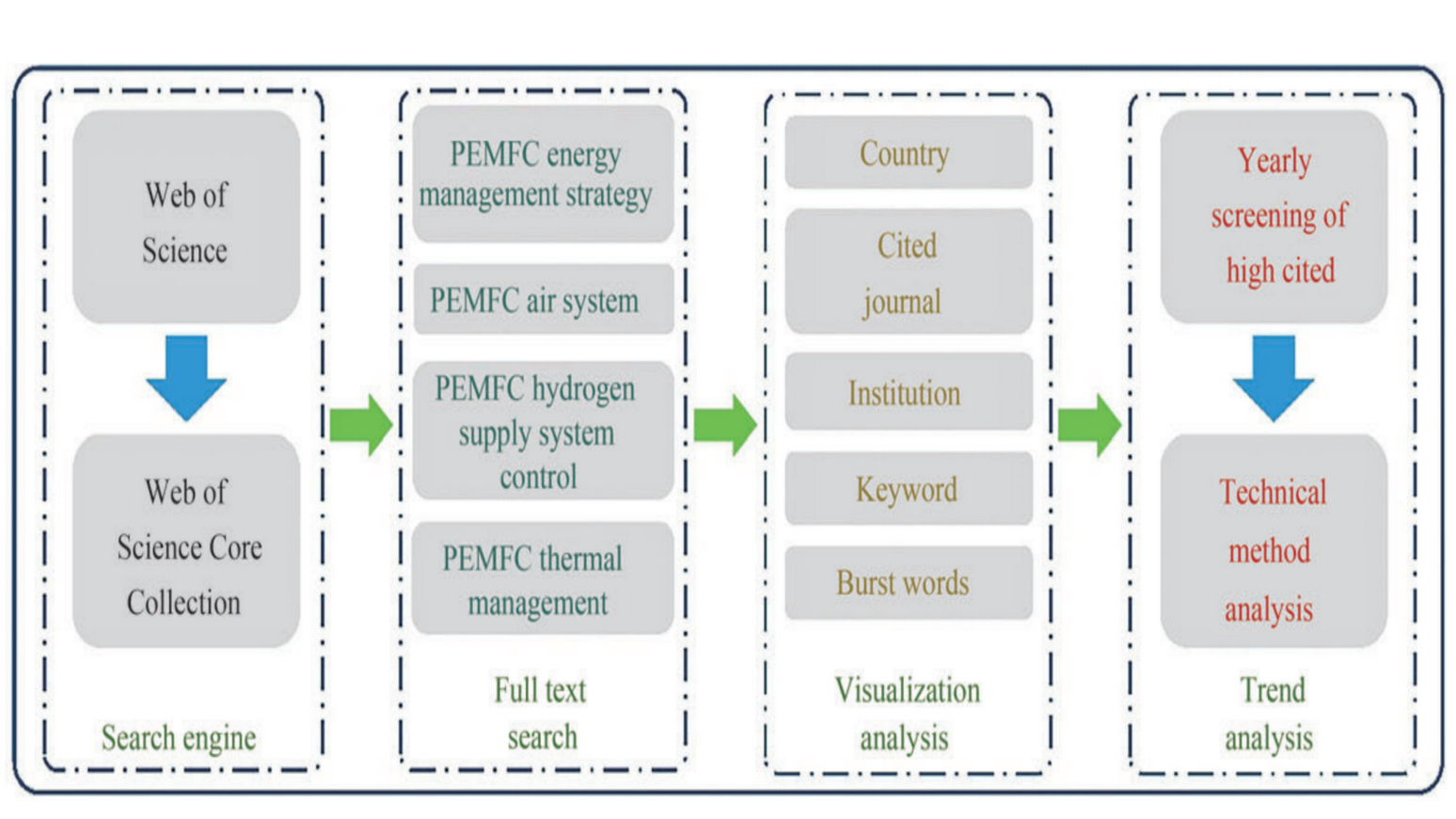
The key technologies of fuel cell systems have a great impact on their performance and lifetime. However, most of the current analyses in reviews only focus on a single system or one aspect of the technology. It is highly necessary to systematically analyze the new development and research trends of vehicular fuel cell systems. This paper proposes a quantitative and visual analysis based on bibliometrics to more intuitively reveal the research direction in this field. Key information on hydrogen/air subsystems, energy management strategies, and thermal management subsystems are analyzed by combining the literature analysis and technical discussion. In detail, the possible reasons behind the variations in the number of articles published within different periods of the subsystem are revealed. Then, through qualitative analysis of representative papers with high citations in different periods, the main research methods adopted by scholars in different periods are derived. Finally, the technology research trends of control methods that need to be addressed in the future are summarized for different subsystems. This paper provides a reference for researchers in the field to understand more clearly the current trends in the field and provide new ideas to break through the challenges of developing high-performance fuel cell systems.
KeyWords AITranslate
[1]S. Yang, B. Sun, H. Guang, R. Wang, B. Zheng, W. Gong, Y. Wang, Y. Shi, Z. Tong, L. Zhang, K. Yang, X. Liu, Y. Cao, J. Li, and Y. Wang, "CHAINS: CHAIN-based fusion safety system framework for intelligent connected vehicle," Chain, vol. 1, no. 1, pp. 2–45, 2024.
[2]S. T. Deng, J. Zhang, C. Z. Zhang, M. Z. Luo, M. Ni, Y. Li, and T. Zeng, "Prediction and optimization of gas distribution quality for high-temperature PEMFC based on data-driven surrogate model," Applied Energy, vol. 327, p. 120000, 2022.
[3]X. Z. Yuan, L. Hui, S. Zhang, J. Martin, and H. Wang, "A review of polymer electrolyte membrane fuel cell durability test protocols," Journal of Power Sources, vol. 196, no. 22, pp. 9107–9116, 2011.
[4]N. F. Asri, T. Husaini, A. B. Sulong, E. H. Majlan, and W. R. W. Daud, "Coating of stainless steel and titanium bipolar plates for anticorrosion in PEMFC: A review," International Journal of Hydrogen Energy, vol. 42, no. 14, pp. 9135–9148, 2016.
[5]L. H. Fan, G. B. Zhang, and K. Jiao, "Characteristics of PEMFC operating at high current density with low external humidification," Energy Conversion and Management, vol. 150, pp. 763–774, 2017.
[6]X. Chen, Z. K. Yu, C. Yang, Y. Chen, C. Jin, Y. J. Ding, W. B. Li, and Z. M. Wan, "Performance investigation on a novel 3D wave flow channel design for PEMFC," International Journal of Hydrogen Energy, vol. 46, no. 19, pp. 11127–11139, 2021.
[7]M. Y. Silaa, M. Derbeli, O. Barambones, and A. Cheknane, "Design and implementation of high order sliding mode control for PEMFC power system," Energies, vol. 13, no. 17, p. 4317, 2020.
[8]R. Cozzolino, S. P. Cicconardi, E. Galloni, M. Minutillo, and A. Perna, "Theoretical and experimental investigations on thermal management of a PEMFC stack," International Journal of Hydrogen Energy, vol. 36, no. 13, pp. 8030–8037, 2011.
[9]S. Sagaria, R. C. Neto, and P. Baptista, "Assessing the performance of vehicles powered by battery, fuel cell and ultra-capacitor: Application to light-duty vehicles and buses," Energy Conversion and Management, vol. 229, no. 9, p. 113767, 2021.
[10]E. B. Agyekum, J. D. Ampah, T. Wilberforce, S. Afrane, and C. Nutakor, "Research progress, trends, and current state of development on PEMFC-new insights from a bibliometric analysis and characteristics of two decades of research output," Membranes, vol. 12, no. 11, p. 1103, 2022.
[11]D. Liu and S. Case, "Durability study of proton exchange membrane fuel cells under dynamic testing conditions with cyclic current profile," Journal of Power Sources, vol. 162, no. 1, pp. 521–531, 2006.
[12]A. H. Tang, Y. H. Yang, Q. Q. Yu, Z. G. Zhang, and L. Yang, "A review of life prediction methods for PEMFCs in electric vehicles," Sustainability, vol. 14, no. 16, p. 9842, 2022.
[13]N. Guerrero Moreno, M. Cisneros Molina, D. Gervasio, and J. F. Perez Robles, "Approaches to polymer electrolyte membrane fuel cells (PEMFCs) and their cost," Renewable & Sustainable Energy Reviews, vol. 52, pp. 897–906, 2015.
[14]Z. C. Gao, Y. Y. Zhao, Q. C. Yang, L. S. Li, Y. X. Liu, and G. B. Liu, "Air and hydrogen supply systems and equipment for PEM fuel cells: A review," International Journal of Green Energy, vol. 19, no. 4, pp. 331–348, 2022.
[15]J. Q. Han, J. M. Feng, P. Chen, Y. M. Liu, and X. Y. Peng, "A review of key components of hydrogen recirculation subsystem for fuel cell vehicles," Energy Conversion and Management-X, vol. 15, p. 100265, 2022.
[16]X. Q. Lu, Y. Qu, Y. D. Wang, C. Qin, and G. Liu, "A comprehensive review on hybrid power system for PEMFC-HEV: Issues and strategies," Energy Conversion and Management, vol. 171, pp. 1273–1291, 2018.
[17]F. Segura, J. M. Andujar, and E. Duran, "Analog current control techniques for power control in pem fuel-cell hybrid systems: A critical review and a practical application," IEEE Transactions on Industrial Electronics, vol. 58, no. 4, pp. 1171–1184, 2011.
[18]P. Garcia, L. M. Fernandez, C. A. Garcia, and F. Jurado, "Energy management system of fuel-cell-battery hybrid tramway," IEEE Transactions on Industrial Electronics, vol. 57, no. 12, pp. 4013–4023, 2010.
[19]W. Jiang and B. Fahimi, "Active current sharing and source management in fuel cell–battery hybrid power system," IEEE Transactions on Industrial Electronics, vol. 57, no. 2, pp. 752–761, 2010.
[20]Z. Feng, I. Eiubovi, Y. Shao, Z. Fan, and R. Tan, "Review of digital twin technology applications in hydrogen energy," Chain, vol. 1, no. 1, pp. 54–74, 2024.
[21]Q. Li, X. Meng, F. Gao, G. R. Zhang, W. R. Chen, and K. Rajashekara, "Reinforcement learning energy management for fuel cell hybrid system: A review," IEEE Industrial Electronics Magazine, vol. 17, no. 4, pp. 45–54, 2022.
[22]H. B. Zhang, Q. Li, H. Q. Wang, Q. Y. Li, G. F. Qin, and Q. Wu, "A review of energy management optimization based on the equivalent consumption minimization strategy for fuel cell hybrid power systems," Fuel Cells, vol. 22, no. 4, pp. 116–130, 2022.
[23]X. Q. Lu, Y. B. Wu, J. Lian, Y. Y. Zhang, C. Chen, P. S. Wang, and L. Z. Meng, "Energy management of hybrid electric vehicles: A review of energy optimization of fuel cell hybrid power system based on genetic algorithm," Energy Conversion and Management, vol. 205, p. 112474, 2020.
[24]Y. K. Zhou, "Advances of machine learning in multi-energy district communities– mechanisms, applications and perspectives," Energy and AI, vol. 10, p. 100187, 2022.
[25]T. Teng, X. Zhang, H. Dong, and Q. Xue, "A comprehensive review of energy management optimization strategies for fuel cell passenger vehicle," International Journal of Hydrogen Energy, vol. 45, no. 39, pp. 20293–20303, 2020.
[26]M. Yue, S. Jemei, R. Gouriveau, and N. Zerhouni, "Review on health-conscious energy management strategies for fuel cell hybrid electric vehicles: Degradation models and strategies," International Journal of Hydrogen Energy, vol. 44, no. 13, pp. 6844–6861, 2019.
[27]T. Rudolf, T. Schurmann, S. Schwab, and S. Hohmann, "Toward holistic energy management strategies for fuel cell hybrid electric vehicles in heavy-duty applications," Proceedings of the IEEE, vol. 109, no. 6, pp. 1094–1114, 2021.
[28]Y. Luo, Y. H. Wu, B. Li, J. K. Qu, S. P. Feng, and P. K. Chu, "Optimization and cutting-edge design of fuel-cell hybrid electric vehicles," International Journal of Energy Research, vol. 45, no. 13, pp. 18392–18423, 2021.
[29]Y. Wang, Y. H. Pang, H. Xu, A. Martinez, and K. S. Chen, "PEM Fuel cell and electrolysis cell technologies and hydrogen infrastructure development—A review," Energy & Environmental Science, vol. 15, no. 6, pp. 2288–2328, 2022.
[30]J. M. Xu, C. Z. Zhang, Z. G. Wan, X. Chen, S. W. Chan, and Z. K. Tu, "Progress and perspectives of integrated thermal management systems in PEM fuel cell vehicles: A review," Renewable and Sustainable Energy Reviews, vol. 155, p. 111908, 2022.
[31]B. Mhsba, C. Maaa, T. A. Qi, L. A. Jing, D. Js, and A. Yw, "Liquid cooling techniques in proton exchange membrane fuel cell stacks: A detailed survey," Alexandria Engineering Journal, vol. 59, no. 2, pp. 635–655, 2020.
[32]L. G. He, Y. Y. Yang, Y. Zhang, P. P. Li, and Y. J. Xin, "A review of thermal management of proton exchange membrane fuel cell systems," Journal of Renewable and Sustainable Energy, vol. 15, no. 1, p. 012703, 2023.
[33]L. Cheng, Z. X. Wu, J. G. Mou, Y. Q. Gu, D. H. Wu, P. J. Zhou, and J. Liu, "Research progress on gas supply system of proton exchange membrane fuel cells," Processes, vol. 12, no. 6, p. 1224, 2024.
[34]X. Lü, Y. Wu, J. Lian, Y. Zhang, C. Chen, P. Wang, and L. Meng, "Energy management of hybrid electric vehicles: A review of energy optimization of fuel cell hybrid power system based on genetic algorithm," Energy Conversion and Management, vol. 205, p. 112474, 2020.
[35]P. Zhang, F. W. Yan, and C. Q. Du, "A comprehensive analysis of energy management strategies for hybrid electric vehicles based on bibliometrics," Renewable & Sustainable Energy Reviews, vol. 48, pp. 88–104, 2015.
[36]W. R. W. Daud, R. E. Rosli, E. H. Majlan, S. A. A. Hamid, R. Mohamed, and T. Husaini, "PEM fuel cell system control: A review," Renewable Energy, vol. 113, pp. 620–638, 2017.
[37]B. Yang, J. Li, Y. Li, Z. Guo, K. Zeng, H. Shu, P. Cao, and Y. Ren, "A critical survey of proton exchange membrane fuel cell system control: Summaries, advances, and perspectives," International Journal of Hydrogen Energy, vol. 47, no. 17, pp. 9986–10020, 2022.
[38]F. Zhou, H. C. Guo, Y. S. Ho, and C. Z. Wu, "Scientometric analysis of geostatistics using multivariate methods," Scientometrics, vol. 73, no. 3, pp. 265–279, 2007.
[39]L. J. Wang, X. Y. Li, P. Y. Guo, S. M. Guo, Z. Z. Yang, and P. C. Pei, "Bibliometric analysis of prognostics and health management (PHM) in hydrogen fuel cell engines," International Journal of Hydrogen Energy, vol. 47, no. 80, pp. 34216–34243, 2022.
[40]A. Martin, "Demonstration fleets on the path to mass commercialization of fuel cell vehicles,"International Hydrogen Energy Conference 2004, Beijing, China, 2004, p. 2.
[41]T. Homma, "Stationary fuel cells application in Japan,"International Hydrogen Energy Conference 2004, Beijing, China, 2004, pp. 179–184.
[42]Q. Zhou, "Trend of lightweight vehicle body technologies," in Proceedings of the 3rd International Forum of Automotive Traffic Safety, Shanghai, China, 2004, pp. 102–109.
[43]J. W. Li and T. Yu, "Sensors integrated control of PEMFC gas supply system based on large-scale deep reinforcement learning," Sensors, vol. 21, no. 2, p. 349, 2021.
[44]C. C. Lin, H. Peng, J. W. Grizzle, J. Liu, and M. Busdiecker, "Control system development for an advanced-technology medium-duty hybrid electric truck,"SAE Technical Paper2003-01-3369, 2003.
[45]M. Kim, Y. J. Sohn, W. Y. Lee, and C. S. Kim, "Fuzzy control based engine sizing optimization for a fuel cell/battery hybrid mini-bus," Journal of Power Sources, vol. 178, no. 2, pp. 706–710, 2008.
[46]M. Ansarey, M. S. Panahi, H. Ziarati, and M. Mahjoob, "Optimal energy management in a dual-storage fuel-cell hybrid vehicle using multi-dimensional dynamic programming," Journal of Power Sources, vol. 250, pp. 359–371, 2014.
[47]P. Polverino, E. Frisk, D. Jung, M. Krysander, and C. Pianese, "Model-based diagnosis through structural analysis and causal computation for automotive polymer electrolyte membrane fuel cell systems," Journal of Power Sources, vol. 357, pp. 26–40, 2017.
[48]C. W. Xiao, B. Wang, D. Zhao, and C. H. Wang, "Comprehensive investigation on lithium batteries for electric and hybrid-electric unmanned aerial vehicle applications," Thermal Science and Engineering Progress, vol. 38, p. 101677, 2023.
[49]R. T. Yadlapalli, R. R. Alla, R. Kandipati, and A. Kotapati, "Supercapacitors for energy storage: Progress, applications and challenges," Journal of Energy Storage, vol. 49, p. 104194, 2022.
[50]K. B. Samal, S. Pati, and R. Sharma, "A review of FCs integration with microgrid and their control strategies," International Journal of Hydrogen Energy, vol. 48, no. 91, pp. 35661–35684, 2023.
[51]A. Rousseau, P. Sharer, and R. Ahluwalia, "Energy storage requirements for fuel cell vehicles,"SAE Technical Papers, 2004-01-1302, 2004.
[52]T. Fletcher, R. Thring, and M. Watkinson, "An energy management strategy to concurrently optimize fuel consumption & PEM fuel cell lifetime in a hybrid vehicle," International Journal of Hydrogen Energy, vol. 41, no. 46, pp. 21503–21515, 2016.
[53]P. Pisu and G. Rizzoni, "A comparative study of supervisory control strategies for hybrid electric vehicles," IEEE Transactions on Control Systems Technology, vol. 15, no. 3, pp. 506–518, 2007.
[54]F. Vidal-Naquet and G. Zito, "Adapted optimal energy management strategy for drivability,"Vehicle Power and Propulsion Conference (VPPC), 2012, IEEE, Seoul, Korea (South), 2012, pp. 358–363.
[55]D. F. Opila, X. Wang, R. Mcgee, R. B. Gillespie, J. A. Cook, and J. W. Grizzle, "An energy management controller to optimally trade off fuel economy and drivability for hybrid vehicles," IEEE Transactions on Control Systems Technology, vol. 20, no. 6, pp. 1490–1505, 2012.
[56]E. Faggioli, P. Rena, V. Danel, X. Andrieu, R. Mallant, and H. Kahlen, "Supercapacitors for the energy management of electric vehicles," Journal of Power Sources, vol. 86, no. 2, pp. 261–269, 1999.
[57]C. H. Zheng, C. E. Oh, Y. I. Park, and S. W. Cha, "Fuel economy evaluation of fuel cell hybrid vehicles based on equivalent fuel consumption," Fuel and Energy Abstracts, vol. 37, no. 2, pp. 1790–1796, 2012.
[58]T. Zeng, C. Zhang, M. Hu, Y. Chen, C. Yuan, J. Chen, and A. Zhou, "Modelling and predicting the energy consumption of a range extender fuel cell hybrid vehicle," Energy, vol. 165, pp. 187–197, 2018.
[59]N. Sulaiman, M. A. Hannan, A. Mohamed, P. J. Ker, E. H. Majlan, and D. Wan, "Optimization of energy management system for fuel-cell hybrid electric vehicles: Issues and recommendations," Applied Energy, vol. 228, pp. 2061–2079, 2018.
[60]H. S. Das, C. W. Tan, and A. Yatim, "Fuel cell hybrid electric vehicles: A review on power conditioning units and topologies," Renewable & Sustainable Energy Reviews, vol. 76, pp. 268–291, 2017.
[61]A. Schell, H. Peng, D. Tran, E. Stamos, C. C. Lin, and J. K. Min, "Modelling and control strategy development for fuel cell electric vehicles," Annual Reviews in Control, vol. 29, no. 1, pp. 159–168, 2005.
[62]F. G. Hamed and F. Meisam, "Online multi-level energy management strategy based on rule-based and optimization-based approaches for fuel cell hybrid electric vehicles," Applied Sciences, vol. 11, no. 9, p. 3849, 2021.
[63]S. Caux, W. Hankache, M. Fadel, and D. Hissel, "On-line fuzzy energy management for hybrid fuel cell systems," International Journal of Hydrogen Energy, vol. 35, no. 5, pp. 2134–2143, 2010.
[64]C. Y. Li and G. P. Liu, "Optimal fuzzy power control and management of fuel cell/battery hybrid vehicles," Journal of Power Sources, vol. 192, no. 2, pp. 525–533, 2009.
[65]L. Qi, W. Chen, Y. Li, S. Liu, and J. Huang, "Energy management strategy for fuel cell/battery/ultracapacitor hybrid vehicle based on fuzzy logic," International Journal of Electrical Power & Energy Systems, vol. 43, no. 1, pp. 514–525, 2012.
[66]Y. C. Wang, Y. Z. Zhang, C. Z. Zhang, J. M. Zhou, D. H. Hu, F. Y. Yi, Z. X. Fan, and T. Zeng, "Genetic algorithm-based fuzzy optimization of energy management strategy for fuel cell vehicles considering driving cycles recognition," Energy, vol. 263, p. 126112, 2023.
[67]B. Geng, J. K. Mills, and D. Sun, "Two-stage energy management control of fuel cell plug-in hybrid electric vehicles considering fuel cell longevity," IEEE Transactions on Vehicular Technology, vol. 61, no. 2, pp. 498–508, 2012.
[68]L. Kwon, D. S. Cho, and C. Ahn, "Degradation-conscious equivalent consumption minimization strategy for a fuel cell hybrid system," Energies, vol. 14, no. 13, p. 3810, 2021.
[69]L. Xu, M. Ouyang, J. Li, F. Yang, L. Lu, and J. Hua, "Application of Pontryagin's minimal principle to the energy management strategy of plugin fuel cell electric vehicles," International Journal of Hydrogen Energy, vol. 38, no. 24, pp. 10104–10115, 2013.
[70]X. Li, Y. Wang, D. Yang, and Z. Chen, "Adaptive energy management strategy for fuel cell/battery hybrid vehicles using Pontryagin's minimal principle," Journal of Power Sources, vol. 440, p. 227105, 2019.
[71]D. Fares, R. Chedid, F. Panik, S. Karaki, and R. Jabr, "Dynamic programming technique for optimizing fuel cell hybrid vehicles," International Journal of Hydrogen Energy, vol. 40, no. 24, pp. 7777–7790, 2015.
[72]X. Tian, S. Zhou, H. Hao, H. Ruan, R. R. Gaddam, R. C. Dutta, T. Zhu, H. Wang, B. Wu, N. P. Brandon, and R. Tan, "Machine learning and density functional theory for catalyst and process design in hydrogen production," Chain, vol. 1, no. 2, pp. 150–166, 2024.
[73]J. Yuan, L. Yang, and Q. Chen, "Intelligent energy management strategy based on hierarchical approximate global optimization for plug-in fuel cell hybrid electric vehicles," International Journal of Hydrogen Energy, vol. 43, no. 16, pp. 8063–8078, 2018.
[74]W. W. Huo, T. Liu, and B. Lu, "A reinforcement learning-based energy management strategy for fuel cell electric vehicle considering coupled-energy sources degradations," Sustainable Energy Grids & Networks, vol. 40, p. 101548, 2024.
[75]J. H. Zhou, H. Y. Zhou, C. Y. Wang, and W. Z. Zhao, "Multi-objective energy management strategy for a dual-stack fuel cell heavy-duty truck via deep reinforcement learning,"Proceedings of the Institution of Mechanical Engineers Part D-Journal of Automobile Engineering, 2024, online first, DOI 10.1177/09544070241279007..
[76]B. Hra, C. Amna, F. Maade, E. Ahad, and H. Afg, "Comparison among various energy management strategies for reducing hydrogen consumption in a hybrid fuel cell/supercapacitor/battery system," International Journal of Hydrogen Energy, vol. 48, no. 8, pp. 6110–6126, 2019.
[77]C. Sheng, Z. Guo, J. Z. Lei, S. Y. Zhang, W. X. Zhang, W. M. Chen, X. F. Jiang, Z. Wang, and X. Li, "Optimal energy management strategies for hybrid power systems considering Pt degradation," Applied Energy, vol. 360, p. 15, 2024.
[78]H. C. Sun, Z. M. Fu, F. Z. Tao, L. L. Zhu, and P. J. Si, "Data-driven reinforcement-learning-based hierarchical energy management strategy for fuel cell/battery/ultracapacitor hybrid electric vehicles," Journal of Power Sources, vol. 455, p. 227964, 2020.
[79]T. Liu, Y. Zou, D. Liu, and F. Sun, "Reinforcement learning of adaptive energy management with transition probability for a hybrid electric tracked vehicle," IEEE Transactions on Industrial Electronics, vol. 62, no. 12, pp. 7837–7846, 2015.
[80]Y. Xia, B. Zhou, and X. Lin, "Online recursive power management strategy based on the reinforcement learning algorithm with cosine similarity and a forgetting factor," IEEE Transactions on Industrial Electronics, vol. 68, no. 6, pp. 5013–5023, 2021.
[81]J. Wu, H. He, J. Peng, Y. Li, and Z. Li, "Continuous reinforcement learning of energy management with deep Q network for a power-split hybrid electric bus," Applied Energy, vol. 222, pp. 799–811, 2018.
[82]X. Han, H. He, J. Wu, J. Peng, and Y. Li, "Energy management based on reinforcement learning with double deep Q-learning for a hybrid electric tracked vehicle," Applied Energy, vol. 254, p. 113708, 2019.
[83]H. F. Kong, J. P. Yan, H. Wang, and L. Fan, "Energy management strategy for electric vehicles based on deep Q-learning using Bayesian optimization," Neural Computing & Applications, vol. 32, no. 18, pp. 14431–14445, 2020.
[84]Y. Li, H. He, J. Peng, and H. Wang, "Deep reinforcement learning-based energy management for a series hybrid electric vehicle enabled by history cumulative trip information," IEEE Transactions on Vehicular Technology, vol. 68, no. 99, pp. 7416–7430, 2019.
[85]Y. Z. Zhang, C. Z. Zhang, R. J. Fan, S. L. Huang, Y. Yang, and Q. W. Xu, "Twin delayed deep deterministic policy gradient-based deep reinforcement learning for energy management of fuel cell vehicle integrating durability information of powertrain," Energy Conversion and Management, vol. 274, p. 116454, 2022.
[86]X. L. Tang, H. T. Zhou, F. Wang, W. D. Wang, and X. K. Lin, "Longevity-conscious energy management strategy of fuel cell hybrid electric vehicle based on deep reinforcement learning," Energy, vol. 238, p. 121593, 2022.
[87]H. He, S. Quan, F. Sun, and Y. X. Wang, "Model predictive control with lifetime constraints based energy management strategy for proton exchange membrane fuel cell hybrid power systems," IEEE Transactions on Industrial Electronics, vol. 67, no. 10, pp. 9012–9023, 2020.
[88]S. Quan, Y. X. Wang, X. Xiao, H. He, and F. Sun, "Real-time energy management for fuel cell electric vehicle using speed prediction-based model predictive control considering performance degradation," Applied Energy, vol. 304, p. 117845, 2021.
[89]K. Ou, Y. X. Wang, Z. Z. Li, Y. D. Shen, and D. J. Xuan, "Feedforward fuzzy-PID control for airflow regulation of PEM fuel cell system," International Journal of Hydrogen Energy, vol. 40, no. 35, pp. 11686–11695, 2015.
[90]J. T. Pukrushpan, A. G. Stefanopoulou, and H. Peng, "Control of fuel cell breathing," Control Systems IEEE, vol. 24, no. 2, pp. 30–46, 2004.
[91]T. Ren and M. Feng, "Anti-shock characteristics of water lubricated bearing for fuel cell vehicle air compressor," Tribology International, vol. 107, pp. 56–64, 2017.
[92]T. Ren and M. Feng, "Stability analysis of water-lubricated journal bearings for fuel cell vehicle air compressor," Tribology International, vol. 95, pp. 342–348, 2016.
[93]K. Powers, I. Kennedy, J. Archer, P. Eynon, J. Horsley, C. Brace, C. Copeland, and P. Milewski, "A new first-principles model to predict mild and deep surge for a centrifugal compressor," Energy, vol. 244, p. 123050, 2022.
[94]M. T. Iqbal, "Modeling and control of a wind fuel cell hybrid energy system," Renewable Energy, vol. 28, no. 2, pp. 223–237, 2003.
[95]C. H. Woo and J. B. Benziger, "PEM fuel cell current regulation by fuel feed control," Chemical Engineering Science, vol. 62, no. 4, pp. 957–968, 2007.
[96]M. Serra, J. Aguado, X. Ansede, and J. Riera, "Controllability analysis of decentralized linear controllers for polymeric fuel cells," Journal of Power Sources, vol. 151, no. 1, pp. 93–102, 2005.
[97]M. Gerard, J. P. Poirot-Crouvezier, D. Hissel, and M. C. Pera, "Oxygen starvation analysis during air feeding faults in PEMFC," International Journal of Hydrogen Energy, vol. 35, no. 22, pp. 12295–12307, 2010.
[98]A. Arce, A. Real, C. Bordons, and D. R. Ramirez, "Real-time implementation of a constrained MPC for efficient airflow control in a PEM fuel cell," IEEE Transactions on Industrial Electronics, vol. 57, no. 6, pp. 1892–1905, 2010.
[99]S. Hahn, J. Braun, H. Kemmer, and H. C. Reuss, "Adaptive operation strategy of a polymer electrolyte membrane fuel cell air system based on model predictive control," International Journal of Hydrogen Energy, vol. 46, no. 33, pp. 17306–17321, 2021.
[100]W. Garcia-Gabin, F. Dorado, and C. Bordons, "Real-time implementation of a sliding mode controller for air supply on a PEM fuel cell," Journal of Process Control, vol. 20, no. 3, pp. 325–336, 2010.
[101]Z. Baroud, M. Benmiloud, A. Benalia, and C. Ocampo-Martinez, "Novel hybrid fuzzy-PID control scheme for air supply in PEM fuel-cell-based systems," International Journal of Hydrogen Energy, vol. 42, no. 15, pp. 10435–10447, 2017.
[102]M. A. Prasad, B. G. U. Bhaskar, and M. Siva, "Fuzzy logic based control strategies for proton exchange membrane fuel cell system," IFAC PapersOnLine, vol. 55, no. 1, pp. 703–708, 2022.
[103]J. Liu, Y. Gao, X. Su, M. Wack, and L. Wu, "Disturbance-observer-based control for air management of pem fuel cell systems via sliding mode technique," IEEE Transactions on Control Systems Technology, vol. 27, no. 3, pp. 1129–1138, 2018.
[104]K. Sankar and A. K. Jana, "Nonlinear multivariable sliding mode control of a reversible PEM fuel cell integrated system," Energy Conversion and Management, vol. 171, no. 1082, pp. 541–565, 2018.
[105]J. W. Li and T. Yu, "Intelligent controller based on distributed deep reinforcement learning for pemfc air supply system," IEEE Access, vol. 9, pp. 7496–7507, 2021.
[106]T. Aihua, Y. Lin, Z. Tao, and Y. Quanqing, "Cascade control method of sliding mode and PID for PEMFC air supply system," Energies, vol. 16, no. 1, p. 228, 2022.
[107]D. Zhao, L. Xia, H. Dang, Z. Wu, and H. Li, "Design and control of air supply system for PEMFC UAV based on dynamic decoupling strategy," Energy Conversion and Management, vol. 253, p. 115159, 2022.
[108]T. Zeng, L. Xiao, J. R. Chen, Y. Li, Y. Yang, S. L. Huang, C. H. Deng, and C. Z. Zhang, "Feedforward-based decoupling control of air supply for vehicular fuel cell system: Methodology and experimental validation," Applied Energy, vol. 335, p. 120756, 2023.
[109]J. Q. Han, J. M. Feng, P. Chen, Y. M. Liu, and X. Y. Peng, "A review of key components of hydrogen recirculation subsystem for fuel cell vehicles," Energy Conversion and Management: X, vol. 15, p. 100265, 2022.
[110]S. Cheng, Y. Z. Feng, K. G. Wang, and X. H. Meng, "A multi-DOF tribo-dynamics analysis of scroll compressor considering wear properties of Oldham's ring," Tribology International, vol. 179, p. 108125, 2023.
[111]B. Zhao, H. Wei, Z. J. Zhang, J. M. Feng, and X. Y. Peng, "Effects of clearances size and fluid medium components on the thermodynamic performance of a claw pump for fuel cell vehicle," International Journal of Energy Research, vol. 46, no. 11, pp. 15054–15065, 2022.
[112]L. F. Xing, J. M. Feng, W. Q. Chen, Z. Y. Xing, and X. Y. Peng, "Development and testing of a roots pump for hydrogen recirculation in fuel cell system," Applied Sciences-Basel, vol. 10, no. 22, p. 8091, 2020.
[113]J. Feng, L. Xing, B. Wang, H. Wei, and Z. Xing, "Effects of working fluids on the performance of a roots pump for hydrogen recirculation in a PEM fuel cell system," Applied Sciences, vol. 10, no. 22, p. 8069, 2020.
[114]C. Hariharan and M. Govardhan, "Improving the performance of an industrial centrifugal blower with parallel wall volutes," Applied Thermal Engineering: Design, Processes, Equipment, Economics, vol. 109, pp. 53–64, 2016.
[115]R. Moradi, E. Habib, E. Bocci, and L. Cioccolanti, "Investigation on the use of a novel regenerative flow turbine in a micro-scale organic Rankine cycle unit," Energy, vol. 210, p. 118519, 2020.
[116]Q. Zhang, J. Feng, W. Jie, and X. Peng, "3D transient CFD modeling of a scroll-type hydrogen pump used in FCVs," International Journal of Hydrogen Energy, vol. 43, no. 41, pp. 19231–19241, 2018.
[117]J. He, S. Y. Choe, and C. O. Hong, "Analysis and control of a hybrid fuel delivery system for a polymer electrolyte membrane fuel cell," Journal of Power Sources, vol. 185, no. 2, pp. 973–984, 2008.
[118]S. Toghyani, E. Afshari, and E. Baniasadi, "A parametric comparison of three fuel recirculation systems in the closed loop fuel supply system of PEM fuel cell," International Journal of Hydrogen Energy, vol. 44, no. 14, pp. 7518–7530, 2019.
[119]S. Toghyani, E. Baniasadi, and E. Afshari, "Performance analysis and comparative study of an anodic recirculation system based on the electrochemical pump in proton exchange membrane fuel cell," International Journal of Hydrogen Energy, vol. 43, no. 42, pp. 19691–19703, 2018.
[120]D. Li, Z. He, S. Sun, C. Wang, and Z. Xing, "Development and analysis of novel six-lobe helical rotors for hydrogen fuel cell vehicle roots blowers," International Journal of Hydrogen Energy, vol. 46, no. 59, pp. 30479–30493, 2021.
[121]J. K. Kuo, W. Z. Jiang, C. H. Li, and T. H. Hsu, "Numerical investigation into hydrogen supply stability and I–V performance of PEM fuel cell system with passive Venturi ejector," Applied Thermal Engineering, vol. 169, p. 114908, 2020.
[122]L. Chen, K. D. Xu, Z. Y. Yang, Z. Yan, and Z. M. Dong, "Optimal design and operation of dual-ejector PEMFC hydrogen supply and circulation system," Energies, vol. 15, no. 15, p. 5427, 2022.
[123]R. M. Wang, Y. Y. Zhang, and G. Y. Cao, "Hybrid intelligent PID control design for PEMFC anode system," Journal of Zhejiang University-Science A, vol. 9, no. 4, pp. 552–557, 2008.
[124]I. Matraji, S. Laghrouche, and M. Wack, "Pressure control in a PEM fuel cell via second order sliding mode," International Journal of Hydrogen Energy, vol. 37, no. 21, pp. 16104–16116, 2012.
[125]J. Liu, W. Lin, F. Alsaadi, and T. Hayat, "Nonlinear observer design for PEM fuel cell power systems via second order sliding mode technique," Neurocomputing, vol. 168, pp. 145–151, 2015.
[126]S. Tong, J. Fang, and Y. Zhang, "Output tracking control of a hydrogen-air PEM fuel cell," IEEE/CAA Journal of Automatica Sinica, vol. 4, no. 2, pp. 273–279, 2017.
[127]X. C. Ye, T. Zhang, H. C. Chen, J. Cao, and J. J. Chen, "Fuzzy control of hydrogen pressure in fuel cell system," International Journal of Hydrogen Energy, vol. 44, no. 16, pp. 8460–8466, 2019.
[128]J. W. Li and Y. Tao, "Sensors integrated control of PEMFC gas supply system based on large-scale deep reinforcement learning," Sensors, vol. 21, no. 2, p. 349, 2021.
[129]R. Cao, H. Wan, Z. He, and Y. Lu, "Multiple model predictive control of perching maneuver based on guardian maps," Chinese Journal of Aeronautics, vol. 35, no. 5, pp. 347–360, 2021.
[130]B. Zhang, D. Hao, J. R. Chen, C. Z. Zhang, B. Chen, Z. B. Wei, and Y. X. Wang, "Modeling and decentralized predictive control of ejector circulation-based PEM fuel cell anode system for vehicular application," Automotive Innovation, vol. 5, no. 3, pp. 333–345, 2022.
[131]Y. Zhu, J. X. Zou, S. Li, C. Peng, and Y. C. Xie, "Nonlinear model predictive control of PEMFC anode hydrogen circulation system based on dynamic coupling analysis," International Journal of Hydrogen Energy, vol. 48, no. 6, pp. 2385–2400, 2023.
[132]B. Zhang, Y. Feng, C. Z. Zhang, Z. C. Gao, T. Zeng, D. Hao, Z. X. Mao, and F. X. Chen, "Modeling, control and analysis of a novel energy-saving oriented fuel cell anode system," Energy Conversion and Management, vol. 283, p. 116942, 2023.
[133]S. L. Cheng, C. Fang, L. F. Xu, J. Q. Li, and M. G. Ouyang, "Model-based temperature regulation of a PEM fuel cell system on a city bus," International Journal of Hydrogen Energy, vol. 40, no. 39, pp. 13566–13575, 2015.
[134]S. Q. Su, J. F. Sun, G. D. Meng, X. Liu, and Y. P. Wang, "Thermal management control strategy of liquid-cooled fuel cell vehicle," Energy Reports, vol. 8, pp. 141–153, 2022.
[135]Y. J. Yang, M. L. Bai, Z. F. Zhou, W. T. Wu, C. Z. Hu, L. S. Gao, Y. Li, Y. B. Li, and Y. C. Song, "Numerical simulation for non-uniform PtCo catalyst degradation under constant voltage condition and its impact on PEMFC performance," International Journal of Heat and Mass Transfer, vol. 218, p. 124793, 2024.
[136]Y. Yuan, L. Chen, X. B. Lyu, W. J. Ning, W. Q. Liu, and W. Q. Tao, "Modeling and optimization of a residential PEMFC-based CHP system under different operating modes," Applied Energy, vol. 353, p. 122066, 2024.
[137]Y. C. Wang, H. J. Ren, and C. Li, "Enhancing proton-exchange membrane fuel-cell heat transfer performance with embedded cooling channel design: A systematic numerical study," Journal of Energy Engineering, vol. 150, no. 1, p. 123326, 2024.
[138]F. Dong, J. P. Zhou, S. Xu, and J. Ni, "Numerical study on the effect of the vane channel parameters on the performance of gas-water separators for a PEMFC system," Chemical Engineering Research and Design, vol. 199, pp. 175–191, 2023.
[139]F. C. Chen, Z. Gao, R. O. Loutfy, and M. Hecht, "Analysis of optimal heat transfer in a PEM fuel cell cooling plate," Fuel Cells, vol. 3, no. 4, pp. 181–188, 2004.
[140]S. M. Rahgoshay, A. A. Ranjbar, A. Ramiar, and E. Alizadeh, "Thermal investigation of a PEM fuel cell with cooling flow field," Energy, vol. 134, pp. 61–73, 2017.
[141]S. M. M. Joibary, S. M. Rahgoshay, M. Rahimi-Esbo, and K. D. Firouzjaee, "Numerical investigation of the influence of different cooling flow channels on the thermal and water saturation distribution in a real dimensional polymer electrolyte membrane fuel cell," International Journal of Hydrogen Energy, vol. 48, no. 7, pp. 2762–2787, 2023.
[142]M. Ghasemi, A. Ramiar, A. A. Ranjbar, and S. M. Rahgoshay, "A numerical study on thermal analysis and cooling flow fields effect on PEMFC performance," International Journal of Hydrogen Energy, vol. 42, no. 38, pp. 24319–24337, 2017.
[143]C. Castelain, Y. Lasbet, B. Auvity, and H. Peerhossaini, "Experimental study of the thermal performance of chaotic geometries for their use in PEM fuel cells," International Journal of Thermal Sciences, vol. 101, pp. 181–192, 2016.
[144]Y. Lasbet, B. Auvity, C. Castelain, and H. Peerhossaini, "Thermal and hydrodynamic performances of chaotic mini-channel: Application to the fuel cell cooling," Heat Transfer Engineering, vol. 28, no. 8–9, pp. 795–803, 2007.
[145]A. P. Sasmito, J. C. Kurnia, and A. S. Mujumdar, "Numerical evaluation of various gas and coolant channel designs for high performance liquid-cooled proton exchange membrane fuel cell stacks," Energy, vol. 44, no. 1, pp. 278–291, 2012.
[146]C. Lin, X. Yan, G. Wei, C. Ke, and J. Zhang, "Optimization of configurations and cathode operating parameters on liquid-cooled proton exchange membrane fuel cell stacks by orthogonal method," Applied Energy, vol. 253, p. 113496, 2019.
[147]J. N. Song, Y. Huang, Y. Liu, Z. P. Ma, L. J. Chen, T. K. Li, and X. Zhang, "Numerical investigation and optimization of cooling flow field design for proton exchange membrane fuel cell," Energies, vol. 15, no. 7, p. 2609, 2022.
[148]M. Z. Pan, D. Li, C. J. Pan, and L. Liang, "Maximum power tracking-based adaptive cold start strategy for proton exchange membrane fuel cell," Energy Conversion and Management, vol. 273, p. 116387, 2022.
[149]X. K. Yang, J. Q. Sun, S. C. Sun, and Z. G. Shao, "An efficient cold start strategy for proton exchange membrane fuel cell stacks," Journal of Power Sources, vol. 542, p. 231492, 2022.
[150]Z. N. Wang, Z. Y. Hu, L. F. Xu, J. Q. Li, and M. G. Ouyang, "Experimental study on cold start strategies of fuel cell stack: Sensitivity analysis, optimization, and boundaries," Journal of the Electrochemical Society, vol. 171, no. 6, p. 064502, 2024.
[151]P. K. Das, X. Li, and Z. S. Liu, "A three-dimensional agglomerate model for the cathode catalyst layer of PEM fuel cells," Journal of Power Sources, vol. 179, no. 1, pp. 186–199, 2008.
[152]M. Hu, A. Gu, M. Wang, X. Zhu, and L. Yu, "Three dimensional, two-phase flow mathematical model for PEM fuel cell: Part I. Model development," Energy Conversion & Management, vol. 45, no. 11–12, pp. 1861–1882, 2004.
[153]Y. Zhang, M. Ouyang, Q. Lu, J. Luo, and X. Li, "A model predicting the performance of proton exchange membrane fuel cell stack thermal systems," Applied Thermal Engineering, vol. 24, no. 4, pp. 501–513, 2004.
[154]J. W. Ahn and S. Y. Choe, "Coolant controls of a PEM fuel cell system," Journal of Power Sources, vol. 179, no. 1, pp. 252–264, 2008.
[155]D. O'Keefe, M. Y. El-Sharkh, J. C. Telotte, and S. Palanki, "Temperature dynamics and control of a water-cooled fuel cell stack," Journal of Power Sources, vol. 256, no. 15, pp. 470–478, 2014.
[156]P. Hu, G. Y. Cao, X. J. Zhu, and M. Hu, "Coolant circuit modeling and temperature fuzzy control of proton exchange membrane fuel cells," International Journal of Hydrogen Energy, vol. 35, no. 17, pp. 9110–9123, 2010.
[157]X. Li, Z. H. Deng, D. Wei, C. S. Xu, and G. Y. Cao, "Parameter optimization of thermal-model-oriented control law for PEM fuel cell stack via novel genetic algorithm," Energy Conversion & Management, vol. 52, no. 11, pp. 3290–3300, 2011.
[158]V. Liso, M. P. Nielsen, S. K. Koer, and H. H. Mortensen, "Thermal modeling and temperature control of a PEM fuel cell system for forklift applications," International Journal of Hydrogen Energy, vol. 39, no. 16, pp. 8410–8420, 2014.
[159]K. Ou, W. W. Yuan, M. Choi, S. Yang, and Y. B. Kim, "Performance increase for an open-cathode PEM fuel cell with humidity and temperature control," International Journal of Hydrogen Energy, vol. 42, no. 50, pp. 29852–29862, 2017.
[160]J. Xu, C. Zhang, R. Fan, H. Bao, and C. Li, "Modelling and control of vehicle integrated thermal management system of PEM fuel cell vehicle," Energy, vol. 199, no. 4, p. 117495, 2020.
[161]X. Chen, Y. Fang, Q. Liu, L. He, Y. Zhao, T. Huang, Z. Wan, and X. Wang, "Temperature and voltage dynamic control of PEMFC stack using MPC method," Energy Reports, vol. 8, pp. 798–808, 2022.
[162]Z. Sun, Z. Chen, Y. Wang, and H. Yuan, "PEM fuel cell thermal management strategy based on multi-model predictive control,"2022 IEEE/IAS Industrial and Commercial Power System Asia (I&CPS Asia), Shanghai, China, 2022, pp. 625–630.
[163]R. K. Zhao, D. C. Qin, B. H. Chen, T. T. Wang, and H. X. Wu, "Thermal management of fuel cells based on diploid genetic algorithm and fuzzy PID," Applied Sciences, vol. 13, no. 1, p. 520, 2022.
[164]X. Wang, J. Li, R. Wang, and Y. Wu, "Lithium battery digital twin model with incremental learning," Chain, vol. 1, no. 3, pp. 249–262, 2024.
Basic Information:
DOI:10.23919/CHAIN.2025.000002
Chinese Library Classification Number:
Citation Information:
The key technologies of fuel cell systems have a great impact on their performance and lifetime. However, most of the current analyses in reviews only focus on a single system or one aspect of the technology. It is highly necessary to systematically analyze the new development and research trends of vehicular fuel cell systems. This paper proposes a quantitative and visual analysis based on bibliometrics to more intuitively reveal the research direction in this field. Key information on hydrogen/air subsystems, energy management strategies, and thermal management subsystems are analyzed by combining the literature analysis and technical discussion. In detail, the possible reasons behind the variations in the number of articles published within different periods of the subsystem are revealed. Then, through qualitative analysis of representative papers with high citations in different periods, the main research methods adopted by scholars in different periods are derived. Finally, the technology research trends of control methods that need to be addressed in the future are summarized for different subsystems. This paper provides a reference for researchers in the field to understand more clearly the current trends in the field and provide new ideas to break through the challenges of developing high-performance fuel cell systems.
quote
| GB/T 7714-2015 | [1] Hongyuan Qing, Mengpei Jia, Caizhi Zhang, et al. Visualization analysis of the tendency of key technology in fuel cell system for vehicle application: A review[J]. Chain, 2025, 2(1): 15-42. DOI:10.23919/CHAIN.2025.000002. |
| MLA | [1] Hongyuan Qing, et al., "Visualization analysis of the tendency of key technology in fuel cell system for vehicle application: A review." Chain, vol. 2, no. 1, 2025, pp. 15-42, https://doi.org/10.23919/CHAIN.2025.000002. |
| APA | [1] Hongyuan Qing, Mengpei Jia, Caizhi Zhang, Yang Liu, Tong Liu, Jun Zhu, Qingjun Chen, & Jiujun Zhang. (2025). Visualization analysis of the tendency of key technology in fuel cell system for vehicle application: A review. Chain, 2(1), 15-42. https://doi.org/10.23919/CHAIN.2025.000002 |
| IEEE | [1] Hongyuan Qing, Mengpei Jia, Caizhi Zhang, Yang Liu, Tong Liu, Jun Zhu, Qingjun Chen, and Jiujun Zhang, "Visualization analysis of the tendency of key technology in fuel cell system for vehicle application: A review," Chain, vol. 2, no. 1, pp. 15-42, 2025, doi: 10.23919/CHAIN.2025.000002. keywords: {proton exchange membrane fuel cell (PEMFCV);bibliometrics;PEMFC system control strategy;literature analysis;co-occurrence analysis} |