

Ammonia fuel: A pathway for carbon-neutral of the transportation sector AITranslate
Abstract AITranslate
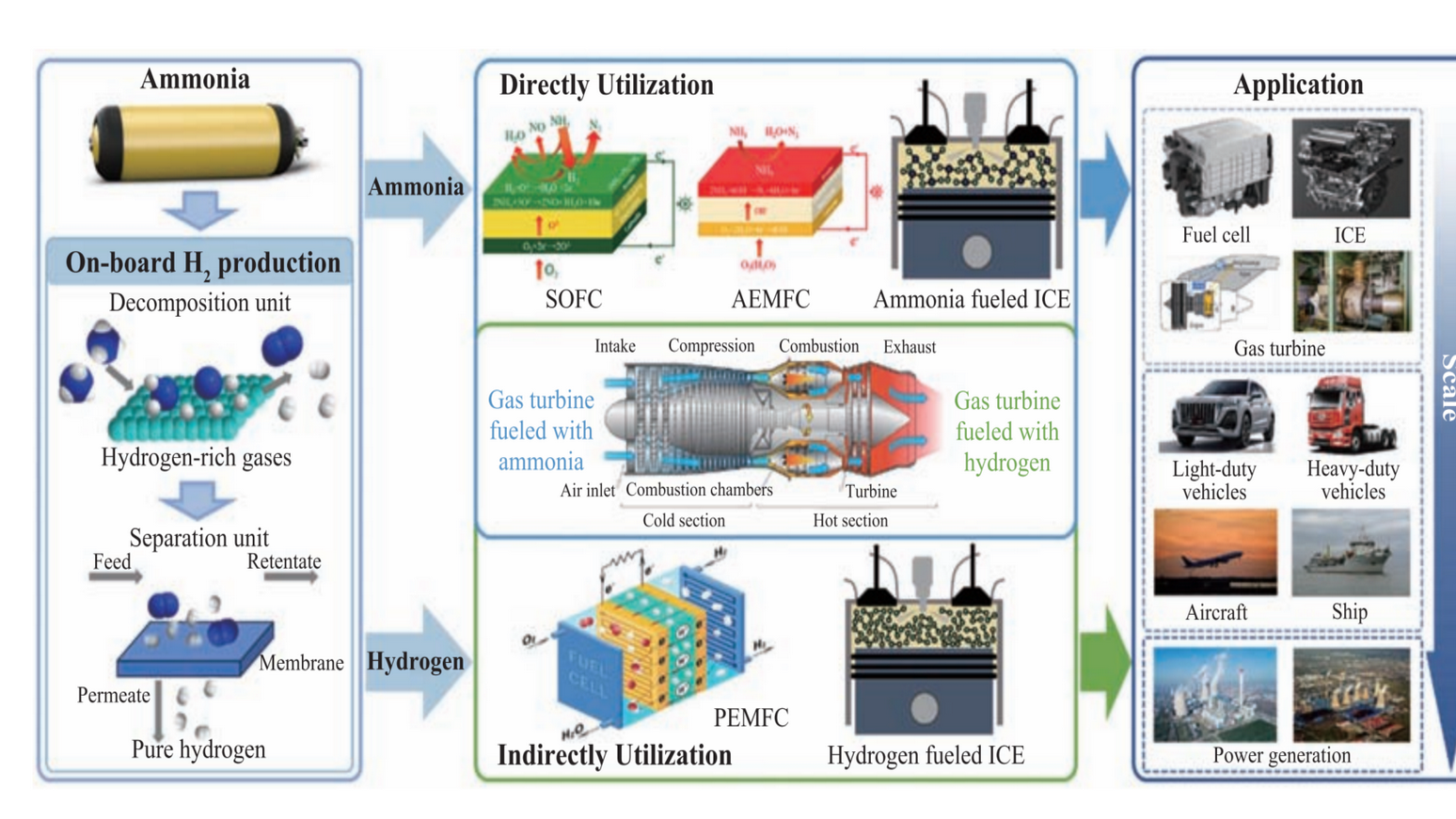
Global warming is the most significant challenge to society due to the increasing carbon dioxide level in the atmosphere nowadays. Accelerating the deployment of zero-carbon fuel is imperative in the transportation field, one of the major sources of carbon emissions. The effort on clean energy represented by hydrogen has been made by showing good breakthroughs in some applications; however, many technical and economic challenges exist for large-scale commercial applications. Ammonia, as another zero-carbon fuel, is an efficient storage and transportation medium for hydrogen component and shows greater application potential. Compared to hydrogen, ammonia has more mature storage and transportation technologies, superior related infrastructure, and a further systematic transportation network. In the review, the current mainstream technology routes of ammonia synthesis, the storage and transportation, and the future development trends are summarized. Carbon emissions and costs for the processes are brought into focus. Additionally, the combustion and emission generation mechanisms with technical routes for ammonia as a direct fuel are discussed. The current opportunities and challenges are then analyzed for ammonia as a zero-carbon fuel. The prospect of utilizing ammonia both as a direct fuel and a carrier for hydrogen in transportation is being explored, along with an architecture of the zero-carbon energy system for transportation based on the ammonia fuel.
KeyWords AITranslate
[1]United Nations, "The paris agreement," Online 2016, Accessed: May 1, 2024 [Online]. Available: https://www.un.org/en/climatechange/paris-agreement.
[2]IEA, "CO2 emissions in 2022," Online 2022, Accessed: May 1, 2024 [Online]. Available: https://www.iea.org/reports/co2-emissions-in-2022.
[3]O. Elishav, L. Mosevitzky, E. M. Miller, D. J. Arent, A. Valera-Medina, A. D. Grinberg, G. E. Shter, and G. S. Grader, "Progress and prospective of nitrogen-based alternative fuels," Chemical Reviews, vol. 120, no. 12, pp. 5352–5436, 2020.
[4]C.W. Gross and S.C. Kong, "Performance characteristics of a compression-ignition engine using direct-injection ammonia–DME mixtures," Fuel, vol. 103, pp. 1069–1079, 2013.
[5]C. Tornatore, L. Marchitto, P. Sabia, and M. De Joannon, "Ammonia as green fuel in internal combustion engines: State-of-the-art and future perspectives," Frontiers of Mechanical Engineering, vol. 8, p. 944201, 2022.
[6]Valera-Medina, H. Xiao, M. Owen-Jones, W. I. David, and P. Bowen, "Ammonia for power," Progress in Energy and Science, vol. 69, pp. 63–102, 2018.
[7]C. Zamfirescu and I. Dincer, "Ammonia as a green fuel and hydrogen source for vehicular applications," Fuel Processing Technology, vol. 90, no. 5, pp. 729–737, 2009.
[8]A. Hayakawa, T. Goto, R. Mimoto, Y. Arakawa, T. Kudo, and H. Kobayashi, "Laminar burning velocity and Markstein length of ammonia/air premixed flames at various pressures," Fuel, vol. 159, pp. 98–106, 2015.
[9]S. M. Grannell, D. N. Assanis, S. V. Bohac, and D. E. Gillespie, "The fuel mix limits and efficiency of a stoichiometric, ammonia, and gasoline dual fueled spark ignition engine," The Journal of Engineering for Turbines and Powers, vol. 130, no. 4, p. 042802, 2008.
[10]A. J. Reiter and S. C. Kong, "Combustion and emissions characteristics of compression-ignition engine using dual ammonia-diesel fuel," Fuel, vol. 90, no. 1, pp. 87–97, 2011.
[11]S. Oh, C. Park, S. Kim, Y. Kim, Y. Choi, and C. Kim, "Natural gas ammonia dual-fuel combustion in spark-ignited engine with various air fuel ratios and split ratios of ammonia under part load condition," Fuel, vol. 290, p. 120095, 2021.
[12]C. W. Gross and S. C. Kong, "Performance characteristics of a compression-ignition engine using direct-injection ammonia DME mixtures," Fuel, vol. 103, p. 1069–1079, 2013.
[13]J. Mao, X. Ma, Y. Ma, Z. Wang, Y. Zhang, and S. Shuai, "Optical diagnostic on HCII combustion characteristics for NH3-PODE3 dual fuel engine," Journal of Automotion Safety and Energy, vol. 13, no. 3, pp. 509–516, 2022.
[14]C. S. Mørch, A. Bjerre, M. P. Gøttrup, S. C. Sorenson, and J. Schramm, "Ammonia/hydrogen mixtures in an SI-engine: Engine performance and analysis of a proposed fuel system," Fuel, vol. 90, no. 2, pp. 854–864, 2011.
[15]IEA, "The role of low-carbon fuels in the clean energy transitions of the power sector,"Retrieved February, 2021, Accessed: June 1, 2024 [Online]. Available: http://www.iea.org/reports/the-role-of-low-carbon-fuels-in-the-clean-energy-transitions-of-the-power-sector.
[16]Council for Science and Technology Policy, "Pioneering the Future: Japanese Science, Technology and Innovation [Brochure SIP]", Online 2021, Retrieved June 1, 2024, Accessed: May 1, 2024 [Online]. Available: https://www8.cao.go.jp/cstp/panhu/sip_english/sip_en.html.
[17]S. H. Crolius, "Japan's electricity sector: An early market for low-carbon ammonia," Online 2020, Accessed: June 1, 2024 [Online]. Available: https://www.ammoniaenergy.org/articles/japans-electricity-sector-the-early-market-for-low-carbon-ammonia/.
[18]S. Bruce, M. Temminghoff, J. Hayward, E. Schmidt, C. Munnings, D. Palfreyman, and P. Hartley, National hydrogen roadmap, Australia: CSIRO, 2018.
[19]S. Bailey, "Yara at the forefront of clean ammonia in Australia," Online 2022, Accessed: June 1, 2024 [Online]. Available: https://www.yara.com.au/news-and-media/news/yara-at-the-forefront-of-clean-ammonia-in-australia/.
[20]International Energy Agency, Ammonia Technology Roadmap: Towards More Sustainable Nitrogen Fertiliser Production, OECD Publishing, 2021.
[21]C. Smith, A. K. Hill, and L. Torrente-Murciano, "Current and future role of Haber–Bosch ammonia in a carbon-free energy landscape," Energy & Environmental Science, vol. 13, no. 2, pp. 331–344, 2020.
[22]M. Aziz, A. T. Wijayanta, and A.B.D. Nandiyanto, "Ammonia as effective hydrogen storage: A review on production, storage and utilization," Energies, vol. 13, no. 12, p. 3062, 2020.
[23]J. Nørskov, J. G. Chen, K. Miranda, T. Fitzsimmons, and R. Stack, "Sustainable ammonia synthesis—Exploring the scientific challenges associated with discovering alternative, sustainable processes for ammonia, production,"U.S. Department of Energy, 2016, OSTIID1283146.
[24]J. Qian, Q. An, A. Fortunelli, R. J. Nielsen, and W. A. Goddard III, "Reaction mechanism and kinetics for ammonia synthesis on the Fe (111) surface," Journal of The American Chemical Society, vol. 140, no. 20, pp. 6288–6297, 2018.
[25]H. Liu, "Ammonia synthesis catalyst 100 years: Practice, enlightenment and challenge," Chinese Journal of Catalysis, vol. 35, no. 10, pp. 1619–1640, 2014.
[26]G. Chehade and I. Dincer, "Progress in green ammonia production as potential carbon-free fuel," Fuel, vol. 299, p. 120845, 2021.
[27]B. J. Shin, J. H. Mun, S. Devkota, S. M. Kim, T. H. Kang, S. A. Mazari, K. Cho, S. H. Kim, D. H. Chun, and K. M. Kim, "Comparative assessment and multi-objective optimization for the gray and blue ammonia synthesis processes: Energy, economic and environmental (3E) analysis," International Journal of Hydrogen Energy, vol. 48, no. 90, pp. 35123–35138, 2023.
[28]B. Chen, Z. Liao, J. Wang, H. Yu, and Y. Yang, "Exergy analysis and CO2 emission evaluation for steam methane reforming," International Journal of Hydrogen Energy, vol. 37, no. 4, pp. 3191–3200, 2012.
[29]A. I. Amhamed, S. Shuibul Qarnain, S. Hewlett, A. Sodiq, Y. Abdellatif, R. J. Isaifan, and O. F. Alrebei, "Ammonia production plants—A review," Fuels, vol. 3, no. 3, pp. 408–435, 2022.
[30]M. Voldsund, K. Jordal, and R. Anantharaman, "Hydrogen production with CO2 capture," International Journal of Hydrogen Energy, vol. 41, no. 9, pp. 4969–4992, 2016.
[31]V. Pattabathula and J. Richardson, "Introduction to ammonia production," Chemical Engineering Progress, vol. 112, no. 9, pp. 69–75, 2016.
[32]R. W. Howarth and M. Z. Jacobson, "How green is blue hydrogen?" Energy Science & Engineering, vol. 9, no. 10, pp. 1676–1687, 2021.
[33]M. Anderson and Y. Lin, "Carbonate–ceramic dual-phase membrane for carbon dioxide separation," Journal of Membrane Science, vol. 357, no. 1–2, pp. 122–129, 2010.
[34]S. Chang, J. Zhuo, S. Meng, S. Qin, and Q. Yao, "Clean coal technologies in China: Current status and future perspectives," Engineering, vol. 2, no. 4, pp. 447–459, 2016.
[35]B. Lee, L. R. Winter, H. Lee, D. Lim, H. Lim, and M. Elimelech, "Pathways to a green ammonia future," ACS Energy Letters, vol.7, no. 9, pp. 3032–3038, 2022.
[36]K. Verleysen, D. Coppitters, A. Parente, W. De Paepe, and F. Contino, "How can power-to-ammonia be robust? Optimization of an ammonia synthesis plant powered by a wind turbine considering operational uncertainties," Fuel, vol. 266, p. 117049, 2020.
[37]M. Rashid, M. K. Al Mesfer, H. Naseem, and M. Danish, "Hydrogen production by water electrolysis: A review of alkaline water electrolysis, PEM water electrolysis and high temperature water electrolysis," International Journal of Engineering and Advanced Technology, vol. 4, no. 3, 80–93. 2015.
[38]O. Schmidt, A. Gambhir, I. Staffell, A. Hawkes, J. Nelson, and S. Few, "Future cost and performance of water electrolysis: An expert elicitation study," International Journal of Hydrogen Energy, vol. 42, no. 52, pp. 30470–30492, 2017.
[39]W. Zhou, B. Zhu, Q. Li, T. Ma, S. Hu, and C. Griffy-Brown, "CO2 emissions and mitigation potential in China's ammonia industry," Energy policy, vol. 38, no. 7, pp. 3701–3709, 2010.
[40]D. Ye and S. C. E. Tsang, "Prospects and challenges of green ammonia synthesis," Nature Synthesis, vol. 2, no. 7, pp. 612–623, 2023.
[41]J. Brightling, "Ammonia and the fertiliser industry: The development of ammonia at Billingham," Johnson Matthey Technology Review, vol. 62, no. 1, pp. 32–47, 2018.
[42]P. Arora, I. Sharma, A. Hoadley, S. Mahajani, and A. Ganesh, "Remote, small-scale,‘greener’routes of ammonia production," Journal of Cleaner Production, vol. 199, pp. 177–192, 2018.
[43]V. Singh, I. Dincer, and M. A. Rosen, "Life cycle assessment of ammonia production methods," in Exergetic, energetic and environmental dimensions, Elsevier, 2018, pp. 935–959.
[44]Kyuha Lee"Techno-economic performances and life cycle greenhouse gas emissions of various ammonia production pathways including conventional, carbon-capturing, nuclear-powered, and renewable production." Green Chemistry, vol. 24, no. 12, 4830–4844, 2022.
[45]H. Council, "Hydrogen decarbonization pathways: A life-cycle assessment," Accessed: June 1, 2024 [Online]. Available: https://hydrogencouncil.com, 2021.
[46]F. Cameli, A. Kourou, V. Rosa, E. Delikonstantis, V. Galvita, K. M. Van Geem, and G. D. Stefanidis, "Conceptual process design and technoeconomic analysis of an e-ammonia plant: Green H2 and cryogenic air separation coupled with Haber-Bosch process," International Journal of Hydrogen Energy, vol. 49, pp. 1416–1425, 2024.
[47]X. Liu, A. Elgowainy, and M. Wang. "Life cycle energy use and greenhouse gas emissions of ammonia production from renewable resources and industrial by-products." Green Chemistry, vol. 22, no. 17, pp. 5751–5761, 2020.
[48]M. Al-Breiki and Y. Bicer, "Comparative life cycle assessment of sustainable energy carriers including production, storage, overseas transport and utilization," Journal of Cleaner Production, vol. 279, p. 123481, 2021.
[49]A. Boulamanti and J. A. Moya, "Production costs of the chemical industry in the EU and other countries: Ammonia, methanol and light olefins," Renewable & Sustainable Energy Reviews, vol. 68, pp. 1205–1212, 2017.
[50]H. Zhang, L. Wang, F. Maréchal, and U. Desideri, "Techno-economic comparison of green ammonia production processes," Applied Energy, vol. 259, p. 114135, 2020.
[51]K. H. Rouwenhorst and G. Castellanos, Innovation Outlook: Renewable Ammonia, IRENA, 2022.
[52]C. Philibert, "Producing ammonia and fertilizers: New opportunities from renewables," IEA Report, pp. 1–6, 2017.
[53]International Energy Agency, "An energy sector roadmap to carbon neutrality in China," Accessed: June 1, 2024, [Online]. Available: https://www.efchina.org/reports-en/report-lceg-2022030-2.
[54]D. Frattini, G. Cinti, G. Bidini, U. Desideri, R. Cioffi, and E. Jannelli. "A system approach in energy evaluation of different renewable energies sources integration in ammonia production plants." Renewable Energy, vol. 99, pp. 472–482, 2016.
[55]J. R. Bartels, A feasibility study of implementing an Ammonia Economy, Iowa State University Digital Repository, 2008.
[56]R. Society, Ammonia: Zero-Carbon Fertiliser, Fuel and Energy Store: Policy Briefing, Royal Society, 2020.
[57]M. Appl, Ammonia : Principles and Industrial Practice, Wiley-VCH, 1999.
[58]B. Elishav, E. M. Mosevitzky Lis, D. J. Miller, A. Arent, A. Valera-Medina, A. G. Dana, G. E. Shter, and G. S. Grader, "Progress and prospective of nitrogen-based alternative fuels," Chemical Reviews, vol. 120, no. 12, pp. 5352–5436, 2020.
[59]L. Jiang and X. Fu, "An ammonia-hydrogen energy roadmap for carbon neutrality: Opportunity and challenges in China," Engineering, vol. 7, no.12, pp. 1688–1691, 2021.
[60]Y. Luo, Y. Shi, S. Liao, C. Chen, Y. Zhan, C.-T. Au, and L. Jiang, "Coupling ammonia catalytic decomposition and electrochemical oxidation for solid oxide fuel cells: A model based on elementary reaction kinetics," Journal of Power Sources, vol. 423, pp. 125–136, 2019.
[61]R. Hudders, C. Dorf, and A. Holcombe, "Railway tank car for transcontinental shipment of liquefied hydrogen,"in Proceeding of Advances in Cryogenic Engineering, Springer, 1963, pp. 461–466.
[62]Kawasaki Heavy Industries Ltd, "Liquefied Hydrogen Carrier -SUISO FRONTIER- Receives Classification from Nippon Kaiji Kyokai," Online 2021, Accessed: June 1, 2024 [Online]. Available: https://global.kawasaki.com/en/corp/newsroom/news/detail/?f=20211203_9557.
[63]Department of Energy, "Hydrogen pipelines," Accessed: June 1, 2024 [Online]. Available: https://www.energy.gov/eere/fuelcells/hydrogen-pipelines.
[64]R. Z. Sørensen, J. S. Hummelshøj, A. Klerke, J. B. Reves, T. Vegge, J. K. Nørskov, and C. H. Christensen, "Indirect, reversible high-density hydrogen storage in compact metal ammine salts," Journal of the American Chemical Society, vol. 130, no. 27, pp. 8660–8668, 2008.
[65]R. Newman, "2.09-Stress corrosion cracking,"in Shreir's Corrosion, Oxford: Elsevier, 2010, pp. 864–901.
[66]A. Grinberg Dana, O. Elishav, A. Bardow, G. E. Shter, and G. S. Grader, "Nitrogen‐based fuels: A power‐to‐fuel‐to‐power analysis," Angewandte Chemie-International Edition, vol. 55, no. 31, pp. 8798–8805, 2016.
[67]K. R. Lee, D. Song, S. B. Park, and J. Han, "A direct ammonium carbonate fuel cell with an anion exchange membrane," RSC Advances, vol. 4, no. 11, pp. 5638–5641, 2014.
[68]J. W. Makepeace, T. He, C. Weidenthaler, T. R. Jensen, F. Chang, T. Vegge, P. Ngene, Y. Kojima, P. E. de Jongh, and P. Chen, "Reversible ammonia-based and liquid organic hydrogen carriers for high-density hydrogen storage: Recent progress," International Journal of Hydrogen Energyy, vol. 44, no. 15, pp. 7746–7767, 2019.
[69]C. H. Christensen, R. Z. Sørensen, T. Johannessen, U. J. Quaade, K. Honkala, T. D. Elmøe, R. Køhler, and J. K. Nørskov, "Metal ammine complexes for hydrogen storage," Journal of Materials Chemistry, vol. 15, no. 38, pp. 4106–4108, 2005.
[70]The Rogal Society, Ammonia: Zero-carbon Fertiliser, Fuel and Energy Store, The Royal Society, 2020.
[71]G. Di Lullo, T. Giwa, A. Okunlola, M. Davis, T. Mehedi, A. Oni, and A. Kumar, "Large-scale long-distance land-based hydrogen transportation systems: A comparative techno-economic and greenhouse gas emission assessment," International Journal of Hydrogen Energyy, vol. 47, no. 83, pp. 35293–35319, 2022.
[72]X. Wu, B. Mao, Q. Zhou, J. Huang, and R. Tong, "Comparative of carbon emission factor levels in different modes of transportation industry," Journal of East China Jiaotong University, vol. 39, no. 4, pp. 41–47, 2022
[73]C. Kurien and M. Mittal, "Review on the production and utilization of green ammonia as an alternate fuel in dual-fuel compression ignition engines," Energy Conversion and Management, vol. 251, p. 114990, 2022.
[74]W. Cornelius, L. W. Huellmantel, and H. R. Mitchell, "Ammonia as an Engine Fuel,"1965 International Automotion Engineering Congress and Exposition, 1965, Accessed: June 1, 2024 [Online]. Available: Available:https://www.sae.org/publications/technical-papers/content/650052/.
[75]L. Duan and T. Li, "Research progress of ammonia combustion characteristic and stable-combustion technology," Huazhong Keji Daxue Xuebao (Ziran Kexue Ban)/Journal of Huazhong University of Science and Technology (Natural Science Edition), vol. 50, no. 7, pp. 41–54, 2022.
[76]M. Comotti and S. Frigo, "Hydrogen generation system for ammonia–hydrogen fuelled internal combustion engines," International Journal of Hydrogen Energyy, vol. 40, no. 33, pp. 10673–10686, 2015.
[77]J. A. Miller, M. D. Smooke, R. M. Green, and R. J. Kee, "Kinetic modeling of the oxidation of ammonia in flames," Combustion Science and Technology, vol. 34, no. 1–6, pp. 149–176, 1983.
[78]A. A. Konnov, "Implementation of the NCN pathway of prompt-NO formation in the detailed reaction mechanism," Combust Flame, vol. 156, no. 11, pp. 2093–2105, 2009.
[79]C. Tornatore, L. Marchitto, P. Sabia, and M. De Joannon, "Ammonia as green fuel in internal combustion engines: State-of-the-art and future perspectives," Frontiers of Mechanical Engineering, vol. 8, p. 944201, 2022.
[80]P. Dimitriou and R. Javaid, "A review of ammonia as a compression ignition engine fuel," International Journal of Hydrogen Energyy, vol. 45, no. 11, pp. 7098–7118, 2020.
[81]J. T. Gray, E. Dimitroff, N. T. Meckel, and R. D. Quillian, "Ammonia fuel-engine compatibility and combustion,"Engineering, Chemistry, Corpus ID 135982531, 1966.
[82]J. B. Heywood, "Automotive engines and fuels: A review of future options," Progress in Energy and Combustion Science, vol. 7, no. 3, pp. 155–184, 1981.
[83]B. Wang, C. Yang, H. Wang, D. Hu, B. Duan, and Y. Wang, "Study on injection strategy of ammonia/hydrogen dual fuel engine under different compression ratios," Fuel, vol. 334, p. 126666, 2023.
[84]M. Koike, H. Miyagawa, T. Suzuoki, and K. Ogasawara, "Ammonia as a hydrogen energy carrier and its application to internal combustion engines," Sustainable Vehicle Technologies, pp. 61–70, 2012.
[85]X. Zhang, "World's first ammonia engine launched," Online 2023, Accessed: June 1, 2024 [Online]. Available: https://new.qq.com/rain/a/20230714A06GDB00.
[86]Y. Qi, W. Liu, S. Liu, W. Wang, Y. Peng, and Z. Wang, "A review on ammonia-hydrogen fueled internal combustion engines," eTransportation, p. 100288, 2023.
[87]Z. Liu, L. Zhou, and H. Wei, "Experimental investigation on the performance of pure ammonia engine based on reactivity controlled turbulent jet ignition," Fuel, vol. 335, p. 127116, 2023.
[88]C. S. Mørch, A. Bjerre, M. P. Gøttrup, S. C. Sorenson, and J. Schramm, "Ammonia/hydrogen mixtures in an SI-engine: Engine performance and analysis of a proposed fuel system," Fuel, vol. 90, no. 2, pp. 854–864, 2011.
[89]M. Dinesh, J. K. Pandey, and G. Kumar, "Study of performance, combustion, and NOx emission behavior of an SI engine fuelled with ammonia/hydrogen blends at various compression ratio," International Journal of Hydrogen Energyy, vol. 47, no. 60, pp. 25391–25403, 2022.
[90]A. Mercier, C. Mounaïm-Rousselle, P. Brequigny, J. Bouriot, and C. Dumand, "Improvement of SI engine combustion with ammonia as fuel: Effect of ammonia dissociation prior to combustion," Fuel Communications, vol. 11, p. 100058, 2022.
[91]S. Mashruk, E. Okafor, M. Kovaleva, A. Alnasif, D. Pugh, A. Hayakawa, and A. Valera-Medina, "Evolution of N2O production at lean combustion condition in NH3/H2/air premixed swirling flames," Combust Flame, vol. 244, p. 1122992022.
[92]I. Lucentini, X. Garcia, X. Vendrell, and J. Llorca, "Review of the decomposition of ammonia to generate hydrogen," Industrial & Engineering Chemistry Research, vol. 60, no. 51, pp. 18560–18611, 2021.
[93]Z. Wang, S. Zheng, Y. Yao, R. Chen, and Z. Wang, "Research progress on electrocatalytic decomposition of ammonia for hydrogen production," Huagong Xuebao/CIESC Journal, 2022.
[94]O. Siddiqui and I. Dincer, "A review and comparative assessment of direct ammonia fuel cells," Thermal Science and Engineering Progress, vol. 5, pp. 568–578, 2018.
[95]N. Q. Minh, "Ceramic fuel cells", Journal of the American Ceramic Society, vol. 76, no. 3, pp. 563–588, 1993.
[96]R. Lan and S. Tao, "Direct ammonia alkaline anion-exchange membrane fuel cells," Electrochemical and Solid State Letters, vol. 13, no. 8, p. B83, 2010.
[97]M. Ezzat and I. Dincer, "Comparative assessments of two integrated systems with/without fuel cells utilizing liquefied ammonia as a fuel for vehicular applications," International Journal of Hydrogen Energyy, vol. 43, no. 9, pp. 4597–4608, 2018.
[98]J. Malayil, "Automaker GAC unveils world's first ammonia-powered engine for cars," Online 2023, Accessed: June 1, 2024 [Online]. Available: https://interestingengineering.com/transportation/gac-worlds-first-ammonia-engine.
[99]Z. Li, Q. Shen, and Y. Dai, "Chinese scholars make breakthroughs in basic research on ammonia-hydrogen fusion zero-carbon power system for heavy-duty vehicles," Online 2023, Accessed: June 1, 2024 [Online]. Available: nsfc.gov.cn.
[100]Y. Hu, M. Wang, L. Li, Z. Men, X. Zhao, Y. Zhu, and L. Liu, "Innovative Development of Ammonia-Hydrogen Powered Marine Ships in China," China Engineering Science, vol. 25, no. 2, pp. 133–146, 2023.
[101]China State Shipbuilding Corporation Limited, "Ammonia fuel-powered 7,000-car car carrier", Online 2022. Accessed: June 1, 2024 [Online]. Available: http://www.csic.com.cn/n135/n171/n179/c22296/content.html.
[102]Man Energy Solutions, "Ammonia for shipping," Online 2023, Accessed: June 1, 2024 [Online]. Available: https://www.man-es.com/marine/strategic-expertise/future-fuels/ammonia.
[103]Wärtsilä Corporation, "Wärtsilä continues to set the pace for marine decarbonisation with launch of world-first 4-stroke engine-based ammonia solution," Online 2023, Accessed: June 1, 2024 [Online]. Available: https://www.wartsila.com/media/news/15-11-2023-wartsila-continues-to-set-the-pace-for-marine-decarbonisation-with-launch-of-world-first-4-stroke-engine-based-ammonia-solution-3357985.
[104]China News Service Website, "China's first medium-speed, high-power ammonia-fueled engine ignites successfully," Online 2023, Accessed: June 1, 2024 [Online]. Available: https://www.chinanews.com.cn/cj/2023/11-30/10120580.shtml.
[105]Eidesvik, "Viking Energy with ammonia-driven fuel cell," Online 2023, Accessed: June 1, 2024 [Online]. Available: https://eidesvik.no/viking-energy-with-ammonia-driven-fuel-cell/.
[106]S. K. Janis Eitner, "The world's first high-temperature ammonia-powered fuel cell for shipping," Online 2021, Accessed: June 1, 2024 [Online]. Available: https://www.fraunhofer.de/content/dam/zv/en/press-media/2021/march-2021/imm-worlds-first-ammonia-powered-fuel-cell-for-shipping.pdf.
[107]M. Otto, L. Vesely, J. Kapat, M. Stoia, N. D. Applegate, and G. Natsui, "Ammonia as an aircraft fuel: A critical assessment from airport to wake," The ASME Open Journal of Engineering, vol. 2, p. 031033, 2023.
[108]Trevor Brown, "Zero emission aircraft: Ammonia for aviation," Online 2020, Accessed: June 1, 2024 [Online]. Available: https://www.ammoniaenergy.org/articles/zero-emission-aircraft-ammonia-for-aviation/.
[109]Airbus, "Hydrogen fuel cells, explained," Online 2020, Accessed: June 1, 2024 [Online]. Available: https://www.airbus.com/en/newsroom/news/2020-10-hydrogen-fuel-cells-explained.
[110]Jared Pike, "Purdue researchers part of NASA initiative to explore ammonia-based jet fuel," Online 2022, Accessed: June 1, 2024 [Online]. Available: https://engineering.purdue.edu/ME/News/2022/purdue-researchers-part-of-nasa-initiative-to-explore-ammoniabased-jet-fuel.
[111]K. Al-Hamed and I. Dincer, "A new direct ammonia solid oxide fuel cell and gas turbine based integrated system for electric rail transportation," eTransportation, vol. 2, p. 100027, 2019.
[112]K. Al-Hamed and I. Dincer, "A novel integrated solid-oxide fuel cell powering system for clean rail applications," Energy Conversion and Management, vol. 205, p. 112327, 2020.
[113]Mitsubishi Power, "MHI succeeded combustion test of ammonia single-fuel burners -- Promoting the energy transition with CO2 emission reduction technologies for existing thermal power plants," Online 2023, Accessed: June 1, 2024 [Online]. Available: https://power.mhi.com/news/231128.html.
[114]Julian Atchison. "Exploring ammonia retrofits at the Sakra power plant, Singapore," Online 2023, Accessed: June 1, 2024 [Online]. Available: https://www.ammoniaenergy.org/articles/exploring-ammonia-retrofits-at-the-sakra-power-plant-singapore/.
Basic Information:
DOI:10.23919/CHAIN.2024.000005
Chinese Library Classification Number:
Citation Information:
Global warming is the most significant challenge to society due to the increasing carbon dioxide level in the atmosphere nowadays. Accelerating the deployment of zero-carbon fuel is imperative in the transportation field, one of the major sources of carbon emissions. The effort on clean energy represented by hydrogen has been made by showing good breakthroughs in some applications; however, many technical and economic challenges exist for large-scale commercial applications. Ammonia, as another zero-carbon fuel, is an efficient storage and transportation medium for hydrogen component and shows greater application potential. Compared to hydrogen, ammonia has more mature storage and transportation technologies, superior related infrastructure, and a further systematic transportation network. In the review, the current mainstream technology routes of ammonia synthesis, the storage and transportation, and the future development trends are summarized. Carbon emissions and costs for the processes are brought into focus. Additionally, the combustion and emission generation mechanisms with technical routes for ammonia as a direct fuel are discussed. The current opportunities and challenges are then analyzed for ammonia as a zero-carbon fuel. The prospect of utilizing ammonia both as a direct fuel and a carrier for hydrogen in transportation is being explored, along with an architecture of the zero-carbon energy system for transportation based on the ammonia fuel.
quote
| GB/T 7714-2015 | [1] Yi Huang, Zexin Nie, Lisheng Zhang, et al. Ammonia fuel: A pathway for carbon-neutral of the transportation sector[J]. Chain, 2024, 1(2): 113-137. DOI:10.23919/CHAIN.2024.000005. |
| MLA | [1] Yi Huang, et al., "Ammonia fuel: A pathway for carbon-neutral of the transportation sector." Chain, vol. 1, no. 2, 2024, pp. 113-137, https://doi.org/10.23919/CHAIN.2024.000005. |
| APA | [1] Yi Huang, Zexin Nie, Lisheng Zhang, Xinhua Liu, Jihong Feng, Yifan Yin, Huiming Wang, Guangyu Tian, Jun Li, & Fei Duan. (2024). Ammonia fuel: A pathway for carbon-neutral of the transportation sector. Chain, 1(2), 113-137. https://doi.org/10.23919/CHAIN.2024.000005 |
| IEEE | [1] Yi Huang, Zexin Nie, Lisheng Zhang, Xinhua Liu, Jihong Feng, Yifan Yin, Huiming Wang, Guangyu Tian, Jun Li, and Fei Duan, "Ammonia fuel: A pathway for carbon-neutral of the transportation sector," Chain, vol. 1, no. 2, pp. 113-137, 2024, doi: 10.23919/CHAIN.2024.000005. keywords: {zero-carbon fuel;ammonia fuel;Haber–Bosch process;ammonia storage and transportation;ammonia engine} |