

Cutting-edge fabrication strategies and low-temperature sintering approaches for manufacturing solid oxide electrolysis cells AITranslate
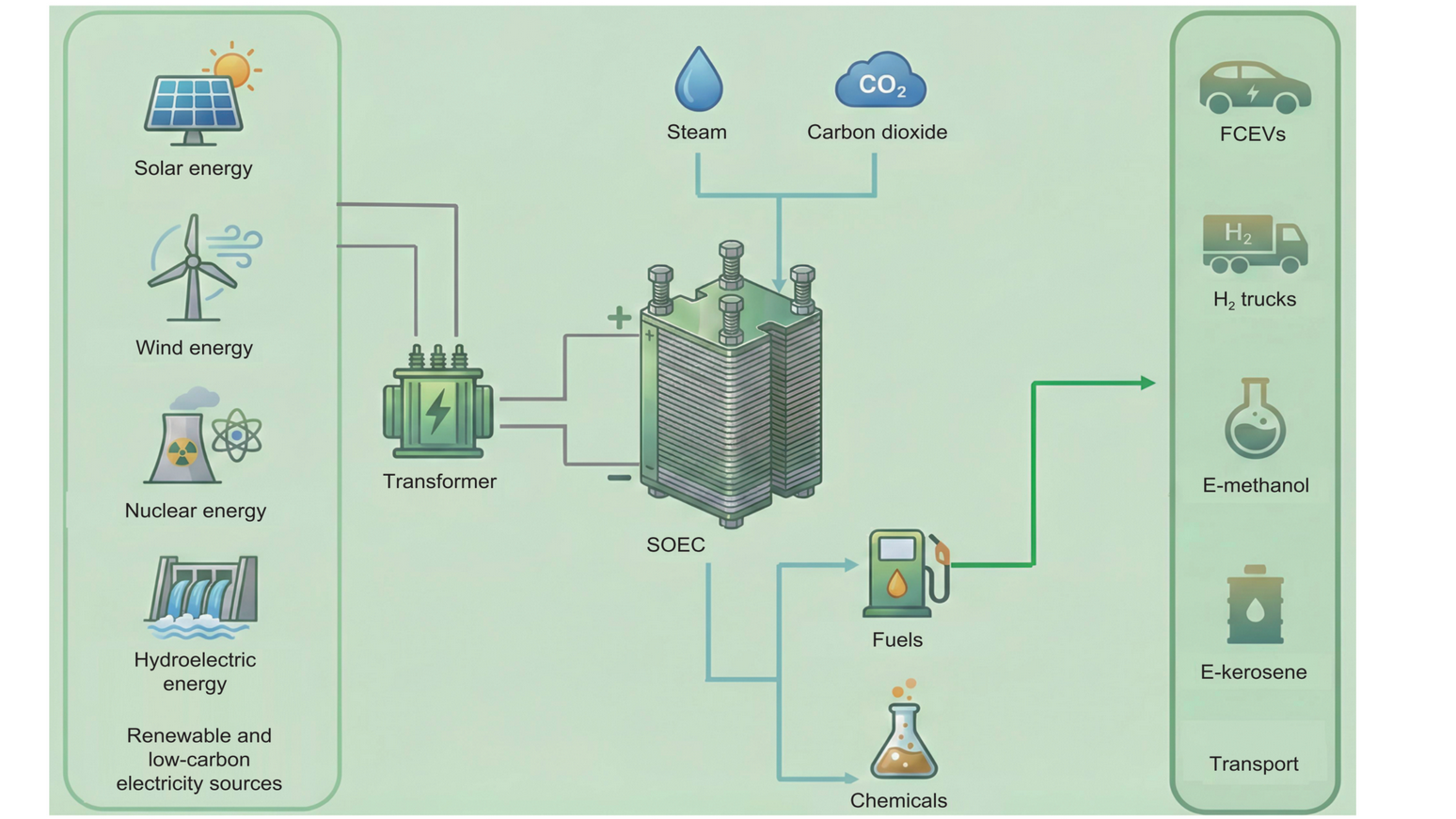
Abstract AITranslate
Steam electrolysers are a key technology for high-efficiency hydrogen production, offering superior thermodynamic performance compared with liquid-water electrolysis when operated at elevated temperatures. Despite these advantages, their wider deployment remains constrained by manufacturing complexity, component cost, and stringent processing requirements for ceramic membranes, electrodes, and interconnect-related components. This mini-review provides a comprehensive assessment of fabrication strategies relevant to steam-electrolyser manufacturing, encompassing compression-based forming, colloidal processing, fibre- and ink-based deposition techniques, as well as physical vapour deposition. Particular attention is given to how electrode architecture, cell geometry, and interfacial compatibility influence viable processing routes and manufacturability, rather than device operation at the single-cell level. Emphasis is placed on solid-state ceramic membranes and electrodes based on gadolinium-doped ceria (GDC) and yttria-stabilised zirconia (YSZ), which remain central to current and emerging steam-electrolyser technologies. Because most scalable fabrication routes ultimately depend on controlled densification and microstructural optimisation of polycrystalline ceramics, the review critically examines low-temperature sintering mechanisms, including grain-boundary-activated densification, transient liquid-phase formation, and nano-powder engineering. Recent advances in single- and multi-element sintering aids are discussed, with co-doping strategies shown to reduce densification temperatures by several hundred degrees while preserving ionic conductivity and long-term stability. A quantitative techno-environmental analysis further demonstrates that reducing electrolyte sintering temperatures from 1,400℃ to 650℃–950℃ can lower energy consumption by 30%–55%, reduce fabrication costs, and significantly decrease CO2 emissions associated with manufacturing. By integrating fabrication methodologies with low-temperature processing chemistry in a steam-electrolysis–relevant context, this review highlights the key materials–process interactions governing manufacturability and identifies future research directions for scalable, durable, and economically competitive steam-electrolyser technologies.
KeyWords AITranslate
1.J. B. Hansen, "Solid Oxide Electrolysis—A Key Enabling Technology for Sustainable Energy Scenarios," Faraday Discuss 182 (2015): 9–48, https://doi.org/10.1039/c5fd90071a.
2.L. Elikan and J. Morris. Solid Electrolyte System for Oxygen Regeneration. NASA contractor report CR-1359. 1969.
3.A. Isenberg, "Energy Conversion Via Solid Oxide Electrolyte Electrochemical Cells at High Temperatures," Solid State Ionics 3 (1981): 431–437, https://doi.org/10.1016/0167-2738(81)90127-2.
4.D. Kusunoki, Y. Kikuoka, V. Yanagi, et al., "Development of Mitsubishi-Planar Reversible Cell—Fundamental Test on Hydrogen-Utilized Electric Power Storage System," International journal of hydrogen energy 20, no. 10 (1995): 831–834, https://doi.org/10.1016/0360-3199(95)94482-9.
5.A. Momma, T. Kato, Y. Kaga, and S. Nagata, "Polarization Behavior of High Temperature Solid Oxide Electrolysis Cells (SOEC)," Journal of the ceramic Society of Japan 105, no. 1221 (1997): 369–373, https://doi.org/10.2109/jcersj.105.369.
6.M. A. Laguna-Bercero, "Recent Advances in High Temperature Electrolysis Using Solid Oxide Fuel Cells: A Review," Journal of Power Sources 203 (2012): 4–16, https://doi.org/10.1016/j.jpowsour.2011.12.019.
7.B. Pivovar, N. Rustagi, and S. Satyapal, "Hydrogen at Scale (H2@Scale): Key to a Clean, Economic, and Sustainable Energy System," The Electrochemical Society Interface 27, no. 1 (2018): 47, https://doi.org/10.1149/2.F04181if.
8.X. Zhang, L. Ye, H. Li, F. Chen, and K. Xie, "Electrochemical Dehydrogenation of Ethane to Ethylene in a Solid Oxide Electrolyzer," ACS Catalysis 10, no. 5 (2020): 3505–3513, https://doi.org/10.1021/acscatal.9b05409.
9.W. Li, H. Wang, Y. Shi, and N. Cai, "Performance and Methane Production Characteristics of H2O–CO2 Co-Electrolysis in Solid Oxide Electrolysis Cells," International Journal of Hydrogen Energy 38, no. 25 (2013): 11104–11109, https://doi.org/10.1016/j.ijhydene.2013.01.008.
10.J. Martinez-Frias, A. Q. Pham, and S. M. Aceves, "A Natural Gas-Assisted Steam Electrolyzer for High-Efficiency Production of Hydrogen," International Journal of Hydrogen Energy 28, no. 5 (2003): 483–490, https://doi.org/10.1016/S0360-3199(02)00135-0.
11.Y. Numata, K. Nakajima, H. Takasu, and Y. Kato, "Carbon Dioxide Reduction on a Metal-Supported Solid Oxide Electrolysis Cell," ISIJ International 59, no. 4 (2019): 628–633, https://doi.org/10.2355/isijinternational.ISIJINT-2018-430.
12.J. Hartvigsen, S. Elangovan, J. Elwell, and D. Larsen, "Oxygen Production from Mars Atmosphere Carbon Dioxide Using Solid Oxide Electrolysis," ECS Transactions 78, no. 1 (2017): 2953, https://doi.org/10.1149/07801.2953ecst.
13.J. Fu, Z. Qu, J. Zhang, H. Wang, and G. Zhang, "A Cross-Scale Numerical Framework of PEM Water Electrolyzer with Pore-Scale Transport Properties of PTL," Energy Conversion and Management 332 (2025): 119771, https://doi.org/10.1016/j.enconman.2025.119771.
14.P. Feng, K. Yang, X. Liu, J. Zhang, and Z. P. Li, "A Review of Advanced SOFCs and SOECs: Materials, Innovative Synthesis, Functional Mechanisms, and System Integration," eScience 6, no. 2 (2026): 100460, https://doi.org/10.1016/j.esci.2025.100460.
15.D. Tian, Q. Wang, Z. Qu, and H. Zhang, "Enabling Direct Flue Gas Electrolysis by Clarifying Impurity Gas Effects on CO2 Electroreduction," Nano Energy 134 (2025): 110563, https://doi.org/10.1016/j.nanoen.2024.110563.
16.H. Liu, M. Yu, X. Tong, Q. Wang, and M. Chen, "High Temperature Solid Oxide Electrolysis for Green Hydrogen Production," Chemical Reviews 124, no. 18 (2024): 10509–10576, https://doi.org/10.1021/acs.chemrev.3c00795.
17.D. Xu, X. Li, Z. Liu, et al., "Crystal Field Stabilization Energy Asymmetrically Constructed Built-in Electric Fields for Efficient Water Cracking," Small 21, no. 24 (2025): 2502250, https://doi.org/10.1002/smll.202502250.
18.A. B. Stambouli and E. Traversa, "Solid Oxide Fuel Cells (SOFCs): A Review of an Environmentally Clean and Efficient Source of Energy," Renewable and sustainable energy reviews 6, no. 5 (2002): 433–455, https://doi.org/10.1016/S1364-0321(02)00014-X.
19.F. P. Nagel, T. J. Schildhauer, S. M. A. Biollaz, and A. Wokaun, "Performance Comparison of Planar, Tubular and Delta8 Solid Oxide Fuel Cells Using a Generalized Finite Volume Model," Journal of Power Sources 184, no. 1 (2008): 143–164, https://doi.org/10.1016/j.jpowsour.2008.05.046.
20.K. Park, D. H. Yoon, S. Lee, et al., "Fabrication and Operation of a 6kWe Class Interconnector-Type Anode-Supported Tubular Solid Oxide Fuel Cell Stack," International Journal of Hydrogen Energy 39, no. 24 (2014): 12884–12893, https://doi.org/10.1016/j.ijhydene.2014.06.080.
21.Y. Yoo, Y. Wang, X. Deng, D. Singh, and J. G. Legoux, "Metal Supported Tubular Solid Oxide Fuel Cells Fabricated by Suspension Plasma Spray and Suspension High Velocity Oxy-Fuel Spray," Journal of Power Sources 215 (2012): 307–311, https://doi.org/10.1016/j.jpowsour.2012.05.031.
22.S. H. Pi, J. W. Lee, S. B. Lee, et al., "Performance and Durability of Anode-Supported Flat-Tubular Solid Oxide Fuel Cells with Ag-Infiltrated Cathodes," J Nanosci Nanotechnol 14, no. 10 (2014): 7668–73, https://doi.org/10.1166/jnn.2014.9460.
23.T. Ryu, T. Okamoto, C. Chen, et al., "Fabrication and Characterization of the Gas Channel Integrated SOFC Cells," ECS Transactions 7, no. 1 (2007): 735, https://doi.org/10.1149/1.2729160.
24.S. Singhal, "Solid Oxide Fuel Cells: An Overview," Abstracts of Papers of the American Chemical Society 228 (2004): U653–U653.
25.T. Higa and H. Nakajima, "Evaluation of Three-Dimensional Placement of Built-in Catalytic Partial Oxidation Catalyst in an Anode-Supported Honeycomb SOFC," ECS Transactions 103, no. 1 (2021): 1991, https://doi.org/10.1149/10301.1991ecst.
26.J. Ding and J. Liu, "A Novel Design and Performance of Cone-Shaped Tubular Anode-Supported Segmented-in-Series Solid Oxide Fuel Cell Stack," Journal of Power Sources 193, no. 2 (2009): 769–773, https://doi.org/10.1016/j.jpowsour.2009.04.049.
27.R. Li, S. Han, Q. Yuan, K. Aseev, and D. Chen, "To Study the Effect of Geometric Parameters on the Performance of a Typical Cone-Shaped Tubular Segmented-in-Series Solid Oxide Fuel Cell Stack," International Journal of Electrochemical Science 19, no. 6 (2024): 100601, https://doi.org/10.1016/j.ijoes.2024.100601.
28.X. Tong, S. Ovtar, K. Brodersen, P. V. Hendriksen, and M. Chen, "Large-Area Solid Oxide Cells with La0.6Sr0.4CoO3-δ Infiltrated Oxygen Electrodes for Electricity Generation and Hydrogen Production," Journal of Power Sources 451 (2020): 227742, https://doi.org/10.1016/j.jpowsour.2020.227742.
29.L. Li, M. Watanabe, M. Inada, and T. Ishihara, "Planar Type Reversible Solid Oxide Cells Using LaGaO3 Electrolyte Thin-Film Prepared by Dip-Coating and Co-Sintering Method," Journal of Power Sources 624 (2024): 235560, https://doi.org/10.1016/j.jpowsour.2024.235560.
30.G. Li, Y. Gou, R. Ren, et al., "Realizing High-Temperature Steam Electrolysis on Tubular Solid Oxide Electrolysis Cells Sufficing Multiple and Rapid Start-Up," Ceramics International 49, no. 9 (2023): 14101–14108, https://doi.org/10.1016/j.ceramint.2022.12.291.
31.X. Ye, X. Miao, X. Zhu, et al., "Electrochemical Performance and Degradation Mechanisms of BaCe0.7Zr0.1Y0.2O3-δ/BaZr0.8Y0.2O3-δ Based Tubular Protonic Ceramic Electrolysis Cells and Stacks for Stable Hydrogen Production," Small 21, no. 22 (2025): 2503162, https://doi.org/10.1002/smll.202503162.
32.Z. Liu, C. Wang, B. Han, et al., "Flat-Tube Solid Oxide Stack with High Performance for Power Generation and Hydrogen Production," Applied Energy 362 (2024): 122999, https://doi.org/10.1016/j.apenergy.2024.122999.
33.Y. Choi, S. Byun, D. W. Seo, et al., "New Design and Performance Evaluation of 1 kW-Class Reversible Solid Oxide Electrolysis-Fuel Cell Stack Using Flat-Tubular Cells," Journal of Power Sources 542 (2022): 231744, https://doi.org/10.1016/j.jpowsour.2022.231744.
34.Y. Iwanaga, H. Nakajima, and K. Ito, "Fuel Production with a Cathode-Supported Honeycomb Solid Oxide Electrolysis Cell," ECS Transactions 91, no. 1 (2019): 2707, https://doi.org/10.1149/09101.2707ecst.
35.H. Xu, Y. Han, J. Zhu, M. Ni, and Z. Yao, "Status and Progress of Metal-Supported Solid Oxide Fuel Cell: Towards Large-Scale Manufactory and Practical Applications," Energy Reviews 3, no. 1 (2024): 100051, https://doi.org/10.1016/j.enrev.2023.100051.
36.M. Zhang, E. Wang, J. Mao, et al., "Performance Analysis of a Metal-Supported Intermediate-Temperature Solid Oxide Electrolysis Cell," Frontiers in Energy Research 10 (2022): 888787, https://doi.org/10.3389/fenrg.2022.888787.
37.K. J. Yoon, S. Lee, S. Y. Park, and N. Q. Minh, "Advances in High-Temperature Solid Oxide Electrolysis Technology for Clean Hydrogen and Chemical Production: Materials, Cells, Stacks, Systems and Economics," Progress in Materials Science 154 (2025): 101520, https://doi.org/10.1016/j.pmatsci.2025.101520.
38.A. Hagen, R. Caldogno, F. Capotondo, and X. Sun, "Metal Supported Electrolysis Cells," Energies 15, no. 6 (2022): 2045, https://doi.org/10.3390/en15062045.
39.M. C. Tucker, "Progress in Metal-Supported Solid Oxide Electrolysis Cells: A Review," International Journal of Hydrogen Energy 45, no. 46 (2020): 24203–24218, https://doi.org/10.1016/j.ijhydene.2020.06.300.
40.S. M. Jamil, M. H. D. Othman, M. A. Rahman, et al., "Recent Fabrication Techniques for Micro-Tubular Solid Oxide Fuel Cell Support: A Review," Journal of the European Ceramic Society 35, no. 1 (2015): 1–22, https://doi.org/10.1016/j.jeurceramsoc.2014.08.034.
41.S. Anelli, E. Hernández, L. Bernadet, et al., "Co-Electrolysis of Steam and Carbon Dioxide in Large Area Solid Oxide Cells Based on Infiltrated Mesoporous Oxygen Electrodes," Journal of Power Sources 478 (2020): 228774, https://doi.org/10.1016/j.jpowsour.2020.228774.
42.Z. Gao, H. Wang, E. Miller, et al., "Tape Casting of High-Performance Low-Temperature Solid Oxide Cells with Thin La0.8Sr0.2Ga0.8Mg0.2O3−δ Electrolytes and Impregnated Nano Anodes," ACS Applied Materials & Interfaces 9, no. 8 (2017): 7115–7124, https://doi.org/10.1021/acsami.6b15224.
43.S. E. Wolf, F. E. Winterhalder, V. Vibhu, et al., "Solid Oxide Electrolysis Cells–Current Material Development and Industrial Application," Journal of Materials Chemistry A 11, no. 34 (2023): 17977–18028, https://doi.org/10.1039/D3TA02161K.
44.A. Hagen, R. Caldogno, F. Capotondo, and X. Sun, "Metal Supported Electrolysis Cells," Energies 15, no. 6 (2022): 2045, https://doi.org/10.3390/en15062045.
45.O. H. Salem and H. Hassan, "A Comprehensive Review on Mainly Hydrogen Production Based on Waste Heat Recovery for Single and Multigeneration Energy Systems," Applied Energy 402 (2026): 126991, https://doi.org/10.1016/j.apenergy.2025.126991.
46.K. Ewsuk, "Powder Granulation and Compaction," Encyclopedia of Materials: Science and Technology (2001): 7788–7800, https://doi.org/10.1016/B0-08-043152-6/01401-7.
47.W. B. James, "New Shaping Methods for Powder Metallurgy Components," Materials & Design 8, no. 4 (1987): 187–197, https://doi.org/10.1016/0261-3069(87)90133-6.
48.W. R. Morgan and R. L. Sands, "Isostatic Compaction of Metal Powders," Metallurgical Reviews 14, no. 1 (1969): 85–102, https://doi.org/10.1179/mtlr.1969.14.1.85.
49.M. A. Laguna-Bercero, R. Campana, A. Larrea, J. A. Kilner, and V. M. Orera, "Performance and Aging of Microtubular YSZ-Based Solid Oxide Regenerative Fuel Cells," Fuel Cells 11, no. 1 (2011): 116–123, https://doi.org/10.1002/fuce.201000069.
50.M. A. Laguna-Bercero, A. R. Hanifi, T. H. Etsell, P. Sarkar, and V. M. Orera, "Microtubular Solid Oxide Fuel Cells with Lanthanum Strontium Manganite Infiltrated Cathodes," International Journal of Hydrogen Energy 40, no. 15 (2015): 5469–5474, https://doi.org/10.1016/j.ijhydene.2015.01.060.
51.J. W. Lee, M. T. Mehran, R. H. Song, et al., "Effects of La2O3 Content and Particle Size on the Long-Term Stability and Thermal Cycling Property of La2O3-Dispersed SUS430 Alloys for SOFC Interconnect Materials," Metals and Materials International 23, no. 6 (2017): 1250–1256, https://doi.org/10.1007/s12540-017-7079-9.
52.T. Altan, C. Timurkutluk, and B. Timurkutluk, "Impact of Lamination Conditions on Microtubular Solid Oxide Fuel Cells Fabricated by Tape Casting Coupled with Isostatic Pressing," Journal of Power Sources 532 (2022): 231369, https://doi.org/10.1016/j.jpowsour.2022.231369.
53.C. Kim, S. Kim, I. Jang, et al., "Facile Fabrication Strategy of Highly Dense Gadolinium-Doped Ceria/Yttria-Stabilized Zirconia Bilayer Electrolyte Via Cold Isostatic Pressing for Low Temperature Solid Oxide Fuel Cells," Journal of Power Sources 415 (2019): 112–118, https://doi.org/10.1016/j.jpowsour.2019.01.057.
54.F. Lemoisson and L. Froyen, "12-Understanding and Improving Powder Metallurgical Processes," in Fundamentals of Metallurgy, ed. S. Seetharaman (Woodhead Publishing, 2005), 471–502.
55.M. M. Gauthier, "Forming and Predensification of Ceramics," in Engineered Materials Handbook Desk Edition, ed. M. M. Gauthier (ASM International, 1995).
56.R. Riedel and I. W. Chen(eds.), Ceramics Science and Technology, Volume 3: Synthesis and Processing, (John Wiley & Sons, 2011).
57.W. A. Lewis Jr., "Dry Pressing Technical Ceramics," American Ceramic Society Bulletin 75, no. 4 (1996):103–106.
58.E. A. Fisher, "Technical Ceramic Fabrication Processes," in Proceedings of the ASME 1975 International Gas Turbine Conference and Products Show, Volume 1B: General, V01BT02A046, ASME, 1975. https://doi.org/10.1115/75-GT-110.
59.X. Wang, B. Yu, W. Zhang, et al., "Microstructural Modification of the Anode/Electrolyte Interface of SOEC for Hydrogen Production," International Journal of Hydrogen Energy 37, no. 17 (2012): 12833–12838, https://doi.org/10.1016/j.ijhydene.2012.05.093.
60.H. A. Rahman, A. Muchtar, N. Muhamad, and H. Abdullah, "La0.6Sr0.4Co0.2Fe0.8O3−δ–SDC Carbonate Composite Cathodes for Low-Temperature Solid Oxide Fuel Cells," Materials Chemistry and Physics 141, no. 2–3 (2013): 752–757, https://doi.org/10.1016/j.matchemphys.2013.05.071.
61.H. Lv, Y. Zhou, X. Zhang, et al., "Infiltration of Ce0.8Gd0.2O1.9 Nanoparticles on Sr2Fe1.5Mo0.5O6-δ Cathode for CO2 Electroreduction in Solid Oxide Electrolysis Cell," Journal of Energy Chemistry 35 (2019): 71–78, https://doi.org/10.1016/j.jechem.2018.11.002.
62.L. Q. Le, C. Meisel, C. H. Hernandez, et al., "Performance Degradation in Proton-Conducting Ceramic Fuel Cell and Electrolyzer Stacks," Journal of Power Sources 537 (2022): 231356, https://doi.org/10.1016/j.jpowsour.2022.231356.
63.C. Xia and M. Liu, "Low-Temperature SOFCs Based on Gd0.1Ce0.9O1.95 Fabricated by Dry Pressing," Solid State Ionics 144, no. 3–4 (2001): 249–255, https://doi.org/10.1016/S0167-2738(01)00980-8.
64.P. Ranran, W. Yan, Y. Lizhai, and M. Zongqiang, "Electrochemical Properties of Intermediate-Temperature SOFCs Based on Proton Conducting Sm-Doped BaCeO3 Electrolyte Thin Film," Solid State Ionics 177, no. 3 (2006): 389–393, https://doi.org/10.1016/j.ssi.2005.11.020.
65.B. Lin, H. Ding, Y. Dong, et al., "Intermediate-to-Low Temperature Protonic Ceramic Membrane Fuel Cells with Ba0.5Sr0.5Co0.8Fe0.2O3-δ–BaZr0.1Ce0.7Y0.2O3-δ Composite Cathode," Journal of Power Sources 186, no. 1 (2009): 58–61, https://doi.org/10.1016/j.jpowsour.2008.09.041.
66.J. P. Pollinger, Y. E. Khalfalla, and K. Y. Benyounis, "Gel Casting," in Reference Module in Materials Science and Materials Engineering (Elsevier, 2016), https://doi.org/10.1016/B978-0-12-803581-8.03556-6.
67.B. Chen, Z. Zhang, J. Zhang, Q. Lin, and D. Jiang, "Fabrication and Mechanical Properties of β-TCP Pieces by Gel-Casting Method," Materials Science and Engineering: C 28, no. 7 (2008): 1052–1056, https://doi.org/10.1016/j.msec.2007.04.034.
68.Z. X. Xiong, C. Fang, Y. X. Wang, and Z. G. Su, "Gel-Casting of Ceramic Components for Wireless Communications," Journal of the European Ceramic Society 25, no. 12 (2005): 2071–2074, https://doi.org/10.1016/j.jeurceramsoc.2005.03.201.
69.N. S. Yüzbasi and T. Graule, "Colloid Casting Processes: Slip Casting, Centrifugal Casting, and Gel Casting," Encyclopedia of Materials: Technical Ceramics and Glasses 1 (2021): 146–153, https://doi.org/10.1016/B978-0-12-803581-8.11767-9.
70.D. McKinney and W. Sigmund, "Chapter 11.1.3-Colloidal Processing Fundamentals," in Handbook of Advanced Ceramics (Second Edition), ed. S. Somiya (Academic Press, 2013), 911–926.
71.J. P. Pollinger, Y. E. Khalfalla, and K. Y. Benyounis, "Gel Casting," in Reference Module in Materials Science and Materials Engineering, (Elsevier, 2016).
72.W. L. Huang, Q. Zhu, and Z. Xie, "Gel-Cast Anode Substrates for Solid Oxide Fuel Cells," Journal of power sources 162, no. 1 (2006): 464–468, https://doi.org/10.1016/j.jpowsour.2006.06.026.
73.D. Dong, J. Gao, X. Liu, and G. Meng, "Fabrication of Tubular NiO/YSZ Anode-Support of Solid Oxide Fuel Cell by Gelcasting," Journal of power sources 165, no. 1 (2007): 217–223, https://doi.org/10.1016/j.jpowsour.2006.10.098.
74.M. E. Navarro, X. G. Capdevila, M. Morales, J. J. Roa, and M. Segarra, "Manufacturing of Anode-Supported Tubular Solid Oxide Fuel Cells by a New Shaping Technique Using Aqueous Gel-Casting," Journal of Power Sources 200 (2012): 45–52, https://doi.org/10.1016/j.jpowsour.2011.10.059.
75.M. Morales, M. A. Laguna-Bercero, M. E. Navarro, F. Espiell, and M. Segarra, "The Effect of Anode Support on the Electrochemical Performance of Microtubular Solid Oxide Fuel Cells Fabricated by Gel-Casting," RSC Advances 5, no. 49 (2015): 39350–39357, https://doi.org/10.1039/c5ra02304a.
76.Y. Liu, Y. Tang, J. Ding, and J. Liu, "Electrochemical Performance of Cone-Shaped Anode-Supported Segmented-in-Series SOFCs Fabricated by Gel-Casting Technique," International Journal of Hydrogen Energy 37, no. 1 (2012): 921–925, https://doi.org/10.1016/j.ijhydene.2011.03.159.
77.D. Hanaor, M. Michelazzi, P. Veronesi, et al., "Anodic Aqueous Electrophoretic Deposition of Titanium Dioxide Using Carboxylic Acids as Dispersing Agents," Journal of the European Ceramic Society 31, no. 6 (2011): 1041–1047, https://doi.org/10.1016/j.jeurceramsoc.2010.12.017.
78.I. Gurrappa and L. Binder, "Electrodeposition of Nanostructured Coatings and Their Characterization—A Review," Science and Technology of Advanced Materials 9, no. 4 (2008): 043001, https://doi.org/10.1088/1468-6996/9/4/043001.
79.F. Bensebaa, "Nanoparticle Assembling and System Integration," in Interface Science and Technology (Elsevier, 2013), 185–277.
80.M. Mozafari, A. Ramedani, Y. Zhang, and D. Mills, "Thin Films for Tissue Engineering Applications," in Thin Film Coatings for Biomaterials and Biomedical Applications (Elsevier, 2016), 167–195.
81.D. Salehzadeh, M. Torabi, Z. Sadeghian, and P. Marashi, "A Multiscale-Architecture Solid Oxide Fuel Cell Fabricated by Electrophoretic Deposition Technique," Journal of Alloys and Compounds 830 (2020): 154654, https://doi.org/10.1016/j.jallcom.2020.154654.
82.O. E. Oskouyi, M. Shahmiri, A. Maghsoudipour, and M. Hasheminiasari, "Pulsed Constant Voltage Electrophoretic Deposition of YSZ Electrolyte Coating on Conducting Porous Ni–YSZ Cermet for SOFCs Applications," Journal of Alloys and Compounds 785 (2019): 220–227, https://doi.org/10.1016/j.jallcom.2019.01.166.
83.R. Kherad, S. Dodangei, S. H. Moussavi, and M. Ghatee, "Characterization of Anode Supported Micro-Tubular Solid Oxide Fuel Cells Prepared by Successive Non-Aqueous Electrophoretic Deposition," Journal of Electroceramics 48 (2022): 1–7https://doi.org/10.1007/s10832-021-00272-5.
84.L. Hench and J. Jones(eds.), Biomaterials, Artificial Organs and Tissue Engineering (Elsevier, 2005).
85.A. Bhaduri, Mechanical Properties and Working of Metals and Alloys (Springer, 2018).
86.F. Händle(ed.), Extrusion in Ceramics (Springer Science & Business Media, 2007).
87.A. M. Soydan, Ö. Yıldız, O. Y. Akduman, and R. Akdeniz, "A New Approach for Production of Anode Microtubes as Solid Oxide Fuel Cell Support," Ceramics International 44, no. 18 (2018): 23001–23007, https://doi.org/10.1016/j.ceramint.2018.09.100.
88.M. E. Sotomayor, B. I. Arias-Serrano, J. Ciruelos, A. Várez, and B. Levenfeld, "Porous Ni-YSZ Planar Anodes by Powder Extrusion Moulding Employing Pmma as Pore Former," Powder Metallurgy 59, no. 4 (2016): 281–287, https://doi.org/10.1080/00325899.2016.1207919.
89.B. Mani and M. H. Paydar, "Mechanical Behaviour of Multi-Layer Half-Cells of Microtubular Solid Oxide Fuel Cells Fabricated by the Co-Extrusion Process," Ceramics International 42, no. 3 (2016): 4194–4203, https://doi.org/10.1016/j.ceramint.2015.11.093.
90.J. Shen, Advanced Ceramics for Dentistry (Butterworth-Heinemann, 2013).
91.M. Jabbari, R. Bulatova, A. I. Y. Tok, et al., "Ceramic Tape Casting: A Review of Current Methods and Trends with Emphasis on Rheological Behaviour and Flow Analysis," Materials Science and Engineering: B 212 (2016): 39–61, https://doi.org/10.1016/j.mseb.2016.07.011.
92.G. Howatt, R. Breckenridge, and J. Brownlow, "Fabrication of Thin Ceramic Sheets for Capacitors," Journal of the American Ceramic Society 30, no. 8 (1947): 237–242, https://doi.org/10.1111/j.1151-2916.1947.tb18889.x.
93.G. N. Howatt, Method of Producing High Dielectric High Insulation Ceramic Plates. United States Patent and Trademark Office, No. US2582993. 1952.
94.D. Hotza and P. Greil, "Aqueous Tape Casting of Ceramic Powders," Materials Science and Engineering: A 202, no. 1–2 (1995): 206–217, https://doi.org/10.1016/0921-5093(95)09785-6.
95.D. Shanefield, Organic Additives and Ceramic Processing (Kluwer Academic Publishers, Boston, 1995).
96.D. H. Yoon and B. I. Lee, "Processing of Barium Titanate Tapes with Different Binders for MLCC Applications—Part I: Optimization Using Design of Experiments," Journal of the European ceramic society 24, no. 5 (2004): 739–752, https://doi.org/10.1016/S0955-2219(03)00333-9.
97.L. Wang, G. Tang, and Z. K. Xu, "Preparation and Electrical Properties of Multilayer ZnO Varistors with Water-Based Tape Casting," Ceramics International 35, no. 1 (2009): 487–492, https://doi.org/10.1016/j.ceramint.2008.01.011.
98.S. W. Sofie, "Fabrication of Functionally Graded and Aligned Porosity in Thin Ceramic Substrates with the Novel Freeze—Tape-Casting Process," Journal of the American Ceramic Society 90, no. 7 (2007): 2024–2031, https://doi.org/10.1111/j.1551-2916.2007.01720.x.
99.A. S. Mehranjani, D. J. Cumming, D. C. Sinclair, and R. H. Rothman, "Low-Temperature Co-Sintering for Fabrication of Zirconia/Ceria Bi-Layer Electrolyte Via Tape Casting Using a Fe2O3 Sintering Aid," Journal of the European Ceramic Society 37, no. 13 (2017): 3981–3993, https://doi.org/10.1016/j.jeurceramsoc.2017.05.018.
100.J. Zhou, Z. Ma, L. Zhang, et al., "Study of CO2 and H2O Direct Co-Electrolysis in an Electrolyte-Supported Solid Oxide Electrolysis Cell by Aqueous Tape Casting Technique," International Journal of Hydrogen Energy 44, no. 54 (2019): 28939–28946, https://doi.org/10.1016/j.ijhydene.2019.09.141.
101.Z. Gao, H. Wang, E. Miller, et al., "Tape Casting of High-Performance Low-Temperature Solid Oxide Cells with Thin La0.8Sr0.2Ga0.8Mg0.2O3-δ Electrolytes and Impregnated Nano Anodes," ACS Applied Materials & Interfaces 9, no. 8 (2017): 7115–7124, https://doi.org/10.1021/acsami.6b15224.
102.S. Anelli, E. Hernández, L. Bernadet, et al., "Co-Electrolysis of Steam and Carbon Dioxide in Large Area Solid Oxide Cells Based on Infiltrated Mesoporous Oxygen Electrodes," Journal of Power Sources 478 (2020): 228774, https://doi.org/10.1016/j.jpowsour.2020.228774.
103.L. Bernadet, C. Moncasi, M. Torrell, and A. Tarancón, "High-Performing Electrolyte-Supported Symmetrical Solid Oxide Electrolysis Cells Operating under Steam Electrolysis and Co-Electrolysis Modes," International Journal of Hydrogen Energy 45, no. 28 (2020): 14208–14217, https://doi.org/10.1016/j.ijhydene.2020.03.144.
104.L. Yang, Y. Li, Z. Hou, et al., "La1-xCaxFeO3-δ Air Electrode Fabricated by Glycine-Nitrate Combustion Method for Solid Oxide Electrolysis Cell," Ceramics International 47, no. 22 (2021): 32318–32323, https://doi.org/10.1016/j.ceramint.2021.08.127.
105.I. M. Wienk, R. M. Boom, M. A. M. Beerlage, et al., "Recent Advances in the Formation of Phase Inversion Membranes Made from Amorphous or Semi-Crystalline Polymers," Journal of Membrane Science 113, no. 2 (1996): 361–371, https://doi.org/10.1016/0376-7388(95)00256-1.
106.J. Kim, "Recent Progress on Improving the Sustainability of Membrane Fabrication," Journal of Membrane Science and Research 6, no. 3 (2020): 241–250, https://doi.org/10.22079/jmsr.2019.106501.1260.
107.Z. Han, Z. Yang, and M. Han, "Fabrication of Metal-Supported Tubular Solid Oxide Fuel Cell by Phase-Inversion Method and in Situ Reduction," International Journal of Hydrogen Energy 41, no. 25 (2016): 10935–10941, https://doi.org/10.1016/j.ijhydene.2016.04.253.
108.C. Ren, Y. Gan, C. Yang, et al., "Fabrication and Characterization of High Performance Intermediate Temperature Alumina Substrate Supported Micro-Tubular SOFCs," Journal of The Electrochemical Society 164, no. 7 (2017): F722–F731, https://doi.org/10.1149/2.0311707jes.
109.J. Lin, L. Chen, T. Liu, et al., "The Beneficial Effects of Straight Open Large Pores in the Support on Steam Electrolysis Performance of Electrode-Supported Solid Oxide Electrolysis Cell," Journal of Power Sources 374 (2018): 175–180, https://doi.org/10.1016/j.jpowsour.2017.10.096.
110.M. Ab Rahman, M. H. D. Othman, H. Fansuri, et al., "Effect of Sintering Temperature on Perovskite-Based Hollow Fiber as a Substrate for Cathode-Supported Micro-Tubular Solid Oxide Fuel Cell," Journal of the Australian Ceramic Society 57, no. 4 (2021): 1199–1208, https://doi.org/10.1007/s41779-021-00620-2.
111.L. Kleiminger, T. Li, K. Li, and G. H. Kelsall, "CO2 Splitting into CO and O2 in Micro-Tubular Solid Oxide Electrolysers," RSC Advances 4, no. 91 (2014): 50003–50016, https://doi.org/10.1039/c4ra08967g.
112.A. Venouil, M. Egels, P. Pannier, et al., "Performance Analysis of a Screen-Printing Process for Cost-Effective Flexible Bow-Tie Antennas," Multidisciplinary Scientific Journal 8, no. 2 (2025): 20, https://doi.org/10.3390/j8020020.
113.A. Pesce, A. Hornés, M. Núñez, et al., "3D Printing the Next Generation of Enhanced Solid Oxide Fuel and Electrolysis Cells," Journal of Materials Chemistry A 8, no. 33 (2020): 16926–16932, https://doi.org/10.1039/d0ta02803g.
114.F. Barbir, A. Basile, and T. N. Veziroglu(eds.), Compendium of Hydrogen Energy: Hydrogen Energy Conversion (Woodhead Publishing, 2015).
115.Z. Cui, Printed Electronics: Materials, Technologies and Applications (John Wiley & Sons, 2016).
116.C. W. Foster, R. O. Kadara, and C. E. Banks, "Fundamentals of Screen-Printing Electrochemical Architectures," in Screen-Printing Electrochemical Architectures (Springer, 2016), 13–23.
117.Y. Tan, N. Duan, A. Wang, et al., "Performance Enhancement of Solution Impregnated Nanostructured La0.8Sr0.2Co0.8Ni0.2O3-δ Oxygen Electrode for Intermediate Temperature Solid Oxide Electrolysis Cells," Journal of Power Sources 305 (2016): 168–174, https://doi.org/10.1016/j.jpowsour.2015.11.094.
118.D. Rotureau, J. P. Viricelle, C. Pijolat, N. Caillol, and M. Pijolat, "Development of a Planar SOFC Device Using Screen-Printing Technology," Journal of the European Ceramic Society 25, no. 12 (2005): 2633–2636, https://doi.org/10.1016/j.jeurceramsoc.2005.03.115.
119.J. Banner, A. Akter, R. Wang, et al., "Rare Earth Nickelate Electrodes Containing Heavily Doped Ceria for Reversible Solid Oxide Fuel Cells," Journal of Power Sources 507 (2021): 230248, https://doi.org/10.1016/j.jpowsour.2021.230248.
120.R. Li, X. Liu, G. He, et al., "Green Catalytic Synthesis of Ammonia Using Solid Oxide Electrolysis Cells Composed of Multicomponent Materials," Catalysis Today 374 (2021): 102–116, https://doi.org/10.1016/j.cattod.2021.03.029.
121.F. Mauvy, J. C. Grenier, J. Vulliet, J. M. Bassat, and A. Rougier, "Lanthanum Nickelate as an Efficient Oxygen Electrode for Solid Oxide Electrolysis Cell," Fuel Cells 22, no. 1–2 (2022): 48–56, https://doi.org/10.1002/fuce.202200013.
122.R. Yang, Y. Tian, Y. Liu, J. Pu, and B. Chi, "Pd-La0.6Sr0.4Co0.2Fe0.8O3–δ Composite as Active and Stable Oxygen Electrode for Reversible Solid Oxide Cells," Journal of Rare Earths 41, no. 4 (2023): 599–604, https://doi.org/10.1016/j.jre.2022.02.017.
123.E. Javanshir, M. Mozammel, and M. Tanhaei, "Fabrication of Improved La0. 8Sr0. 2MnO3 Cathode Layer for Solid Oxide Fuel Cells Using Economical Coating Methods," International Journal of Applied Ceramic Technology 15, no. 2 (2018): 328–337, https://doi.org/10.1111/ijac.12843.
124.R. Liu, C. Zhao, J. Li, et al., "Testing of a Cathode Fabricated by Painting with a Brush Pen for Anode-Supported Tubular Solid Oxide Fuel Cells," Journal of Power Sources 195, no. 2 (2010): 541–545, https://doi.org/10.1016/j.jpowsour.2009.06.099.
125.K. Manakor, S. M. Jamil, M. H. D. Othman, et al., "Effect of Sintering Aid on Cgo Electrolyte for the Fabrication of Low Cost, Structural-Controlled Solid Oxide Fuel Cell," Jurnal Teknologi 70, no. 2 (2014): 33–39, https://doi.org/10.11113/jt.v70.3432.
126.Y. Yang, N. Shi, Y. Xie, et al., "K Doping as a Rational Method to Enhance the Sluggish Air-Electrode Reaction Kinetics for Proton-Conducting Solid Oxide Cells," Electrochimica Acta 389 (2021): 138453, https://doi.org/10.1016/j.electacta.2021.138453.
127.Z. Heng, Y. Wan, and C. Xia, "Calcium Stabilized La0.6Sr0.4Fe0.8Mn0.2O3-δ Perovskite as Ceramic Fuel Electrode for Solid Oxide Cell," Journal of Power Sources 537 (2022): 231535, https://doi.org/10.1016/j.jpowsour.2022.231535.
128.S. Biswas, A. P. Kulkarni, D. Fini, S. Giddey, and S. Bhattacharya, "In Situ Synthesis of Methane Using Ag–GDC Composite Electrodes in a Tubular Solid Oxide Electrolytic Cell: New Insight into the Role of Oxide Ion Removal," Sustainable Energy & Fuels 5, no. 7 (2021): 2055–2064, https://doi.org/10.1039/d0se01887b.
129.S. Gunduz, D. J. Deka, M. Ferree, et al., "Composite Cathodes with Oxide and Nitride Phases for High-Temperature Electrocatalytic Ammonia Production from Nitrogen and Water," ECS Advances 1, no. 1 (2022): 014501, https://doi.org/10.1149/2754-2734/ac6618.
130.E. Lokensgard, Industrial Plastics: Theory and Applications (Cengage Learning, 2016).
131.Q. A. Acton, Advances in Bioengineering Research and Application: 2013 Edition: Scholarlybrief (ScholarlyEditions, 2013).
132.C. A. Harper(ed.), Handbook of Plastics, Elastomers, and Composites (McGraw-Hill, 2002).
133.Y. Du and N. M. Sammes, "Fabrication and Properties of Anode-Supported Tubular Solid Oxide Fuel Cells," Journal of Power Sources 136, no. 1 (2004): 66–71, https://doi.org/10.1016/j.jpowsour.2004.05.028.
134.T. Suzuki, B. Liang, T. Yamaguchi, K. Hamamoto, and Y. Fujishiro, "Development of Novel Micro Flat-Tube Solid-Oxide Fuel Cells," Electrochemistry Communications 13, no. 7 (2011): 719–722, https://doi.org/10.1016/j.elecom.2011.04.019.
135.W. Sun, N. Zhang, Y. Mao, and K. Sun, "Preparation of Dual-Pore Anode Supported Sc2O3-Stabilized-ZrO2 Electrolyte Planar Solid Oxide Fuel Cell by Phase-Inversion and Dip-Coating," Journal of Power Sources 218 (2012): 352–356, https://doi.org/10.1016/j.jpowsour.2012.06.107.
136.P. Temluxame, P. Puengjinda, S. Peng-ont, et al., "Comparison of Ceria and Zirconia Based Electrolytes for Solid Oxide Electrolysis Cells," International Journal of Hydrogen Energy 46, no. 48 (2021): 24568–24580, https://doi.org/10.1016/j.ijhydene.2020.03.121.
137.B. Beyribey, J. Bayne, and J. Persky, "The Effect of Dip-Coating Parameters on the Thickness and Uniformity of BCZYZ Electrolyte Layer on Porous NiO-BCZYZ Tubular Supports," Ceramics International 48, no. 5 (2022): 6046–6051, https://doi.org/10.1016/j.ceramint.2021.11.141.
138.Paras and A. Kumar, "Anti-Wetting Polymeric Coatings," in Reference Module in Materials Science and Materials Engineering (Elsevier, 2021), https://doi.org/10.1016/B978-0-12-820352-1.00141-3.
139.N. Nikitenkov(ed.), Modern Technologies for Creating the Thin-Film Systems and Coatings (IntechOpen, 2017), https://doi.org/10.5772/63326.
140.D. Meyerhofer, "Characteristics of Resist Films Produced by Spinning," Journal of Applied Physics 49, no. 7 (1978): 3993–3997, https://doi.org/10.1063/1.325357.
141.D. Levy and M. Zayat(eds.), The Sol Gel Handbook: Synthesis, Characterization, and Applications, 2015 (Wiley-VCH Verlag GmbH & Co. KGaA, 2015).
142.Y. Song, X. Zhang, Y. Zhou, et al., "Promoting Oxygen Evolution Reaction by RuO2 Nanoparticles in Solid Oxide CO2 Electrolyzer," Energy Storage Materials 13 (2018): 207–214, https://doi.org/10.1016/j.ensm.2018.01.013.
143.D. Ramasamy, N. Nasani, D. Pukazhselvan, and D. P. Fagg, "Increased Performance by Use of a Mixed Conducting Buffer Layer, Terbia-Doped Ceria, for Nd2NiO4+δ SOFC/SOEC Oxygen Electrodes," International Journal of Hydrogen Energy 44, no. 59 (2019): 31466–31474, https://doi.org/10.1016/j.ijhydene.2019.10.008.
144.E. H. Kang, H. R. Choi, J. S. Park, et al., "Protonic Ceramic Fuel Cells with Slurry-Spin Coated BaZr0.2Ce0.6Y0.1Yb0.1O3-δ Thin-Film Electrolytes," Journal of Power Sources 465 (2020): 228254, https://doi.org/10.1016/j.jpowsour.2020.228254.
145.H. Toriumi, S. Jeong, S. Kitano, H. Habazaki, and Y. Aoki, "Enhanced Performance of Protonic Solid Oxide Steam Electrolysis Cell of Zr-Rich Side BaZr0.6Ce0.2Y0.2O3-δ Electrolyte with an Anode Functional Layer," ACS Omega 7, no. 11 (2022): 9944–9950, https://doi.org/10.1021/acsomega.2c00569.
146.A. Wain-Martin, A. Morán-Ruiz, M. A. Laguna-Bercero, et al., "SOFC Cathodic Layers Using Wet Powder Spraying Technique with Self Synthesized Nanopowders," International Journal of Hydrogen Energy 44, no. 14 (2019): 7555–7563, https://doi.org/10.1016/j.ijhydene.2019.01.220.
147.S. Anelli, F. Baiutti, A. Hornés, et al., "Improved Mesostructured Oxygen Electrodes for Highly Performing Solid Oxide Cells for Co-Electrolysis of Steam and Carbon Dioxide," Journal of Materials Chemistry A 7, no. 48 (2019): 27458–27468, https://doi.org/10.1039/c9ta07373f.
148.J. Durango-Petro, J. Usuba, H. Valle, et al., "Ascendable Method for the Fabrication of Micro-Tubular Solid Oxide Fuel Cells by Ram-Extrusion Technique," Ceramics International 46, no. 3 (2020): 2602–2611, https://doi.org/10.1016/j.ceramint.2019.08.252.
149.W. Feng, W. Wu, C. Jin, et al., "Exploring the Structural Uniformity and Integrity of Protonic Ceramic Thin Film Electrolyte Using Wet Powder Spraying," Journal of Power Sources Advances 11 (2021): 100067, https://doi.org/10.1016/j.powera.2021.100067.
150.L. Yang, S. Bhaduri, and T. J. Webster(eds.), Biomaterials in Translational Medicine (Academic Press, 2018).
151.B. Berman, "3-D Printing: The New Industrial Revolution," Business horizons 55, no. 2 (2012): 155–162, https://doi.org/10.1016/j.bushor.2011.11.003.
152.A. Pîrjan and D. M. Petroşanu, "The Impact of 3D Printing Technology on the Society and Economy," Journal of Information Systems & Operations Management 7, no. 2 (2013): 360–370.
153.J. Zhang and Z. Yu, "Overview of 3D Printing Technologies for Reverse Engineering Product Design," Automatic Control and Computer Sciences 50, no. 2 (2016): 91–97, https://doi.org/10.3103/S0146411616020073.
154.T. Duda and L. V. Raghavan, "3D Metal Printing Technology," IFAC-PapersOnLine 49, no. 29 (2016): 103–110, https://doi.org/10.1016/j.ifacol.2016.11.111.
155.N. M. Farandos, L. Kleiminger, T. Li, A. Hankin, and G. H. Kelsall, "Three-Dimensional Inkjet Printed Solid Oxide Electrochemical Reactors. I. Yttria-Stabilized Zirconia Electrolyte," Electrochimica Acta 213 (2016): 324–331, https://doi.org/10.1016/j.electacta.2016.07.103.
156.Z. Feng, L. Liu, L. Li, et al., "3D Printed Sm-Doped Ceria Composite Electrolyte Membrane for Low Temperature Solid Oxide Fuel Cells," International Journal of Hydrogen Energy 44, no. 26 (2019): 13843–13851, https://doi.org/10.1016/j.ijhydene.2019.03.254.
157.L. Wei, J. Zhang, F. Yu, et al., "A Novel Fabrication of Yttria-Stabilized-Zirconia Dense Electrolyte for Solid Oxide Fuel Cells by 3D Printing Technique," International Journal of Hydrogen Energy 44, no. 12 (2019): 6182–6191, https://doi.org/10.1016/j.ijhydene.2019.01.071.
158.S. Masciandaro, M. Torrell, P. Leone, and A. Tarancón, "Three-Dimensional Printed Yttria-Stabilized Zirconia Self-Supported Electrolytes for Solid Oxide Fuel Cell Applications," Journal of the European Ceramic Society 39, no. 1 (2019): 9–16, https://doi.org/10.1016/j.jeurceramsoc.2017.11.033.
159.V. J. Ferreira, D. Wolff, A. Hornés, et al., "5kW SOFC Stack Via 3D Printing Manufacturing: An Evaluation of Potential Environmental Benefits," Applied Energy 291 (2021): 116803, https://doi.org/10.1016/j.apenergy.2021.116803.
160.S. Shang and W. Zeng, "Conductive Nanofibres and Nanocoatings for Smart Textiles," in Multidisciplinary Know-How for Smart-Textiles Developers, ed. Tünde Kirstein (Elsevier, 2013), 92–128.
161.R. F. Bunshah, Deposition Technologies for Films and Coatings: Developments and Applications (Noyes Publications, 1982).
162.G. E. Totten, K. Funatani, and L. Xie, Handbook of Metallurgical Process Design (CRC press, 2004).
163.A. S. H. Makhlouf, "Current and Advanced Coating Technologies for Industrial Applications," in Nanocoatings and Ultra-Thin Films: Technologies and Applications (Woodhead Publishing, 2011), 3–23, https://doi.org/10.1016/B978-1-84569-812-6.50001-4.
164.J. Chevallier, L. Isern, K. Almandoz Forcen, C. Chalk, and J. R. Nicholls, "Modelling Evaporation in Electron-Beam Physical Vapour Deposition of Thermal Barrier Coatings," Emergent Materials 4, no. 6 (2021): 1499–1513, https://doi.org/10.1007/s42247-021-00284-5.
165.S. Uhlenbruck, N. Jordan, J. M. Serra, H. P. Buchkremer, and D. Stöver, "Application of Electrolyte Layers for Solid Oxide Fuel Cells by Electron Beam Evaporation," Solid State Ionics 181, no. 8–10 (2010): 447–452, https://doi.org/10.1016/j.ssi.2010.01.026.
166.M. Tanhaei and M. Mozammel, "Yttria-Stabilized Zirconia Thin Film Electrolyte Deposited by EB-PVD on Porous Anode Support for SOFC Applications," Ceramics International 43, no. 3 (2017): 3035–3042, https://doi.org/10.1016/j.ceramint.2016.11.097.
167.F. Han, N. Sata, M. Riegraf, et al., "Thin-Film Gd-Doped Ceria Sr-Barrier Layers for Electrolyte Supported SOFCs," ECS Transactions 91, no. 1 (2019): 1157, https://doi.org/10.1149/09101.1157ecst.
168.M. Riegraf, I. Bombarda, F. Domling, et al., "Enhancing the Mechanical Strength of Electrolyte-Supported Solid Oxide Cells with Thin and Dense Doped-Ceria Interlayers," ACS Applied Materials & Interfaces 13, no. 42 (2021): 49879–49889, https://doi.org/10.1021/acsami.1c13899.
169.F. Iguchi, T. Yamane, H. Kato, and H. Yugami, "Low-Temperature Fabrication of an Anode-Supported SOFC with a Proton-Conducting Electrolyte Based on Lanthanum Scandate Using a PLD Method," Solid State Ionics 275 (2015): 117–121, https://doi.org/10.1016/j.ssi.2015.03.022.
170.E. Stefan, M. Stange, C. Denonville, et al., "Layered Microstructures Based on BaZr0.85Y0.15O3−δ by Pulsed Laser Deposition for Metal-Supported Proton Ceramic Electrolyser Cells," Journal of Materials Science 52, no. 11 (2017): 6486–6497, https://doi.org/10.1007/s10853-017-0884-1.
171.M. Morales, A. Pesce, A. Slodczyk, et al., "Enhanced Performance of Gadolinia-Doped Ceria Diffusion Barrier Layers Fabricated by Pulsed Laser Deposition for Large-Area Solid Oxide Fuel Cells," ACS Applied Energy Materials 1, no. 5 (2018): 1955–1964, https://doi.org/10.1021/acsaem.8b00039.
172.G. M. Rupp, M. Kubicek, A. K. Opitz, and J. Fleig, "In Situ Impedance Analysis of Oxygen Exchange on Growing La0.6Sr0.4CoO3-δ Thin Films," ACS Applied Energy Materials 1, no. 9 (2018): 4522–4535, https://doi.org/10.1021/acsaem.8b00586.
173.L. Bouleau, N. Coton, P. Coquoz, et al., "GDC Buffer Layer Synthesized by Reactive Magnetron Sputtering: Effect of Total Pressure and Thickness on SOFC Performances," Crystals 10, no. 9 (2020): 759, https://doi.org/10.3390/cryst10090759.
174.Y. C. Yang, P. H. Wang, Y. T. Tsai, and H. C. Ong, "Influences of Feedstock and Plasma Spraying Parameters on the Fabrication of Tubular Solid Oxide Fuel Cell Anodes," Ceramics International 44, no. 7 (2018): 7824–7830, https://doi.org/10.1016/j.ceramint.2018.01.216.
175.Y.-P. Wang, J. T. Gao, W. Chen, et al., "Development of ScSZ Electrolyte by Very Low Pressure Plasma Spraying for High-Performance Metal-Supported SOFCs," Journal of Thermal Spray Technology 29, no. 1–2 (2019): 223–231, https://doi.org/10.1007/s11666-019-00970-1.
176.K. Yuan, C. Song, G. Chen, et al., "Preparation of Dense ScSZ Thin Films by Plasma Spraying with Densified ScSZ Powders," International Journal of Hydrogen Energy 46, no. 15 (2021): 9749–9757, https://doi.org/10.1016/j.ijhydene.2020.10.084.
177.J. Lin, H. Li, W. Wang, et al., "Atmospheric Plasma Spraying to Fabricate Metal‐Supported Solid Oxide Fuel Cells with Open‐Channel Porous Metal Support," Journal of the American Ceramic Society 106, no. 1 (2022):68–78, https://doi.org/10.1111/jace.18450.
178.J. Nicholas and L. Dejonghe, "Prediction and Evaluation of Sintering Aids for Cerium Gadolinium Oxide," Solid State Ionics 178, no. 19–20 (2007): 1187–1194, https://doi.org/10.1016/j.ssi.2007.05.019.
179.W. Mao, Q. Xu, D. Huang, et al., "Low-Temperature Sintering Properties of Bi2O3 Doped PZT-5H Piezoelectric Ceramics," Journal of Electronic Materials 52, no. 5 (2023): 3334–3342, https://doi.org/10.1007/s11664-023-10312-1.
180.C. F. Lee, C. F. Wu, and J. H. Jean, "Effects of CuO on Constrained Sintering of a Polycrystalline TiO2 Ceramics," Journal of the American Ceramic Society 102, no. 1 (2019): 158–166, https://doi.org/10.1111/jace.15897.
181.S. Li, C. Xian, K. Yang, et al., "Feasibility and Mechanism of Lithium Oxide as Sintering Aid for Ce0.8Sm0.2Oδ Electrolyte," Journal of Power Sources 205 (2012): 57–62, https://doi.org/10.1016/j.jpowsour.2012.01.010.
182.C. Herring, "Effect of Change of Scale on Sintering Phenomena," Journal of Applied Physics 21, no. 4 (1950): 301–303, https://doi.org/10.1063/1.1699658.
183.T. Zhu, Y. Lin, Z. Yang, et al., "Evaluation of Li2O as an Efficient Sintering Aid for Gadolinia-Doped Ceria Electrolyte for Solid Oxide Fuel Cells," Journal of Power Sources 261 (2014): 255–263, https://doi.org/10.1016/j.jpowsour.2014.03.010.
184.H. J. Choi, Y. H. Na, M. Kwak, et al., "Development of Solid Oxide Cells by Co-Sintering of GDC Diffusion Barriers with LSCF Air Electrode," Ceramics International 43, no. 16 (2017): 13653–13660, https://doi.org/10.1016/j.ceramint.2017.07.075.
185.G. Accardo, D. Frattini, H. C. Ham, J. H. Han, and S. P. Yoon, "Improved Microstructure and Sintering Temperature of Bismuth Nano-Doped GDC Powders Synthesized by Direct Sol-Gel Combustion," Ceramics International 44, no. 4 (2018): 3800–3809, https://doi.org/10.1016/j.ceramint.2017.11.165.
186.C. Nicollet, J. Waxin, T. Dupeyron, et al., "Gadolinium Doped Ceria Interlayers for Solid Oxide Fuel Cells Cathodes: Enhanced Reactivity with Sintering Aids (Li, Cu, Zn), and Improved Densification by Infiltration," Journal of Power Sources 372 (2017): 157–165, https://doi.org/10.1016/j.jpowsour.2017.10.064.
187.Y. Liu, M. Xu, W. Zhang, Y. Zhao, and B. Amini Horri, "Li–Co Dual-Doped Ceria-Based Composite as a Promising Low-Temperature Electrolyte for Metal-Supported Solid Oxide Electrolyzers," ChemSusChem 19, no. 2 (2025): e202501679, https://doi.org/10.1002/cssc.202501679.
188.Y. Liu, M. Xu, W. Zhang, Y. Zhao, and B. Amini Horri, "Low-Level Bi–Cu Doping of Gd-Doped Ceria for Solid Oxide Cells with Reduced Sintering Temperature," Chemical Engineering Journal 524 (2025): 169908, https://doi.org/10.1016/j.cej.2025.169908.
189.Y. Liu, M. Xu, Y. Zhao, and B. Amini Horri, "Multi-Doped Ceria-Based Composite as a Promising Low-Temperature Electrolyte with Enhanced Ionic Conductivity for Steam Electrolysis," Molecular Systems Design & Engineering 8, no. 8 (2023): 992–1003, https://doi.org/10.1039/D3ME00011G.
190.J. Xiong, C. Jiao, M. Han, et al., "Effect of Li2O Additions Upon the Crystal Structure, Sinterability and Electrical Properties of Yttria Stabilized Zirconia Electrolyte," RSC Advances 6, no. 108 (2016): 106555–106562, https://doi.org/10.1039/c6ra24486f.
191.J. Han, J. Zhang, F. Li, J. Luan, and B. Jia, "Low-Temperature Sintering and Microstructure Evolution of Bi2O3-Doped YSZ," Ceramics International 44, no. 1 (2018): 1026–1033, https://doi.org/10.1016/j.ceramint.2017.10.039.
192.T. H. Yeh, G. E. Kusuma, M. B. Suresh, and C. C. Chou, "Effect of Sintering Process on the Microstructures of Bi2O3-Doped Yttria Stabilized Zirconia," Materials Research Bulletin 45, no. 3 (2010): 318–323, https://doi.org/10.1016/j.materresbull.2009.12.014.
193.F. Guo and P. Xiao, "Effect of Fe2O3 Doping on Sintering of Yttria-Stabilized Zirconia," Journal of the European Ceramic Society 32, no. 16 (2012): 4157–4164, https://doi.org/10.1016/j.jeurceramsoc.2012.07.035.
194.Y. Liu and L. E. Lao, "Structural and Electrical Properties of ZnO-Doped 8 Mol% Yttria-Stabilized Zirconia," Solid State Ionics 177, no. 1 (2006): 159–163, https://doi.org/10.1016/j.ssi.2005.10.002.
195.K. Neuhaus, R. Dolle, and H. D. Wiemhöfer, "Assessment of the Effect of Transition Metal Oxide Addition on the Conductivity of Commercial Gd-Doped Ceria," Journal of The Electrochemical Society 165, no. 7 (2018): F533, https://doi.org/10.1149/2.1111807jes.
196.X. D. Zhou, W. Huebner, I. Kosacki, and H. U. Anderson, "Microstructure and Grain‐Boundary Effect on Electrical Properties of Gadolinium‐Doped Ceria," Journal of the American Ceramic Society 85, no. 7 (2002): 1757–1762, https://doi.org/10.1111/j.1151-2916.2002.tb00349.xDigital.
197.A. Arabacı and M. F. Öksüzömer, "Preparation and Characterization of 10mol% Gd Doped CeO2 (GDC) Electrolyte for SOFC Applications," Ceramics International 38, no. 8 (2012): 6509–6515, https://doi.org/10.1111/j.1151-2916.2002.tb00349.x.
198.J. P. F. Grilo, D. A. Macedo, R. M. Nascimento, and F. M. B. Marques, "Performance of GDC with Alkali Metal Carbonates as Sintering Aids," Solid State Ionics 346 (2020): 115221, https://doi.org/10.1016/j.ssi.2020.115221.
199.N. Mahato, A. Banerjee, A. Gupta, S. Omar, and K. Balani, "Progress in Material Selection for Solid Oxide Fuel Cell Technology: A Review," Progress in Materials Science 72 (2015): 141–337, https://doi.org/10.1016/j.pmatsci.2015.01.001.
200.Y. Zhang, X. Huang, Z. Lu, et al., "Effect of Starting Powder on Screen-Printed YSZ Films Used as Electrolyte in SOFCs," Solid State Ionics 177, no. 3–4 (2006): 281–287, https://doi.org/10.1016/j.ssi.2005.11.008.
201.D. Tian, Z. Qu, and J. Zhang, "Electrochemical Condition Optimization and Techno-Economic Analysis on the Direct CO2 Electroreduction of Flue Gas," Applied Energy 351 (2023): 121787, https://doi.org/10.1016/j.apenergy.2023.121787.
202.W. Chen and C. Sun, "Recent Advances in High Temperature Solid Oxide Electrolytic Cells," Energy Materials 5, no. 5 (2025): 500045, https://doi.org/10.20517/energymater.2024.144.
203.D. Tian, X. Liu, Z. Qu, and S. Deng, "Synergistic Integration of Electrocatalytic CO2 Reduction and Oxygen-Enriched Blast Furnace: A Technoeconomic Pathway toward Carbon–Neutral Steel Production," Energy Conversion and Management 345 (2025): 120348, https://doi.org/10.1016/j.enconman.2025.120348.
204.S. M. Parsa, Z. Chen, H. H. Ngo, et al., "15 Years of Progress on Transition Metal-Based Electrocatalysts for Microbial Electrochemical Hydrogen Production: From Nanoscale Design to Macroscale Application," Nano-Micro Letters 17, no. 1 (2025): 303, https://doi.org/10.1007/s40820-025-01781-6.
Basic Information:
DOI:10.23919/CHAIN.2026.000009
Chinese Library Classification Number:
Citation Information:
Steam electrolysers are a key technology for high-efficiency hydrogen production, offering superior thermodynamic performance compared with liquid-water electrolysis when operated at elevated temperatures. Despite these advantages, their wider deployment remains constrained by manufacturing complexity, component cost, and stringent processing requirements for ceramic membranes, electrodes, and interconnect-related components. This mini-review provides a comprehensive assessment of fabrication strategies relevant to steam-electrolyser manufacturing, encompassing compression-based forming, colloidal processing, fibre- and ink-based deposition techniques, as well as physical vapour deposition. Particular attention is given to how electrode architecture, cell geometry, and interfacial compatibility influence viable processing routes and manufacturability, rather than device operation at the single-cell level. Emphasis is placed on solid-state ceramic membranes and electrodes based on gadolinium-doped ceria (GDC) and yttria-stabilised zirconia (YSZ), which remain central to current and emerging steam-electrolyser technologies. Because most scalable fabrication routes ultimately depend on controlled densification and microstructural optimisation of polycrystalline ceramics, the review critically examines low-temperature sintering mechanisms, including grain-boundary-activated densification, transient liquid-phase formation, and nano-powder engineering. Recent advances in single- and multi-element sintering aids are discussed, with co-doping strategies shown to reduce densification temperatures by several hundred degrees while preserving ionic conductivity and long-term stability. A quantitative techno-environmental analysis further demonstrates that reducing electrolyte sintering temperatures from 1,400℃ to 650℃–950℃ can lower energy consumption by 30%–55%, reduce fabrication costs, and significantly decrease CO2 emissions associated with manufacturing. By integrating fabrication methodologies with low-temperature processing chemistry in a steam-electrolysis–relevant context, this review highlights the key materials–process interactions governing manufacturability and identifies future research directions for scalable, durable, and economically competitive steam-electrolyser technologies.
quote
| GB/T 7714-2015 | [1] Yuheng Liu, Ming Xu, Kai Yang, et al. Cutting-edge fabrication strategies and low-temperature sintering approaches for manufacturing solid oxide electrolysis cells[J]. Chain, 2026, 3(2): 152-186. DOI:10.23919/CHAIN.2026.000009. |
| MLA | [1] Yuheng Liu, et al., "Cutting-edge fabrication strategies and low-temperature sintering approaches for manufacturing solid oxide electrolysis cells." Chain, vol. 3, no. 2, 2026, pp. 152-186, https://doi.org/10.23919/CHAIN.2026.000009. |
| APA | [1] Yuheng Liu, Ming Xu, Kai Yang, Wei Zhang, Yunlong Zhao, & Bahman Amini Horri. (2026). Cutting-edge fabrication strategies and low-temperature sintering approaches for manufacturing solid oxide electrolysis cells. Chain, 3(2), 152-186. https://doi.org/10.23919/CHAIN.2026.000009 |
| IEEE | [1] Yuheng Liu, Ming Xu, Kai Yang, Wei Zhang, Yunlong Zhao, and Bahman Amini Horri, "Cutting-edge fabrication strategies and low-temperature sintering approaches for manufacturing solid oxide electrolysis cells," Chain, vol. 3, no. 2, pp. 152-186, 2026, doi: 10.23919/CHAIN.2026.000009. keywords: {electrolyte densification;fabrication strategies;low-temperature sintering;sintering aids;solid oxide electrolysis cell;steam electrolysers} |