ContentsFigures & Tables
Global climate change, driven by excessive fossil fuel consumption, has caused an unprecedented rise in atmospheric CO2 levels, exceeding 420 ppm and leading to more frequent extreme weather events and long-term ecological risks. These issues have increased global focus on carbon-neutral and renewable energy technologies. Although wind, solar, and hydropower have advanced rapidly, their intermittency and the high costs of large-scale energy storage remain major obstacles to deep decarbonisation. Consequently, efficient power-to-X technologies that can convert renewable electricity into storable fuels are becoming increasingly important.
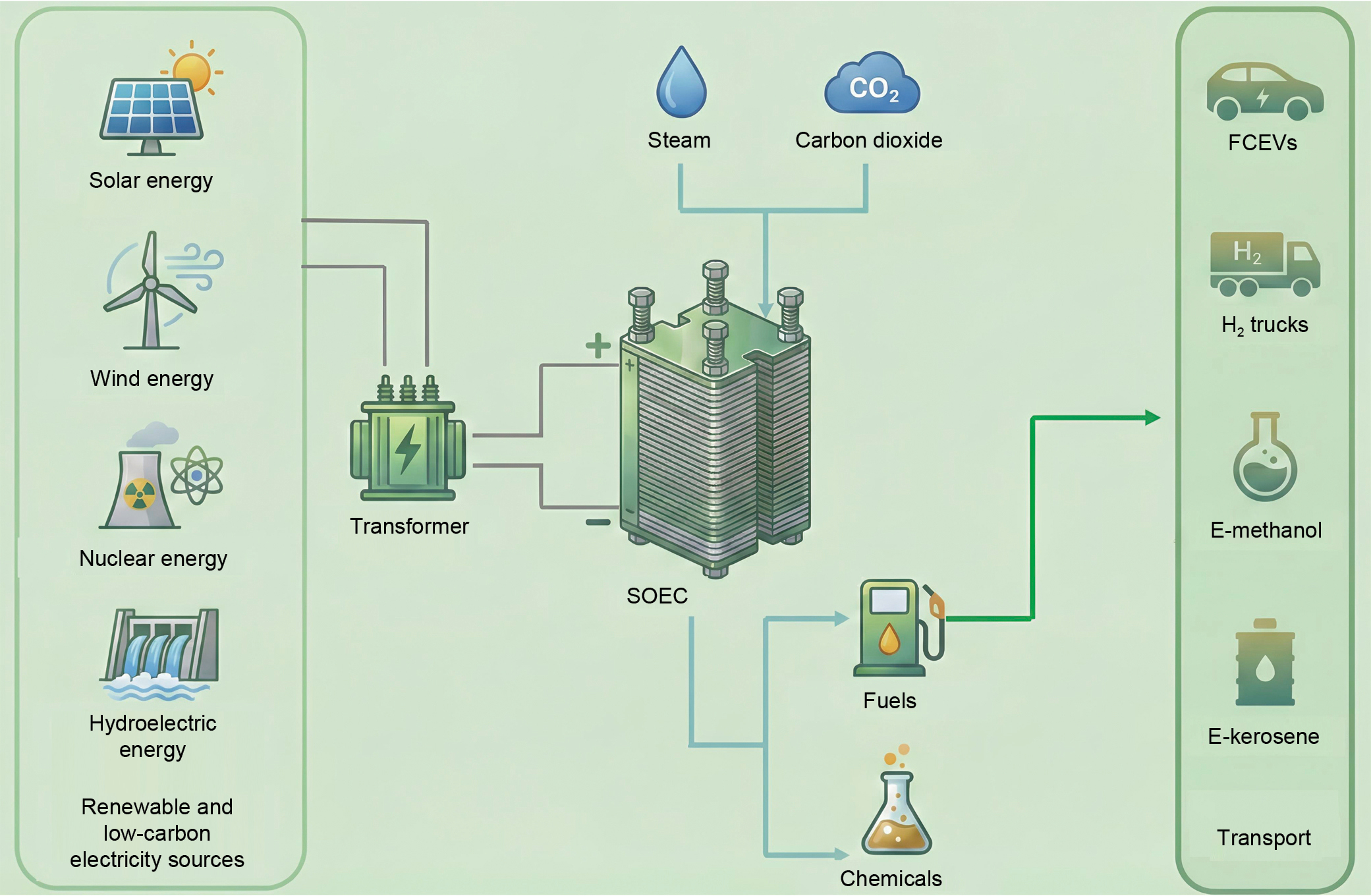
Solid oxide electrolysis cells (SOECs) have emerged as one of the most promising high-temperature electrochemical systems for green hydrogen production and CO2 utilisation. Operating at 500℃–900℃, SOECs enable fast electrode kinetics and low electrical energy consumption, while avoiding the use of platinum-group catalysts required by proton exchange membrane (PEM) and anion exchange membrane (AEM) electrolysers [1]. SOECs have been widely investigated for hydrogen production, syngas generation, co-electrolysis, and synthetic-fuel pathways because of their high efficiency and favourable high-temperature electrochemical kinetics [2–12]. Figure 1 illustrates an idealised energy-flow scheme in which electricity generated from renewable sources is used by SOECs to convert water and carbon dioxide into fuels and chemicals. In addition to supplying industrial feedstocks, SOEC-derived hydrogen and e-fuels can also support transport electrification and fuel substitution, thereby enabling a transport–energy integrated pathway.
Recent studies have significantly broadened the understanding of electrolysis technologies from multiple perspectives, including high-temperature solid oxide electrolysis for green hydrogen production, advanced solid oxide fuel cells (SOFC)/SOEC materials and system integration, cross-scale modelling of water electrolysers, impurity-tolerant electrolysis under realistic gas feeds, and catalyst design for efficient water splitting [13–17]. Despite this substantial progress in electrochemical performance and broader device-level understanding, the commercialisation of SOECs remains hindered by fabrication-related challenges. High-temperature sintering of ceramic layers ( > 1400℃), strict requirements on layer uniformity and gas-tightness, and compatibility with metal supports significantly influence cost, durability, and manufacturability. As SOECs move toward industrialisation, understanding the advantages, limitations, and scalability of different fabrication strategies, together with emerging low-temperature processing routes, has therefore become increasingly critical.
In this context, the present mini-review is intended to complement the existing literature by focusing specifically on fabrication strategies and low-temperature sintering approaches for steam electrolyser manufacturing, rather than on general device operation, catalyst chemistry, or system-level modelling alone [14, 16]. Accordingly, this mini-review summarises current fabrication methods for SOEC components, highlights recent advances in low-temperature sintering and dopant-assisted densification, and discusses the implications of these developments for scalable and cost-effective SOEC manufacturing. Although steam electrolysers are ultimately deployed as multi-cell stacks, the present review specifically focuses on the manufacturing–sintering coupling at the cell and component level, where materials selection, forming routes, electrolyte densification behaviour, and thermal compatibility fundamentally determine manufacturability, performance, and cost. In this sense, the scope of this work is distinct from broader SOEC reviews centred on electrochemical performance, degradation behaviour, or stack/system operation.
The fabrication of SOECs is intrinsically linked to their structural design. Three major aspects (cell geometries, support structures, and key fabrication requirements) govern the choice of processing routes, achievable microstructures, mechanical robustness, and long-term electrochemical performance. These interdependencies impose strict design and manufacturing constraints that influence the scalability and cost of SOEC technologies. A summarised schematic of these relationships is shown in Figure 2.
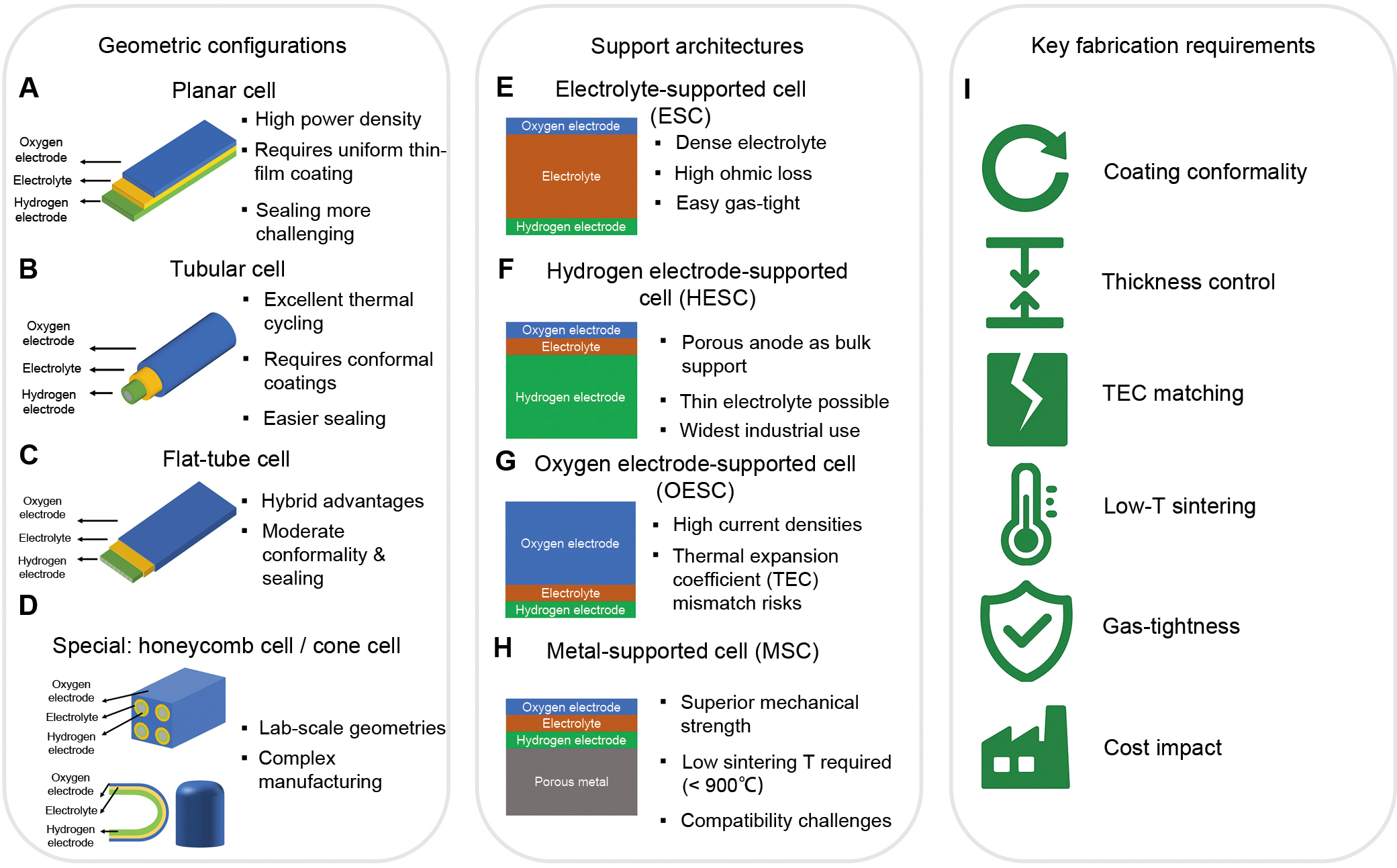
SOECs have been developed in several geometric forms, including planar, tubular, flat-tube, and special cellular geometries such as honeycomb and cone-shaped cells. Each configuration presents unique fabrication challenges, particularly in terms of coating uniformity and sealing.
Planar cells (Figure 2A) remain the most widely researched geometry due to their high-power density and strong compatibility with large-area manufacturing. However, planar geometries demand highly uniform thin-film deposition (e.g., screen printing, tape casting) and reliable edge sealing, as gas leakage at the periphery can severely compromise performance. Planar cells also experience more pronounced thermal gradients during operation because of their large footprint, which increases the need for matched thermal expansion coefficients among layers [18].
Tubular cells (Figure 2B) offer excellent thermal-cycling stability and reduced sealing complexity because the tube itself can act as a gas separator. Their primary fabrication challenge is the demand for a fully conformal coating over a curved surface. Dip-coating, spray-coating, gel casting, and extrusion-based techniques are frequently adopted to produce uniform layers, while direct thin-film deposition remains more difficult to scale on tubular substrates [19–21]. Despite lower volumetric power density, tubular SOECs are well known for their durability.
Flat-tube cells (Figure 2C) attempt to combine the manufacturing scalability of planar cells with the structural robustness of tubular designs. Their moderate curvature lowers conformality requirements, allowing conventional planar coatings to be applied while still enabling simpler sealing than planar cells. However, fabrication requires customised die extrusion and careful control of geometrical tolerance [19, 22–24].
Honeycomb and cone-shaped geometries (Figure 2D), although offering increased surface area and potentially improved gas utilisation, remain largely confined to laboratory demonstrations due to the need for highly precise moulds, complex coating pathways, and limited scalability [25–27].
Overall, geometric design dictates the level of coating conformality, sealing strategy, handling robustness, and achievable manufacturing throughput.
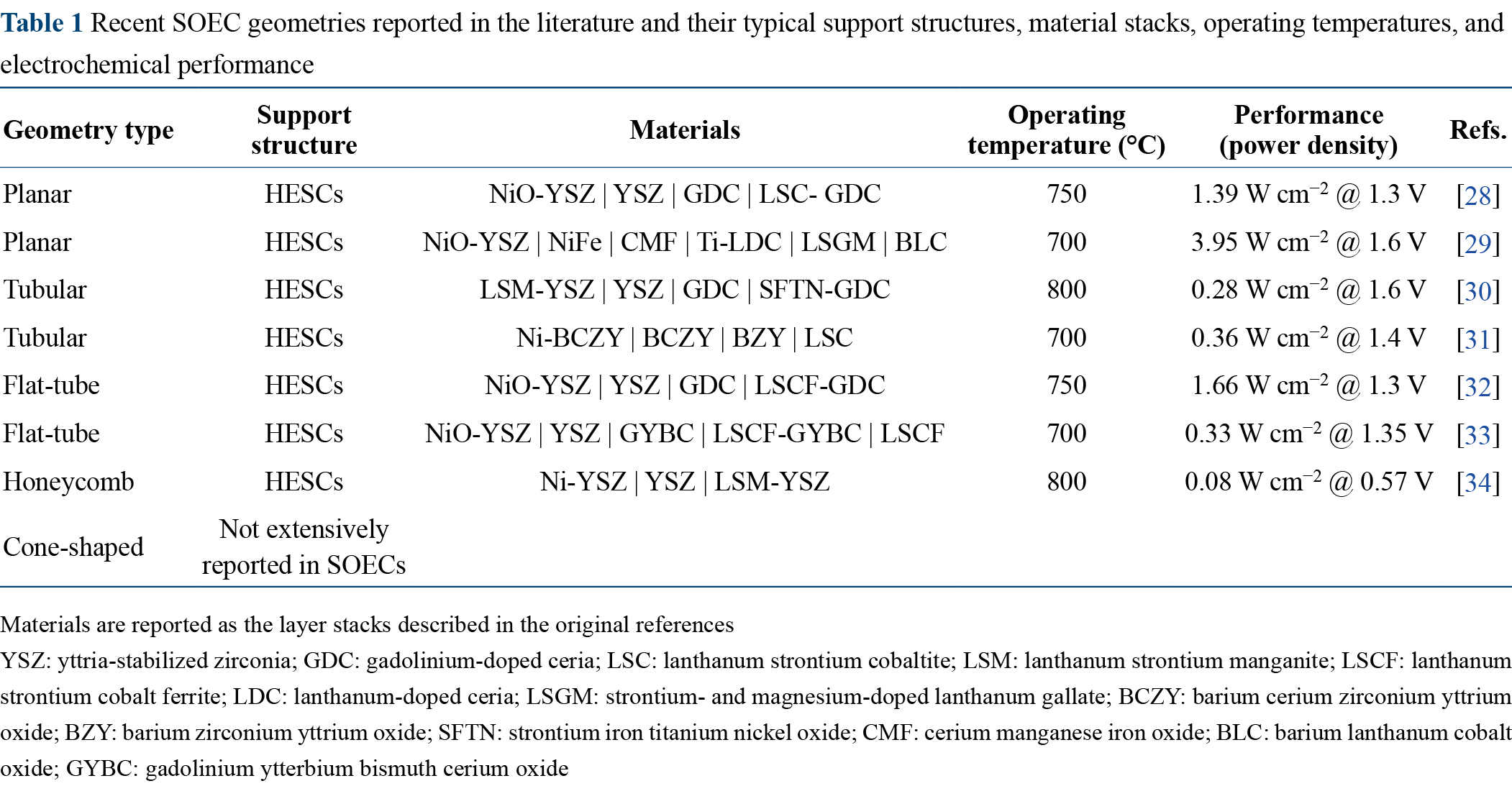
A comparison of representative SOEC geometries reported in the literature [28–34], including their support structures, material stacks, operating temperatures, and electrochemical performance metrics, is summarised in Table 1. This comparison highlights how geometric configuration directly constrains viable fabrication routes and achievable performance, thereby underscoring the importance of geometry-driven process selection in SOEC manufacturing. Beyond providing a snapshot of reported performance, the table illustrates that differences in power density among geometries are closely linked to geometry-imposed fabrication constraints rather than to intrinsic material properties alone. For example, planar and flat-tubular cells are inherently compatible with large-area forming and coating techniques that enable the fabrication of thin, uniform electrolytes and well-controlled electrode architectures, which is reflected in their relatively high reported power densities under comparable operating temperatures.
| Geometry type | Support structure | Materials | Operating temperature (°C) | Performance (power density) | Refs. |
|---|---|---|---|---|---|
| Planar | HESCs | NiO-YSZ | YSZ | GDC | LSC- GDC | 750 | 1.39 W cm−2 @ 1.3 V | [28] |
| Planar | HESCs | NiO-YSZ | NiFe | CMF | Ti-LDC | LSGM | BLC | 700 | 3.95 W cm−2 @ 1.6 V | [29] |
| Tubular | HESCs | LSM-YSZ | YSZ | GDC | SFTN-GDC | 800 | 0.28 W cm−2 @ 1.6 V | [30] |
| Tubular | HESCs | Ni-BCZY | BCZY | BZY | LSC | 700 | 0.36 W cm−2 @ 1.4 V | [31] |
| Flat-tube | HESCs | NiO-YSZ | YSZ | GDC | LSCF-GDC | 750 | 1.66 W cm−2 @ 1.3 V | [32] |
| Flat-tube | HESCs | NiO-YSZ | YSZ | GYBC | LSCF-GYBC | LSCF | 700 | 0.33 W cm−2 @ 1.35 V | [33] |
| Honeycomb | HESCs | Ni-YSZ | YSZ | LSM-YSZ | 800 | 0.08 W cm−2 @ 0.57 V | [34] |
| Cone-shaped | Not extensively reported in SOECs |
By contrast, tubular and honeycomb geometries introduce additional challenges associated with coating conformality, layer continuity, and thickness uniformity on curved or highly structured substrates. These constraints often necessitate the use of specialised forming and deposition routes, such as extrusion, dip coating, or spray-based techniques, which can limit the minimum achievable electrolyte thickness and increase processing complexity. As a result, such geometries typically exhibit lower areal power densities but offer advantages in terms of mechanical robustness, thermal-cycling tolerance, and simplified sealing strategies. The comparison, therefore, reveals a fundamental trade-off between electrochemical performance and manufacturability that is inherently dictated by cell geometry.
Importantly, Table 1 also highlights that operating temperature alone does not determine performance trends across different geometries. Instead, achievable power density emerges from the combined effects of geometry, support architecture, and the fabrication methods required to realise dense electrolytes and functional electrode layers. This observation reinforces the notion that SOEC design must be considered as an integrated material–geometry–process system, in which geometric configuration defines the practical processing window and sets upper limits on achievable performance. Consequently, geometry-driven constraints provide a critical framework for evaluating and selecting fabrication strategies, forming the basis for the systematic discussion of forming, deposition, and sintering methods presented in the following section.
Beyond geometry, SOECs differ substantially in their supporting architecture, which directly determines the thickness distribution of cell layers, gas transport pathways, thermal compatibility, and required sintering temperatures.
Electrolyte-supported cells (ESCs, Figure 2E) employ a thick, dense electrolyte as the mechanical backbone. While ESCs offer robust gas-tightness and chemical stability, the thick electrolyte results in significant ohmic losses. Electrodes can be deposited with relative ease, but the thick electrolyte restricts efficiency under intermediate-temperature operation [35].
Hydrogen electrode-supported cells (HESCs, Figure 2F), the most industrially mature architecture, use a thick, porous hydrogen electrode scaffold. This structure enables very thin electrolyte layers (5–15 μm), drastically reducing ohmic resistance. Achieving these thin electrolytes requires precise deposition methods such as screen printing, spray deposition, or physical vapour deposition (PVD), coupled with careful control of pore morphology. HESCs exhibit favourable thermal expansion coefficients (TECs) matching among the ceramic layers and display the most balanced combination of performance, manufacturability, and durability [36].
Oxygen electrode-supported cells (OESCs, Figure 2G) can provide high current densities at reduced temperatures, owing to thicker, highly active cathode scaffolds. However, cathode materials like perovskites often possess higher TEC, causing TEC mismatch with yttria-stabilized zirconia (YSZ)-based electrolytes [37]. This mismatch increases susceptibility to delamination or cracking during thermal cycling, limiting OESCs’ scalability and long-term reliability [35].
Metal-supported cells (MSCs, Figure 2H) represent a promising emerging architecture due to their mechanical toughness, rapid thermal cycling, and significantly reduced material costs. However, their fabrication is highly sensitive to temperature: metal substrates can oxidise, warp, and interdiffuse with ceramic layers when exposed to high sintering temperatures. Therefore, electrolytes in MSCs must be densified below ~900℃, necessitating low-temperature sintering strategies such as dopant-assisted densification, liquid-phase sintering, or ultra-fine powder processing [38, 39].
Support architecture thus governs electrolyte thickness requirements, thermal expansion compatibility, and the feasible sintering temperature window, thereby determining the choice of viable fabrication routes.
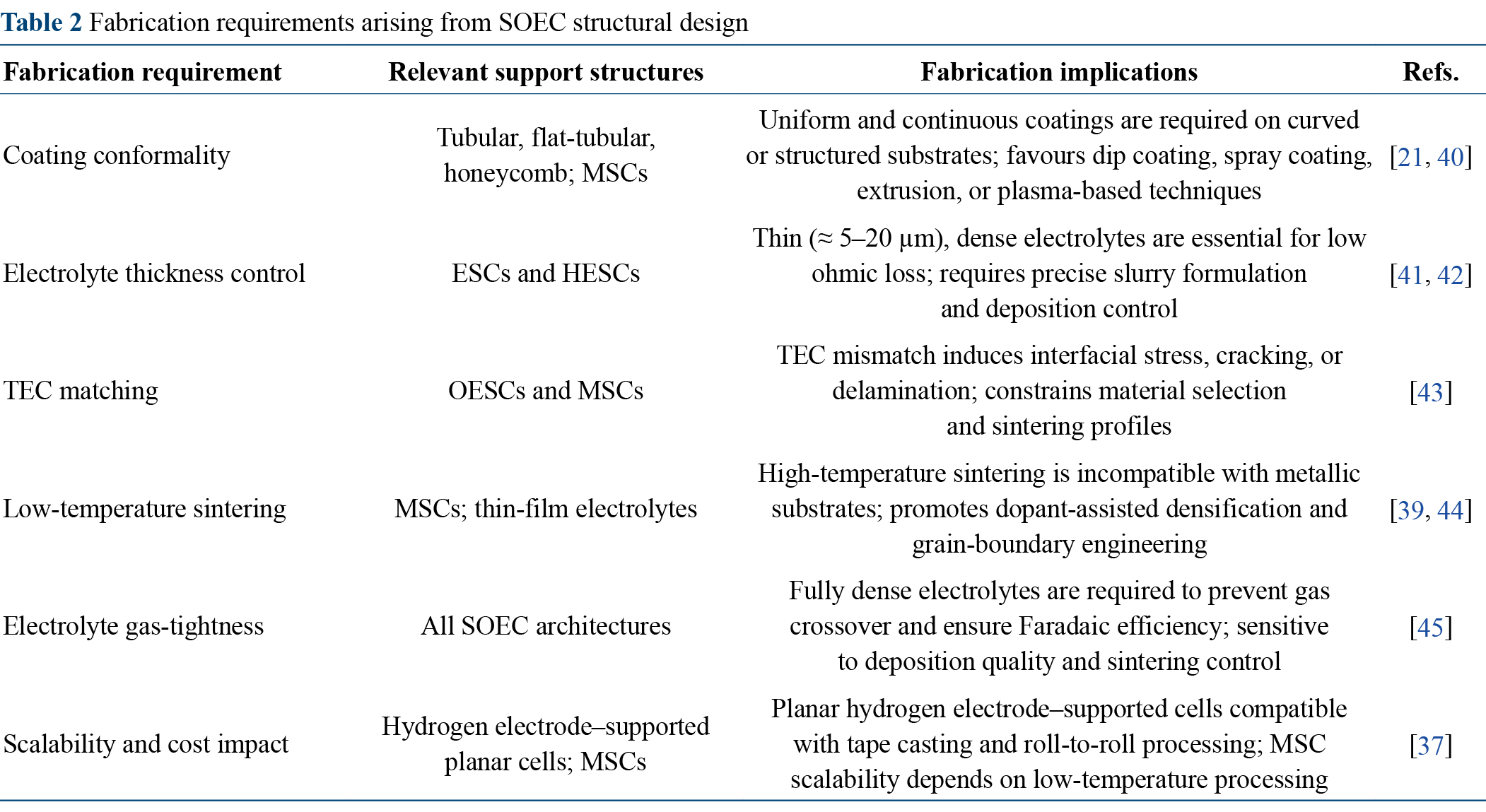
The combined influences of cell geometry and support structure lead to a set of universal fabrication requirements that collectively define the processing window for SOEC manufacturing, as illustrated in Figure 2I and summarised in Table 2 (based on [21, 37, 39–45]). These requirements—encompassing coating conformality, electrolyte thickness control, thermal expansion compatibility, densification temperature, gas tightness, and scalability—should not be considered independently. Instead, they emerge simultaneously from structural design choices and impose coupled constraints on viable fabrication strategies.
| Fabrication requirement | Relevant support structures | Fabrication implications | Refs. |
|---|---|---|---|
| Coating conformality | Tubular, flat-tubular, honeycomb; MSCs | Uniform and continuous coatings are required on curved or structured substrates; favours dip coating, spray coating, extrusion, or plasma-based techniques | [21, 40] |
| Electrolyte thickness control | ESCs and HESCs | Thin (≈ 5–20 µm), dense electrolytes are essential for low ohmic loss; requires precise slurry formulation and deposition control | [41, 42] |
| TEC matching | OESCs and MSCs | TEC mismatch induces interfacial stress, cracking, or delamination; constrains material selection and sintering profiles | [43] |
| Low-temperature sintering | MSCs; thin-film electrolytes | High-temperature sintering is incompatible with metallic substrates; promotes dopant-assisted densification and grain-boundary engineering | [39, 44] |
| Electrolyte gas-tightness | All SOEC architectures | Fully dense electrolytes are required to prevent gas crossover and ensure Faradaic efficiency; sensitive to deposition quality and sintering control | [45] |
| Scalability and cost impact | Hydrogen electrode–supported planar cells; MSCs | Planar hydrogen electrode–supported cells compatible with tape casting and roll-to-roll processing; MSC scalability depends on low-temperature processing | [37] |
In particular, geometric complexity and support selection directly limit the tolerance available for layer deposition and thermal processing. As indicated by the trends summarised in Table 2, requirements related to coating conformality, and electrolyte thickness become increasingly restrictive as cell architectures deviate from simple planar designs or incorporate metallic substrates. Under such conditions, achieving thin electrolytes or reduced sintering temperatures must be carefully balanced against risks associated with interfacial stress development and loss of gas tightness. This coupling highlights that performance optimisation through aggressive thickness reduction or low-temperature processing is often accompanied by a narrowing of the acceptable fabrication window. Support architecture further modulates these trade-offs. ESCs and HESCs generally allow greater flexibility in electrolyte densification and thickness optimisation, whereas OESCs and MSCs impose tighter constraints owing to intrinsic thermomechanical mismatches and substrate compatibility limits. Consequently, fabrication requirements increasingly shift from purely performance-driven considerations toward process robustness and reliability, as reflected by the emphasis on low-temperature sintering and interfacial stability in advanced cell designs. From a manufacturing perspective, the requirements summarised in Table 2 also have direct implications for scalability and cost. Fabrication routes capable of simultaneously satisfying densification, compatibility, and structural integrity constraints are inherently more amenable to scale-up, while approaches that rely on narrow processing windows or highly specialised deposition techniques face greater challenges in industrial implementation. Overall, structural design governs not only the electrochemical configuration of SOECs, but also the hierarchy and interdependence of fabrication requirements that ultimately determine manufacturability.
As discussed in Section 2, the selection of fabrication routes for SOECs is not independent of cell design. Geometric configuration, support architecture, electrolyte thickness requirements, coating conformality, and thermal-budget constraints collectively define the feasible processing window for each cell type. Therefore, the fabrication methods reviewed in the following section should be understood in the context of these design-driven constraints, as summarised in Figure 2 and Table 2, rather than as isolated processing options.
The fabrication method for layers is a key factor in the commercial production of SOECs, as it can affect cell cost, performance, and production rate. Seventeen fabrication methods, which have the potential to scale up production of SOECs, as shown in Figure 3, are discussed in this section. Among these fabrication techniques, several have already been validated and applied in pilot- or industrial-scale SOEC manufacturing. Tape casting is the most established method for producing planar cells due to its scalability and ability to form uniform layers, while screen printing is widely used for depositing electrodes and interlayers in commercial prototypes [43]. For tubular SOECs, extrusion and plasma spraying have been successfully implemented by industrial developers such as Sunfire and Topsoe [43].
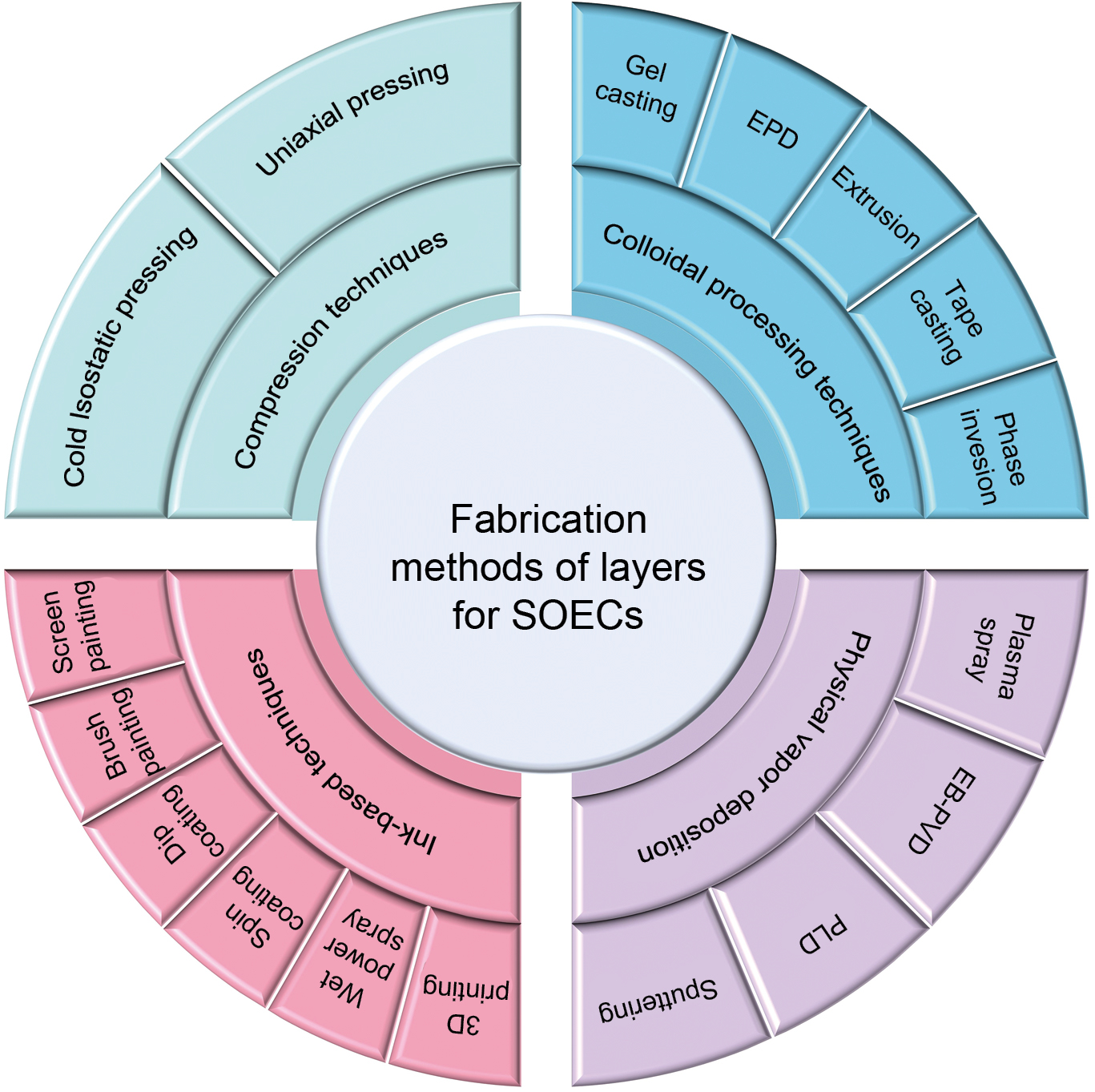
These methods can be grouped into four broad categories: compression techniques, colloidal processing techniques, ink-based techniques, and PVD.
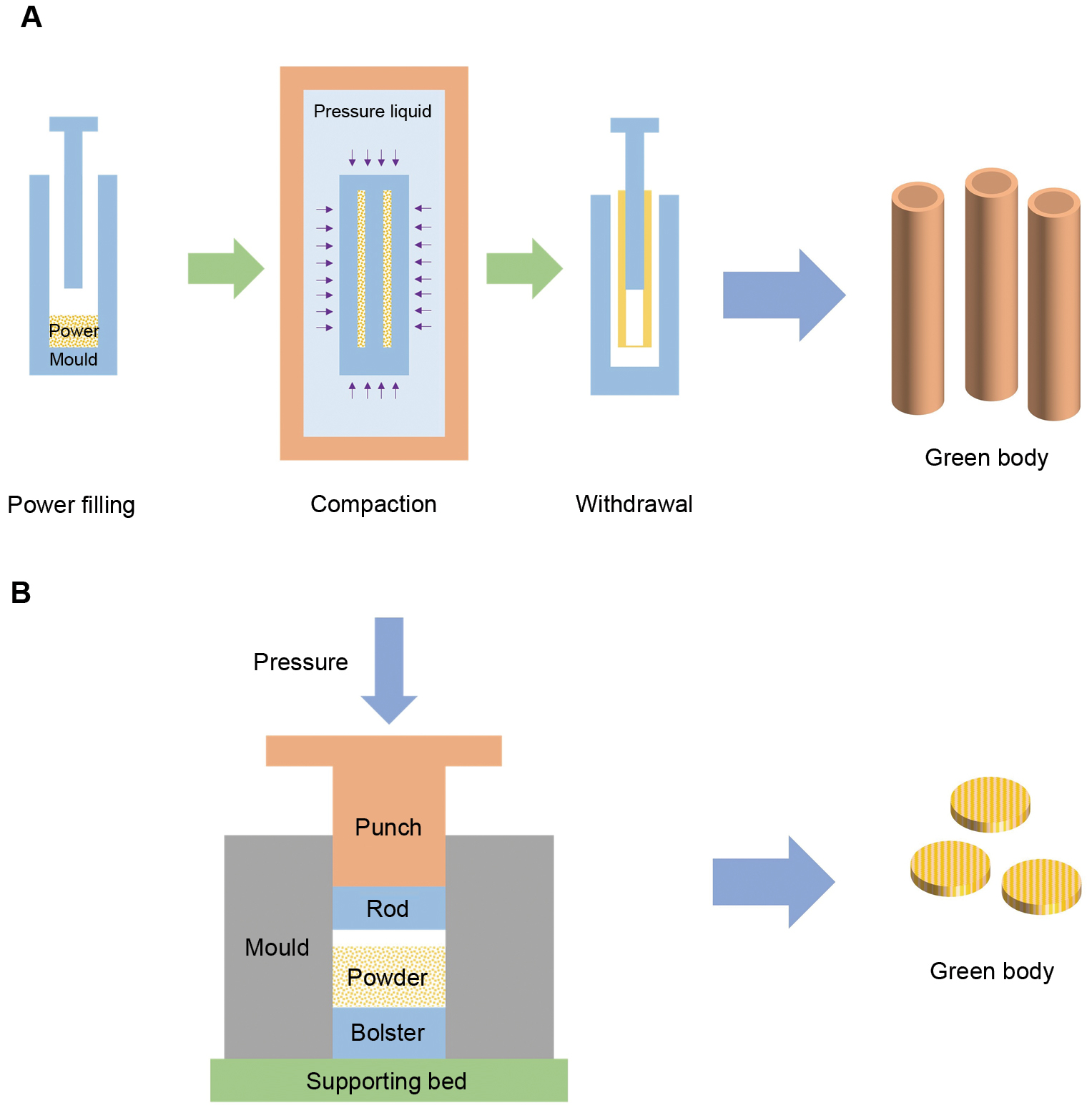
Compression-based methods are fundamental to SOEC fabrication because they consolidate ceramic powders into mechanically robust green bodies with controlled porosity and geometry. These approaches are particularly important for producing thick support layers that provide mechanical strength in both planar and tubular cells. Among these techniques, cold isostatic pressing (CIP) and uniaxial pressing, as shown in Figure 4, are the most established routes, each offering distinct advantages depending on the required geometry and component function.
CIP enables uniform powder compaction by transmitting hydrostatic pressure through an incompressible fluid medium, effectively eliminating die-wall friction and density gradients that arise in rigid-die compaction [46]. This uniformity makes CIP particularly suitable for fabricating tubular SOEC support layers, where consistent porosity and mechanical robustness are essential. CIP tooling is flexible and reusable, supporting the formation of complex geometries at relatively low tooling cost. However, the technique has limitations, including lower dimensional precision due to elastomer deformation, longer processing cycles, periodic maintenance requirements for hydraulic fluids, and reduced formability for powders with irregular morphology [47, 48].
In SOEC applications, CIP has been broadly employed to fabricate NiO/YSZ and YSZ tubular supports using pressures in the range of 10–250 MPa, typically yielding support structures with thicknesses of approximately 400–1,000 μm [49–52]. The method has also been applied to planar components, such as La2O3/SUS430 interconnects with a thickness of about 2,000 μm when compacted at 250 MPa [51]. When combined with secondary deposition techniques such as tape casting, CIP can also support thin-layer fabrication, including gadolinium-doped ceria (GDC)/YSZ electrolyte or barrier layers with thicknesses around 5–10 μm [53]. Although its dimensional accuracy is generally lower than that achievable with uniaxial pressing, the excellent density uniformity and scalability of CIP make it a reliable approach for preparing thick ceramic support layers, especially for tubular SOEC designs.
Uniaxial pressing is a simple, rapid, and industrially mature forming method widely used for planar SOEC fabrication [54]. By applying a single-directional load, typically 100–300 MPa, the process produces green bodies with relative densities of 55%–65% prior to sintering [55]. The technique requires minimal binder content and enables multilayer co-pressing, allowing the simultaneous formation of support and thin electrolyte layers. However, because the pressure is applied in only one direction, uniaxial pressing creates density gradients that may lead to anisotropic shrinkage, microcracking, delamination, or reduced gas-tightness after sintering [56–58]. Powder flowability often dictates process reliability, necessitating granulation or binder addition, while die wear becomes significant for large components.
In SOEC research, uniaxial pressing has been commonly used to fabricate planar supports composed of NiO/YSZ, YSZ, NiO/samarium doped ceria (SDC), and barium zirconium cerium yttrium ytterbium oxide (BZCYYb), producing typical layer thicknesses of 500–800 μm under applied pressures of 60–250 MPa [59–62]. Co-pressing enables the formation of electrolyte or functional layers with thicknesses in the range of 20–75 μm, as demonstrated in NiO/GDC, barium strontium cobalt oxide (BSCO), and BZCYYb multilayer structures [63–65]. Binder-assisted pressing is often required; for example, a 10% polyvinyl alcohol (PVA) binder improves the mechanical stability and compaction uniformity of BZCYYb green bodies [62]. Although density gradients remain a challenge, optimising powder preparation, binder formulation, die geometry, and compaction pressure can effectively mitigate associated defects. Due to its reproducibility, low cost, and suitability for planar multilayer architectures, uniaxial pressing remains one of the most practical and widely used forming routes for SOEC support structures.
Colloidal processing routes utilise ceramic suspensions or polymer–ceramic slurries to form SOEC components with controlled porosity, microstructure, and geometry. These methods are particularly suitable for fabricating tubular, flat-tube, or complex support structures and, in some cases, thin functional layers. Compared with compression-based methods, colloidal techniques offer greater flexibility in shaping and pore tailoring, improved homogeneity, and opportunities for multilayer integration. Representative approaches, as shown in Figure 5, include gel casting, electrophoretic deposition, extrusion, tape casting, and phase inversion, each offering distinct strengths and limitations for SOEC fabrication.
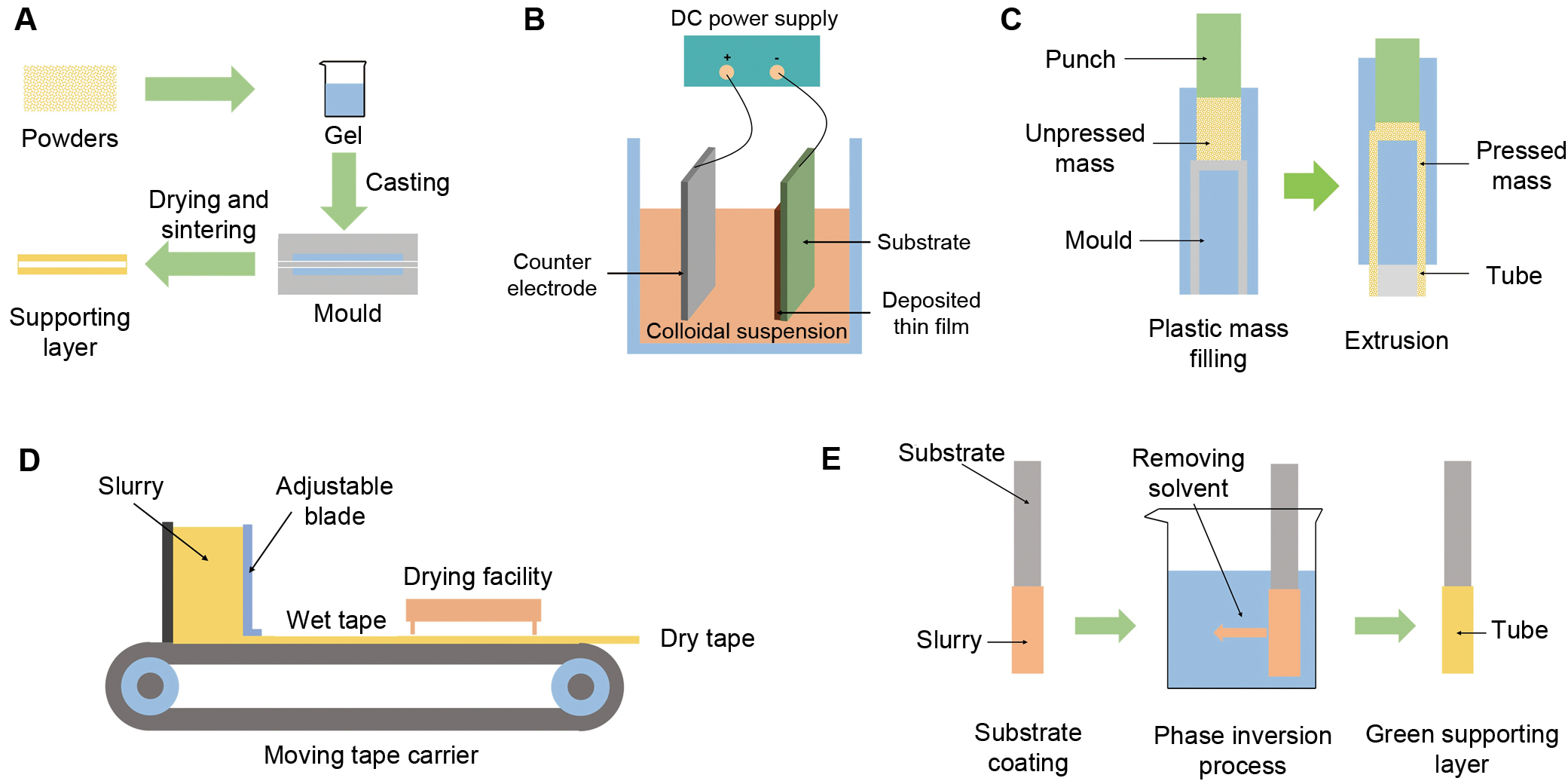
Gel casting is a wet-forming method in which ceramic powders are dispersed in a monomer-containing solution and polymerised in situ to form a strong green body with uniform microstructure [66]. The method offers several advantages for SOEC fabrication: it enables the shaping of complex geometries, allows the use of low-cost mould materials, and produces high-strength green bodies due to the polymer network that binds ceramic particles [67–69]. The relatively low organic content improves binder burnout, and the high degree of microstructural homogeneity supports stable sintering behaviour and improved mechanical robustness, which are particularly beneficial for SOEC support layers. However, gel casting also involves long gelation times, potential toxicity of monomers, difficulties sealing moulds used for intricate shapes, and high slurry viscosity when fine powders are employed [70, 71]. Low solid loading can cause substantial shrinkage during drying and sintering, leading to cracking and dimensional variation, while incomplete polymer removal may leave carbon residues that negatively affect SOEC performance.
In published SOEC studies, gel casting has been applied primarily to support layers. Planar NiO/YSZ supports have been produced using polyacrylic acid and acrylamide-based monomer systems, while tubular NiO/YSZ and NiO/SDC supports have been fabricated using dispersants such as polyacrylic acid or DOLAPIX CE 64 (Zschimmer & Schwarz, Germany) [72–74].
Reported thicknesses typically range from several hundred micrometres to around 1 mm, depending on composition and slurry formulation [74, 75]. Cone-shaped NiO/YSZ supports have also been demonstrated, reflecting the method's ability to produce non-standard geometries [76]. Overall, gel casting is well-suited for thick, mechanically robust SOEC supports when slurry formulation, powder dispersion, and drying schedules are carefully controlled.
EPD deposits charged ceramic particles from a stable suspension onto an electrode under an applied electric field, forming uniform thin films suitable for SOEC components [77]. The technique provides several advantages: low equipment cost, high deposition rates, excellent thickness uniformity, and low porosity in the deposited layer [78]. Film thickness can be tuned by adjusting suspension concentration, voltage, and deposition time, and the method is compatible with various substrates. These characteristics make EPD particularly suitable for fabricating thin electrolytes, barrier layers, and some cathode or anode functional layers. Nonetheless, EPD has limitations, including reduced film uniformity when using polydisperse powders, poor adhesion between the deposited film and substrate, and susceptibility to cracking during drying or sintering [79, 80]. Such defects can compromise gas tightness, cause delamination, or degrade electrochemical performance in SOECs.
EPD has been widely used to fabricate thin layers for planar SOECs. NiO/YSZ, YSZ, and lanthanum strontium manganite (LSM)/YSZ layers of around 6.5, 3, and 11.1 μm have been deposited at 25 V for 3 min in acetylacetone-based systems [81], while YSZ films between 10 and 35 μm have been obtained using pulsed power supplies and iodine–ethanol dispersions [82]. EPD has also been demonstrated for tubular structures using specially designed electrode configurations. Ni/YSZ, YSZ, and LSM layers with thicknesses between approximately 30 and 70 μm have been deposited using isopropanol suspensions containing additives such as 4-hydroxybenzoic acid and polyvinyl butyral (PVB) to improve adhesion and reduce cracking [83]. Overall, EPD is an effective method for producing dense thin films for planar SOECs and, with suitable device design, for tubular architectures, although adhesion and particle-size control remain critical.
Extrusion forms ceramic bodies by forcing a plasticised feedstock through a die, producing components with a constant cross-section such as tubes, rods, or channels [84]. The process is widely used for SOEC support fabrication because it allows the production of long, continuous tubular shapes with controlled geometry, smooth surfaces, and high reproducibility. Advantages include strong dimensional stability, compatibility with multilayer co-extrusion, rapid tool change, and straightforward automation [85]. These features are valuable for producing tubular SOEC architectures where consistent wall thickness and circularity are essential for sealing and mechanical strength. However, extrusion also exhibits limitations such as material-flow inhomogeneity between the core and surface, high tooling wear, batch-wise operation that limits productivity, and increased process waste (often 10%–15%) [85, 86]. The relatively high tooling cost due to wear-resistant die materials can also restrict cost-sensitive applications.
For SOECs, extrusion has been predominantly applied to fabricate NiO/YSZ and NiO/GDC tubular supports. Typical wall thicknesses range from approximately 220 to 1,000 μm, depending on composition and binder systems [87, 88]. Common organic additives include polypropylene, paraffin wax, stearic acid, polyethylene, dibutyl phthalate, and cyclohexanone, which act as binders, plasticisers, or processing aids [89]. Co-extrusion further enables the simultaneous formation of support and thin electrolyte layers. One example is a NiO/YSZ support co-extruded with a YSZ layer of approximately 100–171 μm using PVB- and cyclohexanone-based binders [89]. Overall, extrusion is a highly practical route for fabricating tubular SOEC supports with good geometric precision and smooth surfaces, provided that feedstock rheology and extrusion parameters are carefully controlled.
Tape casting forms thin ceramic layers by spreading a well-dispersed slurry onto a moving substrate using a doctor blade, followed by controlled drying and sintering [90]. The technique offers excellent control over tape thickness, typically from a few micrometres to several hundred micrometres, and provides uniform particle distribution across large areas [91–93]. These characteristics are highly advantageous for planar SOEC architectures where precise electrolyte thickness, flatness, and homogeneity are essential for gas tightness and low ohmic resistance. Tape casting supports both aqueous and solvent-based systems. Aqueous systems are cost-effective and non-toxic but sensitive to drying conditions and prone to cracking, while solvent-based systems allow faster drying with lower defect rates but pose environmental and safety concerns [94–97]. The multiple processing steps involved in tape casting can also limit overall production speed.
In SOEC research, tape casting has been widely used to fabricate planar supports and thin functional layers. Freeze-cast aqueous YSZ supports of approximately 500–1,500 μm have been reported [98], while solvent-based slurries have been used to produce Fe-doped GDC supports of about 100–300 μm and scandia-stabilized zirconia (SSZ) supports around 200 μm [99, 100]. Multilayer structures have been demonstrated with thin (~ 50 μm) functional layers and thicker (~ 600 μm) supports [101]. Tape casting has also been used to fabricate thin electrolytes, including YSZ films as thin as ~ 7 μm when combined with NiO/YSZ support layers [102]. Further examples include ytterbium and scandium stabilized zirconia (YbScSZ) supports around 280 μm and NiO/SSZ or NiO/YSZ supports of roughly 440 μm [103, 104]. Overall, tape casting is a flexible and reliable method for planar SOEC components, offering precise thickness control and excellent surface quality when slurry composition and drying parameters are carefully optimised.
Phase inversion is a membrane-forming technique in which a polymer–ceramic solution undergoes liquid–liquid phase separation upon immersion in a non-solvent bath, forming a porous green body that is subsequently dried and sintered [105]. The method is attractive for SOEC fabrication because it offers simple equipment requirements, short processing times, and the ability to tailor pore morphology, including sponge-like and finger-like structures that improve gas diffusion and mechanical support [40]. The technique is particularly useful for producing graded or asymmetric porous supports. However, phase inversion often relies on hazardous organic solvents, produces solvent-contaminated effluents, and increases production cost due to solvent handling and recovery [106]. Residual solvent or uncontrolled pore formation may lead to microstructural inhomogeneity, compromising mechanical strength, gas tightness, and long-term electrochemical stability.
Phase inversion has been widely used to produce porous supports, especially tubular structures for SOECs. Ni/Fe alloy supports (~ 110 μm) and alumina-based tubular supports (~ 300 μm) produced with polyethersulfone (PESF)/polyvinylpyrrolidone (PVP)/ N-methyl-2-pyrrolidone (NMP) systems [107, 108]. Planar NiO/YSZ supports around 920 μm have also been demonstrated [109], and multi-layer LSM/YSZ and lanthanum strontium cobalt ferrite (LSCF)/YSZ tubular structures with thicknesses near 190 μm and ~56 μm have been fabricated [110]. Phase inversion is often combined with other methods, such as co-extrusion or tape casting, to obtain complex or graded architectures [111]. Overall, phase inversion is a versatile technique for producing porous SOEC supports but faces challenges related to solvent use, environmental impact, and scale-up.
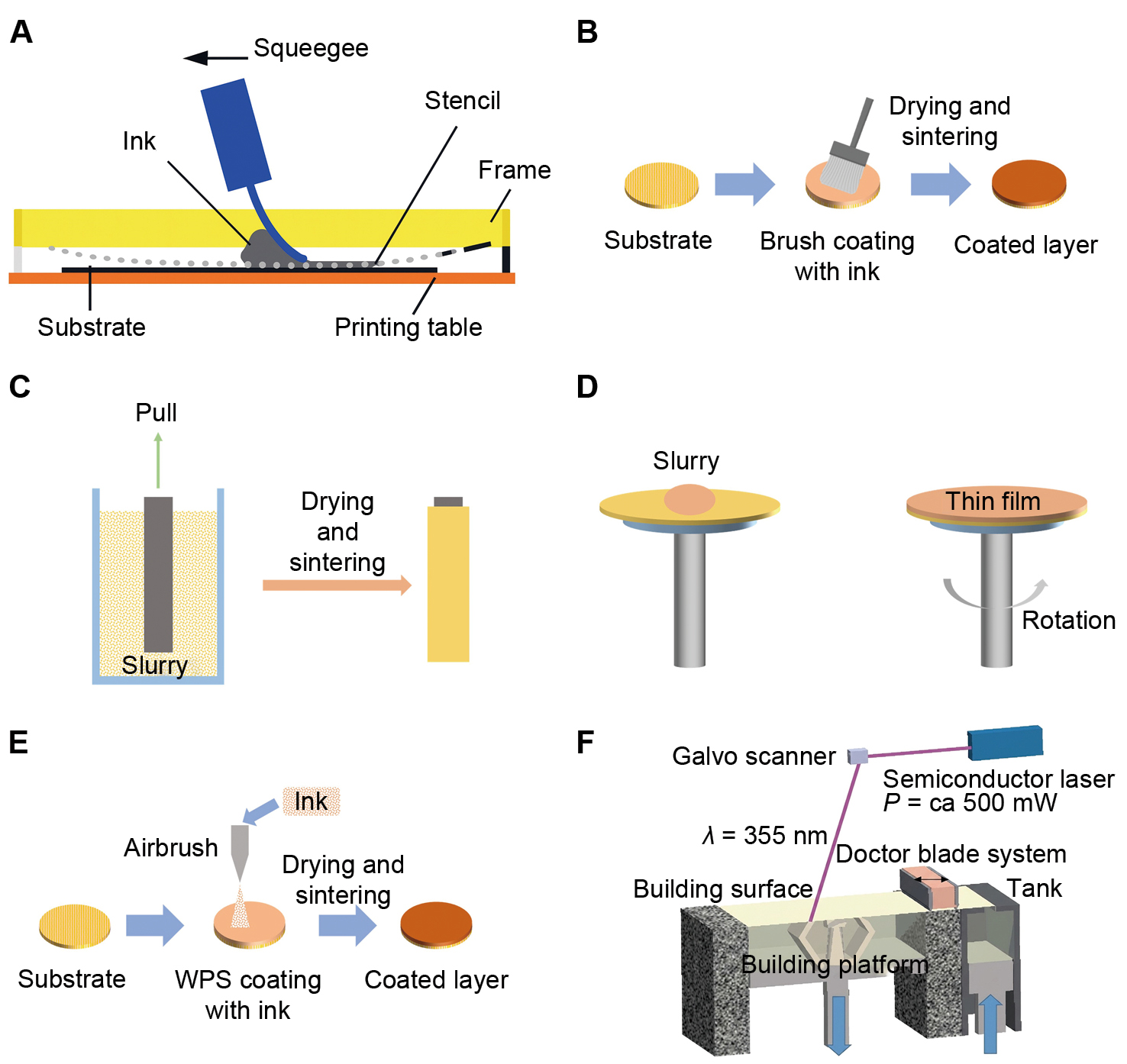
Ink-based techniques use particle-loaded slurries or pastes to deposit thin ceramic or composite layers onto preformed substrates. These methods are particularly important for SOEC fabrication because they enable the controlled deposition of electrolytes, electrodes, and functional interlayers with tunable thickness, microstructure, and coverage on planar, tubular, or MSCs. Compared with colloidal forming routes, ink-based processes are typically applied to already sintered or partially sintered supports and are therefore well-suited for multilayer architectures. Representative ink-based techniques, as shown in Figure 6 (schematics of screen printing and 3D printing are reproduced from [112, 113]), include screen printing, brush painting, dip coating, spin coating, wet powder spray, and 3D printing, each offering a different balance between process simplicity, film quality, scalability, and geometric flexibility.
Screen printing is a stencil-based technique in which a viscous ceramic ink is forced through a patterned mesh onto a flat substrate using a squeegee, followed by drying and sintering [114]. It is one of the most established methods for depositing thick films on planar cells because it offers high production speed, low equipment cost, and straightforward thickness control for films typically thicker than 10 μm [115–117]. The method is particularly attractive for fabricating electrodes and some electrolytes over large areas, where intimate contact and good adhesion to the substrate are required. However, ink sedimentation, and separation can cause viscosity changes, nozzle clogging and non-uniform prints, and the use of organic additives needed to achieve high paste viscosity may affect the electrical properties of the final layer if burnout is incomplete [115, 117]. Careful optimisation of ink formulation and printing parameters is therefore essential.
In SOEC fabrication, screen printing has been widely used to prepare thin functional layers on planar cells. Early studies demonstrated NiO/YSZ and LSM layers of around 20 μm [118]. More recent work has focused on finer control of layer thickness and microstructure using optimised pastes. For example, YSZ, GDC, and LSCN/GDC films with thicknesses of approximately 6–10μm have been obtained [117]. Multi-material screen printing has also been used to fabricate GDC and various double-layer cathodes, such as lanthanum nickelate (LNO)/lanthanum-doped ceria (LDC), neodymium nickelate (NNO)/neodymium-doped ceria (NDC), and LSM/YSZ, with thicknesses between about 8 and 31 μm [119, 120]. Recent reports include GDC, YSZ, LNO, lanthanum nickel ferrite (LNF), and Pd/LSCF films with thicknesses in the 3–20 μm range for advanced electrode and electrolyte architectures [121, 122]. Overall, screen printing is a mature, scalable, and industrially relevant technique for planar SOECs, particularly suited to large-area electrode and electrolyte deposition.
Brush painting deposits a ceramic slurry onto a substrate using a brush, followed by drying and sintering. The method is conceptually simple, requires minimal equipment and environmental control, and can be applied to substrates with different geometries. It offers low fabrication cost, easy adjustment of coating thickness by varying slurry loading or brushing cycles, and high flexibility for laboratory-scale prototyping [123–125]. However, film quality strongly depends on operator skill, slurry rheology, and brushing technique, which often results in non-uniform thickness, poor dimensional accuracy, and variable adhesion. Brush cleaning or replacement is also necessary to avoid clogging or contamination and achieving high reproducibility for large-scale production is challenging.
In SOEC research, brush painting has been primarily used to deposit thin electrodes or functional layers on both planar and tubular cells. More recent work has employed brush painting to fabricate potassium doped strontium iron molybdenum oxide (KSFM)/barium zirconium cerium yttrium oxide (BZCY) composite electrodes and LSCF/SDC cathodes for proton- and oxide-conducting systems [126, 127]. Ag/GDC coatings of 30–50 μm have been applied to tubular geometries, illustrating the method's adaptability to non-planar substrates [128]. Other studies report lanthanum strontium ferrite (LSF) and LSCF-based cathodes on planar cells [129]. Overall, brush painting is useful for exploratory studies and small- to medium-scale fabrication of SOEC components, especially where complex or non-standard geometries are involved, but it is less suitable for high-volume manufacturing that demands tight tolerances and high layer uniformity.
Dip coating involves immersing a support into a ceramic slurry and withdrawing it at a controlled speed, leaving a liquid film that is subsequently dried and sintered. The technique can coat both light and heavy films on substrates with simple or complex shapes, including tubes and flat-tubes, and requires relatively low-cost equipment [130, 131]. Film thickness is governed by slurry viscosity, solids loading, and withdrawal speed, offering good tunability for thin electrolyte or electrode layers. However, dip coating suffers from the so-called wedge effect, in which thickness varies along the vertical direction due to gravity and drainage. Precise control of slurry rheology and withdrawal rate is required to minimise non-uniformity and avoid defects such as cracking or runs [130–132]. These challenges become more pronounced when thicker films or large components are coated.
For SOECs, dip coating has been widely explored for thin electrolytes on tubular, flat-tube and planar supports. YSZ layers between 10 and 50 μm have been deposited on tubular supports [133], whereas flat-tube cells have been coated with NiO/YSZ, scandia-stabilized zirconia (ScSZ), GDC and LSCF/GDC layers, typically around 10–15 μm [134]. Planar NiO/ScSZ and ScSZ layers of about 20 and 36 μm have also been reported [135]. More recent examples include GDC, YSZ, and scandium, cerium, gadolinium-stabilized zirconia (SCGZ) films of about 20 μm on planar cells [136], and barium cerium zirconium yttrium zinc oxide (BCZYZ) layers with thicknesses between roughly 22 and 35 μm on tubular supports [137]. These studies show that dip coating is a versatile method for obtaining thin functional layers across different SOEC geometries, although multiple coating cycles are often required to reach the desired thickness, which can limit throughput in large-scale manufacturing.
Spin coating deposits a liquid film on a rotating substrate and uses centrifugal forces to spread the slurry into a thin, uniform layer that is dried and sintered [138]. Key process parameters include dispensed volume, spinning speed, spin time, and slurry viscosity, which collectively determine the final film thickness and uniformity [139–141]. Spin coating offers several advantages for SOEC thin-film fabrication: it is simple to operate, produces highly uniform films, allows fine thickness control down to the sub-micrometre range, and is compatible with multilayer architectures. The process is relatively low-cost and is well-suited to research-scale production of thin electrolytes and functional layers. Its primary limitations are the requirement for smooth, flat substrates, potential thickness non-uniformities such as radial streaks, and significant material waste because excess slurry is spun off the substrate [139, 141].
In planar SOECs, spin coating has been widely used to prepare very thin electrolytes and electrode functional layers. Studies have reported NiO/YSZ and YSZ films of about 15 and 10 μm [142], Co-doped ceria films as thin as 0.5 μm [143], and BZCY or BZCYYb electrolytes with thicknesses in the 7–30 μm range using polyethyleneimine- or terpineol-based inks [144, 145]. Spin coating, therefore, enables extremely thin, dense layers that can significantly reduce ohmic losses, although multiple coating cycles are frequently required to build up sufficient thickness, and the need for disc-like, flat substrates limits direct translation to high-density stack designs.
WPS, also referred to as spray painting or slurry spraying, uses a spray gun or airbrush to atomise a ceramic suspension and deposit it onto a substrate, followed by drying and sintering. The method requires relatively simple, low-cost equipment and is capable of coating flat, tubular, or more complex shapes. It is compatible with a wide range of materials and allows coating thickness to be controlled by adjusting spraying time and suspension properties. These characteristics make WPS an attractive technique for depositing both porous electrodes and dense electrolytes in SOECs. However, achieving homogeneous thickness over large areas can be challenging, and improper parameter control may lead to drips, runs, or local defects. The use of organic solvents and binders also raises safety and environmental concerns and necessitates adequate ventilation and process control.
In the context of SOECs, WPS has been widely applied to planar and tubular thin layers. For example, studies report SDC, LSF, and LNF layers with thicknesses in the 3–10 μm range [146], as well as GDC films around 15 μm [147]. More recently, GDC layers of about 20 μm have been sprayed on tubular supports using complex aqueous-organic suspensions [148], and BZCYYb films of around 7 μm have been produced on planar supports [149]. Overall, WPS is a versatile and scalable technique for producing thin layers on different SOEC geometries, although one-time coating thickness is limited, and multiple passes are often required, similar to dip and spin coating.
3D printing, or additive manufacturing, builds three-dimensional objects layer by layer from a digital model, usually using an extruded or ink-based feedstock [150]. For SOECs, 3D printing offers the potential to fabricate complex geometries, integrated architectures, and designed porosity that are difficult to achieve with conventional techniques. Advantages include elimination of expensive moulds or dies, high design flexibility, reduced material waste, and the capability to rapidly prototype new structures [151, 152]. However, printing resolution and surface quality are often inferior to more traditional forming methods, build rates can be relatively slow, and the process is typically discontinuous. The cost of printing equipment and specialised feedstocks remains high, and the maximum component size is constrained by the printer's build volume [152–154].
In SOEC and solid oxide cell (SOC) research, 3D printing has so far been used mainly for planar cells and supports. Reported examples include YSZ thin layers of about 23 μm produced using dispersants such as Dispex A40, polyethylene glycol (PEG), and surfactants [155], and SDC/sodium cobaltite composite supports of roughly 1,200 μm with secondary surface structures such as pillar arrays or scaffold patterns that enhance electrode–electrolyte contact [156]. Other studies have demonstrated that YSZ supports formed from UV-curable resins and PEG-based systems with thicknesses in the 260–340 μm range [157, 158]. These works illustrate the potential of 3D printing for tailoring internal architecture and surface features, and, in some cases, for fabricating entire SOC stacks [159]. Nevertheless, the technique is currently limited to laboratory-scale prototyping, and its hallmark capability of forming fully three-dimensional, highly integrated SOEC stacks has yet to be fully explored. Further development is required to improve precision, reduce cost, and adapt 3D printing for reliable large-scale SOEC manufacturing.
PVD refers to thin-film processes in which a target material is vaporised in vacuum and condensed onto a substrate to form a dense coating [160]. For SOECs, PVD is attractive because it can produce dense, thin electrolyte or electrode layers without a high-temperature sintering step, thereby reducing thermal stress and interfacial reactions. It also offers excellent control over film purity, stoichiometry, and thickness, leading to high gas tightness, good adhesion, and potentially superior ionic or electronic conductivity [161, 162]. A wide range of oxides and composites can be deposited under controlled atmosphere and temperature, which is advantageous for multilayer or functionally graded architectures. However, most PVD methods are best suited to line-of-sight deposition and therefore struggle with complex 3D geometries. In addition, the high capital cost, vacuum infrastructure, and process complexity limit large-scale industrial deployment, making PVD more appropriate for research-scale thin-film SOECs or high-performance demonstrators [162, 163]. According to different methods of vapour generation, there are many types of PVD, as shown in Figure 7, including EB-PVD (Electron-beam PVD), sputtering, and pulsed laser deposition (PLD).
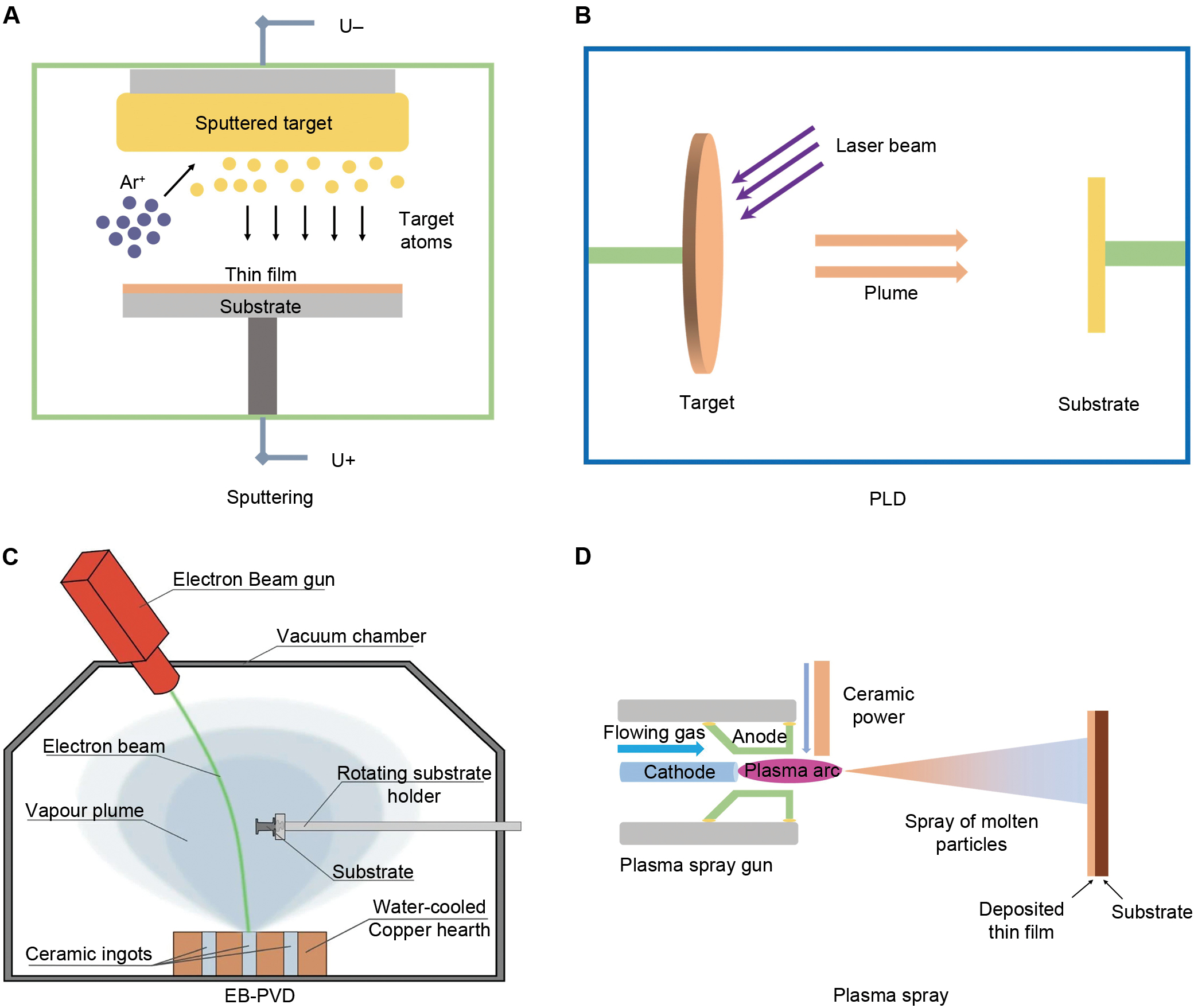
Several PVD variants have been explored for SOECs, including sputtering, pulsed laser deposition, electron-beam PVD, and plasma spray. Pulsed laser deposition and electron-beam PVD have mainly been used for nanometre- to micrometre-scale electrolyte and electrode films on planar cells. Reported examples include GDC and YSZ layers with thicknesses of about 0.2–5 μm by EB-PVD [165–168], barium zirconium yttrium oxide (BZY) and Sr/Co-doped LaScO3 films of roughly 2–8 μm by PLD [169–171], and LSC coatings as thin as 0.001–0.1 μm [172]. Sputtering has been used to deposit GDC electrolytes of around 1 μm [173]. Plasma spray, by contrast, can also address more complex shapes and thicker layers. NiO/YSZ supports of about 500 μm and multi-layer LSCC, NiO/YSZ, YSZ, and LSCF structures with thicknesses from 50 to 500 μm have been produced by plasma spraying [168, 174–177], demonstrating its suitability for both supports and functional coatings. Overall, PVD methods provide a powerful toolbox for fabricating dense, thin SOEC layers without additional sintering, but their geometric constraints, equipment cost, and process sophistication currently confine their use mainly to planar model cells and specialised applications rather than routine mass production.
The diverse fabrication methods available for SOEC components reflect the wide range of structural, microstructural and functional requirements associated with modern cell architectures. Selecting an appropriate route requires aligning geometric constraints, target layer thickness, porosity, mechanical stability and processing temperature with the capabilities of the chosen technique.
This selection is inherently trade-off-driven because no fabrication category simultaneously maximises geometric adaptability, thin-film precision, scalability, and compatibility with reduced thermal budgets. Compression-based methods are advantageous for producing mechanically robust and uniformly porous support structures, but their limitations in thin-layer precision and interfacial control make them less suitable for architectures that require very thin dense electrolytes. Colloidal processing routes offer greater flexibility in shaping complex geometries and tailoring porosity, which is particularly valuable for tubular and flat-tube designs; however, these routes are often more sensitive to slurry stability, drying behaviour, shrinkage mismatch, and batch-to-batch reproducibility. Ink-based techniques provide a practical compromise between cost, scalability, and deposition flexibility for electrodes and thin electrolytes, yet they frequently involve trade-offs between coating conformality, thickness uniformity, and the need for repeated coating/sintering cycles. PVD methods deliver the highest precision, gas-tightness, and microstructural control for ultra-thin layers, but their high capital cost, line-of-sight limitation, and reduced throughput restrict their broader manufacturing applicability, particularly beyond planar model systems. An important remaining gap is that methods most attractive for scalable shaping are not always fully compatible with the low-temperature sintering requirements of metal-supported and thin-electrolyte SOECs. As a result, future progress will likely depend not on a single universally optimal route, but on better integration of fabrication category, cell architecture, and densification strategy within the constraint framework already outlined in Table 2.
Thick and porous support structures, typically several hundred micrometres in thickness, are fundamental to both planar and tubular designs and therefore demand forming routes capable of producing mechanically robust, uniformly porous substrates. Compression-based techniques such as uniaxial pressing and cold isostatic pressing meet these requirements for planar and simple tubular geometries, although uniaxial pressing may introduce density gradients, and CIP requires longer processing cycles and mould preparation. In contrast, colloidal shaping routes (including gel casting, extrusion, tape casting, and phase inversion) provide greater flexibility for fabricating complex geometries and tailoring pore structures. Tape casting is especially effective for planar supports or electrolytes requiring precise thickness control and smooth surfaces, whereas extrusion and phase inversion are best suited for tubular supports due to their superior geometric conformity and control over internal porosity. Gel casting enables intricate shapes with high green strength but requires precise slurry formulation and long gelation times.
For thin functional layers such as electrolytes and electrodes, ink-based deposition routes provide a practical balance between film quality, adjustability, and scalability. Screen printing, dip coating, spin coating, and wet powder spray each offer unique advantages. Screen printing supports rapid, large-area planar deposition with good reproducibility, but is limited to flat substrates. Dip coating and wet powder spray provide conformal coverage on tubular and flat-tube geometries, although achieving uniform thickness demands careful control of slurry rheology and withdrawal or spraying parameters. Spin coating enables extremely thin and uniform layers, often below 1 μm, but is constrained by substrate smoothness and geometric simplicity and is therefore best suited to laboratory-scale planar devices. These techniques are generally low-cost and compatible with a broad array of ceramic and composite inks, making them attractive for industrial scaling when layer uniformity requirements are moderate.
At the high-precision end of thin-film fabrication, physical vapour deposition techniques such as pulsed laser deposition, sputtering, electron-beam PVD, and plasma spray enable the formation of dense, high-purity films without high-temperature sintering. These methods are particularly useful for ultra-thin electrolytes, barrier layers, and specialised electrode coatings. PVD routes offer unmatched control over stoichiometry, density, and microstructure, leading to exceptional gas tightness and interfacial adhesion. However, their line-of-sight nature limits applicability to mostly planar geometries, and the high equipment cost and sophisticated vacuum systems restrict large-scale deployment. Plasma spray, as an exception within this group, accommodates more complex geometries and can form either dense or porous layers depending on process conditions, making it suitable for both supports and functional films. Despite these advantages, PVD remains predominantly a research-scale method for high-performance planar SOECs rather than a mass-production technology.
Compression-based routes excel in mechanical robustness but lack thin-film precision. Colloidal routes offer versatility and microstructural control but require careful slurry management and may involve environmentally sensitive solvents. Ink-based methods strike a balance between scalability, cost, and layer quality but often demand multiple coating cycles to achieve sufficient thickness. PVD routes provide the highest-quality films yet face geometric and economic constraints. Consequently, hybrid fabrication strategies are becoming increasingly important. Examples include coupling CIP with tape casting to combine structural robustness with thin-film precision, integrating co-extrusion with phase inversion to achieve graded porosity, or using screen printing followed by plasma spray to produce multi-layer electrode–electrolyte architectures with improved adhesion and durability. These combinations allow individual methods to compensate for one another's weaknesses and offer a pathway to more sophisticated and reliable SOEC designs.
Looking forward, several trends are expected to shape the evolution of SOEC fabrication. Low-temperature processing (< 900℃) will become increasingly important, particularly for MSCs, where avoiding oxidation and interfacial reactions is essential. Advances in nano-sized powders, liquid-phase sintering aids and thin-film deposition techniques will support this shift. Digital manufacturing and 3D printing offer new opportunities for designing complex internal channels, hierarchical porosity, and integrated multi-layer structures, although further work is needed to improve precision and scalability. Automation, machine-learning-assisted process optimisation, and in situ monitoring will enhance reproducibility across all manufacturing routes. At the same time, sustainability considerations (such as solvent recovery, greener binder systems, and minimisation of industrial waste) will increasingly influence process development.
From the perspective of scale-up, the fabrication methods discussed here also differ markedly in their readiness for industrial implementation. Tape casting and screen printing are currently among the most industrially feasible routes for planar SOEC manufacturing because they combine relatively high throughput, good thickness control, and compatibility with continuous or semi-continuous processing. Extrusion and plasma-based spraying routes are particularly attractive for tubular or flat-tube architectures and already show stronger relevance to industrial practice, as reflected by their use in systems developed by companies such as Sunfire and Topsoe. By contrast, methods such as brush painting, spin coating, and, in most current cases, 3D printing remain more valuable at the laboratory or prototyping stage, where flexibility and rapid process exploration are prioritised over throughput and large-area reproducibility. PVD techniques occupy a special position: although they offer outstanding film quality and precision, their cost, equipment complexity, and limited throughput generally restrict them to research-scale thin-film cells or specialised high-performance applications. Therefore, the gap between laboratory suitability and industrial feasibility remains an important criterion in evaluating fabrication routes, alongside geometry, electrolyte thickness control, and compatibility with low-temperature sintering.
Overall, future SOEC fabrication is expected to converge toward integrated, digitally enhanced, low-temperature, and highly scalable manufacturing strategies that combine the strengths of multiple methods. Such an approach will be critical to achieving the performance, cost, and reliability targets necessary for commercial SOEC deployment.
The fabrication methods discussed in the previous chapter provide diverse routes to shape or deposit SOEC components; however, most of these techniques ultimately rely on a sintering step to achieve dense and gas-tight electrolytes. For electrolyte layers formed by tape casting, screen printing, dip coating, phase inversion, gel casting, extrusion, and other slurry-based or powder-based routes, sintering determines the final microstructure, grain connectivity, and mechanical stability. Conventional sintering temperatures for YSZ and GDC typically exceed 1,400℃, which is incompatible with many modern SOEC architectures, especially those incorporating thin electrolytes, multilayer structures, or metal supports. High-temperature sintering can induce thermal mismatch, interfacial reactions, and microstructural coarsening, leading to performance degradation or structural failure. These limitations are particularly severe in metal-supported SOECs, where ferritic steel substrates cannot tolerate prolonged exposure to high temperatures without oxidation, warping, or interdiffusion. Consequently, reducing the electrolyte sintering temperature has become a central requirement for enabling advanced SOEC designs, improving fabrication compatibility, and lowering overall manufacturing cost.
Low-temperature sintering (typically achieved through grain-boundary activating dopants, nano-powder engineering or transient liquid-phase formation) offers a promising pathway to achieve full densification at temperatures several hundred degrees lower than those used in conventional ceramic processing. The following sections discuss the fundamental mechanisms of low-temperature densification and summarise the latest advances in sintering-aid development for GDC and YSZ electrolytes.
Lowering the densification temperature of SOEC electrolytes requires shifting the dominant mass-transport pathway from lattice diffusion to grain-boundary diffusion. This behaviour is captured by Herring's relation:[empty formula](1)where the diffusion flux depends on atomic mobility M, vacancy concentration C, and the driving force ∇μ [178], enhancing any of these parameters enables densification at reduced temperatures, and three mechanisms are primarily responsible.
Low-melting additives such as Bi2O3, CuO, or Li2O form liquid films at grain boundaries during heating [179–181]. These liquids wet the ceramic surface, promote particle rearrangement, and provide fast diffusion pathways, dramatically reducing the temperature required for pore elimination.
Dopants such as Li+, Zn2+, Co2+, and Fe3+ segregate to grain boundaries, lowering interfacial energy and increasing defect concentration [182]. This enhances mobility and reduces the activation energy for grain-boundary diffusion, enabling substantial reductions in sintering temperature.
Smaller particles increase surface energy and reduce diffusion distances, allowing densification to occur primarily through grain-boundary diffusion instead of slow lattice diffusion. As Herring demonstrated, nano-scale powders can shift the onset of densification downward by several hundred degrees [182].
These mechanisms provide the theoretical foundation for achieving dense YSZ and GDC electrolytes at relatively low sintering temperatures, necessary for compatibility with metal-supported SOECs and thin-film multilayer structures.
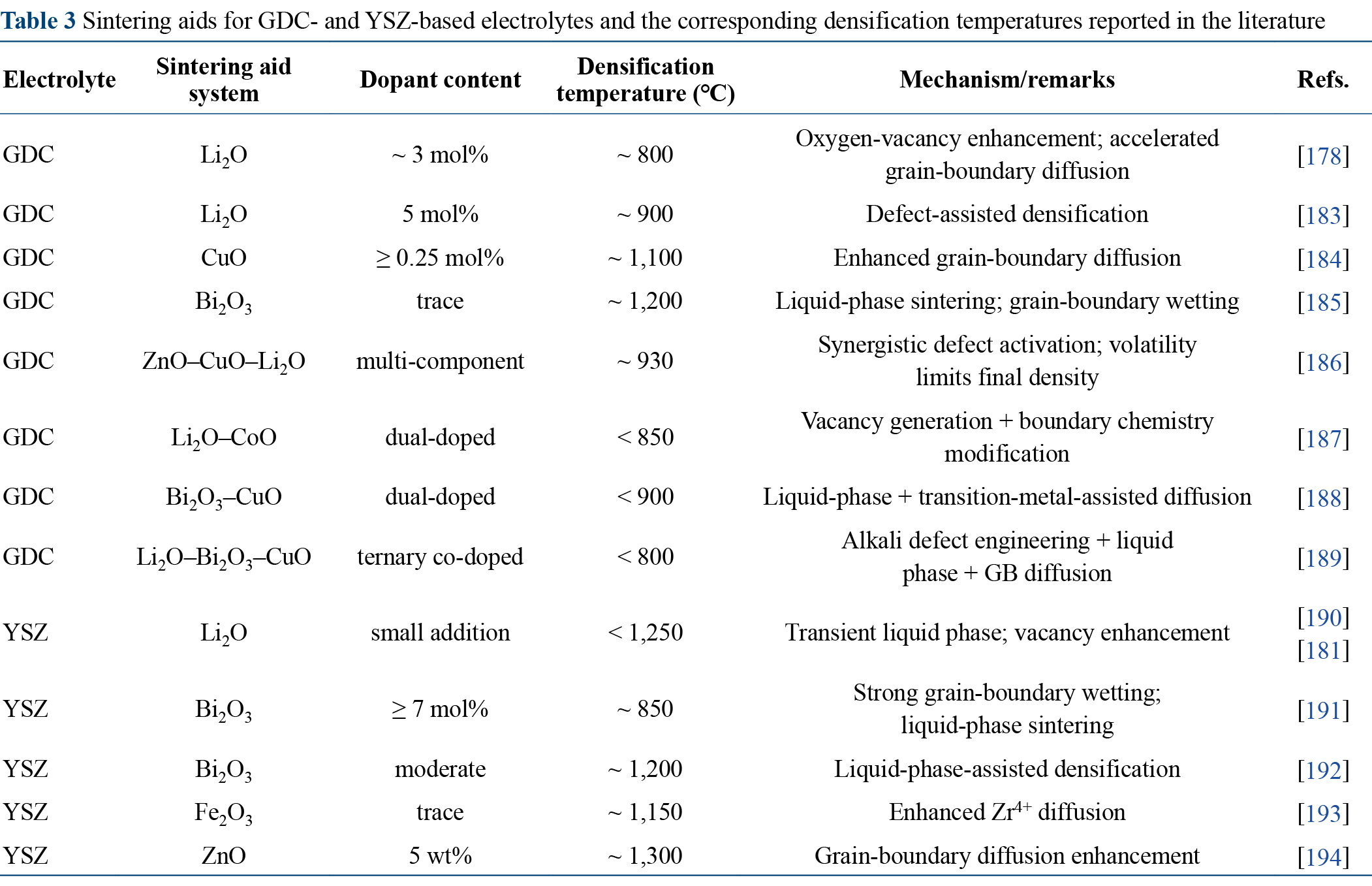
Reducing the sintering temperature of solid oxide electrolytes represents one of the most critical enabling steps for the practical implementation of advanced SOEC architectures, particularly metal-supported designs. Conventional densification temperatures for fluorite electrolytes such as GDC and YSZ typically exceed 1,300°C, imposing severe constraints on manufacturing cost, energy consumption, and compatibility with metallic substrates. As a result, the development of effective sintering-aid strategies has become a central research focus, aimed not only at lowering densification temperatures but also at preserving phase stability and ionic transport properties. In this context, a wide range of single- and multi-component dopants have been explored to activate mass transport through defect engineering, grain-boundary modification, and liquid-phase-assisted sintering, forming the basis for the low-temperature fabrication routes discussed in this section. Table 3 summarises the sintering aids reported for GDC- and YSZ-based electrolytes (based on Refs. [179,182–195] ) .
| Electrolyte | Sintering aid system | Dopant content | Densification temperature (℃) | Mechanism/remarks | Refs. |
|---|---|---|---|---|---|
| GDC | Li2O | ~ 3 mol% | ~ 800 | Oxygen-vacancy enhancement; accelerated grain-boundary diffusion | [178] |
| GDC | Li2O | 5 mol% | ~ 900 | Defect-assisted densification | [183] |
| GDC | CuO | ≥ 0.25 mol% | ~ 1,100 | Enhanced grain-boundary diffusion | [184] |
| GDC | Bi2O3 | trace | ~ 1,200 | Liquid-phase sintering; grain-boundary wetting | [185] |
| GDC | ZnO–CuO–Li2O | multi-component | ~ 930 | Synergistic defect activation; volatility limits final density | [186] |
| GDC | Li2O–CoO | dual-doped | < 850 | Vacancy generation + boundary chemistry modification | [187] |
| GDC | Bi2O3–CuO | dual-doped | < 900 | Liquid-phase + transition-metal-assisted diffusion | [188] |
| GDC | Li2O–Bi2O3–CuO | ternary co-doped | < 800 | Alkali defect engineering + liquid phase + GB diffusion | [189] |
| YSZ | Li2O | small addition | < 1,250 | Transient liquid phase; vacancy enhancement | [190] [181] |
| YSZ | Bi2O3 | ≥ 7 mol% | ~ 850 | Strong grain-boundary wetting; liquid-phase sintering | [191] |
| YSZ | Bi2O3 | moderate | ~ 1,200 | Liquid-phase-assisted densification | [192] |
| YSZ | Fe2O3 | trace | ~ 1,150 | Enhanced Zr4+ diffusion | [193] |
| YSZ | ZnO | 5 wt% | ~ 1,300 | Grain-boundary diffusion enhancement | [194] |
GDC is widely used as an intermediate-temperature electrolyte (500℃–700℃) [195, 196], but commercial powders typically require sintering at 1,300℃–1,400℃ [197, 198]. Various sintering aids have been shown to reduce the densification temperature significantly. Nicholas's group predicted that Li, Cu, Co, Fe, Mn, and Zn dopants could lower GDC sintering temperatures, with 3 mol% Li-GDC achieving ~ 99% density at 800℃ [178]. Chen et al. [183] confirmed that 5 mol% Li2O-GDC reached 99.3% relative density at 900℃. CuO additions also lower GDC sintering temperatures from 1,400℃ to ~1,100℃ at concentrations above 0.25 mol% [184], while Bi nano-doping reduces the temperature to ~1,200℃ through liquid-phase promotion [185]. A combined Zn–Cu–Li system achieved densification near 930℃, though decomposition and evaporation of ZnO/CuO at high temperatures reduced final density [186]. Mechanistically, Li+ increases oxygen-vacancy concentration, Bi2O3 promotes grain-boundary wetting, Cu2+ and Co2+ enhance electronic/ionic defect mobility, and Ga3+ introduces lattice distortions—collectively accelerating boundary diffusion and grain growth.
YSZ remains the most widely used SOEC electrolyte due to its high oxide-ion conductivity and chemical stability [199], yet pure YSZ requires ≥ 1,400℃ for densification [200]. Li2O effectively lowers YSZ sintering temperatures below 1250℃ while increasing ionic conductivity via transient liquid-phase formation and oxygen-vacancy enhancement [190]. Bi2O3 additions reduce YSZ sintering temperatures to 1,200℃ [192], and even to 850℃ when ≥ 7 mol% Bi2O3 is used, owing to strong grain-boundary wetting and liquid-phase sintering [191]. Fe2O3 and ZnO also act as effective sintering aids: Fe2O3-doped YSZ densifies at ~1,150℃ due to enhanced Zr4+ diffusion [193], while 5 wt% ZnO-YSZ achieves ~96% density at 1,300℃ [194].
Recent progress has shown that multi-element co-doping provides a more effective route for lowering the sintering temperature of fluorite electrolytes than traditional single- or binary-dopant approaches. Binary systems such as Bi–Cu have already demonstrated that combining a low-melting oxide (Bi2O3) with a defect-activating transition metal oxide (CuO) can significantly enhance grain-boundary mobility and accelerate densification, enabling near-full density at temperatures far below those of undoped GDC [188]. Similarly, dual doping with Li and Co has proven highly effective, as the complementary effects of Li⁺-induced oxygen-vacancy generation and Co-modified grain-boundary chemistry allow commercial GDC powders to densify at markedly reduced temperatures, approaching the 650℃–800℃ range under inert conditions [187]. Building on these developments, ternary co-doping has emerged as an especially promising direction, where the synergistic interplay among three dopants activates multiple mass-transport pathways simultaneously. A representative example is Li–Bi–Cu co-doping, which achieves substantially low densification temperatures, reflecting the combined benefits of alkali-metal defect engineering, low-melting-point liquid-phase formation, and transition-metal-enhanced grain-boundary diffusion [189].
To provide a systematic overview of these developments, Table 3 summarises the sintering aids reported for GDC- and YSZ-based electrolytes, together with the corresponding densification temperatures and material systems. The comparison clearly reveals a progression from single-component dopants toward multi-element co-doping strategies, with increasingly pronounced reductions in sintering temperature. Notably, complex co-doping systems (particularly those combining alkali metals, Bi-based liquid-phase promoters, and transition-metal oxides) consistently enable sub-800℃ densification, highlighting their unique relevance for metal-supported SOEC fabrication. Together, these studies suggest that complex co-doping (particularly combinations involving alkali metals, Bi-based liquid-phase promoters and transition metals) constitutes one of the most promising strategies for achieving sub-800℃ electrolyte sintering compatible with metal-supported SOECs, offering a realistic path toward further thermal-budget reduction without compromising phase stability or ionic transport.
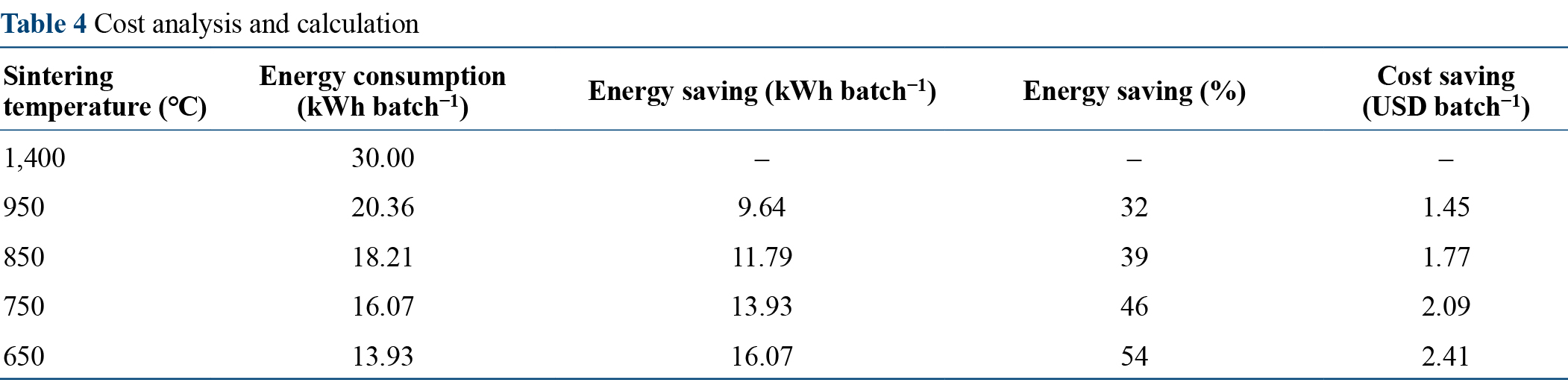
The mechanisms discussed in Section 4.2 demonstrate that appropriate sintering-aid strategies can significantly reduce the densification temperature of GDC and YSZ electrolytes. Beyond the microstructural and compatibility advantages, such temperature reductions also have direct economic and environmental implications, as the sintering step is typically the most energy-intensive stage in SOEC electrolyte fabrication. It should be noted that the present analysis is intended as a simplified first-order process-level estimation to illustrate the direct influence of sintering temperature on manufacturing energy demand, electricity cost, and associated CO2 emissions, rather than a full techno-economic or life-cycle assessment [201–204]. Such an assumption-based approach nevertheless provides a transparent and comparable basis for evaluating the relative benefits of lowering the sintering temperature, while acknowledging that broader industrial feasibility and sustainability are also affected by system boundaries, operating conditions, and scale. To quantify these impacts, a simplified furnace-operation model was adopted using the following assumptions: a 5-kW electric furnace, 6 h per batch, electricity cost of 0.15 USD kWh−1, and energy consumption proportional to maximum furnace temperature. Under these conditions, the energy consumption, saving percentage, and cost reduction at various sintering temperatures were calculated, as shown in Table 4.
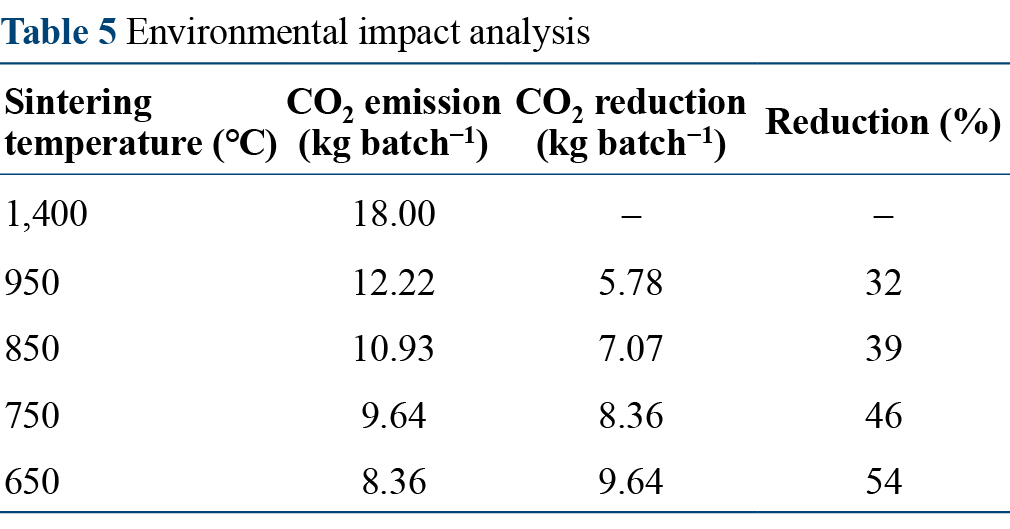
The results clearly indicate that reducing the sintering temperature from 1,400℃ to 750℃ decreases energy demand by nearly 46%, corresponding to an estimated cost saving of 2.09 USD per batch. Further reductions to 650℃ could achieve savings exceeding 50%. On an annual scale, assuming 1,000 production batches, the total electricity cost reduction ranges between 14,500 USD (950℃) and 24,100 USD (650℃) per year, depending on the achievable sintering temperature. These values demonstrate the strong economic incentive for adopting low-temperature processing routes in SOEC electrolyte fabrication. The environmental benefits of low-temperature sintering are equally significant. The decrease in electrical energy demand directly reduces CO2 emissions associated with power generation. Assuming an average carbon intensity of 0.6 kg CO2 kWh−1, the estimated CO2 reductions are summarised in Table 5.
Reducing the sintering temperature from 1,400℃ to 750℃ avoids approximately 8.4 kg CO2 per batch, which corresponds to nearly 8.4 tonnes CO2 per year for 1,000 batches. In addition to direct energy savings, low-temperature operation reduces thermal stress on furnace components, extending furnace lifespan and decreasing material waste, as shown in Table 5. Moreover, shorter heating and cooling cycles further enhance process efficiency and sustainability. These findings highlight that the low-temperature sintering process not only reduces energy consumption and cost but also aligns with global sustainability targets by lowering the carbon footprint of SOEC manufacturing. The quantitative analysis confirms that lowering the sintering temperature of GDC electrolytes from 1,400℃ to 650℃–950℃ can reduce energy consumption by 30%–55%, lower fabrication costs by up to 2.4 USD per batch and decrease CO2 emissions by up to 9.6 kg per batch. This substantial improvement demonstrates that lowering the sinter temperature of SOECs is not only technically advantageous but also economically and environmentally sustainable.
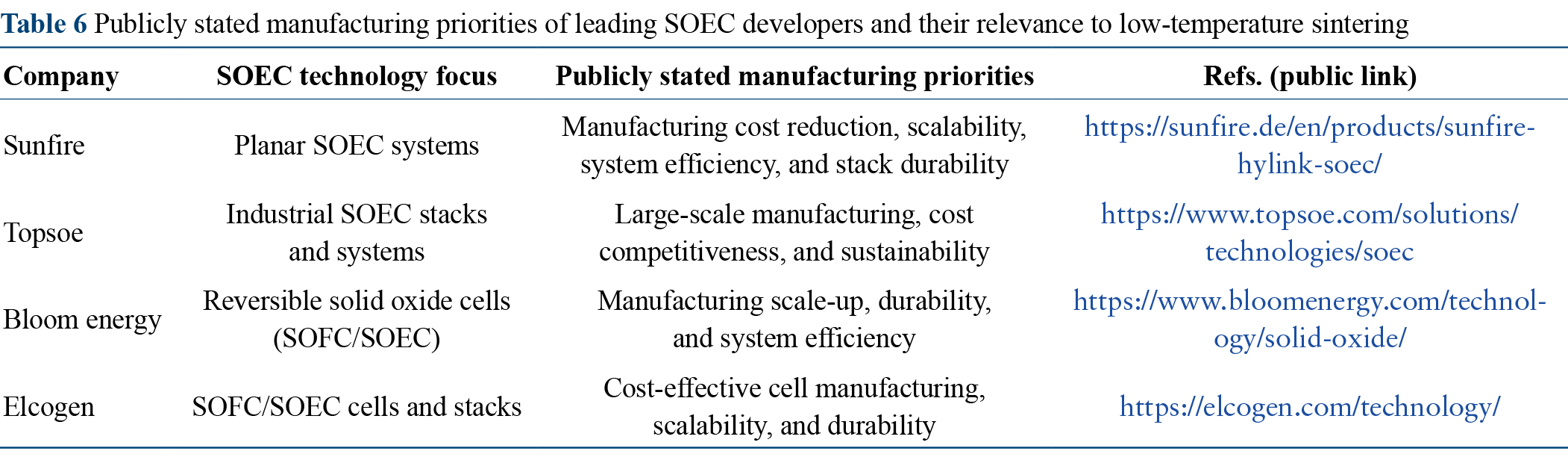
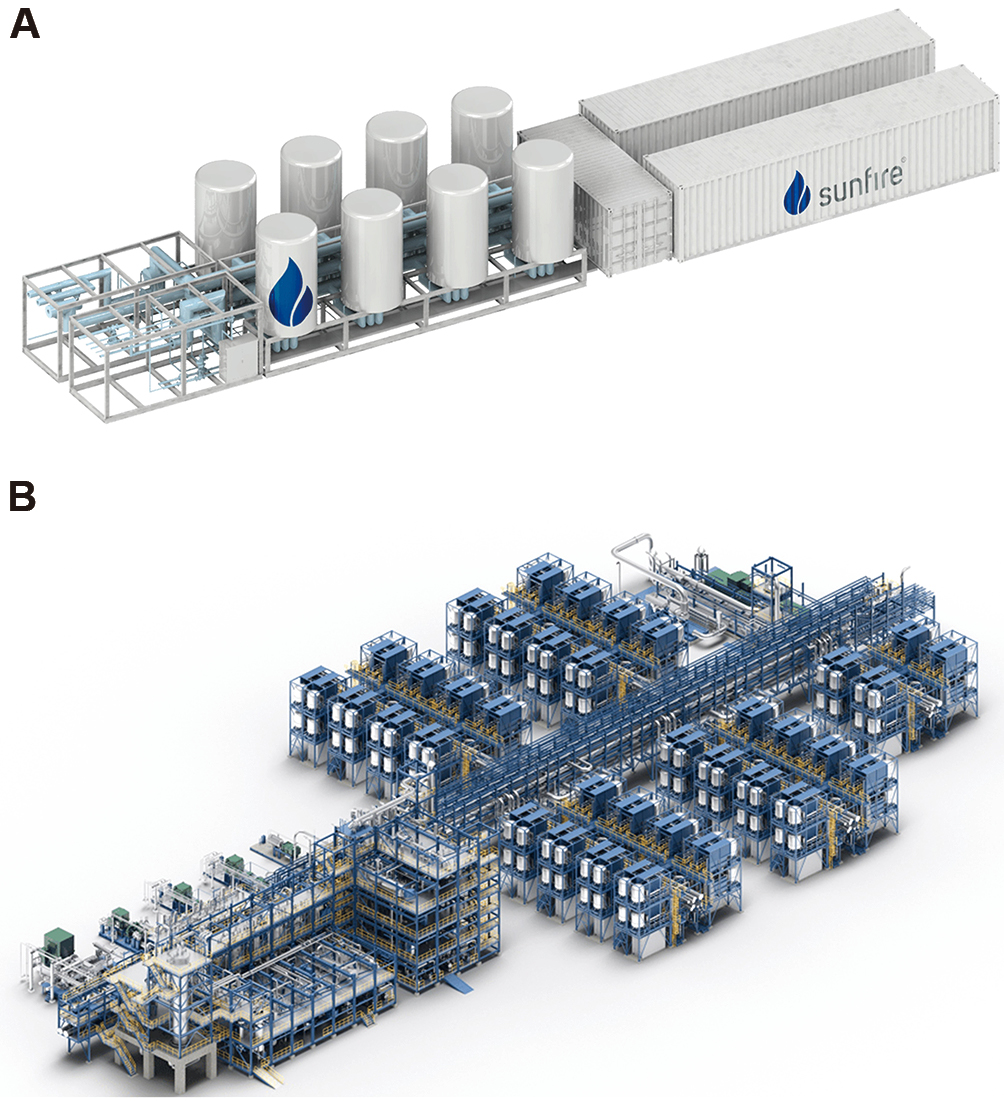
While the quantitative analysis above focuses on process-level energy use and associated cost/CO2 impacts of electrolyte sintering temperature, it is also important to contextualise these trends against industrial manufacturing priorities. To place these process-level benefits into an industrial context, representative industrial SOEC systems have been designed and developed by leading manufacturers like Sunfire (Figure 8A) and Topsoe (Figure 8B). Table 6 summarises publicly stated priorities from leading SOEC developers and highlights why reducing the thermal budget of electrolyte fabrication is industrially relevant.
| Company | SOEC technology focus | Publicly stated manufacturing priorities | Refs. (public link) |
|---|---|---|---|
| Sunfire | Planar SOEC systems | Manufacturing cost reduction, scalability, system efficiency, and stack durability | https://sunfire.de/en/products/sunfire-hylink-soec/ |
| Topsoe | Industrial SOEC stacks and systems | Large-scale manufacturing, cost competitiveness, and sustainability | https://www.topsoe.com/solutions/technologies/soec |
| Bloom energy | Reversible solid oxide cells (SOFC/SOEC) | Manufacturing scale-up, durability, and system efficiency | https://www.bloomenergy.com/technology/solid-oxide/ |
| Elcogen | SOFC/SOEC cells and stacks | Cost-effective cell manufacturing, scalability, and durability | https://elcogen.com/technology/ |
It should be noted that detailed cost, efficiency, and process-specific energy data for individual fabrication steps are generally not publicly disclosed by industrial SOEC manufacturers due to commercial sensitivity. Accordingly, the present discussion uses publicly available sources to provide context, and the simplified furnace-based model is intended to capture first-order process-level trends rather than proprietary system-level technoeconomic metrics. Within this scope, lowering sintering temperature directly reduces the thermal budget of electrolyte manufacturing, which in turn lowers electricity demand and embodied CO2 at the fabrication stage, and can also alleviate thermal stress on furnace components. These first-order benefits align with the industrial emphasis on cost competitiveness, scalability, and sustainability (Table 6), reinforcing low-temperature sintering as a manufacturing enabler rather than solely a materials-level optimisation. Despite the clear manufacturing advantages of low-temperature sintering, its benefits should not be viewed as unconditional. From a fabrication perspective, reduced densification temperature improves process compatibility, lowers the thermal budget, facilitates co-processing with temperature-sensitive supports, and decreases manufacturing-related energy consumption and cost. However, the chemical and microstructural modifications that enable low-temperature densification may also introduce longer-term risks during SOEC operation. In particular, sintering aids and co-dopants that enhance grain-boundary mobility or create transient liquid phases can modify interfacial chemistry in ways that are beneficial during fabrication but less favourable under prolonged electrochemical and thermal loading. Possible consequences include dopant redistribution, volatilisation of low-melting constituents, grain-boundary phase evolution, and interfacial reactions with neighbouring functional layers, all of which may influence mechanical integrity, ionic transport, and durability over time. For this reason, the value of low-temperature sintering should be assessed through a dual perspective: it is a powerful strategy for improving processability and manufacturability, but its long-term implications for structural and electrochemical stability must also be evaluated before it can be regarded as fully beneficial for practical SOEC deployment.
Despite significant progress in fabrication routes and low-temperature densification strategies for SOEC electrolytes, the development of reliable, scalable, and cost-effective SOEC systems remains a complex system-level challenge. As demonstrated throughout this review, fabrication and sintering cannot be optimised independently. Nearly all forming methods, including tape casting, dip coating, screen printing, extrusion, gel casting, and phase inversion, produce green bodies whose final densification behaviour, dimensional stability, and electrochemical performance are ultimately determined during the sintering stage. Conversely, the effectiveness of low-temperature sintering strategies strongly depends on the homogeneity, defect distribution, and interfacial quality established during forming.
From a processing perspective, ensuring thickness uniformity, porosity control, and shrinkage compatibility over large areas remains particularly demanding for both planar and tubular geometries. These challenges are further amplified in metal-supported SOEC architectures, where thin ceramic layers must maintain chemical and mechanical compatibility with metallic substrates under constrained thermal budgets. Even small mismatches in thermal expansion behaviour or interfacial adhesion can lead to warping, delamination, or accelerated degradation during thermal and redox cycling. These issues highlight the need for integrated fabrication–sintering protocols that treat dimensional stability, interface formation, and thermomechanical compatibility as interdependent parameters.
At the materials level, advances in sintering-aid design and multi-element co-doping have emerged as powerful tools for reducing densification temperatures of GDC- and YSZ-based electrolytes. However, the long-term consequences of dopant redistribution, grain-boundary phase evolution, and chemical interactions with electrode materials under SOEC operating conditions remain insufficiently understood. While liquid-phase promoters and transition-metal dopants can substantially enhance grain-boundary transport, they may also introduce risks associated with volatilisation, secondary-phase formation, or interfacial reactions during extended operation.
Future progress will require coordinated advances across multiple fronts. Improvements in powder processing, slurry engineering, and binder chemistry are essential to ensure reproducible forming behaviour compatible with low-temperature densification. Data-driven and machine-learning-assisted optimisation of dopant combinations and microstructural evolution may accelerate the rational design of co-doped electrolyte compositions. In parallel, emerging hybrid densification techniques, including cold sintering, field-assisted sintering, and plasma-assisted heating, offer promising opportunities to further reduce thermal budgets while maintaining precise microstructural control. Ultimately, advancing SOEC manufacturing will depend on treating materials chemistry, fabrication processes, and sintering protocols within a unified system-engineering framework rather than as isolated optimisation problems.
This review has provided a comprehensive analysis of fabrication strategies for SOECs, spanning geometric design, support architectures, forming routes, and low-temperature densification approaches for electrolytes. Rather than treating individual processing steps in isolation, the review highlights how SOEC performance, durability, and scalability are governed by the coupled interactions between cell geometry, support configuration, materials selection, forming quality, and subsequent sintering behaviour. Different geometric configurations, including planar, tubular, flat-tubular, and cellular designs, impose distinct constraints on coating conformality, electrolyte thickness control, sealing strategies, and thermal–mechanical compatibility. Similarly, the choice of support architecture strongly influences feasible fabrication routes, thermal budgets, and long-term stability, particularly for metal-supported and thin-film electrolyte designs. Conventional forming techniques such as tape casting, extrusion, dip coating, screen printing, gel casting, and phase inversion offer versatile pathways for shaping SOEC components; however, their effectiveness ultimately depends on how green microstructures evolve during sintering.
Within this broader fabrication framework, recent advances in sintering-aid design and multi-element co-doping have emerged as powerful enablers for reducing the densification temperatures of GDC- and YSZ-based electrolytes. These developments significantly improve compatibility with metal-supported architectures and thin electrolytes while offering measurable reductions in manufacturing energy consumption, processing cost, and environmental impact. Importantly, the benefits of low-temperature sintering can only be fully realised when integrated with optimised powder design, slurry formulation, forming uniformity, and interface engineering.
Based on the literature reviewed, the following conclusive remarks can be drawn:
(i) SOEC fabrication is inherently a system-level challenge in which geometry, support structure, forming route, and sintering behaviour are strongly interdependent and must be optimised collectively.
(ii) Conventional forming methods provide flexible manufacturing options, but their success is ultimately determined by microstructural evolution during sintering, particularly for thin and constrained ceramic layers.
(iii) Advances in sintering-aid engineering, especially multi-element co-doping strategies, enable substantial reductions in electrolyte densification temperature while maintaining phase stability and high ionic conductivity.
(iv) Lowering electrolyte sintering temperatures from conventional values to the 650℃–950℃ range offers significant benefits in manufacturing energy demand, cost, and carbon footprint, improving compatibility with metal-supported and scalable SOEC designs.
(v) Future progress in SOEC manufacturing will rely on the coordinated integration of materials chemistry, fabrication processes, sintering strategies, and interfacial engineering rather than incremental optimisation of individual steps.
Overall, the convergence of rational materials design with fabrication-oriented process optimisation provides a clear pathway toward scalable, durable, and economically viable SOEC technologies. By treating fabrication and sintering as an integrated workflow, rather than isolated operations, next-generation SOEC systems can be realised with improved performance, reliability, and sustainability.
Looking ahead, several research gaps remain critical for advancing practical SOEC manufacturing. Among the highest priorities are the development of low-temperature sintering strategies that improve processability without compromising long-term structural and electrochemical stability, better control of material compatibility and interface evolution across complex multilayer architectures, and closer integration of fabrication routes with densification strategies under realistic manufacturing constraints. In addition, greater emphasis is needed on reproducibility, process integration, and industrial scale-up, so that promising laboratory-scale methods can be translated into durable and economically viable production routes. Addressing these challenges will be essential for transforming current progress in materials and processing into scalable, reliable, and commercially relevant SOEC technologies.
Yuheng Liu: Methodology; investigation; formal analysis; data curation; visualisation; writing–original draft; writing–review & editing. Ming Xu: Investigation; validation; writing–review & editing. Kai Yang: Investigation; validation. Wei Zhang: Investigation; writing–review & editing. Yunlong Zhao: Supervision; validation; writing–review & editing. Bahman Amini Horri: Conceptualisation; methodology; resources; supervision; project administration; writing–review & editing.
The data that support the findings of this study are available from the corresponding author upon reasonable request.
J. B. Hansen, "Solid Oxide Electrolysis—A Key Enabling Technology for Sustainable Energy Scenarios," Faraday Discuss 182 (2015): 9–48, https://doi.org/10.1039/c5fd90071a.
L. Elikan and J. Morris. Solid Electrolyte System for Oxygen Regeneration. NASA contractor report CR-1359. 1969.
A. Isenberg, "Energy Conversion Via Solid Oxide Electrolyte Electrochemical Cells at High Temperatures," Solid State Ionics 3 (1981): 431–437, https://doi.org/10.1016/0167-2738(81)90127-2.
D. Kusunoki, Y. Kikuoka, V. Yanagi, et al., "Development of Mitsubishi-Planar Reversible Cell—Fundamental Test on Hydrogen-Utilized Electric Power Storage System," International journal of hydrogen energy 20, no. 10 (1995): 831–834, https://doi.org/10.1016/0360-3199(95)94482-9.
A. Momma, T. Kato, Y. Kaga, and S. Nagata, "Polarization Behavior of High Temperature Solid Oxide Electrolysis Cells (SOEC)," Journal of the ceramic Society of Japan 105, no. 1221 (1997): 369–373, https://doi.org/10.2109/jcersj.105.369.
M. A. Laguna-Bercero, "Recent Advances in High Temperature Electrolysis Using Solid Oxide Fuel Cells: A Review," Journal of Power Sources 203 (2012): 4–16, https://doi.org/10.1016/j.jpowsour.2011.12.019.
B. Pivovar, N. Rustagi, and S. Satyapal, "Hydrogen at Scale (H2@Scale): Key to a Clean, Economic, and Sustainable Energy System," The Electrochemical Society Interface 27, no. 1 (2018): 47, https://doi.org/10.1149/2.F04181if.
X. Zhang, L. Ye, H. Li, F. Chen, and K. Xie, "Electrochemical Dehydrogenation of Ethane to Ethylene in a Solid Oxide Electrolyzer," ACS Catalysis 10, no. 5 (2020): 3505–3513, https://doi.org/10.1021/acscatal.9b05409.
W. Li, H. Wang, Y. Shi, and N. Cai, "Performance and Methane Production Characteristics of H2O–CO2 Co-Electrolysis in Solid Oxide Electrolysis Cells," International Journal of Hydrogen Energy 38, no. 25 (2013): 11104–11109, https://doi.org/10.1016/j.ijhydene.2013.01.008.
J. Martinez-Frias, A. Q. Pham, and S. M. Aceves, "A Natural Gas-Assisted Steam Electrolyzer for High-Efficiency Production of Hydrogen," International Journal of Hydrogen Energy 28, no. 5 (2003): 483–490, https://doi.org/10.1016/S0360-3199(02)00135-0.
Y. Numata, K. Nakajima, H. Takasu, and Y. Kato, "Carbon Dioxide Reduction on a Metal-Supported Solid Oxide Electrolysis Cell," ISIJ International 59, no. 4 (2019): 628–633, https://doi.org/10.2355/isijinternational.ISIJINT-2018-430.
J. Hartvigsen, S. Elangovan, J. Elwell, and D. Larsen, "Oxygen Production from Mars Atmosphere Carbon Dioxide Using Solid Oxide Electrolysis," ECS Transactions 78, no. 1 (2017): 2953, https://doi.org/10.1149/07801.2953ecst.
J. Fu, Z. Qu, J. Zhang, H. Wang, and G. Zhang, "A Cross-Scale Numerical Framework of PEM Water Electrolyzer with Pore-Scale Transport Properties of PTL," Energy Conversion and Management 332 (2025): 119771, https://doi.org/10.1016/j.enconman.2025.119771.
P. Feng, K. Yang, X. Liu, J. Zhang, and Z. P. Li, "A Review of Advanced SOFCs and SOECs: Materials, Innovative Synthesis, Functional Mechanisms, and System Integration," eScience 6, no. 2 (2026): 100460, https://doi.org/10.1016/j.esci.2025.100460.
D. Tian, Q. Wang, Z. Qu, and H. Zhang, "Enabling Direct Flue Gas Electrolysis by Clarifying Impurity Gas Effects on CO2 Electroreduction," Nano Energy 134 (2025): 110563, https://doi.org/10.1016/j.nanoen.2024.110563.
H. Liu, M. Yu, X. Tong, Q. Wang, and M. Chen, "High Temperature Solid Oxide Electrolysis for Green Hydrogen Production," Chemical Reviews 124, no. 18 (2024): 10509–10576, https://doi.org/10.1021/acs.chemrev.3c00795.
D. Xu, X. Li, Z. Liu, et al., "Crystal Field Stabilization Energy Asymmetrically Constructed Built-in Electric Fields for Efficient Water Cracking," Small 21, no. 24 (2025): 2502250, https://doi.org/10.1002/smll.202502250.
A. B. Stambouli and E. Traversa, "Solid Oxide Fuel Cells (SOFCs): A Review of an Environmentally Clean and Efficient Source of Energy," Renewable and sustainable energy reviews 6, no. 5 (2002): 433–455, https://doi.org/10.1016/S1364-0321(02)00014-X.
F. P. Nagel, T. J. Schildhauer, S. M. A. Biollaz, and A. Wokaun, "Performance Comparison of Planar, Tubular and Delta8 Solid Oxide Fuel Cells Using a Generalized Finite Volume Model," Journal of Power Sources 184, no. 1 (2008): 143–164, https://doi.org/10.1016/j.jpowsour.2008.05.046.
K. Park, D. H. Yoon, S. Lee, et al., "Fabrication and Operation of a 6kWe Class Interconnector-Type Anode-Supported Tubular Solid Oxide Fuel Cell Stack," International Journal of Hydrogen Energy 39, no. 24 (2014): 12884–12893, https://doi.org/10.1016/j.ijhydene.2014.06.080.
Y. Yoo, Y. Wang, X. Deng, D. Singh, and J. G. Legoux, "Metal Supported Tubular Solid Oxide Fuel Cells Fabricated by Suspension Plasma Spray and Suspension High Velocity Oxy-Fuel Spray," Journal of Power Sources 215 (2012): 307–311, https://doi.org/10.1016/j.jpowsour.2012.05.031.
S. H. Pi, J. W. Lee, S. B. Lee, et al., "Performance and Durability of Anode-Supported Flat-Tubular Solid Oxide Fuel Cells with Ag-Infiltrated Cathodes," J Nanosci Nanotechnol 14, no. 10 (2014): 7668–73, https://doi.org/10.1166/jnn.2014.9460.
T. Ryu, T. Okamoto, C. Chen, et al., "Fabrication and Characterization of the Gas Channel Integrated SOFC Cells," ECS Transactions 7, no. 1 (2007): 735, https://doi.org/10.1149/1.2729160.
S. Singhal, "Solid Oxide Fuel Cells: An Overview," Abstracts of Papers of the American Chemical Society 228 (2004): U653–U653.
T. Higa and H. Nakajima, "Evaluation of Three-Dimensional Placement of Built-in Catalytic Partial Oxidation Catalyst in an Anode-Supported Honeycomb SOFC," ECS Transactions 103, no. 1 (2021): 1991, https://doi.org/10.1149/10301.1991ecst.
J. Ding and J. Liu, "A Novel Design and Performance of Cone-Shaped Tubular Anode-Supported Segmented-in-Series Solid Oxide Fuel Cell Stack," Journal of Power Sources 193, no. 2 (2009): 769–773, https://doi.org/10.1016/j.jpowsour.2009.04.049.
R. Li, S. Han, Q. Yuan, K. Aseev, and D. Chen, "To Study the Effect of Geometric Parameters on the Performance of a Typical Cone-Shaped Tubular Segmented-in-Series Solid Oxide Fuel Cell Stack," International Journal of Electrochemical Science 19, no. 6 (2024): 100601, https://doi.org/10.1016/j.ijoes.2024.100601.
X. Tong, S. Ovtar, K. Brodersen, P. V. Hendriksen, and M. Chen, "Large-Area Solid Oxide Cells with La0.6Sr0.4CoO3-δ Infiltrated Oxygen Electrodes for Electricity Generation and Hydrogen Production," Journal of Power Sources 451 (2020): 227742, https://doi.org/10.1016/j.jpowsour.2020.227742.
L. Li, M. Watanabe, M. Inada, and T. Ishihara, "Planar Type Reversible Solid Oxide Cells Using LaGaO3 Electrolyte Thin-Film Prepared by Dip-Coating and Co-Sintering Method," Journal of Power Sources 624 (2024): 235560, https://doi.org/10.1016/j.jpowsour.2024.235560.
G. Li, Y. Gou, R. Ren, et al., "Realizing High-Temperature Steam Electrolysis on Tubular Solid Oxide Electrolysis Cells Sufficing Multiple and Rapid Start-Up," Ceramics International 49, no. 9 (2023): 14101–14108, https://doi.org/10.1016/j.ceramint.2022.12.291.
X. Ye, X. Miao, X. Zhu, et al., "Electrochemical Performance and Degradation Mechanisms of BaCe0.7Zr0.1Y0.2O3-δ/BaZr0.8Y0.2O3-δ Based Tubular Protonic Ceramic Electrolysis Cells and Stacks for Stable Hydrogen Production," Small 21, no. 22 (2025): 2503162, https://doi.org/10.1002/smll.202503162.
Z. Liu, C. Wang, B. Han, et al., "Flat-Tube Solid Oxide Stack with High Performance for Power Generation and Hydrogen Production," Applied Energy 362 (2024): 122999, https://doi.org/10.1016/j.apenergy.2024.122999.
Y. Choi, S. Byun, D. W. Seo, et al., "New Design and Performance Evaluation of 1 kW-Class Reversible Solid Oxide Electrolysis-Fuel Cell Stack Using Flat-Tubular Cells," Journal of Power Sources 542 (2022): 231744, https://doi.org/10.1016/j.jpowsour.2022.231744.
Y. Iwanaga, H. Nakajima, and K. Ito, "Fuel Production with a Cathode-Supported Honeycomb Solid Oxide Electrolysis Cell," ECS Transactions 91, no. 1 (2019): 2707, https://doi.org/10.1149/09101.2707ecst.
H. Xu, Y. Han, J. Zhu, M. Ni, and Z. Yao, "Status and Progress of Metal-Supported Solid Oxide Fuel Cell: Towards Large-Scale Manufactory and Practical Applications," Energy Reviews 3, no. 1 (2024): 100051, https://doi.org/10.1016/j.enrev.2023.100051.
M. Zhang, E. Wang, J. Mao, et al., "Performance Analysis of a Metal-Supported Intermediate-Temperature Solid Oxide Electrolysis Cell," Frontiers in Energy Research 10 (2022): 888787, https://doi.org/10.3389/fenrg.2022.888787.
K. J. Yoon, S. Lee, S. Y. Park, and N. Q. Minh, "Advances in High-Temperature Solid Oxide Electrolysis Technology for Clean Hydrogen and Chemical Production: Materials, Cells, Stacks, Systems and Economics," Progress in Materials Science 154 (2025): 101520, https://doi.org/10.1016/j.pmatsci.2025.101520.
A. Hagen, R. Caldogno, F. Capotondo, and X. Sun, "Metal Supported Electrolysis Cells," Energies 15, no. 6 (2022): 2045, https://doi.org/10.3390/en15062045.
M. C. Tucker, "Progress in Metal-Supported Solid Oxide Electrolysis Cells: A Review," International Journal of Hydrogen Energy 45, no. 46 (2020): 24203–24218, https://doi.org/10.1016/j.ijhydene.2020.06.300.
S. M. Jamil, M. H. D. Othman, M. A. Rahman, et al., "Recent Fabrication Techniques for Micro-Tubular Solid Oxide Fuel Cell Support: A Review," Journal of the European Ceramic Society 35, no. 1 (2015): 1–22, https://doi.org/10.1016/j.jeurceramsoc.2014.08.034.
S. Anelli, E. Hernández, L. Bernadet, et al., "Co-Electrolysis of Steam and Carbon Dioxide in Large Area Solid Oxide Cells Based on Infiltrated Mesoporous Oxygen Electrodes," Journal of Power Sources 478 (2020): 228774, https://doi.org/10.1016/j.jpowsour.2020.228774.
Z. Gao, H. Wang, E. Miller, et al., "Tape Casting of High-Performance Low-Temperature Solid Oxide Cells with Thin La0.8Sr0.2Ga0.8Mg0.2O3−δ Electrolytes and Impregnated Nano Anodes," ACS Applied Materials & Interfaces 9, no. 8 (2017): 7115–7124, https://doi.org/10.1021/acsami.6b15224.
S. E. Wolf, F. E. Winterhalder, V. Vibhu, et al., "Solid Oxide Electrolysis Cells–Current Material Development and Industrial Application," Journal of Materials Chemistry A 11, no. 34 (2023): 17977–18028, https://doi.org/10.1039/D3TA02161K.
A. Hagen, R. Caldogno, F. Capotondo, and X. Sun, "Metal Supported Electrolysis Cells," Energies 15, no. 6 (2022): 2045, https://doi.org/10.3390/en15062045.
O. H. Salem and H. Hassan, "A Comprehensive Review on Mainly Hydrogen Production Based on Waste Heat Recovery for Single and Multigeneration Energy Systems," Applied Energy 402 (2026): 126991, https://doi.org/10.1016/j.apenergy.2025.126991.
K. Ewsuk, "Powder Granulation and Compaction," Encyclopedia of Materials: Science and Technology (2001): 7788–7800, https://doi.org/10.1016/B0-08-043152-6/01401-7.
W. B. James, "New Shaping Methods for Powder Metallurgy Components," Materials & Design 8, no. 4 (1987): 187–197, https://doi.org/10.1016/0261-3069(87)90133-6.
W. R. Morgan and R. L. Sands, "Isostatic Compaction of Metal Powders," Metallurgical Reviews 14, no. 1 (1969): 85–102, https://doi.org/10.1179/mtlr.1969.14.1.85.
M. A. Laguna-Bercero, R. Campana, A. Larrea, J. A. Kilner, and V. M. Orera, "Performance and Aging of Microtubular YSZ-Based Solid Oxide Regenerative Fuel Cells," Fuel Cells 11, no. 1 (2011): 116–123, https://doi.org/10.1002/fuce.201000069.
M. A. Laguna-Bercero, A. R. Hanifi, T. H. Etsell, P. Sarkar, and V. M. Orera, "Microtubular Solid Oxide Fuel Cells with Lanthanum Strontium Manganite Infiltrated Cathodes," International Journal of Hydrogen Energy 40, no. 15 (2015): 5469–5474, https://doi.org/10.1016/j.ijhydene.2015.01.060.
J. W. Lee, M. T. Mehran, R. H. Song, et al., "Effects of La2O3 Content and Particle Size on the Long-Term Stability and Thermal Cycling Property of La2O3-Dispersed SUS430 Alloys for SOFC Interconnect Materials," Metals and Materials International 23, no. 6 (2017): 1250–1256, https://doi.org/10.1007/s12540-017-7079-9.
T. Altan, C. Timurkutluk, and B. Timurkutluk, "Impact of Lamination Conditions on Microtubular Solid Oxide Fuel Cells Fabricated by Tape Casting Coupled with Isostatic Pressing," Journal of Power Sources 532 (2022): 231369, https://doi.org/10.1016/j.jpowsour.2022.231369.
C. Kim, S. Kim, I. Jang, et al., "Facile Fabrication Strategy of Highly Dense Gadolinium-Doped Ceria/Yttria-Stabilized Zirconia Bilayer Electrolyte Via Cold Isostatic Pressing for Low Temperature Solid Oxide Fuel Cells," Journal of Power Sources 415 (2019): 112–118, https://doi.org/10.1016/j.jpowsour.2019.01.057.
F. Lemoisson and L. Froyen, "12-Understanding and Improving Powder Metallurgical Processes," in Fundamentals of Metallurgy, ed. S. Seetharaman (Woodhead Publishing, 2005), 471–502.
M. M. Gauthier, "Forming and Predensification of Ceramics," in Engineered Materials Handbook Desk Edition, ed. M. M. Gauthier (ASM International, 1995).
R. Riedel and I. W. Chen(eds.), Ceramics Science and Technology, Volume 3: Synthesis and Processing, (John Wiley & Sons, 2011).
W. A. Lewis Jr., "Dry Pressing Technical Ceramics," American Ceramic Society Bulletin 75, no. 4 (1996):103–106.
E. A. Fisher, "Technical Ceramic Fabrication Processes," in Proceedings of the ASME 1975 International Gas Turbine Conference and Products Show, Volume 1B: General, V01BT02A046, ASME, 1975. https://doi.org/10.1115/75-GT-110.
X. Wang, B. Yu, W. Zhang, et al., "Microstructural Modification of the Anode/Electrolyte Interface of SOEC for Hydrogen Production," International Journal of Hydrogen Energy 37, no. 17 (2012): 12833–12838, https://doi.org/10.1016/j.ijhydene.2012.05.093.
H. A. Rahman, A. Muchtar, N. Muhamad, and H. Abdullah, "La0.6Sr0.4Co0.2Fe0.8O3−δ–SDC Carbonate Composite Cathodes for Low-Temperature Solid Oxide Fuel Cells," Materials Chemistry and Physics 141, no. 2–3 (2013): 752–757, https://doi.org/10.1016/j.matchemphys.2013.05.071.
H. Lv, Y. Zhou, X. Zhang, et al., "Infiltration of Ce0.8Gd0.2O1.9 Nanoparticles on Sr2Fe1.5Mo0.5O6-δ Cathode for CO2 Electroreduction in Solid Oxide Electrolysis Cell," Journal of Energy Chemistry 35 (2019): 71–78, https://doi.org/10.1016/j.jechem.2018.11.002.
L. Q. Le, C. Meisel, C. H. Hernandez, et al., "Performance Degradation in Proton-Conducting Ceramic Fuel Cell and Electrolyzer Stacks," Journal of Power Sources 537 (2022): 231356, https://doi.org/10.1016/j.jpowsour.2022.231356.
C. Xia and M. Liu, "Low-Temperature SOFCs Based on Gd0.1Ce0.9O1.95 Fabricated by Dry Pressing," Solid State Ionics 144, no. 3–4 (2001): 249–255, https://doi.org/10.1016/S0167-2738(01)00980-8.
P. Ranran, W. Yan, Y. Lizhai, and M. Zongqiang, "Electrochemical Properties of Intermediate-Temperature SOFCs Based on Proton Conducting Sm-Doped BaCeO3 Electrolyte Thin Film," Solid State Ionics 177, no. 3 (2006): 389–393, https://doi.org/10.1016/j.ssi.2005.11.020.
B. Lin, H. Ding, Y. Dong, et al., "Intermediate-to-Low Temperature Protonic Ceramic Membrane Fuel Cells with Ba0.5Sr0.5Co0.8Fe0.2O3-δ–BaZr0.1Ce0.7Y0.2O3-δ Composite Cathode," Journal of Power Sources 186, no. 1 (2009): 58–61, https://doi.org/10.1016/j.jpowsour.2008.09.041.
J. P. Pollinger, Y. E. Khalfalla, and K. Y. Benyounis, "Gel Casting," in Reference Module in Materials Science and Materials Engineering (Elsevier, 2016), https://doi.org/10.1016/B978-0-12-803581-8.03556-6.
B. Chen, Z. Zhang, J. Zhang, Q. Lin, and D. Jiang, "Fabrication and Mechanical Properties of β-TCP Pieces by Gel-Casting Method," Materials Science and Engineering: C 28, no. 7 (2008): 1052–1056, https://doi.org/10.1016/j.msec.2007.04.034.
Z. X. Xiong, C. Fang, Y. X. Wang, and Z. G. Su, "Gel-Casting of Ceramic Components for Wireless Communications," Journal of the European Ceramic Society 25, no. 12 (2005): 2071–2074, https://doi.org/10.1016/j.jeurceramsoc.2005.03.201.
N. S. Yüzbasi and T. Graule, "Colloid Casting Processes: Slip Casting, Centrifugal Casting, and Gel Casting," Encyclopedia of Materials: Technical Ceramics and Glasses 1 (2021): 146–153, https://doi.org/10.1016/B978-0-12-803581-8.11767-9.
D. McKinney and W. Sigmund, "Chapter 11.1.3-Colloidal Processing Fundamentals," in Handbook of Advanced Ceramics (Second Edition), ed. S. Somiya (Academic Press, 2013), 911–926.
J. P. Pollinger, Y. E. Khalfalla, and K. Y. Benyounis, "Gel Casting," in Reference Module in Materials Science and Materials Engineering, (Elsevier, 2016).
W. L. Huang, Q. Zhu, and Z. Xie, "Gel-Cast Anode Substrates for Solid Oxide Fuel Cells," Journal of power sources 162, no. 1 (2006): 464–468, https://doi.org/10.1016/j.jpowsour.2006.06.026.
D. Dong, J. Gao, X. Liu, and G. Meng, "Fabrication of Tubular NiO/YSZ Anode-Support of Solid Oxide Fuel Cell by Gelcasting," Journal of power sources 165, no. 1 (2007): 217–223, https://doi.org/10.1016/j.jpowsour.2006.10.098.
M. E. Navarro, X. G. Capdevila, M. Morales, J. J. Roa, and M. Segarra, "Manufacturing of Anode-Supported Tubular Solid Oxide Fuel Cells by a New Shaping Technique Using Aqueous Gel-Casting," Journal of Power Sources 200 (2012): 45–52, https://doi.org/10.1016/j.jpowsour.2011.10.059.
M. Morales, M. A. Laguna-Bercero, M. E. Navarro, F. Espiell, and M. Segarra, "The Effect of Anode Support on the Electrochemical Performance of Microtubular Solid Oxide Fuel Cells Fabricated by Gel-Casting," RSC Advances 5, no. 49 (2015): 39350–39357, https://doi.org/10.1039/c5ra02304a.
Y. Liu, Y. Tang, J. Ding, and J. Liu, "Electrochemical Performance of Cone-Shaped Anode-Supported Segmented-in-Series SOFCs Fabricated by Gel-Casting Technique," International Journal of Hydrogen Energy 37, no. 1 (2012): 921–925, https://doi.org/10.1016/j.ijhydene.2011.03.159.
D. Hanaor, M. Michelazzi, P. Veronesi, et al., "Anodic Aqueous Electrophoretic Deposition of Titanium Dioxide Using Carboxylic Acids as Dispersing Agents," Journal of the European Ceramic Society 31, no. 6 (2011): 1041–1047, https://doi.org/10.1016/j.jeurceramsoc.2010.12.017.
I. Gurrappa and L. Binder, "Electrodeposition of Nanostructured Coatings and Their Characterization—A Review," Science and Technology of Advanced Materials 9, no. 4 (2008): 043001, https://doi.org/10.1088/1468-6996/9/4/043001.
F. Bensebaa, "Nanoparticle Assembling and System Integration," in Interface Science and Technology (Elsevier, 2013), 185–277.
M. Mozafari, A. Ramedani, Y. Zhang, and D. Mills, "Thin Films for Tissue Engineering Applications," in Thin Film Coatings for Biomaterials and Biomedical Applications (Elsevier, 2016), 167–195.
D. Salehzadeh, M. Torabi, Z. Sadeghian, and P. Marashi, "A Multiscale-Architecture Solid Oxide Fuel Cell Fabricated by Electrophoretic Deposition Technique," Journal of Alloys and Compounds 830 (2020): 154654, https://doi.org/10.1016/j.jallcom.2020.154654.
O. E. Oskouyi, M. Shahmiri, A. Maghsoudipour, and M. Hasheminiasari, "Pulsed Constant Voltage Electrophoretic Deposition of YSZ Electrolyte Coating on Conducting Porous Ni–YSZ Cermet for SOFCs Applications," Journal of Alloys and Compounds 785 (2019): 220–227, https://doi.org/10.1016/j.jallcom.2019.01.166.
R. Kherad, S. Dodangei, S. H. Moussavi, and M. Ghatee, "Characterization of Anode Supported Micro-Tubular Solid Oxide Fuel Cells Prepared by Successive Non-Aqueous Electrophoretic Deposition," Journal of Electroceramics 48 (2022): 1–7https://doi.org/10.1007/s10832-021-00272-5.
L. Hench and J. Jones(eds.), Biomaterials, Artificial Organs and Tissue Engineering (Elsevier, 2005).
A. M. Soydan, Ö. Yıldız, O. Y. Akduman, and R. Akdeniz, "A New Approach for Production of Anode Microtubes as Solid Oxide Fuel Cell Support," Ceramics International 44, no. 18 (2018): 23001–23007, https://doi.org/10.1016/j.ceramint.2018.09.100.
M. E. Sotomayor, B. I. Arias-Serrano, J. Ciruelos, A. Várez, and B. Levenfeld, "Porous Ni-YSZ Planar Anodes by Powder Extrusion Moulding Employing Pmma as Pore Former," Powder Metallurgy 59, no. 4 (2016): 281–287, https://doi.org/10.1080/00325899.2016.1207919.
B. Mani and M. H. Paydar, "Mechanical Behaviour of Multi-Layer Half-Cells of Microtubular Solid Oxide Fuel Cells Fabricated by the Co-Extrusion Process," Ceramics International 42, no. 3 (2016): 4194–4203, https://doi.org/10.1016/j.ceramint.2015.11.093.
M. Jabbari, R. Bulatova, A. I. Y. Tok, et al., "Ceramic Tape Casting: A Review of Current Methods and Trends with Emphasis on Rheological Behaviour and Flow Analysis," Materials Science and Engineering: B 212 (2016): 39–61, https://doi.org/10.1016/j.mseb.2016.07.011.
G. Howatt, R. Breckenridge, and J. Brownlow, "Fabrication of Thin Ceramic Sheets for Capacitors," Journal of the American Ceramic Society 30, no. 8 (1947): 237–242, https://doi.org/10.1111/j.1151-2916.1947.tb18889.x.
G. N. Howatt, Method of Producing High Dielectric High Insulation Ceramic Plates. United States Patent and Trademark Office, No. US2582993. 1952.
D. Hotza and P. Greil, "Aqueous Tape Casting of Ceramic Powders," Materials Science and Engineering: A 202, no. 1–2 (1995): 206–217, https://doi.org/10.1016/0921-5093(95)09785-6.
D. Shanefield, Organic Additives and Ceramic Processing (Kluwer Academic Publishers, Boston, 1995).
D. H. Yoon and B. I. Lee, "Processing of Barium Titanate Tapes with Different Binders for MLCC Applications—Part I: Optimization Using Design of Experiments," Journal of the European ceramic society 24, no. 5 (2004): 739–752, https://doi.org/10.1016/S0955-2219(03)00333-9.
L. Wang, G. Tang, and Z. K. Xu, "Preparation and Electrical Properties of Multilayer ZnO Varistors with Water-Based Tape Casting," Ceramics International 35, no. 1 (2009): 487–492, https://doi.org/10.1016/j.ceramint.2008.01.011.
S. W. Sofie, "Fabrication of Functionally Graded and Aligned Porosity in Thin Ceramic Substrates with the Novel Freeze—Tape-Casting Process," Journal of the American Ceramic Society 90, no. 7 (2007): 2024–2031, https://doi.org/10.1111/j.1551-2916.2007.01720.x.
A. S. Mehranjani, D. J. Cumming, D. C. Sinclair, and R. H. Rothman, "Low-Temperature Co-Sintering for Fabrication of Zirconia/Ceria Bi-Layer Electrolyte Via Tape Casting Using a Fe2O3 Sintering Aid," Journal of the European Ceramic Society 37, no. 13 (2017): 3981–3993, https://doi.org/10.1016/j.jeurceramsoc.2017.05.018.
J. Zhou, Z. Ma, L. Zhang, et al., "Study of CO2 and H2O Direct Co-Electrolysis in an Electrolyte-Supported Solid Oxide Electrolysis Cell by Aqueous Tape Casting Technique," International Journal of Hydrogen Energy 44, no. 54 (2019): 28939–28946, https://doi.org/10.1016/j.ijhydene.2019.09.141.
Z. Gao, H. Wang, E. Miller, et al., "Tape Casting of High-Performance Low-Temperature Solid Oxide Cells with Thin La0.8Sr0.2Ga0.8Mg0.2O3-δ Electrolytes and Impregnated Nano Anodes," ACS Applied Materials & Interfaces 9, no. 8 (2017): 7115–7124, https://doi.org/10.1021/acsami.6b15224.
S. Anelli, E. Hernández, L. Bernadet, et al., "Co-Electrolysis of Steam and Carbon Dioxide in Large Area Solid Oxide Cells Based on Infiltrated Mesoporous Oxygen Electrodes," Journal of Power Sources 478 (2020): 228774, https://doi.org/10.1016/j.jpowsour.2020.228774.
L. Bernadet, C. Moncasi, M. Torrell, and A. Tarancón, "High-Performing Electrolyte-Supported Symmetrical Solid Oxide Electrolysis Cells Operating under Steam Electrolysis and Co-Electrolysis Modes," International Journal of Hydrogen Energy 45, no. 28 (2020): 14208–14217, https://doi.org/10.1016/j.ijhydene.2020.03.144.
L. Yang, Y. Li, Z. Hou, et al., "La1-xCaxFeO3-δ Air Electrode Fabricated by Glycine-Nitrate Combustion Method for Solid Oxide Electrolysis Cell," Ceramics International 47, no. 22 (2021): 32318–32323, https://doi.org/10.1016/j.ceramint.2021.08.127.
I. M. Wienk, R. M. Boom, M. A. M. Beerlage, et al., "Recent Advances in the Formation of Phase Inversion Membranes Made from Amorphous or Semi-Crystalline Polymers," Journal of Membrane Science 113, no. 2 (1996): 361–371, https://doi.org/10.1016/0376-7388(95)00256-1.
J. Kim, "Recent Progress on Improving the Sustainability of Membrane Fabrication," Journal of Membrane Science and Research 6, no. 3 (2020): 241–250, https://doi.org/10.22079/jmsr.2019.106501.1260.
Z. Han, Z. Yang, and M. Han, "Fabrication of Metal-Supported Tubular Solid Oxide Fuel Cell by Phase-Inversion Method and in Situ Reduction," International Journal of Hydrogen Energy 41, no. 25 (2016): 10935–10941, https://doi.org/10.1016/j.ijhydene.2016.04.253.
C. Ren, Y. Gan, C. Yang, et al., "Fabrication and Characterization of High Performance Intermediate Temperature Alumina Substrate Supported Micro-Tubular SOFCs," Journal of The Electrochemical Society 164, no. 7 (2017): F722–F731, https://doi.org/10.1149/2.0311707jes.
J. Lin, L. Chen, T. Liu, et al., "The Beneficial Effects of Straight Open Large Pores in the Support on Steam Electrolysis Performance of Electrode-Supported Solid Oxide Electrolysis Cell," Journal of Power Sources 374 (2018): 175–180, https://doi.org/10.1016/j.jpowsour.2017.10.096.
M. Ab Rahman, M. H. D. Othman, H. Fansuri, et al., "Effect of Sintering Temperature on Perovskite-Based Hollow Fiber as a Substrate for Cathode-Supported Micro-Tubular Solid Oxide Fuel Cell," Journal of the Australian Ceramic Society 57, no. 4 (2021): 1199–1208, https://doi.org/10.1007/s41779-021-00620-2.
L. Kleiminger, T. Li, K. Li, and G. H. Kelsall, "CO2 Splitting into CO and O2 in Micro-Tubular Solid Oxide Electrolysers," RSC Advances 4, no. 91 (2014): 50003–50016, https://doi.org/10.1039/c4ra08967g.
A. Venouil, M. Egels, P. Pannier, et al., "Performance Analysis of a Screen-Printing Process for Cost-Effective Flexible Bow-Tie Antennas," Multidisciplinary Scientific Journal 8, no. 2 (2025): 20, https://doi.org/10.3390/j8020020.
A. Pesce, A. Hornés, M. Núñez, et al., "3D Printing the Next Generation of Enhanced Solid Oxide Fuel and Electrolysis Cells," Journal of Materials Chemistry A 8, no. 33 (2020): 16926–16932, https://doi.org/10.1039/d0ta02803g.
F. Barbir, A. Basile, and T. N. Veziroglu(eds.), Compendium of Hydrogen Energy: Hydrogen Energy Conversion (Woodhead Publishing, 2015).
Z. Cui, Printed Electronics: Materials, Technologies and Applications (John Wiley & Sons, 2016).
C. W. Foster, R. O. Kadara, and C. E. Banks, "Fundamentals of Screen-Printing Electrochemical Architectures," in Screen-Printing Electrochemical Architectures (Springer, 2016), 13–23.
Y. Tan, N. Duan, A. Wang, et al., "Performance Enhancement of Solution Impregnated Nanostructured La0.8Sr0.2Co0.8Ni0.2O3-δ Oxygen Electrode for Intermediate Temperature Solid Oxide Electrolysis Cells," Journal of Power Sources 305 (2016): 168–174, https://doi.org/10.1016/j.jpowsour.2015.11.094.
D. Rotureau, J. P. Viricelle, C. Pijolat, N. Caillol, and M. Pijolat, "Development of a Planar SOFC Device Using Screen-Printing Technology," Journal of the European Ceramic Society 25, no. 12 (2005): 2633–2636, https://doi.org/10.1016/j.jeurceramsoc.2005.03.115.
J. Banner, A. Akter, R. Wang, et al., "Rare Earth Nickelate Electrodes Containing Heavily Doped Ceria for Reversible Solid Oxide Fuel Cells," Journal of Power Sources 507 (2021): 230248, https://doi.org/10.1016/j.jpowsour.2021.230248.
R. Li, X. Liu, G. He, et al., "Green Catalytic Synthesis of Ammonia Using Solid Oxide Electrolysis Cells Composed of Multicomponent Materials," Catalysis Today 374 (2021): 102–116, https://doi.org/10.1016/j.cattod.2021.03.029.
F. Mauvy, J. C. Grenier, J. Vulliet, J. M. Bassat, and A. Rougier, "Lanthanum Nickelate as an Efficient Oxygen Electrode for Solid Oxide Electrolysis Cell," Fuel Cells 22, no. 1–2 (2022): 48–56, https://doi.org/10.1002/fuce.202200013.
R. Yang, Y. Tian, Y. Liu, J. Pu, and B. Chi, "Pd-La0.6Sr0.4Co0.2Fe0.8O3–δ Composite as Active and Stable Oxygen Electrode for Reversible Solid Oxide Cells," Journal of Rare Earths 41, no. 4 (2023): 599–604, https://doi.org/10.1016/j.jre.2022.02.017.
E. Javanshir, M. Mozammel, and M. Tanhaei, "Fabrication of Improved La0. 8Sr0. 2MnO3 Cathode Layer for Solid Oxide Fuel Cells Using Economical Coating Methods," International Journal of Applied Ceramic Technology 15, no. 2 (2018): 328–337, https://doi.org/10.1111/ijac.12843.
R. Liu, C. Zhao, J. Li, et al., "Testing of a Cathode Fabricated by Painting with a Brush Pen for Anode-Supported Tubular Solid Oxide Fuel Cells," Journal of Power Sources 195, no. 2 (2010): 541–545, https://doi.org/10.1016/j.jpowsour.2009.06.099.
K. Manakor, S. M. Jamil, M. H. D. Othman, et al., "Effect of Sintering Aid on Cgo Electrolyte for the Fabrication of Low Cost, Structural-Controlled Solid Oxide Fuel Cell," Jurnal Teknologi 70, no. 2 (2014): 33–39, https://doi.org/10.11113/jt.v70.3432.
Y. Yang, N. Shi, Y. Xie, et al., "K Doping as a Rational Method to Enhance the Sluggish Air-Electrode Reaction Kinetics for Proton-Conducting Solid Oxide Cells," Electrochimica Acta 389 (2021): 138453, https://doi.org/10.1016/j.electacta.2021.138453.
Z. Heng, Y. Wan, and C. Xia, "Calcium Stabilized La0.6Sr0.4Fe0.8Mn0.2O3-δ Perovskite as Ceramic Fuel Electrode for Solid Oxide Cell," Journal of Power Sources 537 (2022): 231535, https://doi.org/10.1016/j.jpowsour.2022.231535.
S. Biswas, A. P. Kulkarni, D. Fini, S. Giddey, and S. Bhattacharya, "In Situ Synthesis of Methane Using Ag–GDC Composite Electrodes in a Tubular Solid Oxide Electrolytic Cell: New Insight into the Role of Oxide Ion Removal," Sustainable Energy & Fuels 5, no. 7 (2021): 2055–2064, https://doi.org/10.1039/d0se01887b.
S. Gunduz, D. J. Deka, M. Ferree, et al., "Composite Cathodes with Oxide and Nitride Phases for High-Temperature Electrocatalytic Ammonia Production from Nitrogen and Water," ECS Advances 1, no. 1 (2022): 014501, https://doi.org/10.1149/2754-2734/ac6618.
Q. A. Acton, Advances in Bioengineering Research and Application: 2013 Edition: Scholarlybrief (ScholarlyEditions, 2013).
Y. Du and N. M. Sammes, "Fabrication and Properties of Anode-Supported Tubular Solid Oxide Fuel Cells," Journal of Power Sources 136, no. 1 (2004): 66–71, https://doi.org/10.1016/j.jpowsour.2004.05.028.
T. Suzuki, B. Liang, T. Yamaguchi, K. Hamamoto, and Y. Fujishiro, "Development of Novel Micro Flat-Tube Solid-Oxide Fuel Cells," Electrochemistry Communications 13, no. 7 (2011): 719–722, https://doi.org/10.1016/j.elecom.2011.04.019.
W. Sun, N. Zhang, Y. Mao, and K. Sun, "Preparation of Dual-Pore Anode Supported Sc2O3-Stabilized-ZrO2 Electrolyte Planar Solid Oxide Fuel Cell by Phase-Inversion and Dip-Coating," Journal of Power Sources 218 (2012): 352–356, https://doi.org/10.1016/j.jpowsour.2012.06.107.
P. Temluxame, P. Puengjinda, S. Peng-ont, et al., "Comparison of Ceria and Zirconia Based Electrolytes for Solid Oxide Electrolysis Cells," International Journal of Hydrogen Energy 46, no. 48 (2021): 24568–24580, https://doi.org/10.1016/j.ijhydene.2020.03.121.
B. Beyribey, J. Bayne, and J. Persky, "The Effect of Dip-Coating Parameters on the Thickness and Uniformity of BCZYZ Electrolyte Layer on Porous NiO-BCZYZ Tubular Supports," Ceramics International 48, no. 5 (2022): 6046–6051, https://doi.org/10.1016/j.ceramint.2021.11.141.
Paras and A. Kumar, "Anti-Wetting Polymeric Coatings," in Reference Module in Materials Science and Materials Engineering (Elsevier, 2021), https://doi.org/10.1016/B978-0-12-820352-1.00141-3.
N. Nikitenkov(ed.), Modern Technologies for Creating the Thin-Film Systems and Coatings (IntechOpen, 2017), https://doi.org/10.5772/63326.
D. Meyerhofer, "Characteristics of Resist Films Produced by Spinning," Journal of Applied Physics 49, no. 7 (1978): 3993–3997, https://doi.org/10.1063/1.325357.
D. Levy and M. Zayat(eds.), The Sol Gel Handbook: Synthesis, Characterization, and Applications, 2015 (Wiley-VCH Verlag GmbH & Co. KGaA, 2015).
Y. Song, X. Zhang, Y. Zhou, et al., "Promoting Oxygen Evolution Reaction by RuO2 Nanoparticles in Solid Oxide CO2 Electrolyzer," Energy Storage Materials 13 (2018): 207–214, https://doi.org/10.1016/j.ensm.2018.01.013.
D. Ramasamy, N. Nasani, D. Pukazhselvan, and D. P. Fagg, "Increased Performance by Use of a Mixed Conducting Buffer Layer, Terbia-Doped Ceria, for Nd2NiO4+δ SOFC/SOEC Oxygen Electrodes," International Journal of Hydrogen Energy 44, no. 59 (2019): 31466–31474, https://doi.org/10.1016/j.ijhydene.2019.10.008.
E. H. Kang, H. R. Choi, J. S. Park, et al., "Protonic Ceramic Fuel Cells with Slurry-Spin Coated BaZr0.2Ce0.6Y0.1Yb0.1O3-δ Thin-Film Electrolytes," Journal of Power Sources 465 (2020): 228254, https://doi.org/10.1016/j.jpowsour.2020.228254.
H. Toriumi, S. Jeong, S. Kitano, H. Habazaki, and Y. Aoki, "Enhanced Performance of Protonic Solid Oxide Steam Electrolysis Cell of Zr-Rich Side BaZr0.6Ce0.2Y0.2O3-δ Electrolyte with an Anode Functional Layer," ACS Omega 7, no. 11 (2022): 9944–9950, https://doi.org/10.1021/acsomega.2c00569.
A. Wain-Martin, A. Morán-Ruiz, M. A. Laguna-Bercero, et al., "SOFC Cathodic Layers Using Wet Powder Spraying Technique with Self Synthesized Nanopowders," International Journal of Hydrogen Energy 44, no. 14 (2019): 7555–7563, https://doi.org/10.1016/j.ijhydene.2019.01.220.
S. Anelli, F. Baiutti, A. Hornés, et al., "Improved Mesostructured Oxygen Electrodes for Highly Performing Solid Oxide Cells for Co-Electrolysis of Steam and Carbon Dioxide," Journal of Materials Chemistry A 7, no. 48 (2019): 27458–27468, https://doi.org/10.1039/c9ta07373f.
J. Durango-Petro, J. Usuba, H. Valle, et al., "Ascendable Method for the Fabrication of Micro-Tubular Solid Oxide Fuel Cells by Ram-Extrusion Technique," Ceramics International 46, no. 3 (2020): 2602–2611, https://doi.org/10.1016/j.ceramint.2019.08.252.
W. Feng, W. Wu, C. Jin, et al., "Exploring the Structural Uniformity and Integrity of Protonic Ceramic Thin Film Electrolyte Using Wet Powder Spraying," Journal of Power Sources Advances 11 (2021): 100067, https://doi.org/10.1016/j.powera.2021.100067.
L. Yang, S. Bhaduri, and T. J. Webster(eds.), Biomaterials in Translational Medicine (Academic Press, 2018).
B. Berman, "3-D Printing: The New Industrial Revolution," Business horizons 55, no. 2 (2012): 155–162, https://doi.org/10.1016/j.bushor.2011.11.003.
A. Pîrjan and D. M. Petroşanu, "The Impact of 3D Printing Technology on the Society and Economy," Journal of Information Systems & Operations Management 7, no. 2 (2013): 360–370.
J. Zhang and Z. Yu, "Overview of 3D Printing Technologies for Reverse Engineering Product Design," Automatic Control and Computer Sciences 50, no. 2 (2016): 91–97, https://doi.org/10.3103/S0146411616020073.
T. Duda and L. V. Raghavan, "3D Metal Printing Technology," IFAC-PapersOnLine 49, no. 29 (2016): 103–110, https://doi.org/10.1016/j.ifacol.2016.11.111.
N. M. Farandos, L. Kleiminger, T. Li, A. Hankin, and G. H. Kelsall, "Three-Dimensional Inkjet Printed Solid Oxide Electrochemical Reactors. I. Yttria-Stabilized Zirconia Electrolyte," Electrochimica Acta 213 (2016): 324–331, https://doi.org/10.1016/j.electacta.2016.07.103.
Z. Feng, L. Liu, L. Li, et al., "3D Printed Sm-Doped Ceria Composite Electrolyte Membrane for Low Temperature Solid Oxide Fuel Cells," International Journal of Hydrogen Energy 44, no. 26 (2019): 13843–13851, https://doi.org/10.1016/j.ijhydene.2019.03.254.
L. Wei, J. Zhang, F. Yu, et al., "A Novel Fabrication of Yttria-Stabilized-Zirconia Dense Electrolyte for Solid Oxide Fuel Cells by 3D Printing Technique," International Journal of Hydrogen Energy 44, no. 12 (2019): 6182–6191, https://doi.org/10.1016/j.ijhydene.2019.01.071.
S. Masciandaro, M. Torrell, P. Leone, and A. Tarancón, "Three-Dimensional Printed Yttria-Stabilized Zirconia Self-Supported Electrolytes for Solid Oxide Fuel Cell Applications," Journal of the European Ceramic Society 39, no. 1 (2019): 9–16, https://doi.org/10.1016/j.jeurceramsoc.2017.11.033.
V. J. Ferreira, D. Wolff, A. Hornés, et al., "5kW SOFC Stack Via 3D Printing Manufacturing: An Evaluation of Potential Environmental Benefits," Applied Energy 291 (2021): 116803, https://doi.org/10.1016/j.apenergy.2021.116803.
S. Shang and W. Zeng, "Conductive Nanofibres and Nanocoatings for Smart Textiles," in Multidisciplinary Know-How for Smart-Textiles Developers, ed. Tünde Kirstein (Elsevier, 2013), 92–128.
R. F. Bunshah, Deposition Technologies for Films and Coatings: Developments and Applications (Noyes Publications, 1982).
G. E. Totten, K. Funatani, and L. Xie, Handbook of Metallurgical Process Design (CRC press, 2004).
A. S. H. Makhlouf, "Current and Advanced Coating Technologies for Industrial Applications," in Nanocoatings and Ultra-Thin Films: Technologies and Applications (Woodhead Publishing, 2011), 3–23, https://doi.org/10.1016/B978-1-84569-812-6.50001-4.
J. Chevallier, L. Isern, K. Almandoz Forcen, C. Chalk, and J. R. Nicholls, "Modelling Evaporation in Electron-Beam Physical Vapour Deposition of Thermal Barrier Coatings," Emergent Materials 4, no. 6 (2021): 1499–1513, https://doi.org/10.1007/s42247-021-00284-5.
S. Uhlenbruck, N. Jordan, J. M. Serra, H. P. Buchkremer, and D. Stöver, "Application of Electrolyte Layers for Solid Oxide Fuel Cells by Electron Beam Evaporation," Solid State Ionics 181, no. 8–10 (2010): 447–452, https://doi.org/10.1016/j.ssi.2010.01.026.
M. Tanhaei and M. Mozammel, "Yttria-Stabilized Zirconia Thin Film Electrolyte Deposited by EB-PVD on Porous Anode Support for SOFC Applications," Ceramics International 43, no. 3 (2017): 3035–3042, https://doi.org/10.1016/j.ceramint.2016.11.097.
F. Han, N. Sata, M. Riegraf, et al., "Thin-Film Gd-Doped Ceria Sr-Barrier Layers for Electrolyte Supported SOFCs," ECS Transactions 91, no. 1 (2019): 1157, https://doi.org/10.1149/09101.1157ecst.
M. Riegraf, I. Bombarda, F. Domling, et al., "Enhancing the Mechanical Strength of Electrolyte-Supported Solid Oxide Cells with Thin and Dense Doped-Ceria Interlayers," ACS Applied Materials & Interfaces 13, no. 42 (2021): 49879–49889, https://doi.org/10.1021/acsami.1c13899.
F. Iguchi, T. Yamane, H. Kato, and H. Yugami, "Low-Temperature Fabrication of an Anode-Supported SOFC with a Proton-Conducting Electrolyte Based on Lanthanum Scandate Using a PLD Method," Solid State Ionics 275 (2015): 117–121, https://doi.org/10.1016/j.ssi.2015.03.022.
E. Stefan, M. Stange, C. Denonville, et al., "Layered Microstructures Based on BaZr0.85Y0.15O3−δ by Pulsed Laser Deposition for Metal-Supported Proton Ceramic Electrolyser Cells," Journal of Materials Science 52, no. 11 (2017): 6486–6497, https://doi.org/10.1007/s10853-017-0884-1.
M. Morales, A. Pesce, A. Slodczyk, et al., "Enhanced Performance of Gadolinia-Doped Ceria Diffusion Barrier Layers Fabricated by Pulsed Laser Deposition for Large-Area Solid Oxide Fuel Cells," ACS Applied Energy Materials 1, no. 5 (2018): 1955–1964, https://doi.org/10.1021/acsaem.8b00039.
G. M. Rupp, M. Kubicek, A. K. Opitz, and J. Fleig, "In Situ Impedance Analysis of Oxygen Exchange on Growing La0.6Sr0.4CoO3-δ Thin Films," ACS Applied Energy Materials 1, no. 9 (2018): 4522–4535, https://doi.org/10.1021/acsaem.8b00586.
L. Bouleau, N. Coton, P. Coquoz, et al., "GDC Buffer Layer Synthesized by Reactive Magnetron Sputtering: Effect of Total Pressure and Thickness on SOFC Performances," Crystals 10, no. 9 (2020): 759, https://doi.org/10.3390/cryst10090759.
Y. C. Yang, P. H. Wang, Y. T. Tsai, and H. C. Ong, "Influences of Feedstock and Plasma Spraying Parameters on the Fabrication of Tubular Solid Oxide Fuel Cell Anodes," Ceramics International 44, no. 7 (2018): 7824–7830, https://doi.org/10.1016/j.ceramint.2018.01.216.
Y.-P. Wang, J. T. Gao, W. Chen, et al., "Development of ScSZ Electrolyte by Very Low Pressure Plasma Spraying for High-Performance Metal-Supported SOFCs," Journal of Thermal Spray Technology 29, no. 1–2 (2019): 223–231, https://doi.org/10.1007/s11666-019-00970-1.
K. Yuan, C. Song, G. Chen, et al., "Preparation of Dense ScSZ Thin Films by Plasma Spraying with Densified ScSZ Powders," International Journal of Hydrogen Energy 46, no. 15 (2021): 9749–9757, https://doi.org/10.1016/j.ijhydene.2020.10.084.
J. Lin, H. Li, W. Wang, et al., "Atmospheric Plasma Spraying to Fabricate Metal‐Supported Solid Oxide Fuel Cells with Open‐Channel Porous Metal Support," Journal of the American Ceramic Society 106, no. 1 (2022):68–78, https://doi.org/10.1111/jace.18450.
J. Nicholas and L. Dejonghe, "Prediction and Evaluation of Sintering Aids for Cerium Gadolinium Oxide," Solid State Ionics 178, no. 19–20 (2007): 1187–1194, https://doi.org/10.1016/j.ssi.2007.05.019.
W. Mao, Q. Xu, D. Huang, et al., "Low-Temperature Sintering Properties of Bi2O3 Doped PZT-5H Piezoelectric Ceramics," Journal of Electronic Materials 52, no. 5 (2023): 3334–3342, https://doi.org/10.1007/s11664-023-10312-1.
C. F. Lee, C. F. Wu, and J. H. Jean, "Effects of CuO on Constrained Sintering of a Polycrystalline TiO2 Ceramics," Journal of the American Ceramic Society 102, no. 1 (2019): 158–166, https://doi.org/10.1111/jace.15897.
S. Li, C. Xian, K. Yang, et al., "Feasibility and Mechanism of Lithium Oxide as Sintering Aid for Ce0.8Sm0.2Oδ Electrolyte," Journal of Power Sources 205 (2012): 57–62, https://doi.org/10.1016/j.jpowsour.2012.01.010.
C. Herring, "Effect of Change of Scale on Sintering Phenomena," Journal of Applied Physics 21, no. 4 (1950): 301–303, https://doi.org/10.1063/1.1699658.
T. Zhu, Y. Lin, Z. Yang, et al., "Evaluation of Li2O as an Efficient Sintering Aid for Gadolinia-Doped Ceria Electrolyte for Solid Oxide Fuel Cells," Journal of Power Sources 261 (2014): 255–263, https://doi.org/10.1016/j.jpowsour.2014.03.010.
H. J. Choi, Y. H. Na, M. Kwak, et al., "Development of Solid Oxide Cells by Co-Sintering of GDC Diffusion Barriers with LSCF Air Electrode," Ceramics International 43, no. 16 (2017): 13653–13660, https://doi.org/10.1016/j.ceramint.2017.07.075.
G. Accardo, D. Frattini, H. C. Ham, J. H. Han, and S. P. Yoon, "Improved Microstructure and Sintering Temperature of Bismuth Nano-Doped GDC Powders Synthesized by Direct Sol-Gel Combustion," Ceramics International 44, no. 4 (2018): 3800–3809, https://doi.org/10.1016/j.ceramint.2017.11.165.
C. Nicollet, J. Waxin, T. Dupeyron, et al., "Gadolinium Doped Ceria Interlayers for Solid Oxide Fuel Cells Cathodes: Enhanced Reactivity with Sintering Aids (Li, Cu, Zn), and Improved Densification by Infiltration," Journal of Power Sources 372 (2017): 157–165, https://doi.org/10.1016/j.jpowsour.2017.10.064.
Y. Liu, M. Xu, W. Zhang, Y. Zhao, and B. Amini Horri, "Li–Co Dual-Doped Ceria-Based Composite as a Promising Low-Temperature Electrolyte for Metal-Supported Solid Oxide Electrolyzers," ChemSusChem 19, no. 2 (2025): e202501679, https://doi.org/10.1002/cssc.202501679.
Y. Liu, M. Xu, W. Zhang, Y. Zhao, and B. Amini Horri, "Low-Level Bi–Cu Doping of Gd-Doped Ceria for Solid Oxide Cells with Reduced Sintering Temperature," Chemical Engineering Journal 524 (2025): 169908, https://doi.org/10.1016/j.cej.2025.169908.
Y. Liu, M. Xu, Y. Zhao, and B. Amini Horri, "Multi-Doped Ceria-Based Composite as a Promising Low-Temperature Electrolyte with Enhanced Ionic Conductivity for Steam Electrolysis," Molecular Systems Design & Engineering 8, no. 8 (2023): 992–1003, https://doi.org/10.1039/D3ME00011G.
J. Xiong, C. Jiao, M. Han, et al., "Effect of Li2O Additions Upon the Crystal Structure, Sinterability and Electrical Properties of Yttria Stabilized Zirconia Electrolyte," RSC Advances 6, no. 108 (2016): 106555–106562, https://doi.org/10.1039/c6ra24486f.
J. Han, J. Zhang, F. Li, J. Luan, and B. Jia, "Low-Temperature Sintering and Microstructure Evolution of Bi2O3-Doped YSZ," Ceramics International 44, no. 1 (2018): 1026–1033, https://doi.org/10.1016/j.ceramint.2017.10.039.
T. H. Yeh, G. E. Kusuma, M. B. Suresh, and C. C. Chou, "Effect of Sintering Process on the Microstructures of Bi2O3-Doped Yttria Stabilized Zirconia," Materials Research Bulletin 45, no. 3 (2010): 318–323, https://doi.org/10.1016/j.materresbull.2009.12.014.
F. Guo and P. Xiao, "Effect of Fe2O3 Doping on Sintering of Yttria-Stabilized Zirconia," Journal of the European Ceramic Society 32, no. 16 (2012): 4157–4164, https://doi.org/10.1016/j.jeurceramsoc.2012.07.035.
Y. Liu and L. E. Lao, "Structural and Electrical Properties of ZnO-Doped 8 Mol% Yttria-Stabilized Zirconia," Solid State Ionics 177, no. 1 (2006): 159–163, https://doi.org/10.1016/j.ssi.2005.10.002.
K. Neuhaus, R. Dolle, and H. D. Wiemhöfer, "Assessment of the Effect of Transition Metal Oxide Addition on the Conductivity of Commercial Gd-Doped Ceria," Journal of The Electrochemical Society 165, no. 7 (2018): F533, https://doi.org/10.1149/2.1111807jes.
X. D. Zhou, W. Huebner, I. Kosacki, and H. U. Anderson, "Microstructure and Grain‐Boundary Effect on Electrical Properties of Gadolinium‐Doped Ceria," Journal of the American Ceramic Society 85, no. 7 (2002): 1757–1762, https://doi.org/10.1111/j.1151-2916.2002.tb00349.xDigital.
A. Arabacı and M. F. Öksüzömer, "Preparation and Characterization of 10mol% Gd Doped CeO2 (GDC) Electrolyte for SOFC Applications," Ceramics International 38, no. 8 (2012): 6509–6515, https://doi.org/10.1111/j.1151-2916.2002.tb00349.x.
J. P. F. Grilo, D. A. Macedo, R. M. Nascimento, and F. M. B. Marques, "Performance of GDC with Alkali Metal Carbonates as Sintering Aids," Solid State Ionics 346 (2020): 115221, https://doi.org/10.1016/j.ssi.2020.115221.
N. Mahato, A. Banerjee, A. Gupta, S. Omar, and K. Balani, "Progress in Material Selection for Solid Oxide Fuel Cell Technology: A Review," Progress in Materials Science 72 (2015): 141–337, https://doi.org/10.1016/j.pmatsci.2015.01.001.
Y. Zhang, X. Huang, Z. Lu, et al., "Effect of Starting Powder on Screen-Printed YSZ Films Used as Electrolyte in SOFCs," Solid State Ionics 177, no. 3–4 (2006): 281–287, https://doi.org/10.1016/j.ssi.2005.11.008.
D. Tian, Z. Qu, and J. Zhang, "Electrochemical Condition Optimization and Techno-Economic Analysis on the Direct CO2 Electroreduction of Flue Gas," Applied Energy 351 (2023): 121787, https://doi.org/10.1016/j.apenergy.2023.121787.
W. Chen and C. Sun, "Recent Advances in High Temperature Solid Oxide Electrolytic Cells," Energy Materials 5, no. 5 (2025): 500045, https://doi.org/10.20517/energymater.2024.144.
D. Tian, X. Liu, Z. Qu, and S. Deng, "Synergistic Integration of Electrocatalytic CO2 Reduction and Oxygen-Enriched Blast Furnace: A Technoeconomic Pathway toward Carbon–Neutral Steel Production," Energy Conversion and Management 345 (2025): 120348, https://doi.org/10.1016/j.enconman.2025.120348.
S. M. Parsa, Z. Chen, H. H. Ngo, et al., "15 Years of Progress on Transition Metal-Based Electrocatalysts for Microbial Electrochemical Hydrogen Production: From Nanoscale Design to Macroscale Application," Nano-Micro Letters 17, no. 1 (2025): 303, https://doi.org/10.1007/s40820-025-01781-6.
 Top