

Layer- and temperature-dependent work function modulation in CrSBr AITranslate
Abstract AITranslate
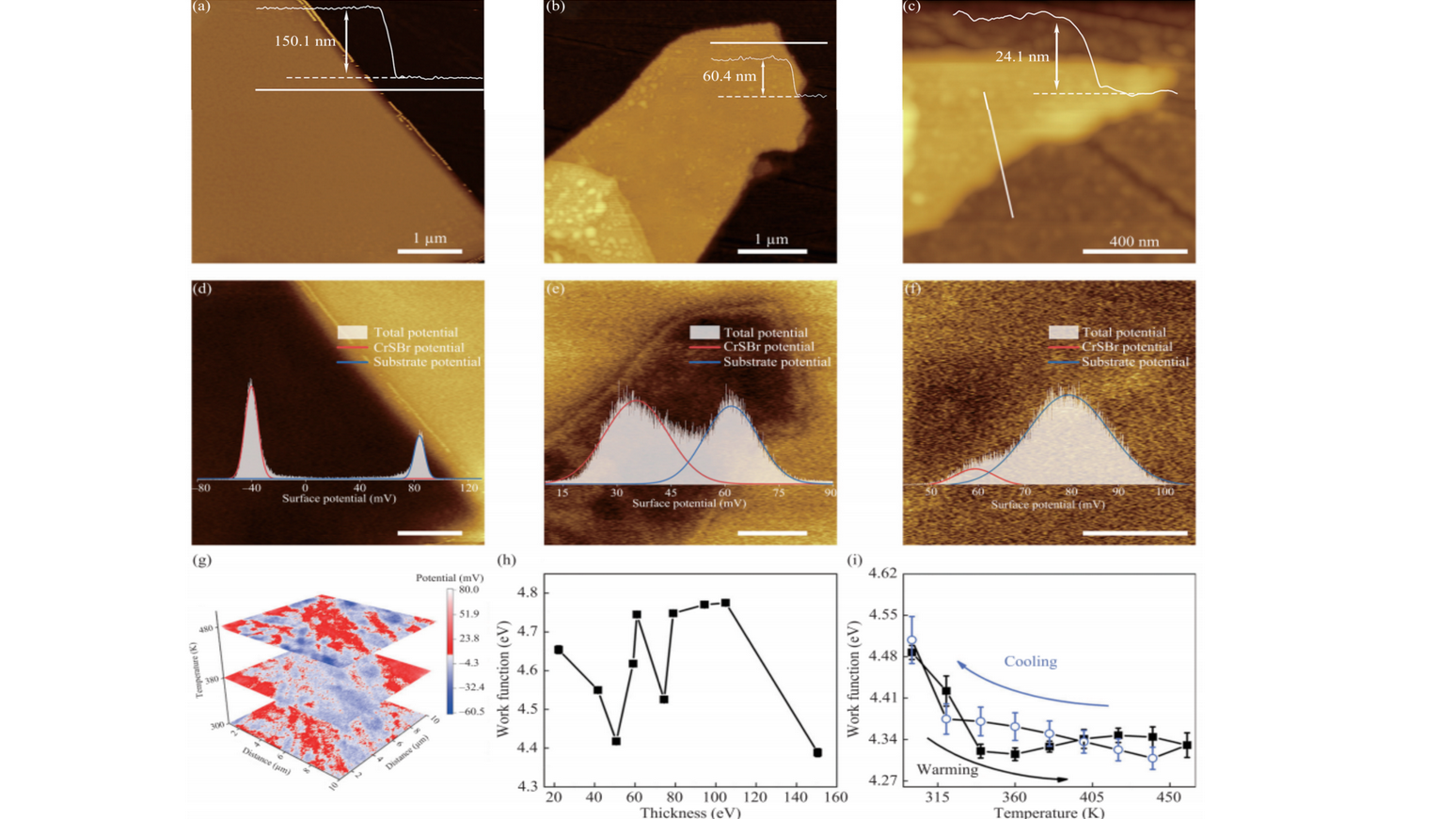
Two-dimensional (2D) magnetic semiconductors have emerged as promising materials for next-generation nanoelectronic and spintronic devices, owing to their unique coupling of electronic and magnetic properties. CrSBr, a quasi-2D magnetic semiconductor, offers a versatile platform for exploring coupled electronic and magnetic phenomena in low-dimensional systems. Here, we systematically investigate the surface work function of CrSBr nanosheets using scanning Kelvin probe microscopy (SKPM), revealing a nonlinear dependence on thickness and a thermally tunable, reversible behavior. Furthermore, a CrSBr-based 2D field-effect transistor (FET) demonstrates that such thermal modulation of the work function effectively alters the Schottky barrier height, directly impacting charge injection. Density functional theory (DFT) calculations reveal the layer- and magnetism-dependent nature of the work function in few-layer CrSBr. This work highlights the importance of work function engineering in CrSBr and provides a foundation for its application in magnetoelectric coupling, spintronic devices, and van der Waals electronics.
KeyWords AITranslate
[1]Y. Wang, W. Xu, D. Yang, Y. Zhang, Y. Xu, Z. Cheng, X. Mi, Y. Wu, Y. Liu.et al, "Above-room-temperature strong ferromagnetism in 2D MnB nanosheet," ACS Nano, vol. 17, pp. 24320–24328, 2023.
[2]Y. Xu, D. Yang, Y. Zhang, G. Yuan, Y. Zou, Z. Zhang, Y. Wang, and Y. Wu, "Realizing room-temperature ferromagnetism in metal-free graphene through vacancy-assisted hydrogenation," Chain, vol. 2, pp. 72–80, 2025.
[3]Y. Wu, Y. Liu, Y. Li, Z. Wei, S. Xing, Y. Wang, D. Zhu, Z. Guo, A. Zhang.et al, "Symmetry engineering in 2D bioelectronics facilitating augmented biosensing interfaces," Proceedings of the National Academy of Sciences of the United States of America, vol. 121, p. e2412684121, 2024.
[4]Y. Wang, D. Yang, S. Wang, W. Xu, Y. Zhang, T. K. Johal, Y. Xu, Y. Wang, Y. Zhang.et al, "p-type vdW semiconductor CrSCl featuring multipolarity coexistence," ACS Materials Letters, vol. 7, pp. 636–645, 2025.
[5]C. Gong, L. Li, Z. Li, H. Ji, A. Stern, Y. Xia, T. Cao, W. Bao, C. Wang.et al, "Discovery of intrinsic ferromagnetism in two-dimensional van der Waals crystals," Nature, vol. 546, pp. 265–269, 2017.
[6]Y. Guo, J. Li, X. Zhan, C. Wang, M. Li, B. Zhang, Z. Wang, Y. Liu, K. Yang.et al, "van der Waals polarity-engineered 3D integration of 2D complementary logic," Nature, vol. 630, pp. 346–352, 2024.
[7]B. Huang, G. Clark, E. Navarro-Moratalla, D. R. Klein, R. Cheng, K. L. Seyler, D. Zhong, E. Schmidgall, M. A. McGuire.et al, "Layer-dependent ferromagnetism in a van der Waals crystal down to the monolayer limit," Nature, vol. 546, pp. 270–273, 2017.
[8]T. Lei, T. Sellers, C. Luo, D. W. Carruth, and Z. Bi, "Graph-based robot optimal path planning with bio-inspired algorithms," Biomimetic Intelligence and Robotics, vol. 3, p. 100119, 2023.
[9]J. Klein, T. Pham, J. D. Thomsen, J. B. Curtis, T. Denneulin, M. Lorke, M. Florian, A. Steinhoff, R. A. Wiscons.et al, "Control of structure and spin texture in the van der Waals layered magnet CrSBr," Nature Communication, vol. 13, p. 5420, 2022.
[10]E. J. Telford, A. H. Dismukes, R. L. Dudley, R. A. Wiscons, K. Lee, D. G. Chica, M. E. Ziebel, M. G. Han, J. Yu.et al, "Coupling between magnetic order and charge transport in a two-dimensional magnetic semiconductor," Nature Materials, vol. 21, pp. 754–760, 2022.
[11]J. Cenker, S. Sivakumar, K. Xie, A. Miller, P. Thijssen, Z. Liu, A. Dismukes, J. Fonseca, E. Anderson.et al, "Reversible strain-induced magnetic phase transition in a van der Waals magnet," Nature Nanotechnology, vol. 17, pp. 256–261, 2022.
[12]T. S. Ghiasi, A. A. Kaverzin, A. H. Dismukes, D. K. de Wal, X. Roy, and B. J. van Wees, "Electrical and thermal generation of spin currents by magnetic bilayer graphene," Nature Nanotechnology, vol. 16, pp. 788–794, 2021.
[13]Y. J. Bae, J. Wang, A. Scheie, J. Xu, D. G. Chica, G. M. Diederich, J. Cenker, M. E. Ziebel, Y. Bai.et al, "Exciton-coupled coherent magnons in a 2D semiconductor," Nature, vol. 609, pp. 282–286, 2022.
[14]N. P. Wilson, K. Lee, J. Cenker, K. Xie, A. H. Dismukes, E. J. Telford, J. Fonseca, S. Sivakumar, C. Dean.et al, "Interlayer electronic coupling on demand in a 2D magnetic semiconductor," Nature Materials, vol. 20, pp. 1657–1662, 2021.
[15]Y. Wu, Y. Li, Y. Liu, D. Zhu, S. Xing, N. Lambert, H. Weisbecker, S. Liu, B. Davis.et al, "Orbit symmetry breaking in MXene implements enhanced soft bioelectronic implants," Science Advances, vol. 10, p. eadp8866, 2024.
[16]L. Lin, R. Jacobs, T. Ma, D. Chen, J. Booske, and D. Morgan, "Work function: Fundamentals, measurement, calculation, engineering, and applications," Physical Review Applied, vol. 19, p. 037001, 2023.
[17]G. Shao, "Work function and electron affinity of semiconductors: Doping effect and complication due to Fermi level pinning," Energy & Environmental Materials, vol. 4, pp. 273–276, 2021.
[18]T. Schultz, P. Bärmann, E. Longhi, R. Meena, Y. Geerts, Y. Gogotsi, S. Barlow, S. R. Marder, T. Petit.et al, "Work function and energy level alignment tuning at Ti3C2Tx MXene surfaces and interfaces using (metal-)organic donor/acceptor molecules," Physical Review Materials, vol. 7, p. 045002, 2023.
[19]G. Hu, V. Fung, J. Huang, and P. Ganesh, "Work function engineering of 2D materials: The role of polar edge reconstructions," The Journal of Physical Chemistry Letters, vol. 12, pp. 2320–2326, 2021.
[20]S. S. Baik, S. Im, and H. J. Choi, "Work function tuning in two-dimensional MoS2 field-effect-transistors with graphene and titanium source-drain contacts," Scientific Reports, vol. 7, p. 45546, 2017.
[21]Z. Peng, X. Chen, Y. Fan, D. J. Srolovitz, and D. Lei, "Strain engineering of 2D semiconductors and graphene: From strain fields to band-structure tuning and photonic applications," Light: Science & Applications, vol. 9, p. 190, 2020.
[22]C. Zhang, J. Chen, J. Li, Y. Peng, and Z. Mao, "Large language models for human–robot interaction: A review," Biomimetic Intelligence and Robotics, vol. 3, p. 100131, 2023.
[23]M. U. Farooq and J. Hong, "Switchable valley splitting by external electric field effect in graphene/CrI3 heterostructures," NPJ 2D Materials and Applications, vol. 3, p. 3, 2019.
[24]S. Rahman, B. Liu, B. Wang, Y. Tang, and Y. Lu, "Giant photoluminescence enhancement and resonant charge transfer in atomically thin two-dimensional Cr2Ge2Te6/WS2 heterostructures," ACS Applied Materials & Interfaces, vol. 13, pp. 7423–7433, 2021.
[25]T. Zhang, S. Zhao, A. Wang, Z. Xiong, Y. Liu, M. Xi, S. Li, H. Lei, Z. V. Han, and F. Wang, "Electrically and magnetically tunable valley polarization in monolayer MoSe2 proximitized by a 2D ferromagnetic semiconductor," Advanced Functional Materials, vol. 32, p. 2204779, 2022.
[26]E. Ko, "Hybridized bands and stacking-dependent band edges in ferromagnetic Fe3GeTe2/CrGeTe3 moiré heterobilayer," Scientific Reports, vol. 12, p. 5101, 2022.
[27]J. Tang, S. Li, L. Zhan, and S. Li, "Contact engineering for two-dimensional van der Waals semiconductors," Materials Today Electronics, vol. 11, p. 100132, 2025.
[28]W. H. Chang, S. Hatayama, Y. Saito, N. Okada, T. Endo, Y. Miyata, and T. Irisawa, "Thermally stable Bi2Te3/WSe2 van der Waals contacts for pMOSFETs application," Scientific Reports, vol. 14, p. 28572, 2024.
[29]Z. Mao, Y. Peng, C. Hu, R. Ding, Y. Yamada, and S. Maeda, "Soft computing-based predictive modeling of flexible electrohydrodynamic pumps," Biomimetic Intelligence and Robotics, vol. 3, p. 100114, 2023.
[30]R. A. B. Villaos, C. P. Crisostomo, Z.-Q. Huang, S.-M. Huang, A. A. B. Padama, M. A. Albao, H. Lin, and F.-C. Chuang, "Thickness dependent electronic properties of Pt dichalcogenides," NPJ 2D Materials and Applications, vol. 3, art. no. 2, 2019.
[31]A. Kuc, N. Zibouche, and T. Heine, "Influence of quantum confinement on the electronic structure of the transition metal sulfide TS2," Physical Review B, vol. 83, art. no. 245213, 2011.
[32]E. J. Telford, A. H. Dismukes, K. Lee, M. Cheng, A. Wieteska, A. K. Bartholomew, Y.-S. Chen, X. Xu, A. N. Pasupathy.et al, "Layered antiferromagnetism induces large negative magnetoresistance in the van der Waals semiconductor CrSBr," Advanced Materials, vol. 32, p. 2003240, 2020.
[33]K. Torres, A. Kuc, L. Maschio, T. Pham, K. Reidy, L. Dekanovsky, Z. Sofer, F. M. Ross, and J. Klein, "Probing defects and spin-phonon coupling in CrSBr via resonant raman scattering," Advanced Functional Materials, vol. 33, p. 2211366, 2023.
[34]A. Pawbake, T. Pelini, N. P. Wilson, K. Mosina, Z. Sofer, R. Heid, and C. Faugeras, "Raman scattering signatures of strong spin-phonon coupling in the bulk magnetic van der Waals material CrSBr," Physical Review B, vol. 107, p. 075421, 2023.
[35]F. Moro, S. Ke, A. G. del Águila, A. Söll, Z. Sofer, Q. Wu, M. Yue, L. Li, X. Liu, and M. Fanciulli, "Revealing 2D magnetism in a bulk CrSBr single crystal by electron spin resonance," Advanced Functional Materials, vol. 32, p. 2207044, 2022.
[36]G. Su, S. Yang, Y. Jiang, J. Li, S. Li, J.-C. Ren, and W. Liu, "Modeling chemical reactions on surfaces: The roles of chemical bonding and van der Waals interactions," Progress in Surface Science, vol. 94, p. 100561, 2019.
[37]B. I. Lundqvist, E. Hult, H. Rydberg, A. Bogicevic, J. Strömquist, and D. C. Langreth, "Density functionals and van der Waals interactions at surfaces," Progress in Surface Science, vol. 59, pp. 149–165, 1998.
[38]O. Leenaerts, B. Partoens, F. M. Peeters, A. Volodin, and C. Van Haesendonck, "The work function of few-layer graphene," Journal of Physics: Condensed Matter, vol. 29, p. 035003, 2017.
[39]N. Morioka, H. Yoshioka, J. Suda, and T. Kimoto, "Quantum-confinement effect on holes in silicon nanowires: Relationship between wave function and band structure," Journal of Applied Physics, vol. 109, p. 064318, 2011.
[40]R. L. Milot, G. E. Eperon, H. J. Snaith, M. B. Johnston, and L. M. Herz, "Temperature-dependent charge-carrier dynamics in CH3NH3PbI3 perovskite thin films," Advanced Functional Materials, vol. 25, pp. 6218–6227, 2015.
[41]M. C. Gélvez-Rueda, N. Renaud, and F. C. Grozema, "Temperature dependent charge carrier dynamics in formamidinium lead iodide perovskite," The Journal of Physical Chemistry C, vol. 121, pp. 23392–23397, 2017.
[42]C. Hou, X. Wang, Y. Sun, Y. Lu, and J. Ni, "Magnetic–electronic coupling in the strained bilayer CrSBr," The Journal of Physical Chemistry C, vol. 127, pp. 22833–22841, 2023.
[43]Y. Wang, S. Wang, Y. Zhang, Z. Cheng, D. Yang, Y. Wang, T. Wang, L. Cheng, Y. Wu.et al, "Piezoelectricity in wide bandgap semiconductor 2D crystal GaN nanosheets," Nanoscale, vol. 16, pp. 15170–15175, 2024.
[44]Y. S. Zhou, R. Hinchet, Y. Yang, G. Ardila, R. Songmuang, F. Zhang, Y. Zhang, W. Han, K. Pradel.et al, "Nano-newton transverse force sensor using a vertical GaN nanowire based on the piezotronic effect," Advanced Materials, vol. 25, pp. 883–888, 2013.
Basic Information:
DOI:10.23919/CHAIN.2025.000013
Chinese Library Classification Number:
Citation Information:
Two-dimensional (2D) magnetic semiconductors have emerged as promising materials for next-generation nanoelectronic and spintronic devices, owing to their unique coupling of electronic and magnetic properties. CrSBr, a quasi-2D magnetic semiconductor, offers a versatile platform for exploring coupled electronic and magnetic phenomena in low-dimensional systems. Here, we systematically investigate the surface work function of CrSBr nanosheets using scanning Kelvin probe microscopy (SKPM), revealing a nonlinear dependence on thickness and a thermally tunable, reversible behavior. Furthermore, a CrSBr-based 2D field-effect transistor (FET) demonstrates that such thermal modulation of the work function effectively alters the Schottky barrier height, directly impacting charge injection. Density functional theory (DFT) calculations reveal the layer- and magnetism-dependent nature of the work function in few-layer CrSBr. This work highlights the importance of work function engineering in CrSBr and provides a foundation for its application in magnetoelectric coupling, spintronic devices, and van der Waals electronics.
quote
| GB/T 7714-2015 | [1] Dingyi Yang, Yongjie Xu, Yichen Liu, et al. Layer- and temperature-dependent work function modulation in CrSBr[J]. Chain, 2025, 2(3): 256-266. DOI:10.23919/CHAIN.2025.000013. |
| MLA | [1] Dingyi Yang, et al., "Layer- and temperature-dependent work function modulation in CrSBr." Chain, vol. 2, no. 3, 2025, pp. 256-266, https://doi.org/10.23919/CHAIN.2025.000013. |
| APA | [1] Dingyi Yang, Yongjie Xu, Yichen Liu, Shaopeng Wang, Wei Xu, Miao Wang, Yang Liu, Lu Zhang, Yu Zhang, Yongmei Wang, Tingting Wang, Yizhang Wu, Yong Wang, & Yue Hao. (2025). Layer- and temperature-dependent work function modulation in CrSBr. Chain, 2(3), 256-266. https://doi.org/10.23919/CHAIN.2025.000013 |
| IEEE | [1] Dingyi Yang, Yongjie Xu, Yichen Liu, Shaopeng Wang, Wei Xu, Miao Wang, Yang Liu, Lu Zhang, Yu Zhang, Yongmei Wang, Tingting Wang, Yizhang Wu, Yong Wang, and Yue Hao, "Layer- and temperature-dependent work function modulation in CrSBr," Chain, vol. 2, no. 3, pp. 256-266, 2025, doi: 10.23919/CHAIN.2025.000013. keywords: {CrSBr;work function modulation;scanning Kelvin probe microscopy (SKPM);two-dimensional magnetic semiconductor;van der Waals electronics} |