

A multi-radical collaborative self-adaptive denoising method based on Res-U-Net and its application in CH-PLIF image denoising AITranslate
Abstract AITranslate
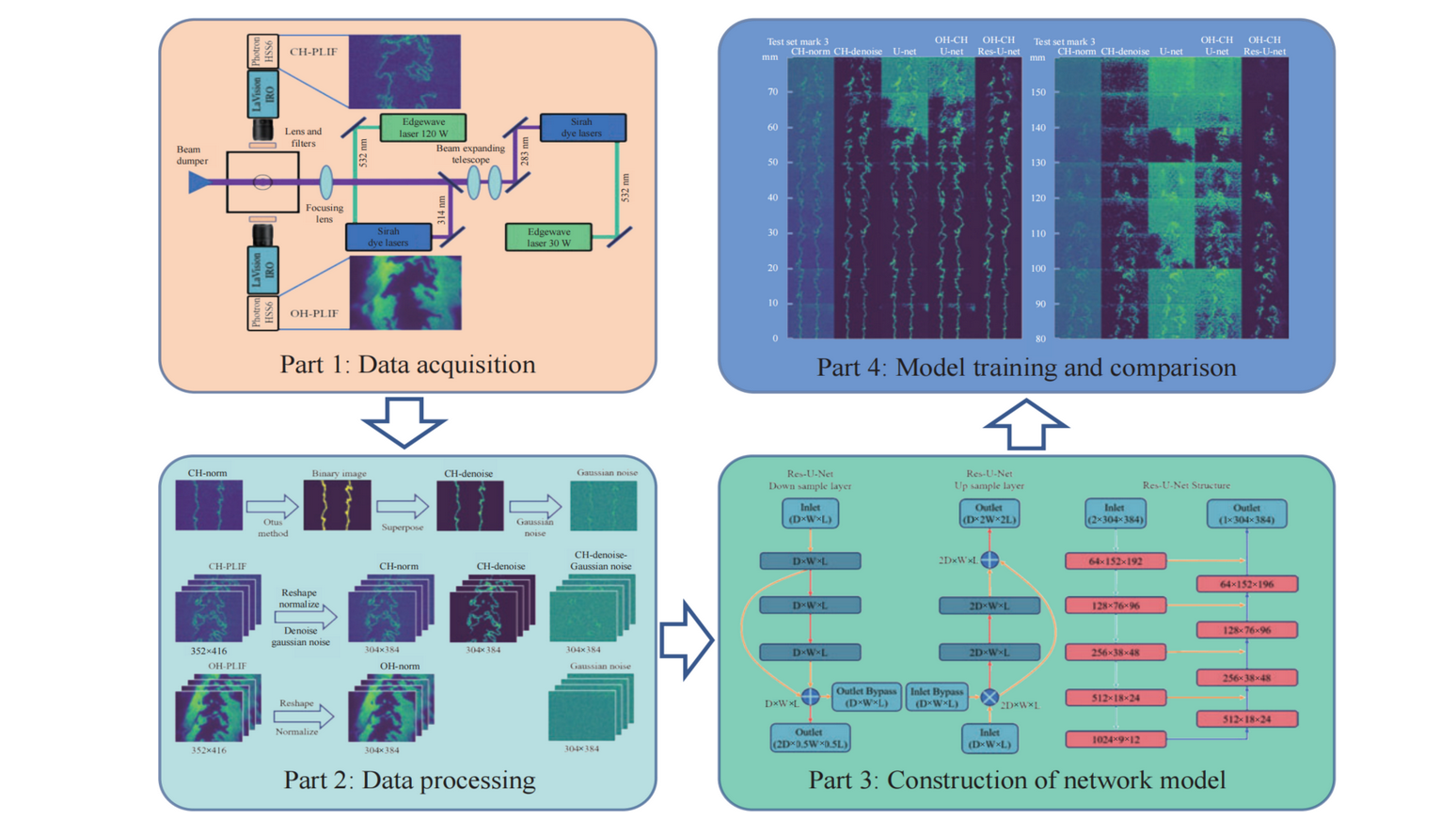
Planar laser-induced fluorescence (PLIF) is a widely applied non-invasive diagnostic technique in the combustion of power units. PLIF often detects CH and OH radicals to be the key markers for chemical process. Therefore, the clarity of OH-PLIF and CH-PLIF imaging is crucial for studying combustion phenomena. Given the short lifetime of CH radicals in flames, the signal-to-noise ratio (SNR) of CH-PLIF images is much lower than that of OH-PLIF images. Faced with the challenge that traditional denoising methods are ineffective for CH-PLIF images, this study proposes an improved Res-U-Net model based on the U-Net network and incorporating residual connections. This model builds on the traditional U-Net architecture, incorporating previous usage experience and introducing a shortcut connection structure to enhance performance. To improve the model's denoising performance under extreme SNR conditions, this study employs a CH-OH collaborative denoising strategy, which uses OH-PLIF images with a higher SNR to assist in the denoising of CH-PLIF images. Comparisons with several other models on low-SNR datasets demonstrate that the proposed denoising model achieves the best denoising performance.
KeyWords AITranslate
[1]A. Alwafi, T. Nguyen, Y. Hassan, and N. K. Anand, "Experimental analysis of a non-isothermal confined impinging single plume using time-resolved particle image velocimetry and planar laser induced fluorescence measurements," International Journal of Heat and Mass Transfer, vol. 193, p. 122952, 2022.
[2]S. A. Skeen, J. Manin, and L. M. Pickett, "Simultaneous formaldehyde PLIF and high-speed schlieren imaging for ignition visualization in high-pressure spray flames," Proceedings of the Combustion Institute, vol. 35, pp. 3167–3174, 2015.
[3]M. Bouvier, G. Cabot, J. Yon, and F. Grisch, "On the use of PIV, LII, PAH-PLIF and OH-PLIF for the study of soot formation and flame structure in a swirl stratified premixed ethylene/air flame," Proceedings of the Combustion Institute, vol. 38, pp. 1851–1858, 2021.
[4]J. Peng, Z. Cao, X. Yu, S. Yang, Y. Yu, H. Ren, Y. Ma, S. Zhang, S. Chen, and Y. Zhao, "Analysis of combustion instability of hydrogen fueled scramjet combustor on high-speed OH-PLIF measurements and dynamic mode decomposition," International Journal of Hydrogen Energy, vol. 45, pp. 13108–13118, 2020.
[5]N. Jiang, R. A. Patton, W. R. Lempert, and J. A. Sutton, "Development of high-repetition rate CH PLIF imaging in turbulent nonpremixed flames," Proceedings of the Combustion Institute, vol. 33, pp. 767–774, 2011.
[6]M. A. Hossain, M. N. A. Islam, W. Hossain, and A. R. Choudhuri, "CH-PLIF diagnostics of high intensity turbulent premixed methane-air combustion," in AIAA Scitech 2020 Forum, Orlando, FL, USA, 6–10 January 2020, p. 1705.
[7]J. Rosell, X. S. Bai, J. Sjoholm, B. Zhou, Z. Li, Z. Wang, P. Pettersson, Z. Li, M. Richter, and M. Alden, "Multi-species PLIF study of the structures of turbulent premixed methane/air jet flames in the flamelet and thin-reaction zones regimes," Combustion and Flame, vol. 182, pp. 324–338, 2017.
[8]C. W. Foley, I. Chterev, J. Seitzman, and T. Lieuwen, "High resolution particle image velocimetry and CH-PLIF measurements and analysis of a shear layer stabilized flame," Journal of Engineering for Gas Turbines and Power, vol. 138, p. 031603, 2015.
[9]J. Sjöholm, J. Rosell, B. Li, M. Richter, Z. Li, X. S. Bai, and M. Aldén, "Simultaneous visualization of OH, CH, CH2O and toluene PLIF in a methane jet flame with varying degrees of turbulence," Proceedings of the Combustion Institute, vol. 34, pp. 1475–1482, 2013.
[10]A. Johchi, Y. Naka, M. Shimura, M. Tanahashi, and T. Miyauchi, "Investigation on rapid consumption of fine scale unburned mixture islands in turbulent flame via 10 kHz simultaneous CH–OH PLIF and SPIV," Proceedings of the Combustion Institute, vol. 35, pp. 3663–3671, 2015.
[11]P. M. Allison, Y. Chen, M. Ihme, and J. F. Driscoll, "Coupling of flame geometry and combustion instabilities based on kilohertz formaldehyde PLIF measurements," Proceedings of the Combustion Institute, vol. 35, pp. 3255–3262, 2015.
[12]W. Meier, X. R. Duan, and P. Weigand, "Reaction zone structures and mixing characteristics of partially premixed swirling CH4/air flames in a gas turbine model combustor," Proceedings of the Combustion Institute, vol. 30. pp. 835–842, 2005.
[13]Q. Che, H. Zhang, L. Wang, M. Li, G. Chen, X. Qi, and S. Chen, "Experimental study on CH-PLIF imaging of swirling flame," Ninth Symposium on Novel Photoelectronic Detection Technology and Applications, vol. 12617, pp. 1692–1699, 2023.
[14]Z. S. Li, J. Kiefer, J. Zetterberg, M. Linvin, A. Leipertz, X. S. Bai, and M. Aldén, "Development of improved PLIF CH detection using an Alexandrite laser for single-shot investigation of turbulent and lean flames," Proceedings of the Combustion Institute, vol. 31, pp. 727–735, 2007.
[15]S. D. Hammack, A. W. Skiba, T. Lee, and C. D. Carter, "CH PLIF and PIV implementation using C-X (0,0) and intra-vibrational band filtered detection," Applied Physics B, vol. 124, p. 34, 2018.
[16]C. M. Mitsingas, S. D. Hammack, E. K. Mayhew, R. Rajasegar, B. McGann, A. W. Skiba, C. D. Carter, and T. Lee, "Simultaneous high speed PIV and CH PLIF using R-branch excitation in the C2Σ+-X2Π (0,0) band," Proceedings of the Combustion Institute, vol. 37, pp. 1479–1487, 2019.
[17]C. D. Carter, S. Hammack, and T. Lee, "High-speed flamefront imaging in premixed turbulent flames using planar laser-induced fluorescence of the CH C−X band," Combustion and Flame, vol. 168, pp. 66–74, 2016.
[18]R. Balachandran, B. O. Ayoola, C. F. Kaminski, A. P. Dowling, and E. Mastorakos, "Experimental investigation of the nonlinear response of turbulent premixed flames to imposed inlet velocity oscillations," Combustion and Flame, vol. 143, pp. 37–55, 2005.
[19]A. Gandomkar, S. Gkantonas, J. Schihl, T. A. McManus, C. D. Carter, and P. M. Allison, "Fuel effects on turbulent premixed jet flame topology as resolved by CH PLIF imaging," AIAA Scitech 2021 Forum, Virtual Event, 11–15 & 19–21 January 2021, 2021.
[20]J. Wang, M. Chang, M. Zhang, G. Li, S. Chen, and Z. Huang, "Flame front identification and its effect on turbulent premixed flames topology at high pressure," Experimental Thermal and Fluid Science, vol. 107, pp. 107–117, 2019.
[21]G. Wang, X. Liu, L. Li, Z. X. Chen, and F. Qi, "Investigation on the flame front and flow field in acoustically excited swirling flames with and without confinement," Combustion Science and Technology, vol. 194, pp. 130–143, 2022.
[22]M. Shimura, T. Ueda, G. M. Choi, M. Tanahashi, and T. Miyauchi, "Simultaneous dual-plane CH PLIF, single-plane OH PLIF and dual-plane stereoscopic PIV measurements in methane-air turbulent premixed flames," Proceedings of the Combustion Institute, vol. 33, pp. 775–782, 2011.
[23]M. Tanahashi, S. Murakami, G. M. Choi, Y. Fukuchi, and T. Miyauchi, "Simultaneous CH–OH PLIF and stereoscopic PIV measurements of turbulent premixed flames," Proceedings of the Combustion Institute, vol. 30, pp. 1665–1672, 2005.
[24]J. M. Donbar, J. F. Driscoll, and C. D. Carter, "Reaction zone structure in turbulent nonpremixed jet flames—from CH-OH PLIF images," Combustion and Flame, vol. 122, pp. 1–19, 2000.
[25]P. S. Kothnur, M. S. Tsurikov, N. T. Clemens, J. M. Donbar, and C. D. Carter, "Planar imaging of CH, OH, and velocity in turbulent non-premixed jet flames," Proceedings of the Combustion Institute, vol. 29, pp. 1921–1927, 2002.
[26]A. W. Skiba, C. D. Carter, S. D. Hammack, and T. Lee, "A simplified approach to simultaneous multi-scalar imaging in turbulent flames," Combustion and Flame, vol. 189, pp. 207–211, 2018.
[27]T. G. Reichel, K. Goeckeler, and O. Paschereit, "Investigation of lean premixed swirl-stabilized hydrogen burner with axial air injection using OH-PLIF imaging," Journal of Engineering for Gas Turbines and Power, vol. 137, p. 111513, 2015.
[28]Z. Wang, Q. Tang, Z. Yang, and P. He, "Experimental study on premixed flame combustion of annular burner with CO2 dilution based on OH-PLIF technology," Cogent Engineering, vol. 6, p. 1593074, 2019.
[29]C. D. Slabaugh, A. C. Pratt, and R. P. Lucht, "Simultaneous 5 kHz OH-PLIF/PIV for the study of turbulent combustion at engine conditions," Applied Physics B, vol. 118, pp. 109–130, 2015.
[30]B. Goyal, A. Dogra, S. Agrawal, B. S. Sohi, and A. Sharma, "Image denoising review: From classical to state-of-the-art approaches," Information Fusion, vol. 55, pp. 220–244, 2020.
[31]M. Wang, S. Zheng, X. Li, and X. Qin, "A new image denoising method based on Gaussian filter," 2014 International Conference on Information Science, Electronics and Electrical Engineering, Sapporo City, Hokkaido, Japan, 26–28 April 2014, pp. 163–167.
[32]Q. Yang, P. Yan, M. K. Kalra, and G. Wang, "CT image denoising with perceptive deep neural networks," arXiv preprint arXiv:1702.07019, 2017.
[33]X. Wang, Z. Luo, W. Li, X. Hu, L. Zhang, and Y. Zhong, "A self-supervised denoising network for satellite-airborne-ground hyperspectral imagery," IEEE Transactions on Geoscience and Remote Sensing, vol. 60, pp. 1–16, 2022.
[34]W. Dong, P. Wang, W. Yin, G. Shi, F. Wu, and X. Lu, "Denoising prior driven deep neural network for image restoration," IEEE Transactions on Pattern Analysis and Machine Intelligence, vol. 41, pp. 2305–2318, 2019.
[35]G. Song, W. Xu, and Y. Qin, "NeXtResUNet: A neural network for industrial CT image denoising," Journal of Radiation Research and Applied Sciences, vol. 17, p. 100822, 2024.
[36]B. Jose and F. Hampp, "Machine learning based spray process quantification," International Journal of Multiphase Flow, vol. 172, p. 104702, 2024.
[37]V. R. Hasti and D. Shin, "Denoising and fuel spray droplet detection from light-scattered images using deep learning," Energy and AI, vol. 7, p. 100130, 2022.
[38]Z. Han, X. Tang, M. M. Hossain, and C. Xu, "Assessment of flame stability through a convolutional denoising autoencoder and statistical analysis," Combustion and Flame, vol. 258, p. 113069, 2023.
[39]R. M. Strässle, F. Faldella, and U. Doll, "Deep learning-based image segmentation for instantaneous flame front extraction," Experiments in Fluids, vol. 65, p. 94, 2024.
[40]S. Barwey, M. Hassanaly, V. Raman, and A. Steinberg, "Using machine learning to construct velocity fields from OH-PLIF images," Combustion Science and Technology, vol. 194, pp. 93–116, 2022.
[41]S. Barwey, V. Raman, and A. M. Steinberg, "Extracting information overlap in simultaneous OH-PLIF and PIV fields with neural networks," Proceedings of the Combustion Institute, vol. 38, pp. 6241–6249, 2021.
[42]A. Procacci, M. M. Kamal, S. Hochgreb, A. Coussement, and A. Parente, "Analysis of the information overlap between the PIV and OH* chemiluminescence signals in turbulent flames using a sparse sensing framework," Combustion and Flame, vol. 257, p. 113004, 2023.
[43]K. He, X. Zhang, S. Ren, and J. Sun, "Deep residual learning for image recognition," 2016 IEEE Conference on Computer Vision and Pattern Recognition (CVPR), Las Vegas, NV, USA, 27–30 June 2016, pp. 770–778.
[44]O. Ronneberger, P. Fischer, and T. Brox, "U-Net: Convolutional networks for biomedical image Segmentation," Medical Image Computing and Computer-Assisted Intervention–MICCAI 2015: 18th International Conference, Munich, Germany, 5–9 October 2015, pp. 234–241.
[45]H. Lu and H. Song, "Science, Research on image classification based on ResNet," Academic Journal of Computing & Information Science, vol. 7, pp. 9–14, 2024.
[46]J. Long, E. Shelhamer, T. Darrell, and M. Intelligence, "Fully convolutional networks for semantic segmentation," Proceedings of the IEEE Conference on Computer Vision and Pattern Recognition, vol. 2015, pp. 640–651, 2015.
[47]Y. Hardalupas, C. Panoutsos, and A. Taylor, "Spatial resolution of a chemiluminescence sensor for local heat-release rate and equivalence ratio measurements in a model gas turbine combustor," Experiments in Fluids, vol. 49, pp. 883–909, 2010.
[48]J. Kojima, Y. Ikeda, and T. Nakajima, "Detail distributions of OH*, CH* and C2* chemiluminescence in the reaction zone of laminar premixed methane/air flames," 36th AIAA/ASME/SAE/ASEE Joint Propulsion Conference and Exhibit, Las Vegas, NV, USA, 24–28 July 2000, p. 3394.
[49]C. S. Panoutsos, Y. Hardalupas, and A. M. K. P. Taylor, "Numerical evaluation of equivalence ratio measurement using OH* and CH* chemiluminescence in premixed and non-premixed methane–air flames," Combustion and Flame, vol. 156, pp. 273–291, 2009.
[50]W. Jin, S. A. Steinmetz, M. Juddoo, M. J. Dunn, Z. Huang, and A. R. Masri, "Effects of shear inhomogeneities on the structure of turbulent premixed flames," Combustion and Flame, vol. 208, pp. 63–78, 2019.
[51]E. Goceri, "Evaluation of denoising techniques to remove speckle and Gaussian noise from dermoscopy images," Computers in Biology and Medicine, vol. 152, p. 106474, 2023.
[52]Y. Xing, J. Xu, J. Tan, D. Li, and W. Zha, "Deep CNN for removal of salt and pepper noise," IET Image Processing, vol. 13, pp. 1550–1560, 2019.
Basic Information:
DOI:10.23919/CHAIN.2025.000009
Chinese Library Classification Number:
Citation Information:
Planar laser-induced fluorescence (PLIF) is a widely applied non-invasive diagnostic technique in the combustion of power units. PLIF often detects CH and OH radicals to be the key markers for chemical process. Therefore, the clarity of OH-PLIF and CH-PLIF imaging is crucial for studying combustion phenomena. Given the short lifetime of CH radicals in flames, the signal-to-noise ratio (SNR) of CH-PLIF images is much lower than that of OH-PLIF images. Faced with the challenge that traditional denoising methods are ineffective for CH-PLIF images, this study proposes an improved Res-U-Net model based on the U-Net network and incorporating residual connections. This model builds on the traditional U-Net architecture, incorporating previous usage experience and introducing a shortcut connection structure to enhance performance. To improve the model's denoising performance under extreme SNR conditions, this study employs a CH-OH collaborative denoising strategy, which uses OH-PLIF images with a higher SNR to assist in the denoising of CH-PLIF images. Comparisons with several other models on low-SNR datasets demonstrate that the proposed denoising model achieves the best denoising performance.
quote
| GB/T 7714-2015 | [1] Wei Pan, Wu Jin, Xiafei Li, et al. A multi-radical collaborative self-adaptive denoising method based on Res-U-Net and its application in CH-PLIF image denoising[J]. Chain, 2025, 2(2): 164-182. DOI:10.23919/CHAIN.2025.000009. |
| MLA | [1] Wei Pan, et al., "A multi-radical collaborative self-adaptive denoising method based on Res-U-Net and its application in CH-PLIF image denoising." Chain, vol. 2, no. 2, 2025, pp. 164-182, https://doi.org/10.23919/CHAIN.2025.000009. |
| APA | [1] Wei Pan, Wu Jin, Xiafei Li, Qian Yao, Chaowei Tang, Li Yuan, & Jianzhong Li. (2025). A multi-radical collaborative self-adaptive denoising method based on Res-U-Net and its application in CH-PLIF image denoising. Chain, 2(2), 164-182. https://doi.org/10.23919/CHAIN.2025.000009 |
| IEEE | [1] Wei Pan, Wu Jin, Xiafei Li, Qian Yao, Chaowei Tang, Li Yuan, and Jianzhong Li, "A multi-radical collaborative self-adaptive denoising method based on Res-U-Net and its application in CH-PLIF image denoising," Chain, vol. 2, no. 2, pp. 164-182, 2025, doi: 10.23919/CHAIN.2025.000009. keywords: {denoise;PLIF;combustion;deep learning;U-Net} |