

Mechanistic insights into the electrochemical and thermal safety degradation of lithium titanate batteries under constant voltage overcharge conditions AITranslate
Abstract AITranslate
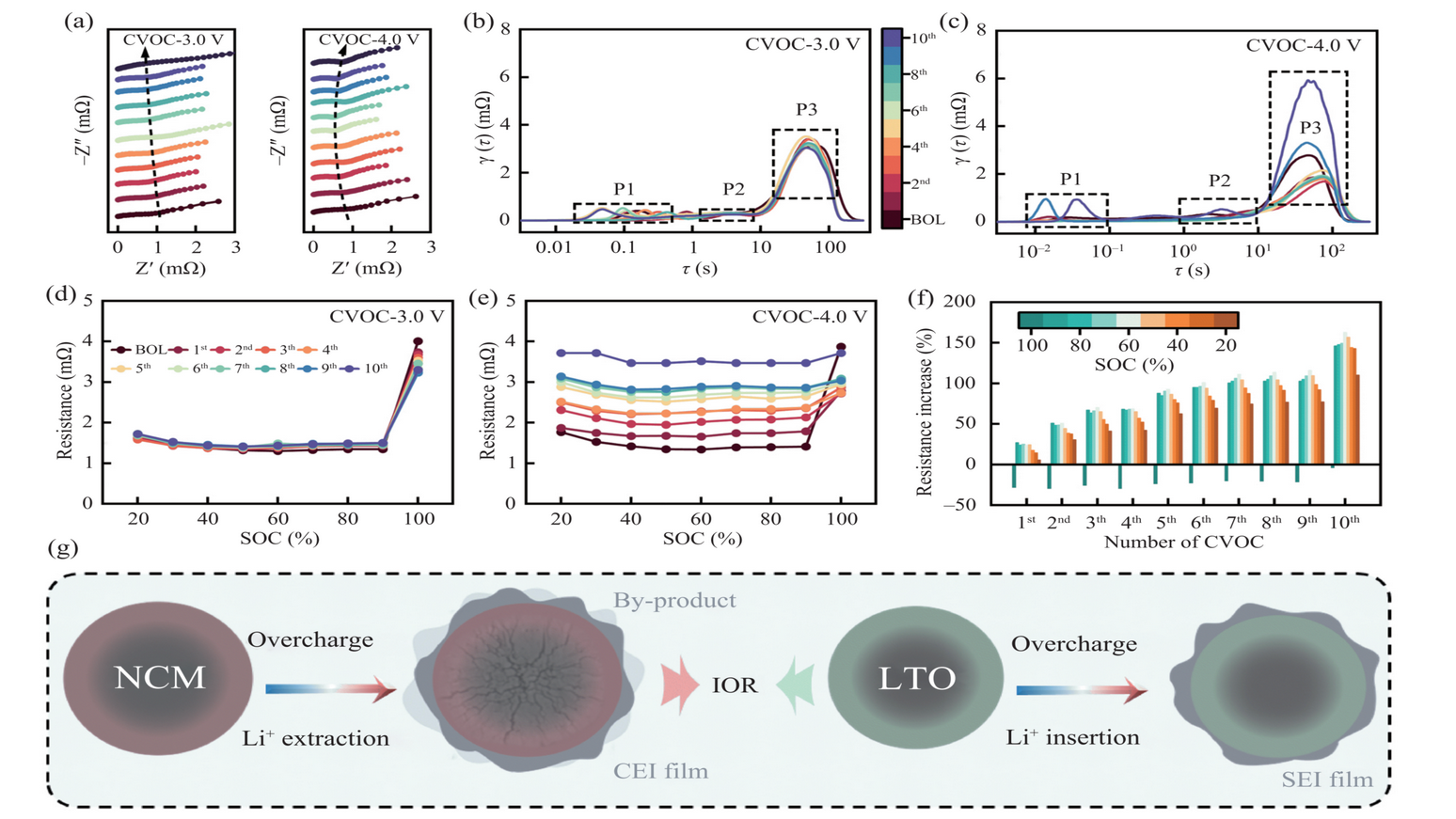
Lithium titanate oxide (Li4Ti5O12, LTO) anode-based batteries are widely recognized for their excellent safety characteristics and long cycle life. However, constant-voltage overcharging (CVOC), arising from cell-to-cell variations and delays in the response of a battery management system (BMS), can accelerate capacity degradation and increase the risk of thermal runaway. In this work, we systematically investigated the effects of CVOC at different voltages on the capacity retention and thermal safety of LTO-based batteries. By subjecting cells to overcharging cycling at elevated voltages, we elucidate the aging mechanisms and degradation pathways. Noninvasive diagnostics combined with postmortem analyses are employed to correlate the electrochemical behavior with the electrode morphology and composition under CVOC conditions. A critical voltage of 3.5 V is identified, beyond which severe degradation occurs. At 4.0 V, continuous CVOC induces the growth of a thick organic-rich solid-electrolyte interphase (SEI) and byproducts, leading to only 60% capacity retention compared with nearly 100% retention under 3.0 V CVOC or conventional constant-current/constant-voltage charging. Furthermore, the self-heating onset temperature decreases by 44.8 °C, indicating a significant reduction in thermal stability associated with high-voltage overcharge. These findings are corroborated by detailed postmortem characterization. Overall, this study demonstrates that the CVOC critically impacts both the electrochemical performance and thermal safety of LTO-based batteries, offering important insights for the design of high-stability, highly safe power sources for electric transportation systems.
KeyWords AITranslate
[1]S. V. Venkatesan, A. Nandy, K. Karan, S. R. Larter, and V. Thangadurai, "Recent advances in the unconventional design of electrochemical energy storage and conversion devices," Electrochemical Energy Reviews, vol. 5, no. 4, art. no. 16, 2022.
[2]M. Li, J. Lu, Z. Chen, and K. Amine, "30 Years of Lithium-Ion batteries," Advanced Materials, vol. 30, no. 33, art. no. 1800561, 2018.
[3]Z. Guo, Z. Ma, J. Liu, W. Zhao, S. Wang, H. Zhao, and L. Ren, "Overcharging cycle aging-induced severe degradation of safety properties of lithium-ion pouch battery cells subjected to mechanical abuse," Energy, vol. 320, art. no. 135168, 2025.
[4]H. Zhang, Y. Yang, H. Xu, L. Wang, X. Lu, and X. He, "Li4Ti5O12 spinel anode: Fundamentals and advances in rechargeable batteries," InfoMat, vol. 4, no. 4, art. no. e12228, 2021.
[5]S. Liu, M. Winter, M. Lewerenz, J. Becker, D. U. Sauer, Z. Ma, and J. Jiang, "Analysis of cyclic aging performance of commercial Li4Ti5O12-based batteries at room temperature," Energy, vol. 173, pp. 1041–1053, 2019.
[6]T. Omiya, A. Ikezawa, K. Takahashi, K. Saito, M. Yonemura, T. Saito, T. Kamiyama, and H. Arai, "Combination of float charging and occasional discharging to cause serious LIB degradation analyzed by operando neutron diffraction," Energy Advances, vol. 3, no. 2, pp. 529–542, 2024.
[7]H. Zhang, X. Lai, and L. Zhou, "A quantitative internal-short-circuit diagnosis method of lithium-ion batteries for float charging systems," Journal of Energy Storage, vol. 96, art. no. 112689, 2024.
[8]H. Chen, A. Chahbaz, S. Yang, W. Zhang, D. U. Sauer, and W. Li, "Thermodynamic and kinetic degradation of LTO batteries: impact of different SOC intervals and discharge voltages in electric train applications," eTransportation, vol. 21, art. no. 100340, 2024.
[9]H. Chen, S. Yang, W. Zhang, C. Zhang, B. Sun, and D. Chen, "An aging-aware modified open-circuit potential electrode model for degradation modes diagnosis of lithium titanate oxide batteries," J. Power Sources, vol. 614, art. no. 234921, 2024.
[10]G. Baure, and M. Dubarry, "Battery durability and reliability under electric utility grid operations: 20-year forecast under different grid applications," J. Energy Storage, vol. 29, art. no. 101391, 2020.
[11]M. Soltani, S. B. Vilsen, A. I. Stroe, V. Knap, and D. I. Stroe, "Degradation behaviour analysis and end-of-life prediction of lithium titanate oxide batteries," Journal of Energy Storage, vol. 68, art. no. 107745, 2023.
[12]X. Lai, B. Li, X. Tang, Y. Zhou, Y. Zheng, and F. Gao, "A quantitative method for early-stage detection of the internal-short-circuit in Lithium-ion battery pack under float-charging conditions," Journal of Power Sources, vol. 573, art. no. 233109, 2023.
[13]Q. Tian, "Research on application of lithium titanate battery in auxiliary system of rail vehicle," IOP Conference Series: Materials Science and Engineering, vol. 366, art. no. 012087, 2018.
[14]T. Yin, L. Zheng, L. Jia, Y. Feng, D. Wang, and Z. Dai, "Overview of research on float charging for lithium-ion batteries," Energy Storage Science and Technology, vol. 10, no. 1, art. no. 310, 2021.
[15]T. Tsujikawa, K. Yabuta, T. Matsushita, M. Arakawa, and K. Hayashi, "A study on the cause of deterioration in float-charged lithium-ion battery," ECS Transactions, vol. 25, no. 36, art. no. 309, 2010.
[16]L. Spitthoff, P. J. S. Vie, M. S. Wahl, J. Wind, and O. S. Burheim, "Incremental capacity analysis (dQ/dV) as a tool for analysing the effect of ambient temperature and mechanical clamping on degradation," J. Electroanal. Chem., vol. 944, art. no. 117627, 2023.
[17]P. Arora, R. E. White, and M. Doyle, "Capacity fade mechanisms and side reactions in lithium‐ion batteries," Journal of The Electrochemical Society, vol. 145, no. 10, pp. 3647–3667, 1998.
[18]J. Gao, B. Gong, Q. Zhang, G. Wang, Y. Dai, and W. Fan, "Study of the surface reaction mechanism of Li4Ti5O12 anode for lithium-ion cells," Ionics, vol. 21, no. 9, pp. 2409–2416, 2015.
[19]T. Yin, L. Jia, X. Li, L. Zheng, and Z. Dai, "Effect of high-rate cycle aging and over-discharge on NCM811 (LiNi0.8Co0.1Mn0.1O2) batteries," Energies, vol. 15, no. 8, art. no. 2862, 2022.
[20]J. Liu, M. Yue, S. Wang, Y. Zhao, and J. Zhang, "A review of performance attenuation and mitigation strategies of lithium‐ion batteries," Advanced Functional Materials, vol. 32, no. 8, art. no. 2107769, 2021.
[21]M. Dubarry, and D. Anseán, "Best practices for incremental capacity analysis," Front. Energy Res., vol. 10, art. no. 1023555, 2022.
[22]M. Dubarry, V. Svoboda, R. Hwu, and B. Yann Liaw, "Incremental capacity analysis and close-to-equilibrium OCV measurements to quantify capacity fade in commercial rechargeable lithium batteries," Electrochemical and Solid-State Letters, vol. 9, no. 10, art. no. A454, 2006.
[23]Y. Hao, K. Li, S. Zhang, J. Wang, X. Zhu, W. Meng, J. Qiu, and H. Ming, "Failure of lithium-ion batteries accelerated by gravity," ACS Applied Materials & Interfaces, vol. 16, no. 21, pp. 27400–27409, 2024.
[24]I. Bloom, A. N. Jansen, D. P. Abraham, J. Knuth, S. A. Jones, V. S. Battaglia, and G. L. Henriksen, "Differential voltage analyses of high-power, lithium-ion cells," Journal of Power Sources, vol. 139, no. 1–2, pp. 295–303, 2005.
[25]J. Wang, J. Purewal, P. Liu, J. Hicks-Garner, S. Soukazian, E. Sherman, A. Sorenson, L. Vu, H. Tataria, and M. W. Verbrugge, "Degradation of lithium ion batteries employing graphite negatives and nickel–cobalt–manganese oxide + spinel manganese oxide positives: Part 1, aging mechanisms and life estimation," Journal of Power Sources, vol. 269, pp. 937–948, 2014.
[26]E. Moazzen, R. Scipioni, M. Ma, and S. Barnett, "Interpretation and modelling of the electrochemical impedance of LiFePO4/Li4Ti5O12 batteries," Journal of The Electrochemical Society, vol. 168, no. 5, art. no. 050519, 2021.
[27]Y. Lu, C.-Z. Zhao, J.-Q. Huang, and Q. Zhang, "The timescale identification decoupling complicated kinetic processes in lithium batteries," Joule, vol. 6, no. 6, pp. 1172–1198, 2022.
[28]F. Zhao, J. Wang, T. Jiang, Y. Si, X. Zhu, S. Zhang, K. Li, W. Meng, H. Zhang et al., "Internal resistance reduction strategies for high-power and fast-charging Lithium-ion batteries," Materials Science and Engineering: R: Reports, vol. 166, p. 101076, 2025.
[29]T. H. Wan, M. Saccoccio, C. Chen, and F. Ciucci, "Influence of the discretization methods on the distribution of relaxation times deconvolution: implementing radial basis functions with DRTtools," Electrochimica Acta, vol. 184, pp. 483–499, 2015.
[30]H. Schichlein, A. C. Müller, M. Voigts, A. Krügel, and E. Ivers-Tiffée, "Deconvolution of electrochemical impedance spectra for the identification of electrode reaction mechanisms in solid oxide fuel cells," Journal of Applied Electrochemistry, vol. 32, no. 8, pp. 875–882, 2002.
[31]M.-C. Liu, H.-J. Chen, G. Wu, X.-L. Wang, and Y.-Z. Wang, "Multifunctional robust aerogel separator towards high-temperature, large-rate, long-cycle lithium-ion batteries," Chinese Chemical Letters, vol. 34, no. 5, art. no. 107546, 2023.
[32]P. Schröer, H. van Faassen, T. Nemeth, M. Kuipers, and D. U. Sauer, "Challenges in modeling high power lithium titanate oxide cells in battery management systems," Journal of Energy Storage, vol. 28, art. no. 101189, 2020.
[33]Z. Liang, Y. Peng, X. Zhang, K. Cao, W. Xiao, and D. Gu, "Sulfur-doped CMK-5 with expanded lattice for high-performance lithium ion batteries," Chinese Chemical Letters, vol. 34, no. 7, art. no. 108054, 2023.
[34]S. Zhang, Z. Yang, Y. Lu, W. Xie, Z. Yan, and J. Chen, "Insights into cation migration and intermixing in advanced cathode materials for lithium-ion batteries insights into cation migration and intermixing in advanced cathode materials for lithium‐ion batteries," Advanced Energy Materials, vol. 14, no. 36, art. no. 2402068, 2024.
[35]Y. Guo, X. Qu, Z. Li, R. Tian, and X. Liu, "A scalable one-pot strategy for the development of polymer electrolytes adaptable to room-temperature high-voltage lithium batteries," Chinese Chemical Letters, vol. 35, no. 3, art. no. 108482, 2024.
[36]J. Hwang, K. Do, and H. Ahn, "Highly conductive 3D structural carbon network-encapsulated Ni-rich LiNi0.8Co0.1Mn0.1O2 as depolarized and passivated cathode for lithium-ion batteries," Chem. Eng. J., vol. 406, art. no. 126813, 2021.
[37]T. Nordh, R. Younesi, M. Hahlin, R. F. Duarte, C. Tengstedt, D. Brandell, and K. Edström, "Manganese in the SEI layer of Li4Ti5O12 studied by combined NEXAFS and HAXPES techniques," The Journal of Physical Chemistry C, vol. 120, no. 6, pp. 3206–3213, 2016.
[38]W. Liang, X. Zhou, B. Zhang, Z. Zhao, X. Song, K. Chen, L. Wang, Z. Ma, and J. Liu, "The versatile establishment of charge storage in polymer solid electrolyte with enhanced charge transfer for LiF-Rich SEI generation in lithium metal batteries," Angewandte Chemie International Edition, vol. 63, no. 18, art. no. 202320149, 2024.
[39]F. Lv, Y. Zhang, M. Wu, and Y. Gu, "A molten-salt method to synthesize ultrahigh-nickel single-crystalline LiNi0.92 Co0.06 Mn0.02 O2 with superior electrochemical performance as cathode material for lithium-ion batteries," Small, vol. 18, no. 28, art. no. e2201946, 2022.
[40]X. Feng, D. Ren, X. He, and M. Ouyang, "Mitigating thermal runaway of lithium-ion batteries," Joule, vol. 4, no. 4, pp. 743–770, 2020.
[41]T. Gao, J. Bai, D. Ouyang, Z. Wang, W. Bai, N. Mao, and Y. Zhu, "Effect of aging temperature on thermal stability of lithium-ion batteries: part A – high-temperature aging," Renewable Energy, vol. 203, pp. 592–600, 2023.
[42]H. Du, Y. Wang, Y. Kang, Y. Zhao, Y. Tian, X. Wang, Y. Tan, Z. Liang, J. Wozny et al., "Side reactions/changes in lithium‐ion batteries: mechanisms and strategies for creating safer and better batteries," Advanced Materials, vol. 36, no. 29, art. no. 2401482, 2024.
[43]Z. Wang, Q. Zhao, S. Wang, Y. Song, B. Shi, and J. He, "Aging and post-aging thermal safety of lithium-ion batteries under complex operating conditions: a comprehensive review," Journal of Power Sources, vol. 623, art. no. 235453, 2024.
Basic Information:
DOI:10.23919/CHAIN.2025.000021
Chinese Library Classification Number:
Citation Information:
Lithium titanate oxide (Li4Ti5O12, LTO) anode-based batteries are widely recognized for their excellent safety characteristics and long cycle life. However, constant-voltage overcharging (CVOC), arising from cell-to-cell variations and delays in the response of a battery management system (BMS), can accelerate capacity degradation and increase the risk of thermal runaway. In this work, we systematically investigated the effects of CVOC at different voltages on the capacity retention and thermal safety of LTO-based batteries. By subjecting cells to overcharging cycling at elevated voltages, we elucidate the aging mechanisms and degradation pathways. Noninvasive diagnostics combined with postmortem analyses are employed to correlate the electrochemical behavior with the electrode morphology and composition under CVOC conditions. A critical voltage of 3.5 V is identified, beyond which severe degradation occurs. At 4.0 V, continuous CVOC induces the growth of a thick organic-rich solid-electrolyte interphase (SEI) and byproducts, leading to only 60% capacity retention compared with nearly 100% retention under 3.0 V CVOC or conventional constant-current/constant-voltage charging. Furthermore, the self-heating onset temperature decreases by 44.8 °C, indicating a significant reduction in thermal stability associated with high-voltage overcharge. These findings are corroborated by detailed postmortem characterization. Overall, this study demonstrates that the CVOC critically impacts both the electrochemical performance and thermal safety of LTO-based batteries, offering important insights for the design of high-stability, highly safe power sources for electric transportation systems.
quote
| GB/T 7714-2015 | [1] Jintao Li, Zhenhao Luo, Jing Wang, et al. Mechanistic insights into the electrochemical and thermal safety degradation of lithium titanate batteries under constant voltage overcharge conditions[J]. Chain, 2025, 2(4): 321-338. DOI:10.23919/CHAIN.2025.000021. |
| MLA | [1] Jintao Li, et al., "Mechanistic insights into the electrochemical and thermal safety degradation of lithium titanate batteries under constant voltage overcharge conditions." Chain, vol. 2, no. 4, 2025, pp. 321-338, https://doi.org/10.23919/CHAIN.2025.000021. |
| APA | [1] Jintao Li, Zhenhao Luo, Jing Wang, Pushpendra Kumar, Songtong Zhang, Xianfeng Hao, Xiayu Zhu, Wenjie Meng, Jingyi Qiu, & Hai Ming. (2025). Mechanistic insights into the electrochemical and thermal safety degradation of lithium titanate batteries under constant voltage overcharge conditions. Chain, 2(4), 321-338. https://doi.org/10.23919/CHAIN.2025.000021 |
| IEEE | [1] Jintao Li, Zhenhao Luo, Jing Wang, Pushpendra Kumar, Songtong Zhang, Xianfeng Hao, Xiayu Zhu, Wenjie Meng, Jingyi Qiu, and Hai Ming, "Mechanistic insights into the electrochemical and thermal safety degradation of lithium titanate batteries under constant voltage overcharge conditions," Chain, vol. 2, no. 4, pp. 321-338, 2025, doi: 10.23919/CHAIN.2025.000021. keywords: {lithium titanate oxide;constant voltage overcharging;thermal runaway;degradation mechanisms;battery safety} |