

Tuning the Mn-based NASICON cathodes: A perspective on stabilizing high working voltage for sustainable sodium-ion batteries AITranslate

Abstract AITranslate
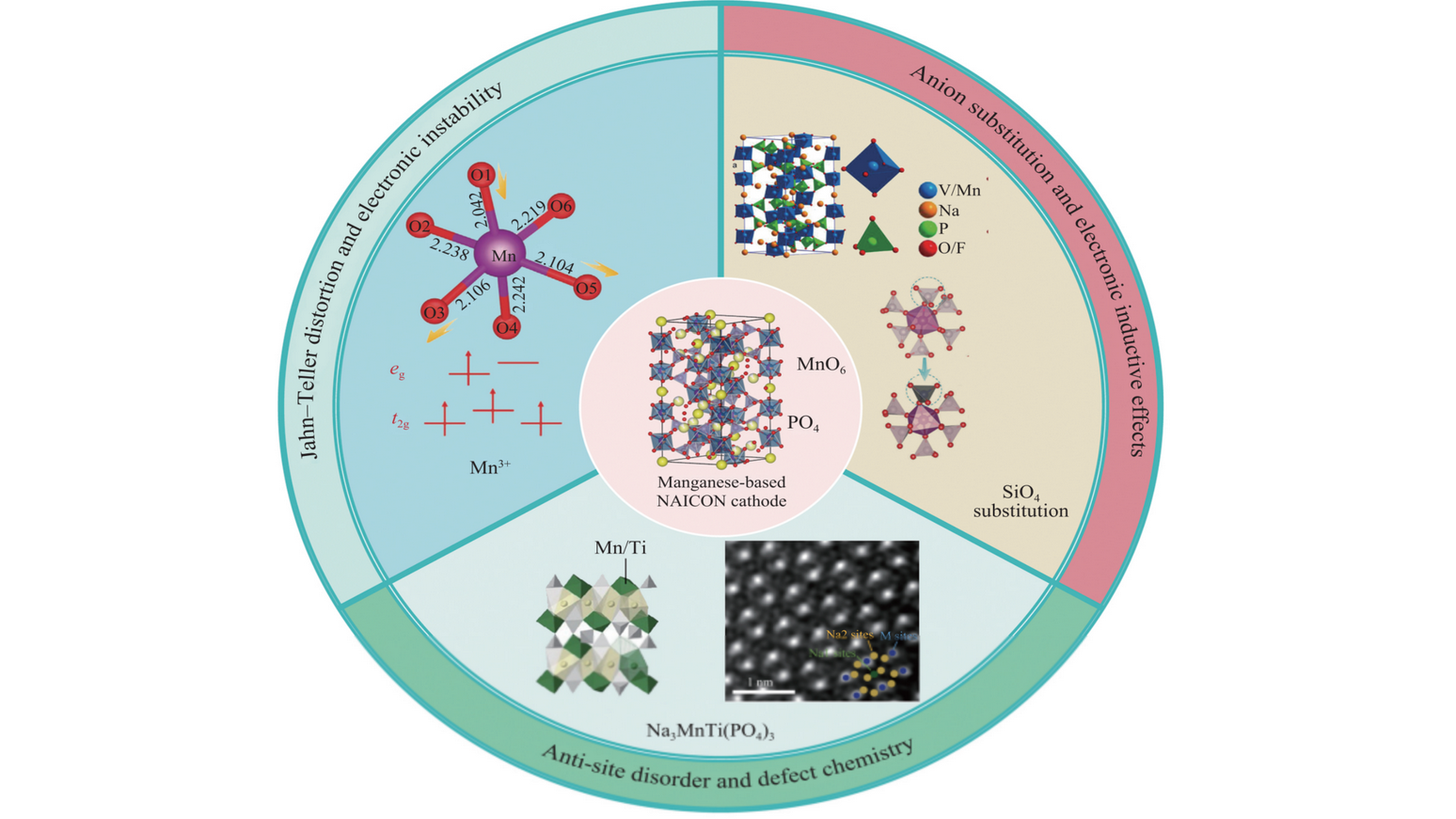
Manganese-based NASICON materials are promising cathodes for sodium-ion batteries owing to their open three-dimensional framework and high Na⁺ mobility. However, their cycling performance is hindered by Jahn–Teller distortions and anti-site defects that destabilize the lattice. Recent studies show that rational electronic structure and defect engineering can effectively address these challenges. High-valent cation doping, such as Ti4+ or Zr4+, reduces lattice strain and stabilizes Mn redox reactions, while controlled synthesis suppresses Mn–Na anti-site defects and enhances Na+ transport. Furthermore, partial anion substitution with fluorophosphate or silicate units strengthens Mn–O bonding and increases operating voltage. Integrating these strategies enables improved structural stability and long-term reversibility, offering a feasible pathway toward durable, high-energy sodium-ion batteries for large-scale energy storage.
KeyWords AITranslate
[1]J.-Y. Hwang, S.-T. Myung, and Y.-K. Sun, "Sodium-ion batteries: present and future," Chemical Society Reviews, vol. 46, no. 12, pp. 3529–3614, 2017.
[2]C.-L. Shi, D. Muhtar, X.-Y. Lu, F.-Q. Liu, X. Lu, Z.-P. Sun, and Z.-P. Guo, "A medium‐entropy NASICON cathode for sodium-ion batteries achieving high energy density through dual enhancement of voltage and capacity," Advanced Energy Materials, vol. 15, no. 26, art. no. 2500448, 2025.
[3]C.-L. Shi, J.-L. Xu, T. Tao, X.-Y. Lu, G.-P. Liu, F.-Q. Xie, S. Wu, Y.-X. Wu, and Z.-P. Sun, "Zero-strain Na3V2(PO4)2F3@RGO/CNT composite as a wide-temperature-tolerance cathode for Na-ion batteries with ultrahigh-rate performance," Small Methods, vol. 8, no. 3, art. no. e2301277, 2024.
[4]Y. Liu, C. Sun, Y. Li, H.-B. Jin, and Y.-J. Zhao, "Recent progress of Mn-based NASICON-type sodium ion cathodes," Energy Storage Materials, vol. 57, no. 1, pp. 69–80, 2023.
[5]H. Gao, I. D. Seymour, S. Xin, L. Xue, G. Henkelman, and J. B. Goodenough, "Na3MnZr(PO4)3: A high-voltage cathode for sodium batteries," Journal of the American Chemical Society, vol. 140, no. 51, pp. 18192–18199, 2018.
[6]J.-S. Zhang, C.-F. Lin, Q.-B. Xia, C. Wang, and X.-S. Zhao, "Improved performance of Na3TiMn(PO4)3 using a Non-stoichiometric synthesis strategy," ACS Energy Letters, vol. 6, no. 6, pp. 2081–2089, 2021.
[7]H. Huang, Y. Xia, Y. Hao, H. Li, M. Yousaf, S. Iqbal, H. Pan, M. Yan, and Y. Jiang, "Local electronic structure regulation enabling fluorophosphates cathode with improved redox potential and reversible capacity for sodium-ion batteries," Journal of the American Chemical Society, vol. 146, no. 42, pp. 28906–28913, 2024.
[8]H. Zhang, Z.-Y. Gu, X.-T. Wang, X.-X. Zhao, Y.-L. Heng, Y. Liu, J.-L. Yang, S.-H. Zheng, and X.-L. Wu, "Electronic confinement-restrained MnNa. Anti-site defects in sodium-rich phosphates toward multi-electron transfer and high energy efficiency," Advanced Materials, vol. 36, no. 47, art. no. e2410797, 2024.
[9]Y. Liu, X.-H. Rong, R. Bai, R.-J. Xiao, C.-L. Xu, C. Zhang, J.-P. Xu, W. Yin, Q.-H. Zhang et al., "Identifying the intrinsic anti-site defect in manganese-rich NASICON-type cathodes," Nature Energy, vol. 8, no. 10, pp. 1088–1096, 2023.
[10]Y. Hou, Q. Liu, L. Yang, J. Hu, Z. Wang, X. Zhang, J. Pan, Z. Bai, H. Wang, and Z. Lu, "Manganese local environment modulation via SiO4 substitution to boost sodium storage performance of Na4MnCr(PO4)3," Small, vol. 19, no. 18, art. no. e2207466, 2023.
[11]Z. Hao, X. Shi, Z. Yang, X. Zhou, L. Li, C.-Q. Ma, and S. Chou, "The distance between phosphate-based polyanionic compounds and their practical application for sodium-ion batteries," Advanced Materials, vol. 36, no. 7, art. no. e2305135, 2024.
Basic Information:
DOI:10.23919/CHAIN.2025.000019
Chinese Library Classification Number:
Citation Information:
Manganese-based NASICON materials are promising cathodes for sodium-ion batteries owing to their open three-dimensional framework and high Na⁺ mobility. However, their cycling performance is hindered by Jahn–Teller distortions and anti-site defects that destabilize the lattice. Recent studies show that rational electronic structure and defect engineering can effectively address these challenges. High-valent cation doping, such as Ti4+ or Zr4+, reduces lattice strain and stabilizes Mn redox reactions, while controlled synthesis suppresses Mn–Na anti-site defects and enhances Na+ transport. Furthermore, partial anion substitution with fluorophosphate or silicate units strengthens Mn–O bonding and increases operating voltage. Integrating these strategies enables improved structural stability and long-term reversibility, offering a feasible pathway toward durable, high-energy sodium-ion batteries for large-scale energy storage.
quote
| GB/T 7714-2015 | [1] Heng Zhang, Xinglong Wu. Tuning the Mn-based NASICON cathodes: A perspective on stabilizing high working voltage for sustainable sodium-ion batteries[J]. Chain, 2025, 2(4): 267-271. DOI:10.23919/CHAIN.2025.000019. |
| MLA | [1] Heng Zhang, and Xinglong Wu. "Tuning the Mn-based NASICON cathodes: A perspective on stabilizing high working voltage for sustainable sodium-ion batteries." Chain, vol. 2, no. 4, 2025, pp. 267-271, https://doi.org/10.23919/CHAIN.2025.000019. |
| APA | [1] Heng Zhang, & Xinglong Wu. (2025). Tuning the Mn-based NASICON cathodes: A perspective on stabilizing high working voltage for sustainable sodium-ion batteries. Chain, 2(4), 267-271. https://doi.org/10.23919/CHAIN.2025.000019 |
| IEEE | [1] Heng Zhang and Xinglong Wu, "Tuning the Mn-based NASICON cathodes: A perspective on stabilizing high working voltage for sustainable sodium-ion batteries," Chain, vol. 2, no. 4, pp. 267-271, 2025, doi: 10.23919/CHAIN.2025.000019. keywords: {manganese-based NASICON;Jahn–Teller distortion;high-voltage structural stability} |