ContentsFigures & Tables
Sodium-ion batteries (SIBs) technology is progressively transitioning from theoretical exploration to practical implementation, emerging as a robust alternative to lithium-ion batteries systems. This evolution is chiefly propelled by sodium's crustal abundance, material cost advantages, and the escalating demand for grid-scale energy storage solutions [1]. Among various SIBs cathode materials, those based on the NASICON structure are particularly notable [2]. Their open three-dimensional framework, exceptional thermal stability, and rapid Na+ conductivity provide an ideal platform for developing high-power, long-lifespan SIBs [3]. Notably, manganese-containing NASICON materials not only retain these structural advantages but also leverage manganese's abundant reserves and environmental benignity. The multivalent redox reactions involving Mn2+/Mn3+/Mn4+ transitions enable competitive working voltages and energy densities [4].
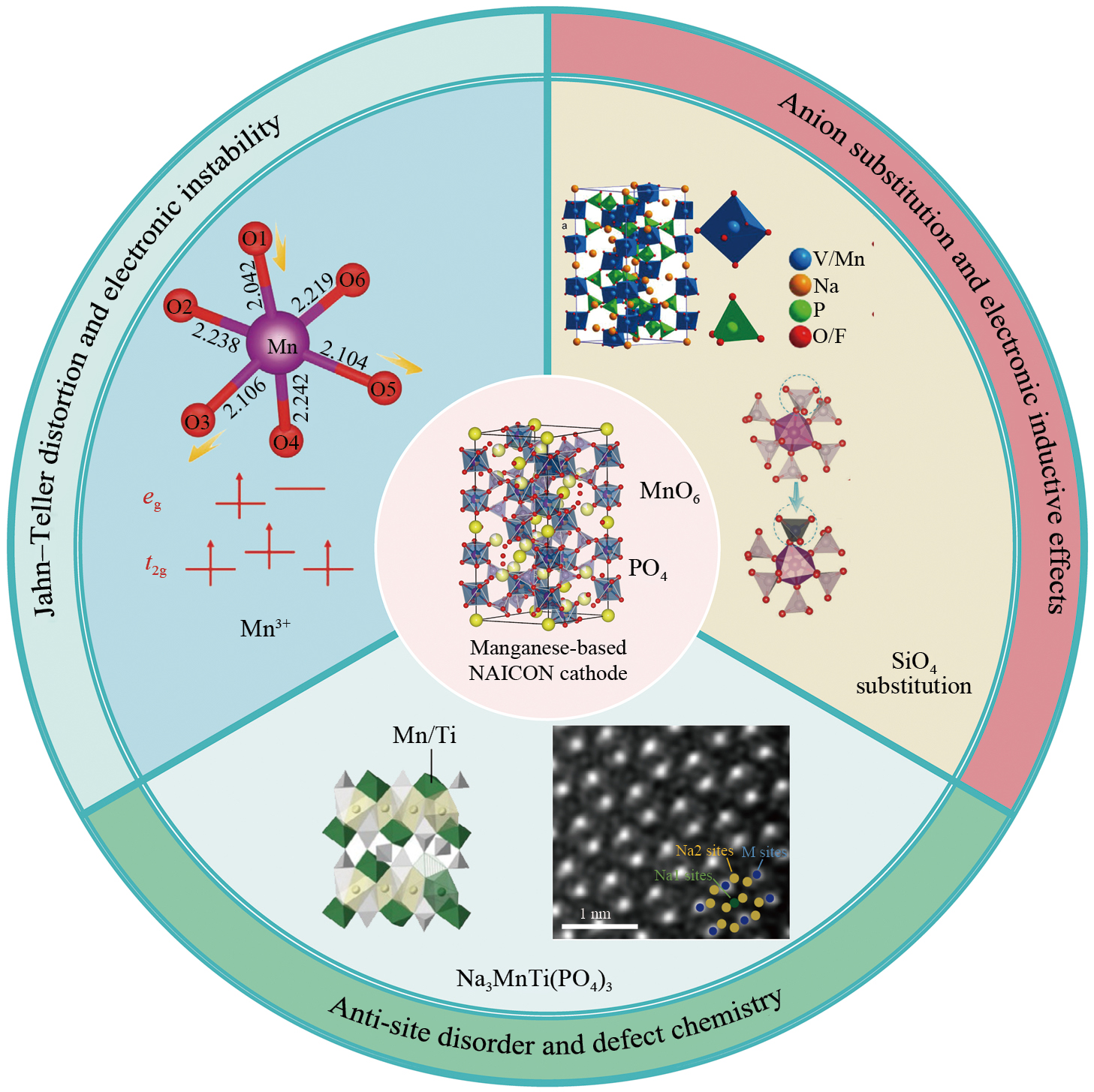
However, the further development of this material system still faces a series of critical challenges, particularly in terms of cycling stability and high-voltage reversibility. The presence of Mn3+ (with a high-spin d4 configuration) readily induces Jahn–Teller distortions, resulting in localized lattice distortions, anisotropic bond elongation, and heterogeneous strain accumulation during cycling. These phenomena subsequently trigger structural degradation and capacity fading. To address this issue, conventional cation doping strategies have demonstrated limited improvements, yet current research is progressively shifting from empirical trials toward rational design approaches focused on electronic structure engineering. For example, introducing dopants with distinct electronic characteristics—such as higher-valent Ti4+ or Zr4+, or redox-active Fe3+ species—can effectively modulate the degree of orbital hybridization between transition metals and oxygen, while redistributing d-electron density within the coordination environment. This strategic manipulation serves to mitigate the detrimental effects associated with Jahn–Teller distortions. While preserving the intact NASICON framework, such doping strategies contribute to enhanced electron delocalization and reduced lattice distortion energy.
However, it may reduce theoretical capacity because fewer Mn ions are available for redox reactions. It could also affect electronic conductivity by disrupting Mn-O electron delocalization. Consequently, they sustain structural stability and reversible redox reactions across an extended voltage window [5–7]. To achieve this objective, the crux lies in rationally balancing the synergistic effects of doping on ionic mobility, electronic conductivity, and structural resilience. Future research should prioritize integrating theoretical computations with advanced spectroscopic characterization to systematically identify doped systems that simultaneously stabilize the lattice while maintaining high ionic conductivity. Such efforts will propel the practical implementation of manganese-containing NASICON materials in next-generation SIBs.
Recent studies have underscored the significant influence of anti-site defects in manganese-based NASICON cathodes [8] (Fig. 1). In particular, in the typical Na3MnTi(PO4)3 structure, partial disorder where Mn and Na ions occupy swapped lattice positions leads to local disruptions in Na⁺ diffusion pathways [9]. This blockage raises the activation energy for Na⁺ migration, causing voltage hysteresis and capacity fade, which negatively impacts the material's overall electrochemical performance. This discovery challenges the traditional view that structural instability in these materials is mainly due to Jahn-Teller distortions of Mn3+ ions. Instead, it highlights that the spontaneous formation of micro-defects within the lattice plays a crucial role in determining electrochemical reversibility and material stability. Additionally, the equilibrium concentration of these defects is highly sensitive to the synthesis conditions, including thermodynamics and kinetics, as well as the ionic radii and charge distribution of the co-existing cations. This suggests that anti-site defects are controllable via the optimization of synthesis parameters, such as precursor selection, controlled nucleation, and tailored annealing protocols. By adjusting these factors to increase the formation energy of anti-site defects, it becomes possible to reduce defect density and preserve continuous Na⁺ conduction pathways, thereby enhancing both the performance and stability of the material. The recent focus on defect engineering has opened new avenues for improving the performance of manganese-based NASICON cathodes. By fine-tuning crystal chemistry to suppress anti-site defects, both Na⁺ migration dynamics and Mn redox cycling can be significantly improved. This design approach provides a fresh perspective on the structure-performance relationship, offering practical strategies for designing high-voltage, long-life SIBs. Ultimately, these findings pave the way for the development of new materials with improved electrochemical stability and cycling performance, contributing to the advancement of SIBs technology.
Anion chemistry provides an orthogonal and potent avenue for improving both voltage and structural integrity. Partial replacement of phosphate (PO43−) with more electronegative or structurally stabilizing moieties—such as fluorophosphate (PO3F⁻), pyrophosphate (P2O74−), and silicate (SiO44−)—induces inductive and geometric effects that strengthen transition-metal–ligand covalency and elevate Mn redox potentials [7, 10]. Fluorine incorporation is particularly noteworthy: by modifying the coordination field, fluorine promotes a more uniform distribution of metal–ligand bond lengths, counteracting the disorder associated with Jahn–Teller activity and enhancing the thermodynamic stability of higher Mn oxidation states. Meanwhile, P2O74− or SiO44− substitution reinforces the three-dimensional framework and broadens Na⁺ diffusion channels through enhanced structural rigidity and reduced lattice distortion. The combined inductive and structural stabilization reduces the driving force for oxygen evolution at elevated potentials and suppresses high-voltage side reactions that otherwise degrade cycle life. Deployment of mixed-anion frameworks therefore introduces a chemical degree of freedom that decouples mechanical robustness from achievable redox potential, enabling cathode formulations that sustain elevated operating voltages with improved ionic transport and structural durability. The synthesis of anion-substituted materials faces challenges like uniform substitution and maintaining structural integrity. Different anions can alter the lattice structure, causing defects or phase changes. Moreover, some anions may be volatile at high temperatures, leading to losses and performance degradation.
These strategies can be integrated in a complementary way to enhance structural stability. High-valent cation doping strengthens the M–O bond and suppresses Jahn–Teller distortion, while anion substitution improves the covalency and mitigates oxygen instability. Meanwhile, controllable synthesis reduces anti-site defects and ensures a uniform distribution of dopants. Their combined application thus produces a synergistic effect that maintains a stable framework under high-voltage operation.
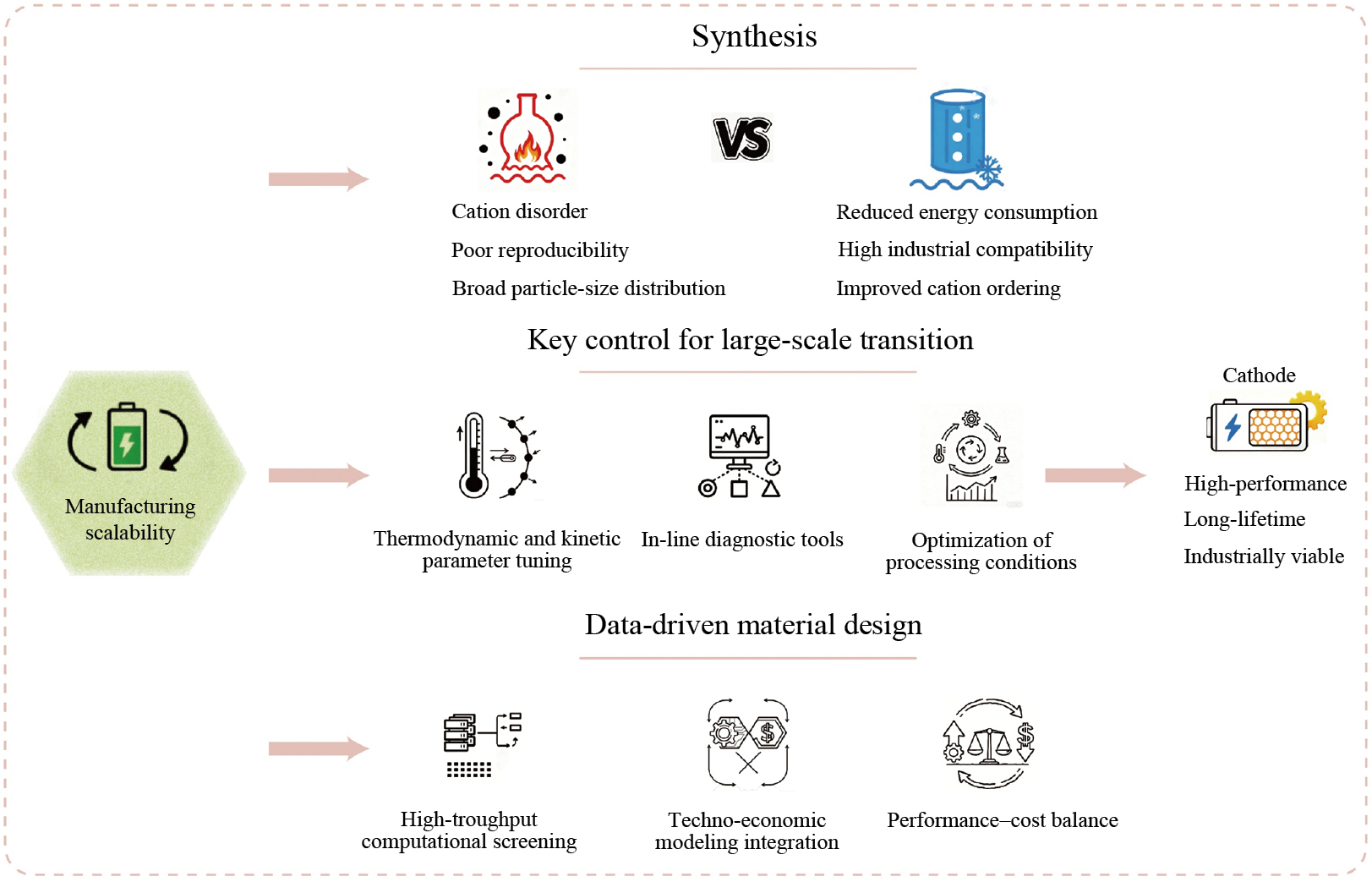
Scalability and manufacturability are fundamental prerequisites for translating SIBs cathode materials from laboratory discovery to practical application and must therefore be considered early in the material selection process [11] (Fig. 2). In practical terms, scaling up the synthesis of NASICON-type cathodes remains challenging due to difficulties in maintaining batch-to-batch reproducibility, controlling particle morphology and size distribution, and ensuring compatibility with electrode processing steps such as slurry casting and calendaring. Careful optimization of synthesis parameters and processing conditions is therefore essential to achieve consistent quality and cost-effective large-scale production. Conventional high-temperature solid-state synthesis, while effective for producing structurally stable compounds, often results in broad particle-size distributions and cation disorder, thereby hindering reproducibility and complicating electrode processing. In contrast, low-temperature solution-based routes and continuous manufacturing techniques offer distinct advantages for scale-up, including more uniform particle morphology, improved cation ordering, and reduced energy consumption, making them more compatible with industrial production. Achieving a smooth transition to large-scale synthesis, however, requires maintaining phase purity and precisely controlling defect chemistry. This can be accomplished through careful management of thermodynamic and kinetic parameters, the implementation of in-line diagnostic tools, and systematic optimization of processing conditions. Furthermore, integrating high-throughput computational screening with techno-economic modeling enables the rapid identification of compositions that simultaneously meet performance and cost-effectiveness criteria. To guide the design of Mn-based NASICON materials, key theoretical calculations include defect formation energies, Na⁺ migration barriers, and electronic density of states (DOS). These calculations help understand defect stability, predict Na⁺ migration efficiency, and optimize electronic conductivity, thereby enhancing material performance. Advances in operando characterization and multiscale modeling further play a pivotal role in guiding rational material design. Techniques such as in situ X-ray diffraction and electron microscopy can directly track lattice distortions, defect evolution, and interfacial reactions during electrochemical cycling, while mesoscale simulations reveal the coupling between microstructural dynamics and electrochemical behavior. Together, these experimental and theoretical insights establish a feedback framework that supports the rational design of high-performance, long-lifetime sodium-ion cathodes suitable for industrial deployment.
In conclusion, Manganese-based NASICON cathode materials offer a strategically significant technological platform for realizing low-cost, high-voltage Na+ energy storage. Their distinctive advantages encompass open three-dimensional ion channels, flexible tunability of composition, and high-voltage characteristics derived from manganese's multi-electron redox reactions. Nevertheless, unlocking their potential for large-scale energy storage necessitates several critical breakthroughs at both material design and preparation levels: suppressing Jahn–Teller lattice distortions through electronic structure modulation, ensuring continuous Na⁺ transport networks via defect engineering, further elevating operating voltages using anionic substitution strategies, and developing interface stabilization techniques to enable long-term cycling under high voltages. Nevertheless, precise control over the distribution of multiple modifiers and a deeper understanding of their long-term synergistic effects remain essential challenges toward practical application. Future research should prioritize integrating theory-guided composition optimization, in-situ characterization of dynamic structural evolution, and precise defect control within scalable manufacturing processes. Through such multiscale, interdisciplinary collaborative design, manganese-based NASICON materials hold promise for achieving ultra-long cycle life required for grid-scale energy storage while maintaining high energy density—thereby propelling SIBs technology toward practical application.
This work was supported by the National Natural Science Foundation of China (No. 52502221), the Natural Science Foundation of Jilin Province (No. 20250101013JJ), the Fundamental Research Funds for the Central Universities (No. 2412025QG001), and the National Postdoctoral Program for Innovative Talents (No. BX20240062).
J.-Y. Hwang, S.-T. Myung, and Y.-K. Sun, "Sodium-ion batteries: present and future," Chemical Society Reviews, vol. 46, no. 12, pp. 3529–3614, 2017.
C.-L. Shi, D. Muhtar, X.-Y. Lu, F.-Q. Liu, X. Lu, Z.-P. Sun, and Z.-P. Guo, "A medium‐entropy NASICON cathode for sodium-ion batteries achieving high energy density through dual enhancement of voltage and capacity," Advanced Energy Materials, vol. 15, no. 26, art. no. 2500448, 2025.
C.-L. Shi, J.-L. Xu, T. Tao, X.-Y. Lu, G.-P. Liu, F.-Q. Xie, S. Wu, Y.-X. Wu, and Z.-P. Sun, "Zero-strain Na3V2(PO4)2F3@RGO/CNT composite as a wide-temperature-tolerance cathode for Na-ion batteries with ultrahigh-rate performance," Small Methods, vol. 8, no. 3, art. no. e2301277, 2024.
Y. Liu, C. Sun, Y. Li, H.-B. Jin, and Y.-J. Zhao, "Recent progress of Mn-based NASICON-type sodium ion cathodes," Energy Storage Materials, vol. 57, no. 1, pp. 69–80, 2023.
H. Gao, I. D. Seymour, S. Xin, L. Xue, G. Henkelman, and J. B. Goodenough, "Na3MnZr(PO4)3: A high-voltage cathode for sodium batteries," Journal of the American Chemical Society, vol. 140, no. 51, pp. 18192–18199, 2018.
J.-S. Zhang, C.-F. Lin, Q.-B. Xia, C. Wang, and X.-S. Zhao, "Improved performance of Na3TiMn(PO4)3 using a Non-stoichiometric synthesis strategy," ACS Energy Letters, vol. 6, no. 6, pp. 2081–2089, 2021.
H. Huang, Y. Xia, Y. Hao, H. Li, M. Yousaf, S. Iqbal, H. Pan, M. Yan, and Y. Jiang, "Local electronic structure regulation enabling fluorophosphates cathode with improved redox potential and reversible capacity for sodium-ion batteries," Journal of the American Chemical Society, vol. 146, no. 42, pp. 28906–28913, 2024.
H. Zhang, Z.-Y. Gu, X.-T. Wang, X.-X. Zhao, Y.-L. Heng, Y. Liu, J.-L. Yang, S.-H. Zheng, and X.-L. Wu, "Electronic confinement-restrained MnNa. Anti-site defects in sodium-rich phosphates toward multi-electron transfer and high energy efficiency," Advanced Materials, vol. 36, no. 47, art. no. e2410797, 2024.
Y. Liu, X.-H. Rong, R. Bai, R.-J. Xiao, C.-L. Xu, C. Zhang, J.-P. Xu, W. Yin, Q.-H. Zhang et al., "Identifying the intrinsic anti-site defect in manganese-rich NASICON-type cathodes," Nature Energy, vol. 8, no. 10, pp. 1088–1096, 2023.
Y. Hou, Q. Liu, L. Yang, J. Hu, Z. Wang, X. Zhang, J. Pan, Z. Bai, H. Wang, and Z. Lu, "Manganese local environment modulation via SiO4 substitution to boost sodium storage performance of Na4MnCr(PO4)3," Small, vol. 19, no. 18, art. no. e2207466, 2023.
 Top
Top