

Human motion intention recognition via sEMG and joint kinematics fusion using MPSO-SVM for intelligent transportation systems AITranslate
Abstract AITranslate
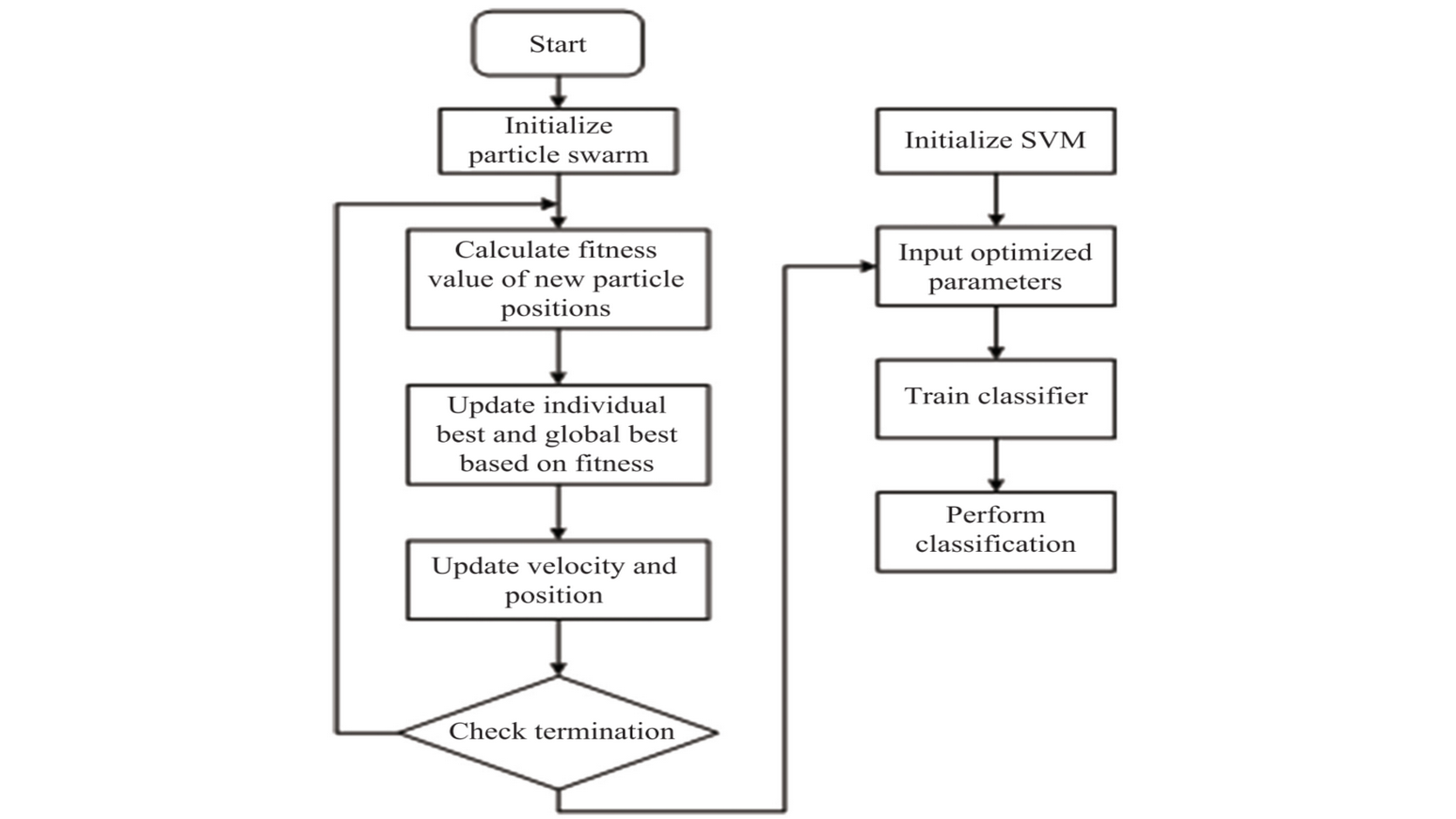
For intelligent transportation systems (ITS), understanding pedestrian motion intention is crucial for enhancing traffic safety, enabling human-centered mobility services, and facilitating adaptive vehicle-pedestrian interactions. This paper proposes a pedestrian gait recognition method based on a modified particle swarm optimization-support vector machine (MPSO-SVM), utilizing fused surface electromyography (sEMG) signals and ankle joint angles. Seven lower-limb gait features were extracted from these signals to characterize walking patterns. The MPSO algorithm optimizes the support vector machine (SVM) parameters to improve classification performance. Experimental results based on data collected from healthy subjects demonstrate a recognition accuracy exceeding 92.5% across four gait phases. The proposed method offers significantly enhanced accuracy and robustness compared to traditional classifiers. These results suggest that the method is suitable for deployment in intelligent traffic control systems, autonomous vehicle navigation, and urban pedestrian behavior prediction.
KeyWords AITranslate
[1]Z. Feng, Y. Luo, D. Li, J. Pan, R. Tan, and Y. Chen, "Integrating digital twins and machine learning for advanced control in green hydrogen production," Chain, vol. 2, no. 1, pp. 1–14, 2025.
[2]Z. Feng, I. Eiubovi, Y. Shao, Z. Fan, and R. Tan, "Review of digital twin technology applications in hydrogen energy," Chain, vol. 1, no. 1, pp. 54–74, 2024.
[3]S. Balasubramanian, V. Shukla, N. Islam, A. Upadhyay, and L. Duong, "Applying artificial intelligence in healthcare: Lessons from the COVID-19 pandemic," International Journal of Production Research, vol. 63, no. 2, pp. 594–627, 2025.
[4]T. Wang, P. Zheng, S. Li, and L. Wang, "Multimodal human-robot interaction for human‐centric smart manufacturing: A survey," Advanced Intelligent Systems, vol. 6. no. 3, p. 2300359, 2024.
[5]X. Tian, S. Zhou, H. Hao, H. Ruan, R. R. Gaddam, R. C. Dutta, and R. Tan, "Machine learning and density functional theory for catalyst and process design in hydrogen production," Chain, vol. 1, no. 2, pp. 150–166, 2024.
[6]Z. Feng, J. Huang, S. Jin, G. Wang, and Y. Chen, "Artificial intelligence-based multi-objective optimisation for proton exchange membrane fuel cell: A literature review," Journal of Power Sources, vol. 520, p. 230808, 2022.
[7]Z. Feng, S. Jin, H. Xiang, D. Li, S. Sun, H. Zhang, and Y. Chen, "Artificial intelligence-based optimization for ring-opening metathesis polymerization of proton exchange membrane," Journal of Polymer Research, vol. 30, no. 11, p. 418, 2023.
[8]L. Zhu, Z. Wang, Z. Ning, Y. Zhang, and C. Chen, "A novel motion intention recognition approach for soft exoskeleton via IMU," Electronics, vol. 9, no. 12, p. 2176, 2020.
[9]P. Zhang, J. Zhang, and A. Elsabbagh, "Lower limb motion intention recognition based on sEMG fusion features," IEEE Sensors Journal, vol. 22, no. 7, pp. 7005–7014, 2022.
[10]K. Yin, K. Xiang, M. Pang, J. Chen, and L. Yang, "Personalised control of robotic ankle exoskeleton through experience-based adaptive fuzzy inference," IEEE Access, vol. 7, pp. 72221–72233, 2019.
[11]K. Yin, Y. Xue, Y. Yu, and S. Xie, "Variable impedance control for bipedal robot standing balance based on artificial muscle activation model," Journal of Robotics, vol. 5, p. 8142161, 2021.
[12]L. -L. Li, G. -Z. Cao, H. -J. Liang, Y. -P. Zhang, and F. Cui, "Human lower limb motion intention recognition for exoskeletons: A review," IEEE Sensors Journal, vol. 23, no. 24, pp. 30007–30036, 2023.
[13]S. Kyeong, J. Feng, J. K. Ryu, J. J. Park, K. H. Lee, and J. Kim, "Surface electromyography characteristics for motion intention recognition and implementation issues in lower-limb exoskeletons," International Journal of Control, Automation and Systems, vol. 20, no. 3, pp. 1018–1028, 2022.
[14]A. J. Young, T. A. Kuiken, and L. J. Hargrove, "Analysis of using EMG and mechanical sensors to enhance intent recognition in powered lower limb prostheses," Journal of Neural Engineering, vol. 11, no. 5, p. 056021, 2014.
[15]J. Li, Z. Wang, C. Wang, and W. Su, "GaitFormer: Leveraging dual-stream spatial–temporal vision transformer via a single low-cost RGB camera for clinical gait analysis," Knowledge-Based Systems, vol. 295, p. 111810, 2024.
[16]Y. Wang, X. Cheng, L. Jabban, X. Sui, and D. Zhang, "Motion intention prediction and joint trajectories generation toward lower limb prostheses using EMG and IMU signals," IEEE Sensors Journal, vol. 22, no. 11, pp. 10719–10729, 2022.
[17]Z. Zhou, Q. Tao, N. Su, J. Liu, Q. Chen, and B. Li, "Lower limb motion recognition based on sEMG and CNN-TL fusion model," Sensors, vol. 24, no. 21, p. 7087, 2024.
[18]J. Wang, Y. Dai, and X. Si, "Analysis and recognition of human lower limb motions based on electromyography (EMG) signals," Electronics, vol. 10, no. 20, p. 2473, 2021.
[19]B. Wang, C. Ou, N. Xie, L. Wang, T. Yu, G. Fan, and J. Chu, "Lower limb motion recognition based on surface electromyography signals and its experimental verification on a novel multi-posture lower limb rehabilitation robots," Computers and Electrical Engineering, vol. 101, p. 108067, 2022.
[20]F. Gao, T. Tian, T. Yao, and Q. Zhang, "Human gait recognition based on multiple feature combination and parameter optimization algorithms," Computational Intelligence and Neuroscience, vol. 2021, no. 1, p. 6693206, 2021.
[21]K. Anam and A. Al-Jumaily, "Evaluation of extreme learning machine for classification of individual and combined finger movements using electromyography on amputees and non-amputees," Neural Networks, vol. 85, pp. 51–68, 2017.
[22]S. Kyeong, J. Feng, J. K. Ryu, and J. J. Park, "Surface electromyography characteristics for motion intention recognition and implementation issues in lower-limb exoskeletons," International Journal of Control, Automation and Systems, vol. 20, no. 3, pp. 1018–1028, 2022.
[23]X. Wang, D. Dong, X. Chi, S. Wang, Y. Miao, M. An, and A. Gavrilov, "sEMG-based consecutive estimation of human lower limb movement by using multi-branch neural network," Biomedical Signal Processing and Control, vol. 68, p. 102781, 2021.
[24]X. Yuan, T. Wu, X. Yuan, and W. Wang, "Research on a full-body power-assisted exoskeleton control method based on GSO-RF intent recognition algorithm," Journal of Mechanical Engineering, vol. 60, no. 17, pp. 91–101, 2024.
[25]E. Wang, X. Chen, Y. Li, Z. Fu, and J. Huang, "Lower limb motion intent recognition based on sensor fusion and fuzzy multitask learning," IEEE Transactions on Fuzzy Systems, vol. 32, no. 5, pp. 2903–2914, 2024.
[26]A. F. T. Ibrahim, V. R. Gannapathy, L. W. Chong, L. W. Chong, and I. S. M. Isa, "Analysis of electromyography (EMG) signal for human arm muscle: A review," Advanced Computer and Communication Engineering Technology: Proceedings of ICOCOE 2015, vol. 2015, pp. 567–575, 2015.
[27]E. Farago, D. MacIsaa, M. Suk, and A. D. C. Chan, "A review of techniques for surface electromyography signal quality analysis," IEEE Reviews in Biomedical Engineering, vol. 16, pp. 472–486, 2022.
[28]A. Roy and S. Chakraborty, "Support vector machine in structural reliability analysis: A review," Reliability Engineering & System Safety, vol. 233, p. 109126, 2023.
[29]M. Bansal, A. Goyal, and A. Choudhary, "A comparative analysis of K-nearest neighbor, genetic, support vector machine, decision tree, and long short-term memory algorithms in machine learning," Decision Analytics Journal, vol. 3, p. 100071, 2022.
[30]K. Yin, B. Tang, M. Li, and H. Zhao, "A multi-objective optimization approach based on an enhanced particle swarm optimization algorithm with evolutionary game theory," IEEE Access, vol. 11, pp. 77566–77584, 2023.
[31]D. Wang, D. Tan, and L. Liu, "Particle swarm optimization algorithm: An overview," Soft Computing, vol. 22, no. 2, pp. 387–408, 2018.
[32]A. G. Gad, "Particle swarm optimization algorithm and its applications: A systematic review," Archives of Computational Methods in Engineering, vol. 29, no. 5, pp. 2531–2561, 2022.
[33]J. Yao, X. Luo, F. Li, J. Dou, and H. Luo, "Research on hybrid strategy particle swarm optimization algorithm and its applications," Scientific Reports, vol. 14, no. 1, p. 24928, 2024.
Basic Information:
DOI:10.23919/CHAIN.2025.000012
Chinese Library Classification Number:
Citation Information:
For intelligent transportation systems (ITS), understanding pedestrian motion intention is crucial for enhancing traffic safety, enabling human-centered mobility services, and facilitating adaptive vehicle-pedestrian interactions. This paper proposes a pedestrian gait recognition method based on a modified particle swarm optimization-support vector machine (MPSO-SVM), utilizing fused surface electromyography (sEMG) signals and ankle joint angles. Seven lower-limb gait features were extracted from these signals to characterize walking patterns. The MPSO algorithm optimizes the support vector machine (SVM) parameters to improve classification performance. Experimental results based on data collected from healthy subjects demonstrate a recognition accuracy exceeding 92.5% across four gait phases. The proposed method offers significantly enhanced accuracy and robustness compared to traditional classifiers. These results suggest that the method is suitable for deployment in intelligent traffic control systems, autonomous vehicle navigation, and urban pedestrian behavior prediction.
quote
| GB/T 7714-2015 | [1] Kaiyang Yin, Yangyang Li, Xuying Li, et al. Human motion intention recognition via sEMG and joint kinematics fusion using MPSO-SVM for intelligent transportation systems[J]. Chain, 2025, 2(2): 198-209. DOI:10.23919/CHAIN.2025.000012. |
| MLA | [1] Kaiyang Yin, et al., "Human motion intention recognition via sEMG and joint kinematics fusion using MPSO-SVM for intelligent transportation systems." Chain, vol. 2, no. 2, 2025, pp. 198-209, https://doi.org/10.23919/CHAIN.2025.000012. |
| APA | [1] Kaiyang Yin, Yangyang Li, Xuying Li, & Huanli Zhao. (2025). Human motion intention recognition via sEMG and joint kinematics fusion using MPSO-SVM for intelligent transportation systems. Chain, 2(2), 198-209. https://doi.org/10.23919/CHAIN.2025.000012 |
| IEEE | [1] Kaiyang Yin, Yangyang Li, Xuying Li, and Huanli Zhao, "Human motion intention recognition via sEMG and joint kinematics fusion using MPSO-SVM for intelligent transportation systems," Chain, vol. 2, no. 2, pp. 198-209, 2025, doi: 10.23919/CHAIN.2025.000012. keywords: {lower-extremity motion intention;support vector machine (SVM);surface electromyography (sEMG);data fusion;intelligent transportation systems} |