

Soft materials in aerospace: from discrete functional elements to integrated system enablers AITranslate
Abstract AITranslate
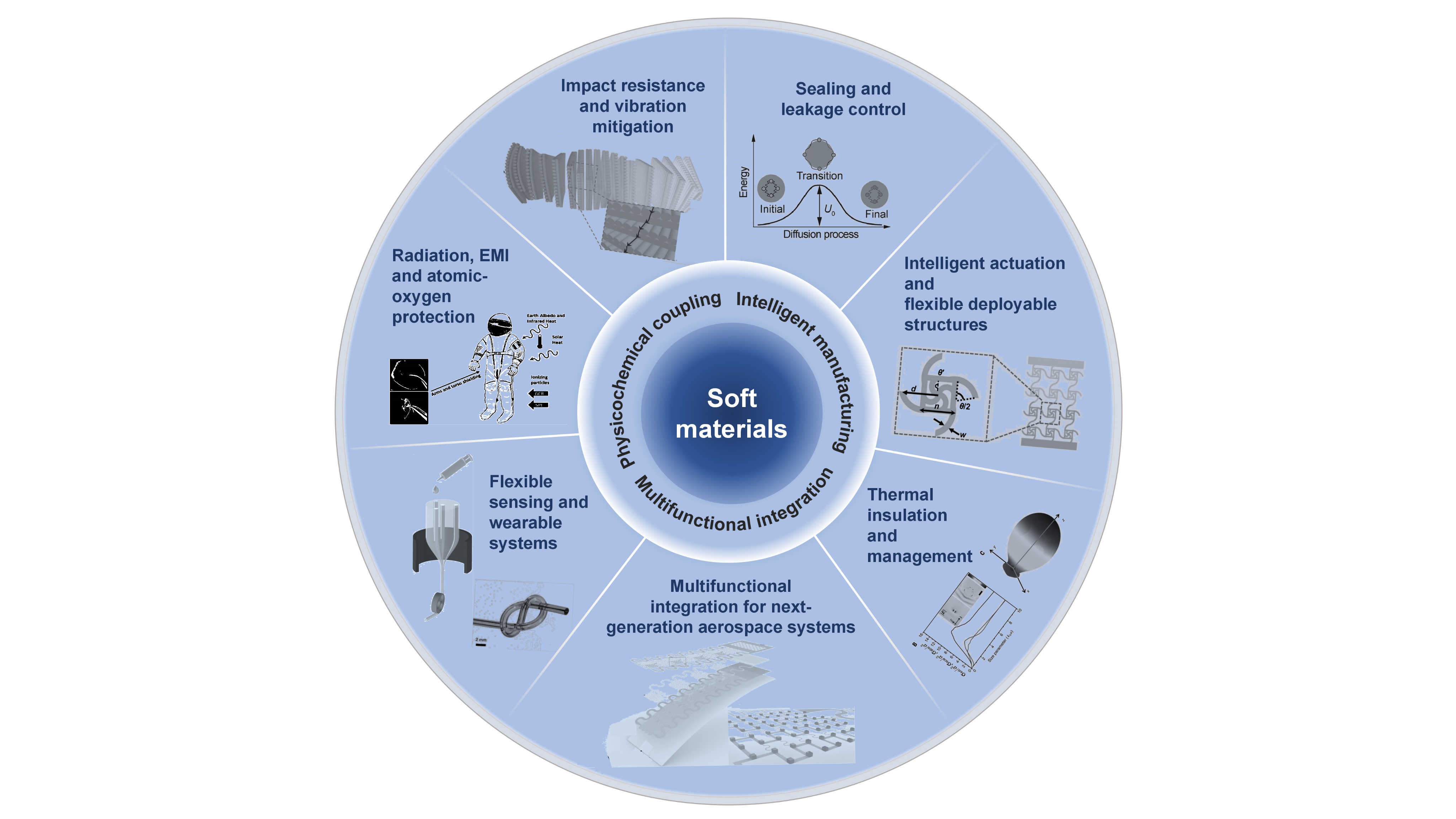
Soft materials are attracting increasing attention in aerospace engineering because they provide combinations of compliance, multifunctionality, and environmental adaptability that are difficult to achieve simultaneously with conventional rigid materials. This review summarizes recent progress in the use of elastomers, hydrogels, aerogels, shape-memory polymers, and related composites for aerospace applications, with emphasis on impact and vibration mitigation, sealing and leakage control, intelligent actuation and deployable structures, thermal insulation and management, radiation protection, flexible sensing, and multifunctional integration. Across these areas, the role of soft materials is shifting from passive auxiliaries toward functional material platforms that couple structure, actuation, sensing, transport regulation, and protection. The literature also shows that several key barriers remain unresolved. Soft materials in aerospace must operate under coupled thermal, mechanical, chemical, vacuum, radiation, and atomic-oxygen environments, yet current understanding of long-term degradation, cross-scale failure, and function retention under such conditions remains limited. In addition, many reported applications are still evaluated mainly through laboratory-scale demonstrations, leaving a substantial gap between proof-of-concept performance and mission-relevant validation. Predictive theories linking molecular design, microstructural evolution, and system-level behavior are still insufficient. This review identifies four closely related directions for future progress: coupled multiphysical and mechano-chemical theories for deformation, aging, and failure; accelerated testing and lifetime prediction methods linked to realistic service conditions; lightweight system architectures integrating structure, actuation, sensing, and protection; and AI-assisted design combined with 4D printing and other advanced manufacturing approaches for rapid optimization and mission-specific customization. Overall, soft materials should be developed not merely as discrete functional elements, but as enabling platforms for future aerospace systems under extreme environments.
KeyWords AITranslate
1.M. P. Falaschetti, F. Semprucci, J. Birnie Hernández, et al., "Experimental and Numerical Assessment of Crashworthiness Properties of Composite Materials: A Review," Aerospace 12, no. 2 (2025): 122, https://doi.org/10.3390/aerospace12020122.
2.H. Y. Guo, H. Yuan, J. X. Zhang, et al., "Review of Sandwich Structures under Impact Loadings: Experimental, Numerical and Theoretical Analysis," Thin-Walled Structures 196 (2024): 111541, https://doi.org/10.1016/j.tws.2023.111541.
3.C. C. Liu, X. J. Jing, S. Daley, et al., "Recent Advances in Micro-Vibration Isolation," Mechanical Systems and Signal Processing 56 (2015): 55–80, https://doi.org/10.1016/j.ymssp.2014.10.007.
4.J. H. Ouyang, Y. F. Li, Y. Z. Zhang, et al., "High-Temperature Solid Lubricants and Self-Lubricating Composites: A Critical Review," Lubricants 10, no. 8 (2022): 177, https://doi.org/10.3390/lubricants10080177.
5.X. Y. Tang, H. Ma, J. S. Zhang, et al., "Research Progress on Carbon-Based Materials for Aerospace Applications," Composites Part B: Engineering 309 (2026): 113105, https://doi.org/10.1016/j.compositesb.2025.113105.
6.J. R. Yang, Z. Q. Zhu, S. J. Han, et al., "Evolution, Limitations, Advantages, and Future Challenges of Magnesium Alloys as Materials for Aerospace Applications," Journal of Alloys and Compounds 1008 (2024): 176707, https://doi.org/10.1016/j.jallcom.2024.176707.
7.X. L. Wang, X. D. Gao, Z. H. Zhang, et al., "Advances in Modifications and High-Temperature Applications of Silicon Carbide Ceramic Matrix Composites in Aerospace: A Focused Review," Journal of the European Ceramic Society 41, no. 9 (2021): 4671–4688, https://doi.org/10.1016/j.jeurceramsoc.2021.03.051.
8.R. Verduci, V. Romano, G. Brunetti, et al., "Solar Energy in Space Applications: Review and Technology Perspectives," Advanced Energy Materials 12, no. 29 (2022): 2200125, https://doi.org/10.1002/aenm.202200125.
9.F. Xie, Y. H. Yang, Z. X. Ping, et al., "Progress and Strategies in Advanced Aerospace Materials for Extreme Environments: A Review," Acta Astronautica 238 (2026): 184–196, https://doi.org/10.1016/j.actaastro.2025.08.011.
10.S. M. Li, Z. L. Han, W. Q. Xu, et al., "Trace-Stimuli-Triggered Controlled Degradation for Hydrogel Adhesives," National Science Review 13, no. 1 (2026): nwaf498, https://doi.org/10.1093/nsr/nwaf498.
11.Z. L. Han, P. Wang, Y. C. Lu, et al., "A Versatile Hydrogel Network–Repairing Strategy Achieved by the Covalent-Like Hydrogen Bond Interaction," Science Advances 8, no. 8 (2022): eabl5066, https://doi.org/10.1126/sciadv.abl5066.
12.P. P. Zhu and Y. M. Fu, "Influence of Crosslinks and Entanglements on Hydrogel Reinforcement: Insights from Molecular Dynamics Simulations," Frontiers in Materials 12 (2025): 1695094, https://doi.org/10.3389/fmats.2025.1695094.
13.B. H. Liu, T. H. Yin, J. Y. Zhu, et al., "Tough and Fatigue-Resistant Polymer Networks by Crack Tip Softening," Proceedings of the National Academy of Sciences 120, no. 6 (2023): e2217781120, https://doi.org/10.1073/pnas.2217781120.
14.Z. H. Qu, Y. M. Fu, Q. P. Yang, et al., "A Method for Identifying the Damage Thresholds of Porcine Brain under Low- and Medium-Strain Rates," Extreme Mechanics Letters 77 (2025): 102335, https://doi.org/10.1016/j.eml.2025.102335.
15.D. M. Zhong, Z. C. Wang, J. W. Xu, et al., "A Strategy for Tough and Fatigue-Resistant Hydrogels via Loose Cross-Linking and Dense Dehydration-Induced Entanglements," Nature Communications 15, no. 1 (2024): 5896, https://doi.org/10.1038/s41467-024-50364-3.
16.G. Y. Mao, L. Wu, Y. M. Fu, et al., "Design and Characterization of a Soft Dielectric Elastomer Peristaltic Pump Driven by Electromechanical Load," IEEE/ASME Transactions on Mechatronics 23, no. 5 (2018): 2132–2143, https://doi.org/10.1109/TMECH.2018.2864252.
17.X. C. Hu, Y. M. Fu, T. H. Wu, et al., "Study of Non-Uniform Axial Magnetic Field Induced Deformation of a Soft Cylindrical Magneto-Active Actuator," Soft Matter 17, no. 32 (2021): 7498–7505, https://doi.org/10.1039/D1SM00757B.
18.Z. Chen, D. H. Zhao, B. H. Liu, et al., "3D Printing of Multifunctional Hydrogels," Advanced Functional Materials 29, no. 20 (2019): 1900971, https://doi.org/10.1002/adfm.201900971.
19.Q. Ge, Z. Chen, J. X. Cheng, et al., "3D Printing of Highly Stretchable Hydrogel with Diverse UV Curable Polymers," Science Advances 7, no. 2 (2021): eaba4261, https://doi.org/10.1126/sciadv.aba4261.
20.X. Y. Song, M. F. Zhang, X. Y. Zhang, et al., "Integrated 3D Printing of Liquid Metal and Elastomer for Soft Robots and Electronics," Research 9 (2026): 1174, https://doi.org/10.34133/research.1174.
21.W. J. Wang, Y. Xiang, J. F. Yu, et al., "Development and Prospect of Smart Materials and Structures for Aerospace Sensing Systems and Applications," Sensors 23, no. 3 (2023): 1545, https://doi.org/10.3390/s23031545.
22.N. G. Garafolo and C. C. Daniels, "A Compressible Permeation Approach to Elastomeric Space Seal Characterization," Journal of Fluids Engineering 134 (2012): 051204, https://doi.org/10.1115/1.4006418.
23.B. Wang, J. C. Zhu, S. C. Zhong, et al., "Space Deployable Mechanics: A Review of Structures and Smart Driving," Materials & Design 237 (2024): 112557, https://doi.org/10.1016/j.matdes.2023.112557.
24.A. Yadav, S. K. Singh, S. Das, et al., "Shape Memory Polymer and Composites for Space Applications: A Review," Polymer Composites 46, no. 13 (2025): 11647–11683, https://doi.org/10.1002/pc.29707.
25.R. Z. Jin, Z. H. Zhou, J. Liu, et al., "Aerogels for Thermal Protection and Their Application in Aerospace," Gels 9, no. 8 (2023): 606, https://doi.org/10.3390/gels9080606.
26.L. Pernigoni, U. Lafont and A. M. Grande, "Self-Healing Polymers for Space: A Study on Autonomous Repair Performance and Response to Space Radiation," Acta Astronautica 210 (2023): 627–634, https://doi.org/10.1016/j.actaastro.2023.05.032.
27.C. Zhang, P. Hu, L. Xun, et al., "A Universal Strategy towards the Fabrication of Ultra-High Temperature Ceramic Matrix Composites with Outstanding Mechanical Properties and Ablation Resistance," Composites Part B: Engineering 280 (2024): 111485, https://doi.org/10.1016/j.compositesb.2024.111485.
28.W. Z. Zhang, M. Y. Tan, D. M. Chen, et al., "Sugar‐Derived Nanocrystalline Graphite Matrix C/C Composites with Excellent Ablative Resistance at 3000° C," Advanced Materials 36, no. 7 (2024): 2309899, https://doi.org/10.1002/adma.202309899.
29.S. Z. Zhang, G. Y. Xu, H. Ji, et al., "Thermally Insulating Polybenzoxazine/Nanosilica Aerogel Ablation Resistant to 1100° C for Re-Entry Capsules," ACS Applied Polymer Materials 5, no. 10 (2023): 8223–8234, https://doi.org/10.1021/acsapm.3c01390.
30.R. B. Mishra, N. El‐Atab, A. M. Hussain, et al., "Recent Progress on Flexible Capacitive Pressure Sensors: From Design and Materials to Applications," Advanced Materials Technologies 6, no. 4 (2021): 2001023, https://doi.org/10.1002/admt.202001023.
31.M. Z. Zhai, S. J. Zhao, H. Guo, et al., "Bionic-Structured Electromagnetic Interference Shielding Composites," Science Bulletin 70, no. 14 (2025): 2347–2364, https://doi.org/10.1016/j.scib.2025.04.074.
32.W. K. Yang, H. Liu, H. Y. Du, et al., "Robust and Superelastic Spider Web-Like Polyimide Fiber-Based Conductive Composite Aerogel for Extreme Temperature-Tolerant Linear Pressure Sensor," Science China Materials 66, no. 7 (2023): 2829–2842, https://doi.org/10.1007/s40843-022-2418-1.
33.M. Ben Amar, P. Ciarletta and P. A. Haas, "Morphogenesis in Space Offers Challenges and Opportunities for Soft Matter and Biophysics," Communications Physics 6, no. 1 (2023): 150, https://doi.org/10.1038/s42005-023-01242-9.
34.C. C. Deng, D. Mu, X. Z. Jia, et al., "Effects of Rubber Shock Absorber on the Flywheel Micro Vibration in the Satellite Imaging System," Photonic Sensors 6, no. 4 (2016): 372–384, https://doi.org/10.1007/s13320-016-0349-1.
35.C. C. Deng, D. Mu, Y. An, et al., "Reduction of Satellite Flywheel Microvibration Using Rubber Shock Absorbers," Journal of Vibroengineering 19, no. 3 (2017): 1465–1478, https://doi.org/10.21595/jve.2016.17021.
36.J. H. Han, S. H. Youn, H. K. Jeong, et al., "Enhanced Shock and Vibration Isolator for the Attenuation of Low-Frequency Vibration and High-Frequency Pyroshock Loads," Proceedings of SPIE 8409 (2012): 84090Z, https://doi.org/10.1117/12.923639.
37.J. Huang, Y. C. Xu, S. H. Qi, et al., "Ultrahigh Energy-Dissipation Elastomers by Precisely Tailoring the Relaxation of Confined Polymer Fluids," Nature Communications 12, no. 1 (2021): 3610, https://doi.org/10.1038/s41467-021-23984-2.
38.G. Q. Chen, J. B. Wu, Z. W. Wang, et al., "Armored Polymer-Fluid Gels with Integrated Damping and Impact Protection across Broad Temperatures," Science Advances 11, no. 15 (2025): eadv5292, https://doi.org/10.1126/sciadv.adv5292.
39.Z. Y. Xu, J. J. Lu, D. Lu, et al., "Rapidly Damping Hydrogels Engineered through Molecular Friction," Nature Communications 15, no. 1 (2024): 4895, https://doi.org/10.1038/s41467-024-49239-4.
40.L. Li, B. H. Wu, S. T. Sun, et al., "High-Entropy Thermal-Stiffening Hydrogels with Fast Switching Dynamics," National Science Review 12, no. 4 (2025): nwaf072, https://doi.org/10.1093/nsr/nwaf072.
41.S. M. Wen, W. Gao, S. C. Zhang, et al., "Gradient Double-Twisted Bouligand Structural Design for High Impact Resistance over a Wide Range of Loading Velocities," Science Advances 11, no. 23 (2025): eadv2169, https://doi.org/10.1126/sciadv.adv2169.
42.J. H. Chai, J. Chen, L. S. Liang, et al., "Low‐Frequency Acoustic Metamaterials: Mechanisms, Designs, and Broadband Absorption Strategies," Advanced Engineering Materials 28 (2026): e202502352, https://doi.org/10.1002/adem.202502352.
43.W. Jiang, X. Ren, S. L. Wang, et al., "Manufacturing, Characteristics and Applications of Auxetic Foams: A State-of-the-Art Review," Composites Part B: Engineering 235 (2022): 109733, https://doi.org/10.1016/j.compositesb.2022.109733.
44.H. B. Feng and L. Li, "Review of Damping Composite Materials and Structures Involving Self-Healing Constituents," Frontiers of Mechanical Engineering 20, no. 2 (2025): 15, https://doi.org/10.1007/s11465-025-0833-7.
45.S. Y. Ni, X. Y. Chen, H. Wu, et al., "Review on Data‐and Mathematics‐Driven Optimization for Metamaterial Lattice Structures," Advanced Engineering Materials 28, no. 3 (2026): e202501701, https://doi.org/10.1002/adem.202501701.
46.B. N. J. Persson, B. Lorenz, M. Shimizu, et al., "Multiscale Contact Mechanics with Application to Seals and Rubber Friction on Dry and Lubricated Surfaces," Advances in Polymer Science 275 (2016): 103–156, https://doi.org/10.1007/12_2016_4.
47.A. Papangelo and M. Ciavarella, "Viscoelastic Normal Indentation of Nominally Flat Randomly Rough Contacts," International Journal of Mechanical Sciences 211 (2021): 106783, https://doi.org/10.1016/j.ijmecsci.2021.106783.
48.C. Putignano, "Oscillating Viscoelastic Periodic Contacts: A Numerical Approach," International Journal of Mechanical Sciences 208 (2021): 106663, https://doi.org/10.1016/j.ijmecsci.2021.106663.
49.X. M. Huang, J. M. Gu, M. Li, et al., "A Leakage Prediction Model for Sealing Performance Assessment of EPDM O-Rings under Irradiation Conditions," Polymers 15, no. 14 (2023): 3073, https://doi.org/10.3390/polym15143073.
50.M. Li, L. He, D. K. Zheng, et al., "Characterization of Long-Term Evolution of Leakage Rates of O-Ring Seals in Nuclear Power Plant under High-Temperature and High-Pressure Conditions," Nuclear Engineering and Design 429 (2024): 113666, https://doi.org/10.1016/j.nucengdes.2024.113666.
51.C. L. Zhou, Y. L. Huang, Y. R. Zheng, et al., "Hydrogen Permeation Behavior of Rubber Sealing Materials for Hydrogen Infrastructure: Recent Advances and Perspectives," International Journal of Hydrogen Energy 59 (2024): 742–754, https://doi.org/10.1016/j.ijhydene.2024.02.042.
52.Y. R. Zheng, Y. Tan, C. L. Zhou, et al., "A Review on Effect of Hydrogen on Rubber Seals Used in the High-Pressure Hydrogen Infrastructure," International Journal of Hydrogen Energy 45, no. 43 (2020): 23721–23738, https://doi.org/10.1016/j.ijhydene.2020.06.069.
53.Y. M. Fu, X. C. Hu, Y. D. Liu, et al., "Impact-Induced Bubble Interactions and Coalescence in Soft Materials," International Journal of Solids and Structures 238 (2022): 111387, https://doi.org/10.1016/j.ijsolstr.2021.111387.
54.Y. M. Fu, H. T. Lu, G. D. Nian, et al., "Size-Dependent Inertial Cavitation of Soft Materials," Journal of the Mechanics and Physics of Solids 137 (2020): 103859, https://doi.org/10.1016/j.jmps.2019.103859.
55.Y. M. Fu, T. H. Yin, S. X. Qu, et al., "Cavitation/Fracture Transition of Soft Materials," Journal of the Mechanics and Physics of Solids 172 (2023): 105192, https://doi.org/10.1016/j.jmps.2022.105192.
56.Y. M. Fu, J. Y. Zhu, D. M. Zhong, et al., "Cavitation and Fracture in Soft Materials with Coupled Effects of Viscoelasticity and Damage," Acta Mechanica Sinica 42 (2026): 425460, https://doi.org/10.1007/s10409-025-25460-x.
57.J. B. Liu and S. T. Lin, "Strain-Engineered Particle Diffusion in Uniaxially Deformed Polymer Networks," Journal of the Mechanics and Physics of Solids 191 (2024): 105732, https://doi.org/10.1016/j.jmps.2024.105732.
58.S. G. Burnay, "An Overview of Polymer Ageing Studies in the Nuclear Power Industry," Nuclear Instruments and Methods in Physics Research Section B: Beam Interactions with Materials and Atoms 185, no. 1–4 (2001): 4–7, https://doi.org/10.1016/S0168-583X(01)00757-1.
59.C. H. Jung, D. H. Lee, I. T. Hwang, et al., "Fabrication and Characterization of Radiation-Resistant LDPE/MWCNT Nanocomposites," Journal of Nuclear Materials 438, no. 1–3 (2013): 41–45, https://doi.org/10.1016/j.jnucmat.2013.03.023.
60.R. J. Han, Y. L. Li, Q. S. Zhu, et al., "Research on the Preparation and Thermal Stability of Silicone Rubber Composites: A Review," Composites Part C: Open Access 8 (2022): 100249, https://doi.org/10.1016/j.jcomc.2022.100249.
61.J. K. Jung, "Review of Developed Methods for Measuring Gas Uptake and Diffusivity in Polymers Enriched by Pure Gas under High Pressure," Polymers 16, no. 5 (2024): 723, https://doi.org/10.3390/polym16050723.
62.D. Battini, G. Donzella, A. Avanzini, et al., "Experimental Testing and Numerical Simulations for Life Prediction of Gate Valve O-Rings Exposed to Mixed Neutron and Gamma Fields," Materials & Design 156 (2018): 514–527, https://doi.org/10.1016/j.matdes.2018.07.020.
63.P. S. Mahankar and A. S. Dhoble, "Review of Hydraulic Seal Failures Due to Effect of Medium to High Temperature," Engineering Failure Analysis 127 (2021): 105552, https://doi.org/10.1016/j.engfailanal.2021.105552.
64.U. Basuli, J. Jose, R. H. Lee, et al., "Properties and Degradation of the Gasket Component of a Proton Exchange Membrane Fuel Cell—A Review," Journal of Nanoscience and Nanotechnology 12, no. 10 (2012): 7641–7657, https://doi.org/10.1166/jnn.2012.6627.
65.H. Patel, S. Salehi, R. Ahmed, et al., "Review of Elastomer Seal Assemblies in Oil & Gas Wells: Performance Evaluation, Failure Mechanisms, and Gaps in Industry Standards," Journal of Petroleum Science and Engineering 179 (2019): 1046–1062, https://doi.org/10.1016/j.petrol.2019.05.019.
66.X. F. Ma, T. J. Li, J. Y. Ma, et al., "Recent Advances in Space-Deployable Structures in China," Engineering 17 (2022): 207–219, https://doi.org/10.1016/j.eng.2022.04.013.
67.M. Straubel, M. E. Zander and C. Hühne, "Design and Sizing of the GOSSAMER Boom Deployment Concept," Advances in Solar Sailing (2014): 593–608, https://doi.org/10.1007/978-3-642-34907-2_37.
68.M. Chandra, S. Kumar, S. Chattopadhyaya, et al., "A Review on Developments of Deployable Membrane-Based Reflector Antennas," Advances in Space Research 68, no. 9 (2021): 3749–3764, https://doi.org/10.1016/j.asr.2021.06.051.
69.K. Tserpes and I. Sioutis, "Advances in Composite Materials for Space Applications: A Comprehensive Literature Review," Aerospace 12, no. 3 (2025): 215, https://doi.org/10.3390/aerospace12030215.
70.Y. L. Xia, Y. He, F. H. Zhang, et al., "A Review of Shape Memory Polymers and Composites: Mechanisms, Materials, and Applications," Advanced Materials 33, no. 6 (2021): 2000713, https://doi.org/10.1002/adma.202000713.
71.Y. J. Liu, H. Y. Du, L. W. Liu, et al., "Shape Memory Polymers and Their Composites in Aerospace Applications: A Review," Smart Materials and Structures 23, no. 2 (2014): 023001, https://doi.org/10.1088/0964-1726/23/2/023001.
72.T. D. Dao, N. S. Ha, N. S. Goo, et al., "Design, Fabrication, and Bending Test of Shape Memory Polymer Composite Hinges for Space Deployable Structures," Journal of Intelligent Material Systems and Structures 29, no. 8 (2018): 1560–1574, https://doi.org/10.1177/1045389X17742728.
73.S. K. Chandaka, A. Das and P. Laskar, "Emergence of Shape Memory Polymers as a New Material for Diverse Applications," RSC Advances 15, no. 38 (2025): 31210–31229, https://doi.org/10.1039/d5ra04372g.
74.J. Q. Liu, Y. C. Gao, Y. J. Lee, et al., "Responsive and Foldable Soft Materials," Trends in Chemistry 2, no. 2 (2020): 107–122, https://doi.org/10.1016/j.trechm.2019.11.003.
75.X. X. Xia, C. M. Spadaccini and J. R. Greer, "Responsive Materials Architected in Space and Time," Nature Reviews Materials 7, no. 9 (2022): 683–701, https://doi.org/10.1038/s41578-022-00450-z.
76.X. Z. Xin, L. W. Liu, Y. J. Liu, et al., "Origami-Inspired Self-Deployment 4D Printed Honeycomb Sandwich Structure with Large Shape Transformation," Smart Materials and Structures 29, no. 6 (2020): 065015, https://doi.org/10.1088/1361-665X/ab85a4.
77.C. L. Yang, X. Z. Xin, W. J. Zhao, et al., "Highly Programmable 4D Printed Multi-Shape Gradient Metamaterials and Multifunctional Devices," International Journal of Extreme Manufacturing 7, no. 5 (2025): 055504, https://doi.org/10.1088/2631-7990/add8ca.
78.X. Z. Xin, C. Lin, B. X. Li, et al., "Multifunctional and Reprogrammable 4D Pixel Mechanical Metamaterials," International Journal of Extreme Manufacturing 7, no. 1 (2025): 015506, https://doi.org/10.1088/2631-7990/ad884a.
79.X. B. Hou, J. Chen, Z. L. Chen, et al., "Flexible Aerogel Materials: A Review on Revolutionary Flexibility Strategies and the Multifunctional Applications," ACS Nano 18, no. 18 (2024): 11525–11559, https://doi.org/10.1021/acsnano.4c00347.
80.Y. N. Zeng and J. H. Zhang, "Multifunctional Polymer Nanocomposites," Materials 19, no. 6 (2026): 1165, https://doi.org/10.3390/ma19061165.
81.J. T. Zhou, E. J. Wu, Y. H. Hu, et al., "Structurally Resilient Carbon Nanofiber Aerogels from Aramid Nanofibers for Thermal Insulation under Extreme Conditions," Chemical Engineering Journal 505 (2025): 159507, https://doi.org/10.1016/j.cej.2025.159507.
82.B. Xu, T. Wang, C. Y. Zhao, et al., "Self-Cross-Linked Carbon-Nanofiber-Based Aerogels for Infrared Stealth under Extreme Conditions," ACS Applied Nano Materials 8, no. 8 (2025): 4151–158, https://doi.org/10.1021/acsanm.4c07061.
83.Z. L. Yu, B. Qin, Z. Y. Ma, et al., "Superelastic Hard Carbon Nanofiber Aerogels," Advanced Materials 31, no. 23 (2019): 1900651, https://doi.org/10.1002/adma.201900651.
84.C. Li, Y. W. Ding, B. C. Hu, et al., "Temperature‐Invariant Superelastic and Fatigue Resistant Carbon Nanofiber Aerogels," Advanced Materials 32, no. 2 (2020): 1904331, https://doi.org/10.1002/adma.201904331.
85.Z. Y. Wu, C. Li, H. W. Liang, et al., "Carbon Nanofiber Aerogels for Emergent Cleanup of Oil Spillage and Chemical Leakage under Harsh Conditions," Scientific Reports 4, no. 1 (2014): 4079, https://doi.org/10.1038/srep04079.
86.M. A. B. Meador, E. J. Malow, R. Silva, et al., "Mechanically Strong, Flexible Polyimide Aerogels Cross-Linked with Aromatic Triamine," ACS Applied Materials & Interfaces 4, no. 2 (2012): 536–544, https://doi.org/10.1021/am2014635.
87.S. Xi, Y. J. Wang, X. X. Zhang, et al., "Fire-Resistant Polyimide-Silica Aerogel Composite Aerogels with Low Shrinkage, Low Density and High Hydrophobicity for Aerospace Applications," Polymer Testing 129 (2023): 108259, https://doi.org/10.1016/j.polymertesting.2023.108259.
88.S. Z. Zhang, Z. Wang, H. Ji, et al., "Mechanically Robust Nanoporous Polyimide/Silica Aerogels for Thermal Superinsulation of Aircraft," ACS Applied Nano Materials 6, no. 9 (2023): 7269–7279, https://doi.org/10.1021/acsanm.3c00384.
89.T. T. Xue, Y. Yu, Z. P. Fu, et al., "Double-Network Polyimide/Silica Aerogel Fiber for Thermal Insulation under Extremely Hot and Humid Environment," Composites Science and Technology 242 (2023): 110196, https://doi.org/10.1016/j.compscitech.2023.110196.
90.C. M. Li, R. Xu, D. Han, et al., "Gradient Nanofiber Aerogels for Extreme Cryogenic and Thermal Environments," Nature Communications 17 (2026): 721, https://doi.org/10.1038/s41467-025-66627-6.
91.M. Simeoni, K. Sun, A. Urbani, et al., "Smart and Flexible Optical Solar Reflectors for Passive Radiative Cooling Regulation in Space Using a W: VO2 Metasurface," Nanophotonics 15, no. 3 (2026): e70011, https://doi.org/10.1002/nap2.70011.
92.Y. Zhai, Y. G. Ma, S. N. David, et al., "Scalable-Manufactured Randomized Glass-Polymer Hybrid Metamaterial for Daytime Radiative Cooling," Science 355, no. 6329 (2017): 1062–1066, https://doi.org/10.1126/science.aai7899.
93.D. S. Fan, H. Sun and Q. Li, "Thermal Control Properties of Radiative Cooling Foil Based on Transparent Fluorinated Polyimide," Solar Energy Materials and Solar Cells 195 (2019): 250–257, https://doi.org/10.1016/j.solmat.2019.03.019.
94.T. Wang, Y. Wu, L. Shi, et al., "A Structural Polymer for Highly Efficient All-Day Passive Radiative Cooling," Nature Communications 12, no. 1 (2021): 365, https://doi.org/10.1038/s41467-020-20646-7.
95.T. Ghidini, "Materials for Space Exploration and Settlement," Nature Materials 17, no. 10 (2018): 846–850, https://doi.org/10.1038/s41563-018-0184-4.
96.J. Barthel and N. Sarigul-Klijn, "A Review of Radiation Shielding Needs and Concepts for Space Voyages beyond Earth's Magnetic Influence," Progress in Aerospace Sciences 110 (2019): 100553, https://doi.org/10.1016/j.paerosci.2019.100553.
97.Z. Nan, W. Wei, Z. H. Lin, et al., "Flexible Electromagnetic Interference Shields: Materials, Structure and Multifunctionalization," Materials Science and Engineering: R: Reports 160 (2024): 100823, https://doi.org/10.1016/j.mser.2024.100823.
98.I. Gouzman, E. Grossman, R. Verker, et al., "Advances in Polyimide‐Based Materials for Space Applications," Advanced Materials 31, no. 18 (2019): 1807738, https://doi.org/10.1002/adma.201807738.
99.T. X. Zhu, Y. M. Ni, G. M. Biesold, et al., "Recent Advances in Conductive Hydrogels: Classifications, Properties, and Applications," Chemical Society Reviews 52, no. 2 (2023): 473–509, https://doi.org/10.1039/D2CS00173J.
100.L. Lambertini, G. Coccarelli, E. Toto, et al., "Poly (Vinyl Alcohol) Gels Cross-Linked by Boric Acid for Radiation Protection of Astronauts," Acta Astronautica 221 (2024): 142–154, https://doi.org/10.1016/j.actaastro.2024.05.020.
101.L. Lambertini, M. G. Santonicola and S. Laurenzi, "Flexible PVA/BA Gel for Passive Radiation Shielding in Spacesuit Applications beyond LEO," Acta Astronautica 243 (2026): 149–161, https://doi.org/10.1016/j.actaastro.2026.01.066.
102.J. Park, M. Kim, S. Choi, et al., "Self-Healable Soft Shield for γ-Ray Radiation Based on Polyacrylamide Hydrogel Composites," Scientific Reports 10, no. 1 (2020): 21689, https://doi.org/10.1038/s41598-020-78663-x.
103.X. Liu, J. G. Deng, Y. C. Lu, et al., "Multifunctional Radiation-Shielding Hydrogels via Sacrificial Template Method for Complex Nuclear Environments," Carbon 245 (2025): 120682, https://doi.org/10.1016/j.carbon.2025.120682.
104.J. Yang, Z. L. Dong, Y. Su, et al., "Development of a Novel Borax@Hydrogel Composite for Neutron Radiation Shielding in Cementitious Composite," Composites Part B: Engineering 311 (2025): 113196, https://doi.org/10.1016/j.compositesb.2025.113196.
105.E. Toto, L. Lambertini, S. Laurenzi, et al., "Recent Advances and Challenges in Polymer-Based Materials for Space Radiation Shielding," Polymers 16, no. 3 (2024): 382, https://doi.org/10.3390/polym16030382.
106.J. Liu, L. Mckeon, J. Garcia, et al., "Additive Manufacturing of Ti3C2‐MXene‐Functionalized Conductive Polymer Hydrogels for Electromagnetic‐Interference Shielding," Advanced Materials 34, no. 5 (2022): 2106253, https://doi.org/10.1002/adma.202106253.
107.Y. Y. Zhu, J. Liu, T. Guo, et al., "Multifunctional Ti3C2Tx MXene Composite Hydrogels with Strain Sensitivity toward Absorption-Dominated Electromagnetic-Interference Shielding," ACS Nano 15 (2021): 1465–1474, https://doi.org/10.1021/acsnano.0c08830.
108.Y. F. Yang, N. Wu, B. Li, et al., "Biomimetic Porous MXene Sediment-Based Hydrogel for High-Performance and Multifunctional Electromagnetic Interference Shielding," ACS Nano 16, no. 9 (2022): 15042–15052, https://doi.org/10.1021/acsnano.2c06164.
109.J. L. Guo, T. Y. Zhang, X. Y. Hao, et al., "Aramid Nanofiber/MXene-Reinforced Polyelectrolyte Hydrogels for Absorption-Dominated Electromagnetic Interference Shielding and Wearable Sensing," Nano-Micro Letters 17, no. 1 (2025): 271, https://doi.org/10.1007/s40820-025-01791-4.
110.Y. Wei, T. E. Wu, M. Y. Cui, et al., "Environmentally Tolerant Conductive Organohydrogel toward Superior Electromagnetic Interference Shielding and Human Motion Detection," Cell Reports Physical Science 5, no. 8 (2024): 102109, https://doi.org/10.1016/j.xcrp.2024.102109.
111.J. Y. Fang, J. Xu, P. Y. Zuo, et al., "New System for Green EMI Shielding: Organohydrogel with Multi-Band Green Electromagnetic Shielding, Sensing, and Infrared-Stealth Capacity," Journal of Materials Science & Technology 219 (2025): 1–9, https://doi.org/10.1016/j.jmst.2024.10.005.
112.L. Zhao, X. Leng, B. W. Bai, et al., "Effect of Coating Thickness on the Atomic Oxygen Resistance of Siloxane Coatings Synthesized by Plasma Polymerization Deposition Technique," Coatings 13, no. 1 (2023): 153, https://doi.org/10.3390/coatings13010153.
113.A. Goto, K. Yukumatsu and Y. Kimoto, "Atomic Oxygen Resistance of Silsesquioxane-Coated Polyimide Films Studied by LEO, VLEO, and Lab Exposures," CEAS Space Journal 18 (2026): 559–574, https://doi.org/10.1007/s12567-025-00668-x.
114.K. Wang, M. J. Chen, G. Lei, et al., "Analysis of Physical–Chemical Properties and Space Environment Adaptability of Two-Component RTV Silicone Rubber," ACS Omega 6, no. 43 (2021): 28477–28484, https://doi.org/10.1021/acsomega.1c00762.
115.Z. G. Xue, H. L. Song, J. A. Rogers, et al., "Mechanically‐Guided Structural Designs in Stretchable Inorganic Electronics," Advanced Materials 32, no. 15 (2020): 1902254, https://doi.org/10.1002/adma.201902254.
116.X. Cheng, Z. M. Shen and Y. H. Zhang, "Bioinspired 3D Flexible Devices and Functional Systems," National Science Review 11, no. 3 (2024): nwad314, https://doi.org/10.1093/nsr/nwad314.
117.Y. G. Sun, W. M. Choi, H. Q. Jiang, et al., "Controlled Buckling of Semiconductor Nanoribbons for Stretchable Electronics," Nature Nanotechnology 1, no. 3 (2006): 201–207, https://doi.org/10.1038/nnano.2006.131.
118.D. H. Kim, J. Z. Song, W. M. Choi, et al., "Materials and Noncoplanar Mesh Designs for Integrated Circuits with Linear Elastic Responses to Extreme Mechanical Deformations," Proceedings of the National Academy of Sciences 105, no. 48 (2008): 18675–18680, https://doi.org/10.1073/pnas.0807476105.
119.L. Z. Xu, S. R. Gutbrod, Y. J. Ma, et al., "Materials and Fractal Designs for 3D Multifunctional Integumentary Membranes with Capabilities in Cardiac Electrotherapy," Advanced Materials 27, no. 10 (2015): 1731–1737, https://doi.org/10.1002/adma.201405017.
120.Y. J. Ma, Y. C. Zhang, S. S. Cai, et al., "Flexible Hybrid Electronics for Digital Healthcare," Advanced Materials 32, no. 15 (2020): 1902062, https://doi.org/10.1002/adma.201902062.
121.K. Nakajima and K. Fukuda, "Conductive Bonding and System Architectures for High‐Performance Flexible Electronics," Advanced Functional Materials 36 (2026): e26846, https://doi.org/10.1002/adfm.202526846.
122.S. H. Wang, Q. Q. Jiang, H. Liu, et al., "Mechanically Adaptive and Deployable Intracortical Probes Enable Long-Term Neural Electrophysiological Recordings," Proceedings of the National Academy of Sciences 121, no. 40 (2024): e2403380121, https://doi.org/10.1073/pnas.2403380121.
123.J. J. Liu, S. X. Qu, Z. G. Suo, et al., "Functional Hydrogel Coatings," National Science Review 8, no. 2 (2021): nwaa254, https://doi.org/10.1093/nsr/nwaa254.
124.Y. Gao, J. J. Chen, X. Y. Han, et al., "A Universal Strategy for Tough Adhesion of Wet Soft Material," Advanced Functional Materials 30, no. 36 (2020): 2003207, https://doi.org/10.1002/adfm.202003207.
125.Y. F. He, X. D. Wan, Y. J. Chen, et al., "Enhance the Debonding Resistance of Hydrogel by Large-Scale Bridging," Journal of the Mechanics and Physics of Solids 155 (2021): 104570, https://doi.org/10.1016/j.jmps.2021.104570.
126.Z. Y. Dong, Z. Sheng, Z. H. Shen, et al., "Mechanics of Electroadhesion of Polyelectrolyte Hydrogel Heterojunctions Enabled by Ionic Double Layers," Journal of the Mechanics and Physics of Solids 195 (2025): 105960, https://doi.org/10.1016/j.jmps.2024.105960.
127.Y. M. Liu, C. Yiu, Z. Song, et al., "Electronic Skin as Wireless Human-Machine Interfaces for Robotic VR," Science Advances 8, no. 2 (2022): eabl6700, https://doi.org/10.1126/sciadv.abl6700.
128.Y. F. Luo, M. R. Abidian, J. H. Ahn, et al., "Technology Roadmap for Flexible Sensors," ACS Nano 17, no. 6 (2023): 5211–5295, https://doi.org/10.1021/acsnano.2c12606.
129.M. Cai, Z. D. Jiao, S. Nie, et al., "A Multifunctional Electronic Skin Based on Patterned Metal Films for Tactile Sensing with a Broad Linear Response Range," Science Advances 7, no. 52 (2021): eabl8313, https://doi.org/10.1126/sciadv.abl8313.
130.J. Ji, H. Y. Luo, J. T. Su, et al., "Multisensory Electronic Skin with Decoupled Pressure–Temperature-Sensing Capabilities for Similar Object Recognition," Proceedings of the National Academy of Sciences 122, no. 41 (2025): e2519693122, https://doi.org/10.1073/pnas.2519693122.
131.B. Park, J. H. Shin, J. Ok, et al., "Cuticular Pad–Inspired Selective Frequency Damper for Nearly Dynamic Noise–Free Bioelectronics," Science 376, no. 6593 (2022): 624–629, https://doi.org/10.1126/science.abj9912.
132.F. Wen, Z. D. Sun, T. He, et al., "Machine Learning Glove Using Self‐Powered Conductive Superhydrophobic Triboelectric Textile for Gesture Recognition in VR/AR Applications," Advanced Science 7, no. 14 (2020): 2000261, https://doi.org/10.1002/advs.202000261.
133.S. Hong, Y. Gu, J. K. Seo, et al., "Wearable Thermoelectrics for Personalized Thermoregulation," Science Advances 5, no. 5 (2019): eaaw0536, https://doi.org/10.1126/sciadv.aaw0536.
134.K. R. Ryan, M. P. Down and C. E. Banks, "Future of Additive Manufacturing: Overview of 4D and 3D Printed Smart and Advanced Materials and Their Applications," Chemical Engineering Journal 403 (2021): 126162, https://doi.org/10.1016/j.cej.2020.126162.
135.Y. L. Zhou, W. N. Cheng, Y. Z. Bai, et al., "Rise of Flexible High-Temperature Electronics," Rare Metals 42, no. 6 (2023): 1773–1777, https://doi.org/10.1007/s12598-023-02298-w.
136.X. T. Cheng, Y. T. Liu, Y. Si, et al., "Direct Synthesis of Highly Stretchable Ceramic Nanofibrous Aerogels via 3D Reaction Electrospinning," Nature Communications 13, no. 1 (2022): 2637, https://doi.org/10.1038/s41467-022-30435-z.
137.Y. Lyu, Z. J. Xu, C. Hou, et al., "Design Approaches for High-Temperature-Resistant Flexible Pressure Sensors in Extreme Environments," Discover Sensors 2, no. 1 (2026): 28, https://doi.org/10.1007/s44397-026-00061-1.
138.X. Qing, W. Z. Li, Y. S. Wang, et al., "Piezoelectric Transducer-Based Structural Health Monitoring for Aircraft Applications," Sensors 19, no. 3 (2019): 545, https://doi.org/10.3390/s19030545.
139.X. Y. Zhang, Y. Wang, X. Y. Gao, et al., "High-Temperature and Flexible Piezoelectric Sensors for Lamb-Wave-Based Structural Health Monitoring," ACS Applied Materials & Interfaces 13, no. 40 (2021): 47764–47772, https://doi.org/10.1021/acsami.1c13704.
140.Y. Zhang, X. M. Zhou, N. Zhang, et al., "Ultrafast Piezocapacitive Soft Pressure Sensors with over 10 kHz Bandwidth via Bonded Microstructured Interfaces," Nature Communications 15, no. 1 (2024): 3048, https://doi.org/10.1038/s41467-024-47408-z.
141.Y. Y. Yan, J. Z. Zheng, Q. R. Zhang, et al., "Ultrafast Piezoresistive Flexible Pressure Sensor for Vibration and Sound Detection with a Bandwidth over 20 kHz," Chemical Engineering Journal 517 (2025): 164221, https://doi.org/10.1016/j.cej.2025.164221.
142.S. Jiang, Y. P. Shen, S. L. Wang, et al., "Flexible Piezoelectric Composite Sensor for Impact Monitoring of Curved Structures," Sensors and Actuators A: Physical 362 (2023): 114655, https://doi.org/10.1016/j.sna.2023.114655.
143.Y. F. Cheng, Y. M. Xie, Z. Y. Liu, et al., "Maximizing Electron Channels Enabled by MXene Aerogel for High-Performance Self-Healable Flexible Electronic Skin," ACS Nano 17, no. 2 (2023): 1393–1402, https://doi.org/10.1021/acsnano.2c09933.
144.F. Han, S. M. Chen, F. Wang, et al., "High‐Conductivity, Self‐Healing, and Adhesive Ionic Hydrogels for Health Monitoring and Human‐Machine Interactions under Extreme Cold Conditions," Advanced Science 12, no. 16 (2025): 2412726, https://doi.org/10.1002/advs.202570116.
145.A. Leber, C. Q. Dong, R. Chandran, et al., "Soft and Stretchable Liquid Metal Transmission Lines as Distributed Probes of Multimodal Deformations," Nature Electronics 3, no. 6 (2020): 316–326, https://doi.org/10.1038/s41928-020-0415-y.
146.H. Zhuo, Y. J. Hu, Z. H. Chen, et al., "A Carbon Aerogel with Super Mechanical and Sensing Performances for Wearable Piezoresistive Sensors," Journal of Materials Chemistry A 7, no. 14 (2019): 8092–8100, https://doi.org/10.1039/C9TA00596J.
147.B. Wang, X. F. Yin, R. Cheng, et al., "Compressible, Superelastic and Fatigue Resistant Carbon Nanofiber Aerogels Derived from Bacterial Cellulose for Multifunctional Piezoresistive Sensors," Carbon 199 (2022): 318–328, https://doi.org/10.1016/j.carbon.2022.08.006.
148.X. Lan, L. W. Liu, C. T. Pan, et al., "Smart Solar Array Consisting of Shape-Memory Releasing Mechanisms and Deployable Hinges," AIAA Journal 59, no. 6 (2021): 2200–2213, https://doi.org/10.2514/1.J059281.
149.L. Santo, F. Quadrini, A. Accettura, et al., "Shape Memory Composites for Self-Deployable Structures in Aerospace Applications," Procedia Engineering 88 (2014): 42–47, https://doi.org/10.1016/j.proeng.2014.11.124.
150.T. Chen, O. R. Bilal, R. Lang, et al., "Autonomous Deployment of a Solar Panel Using Elastic Origami and Distributed Shape-Memory-Polymer Actuators," Physical Review Applied 11, no. 6 (2019): 064069, https://doi.org/10.1103/PhysRevApplied.11.064069.
151.S. Zelenika, Z. Hadas, S. Bader, et al., "Energy Harvesting Technologies for Structural Health Monitoring of Airplane Components—A Review," Sensors 20, no. 22 (2020): 6685, https://doi.org/10.3390/s20226685.
152.N. Sezer and M. Koç, "A Comprehensive Review on the State-of-the-Art of Piezoelectric Energy Harvesting," Nano Energy 80 (2021): 105567, https://doi.org/10.1016/j.nanoen.2020.105567.
153.N. Tsushima and W. H. Su, "Concurrent Active Piezoelectric Control and Energy Harvesting of Highly Flexible Multifunctional Wings," Journal of Aircraft 54, no. 2 (2017): 724–736, https://doi.org/10.2514/1.C033846.
154.Y. Wang, L. Yang, X. L. Shi, et al., "Flexible Thermoelectric Materials and Generators: Challenges and Innovations," Advanced Materials 31, no. 29 (2019): 1807916, https://doi.org/10.1002/adma.201807916.
Basic Information:
DOI:10.67600/hp.000004
Chinese Library Classification Number:
Citation Information:
Soft materials are attracting increasing attention in aerospace engineering because they provide combinations of compliance, multifunctionality, and environmental adaptability that are difficult to achieve simultaneously with conventional rigid materials. This review summarizes recent progress in the use of elastomers, hydrogels, aerogels, shape-memory polymers, and related composites for aerospace applications, with emphasis on impact and vibration mitigation, sealing and leakage control, intelligent actuation and deployable structures, thermal insulation and management, radiation protection, flexible sensing, and multifunctional integration. Across these areas, the role of soft materials is shifting from passive auxiliaries toward functional material platforms that couple structure, actuation, sensing, transport regulation, and protection. The literature also shows that several key barriers remain unresolved. Soft materials in aerospace must operate under coupled thermal, mechanical, chemical, vacuum, radiation, and atomic-oxygen environments, yet current understanding of long-term degradation, cross-scale failure, and function retention under such conditions remains limited. In addition, many reported applications are still evaluated mainly through laboratory-scale demonstrations, leaving a substantial gap between proof-of-concept performance and mission-relevant validation. Predictive theories linking molecular design, microstructural evolution, and system-level behavior are still insufficient. This review identifies four closely related directions for future progress: coupled multiphysical and mechano-chemical theories for deformation, aging, and failure; accelerated testing and lifetime prediction methods linked to realistic service conditions; lightweight system architectures integrating structure, actuation, sensing, and protection; and AI-assisted design combined with 4D printing and other advanced manufacturing approaches for rapid optimization and mission-specific customization. Overall, soft materials should be developed not merely as discrete functional elements, but as enabling platforms for future aerospace systems under extreme environments.
quote
| GB/T 7714-2015 | [1] Yimou Fu, Ping Rao, Zilong Han, et al. Soft materials in aerospace: from discrete functional elements to integrated system enablers[J]. Hyper, 2026, 1(1): 122-80. DOI:10.67600/hp.000004. |
| MLA | [1] Yimou Fu, et al., "Soft materials in aerospace: from discrete functional elements to integrated system enablers." Hyper, vol. 1, no. 1, 2026, pp. 122-80, https://doi.org/10.67600/hp.000004. |
| APA | [1] Yimou Fu, Ping Rao, Zilong Han, Pengbo Su, & Shaoxing Qu. (2026). Soft materials in aerospace: from discrete functional elements to integrated system enablers. Hyper, 1(1), 122-80. https://doi.org/10.67600/hp.000004 |
| IEEE | [1] Yimou Fu, Ping Rao, Zilong Han, Pengbo Su, and Shaoxing Qu, "Soft materials in aerospace: from discrete functional elements to integrated system enablers," Hyper, vol. 1, no. 1, pp. 122-80, 2026, doi: 10.67600/hp.000004. keywords: {aerospace engineering;extreme environments;multifunctional integration;soft materials} |