

Brain‑inspired computing for space: a review of neuromorphic processors and aerospace opportunities AITranslate
Abstract AITranslate
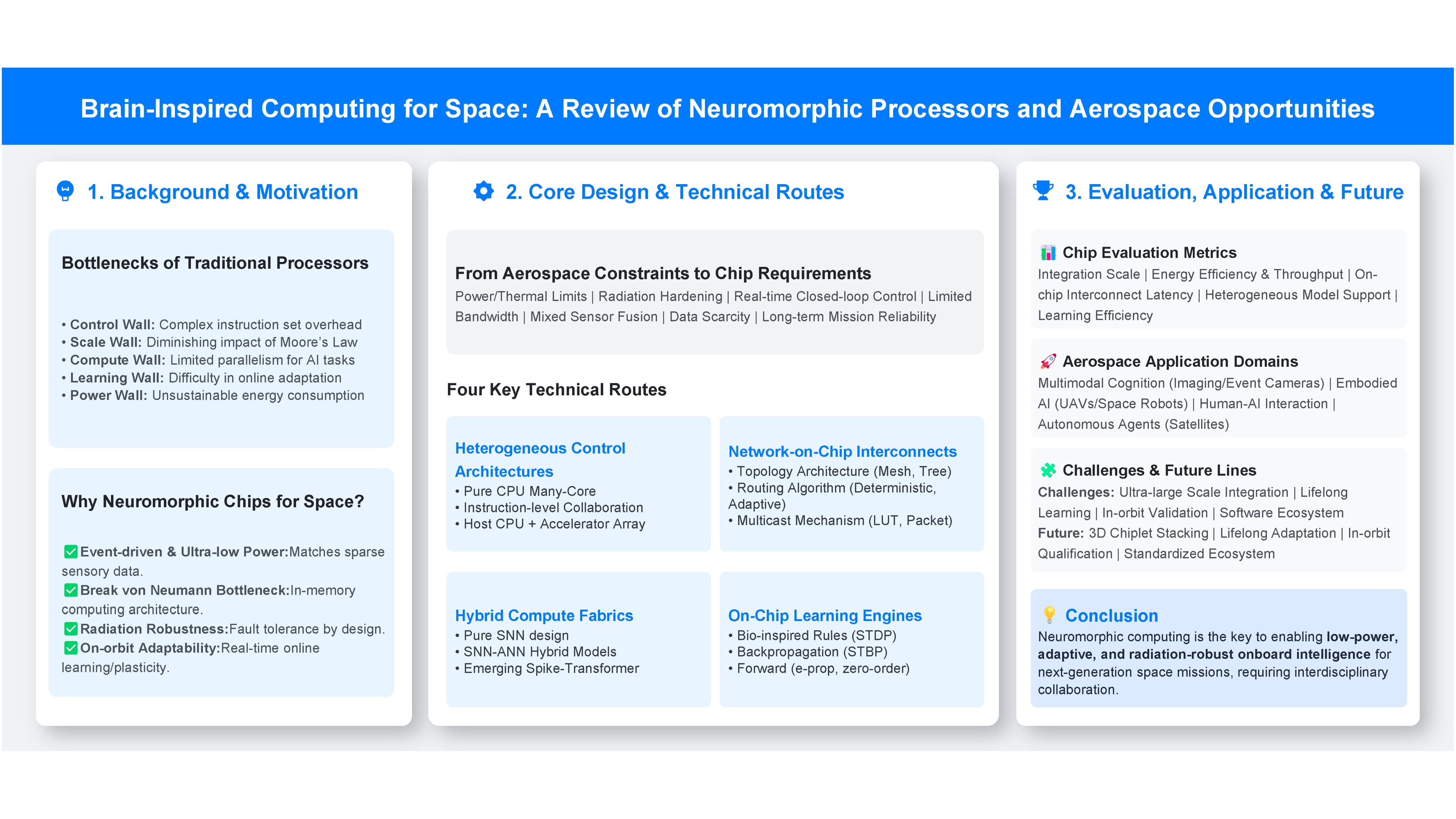
Conventional processors face fundamental bottlenecks when deployed in resource‑constrained aerospace systems that demand onboard intelligence. This review examines brain‑inspired neuromorphic computing as an alternative, focusing on digital neuromorphic processors with embedded central processing unit (CPU) control, multi‑core architectures, hybrid compute fabrics, and on‑chip learning capabilities for space applications. This review first translates aerospace constraints into chip‑level design requirements, such as low‑power event‑driven computation, sparse communication, hybrid model support, and incremental on‑chip learning. Based on these requirements, we survey four key technical routes in neuromorphic chip designs: heterogeneous control architectures, network‑on‑chip interconnects, hybrid compute fabrics, and on‑chip learning engines. A comparative evaluation of fabricated chips reveals a clear trend toward larger scale, higher energy efficiency, and greater model flexibility. Validation cases across four aerospace domains are examined, though most remain ground‑based with little flight heritage. This review identifies four persistent challenges and outlines corresponding future research lines, including scale, learning, validation and ecosystem aspects. It concludes that neuromorphic chips offer a viable path toward low‑power, adaptive, and robust onboard intelligence, provided that close collaboration bridges the remaining gaps.
KeyWords AITranslate
1.L. Diana and P. Dini, "Review on Hardware Devices and Software Techniques Enabling Neural Network Inference Onboard Satellites," Remote Sensing 16, no. 21 (2024): 1–29, https://doi.org/10.3390/rs16213957.
2.M. O. D. Castillo, J. Morgan, J. McRobbie, et al., "Mitigating Challenges of the Space Environment for Onboard Artificial Intelligence: Design Overview of the Imaging Payload on SpIRIT," paper presented at IEEE/CVF Conference on Computer Vision and Pattern Recognition Workshops, Seattle, WA, USA, June 17–18, 2024.
3.S. Chakrabartty and G. Cauwenberghs, "Performance Walls in Machine Learning and Neuromorphic Systems," paper presented at IEEE International Symposium on Circuits and Systems, Monterey, CA, USA, May 21–25, 2023.
4.C. Mead, "Neuromorphic Electronic Systems," Proceedings of the IEEE 78, no. 10 (1990): 1629–1636, https://doi.org/10.1109/5.58356.
5.C. D. Schuman, T. E. Potok, R. M. Patton, et al., "A Survey of Neuromorphic Computing and Neural Networks in Hardware," arXiv: 1705.06963 (2017): 1–88. https://doi.org/10.48550/arXiv.1705.06963.
6.K. Roy, A. Jaiswal, and P. Panda, "Towards Spike-Based Machine Intelligence with Neuromorphic Computing," Nature 575 (2019): 607–617, https://doi.org/10.1038/s41586-019-1677-2.
7.D. Izzo, A. Hadjiivanov, D. Dold, et al., "Neuromorphic Computing and Sensing in Space," arXiv: 2212.05236 (2022): 1–46. https://doi.org/10.48550/arXiv.2212.05236.
8.A. B. Abdallah and K. N. Dang, "Communication Networks for Neuromorphic Systems," in Neuromorphic Computing Principles and Organization (Springer, 2022), 79–126.
9.J. Lechner and A. Veeravalli, "Modular Redundancy in a GALS System Using Asynchronous Recovery Links," paper presented at IEEE International Symposium on Asynchronous Circuits and Systems, Santa Monica, CA, USA, May 19–22, 2013.
10.Z. Joukhadar, J. Morgan, C. Bayliss, et al., "Designing an Adaptive AI System for Operation on Board the Spirit Nano-Satellite," paper presented at Advances in Artificial Intelligence, Melbourne, VIC, Australia, November 25–29, 2024.
11.C. Frenkel and G. Indiveri, "ReckOn: A 28 nm Sub-mm2 Task-Agnostic Spiking Recurrent Neural Network Processor Enabling On-Chip Learning over Second-Long Timescales," paper presented at IEEE International Solid-State Circuits Conference, San Francisco, CA, USA, February 20–26, 2022.
12.F. Ortiz, N. Skatchkovsky, E. Lagunas, et al., "Energy-Efficient On-Board Radio Resource Management for Satellite Communications via Neuromorphic Computing," IEEE Transactions on Machine Learning in Communications and Networking 2 (2024): 169–189, https://doi.org/10.1109/TMLCN.2024.3352569.
13.B. Chintalapati, A. Precht, S. Hanra, et al., "Opportunities and Challenges of On-Board AI-Based Image Recognition for Small Satellite Earth Observation Missions," Advances in Space Research 75, no. 9 (2025): 6734–6751, https://doi.org/10.1016/j.asr.2024.03.053.
14.A. M. P. Mattos, D. A. Santos, L. M. Luza, et al., "Investigation of Single-Event Effects for Space Applications: Instrumentation for In-Depth System Monitoring," Electronics 13, no. 10 (2024): 1–15, https://doi.org/10.3390/electronics13101822.
15.J. Pei, L. Deng, S. Song, et al., "Towards Artificial General Intelligence with Hybrid Tianjic Chip Architecture," Nature 572 (2019): 106–111, https://doi.org/10.1038/s41586-019-1424-8.
16.S. B. Furber, F. Galluppi, S. Temple, et al., "The SpiNNaker Project," Proceedings of the IEEE 102, no. 5 (2014): 652–665, https://doi.org/10.1109/JPROC.2014.2304638.
17.E. Painkras, L. A. Plana, J. Garside, et al., "SpiNNaker: A 1-W 18-Core System-on-Chip for Massively-Parallel Neural Network Simulation," IEEE Journal of Solid-State Circuits 48, no. 8 (2013): 1943–1953, https://doi.org/10.1109/JSSC.2013.2259038.
18.D. Ma, X. Jin, S. Sun, et al., "Darwin3: A Large-Scale Neuromorphic Chip with a Novel ISA and On-Chip Learning," National Science Review 11, no. 5 (2024): 1–17, https://doi.org/10.1093/nsr/nwae102.
19.P. J. Zhou, Q. Yu, M. Chen, et al., "A 0.96pJ/SOP, 30.23K-neuron/mm2 Heterogeneous Neuromorphic Chip with Fullerene-Like Interconnection Topology for Edge-AI Computing," paper presented at IEEE International Symposium on Circuits and Systems, Singapore, Singapore, May 19–22, 2024.
20.M. Davies, N. Srinivasa, T. Lin, et al., "Loihi: A Neuromorphic Manycore Processor with On-Chip Learning," IEEE Micro 38, no. 1 (2018): 82–99, https://doi.org/10.1109/MM.2018.112130359.
21.P. A. Merolla, J. V. Arthur, R. Alvarez-Icaza, et al., "A Million Spiking-Neuron Integrated Circuit with a Scalable Communication Network and Interface," Science 345, no. 6197 (2014): 668–673, https://doi.org/10.1126/science.1254642.
22.F. Akopyan, J. Sawada, A. Cassidy, et al., "TrueNorth: Design and Tool Flow of a 65 mW 1 Million Neuron Programmable Neurosynaptic Chip," IEEE Transactions on Computer-Aided Design of Integrated Circuits and Systems 34, no. 10 (2015): 1537–1557, https://doi.org/10.1109/TCAD.2015.2474396.
23.Y. Kuang, X. Cui, Y. Zhong, et al., "A 64K-Neuron 64M-1b-Synapse 2.64pJ/SOP Neuromorphic Chip with All Memory on Chip for Spike-Based Models in 65 nm CMOS," IEEE Transactions on Circuits and Systems II: Express Briefs 68, no. 7 (2021): 2655–2659, https://doi.org/10.1109/TCSII.2021.3052172.
24.S. Moradi, N. Qiao, F. Stefanini, et al., "A Scalable Multicore Architecture with Heterogeneous Memory Structures for Dynamic Neuromorphic Asynchronous Processors (DYNAPs)," IEEE Transactions on Biomedical Circuits and Systems 12, no. 1 (2018): 106–122, https://doi.org/10.1109/TBCAS.2017.2759700.
25.Y. Zhong, Y. Kuang, K. Liu, et al., "PAICORE: A 1.9-Million-Neuron 5.181-TSOPS/W Digital Neuromorphic Processor with Unified SNN-ANN and On-Chip Learning Paradigm," IEEE Journal of Solid-State Circuits 60, no. 2 (2025): 651–671, https://doi.org/10.1109/JSSC.2024.3426319.
26.G. K. Chen, R. Kumar, H. E. Sumbul, et al., "A 4096-Neuron 1M-Synapse 3.8-pJ/SOP Spiking Neural Network with On-Chip STDP Learning and Sparse Weights in 10-nm FinFET CMOS," IEEE Journal of Solid-State Circuits 54, no. 4 (2019): 992–1002, https://doi.org/10.1109/JSSC.2018.2884901.
27.Y. Zhong, Z. Wang, Z. Zhang, et al., "DualLearn: A 4.686pJ/SOP-4.026pJ/FLOP SNN-ANN Neuromorphic Inference-Training Processor with Distributed and Memory-Adaptive Architecture," paper presented at IEEE Custom Integrated Circuits Conference, Seattle, WA, USA, April 19–23, 2026.
28.Y. Zhong, Z. Wang, Y. Gao, et al., "NeuroHexa: A 2D/3D-Scalable Model-Adaptive NoC Architecture for Neuromorphic Computing," paper presented at Design, Automation & Test in Europe Conference, Lyon, France, March 31–April 2, 2025.
29.S. Kim, S. Kim, S. Hong, et al., "C-DNN: A 24.5-85.8TOPS/W Complementary-Deep-Neural-Network Processor with Heterogeneous CNN/SNN Core Architecture and Forward-Gradient-Based Sparsity Generation," paper presented at IEEE International Solid-State Circuits Conference, San Francisco, CA, USA, February 19–23, 2023.
30.S. Kim, S. Kim, W. Jo, et al., "C-Transformer: A 2.6-18.1μJ/Token Homogeneous DNN-Transformer/Spiking-Transformer Processor with Big-Little Network and Implicit Weight Generation for Large Language Models," paper presented at IEEE International Solid-State Circuits Conference, San Francisco, CA, USA, February 18–22, 2024.
31.N. Qiao, H. Mostafa, F. Corradi, et al., "A Reconfigurable On-Line Learning Spiking Neuromorphic Processor Comprising 256 Neurons and 128K Synapses," Frontiers in Neuroscience 9 (2015): 1–17, https://doi.org/10.3389/fnins.2015.00141.
32.C. Frenkel, M. Lefebvre, J. D. Legat, et al., "A 0.086-mm2 12.7-pJ/SOP 64k-Synapse 256-Neuron Online-Learning Digital Spiking Neuromorphic Processor in 28-nm CMOS," IEEE Transactions on Biomedical Circuits and Systems 13, no. 1 (2019): 145–158, https://doi.org/10.1109/TBCAS.2018.2880425.
33.C. Frenkel, J. D. Legat, and D. Bol, "MorphIC: A 65-nm 738k-Synapse/mm2 Quad-Core Binary-Weight Digital Neuromorphic Processor with Stochastic Spike-Driven Online Learning," IEEE Transactions on Biomedical Circuits and Systems 13, no. 5 (2019): 999–1010, https://doi.org/10.1109/TBCAS.2019.2928793.
34.Y. Zhong, Z. Wang, X. Cui, et al., "An Efficient Neuromorphic Implementation of Temporal Coding-Based On-Chip STDP Learning," IEEE Transactions on Circuits and Systems II: Express Briefs 70, no. 11 (2023): 4241–4245, https://doi.org/10.1109/TCSII.2023.3282653.
35.L. Liang, Z. Qu, Z. Chen, et al., "H2Learn: High-Efficiency Learning Accelerator for High-Accuracy Spiking Neural Networks," IEEE Transactions on Computer-Aided Design of Integrated Circuits and Systems 41, no. 11 (2022): 4782–4796, https://doi.org/10.1109/TCAD.2021.3138347.
36.J. Zhang, D. Huo, J. Zhang, et al., "ANP-I: A 28 nm 1.5pJ/SOP Asynchronous Spiking Neural Network Processor Enabling Sub-0.1 μJ/Sample On-Chip Learning for Edge-AI Applications," paper presented at IEEE International Solid-State Circuits Conference, San Francisco, CA, USA, February 19–23, 2023.
37.B. V. Benjamin, P. Gao, E. McQuinn, et al., "Neurogrid: A Mixed-Analog-Digital Multichip System for Large-Scale Neural Simulations," Proceedings of the IEEE 102, no. 5 (2014): 699–716, https://doi.org/10.1109/JPROC.2014.2313565.
38.J. Schemmel, D. Brüderle, A. Grübl, et al., "A Wafer-Scale Neuromorphic Hardware System for Large-Scale Neural Modeling," paper presented at IEEE International Symposium on Circuits and Systems, Paris, France, May 30–June 2, 2010.
39.S. Scholze, S. Schiefer, J. Partzsch, et al., "VLSI Implementation of a 2.8 Gevent/s Packet-Based AER Interface with Routing and Event Sorting Functionality," Frontiers in Neuroscience 5 (2011): 1–13, https://doi.org/10.3389/fnins.2011.00117.
40.D. Ma, J. Shen, Z. Gu, et al., "Darwin: A Neuromorphic Hardware Co-Processor Based on Spiking Neural Networks," Journal of Systems Architecture 77 (2017): 43–51, https://doi.org/10.1016/j.sysarc.2017.01.003.
41.S. Ma, J. Pei, W. Zhang, et al., "Neuromorphic Computing Chip with Spatiotemporal Elasticity for Multi-Intelligent-Tasking Robots," Science Robotics 7, no. 67 (2022): 1–13, https://doi.org/10.1126/scirobotics.abk2948.
42.D. Huo, J. Zhang, X. Dai, et al., "ANP-G: A 28 nm 1.04pJ/SOP Sub-mm2 Spiking and Back-Propagation Hybrid Neural Network Asynchronous Olfactory Processor Enabling Few-Shot Class-Incremental On-Chip Learning," paper presented at IEEE Symposium on VLSI Technology and Circuits, Kyoto, Japan, June 11–16, 2023.
43.D. Huo, J. Zhang, and H. Chen, "ANP-L: A 22 nm 0.72pJ/SOP Asynchronous SNN-based Edge-AI Processor Enabling One/Few-shot On-Chip Incremental Learning," paper presented at IEEE International Conference on Artificial Intelligence Circuits and Systems (AICAS), Bordeaux, France, April 28–30, 2025.
44.Z. Cheng, D. Huo, J. Zhang, et al., "ANP-R: A 22 nm 0.88pJ/SOP Versatile Asynchronous SNN-based Processor with Coarse-Grained Reconfigurable Architecture Enabling On-Chip Incremental Learning," paper presented at IEEE Asian Solid-State Circuits Conference, Daejeon, Korea, November 2–5, 2025.
45.D. Huo, Y. Lin, P. K. Shihabudeen, et al., "ANP-O: A 67 μW/Channel, 0.13 nW/Synapse/Bit Nose-on-a-Chip for Noninvasive Diagnosis of Diseases with On-Chip Incremental Learning," IEEE Journal of Solid-State Circuits 61, no. 8 (2026): 4250–4261, https://doi.org/10.1109/JSSC.2026.3656214.
46.V. P. Nambiar, J. Pu, Y. K. Lee, et al., "Energy Efficient 0.5V 4.8pJ/SOP 0.93μW Leakage/Core Neuromorphic Processor Design," IEEE Transactions on Circuits and Systems II: Express Briefs 68, no. 9 (2021): 3148–3152, https://doi.org/10.1109/TCSII.2021.3096883.
47.J. Park, S. Ha, T. Yu, et al., "A 65k-neuron 73-Mevents/s 22-pJ/event Asynchronous Micro-Pipelined Integrate-And-Fire Array Transceiver," paper presented at IEEE Biomedical Circuits and Systems Conference, Lausanne, Switzerland, October 22–24, 2014.
48.M. Davies, "Taking Neuromorphic Computing to the Next Level with Loihi 2," Intel Technology Brief, 2021.
49.Y. Zhong, X. Cui, Y. Kuang, et al., "A Spike-Event-Based Neuromorphic Processor with Enhanced On-Chip STDP Learning in 28 nm CMOS," paper presented at IEEE International Symposium on Circuits and Systems, Daegu, Korea, May 22–28, 2021.
50.J. Park, J. Lee, and D. Jeon, "A 65-nm Neuromorphic Image Classification Processor with Energy-Efficient Training Through Direct Spike-Only Feedback," IEEE Journal of Solid-State Circuits 55, no. 1 (2020): 108–119, https://doi.org/10.1109/JSSC.2019.2942367.
51.M. Yao, O. Richter, G. Zhao, et al., "Spike-Based Dynamic Computing with Asynchronous Sensing-Computing Neuromorphic Chip," Nature Communications 15 (2024): 1–18, https://doi.org/10.1038/s41467-024-47811-6.
52.A. Neckar, S. Fok, B. V. Benjamin, et al., "Braindrop: A Mixed-Signal Neuromorphic Architecture with a Dynamical Systems-Based Programming Model," Proceedings of the IEEE 107, no. 1 (2019): 144–164, https://doi.org/10.1109/JPROC.2018.2881432.
53.Z. Wang, Z. Ou, Y. Zhong, et al., "NeuroREC: A 28-nm Efficient Neuromorphic Processor for Radar Emitter Classification," IEEE Transactions on Circuits and Systems I: Regular Papers 71, no. 12 (2024): 6215–6228, https://doi.org/10.1109/TCSI.2024.3427385.
54.S. Cho, E. Beigné, and Z. Zhang, "A 2048-Neuron Spiking Neural Network Accelerator with Neuro-Inspired Pruning and Asynchronous Network on Chip in 40 nm CMOS," paper presented at IEEE Custom Integrated Circuits Conference, Austin, TX, USA, April 14–17, 2019.
55.S. Liu, J. Wang, J. Zhou, et al., "An Area- and Energy-Efficient Spiking Neural Network with Spike-Time-Dependent Plasticity Realized with SRAM Processing-in-Memory Macro and On-Chip Unsupervised Learning," IEEE Transactions on Biomedical Circuits and Systems 17, no. 1 (2023): 92–104, https://doi.org/10.1109/TBCAS.2023.3242413.
56.J. Pu, W. Goh, V. Nambiar, et al., "A 5.28-mm2 4.5-pJ/SOP Energy-Efficient Spiking Neural Network Hardware with Reconfigurable High Processing Speed Neuron Core and Congestion-Aware Router," IEEE Transactions on Circuits and Systems I: Regular Papers 68, no. 12 (2021): 5081–5094, https://doi.org/10.1109/TCSI.2021.3112979.
57.H. Tang, H. Kim, H. Kim, et al., "Spike Counts Based Low Complexity SNN Architecture with Binary Synapse," IEEE Transactions on Biomedical Circuits and Systems 13, no. 6 (2019): 1664–1677, https://doi.org/10.1109/TBCAS.2019.2945406.
58.C. Fang, Z. Shen, Z. Wang, et al., "An Energy-Efficient Unstructured Sparsity-Aware Deep SNN Accelerator with 3-D Computation Array," IEEE Journal of Solid-State Circuits 60, no. 3 (2025): 977–989, https://doi.org/10.1109/JSSC.2024.3507095.
59.Z. Wang, Z. Ou, Y. Zhong, et al., "EA-HWP: An Efficient CNN/SNN Accelerator with Hybrid Weight Precision," IEEE Transactions on Circuits and Systems II: Express Briefs 73, no. 4 (2026): 468–472, https://doi.org/10.1109/TCSII.2026.3668087.
60.T. Zhang, Y. Zhong, Y. Yang, et al., "A 28-nm Optical Flow Estimation Accelerator with Redundancy Speculation, Bit-Width-Aware Compression and Similarity Detection," paper presented at IEEE Custom Integrated Circuits Conference, Seattle, WA, USA, April 19–23, 2026.
61.Y. Kuang, X. Cui, Y. Zhong, et al., "A 28-nm 0.34-pJ/SOP Spike-Based Neuromorphic Processor for Efficient Artificial Neural Network Implementations," paper presented at IEEE International Symposium on Circuits and Systems, Daegu, Korea, May 22–28, 2021.
62.C. Mayr, S. Hoeppner, and S. Furber, "SpiNNaker 2: A 10 Million Core Processor System for Brain Simulation and Machine Learning," arXiv:1911.02385 (2019): 1–4. https://doi.org/10.48550/arXiv.1911.02385.
63.C. Pehle, S. Billaudelle, B. Cramer, et al., "The BrainScaleS-2 Accelerated Neuromorphic System with Hybrid Plasticity," Frontiers in Neuroscience 16 (2022): 1–21, https://doi.org/10.3389/fnins.2022.795876.
64.S. Roffe, H. Akolkar, A. D. George, et al., "Neutron-Induced, Single-Event Effects on Neuromorphic Event-Based Vision Sensor: A First Step and Tools to Space Applications," IEEE Access 9 (2021): 85748–85763, https://doi.org/10.1109/ACCESS.2021.3085136.
65.M. Jawaid, M. Märtens, and T. J. Chin, "Event-RGB Fusion for Spacecraft Pose Estimation under Harsh Lighting," Aerospace Science and Technology 168 (2026): 1–31, https://doi.org/10.1016/j.ast.2025.111039.
66.A. Rathinam, H. Qadadri, and D. Aouada, "SPADES: A Realistic Spacecraft Pose Estimation Dataset Using Event Sensing," paper presented at IEEE International Conference on Robotics and Automation, Yokohama, Japan, May 13–17, 2024.
67.F. Paredes-Valles, J. J. Hagenaars, J. Dupeyroux, et al., "Fully Neuromorphic Vision and Control for Autonomous Drone Flight," Science Robotics 9, no. 90 (2024): 1–18, https://doi.org/10.1126/scirobotics.adi0591.
68.A. Vitale, A. Renner, C. Nauer, et al., "Event-Driven Vision and Control for UAVs on a Neuromorphic Chip," paper presented at IEEE International Conference on Robotics and Automation, Xi'an, China, May 30–June 5, 2021.
69.S. Chapin, K. Stewart, R. Leontie, et al., "Autonomous Planning In-Space Assembly Reinforcement-Learning free-flYer (APIARY) International Space Station Astrobee Testing," paper presented at International Conference on Space Robotics, Sendai, Japan, December 1–4, 2025.
70.K. Stewart, S. Chapin, R. Leontie, et al., "Crossing the Sim2Real Gap Between Simulation and Ground Testing to Space Deployment of Autonomous Free-Flyer Control," paper presented at International Conference on Space Robotics, Sendai, Japan, December 1–4, 2025.
71.D. Kudithipudi, C. Schuman, C. M. Vineyard, et al., "Neuromorphic Computing at Scale," Nature 637 (2025): 801–812, https://doi.org/10.1038/s41586-024-08253-8.
72.Z. Yi, J. Lian, Q. Liu, et al., "Learning Rules in Spiking Neural Networks: A Survey," Neurocomputing 531 (2023): 163–179, https://doi.org/10.1016/j.neucom.2023.02.026.
Basic Information:
DOI:10.67600/hp.000005
Chinese Library Classification Number:
Citation Information:
Conventional processors face fundamental bottlenecks when deployed in resource‑constrained aerospace systems that demand onboard intelligence. This review examines brain‑inspired neuromorphic computing as an alternative, focusing on digital neuromorphic processors with embedded central processing unit (CPU) control, multi‑core architectures, hybrid compute fabrics, and on‑chip learning capabilities for space applications. This review first translates aerospace constraints into chip‑level design requirements, such as low‑power event‑driven computation, sparse communication, hybrid model support, and incremental on‑chip learning. Based on these requirements, we survey four key technical routes in neuromorphic chip designs: heterogeneous control architectures, network‑on‑chip interconnects, hybrid compute fabrics, and on‑chip learning engines. A comparative evaluation of fabricated chips reveals a clear trend toward larger scale, higher energy efficiency, and greater model flexibility. Validation cases across four aerospace domains are examined, though most remain ground‑based with little flight heritage. This review identifies four persistent challenges and outlines corresponding future research lines, including scale, learning, validation and ecosystem aspects. It concludes that neuromorphic chips offer a viable path toward low‑power, adaptive, and robust onboard intelligence, provided that close collaboration bridges the remaining gaps.
quote
| GB/T 7714-2015 | [1] Yi Zhong, Tao Zhang, Jinhao Ruan, et al. Brain‑inspired computing for space: a review of neuromorphic processors and aerospace opportunities[J]. Hyper, 2026, 1(1): 1-29. DOI:10.67600/hp.000005. |
| MLA | [1] Yi Zhong, et al., "Brain‑inspired computing for space: a review of neuromorphic processors and aerospace opportunities." Hyper, vol. 1, no. 1, 2026, pp. 1-29, https://doi.org/10.67600/hp.000005. |
| APA | [1] Yi Zhong, Tao Zhang, Jinhao Ruan, Yipeng Gao, & Yuan Wang. (2026). Brain‑inspired computing for space: a review of neuromorphic processors and aerospace opportunities. Hyper, 1(1), 1-29. https://doi.org/10.67600/hp.000005 |
| IEEE | [1] Yi Zhong, Tao Zhang, Jinhao Ruan, Yipeng Gao, and Yuan Wang, "Brain‑inspired computing for space: a review of neuromorphic processors and aerospace opportunities," Hyper, vol. 1, no. 1, pp. 1-29, 2026, doi: 10.67600/hp.000005. keywords: {aerospace application;embedded control;hybrid computing;multi-core architecture;neuromorphic chip;on-chip learning} |