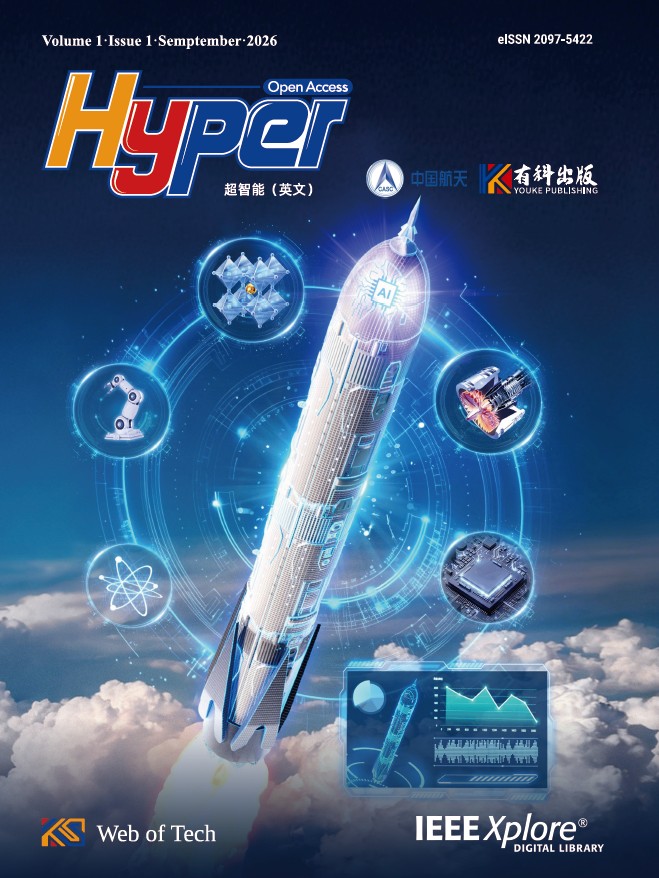
Hyper aims to publish a world-class scientific journal in interdisciplinary fields of aerospace, covering artificial intelligence, information science, advanced manufacturing, and other related areas. It is dedicated to publishing fundamental, original, and groundbreaking academic achievements. Characterized by multidisciplinary integration, multi-technology convergence, and multi-application-driven approaches, the journal focuses on the latest global trends and advancements, gathering and showcasing cutting-edge research and innovative results. Serving as an open and sharing platform and a bridge from basic research to engineering technology innovation and application, Hyper promotes the rapid integration of aerospace-related interdisciplinary fields and leads the direction of new technological breakthroughs.
The fields and topics covered by the journal include, but are not limited to:
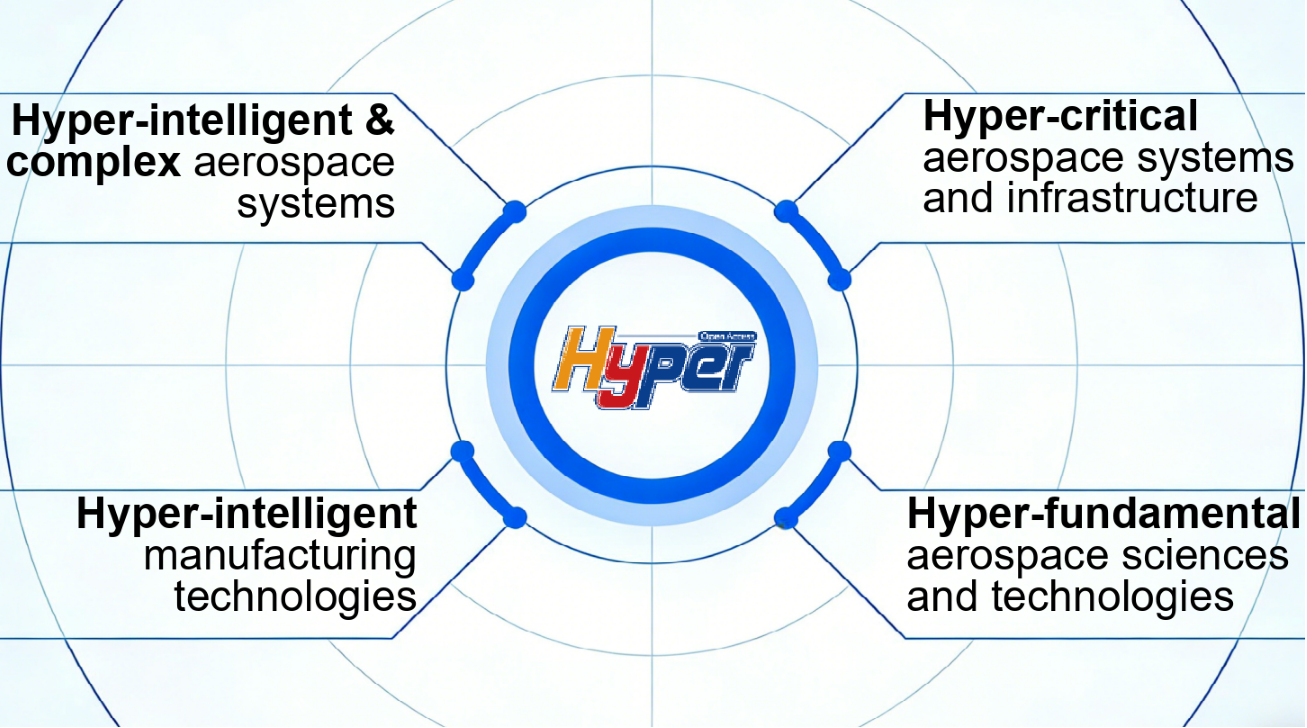
(1) Intelligent & Complex Aerospace Systems and Technologies
• Artificial Intelligence (AI): Fundamental theories and applied technologies of artificial intelligence for the requirements of aerospace application scenarios, including but not limited to cognitive science and neuroscience, information and computing science, mathematical foundation sciences, data science and big data technology, etc.
• Intelligent flight of aerospace vehicles, multi-source sensor fusion, intelligent autonomous decision-making, efficient human-machine collaboration, swarm collaboration & intelligent autonomy
• Aerospace AI assurance, spacecraft health management and on-orbit maintenance (SHM&OMM), safety, interpretability, and evaluation
• Aerospace System of Systems (SoS) modelling, simulation, digital twin, and lifecycle management
• Next-generation air traffic management, automated systems, and verification
• Intelligent systems engineering and embodied intelligence
(2) Air-Space-Ground Integrated Infrastructure
• Air-space-ground integrated communication networks, navigation, and surveillance systems
• Distributed sensing, microwave photonics, edge/cloud computing, and real-time aerospace networks
• Advanced propulsion systems, advanced structures, advanced energy, dynamic modelling and simulation of complex systems
(3) Advanced Materials & Manufacturing Technologies
• Advanced materials, superstructures and metamaterials
• New principles, methods and technologies for structures, materials and manufacturing
• Intelligent and autonomous aerospace manufacturing systems
• Digital manufacturing, robotics, and human-machine collaborative production
• Aerospace functional materials, smart structures and embedded intelligence
• Closed-loop integration of design, manufacturing and operation
(4) Fundamental Aerospace Sciences & Technologies
• Key algorithms and models for AI for Science (AI4S), digital intelligence mechanics, quantum technology, and bionic technology
• Space physics and celestial mechanics, microgravity and space life sciences, specialized aerospace chip technology
• Extended interdisciplinary fields: deep space astronomy, cosmic evolution and exploration, etc. The scope of acceptance is not limited to the above-listed directions