

Learning viscoplastic constitutive behavior via physics-informed recurrent neural network AITranslate
Abstract AITranslate
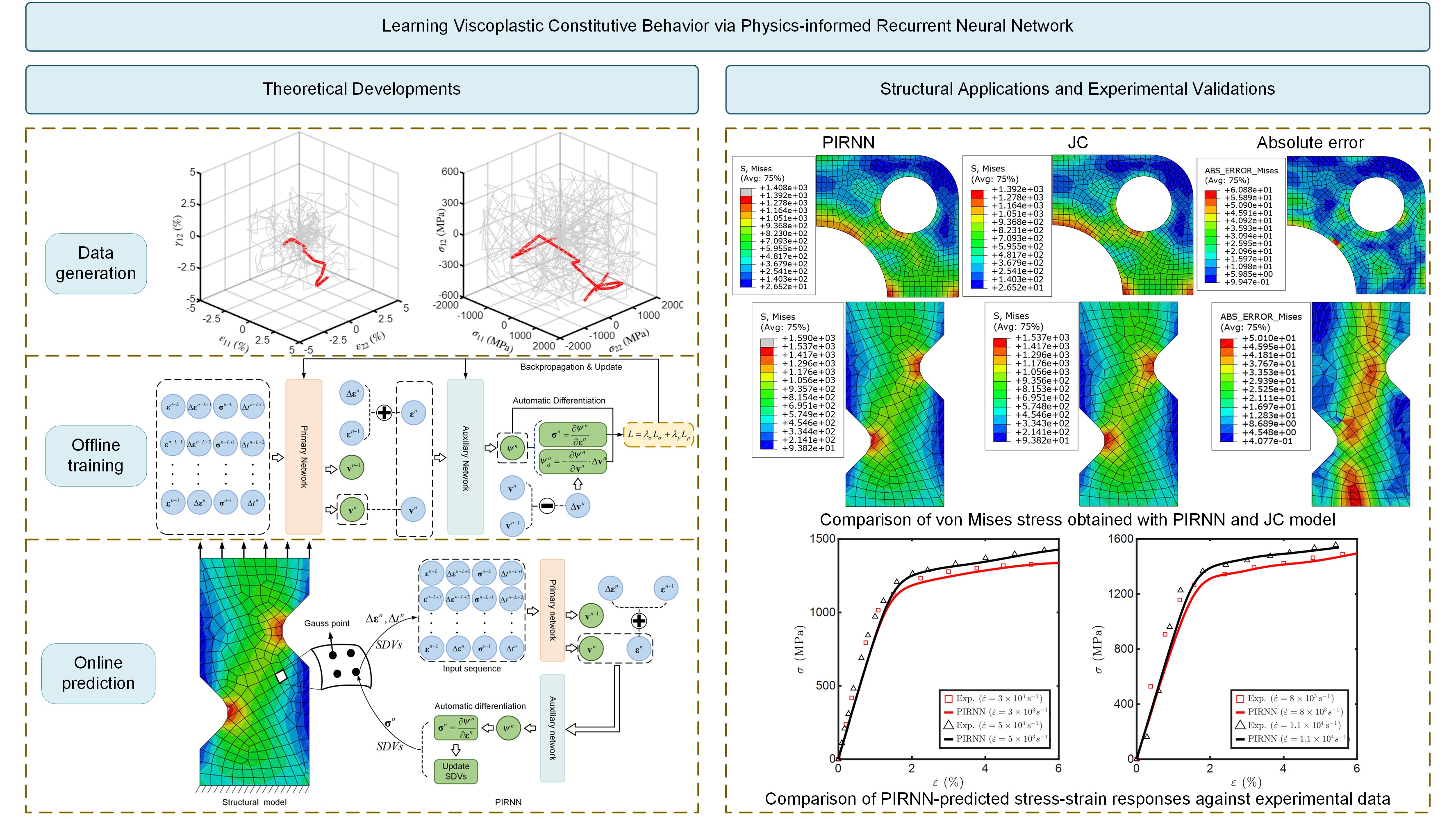
A novel physics-informed recurrent neural network (PIRNN) model has been developed for data-driven constitutive modeling of metallic materials under high-strain-rate loading. The proposed PIRNN framework integrates a gated recurrent unit (GRU) network and a fully connected neural network to capture the rate-dependent stress-strain behavior directly from synthetic stress and strain sequences generated from the Johnson-Cook constitutive model. Notably, the inherent memory capability of the GRU model enables implicit representation of arbitrary loading history, without the need for explicitly accounting for internal state variables or prescribed constitutive relations, while the fully connected neural network is utilized to estimate Helmholtz free energy under general loading conditions. Thermodynamic admissibility is ensured by enforcing Helmholtz free energy positivity and the dissipation inequality within the loss function. Validation at the material point level against direct numerical solutions and experimental data demonstrates the accurate predictive capability of the PIRNN under both multiaxial and uniaxial loading conditions. The PIRNN is further implemented in ABAQUS for structural simulations to demonstrate its applicability in structural analyses.
KeyWords AITranslate
1.J. Pan, W. He, Z. Cao, et al., "Study on HCF/VHCF Properties and Fatigue Life Prediction of Ti60 Titanium Alloy under Three-Point Bending," International Journal of Fatigue 209 (2026): 109603, https://doi.org/10.1016/j.ijfatigue.2026.109603.
2.K. Kaymak, Y. Tazegül, A. B. Keyvankl1, et al., "Effects of Ti Addition and Wall Thickness on Microstructure, Hardness, and Wear Properties of Spheroidal Graphite Cast Irons," Tribology International 195 (2024): 109612, https://doi.org/10.1016/j.triboint.2024.109612.
3.Y. Zheng, Y. Zheng, X. Cao, et al., "Microstructure Evolution Behavior of Titanium Alloy during the Electromagnetic Pulse Welding Process between Titanium and Stainless Steel," Materials Today Communications 52 (2026): 114958, https://doi.org/10.1016/j.mtcomm.2026.114958.
4.G. R. Johnson and W. H. Cook, "Fracture Characteristics of Three Metals Subjected to Various Strains, Strain Rates, Temperatures and Pressures," Engineering Fracture Mechanics 21 (1985): 31–48, https://doi.org/10.1016/0013-7944(85)90052-9.
5.B. Özcan, O. Cavusoglu, U. Çalışkan, et al., "Experimental and Numerical Characterization of Johnson–Cook Plasticity and Damage Models for Spheroidal Graphite Cast Irons at High Strain Rates and Elevated Temperatures," International Journal of Solids and Structures 332 (2026): 113916, https://doi.org/10.1016/j.ijsolstr.2026.113916.
6.L. Wang, Z. Wang, S. Zhang, et al., "Spiral Metal Tube Multi-Roller Bending Springback Prediction Model Based on Dynamic Deformation Enhancement Analysis," International Journal of Solids and Structures 254–255 (2022): 111940, https://doi.org/10.1016/j.ijsolstr.2022.111940.
7.M. Cao, C. Zhang, T. Ren, et al., "A Modified Johnson–Cook Model and a Novel Wilkins–Kamoulakos Model Used to Simulate the Impact between Aero-Engine Turbine Casing and Fractured Blade," Thin-Walled Structures 220 (2026): 114277, https://doi.org/10.1016/j.tws.2025.114277.
8.Q. Chen, R. Jia, and S. Pang, "Deep Long Short-Term Memory Neural Network for Accelerated Elastoplastic Analysis of Heterogeneous Materials: An Integrated Data-Driven Surrogate Approach," Composite Structures 264 (2021): 113688, https://doi.org/10.1016/j.compstruct.2021.113688.
9.S. Wu, L. Guo, Z. Li, et al., "A Data-Driven Multiscale Model SCA-DNN for 3D Woven Composites Based on the Damage Evolution Genome Database," Composites Part A: Applied Science and Manufacturing 200 (2026): 109318, https://doi.org/10.1016/j.compositesa.2025.109318.
10.M. El Fallaki Idrissi, A. Pasquale, F. Meraghni, et al., "Advanced Meta-Modeling Framework Combining Machine Learning and Model Order Reduction towards Real-Time Virtual Testing of Woven Composite Laminates in Nonlinear Regime," Composites Science and Technology 262 (2025): 111055, https://doi.org/10.1016/j.compscitech.2025.111055.
11.K. Linka, M. Hillgärtner, K. P. Abdolazizi, et al., "Constitutive Artificial Neural Networks: A Fast and General Approach to Predictive Data-Driven Constitutive Modeling by Deep Learning," Journal of Computational Physics 429 (2021): 110010, https://doi.org/10.1016/j.jcp.2020.110010.
12.A. E. Marques, T. G. Parreira, A. F. G. Pereira, et al., "Machine Learning Applications in Sheet Metal Constitutive Modelling: A Review," International Journal of Solids and Structures 303 (2024): 113024, https://doi.org/10.1016/j.ijsolstr.2024.113024.
13.A. Zhang and D. Mohr, "Using Neural Networks to Represent von Mises Plasticity with Isotropic Hardening," International Journal of Plasticity 132 (2020): 102732, https://doi.org/10.1016/j.ijplas.2020.102732.
14.W. G. Dettmer, E. J. Muttio, R. Alhayki, et al., "A Framework for Neural Network Based Constitutive Modelling of Inelastic Materials," Computer Methods in Applied Mechanics and Engineering 420 (2024): 116672, https://doi.org/10.1016/j.cma.2023.116672.
15.J. Ghaboussi, J. H. Garrett, and X. Wu, "Knowledge-Based Modeling of Material Behavior with Neural Networks," Journal of Engineering Mechanics 117, no. 1 (1991): 132–153, https://doi.org/10.1061/(ASCE)0733-9399(1991)117:1(132).
16.D. P. Jang, P. Fazily, and J. W. Yoon, "Machine Learning-Based Constitutive Model for J2 Plasticity," International Journal of Plasticity 138 (2021): 102919, https://doi.org/10.1016/j.ijplas.2020.102919.
17.K. Xu, A. M. Tartakovsky, J. Burghardt, et al., "Learning Viscoelasticity Models from Indirect Data Using Deep Neural Networks," Computer Methods in Applied Mechanics and Engineering 387 (2021): 114124, https://doi.org/10.1016/j.cma.2021.114124.
18.M. Bourdyot, M. Compans, R. Langlois, et al., "Learning a Hyperelastic Constitutive Model from 3D Experimental Data," Computer Methods in Applied Mechanics and Engineering 450 (2026): 118592, https://doi.org/10.1016/j.cma.2025.118592.
19.J. Jiang, J. Wu, Q. Chen, et al., "Physically Informed Deep Homogenization Neural Network for Unidirectional Multiphase/Multi-Inclusion Thermoconductive Composites," Computer Methods in Applied Mechanics and Engineering 409 (2023): 115972, https://doi.org/10.1016/j.cma.2023.115972.
20.Q. Chen, X. Du, G. Chatzigeorgiou, et al., "Physics-Informed Deep Neural Networks towards Finite Strain Homogenization of Unidirectional Soft Composites," European Journal of Mechanics A/Solids 114 (2025): 105752, https://doi.org/10.1016/j.euromechsol.2025.105752.
21.Z. Wang, R. Cudmani, and A. A. P. Olarte, "Connecting and Distinguishing Conventional and Data-Driven Constitutive Models: The Role of State Boundary Surfaces," Journal of the Mechanics and Physics of Solids 200 (2025): 106122, https://doi.org/10.1016/j.jmps.2025.106122.
22.S. E. Sekkal, M. El Fallaki Idrissi, F. Meraghni, et al., "Multiscale Thermodynamics-Informed Neural Networks (MuTINN) for Nonlinear Structural Computations of Recycled Thermoplastic Composites," Composites Part B: Engineering 300 (2025): 112455, https://doi.org/10.1016/j.compositesb.2025.112455.
23.F. Masi, I. Stefanou, P. Vannucci, et al., "Thermodynamics-Based Artificial Neural Networks for Constitutive Modeling," Journal of the Mechanics and Physics of Solids 147 (2021): 104277, https://doi.org/10.1016/j.jmps.2020.104277.
24.F. Masi and I. Stefanou, "Multiscale Modeling of Inelastic Materials with Thermodynamics-Based Artificial Neural Networks (TANN)," Computer Methods in Applied Mechanics and Engineering 398 (2022): 115190, https://doi.org/10.1016/j.cma.2022.115190.
25.F. Masi and I. Stefanou, "Evolution TANN and the Identification of Internal Variables and Evolution Equations in Solid Mechanics," Journal of the Mechanics and Physics of Solids 174 (2023): 105245, https://doi.org/10.1016/j.jmps.2023.105245.
26.M. M. Su, Y. Yu, T. H. Chen, et al., "A Thermodynamics-Informed Neural Network for Elastoplastic Constitutive Modeling of Granular Materials," Computer Methods in Applied Mechanics and Engineering 430 (2024): 117246, https://doi.org/10.1016/j.cma.2024.117246.
27.P. Zhang, K. Karapiperis, and O. Weeger, "T-PiNet: A Thermodynamics-Informed Hierarchical Learning for Discovering Constitutive Relations of Geomaterials," Journal of the Mechanics and Physics of Solids 197 (2025): 106049, https://doi.org/10.1016/j.jmps.2025.106049.
28.X. He and J.-S. Chen, "Thermodynamically Consistent Machine-Learned Internal State Variable Approach for Data-Driven Modeling of Path-Dependent Materials," Computer Methods in Applied Mechanics and Engineering 402 (2022): 115348, https://doi.org/10.1016/j.cma.2022.115348.
29.R. Lourenço, P. Georgieva, E. Cueto, et al., "An Indirect Training Approach for Implicit Constitutive Modelling Using Recurrent Neural Networks and the Virtual Fields Method," Computer Methods in Applied Mechanics and Engineering 425 (2024): 116961, https://doi.org/10.1016/j.cma.2024.116961.
30.A. Girard and D. Mohr, "Recurrent Neural Network Model Predicting Elasto-Plasticity and Matrix Fracture in Fiber Constitutive Modeling," International Journal of Mechanical Sciences (2026): 111816, https://doi.org/10.1016/j.ijmecsci.2026.111816.
31.C. Bonatti, B. Berisha, and D. Mohr, "From CP-FFT to CP-RNN: Recurrent Neural Network Surrogate Model of Crystal Plasticity," International Journal of Plasticity 158 (2022): 103430, https://doi.org/10.1016/j.ijplas.2022.103430.
32.R. Lourenço, A. Tariq, P. Georgieva, et al., "On the Use of Physics-Based Constraints and Validation KPI for Data-Driven Elastoplastic Constitutive Modelling," Computer Methods in Applied Mechanics and Engineering 437 (2025): 117743, https://doi.org/10.1016/j.cma.2025.117743.
33.X. Zhang, Q. Chen, R. Lourenço, et al., "Thermodynamics-Informed Multi-Head Attention Neural Networks for Constitutive Modelling," International Journal of Solids and Structures 328 (2026): 113845, https://doi.org/10.1016/j.ijsolstr.2026.113845.
34.S. Kim and H. Shin, "Accelerating the Data-Driven Multiscale Finite Element Analysis for Elastoplastic Materials by Using Proper Orthogonal Decomposition and Transformer Architecture," Computer Methods in Applied Mechanics and Engineering 437 (2025): 117827, https://doi.org/10.1016/j.cma.2025.117827.
35.Y. Zhongbo and P. L. Hien, "Pre-Trained Transformer Model as a Surrogate in Multiscale Computational Homogenization Framework for Elastoplastic Composite Materials Subjected to Generic Loading Paths," Computer Methods in Applied Mechanics and Engineering 421 (2024): 116745, https://doi.org/10.1016/j.cma.2024.116745.
36.X. Zhang, Q. Chen, and X. Chen, "Thermodynamics-Informed Attention Networks for Concurrent Multiscale Modeling of Nonlinear Composites," International Journal of Plasticity 201 (2026): 104681, https://doi.org/10.1016/j.ijplas.2026.104681.
37.J.-J. Wang, C. Wang, J.-S. Fan, et al., "A Deep Learning Framework for Constitutive Modeling Based on Temporal Convolutional Network," Journal of Computational Physics 449 (2022): 110784, https://doi.org/10.1016/j.jcp.2021.110784.
38.A. Ostadrahimi, A. Teimouri, K. Upadhyay, et al., "Stress Softening Damage in Strongly Nonlinear Viscoelastic Soft Materials: A Physics-Informed Data-Driven Constitutive Model with Time–Temperature Coupling," International Journal of Plasticity 197 (2026): 104582, https://doi.org/10.1016/j.ijplas.2025.104582.
39.X. Zhang, Q. Chen, H. Quan, et al., "Physics-Informed Temporal Convolutional Networks for Composite Reinforced Composites," International Journal of Solids and Structures 326 (2026): 113703, https://doi.org/10.1016/j.ijsolstr.2025.113703.
40.B. Liu, E. Ocegueda, M. Trautner, et al., "Learning Macroscopic Internal Variables and History Dependence from Microscopic Models," Journal of the Mechanics and Physics of Solids 178 (2023): 105329, https://doi.org/10.1016/j.jmps.2023.105329.
41.B. Guo, Z. Lin, and Q. He, "History-Aware Neural Operator: Robust Data-Driven Constitutive Modeling of Path-Dependent Materials," Computer Methods in Applied Mechanics and Engineering 447 (2025): 118358, https://doi.org/10.1016/j.cma.2025.118358.
42.C. Bonatti and D. Mohr, "On the Importance of Self-Consistency in Recurrent Neural Network Models Representing Elasto-Plastic Solids," Journal of the Mechanics and Physics of Solids 158 (2022): 104697, https://doi.org/10.1016/j.jmps.2021.104697.
43.J. N. Heidenreich and D. Mohr, "Extended Minimal State Cells (EMSC): Self-Consistent Recurrent Neural Networks for Rate- and Temperature-Dependent Plasticity," International Journal of Plasticity 188 (2025): 104305, https://doi.org/10.1016/j.ijplas.2025.104305.
44.R. Lourenço, P. Georgieva, and A. Andrade-Campos, "Data-Driven Elastoplastic Constitutive Modelling with Physics-Informed RNNs Using the Virtual Fields Method for Indirect Training," Computer Methods in Applied Mechanics and Engineering 440 (2025): 117935, https://doi.org/10.1016/j.cma.2025.117935.
45.H. Quan, Q. Chen, Z. Hu, et al., "Parametric Reduced-Order Constitutive Model for High-Strain-Rate and Temperature-Dependent Behavior," Acta Mechanica Solida Sinica (2026), https://doi.org/10.1007/s10338-026-00751-8.
46.L. Shi, T. Wang, L. Wang, et al., "Research on Johnson–Cook Constitutive Model of Γ-TiAl Alloy with Improved Parameters," Materials 16, no. 20 (2023): 6715, https://doi.org/10.3390/ma16206715.
47.J. Chung, C. Gulcehre, K. Cho, et al., "Empirical Evaluation of Gated Recurrent Neural Networks on Sequence Modeling," arXiv preprint arXiv:1412.3555 (2014), https://doi.org/10.48550/arXiv.1412.3555.
Basic Information:
DOI:10.67600/hp.000003
Chinese Library Classification Number:
Citation Information:
A novel physics-informed recurrent neural network (PIRNN) model has been developed for data-driven constitutive modeling of metallic materials under high-strain-rate loading. The proposed PIRNN framework integrates a gated recurrent unit (GRU) network and a fully connected neural network to capture the rate-dependent stress-strain behavior directly from synthetic stress and strain sequences generated from the Johnson-Cook constitutive model. Notably, the inherent memory capability of the GRU model enables implicit representation of arbitrary loading history, without the need for explicitly accounting for internal state variables or prescribed constitutive relations, while the fully connected neural network is utilized to estimate Helmholtz free energy under general loading conditions. Thermodynamic admissibility is ensured by enforcing Helmholtz free energy positivity and the dissipation inequality within the loss function. Validation at the material point level against direct numerical solutions and experimental data demonstrates the accurate predictive capability of the PIRNN under both multiaxial and uniaxial loading conditions. The PIRNN is further implemented in ABAQUS for structural simulations to demonstrate its applicability in structural analyses.
quote
| GB/T 7714-2015 | [1] Qiang Chen, Xuyang Zhang, Xuefeng Chen, et al. Learning viscoplastic constitutive behavior via physics-informed recurrent neural network[J]. Hyper, 2026, 1(1): 31-48. DOI:10.67600/hp.000003. |
| MLA | [1] Qiang Chen, et al., "Learning viscoplastic constitutive behavior via physics-informed recurrent neural network." Hyper, vol. 1, no. 1, 2026, pp. 31-48, https://doi.org/10.67600/hp.000003. |
| APA | [1] Qiang Chen, Xuyang Zhang, Xuefeng Chen, Pengfei Wang, George Chatzigeorgiou, & Fodil Meraghni. (2026). Learning viscoplastic constitutive behavior via physics-informed recurrent neural network. Hyper, 1(1), 31-48. https://doi.org/10.67600/hp.000003 |
| IEEE | [1] Qiang Chen, Xuyang Zhang, Xuefeng Chen, Pengfei Wang, George Chatzigeorgiou, and Fodil Meraghni, "Learning viscoplastic constitutive behavior via physics-informed recurrent neural network," Hyper, vol. 1, no. 1, pp. 31-48, 2026, doi: 10.67600/hp.000003. keywords: {constitutive modeling;Johnson-Cook constitutive model;physics-informed machine learning;recurrent neural networks} |