1 Introduction
Aerospace systems operate across a sequence of mission stages, including launch, on-orbit
service, long-duration deep-space exploration, re-entry and recovery, and crewed operations.
Although each stage involves distinct loading conditions and environmental exposures,
they pose a common requirement for materials: the material system must remain functional
and reliable under shock [1, 2], vibration [3], vacuum [4], atomic oxygen [5], large temperature variations [6, 7], accumulated radiation damage [8], and long-term thermomechanical interactions. These challenges are becoming increasingly
prominent in current aerospace developments, such as deep-space exploration missions
exemplified by the NASA Artemis program and large-scale commercial satellite constellations
represented by SpaceX Starlink. In this context, metals and fiber-reinforced composites
remain essential because they provide high load-bearing capacity and structural stability.
In addition, as aerospace systems move toward large deployable components, long-duration
autonomous operation, intelligent sensing, and closer coupling between hardware and
humans, the key issue is no longer how a material performs under a single dominant
load, but how it maintains performance when several extreme factors act together over
time [9]. Elastomers, hydrogels, aerogels, shape-memory polymers, and related composites
generally combine low modulus [10, 11], large deformation [12, 13], high hysteresis [14, 15], and tunable response to external stimuli [16−20]. These characteristics make them useful in aerospace engineering, such as lightweight
elements that integrate structure, actuation, sensing, and protection [9, 21].
At the launch stage, the most direct uses of soft materials are shock reduction, vibration
control, and sealing. Ignition, stage separation, and pyrotechnic events generate
transient impact loads. In contrast, broadband vibration—typically comprising sinusoidal
and random components—arises from engine thrust oscillations, engine-induced noise,
and aerodynamic excitation. Under these combined dynamic disturbances, mechanically
disturbed interfaces must still maintain effective sealing. Compared with rigid connections,
soft materials can dissipate energy through viscoelastic damping and localized chain
scission, and reduce load transfer across interfaces, which is advantageous for lightweight
vibration-control design. Sealing, moreover, is not determined only by contact geometry.
It is also governed by pressure-driven transport processes, including diffusion and
advection. Garafolo and Daniels [22] showed that leakage in elastomeric space seals cannot be described adequately by
diffusion alone, and that compressibility together with pressure-dependent permeability
must be considered. This example illustrates that the mechanical and transport behavior
of soft materials can be engineered for specific functions.
During on-orbit service, the engineering focus shifts from meeting launch-stage mechanical
requirements to achieving reliable operation in space while enabling large functional
structures. Spacecraft must deploy large components after launch from a compact stowed
configuration, but they must also withstand vacuum, atomic oxygen exposure, and repeated
thermal cycling. This combination of design and environmental requirements has made
deployable and inflatable structures increasingly important [23]. Soft materials provide a practical basis for these architectures. Shape-memory
polymers and their composites can be folded into compact forms, triggered to recover
their programmed shapes, and adjusted in stiffness after deployment, which makes them
attractive for antennas, solar arrays, booms, and other deployable systems. As summarized
by Yadav et al. [24], their appeal lies in large recoverable strain, low structural mass, and relatively
low actuation energy. Aerogels provide another important route at this stage. Their
nanoporous structures suppress solid, gas-phase, and radiative heat transfer, giving
them distinct advantages for thermal management under coupled thermal and mechanical
conditions [25].
For long-duration deep-space missions, the problem extends beyond environmental resistance
to long-term autonomous functionality. Continuous exposure to cosmic radiation, high-energy
particle events, long mission durations, and restricted maintenance opportunities
means that materials must do more than simply resist degradation. They should also
tolerate damage, indicate performance changes, and ideally recover at least part of
their functionality. Soft materials are especially relevant here because their molecular
networks and internal architectures are highly tunable, making it easier to combine
multiple functions such as shielding, self-repair, and stimulus response within one
material platform. Pernigoni et al. [26] demonstrated that self-healing polymer candidates can recover from puncture in spacesuit-related
scenarios, but also found that radiation exposure weakens healing performance. This
finding highlights an important point: deep-space soft materials should be judged
by whether they retain functionality after prolonged exposure to coupled thermal,
mechanical, and radiation-related damage. Future aerospace materials should move beyond
passive endurance toward active response and structural-functional integration [9].
During re-entry and recovery, thermal protection remains the primary concern. In addition
to thermal insulation, materials are increasingly expected to provide damage tolerance
and mechanical adaptability. Conventional rigid thermal-protection materials remain
important for high-temperature applications [27, 28], but they are less effective when complex surfaces, thermal shock, or local damage
must be accommodated. Soft or compliant porous thermal materials, especially aerogel-based
systems, offer a different design strategy. Their high porosity and multiscale resistance
to heat transfer enable extremely low thermal conductivity, while also allowing greater
flexibility in structural design [29]. Jin et al. [25] describe aerogels as outstanding thermal-insulation materials for aerospace applications.
More importantly, their significance lies not only in insulation itself, but in the
possibility of building thermal-protection systems that are more tunable, damage-tolerant,
and functionally integrated.
In crewed aerospace applications, soft materials play an even broader role because
they operate directly at the interface between the human body, equipment, and the
surrounding environment. As long-duration habitation and deep-space missions advance,
materials must satisfy requirements for conformability, biocompatibility, continuous
monitoring, and local protection [30, 31]. For this reason, flexible sensors and wearable electronics are becoming increasingly
important in human-support systems. Yang et al. [32] reported a flexible aerogel sensor that combines pressure sensing, thermal insulation,
and stable operation under extreme temperatures, and suggested its relevance to spacesuits
and future habitats. At the same time, the properties and functions of soft materials
in space must be reconsidered from a more fundamental physical perspective. Ben Amar
et al. [33] showed that microgravity changes the balance among geometric nonlinearity, capillarity,
and gravitational effects, which means that the behavior of soft matter in space cannot
be monitored simply from ground-based conditions.
Overall, the role of soft materials in aerospace engineering is changing from passive
use in components such as seals, damping pads, and insulating fillers to more integrated
functions related to structural reconfiguration, thermal management, environmental
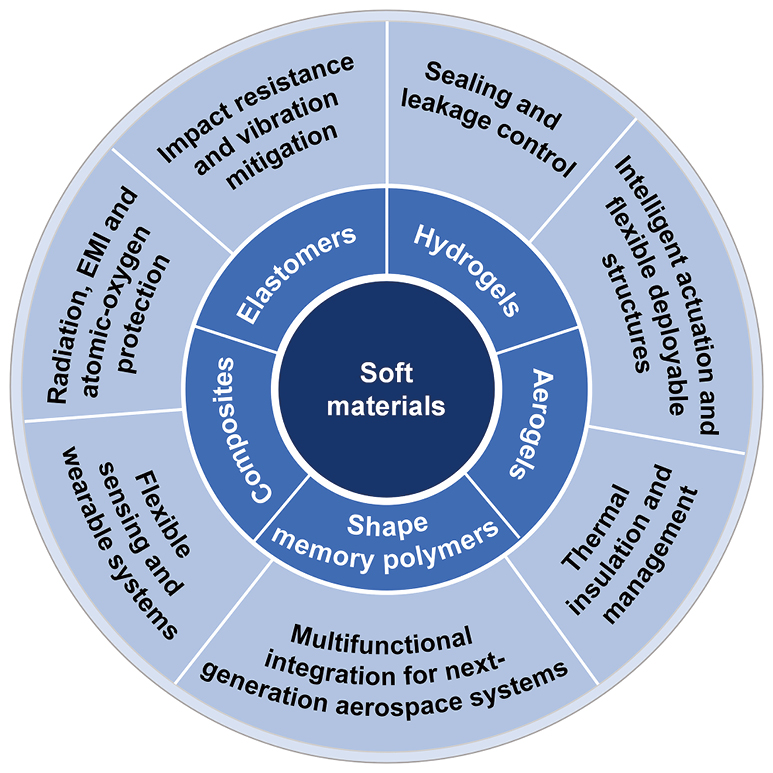
adaptation, flexible sensing, and human support. As shown in Figure 1, this review is organized around the full aerospace mission lifecycle, with particular
emphasis on impact and vibration mitigation, sealing, deployable structures, thermal
management, radiation protection, flexible electronics, and multifunctional integration.
To complement this mission-based overview, Table 1 summarizes representative soft-material platforms for each functional category, together
with their key performance, aerospace application scenarios, and main limitations
or validation needs. These topics will be reviewed and discussed in the following
sections.
Table 1 Summary of soft-material platforms for aerospace applications
| Functional category |
Representative platforms |
Key performance |
Representative aerospace applications |
Main limitations/ validation needs |
|---|
| Impact and vibration mitigation |
Rubber/viscoelastic isolators [34−36]; confined polymer-fluid elastomers [37]; armored polymer-fluid gels [38]; damping hydrogels [39, 40]; soft/hard architected composites [41]. |
Rubber shock absorbers improved satellite imaging MTF by ~10% [34, 35]; confined polymer-fluid elastomers cover 10−2–108 Hz with loss factor > 0.5, reducing impact force by up to 85% and vibration by 90%
[37]; armored gels operate from −45℃ to 135℃, reduce rebound by > 98%, and lower vibrational
force by up to 72% [38]; molecular-friction hydrogels recover damping within seconds [39]; thermally stiffening hydrogels exhibit repeatable impact resistance, and Bouligand
composites provide protection from quasi-static to ballistic impact regimes [40, 41]. |
Flywheel isolation, optical-payload vibration mitigation, reusable buffer layers,
broadband vibration isolators and impact-protection pads. |
Damping–stiffness trade-off, resonance control, fatigue life, vacuum outgassing, fluid
retention, hydrogel dehydration and scale-up of architected structures. |
| Sealing and leakage control |
EPDM/silicone O-rings and space seals [22, 46−50, 58−63]; high-pressure-hydrogen rubber seals [51, 52, 61]; deformation-coupled polymer transport networks [57]. |
Sealing performance depends on rough contact, compression, stress relaxation, and
pressure-driven transport [46−50, 61−63]. Hydrogen permeation involves sorption, diffusion, and desorption [51]. High-pressure hydrogen or rapid gas decompression can cause swelling, modulus degradation,
cavitation, fracture, and extrusion cracking [52, 53−56]. Deformation-dependent diffusivity is governed by the ratio between particle diameter
and mesh size, and by the stretch ratio of polymer chains [57]. |
Cabin pressure retention, propellant/gas isolation, cryogenic or high-pressure interfaces,
sealing and compressible sealing structures. |
Stress relaxation, extrusion, cavitation/fracture, irradiation-induced chain scission/crosslinking,
leakage-channel connectivity and lifetime prediction. |
| Intelligent actuation and flexible deployable structures |
SMPs/SMPCs [24, 70−73, 148]; 4D-printed SMP sandwich structures [74−76]; reprogrammable mechanical metamaterials [77, 78]; elastic-origami solar arrays [150]. |
SMPs/SMPCs provide high recoverable strain, low density and low actuation energy [24, 70−73]; 4D-printed sandwich structures combine large transformation with post-deployment
stiffness [74−76]; reprogrammable mechanical metamaterials enable multi-stability and coupling functions
[77, 78]; Aerospace-grade SMPs show 98%–100% shape-recovery fidelity in vacuum [148]; elastic-origami solar arrays can achieve ~1000% area expansion in <40 s [150]. |
Self-deploying solar arrays, antennas, hinges, foldable/coilable booms, reconfigurable
panels and programmable support/buffer structures. |
Repeated folding damage, recovery-force decay, deployment synchronization, and combined
thermal, vacuum, radiation, and cyclic-loading validation. |
| Thermal insulation and management |
Carbon nanofiber aerogels (CNFAs) [81−85]; PI/silica hybrid aerogels and PI/CNT conductive aerogels [86−90]; smart thermal-control coatings [91−94]. |
CNFAs show room-temperature thermal conductivity as low as 0.02 W m−1 K−1 [81], thermal/mechanical stability from cryogenic temperatures to ~1000℃ [82−84], and recoverable compression behavior [81−84]; PI aerogels withstand up to 400℃ [86] and PI/silica or PI/CNT aerogels combine insulation with mechanical or sensing functions
[87−90]; smart coatings and radiative coolers tune emissivity, solar reflection and passive
heat rejection [91−94]. |
Cryogenic systems, microsatellite thermal control, spacesuit and habitat insulation,
passive heat rejection and compliant thermal-protection interlayers. |
AO/oxidation protection, outgassing, particulate contamination, optical/spectral drift,
coating adhesion and coupled thermal–mechanical durability. |
| Radiation, EMI and atomic-oxygen protection |
Hydrogen-rich hydrogels [100–105]; MXene/aramid-nanofiber organohydrogels and conductive porous/interfacial architecture
[106−111]; silicone rubber/polysiloxane/POSS/silsesquioxane coatings [98, 99, 112−114]. |
Radiation shielding: PVA/BA gels were modeled for GCR/SPE/LEO astronaut shielding,
retained high water content, showed water-comparable protection and roughly doubled
elastic modulus vs PVA gels [100], and were further proposed as passive spacesuit interlayers without increasing suit
thickness [101]. PAM/PbO2/Laponite hydrogels (3.23 M PbO2) reached >1400% stretchability, μ = 0.1343 cm−1 for Co-60 gamma rays, and 96.55% self-healing [102]. EMI shielding: 3D-printed MXene/PEDOT:PSS hydrogels achieved 1525.8 S m−1 conductivity at 96.6 wt% water and 51.7 dB SE at ~295 μm [106]; MXene hydrogels reached 45.3 dB SE at 0.13 mm and 0.2–2.0 THz absorption bandwidth
[107]; ANF/MXene hydrogels showed SEA/SET = 80.37%–94.52% (2–8 mm) and THz SET up to ~110 dB
[109]; AlCl3 organohydrogels kept EMI SE >40 dB and >25 dB after subzero/long-term use [110]. AO protection: SQ-coated PI showed 3.7 × 10⁻²⁶ cm3 atom−1 LEO erosion yield at ~1.3–2.1 × 10²¹ atoms cm−2 and formed SiOx passivation but cracked through PI [113]; RTV silicone coatings with thicknesses of 20–80 μm were evaluated under 4.9 × 10¹⁸ and 1.2 × 10²¹ atoms cm−2 AO [114]. |
Inner spacesuit radiation shields, flexible habitat liners, wearable protection, EMI
protection for flexible electronics and AO protection of polyimide films/deployable
external surfaces. |
Vacuum dehydration, shielding mass efficiency, network damage, low-temperature conductivity,
secondary electromagnetic effects, coating cracking/defects and ground-to-orbit correlation. |
| Flexible sensing and wearable systems |
PI-based conductive aerogel sensors [32, 90]; Stretchable electronic skins with wavy/island–bridge/fractal/kirigami layouts [115, 117−119]; soft-interface filtering materials [131]; MXene aerogel e-skins [143]; ionic hydrogels [144]; liquid-metal distributed transmission lines [145]. |
PI-based conductive aerogel sensors combine superelasticity, insulation and piezoresistive
sensing across extreme temperatures [32, 90]; Wavy, island–bridge, fractal and kirigami layouts redistribute strain and preserve
device performance [115, 117−119]; soft-interface dampers suppress motion-induced low-frequency noise [131]; MXene aerogel e-skins show sensitivity of 1799.5 kPa−1, 11 ms response and > 25,000 stable cycles [143]; ionic hydrogels remain conductive/adhesive/self-healable at −80℃ [144]; distributed liquid-metal probes resolve deformation type, magnitude and position
[145]. |
Spacesuit and habitat human–machine interfaces, body-motion and physiological monitoring,
soft gripping, large-area deformation sensing and distributed structural monitoring. |
Interconnect fatigue, signal drift, conductive bonding, gel dehydration, vacuum/low-temperature
packaging, liquid-metal containment and long-term calibration. |
| Multifunctional integration |
Monolithic structure–sensing aerogels [90, 146, 147]; SMP actuation–structure systems [71, 148−150]; flexible piezoelectric and thermoelectric energy-conversion materials [151−154]. |
CNFA and PINF@CNT aerogels enable lightweight thermal-insulating sensors: CNFA-based
aerogels show sensitivity up to 114.6 kPa−1 and > 95% height retention after 10,000 cycles [146, 147], while dual-gradient PINF/CNT aerogels combine 0.023 g cm−3 density, 28 mW m−1 K−1 thermal conductivity, −196℃ to 533.3℃ thermal resilience, 156 MPa−1 sensitivity, and 223 kPa detection range [90]. SMP systems support vacuum shape recovery and self-deployment [148]; soft piezoelectric and thermoelectric materials provide sensing, vibration control,
thermal regulation, and auxiliary power [151−154]. |
Deployable-antenna deformation monitoring, thermal-protection integrity sensing, self-deploying
frames/solar arrays, structural health monitoring and auxiliary power for distributed
soft systems. |
Thermal-cycling drift, environmental aging, power density, contact resistance, packaging
and long-term reliability. |
2 Impact Resistance and Vibration Mitigation
In aerospace engineering, launch shock, pyroshock, broadband vibration, long-term
microvibration, and extreme thermal cycling act on structures and payloads over very
different time and energy scales. As a result, it is essential to simultaneously address
stiffness, impact protection, cyclic durability, thermal tolerance, and low mass within
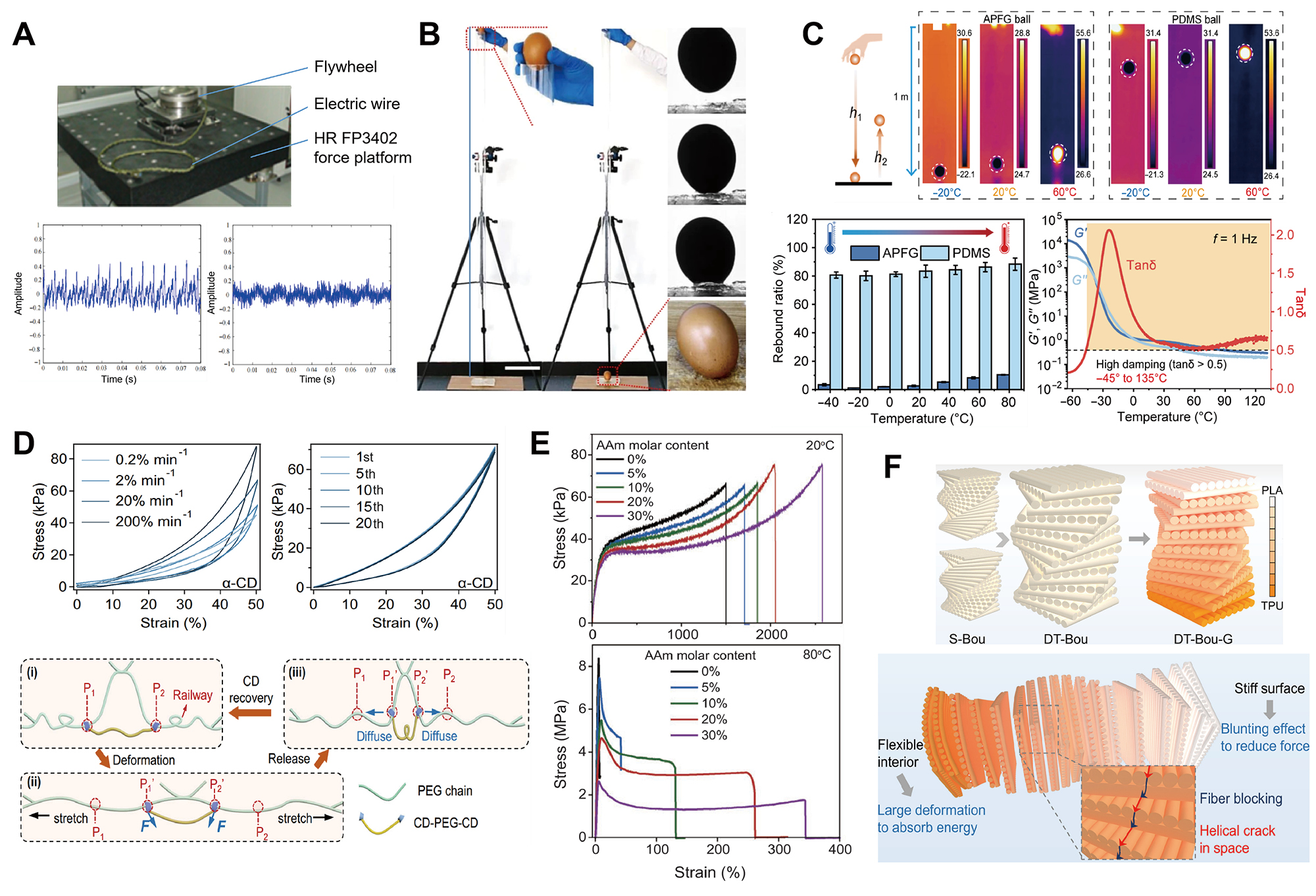
an integrated material-structure system. As shown in Figure 2A, Deng et al. [34] showed on a satellite imaging platform that rubber shock absorbers can reduce microvibration
transmitted from the flywheel and improve imaging performance. Both simulation and
experiment indicated an improvement of about 10% in modulation transfer function,
highlighting the practical value of viscoelastic soft isolators for on-orbit vibration
control [34, 35]. At the same time, isolators based purely on soft rubber remain constrained by a
familiar contradiction: low stiffness is favorable for high-frequency isolation, but
it also shifts resonance into the low-frequency range and increases the risk of excessive
deformation and fracture under severe launch vibration. Han et al. [36] highlighted this limitation and proposed a pseudoelastic hybrid isolator specifically
to improve attenuation across both low-frequency vibration and high-frequency pyroshock
conditions, underscoring that the core requirement is not only attenuation, but attenuation
without loss of structural stability under harsh loading.
At the material level, a central limitation of conventional viscoelastic polymers
lies in the trade-off between damping capacity and modulus, together with their relatively
narrow effective frequency and temperature ranges. Recent studies have therefore focused
on material strategies that decouple energy dissipation from stiffness while extending
serviceability across broader loading and thermal conditions. Huang et al. [37] showed that elastomers containing confined polymer fluids can dissipate energy through
hierarchical relaxation over an exceptionally broad frequency range of 10−2−108 Hz while maintaining a nearly stable modulus; in their tests, the loss factor exceeded
0.5, the impact force was reduced by as much as 85%, and vibration attenuation reached
90%, demonstrating that soft damping media can be designed for both transient impact
and sustained excitation (Figure 2B). Chen et al. [38] extended this idea through armored polymer-fluid gels, where a stiffened outer layer
and dissipative interior jointly mitigated the damping-modulus trade-off over a wide
service temperature range from −45℃−135℃; under these conditions, rebound was reduced
by more than 98%, and vibrational force was lowered by as much as 72% under low-temperature
loading, which is especially relevant to aerospace environments with large thermal
excursions (Figure 2C). Hydrogels add another design dimension because they introduce not only dissipation,
but repeated and adaptive mechanical response. Xu et al. [39] showed that molecular-friction hydrogels can restore damping within seconds after
deformation, thereby overcoming the slow recovery associated with sacrificial-bond
systems (Figure 2D), while Li et al. [40] developed thermal-stiffening hydrogels that can switch rapidly from compliant to
load-bearing states and then recover quickly enough to support repeated impact resistance
(Figure 2E). These studies indicate that soft impact-resistant materials are moving from passive
dissipative media toward programmable systems in which damping, stiffness, temperature
response, and recoverability are designed simultaneously.
Structural approaches provide a further route to impact and vibration resistance,
with protective performance generated through hierarchy, topology, and wave regulation
rather than through intrinsic material damping alone. Wen et al. [41] showed that a gradient double-twisted Bouligand architecture composed of stiff Polylactic
Acid (PLA) and soft Thermoplastic Polyurethane (TPU) improves impact resistance over
loading conditions ranging from quasi-static to ballistic, illustrating how bioinspired
hierarchical design can broaden protective performance across different strain-rate
regimes (Figure 2F). Reviews of low-frequency acoustic metamaterials and porous materials further show
that tunable resonance, negative-Poisson-ratio deformation, and multiscale wave attenuation
provide additional routes for broadband vibration suppression and impact energy redistribution
in lightweight systems [42, 43]. Feng and Li [44] argued that damping systems should be evaluated within an integrated material-structure-performance
framework, because high damping alone cannot ensure effective vibration suppression
without adequate stiffness and suitable deformation modes; in this context, self-healing
constituents enable repeatable damping structures by restoring dissipation after damage.
The same trend is now extending to design methodology, where data- and mathematics-driven
optimization is being used to co-design metamaterial topology and target functions
for lightweight energy absorption and vibration-control behavior [45]. Overall, the most promising direction is to integrate soft-material dissipation,
hierarchical structural design, reusable or self-healing functionality, and inverse
design into aerospace-specific systems capable of withstanding both instantaneous
impact and sustained vibration under realistic mission environments.
3 Sealing and Leakage Control
Sealing and leakage control are indispensable in aerospace engineering because loss
of sealing integrity can compromise pressure containment, medium isolation, and environmental
protection even when a seal remains under nominal compression. For soft sealing systems,
leakage is not a simple consequence of insufficient preload or geometric mismatch;
rather, it arises from the coupled evolution of interfacial contact, viscoelastic
stress relaxation, and flow through non-contact channels across multiple length and
time scales. This point has been clarified in rough-surface contact mechanics, where
sealing performance is governed by the real contact condition and the connectivity
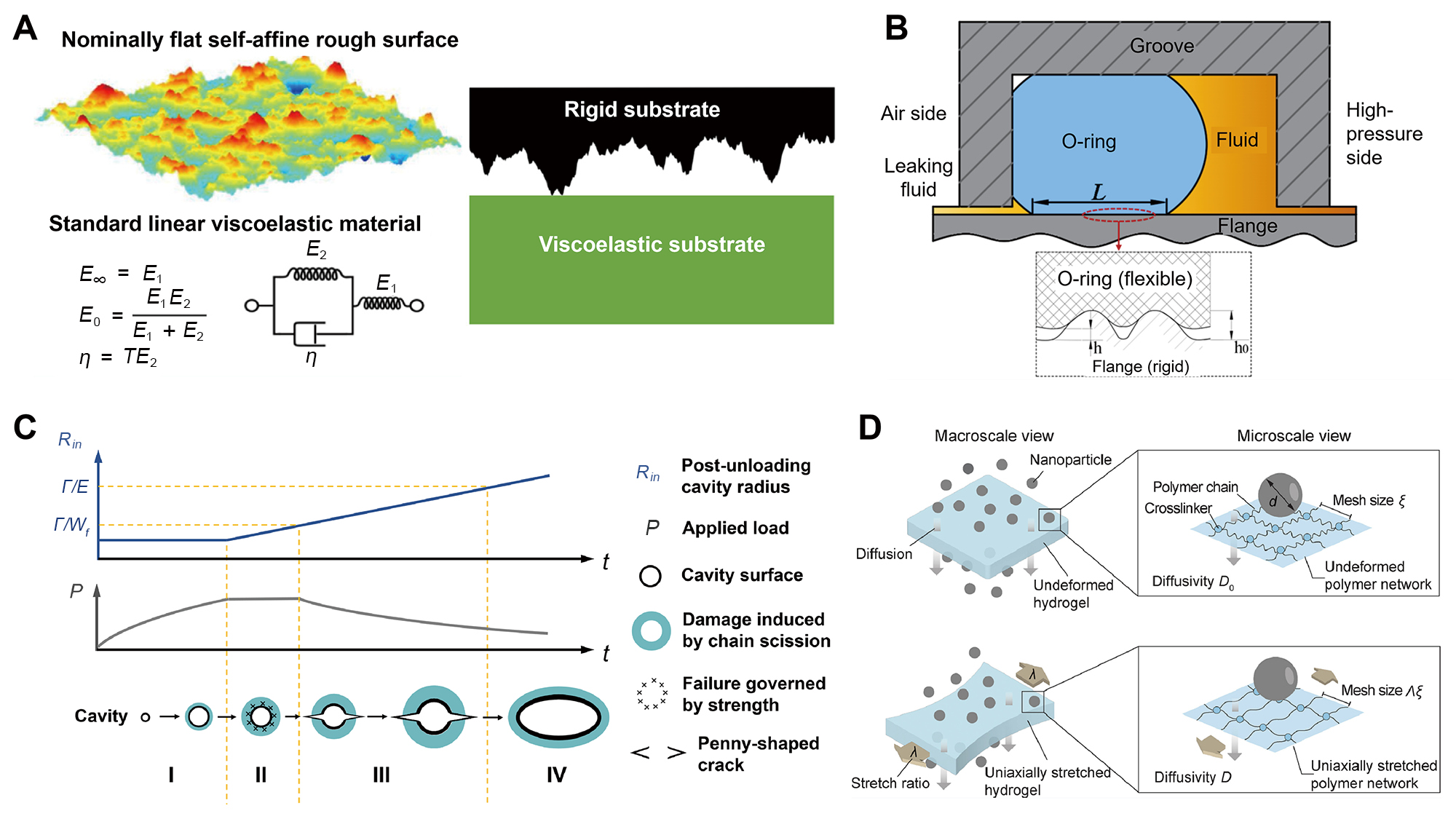
of non-contact leakage paths rather than by nominal contact area alone [46]. Viscoelastic contact analyses showed that time-dependent loading alters interfacial
separation, real contact area, and dissipative behavior, so that leakage pathways
become dependent on loading history under cyclic or sustained service (Figure 3A) [47, 48]. Huang et al. [49] developed a predictive leakage model for irradiated ethylene propylene diene monomer
O-rings by coupling macroscopic simulations of O-ring deformation with mesoscopic
simulations of interfacial leakage. Their results showed that leak rate cannot be
predicted from irradiation-induced material changes alone, because surface roughness,
compression ratio, and pressure differential also govern the morphology and connectivity
of interfacial flow channels (Figure 3B). In addition, Li et al. [50] reported a result for O-ring seals under high-temperature and high-pressure conditions:
although elevated temperature may temporarily increase contact stress and improve
sealing in the short term, prolonged exposure accelerates stress relaxation, extrusion,
and leakage growth. This finding indicates that the key challenge for O-ring sealing
reliability lies not in short-term sealing enhancement, but in the long-term degradation
of sealing performance.
The sealing problem becomes more complex when the sealed medium is chemically reactive
or highly diffusive. In hydrogen environments, Zhou et al. [51] showed that gas transport in rubber follows a solution-diffusion mechanism involving
sorption, diffusion, and desorption, with hydrogen permeability governed by pressure,
temperature, filler characteristics, crosslink density, and polymer polarity. In high-pressure
hydrogen environments, gas transport is closely linked to the permanent deformation
of rubber seals. Zheng et al. [52] showed that swelling, modulus degradation, cavitation and fracture by rapid gas
decompression [53−56] (Figure 3C), and extrusion-related cracking may develop concurrently, indicating that seal failure
should be understood as a coupled mechanics-transport problem rather than as a simple
consequence of geometric mismatch. A broader mechano-transport perspective is provided
by Liu et al. [57], who showed that diffusivity in deformed polymer networks is controlled by two dimensionless
parameters: the ratio of particle diameter to mesh size, and the ratio of current
polymer chain length to its initial length. Their results indicate that transport
in soft polymers is deformation-dependent, so diffusivity should be incorporated into
sealing analysis as a mechanically coupled parameter (Figure 3D). The same logic extends to aging caused by radiation. Chain scission, crosslinking,
and diffusion-limited oxidation evolve concurrently over long service periods, progressively
changing both stress-retention capability and barrier performance [58, 59]. For silicone-based sealing materials, long-term stability remains a challenge,
because thermal-oxidative aging, including oxidative crosslinking and scission of
molecular chains, progressively degrades network integrity unless they are mitigated
through formulation design, interfacial compatibility, and network stabilization [60].
Accelerated testing and life prediction remain difficult because sealing reliability
cannot be inferred from a single test result or a material property. Jung [61] showed that the gas uptake, solubility, and diffusivity obtained from gravimetric,
volumetric, manometric, and gas-chromatographic methods are generally consistent,
while the methods differ in resolution, stability, expanded uncertainty, sensitivity
to temperature and pressure, and practical applicability; in this sense, the main
issue is how measurement route and test condition affect the reliability and usability
of those data in leakage evaluation. A similar point appears in radiation-induced
degradation. Battini et al. [62] showed that the safe service of gate-valve O-rings exposed to radiation cannot be
defined by any single radiation-sensitive material property, but depends jointly on
squeeze degree, service time, storage time, and the contact pressure required to preserve
sealing; accordingly, their study yielded a life-prediction map rather than a single
end-point criterion. In addition, Mahankar and Dhoble [63] showed that hydraulic seal failure under elevated temperature arises from the interaction
of swelling, oxidation, loss of additives, compression set, friction, and wear, while
Basuli et al. [64] and Patel et al. [65] similarly argued that proton exchange membrane (PEM) fuel-cell gaskets and oil-and-gas
elastomer assemblies cannot be evaluated from bulk material tests alone, because chemical
compatibility, stress relaxation, extrusion gaps, thermal cycling, and assembly conditions
remain strongly coupled at the component scale. Overall, future aerospace sealing
research needs predictive frameworks that relate leakage directly to coupled contact
mechanics, transport behavior, aging under environmental exposure, and accelerated
test conditions, so that service life can be estimated from the evolution of sealing
function rather than from isolated material-property changes alone.
4 Intelligent Actuation and Flexible Deployable Structures
In aerospace deployable systems, soft materials offer the potential to integrate compliance,
actuation, and functional adaptation directly into the structure, thereby reducing
reliance on complex mechanical subsystems. For such systems, compact stowage and reliable
deployment are only the initial requirements; equal attention must also be given to
post-deployment stiffness, recovery force, geometric accuracy, and stability under
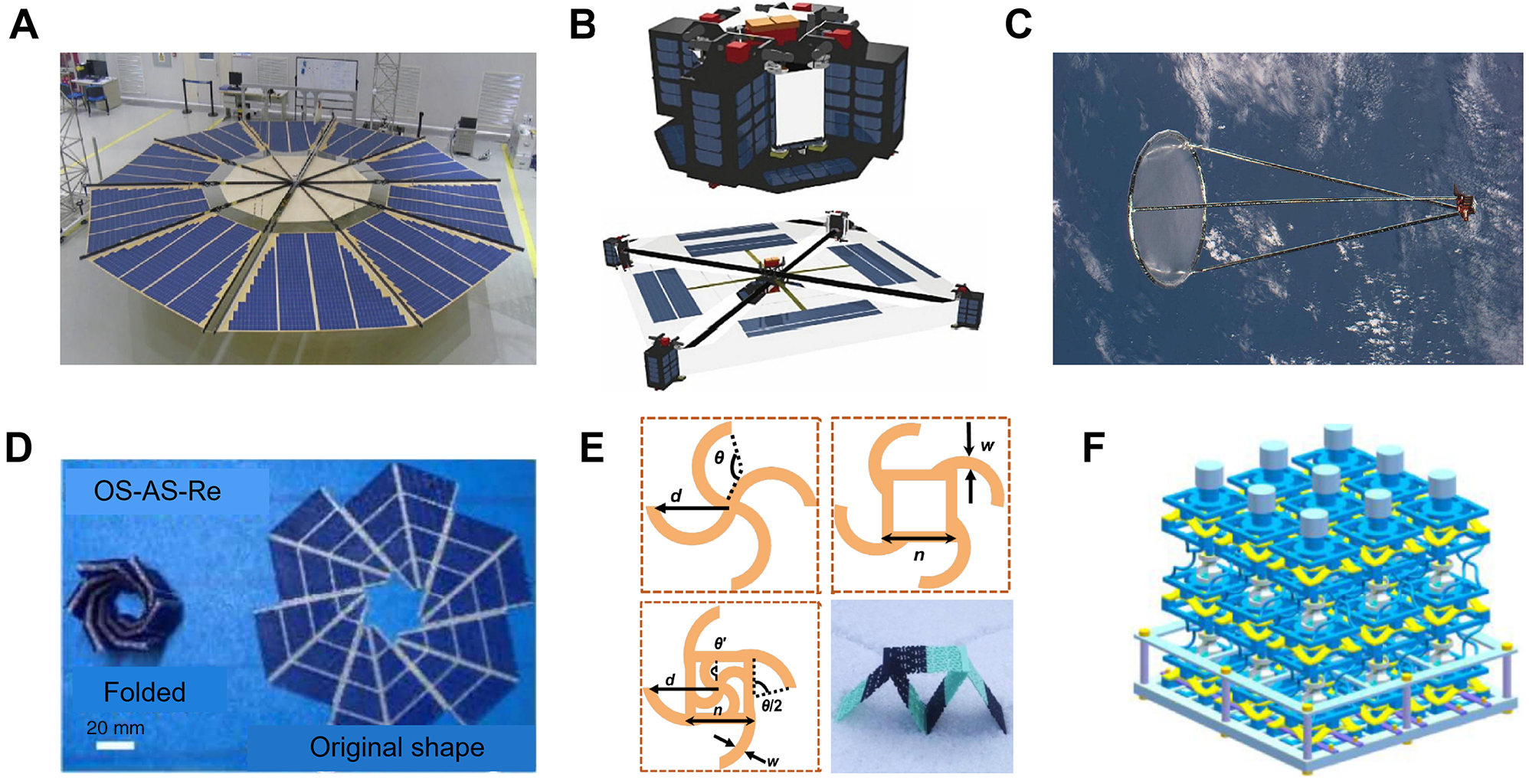
the space environment. Wang et al. [23] classified space deployable structures into pantographic (Figure 4A) [66], elastically deployed (Figure 4B) [67], and inflatable systems (Figure 4C) [68], and showed that the significance of smart materials lies in their ability to reduce
structural complexity while improving controllability, environmental adaptability,
and deployment precision. This requirement is particularly evident in membrane and
gossamer structures, where reflector antennas, booms, solar arrays, and inflatable
habitats all benefit from high packaging efficiency and low mass, yet remain constrained
by wrinkling, shape control, vibration, and deployment reliability [68]. In this context, material-structure coordination remains a critical issue in advanced
deployable space systems [69].
Shape-memory polymers (SMPs) and their composites are among the most extensively studied
soft-material systems for intelligent deployment in aerospace. Xia et al. [70] noted that the shape-memory effect in polymers can be interpreted through complementary
thermoviscoelastic and phase-transition frameworks, while composite design extends
actuation beyond direct heating to electricity, light, magnetism, water, and other
external stimuli. Yadav et al. [24] showed that, relative to shape-memory alloys, SMPs generally offer higher recoverable
strain, lower density, easier processing, and lower actuation energy, which accounts
for their continued use in antennas, hinges, booms, and related deployable elements;
however, they also emphasized that vacuum, ultraviolet irradiation, and thermal cycling
remain important constraints on long-term service performance. A more application-oriented
perspective was provided by Liu et al. [71], who reviewed hinges, foldable and coilable booms, deployable panels, reflector
antennas, and morphing wings made of shape memory polymer composites (SMPCs), and
showed that the engineering significance of SMPCs lies in their ability to balance
low structural mass, recovery force, and deployment shock within a single deployable
system. Dao et al. [72] designed carbon-fabric-reinforced SMPC hinges for space deployable structures and
found that carbon-epoxy reinforcement improved both stiffness and shape recovery,
but repeated folding and deployment also led to progressive damage and longer recovery
times, indicating that cyclic durability is a central requirement for practical aerospace
use. More broadly, the key challenge lies in achieving stable and controllable actuation
under coupled thermal, mechanical, and environmental conditions, while preserving
recovery force, dimensional stability, and repeatable deployment performance [73].
A significant development in this field is the increasing integration of actuation,
structural design, and manufacturing. Programmable deployment does not arise from
responsive materials alone, but from spatially organized heterogeneity, such as gradients,
multilayers, patterned stiffness, and active fillers, through which local deformation
can be transformed into controlled global shape change [74]. Additive manufacturing enables material response to be encoded into geometry and
spatial arrangement [75]. This strategy is evident in 4D-printed deployable structures. As shown in Figure 4D, Xin et al. [76] designed origami-inspired honeycomb sandwich structures combining shape-memory actuation
with sandwich stiffening, so that thin responsive sheets can achieve both large shape
transformation and sufficient stiffness after deployment for antenna-like applications.
The same design logic has also extended from one-time self-deployment to reprogrammable
multifunctionality. Yang et al. [77] developed gradient metamaterials based on thermo-, photo-, electro-, and magneto-responsive
SMP nanocomposites, showing that multi-material 4D printing can coordinate shape change
and mechanical response within a single structure (Figure 4E). Xin et al. [78] further proposed modular 4D pixel mechanical metamaterials, in which properties
such as multistability and compression-torsion coupling are determined by reconfigurable
unit design rather than fixed once at fabrication (Figure 4F). Much of the existing work has focused on actuation design and functional expansion
under relatively conventional conditions. In aerospace deployable systems, however,
structural performance must be maintained after deployment under extreme environments
such as large thermal excursions and high-temperature exposure. This requirement brings
non-actuating soft materials into the design problem as well. Flexible aerogels and
multifunctional polymer nanocomposites, for example, can provide compliant thermal-protection
layers, deformable interfaces, and additional functional integration, thereby extending
the material and structural design space of deployable soft systems [79, 80].
5 Thermal Insulation and Management
Among the aerospace applications of soft materials, thermal insulation and management
are particularly important, as they address the severe thermal conditions encountered
in modern space missions—from crewed lunar landings and deep space exploration to
hypersonic flight and large inflatable space stations. These missions require protection
against extreme cyclic thermal environments spanning from −270℃ in deep space to over
1200℃ during hypersonic re-entry, together with stringent requirements for lightweight
design, geometric conformability, and low energy consumption. Conventional rigid solutions,
including bulk ceramic heat shields, metallic thermal control structures, and traditional
multi-layer insulation (MLI), are increasingly constrained by trade-offs among thermal
efficiency, mechanical flexibility, and long-term durability in space environments.
In this context, nanostructured soft materials provide new opportunities for aerospace
thermal management.
Carbon nanofiber aerogels (CNFAs) are promising candidates for high-performance thermal
insulation through rational nanostructure design, extending the use of soft materials
toward more demanding thermal-protection scenarios. Constructed from three-dimensional
interconnected one-dimensional nanofiber networks with porosities exceeding 99% and
pore sizes smaller than the mean free path of air molecules, CNFAs can simultaneously
suppress gaseous convection, solid heat conduction, and high-temperature infrared
radiative transfer across a wide temperature range. Recent advances in electrospinning
fabrication, biosynthesis, and interface engineering have substantially improved the
historical fragility and irreversible structural collapse of conventional carbon aerogels:
state-of-the-art CNFAs achieve room-temperature thermal conductivity as low as 0.02
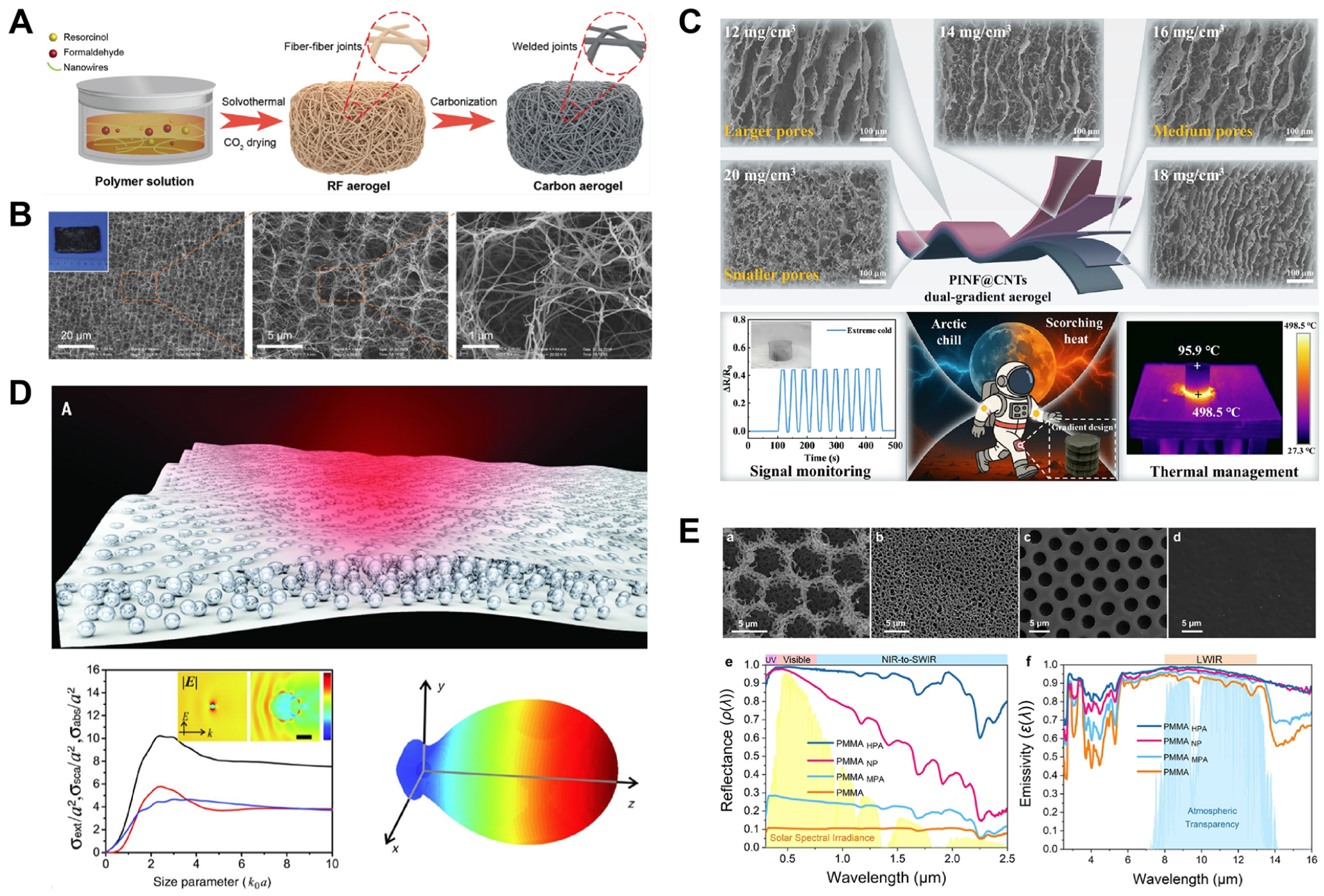
W m−1 K−1 [81], exceptional thermomechanical stability spanning from −196℃ to 1000℃ [81, 82], an extremely fast structure recovery speed of 860 mm s−1 alongside high compressive strength (Figure 5A) [83], and fatigue resistance reaching up to millions of compression cycles without plastic
deformation (Figure 5B) [84]. An ultralight carbon nanofiber aerogel can stably stand on a dandelion and support
heavy weights thousands of times its own mass [85]. For aerospace applications, these CNFAs offer an ultralight solution with potential
relevance to hypersonic vehicle leading edges, lunar lander cryogenic systems, and
micro-satellite thermal control units, while potentially reducing launch weight and
active thermal-control loads.
Flexible aerogel insulation materials have also advanced rapidly, particularly for
next-generation spacesuits. These materials use the inherent conformability of soft
materials to address the geometric limitations of rigid insulation and thereby broaden
the design space of human spaceflight systems. Traditional spacesuit MLI suffers from
excessive thickness, weight, and poor conformability to joint regions, which severely
restricts astronaut mobility. While pristine silica aerogels feature extremely low
solid-state thermal conductivity, their brittleness and powder shedding have long
hindered aerospace deployment. The detached powder acts as a contaminant, adhering
to optical surfaces, seals, and electronic components, ultimately causing payload
failure. Recent innovations in organic-inorganic hybridization have substantially
improved these limitations. Pioneering flexible polyimide aerogels from NASA withstand
temperatures up to 400℃ with high tensile strength [86]. Polyimide-silica (PI/SiO2) hybrid aerogels now achieve ultra-low densities of 0.061 g cm–3 and thermal conductivities of 0.0216 W m–1 K–1, while demonstrating no fracture even under 80% compressive strain [87]. Moreover, they support heavy weights exceeding 2,999 times their own mass without
structural collapse [88]. Under simulated space environments, they maintain stable insulation despite high-vacuum
outgassing, high-energy proton/electron irradiation, and extreme thermal cycling [87]. Furthermore, double-network PI/SiO2 aerogel formulations mitigate cryogenic brittleness and exhibit a 60% lower thermal
conductivity than pristine silica at 100% relative humidity [89], which may help reduce thermal-management demands in life-support-related systems.
This environmental adaptability is further illustrated by the recently developed dual-gradient
polyimide nanofiber/carbon nanotube (PINF@CNTs) aerogels. As demonstrated in Figure 5C, such advanced PI-based aerogels can maintain stable piezoresistive sensing capabilities
under cryogenic conditions (−196℃) and provide thermal management on a ~500℃ hot surface,
indicating their potential for astronaut health monitoring and thermal protection
in spacesuits [90].
Flexible thermal-control coatings and radiative-cooling soft materials constitute
another active direction, especially for spacesuits and flexible deployable aerospace
structures, where soft materials may enable thermal-management configurations that
are less accessible to rigid solutions. In the vacuum of space, thermal radiation
is the only viable heat-rejection pathway. Conventional rigid metallic coatings with
fixed emissivity cannot readily adapt to cyclic thermal environments or flexible non-planar
surfaces. Recent advances in spectral engineering have yielded flexible soft coatings
with on-demand thermal regulation: for autonomous thermal control, ESA-backed smart
optical solar reflectors (meta-OSRs) utilizing W:VO2 metasurfaces on space-grade polyimide achieve a high-temperature emissivity of 0.80
and a contrast of 0.33 near a transition temperature of 30℃, saving up to 50% of spacecraft
heating power [91]. For passive daytime radiative cooling, scalable glass-polymer hybrid metamaterials
[92] and transparent fluorinated polyimide (FPI) foils embedding SiO2 microspheres [93] represent important recent advances. Specifically, the FPI/SiO2 foils achieve ultralow solar absorptivity (0.07) and high infrared emissivity (0.94)
within the atmospheric window [93]. Meanwhile, the scalable roll-to-roll manufactured glass-polymer hybrid metamaterials
deliver a noon-time cooling power of 93 W m–2 under direct sunlight (Figure 5D) [92]. Similarly, hierarchically porous structural polymers, such as rationally designed
PMMA films, have been developed for efficient all-day passive radiative cooling. As
illustrated in Figure 5E, such porous polymer films exhibit a bright white appearance for high solar reflectance
and can deliver stable, continuous sub-ambient cooling performance during midday [94]. These material systems may also offer weight advantages relative to rigid structures.
6 Radiation, EMI and Atomic-oxygen Protection
Aerospace materials are exposed to coupled space stressors, including ionizing radiation,
electromagnetic irradiation, atomic oxygen (AO), vacuum, ultraviolet exposure, and
thermal cycling. These conditions accelerate degradation and impose stringent demands
on mass efficiency, mechanical compliance, and durability [95, 96]. Three hazards are particularly consequential: ionizing radiation beyond Earth's
magnetic shielding [96], non-ionizing electromagnetic irradiation in highly integrated electronic systems
[97], and AO erosion in low-Earth orbit (LEO) and very-low-Earth orbit (VLEO), which
progressively degrades exposed polymeric surfaces [98, 99]. Recent advances show that soft frameworks can integrate hydrogen-rich networks,
conductive nanostructures, and silicon-based hybrid chemistries to deliver radiation
attenuation, electromagnetic interference (EMI) shielding, and AO resistance within
a unified materials strategy [97−99].
For ionizing-radiation protection, the central design principle in soft materials
is to combine hydrogen-rich matrices that moderate incident particles with functional
fillers that selectively absorb or attenuate specific radiation components. Recent
studies have shown that poly(vinyl alcohol) (PVA)-based gels, owing to their high
water content, can effectively dissipate the energy of high-energy charged particles,
while boric-acid crosslinking not only stabilizes the polymer network but also enhances
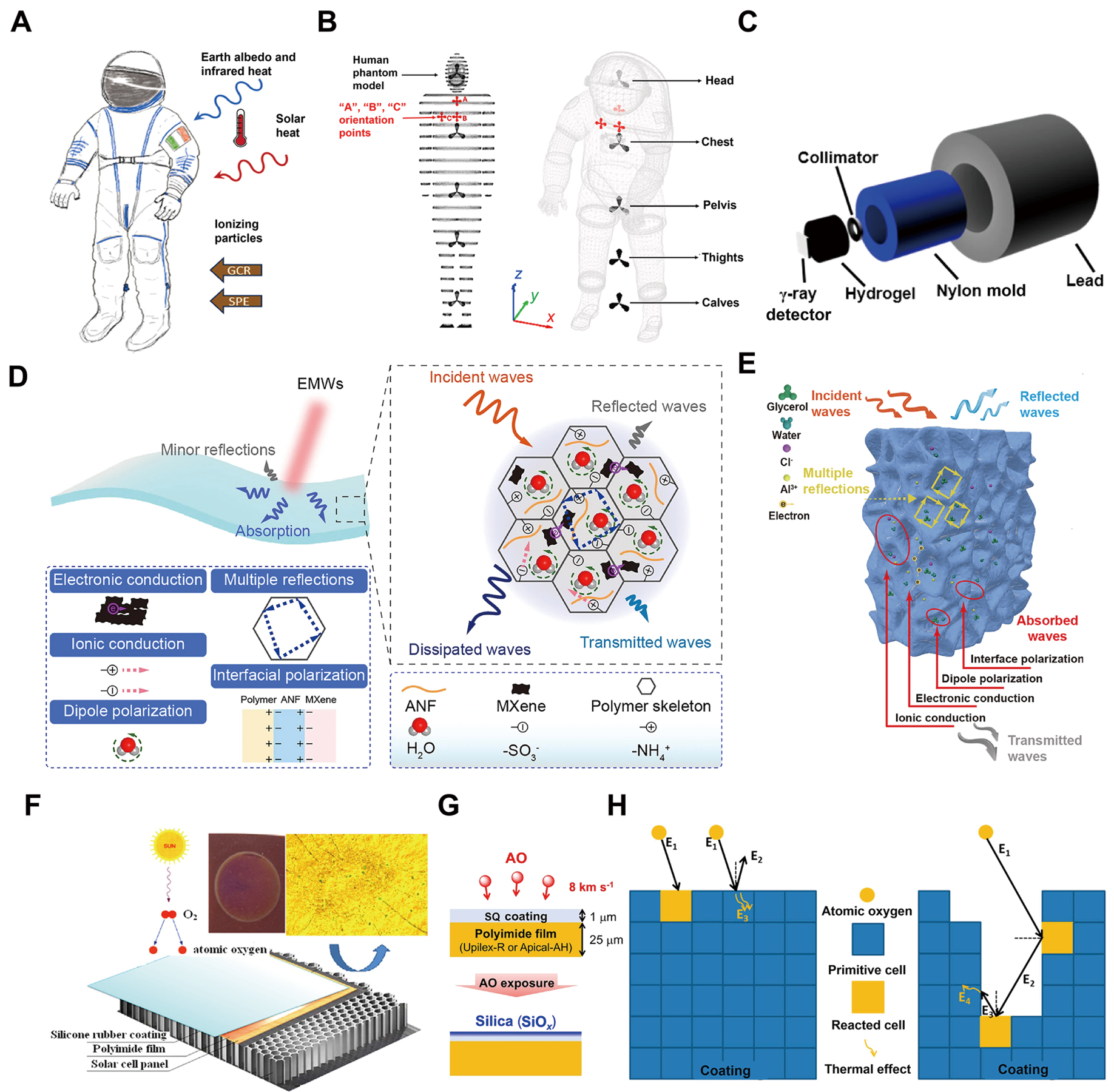
engineering relevance for astronaut radiation protection (Figure 6A) [100]. Lambertini and co-workers [101] developed passive shielding models based on poly(vinyl alcohol)/boric acid (PVA/BA)
gels for astronaut protection and spacesuit applications beyond LEO, demonstrating
the practical value of such flexible gels under solar particle event conditions (Figure 6B). Beyond neat hydrogen-rich systems, current efforts increasingly focus on integrating
high-Z constituents, MXenes, boron nitride, and boron-containing motifs to achieve
synergistic shielding against gamma rays, neutrons, and mixed-radiation environments
[102–105]. For example, porous MXene-BN hydrogels have been shown to provide simultaneous
gamma-ray and thermal-neutron shielding while maintaining anti-freezing capability,
self-healing behavior, and moisture permeability [103]. Similarly, self-healable polyacrylamide (PAM)/PbO2/Laponite hydrogels demonstrate that high-Z nanofillers can substantially enhance
gamma attenuation, as evidenced by representative γ-ray exposure tests on hydrogel
shielding composites (Figure 6C) [102]. Borax-incorporated hydrogel composites further illustrate a rational neutron-shielding
strategy based on matrix-mediated moderation coupled with selective capture by functional
units [104]. Collectively, these studies suggest that the emphasis in ionizing-radiation protection
is moving away from maximizing attenuation coefficients alone and toward constructing
lightweight, flexible, and wearable shielding networks more compatible with actual
aerospace deployment.
By contrast, protection against non-ionizing radiation is governed primarily by electromagnetic-wave
transmission, reflection, absorption, and dissipation, and is thus directly linked
to electromagnetic compatibility, stealth, and integrated thermal management in aerospace
electronics. Here, the advantages of soft materials lie in their ability to form continuous
conductive pathways, porous scattering architectures, and deformable interfaces. MXenes,
graphene, aramid nanofibers, and conductive polymers have all been extensively exploited
to fabricate high-performance gel-based EMI shielding systems. Liu et al. [106] demonstrated that additive manufacturing of MXene-functionalized conductive polymer
hydrogels enables a transition from laboratory-scale formulations to structurally
programmable shielding architectures. Zhu et al. [107] further showed that Ti3C2Tx MXene composite hydrogels can achieve absorption-dominated EMI shielding, a particularly
desirable feature because it mitigates secondary electromagnetic pollution arising
from excessive reflection. Likewise, the biomimetic porous MXene-sediment hydrogel
reported by Yang et al. [108] leveraged ordered pore channels and highly conductive frameworks to realize exceptionally
strong EMI shielding. Importantly, the field is increasingly recognizing that the
most valuable systems are not those with the highest nominal shielding effectiveness
alone, but those that preferentially dissipate electromagnetic energy through polarization
loss, interfacial dissipation, and multiple scattering (Figure 6D) [107, 109]. At the same time, the development of organohydrogels has alleviated the long-standing
limitations of conventional hydrogels under low-temperature and dehydration conditions,
thereby pushing soft EMI shielding materials closer to realistic use in extreme environments
(Figure 6E) [110, 111]. Non-ionizing-radiation protection is therefore evolving toward environmentally
resilient, absorption-dominated, and multifunctionally integrated platforms, rather
than the simple pursuit of ever-larger dB values.
Among the three protective targets, atomic-oxygen resistance most clearly exposes
both the boundaries and the diversification of soft-material strategies. For water-rich
or highly hydrophilic network materials, vacuum-induced dehydration combined with
persistent AO etching severely constrains their direct use as exposed outer-surface
protective layers. Accordingly, the most mature solutions currently rely on silicone
rubbers, polysiloxanes, polyhedral oligomeric silsesquioxane (POSS)-containing systems,
and silsesquioxane-based hybrids [112–114]. These materials share a common physicochemical advantage: under AO attack, they
generate relatively dense SiOx or SiO2 passivation layers that suppress continued erosion of the underlying organic matrix
[112, 113]. Wang et al. [114] analyzed a two-component room-temperature-vulcanizing (RTV) silicone-rubber coating
sprayed on polyimide and showed that AO exposure induced surface cracking and compositional
evolution while still confirming the practical potential of silicone-rubber protective
layers for spacecraft polymer surfaces (Figure 6F). Goto et al. [113], through comparative exposure of silsesquioxane-coated polyimide films in LEO, VLEO,
and laboratory environments, further demonstrated that AO protection in real orbital
conditions involves more than surface passivation alone; crack evolution, coating
integrity, and coupled environmental degradation all play decisive roles (Figure 6G). More recently, plasma-polymerized siloxane coatings with optimized thickness have
been shown to provide improved atomic-oxygen resistance, highlighting the importance
of coating-thickness control in balancing barrier performance and structural compliance
(Figure 6H) [112]. These findings carry an important implication for the broader soft-material field:
if gel-based systems are to be advanced toward exposed space-surface applications,
they will likely require silicon-functionalized chemistries, surface barrier layers,
or layered composite architectures that separate inner functional roles from outer
protective functions.
It is worth noting that the engineering relevance of hydrogel-based radiation shielding
should be interpreted with caution. Hydrogen-rich and water-containing polymer networks
provide a promising basis for attenuating charged particles and secondary radiation,
but most demonstrations have been performed under simplified laboratory irradiation
conditions rather than under the coupled environments encountered in space. In service,
vacuum exposure may cause dehydration, shrinkage, and loss of conformability. Repeated
temperature cycling may also induce freezing, phase separation, cracking, or changes
in ion transport and mechanical compliance. Prolonged irradiation may further alter
the network through chain scission, additional crosslinking, debonding between fillers
and the polymer matrix, and interfacial damage, thereby changing both shielding performance
and structural integrity. Thus, current hydrogel shielding systems are better viewed
as design concepts for protected, encapsulated, or replaceable architectures, such
as spacesuit inner layers, habitat shielding modules, and conformal wearable protection,
rather than as materials already qualified for exposed spacecraft surfaces. Future
work should move beyond single-factor irradiation tests toward protocols that combine
vacuum exposure, thermal cycling, radiation, ultraviolet irradiation, and atomic oxygen,
together with accelerated aging and lifetime prediction, to determine whether hydrogel-based
systems can retain protective function over mission-relevant timescales.
7 Flexible Sensing and Wearable Systems
Long-duration missions, extravehicular activities, and habitat operation require the
continuous acquisition of physiological, mechanical, and environmental information
at deformable human–machine interfaces. Flexible sensing and wearable systems used
in these settings must therefore maintain conformal contact, electrical continuity,
and signal stability when attached to skin, spacesuits, or inflatable structures under
stretching, bending, twisting, and repeated motion. In this context, device performance
cannot be attributed to the softness of constituent materials alone; it also depends
on how structural design redistributes strain, reduces interfacial mismatch, and preserves
functional coupling during deformation [115, 116]. Cheng et al. [116] showed that flexible devices are evolving from planar layouts toward bioinspired
three-dimensional systems, in which geometry, heterogeneous integration, and structural
design are used to maintain conformal contact and expand device functionality. A similar
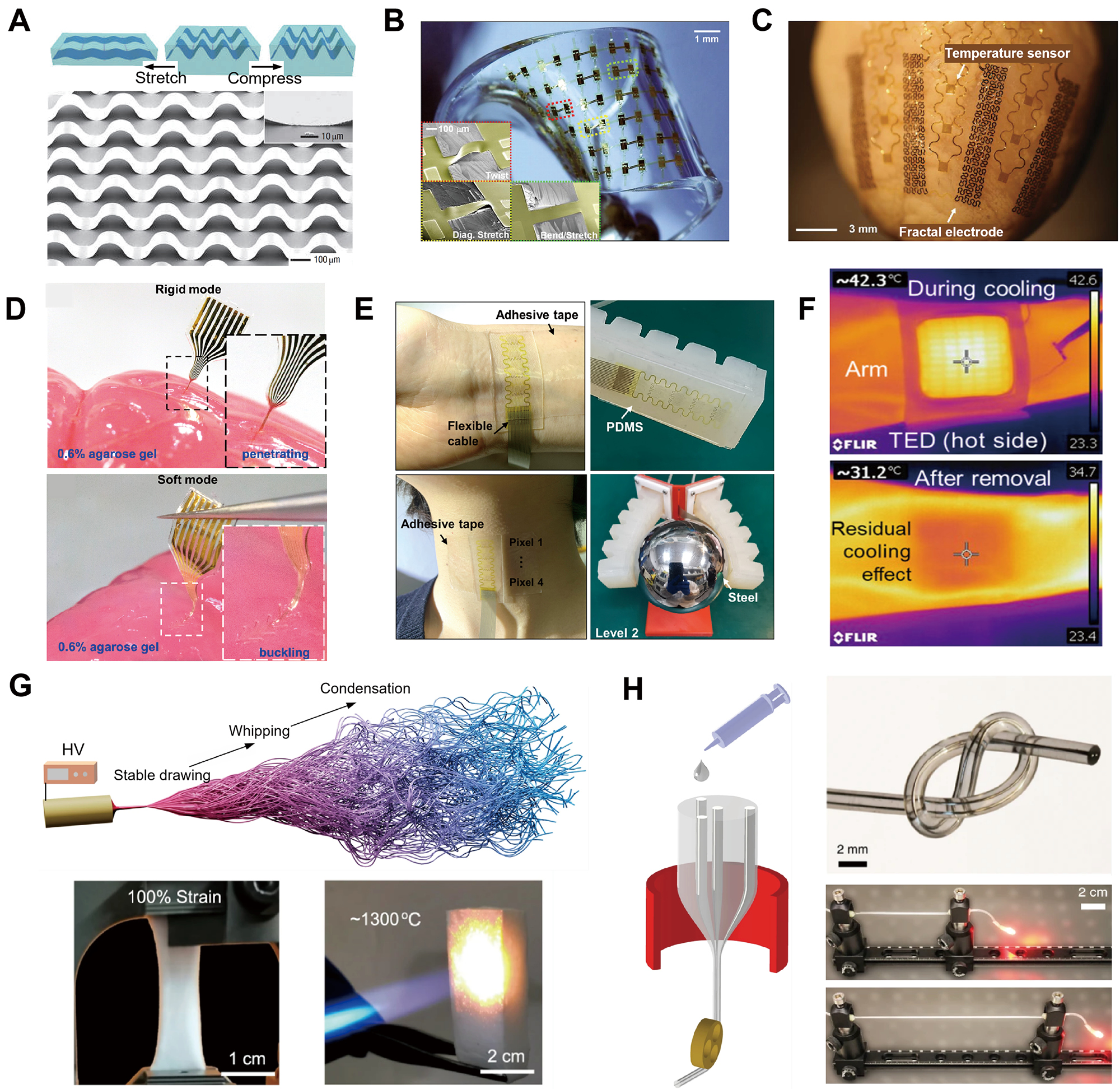
requirement appears in mechanically guided stretchable electronics, where wavy (Figure 7A) [117], island–bridge (Figure 7B) [118], fractal-inspired (Figure 7C) [119], and kirigami layouts allow rigid functional components and compliant substrates
to coexist within a deformable system without loss of performance [115]. At the system level, reliable operation further requires the coordinated design
of sensing materials, interconnects, encapsulation, power modules, conductive bonding,
and multilayer architectures, because repeated deformation can interrupt current pathways
and degrade device-level stability if these elements are treated separately [120, 121]. This need for mechanical adaptation is also evident in deployable intracortical
probes, where temporary stiffness and post-deployment softening are combined within
the same device architecture (Figure 7D). Wang et al. [122] designed a foldable fishbone-like probe on a temperature-responsive shape-memory
polymer substrate, reducing the insertion width from about 710 μm in the deployed
state to approximately 300 μm in the folded state, and then allowing the branches
to recover after implantation. In physiological saline, the substrate modulus at 37℃
decreased from 1.8 GPa initially to 130 MPa after four weeks, while chronic implantation
supported stable single-neuron recordings for months, indicating that long-term interface
stability in soft electronic systems may require time-dependent mechanical adaptation.
Reliable adhesion provides another interface-level requirement for wearable electronics
and intelligent skins, especially when hydrogel-based sensing or ion-conducting layers
must be integrated with skin, textiles, elastomers, metals, or preformed structural
substrates. Functional hydrogel coatings show that hydrated soft layers can endow
substrates with functions such as biocompatibility, lubrication, antifouling behavior,
ionic transport, and sensing, while the substrates provide stiffness, strength, and
mechanical support; however, their cyclic durability and long-term stability in wet
or harsh environments remain central challenges [123]. At the material level, stitch-bonding offers a chemistry–topology coupled strategy
for wet soft adhesion: catechol-functionalized polymer chains infiltrate a hydrogel
network, crosslink in situ, and simultaneously bond to diverse surfaces, enabling
PAAm hydrogels to adhere to representative substrates with adhesion energies of 200–400
J m−2 and toughened PAA–PAAm hydrogels to reach approximately 900 J m−2 [124]. At the structural-mechanics level, debonding resistance can be improved by activating
deformation over a larger region ahead of an interfacial crack. Large-scale bridging
in 90° peel, achieved by increasing the bending stiffness of the backing layer, increased
the maximum peel force per width from 185 to 856 N m−1 for PAAm hydrogels and from 486 to 2054 N m−1 for double-network hydrogels [125]. For reconfigurable or detachable soft interfaces, electroadhesion enabled by ionic
double layers provides an additional route: an applied bias drives mobile ions and
charged polymer chains in polyelectrolyte hydrogels to form an interfacial electric
field and a temporary bridging network, allowing the adhesion to be regulated electrically
[126].
On this basis of structural compliance, mechanical adaptation, and robust interfacial
bonding, flexible sensing has progressed from isolated transducers toward distributed
and multifunctional platforms. Liu et al. [127] provided an early systems-level example by integrating soft electronics, body-motion
capture, and haptic feedback into a wireless epidermal human–machine interface, thereby
extending wearable electronics from passive monitoring to closed-loop interaction.
Luo's technology roadmap similarly framed flexible sensors not as standalone devices
but as integrated arrays that must simultaneously deliver sensitivity, selectivity,
stretchability, reliability, and scalable connectivity on deforming surfaces [128]. Within this broader direction, Cai et al. [129] developed a multifunctional electronic skin based on patterned metal films, using
a single piezoresistive mechanism rather than multiple heterogeneous transduction
mechanisms to decouple pressure and temperature sensing through the structural combination
of serpentine metal traces and spatially distributed microprotrusions. In that design,
the same device could conform to skin for artery-pulse and swallowing monitoring and
could also be integrated with a flexible gripper to detect object softness and temperature
(Figure 7E). Ji et al. [130] reported a multilayer multisensory electronic skin that combines a protrusion texture,
separate pressure and temperature units, and an embedded heater, thereby mimicking
the pressure-sensitive, temperature-sensitive, and heat-exchange functions of biological
skin within one architecture. In addition, flexible wearable systems are also incorporating
functions, including signal conditioning, human–machine interaction, local thermal
regulation, and manufacturing-enabled customization. Park et al. [131] showed that a viscoelastic hydrogel-based frequency-selective damper can suppress
motion-induced low-frequency noise while preserving target biophysical signals, thereby
shifting part of the filtering function from downstream electronics into the soft
interface itself. Wen et al. [132] combined self-powered triboelectric textile gloves with machine-learning analysis,
so that gesture recognition relied on multichannel signal interpretation under realistic
disturbances such as sweat, rather than on simple threshold-based sensing. Hong et
al. extended wearable functionality from monitoring to active regulation by showing
that flexible thermoelectric devices can provide local cooling in addition to body-related
sensing (Figure 7F) [133]. From a manufacturing perspective, Ryan et al. [134] indicated that additive manufacturing and 4D printing provide routes for integrating
sensing, self-healing, shape adaptation, and structural customization in scenarios
where direct maintenance is limited.
For aerospace electronic skin, multifunctionality must be accompanied by resistance
to severe service environments, especially thermal exposure. This requirement has
motivated high-temperature flexible electronics as a distinct branch of flexible sensing,
in which the sensing layer must remain mechanically compliant while retaining electrical
and interfacial stability at temperatures that exceed the working window of most polymeric
substrates. In aircraft and spacecraft, such conformal sensing layers are expected
to map strain, temperature, pressure, and structural or aerodynamic states over curved
airframe components; in external-surface applications, the operating temperature can
exceed 500℃, making conventional polymer-supported devices insufficient [135]. Recent studies therefore point to ceramic-fiber membranes, thermally stable conductive
networks, and ceramic dielectric layers as candidate building blocks for sensing under
these conditions [135]. A representative material-level strategy is to generate compliance through architecture
rather than through polymer elasticity. For example, ceramic nanofibrous aerogels
prepared by 3D reaction electrospinning use entangled and crimped fiber networks to
accommodate deformation, enabling elongation to 100% strain, reversible stretching
after exposure to 1300℃, and stability over a temperature window from −196℃ to 1400℃
(Figure 7G) [136]. High-temperature flexible pressure sensors still face coupled limitations associated
with thermally stable conductors, ceramic or hybrid substrates, interface integrity,
and cyclic structural recovery. Current designs based on fibrous networks, porous
frameworks, and spring-like geometries further indicate that future sensing skins
should combine transduction, thermal shielding, and deformation tolerance within one
integrated architecture [137].
Beyond low-frequency wearable monitoring, aerospace smart skins must also address
high-frequency dynamic sensing. Structural health monitoring of aircraft and spacecraft
involves vibration, impact, acoustic emission, and guided-wave detection, in which
piezoelectric transducers are widely used because they can act as both sensors and
actuators in built-in sensor networks [138]. These tasks are substantially different from physiological or human-motion sensing:
impact stress waves and Lamb-wave signals commonly operate in the kilohertz to hundreds-of-kilohertz
range, as illustrated by flexible piezoelectric Lamb-wave sensors detecting signals
at a central frequency of 350 kHz [139]. Recent ultrafast flexible pressure sensors have begun to close this gap. Bonded
microstructured piezocapacitive sensors reduced both response and relaxation times
to approximately 0.04 ms, enabling vibration detection up to 12.5 kHz, a frequency
resolution of 0.2 Hz at 1000 Hz, and a detection limit of 0.007 Pa [140]. Ultrafast piezoresistive flexible pressure sensors based on porous hierarchical
structures further captured dynamic stimuli exceeding 20 kHz, with a frequency resolution
of 0.1 Hz, a minimum detectable pressure of 1 Pa, and a pressure range from 1 Pa to
1000 kPa [141]. Flexible piezoelectric composite sensors have also been developed for aircraft
structural impact monitoring on curved surfaces, with Lamb-wave signals detectable
at 75℃ and impact source localization demonstrated on curved structures [142]. These advances show that flexible sensors are no longer restricted to low-frequency
wearable signals; however, their bandwidth still only partially overlaps with many
aerospace structural-monitoring requirements. For high-frequency smart skins, usable
bandwidth, phase fidelity, signal-to-noise ratio, interfacial bonding, and environmental
stability under thermal, vacuum, radiation, and cyclic loading must be evaluated together
with sensitivity and stretchability.
Complementary material innovations have further broadened the capability of soft platforms.
Cheng et al. built self-healable electronic skin from MXene aerogels with a sensitivity
of 1799.5 kPa−1, a response time of 11 ms, and stable cycling beyond 25,000 cycles, showing how porous
conductive frameworks can improve both electromechanical performance and recoverability
[143]. Han et al. [144] addressed the environmental instability of hydrogel wearables by developing ionic
hydrogels that remain conductive, adhesive, and self-healable even at −80℃, which
is directly relevant to extraterrestrial or cryogenic applications. Yang et al. [32] further showed that conductive composite aerogels based on polyimide fibers can
combine superelasticity, thermal insulation, and stable piezoresistive sensing across
extreme temperatures, which may support sensing units in spacesuits and inflatable
lunar or Martian habitats. At the sensor level, Leber et al. [145] replaced dense point-sensor arrays with soft liquid-metal transmission lines interrogated
by time-domain reflectometry, allowing a single distributed probe to resolve the type,
magnitude, and position of multiple simultaneous deformation events while markedly
reducing interconnect complexity (Figure 7H). Overall, the central requirement for aerospace wearable electronics is the sustained
performance of an integrated soft platform under repeated deformation and coupled
environmental loading.
8 Multifunctional Integration for Next-generation Aerospace Systems
The evolution of modern aerospace engineering has long been constrained by a foundational
architectural paradigm: functional decomposition, where structural load-bearing, sensing,
actuation, and power supply are designed as discrete components and assembled post-fabrication.
For conventional rigid aerospace systems, this component-wise assembly imposes persistent
trade-offs among payload mass efficiency, system reliability, geometric adaptability,
and survivability in extreme space environments—trade-offs that have become increasingly
difficult to accommodate for next-generation missions, including long-duration deep
space exploration, reusable hypersonic flight, large-scale microsatellite constellations,
and intelligent extravehicular activity (EVA) systems. Against this backdrop, soft
materials are being considered not simply as replacements for rigid bulk materials,
but as a materials platform for integrating multiple functions within a single conformable
matrix.
At the foundation of this integrated framework lies monolithic sensing-structure integration
via piezoresistive carbon nanofiber aerogels (CNFAs), which addresses several limitations
of conventional aerospace sensing architectures. Traditional structural health monitoring
(SHM) systems rely on discrete, surface-mounted rigid transducers, which require complex
wiring, suffer from signal degradation under extreme conditions, and cannot conform
readily to curved surfaces. In contrast, the three-dimensional interconnected conductive
nanofiber network of aerospace-grade CNFAs endows the material with an intrinsic piezoresistive
response while retaining ultralight load-bearing capability. This makes it possible
to move from "sensing on the structure" toward "sensing within the structure": state-of-the-art
formulations maintain stable, high-sensitivity piezoresistive performance (up to 114.6 kPa−1) across extreme temperature ranges, with negligible drift and > 95% height retention
over 10,000 loading cycles [146, 147]. The practical relevance of such monolithic sensing-structure integration is illustrated
by the aforementioned PINF@CNTs dual-gradient aerogels, which can deliver stable and
repeatable real-time piezoresistive responses for monitoring physiological signals
even under extreme cold conditions [90]. For aerospace applications, this monolithic integration offers a possible route
to real-time in situ monitoring of deployable antenna deformation, hypersonic thermal-protection-system
integrity, and EVA suit kinematics without introducing separate rigid sensing units.
Another important advance is actuation-structure integration via SMPs, which reduces
the separation between load-bearing structure and discrete actuation components. Conventional
deployable aerospace structures often depend on motors, springs, and other discrete
actuation systems that increase structural complexity. As stimulus-responsive soft
structural materials, SMPs embed programmable actuation capability directly into the
load-bearing matrix: they can be fixed into a compact temporary shape for launch and
recover their operational shape through thermal or electrical triggering. Recent aerospace-grade
SMP formulations achieve 98%–100% shape recovery fidelity in vacuum environments,
together with wide operational temperature windows and good durability [71, 148]. Reported aerospace applications include self-deploying antenna reflectors [71], structural frames [149], and compact deployable solar arrays utilizing elastic origami architectures that
achieve a 1000% area expansion ratio in under 40 s [150]. A deployable solar-panel array demonstrates the transition from a compact collapsed
configuration to a fully expanded state through embedded actuation, thereby reducing
dependence on conventional discrete actuation architectures [150].
To move toward more self-sustaining systems, soft piezoelectric and thermoelectric
materials offer an important route for integrated energy conversion and harvesting.
Conventional aerospace power systems are dominated by centralized solar arrays and
batteries, which can impose substantial mass penalties in long-duration missions.
Soft piezoelectric materials can harvest electrical energy from ambient mechanical
vibrations, delivering power densities on the order of mW cm−3 for SHM sensor nodes [151, 152], while also enabling active aeroelastic control that can reduce structural vibration
levels by over 30% [153]. In one such demonstration, flexible macro-fiber piezoelectric patches are embedded
directly into the structure of a small civil aircraft for ambient vibrational energy
scavenging [151]. Meanwhile, soft thermoelectric materials convert cyclic temperature gradients generated
by orbital thermal cycling into usable power, achieving high power factors in flexible
modules [154]. This concept has also been examined in realistic aerospace-related settings, such
as the installation of a thermoelectric generator near the front left door of an A320
aircraft fuselage to utilize environmental temperature gradients [151]. Because both material classes retain substantial conformability, they provide opportunities
for integration with aerospace structures without major changes to the external system
envelope, and may therefore support future battery-reduced or battery-assisted systems
for microsatellites and smart EVA suits. In aggregate, these integrated soft material
systems illustrate a shift away from strictly component-based aerospace design toward
multifunctional material architectures. Their significance lies in the possibility
of improving mass efficiency, functional integration, and mission adaptability through
material-level design.
9 Conclusion and Outlook
This review examines soft materials across the full aerospace mission lifecycle and
shows that they are no longer limited to passive roles such as seals, damping pads,
or compliant fillers. Instead, they are increasingly being developed as active functional
media for impact and vibration mitigation, sealing and leakage control, deployable
structures, thermal insulation and management, radiation protection, flexible sensing,
and multifunctional integration. Their value lies in the possibility of coupling compliance,
transport regulation, actuation, sensing, and environmental adaptation. In this sense,
soft materials are emerging as integrated platform enablers for the redesign of aerospace
systems.
The main scientific bottlenecks remain unresolved. Aerospace service conditions are
intrinsically coupled: high and low temperatures, vacuum, atomic oxygen, radiation,
ultraviolet irradiation, humidity loss, and mechanical loading do not act independently,
and their interactions often govern the actual aging and failure behavior of soft
materials. This implies that future progress will depend on the development of predictive
frameworks capable of linking microstructural evolution, deformation, and failure
under multiphysical environments. In particular, new mechano-chemical models are required
to describe how stress relaxation, network damage, diffusion, oxidation, irradiation-induced
chain scission or crosslinking, and interfacial degradation evolve concurrently over
long service periods. Such models are especially important for the quantitative prediction
of structural integrity and functional stability, both of which are controlled by
coupled field effects rather than by isolated material constants.
A related challenge concerns testing and lifetime prediction. Much of the existing
literature still relies on simplified laboratory demonstrations, short-duration loading
histories, or single-factor environmental tests. Yet the key question for aerospace
applications is not whether a material can perform under one selected condition, but
whether it can maintain functionality over long durations under realistic mission
sequences. This requires accelerated testing methods that go beyond simply increasing
temperature or loading frequency. Future methodologies should aim to reconstruct the
combined effects of vacuum, radiation, thermal cycling, oxidation, and mechanical
perturbation in a controllable manner, so that laboratory experiments can provide
reliable guidance for long-term deep-space service. Correspondingly, lifetime prediction
should move beyond empirical extrapolation toward a physics-informed, multiscale framework
that explicitly links molecular design and mesoscale architecture to macroscopic functional
degradation. Without such a framework, it will remain difficult to determine whether
excellent laboratory performance can translate into durable aerospace reliability.
The long-standing aerospace demands for conformal attachment, rigid-soft coupling,
programmable actuation, vibration attenuation, environmental buffering, and local
sensing or regulation are difficult to achieve simultaneously with conventional rigid
architectures. Soft materials provide a route toward these combinations because they
can store, dissipate, transduce, or redistribute energy while adapting to complex
geometries and interfaces. However, this does not imply that soft materials will replace
all conventional aerospace materials. For the most severe thermal or ablative environments,
especially those associated with the outermost surfaces of high-speed re-entry systems,
current soft materials are more realistically viewed as components of layered or hybrid
architectures rather than as stand-alone substitutes for ultra-high-temperature structural
materials. Their greatest near-term value is likely to lie in compliant insulation
layers, deployable thermal interfaces, embedded sensing skins, adaptive coatings,
and multifunctional inner protection systems that work together with rigid load-bearing
or ablative layers. This layered design logic may prove more important than the search
for any single "universal" soft material.
AI-assisted materials discovery and advanced manufacturing are likely to become integral
to the development of next-generation soft aerospace systems. Their significance lies
in establishing a predictive route from functional requirements to material realization,
rather than relying predominantly on empirical trial-and-error. In soft multifunctional
systems, performance depends on the coupled effects of chemical composition, microstructural
architecture, structural geometry, and environmental response, creating a design space
too large to be explored efficiently through experiments alone. AI-assisted materials
discovery, inverse design, digital twins, and data-driven multiscale optimization
provide complementary approaches to navigating this complexity by linking candidate
materials, structural parameters, service conditions, and target functions across
scales. Their use is particularly valuable when combined with mechanics-based and
multiphysical models. In parallel, 4D printing and multi-material additive manufacturing
provide practical routes for realizing such designs. A key future direction is therefore
to establish a closed-loop development framework that connects predictive design,
multiscale modeling, programmable manufacturing, and mission-relevant validation.