

Cost-effective and high-speed implementation of brain-like spiking neural network with encoding architectures on FPGA AITranslate

Abstract AITranslate
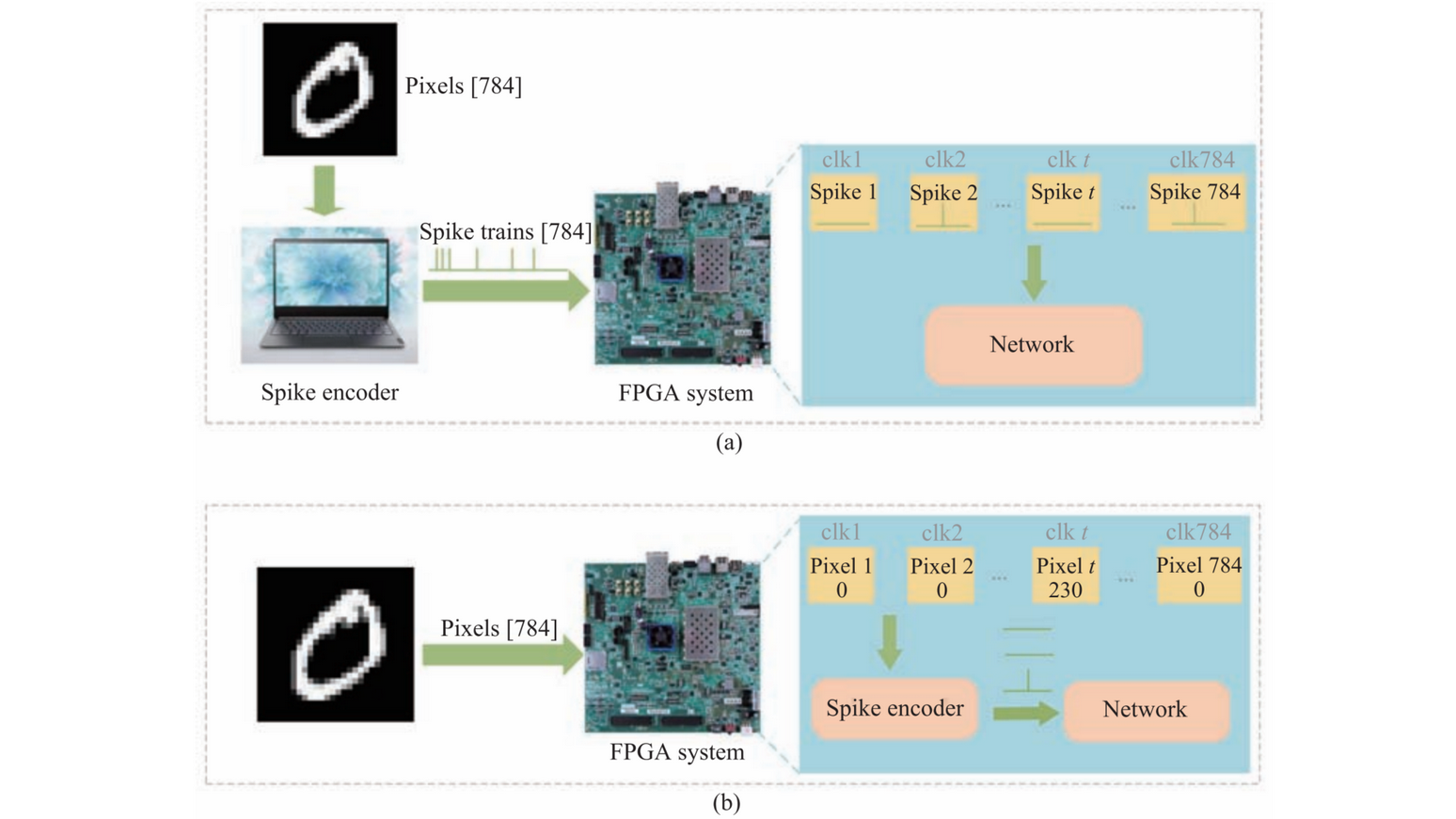
The spiking neural network (SNN) is the third generation of neural networks, valued for its biological interpretability, hardware compatibility, and low power consumption. While field programmable gate array (FPGA), based SNN accelerators show promise with their intelligent design and low power consumption, existing models lack a crucial spiking encoding module. This leads to increased pre-processing time on the CPU. To address these issues, this paper proposes an FPGA-based SNN accelerator with a spiking encoding module. This innovation reduces CPU pre-processing time by threefold without adding FPGA processing time. Achieving 92.62% accuracy on the MNIST dataset using LIF spiking neurons at 0.675 W, the accelerator outperforms CPU and GPU, being 14× faster and 2.5× faster, respectively, and more power-efficient with minimal resource usage. Given its pixel input, it can be seamlessly embedded in real-time classification systems for efficient classification and detection.
KeyWords AITranslate
[1]W. Maass, "Networks of spiking neurons: The third generation of neural network models," Neural Networks, vol. 10, no. 9, pp. 1659–1671, 1997.
[2]E. M. Izhikevich, "Simple model of spiking neurons," IEEE Transactions on Neural Networks. vol. 14, no. 6, pp. 1569–1572, 2003.
[3]K. Roy, A. Jaiswal, and P. Panda, "Towards spike-based machine intelligence with neuromorphic computing," Nature, vol. 575, no. 7784, pp. 607–617, 2019.
[4]A. Taherkhani, A. Belatreche, Y. Li, G. Cosma, L. P. Maguire, and T. M. McGinnity, "A review of learning in biologically plausible spiking neural networks," Neural Networks, vol. 122, pp. 253–272, 2020.
[5]S. B. Furber, F. Galluppi, S. Temple, R. Alvarez-Icaza, J. Arthur, P. Merolla, N. Imam, Y. Nakamura, P. Datta, G. J. Nam, et al., "The spinnaker project," Proceedings of the IEEE, vol. 102, no. 5, pp. 652–665, 2014.
[6]F. Akopyan, J. Sawada, A. Cassidy, R. Alvarez-lcaza, J. Arthur, P. Merolla, N. Imam, Y. Nakamura, P. Datta, and G. -J. Nam, "Truenorth: Design and tool flow of a 65 mW 1 million neuron programmable neurosynaptic chip," IEEE Transactions on Computer-Aided Design of Integrated Circuits and Systems. vol. 34, no. 10, pp. 1537–1557, 2015.
[7]J. Shen, D. Ma, Z. Gu, M. Zhang, and G. Pan, "Darwin: A neuromorphic hardware co-processor based on spiking neural networks," Science China - Information Sciences, vol. 59, no. 2, pp. 1–5, 2016.
[8]S. Deng, P. Lv, O. Jin, S. Dustdar, Y. Li, D. Ma, Z. Wu, and G. Pan, "Darwin-S: A reference software architecture for brain-inspired computers," Computer, vol. 55, no. 5, pp. 51–63, 2022.
[9]M. Davies, N. Srinivasa, T. H. Lin, G. Chinya, P. Joshi, A. Lines, A. Wild, and H. Wang, "Loihi: A neuromorphic manycore processor with on-chip learning," IEEE Micro. vol. 38, no. 1, pp. 82–99, 2018.
[10]G. Orchard, E. P. Frady, D. B. D. Rubin, S. Sanborn, S. B. Shrestha, F. T. Sommer, and M. Davies, "Efficient neuromorphic signal processing with Loihi 2,"in Proceedings of the 2021 IEEE Workshop on Signal Processing Systems (SiPS), Coimbra, Portugal, 2021, pp. 254–259.
[11]J. Pei, L. Deng, S. Song, M. G. Zhao, Y. H. Zhang, S. Wu, G. R. Wang, Z. Zou, Z. Z. Wu, W. He, et al."Towards artificial general intelligence with hybrid Tianjic chip architecture," Nature, vol. 572, no. 7767, pp. 106–111, 2019.
[12]S. Ma, J. Pei, W. Zhang, G. Wang, D. Feng, F. Yu, C. Song, H. Qu, C. Ma, and M. Lu, "Neuromorphic computing chip with spatiotemporal elasticity for multi-intelligent-tasking robots," Science Robotics, vol. 7, no. 67, p. 2948, 2022.
[13]L. P. Maguire, T. M. McGinnity, B. Glackin, A. Ghani, A. Belatreche, and J. Harkin, "Challenges for large-scale implementations of spiking neural networks on FPGAs," Neurocomputing, vol. 71, no. 1–3, pp. 13–29, 2007.
[14]D. Neil and S. C. Liu, "Minitaur, an event-driven FPGA-based spiking network accelerator," IEEE Transactions on Very Large Scale Integration (VLSI) Systems, vol. 22, no. 12, pp. 2621–2628, 2014.
[15]J. Zhang, H. Wu, J. Wei, S. J. Wei, and H. Chen, "An asynchronous reconfigurable SNN accelerator with event-driven time step update,"in Proceedings of the 2019 IEEE Asian Solid-State Circuits Conference (A-SSCC), Macau, China, 2019, pp. 213–216.
[16]X. Huang, E. Jones, S. Zhang, S. Y. Xie, S. Furber, Y. Goulermas, E. Marsden, I. Baistow, S. Mitra, and A. Hamilton, "Spiking Neural network based low-power radioisotope identification using FPGA,"in Proceedings of the 2020 27th IEEE International Conference on Electronics, Circuits and Systems (ICECS)", Glasgow, Scotland, 2020, pp. 1–4.
[17]A. Khodamoradi, K. Denolf, and R. Kastner. "S2N2: A FPGA accelerator for streaming spiking neural networks,"in Proceedings of the 2021 ACM/SIGDA International Symposium on Field-Programmable Gate Arrays. Virtual Event, USA, 2021, pp. 194–205.
[18]T. Gao, B. Deng, J. Wang, and G. Yi, "Highly efficient neuromorphic learning system of spiking neural network with multi-compartment leaky integrate-and-fire neurons," Frontiers in Neuroscience, vol. 16, p. 929644, 2022.
[19]Y. F. Hu, G. Q. Li, Y. J. Wu, and L. Deng, "Spiking neural networks: A survey on recent advances and new directions," Control and Decision, vol. 36, no. 1, pp. 1–26, 2021.
[20]Y. Cao, Y. Chen, and D. Khosla, "Spiking deep convolutional neural networks for energy-efficient object recognition," International Journal of Computer Vision, vol. 113, no. 1, pp. 54–66, 2015.
[21]P. U. Diehl, D. Neil, J. Binas, M. Cook, and S. C. Liu"Fast-classifying, high-accuracy spiking deep networks through weight and threshold balancing,"in Proceedings of the 2015 International Joint Conference on Neural Networks (IJCNN), Killarney, Ireland, 2015, pp. 1–8.
[22]A. L. Hodgkin and A. F. Huxley, "A quantitative description of membrane current and its application to conduction and excitation in nerve," The Journal of Physiology, vol. 117, no. 4, pp. 500, 1952.
[23]P. Dayanand and L. F. Abbott, "Theoretical neuroscience: Computational and mathematical modeling of neural systems," Journal of Cognitive Neuroscience, vol. 15, no. 1, pp. 154–155, 2003.
[24]P. Dayan and L. Abbott, Computational Neuroscience: Theoretical Neuroscience: Computational and Mathematical Modeling of Neural Systems, Cambridge, UK: MIT Press, 2001, pp. 162–166.
[25]X. Ju, B. Fand, and R. Yan, "An FPGA implementation of deep spiking neural networks for low-power and fast classification," Neural Computation, vol. 32, no. 1, pp. 182–204, 2020.
[26]X. Huang, E. Jones, S. Zhang, S. Y. Xie, S. Furber, Y. Goulermas, and E. Marsden, "An FPGA implementation of convolutional spiking neural networks for radioisotope identification,"in Proceedings of the 2021 IEEE International Symposium on Circuits and Systems (ISCAS), Daegu, South Korea, 2021, pp. 1–5.
[27]K. A. Boahen, "Point-to-point connectivity between neuromorphic chips using address events," IEEE Transactions on Circuits and Systems II: Analog and Digital Signal Processing, vol. 47, no. 5, pp. 416–434, 2000.
[28]W. Fang, Y. Chen, J. Ding, D. Chen, Z. Yu, H. Zhou, T. Masquelier, Y. Tian, "Spikingjelly," Accessed: May 1, 2024 [Online]. Available: https://github.com/fangwei123456/spikingjelly,2020.
[29]B. Fang, Y. Zhang, R. Yan, and H. J. Tang, "Spike trains encoding optimization for spiking neural networks implementation in FPGA,"in Proceedings of the 2020 12th International Conference on Advanced Computational Intelligence (ICACI), Dali, China, 2020, pp. 412–48.
[30]H. Fang, Z. Mei, A. Shrestha, Z. Y. Zhao, Y. L. Li, and Q. R. Qiu, "Encoding, model, and architecture: Systematic optimization for spiking neural network in FPGAs,"in Proceedings of the 39th International Conference on Computer-Aided Design. Virtual Event, USA, 2020, pp. 1–9.
[31]Y. J. ShenJ. C. Shen, J. Ye, Q. Ma, "Design of spiking neural network Accelerator based on FPGA," Electronic Science and Technology. vol. 30, no. 10, pp. 89–92, 2017.
[32]S. Gupta, A. Vyas, and G. Trivedi, "FPGA implementation of simplified Spiking Neural Network,"in Proceedings of the 27th IEEE International Conference on Electronics, Circuits and Systems (ICECS), Glasgow, Scotland, 2020, pp. 1–4.
Basic Information:
DOI:10.23919/CHAIN.2024.000003
Chinese Library Classification Number:
Citation Information:
The spiking neural network (SNN) is the third generation of neural networks, valued for its biological interpretability, hardware compatibility, and low power consumption. While field programmable gate array (FPGA), based SNN accelerators show promise with their intelligent design and low power consumption, existing models lack a crucial spiking encoding module. This leads to increased pre-processing time on the CPU. To address these issues, this paper proposes an FPGA-based SNN accelerator with a spiking encoding module. This innovation reduces CPU pre-processing time by threefold without adding FPGA processing time. Achieving 92.62% accuracy on the MNIST dataset using LIF spiking neurons at 0.675 W, the accelerator outperforms CPU and GPU, being 14× faster and 2.5× faster, respectively, and more power-efficient with minimal resource usage. Given its pixel input, it can be seamlessly embedded in real-time classification systems for efficient classification and detection.
quote
| GB/T 7714-2015 | [1] Zhen Cao, Ziyi Zhang, Qi Sun, et al. Cost-effective and high-speed implementation of brain-like spiking neural network with encoding architectures on FPGA[J]. Chain, 2024, 1(2): 167-176. DOI:10.23919/CHAIN.2024.000003. |
| MLA | [1] Zhen Cao, et al., "Cost-effective and high-speed implementation of brain-like spiking neural network with encoding architectures on FPGA." Chain, vol. 1, no. 2, 2024, pp. 167-176, https://doi.org/10.23919/CHAIN.2024.000003. |
| APA | [1] Zhen Cao, Ziyi Zhang, Qi Sun, Biao Hou, Licheng Jiao, & Yintang Yang. (2024). Cost-effective and high-speed implementation of brain-like spiking neural network with encoding architectures on FPGA. Chain, 1(2), 167-176. https://doi.org/10.23919/CHAIN.2024.000003 |
| IEEE | [1] Zhen Cao, Ziyi Zhang, Qi Sun, Biao Hou, Licheng Jiao, and Yintang Yang, "Cost-effective and high-speed implementation of brain-like spiking neural network with encoding architectures on FPGA," Chain, vol. 1, no. 2, pp. 167-176, 2024, doi: 10.23919/CHAIN.2024.000003. keywords: {SNN accelerator;FPGA;spiking encoding;low-power;neuromorphic computing} |