

Multi-scenario deep learning-based framework to estimate the remaining charge time of lithium-ion power batteries AITranslate
Abstract AITranslate
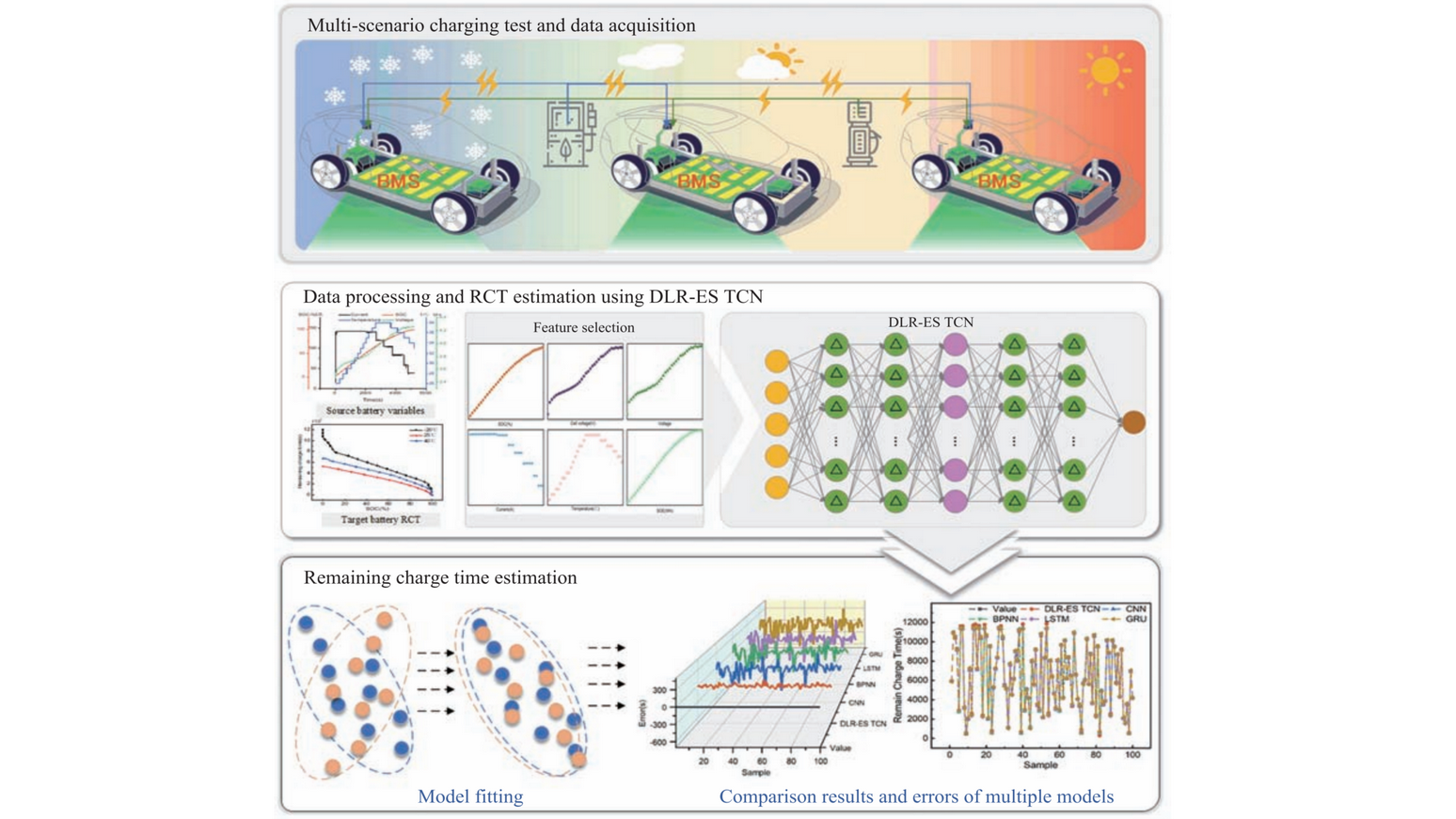
The accurate estimation of the remaining charge time (RCT) is essential in a battery management system (BMS), because it guarantees the safety and dependability of the power battery systems of new energy vehicles. However, the direct estimation of RCT is challenging because of the variability of actual charging scenarios and the complex charging process, which complicates the estimation of RCT in actual scenarios. Hence, this paper proposes an estimation framework based on deep learning for multi-scenario charging data to estimate the remaining charging times. Through an in-depth analysis of multi-scenario charging data, the RCT of the charging process is estimated using the temporal convolutional network (TCN) model, which has a strong generalization ability. Additionally, a dynamic learning rate (DLR) mechanism and an early stopping strategy (ES) are designed in the TCN model (DLR-ES TCN) for the nonlinear characteristics of the battery system to balance the relationship between model convergence speed and accuracy. Finally, compared with the traditional TCN model and four common deep learning models under three different scenarios, the experimental results show the mean absolute percentage error (MAPE) of the proposed method is less than 2%, indicating better accuracy and stability. This research can improve the safety monitoring of power batteries when applied to various target domains.
KeyWords AITranslate
[1]Research and Markets, “Global new energy car market - Forecasts from 2022 to 2027,”https://www.researchandmarkets.com/reports/5649025/global-new-energy-car-market-forecasts-from#src-pos-1.%202023 (accessed May 1, 2023).
[2]International Energy Agency, “Global EV Outlook 2023,”https://www.iea.org/events/global-ev-outlook-2023 (accessed May 15, 2023).
[3]W. L. Shang, J. Y. Chen, H. B. Bi, Y. Sui, Y. Y. Chen, and H. T. Yu. “Impacts of COVID-19 pandemic on user behaviors and environmental benefits of bike sharing: A big-data analysis,” Applied Energy, vol. 285, p. 116429, 2021.
[4]J. Rogelj, D. Huppmann, V. Krey, K. Riahi, L. Clarke, M. Gidden, Z. Nicholls, and M. Meinshausen, “A new scenario logic for the Paris Agreement long-term temperature goal,” Nature, vol. 573, no. 7774, pp. 357-363, 2019.
[5]K. L. Liu, Z. B. Wei, C. H. Zhang, Y. L. Shang, R. Teodorescu, Q. L. Han, “Teodorescu Towards long lifetime battery: AI-based manufacturing and management,” IEEE/CAA Journal of Automatica Sinica, vol. 9, no. 7, pp. 1139-1165, 2022.
[6]C. W. Hsu, R. Xiong, N. Y. Chen, J. Li, and N. T. Tsou. “Deep neural network battery life and voltage prediction by using data of one cycle only,” Applied Energy, vol. 306, p. 118134, 2022.
[7]C. Y. Wang, N. X. Cui, C. L. Li, and C. H. Zhang. “State of power prediction based on electro-thermal battery model and multi-parameter constraints for lithium-ion battery,” Journal of Mechanical Engineering, vol. 55, no. 20, p. 114324, 2019.
[8]Y. J. Zhang, H. W. Wang, X. N. Feng, M. G. Ouyang, A. J. Zhou, L. Su, and H. Q. Yang. “Research progress on thermal runaway combustion characteristics of power lithium-ion batteries,” Journal of Mechanical Engineering, vol. 55, no. 20, pp. 17-27, 2019.
[9]Y. J. Wang and Z. H. Chen. “A framework for state-of-charge and remaining discharge time prediction using unscented particle filter,” Applied Energy, vol. 260, pp. 114324, 2020.
[10]J. G. Wang, S. D. Zhang, C. Y. Li, L. F. Wu, Y. Z. Wang. “A data-driven method with mode decomposition mechanism for remaining useful life prediction of lithium-ion batteries,” IEEE Transactions on Power Electronics, vol. 37, no. 11, pp. 13684-13695, 2022.
[11]S. X. Liu, Y. F. Zhou, Y. L. Liu, J. Lian, L. J. Huang. A method for battery health estimation based on charging time segment,” Energies, vol. 14, no. 9, pp. 2612, 2021.
[12]M. L. Di Silvestre, E. Riva Sanseverino, G. Zizzo, G. Gradii, “An optimization approach for efficient management of EV parking lots with batteries recharging facilities,” Journal of Ambient Intelligence and Humanized Computing, vol. 4, pp. 641-649, 2013.
[13]S. S. Su, W. Li, A. Garg, L. Gao. “An adaptive boosting charging strategy optimization based on thermoelectric-aging model, surrogates and multi-objective optimization,” Applied Energy, vol. 312, p. 118795, 2022.
[14]J. S. Moon, J. H. Lee, I. Y. Ha, T. K. Lee, C. Y. Won. “An efficient battery charging algorithm based on state-of-charge estimation for electric vehicle,”2011 International Conference on Electrical Machines and Systems. IEEE, 2011, pp. 1–6.
[15]J. Z. Shi, M. Tian, S. W. Han, T. Y. Wu, and Y. F. Tang. “Electric vehicle battery remaining charging time estimation considering charging accuracy and charging profile prediction,” Journal of Energy Storage, vol. 49, p. 104132, 2022.
[16]D. Zhou, W. B. Zheng, P. Fu, and X. L. Pan. “Research on online estimation of available capacity of lithium batteries based on daily charging data,” Journal of Power Sources, vol. 451, p. 227713, 2020. https://doi.org/10.1016/j.jpowsour.2020.227713.
[17]M. Torchio, N. A. Wolff, D. M. Raimondo, L. Magni, U. Krewer, R. B. Gopaluni, J. A. Paulson, and R. D. Braatz. “Real-time model predictive control for the optimal charging of a lithium-ion battery,”2015 American Control Conference (ACC). IEEE, 2015, pp. 4536–4541.
[18]A. Abdollahi, X. Han, G. V.Avvari, N. Raghunathan, B. Balasingam, K. R. Pattipati, and Y. Bar-Shalom. “Optimal battery charging, Part I: Minimizing time-to-charge, energy loss, and temperature rise for OCV-resistance battery model,” Journal of Power Sources, vol. 303, pp. 388-398, 2016.
[19]X. Hu, S. B. Li, H. E. Peng, and F. C. Sun, “Charging time and loss optimization for LiNMC and LiFePO4 batteries based on equivalent circuit models,” Journal of Power Sources, vol. 239, pp. 449-457, 2013. https://doi.org/10.1016/j.jpowsour.2013.03.157
[20]G. Trentadue, A. Lucas, M. Otura, K. Pliakostathis, M. Zanni, and H. Scholz, “Evaluation of fast charging efficiency under extreme temperatures. Energies2018, vol. 11, no. 8, p. 1937, 2018.
[21]T. Nazghelichi, F. Torabi, and V. Esfahanian. “Reducing the charging time of a lead–acid cell in the sense of linear stability analysis,” Journal of Energy Storage, vol. 36, p. 102369, 2021.
[22]P. C. Lin. “Tri-Section SVR model for predicting charging time of lithium-ion batteries,” Chinese Journal of Power Sources, vol. 042, no. 008, pp. 1155-1157,1232, 2018.
[23]S. Y. Cheng, P. C. Lin, and P. J. Lin. “New method of predict remaining charging time for lithium-ion batteries,” Chinese Journal of Power Sources, vol. 43, no. 1, pp. 99-135, 2019.
[24]Y. F. Xie, F. Li, D. Cheng, X. Y. Wang, and Y. J. Feng. “A new energy vehicle charging time prediction method based on machine learning,” Modern Industrial Economy and Informaionization, vol. 12, no. 2, pp. 100-102, 2022.
[25]H. F. Yang and S. F. Wu. “Prediction of remaining time of tram charging based on Bi-GRU,”in Proceedings of the 3rd Asia-Pacific Conference on Image Processing, Electronics and Computers. 2022, pp. 521–524.
[26]J. Y. Du, X. Liu, Q. L. Liu, and J. C. Wang. “Prediction of remaining time of lithium battery charging based on indy-lstm,” Computer Applications and Software, vol. 38 no. 05, pp. 112-116, 2021.
[27]W. D. Fang, C. D. Xu, J. S. Pan, H. L. Chen, and S. Wang, “A method of prediction of charging time based on lstm neural network, ” Journal of Network Intelligence, vol. 6, pp. 339-349, 2021.
[28]K. N. Kumar, P. H. Cheah, B. Sivaneasan, P. L. So, and D. Z. W. Wang, “Electric vehicle charging profile prediction for efficient energy management in buildings,”2012 10th International Power & Energy Conference (IPEC). IEEE, 2012, pp. 480–485.
[29]Y. Ma, M. B. Yao, H. C. Liu, and Z. H. Tang, “State of health estimation and remaining useful life prediction for lithium-ion batteries by improved particle swarm optimization-back propagation neural network,” Journal of Energy Storage, vol. 52, p. 14750, 2022.
[30]M. K. Chai, F. Xia, S. T. Hao, D. G. Peng, C. G. Cui, and W. Liu, “PV power prediction based on LSTM with adaptive hyperparameter adjustment,” IEEE Access, vol. 7 pp. 115473-115486, 2019.
[31]B. Sun, J. L. Pan, Z. Y. Wu, Q. Xia, Z. L. Wang, Y. Ren, D. Z. Yang, X. Guo, and Q. Feng, “Adaptive evolution enhanced physics-informed neural networks for time-variant health prognosis of lithium-ion batteries,” Journal of Power Sources, vol. 556, p. 232432, 2023.
[32]Y. F. Liu, J. Q. Li, G. Zhang, B. Hua, and N. Xiong, “State of charge estimation of lithium-ion batteries based on temporal convolutional network and transfer learning,” IEEE Access, vol. 9, pp. 34177-34187, 2021.
[33]M. Khanra and A. K. Nandi. “Optimal driving based trip planning of electric vehicles using evolutionary algorithms: A driving assistance system,” Applied Soft Computing, vol. 93, p. 106361, 2020.
[34]Z. W. Deng, L. Xu, H. G. Liu, X. S. Xu, Z. X. Duan, and Y. Xu, “Prognostics of battery capacity based on charging data and data-driven methods for on-road vehicles,” Applied Energy, vol. 339, p. 120954, 2023.
[35]G. Cai, T. Dong, Y. Li, et al.Fast Charging Characteristics of Lithium-ion Power Batteries at Different Temperatures [J]. Environmental Technology, no. S01, p. 039(59-66?), 2021. https://doi.org/1004-7204(2021)S1-0059-04.
[36]S. J. Bai, J. Z. Kolter, and V. Koltun, “An empirical evaluation of generic convolutional and recurrent networks for sequence modeling,” arXiv preprint arXiv:1803.01271, 2018. https://doi.org/10.48550/arXiv.1803.01271.
[37]P. Lara-Benítez, M. Carranza-García, J. M. Luna-Romera, and J. C. Riquelme, “Temporal convolutional networks applied to energy-related time series forecasting,” Applied Sciences, 2020, vol. 10, no. 7, p. 2322, 2020.
[38]J. Long, E. Shelhamer, and T. Darrell. “Fully convolutional networks for semantic segmentation,” Proceedings of the IEEE Conference on Computer Vision and Pattern Recognition., 2015, pp. 3431-3440.
[39]A. Oord, S. Dieleman, H. Zen, K. Simonyan, O. Vinyals, A. Graves, N. Kalchbrenner, A. Senior, and K. Kavukcuoglu, “Wavenet: A generative model for raw audio,” arXiv preprint arXiv:1609.03499, 2016. https://doi.org/10.48550/arXiv.1609.03499.
[40]F. Yu and V. Koltun, “Multi-scale context aggregation by dilated convolutions,” arXiv preprint arXiv:1511.07122, 2015. https://doi.org/10.48550/arXiv.1511.07122.
[41]W. T. Zhao, Y. Y. Gao, T. X. Ji, F. Ye, and G. W. Bai, “Deep temporal convolutional networks for short-term traffic flow forecasting,” IEEE Access, vol. 7, pp. 114496-114507, 2019.
[42]K. M. He, X. Y. Zhang, S. Q. Ren, and J. Sun, “Deep residual learning for image recognition,”in Proceedings of the IEEE Conference on Computer Vision and Pattern Recognition. 2016, pp. 770–778.
[43]N. Srivastava, G. Hinton, A. Krizhevsky, H. Sutskever, and R. Salakhutdinov, “Dropout: a simple way to prevent neural networks from overfitting,” Journal of Machine Learning Research, vol. 15, no. 1, pp. 1929-1958, 2014.
[44]J. J. Zhang, F. Hu, L. Li, X. F. Xu, and Z. B. Yang. “AEDR: An adaptive mechanism to achieve online learning rate dynamically,”2017 IEEE 29th International Conference on Tools with Artificial Intelligence (ICTAI). IEEE, 2017, pp. 30–36.
[45]L. N. Smith. “Cyclical learning rates for training neural networks,”2017 IEEE Winter Conference on Applications of Computer Vision (WACV). IEEE, 2017, pp. 464–472.
Basic Information:
DOI:10.23919/CHAIN.2024.000002
Chinese Library Classification Number:
Citation Information:
The accurate estimation of the remaining charge time (RCT) is essential in a battery management system (BMS), because it guarantees the safety and dependability of the power battery systems of new energy vehicles. However, the direct estimation of RCT is challenging because of the variability of actual charging scenarios and the complex charging process, which complicates the estimation of RCT in actual scenarios. Hence, this paper proposes an estimation framework based on deep learning for multi-scenario charging data to estimate the remaining charging times. Through an in-depth analysis of multi-scenario charging data, the RCT of the charging process is estimated using the temporal convolutional network (TCN) model, which has a strong generalization ability. Additionally, a dynamic learning rate (DLR) mechanism and an early stopping strategy (ES) are designed in the TCN model (DLR-ES TCN) for the nonlinear characteristics of the battery system to balance the relationship between model convergence speed and accuracy. Finally, compared with the traditional TCN model and four common deep learning models under three different scenarios, the experimental results show the mean absolute percentage error (MAPE) of the proposed method is less than 2%, indicating better accuracy and stability. This research can improve the safety monitoring of power batteries when applied to various target domains.
quote
| GB/T 7714-2015 | [1] Jianhui Mou, Chengcheng Yu, Peiyong Duan, et al. Multi-scenario deep learning-based framework to estimate the remaining charge time of lithium-ion power batteries[J]. Chain, 2024, 1(3): 229-248. DOI:10.23919/CHAIN.2024.000002. |
| MLA | [1] Jianhui Mou, et al., "Multi-scenario deep learning-based framework to estimate the remaining charge time of lithium-ion power batteries." Chain, vol. 1, no. 3, 2024, pp. 229-248, https://doi.org/10.23919/CHAIN.2024.000002. |
| APA | [1] Jianhui Mou, Chengcheng Yu, Peiyong Duan, Junjie Li, Chunjiang Zhang, Yuhui Liu, Xinhua Liu, Akhil GARG, & Shaosen Su. (2024). Multi-scenario deep learning-based framework to estimate the remaining charge time of lithium-ion power batteries. Chain, 1(3), 229-248. https://doi.org/10.23919/CHAIN.2024.000002 |
| IEEE | [1] Jianhui Mou, Chengcheng Yu, Peiyong Duan, Junjie Li, Chunjiang Zhang, Yuhui Liu, Xinhua Liu, Akhil GARG, and Shaosen Su, "Multi-scenario deep learning-based framework to estimate the remaining charge time of lithium-ion power batteries," Chain, vol. 1, no. 3, pp. 229-248, 2024, doi: 10.23919/CHAIN.2024.000002. keywords: {new energy vehicles;lithium-ion power battery;multi-scenario;temporal convolution network;remaining charging time;dynamic learning rate and early stopping} |