

Lithium battery digital twin model with incremental learning AITranslate
Abstract AITranslate
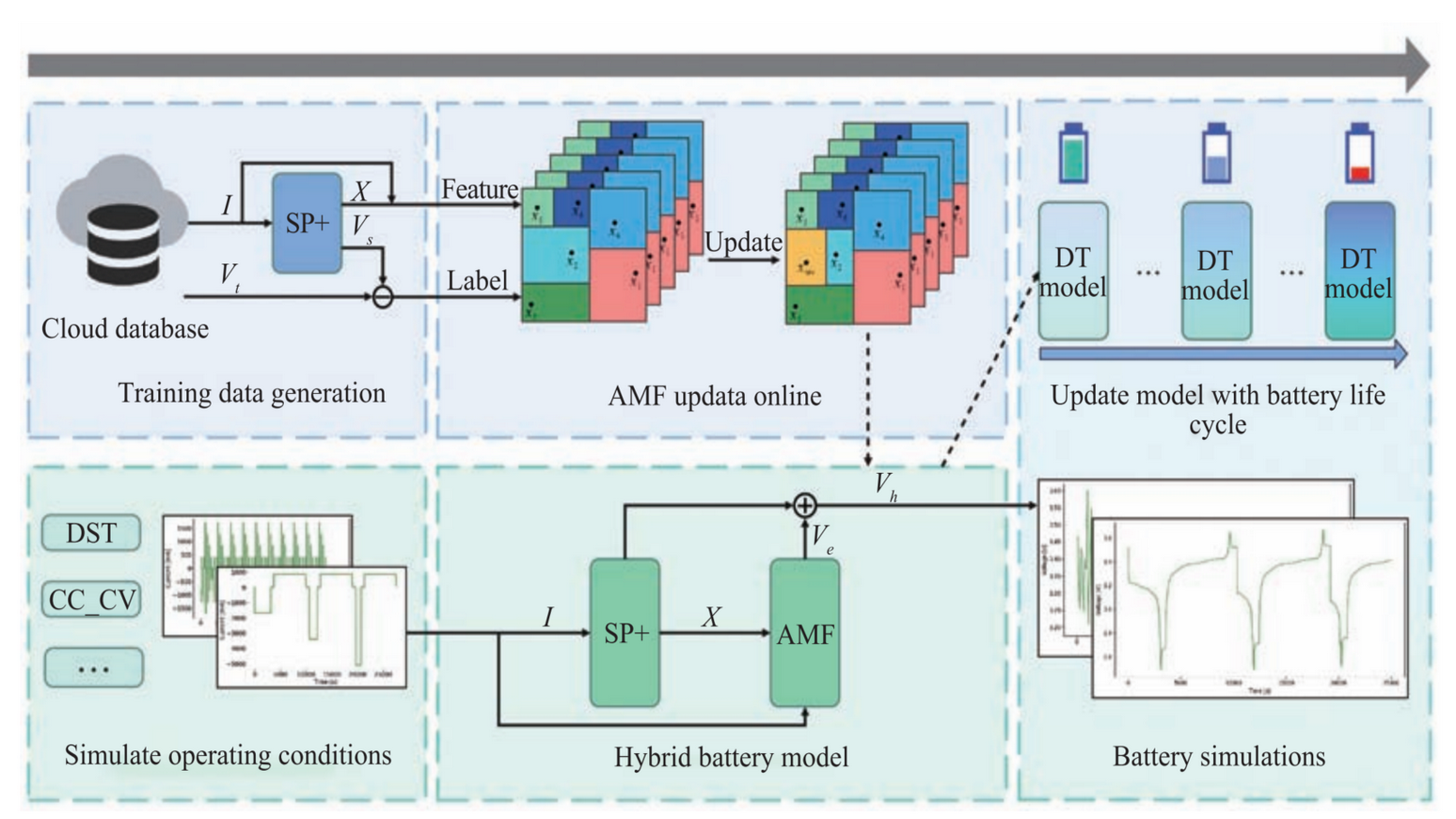
Digital twin technology used to realize the interactive mapping between digital model and physical entity in virtual space plays a crucial role in promoting the transformation of battery management to digitalization and intelligence. The key to achieving a digital twin is developing a virtual model that can accurately reflect the physical object. However, the intricate time-varying and nonlinear reaction characteristics within the battery often pose challenges in simulating complex operational conditions and maintaining high accuracy throughout the full life cycle. Incremental learning algorithms are suitable for online streaming data processing and can adapt to concept drift of the data stream by receiving new data online without retraining the entire model from scratch. This paper employs a simplified electrochemical model of the battery and integrates an Aggregated Mondrian Forest with incremental learning capabilities to construct a hybrid mechanism-data battery model. The developed hybrid model can acquire battery data and train in real time during battery operation to realize co-evolution with the physical battery to ensure the voltage prediction accuracy during the full life cycle of the battery.
KeyWords AITranslate
[1]M.W. Grieves, "Virtually intelligent product systems: Digital and physical twins," Complex Systems Engineering: Theory and Practice, vol. 7, pp. 175–200, 2019.
[2]A. Thelen, X. Zhang, O. Fink, Y. Lu, S. Ghosh, B. D. Youn, M. D. Todd, S. Mahadevan, C. Hu, and Z. Hu, "A comprehensive review of digital twin—Part 2: Roles of uncertainty quantification and optimization, a battery digital twin, and perspectives," Structural and Multidisciplinary Optimization, vol. 66, art. no. 1, 2023.
[3]W. Li, M. Rentemeister, J. Badeda, D. Jöst, D. Schulte, and D. U. Sauer, "Digital twin for battery systems: Cloud battery management system with online state-of-charge and state-of-health estimation," Journal of Energy Storage, vol. 30, p. 101557, 2020.
[4]Y. Wang, R. Xu, C. Zhou, X. Kang, X Kang, and Z. Chen, "Digital twin and cloud-side-end collaboration for intelligent battery management system," Journal of Manufacturing Systems, vol. 62, pp. 124–134, 2022.
[5]H. Tang, Y. Wu, Y. Cai, F. Wang, Z. Lin, and Y. Pei, "Design of power lithium battery management system based on digital twin," Journal of Energy Storage, vol. 47, p. 103679, 2022.
[6]J. Wu, Y. Yang, X. Cheng, H. Zuo, and Z. Cheng, "The development of digital twin technology review,"2020 Chinese Automation Congress, Shanghai, China, 2020, pp. 4901–4906.
[7]W. Zhou, Y. Zheng, Z. Pan, and Q. Lu, "Review on the battery model and SOC estimation method," Processes, 2021, vol. 9, p. 1685, 2021.
[8]R. R. Thakkar, Y. S. Rao, and R. R.Sawant, "Performance analysis of electrical equivalent circuit models of lithium-ion battery,"2020 IEEE Pune Section International Conference, Pune, India, 2020, pp. 103–107.
[9]D. Deng, J. Qiao, J. Qi, et al, "Equivalent modeling and parameter identification of power lithium-ion batteries," vol. 6, pp. 95–124, 2023.
[10]M. Doyle, T. F. Fuller, and J. Newman, "Modeling of galvanostatic charge and discharge of the lithium polymer insertion cell," Journal of The Electrochemical Society, 1993, vol. 140, pp. 1526–1533, 1993.
[11]J. Sabatier, J. M. Francisco, F. Guillemard, L. Lavigne, M. Moze, and M. Merveillaut, "Lithium-ion batteries modeling: A simple fractional differentiation based model and its associated parameters estimation method," Signal Processing, vol. 107, pp. 290–301, 2015.
[12]M. M. Majdabadi, S. Farhad, M. Farkhondeh, R. A. Fraser, and M. Fowler, "Simplified electrochemical multi-particle model for LiFePO4 cathodes in lithium-ion batteries," Journal of Power Sources, vol. 275, pp. 633–643, 2015.
[13]C. Shinagawa, H. Ushiyama, and K. Yamashita, "Multiscale simulations for lithium-ion batteries: SEI film growth and capacity fading," Journal of The Electrochemical Society, 2017, vol. 164, pp. A3018–A3024, 2017.
[14]J. Li, N. Lotfi, R. G. Landers, and J. Park. "A single particle model for lithium-ion batteries with electrolyte and stress-enhanced diffusion physics," Journal of The Electrochemical Society, vol. 164, pp. A874–A883, 2017.
[15]D. Jiménez-Bermejo, J. Fraile-Ardanuy, S. Castaño-Solis, J. Merino, and R. Álvaro-Hermana, "Using dynamic neural networks for battery state of charge estimation in electric vehicles," Procedia Computer Science, vol. 130, pp. 533–540, 2018.
[16]J. C. Álvarez Antón, P. J. García Nieto, C. Blanco Viejo, and J. A. V. Vilán, "Support vector machines used to estimate the battery state of charge," IEEE Transactions on Power Electronics, vol. 28, pp. 5919–5926, 2013.
[17]M. A. Abu-Seif, A. S. Abdel-Khalik, M. S. Hamad, E. Hamdan, and N. A. Elmalhy, "Data-driven modeling for Li-ion battery using dynamic mode decomposition," Alexandria Engineering Journal, vol. 61, pp. 11277–11290, 2022.
[18]S. Li, H. He, and J. Li, "Big data driven lithium-ion battery modeling method based on SDAE-ELM algorithm and data pre-processing technology," Applied Energy, vol. 242, pp. 1259–1273, 2019.
[19]M. Aykol1, C. B. Gopal1, A. Anapolsky1, P. K. Herring, B. van Vlijmen, M. D. Berliner, M. Z. Bazant, R. D. Braatz, William, C. Chueh, and B. D. Storey, "Perspective—Combining physics and machine learning to predict battery lifetime," Journal of The Electrochemical Society, vol. 168, p. 030525, 2021.
[20]D. P. Finegan, J. Zhu, X. Feng, M. Keyser, M. Ulmefors, W. Li, M. Z. Bazant, and S. J. Cooper, "The application of data-driven methods and physics-based learning for improving battery safety," Joule, vol. 5, pp. 316–329, 2021.
[21]F. Feng, S. Teng, K. Liu, J. Xie, Y. Xie, B. Liu, and K. Li, "Co-estimation of lithium-ion battery state of charge and state of temperature based on a hybrid electrochemical-thermal-neural-network model," Journal of Power Sources, vol. 455, p. 227935, 2020.
[22]H. Tu, S. Moura, Y. Wang, and H. Fang, "Integrating physics-based modeling with machine learning for lithium-ion batteries," Applied Energy, 2023, vol. 329, p. 120289, 2023.
[23]G. M. van de Ven, T. Tuytelaars, and A. S. Tolias, "Three types of incremental learning," Nature Machine Intelligence, vol. 4, pp. 1185–1197, 2022.
[24]G. Widmer and M. Kubat, "Learning in the presence of concept drift and hidden contexts," Machine Learning, vol. 23, pp. 69–101, 1996.
[25]J. Lu, A. Liu, F. Dong, F. Gu, J. Gama, and G. Zhang, "Learning under concept drift: A review," IEEE Transactions on Knowledge and Data Engineering, vol. 31, pp. 2346–2363, 2019.
[26]J. Li, L. Wang, C. Lyu, E. Liu, Y. Xing, and M. Pecht, "A parameter estimation method for a simplified electrochemical model for Li-ion batteries," Electrochimica Acta, vol. 275, pp. 50–58, 2018.
[27]J. Mourtada, S. Gaïffas, and E. Scornet, "AMF: Aggregated Mondrian forests for online learning," Journal of the Royal Statistical Society Series B: Statistical Methodology, vol. 83, pp. 505–533, 2021.
[28]B. Lakshminarayanan, D. M. Roy, and Y. W. Teh, "Mondrian forests: Efficient online random forests,"in Proceedings of the 27 th International Conference on Neural Information Processing Systems, 2014, pp. 3140–3148.
[29]X. Qu, Y. Song, D. Liu, X. Cui, and Y. Peng, "Lithium-ion battery performance degradation evaluation in dynamic operating conditions based on a digital twin model," Microelectronics Reliability, vol. 114, p. 113857, 2020.
[30]C. Lyu, S. Xu, J. Li, and M. Pecht, "Digital twin modeling method for lithium-ion batteries based on data-mechanism fusion driving," Green Energy and Intelligent Transportation, in press, 2024, doi 10.1016/j.geits.2024.100162.
Basic Information:
DOI:10.23919/CHAIN.2024.100002
Chinese Library Classification Number:
Citation Information:
Digital twin technology used to realize the interactive mapping between digital model and physical entity in virtual space plays a crucial role in promoting the transformation of battery management to digitalization and intelligence. The key to achieving a digital twin is developing a virtual model that can accurately reflect the physical object. However, the intricate time-varying and nonlinear reaction characteristics within the battery often pose challenges in simulating complex operational conditions and maintaining high accuracy throughout the full life cycle. Incremental learning algorithms are suitable for online streaming data processing and can adapt to concept drift of the data stream by receiving new data online without retraining the entire model from scratch. This paper employs a simplified electrochemical model of the battery and integrates an Aggregated Mondrian Forest with incremental learning capabilities to construct a hybrid mechanism-data battery model. The developed hybrid model can acquire battery data and train in real time during battery operation to realize co-evolution with the physical battery to ensure the voltage prediction accuracy during the full life cycle of the battery.
quote
| GB/T 7714-2015 | [1] Xinyu Wang, Junfu Li, Runze Wang, et al. Lithium battery digital twin model with incremental learning[J]. Chain, 2024, 1(3): 249-262. DOI:10.23919/CHAIN.2024.100002. |
| MLA | [1] Xinyu Wang, et al., "Lithium battery digital twin model with incremental learning." Chain, vol. 1, no. 3, 2024, pp. 249-262, https://doi.org/10.23919/CHAIN.2024.100002. |
| APA | [1] Xinyu Wang, Junfu Li, Runze Wang, & Yi Wu. (2024). Lithium battery digital twin model with incremental learning. Chain, 1(3), 249-262. https://doi.org/10.23919/CHAIN.2024.100002 |
| IEEE | [1] Xinyu Wang, Junfu Li, Runze Wang, and Yi Wu, "Lithium battery digital twin model with incremental learning," Chain, vol. 1, no. 3, pp. 249-262, 2024, doi: 10.23919/CHAIN.2024.100002. keywords: {lithium battery;digital twin;incremental learning;mechanism-data model;full life cycle} |