

Electrochemical-thermal-mechanical coupling model considering lithium plating for multi-stage constant current fast charging of lithium-ion batteries AITranslate

Abstract AITranslate
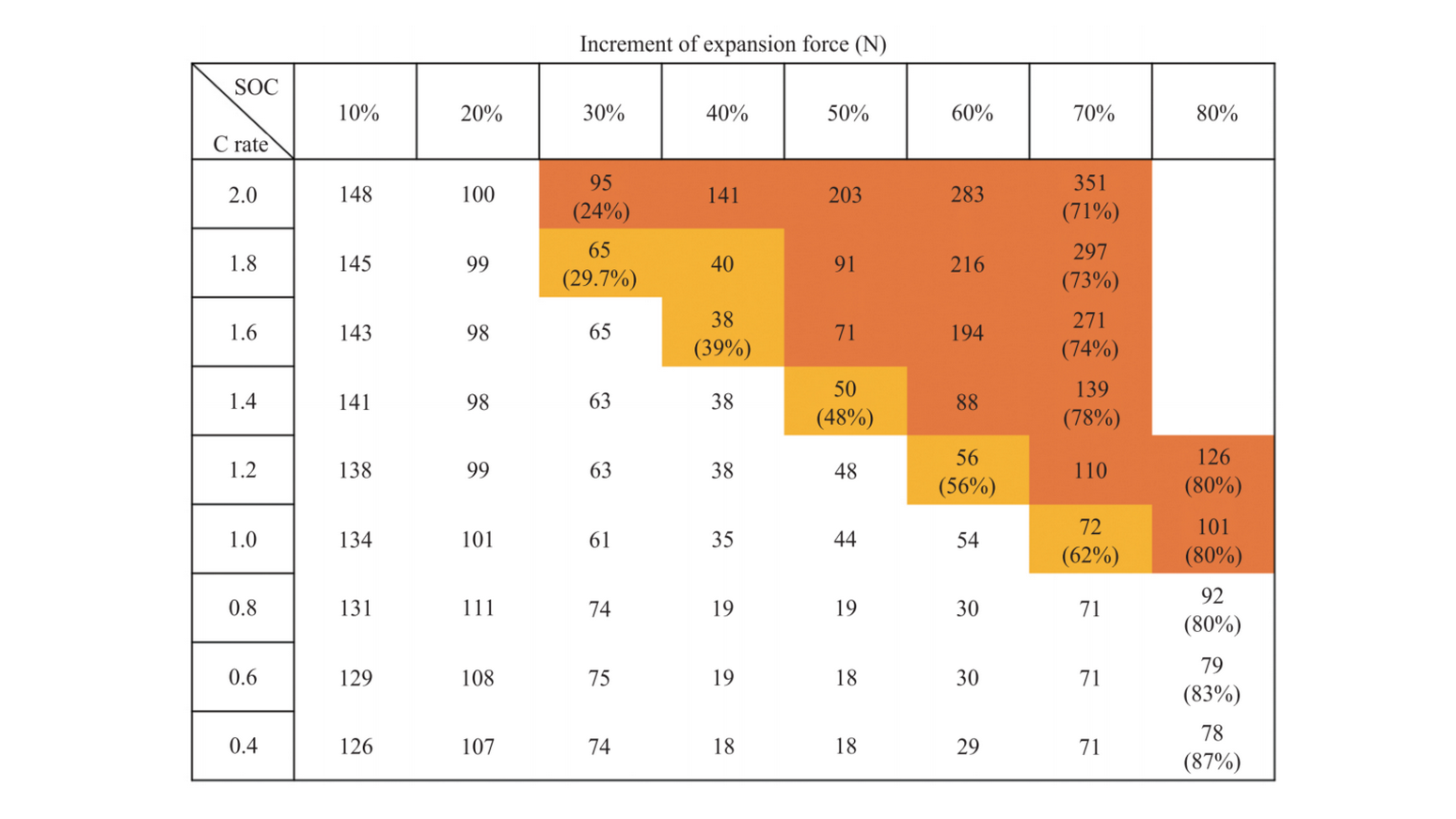
Lithium plating has been identified as the main form of failure in fast charging, so it is imperative to develop effective methods for detecting lithium plating. Experimental results validated the effectiveness of lithium plating detection via expansion force measurement. While multi-stage constant current (MCC) charging is a common form of fast charging, experimental investigations of lithium plating under MCC charging remain scarce, particularly lacking models to describe the battery expansion force changes during the lithium plating process under MCC conditions. The expansion of batteries during charging is caused by factors such as intercalation reactions, thermal expansion, and lithium plating. Through the establishment of the coupling model, the expansion displacement of the battery is calculated. The thermal expansion coefficient and equivalent stiffness of the battery are obtained through experiments, which are used to calculate the battery expansion force. Additionally, the battery overpotential is calculated through the model to determine the impact of lithium plating on the expansion force. The model investigates the effects of lithium plating on battery expansion force under different C-rates during constant current and MCC charging processes, achieving semi-quantitative prediction of battery expansion force under MCC charging and providing model-based optimization directions for MCC charging strategies. This work provides valuable insights for battery modeling and charging strategy optimization in terms of expansion force modeling under multi-stage constant current charging.
KeyWords AITranslate
[1]G. E. Blomgren, "The development and future of lithium ion batteries," Journal of The Electrochemical Society, vol. 164, no. 1, p. A5019, 2017.
[2]F. M. N. U. Khan, M. G. Rasul, A. S. M. Sayem, and N. Mandal, "Maximizing energy density of lithium-ion batteries for electric vehicles: A critical review," Energy Reports, vol. 9, pp. 11–21, 2023.
[3]J. Zhang, H. Huang, G. Zhang, Z. Dai, Y. Wen, and L. Jiang, "Cycle life studies of lithium-ion power batteries for electric vehicles: A review," Journal of Energy Storage, vol. 93, p. 112231, 2024.
[4]M. Li, J. Lu, Z. Chen, and K. Amine, "30 years of lithium-ion batteries," Advanced Materials, vol. 30, no. 33, p. 1800561, 2018.
[5]B. Scrosati and J. Garche, "Lithium batteries: Status, prospects and future," Journal of Power Sources, vol. 195, no. 9, pp. 2419–2430, 2010.
[6]H. Sun, W. Tian, J. Yue, and F. Su, "Lithium-ion battery heterogeneous electrochemical-thermal-mechanical multiphysics coupling model and characterization of microscopic properties," Journal of Power Sources, vol. 629, p. 235970, 2025.
[7]W. Ai, L. Kraft, J. Sturm, A. Jossen, and B. Wu, "Electrochemical thermal-mechanical modelling of stress inhomogeneity in lithium-ion pouch cells," Journal of The Electrochemical Society, vol. 167, no. 1, p. 013512, 2020.
[8]P. Luo, P. Li, D. Ma, K. Wang, and H. Zhang, "Coupled electrochemical-thermal-mechanical modeling and simulation of lithium-ion batteries," Journal of the Electrochemical Society, vol. 169, p. 100535, 2022.
[9]D. R. Baker and M. W. Verbrugge, "Modeling overcharge at graphite electrodes: Plating and dissolution of lithium," Journal of The Electrochemical Society, vol. 167, no. 1, p. 013504, 2020.
[10]Y. Tian, C. Lin, X. Chen, X. Yu, R. Xiong, and Q. Zhang, "Reversible lithium plating on working anodes enhances fast charging capability in low-temperature lithium-ion batteries," Energy Storage Materials, vol. 56, pp. 412–423, 2023.
[11]A. Adam, J. Wandt, E. Knobbe, G. Bauer, and A. Kwade, "Fast-charging of automotive lithium-ion cells: In-situ lithium-plating detection and comparison of different cell designs," Journal of the Electrochemical Society, vol. 167, p. 130503, 2020.
[12]H. Yu, L. Wang, Z. Zhang, Y. Li, S. Yang, and X. He, "Insight understanding of external pressure on lithium plating in commercial lithium-ion batteries," Advanced Functional Materials, vol. 34, no. 42, p. 2406966, 2024.
[13]U. R. Koleti, A. Rajan, C. Tan, S. Moharana, T. Q. Dinh, and J. Marco, "A study on the influence of lithium plating on battery degradation," Energies, vol. 13, no. 13, p. 3458, 2020.
[14]J. Deng, X. Yang, and G. Zhang, "Simulation study on internal short circuit of lithium ion battery caused by lithium dendrite," Materials Today Communications, vol. 31, p. 103570, 2022.
[15]B. Liu, Y. Jia, C. Yuan, L. Wang, X. Gao, S. Yin, and J. Xu, "Safety issues and mechanisms of lithium-ion battery cell upon mechanical abusive loading: A review," Energy Storage Materials, vol. 24, pp. 85–112, 2020.
[16]B. Jiang, S. Tao, X. Wang, J. Zhu, X. Wei, and H. Dai, "Mechanics-based state of charge estimation for lithium-ion pouch battery using deep learning technique," Energy, vol. 278, p. 127890, 2023.
[17]Y. Chen, Y. Kang, Y. Zhao, L. Wang, J. Liu, Y. Li, Z. Liang, X. He, X. Li, N. Tavajohi et al., "A review of lithium-ion battery safety concerns: The issues, strategies, and testing standards," Journal of Energy Chemistry, vol. 59, pp. 83–99, 2021.
[18]T. Krause, D. Nusko, L. P. Bauermann, M. Vetter, M. Schäfer, and C. Holly, "Methods for quantifying expansion in lithium-ion battery cells resulting from cycling: A review," Energies, vol. 17, no. 7, p. 1566, 2024.
[19]W. Mei, Q. Duan, W. Lu, J. Sun, and Q. Wang, "An investigation on expansion behavior of lithium ion battery based on the thermal-mechanical coupling model," Journal of Cleaner Production, vol. 274, p. 122643, 2020.
[20]H. Yu, L. Wang, Z. Zhang, Y. Li, S. Yang, and X. He, "Insight understanding of external pressure on lithium plating in commercial lithium-ion batteries," Advanced Functional Materials, vol. 34, no. 42, p. 2406966, 2024.
[21]A. Tokranov, R. Kumar, C. Li, S. Minne, X. Xiao, and B. W. Sheldon, "Control and optimization of the electrochemical and mechanical properties of the solid electrolyte interphase on silicon electrodes in lithium ion batteries," Advanced Energy Materials, vol. 6, no. 8, p. 1502302, 2016.
[22]T. Bond, J. Zhou, and J. Cutler, "Electrode stack geometry changes during gas evolution in pouch-cell-type lithium ion batteries," Journal of the Electrochemical Society, vol. 164, pp. A6158–A6162, 2017.
[23]J. Gu, Z. Liang, J. Shi, and Y. Yang, "Electrochemo-mechanical stresses and their measurements in sulfide-based all-solid-state batteries: A review," Advanced Energy Materials, vol. 13, no. 2, p. 2203153, 2023.
[24]K.-Y. Oh and B. I. Epureanu, "Characterization and modeling of the thermal mechanics of lithium-ion battery cells," Applied Energy, vol. 178, pp. 633–646, 2016.
[25]S. Wang, D. Ren, C. Xu, X. Han, X. Liu, L. Lu, and M. Ouyang, "Lithium plating induced volume expansion overshoot of lithium-ion batteries: Experimental analysis and modeling," Journal of Power Sources, vol. 593, p. 233946, 2024.
[26]K. Yu, A. M. Adeyinka, S.-Y. Choe, and W. Lee, "Optimized multi-stage constant current fast charging protocol suppressing lithium plating for lithium-ion batteries using reduced order electrochemical-thermal-life model," Journal of Power Sources, vol. 626, p. 235759, 2025.
[27]F. An, R. Zhang, Z. Wei, and P. Li, "Multi-stage constant-current charging protocol for a high-energy-density pouch cell based on a 622NCM/graphite system," RSC Advances, vol. 9, no. 37, pp. 21498–21506, 2019.
[28]Y. Wang, R. Ni, X. Jiang, M. Yin, D. Zhang, and Z. Xie, "An electrochemical-mechanical coupled multi-scale modeling method and full-field stress distribution of lithium-ion battery," Applied Energy, vol. 347, p. 121444, 2023.
[29]M. U. Tahir, A. Sangwongwanich, D. I. Stroe, and F. Blaabjerg, "The effect of multi-stage constant current charging on lithium-ion battery's performance," CPE-PowerEng 2023— 17th IEEE International Conference on Compatibility, Power Electronics and Power Engineering, Tallinn, Estonia, 14–16 June 2023.
[30]X. Wu, Y. Xia, J. Du, X. Gao, and S. Nikolay, "Multistage constant current charging strategy based on multiobjective current optimization," IEEE Transactions on Transportation Electrification, vol. 9, no. 4, pp. 4990–5001, 2023.
[31]Y. Shen, X. Wang, Z. Jiang, B. Luo, D. Chen, X. Wei, and H. Dai, "Online detection of lithium plating onset during constant and multistage constant current fast charging for lithium-ion batteries," Applied Energy, vol. 370, p. 123631, 2024.
[32]M. Doyle, T. F. Fuller, and J. Newman, "Modeling of galvanostatic charge and discharge of the lithium/polymer/insertion cell," Journal of The Electrochemical Society, vol. 140, no. 6, p. 1526, 1993.
[33]M. Doyle, J. Newman, A. S. Gozdz, C. N. Schmutz, and J. M. Tarascon, "Comparison of modeling predictions with experimental data from plastic lithium ion cells," Journal of The Electrochemical Society, vol. 143, no. 6, p. 1890, 1996.
[34]X. Zhang, W. Shyy, and A. Marie Sastry, "Numerical simulation of intercalation-induced stress in Li-ion battery electrode particles," Journal of the Electrochemical Society, vol. 154, no. 10, pp. A910–A916, 2007.
[35]W. Mei, H. Chen, J. Sun, and Q. Wang, "Numerical study on tab dimension optimization of lithium-ion battery from the thermal safety perspective," Applied Thermal Engineering, vol. 142, pp. 148–165, 2018.
[36]P. Arora, M. Doyle, and R. E. White, "Mathematical modeling of the lithium deposition overcharge reaction in lithium-ion batteries using carbon-based negative electrodes," Journal of the Electrochemical Society, vol. 146, no. 10, pp. 3543–3553, 1999.
[37]W. Mei, L. Zhang, J. Sun, and Q. Wang, "Experimental and numerical methods to investigate the overcharge caused lithium plating for lithium ion battery," Energy Storage Materials, vol. 32, pp. 91–104, 2020.
[38]J. Cai, X. Wei, X. Wang, J. Zhu, B. Jiang, Z. Tao, M. Tian, and H. Dai, "Revealing effects of pouch Li-ion battery structure on fast charging ability through numerical simulation," Applied Energy, vol. 377, p. 124438, 2025.
[39]S. Goutam, A. Nikolian, J. Jaguemont, J. Smekens, N. Omar, P. Van Dan Bossche, and J. Van Mierlo, "Three-dimensional electro-thermal model of li-ion pouch cell: Analysis and comparison of cell design factors and model assumptions," Applied Thermal Engineering, vol. 126, pp. 796–808, 2017.
[40]E. Schuster, C. Ziebert, A. Melcher, M. Rohde, and H. J. Seifert, "Thermal behavior and electrochemical heat generation in a commercial 40 A·h lithium ion pouch cell," Journal of Power Sources, vol. 286, pp. 580–589, 2015.
[41]I. Baghdadi, O. Briat, A. Eddahech, J. M. Vinassa, and P. Gyan, "Electro-thermal model of lithium-ion batteries for electrified vehicles applications," 2015 IEEE 24th International Symposium on Industrial Electronics (ISIE), Buzios, Brazil, 03–05 June 2015, p. 1248–1252.
[42]D. Clerici, F. Mocera, and A. Somà, "Electrochemical–mechanical multi-scale model and validation with thickness change measurements in prismatic lithium-ion batteries," Journal of Power Sources, vol. 542, p. 231735, 2022.
[43]C. Zoerr, J. J. Sturm, S. Solchenbach, S. V. Erhard, and A. Latz, "Electrochemical polarization-based fast charging of lithium-ion batteries in embedded systems," Journal of Energy Storage, vol. 72, p. 108234, 2023.
Basic Information:
DOI:10.23919/CHAIN.2025.000004
Chinese Library Classification Number:
Citation Information:
Lithium plating has been identified as the main form of failure in fast charging, so it is imperative to develop effective methods for detecting lithium plating. Experimental results validated the effectiveness of lithium plating detection via expansion force measurement. While multi-stage constant current (MCC) charging is a common form of fast charging, experimental investigations of lithium plating under MCC charging remain scarce, particularly lacking models to describe the battery expansion force changes during the lithium plating process under MCC conditions. The expansion of batteries during charging is caused by factors such as intercalation reactions, thermal expansion, and lithium plating. Through the establishment of the coupling model, the expansion displacement of the battery is calculated. The thermal expansion coefficient and equivalent stiffness of the battery are obtained through experiments, which are used to calculate the battery expansion force. Additionally, the battery overpotential is calculated through the model to determine the impact of lithium plating on the expansion force. The model investigates the effects of lithium plating on battery expansion force under different C-rates during constant current and MCC charging processes, achieving semi-quantitative prediction of battery expansion force under MCC charging and providing model-based optimization directions for MCC charging strategies. This work provides valuable insights for battery modeling and charging strategy optimization in terms of expansion force modeling under multi-stage constant current charging.
quote
| GB/T 7714-2015 | [1] Yuguang Li, Yudong Shen, Xueyuan Wang, et al. Electrochemical-thermal-mechanical coupling model considering lithium plating for multi-stage constant current fast charging of lithium-ion batteries[J]. Chain, 2025, 2(2): 148-163. DOI:10.23919/CHAIN.2025.000004. |
| MLA | [1] Yuguang Li, et al., "Electrochemical-thermal-mechanical coupling model considering lithium plating for multi-stage constant current fast charging of lithium-ion batteries." Chain, vol. 2, no. 2, 2025, pp. 148-163, https://doi.org/10.23919/CHAIN.2025.000004. |
| APA | [1] Yuguang Li, Yudong Shen, Xueyuan Wang, Xuezhe Wei, & Haifeng Dai. (2025). Electrochemical-thermal-mechanical coupling model considering lithium plating for multi-stage constant current fast charging of lithium-ion batteries. Chain, 2(2), 148-163. https://doi.org/10.23919/CHAIN.2025.000004 |
| IEEE | [1] Yuguang Li, Yudong Shen, Xueyuan Wang, Xuezhe Wei, and Haifeng Dai, "Electrochemical-thermal-mechanical coupling model considering lithium plating for multi-stage constant current fast charging of lithium-ion batteries," Chain, vol. 2, no. 2, pp. 148-163, 2025, doi: 10.23919/CHAIN.2025.000004. keywords: {lithium-ion battery;lithium plating;coupling model;expansion force;multi-stage constant current} |