

Vehicle queue prediction method for signalized intersections based on roadside traffic data AITranslate
Abstract AITranslate
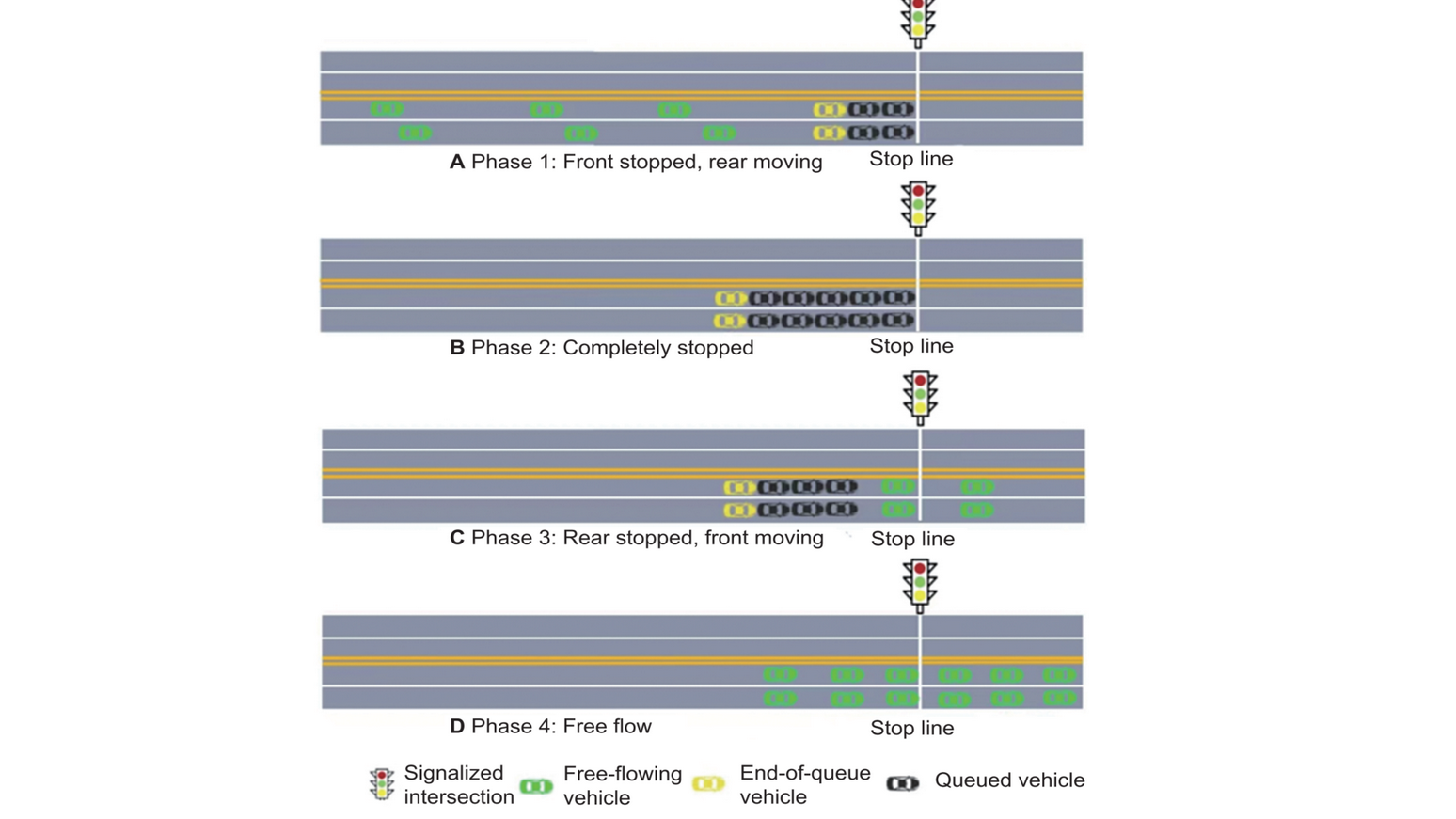
With the development of vehicle-to-infrastructure (V2I) and intelligent connected vehicle technologies, roadside sensing data provides a new foundation for vehicle queue prediction at signalized intersections. However, existing queue-prediction models still have prominent limitations. Mechanism-based models generally ignore the impact of signal-phase changes on driver start–stop behaviour and do not account for individual driver differences, while data-driven models act as black boxes and rely heavily on large-scale historical data. In addition, some connected-vehicle-based approaches are constrained by low penetration rates or limited real-time performance, restricting their engineering applicability. To address these issues, this paper proposes a microscopic driver-behaviour-oriented queue prediction method for signalized intersections based on roadside traffic data. The classical intelligent driver model (IDM) is extended by introducing a traffic-light remaining-time adjustment term, so that drivers’ anticipatory braking under red phases and speed adaptation near the end of green phases are explicitly embedded in the longitudinal acceleration. Together with the minimizing overall braking induced by lane changes (MOBIL) model, a unified prediction framework is constructed to describe both car-following and lane-changing decisions. Using vehicle position, speed, and signal-phase information collected by roadside sensors, a dynamic evolution model of queue formation, stagnation, and dissipation is further established, and quantitative estimation methods are developed for the maximum queue length and queue dissipation time. Multi-scenario validation is conducted on a simulation of urban mobility (SUMO)-based platform and with field data from the Yizhuang corridor in Beijing. The proposed method achieves a mean absolute percentage error (MAPE) of 20.66% in simulation and 25.73% in field verification, and outperforms conventional IDM-based and support vector regression (SVR)-based baselines in prediction accuracy across varying traffic demand levels. These findings indicate that the proposed method can provide practical support for signal timing optimisation, green-wave coordination, and V2I-based traffic management.
KeyWords AITranslate
1.J. H. Han, D. L. Shen, J. Jeong, et al., "Energy Impact of Connecting Multiple Signalized Intersections to Energy-Efficient Driving: Simulation and Experimental Results," IEEE Control Systems Letters 7 (2023): 1297–1302, https://doi.org/10.1109/LCSYS.2023.3235332.
2.Z. Chang and Y. Pei, "Urban Roads Carrying Capacity and Saturation Considering Real-Time Data," Technology & Economy in Areas of Communications 24, no. 4 (2022): 8–15, https://doi.org/10.19348/j.cnki.issn1008-5696.2022.04.002.
3.H. Cao, "Research on Regional Traffic Coordination Optimal Control Based on Vehicle Average Vehicle Delay Model" (M.S. thesis, Nanjing University of Posts and Telecommunications, 2021).
4.C. Tan, J. Yao, K. Tang, and J. Sun, "Cycle-Based Queue Length Estimation for Signalized Intersections Using Sparse Vehicle Trajectory Data," IEEE Transactions on Intelligent Transportation Systems 22, no. 1 (2021): 91–106, https://doi.org/10.1109/TITS.2019.2953646.
5.K. N. Balke, H. Charara, and R. Parker. Development of a Traffic Signal Performance Measurement System (TSPMS). Texas Transportation Institute Tech. Rep. FHWA/TX-05/0-4429-1. 2005.
6.H. Hui, "Urban Public Transit Dispatch Based on Queuing Theory," in Proceedings of the 5th International Conference on Natural Computation 6, 468–472, IEEE, https://doi.org/10.1109/ICNC.2009.61.
7.J. Li, C. Wang, S. He, and T. Z. Qiu, "Dynamic Traffic Shockwave Speed Estimation in Connected Vehicle Environment," in Proceedings of the 4th International Conference on Transportation Information and Safety (ICTIS), 54–59, IEEE, https://doi.org/10.1109/ICTIS.2017.8047742.
8.H. Lin, Y. Sun, and X. Shi, "Method of Extracting Traffic Characteristics Based on Historical Data Information," Urban Transport of China 5, no. 5 (2007): 38–41, https://doi.org/10.13813/j.cn11-5141/u.2007.05.009.
9.J. Yao, R. He, T. Shi, P. Wang, and X. Zhao, "Review on Machine Learning-Based Traffic Flow Prediction Methods," Journal of Traffic and Transportation Engineering 23, no. 3 (2023): 44–67, https://doi.org/10.19818/j.cnki.1671-1637.2023.03.003.
10.B. Gao, Q. Chen, Y. Liu, J. Li, and H. Zhang, "Predictive Cruise Control Under Cloud Control System for Urban Bus Considering Queue Dissipation Time," IEEE Transactions on Intelligent Vehicles 8, no. 4 (2023): 2639–2649, https://doi.org/10.1109/TIV.2023.3234586.
11.C. Sun, C. Zhang, H. Yu, W. Liang, Q. Ren, and J. Li, "An Eco-Driving Approach With Flow Uncertainty Tolerance for Connected Vehicles Against Waiting Queue Dynamics on Arterial Roads," IEEE Transactions on Industrial Informatics 18, no. 8 (2022): 5286–5296, https://doi.org/10.1109/TII.2021.3126620.
12.P. Hao, X. Ban, D. Guo, and Q. Ji, "Cycle-by-Cycle Intersection Queue Length Distribution Estimation Using Sample Travel Times," Transportation Research Part B: Methodological 68 (2014): 185–204, https://doi.org/10.1016/j.trb.2014.08.012.
13.S. Jayatilleke, V. Wickramasinghe, and N. Amarasingha, "Introduction of a Simple Estimation Method for Lane-Based Queue Lengths with Lane-Changing Movements," Journal of The Institution of Engineers (India): Series A 104 (2023): 143–153, https://doi.org/10.1007/s40030-022-00693-w.
14.M. A. Aljamal, H. M. Abdelghaffar, and H. A. Rakha, "Real-Time Estimation of Vehicle Counts on Signalized Intersection Approaches Using Probe Vehicle Data," IEEE Transactions on Intelligent Transportation Systems 22, no. 5 (2021): 2719–2729, https://doi.org/10.1109/TITS.2020.3000727.
15.Y. Zhao, W. Wong, J. Zheng, and H. X. Liu, "Maximum Likelihood Estimation of Probe Vehicle Penetration Rates and Queue Length Distributions From Probe Vehicle Data," IEEE Transactions on Intelligent Transportation Systems 23, no. 7 (2022): 7628–7636, https://doi.org/10.1109/TITS.2021.3071379.
16.G. Comert, Z. Khan, M. Rahman, and M. Chowdhury, "Grey Models for Short-Term Queue Length Predictions for Adaptive Traffic Signal Control," Expert Systems with Applications 185 (2021): 115618, https://doi.org/10.1016/j.eswa.2021.115618.
17.K. Tiaprasert, Y. Zhang, X. B. Wang, and X. Zeng, "Queue Length Estimation Using Connected Vehicle Technology for Adaptive Signal Control," IEEE Transactions on Intelligent Transportation Systems 16, no. 4 (2015): 2129–2140, https://doi.org/10.1109/TITS.2015.2403212.
18.Y. Tang, K. Ozbay, and L. Jin, "Robust Queue Length Estimation for Ramp Metering in a Connected Vehicle Environment," arXiv preprint, arXiv: 2305.17921, May, 8, 2023, https://doi.org/10.48550/arXiv.2305.17921.
19.R. Rahman and S. Hasan, "Real-Time Signal Queue Length Prediction Using Long Short-Term Memory Neural Network," Neural Computing and Applications 33, no. 8 (2021): 3311–3324, https://doi.org/10.1007/s00521-020-05186-x.
20.M. Umair, M. U. Farooq, R. H. Raza, Q. Chen, and B. Abdulhai, "Efficient Video-Based Vehicle Queue Length Estimation Using Computer Vision and Deep Learning for an Urban Traffic Scenario," Processes 9, no. 10 (2021): 1786, https://doi.org/10.3390/pr9101786.
21.W. Abewickrema, M. Yildirimoglu, and J. Kim, "An Ensemble Deep Learning Framework for Real-Time Queue Length Estimation at Signalized Intersections," Data Science for Transportation 7, no. 2 (2025): 15, https://doi.org/10.1007/s42421-025-00129-1.
22.L. Huang, J. Qin, and T. Wu, "Multisource Data Fusion with Graph Convolutional Neural Networks for Node-Level Traffic Flow Prediction," Journal of Advanced Transportation 2024 (2024): 7109780, https://doi.org/10.1155/2024/7109780.
23.A. A. M. Anisha, M. Abdel-Aty, A. Abdelraouf, Z. Islam, and O. Zheng, "Automated Vehicle to Vehicle Conflict Analysis at Signalized Intersections by Camera and LiDAR Sensor Fusion," Transportation Research Record 2677, no. 5 (2023): 117–132, https://doi.org/10.1177/03611981221115086.
24.B. Gao, R. Mei, Y. Lu, J. Wang, and K. Li, "Predictive Lane-Changing Control for Platoon Based on Cloud Control System in Highway Scenarios," CHAIN 1, no. 1 (2024): 75–98, https://doi.org/10.23919/CHAIN.2023.000001.
25.T. T. Zhang, P. J. Jin, S. T. McQuade, A. Bayen, and B. Piccoli, "Car-Following Models: A Multidisciplinary Review," IEEE Transactions on Intelligent Vehicles 10, no. 1 (2025): 92–116, https://doi.org/10.1109/TIV.2024.3409468.
26.E. Macioszek and D. Iwanowicz, "A Back-of-Queue Model of a Signal-Controlled Intersection Approach Developed Based on Analysis of Vehicle Driver Behavior," Energies 14, no. 4 (2021): 1204, https://doi.org/10.3390/en14041204.
27.Y. Wei and Y. Han, "Construction and Simulation of Vehicle Car-Following and Lane-Changing Model at Intersections," Transport Research 4, no. 3 (2018): 36–41.
28.Y. Qin, H. Wang, W. Wang, and D. Ni, "Review of Car-Following Models for Adaptive Cruise Control Vehicles," Journal of Traffic and Transportation Engineering 17, no. 3 (2017): 121–130, https://doi.org/10.19818/j.cnki.1671-1637.2017.03.013.
29.T. Tang, C. Li, and H. Huang, "A New Car-Following Model With the Consideration of the Driver's Forecast Effect," Physics Letters A 374, no. 38 (2010): 3951–3956, https://doi.org/10.1016/j.physleta.2010.07.065.
30.R. Li, L. Zhang, and Z. Liu, "Study on Traffic-Flow Model Based on Interaction Between Car-Following and Lane-Changing in Two-Lane Conditions," Journal of System Simulation 31, no. 12 (2019): 2470–2477, https://doi.org/10.16182/j.issn.1004731x.joss.19-FZ0344.
31.M. Treiber, A. Hennecke, and D. Helbing, "Congested Traffic States in Empirical Observations and Microscopic Simulations," Physical Review E 62 (2000): 1805–1824, https://doi.org/10.1103/PhysRevE.62.1805.
32.M. Treiber and A. Kesting, "The Intelligent Driver Model with Stochasticity—New Insights Into Traffic Flow Oscillations," Transportation Research Procedia 23 (2017): 174–187, https://doi.org/10.1016/j.trpro.2017.05.011.
33.C. Lu, J. Dong, and L. Hu, "Energy-Efficient Adaptive Cruise Control for Electric Connected and Autonomous Vehicles," IEEE Intelligent Transportation Systems Magazine 11, no. 3 (2019): 42–55, https://doi.org/10.1109/MITS.2019.2919543.
34.J. Huang, K. Wan, J. Chen, and B. Gao, "A Forward-Looking Sequential Asynchronous Lane-Change Strategy for Vehicle Platoon Under Cloud-Vehicle-Road Integrated Architecture," CHAIN 2, no. 1 (2025): 43–56.
35.Y. Pan and S. Wang, "Improved Weighted MOBIL Autonomous Lane-Changing Decision Model Under Connected and Automated Driving Environment," Journal of Chongqing Jiaotong University (Natural Science) 40, no. 5 (2021): 46–52, https://doi.org/10.3969/j.issn.1674-0696.2021.05.008.
36.A. Kesting and M. Treiber, "Calibrating Car-Following Models by Using Trajectory Data: Methodological Study," Transportation Research Record 2088, no. 1 (2008): 148–156, https://doi.org/10.3141/2088-16.
37.A. Kesting, M. Treiber, and D. Helbing, "General Lane-Changing Model MOBIL for Car-Following Models," Transportation Research Record 1999, no. 1 (2007): 86–94, https://doi.org/10.3141/1999-10.
Basic Information:
DOI:10.23919/CHAIN.2026.000001
Chinese Library Classification Number:
Citation Information:
With the development of vehicle-to-infrastructure (V2I) and intelligent connected vehicle technologies, roadside sensing data provides a new foundation for vehicle queue prediction at signalized intersections. However, existing queue-prediction models still have prominent limitations. Mechanism-based models generally ignore the impact of signal-phase changes on driver start–stop behaviour and do not account for individual driver differences, while data-driven models act as black boxes and rely heavily on large-scale historical data. In addition, some connected-vehicle-based approaches are constrained by low penetration rates or limited real-time performance, restricting their engineering applicability. To address these issues, this paper proposes a microscopic driver-behaviour-oriented queue prediction method for signalized intersections based on roadside traffic data. The classical intelligent driver model (IDM) is extended by introducing a traffic-light remaining-time adjustment term, so that drivers’ anticipatory braking under red phases and speed adaptation near the end of green phases are explicitly embedded in the longitudinal acceleration. Together with the minimizing overall braking induced by lane changes (MOBIL) model, a unified prediction framework is constructed to describe both car-following and lane-changing decisions. Using vehicle position, speed, and signal-phase information collected by roadside sensors, a dynamic evolution model of queue formation, stagnation, and dissipation is further established, and quantitative estimation methods are developed for the maximum queue length and queue dissipation time. Multi-scenario validation is conducted on a simulation of urban mobility (SUMO)-based platform and with field data from the Yizhuang corridor in Beijing. The proposed method achieves a mean absolute percentage error (MAPE) of 20.66% in simulation and 25.73% in field verification, and outperforms conventional IDM-based and support vector regression (SVR)-based baselines in prediction accuracy across varying traffic demand levels. These findings indicate that the proposed method can provide practical support for signal timing optimisation, green-wave coordination, and V2I-based traffic management.
quote
| GB/T 7714-2015 | [1] Hengkai Wang, Guanzhong Li, Xiao Luo, et al. Vehicle queue prediction method for signalized intersections based on roadside traffic data[J]. Chain, 2026, 3(1): 73-93. DOI:10.23919/CHAIN.2026.000001. |
| MLA | [1] Hengkai Wang, et al., "Vehicle queue prediction method for signalized intersections based on roadside traffic data." Chain, vol. 3, no. 1, 2026, pp. 73-93, https://doi.org/10.23919/CHAIN.2026.000001. |
| APA | [1] Hengkai Wang, Guanzhong Li, Xiao Luo, Wei Zhong, Hong Qi, & Dong Zhang. (2026). Vehicle queue prediction method for signalized intersections based on roadside traffic data. Chain, 3(1), 73-93. https://doi.org/10.23919/CHAIN.2026.000001 |
| IEEE | [1] Hengkai Wang, Guanzhong Li, Xiao Luo, Wei Zhong, Hong Qi, and Dong Zhang, "Vehicle queue prediction method for signalized intersections based on roadside traffic data," Chain, vol. 3, no. 1, pp. 73-93, 2026, doi: 10.23919/CHAIN.2026.000001. keywords: {signalized intersection;roadside sensing data;vehicle queue prediction;vehicle-to-infrastructure} |