

Experimental optimization of process parameters for Pt/Al2O3-catalyzed hydrogen elimination and corresponding regulation strategies AITranslate
Abstract AITranslate
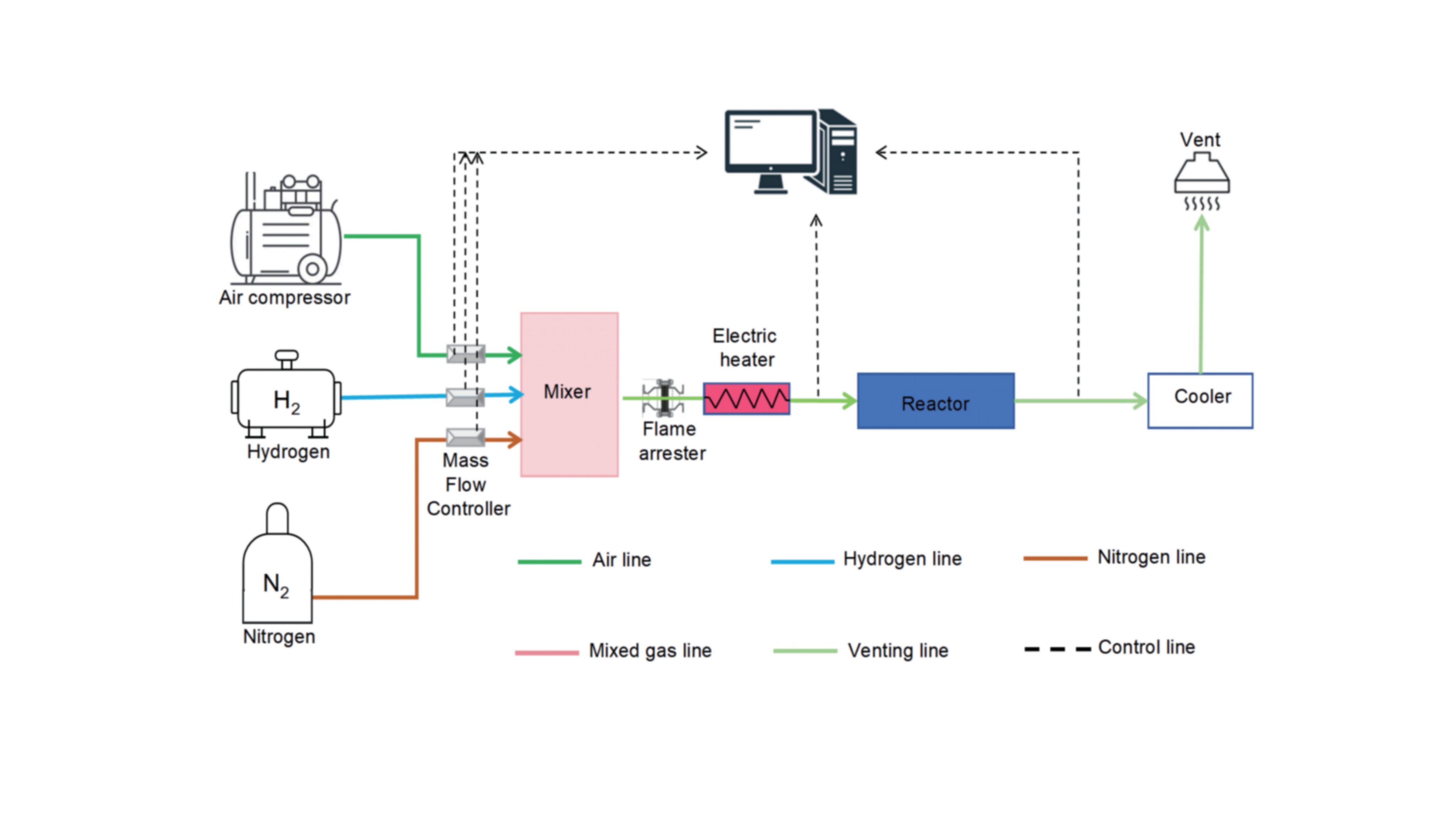
To address safety hazards arising from trace H2 leakage in hydrogen energy systems, catalytic elimination using a Pt/Al2O3 catalyst was investigated. A test system was constructed to study the effects of Pt loading, inlet temperature, and space velocity on hydrogen conversion, along with catalyst microstructure analysis. Single-factor experiments indicate that increasing Pt loading from 1 wt% to 4 wt% significantly raises conversion rate from approximately 30% to over 85% at 1 vol% H2. Elevating the inlet temperature effectively overcomes the activation barrier, with a particularly pronounced effect at low temperatures. In contrast, the influence of space velocity is relatively weak and negatively correlated with hydrogen conversion. Multivariable synergistic analysis identifies inlet temperature as the dominant factor for overcoming surface activation limitations at low H2 concentrations, while Pt loading enhances reaction kinetics via increased active site density. At H2 concentrations above 2 vol%, the system enters an "interfacial reaction saturation" regime where all parameter effects diminish. Numerical simulations confirm these mechanisms, clarifying that synergistic mode of action wherein temperature dominates activation while Pt loading increases the reaction rate.
KeyWords AITranslate
1.J. Cao, C. Dong, D. Jin, S. Jin, H. Zhang, and J. Lang, "Preparation and Electrocatalytic Properties of MoS2/CNTs/Ni3S2 Nanocomposite Catalyst," Journal of Jilin Normal University (Natural Science Edition) 46, no. 4 (2025): 1–6, https://doi.org/10.16862/j.cnki.issn1674-3873.2025.04.001.
2.Z. Li, H. Liu, S. Hong, J. Han, C. Hu, and L. Wei, "LiCoO2 Derived Co2P Nanocatalyst for Hydrolysis of Sodium Borohydrid," Guangzhou Chemical Industry 53, no. 20 (2025): 43–45+78, https://doi.org/10.20220/j.cnki.1001-9677.2025.20.011.
3.L. Zhao, Z. Bian, M. Duan, J. Wang, and Y. Song, "Industrial Progress in Fuel Cell Combined Heat and Power Systems," Battery Bimonthly 55, no. 3 (2025): 586–592, https://doi.org/10.19535/j.1001-1579.2025.03.028.
4.M. H. Rahman, R. Baldacci, and B. C. Menezes, "Cost and Emission Performance of Blue and Grey Hydrogen as Diesel Alternatives in Fuel Cell Trucks," International Journal of Energy Research 2026, no. 1 (2026): 3858752, https://doi.org/10.1155/er/3858752.
5.Z. Li, Y. Li, M. He, and M. Liu, "A Comprehensive Review of NVH Performance for Hydrogen Fuel Cell Vehicle Powertrains," Automotive Digest, no. 11 (2025): 21–29, https://doi.org/10.19822/j.cnki.1671-6329.20250098.
6.M. Calabrese, M. Portarapillo, A. D. Nardo, et al., "Hydrogen Safety Challenges: A Comprehensive Review on Production, Storage, Transport, Utilization, and CFD-Based Consequence and Risk Assessment," Energies 17, no. 6 (2024): 1350, https://doi.org/10.3390/en17061350.
7.K. Song, R. Jia, P. Huang, X. Huang, B. Zhang, and F. Li, "Functional Safety-Oriented Hazard Analysis and Risk Assessment for Vehicular Fuel Cell Systems," Heliyon 11, no. 1 (2025): 41410, https://doi.org/10.1016/j.heliyon.2024.e41410.
8.B. Song, X. Wang, Y. Kang, H. Li, M. Li, and Z. Cheng, "Hydrogen Fuel Cell Vehicles on Highways: Leakage Diffusion Characteristics and Safety Assessment," Process Safety and Environmental Protection 199 (2025): 107255, https://doi.org/10.1016/j.psep.2025.107255.
9.J. Deng, Y. Fan, C. Wang, and N. Yang, "Advances in Hydrogen Leakage Jets for Hydrogen Storage Systems," International Journal of Hydrogen Energy 93 (2024): 93585–93606, https://doi.org/10.1016/j.ijhydene.2024.10.439.
10.B. Song, X. Wang, Y. Kang, and H. Li, "Research on Hydrogen Leakage Diffusion and Safety Analysis in Hydrogen Fuel Cell Vehicles with Regard to Leakage Location and Ventilation Ports," International Journal of Hydrogen Energy 83 (2024): 173–187, https://doi.org/10.1016/j.ijhydene.2024.08.105.
11.X. Liu, J. Li, J. Guo, et al., "Porous Graphitized Carbon-supported Pt for Catalytic Oxidation of Carbon Monoxide and Formaldehyde Under Ambient Conditions," Separation and Purification Technology 361, Part 2 (2025): 131512, https://doi.org/10.1016/j.seppur.2025.131512.
12.X. Li, J. Wang, S. P. Teong, S. P. Chan, and Y. Zhang, "Durable and Superhydrophobic Hydrogen Elimination Catalysts for Enhanced Hydrogen Safety," International Journal of Hydrogen Energy 115 (2025): 93–100, https://doi.org/10.1016/j.ijhydene.2025.02.474.
13.W. Wang, Y. Sun, M. Ge, and X. Xia, "A Palladium-containing Zeolite Catalyst for Removal of Undesirable Hydrogen in Enclosed Environments," Journal of Materials Research 40, no. 3 (2025): 1–10, https://doi.org/10.1557/s43578-024-01503-5.
14.Y. Li, C. Wang, J. Lu, W. Guo, X. Kang, "Research on Low-temperature Catalytic Oxidation of Ethylene Over Pt Supported on Sulfated Alumina," Modern Chemical Industry 46, no. 4 (2026): 129–134, https://doi.org/10.16606/j.cnki.issn0253-4320.2026.04.022.
15.T. Xue, C. Li, T. Liu, et al., "Research Status of Catalysts for Diesel Reforming Hydrogen Production and Application of 3D Printing Technology in Reforming Hydrogen Production Field," Materials China 45, no. 5 (2026): 406–414, https://doi.org/10.7502/j.issn.1674-3962.202504004.
16.S. Hou and W. Xie, "Exploring Hierarchical Porous γ-Al2O3 Modified with MoV Metal Oxides Used as A High-Efficiency Solid Catalyst for Sustainable Biodiesel Production from Low-cost Acidic Oils," Renewable Energy 250 (2025): 123303, https://doi.org/10.1016/j.renene.2025.123303.
17.C. Liu, "Study on The Preparation and Hydrogen Elimination Properties of ZrFe Hydrogen Storage Alloy Loaded Pd and Pt Catalysts" (PhD Dissertation, University of Science and Technology Beijing, 2024), https://doi.org/10.26945/d.cnki.gbjku.2024.000057.
18.W. Yu, F. Yuan, B. Bao, and X. Shi, "Superhydrophobic Pt-Pd/Al2O3Catalyst Coating for Hydrogen Mitigation System of Nuclear Power Plant," Nuclear Science and Engineering 39, no. 3 (2019): 454–462, https://doi.org/10.1016/j.ijhydene.2017.04.102.
19.M. N. A. Mondal, N. Karimi, S. D. Jackson, and M. C. Paul, "Impact of Catalyst Quantity on Premixed Ultralean Hydrogen/Air Combustion in A Packed Bed Reactor," Energy Fuels 39, no. 19 (2025): 9121–9133, https://doi.org/10.1021/acs.energyfuels.5c00576.
20.S. Y. Joshi, Y. J. Ren, M. P. Harold, and V. Balakotaiah, "Distinguishing Kinetic and Mass Transfer Regimes in Catalytic Hydrogen Combustion on Pt/Al2O3 Honeycomb Monoliths at High Space Velocities," Applied Catalysis B: Environmental 102, no. 3–4 (2011): 484–495, https://doi.org/10.1016/j.apcatb.2010.12.030.
21.L. Tang, D. Yamaguchi, J. Orellana, and W. Tian, "Multiphysics Studies of 3D Plate Fin Heat Exchanger Filled with Ortho-Para-Hydrogen Conversion Catalyst for Hydrogen Liquefaction," Hydrogen 5, no. 4, (2024): 682–709, https://doi.org/10.3390/hydrogen5040036.
22.A. A. Malakhov, M. H. Toit, A. V. Avdeenkov, and D. G. Bessarabov, "Numerical Modelling of Catalytic Hydrogen Combustion in Passive Autocatalytic Recombiners: A Review," Progress in Nuclear Energy 171 (2024): 105199, https://doi.org/10.1016/j.pnucene.2024.105199.
23.L. Fan and J. Cao, "Catalytic Decomposition of Hydrogen Molecules on Transition Metal-doped Al(111) Surfaces," Acta Physica Sinica 64, no. 3 (2015): 038801, http://doi.org/10.7498/aps.64.038801.
24.Y. Liu, K. Ji, X. Wang, et al., "Modulating the Coverage of Adsorbed Hydrogen via Hydrogen Spillover Enables Selective Electrocatalytic Hydrogenation of Phenol to Cyclohexanone," Angewandte Chemie International Edition 64, no. 7 (2025): e202419178, https://doi.org/10.1002/anie.202419178.
25.X. Wen, J. Gu, Y. Pan, A. Mebarki, and J. Jiang, "Safety-oriented Catalytic Hydrogenation Based on Supported Catalysts: Research Progress and Perspectives," Journal of Loss Prevention in the Process Industries 100 (2026): 105902, https://doi.org/10.1016/j.jlp.2025.105902.
26.J. Zhang, Z. Hu, T. Man, Y. Zhao, M. Ding, and Z. Guo, "A Review of Catalyst Material for Hydrogen Mitigation Systems in Nuclear Facilities," Nuclear Engineering and Design 428 (2024): 113481, https://doi.org/10.1016/j.nucengdes.2024.113481.
27.J. A. Hopkins, B. J. Page, S. G. Wang, et al., "Isopotential Electron Titration: Hydrogen Adsorbate -Metal Charge Transfer," ACS Central Science 11, no. 11 (2025): 2063–2073, https://doi.org/10.1021/acscentsci.5c00851.
28.P. Li, J. Wang, X. Gong, et al., "Sulfur-Doped Al2O3 for Tuning Catalyst Surface Properties to Enhance the Dehydrogenation Performance of Dodecahydro-N-Ethylcarbazole," Fuel 425 (2026): 139440, https://doi.org/10.1016/j.fuel.2026.139440.
29.R. Lipin and M. Vandichel, "Tuning H-Loading in Pd(111) via Metal Overlayers: Insights from Ab Initio Thermodynamics and Pourbaix Diagrams," ACS Applied Materials & Interfaces 17, no. 47 (2025): 65335–65345, https://doi.org/10.1021/acsami.5c17561.
30.A. Zhang, F. Yang, Y. Luo, et al., "Microenvironmental Regulation of PdCo Nanoclusters in Mesoporous Carbon Enhances Hydrogen Production from Formic Acid," Applied Catalysis B: Environment and Energy 373 (2025): 125360, https://doi.org/10.1016/j.apcatb.2025.125360.
Basic Information:
DOI:10.23919/CHAIN.2026.000017
Chinese Library Classification Number:
Citation Information:
To address safety hazards arising from trace H2 leakage in hydrogen energy systems, catalytic elimination using a Pt/Al2O3 catalyst was investigated. A test system was constructed to study the effects of Pt loading, inlet temperature, and space velocity on hydrogen conversion, along with catalyst microstructure analysis. Single-factor experiments indicate that increasing Pt loading from 1 wt% to 4 wt% significantly raises conversion rate from approximately 30% to over 85% at 1 vol% H2. Elevating the inlet temperature effectively overcomes the activation barrier, with a particularly pronounced effect at low temperatures. In contrast, the influence of space velocity is relatively weak and negatively correlated with hydrogen conversion. Multivariable synergistic analysis identifies inlet temperature as the dominant factor for overcoming surface activation limitations at low H2 concentrations, while Pt loading enhances reaction kinetics via increased active site density. At H2 concentrations above 2 vol%, the system enters an "interfacial reaction saturation" regime where all parameter effects diminish. Numerical simulations confirm these mechanisms, clarifying that synergistic mode of action wherein temperature dominates activation while Pt loading increases the reaction rate.
quote
| GB/T 7714-2015 | [1] Chenguang Liu, Jiahui Liu, Junlong Su, et al. Experimental optimization of process parameters for Pt/Al2O3-catalyzed hydrogen elimination and corresponding regulation strategies[J]. Chain, 2026, 3(3): 398-414. DOI:10.23919/CHAIN.2026.000017. |
| MLA | [1] Chenguang Liu, et al., "Experimental optimization of process parameters for Pt/Al2O3-catalyzed hydrogen elimination and corresponding regulation strategies." Chain, vol. 3, no. 3, 2026, pp. 398-414, https://doi.org/10.23919/CHAIN.2026.000017. |
| APA | [1] Chenguang Liu, Jiahui Liu, Junlong Su, Yu Wang, Qianqian Zhang, Xuchong Wen, & Hongbin Zhang. (2026). Experimental optimization of process parameters for Pt/Al2O3-catalyzed hydrogen elimination and corresponding regulation strategies. Chain, 3(3), 398-414. https://doi.org/10.23919/CHAIN.2026.000017 |
| IEEE | [1] Chenguang Liu, Jiahui Liu, Junlong Su, Yu Wang, Qianqian Zhang, Xuchong Wen, and Hongbin Zhang, "Experimental optimization of process parameters for Pt/Al2O3-catalyzed hydrogen elimination and corresponding regulation strategies," Chain, vol. 3, no. 3, pp. 398-414, 2026, doi: 10.23919/CHAIN.2026.000017. keywords: {catalytic hydrogen elimination;multivariate synergistic effects;numerical simulation;Pt/AlO catalyst} |