ContentsFigures & Tables
As a crucial clean energy carrier, hydrogen plays an increasingly vital role in the low-carbon transition of the global energy system [1, 2]. At present, its application scope has expanded from traditional industrial fields to power generation, building heating, transportation and other fields. In particular, the commercial operation of hydrogen fuel cell vehicles has achieved initial results in the transportation field [3–5]. However, hydrogen has distinctive physicochemical characteristics. It features an extremely low ignition energy [6], a wide flammability range, and high molecular diffusivity. Consequently, hydrogen leakage is prone to occur during its production, storage, transportation, and application processes [7]. Leaked hydrogen easily accumulates in enclosed or confined spaces and may trigger combustion and explosion accidents once exposed to tiny ignition sources [8], which severely limits the large-scale safe promotion and application of hydrogen energy [9]. Therefore, achieving efficient, safe, and controllable elimination of leaked hydrogen has become an urgent key problem to be solved in the field of hydrogen energy safety [10].
Among hydrogen safety control technologies, catalytic hydrogen elimination is regarded as the most promising technology for engineering applications. It features mild reaction conditions, low energy consumption, complete hydrogen elimination, and zero secondary pollution [11]. Its basic principle is to reduce the activation energy of the hydrogen-oxygen recombination reaction using catalysts, thereby facilitating the reaction between hydrogen and oxygen to generate water under mild operating conditions. This process effectively eliminates potential safety hazards induced by hydrogen leakage at the source [12]. Currently, widely applied catalytic systems for hydrogen elimination can be classified into four main categories: noble metal catalysts represented by Pt and Pd, transition metal oxide catalysts such as manganese dioxide and copper oxide, novel carbon-based catalysts, and molecular sieve-based catalysts [13].
Among the aforementioned catalytic systems, Pt-based noble metal catalysts stand out with outstanding comprehensive performance and possess strong irreplaceable advantages. Despite the scarcity and high costs of noble metal resources, Pt-based catalysts exhibit superior overall performance over oxide, carbon-based, and molecular sieve catalysts. They possess superior low-temperature catalytic activity, low light-off temperature, stable active structures, strong resistance to water vapor and impurity interference, and only mild performance attenuation during long-term operation [14]. Hence, no low-cost materials can completely replace them in hydrogen elimination scenarios under harsh working conditions [15].
Accordingly, Pt is selected as the active component in this study, and alumina (Al2O3) is adopted as the carrier. Alumina features a large specific surface area, high thermal stability, and mechanical strength, which enables favorable dispersion of the active components. Additionally, its surface acidic sites can regulate the adsorption behaviors of hydrogen and oxygen, laying a solid foundation of carrier materials for constructing efficient and stable hydrogen elimination catalytic systems [16].
In recent years, Pt- and Pd-based noble metal catalysts have become research hotspots in the field of catalytic hydrogen elimination, and the structure–activity correlation mechanism has been widely verified. Liu et al. [17] carried out relevant research and drew the following conclusion. The 2.0 wt% Pd/ZrVFe catalyst reduced at 60℃ possesses superior activity and stability compared with conventional catalysts. This improvement originates from the thermal synergistic hydrogen uptake mechanism formed between the carrier and active components. Yu et al. [18] developed Pt0.5Pd0.5 superhydrophobic alloy catalysts with excellent resistance to water vapor and iodine impurities, which can achieve a hydrogen conversion rate above 99.0% within 25 minutes and are suitable for nuclear power accident working conditions. Mondal et al. [19] carried out research on Pt/Al2O3 catalysts and found that there exists a critical threshold for Pt loading and catalyst dosage. Excessively thick catalytic layers will lead to limited internal diffusion and reduced catalyst utilization efficiency. The above studies indicate that hydrogen elimination performance is restricted by the interplay of carrier properties, active components, and mass transfer processes. Single-factor research hardly enables breakthroughs in performance bottlenecks, and it is urgent to explore the multivariate coupling interaction laws among catalysts, temperature, and space velocity within hydrogen elimination systems. Inlet gas temperature and reaction space velocity serve as the core process parameters regulating hydrogen elimination performance. In the research on Pt/Al2O3 honeycomb catalysts, Joshi et al. [20] clarified the influence of temperature on reaction rate-controlling mechanisms. They also confirmed that elevated temperature can shift the reaction system from intrinsic kinetic control to external mass transfer limitation. These conclusions provide theoretical support for the optimizing low-temperature hydrogen elimination processes. Tang et al. [21] found that space velocity is a key factor affecting ortho-para hydrogen conversion efficiency: high space velocity shortens catalyst residence time and limits performance. The study also revealed synergistic effects among temperature, pressure, and space velocity: higher operating pressure can partially offset the negative impact of high space velocity while moderately enhancing conversion kinetics. These findings verify a significant "space velocity–temperature" combined threshold effect in catalytic conversion systems.
Essentially, catalytic hydrogen elimination is a cyclic process dominated by active sites, including adsorption, activation, reaction, and desorption [22]. Active sites of Pt, Pd, and metal-doped defects can dissociate hydrogen molecules to form active hydrogen species, which subsequently undergo oxidation reactions to realize hydrogen elimination. Based on first-principles calculations, Fan et al. [23] verified that transition metal doping can drastically lower the activation energy for hydrogen dissociation. Ti doping achieves the optimal modification effect on Al(111) surfaces. The above result offers theoretical guidance for the modification of alumina-based hydrogen elimination catalysts. Supports with large specific surface areas and excellent stability are critical to achieving homogeneous dispersion of active metal species and maintaining stable catalytic performance. The Al2O3 carrier selected in this study fully meets the above requirements, and its unique surface acidic sites can further regulate the competitive adsorption of hydrogen and oxygen, while optimizing surface reaction kinetics [24, 25]. Systematic exploration of multivariate coupling rules for hydrogen elimination (including Pt loading, reaction temperature, and space velocity) based on this carrier bears great theoretical and engineering significance. Such research helps develop high-efficiency and stable hydrogen elimination systems suitable to practical industrial operating conditions.
However, single-variable research fails to accurately reflect the actual hydrogen elimination reaction laws under practical operating conditions. The lack of research on multi-factor coupling mechanisms has become a major bottleneck restricting the industrial application of this technology. Taking Pt/Al2O3 catalysts as the research object, this study systematically explores how the coupling effects of Pt loading, inlet gas temperature and reaction space velocity affect hydrogen elimination efficiency. It further clarifies the internal mechanism by which multiple parameters synergistically regulate catalytic performance. The research results can provide a theoretical foundation and supporting data to optimize the process parameters of catalytic hydrogen elimination and regulate reactor operation. Additionally, the findings offer references for the engineering application of hydrogen safety prevention and control technologies.
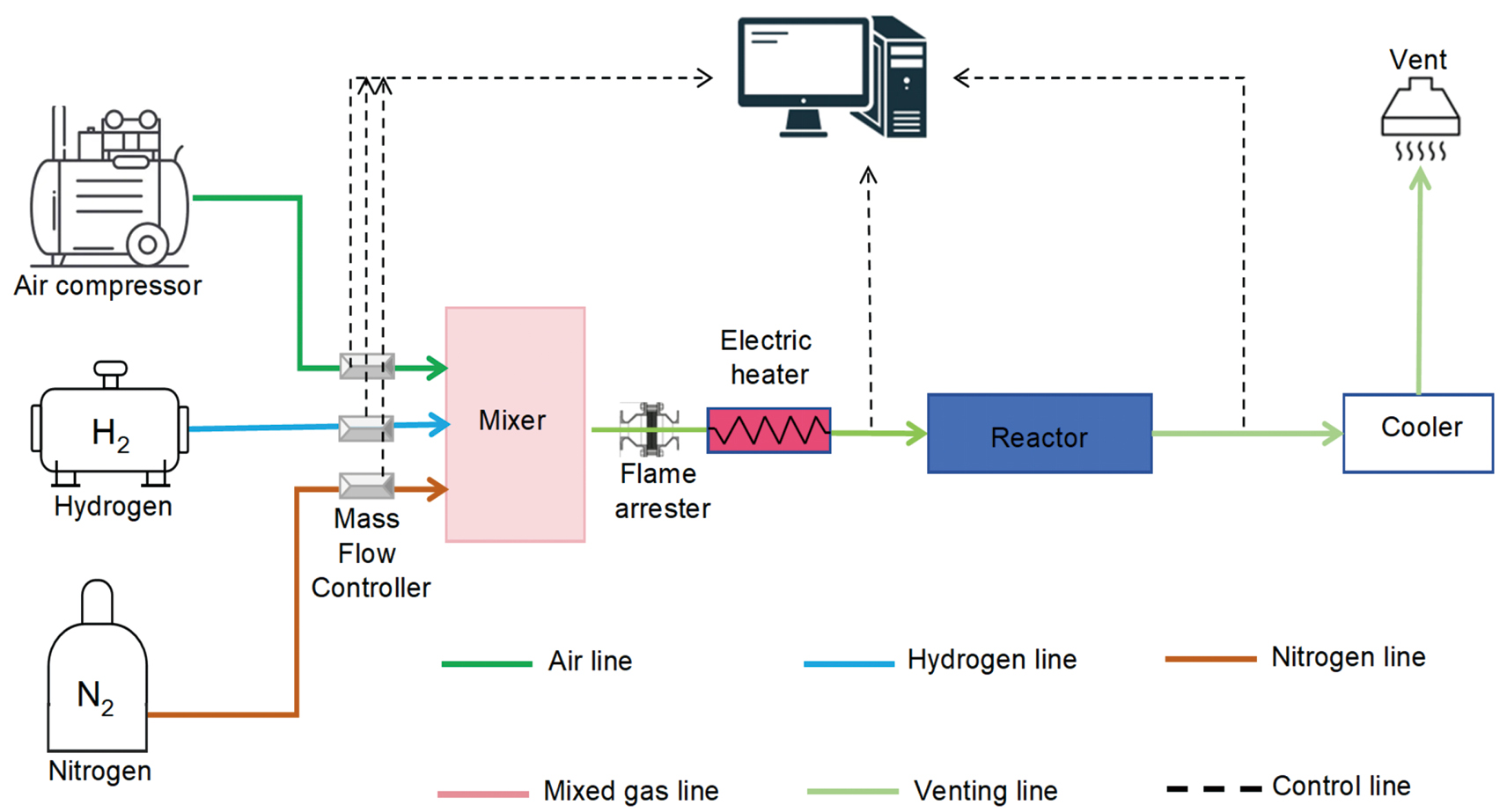
Figure 1 shows the schematic diagram of the catalytic hydrogen combustion test system. A Pt/Al2O3 catalyst was used for catalytic hydrogen combustion and loaded into the reactor before the experiment. The hydrogen-containing mixed gas for the reaction was prepared by manual mixing, with hydrogen, nitrogen and air as feed gases. Specifically, air was supplied by an air compressor, while high-purity (99.999%) gas cylinders were used to provide hydrogen and nitrogen. The inlet flow rates of different gases were regulated separately by Alicat mass flow controllers, and the gases were pre-mixed in a mixer to obtain hydrogen-containing mixtures with hydrogen volume fraction ranging from 1 vol% to 3 vol%. The mixed gas passed through a preheating unit and then entered the reactor, with the gas hourly space velocity (GHSV) controlled within the range of 25,000–45,000 h⁻1.
Meanwhile, gas samples before and after the reaction were collected and analyzed via gas chromatography to determine hydrogen concentration, so as to ensure reliable calibration of hydrogen sensors. In addition, the electromagnetic valves, mass flow controllers, and other components equipped on the whole reaction device were automatically controlled by a computer through a dedicated control system. Temperature sensors and hydrogen concentration sensors were installed at the inlet and outlet of the reactor respectively, and the acquired real-time data, including temperature and hydrogen concentration, were transmitted to the computer for subsequent analysis.
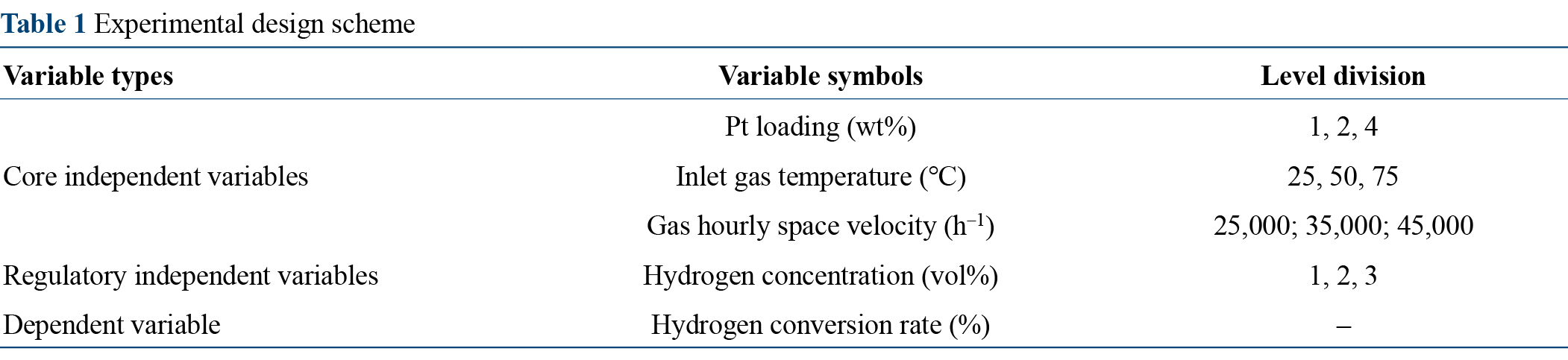
This study adopted a multivariate experimental design and investigated the single-factor effects and two-factor interactive effects of key variables, including Pt loading, inlet gas temperature, and gas hourly space velocity. Hydrogen concentration was set as the controlled variable to explore the influence of external operating conditions. Pt loading, inlet gas temperature, and gas hourly space velocity were selected as the three key independent variables, each set to three levels to cover the critical ranges of each parameter. Meanwhile, the controlled variable hydrogen concentration was arranged at three levels to simulate different application scenarios. The dependent variables were quantitatively calculated by standardized methods to ensure data reliability.
The experiment was carried out in two stages. In the single-factor stage, the other two key variables were fixed at baseline levels. The level of the target variable was changed sequentially under different hydrogen concentrations, and three parallel experiments were designed for each combination. In the interaction stage, the third key variable was kept at the baseline level, while all nine level combinations of the two variables were tested under different hydrogen concentrations, with three parallel experiments performed for each group.
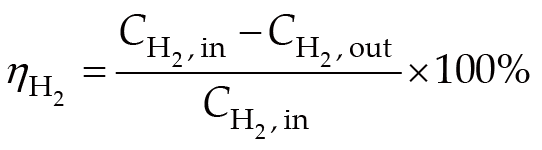
The experimental design scheme is listed in Table 1, and the hydrogen concentration levels (1 vol%, 2 vol%, and 3 vol%) were selected based on practical hydrogen leakage scenarios and preliminary screening experiments. In addition, the hydrogen conversion rate is calculated by the following Equation (1):(1)where is the Hydrogen conversion rate (%); is inlet hydrogen concentration; and is outlet hydrogen concentration.
In this study, scanning electron microscopy (SEM, KYKY-EM8100P, Wuxi Creative Metrology Co., Ltd., Wuxi, China) and X-ray diffraction (XRD, TD-3500, Dandong Tongda Science & Technology Co., Ltd., Dandong, China) were employed to systematically characterize the micromorphology, elemental distribution, and phase composition of the prepared catalysts. SEM was utilized to observe surface morphology, coating thickness, and particle compactness. Combined with energy dispersive spectroscopy (EDS, KYKY-EM8100P, Wuxi Creative Metrology Co., Ltd., Wuxi, China) elemental mapping, semi-quantitative analysis was conducted to evaluate the distribution uniformity of key elements (Pt, Al, and O). XRD characterization was performed to identify the crystal phase structures of the catalysts, and the phase stability of the γ-Al2O3 support and the active Pt component was assessed by comparing XRD patterns before and after reaction. This analysis clarified whether significant phase transformation or new phase formation took place during the catalytic process. The XRD measurements were conducted at a tube voltage of 40 kV and a tube current of 30 mA, with a scanning rate of 10° min−1. These test parameters ensured high intensity and high resolution of diffraction signals, providing reliable evidence for subsequent phase identification and structural analysis.
Three-dimensional computational fluid dynamics software ANSYS Fluent (2022 R1, ANSYS Inc., Canonsburg, PA, USA) was adopted to numerically simulate the flow field, heat transfer and species reaction behaviors within the hydrogen catalytic combustion reactor. In accordance with the actual structure of the experimental reactor, the geometric model was simplified into a single-pass cylindrical structure with an inner diameter of 28 mm and a catalyst bed length of 40 mm. In this simulation, a pressure-based steady-state solver was adopted. The continuity equation, momentum equation, energy equation, and species transport equation were activated to comprehensively describe the internal flow, heat transfer, and catalytic reaction processes, and the mixed gas was assumed to follow ideal gas properties. The Shear–Stress Transport (SST) k–ω turbulence model together with enhanced wall treatment was adopted to precisely capture the near-wall mass transfer characteristics. The catalyst bed was defined as a porous domain using the porous zone resistance model. The viscous resistance coefficient was set to 4.0 × 10⁷ m−2 and the inertial resistance coefficient to 42.21 m−1 to characterize flow resistance inside the packed bed. The corresponding structural parameters included a cell density of 300 cells per square inch (cpsi), an equivalent pore size of 1.3 mm, and a porosity of 0.7. The reaction kinetic parameters were set for a first-order reaction with an activation energy of 1.28 × 10⁷ kJ mol−1. The coupled algorithm was used for pressure-velocity coupling. For convergence judgment, the residuals of energy, momentum, turbulence, and species equations were all controlled below 1 × 10⁻⁶. Meanwhile, key monitoring indicators such as outlet hydrogen mole fraction and maximum temperature of catalyst bed were tracked. The numerical calculation was considered fully converged when the fluctuation of all monitored parameters was less than 1 × 10⁻³.
Velocity-inlet boundary condition was adopted for the model inlet, where matched inlet temperature and volume fractions of each gas component were assigned. The hydrogen volume fraction was set to 1 vol%–3 vol%, oxygen was fixed at 21 vol%, and the balance was supplemented by inert nitrogen to simulate real air atmosphere. All walls were set as zero heat flux walls, and the radiation heat transfer model was not activated for simplification. The fluid region with catalytic reactions was defined as a porous medium reaction zone. The exothermic heat from hydrogen catalytic elimination was incorporated into the energy conservation equation as a volumetric heat source term, calculated in real time based on the local hydrogen consumption rate solved by the surface catalytic reaction kinetics model embedded in ANSYS Fluent. This heat source was tightly coupled with the species transport and flow governing equations, enabling synchronous iterative calculation of the flow field, species concentration distribution, and temperature field with reaction exotherm considered.
As shown in Figure 2, the 2 wt% Pt/γ-Al2O3 catalytic layer presents a continuous and compact coating morphology with an overall thickness of approximately 20 μm. EDS elemental mapping reveals the key elements including Al, O, and Pt are uniformly dispersion in space. This uniform distribution not only maximizes the number of effective active sites of Pt, but also effectively improves the structural stability and anti-deactivation performance of the catalyst during hydrogen elimination reactions.
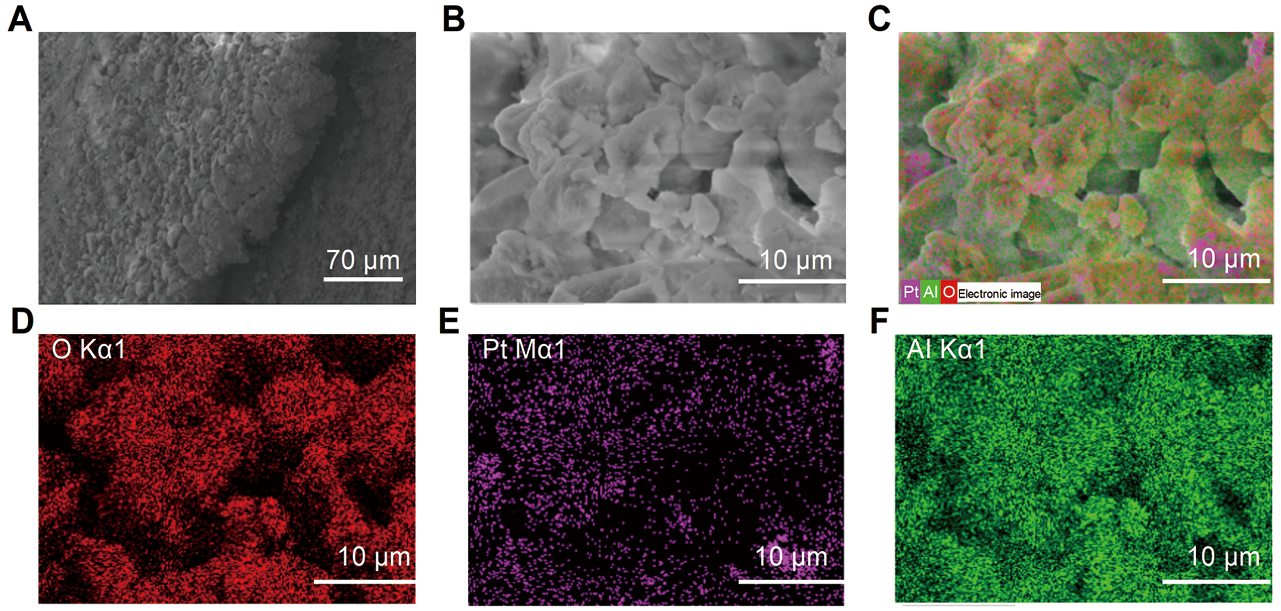
Figure 3A displays the XRD patterns of the catalyst before and after reaction, which were employed to characterize the crystal phase stability of γ-Al2O3 support and supported Pt active components. Several typical diffraction peaks of γ-Al2O3 can be clearly observed at approximately 28°–30°, 36°–38°, 45°–46°, and 66°–68°, confirming the well-preserved crystal skeleton of the support. Distinct diffraction peaks are detected around 46.2° and 67.4°–67.5°, which correspond well to the (200) and (220) crystal planes of metallic Pt. An enhanced signal is also observed in the 39°–40° range, which corresponds to the characteristic peak of the Pt(111) plane. Comparing the XRD patterns before and after the reaction, nearly all diffraction peak positions stay consistent, and no obvious new diffraction peaks corresponding to platinum oxides are detected. These results demonstrate that no substantial crystal phase transformation or new phase formation occurs under the applied catalytic conditions, revealing that the catalytic layer maintains favorable crystal phase stability and structural integrity after cyclic reactions.
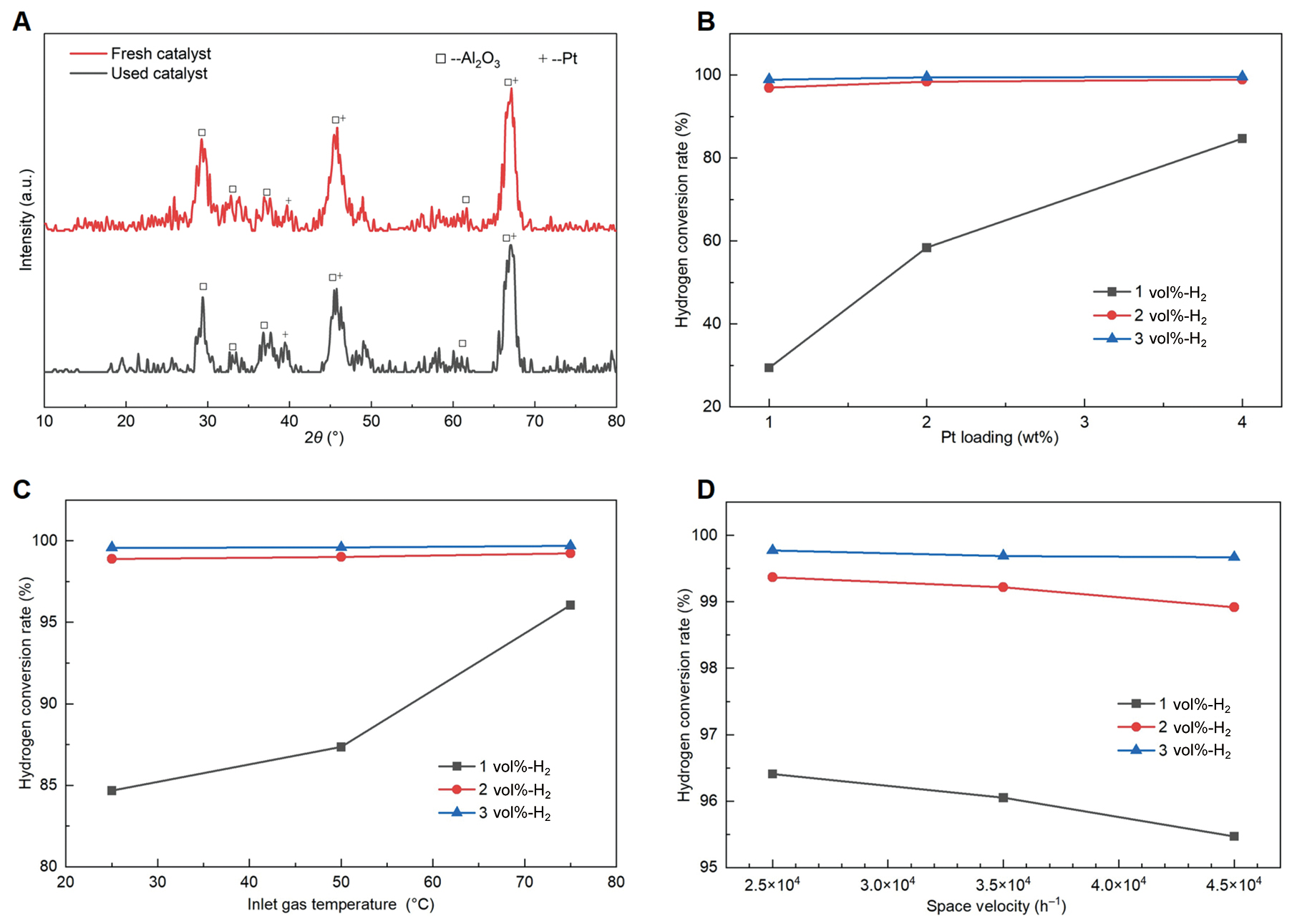
Figure 3B illustrates the effect of Pt loading on hydrogen conversion efficiency under different hydrogen concentrations, with the inlet temperature fixed at 25℃ and a space velocity of 35,000 h−1. It can be observed that hydrogen conversion increases monotonically with rising Pt loading at various hydrogen concentrations, whereas the magnitude of growth varies distinctly. At the hydrogen concentration of 1 vol%, hydrogen conversion exhibits a prominent upward trend with increasing Pt loading. Specifically, the conversion is approximately 30.0% at 1 wt% Pt loading, which exceeds 85.0% when the loading is increased to 4 wt%. This finding confirms that Pt loading serves as the core factor governing reaction efficiency under low hydrogen concentration conditions, with a strong correlation existing between them. In contrast, when the inlet hydrogen concentration exceeds 2 vol%, hydrogen conversion stably stays within the range of 96.8%–99.7%. Further increasing Pt loading exerts a marginal effect on hydrogen conversion, and the corresponding curves gradually level off.
This phenomenon indicates that at high hydrogen concentrations with sufficient hydrogen feedstock, the reaction process is mainly restricted by hydrogen concentration, and Pt loading is no longer the dominant limiting factor. The above findings suggest that the hydrogen conversion reaction can be completed rapidly in hydrogen-rich environments above 2 vol%, and an additional increase in Pt loading cannot effectively enhance the reaction performance. By comparison, raising Pt loading can efficiently accelerate reaction kinetics and improve hydrogen utilization efficiency under a low hydrogen concentration of 1 vol%. Accordingly, proper increase in Pt loading favors achieving high conversion efficiency under insufficient hydrogen supply, while reducing catalyst dosage is feasible to lower experimental and operational costs under an adequate hydrogen atmosphere.
As illustrated in Figure 3C, the maximum hydrogen conversion is achieved at a Pt loading of 4 wt%. On this basis, Figure 3C presents the influence of inlet temperature on hydrogen conversion rate under a fixed Pt loading of 4 wt% and a space velocity of 35,000 h−1. It is clearly observed that hydrogen conversion rises with increasing inlet temperature at all tested hydrogen concentrations, while the growth magnitude shows obvious differences. At a low hydrogen concentration of 1 vol%, inlet temperature exerts the remarkable promoting effect on hydrogen conversion. Specifically, the hydrogen conversion is approximately 85.0% at a room temperature of 25℃, and rises above 95.0% when the temperature increases to 75℃. This demonstrates that inlet temperature acts as a vital factor dominating hydrogen conversion performance under low hydrogen concentration conditions.
In contrast, when the inlet hydrogen concentration exceeds 2 vol%, hydrogen conversion varies slightly with rising inlet temperature and the corresponding curves tend to be stable, with all conversion values maintaining values above 98.0%. The results reveal that sufficient hydrogen feedstock under high hydrogen concentration makes the reaction process mainly governed by hydrogen concentration. In this case, the inlet temperature has negligible influence on catalytic efficiency, as the system is already approaching complete hydrogen conversion. Hence, the temperature increment can hardly improve the reaction performance. A comparison of Figure 3B, C indicates that hydrogen conversion exceeds 80.0% at various hydrogen concentrations when the Pt loading is fixed at 4 wt%, and the regulating effect of inlet temperature on hydrogen conversion becomes relatively weak under such circumstances.
Figure 3D shows the effect of space velocity on hydrogen conversion rate at a Pt loading of 4 wt% and an inlet temperature of 75℃. The experimental results reveal that hydrogen conversion rate slightly decreases with the increase of space velocity under various hydrogen concentrations. The elevation of space velocity shortens the residence time of reactant gas inside the reactor, which reduces the contact duration between hydrogen molecules and catalyst active sites, thereby inhibits sufficient proceeding of catalytic reaction and lowering hydrogen conversion efficiency. Nevertheless, such influence varies distinctly with hydrogen concentration, and the conversion rate presents negligible fluctuation under high hydrogen concentration. Even at the low hydrogen concentration of 1 vol%, space velocity imposes only a weak influence on catalytic performance. Specifically, the hydrogen conversion rate is approximately 96.5% at a space velocity of 25,000 h−1, and merely declines to 95.6% when space velocity rises to 45,000 h−1. It is verified that relatively high hydrogen conversion can still be maintained at low hydrogen concentration despite the variation of space velocity. For hydrogen concentrations of 2 vol% and 3 vol%, the change of space velocity barely affects hydrogen conversion rate. This phenomenon indicates that sufficient hydrogen supply enables the reaction to approach the maximum conversion limit at high hydrogen concentrations, and the adverse effect of increased space velocity on hydrogen conversion can be regarded as negligible.
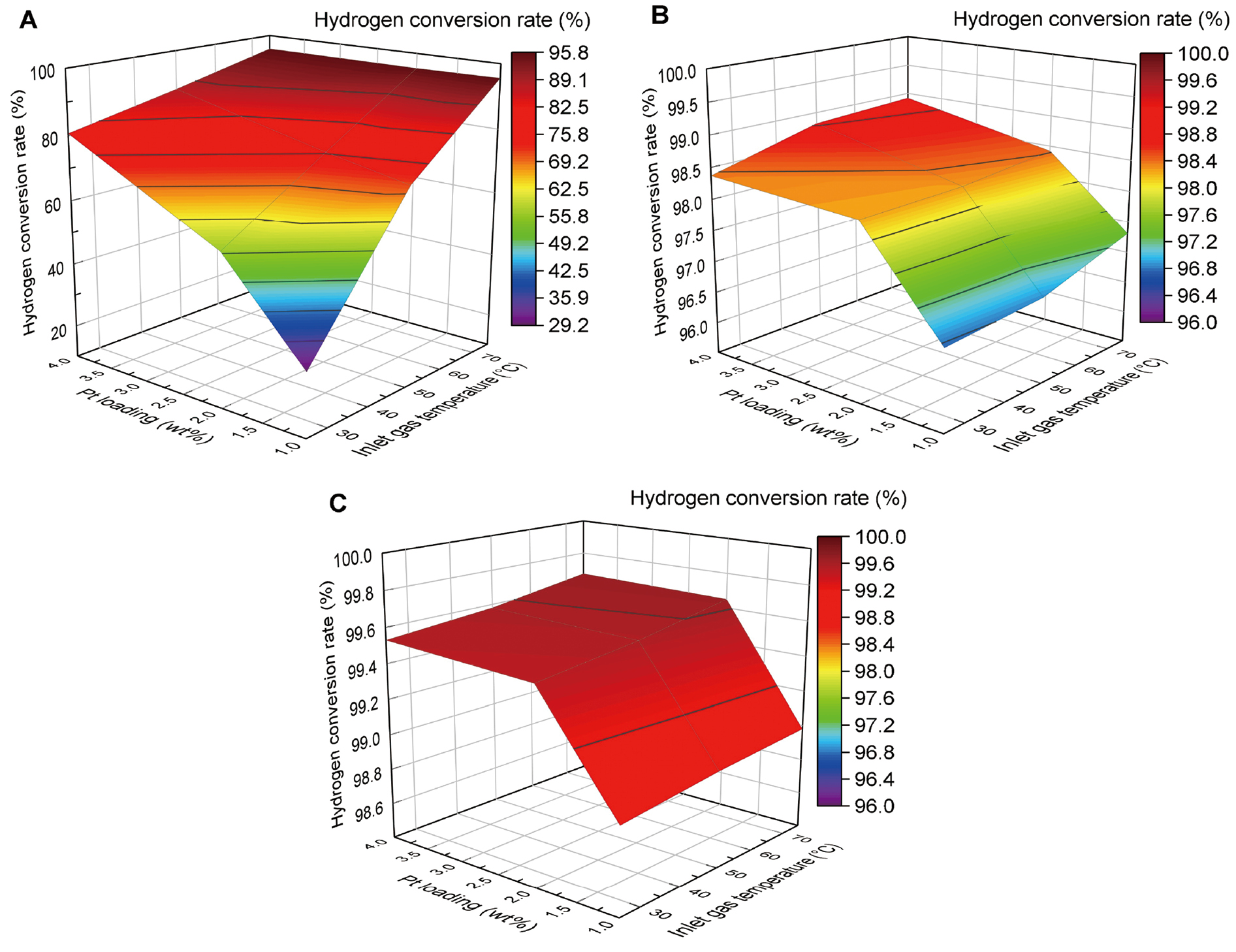
Previous investigations have confirmed that the hydrogen conversion rate exhibits the highest sensitivity to variations in inlet temperature and space velocity at a Pt loading of 1 wt%. To explore the synergistic effects of inlet temperature and space velocity on hydrogen elimination performance, experiments were conducted with a fixed Pt loading of 1 wt% under hydrogen concentrations of 1 vol%, 2 vol%, and 3 vol%. The combined influences of inlet temperature and space velocity on hydrogen conversion were analyzed, and the corresponding results are presented in Figure 4. It can be observed that all three response surfaces demonstrate a consistent trend, in which hydrogen conversion rises distinctly with increasing temperature and declines slightly with increasing space velocity. Obvious differences in surface morphology and response sensitivity can be observed across different hydrogen concentrations.
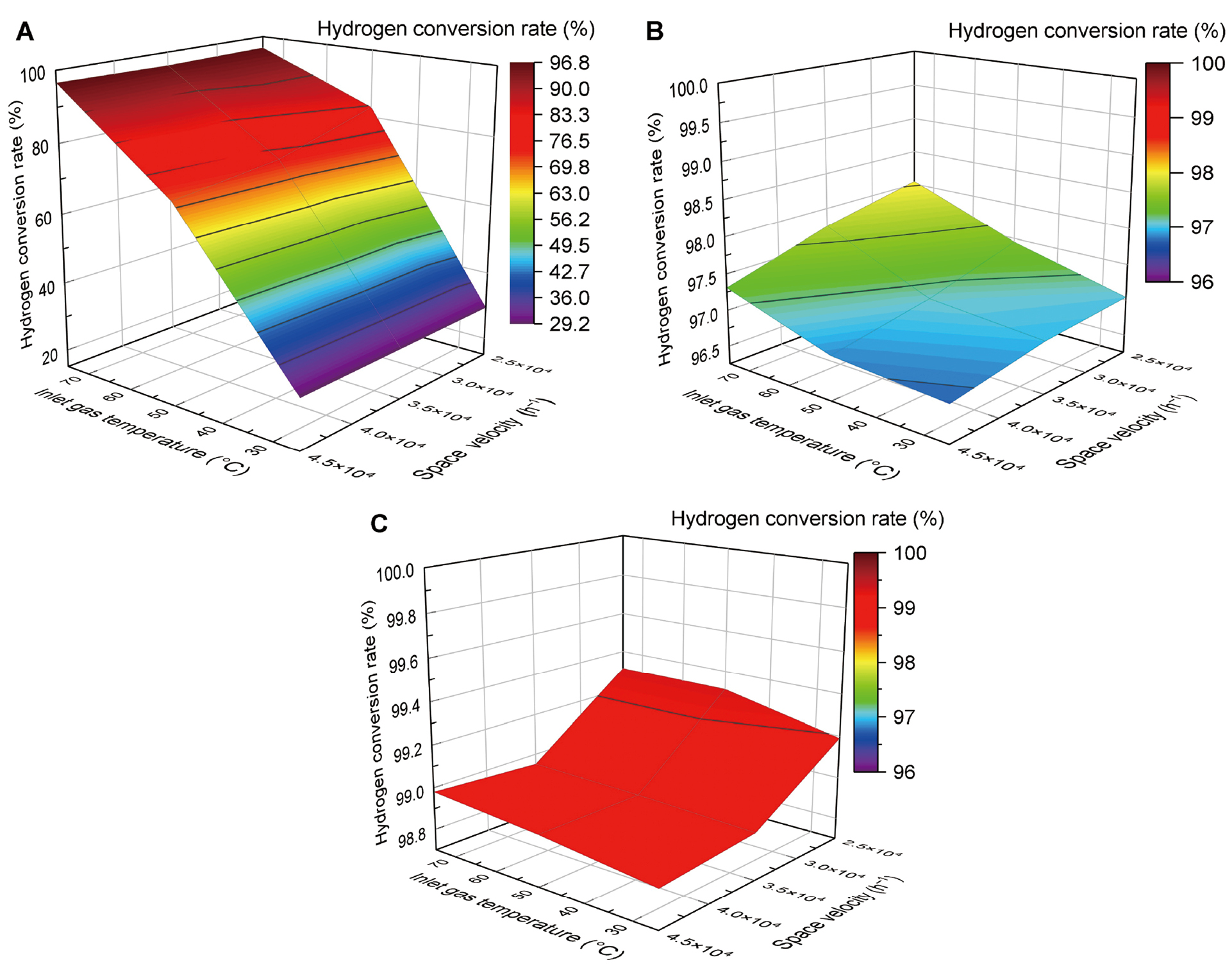
At a hydrogen concentration of 1 vol%, the overall reaction is governed by kinetic limitation. The hydrogen conversion increases remarkably with the rising inlet temperature. Specifically, the conversion rate is merely 29.3% at 25℃ with a space velocity of 45,000 h−1, indicating insufficient activation on the catalyst surface under such conditions. When the inlet temperature rises to 75℃ at the same space velocity, the hydrogen conversion rapidly climbs to 95.6%, which verifies that optimized reaction conditions greatly improve the catalytic efficiency. By contrast, space velocity presents an insignificant effect on hydrogen conversion at a fixed temperature. For instance, the conversion rate reaches 29.5% at 25℃ and 25,000 h−1, which is almost consistent with values at other space velocities at the same temperature. This confirms that inlet temperature acts as a dominant factor regulating hydrogen conversion at 1 vol% H2. Due to inadequate surface activation of the catalyst at low hydrogen concentrations, reaction kinetics can be effectively accelerated by increasing temperature, which serves as the primary strategy to enhance hydrogen conversion.
Distinct variations in catalytic performance emerge when hydrogen concentration increases to 2 vol% and 3 vol%. At 2 vol% H2, hydrogen conversion remains stable within the range of 96.8%–98.0%. When hydrogen concentration further rises to 3 vol%, the reaction proceeds nearly to completion, with conversion maintained at 98.9%–99.3%. At such high hydrogen concentrations, the temperature sensitivity of catalytic activity decreases substantially, whereas the effect of space velocity remains negligible. These results indicate that sufficient hydrogen supply facilitates adequate surface reactions and the gradual saturation of active sites, with adsorption-reaction equilibrium fully established. Accordingly, overall hydrogen conversion approaches its theoretical maximum value. In summary, as hydrogen concentration increases, the dominant factor shifts from surface activation to active-site saturation and interfacial adsorption equilibrium, conferring high stability and excellent adaptability to high H2 atmospheres.
At an inlet temperature of 25℃, the hydrogen conversion rate is most sensitive to changes in Pt loading and space velocity. Accordingly, this temperature was selected as the baseline experimental condition to investigate the synergistic interaction between the two parameters under various hydrogen concentrations, as displayed in Figure 5. It can be found that an obvious inverse response relationship exists between the two variables at a hydrogen concentration of 1 vol%. Specifically, hydrogen conversion increases significantly with increasing Pt loading yet decreases slightly with increasing space velocity. Hydrogen conversion is only approximately 29.3% at a Pt loading of 1 wt% and a space velocity of 45,000 h−1. At the same space velocity, the conversion sharply rises to 80.6% when Pt loading is increased to 4 wt%. In comparison, when Pt loading is fixed at 1 wt% and space velocity decreases from 45,000 to 25,000 h−1, the conversion only slightly increases to 29.5%, demonstrating that the optimization effect brought by adjusting space velocity is extremely limited. This phenomenon reveals that the catalytic system remains kinetically limited at low hydrogen concentrations, and the reaction performance is predominantly governed by the quantity and distribution of active sites on catalyst surfaces. Owing to the low hydrogen content, the number of available hydrogen molecules participating in the reaction per unit time is insufficient. Increasing Pt loading can effectively expand the reactive contact area and provide abundant active sites, thereby greatly boosting hydrogen conversion. In contrast, varying space velocity merely alters gas residence time and contributes little to the improvement of reaction kinetics. Consequently, Pt loading acts as the predominant factor governing hydrogen conversion at low hydrogen concentrations, as it modulates reaction rate by adjusting active site density and the probability of gas-solid interfacial contact.
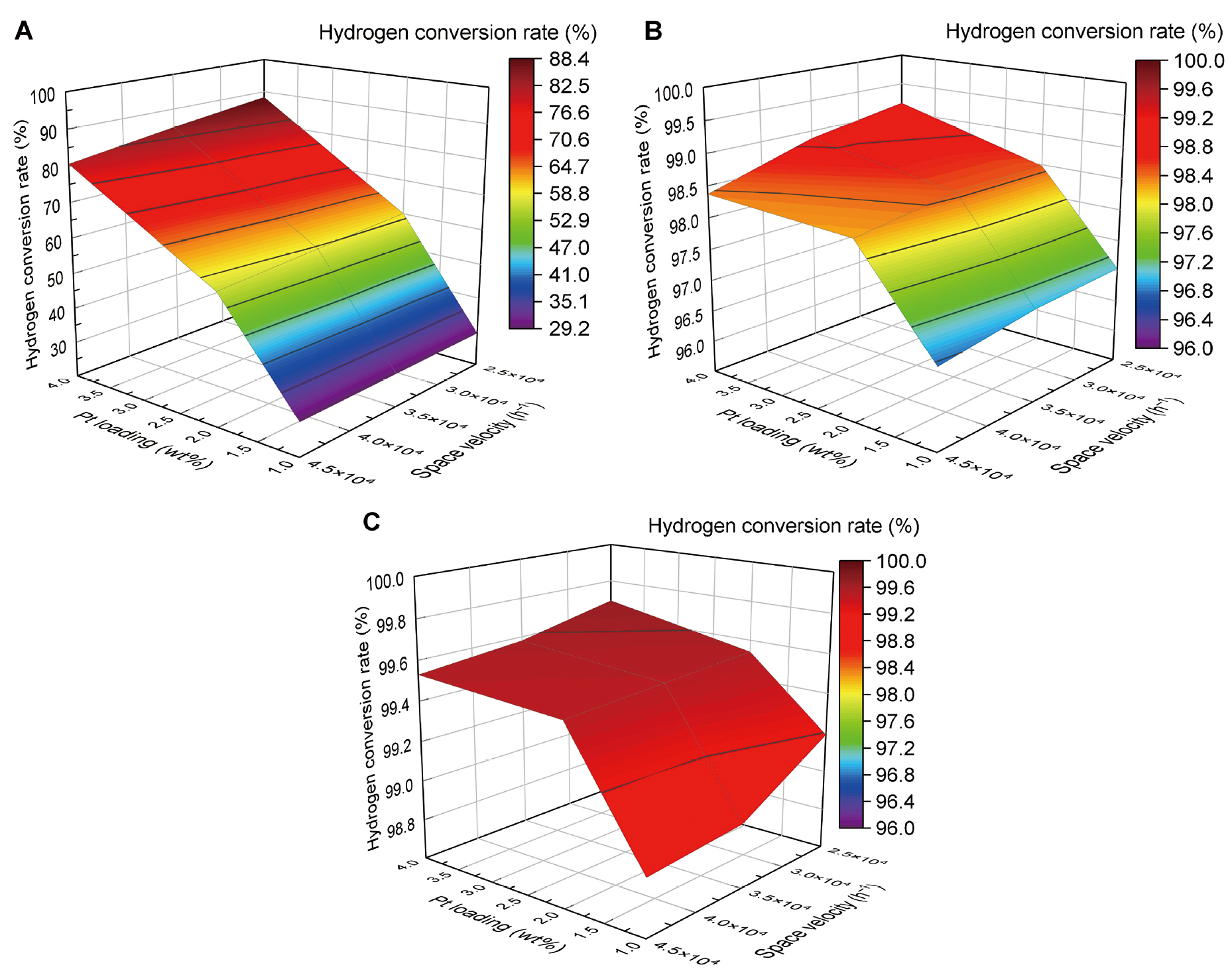
When hydrogen concentration increases to 2 vol%, hydrogen conversion rate changes significantly and stabilizes at 96.8%–99.2% with minor fluctuations. Increasing Pt loading can still yield a mild conversion improvement of around 2%, whereas the influence of space velocity is greatly weakened; conversion rate remains nearly constant over space velocities of 25,000–45,000 h−1. This indicates that active sites on the catalyst surface are nearly saturated, and sufficient hydrogen supply drives the catalytic system to transition from kinetically limited conditions to a saturation-controlled reaction regime. As hydrogen concentration further rises to 3 vol%, hydrogen conversion rate is maintained steadily between 98.9% and 99.7% with negligible variations. At this stage, neither space velocity nor Pt loading exerts a notable effect on catalytic performance. The results confirm that the catalyst surface is fully activated, the hydrogen feed exceeds reaction requirements, and the entire system operates under a stable and high-efficiency reaction state.
When hydrogen concentration rises to 2 vol%, hydrogen conversion rate reaches markedly to the range of 96.8%–99.0%. At this stage, the effects of inlet temperature and Pt loading are obviously weakened, and the response surface presents a gentle arc shape, as shown in Figure 6. Both elevated temperature and increased Pt loading can boost hydrogen conversion, yet their promotion effects are quite limited; of the two, Pt loading exhibits a relatively more prominent influence. For instance, hydrogen conversion stands at only 96.8% at 25℃ with a Pt loading of 1 wt%. It rises to 98.4% as the loading increases to 4 wt% at the same temperature, while it merely reaches 97.3% when the temperature is raised to 75℃ under a Pt loading of 1wt%. This indicates that sufficient reactant molecules occupy most active sites on the catalyst surfaces at 2 vol% H2. The reaction system gradually transitions from surface activation limitation to a nearly saturated reaction state, resulting in weakened marginal gains from both temperature and Pt loading. When hydrogen concentration further increases to 3 vol%, the reaction proceeds almost completely, and hydrogen conversion remains stable between 98.9% and 99.7% with extremely slight fluctuations. These results demonstrate that sufficient hydrogen supply guarantees thorough surface catalytic reactions, and the entire system reaches a high level of reaction saturation at high hydrogen concentrations.
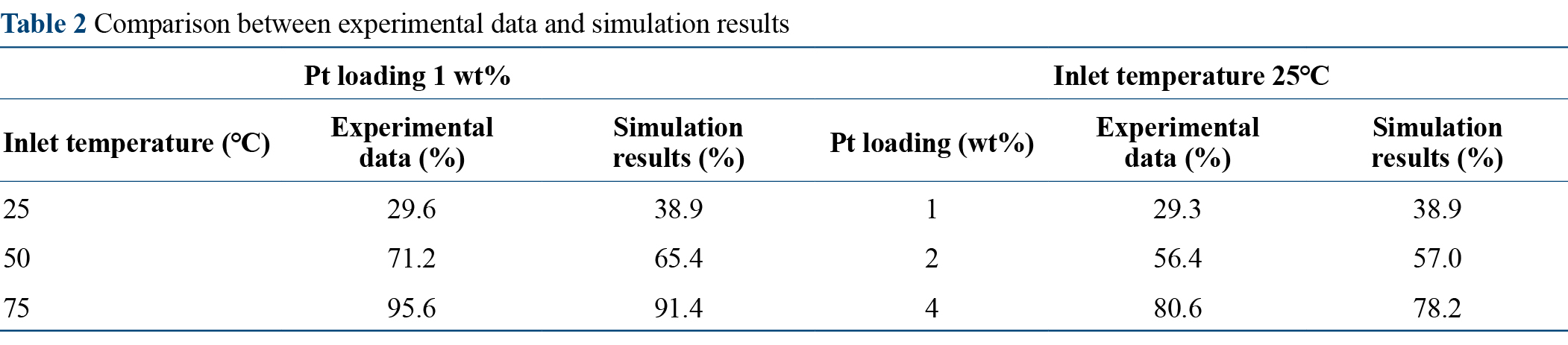
Previous experimental data indicate that the hydrogen conversion rate shows the highest sensitivity to variations in inlet temperature and Pt loading under the operating conditions of 1 vol% hydrogen concentration, 1 wt% Pt loading and a space velocity of 45,000 h−1. To further clarify the essential regulation mechanism of internal mass transfer and reaction characteristics inside the reactor under such conditions, numerical simulations of temperature and hydrogen concentration fields were carried out at inlet temperatures of 25℃, 50℃, and 75℃, and Pt loadings of 1 wt%, 2 wt%, and 4 wt%, respectively. A comparison of simulation results and experimental data is presented in Table 2. Under all tested operating conditions, the simulated hydrogen conversion values are in satisfactory consistency with experimental measurements. The numerical results closely reproduce the variation trend of experimental data with acceptable overall consistency. These findings fully verify that the established simulation model possesses acceptable prediction accuracy and can reliably capture the actual hydrogen conversion process.
Figure 7A, C, E shows temperature distribution contours inside the reactor at different inlet temperatures. As the inlet temperature rises from 25℃ to 75℃, the overall temperature field inside the reactor increases evidently; the maximum temperatures reach 44.7℃, 101℃, and 146℃, with the corresponding temperature increments of approximately 19.7℃, 51℃, and 71℃, respectively. This demonstrates that raising the inlet temperature can remarkably strengthen the exothermic behavior of catalytic hydrogen combustion.
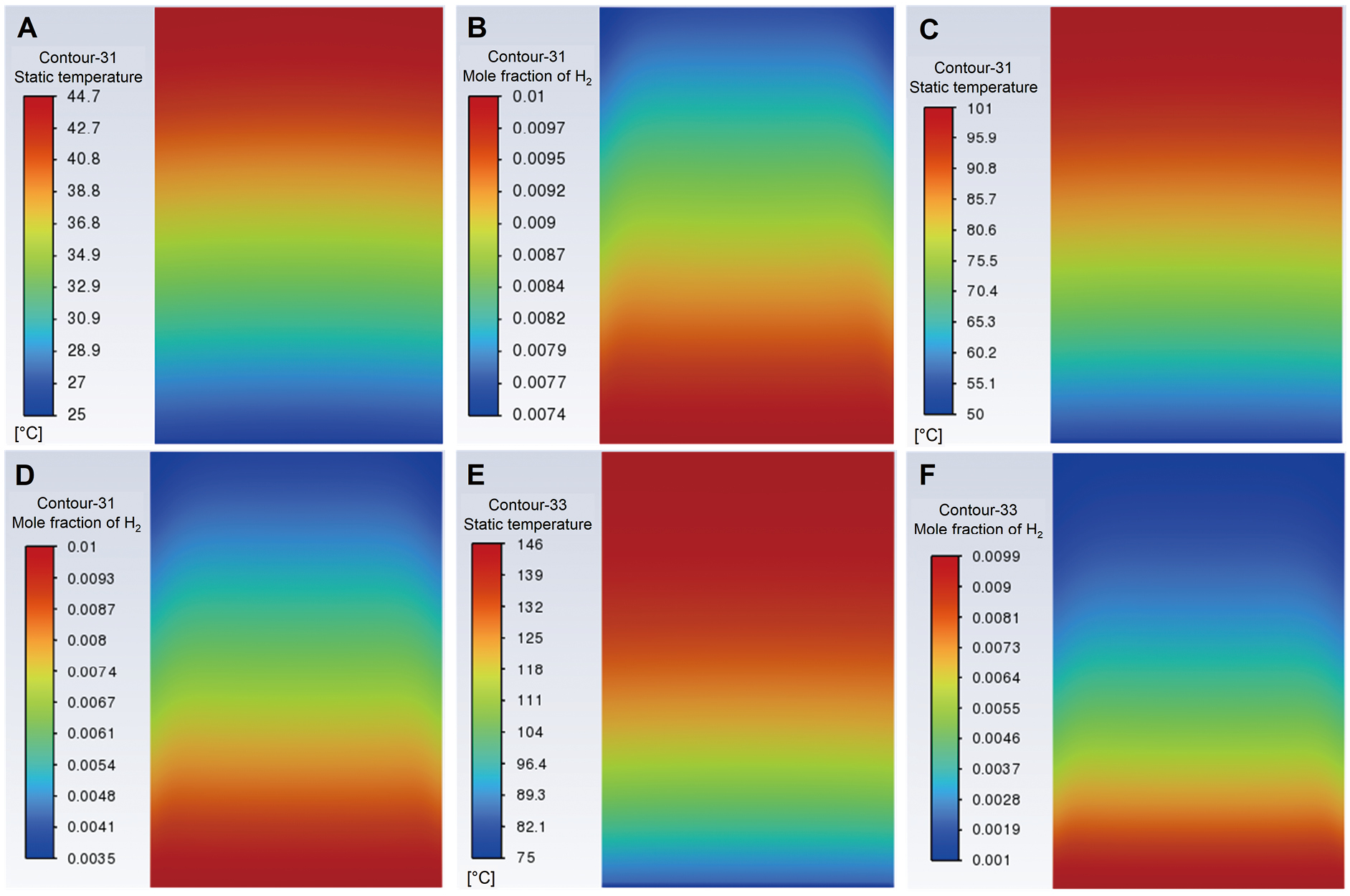
Hydrogen concentration distribution contours are displayed in Figure 7B, D, F. Hydrogen concentration gradually decreases along the flow direction with negligible radial differences, proving that the reaction is mainly controlled by axial reaction progression. At 25℃, the outlet hydrogen mole fraction is roughly 0.74%, matching the experimental hydrogen conversion rate of 29.3%. Owing to the low temperature, the adsorption and dissociation rates of hydrogen molecules on Pt active sites are severely restricted. Hydrogen dissociation acts as the rate-determining step, making the reaction system characteristic of kinetic limitation.
When the inlet temperature increases to 50℃, the outlet hydrogen mole fraction falls to around 0.35%, and hydrogen consumption efficiency is greatly improved. Higher temperatures supply sufficient energy for hydrogen molecules to cross the activation energy barrier, which significantly accelerates surface dissociation and molecular migration. Further increasing the temperature to 75℃ lowers the minimum outlet hydrogen mole fraction to 0.1%, indicating that most hydrogen inside the reactor is effectively eliminated, and the experimental conversion rate reaches 95.6%. Meanwhile, the low-hydrogen-concentration region gradually expands from the local outlet area into a continuous consumption zone near the inlet. The effective reaction region extends from the rear section to the front and middle sections, which matches well with the forward shift trend of the high-temperature zone shown in temperature contours.
The above results verify that under operating conditions of low hydrogen concentration, low Pt loading and high space velocity, inlet temperature acts as the dominant factor to overcome surface activation limitations and govern hydrogen elimination performance.
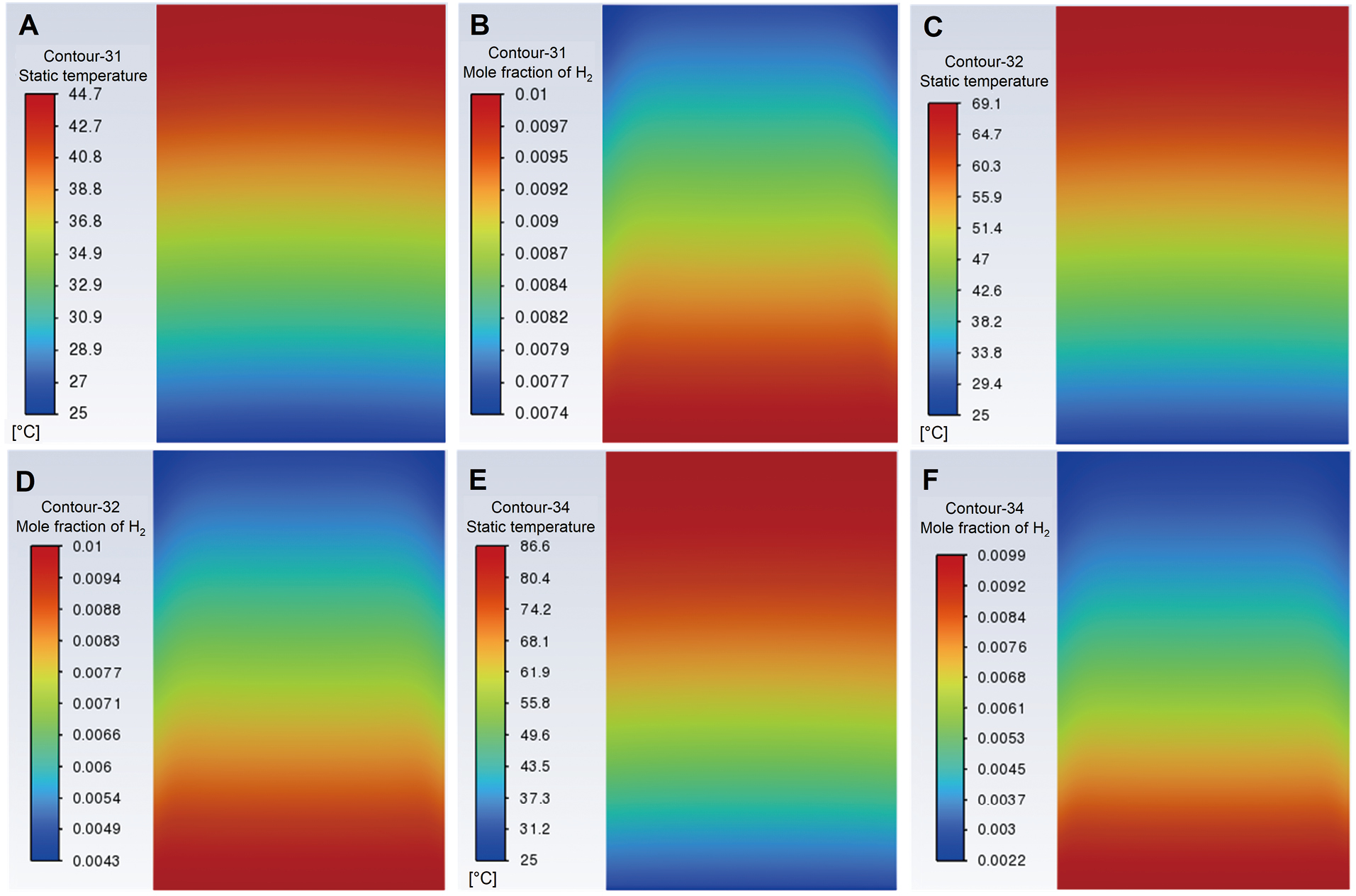
Figure 8A, C, E shows the temperature distribution contours under the conditions of 1 vol% hydrogen concentration, 25℃ and a space velocity of 45,000 h−1 with different Pt loadings (1 wt%, 2 wt%, and 4 wt%). As the Pt loading increases, the high-temperature region gradually expands from a local area near the outlet into a continuous high-temperature zone covering the middle and rear sections. The maximum temperature rises from 44.7℃ to 69.1℃ and 86.6℃. Figure 8B, D, F shows the hydrogen concentration distribution contours under the same operating conditions. Unlike increasing inlet temperature, raising Pt loading fails to shift the high-temperature boundary obviously toward the inlet, and the axial temperature gradient remains nearly constant.
Combined with the experimental data in Sections 2.2 and 2.3, it can be clearly observed that when hydrogen concentration increases to 2 vol%–3 vol%, the sensitivity of conversion rate to temperature and Pt loading decreases significantly, and conversion rate stabilizes above 96%. This transition reflects the mechanistic evolution of the reaction system from surface activation limitation to interfacial reaction saturation. Under a high partial pressure of hydrogen, Pt surfaces are rapidly occupied by adsorbed hydrogen species [26], so adsorption and dissociation no longer act as the reaction bottleneck [27]. Instead, the overall reaction is governed by hydrogenation at the Pt-γ-Al2O3 interface. The γ-Al2O3 support facilitates oxygen activation through Lewis acid sites [28], forming a ternary synergistic catalytic cycle; the corresponding reaction mechanism is displayed in Figure 9.
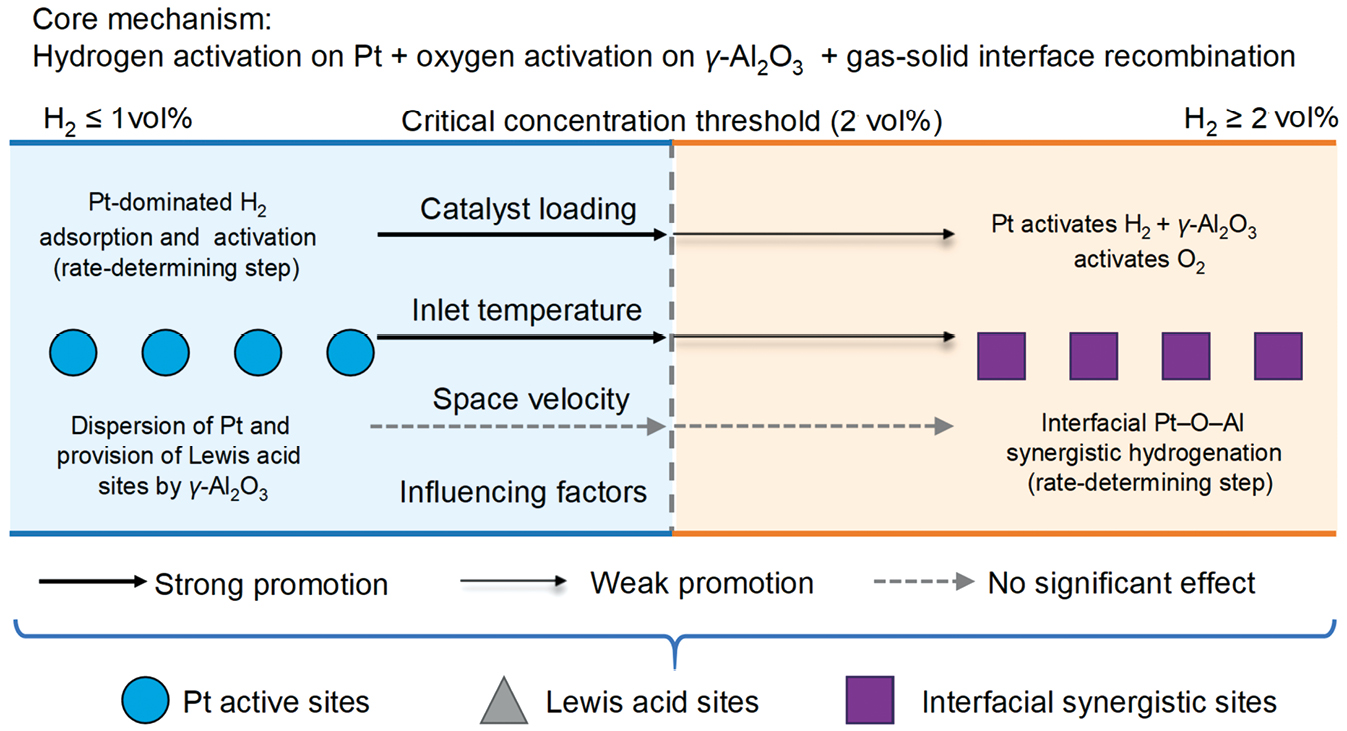
By contrast, the system exhibits obvious kinetically limited characteristics at a low hydrogen concentration of 1 vol%. Insufficient adsorption and activation rates of hydrogen molecules on Pt active sites make hydrogen dissociation the rate-determining step for the overall hydrogen elimination reaction.
Furthermore, XRD characterization confirms that no obvious sintering of Pt particles occurs after catalyst operation, which guarantees structural stability of the interfacial synergistic region [29]. Accordingly, the dominant effects of temperature and Pt loading at low temperature and low Pt loading revealed by numerical simulation directly reflect the surface activation-controlled behavior in low hydrogen concentration regions. Meanwhile, the saturation trend of experimental data at high hydrogen concentrations validates the prevalence of the interfacial reaction-controlled mechanism [30].
This study investigated the micromorphology and phase evolution of Pt/γ-Al2O3 catalysts, as well as the regulation effects and synergistic rules of Pt loading, inlet temperature, and space velocity on catalytic hydrogen removal performance. The main conclusions are summarized as follows:
(i) Morphology and elemental characterization results reveal that the Pt/γ-Al2O3 catalyst presents a continuous, dense coating layer with a thickness of approximately 20 μm, where Al, O, and Pt elements are uniformly distributed. XRD analysis demonstrates that no obvious changes occur in the crystal phases of both the catalyst support and active components after cyclic catalytic hydrogen elimination reactions, confirming the excellent crystalline phase stability and structural integrity of the catalyst.
(ii) Univariate experiments clarified the effects of Pt loading, space velocity and inlet temperature on hydrogen elimination performance. At a low hydrogen concentration (1 vol%), increasing Pt loading from 1 wt% to 4 wt% markedly raised the hydrogen conversion rate from nearly 30% to over 85%, showing a strong positive correlation between Pt loading and hydrogen elimination efficiency within a certain range. Increasing space velocity from 25,000 to 45,000 h−1 only slightly reduced the conversion rate from 96.5% to 95.6%, presenting a weak negative correlation. When the inlet temperature increased from 25℃ to 75℃, the conversion rate rose from 85% to above 95%, indicating that elevated inlet temperature facilitates hydrogen elimination. Nevertheless, such a promotional effect became insignificant at high hydrogen concentrations.
(iii) Multivariate synergistic analysis and numerical simulations reveal that the reaction is surface-activation-limited at 1 vol% H2. Inlet temperature dominates by overcoming the activation barrier; Pt loading improves intrinsic reaction kinetics through higher active site density, whereas space velocity has a weak effect. At 2 vol%–3 vol% H2, the system enters an interfacial reaction saturation regime, where the marginal effects of temperature and Pt loading diminish drastically, and hydrogen conversion remains steady above 96%. Numerical results further indicate that raising temperature shifts the reaction zone forward. By contrast, increasing Pt loading uniformly boosts the reaction rate along the axial direction without modifying the concentration gradient. Accordingly, low-concentration leakage scenarios require prioritizing temperature elevation together with a rational Pt loading, while high-concentration conditions allow moderate operational relaxation to reduce costs.
Chenguang Liu: Investigation; conceptualization; data curation; writing. Jiahui Liu: Investigation; review & editing. Junlong Su: Data curation; review & editing. Yu Wang: Review & editing. Qianqian Zhang: Formal analysis; review & editing. Xuchong Wen: Review & editing. Hongbin Zhang: Data curation; review & editing.
This work was supported by the Key R&D Program of Shandong Province, China (Grant No. 2025CXPT045), and the R&D Project of CIOE (Grant No. SXNY24030010).
The data that support the findings of this study are available from the corresponding author upon reasonable request.
J. Cao, C. Dong, D. Jin, S. Jin, H. Zhang, and J. Lang, "Preparation and Electrocatalytic Properties of MoS2/CNTs/Ni3S2 Nanocomposite Catalyst," Journal of Jilin Normal University (Natural Science Edition) 46, no. 4 (2025): 1–6, https://doi.org/10.16862/j.cnki.issn1674-3873.2025.04.001.
Z. Li, H. Liu, S. Hong, J. Han, C. Hu, and L. Wei, "LiCoO2 Derived Co2P Nanocatalyst for Hydrolysis of Sodium Borohydrid," Guangzhou Chemical Industry 53, no. 20 (2025): 43–45+78, https://doi.org/10.20220/j.cnki.1001-9677.2025.20.011.
L. Zhao, Z. Bian, M. Duan, J. Wang, and Y. Song, "Industrial Progress in Fuel Cell Combined Heat and Power Systems," Battery Bimonthly 55, no. 3 (2025): 586–592, https://doi.org/10.19535/j.1001-1579.2025.03.028.
M. H. Rahman, R. Baldacci, and B. C. Menezes, "Cost and Emission Performance of Blue and Grey Hydrogen as Diesel Alternatives in Fuel Cell Trucks," International Journal of Energy Research 2026, no. 1 (2026): 3858752, https://doi.org/10.1155/er/3858752.
Z. Li, Y. Li, M. He, and M. Liu, "A Comprehensive Review of NVH Performance for Hydrogen Fuel Cell Vehicle Powertrains," Automotive Digest, no. 11 (2025): 21–29, https://doi.org/10.19822/j.cnki.1671-6329.20250098.
M. Calabrese, M. Portarapillo, A. D. Nardo, et al., "Hydrogen Safety Challenges: A Comprehensive Review on Production, Storage, Transport, Utilization, and CFD-Based Consequence and Risk Assessment," Energies 17, no. 6 (2024): 1350, https://doi.org/10.3390/en17061350.
K. Song, R. Jia, P. Huang, X. Huang, B. Zhang, and F. Li, "Functional Safety-Oriented Hazard Analysis and Risk Assessment for Vehicular Fuel Cell Systems," Heliyon 11, no. 1 (2025): 41410, https://doi.org/10.1016/j.heliyon.2024.e41410.
B. Song, X. Wang, Y. Kang, H. Li, M. Li, and Z. Cheng, "Hydrogen Fuel Cell Vehicles on Highways: Leakage Diffusion Characteristics and Safety Assessment," Process Safety and Environmental Protection 199 (2025): 107255, https://doi.org/10.1016/j.psep.2025.107255.
J. Deng, Y. Fan, C. Wang, and N. Yang, "Advances in Hydrogen Leakage Jets for Hydrogen Storage Systems," International Journal of Hydrogen Energy 93 (2024): 93585–93606, https://doi.org/10.1016/j.ijhydene.2024.10.439.
B. Song, X. Wang, Y. Kang, and H. Li, "Research on Hydrogen Leakage Diffusion and Safety Analysis in Hydrogen Fuel Cell Vehicles with Regard to Leakage Location and Ventilation Ports," International Journal of Hydrogen Energy 83 (2024): 173–187, https://doi.org/10.1016/j.ijhydene.2024.08.105.
X. Liu, J. Li, J. Guo, et al., "Porous Graphitized Carbon-supported Pt for Catalytic Oxidation of Carbon Monoxide and Formaldehyde Under Ambient Conditions," Separation and Purification Technology 361, Part 2 (2025): 131512, https://doi.org/10.1016/j.seppur.2025.131512.
X. Li, J. Wang, S. P. Teong, S. P. Chan, and Y. Zhang, "Durable and Superhydrophobic Hydrogen Elimination Catalysts for Enhanced Hydrogen Safety," International Journal of Hydrogen Energy 115 (2025): 93–100, https://doi.org/10.1016/j.ijhydene.2025.02.474.
W. Wang, Y. Sun, M. Ge, and X. Xia, "A Palladium-containing Zeolite Catalyst for Removal of Undesirable Hydrogen in Enclosed Environments," Journal of Materials Research 40, no. 3 (2025): 1–10, https://doi.org/10.1557/s43578-024-01503-5.
Y. Li, C. Wang, J. Lu, W. Guo, X. Kang, "Research on Low-temperature Catalytic Oxidation of Ethylene Over Pt Supported on Sulfated Alumina," Modern Chemical Industry 46, no. 4 (2026): 129–134, https://doi.org/10.16606/j.cnki.issn0253-4320.2026.04.022.
T. Xue, C. Li, T. Liu, et al., "Research Status of Catalysts for Diesel Reforming Hydrogen Production and Application of 3D Printing Technology in Reforming Hydrogen Production Field," Materials China 45, no. 5 (2026): 406–414, https://doi.org/10.7502/j.issn.1674-3962.202504004.
S. Hou and W. Xie, "Exploring Hierarchical Porous γ-Al2O3 Modified with MoV Metal Oxides Used as A High-Efficiency Solid Catalyst for Sustainable Biodiesel Production from Low-cost Acidic Oils," Renewable Energy 250 (2025): 123303, https://doi.org/10.1016/j.renene.2025.123303.
C. Liu, "Study on The Preparation and Hydrogen Elimination Properties of ZrFe Hydrogen Storage Alloy Loaded Pd and Pt Catalysts" (PhD Dissertation, University of Science and Technology Beijing, 2024), https://doi.org/10.26945/d.cnki.gbjku.2024.000057.
W. Yu, F. Yuan, B. Bao, and X. Shi, "Superhydrophobic Pt-Pd/Al2O3Catalyst Coating for Hydrogen Mitigation System of Nuclear Power Plant," Nuclear Science and Engineering 39, no. 3 (2019): 454–462, https://doi.org/10.1016/j.ijhydene.2017.04.102.
M. N. A. Mondal, N. Karimi, S. D. Jackson, and M. C. Paul, "Impact of Catalyst Quantity on Premixed Ultralean Hydrogen/Air Combustion in A Packed Bed Reactor," Energy Fuels 39, no. 19 (2025): 9121–9133, https://doi.org/10.1021/acs.energyfuels.5c00576.
S. Y. Joshi, Y. J. Ren, M. P. Harold, and V. Balakotaiah, "Distinguishing Kinetic and Mass Transfer Regimes in Catalytic Hydrogen Combustion on Pt/Al2O3 Honeycomb Monoliths at High Space Velocities," Applied Catalysis B: Environmental 102, no. 3–4 (2011): 484–495, https://doi.org/10.1016/j.apcatb.2010.12.030.
L. Tang, D. Yamaguchi, J. Orellana, and W. Tian, "Multiphysics Studies of 3D Plate Fin Heat Exchanger Filled with Ortho-Para-Hydrogen Conversion Catalyst for Hydrogen Liquefaction," Hydrogen 5, no. 4, (2024): 682–709, https://doi.org/10.3390/hydrogen5040036.
A. A. Malakhov, M. H. Toit, A. V. Avdeenkov, and D. G. Bessarabov, "Numerical Modelling of Catalytic Hydrogen Combustion in Passive Autocatalytic Recombiners: A Review," Progress in Nuclear Energy 171 (2024): 105199, https://doi.org/10.1016/j.pnucene.2024.105199.
L. Fan and J. Cao, "Catalytic Decomposition of Hydrogen Molecules on Transition Metal-doped Al(111) Surfaces," Acta Physica Sinica 64, no. 3 (2015): 038801, http://doi.org/10.7498/aps.64.038801.
Y. Liu, K. Ji, X. Wang, et al., "Modulating the Coverage of Adsorbed Hydrogen via Hydrogen Spillover Enables Selective Electrocatalytic Hydrogenation of Phenol to Cyclohexanone," Angewandte Chemie International Edition 64, no. 7 (2025): e202419178, https://doi.org/10.1002/anie.202419178.
X. Wen, J. Gu, Y. Pan, A. Mebarki, and J. Jiang, "Safety-oriented Catalytic Hydrogenation Based on Supported Catalysts: Research Progress and Perspectives," Journal of Loss Prevention in the Process Industries 100 (2026): 105902, https://doi.org/10.1016/j.jlp.2025.105902.
J. Zhang, Z. Hu, T. Man, Y. Zhao, M. Ding, and Z. Guo, "A Review of Catalyst Material for Hydrogen Mitigation Systems in Nuclear Facilities," Nuclear Engineering and Design 428 (2024): 113481, https://doi.org/10.1016/j.nucengdes.2024.113481.
J. A. Hopkins, B. J. Page, S. G. Wang, et al., "Isopotential Electron Titration: Hydrogen Adsorbate -Metal Charge Transfer," ACS Central Science 11, no. 11 (2025): 2063–2073, https://doi.org/10.1021/acscentsci.5c00851.
P. Li, J. Wang, X. Gong, et al., "Sulfur-Doped Al2O3 for Tuning Catalyst Surface Properties to Enhance the Dehydrogenation Performance of Dodecahydro-N-Ethylcarbazole," Fuel 425 (2026): 139440, https://doi.org/10.1016/j.fuel.2026.139440.
R. Lipin and M. Vandichel, "Tuning H-Loading in Pd(111) via Metal Overlayers: Insights from Ab Initio Thermodynamics and Pourbaix Diagrams," ACS Applied Materials & Interfaces 17, no. 47 (2025): 65335–65345, https://doi.org/10.1021/acsami.5c17561.
A. Zhang, F. Yang, Y. Luo, et al., "Microenvironmental Regulation of PdCo Nanoclusters in Mesoporous Carbon Enhances Hydrogen Production from Formic Acid," Applied Catalysis B: Environment and Energy 373 (2025): 125360, https://doi.org/10.1016/j.apcatb.2025.125360.
 Top
Top