

Robust control of the PEM fuel cell hydrogen recirculation system using backstepping sliding mode control with RBF neural network AITranslate
Abstract AITranslate
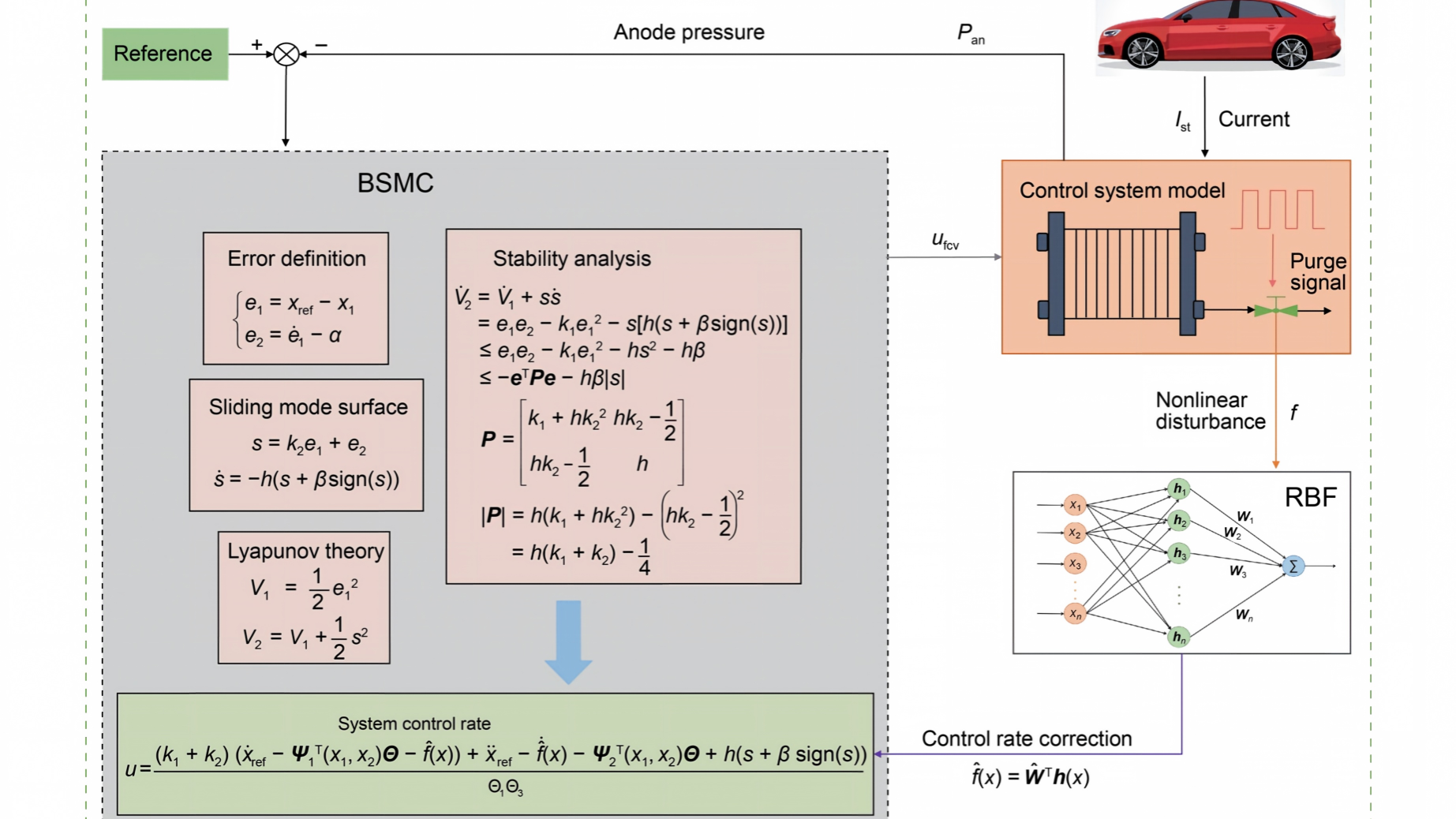
The dynamic behavior of hydrogen gas in the anode recirculation loop of a proton exchange membrane fuel cell (PEMFC) is governed by coupled flow‑pressure interactions within the ejector, supply manifold, and stack channels, making precise pressure regulation a critical challenge for system efficiency, stability, and lifetime. Ensuring adequate anode fuel supply and stable hydrogen supply pressure requires meticulous control of the gas handling system. This study proposes a single‑ejector‑based backstepping sliding mode controller (BSMC) for PEMFC hydrogen recirculation systems. To compensate for the unknown gas flow disturbance induced by periodic purging, a radial basis function (RBF) neural network is integrated with the BSMC, which adaptively corrects the control law under different system states. Simulation results demonstrate that the proposed RBF‑compensated BSMC effectively mitigates purge‑induced pressure fluctuations. The controller achieves a maximum tracking error of 8.173 kPa, a mean absolute error of 0.17 kPa, and a root mean square error of 0.53 kPa. Consequently, the proposed control strategy offers superior stability and robustness compared to conventional proportional‑integral‑derivative (PID) controllers under step load current variations, variable pressure targets, and periodic purge disturbances.
KeyWords AITranslate
1.Y. D. Wang, Q. Meyer, K. Tang, et al., "Large-Scale Physically Accurate Modelling of Real Proton Exchange Membrane Fuel Cell with Deep Learning," Nature Communications 14 (2023): 745, https://doi.org/10.1038/s41467-023-35973-8.
2.J. Xu, C. Zhang, R. Fan, et al., "Modelling and Control of Vehicle Integrated Thermal Management System of PEM Fuel Cell Vehicle," Energy 199 (2020): 117495, https://doi.org/10.1016/j.energy.2020.117495.
3.L. Cai, C. Liang, C. Zhang, et al., "Design and Investigation of Novel Gradient Flow Fields for Proton Exchange Membrane Fuel Cell," International Journal of Heat and Mass Transfer 224 (2024): 125310, https://doi.org/10.1016/j.ijheatmasstransfer.2024.125310.
4.M. X. Li, Y. F. Bai, C. Z. Zhang, et al., "Review on the Research of Hydrogen Storage System Fast Refueling in Fuel Cell Vehicle," International Journal of Hydrogen Energy 44, no. 21 (2019): 10677–10693, https://doi.org/10.1016/j.ijhydene.2019.02.208.
5.D. Manzo, R. Thai, H. T. Le, and G. K. Venayagamoorthy, "Fuel Cell Technology Review: Types, Economy, Applications, and Vehicle-to-grid Scheme," Sustainable Energy Technologies and Assessments 75 (2025): 104229, https://doi.org/10.1016/j.seta.2025.104229.
6.Q. Su, J. Zhou, F. Yi, et al., "An Intelligent Control Method for PEMFC Air Supply Subsystem to Optimize Dynamic Response Performance," Fuel 361 (2024): 130697, https://doi.org/10.1016/j.fuel.2023.130697.
7.C. Jia, J. Zhou, H. He, et al., "A Novel Energy Management Strategy for Hybrid Electric Bus with Fuel Cell Health and Battery Thermal-and Health-constrained Awareness," Energy 271 (2023): 127105, https://doi.org/10.1016/j.energy.2023.127105.
8.D. Hu, Y. Wang, J. Li, J. Wang, and Q. Yang, "Energy Saving Control of Waste Heat Utilization Subsystem for Fuel Cell Vehicle," IEEE Transactions on Transportation Electrification 10, no. 2 (2023): 3192–3205, https://doi.org/10.1109/TTE.2023.3304844.
9.H. T. Zhao, M. Q. Yuan, Y. H. Peng, et al., "An Integrated Approach to Analyzing Matrix-crack-induced Stiffness Degradation and Medium Leakage in Linerless Composite Vessels," Composites Part A: Applied Science and Manufacturing 185 (2024): 108364, https://doi.org/10.1016/j.compositesa.2024.108364.
10.A. Priyam, "Hydrogen as an Alternative Fuel for Internal Combustion Engines: A Review," Sustainable Energy Technologies and Assessments 82 (2025): 104551, https://doi.org/10.1016/j.seta.2025.104551.
11.Z. Yang, Q. Du, Z. Jia, et al., "A Comprehensive Proton Exchange Membrane Fuel Cell System Model Integrating Various Auxiliary Subsystems," Applied energy 256 (2019): 113959, https://doi.org/10.1016/j.apenergy.2019.113959.
12.B. Wang, H. Deng, and K. Jiao, "Purge Strategy Optimization of Proton Exchange Membrane Fuel Cell with Anode Recirculation," Applied energy 225 (2018): 1–13, https://doi.org/10.1016/j.apenergy.2018.04.058.
13.Y. Song, L. Wang, L. Jia, and X. Wang, "Optimization and Performance Investigation of Confocal Twin-nozzle Ejector for PEMFC Hydrogen Supply and Recirculation System Under Actual Variable Operating Conditions," International Journal of Hydrogen Energy 50, Part B (2024): 1450–1464, https://doi.org/10.1016/j.ijhydene.2023.07.201.
14.X. Liang, H. Kang, J. Shen, Z. Li, and R. Zeng, "Review and Analysis of Hydrogen Recirculation Devices for Compact Vehicular Proton Exchange Membrane Fuel Cells," Journal of Power Sources 555 (2023): 232308, https://doi.org/10.1016/j.jpowsour.2022.232308.
15.C. Z. Zhang, X. J. Cao, P. Bujlo, et al., "Review on the Safety Analysis and Protection Strategies of Fast Filling Hydrogen Storage System for Fuel Cell Vehicle Application," Journal of Energy Storage 45 (2022): 103451, https://doi.org/10.1016/j.est.2021.103451.
16.X. Meng, H. Ren, X. Yang, T. Tao, and Z. Shao, "Experimental Study of Key Operating Parameters Effects on the Characteristics of Proton Exchange Membrane Fuel Cell with Anode Recirculation," Energy Conversion and Management 256 (2022): 115394, https://doi.org/10.1016/j.enconman.2022.115394.
17.Y. Liu, Z. Tu, and S. H. Chan, "Water Management and Performance Enhancement in a Proton Exchange Membrane Fuel Cell System Using Optimized Gas Recirculation Devices," Energy 279 (2023): 128029, https://doi.org/10.1016/j.energy.2023.128029.
18.C. Zhang, Y. Zhang, M. Fan, Y. Zhang, and D. Hao, "Analysis of the Standard System of China For Hydrogen Energy and Fuel Cell Vehicle Related Fields," Energy Proceedings 19 (2021): 394, https://doi.org/10.46855/energy-proceedings-9231.
19.H. Qing, M. Jia, C. Zhang, et al., "Visualization Analysis of the Tendency of Key Technology in Fuel Cell System for Vehicle Application: A Review," CHAIN 2, no. 1 (2025): 15–42, https://doi.org/10.23919/CHAIN.2025.000002.
20.Z. Yu, Y. Tian, J. Liu, and L. Wang, "Research on PEMFC Gas Supply System: from Structural Improvement to Advanced Control Strategies," Fuel 405, Part D (2026): 136582, https://doi.org/10.1016/j.fuel.2025.136582.
21.J. Q. Zhang, Y. Yan, C. Zhang, et al., "Properties Improvement of Composite Layer of Cryo-compressed Hydrogen Storage Vessel by Polyethylene Glycol Modified Epoxy Resin," International Journal of Hydrogen Energy 48, no. 14 (2023): 5576–5594, https://doi.org/10.1016/j.ijhydene.2022.11.138.
22.X. Z. Yu, J. W. Fan, Y. H. Zhou, et al., "Experimental Investigation of the Effect of Hydrogen Recirculation on the Performance of a Proton Exchange Membrane Fuel Cell," International Journal of Hydrogen Energy 47, no. 2 (2022): 1183–1191, https://doi.org/10.1016/j.ijhydene.2021.10.063.
23.T. Zeng, C. Z. Zhang, A. J. Zhou, et al., "Enhancing Reactant Mass Transfer Inside Fuel Cells to Improve Dynamic Performance via Intelligent Hydrogen Pressure Control," Energy 230 (2021): 120620, https://doi.org/10.1016/j.energy.2021.120620.
24.B. Zhang, D. Hao, J. Chen, et al., "Modeling and Decentralized Predictive Control of Ejector Circulation-based PEM Fuel Cell Anode System for Vehicular Application," Automotive Innovation 5, no. 3 (2022):333–345, https://doi.org/10.1007/s42154-022-00190-4.
25.J. He, J. Ahn, and S. Y. Choe, "Analysis and Control of a Fuel Delivery System Considering a Two-phase Anode Model of the Polymer Electrolyte Membrane Fuel Cell Stack," Journal of Power Sources 196, no. 10 (2011): 4655–4670, https://doi.org/10.1016/j.jpowsour.2011.01.019.
26.Y. Wang, G. Wu, and Y. Wang, "Modeling and Control for PEMFC Hydrogen Management Subsystem Based on Neural Network Compensation and Prescribed Tracking Accuracy," Fuel 352 (2023): 129019, https://doi.org/10.1016/j.fuel.2023.129019.
27.F. Chen, Y. Pei, J. Jiao, X. Chi, and Z. Hou, "Energy Flow and Thermal Voltage Analysis of Water-cooled PEMFC Stack Under Normal Operating Conditions," Energy 275 (2023):127254, https://doi.org/10.1016/j.energy.2023.127254.
28.X. Ye, T. Zhang, H. Chen, J. Cao, and J. Chen, "Fuzzy Control of Hydrogen Pressure in Fuel Cell System," International Journal of Hydrogen Energy 44, no. 16 (2019): 8460–8466, https://doi.org/10.1016/j.ijhydene.2019.02.020.
29.H. Yuan, H. Dai, W. Wu, J. Xie, J. Shen, and X. Wei, "A Fuzzy Logic PI Control with Feedforward Compensation for Hydrogen Pressure in Vehicular Fuel Cell System," International Journal of Hydrogen Energy 46, no. 7 (2021): 5714–5728, https://doi.org/10.1016/j.ijhydene.2019.02.020.
30.H. Wei, C. Du, F. Ke, J. Zhao, J. Zhao, and X. Li, "Research on Air Supply Management for a 100-kW Vehicle Fuel Cell System with Fuzzy Self-adaptive Anti-disturbance Controller," Fuel 400 (2025): 135718, https://doi.org/10.1016/j.fuel.2025.135718.
31.L. Hong, J. Chen, Z. Liu, L. Huang, and Z. Wu, "A Nonlinear Control Strategy for Fuel Delivery in PEM Fuel Cells Considering Nitrogen Permeation," International Journal of Hydrogen Energy 42, no. 2 (2017): 1565–1576, https://doi.org/10.1016/j.ijhydene.2016.07.240.
32.S. Quan, Y. X. Wang, X. Xiao, H. He, and F. Sun, "Feedback Linearization-based MIMO Model Predictive Control with Defined Pseudo-reference for Hydrogen Regulation of Automotive Fuel Cells," Applied Energy 293 (2021): 116919, https://doi.org/10.1016/j.apenergy.2021.116919.
33.Z. M. Liu, G. F. Chang, H. Yuan, et al., "Optimal Control for Hydrogen Exhaust of Fuel Cell Systems Integrating Deep Reinforcement Learning With Risk Protection," IEEE Transactions on Transportation Electrification 12, no. 4 (2026): 5589–5601, https://doi.org/10.1109/TTE.2026.3665600.
34.X. C. Ge, W. Y. Li, J. Li, et al., "Exhaust Strategy Optimization of Hydrogen Supply System for Vehicle Proton-Exchange Membrane Fuel Cell," Journal of Energy Engineering 152, no. 2 (2026): 04025121, https://doi.org/10.1061/JLEED9.EYENG-6256.
35.Y. F. Bai, C. Z. Zhang, H. Duan, et al., "Modeling and Optimal Control of Fast Filling Process of Hydrogen to Fuel Cell Vehicle," Journal of Energy Storage 35 (2021): 102306, https://doi.org/10.1016/j.est.2021.102306.
36.H. He, S. Quan, and Y. X. Wang, "Hydrogen Circulation System Model Predictive Control for Polymer Electrolyte Membrane Fuel Cell-based Electric Vehicle Application," International Journal of Hydrogen Energy 45, no. 39 (2020): 20382–20390, https://doi.org/10.1016/j.ijhydene.2019.12.147.
37.Z. Du, Q. Liu, X. Wang, and L. Wang, "Performance Investigation on a Coaxial-nozzle Ejector for PEMFC Hydrogen Recirculation System," International Journal of Hydrogen Energy 46, no. 76 (2021): 38026–38039, https://doi.org/10.1016/j.ijhydene.2021.09.048.
38.L. Chen, K. Xu, Z. Yang, Z. Yan, C. Zhai, and Z. Dong, "Optimal Design of a Novel Nested-nozzle Ejector for PEMFC's Hydrogen Supply and Recirculation System," International Journal of Hydrogen Energy 48, no. 70 (2023): 27330–27343, https://doi.org/10.1016/j.ijhydene.2023.03.403.
39.C. Z. Zhang, L. Y. Chen, L. Lu, et al., "The Experiment and the Control of Hydrogen Circulation of Fuel Cell Based on of Fuel Ejector: A Review," International Journal of Hydrogen Energy 50 (2024): 1415–1431, https://doi.org/10.1016/j.ijhydene.2023.10.307.
40.J. He, S. Y. Choe, and C. O. Hong, "Analysis and Control of a Hybrid Fuel Delivery System for a Polymer Electrolyte Membrane Fuel Cell," Journal of Power Sources 185, no. 2 (2008): 973–984, https://doi.org/10.1016/j.jpowsour.2008.09.011.
41.Y. Zhu and Y. Li, "New Theoretical Model for Convergent Nozzle Ejector in the Proton Exchange Membrane Fuel Cell System," Journal of Power Sources 191, no. 2 (2009): 510–519, https://doi.org/10.1016/j.jpowsour.2009.02.014.
42.J. T. Pukrushpan, H. Peng, and A. G. Stefanopoulou, "Control-oriented Modeling and Analysis for Automotive Fuel Cell Systems," Journal of Dynamic Systems, Measurement, and Control 126, no. 1 (2004): 14–25, https://doi.org/10.1115/1.1648308.
43.B. Deng, W. Huang, and Q. Jian, "An Open-Cathode PEMFC Efficiency Optimization Strategy Based on Exergy Analysis and Data-driven Modeling," Energy 264 (2023): 126148, https://doi.org/10.1016/j.energy.2022.126148.
44.M. Yu, C. Wang, L. Wang, X. Wang, and D. Li, "Auxiliary-Ejector-Based Hydrogen Recirculation System to Broaden PEMFC Operating Range," International Journal of Hydrogen Energy 57 (2024): 515–529, https://doi.org/10.1016/j.ijhydene.2024.01.046.
45.P. Jithesh, A. Bansode, T. Sundararajan, and S. K. Das, "The Effect of Flow Distributors on the Liquid Water Distribution and Performance of a PEM Fuel Cell," International journal of hydrogen energy 37, no. 22 (2012): 17158–17171, https://doi.org/10.1016/j.ijhydene.2012.08.058.
46.H. Zhuang, Q. Sun, Z. Chen, and X. Zeng, "Robust Adaptive Sliding Mode Attitude Control for Aircraft Systems Based on Back-stepping Method," Aerospace Science and Technology 118 (2021): 107069, https://doi.org/10.1016/j.ast.2021.107069.
47.Y. Hu, C. Zhang, X. Gong, J. Gao, L. Zhang, and H. Chen, "Design of a Nonlinear Dynamic Output Feedback Controller Based on a Fixed-time RBF Disturbance Observer for a PEMFC Air Supply System," Measurement 211 (2023): 112683, https://doi.org/10.1016/j.measurement.2023.112683.
48.H. W. Li, B. S. Xu, C. H. Du, and Y. Yang, "Performance Prediction and Power Density Maximization of a Proton Exchange Membrane Fuel Cell Based on Deep Belief Network," Journal of Power Sources 461 (2020): 228154, https://doi.org/10.1016/j.jpowsour.2020.228154.
49.E. Dehdarinejad and M. Bayareh, "Performance Analysis of a Novel Cyclone Separator Using RBFNN and MOPSO Algorithms," Powder Technology 426 (2023): 118663, https://doi.org/10.1016/j.powtec.2023.118663.
Basic Information:
DOI:10.23919/CHAIN.2026.000021
Chinese Library Classification Number:
Citation Information:
The dynamic behavior of hydrogen gas in the anode recirculation loop of a proton exchange membrane fuel cell (PEMFC) is governed by coupled flow‑pressure interactions within the ejector, supply manifold, and stack channels, making precise pressure regulation a critical challenge for system efficiency, stability, and lifetime. Ensuring adequate anode fuel supply and stable hydrogen supply pressure requires meticulous control of the gas handling system. This study proposes a single‑ejector‑based backstepping sliding mode controller (BSMC) for PEMFC hydrogen recirculation systems. To compensate for the unknown gas flow disturbance induced by periodic purging, a radial basis function (RBF) neural network is integrated with the BSMC, which adaptively corrects the control law under different system states. Simulation results demonstrate that the proposed RBF‑compensated BSMC effectively mitigates purge‑induced pressure fluctuations. The controller achieves a maximum tracking error of 8.173 kPa, a mean absolute error of 0.17 kPa, and a root mean square error of 0.53 kPa. Consequently, the proposed control strategy offers superior stability and robustness compared to conventional proportional‑integral‑derivative (PID) controllers under step load current variations, variable pressure targets, and periodic purge disturbances.
quote
| GB/T 7714-2015 | [1] Caizhi Zhang, Yuanjie Gao, Yuan Feng, et al. Robust control of the PEM fuel cell hydrogen recirculation system using backstepping sliding mode control with RBF neural network[J]. Chain, 2026, 3(3): 434-452. DOI:10.23919/CHAIN.2026.000021. |
| MLA | [1] Caizhi Zhang, et al., "Robust control of the PEM fuel cell hydrogen recirculation system using backstepping sliding mode control with RBF neural network." Chain, vol. 3, no. 3, 2026, pp. 434-452, https://doi.org/10.23919/CHAIN.2026.000021. |
| APA | [1] Caizhi Zhang, Yuanjie Gao, Yuan Feng, Changhong Du, Tao Zeng, Junyu Yang, Yuansong Li, Dávid Kis, & Quan Liao. (2026). Robust control of the PEM fuel cell hydrogen recirculation system using backstepping sliding mode control with RBF neural network. Chain, 3(3), 434-452. https://doi.org/10.23919/CHAIN.2026.000021 |
| IEEE | [1] Caizhi Zhang, Yuanjie Gao, Yuan Feng, Changhong Du, Tao Zeng, Junyu Yang, Yuansong Li, Dávid Kis, and Quan Liao, "Robust control of the PEM fuel cell hydrogen recirculation system using backstepping sliding mode control with RBF neural network," Chain, vol. 3, no. 3, pp. 434-452, 2026, doi: 10.23919/CHAIN.2026.000021. keywords: {backstepping sliding-mode control;pressure control;proton exchange membrane fuel cell;radial basis function neural network} |