

Modulating interfacial chemistry and designing robust solid electrolyte interphases for high-performance aqueous zinc-ion batteries AITranslate
Abstract AITranslate
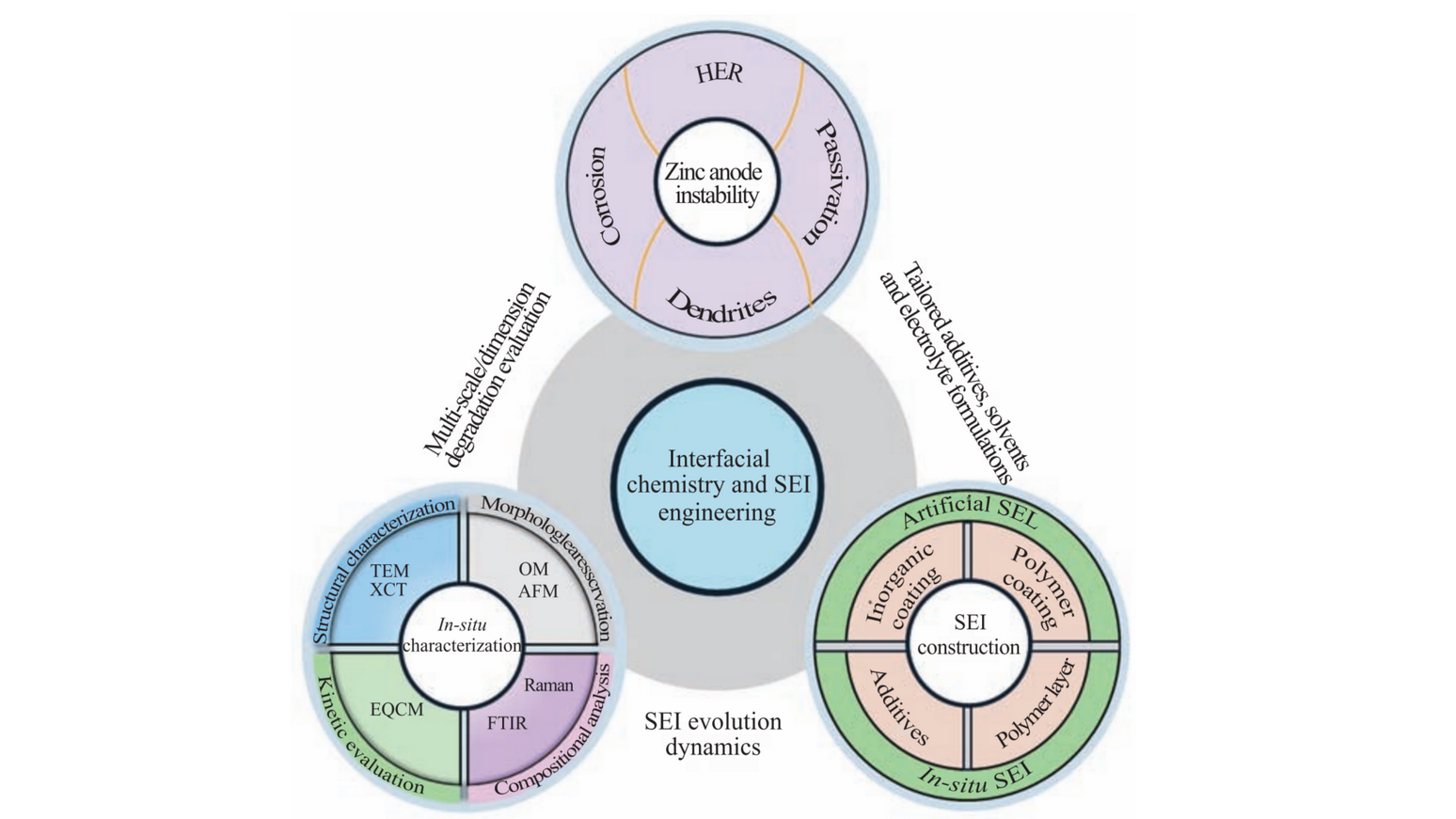
Aqueous zinc-ion batteries have emerged as a promising energy storage technology due to their intrinsic safety, cost-effectiveness, and environmental sustainability. However, practical deployment of aqueous zinc-ion batteries faces critical challenges related to zinc anode instability, including dendrite formation, hydrogen evolution, corrosion, and interfacial degradation. This review highlights recent advancements on modulating interfacial chemistry and designing robust solid electrolyte interphases (SEI) layers enriched with functional components to address these challenges. Strategies including advanced electrode/electrolyte interface engineering, functional electrolyte additives, and artificial SEI are explored for improving zinc metal anode stability and overall battery performance. Additionally, cutting-edge in-situ characterization techniques across various scales and dimensions are introduced, offering unprecedented insights into the SEI formation processes, dendrite suppression, and Zn2+ transport dynamics. By integrating functional interfacial designs with advanced characterization, this work outlines innovative approaches to improve zinc anode performance and realize high-efficiency, long-lifespan aqueous zinc-ion batteries.
KeyWords AITranslate
[1]D. S. Renné, "Progress, opportunities and challenges of achieving net-zero emissions and 100% renewables," Solar Compass, vol. 1, p. 100007, 2022.
[2]C. Zielinski, "COP27 climate change conference: Urgent action needed for Africa and the world," Palliative Medicine, vol. 37, no. 1, pp. 7–9, 2023.
[3]J. Lin, X. Zhang, E. Fan, R. Chen, F. Wu, and L. Li, "Carbon neutrality strategies for sustainable batteries: From structure, recycling, and properties to applications," Energy & Environmental Science, vol. 16, no. 3, pp. 745–791, 2023.
[4]C. Zhao, P. B. Andersen, C. Traeholt, and S. Hashemi, "Grid-connected battery energy storage system: A review on application and integration," Renewable and Sustainable Energy Reviews, vol. 182, p. 113400, 2023.
[5]J. Jiang, Z. Li, Z. Pan, S. Wang, Y. Chen, Q. Zhuang, Z. Ju, and X. Zhang, "Recent progress and prospects on dendrite-free engineerings for aqueous zinc metal anodes," Energy & Environmental Materials, vol. 6, no. 3, p. e12410, 2022.
[6]J. Wang, K. Yang, S. Sun, Q. Ma, G. Yi, X. Chen, Z. Wang, W. Yan, X. Liu, Q. Cai, and Y. Zhao, "Advances in thermal-related analysis techniques for solid-state lithium batteries," InfoMat, vol. 5, no. 4, p. e12410, 2023.
[7]Y. Wang, X. Feng, W. Huang, X. He, L. Wang, and M. Ouyang, "Challenges and opportunities to mitigate the catastrophic thermal runaway of high-energy batteries," Advanced Energy Materials, vol. 13, no. 15, p. 2203841, 2023.
[8]L. Kong, Y. Li, and W. Feng, "Strategies to solve lithium battery thermal runaway: From mechanism to modification," Electrochemical Energy Reviews, vol. 4, no. 4, pp. 633–679, 2021.
[9]Y. Liang, H. Dong, D. Aurbach, and Y. Yao, "Current status and future directions of multivalent metal-ion batteries," Nature Energy, vol. 5, no. 9, pp. 646–656, 2020.
[10]X. Yang, X. Wang, Y. Xiang, L. Ma, and W. Huang, "Asymmetric electrolytes design for aqueous multivalent metal ion batteries," Nano-Micro Letters, vol. 16, no. 1, p. 51, 2023.
[11]B. Tang, L. Shan, S. Liang, and J. Zhou, "Issues and opportunities facing aqueous zinc-ion batteries," Energy & Environmental Science, vol. 12, no. 11, pp. 3288–3304, 2019.
[12]C. Xu, B. Li, H. Du, and F. Kang, "Energetic zinc ion chemistry: The rechargeable zinc ion battery," Angewandte Chemie International Edition, vol. 51, no. 4, pp. 933–935, 2012.
[13]N. Zhang, X. Chen, M. Yu, Z. Niu, F. Cheng, and J. Chen, "Materials chemistry for rechargeable zinc-ion batteries," Chemical Society Reviews, vol. 49, no. 13, pp. 4203–4219, 2020.
[14]X. Zhang, J. P. Hu, N. Fu, W. B. Zhou, B. Liu, Q. Deng, and X. W. Wu, "Comprehensive review onzinc-ionbattery anode: Challenges and strategies," InfoMat, vol. 4, no. 7, p. e12306, 2022.
[15]T. Zhang, Y. Tang, S. Guo, X. Cao, A. Pan, G. Fang, J. Zhou, and S. Liang, "Fundamentals and perspectives in developing zinc-ion battery electrolytes: A comprehensive review," Energy & Environmental Science, vol. 13, no. 12, pp. 4625–4665, 2020.
[16]S. Liu, R. Zhang, C. Wang, J. Mao, D. Chao, C. Zhang, S. Zhang, and Z. Guo, "Zinc ion batteries: Bridging the gap from academia to industry for grid-scale energy storage," Angewandte Chemie International Edition, vol. 63, no. 17, p. e202400045, 2024.
[17]G. Li, L. Sun, S. Zhang, C. Zhang, H. Jin, K. Davey, G. Liang, S. Liu, J. Mao, and Z. Guo, "Developing cathode materials for aqueous zinc ion batteries: Challenges and practical prospects," Advanced Functional Materials, vol. 34, no. 5, p. 2301291, 2023.
[18]L. E. Blanc, D. Kundu, and L. F. Nazar, "Scientific challenges for the implementation of zn-ion batteries," Joule, vol. 4, no. 4, pp. 771–799, 2020.
[19]H. Ahn, D. Kim, M. Lee, and K. W. Nam, "Challenges and possibilities for aqueous battery systems," Communications Materials, vol. 4, art no. 37, 2023.
[20]M. Li, M. Maisuradze, R. Sciacca, I. Hasa, and M. Giorgetti, "A structural perspective on prussian blue analogues for aqueous zinc‐ion batteries," Batteries & Supercaps, vol. 6, no. 11, p. e202300340, 2023.
[21]W. Shi, W. S. V. Lee, and J. Xue, "Recent development of mn-based oxides as zinc-ion battery cathode," ChemSusChem, vol. 14, no. 7, pp. 1634–1658, 2021.
[22]Z. Azmi, K. C. Senapati, A. K. Goswami, and S. R. Mohapatra, "A comprehensive review of strategies to augment the performance of MnO2 cathode by structural modifications for aqueous zinc ion battery," Journal of Power Sources, vol. 613, pp. 234816, 2024.
[23]J. Yang, B. Yin, Y. Sun, H. Pan, W. Sun, B. Jia, S. Zhang, and T. Ma, "Zinc anode for mild aqueous zinc-ion batteries: Challenges, strategies, and perspectives," Nanomicro Lett, vol. 14, no. 1, p. 42, 2022.
[24]C. Xie, Y. Li, Q. Wang, D. Sun, Y. Tang, and H. Wang, "Issues and solutions toward zinc anode in aqueous zinc‐ion batteries: A mini review," Carbon Energy, vol. 2, no. 4, pp. 540–560, 2020.
[25]P. Ruan, S. Liang, B. Lu, H. J. Fan, and J. Zhou, "Design strategies for high-energy-density aqueous zinc batteries," Angewandte Chemie International Edition, vol. 61, no. 17, p. e202200598, 2022.
[26]W. Ling, P. Wang, Z. Chen, H. Wang, J. Wang, Z. Ji, J. Fei, Z. Ma, N. He, and Y. Huang, "Nanostructure design strategies for aqueous zinc‐ion batteries," ChemElectroChem, vol. 7, no. 14, p. 29572978, 2020.
[27]Y. Zou, J. Sun, Y. Chi, X. Cheng, and D. Yang, "Recent advances and challenges of cathode materials in aqueous rechargeable zinc‐ion batteries," EcoEnergy, vol. 2, no. 4, pp. 599–629, 2024.
[28]M. Chen, S.-C. Zhang, Z.-G. Zou, S.-L. Zhong, W.-Q. Ling, J. Geng, F.-A. Liang, X.-X. Peng, Y. Gao, and F.-G. Yu, "Review of vanadium-based oxide cathodes as aqueous zinc-ion batteries," Rare Metals, vol. 42, no. 9, p. 2868–2905, 2024.
[29]Y. Zhao, C. Yang, and Y. Yu, "A review on covalent organic frameworks for rechargeable zinc-ion batteries," Chinese Chemical Letters, vol. 35, no. 7, p. 108865, 2024.
[30]M. S. Javed, A. Mateen, S. Ali, and X. Zhang, I. Hussain, M. Imran, S. S. A. Shah, W. Han, "The emergence of 2D MXenes based Zn-ion batteries: Recent development and prospects," Small, vol. 18, no. 26, p. e2201989, 2022.
[31]L. Wang, S. Li, C. Wang, S. Yao, G. Chen, and F. Du, "Recent advance and design strategies of chalcogenides for high-performance aqueous zinc-ion batteries," Journal of Physics D: Applied Physics, vol. 57, no. 25, p. 253001, 2024.
[32]Y. Zhao, P. Zhang, J. Liang, X. Xia, L. Ren, L. Song, W. Liu, and X. Sun, "Unlocking layered double hydroxide as a high-performance cathode material for aqueous zinc-ion batteries," Advanced Materials, vol. 34, no. 37, p. e2204320, 2022.
[33]Y. Zhao, Y. Wang, J. Li, J. Xiong, Q. Li, K. K. Abdalla, Y. Zhao, Z. Cai, and X. Sun, "Thermodynamic and kinetic insights for manipulating aqueous Zn battery chemistry: Towards future grid-scale renewable energy storage systems," eScience, in press, 2024, doi: 10.1016/j.esci.2024.100331.
[34]Y. Zhu, G. Liang, X. Cui, X. Liu, H. Zhong, C. Zhi, and Y. Yang, "Engineering hosts for Zn anodes in aqueous Zn-ion batteries," Energy & Environmental Science, vol. 17, no. 2, pp. 369–385, 2024.
[35]Z. Fan, J. Wang, Y. Wu, X. Yan, D. Dai, and X. -L. Wu, "Research progresses on cathode materials of aqueous zinc-ion batteries," Journal of Energy Chemistry, vol. 97, pp. 237–264, 2024.
[36]Y. Li, Y. Li, Q. Liu, Y. Liu, T. Wang, M. Cui, Y. Ding, H. Li, and G. Yu, "Revealing the dominance of the dissolution-deposition mechanism in aqueous Zn-MnO2 batteries," Angewandte Chemie International Edition, vol. 63, no. 6, pp. e202318444, 2024.
[37]T. Lv, Y. Peng, G. Zhang, S. Jiang, Z. Yang, S. Yang, and H. Pang, "How about vanadium-based compounds as cathode materials for aqueous zinc ion batteries?" Advanced Science (Weinh), vol. 10, no. 12, p. e2206907, 2023.
[38]Y. Dai, C. Zhang, J. Li, X. Gao, P. Hu, C. Ye, H. He, J. Zhu, W. Zhang, R. Chen, W. Zong, F. Guo, I. P. Parkin, D. J. L. Brett, P. R. Shearing, L. Mai, and G. He, "Inhibition of vanadium cathodes dissolution in aqueous Zn-ion batteries," Advanced Materials, vol. 36, no. 14, p. e2310645, 2024.
[39]X. Zeng, Z. Gong, C. Wang, P. J. Cullen, and Z. Pei, "Vanadium‐based cathodes modification via defect engineering: Strategies to support the leap from lab to commercialization of aqueous zinc‐ion batteries," Advanced Energy Materials, vol. 14, no. 31, p. 2401704, 2024.
[40]C. Su, X. Gao, K. Liu, Y. Dai, H. Dong, Y. Liu, J. Zhu, Q. Zhang, H. He, and G. He, "From lab to market: A review of commercialization and advances for binders in lithium-, zinc-, sodium-ion batteries," Nano Research Energy, vol. 3, no. 1, p. e9120094, 2024.
[41]L. Miao, Z. Guo, L. Jiao, "Insights into the design of mildly acidic aqueous electrolytes for improved stability of Zn anode performance in zinc-ion batteries," Energy Materials, vol. 3, p. 300014, 2023.
[42]Q. Wen, H. Fu, R. -D. Cui, H. -Z. Chen, R. -H. Ji, L. -B. Tang, C. Yan, J. Mao, K. -H. Dai, X. -H. Zhang, and J. -C. Zheng, "Recent advances in interfacial modification of zinc anode for aqueous rechargeable zinc ion batteries," Journal of Energy Chemistry, vol. 83, pp. 287–303, 2023.
[43]Q. Zhang, J. Luan, Y. Tang, X. Ji, and H. Wang, "Interfacial design of dendrite-free zinc anodes for aqueous zinc-ion batteries," Angewandte Chemie International Edition, vol. 59, no. 32, pp. 13180–13191, 2020.
[44]Z. Feng, Y. Feng, F. Fan, D. Deng, H. Dong, S. Liu, L. Kang, S. C. Jun, L. Wang, J. Zhu, L. Dai, and Z. He, "Functionalization design of zinc anode for advanced aqueous zinc—ion batteries," SusMat, vol. 4, no. 2, pp. e184, 2024.
[45]B. B. Upreti, N. Kamboj, and R. S. Dey, "Advancing zinc anodes: Strategies for enhanced performance in aqueous zinc-ion batteries," Small, in press, 2024, doi: 10.1002/smll.202408138.
[46]S. Huang, J. Zhu, J. Tian, and Z. Niu, "Recent progress in the electrolytes of aqueous zinc-ion batteries," Chemistry, vol. 25, no. 64, pp. 14480–14494, 2019.
[47]Q. -H. Yang, L. -F. Wang, X. -Y. Wang, and M. -M. Zhen, "Progress and challenges of electrolyte modulation in aqueous zinc-ion batteries," Rare Metals, vol. 43, no. 7, pp. 2940–2967, 2024.
[48]Q. Meng, T. Yan, Y. Wang, X. Lu, H. Zhou, and S. Dong, "Critical design strategy of electrolyte engineering toward aqueous zinc-ion battery," Chemical Engineering Journal, vol. 497, p. 154541, 2024.
[49]J. Cao, F. Zhao, W. Guan, X. Yang, Q. Zhao, L. Gao, X. Ren, G. Wu, and A. Liu, "Additives for aqueous zinc-ion batteries: Recent progress, mechanism analysis, and future perspectives," Small, vol. 20, no. 33, p. e2400221, 2024.
[50]L. Li, S. Jia, Z. Cheng, and C. Zhang, "Improved strategies for separators in zinc-ion batteries," ChemSusChem, vol. 16, no. 8, p. e202202330, 2023.
[51]B. Li, Y. Zeng, W. Zhang, B. Lu, Q. Yang, J. Zhou, and Z. He, "Separator designs for aqueous zinc-ion batteries," Science Bulletin (Beijing), vol. 69, no. 5, pp. 688–703, 2024.
[52]Y. Zong, H. He, Y. Wang, M. Wu, X. Ren, Z. Bai, N. Wang, X. Ning, and S. X. Dou, "Functionalized separator strategies toward advanced aqueous zinc-ion batteries," Advanced Energy Materials, vol. 13, no. 20, p. 2300403, 2023.
[53]Y. Qin, P. Liu, Q. Zhang, Q. Wang, D. Sun, Y. Tang, Y. Ren, and H. Wang, "Advanced filter membrane separator for aqueous zinc-ion batteries," Small, vol. 16, no. 39, p. e2003106, 2020.
[54]D. J. Arnot, M. B. Lim, N. S. Bell, N. B. Schorr, R. C. Hill, A. Meyer, Y. T. Cheng, and T. N. Lambert, "High depth-of-discharge zinc rechargeability enabled by a self-assembled polymeric coating," Advanced Energy Materials, vol. 11, no. 38, pp. 2101594, 2021.
[55]D. Yuan, W. Manalastas Jr., L. Zhang, J. J. Chan, S. Meng, Y. Chen, and M. Srinivasan, "Lignin@Nafion membranes forming Zn solid-electrolyte interfaces enhance the cycle life for rechargeable zinc-ion batteries," ChemSusChem, vol. 12, no. 21, pp. 4889–4900, 2019.
[56]Y. Liu, S. Liu, X. Xie, Z. Li, P. Wang, B. Lu, S. Liang, Y. Tang, and J. Zhou, "A functionalized separator enables dendrite‐free Zn anode via metal‐polydopamine coordination chemistry," InfoMat, vol. 5, no. 3, p. e12374, 2022.
[57]H. Qin, W. Chen, W. Kuang, N. Hu, X. Zhang, H. Weng, H. Tang, D. Huang, J. Xu, and H. He, "A nature-inspired separator with water-confined and kinetics-boosted effects for sustainable and high-utilization Zn metal batteries," Small, vol. 19, no. 20, p. e2300130, 2023.
[58]B. Yong, D. Ma, Y. Wang, H. Mi, C. He, and P. Zhang, "Understanding the design principles of advanced aqueous zinc-ion battery cathodes: From transport kinetics to structural engineering, and future perspectives," Advanced Energy Materials, vol. 10, no. 45, p. 2002354, 2020.
[59]N. Zhang, Y. -R. Ji, J. -C. Wang, P. -F. Wang, Y. -R. Zhu, and T. -F. Yi, "Understanding of the charge storage mechanism of MnO2-based aqueous zinc-ion batteries: Reaction processes and regulation strategies," Journal of Energy Chemistry, vol. 82, pp. 423–463, 2023.
[60]M. H. Alfaruqi, V. Mathew, J. Gim, S. Kim, J. Song, J. P. Baboo, S. H. Choi, and J. Kim, "Electrochemically induced structural transformation in a γ-MnO2 cathode of a high capacity zinc-ion battery system," Chemistry of Materials, vol. 27, no. 10, pp. 3609–3620, 2015.
[61]Z. Li, Y. Ren, L. Mo, C. Liu, K. Hsu, Y. Ding, X. Zhang, X. Li, L. Hu, D. Ji, and G. Cao, "Impacts of oxygen vacancies on zinc ion intercalation in VO2," ACS Nano, vol. 14, no. 5, pp. 5581–5589, 2020.
[62]F. Cui, J. Zhao, D. Zhang, Y. Fang, F. Hu, and K. Zhu, "VO2(B) nanobelts and reduced graphene oxides composites as cathode materials for low-cost rechargeable aqueous zinc ion batteries," Chemical Engineering Journal, vol. 390, pp. 124118, 2020.
[63]X. Wang, S. L. Clegg, and D. Di Tommaso, "Bridging atomistic simulations and thermodynamic hydration models of aqueous electrolyte solutions," Journal of Chemical Physics, vol. 156, no. 2, p. 024502, 2022.
[64]J. J. Ye, P. H. Li, Z. Hou, W. Zhang, W. Zhu, S. Jin, and H. Ji, "Se-dopant modulated selective co-insertion of H+ and Zn2+ in MnO2 for high-capacity and durable aqueous Zn-ion batteries," Angewandte Chemie International Edition, vol. 63, no. 43, p. e202410900, 2024.
[65]H. Huang, X. Xia, J. Yun, C. Huang, D. Li, B. Chen, Z. Yang, and W. Zhang, "Interfacial engineering of hydrated vanadate to promote the fast and highly reversible H+/Zn2+ co-insertion processes for high-performance aqueous rechargeable batteries," Energy Storage Materials, vol. 52, pp. 473–484, 2022.
[66]T. Lv, G. Zhu, S. Dong, Q. Kong, Y. Peng, S. Jiang, G. Zhang, Z. Yang, S. Yang, X. Dong, H. Pang, and Y. Zhang, "Co-intercalation of dual charge carriers in metal-ion-confining layered vanadium oxide nanobelts for aqueous zinc-ion batteries," Angewandte Chemie International Edition, vol. 62, no. 5, p. e202216089, 2023.
[67]D. Chen, M. Lu, D. Cai, H. Yang, and W. Han, "Recent advances in energy storage mechanism of aqueous zinc-ion batteries," Journal of Energy Chemistry, vol. 54, pp. 712–726, 2021.
[68]H. Xu, W. Yang, M. Li, H. Liu, S. Gong, F. Zhao, C. Li, J. Qi, H. Wang, W. Peng, and J. Liu, "Advances in aqueous zinc ion batteries based on conversion mechanism: Challenges, strategies, and prospects," Small, vol. 20, no. 27, p. e2310972, 2024.
[69]W. Li and D. Wang, "Conversion-type cathode materials for aqueous Zn metal batteries in nonalkaline aqueous electrolytes: Progress, challenges, and solutions", Advanced Materials, in press, 2023, doi: https://doi.org/10.1002/adma.202304983.
[70]T. Liang, X. Zhang, Y. Huang, Y. Lu, H. Jia, Y. Yuan, L. Meng, Y. Zhou, L. Zhou, P. Guan, T. Wan, M. Ferry, and D. Chu, "Cutting-edge progress in aqueous Zn-S batteries: innovations in cathodes, electrolytes, and mediators," Small, in press, 2024, doi: 10.1002/smll.202405810.
[71]X. Wang, L. Liu, Z. Hu, C. Peng, C. Han, and W. Li, "High energy density aqueous zinc–chalcogen (S, Se, Te) batteries: Recent progress, challenges, and perspective," Advanced Energy Materials, vol. 13, no. 44, pp. 2302927, 2023.
[72]Y. Zou, T. Liu, Q. Du, Y. Li, H. Yi, X. Zhou, Z. Li, L. Gao, L. Zhang, and X. Liang, "A four-electron Zn-I2 aqueous battery enabled by reversible I–/I2/I+ conversion," Nature Communications, vol. 12, no. 1, pp. 170, 2021.
[73]Z. Cao, P. Zhuang, X. Zhang, M. Ye, J. Shen, and P. M. Ajayan, "Strategies for dendrite‐Free anode in aqueous rechargeable zinc ion batteries," Advanced Energy Materials, vol. 10, no. 30, p. 2001599, 2020.
[74]J. Wang, Y. Yang, Y. Zhang, Y. Li, R. Sun, Z. Wang, and H. Wang, "Strategies towards the challenges of zinc metal anode in rechargeable aqueous zinc ion batteries," Energy Storage Materials, vol. 35, pp. 19–46, 2021.
[75]R. Tan, H. He, A. Wang, T. Wong, Y. Yang, S. Iguodala, C. Ye, D. Liu, Z. Fan, M. Furedi, G. He, S. Guldin, D. J. L. Brett, N. B. McKeown, and Q. Song, "Interfacial engineering of polymer membranes with intrinsic microporosity for dendrite-free zinc metal batteries," Angewandte Chemie International Edition, vol. 63, no. 49, p. e202409322, 2024.
[76]X. Wang, C. Sun, and Z. S. Wu, "Recent progress of dendrite‐free stable zinc anodes for advanced zinc‐based rechargeable batteries: Fundamentals, challenges, and perspectives," SusMat, vol. 3, no. 2, pp. 180–206, 2023.
[77]P. Zou, R. Lin, T. P. Pollard, L. Yao, E. Hu, R. Zhang, Y. He, C. Wang, W. C. West, L. Ma, O. Borodin, K. Xu, X. Q. Yang, and H. L. Xin, "Localized hydrophobicity in aqueous zinc electrolytes improves zinc metal reversibility," Nano Letters, vol. 22, no. 18, pp. 7535–7544, 2022.
[78]J. Cao, D. Zhang, X. Zhang, Z. Zeng, J. Qin, and Y. Huang, "Strategies of regulating Zn2+solvation structures for dendrite-free and side reaction-suppressed zinc-ion batteries," Energy & Environmental Science, vol. 15, no. 2, pp. 499–528, 2022.
[79]X. Qian, T. Chen, Y. Wang, Q. Zhang, W. Li, and J. Fu, "Revitalizing dead zinc with ferrocene/ferrocenium redox chemistry for deep-cycle zinc metal batteries," Angewandte Chemie International Edition, early view, p. e202412989, 2024.
[80]Z. Wen, Z. Hu, X. Wang, Y. Zhang, W. Du, M. Ye, Y. Tang, X. Liu, and C. C. Li, "Weakening the space charge layer effect through tethered anion electrolyte and piezoelectric effect toward ultra-stable zinc anode," Advanced Materials, vol. 36, no. 44, p. e2407390, 2024.
[81]Y. Liang, M. Qiu, P. Sun, and W. Mai, "Comprehensive review of electrolyte modification strategies for stabilizing Zn metal anodes," Advanced Functional Materials, vol. 33, no. 51, pp. 2304878, 2023.
[82]X. Guo, Z. Zhang, J. Li, N. Luo, G. -L. Chai, T. S. Miller, F. Lai, P. Shearing, D. J. L. Brett, D. Han, Z. Weng, G. He, and I. P. Parkin, "Alleviation of dendrite formation on zinc anodes via electrolyte additives," ACS Energy Letters, vol. 6, no. 2, pp. 395–403, 2021.
[83]M. Liu, P. Wang, W. Zhang, H. He, G. He, S. Xu, L. Yao, and T. S. Miller, "Strategies for pH regulation in aqueous zinc ion batteries", Energy Storage Materials, vol. 67, pp. 103248, 2024.
[84]Q. Zhang, Z. Yang, H. Ji, X. Zeng, Y. Tang, D. Sun, and H. Wang, "Issues and rational design of aqueous electrolyte for Zn‐ion batteries," SusMat, vol. 1, no. 3, pp. 432–447, 2021.
[85]R. Jayakumar, D. M. Harrison, J. Xu, A. V. Suresh Babu, C. Luo, and L. Ma, "Interphases in aqueous rechargeable zinc metal batteries," Journal of Materials Chemistry A, vol. 11, no. 16, pp. 8470–8496, 2023.
[86]Z. Yi, G. Chen, F. Hou, L. Wang, and J. Liang, "Strategies for the stabilization of Zn metal anodes for Zn‐ion batteries," Advanced Energy Materials, vol. 11, no. 1, pp. 2003065, 2020.
[87]A. Bayaguud, Y. Fu, and C. Zhu, "Interfacial parasitic reactions of zinc anodes in zinc ion batteries: Underestimated corrosion and hydrogen evolution reactions and their suppression strategies," Journal of Energy Chemistry, vol. 64, no. pp. 246–262, 2022.
[88]C. Li, S. Jin, L. A. Archer, and L. F. Nazar, "Toward practical aqueous zinc-ion batteries for electrochemical energy storage," Joule, vol. 6, no. 8, pp. 1733–1738, 2022.
[89]W. Du, E. H. Ang, Y. Yang, Y. Zhang, M. Ye, and C. C. Li, "Challenges in the material and structural design of zinc anode towards high-performance aqueous zinc-ion batteries," Energy & Environmental Science, vol. 13, no. 10, pp. 3330–3360, 2020.
[90]C. Li, X. Xie, S. Liang, and J. Zhou, "Issues and future perspective on zinc metal anode for rechargeable aqueous zinc‐ion batteries," Energy & Environmental Materials, vol. 3, no. 2, pp. 146–159, 2020.
[91]T. Wang, C. Li, X. Xie, B. Lu, Z. He, S. Liang, and J. Zhou, "Anode materials for aqueous zinc ion batteries: Mechanisms, properties, and perspectives," ACS Nano, vol. 14, no. 12, pp. 16321–16347, 2020.
[92]T. Liu, L. Lin, X. Bi, L. Tian, K. Yang, J. Liu, M. Li, Z. Chen, J. Lu, K. Amine, K. Xu, and F. Pan, "In situ quantification of interphasial chemistry in Li-ion battery," Nature Nanotechnology, vol. 14, no. 1, pp. 50–56, 2019.
[93]X. Wang, X. Li, H. Fan, and L. Ma, "Solid electrolyte interface in Zn-based battery systems," Nano-Micro Letters, vol. 14, no. 1, p. 205, 2022.
[94]H. Liu, Q. Zhou, Q. Xia, Y. Lei, X. Long Huang, M. Tebyetekerwa, and X. S. Zhao, "Interface challenges and optimization strategies for aqueous zinc-ion batteries," Journal of Energy Chemistry, vol. 77, pp. 642–659, 2023.
[95]T. Li, S. Hu, C. Wang, D. Wang, M. Xu, C. Chang, X. Xu, and C. Han, "Engineering fluorine-rich double protective layer on zn anode for highly reversible aqueous zinc-ion batteries," Angewandte Chemie International Edition, vol. 62, no. 51, p. e202314883, 2023.
[96]M. Wu, X. Wang, F. Zhang, Q. Xiang, Y. Li, and J. Guo, "Highly reversible and stable Zn metal anodes realized using a trifluoroacetamide electrolyte additive," Energy & Environmental Science, vol. 17, no. 2, pp. 619–629, 2024.
[97]L. Cao, D. Li, T. Pollard, T. Deng, B. Zhang, C. Yang, L. Chen, J. Vatamanu, E. Hu, M. J. Hourwitz, L. Ma, M. Ding, Q. Li, S. Hou, K. Gaskell, J. T. Fourkas, X. Q. Yang, K. Xu, O. Borodin, and C. Wang, "Fluorinated interphase enables reversible aqueous zinc battery chemistries," Nature Nanotechnology, vol. 16, no. 8, pp. 902–910, 2021.
[98]C. Huang, X. Zhao, S. Liu, Y. Hao, Q. Tang, A. Hu, Z. Liu, and X. Chen, "Stabilizing zinc anodes by regulating the electrical double layer with saccharin anions," Advanced Materials, vol. 33, no. 38, p. e2100445, 2021.
[99]Y. Chu, S. Zhang, S. Wu, Z. Hu, G. Cui, and J. Luo, "In situ built interphase with high interface energy and fast kinetics for high performance Zn metal anodes," Energy & Environmental Science, vol. 14, no. 6, pp. 3609–3620, 2021.
[100]Y. Liu, Y. An, L. Wu, J. Sun, F. Xiong, H. Tang, S. Chen, Y. Guo, L. Zhang, Q. An, and L. Mai, "Interfacial chemistry modulation via amphoteric glycine for a highly reversible zinc anode," ACS Nano, vol. 17, no. 1, pp. 552–560, 2023.
[101]D. Xie, Y. Sang, D. H. Wang, W. Y. Diao, F. Y. Tao, C. Liu, J. W. Wang, H. Z. Sun, J. P. Zhang, and X. L. Wu, "ZnF2 -riched inorganic/organic hybrid SEI: In situ-chemical construction and performance-improving mechanism for aqueous zinc-ion batteries," Angewandte Chemie International Edition, vol. 62, no. 7, p. e202216934, 2023.
[102]D. Li, L. Cao, T. Deng, S. Liu, and C. Wang, "Design of a solid electrolyte interphase for aqueous zn batteries," Angewandte Chemie International Edition, vol. 60, no. 23, pp. 13035–13041, 2021.
[103]J. Y. Kim, G. Liu, R. E. A. Ardhi, J. Park, H. Kim, and J. K. Lee, "Stable Zn metal anodes with limited Zn-doping in MgF2 interphase for fast and uniformly ionic flux," Nanomicro Lett, vol. 14, no. 1, p. 46, 2022.
[104]H. Wang, G. Zhao, W. Li, S. Watanabe, and X. Wang, "Fluoride-based artificial interface for a highly reversible zn metal anode interlayer in aqueous zinc-ion batteries," ACS Sustainable Chemistry & Engineering, vol. 12, no. 1, pp. 355–364, 2023.
[105]Y. Chen, Z. Deng, Y. Sun, Y. Li, H. Zhang, G. Li, H. Zeng, and X. Wang, "Ultrathin zincophilic interphase regulated electric double layer enabling highly stable aqueous zinc-ion batteries," Nano-Micro Letters, vol. 16, no. 1, p. 96, 2024.
[106]W. Wang, S. Chen, X. Liao, R. Huang, F. Wang, J. Chen, Y. Wang, F. Wang, and H. Wang, "Regulating interfacial reaction through electrolyte chemistry enables gradient interphase for low-temperature zinc metal batteries," Nature Communications, vol. 14, no. 1, p. 5443, 2023.
[107]R. Chen, W. Zhang, C. Guan, Y. Zhou, I. Gilmore, H. Tang, Z. Zhang, H. Dong, Y. Dai, Z. Du, X. Gao, W. Zong, Y. Xu, P. Jiang, J. Liu, F. Zhao, J. Li, X. Wang, and G. He, "Rational design of an in-situ polymer-inorganic hybrid solid electrolyte interphase for realising stable Zn metal anode under harsh conditions," Angewandte Chemie International Edition, vol. 63, no. 21, p. e202401987, 2024.
[108]Z. Zhang, X. Wang, J. Ke, W. Du, Z. Lv, Y. Tang, M. Ye, Y. Zhang, X. Liu, Y. Yang, Z. Wen, and C. C. Li, "Approaching 100% comprehensive utilization rate of ultra-stable Zn metal anodes by constructing chitosan‐based homologous gel/solid synergistic interface," Advanced Functional Materials, vol. 34, no. 17, p. 2313150, 2024.
[109]Y. An, Y. Tian, K. Zhang, Y. Liu, C. Liu, S. Xiong, J. Feng, and Y. Qian, "Stable aqueous anode‐free zinc batteries enabled by interfacial engineering," Advanced Functional Materials, vol. 31, no. 26, pp. 2101886, 2021.
[110]W. Xin, L. Miao, L. Zhang, H. Peng, Z. Yan, and Z. Zhu, "Turning the byproduct Zn4(OH)6SO4·xH2O into a uniform solid electrolyte interphase to stabilize aqueous Zn anode," ACS Materials Letters, vol. 3, no. 12, pp. 1819–1825, 2021.
[111]J. Li, S. Qin, M. Xu, W. Wang, J. Zou, Y. Zhang, H. Dou, and Z. Chen, "Multifunctional dual‐metal‐salt derived ternary eutectic electrolyte for highly reversible zinc ion battery," Advanced Functional Materials, vol. 34, no. 37, pp. 2024.
[112]S. Chen, S. Li, L. Ma, Y. Ying, Z. Wu, H. Huang, and C. Zhi, "Asymmetric anion zinc salt derived solid electrolyte interphase enabled long-lifespan aqueous zinc bromine batteries," Angewandte Chemie International Edition, vol. 63, no. 11, p. e202319125, 2024.
[113]X. Zeng, J. Mao, J. Hao, J. Liu, S. Liu, Z. Wang, Y. Wang, S. Zhang, T. Zheng, J. Liu, P. Rao, and Z. Guo, "Electrolyte design for in situ construction of highly Zn2+ -conductive solid electrolyte interphase to enable high-performance aqueous Zn-ion batteries under practical conditions," Advanced Materials, vol. 33, no. 11, p. e2007416, 2021.
[114]B. W. Olbasa, C. J. Huang, F. W. Fenta, S. K. Jiang, S. A. Chala, H. C. Tao, Y. Nikodimos, C. C. Wang, H. S. Sheu, Y. W. Yang, T. L. Ma, S. H. Wu, W. N. Su, H. Dai, and B. J. Hwang, "Highly reversible Zn metal anode stabilized by dense and anion‐derived passivation layer obtained from concentrated hybrid aqueous electrolyte," Advanced Functional Materials, vol. 32, no. 7, pp. 2103959, 2021.
[115]L. Zheng, H. Li, X. Wang, Z. Chen, C. Hu, K. Wang, G. Guo, S. Passerini, and H. Zhang, "Competitive solvation-induced interphases enable highly reversible Zn anodes," ACS Energy Letters, vol. 8, no. 5, pp. 2086–2096, 2023.
[116]X. Xu, H. Su, J. Zhang, Y. Zhong, Y. Xu, Z. Qiu, H. B. Wu, X. Wang, C. Gu, and J. Tu, "Sulfamate-derived solid electrolyte interphase for reversible aqueous zinc battery," ACS Energy Letters, vol. 7, no. 12, pp. 4459–4468, 2022.
[117]C. Lin, T. C. Li, P. Wang, Y. Xu, D. S. Li, A. Sliva, and H. Y. Yang, "In situ formed robust solid electrolyte interphase with organic-inorganic hybrid layer for stable Zn metal anode," Small Methods, early view, p. e2400127, 2024.
[118]C. Huang, F. Huang, X. Zhao, Y. Hao, Y. Yang, Y. Qian, G. Chang, Y. Zhang, Q. Tang, A. Hu, and X. Chen, "Rational design of sulfonamide‐based additive enables stable solid electrolyte interphase for reversible Zn metal anode," Advanced Functional Materials, vol. 33, no. 1, pp. 2210197, 2022.
[119]Y. Dong, L. Miao, G. Ma, S. Di, Y. Wang, L. Wang, J. Xu, and N. Zhang, "Non-concentrated aqueous electrolytes with organic solvent additives for stable zinc batteries," Chemical Science, vol. 12, no. 16, pp. 5843–5852, 2021.
[120]D. Wang, D. Lv, H. Liu, S. Zhang, C. Wang, C. Wang, J. Yang, and Y. Qian, "In situ formation of nitrogen-rich solid electrolyte interphase and simultaneous regulating solvation structures for advanced Zn metal batteries," Angewandte Chemie International Edition, vol. 61, no. 52, p. e202212839, 2022.
[121]F. Ming, Y. Zhu, G. Huang, A. H. Emwas, H. Liang, Y. Cui, and H. N. Alshareef, "Co-solvent electrolyte engineering for stable anode-free zinc metal batteries," Journal of The American Chemical Society, vol. 144, no. 16, pp. 7160–7170, 2022.
[122]J. Chen, W. Zhou, Y. Quan, B. Liu, M. Yang, M. Chen, X. Han, X. Xu, P. Zhang, and S. Shi, "Ionic liquid additive enabling anti-freezing aqueous electrolyte and dendrite-free Zn metal electrode with organic/inorganic hybrid solid electrolyte interphase layer," Energy Storage Materials, vol. 53, pp. 629–637, 2022.
[123]L. Cao, D. Li, E. Hu, J. Xu, T. Deng, L. Ma, Y. Wang, X. Q. Yang, and C. Wang, "Solvation structure design for aqueous Zn metal batteries," Journal of The American Chemical Society, vol. 142, no. 51, pp. 21404–21409, 2020.
[124]H. Qiu, X. Du, J. Zhao, Y. Wang, J. Ju, Z. Chen, Z. Hu, D. Yan, X. Zhou, and G. Cui, "Zinc anode-compatible in-situ solid electrolyte interphase via cation solvation modulation," Nature Communications, vol. 10, no. 1, p. 5374, 2019.
[125]J. Han, H. Euchner, M. Kuenzel, S. M. Hosseini, A. Groß, A. Varzi, and S. Passerini, "A thin and uniform fluoride-based artificial interphase for the zinc metal anode enabling reversible Zn/MnO2 batteries," ACS Energy Letters, vol. 6, no. 9, pp. 3063–3071, 2021.
[126]X. Zeng, K. Xie, S. Liu, S. Zhang, J. Hao, J. Liu, W. K. Pang, J. Liu, P. Rao, Q. Wang, J. Mao, and Z. Guo, "Bio-inspired design of anin situmultifunctional polymeric solid–electrolyte interphase for Zn metal anode cycling at 30 mA·cm−2 and 30 mA·h·cm−2," Energy & Environmental Science, vol. 14, no. 11, pp. 5947–5957, 2021.
[127]P. Li, J. Ren, C. Li, J. Li, K. Zhang, T. Wu, B. Li, and L. Wang, "MOF-derived defect-rich CeO2 as ion-selective smart artificial SEI for dendrite-free Zn-ion battery," Chemical Engineering Journal, vol. 451, pp. 138769, 2023.
[128]H. Wu, H. Yin, H. Tian, J. Yang, and R. Liu, "Stable Zn‐Metal anode enabled by solvation structure modulation and in‐situ SEI layer construction," Energy & Environmental Materials, vol., early view, p. e12839, 2024.
[129]H. Yin, H. Wu, Y. Yang, S. Yao, P. Han, Y. Shi, and R. Liu, "Electrical double layer and in situ polymerization SEI enables high reversible zinc metal anode," Small, vol. 20, no. 50, p. e2404367, 2024.
[130]Y. Zhao, H. Hong, L. Zhong, J. Zhu, Y. Hou, S. Wang, H. Lv, P. liang, Y. Guo, D. Wang, P. Li, Y. Wang, Q. Li, S. C. Cao, H. Li, and C. Zhi, "Zn-rejuvenated and SEI‐regulated additive in zinc metal battery via the iodine post-functionalized zeolitic imidazolate framework‐90," Advanced Energy Materials, vol. 13, no. 28, p. 2300627, 2023.
[131]W. Zhang, Q. Yao, C. Wang, R. Feng, N. Chen, J. Zhu, and Z. Li, "Taming Zn Electrochemistry with carbon nitride: Atomically gradient interphase for highly reversible aqueous Zn batteries," Advanced Functional Materials, vol. 34, no. 5, p. 2303590, 2023.
[132]H. Dai, T. Sun, J. Zhou, J. Wang, Z. Chen, G. Zhang, and S. Sun, "Unraveling chemical origins of dendrite formation in zinc-ion batteries via in situ/operando X-ray spectroscopy and imaging," Nature Communications, vol. 15, no. 1, pp. 8577, 2024.
[133]J. Wang, J. X. Tian, G. X. Liu, Z. Z. Shen, and R. Wen, "In situ insight into the interfacial dynamics in "water-in-salt" electrolyte-based aqueous zinc batteries," Small Methods, vol. 7, no. 6, pp. e2300392, 2023.
[134]M. Liu, L. Yao, Y. Ji, M. Zhang, Y. Gan, Y. Cai, H. Li, W. Zhao, Y. Zhao, Z. Zou, R. Qin, Y. Wang, L. Liu, H. Liu, K. Yang, T. S. Miller, F. Pan, and J. Yang, "Nanoscale ultrafine zinc metal anodes for high stability aqueous zinc ion batteries," Nano Letters, vol. 23, no. 2, pp. 541–549, 2023.
[135]Y. Sasaki, K. Yoshida, A. Kuwabara, and Y. Ikuhara, "On-chip electrochemical analysis combined with liquid-phase electron microscopy of zinc deposition/dissolution," Journal of The Electrochemical Society, vol. 168, no. 11, pp. 112511, 2021.
[136]Y. Huang, Q. Gu, Z. Guo, W. Liu, Z. Chang, Y. Liu, F. Kang, L. Dong, and C. Xu, "Unraveling dynamical behaviors of zinc metal electrodes in aqueous electrolytes through an operando study," Energy Storage Materials, vol. 46, pp. 243–251, 2022.
[137]W. Zhuang, Q. Chen, J. Wan, Z. Hou, and L. Huang, "Correlating buffering agents' premier pH with interface stability toward long-term Zn metal anodes," Small, vol. 20, no. 28, pp. e2309519, 2024.
[138]X. Liang, X. Chen, Z. Zhai, T. Yu, H. Yu, H. Wang, D. Meng, L. Peng, and S. Yin, "Synergistic modulation of hydrogen bond network reconstruction and pH buffering of electrolyte enables highly reversible Zn anode," Chemical Engineering Journal, vol. 493, no. p. 152622, 2024.
[139]J. Liu, C. Li, Q. Lv, D. Chen, J. Zhao, X. Xia, Z. Wu, J. Lai, and L. Wang, "Reconstruction of electric double layer on the anode interface by localized electronic structure engineering for aqueous zn ion batteries," Advanced Energy Materials, vol. 14, no. 29, p. 2401118, 2024.
[140]J. Zhang, P. Li, Y. Wang, Z. Zhao, and Z. Peng, "Linking interfacial hydrogen-bond network to electrochemical performance of zinc anode in aqueous solution," Advanced Functional Materials, vol. 33, no. 41, p. 2305804, 2023.
[141]G. Li, Z. Zhao, S. Zhang, L. Sun, M. Li, J. A. Yuwono, J. Mao, J. Hao, J. P. Vongsvivut, L. Xing, C. X. Zhao, and Z. Guo, "A biocompatible electrolyte enables highly reversible Zn anode for zinc ion battery," Nature Communications, vol. 14, no. 1, p. 6526, 2023.
[142]S. J. Zhang, J. Hao, Y. Zhu, H. Li, Z. Lin, and S. Z. Qiao, "pH-triggered molecular switch toward texture-regulated Zn anode," Angewandte Chemie International Edition, vol. 62, no. 17, p. e202301570, 2023.
[143]S. Cora, S. Ahmad, N. Sa, "In Situ probing of mass exchange at the solid electrolyte interphase in aqueous and nonaqueous Zn electrolytes with EQCM-D," ACS Applied Materials & Interfaces, vol. 13, no. 8, pp. 10131–10140, 2021.
[144]G. Duan, Y. Wang, L. Sun, Z. Bao, B. Luo, S. Zheng, Z. Ye, J. Huang, and Y. Lu, "Atomic pinning of trace additives induces interfacial solvation for highly reversible zn metal anodes," ACS Nano, vol. 17, no. 22, pp. 22722–22732, 2023.
Basic Information:
DOI:10.23919/CHAIN.2024.000010
Chinese Library Classification Number:
Citation Information:
Aqueous zinc-ion batteries have emerged as a promising energy storage technology due to their intrinsic safety, cost-effectiveness, and environmental sustainability. However, practical deployment of aqueous zinc-ion batteries faces critical challenges related to zinc anode instability, including dendrite formation, hydrogen evolution, corrosion, and interfacial degradation. This review highlights recent advancements on modulating interfacial chemistry and designing robust solid electrolyte interphases (SEI) layers enriched with functional components to address these challenges. Strategies including advanced electrode/electrolyte interface engineering, functional electrolyte additives, and artificial SEI are explored for improving zinc metal anode stability and overall battery performance. Additionally, cutting-edge in-situ characterization techniques across various scales and dimensions are introduced, offering unprecedented insights into the SEI formation processes, dendrite suppression, and Zn2+ transport dynamics. By integrating functional interfacial designs with advanced characterization, this work outlines innovative approaches to improve zinc anode performance and realize high-efficiency, long-lifespan aqueous zinc-ion batteries.
quote
| GB/T 7714-2015 | [1] Mingqiang Liu, Yunke Wang, Shaoyin Li, et al. Modulating interfacial chemistry and designing robust solid electrolyte interphases for high-performance aqueous zinc-ion batteries[J]. Chain, 2024, 1(4): 280-318. DOI:10.23919/CHAIN.2024.000010. |
| MLA | [1] Mingqiang Liu, et al., "Modulating interfacial chemistry and designing robust solid electrolyte interphases for high-performance aqueous zinc-ion batteries." Chain, vol. 1, no. 4, 2024, pp. 280-318, https://doi.org/10.23919/CHAIN.2024.000010. |
| APA | [1] Mingqiang Liu, Yunke Wang, Shaoyin Li, José V. Anguita, S. Ravi P. Silva, & Kai Yang. (2024). Modulating interfacial chemistry and designing robust solid electrolyte interphases for high-performance aqueous zinc-ion batteries. Chain, 1(4), 280-318. https://doi.org/10.23919/CHAIN.2024.000010 |
| IEEE | [1] Mingqiang Liu, Yunke Wang, Shaoyin Li, José V. Anguita, S. Ravi P. Silva, and Kai Yang, "Modulating interfacial chemistry and designing robust solid electrolyte interphases for high-performance aqueous zinc-ion batteries," Chain, vol. 1, no. 4, pp. 280-318, 2024, doi: 10.23919/CHAIN.2024.000010. keywords: {zinc ion battery;electrode/electrolyte interface;SEI;electrolyte additives;in-situ characterization} |