

Artificial neural network-driven robust model for estimating hydrogen bonded formation potential towards rational design of MOFs proton conductors AITranslate
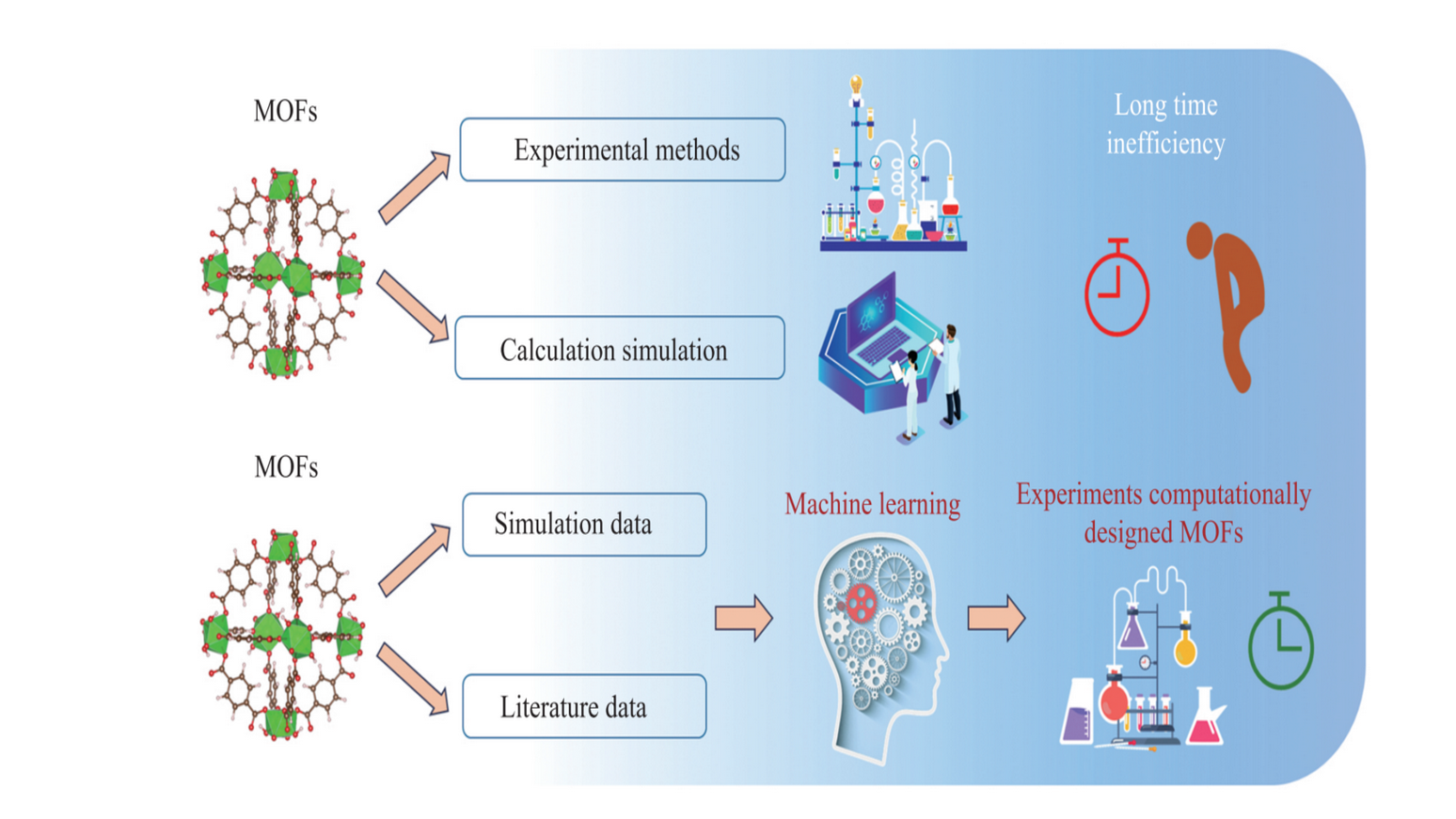
Abstract AITranslate
Significant advancements have been made in metal-organic frameworks (MOFs) for proton conductivity in proton exchange membrane fuel cells; however, a comprehensive and rational design road map for these materials remains under explored, particularly regarding the quantitative contributions of internal structural factors (proton donor-acceptor types and spatial distances) and external environmental factors (temperature and humidity) to hydrogen-bond formation. In this study, the hydrogen-bonded network formation potential (ФH) is proposed based on these factors to establish structure-property relationship of MOFs via artificial neural network (ANN) model, by which a linear function relationship has been fitted to facilitate the rational design of MOFs, providing a simple assessment of proton conductivity performance in reverse. As a proof of concept, UiO-66-NH2-SO3H with varying group ratios was fabricated, and UiO-66-NH2-SO3H-1:5 exhibited favorable proton conductivity (0.08 S∙cm–1) due to the favorable matching of Brönsted acid-base pairs, which facilitates the extensive formation of hydrogen-bonded networks. The proposed hydrogen-bonded network formation potential is expected to advance the design and synthesis of MOF-based proton-conductive materials, serving as a valuable index for the proton exchange membrane fuel cell research community.
KeyWords AITranslate
[1]F. Zhang, B. Zu, B. Wang, Z. Qin, J. Yao, Z. Wang, L. Fan, and K. Jiao, "Developing long-durability proton-exchange membrane fuel cells," Joule, vol. 9, no. 3, art. no. 101853, 2025.
[2]X. Yang, Z. Feng, M. Alshurafa, M. Yu, A. B. Foster, H. Zhai, Y. Yuan, Y. Xiao, C. D'Agostino et al., "Durable proton exchange membrane based on polymers of intrinsic microporosity for fuel cells," Advanced Materials, vol. 37, no. 19, art. no. 2419534, 2025.
[3]Y. Wang, Y. Zhang, X. Xin, J. Yang, M. Wang, R. Wang, P. Guo, W. Hang, A. J. Sobrido et al., "In situ photocatalytically enhanced thermogalvanic cells for electricity and hydrogen production," Science, vol. 381, no. 6655, pp. 291–296, 2023.
[4]S. Mao, Y. Zhang, Y. Wang, S. Zhang, S. Liu, W. Chen, J. Zhou, and X. Li, "Oxygen-evolving covalent organic frameworks via phosphonate ylide-engineering for enhanced photocatalytic overall water splitting," Advanced Materials, vol. 37, no. 34, art. no. 2507668, 2025.
[5]H. Gao, Y. He, J. Hou, and X. Zhang, "In situ aliovalent nickle substitution and acidic modification of nanowalls promoted proton conductivity in inOF with 1D helical channel," ACS Applied Materials & Interfaces, vol. 13, no. 32, pp. 38289–38295, 2021.
[6]X. Zhang, M. Yan, P. Chen, J. Li, Y. Li, H. Li, X. Liu, Z. Chen, H. Yang et al., "Emerging MOFs, COFs, and their derivatives for energy and environmental applications," The Innovation, vol. 6, no. 2, art. no. 100778, 2025.
[7]S. Liu, Y. Zhang, M. Wang, Y. Wei, Y. Wang, W. Chen, S. Mao, P. Guo, J. B. Ghasemi et al., "A near-perfect Pt cocatalyst with a spatially oriented distribution of Pt2+/Pt0 for photocatalytic water splitting," Advanced Materials, art. no. e08693, 2025.
[8]D. Mukherjee, A. Saha, S. Moni, D. Volkmer, and M. C. Das, "Anhydrous solid-state proton conduction in crystalline MOFs, COFs, HOFs, and POMs," Journal of the American Chemical Society, vol. 147, no. 7, pp. 5515–5553, 2025.
[9]A. Gomez, W. H. Thompson, and D. Laage, "Neural-network-based molecular dynamics simulations reveal that proton transport in water is doubly gated by sequential hydrogen-bond exchange," Nature Chemistry, vol. 16, no. 11, pp. 1838–1844, 2024.
[10]L. Zeng, D. Dong, J. Lu, K. He, X. Liu, J. Wang, Z. Wei, M. Gresil, J. Ratcliffe et al., "Hyperbranched interpenetrating hydrogen bond network (HIHBN) proton exchange membrane for fuel cells above 220 ℃," Advanced Functional Materials, vol. 35, no. 31, art. no. 2424662, 2025.
[11]X. Wang, S. Guo, C. Suo, F. Zhang, J. Wang, W. Wang, D. Yuan, L. Liang, and X. Zhang, "Enhancing anion conductivity in a highly alkali-stable eta topologic Cu(I) framework via strong electrostatic repulsion," Science China Chemistry, vol. 68, no. 3, pp. 980–986, 2025.
[12]X. Wang, L. Liang, S. Dou, and X. Zhang, "Two-in-one tecton strategy to construct single crystalline hydrogen-bonded organic framework with high proton conductivity above 100 ℃," Science China Chemistry, vol. 66, no. 9, pp. 2563–2568, 2023.
[13]D. W. Lim and H. Kitagawa, "Proton transport in metal–organic frameworks," Chemical Reviews, vol. 120, no. 16, pp. 8416–8467, 2020.
[14]H. Daglar, H. C. Gulbalkan, G. O. Aksu, and S. Keskin, "Computational simulations of metal–organic frameworks to enhance adsorption applications," Advanced Materials, art. no. 2405532, 2024.
[15]S. Chuhadiya, Himanshu, D. Suthar, S. L. Patel, and M. S. Dhaka, "Metal organic frameworks as hybrid porous materials for energy storage and conversion devices: A review," Coordination Chemistry Reviews, vol. 446, no. 1, art. no. 214115, 2021.
[16]Y. Zhao, Z. Shang, M. Feng, H. Zhong, Y. Du, W. Chen, Y. Wang, J. Zou, Y. Chen et al., "Oriented assembly of 2D metal-pyridylporphyrinic framework to regulate the redox kinetics in Li−S batteries," Advanced Materials, vol. 37, no. 17, art. no. 2501869, 2025.
[17]T. Ko, D. Kim, J. Park, and S. H. Lee, "Physics-informed neural network for long-term prognostics of proton exchange membrane fuel cells," Applied Energy, vol. 38, no. 15, art. no. 125318, 2025.
[18]G. Ren, Z. Qu, Z. Niu, and Y. Wang, "Advancing porous electrode design for pem fuel cells: From physics to artificial intelligence," Electrochemical Energy Reviews, vol. 8, no. 1, art. no. 6, 2025.
[19]M. Chafiq, A. Chaouiki, and Y. G. Ko, "Targeted metal–organic framework discovery goes digital: machine learning's quest from algorithms to atom arrangements," Advanced Composites and Hybrid Materials, vol. 7, no. 6, art. no. 222, 2024.
[20]J. Chen, P. He, S. Cai, Z. He, H. Zhu, Z. Yu, L. Yang, and W. Tao, "Modeling and temperature control of a water-cooled PEMFC system using intelligent algorithms," Applied Energy, vol. 372, art. no. 123790, 2024.
[21]F. Zhang, M. Ni, S. Tai, B. Zu, F. Xi, Y. Shen, B. Wang, Z. Qin, R. Wang et al., "Machine learning assisted health status analysis and degradation prediction of aging proton exchange membrane fuel cells," Appl Energy, vol. 384, art. no. 125483, 2025.
[22]Y. Yuan, R. K. Patel, S. Banik, T. B. Reta, R. S. Bisht, D. D. Fong, S. K. Sankaranarayanan, and S. Ramanathan, "Proton conducting neuromorphic materials and devices," Chemical Reviews, vol. 124, no. 16, pp. 9733–9784, 2024.
[23]B. Yang, B. Liang, Y. Qian, R. Zheng, S. Su, Z. Guo, and L. Jiang, "Parameter identification of PEMFC via feedforward neural network-pelican optimization algorithm," Applied Energy, vol. 361, art. no. 122857, 2024.
[24]H. Demir, H. Daglar, H. C. Gulbalkan, G. O. Aksu, and S. Keskin, "Recent advances in computational modeling of MOFs: From molecular simulations to machine learning," Coordination Chemistry Reviews, vol. 484, art. no. 215112, 2023.
[25]C. Li, L. Bao, Y. Ji, Z. Tian, M. Cui, Y. Shi, Z. Zhao, and X. Wang, "Combining machine learning and metal–organic frameworks research: novel modeling, performance prediction, and materials discovery," Coordination Chemistry Reviews, vol. 514, art. no. 215888, 2024.
[26]A. Nandy, S. Yue, C. Oh, C. Duan, G. G. Terrones, Y. G. Chung, and H. J. Kulik, "A database of ultrastable MOFs reassembled from stable fragments with machine learning models," Matter, vol. 6, no. 5, pp. 1585–1603, 2023.
[27]K. Chen, W. Chen, G. Zou, and B. Chen, "Intelligent optimization: Novel application of PCC, MCDM, and ANN + NSGA-III in integrated optimization of the flow field and porous layer structures for unitized regenerative fuel cell," Applied Energy, vol. 375, art. no. 124008, 2024.
[28]Y. Hou, P. Schneider, L. Ney, and N. Zamel, "Optimizing catalyst layer composition of PEM fuel cell via machine learning: Insights from in-house experimental data," Energy and AI, vol. 18, art. no. 100439, 2024.
[29]L. Zhu, H. Yang, T. Xu, F Shen, and C. Si, "Precision-engineered construction of proton-conducting metal–organic frameworks," Nano-Micro Letters, vol. 17, art. no. 87, 2024.
[30]I. E. Khalil, J. Fonseca, M. R. Reithofer, T. Eder, and J. M. Chin, "Tackling orientation of metal-organic frameworks (MOFs): The quest to enhance MOF performance," Coordination Chemistry Reviews, vol. 418, art. no. 215043, 2023.
[31]Z. Wang, T. Wu, L. Zeng, J. Peng, X. Tan, D. Yu, M. Gao, and G. Feng, "Machine learning relationships between nanoporous structures and electrochemical performance in MOF supercapacitors," Advanced Materials, vol. 37, no. 15, art. no. 2500943, 2025.
[32]S. Guo, X. Huang, Y. Situ, Q. Huang, K. Guan, J. Huang, W. Wang, X. Bai, Z. Liu et al., "Interpretable machine-learning and big data mining to predict gas diffusivity in metal-organic frameworks," Advanced Science, vol. 10, no. 21, art. no. 2301461, 2023.
[33]J. R. Quinlan, "Induction of decision trees," Machine Learning, vol. 1, pp. 81–106, 1986.
[34]M. Rivera-Torrente, L. D. Mandemaker, M. Filez, G. Delen, B. Seoane, F. Meirer, and B. M. Weckhuysen, "Spectroscopy, microscopy, diffraction and scattering of archetypal MOFs: Formation, metal sites in catalysis and thin films," Chemical Society Reviews, vol. 49, no. 18, pp. 6694–6732, 2020.
[35]Q. Wang, X. Zheng, H. Chen, Z. Shi, H. Tang, P. Gong, L. Guo, M. Li, H. Huang, and Z. Liu, "Synergistic effect of MOF-directed acid-base pairs for enhanced proton conduction," Microporous and Mesoporous Materials, vol. 49, no. 23, art. no. 111199, 2021.
[36]H. Fan, M. Li, and E. Wang, "Anion-functionalized interfacial layer for stable Zn metal anodes," Nano Energy, vol. 103, art. no. 107751, 2022.
[37]I. Ahmed, N. A. Khan, and S. H. Jhung, "Adsorptive denitrogenation of model fuel by functionalized UiO-66 with acidic and basic moieties," Chemical Engineering Journal, vol. 321, pp. 40–47, 2017.
[38]I. Ahmed, S. H. Jhung, and J. Hazard, "Effective adsorptive removal of indole from model fuel using a metal-organic framework functionalized with amino groups," Journal of Hazardous Materials, vol. 283, pp. 544–550, 2015.
[39]K. D. Kreuer, "Proton conductivity: Materials and applications," Chemistry of Materials, vol. 8, no. 3, pp. 610–641, 1996.
[40]M. Wang, J. Cai, H. Lun, M. Lv, J. Zhang, S. Andra, B. Li, D. Dang, Y. Bai, and Y. Li, "Design and analysis of pom‐guanidine compounds: Achieving ultra‐high single‐crystal proton conduction," Advanced Functional Materials, vol. 34, no. 7, art. no. 2311912, 2023.
[41]N. Mukherjee, O. Basu, S. Mukhopadhyay, and T. Jana, "Grafting of poly(vinyl phosphonic acid) to MOF surfaces to achieve proton conducting hybrid materials," ACS Applied Polymer Materials, vol. 6, no. 13, pp. 7488–7499, 2024.
[42]S. Zhang, Y. Xie, R. Somerville, F. F. Tirani, R. Scopelliti, Z. Fei, D. Zhu, and P. J. Dyson, "MOF‐based solid‐state proton conductors obtained by intertwining protic ionic liquid polymers with MIL‐101," Small, vol. 19, no. 41, art. no. 2206999, 2023.
[43]X. Li, D. Zhang, S. Chen, Y. Geng, Y. Liu, L. Qian, X. Chen, J. Li, P. Fang, and C. He, "Outstanding proton conductivity over wide temperature and humidity ranges and enhanced mechanical, thermal stabilities for surface-modified MIL-101-Cr-NH2/Nafion composite membranes," Green Energy & Environment, vol. 9, no. 11, pp. 1734–1746, 2024.
[44]S. Liu, Z. Han, J. Yang, S. Huang, X. Dong, and S. Zang, "Sulfonic groups lined along channels of metal–organic frameworks (MOFs) for super-proton conductor," Inorganic Chemistry, vol. 59, no. 1, pp. 396–402, 2019.
[45]N. Wang, B. Zhang, X. Wu, J. Wang, X. Han, J. Sun, X. Wang, and Z. Su, "Conjugated acid-base pairs in keggin-type polyoxometalate-based metal-organic frameworks enhance proton conduction," Chemical Engineering Journal, vol. 498, art. no. 155821, 2024.
[46]L. Feng, H. Hou, and H. Zhou, "UiO-66 derivatives and their composite membranes for effective proton conduction," Dalton Transactions, vol. 49, no. 47, pp. 17130–17139, 2020.
[47]A. Sharma, J. Lim, S. Lee, S. Han, J. Seong, S. B. Baek, and M. S. Lah, "Superprotonic conductivity of MOFs confining zwitterionic sulfamic acid as proton source and conducting medium," Angewandte Chemie International Edition, vol. 62, no. 29, art. no. e202302376, 2023.
[48]A. Sharma, J. Lim, J. S. Jeong, S. Won, J. Seong, S. Lee, Y. S. Kim, S. B. Baek, and M. S. Lah, "Superprotonic conductivity of MOF-808 achieved by controlling the binding mode of grafted sulfamate," Angewandte Chemie International Edition, vol. 60, no. 26, pp. 14334–14338, 2021.
[49]V. Pophristic and L. Goodman, "Hyperconjugation not steric repulsion leads to the staggered structure of ethane," Nature, vol. 411, no. 6837, pp. 565–568, 2011.
[50]A. G. Evans and M. Polanyi, "Calculation of steric hindrance," Nature, vol. 149, no. 3787, pp. 608–608, 1942.
[51]C. J. Woodward, "Priestley and coulomb's law," Nature, vol. 80, no. 2053, art. no. 8, 1909.
[52]T. Yamada, K. Otsubo, R Makiura, and H. Kitagawa, "Designer coordination polymers: Dimensional crossover architectures and proton conduction," Chemical Society Reviews, vol. 42, no. 16, art. no. 6655, 2013.
Basic Information:
DOI:10.23919/CHAIN.2025.000018
Chinese Library Classification Number:
Citation Information:
Significant advancements have been made in metal-organic frameworks (MOFs) for proton conductivity in proton exchange membrane fuel cells; however, a comprehensive and rational design road map for these materials remains under explored, particularly regarding the quantitative contributions of internal structural factors (proton donor-acceptor types and spatial distances) and external environmental factors (temperature and humidity) to hydrogen-bond formation. In this study, the hydrogen-bonded network formation potential (ФH) is proposed based on these factors to establish structure-property relationship of MOFs via artificial neural network (ANN) model, by which a linear function relationship has been fitted to facilitate the rational design of MOFs, providing a simple assessment of proton conductivity performance in reverse. As a proof of concept, UiO-66-NH2-SO3H with varying group ratios was fabricated, and UiO-66-NH2-SO3H-1:5 exhibited favorable proton conductivity (0.08 S∙cm–1) due to the favorable matching of Brönsted acid-base pairs, which facilitates the extensive formation of hydrogen-bonded networks. The proposed hydrogen-bonded network formation potential is expected to advance the design and synthesis of MOF-based proton-conductive materials, serving as a valuable index for the proton exchange membrane fuel cell research community.
quote
| GB/T 7714-2015 | [1] Chao Suo, Xiaolu Wang, Jiarong Liu, et al. Artificial neural network-driven robust model for estimating hydrogen bonded formation potential towards rational design of MOFs proton conductors[J]. Chain, 2025, 2(4): 293-303. DOI:10.23919/CHAIN.2025.000018. |
| MLA | [1] Chao Suo, et al., "Artificial neural network-driven robust model for estimating hydrogen bonded formation potential towards rational design of MOFs proton conductors." Chain, vol. 2, no. 4, 2025, pp. 293-303, https://doi.org/10.23919/CHAIN.2025.000018. |
| APA | [1] Chao Suo, Xiaolu Wang, Jiarong Liu, Kun Zhang, Shaohui Guo, Xiaochuan Duan, & Xianming Zhang. (2025). Artificial neural network-driven robust model for estimating hydrogen bonded formation potential towards rational design of MOFs proton conductors. Chain, 2(4), 293-303. https://doi.org/10.23919/CHAIN.2025.000018 |
| IEEE | [1] Chao Suo, Xiaolu Wang, Jiarong Liu, Kun Zhang, Shaohui Guo, Xiaochuan Duan, and Xianming Zhang, "Artificial neural network-driven robust model for estimating hydrogen bonded formation potential towards rational design of MOFs proton conductors," Chain, vol. 2, no. 4, pp. 293-303, 2025, doi: 10.23919/CHAIN.2025.000018. keywords: {hydrogen bonded network formation potential;proton conductivity;artificial neural network model} |