ContentsFigures & Tables
Proton exchange membrane fuel cells are regarded as highly promising candidates for the development of clean and renewable energy solutions due to their high energy density, low pollutant emissions, and mild operating conditions [1, 2]. The proton conductive performance of materials plays a crucial role in these systems. Metal-organic frameworks (MOFs) have emerged as a promising class of solids for such applications [3–5], and various MOFs have been explored to achieve high-efficiency proton conductivity [6–8]. However, effective guidelines for designing and preparing optimal MOF materials remain insufficient.
From the perspective of proton conductivity engineering, the strategic construction of hydrogen-bonded networks serves as a critical design principle for establishing efficient proton transport pathways [9–12]. This fundamental understanding drives the rational modulation of MOF crystallization processes, where hydrogen-bond network engineering predominantly depends on three key secondary building units: inorganic metal clusters, organic linker configurations, and surface functional group topologies. Nevertheless, significant challenges persist in quantifying the synergistic contributions of proton donor-acceptor types, spatial distances, and environmental variables (temperature and humidity) to hydrogen-bond network formation, leading to suboptimal proton conduction performance and economically inefficient synthetic protocols.
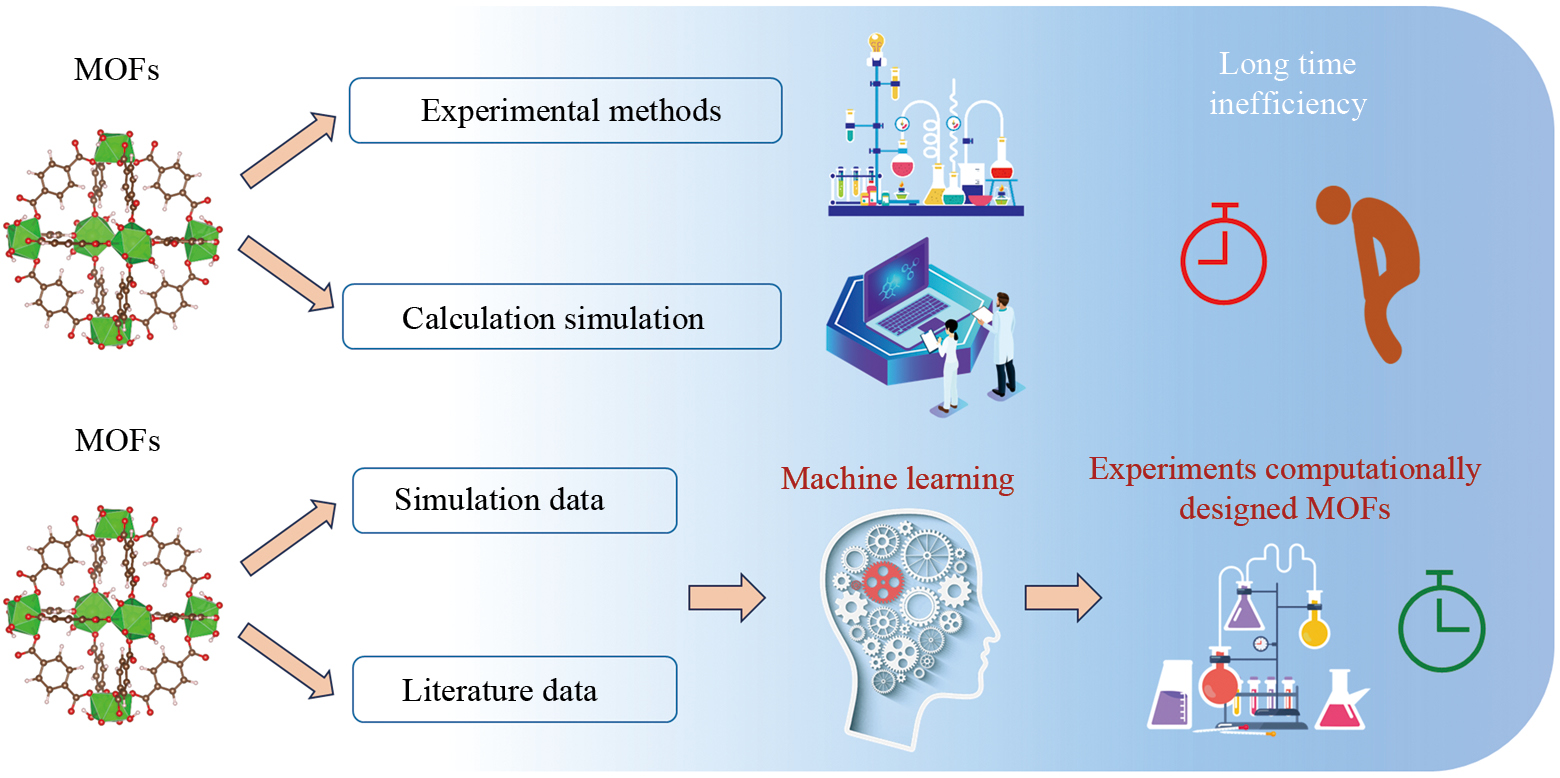
The conventional MOF synthesis approach (top loop in Scheme 1) relies on a time-consuming trial-and-error process. Typically, MOF synthesis is performed by referencing literature to identify similar synthesis conditions and experimental methods. Proton conductivity is affected by adjustable proton concentration and the conduction pathway, which is determined by the synergistic effects of factors such as temperature, humidity, and guest molecules [13]. These complexities make the design of MOFs with high proton conductivity particularly challenging. In addition to experimental approaches, computational simulations [14], including density functional theory (DFT) and molecular dynamics (MD), have been employed to assist in MOF synthesis [15, 16]. However, MOF synthesis through these methods requires significant computational resources.
To overcome this challenge, data-driven research has been explored as a potential solution [17–20]. Studies are focused on predicting and designing material with specific physical properties by machine learning models trained on experimental and computational data [21–23]. Machine learning is considered an effective tool to reduce the workload associated with MOF design and synthesis (bottom loop in Scheme 1) [24–26]. Simulation data, such as those from the Materials Project, and literature-derived data are utilized for training, facilitating MOF synthesis by identifying critical influencing factors.
All reagents were purchased commercially and were used directly without purification. Monosodium 2-sulfoterephthalate (purity > 98%), 2-Aminoterephthalic acid (purity > 98%), zirconium (IV) oxychloride octahydrate (purity > 99%), N, N-dimethylacetamide (DMA), and acetone were obtained from Nantong Feiyu Biological Technology Co. Ltd.
UiO-66-NH2-SO3H-1:1 was synthesized as follow:
ZrOCl2·8H2O (1.00 g, i.e., 0.031 mol), monosodium 2-sulfoterephthalate (0.41 g, i.e., 0.0015 mol), and 2-aminoterephthalic acid (0.27 g, i.e., 0.0015 mol) were dissolved in a mixed solution of formic acid (11.7 mL, i.e., 0.031 mol) and DMA (30 mL). The solution was heated in a 100 mL autoclave at 150 ℃ for 24 h. After cooling down, sediment was separated via centrifugation and washed with acetone thoroughly. Finally, the sample was vacuumed at 80 ℃ for 12 h to evacuate acetone in the pores.
The synthesis process of other UiO-66-NH2-SO3H materials were similar to that of UiO-66-NH2-SO3H-1:1, and only the precursors mass was tuned for different groups ratio. The details of synthesis process of other UiO-66-NH2-SO3H materials were provided in Table 1.
Fourier transform infrared (FT-IR) spectra were recorded on FT-IR spectrometer (INVENIOS, Bruker, Germany). X-ray diffraction (XRD) patterns were measured using X-ray diffractometer (Smartlab SE, Rigaku, Japan). Scanning electron microscope (SEM) images were recorded on SEM (7900F, Carl Zeiss AG, Germany). 1H nuclear magnetic resonance (NMR) spectra were measured on an NMR spectrometer (Bruker Ascend 600 MHz, Germany). Proton conductivity was performed on a CHI660E electrochemical workstation (Chenhua Instrument, China). Brunauer-Emmet-Teller (BET) curves were measured on specific surface area and porosity analyzer (Autosorb IQ-MP-AG -Vlton, Quantanchrome, USA). X-ray photoelectron spectroscopy (XPS) spectra were measured on XPS (ESCALAB Xi+, Thermo Scientific, USA).
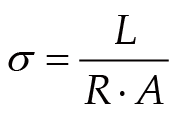
The UiO-66-NH2-SO3H powder (30 mg) was pressed at 4 MPa pressure for 30 s to make circle piece (radius 3 mm). The circle piece was equilibrated under 75% relative humidity (RH) for 12 h before the first measurement. When the temperature changed, it was allowed to stand for another 2 h to equilibrate temperature and humidity. The proton conductivity was demonstrated by A.C. impedance method with the frequencies ranging 1 Hz to 1 M Hz and the test temperature spanning from 303 to 363 K at 75% RH. Then the humidity was altered to 85% and 95% for repeating the above test.
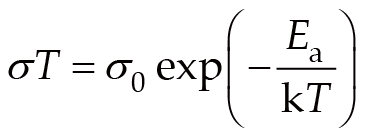
The proton conductivity performance σ of samples were calculated by the Eqs. (1) and (2):(1)(2)where the symbol σ represents the proton conductivity; k is the Boltzmann constant; and Ea stands for the activation energy; L is the thickness of the circle piece; R is the value of resistance parameter based on calculation of electrochemical impedance spectroscopy (EIS); A is the area of the circle piece.
In the present work, UiO-66 molecules in solution were studied using molecular dynamics simulations. Simulations were performed using the Gromacs-2020.7 software package and the molecular force field was performed using General Amber Force Field (GAFF). The results were visualized using the visualization software Visual Molecular Dynamics (VMD).
First, energy minimization was performed using the steepest descent method with energies and forces of 0.01 kJ·mol−1 and 1000 kJ·mol−1·nm−1. Next, MD was run for 125,000 steps of 1 fs, which is a constant volume process using a Berendsen thermostat. MD integrates Newton's equations using the velocity-Verlet algorithm. Then MD is run for 250,000 steps of 2 fs, using Berendsen for both the thermostat and pressure coupling. Finally, MD is run for 5,000,000 steps of 2 fs, using Nose-Hoover and Parrinello-Rahman for the thermostat and pressure coupling, respectively.
An ANN model was constructed using PyTorch for the prediction of proton conductivity. First, the dataset was split into a training set and a test set at a ratio of 6:4, with a random seed set to 42 to ensure the reproducibility of results. Next, an ANN model consisting of four fully connected layers was defined. The number of nodes in each layer was configured as follows: from the input layer to 64 nodes, 64 nodes to 32 nodes, 32 nodes to 16 nodes, and finally 16 nodes to the output layer. The rectified linear unit (ReLU) function was selected as the activation function, and the input dimension was determined by the number of features in the training set. For model training, the mean squared error was adopted as the loss function, which is suitable for regression tasks; the Adam optimizer was used, with a learning rate set to 0.001 to ensure favorable convergence speed and stability. After the training process was completed, the model was used to make predictions on the test set. Mean squared error and coefficient of determination (R2) were calculated as evaluation metrics to assess the model's performance.
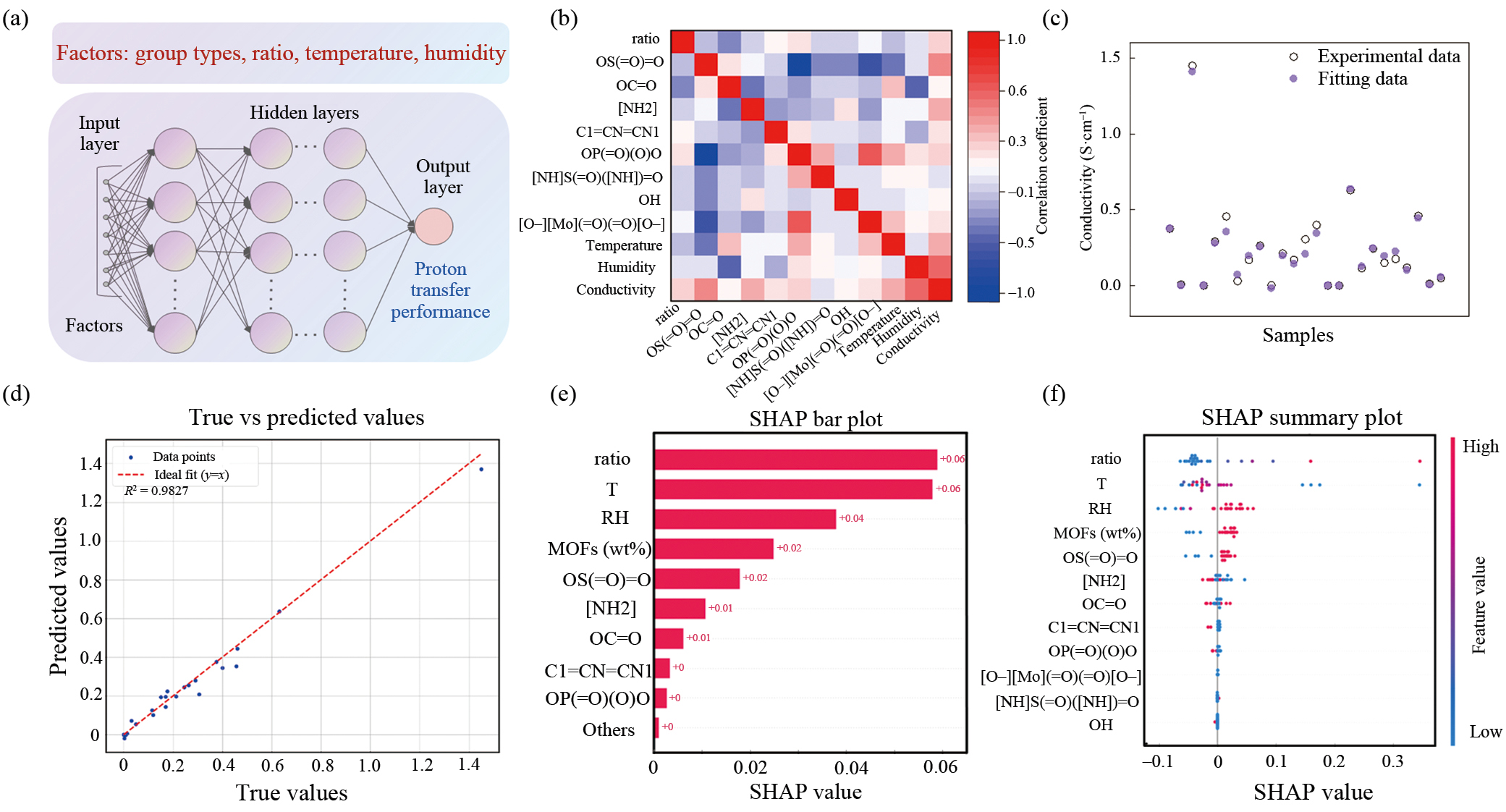
In this work, the machine learning assistance strategy is considered to quantify the synergistic contributions of Brönsted acidic/alkalinous sites and environmental factor to proton conductivity, and it is desired to establish the functional model as a materials design guideline. Relevant literature has been collected, and data on key factors influencing proton conductivity have been summarized for use in the ANN model [27, 28] (Fig. 1(a) and Table S1). The related data are not only focused on the MOFs-based materials, but also extracted from other multiple chemical groups of proton conductors. Considering some penetrating discussion about the backbone structure of proton-conductive materials in previous literature [29, 30], the surface functional groups effect and environmental variables to hydrogen bonded formation will be profoundly discussed in this work. According to the Pearson correlation heat map analysis (Fig. 1(b)), each group exhibits a weak correlation with other groups, while proton conductivity demonstrates a strong correlation with −SO3H and −NH2 groups, ratio, temperature, and humidity. Furthermore, data have been partitioned into training, validation, and test sets, ensuring that identical conditions are not repeated across these sets. The model's performance is assessed through a comparison of predicted proton conductivity with literature data (Fig. 1(c, d)). The ANN model effectively fits the proton conductivity data, demonstrating agreement with reported values. Considering the "black box" features, the Shapley additive explanations (SHAP) method is further used for analysis the significant factors [31, 32]. In Fig. 1(e, f), the important factors are chemical functional group ratio, temperature, humidity, chemical functional groups −SO3H and −NH2 sequence. This highlights the fundamental importance of temperature and humidity in predicting proton conductivity, while also emphasizing the crucial role of groups and MOF composition ratio.
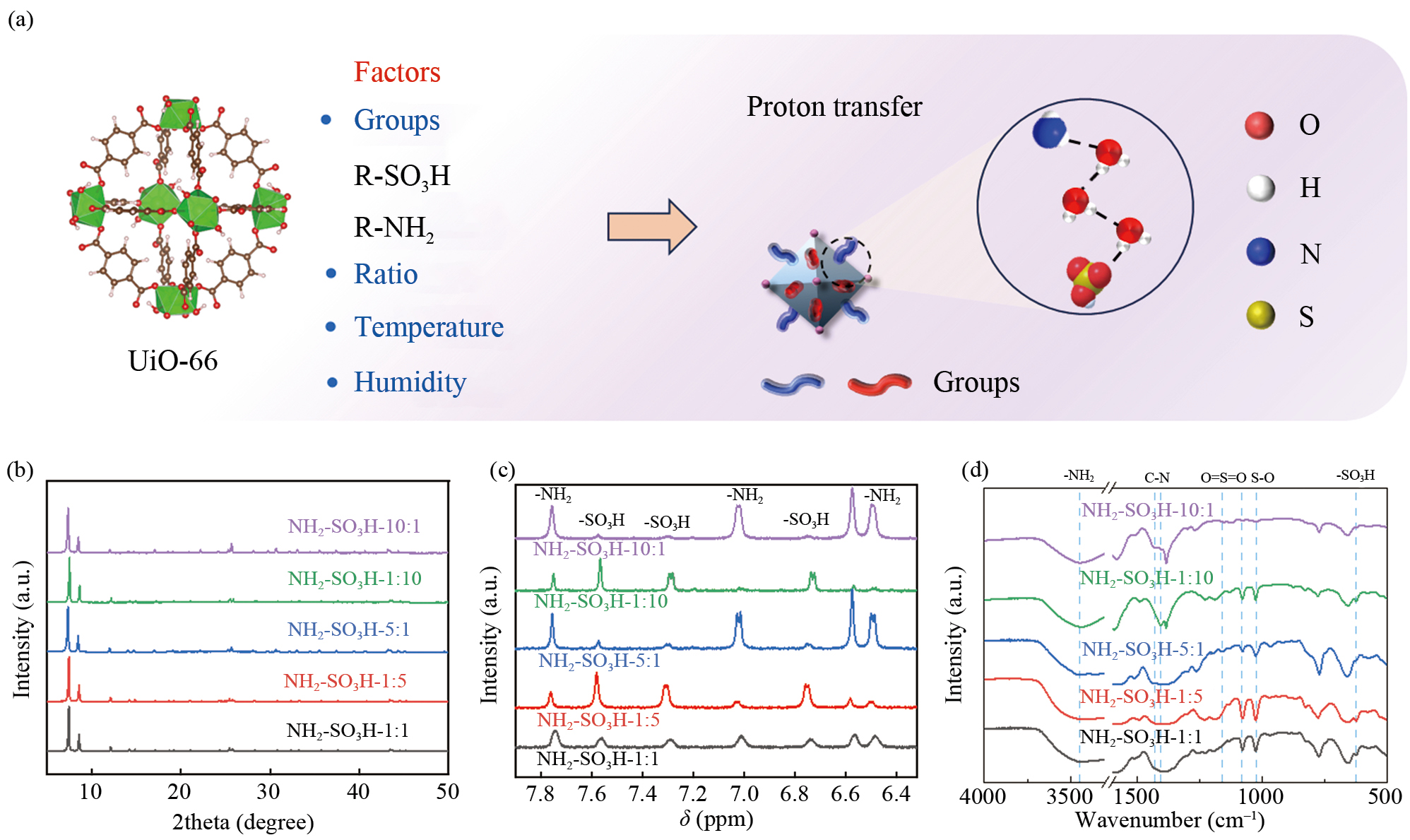
The proton conductivity of MOFs is governed by an intricate interplay between intrinsic structural determinants (including functional group architectures and ratio) and extrinsic environmental parameters (temperature and RH). Establishment of quantitative structure-property relationships in such complex systems requires rigorous multivariate analysis to systematically decouple the synergistic effects of these variables on proton transport dynamics. As a proof of concept, UiO-66 has been selected as a representative MOF for proton conductivity studies (Fig. 2(a)). Due to the consistent main structure of UiO-66, the mathematical model can be simplified. To validate the ANN model [33, 34], the significant functional groups −SO3H and −NH2 have been examined experimentally, which can effectively reduce the experimental workload by 96.4% compared to the trial-and-error method. The ratio between −NH2 and −SO3H has been systematically varied from 10:1 to 1:10, as shown in Fig. 2. In this work, it focuses on the surface chemical groups status and external environmental factors, and therefore structural and morphological analyses of the samples were performed first to identify the unified backbone structure. XRD patterns (Fig. 2(b)) confirm the typical crystal structure of UiO-66, and indicate that the −SO3H and −NH2 groups are positioned on the outer surface of the unit cell rather than within its interior. To further analyze the group ratio and structural state, NMR and FT-IR measurements were conducted. The NMR spectra (Fig. 2(c)) show peaks at 7.8, 7.0, and 6.5 ppm corresponding to -NH2, while peaks at 7.6, 7.3, and 6.7 ppm correspond to -SO3H [35], confirming the successful incorporation of these groups into UiO-66. The peak intensity trends correlate with the functional group ratio, and the ratio of functional groups between −SO3H and −NH2 is calculated as 10:1, 1:10, 4.5:1, 1:5.5, and 1:1 from top to bottom in sequence of Fig. 2(c), agreeable with the molar ratio of precursors. FT-IR spectra (Fig. 2(d)) reveal peaks at 619, 1025, 1080, and 1187 cm–1, attributed to the -SO3H stretching vibration, S-O stretching vibration, in-plane vibration within the benzene ring, and O=S=O symmetric stretching vibration modes, respectively, further validating the presence of -SO3H and -NH2 [36–38]. Morphologies and specific surface areas of different group ratios are shown in Figs. S1–S5, demonstrating that UiO-66 maintains its typical morphology across different functional group ratios. This confirms that outer functional groups do not disrupt the fundamental crystal structure, consistent with XRD results (Fig. 2(a)). Additionally, XPS spectra of different samples (Figs. S6–S10) indicate that the element content and surface coordination states of −NH2 and −SO3H align with the observed group ratio variations.
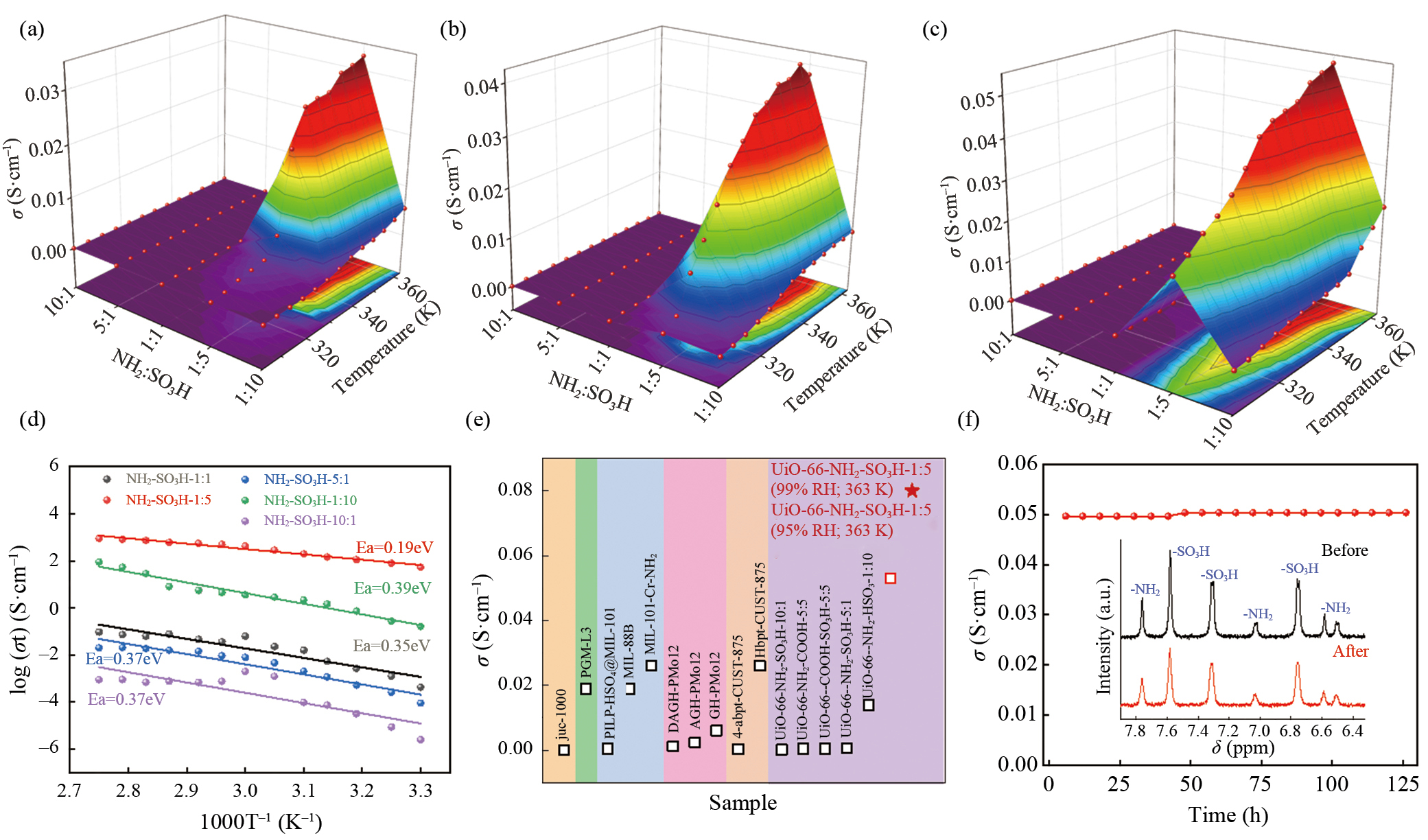
Proton conductivity measurements for the synthesized samples were conducted under varying humidity and temperature conditions. Humidity was adjusted to 75% RH, 85% RH, and 95% RH, while temperature was varied from 303 to 363 K. The EIS curves of different samples are shown in Figs. S11-S13, and the proton conductivity data are presented as a three-dimensional scatter plot (Fig. 3(a)–(c)). The results indicate that proton conductivity improves with increasing humidity and temperature. Samples with lower −NH2/−SO3H ratios exhibit superior proton conductivity, with the −NH2/−SO3H 1:5 sample demonstrating the highest performance, achieving a proton conductivity of 0.05 S∙cm–1 at 95% RH and 363 K. Based on the measurement data, activation energy calculations for the samples at 95% RH and 363 K are provided in Fig. 3(d). The activation energy for all samples remains below 0.4 eV, indicating the Grotthuss mechanism [39]. The ratio of −NH2 to −SO3H influences activation energy, with the −NH2/−SO3H 1:5 sample exhibiting the lowest activation energy, thereby favoring proton transport. Proton conductivity for UiO-66-NH2-SO3H-1:5 improves with increasing temperature, reaching 0.08 S∙cm–1 at 99% RH and 363 K (Fig. S14). A comparison of MOF-based proton conductivity performance from literature is presented in Fig. 3(e). The proton conductivity of and the PMo12-based materials [40] remains below 0.01 S∙cm–1, while the PGM-based materials [41] exhibit improved performance at about 0.02 S∙cm–1. MIL and CUST MOFs [42–44, 45] further enhance proton conductivity, reaching nearly 0.03 S∙cm–1. Although UiO-66 has been extensively studied with varying functional group types and ratios, its overall performance remains suboptimal [46]. The synthesized UiO-66-NH2-SO3H-1:5 sample exhibits superior proton conductivity compared to previously reported materials. Additionally, the proton conductivity of the −NH2/−SO3H 1:5 sample at 95% RH and 363 K remains stable over 125 h, demonstrating excellent long-term stability (Fig. 3(f)). After measurements, XRD patterns and NMR spectra confirm that the primary crystal structure and surface functional group ratios remain unchanged (Figs. 3(f) and S15).
Different ratios of UiO-66 models have been simulated to study the formation of a hydrogen-bonded network. This feature is crucial for enabling proton propagation, which underpins the promising proton conductive performance of UiO-66-NH2-SO3H. In Fig. 4(a), the radial distribution function analysis for the N of the -NH2 group and the H of the −SO3H group shows that r ()=1.6 Å, with about 5 H atoms around N, consistent with the optimal group ratio for experimental proton conductivity performance in UiO-66. Moreover, the solvent accessible surface areas for different group ratios of UiO-66 have been explored in Fig. 4(b). These areas relate to the participation of water molecules, and hence, the number of water molecules around UiO-66-NH2-SO3H at different group ratios appears similar, suggesting a comparable aqueous environment. Within this environment, the number of hydrogen bonds is calculated, as shown in Fig. 4(c). Notably, the UiO-66-NH2-SO3H-1:5 system exhibits a higher number of hydrogen bonds than other systems, supporting the formation of a more extensive hydrogen bond network, which correlates with the observed experimental proton conductivity performance.
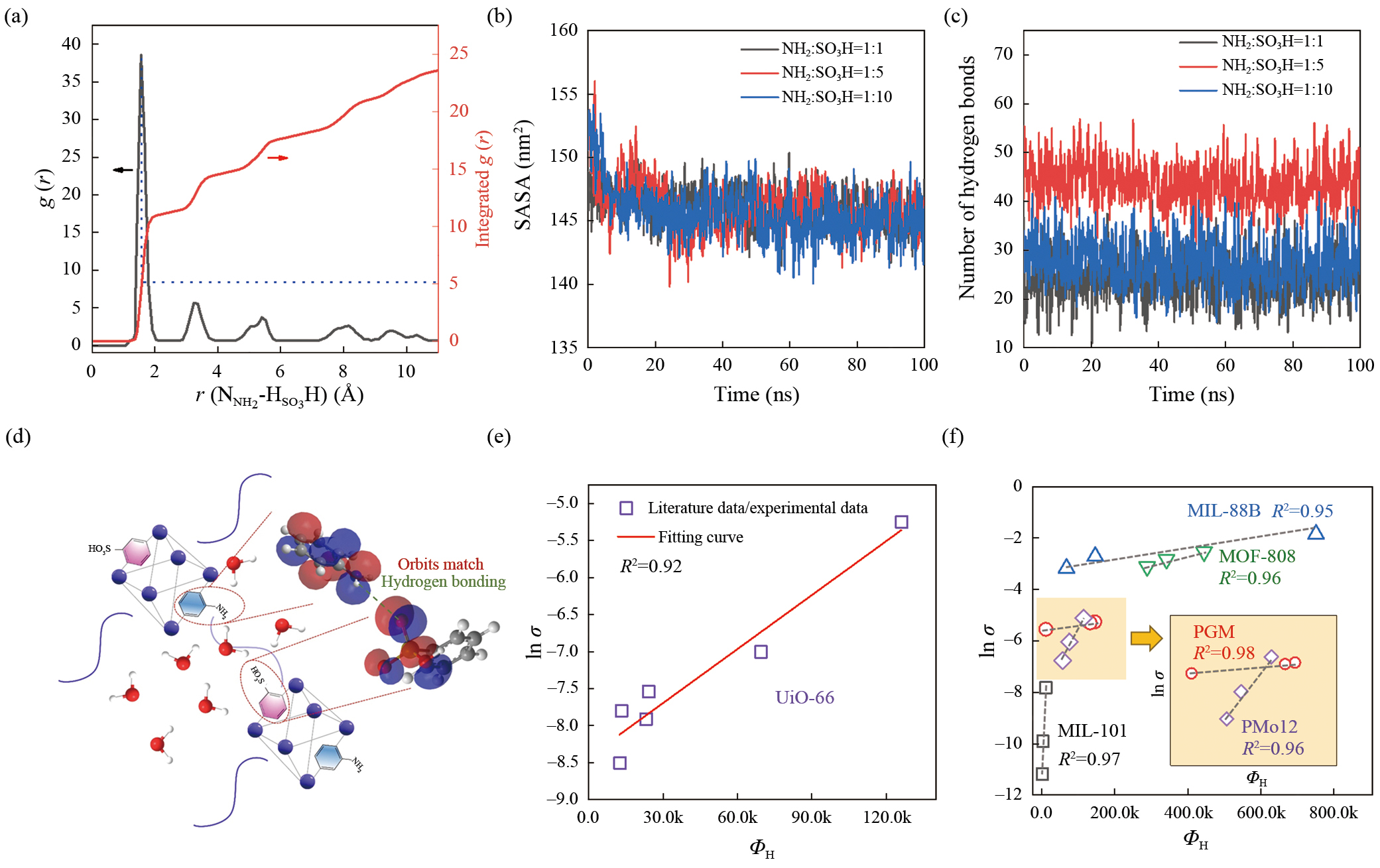
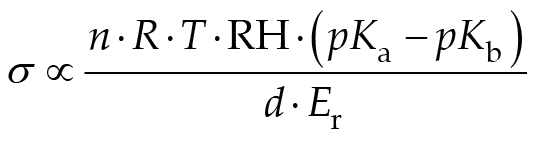
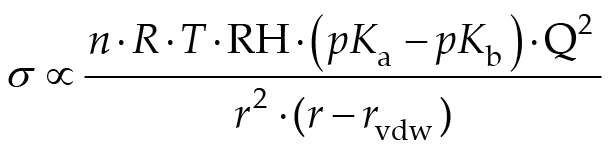
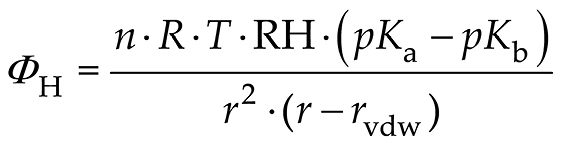
The molecular simulation suggests that the efficient formation of a hydrogen bond network is due to the appropriate matching of group ratios between -NH2 and −SO3H, as supported by ANN results. It is suggested that the matching of orbits is critical for hydrogen bond formation between these groups (Fig. 4(d). Here, it is difficult to confirm the spatial distribution of chemical functional groups in UiO-66, and thus the -R is used to describe the indeterminacy functional groups.). By integrating ANN analysis results with molecular simulations, we propose the potential for hydrogen bond network formation, denoted as ФH, to assess this process. The proton conductivity σ is influenced by the ratio of Brönsted acid-base pairs (denoted by symbol n), temperature (T), relative humidity (RH), dissociation constants (pKa and pKb), the distance between acid-base pairs (d), and the barrier to Brönsted acid-base pair interactions (Er). The proton conductivity is thus succinctly described, as shown in Eq.(3).(3)Here, the rotation barrier of chemical groups is attributed to electrostatic interactions and the steric effect [47–49]. The steric effect is quantified by the penetration radius [50], which is the difference between the distance r and the van der Waals radius rvdw; the electrostatic interactions are considered among adjacent atoms based on Coulomb's Law [51]. Consequently, proton conductivity can be further described by:(4)
The charge of the conducting carrier, hydrogen proton, is 1e, hence the value of Q is 1. Considering the effects of temperature, humidity, and acid-base pairs on the formation of the hydrogen bond network, the potential for hydrogen bond network formation (ФH), is defined as:
Based on literature and experimental data (Table S2), the relationship between lnσ and ФH is illustrated in Fig. 4(e), along with the corresponding Eq. (5):(5)
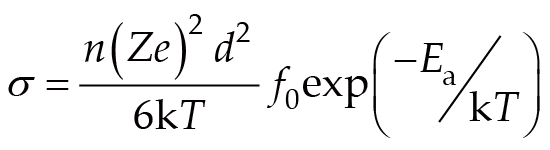
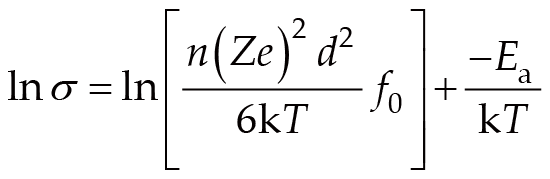
This fitting exponential model is agreeable with the well-known equation [52]:(6)(7)where σ is conductivity, n is carrier concentration, Ze is the charge of the conducting carrier (proton: Z = 1), d is the self-diffusion coefficient, k is the Boltzmann constant, T is temperature, fo is hopping frequency, and Ea is activation energy.
In this fitting model, the proposed hydrogen bonded network formation potential is attributed to the activation energy Ea, which encompasses the processes of hydrogen bond formation, dissociation enthalpy, recombination, and proton transport. Thus, the value of −8.42 and 2.43×10⁻⁵ in fitting UiO-66-based model are attributed to the diffusion relevant coefficient and structural relevant coefficient, which are strongly associated with environmental status and the MOFs topological structure. Besides, in Fig. 4(f), as for various MOFs, the hydrogen bonded formation potential ФH is calculated, and the linear relationship is well fitted, proving good universality of this function model [40–44, 47–48]. Consequently, this potential ФH serves as a straightforward index for assessing proton conductivity performance, utilizing either tabular look-up or empirical methods.
In conclusion, the structure-property relationship of MOFs designed for proton conductivity has been established with the assistance of the ANN model. According to the ANN analysis, factors such as chemical functional group ratios, temperature, and relative humidity significantly influence proton conductivity. These factors are crucial in the hydrogen bond formation process, and an index named hydrogen bonded network formation potential has been proposed to quantify this process. Moreover, a linear relationship between the formation match value and proton conductivity has been established, providing guidance for MOF design. As a proof of concept, UiO-66-NH2-SO3H with varying group ratios has been synthesized, and the UiO-66-NH2-SO3H-1:5 demonstrates superior proton conductivity performance compared to other MOF-based materials, exhibiting 125 h of stability, potentially heralding a new era for the development of MOF-based materials in energy devices.
The authors declare that they have no known competing financial interests or personal relationships that could have appeared to influence the work reported in this paper.
Chao Suo and Xiaolu Wang were responsible for the synthesis, experiments, characterization, and drafting of the manuscript. Jiarong Liu was responsible for the analysis of the data. Xiaochuan Duan and Shaohui Guo contributed to the data analysis and revision of the draft. Xinming Zhang provided supervision for the project design and reviewed the draft. All authors contributed to the final manuscript.
Additional supporting information can be found online in the Supplemental Items.
F. Zhang, B. Zu, B. Wang, Z. Qin, J. Yao, Z. Wang, L. Fan, and K. Jiao, "Developing long-durability proton-exchange membrane fuel cells," Joule, vol. 9, no. 3, art. no. 101853, 2025.
X. Yang, Z. Feng, M. Alshurafa, M. Yu, A. B. Foster, H. Zhai, Y. Yuan, Y. Xiao, C. D'Agostino et al., "Durable proton exchange membrane based on polymers of intrinsic microporosity for fuel cells," Advanced Materials, vol. 37, no. 19, art. no. 2419534, 2025.
Y. Wang, Y. Zhang, X. Xin, J. Yang, M. Wang, R. Wang, P. Guo, W. Hang, A. J. Sobrido et al., "In situ photocatalytically enhanced thermogalvanic cells for electricity and hydrogen production," Science, vol. 381, no. 6655, pp. 291–296, 2023.
S. Mao, Y. Zhang, Y. Wang, S. Zhang, S. Liu, W. Chen, J. Zhou, and X. Li, "Oxygen-evolving covalent organic frameworks via phosphonate ylide-engineering for enhanced photocatalytic overall water splitting," Advanced Materials, vol. 37, no. 34, art. no. 2507668, 2025.
H. Gao, Y. He, J. Hou, and X. Zhang, "In situ aliovalent nickle substitution and acidic modification of nanowalls promoted proton conductivity in inOF with 1D helical channel," ACS Applied Materials & Interfaces, vol. 13, no. 32, pp. 38289–38295, 2021.
X. Zhang, M. Yan, P. Chen, J. Li, Y. Li, H. Li, X. Liu, Z. Chen, H. Yang et al., "Emerging MOFs, COFs, and their derivatives for energy and environmental applications," The Innovation, vol. 6, no. 2, art. no. 100778, 2025.
S. Liu, Y. Zhang, M. Wang, Y. Wei, Y. Wang, W. Chen, S. Mao, P. Guo, J. B. Ghasemi et al., "A near-perfect Pt cocatalyst with a spatially oriented distribution of Pt2+/Pt0 for photocatalytic water splitting," Advanced Materials, art. no. e08693, 2025.
D. Mukherjee, A. Saha, S. Moni, D. Volkmer, and M. C. Das, "Anhydrous solid-state proton conduction in crystalline MOFs, COFs, HOFs, and POMs," Journal of the American Chemical Society, vol. 147, no. 7, pp. 5515–5553, 2025.
A. Gomez, W. H. Thompson, and D. Laage, "Neural-network-based molecular dynamics simulations reveal that proton transport in water is doubly gated by sequential hydrogen-bond exchange," Nature Chemistry, vol. 16, no. 11, pp. 1838–1844, 2024.
L. Zeng, D. Dong, J. Lu, K. He, X. Liu, J. Wang, Z. Wei, M. Gresil, J. Ratcliffe et al., "Hyperbranched interpenetrating hydrogen bond network (HIHBN) proton exchange membrane for fuel cells above 220 ℃," Advanced Functional Materials, vol. 35, no. 31, art. no. 2424662, 2025.
X. Wang, S. Guo, C. Suo, F. Zhang, J. Wang, W. Wang, D. Yuan, L. Liang, and X. Zhang, "Enhancing anion conductivity in a highly alkali-stable eta topologic Cu(I) framework via strong electrostatic repulsion," Science China Chemistry, vol. 68, no. 3, pp. 980–986, 2025.
X. Wang, L. Liang, S. Dou, and X. Zhang, "Two-in-one tecton strategy to construct single crystalline hydrogen-bonded organic framework with high proton conductivity above 100 ℃," Science China Chemistry, vol. 66, no. 9, pp. 2563–2568, 2023.
D. W. Lim and H. Kitagawa, "Proton transport in metal–organic frameworks," Chemical Reviews, vol. 120, no. 16, pp. 8416–8467, 2020.
H. Daglar, H. C. Gulbalkan, G. O. Aksu, and S. Keskin, "Computational simulations of metal–organic frameworks to enhance adsorption applications," Advanced Materials, art. no. 2405532, 2024.
S. Chuhadiya, Himanshu, D. Suthar, S. L. Patel, and M. S. Dhaka, "Metal organic frameworks as hybrid porous materials for energy storage and conversion devices: A review," Coordination Chemistry Reviews, vol. 446, no. 1, art. no. 214115, 2021.
Y. Zhao, Z. Shang, M. Feng, H. Zhong, Y. Du, W. Chen, Y. Wang, J. Zou, Y. Chen et al., "Oriented assembly of 2D metal-pyridylporphyrinic framework to regulate the redox kinetics in Li−S batteries," Advanced Materials, vol. 37, no. 17, art. no. 2501869, 2025.
T. Ko, D. Kim, J. Park, and S. H. Lee, "Physics-informed neural network for long-term prognostics of proton exchange membrane fuel cells," Applied Energy, vol. 38, no. 15, art. no. 125318, 2025.
G. Ren, Z. Qu, Z. Niu, and Y. Wang, "Advancing porous electrode design for pem fuel cells: From physics to artificial intelligence," Electrochemical Energy Reviews, vol. 8, no. 1, art. no. 6, 2025.
M. Chafiq, A. Chaouiki, and Y. G. Ko, "Targeted metal–organic framework discovery goes digital: machine learning's quest from algorithms to atom arrangements," Advanced Composites and Hybrid Materials, vol. 7, no. 6, art. no. 222, 2024.
J. Chen, P. He, S. Cai, Z. He, H. Zhu, Z. Yu, L. Yang, and W. Tao, "Modeling and temperature control of a water-cooled PEMFC system using intelligent algorithms," Applied Energy, vol. 372, art. no. 123790, 2024.
F. Zhang, M. Ni, S. Tai, B. Zu, F. Xi, Y. Shen, B. Wang, Z. Qin, R. Wang et al., "Machine learning assisted health status analysis and degradation prediction of aging proton exchange membrane fuel cells," Appl Energy, vol. 384, art. no. 125483, 2025.
Y. Yuan, R. K. Patel, S. Banik, T. B. Reta, R. S. Bisht, D. D. Fong, S. K. Sankaranarayanan, and S. Ramanathan, "Proton conducting neuromorphic materials and devices," Chemical Reviews, vol. 124, no. 16, pp. 9733–9784, 2024.
B. Yang, B. Liang, Y. Qian, R. Zheng, S. Su, Z. Guo, and L. Jiang, "Parameter identification of PEMFC via feedforward neural network-pelican optimization algorithm," Applied Energy, vol. 361, art. no. 122857, 2024.
H. Demir, H. Daglar, H. C. Gulbalkan, G. O. Aksu, and S. Keskin, "Recent advances in computational modeling of MOFs: From molecular simulations to machine learning," Coordination Chemistry Reviews, vol. 484, art. no. 215112, 2023.
C. Li, L. Bao, Y. Ji, Z. Tian, M. Cui, Y. Shi, Z. Zhao, and X. Wang, "Combining machine learning and metal–organic frameworks research: novel modeling, performance prediction, and materials discovery," Coordination Chemistry Reviews, vol. 514, art. no. 215888, 2024.
A. Nandy, S. Yue, C. Oh, C. Duan, G. G. Terrones, Y. G. Chung, and H. J. Kulik, "A database of ultrastable MOFs reassembled from stable fragments with machine learning models," Matter, vol. 6, no. 5, pp. 1585–1603, 2023.
K. Chen, W. Chen, G. Zou, and B. Chen, "Intelligent optimization: Novel application of PCC, MCDM, and ANN + NSGA-III in integrated optimization of the flow field and porous layer structures for unitized regenerative fuel cell," Applied Energy, vol. 375, art. no. 124008, 2024.
Y. Hou, P. Schneider, L. Ney, and N. Zamel, "Optimizing catalyst layer composition of PEM fuel cell via machine learning: Insights from in-house experimental data," Energy and AI, vol. 18, art. no. 100439, 2024.
L. Zhu, H. Yang, T. Xu, F Shen, and C. Si, "Precision-engineered construction of proton-conducting metal–organic frameworks," Nano-Micro Letters, vol. 17, art. no. 87, 2024.
I. E. Khalil, J. Fonseca, M. R. Reithofer, T. Eder, and J. M. Chin, "Tackling orientation of metal-organic frameworks (MOFs): The quest to enhance MOF performance," Coordination Chemistry Reviews, vol. 418, art. no. 215043, 2023.
Z. Wang, T. Wu, L. Zeng, J. Peng, X. Tan, D. Yu, M. Gao, and G. Feng, "Machine learning relationships between nanoporous structures and electrochemical performance in MOF supercapacitors," Advanced Materials, vol. 37, no. 15, art. no. 2500943, 2025.
S. Guo, X. Huang, Y. Situ, Q. Huang, K. Guan, J. Huang, W. Wang, X. Bai, Z. Liu et al., "Interpretable machine-learning and big data mining to predict gas diffusivity in metal-organic frameworks," Advanced Science, vol. 10, no. 21, art. no. 2301461, 2023.
M. Rivera-Torrente, L. D. Mandemaker, M. Filez, G. Delen, B. Seoane, F. Meirer, and B. M. Weckhuysen, "Spectroscopy, microscopy, diffraction and scattering of archetypal MOFs: Formation, metal sites in catalysis and thin films," Chemical Society Reviews, vol. 49, no. 18, pp. 6694–6732, 2020.
Q. Wang, X. Zheng, H. Chen, Z. Shi, H. Tang, P. Gong, L. Guo, M. Li, H. Huang, and Z. Liu, "Synergistic effect of MOF-directed acid-base pairs for enhanced proton conduction," Microporous and Mesoporous Materials, vol. 49, no. 23, art. no. 111199, 2021.
H. Fan, M. Li, and E. Wang, "Anion-functionalized interfacial layer for stable Zn metal anodes," Nano Energy, vol. 103, art. no. 107751, 2022.
I. Ahmed, N. A. Khan, and S. H. Jhung, "Adsorptive denitrogenation of model fuel by functionalized UiO-66 with acidic and basic moieties," Chemical Engineering Journal, vol. 321, pp. 40–47, 2017.
I. Ahmed, S. H. Jhung, and J. Hazard, "Effective adsorptive removal of indole from model fuel using a metal-organic framework functionalized with amino groups," Journal of Hazardous Materials, vol. 283, pp. 544–550, 2015.
K. D. Kreuer, "Proton conductivity: Materials and applications," Chemistry of Materials, vol. 8, no. 3, pp. 610–641, 1996.
M. Wang, J. Cai, H. Lun, M. Lv, J. Zhang, S. Andra, B. Li, D. Dang, Y. Bai, and Y. Li, "Design and analysis of pom‐guanidine compounds: Achieving ultra‐high single‐crystal proton conduction," Advanced Functional Materials, vol. 34, no. 7, art. no. 2311912, 2023.
N. Mukherjee, O. Basu, S. Mukhopadhyay, and T. Jana, "Grafting of poly(vinyl phosphonic acid) to MOF surfaces to achieve proton conducting hybrid materials," ACS Applied Polymer Materials, vol. 6, no. 13, pp. 7488–7499, 2024.
S. Zhang, Y. Xie, R. Somerville, F. F. Tirani, R. Scopelliti, Z. Fei, D. Zhu, and P. J. Dyson, "MOF‐based solid‐state proton conductors obtained by intertwining protic ionic liquid polymers with MIL‐101," Small, vol. 19, no. 41, art. no. 2206999, 2023.
X. Li, D. Zhang, S. Chen, Y. Geng, Y. Liu, L. Qian, X. Chen, J. Li, P. Fang, and C. He, "Outstanding proton conductivity over wide temperature and humidity ranges and enhanced mechanical, thermal stabilities for surface-modified MIL-101-Cr-NH2/Nafion composite membranes," Green Energy & Environment, vol. 9, no. 11, pp. 1734–1746, 2024.
S. Liu, Z. Han, J. Yang, S. Huang, X. Dong, and S. Zang, "Sulfonic groups lined along channels of metal–organic frameworks (MOFs) for super-proton conductor," Inorganic Chemistry, vol. 59, no. 1, pp. 396–402, 2019.
N. Wang, B. Zhang, X. Wu, J. Wang, X. Han, J. Sun, X. Wang, and Z. Su, "Conjugated acid-base pairs in keggin-type polyoxometalate-based metal-organic frameworks enhance proton conduction," Chemical Engineering Journal, vol. 498, art. no. 155821, 2024.
L. Feng, H. Hou, and H. Zhou, "UiO-66 derivatives and their composite membranes for effective proton conduction," Dalton Transactions, vol. 49, no. 47, pp. 17130–17139, 2020.
A. Sharma, J. Lim, S. Lee, S. Han, J. Seong, S. B. Baek, and M. S. Lah, "Superprotonic conductivity of MOFs confining zwitterionic sulfamic acid as proton source and conducting medium," Angewandte Chemie International Edition, vol. 62, no. 29, art. no. e202302376, 2023.
A. Sharma, J. Lim, J. S. Jeong, S. Won, J. Seong, S. Lee, Y. S. Kim, S. B. Baek, and M. S. Lah, "Superprotonic conductivity of MOF-808 achieved by controlling the binding mode of grafted sulfamate," Angewandte Chemie International Edition, vol. 60, no. 26, pp. 14334–14338, 2021.
V. Pophristic and L. Goodman, "Hyperconjugation not steric repulsion leads to the staggered structure of ethane," Nature, vol. 411, no. 6837, pp. 565–568, 2011.
A. G. Evans and M. Polanyi, "Calculation of steric hindrance," Nature, vol. 149, no. 3787, pp. 608–608, 1942.
 Top