

daohang fenxiangbox searchbox qikanlogonew daohangnew searchboxnew navrightzone footerzone bookdetail
稀有金属(英文版)

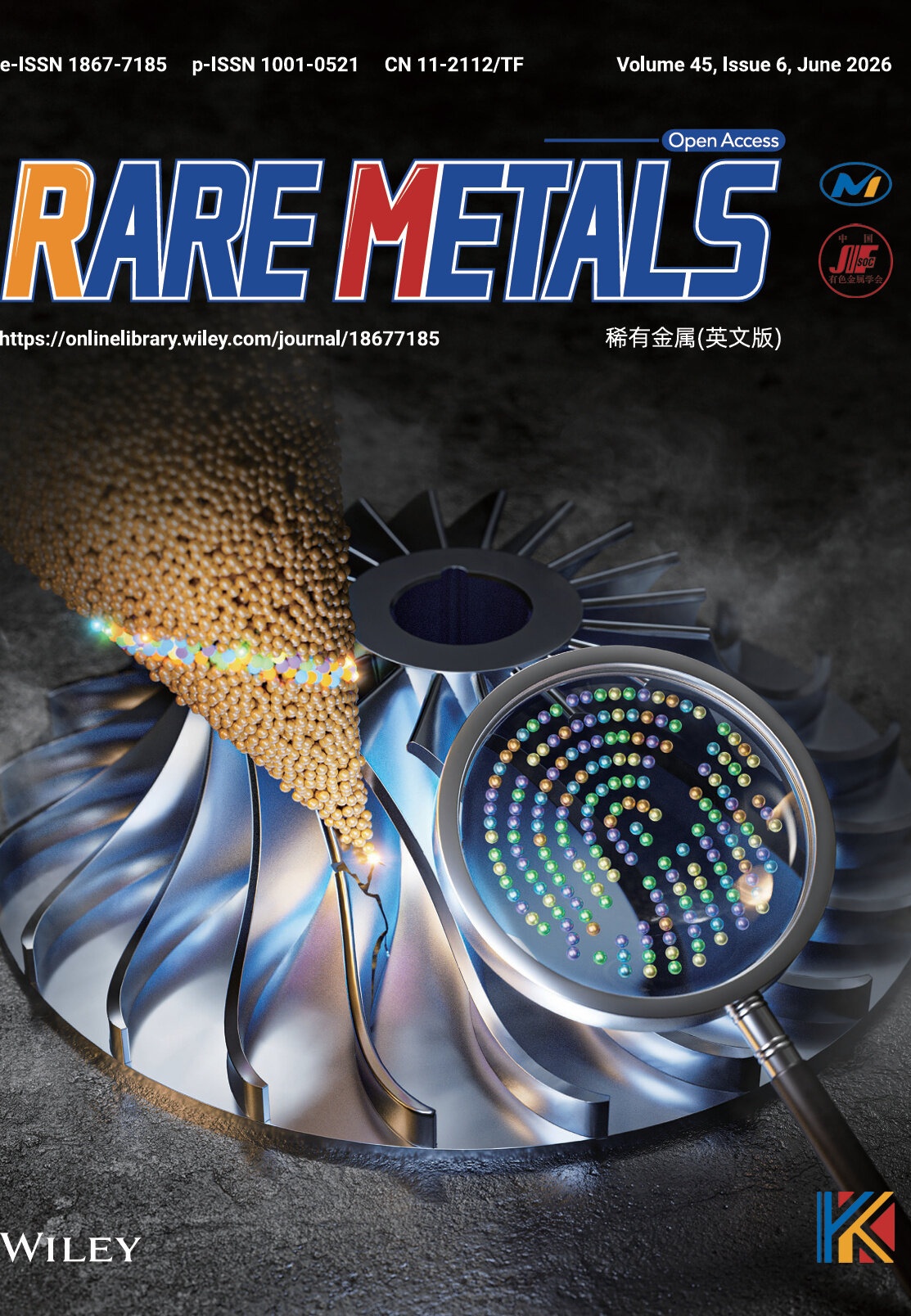
Rare Metals

Open Access
ISSN(Print): 1001-0521 | ISSN(Online): 1867-7185 | CN: 11-2112/TF

Aims & Scope

15.3CiteScore
12.1Impact Factor

Peer-reviewed and published monthly, Rare Metals is the official journal of the Nonferrous Metals Society of China, published by Youke Publishing Co., Ltd. The journal is dedicated to the publication and dissemination of original research articles (and occasional invited reviews) in the field of rare metals to establish a platform of communication between engineers and scientists. Rare Metals considers full-length articles, letters, mini reviews, reviews, perspectives, highlights, editorials, etc. Focal areas and topics of interest of the journal include, but are not limited to: Cross-disciplinary research in application of rare metals elements in advanced materials, including metal and metallurgy materials, ceramics, composites, magnetic materials, amorphous materials, battery materials, thermoelectric materials, catalytic materials, other energy materials, superconducting materials, 2D materials, biomaterials, perovskite materials, electronic materials, metamaterials, photonic materials, quantum materials, ecomaterials, etc. Characterization of the structure and properties of rare metal materials, specifically related to cutting-edge materials. Development of methodology with potential global impact in metallurgy, synthesis, and processing of rare metal materials.

More ↓

Nanofiltration Membranes for High-Selectivity Separation of Li+ and Mg2+ From Salt Lake Brines: Strategies, Challenges, and Perspectives

Against the backdrop of global clean energy transition and surging demand for lithium resources, lithium extraction from salt lakes presents unprecedented development opportunities. Nanofiltration (NF) membrane technology, recognized for its efficiency, energy savings, and environmental benefits, demonstrates significant application potential in lithium extraction from salt lake brines, particularly for the critical Mg2+/Li + separation step in high Mg2+/Li+ ratio brines—a key resource. However, substantial challenges remain. This review systematically summarizes recent research advances in the core separation mechanisms of NF membranes for Mg2+/Li+ separation and strategies for membrane structural design optimization. It prospectively analyzes key bottleneck issues, including membrane fouling, long-term operational stability under extreme brine environments, and the economic viability of large-scale applications. Furthermore, future research directions are highlighted, emphasizing the need to focus on machine learning-assisted membrane design, the development of advanced anti-fouling coatings, and integrated technologies coupling NF with processes such as electrodialysis or adsorption. This review aims to provide technical references for the efficient exploitation of salt lake lithium resources and offer scientific guidance for the development of next-generation high-performance NF membranes.

Show more
Redox Reaction and Dissolution Analysis for Hollow C Nanospheres Comprising N-Doped C Framework With Abundant Ni–Co Heteronuclear Catalysts for Highly Durable K‒Te Batteries

Tellurium (Te), emerging as a promising alternative to sulfur (S) and selenium (Se), offers significant advantages for potassium (K) ion storage due to its comparable theoretical volumetric capacity (2619 mAh cm−3) and higher electronic conductivity (∼102 S m−1), which promotes rapid charge transfer and improves reaction kinetics. However, substantial volume changes during potassiation/depotassiation and the shuttling effect of polytellurides hinder the feasibility of K–Te batteries. Moreover, comprehensive studies on the phase formation and dissolution mechanism of K-polytellurides (K–pTen) employing various in situ and ex-situ techniques are scarcely reported. Herein, we introduce a rational strategy utilizing nickel (Ni) and cobalt (Co) heteronuclear double-atom catalysts (DACs) encapsulated within hollow porous carbon nanospheres (Ni/Co‒N‒HPCNS) as hosts for tellurium impregnation (Te‒Ni/Co‒N‒HPCNS). In situ and ex-situ XRD analysis revealed continuous phase transformation during discharge from amorphous Te (starting at OCV) to K2Te3 (discharged to 1.5 V) and finally to K5Te3 (discharged to 0.5 V). During the reverse scan, K5Te3 was reversibly converted to K2Te3 (charged to 3.0 V). Additionally, density functional theory calculations have shown that the presence of Ni/Co‒DAC significantly impedes the dissolution of K–pTen species, thereby expediting the reaction kinetics to unprecedented levels (3000 cycles at 2.0C). When tested as a negative electrode for K-ion storage in a full-cell layout, the prepared nanostructure exhibits highly reversible K-ion redox reactions, demonstrating its potential for commercial applications. We believe that the comprehensive design and characterization strategy discussed herein will open new frontiers for obtaining nanostructures with unparalleled electrochemical performances.

Show more

Non-Precious Metals Enhance Hydrogen Evolution in COF/Cd0.9Cu0.1S S-Scheme Heterojunctions: KPFM Reveals Charge Transfer Pathways

Photocatalytic hydrogen production from water splitting is a promising strategy for sustainable and clean energy generation. However, the design of low-cost, highly active photocatalysts remains a critical challenge. In this study, covalent organic frameworks (COFs) were loaded onto the surface of Cd0.9Cu0.1S to fabricate COF/Cd0.9Cu0.1S heterojunction. As a photocatalyst for hydrogen evolution, the optimized 10COF/Cd0.9Cu0.1S sample achieved a hydrogen evolution rate of 3398.3 μmol h−1 g−1, representing 2.3-fold and 3398.3-fold enhancements compared with pristine Cd0.9Cu0.1S (1523.3 μmol h−1 g−1) and COF (almost nothing), respectively. The addition of Co2+ as a co-catalyst is a key factor in enhancing performance. Comprehensive photocatalytic tests, in situ X-ray photoelectron spectroscopy, and transient absorption spectroscopy revealed that the charge–transfer process follows an S-scheme mechanism. The covalent interaction between COF and Cd0.9Cu0.1S, coupled with favorable band alignment, induces a built-in electric field at the heterojunction interface, thereby accelerating charge separation and suppressing recombination. This work provides an effective strategy for constructing efficient organic–inorganic heterojunctions, offering new insights into photocatalytic water splitting.

Show more
xiazailiang-82
xiazailiang-0

Electronegativity-Driven Frontier Orbital Engineering in B-Ti Diatomic Synergy Enables Selective Li2C2O4 Conversion in Li-CO2 Batteries

s a promising alternative to sluggish Li2CO3-based Li-CO2 electrochemistry, Li2C2O4 offers a favorable 2e− discharge pathway, yet its selective formation and reversible decomposition remain debated. Herein, we propose a nonmetal-metal synergistic catalyst—B-Ti coregulated layered transition metal boride Ti18B18O9/graphene (B-Ti/TiBOG)—to enable efficient CO2-to-Li2C2O4 conversion via frontier orbital engineering (FOE). Density functional theory (DFT) and ab initio molecular dynamics (AIMD) simulations reveal that the low electronegativity of B (O > N > C > B) induces asymmetric Ti coordination, driving strong B 2p and Ti 3d orbital hybridization near the Fermi level, and better structural stability, outperforming C/N/O-Ti analogs. Interestingly, this unique FO alignment activates CO2 by populating its antibonding orbitals through a bidirectional “acceptance-feedback” mechanism to enhance CO2 adsorption (from −0.19 to −1.05 eV). The B-Ti synergy selectively stabilizes Li2C2O4 nucleation while kinetically suppressing its conversion to Li2CO3 (barrier > 0.68 eV). Consequently, the hybrid B-Ti/TiBOG catalyst achieves exceptional bifunctionality, yielding a minimal total overpotential (0.75 V) for CO2-to-Li2C2O4 cycling—maintained in the tetraethylene glycol dimethyl ether (TEGDME) solvent environments. This work highlights electronegativity-driven FOE in B-Ti diatomic synergy as key for rechargeable Li-CO2 batteries.

Show more
xiazailiang-0

Broad-Spectral Response Lead Halide Perovskite Solar Cells Through Integration of Multifunctional Organic Bulk-Heterojunction and Quantum-Cutting Downconversion Materials

Expanding near-infrared (NIR) spectral response and utilizing ultraviolet (UV) photons are effective strategies for enhancing the power conversion efficiency (PCE) of lead halide perovskite solar cells (PSCs). However, the range of NIR spectral response extension and the utilization of UV light for devices are not enough, and the loss of photovoltaic performance caused by UV light-induced degradation is still unavoidable. Herein, we develop a novel strategy by integrating a PTB7-Th:COi8DFIC bulk heterojunction (BHJ) with perovskite layers to broaden the NIR spectral absorption range to 1050 nm. Meanwhile, the BHJ layer with a suitable energy level can effectively passivate defects, improve charge transport, and resist the erosion of moisture. The mechanism of UV light-induced degradation in PSCs demonstrates that the evolution of microstructure results in a drastic decrease in photovoltaic parameters. For increasing UV utilization, a Y2O3:Bi3+, Yb3+ film is introduced into the device to convert high-energy photons in the UV region into lower-energy photons in the visible and NIR regions by the quantum-cutting effect. After synchronously broadening the NIR spectral absorption and improving the UV spectral response of the PSCs, the efficiency is considerably improved to 23.47%, and the short-circuit current density is enhanced from 21.33 to 24.62 mA cm−2. Upgraded devices exhibit excellent UV, humidity, and long-term stability. This study explores a comprehensive strategy for obtaining high-performance and stable broad-spectral response PSCs.

Show more
xiazailiang-0

Coalescence-Ripening Mechanism of γ′−Ni3(Al, Ti) During Long-Term/High-Temperature Operation of Ni-Based Superalloy Discs

The evolution of the γ′−Ni3(Al, Ti) phase in superalloys is governed by a coupled coalescence-ripening mechanism driven by elemental diffusion. In this study, thermal exposure experiments were performed at 750°C and 800°C for durations ranging from 100 to 20,000 h. The γ′ phase underwent coalescence-ripening, with its morphology evolving from small spherical particles to elliptical and finally to large spherical particles. During this process, high chemical potential gradients were observed around small-diameter γ′ phases and at the long-axis ends of elliptical γ′ phases. These gradients drove the dissolution of smaller γ′ phases by larger ones and the evolution of elliptical γ′ into spherical ones. Concurrently, the Ni/(Al + Ti) ratio in the γ′ phase decreased from 3.26 to 3.02 during exposure at 800°C. High-resolution scanning transmission electron microscopy (HR-STEM) analysis revealed complex atomic arrangements at the γ/γ′ interface and the dislocation, featuring variations in interplanar distance and abundant edge dislocations, which serve as efficient pathways for atomic diffusion. Moreover, as the γ′ phase coarsened, the γ/γ′ interfaces remained coherent, with the lattice mismatch gradually approaching zero. Geometric phase analysis (GPA) indicated a significant relaxation of elastic strain at these interfaces. Based on the change in Al concentration at the γ/γ′ interfaces, the interfacial energy decreased by approximately 3 times between 100 and 20,000 h of exposure at 800°C. This study provides foundational insights for a deeper understanding of elemental diffusion mechanisms in superalloys.

Show more
Special Collections
View All Collections→