

Overcoming low light and missed detection: A real-time vehicle cooperative perception and early warning method based on deep learning AITranslate
Abstract AITranslate
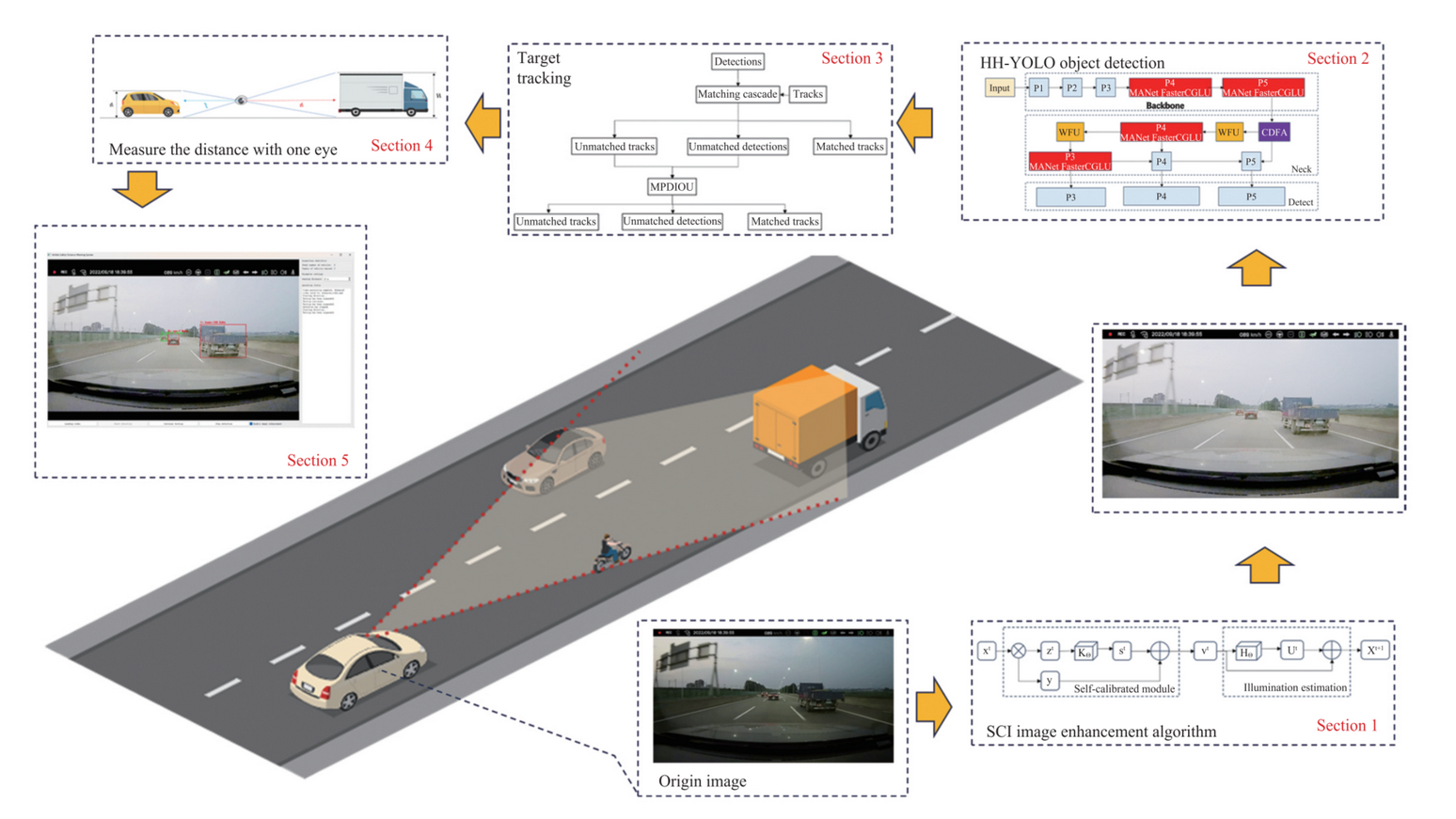
In traffic scenarios, the dynamic characteristics and random behaviors of vehicles are the main reasons for the frequent occurrence of collision accidents. Traditional early warning systems restrict traffic safety due to low detection accuracy and poor tracking effect. Research has proposed a vehicle safety distance early warning system based on deep learning to enhance traffic safety. Innovations include: adopting the self-calibrated illumination (SCI) algorithm to overcome light interference; the YOLOv11 algorithm is improved by introducing a secondary innovative cross-domain feature attention (CDFA) mechanism, reconstructing the feature pyramid, and integrating knowledge distillation to balance detection accuracy and real-time performance. The DeepSORT algorithm is improved by applying group convolution to reduce the number of parameters and replacing Intersection over Union (IoU) with MPDIoU to enhance tracking accuracy. The distance between vehicles is calculated by using the monocular vision ranging method. The detection, tracking, and ranging modules are integrated into a vehicle safety distance early warning system. Experimental evaluation demonstrates a marked improvement in the system's performance. On the public dataset, the detection model exhibits a gain of 3.89% in mAP@0.5 and 2.76% in mAP@0.5:0.95, while the tracking model achieves a 0.9% increase in multiple object tracking accuracy (MOTA). Furthermore, real-world vehicle validation confirms that the synergistic operation of the detection and tracking modules effectively mitigates the miss rate, thereby substantiating a tangible enhancement in overall system safety.
KeyWords AITranslate
[1]W. Yue, C. Li, P. Duan, and F.-R. Yu, "Revolution on wheels: A survey on the positive and negative impacts of connected and automated vehicles in the era of mixed autonomy," IEEE Internet Things Journal, vol. 10, no. 24, pp. 21820–21835, 2023.
[2]J. Xu, Y. Hou, D. Ren, L. Liu, F. Zhu, M. Yu, H. Wang, and L. Shao, "STAR: A structure and texture aware retinex model," IEEE Transactions on Image Processing, vol. 29, pp. 5022–5037, 2020.
[3]C. Li, C. Guo, and C. C. Loy, "Learning to enhance low-light image via zero-reference deep curve estimation," IEEE Transactions on Pattern Analysis and Machine Intelligence, vol. 44, no. 8, pp. 4225–4238, 2022.
[4]H. Zhao, Y. Gao, and W. Deng, "Defect detection using shuffle Net-CA-SSD lightweight network for turbine blades in IoT," IEEE Internet of Things Journal, vol. 11, no. 20, pp. 32804–32812, 2024.
[5]S. Yang, Y. Li, J. Nie, S. Ercisli, and T. R. Gadekallu, "Enhanced brain tumor detection using DCGAN augmentation and optimized efficientDet in IoT-based healthcare industry 5.0," IEEE Internet of Things Journal, vol. 12, no. 22, pp. 46093–46103, 2025.
[6]Z. Tian, H. Liu, J. Wu, W. Chen, R. Zheng, and Z. Wang, "PrFu-YOLO: A lightweight network model for UAV-assisted real-time vehicle detection toward an IoT underlayer," IEEE Internet Things Journal, vol. 11, no. 23, pp. 37536–37549, 2024.
[7]Y. Xie, D. Du, and M. Bi, "YOLO-ACE: A vehicle and pedestrian detection algorithm for autonomous driving scenarios based on knowledge distillation of YOLOv10," IEEE Internet Things Journal, vol. 12, no. 15, pp. 30086–30097, 2025.
[8]E. Yıldız and M. Keskinöz, "Efficient FCOS model for fire and smoke detection," 2025 9th International Symposium on Innovative Approaches in Smart Technologies (ISAS), pp. 1–5, 2025.
[9]X. Wu and Q. Xue, "An improved corner net-lite method for pedestrian detection of unmanned aerial vehicle images," 2021 China Automation Congress (CAC), pp. 2322–2327, 2021.
[10]Q. Gu, H. Huang, Z. Han, Q. Fan, and Y. Li, "GLFE-YOLOX: Global and local feature enhanced YOLOX for remote sensing images," IEEE Transactions on Instrumentation and Measurement, vol. 73, pp. 1–12, 2024.
[11]F. Li, H. Zhang, S. Liu, J. Guo, L. M. Ni, and L. Zhang, "DN-DETR: Accelerate DETR training by introducing query denoising," IEEE Transactions on Pattern Analysis and Machine Intelligence, vol. 46, no. 4, pp. 2239–2251, 2024.
[12]H. Li, Q. Wang, and Z. Li, "Investigating walking characteristics of passengers in subway corridors by video processing based on YOLOX and DeepSORT algorithm," Proc. China Autom. Congr. (CAC), pp. 5766–5771, 2022.
[13]Y. Liu, F. Liu, Y. Huang, J. Hu, W. Zhang, and Y. Hou, "The real-time pavement distress detection system based on edge-cloud collaborative computing," IEEE Trans. Intell. Transp. Syst., vol. 26, no. 7, pp. 10512–10522, 2025.
[14]Y. Jiang, X. Gong, D. Liu, Y. Cheng, C. Fang, and X. Shen, "EnlightenGAN: Deep light enhancement without paired supervision," IEEE Trans. Image Process., vol. 30, pp. 2340–2349, 2021.
[15]R. Liu, L. Ma, J. Zhang, X. Fan, and Z. Luo, "Retinex-inspired unrolling with cooperative prior architecture search for low-light image enhancement," Proc. IEEE/CVF Conf. Comput. Vis. Pattern Recognit. (CVPR), pp. 10556–10565, 2021.
[16]L. Ma, T. Ma, R. Liu, X. Fan, and Z. Luo, "Toward fast, flexible, and robust low-light image enhancement," Proc. IEEE/CVF Conf. Comput. Vis. Pattern Recognit. (CVPR), pp. 5627–5636, 2022.
[17]W. Wu, J. Weng, P. Zhang, X. Wang, W. Yang, and J. Jiang, "Interpretable optimization-inspired unfolding network for low-light image enhancement," IEEE Trans. Pattern Anal. Mach. Intell., vol. 47, no. 4, pp. 2545–2562, 2025.
[18]D. C. Khrisne, M. Sudarma, I. A. Dwi Giriantari, and D. Made Wiharta, "Nighttime traffic surveillance using glare reduction and Zero-DCE-based low-light image enhancement," Proc. Int. Conf. Smart-Green Technol. Electr. Inf. Syst. (ICSGTEIS), pp. 161–165, 2023.
[19]J. Shi, S. Ruan, Y. Tao, Y. Rui, J. Deng, P. Liao, and P. Mei, "Improved YOLO algorithm based on multi-scale object detection in haze weather scenarios," CHAIN, vol. 2, no. 2, pp. 183–197, 2025.
[20]M. Lei, H. Wu, X. Lv, and X. Wang, "CondSeg: A general medical image segmentation framework via contrast-driven feature enhancement," Proc. AAAI Conf. Artif. Intell. (AAAI), vol. 39, no. 5, pp. 4571–4579, 2025.
[21]W. Li, H. Guo, X. Liu, K. Liang, J. Hu, Z. Ma, and J. Guo, "Efficient face super-resolution via wavelet-based feature enhancement network," Proc. 32nd ACM Int. Conf. Multimedia (ACM MM), pp. 4515–4523, 2024.
[22]Y. Feng, J. Huang, S. Du, S. Ying, J. Yong, and Y. Li, "Hyper-YOLO: When visual object detection meets hypergraph computation," IEEE Trans. Pattern Anal. Mach. Intell., vol. 47, no. 4, pp. 2388–2401, 2025.
[23]J. Chen, S. Kao, H. He, W. Zhou, S. Wen, and C. LEE, "Run, don’t walk: Chasing higher FLOPS for faster neural networks," Proc. IEEE/CVF Conf. Comput. Vis. Pattern Recognit. (CVPR), pp. 12021–12031, 2023.
[24]D. Shi, "TransNeXt: Robust foveal visual perception for vision transformers," Proc. IEEE/CVF Conf. Comput. Vis. Pattern Recognit. (CVPR), pp. 17773–17783, 2024.
[25]Y. Wu and K. He, "Group normalization," Proc. Eur. Conf. Comput. Vis. (ECCV), pp. 3–19, 2018.
[26]Z. Tian, C. Shen, H. Chen, and T. He, "FCOS: A simple and strong anchor-free object detector," IEEE Trans. Pattern Anal. Mach. Intell., vol. 44, no. 4, pp. 1922–1933, 2022.
[27]Z. Chen, Z. He, and Z.-M. Lu, "DEA-Net: Single image dehazing based on detail-enhanced convolution and content-guided attention," IEEE Trans. Image Process., vol. 33, pp. 1002–1015, 2024.
[28]F. Zhang, H. Liu, Z. Chen, L. Wang, Q. Zhang, and L. Guo, "Collision risk warning model for construction vehicles based on YOLO and DeepSORT algorithms," J. Constr. Eng. Manag., vol. 150, no. 6, 2024.
[29]J. Xu, Y. Sun, S. Zhang, D. Sun, and Z. Xiang, "Wheat-YOLO: A real-time and high precision object detection for wheat," Proc. IEEE Int. Conf. Syst., Man, Cybern. (SMC), pp. 2165–2170, 2024.
[30]K. J. de Jesus, M. O. K. Pereira, L. R. Emmendorfer, and D. F. T. Gamarra, "A comparison of visual SLAM algorithms ORB-SLAM3 and DynaSLAM on KITTI and TUM monocular datasets," Proc. 36th SIBGRAPI Conf. Graph., Patterns Images (SIBGRAPI), pp. 109–114, 2023.
[31]F. Yu, H. Chen, X. Wang, W. Xian, Y. Chen, and F. Liu, "BDD100K: A diverse driving dataset for heterogeneous multitask learning," Proc. IEEE/CVF Conf. Comput. Vis. Pattern Recognit. (CVPR), pp. 2633–2642, 2020.
[32]S. Rujikietgumjorn and N. Watcharapinchai, "Vehicle detection with sub-class training using R-CNN for the UA-DETRAC benchmark," Proc. 14th IEEE Int. Conf. Adv. Video Signal Based Surveillance (AVSS), pp. 1–5, 2017.
[33]X. Xiong, M. He, T. Li, G. Zheng, W. Xu, and X. Fan, "Adaptive feature fusion and improved attention mechanism-based small object detection for UAV target tracking," IEEE Internet Things Journal, vol. 11, no. 12, pp. 21239–21249, 2024.
[34]M. B. Muhammad and M. Yeasin, "Eigen-CAM: Class activation map using principal components," Proc. Int. Joint Conf. Neural Netw. (IJCNN), pp. 1–7, 2020.
[35]B. Gao, R. Mei, Y. Lu, D. Chu, S. Zhang, Z. Wang, and K. Li, "Predictive lane-changing control for platoon based on cloud control system in highway scenarios," CHAIN, vol. 1, no. 1, pp. 75–98, 2024.
[36]J. Huang, K. Wan, J. Chen, J. Zhou, W. Zhong, and B. Gao, "A forward-looking sequential asynchronous lane-change strategy for vehicle platoon under cloud-vehicle-road integrated architecture," CHAIN, vol. 2, no. 1, pp. 43–56, 2025.
Basic Information:
DOI:10.23919/CHAIN.2025.000022
Chinese Library Classification Number:
Citation Information:
In traffic scenarios, the dynamic characteristics and random behaviors of vehicles are the main reasons for the frequent occurrence of collision accidents. Traditional early warning systems restrict traffic safety due to low detection accuracy and poor tracking effect. Research has proposed a vehicle safety distance early warning system based on deep learning to enhance traffic safety. Innovations include: adopting the self-calibrated illumination (SCI) algorithm to overcome light interference; the YOLOv11 algorithm is improved by introducing a secondary innovative cross-domain feature attention (CDFA) mechanism, reconstructing the feature pyramid, and integrating knowledge distillation to balance detection accuracy and real-time performance. The DeepSORT algorithm is improved by applying group convolution to reduce the number of parameters and replacing Intersection over Union (IoU) with MPDIoU to enhance tracking accuracy. The distance between vehicles is calculated by using the monocular vision ranging method. The detection, tracking, and ranging modules are integrated into a vehicle safety distance early warning system. Experimental evaluation demonstrates a marked improvement in the system's performance. On the public dataset, the detection model exhibits a gain of 3.89% in mAP@0.5 and 2.76% in mAP@0.5:0.95, while the tracking model achieves a 0.9% increase in multiple object tracking accuracy (MOTA). Furthermore, real-world vehicle validation confirms that the synergistic operation of the detection and tracking modules effectively mitigates the miss rate, thereby substantiating a tangible enhancement in overall system safety.
quote
| GB/T 7714-2015 | [1] Hengkai Wang, Zhe Zhang, Xiao Luo, et al. Overcoming low light and missed detection: A real-time vehicle cooperative perception and early warning method based on deep learning[J]. Chain, 2025, 2(4): 304-320. DOI:10.23919/CHAIN.2025.000022. |
| MLA | [1] Hengkai Wang, et al., "Overcoming low light and missed detection: A real-time vehicle cooperative perception and early warning method based on deep learning." Chain, vol. 2, no. 4, 2025, pp. 304-320, https://doi.org/10.23919/CHAIN.2025.000022. |
| APA | [1] Hengkai Wang, Zhe Zhang, Xiao Luo, Wei Zhong, Hong Qi, & Dong Zhang. (2025). Overcoming low light and missed detection: A real-time vehicle cooperative perception and early warning method based on deep learning. Chain, 2(4), 304-320. https://doi.org/10.23919/CHAIN.2025.000022 |
| IEEE | [1] Hengkai Wang, Zhe Zhang, Xiao Luo, Wei Zhong, Hong Qi, and Dong Zhang, "Overcoming low light and missed detection: A real-time vehicle cooperative perception and early warning method based on deep learning," Chain, vol. 2, no. 4, pp. 304-320, 2025, doi: 10.23919/CHAIN.2025.000022. keywords: {real-time vehicle detection;multi-target tracking;deep learning;traffic safety warning;attention mechanism} |