Contents of issue 3 volume 3 Contents of issue 3 volume 3

Hydrogen energy is a clean and versatile energy carrier, increasingly recognized for its role in a sustainable energy future due to its clean and abundant energy production. Bridging the gap between potential and practicality, digital Twin (DT) technology emerges as a pivotal artificial intelligence tool, providing a virtual modelling platform that enhances the operation and integration of hydrogen energy into modern energy systems. This review firstly explores the multifaceted applications of DT technology across different stages of the hydrogen energy lifecycle, including production, storage, transport, and utilization. It commences with a detailed introduction to DT technology, elucidating its definition, core principles, and structural nuances, thus laying the groundwork for understanding its pivotal role in energy systems. The core of the review delves into the applications of DT technology in hydrogen energy, segmenting the discussion into production, storage, transport, and utilization processes. Specific focus is given to optimizing fuel cells and hybrid electric vehicles through DT models, along with the seamless integration of hydrogen systems with broader energy networks. It further dissects the working mechanism of DT, highlighting the key features that contribute to itsgrowing prominence in the energy sector.
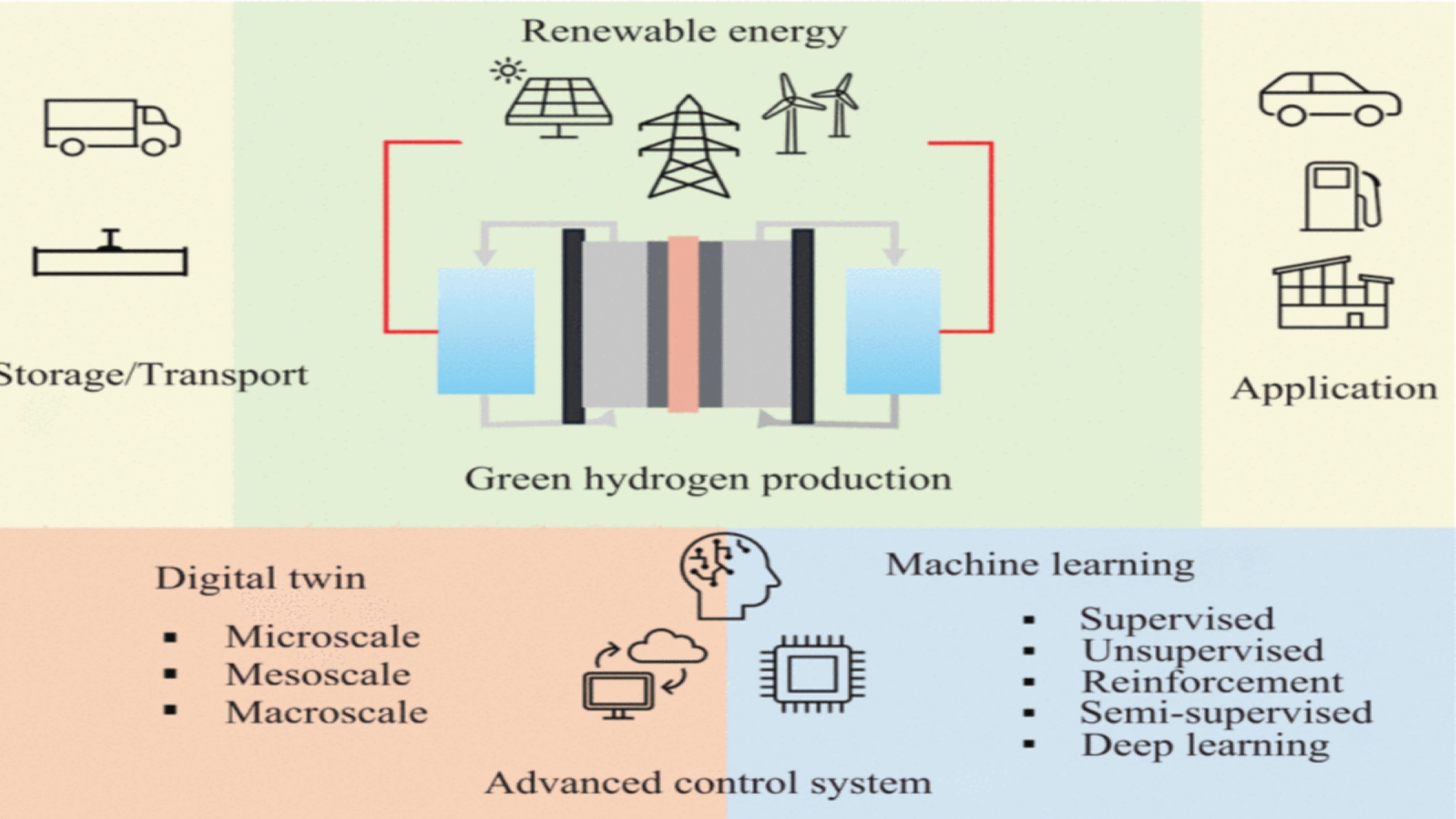
The successful reduction of carbon emissions in major sectors such as heavy industry and long-distance transport depends crucially on the ability to produce green hydrogen on a large scale. This involves generating hydrogen via water electrolysis, utilizing power sourced from renewable energies. However, persistent challenges, such as dynamic inefficiencies, material degradation, and renewable intermittency, demand a paradigm shift from static control strategies to adaptive, self-optimizing systems. This perspective argues that the synergistic integration of digital twins (DTs) and machine learning (ML) offers a transformative framework for real-time optimization, predictive maintenance, and resilient grid integration. By synthesizing physics-based modeling with data-driven intelligence, DT-ML systems enable closed-loop control architectures that dynamically adapt to operational uncertainties. We analyze the technical foundations of this integration, address critical barriers, and propose actionable pathways for stakeholders to accelerate the hydrogen economy's transition from promise to practice.
Hydrogen plays a vital role in achieving NetZero emissions as a carbon-free energy carrier. However, its production, especially green hydrogen generated from renewable sources, is hindered by low efficiency and limited yield, primarily due to the performance of the catalysts used. Developing efficient catalysts typically involves extensive experimental work and trial-and-error processes. For instance, screening for effective catalysts still heavily relies on human-lab-work, a process that is time-consuming. Facing this critical challenge, machine learning (ML) emerges as a promising solution. ML, a core component of data mining and analysis that uses statistical algorithms without explicit instructions, can rationalize the design of catalysts through the use of big data, including DFT results. This approach makes a significant shift from traditional trial-and-error approaches to more computationally driven strategies, offering a more effective path to uncovering vital methodologies for catalyst development. This review aims to capture and evaluate the impact of ML algorithms that have driven progress in catalyst research over the past three years. It presents an overview of the existing ML algorithms, exploring their specific functionalities, benefits, and limitations. Besides, this review also considers prospective solutions and future directions for applying ML to enhance the efficiency of green hydrogen production, particularly through electrochemical and biological processes.
Benefiting from the synergistic integration of aerial agility and terrestrial endurance, aerial-ground amphibious platforms can effectively traverse unstructured environments, demonstrating considerable potential for emergency response and reconnaissance applications. However, most existing systems adopt a decoupled configuration, utilizing independent propulsion units for ground and aerial modes. Although this approach enables dual-domain operation, the duplicated actuators and transmission chains inevitably incur structural redundancy and additional mass, which reduce overall system integration and payload efficiency. To address these limitations, this paper proposes a novel aerial-ground amphibious platform based on an integrated wheel-propeller structure. In the proposed design, a single electric motor actuates both the wheel and ducted propeller through a shared powertrain, where an electromagnetic clutch selectively engages the transmission path to switch between terrestrial locomotion and aerial propulsion. Building upon this mechanism, an amphibious platform configuration incorporating eight-wheel-propeller units is developed. By establishing a dynamic simulation model of the platform, the dynamic response characteristics during the drive-to-fly transition were investigated. The results demonstrate the feasibility of the operational principle underpinning the platform. The research provides a feasible technical approach for lightweight and highly integrated aerial-ground platforms, laying the foundation for future experimental implementation.
The ionomer coating structure on the catalyst surface critically determines the performance and durability of proton exchange membrane fuel cell (PEMFC) electrodes. Conventional fabrication often yields non‑uniform overlayers, increasing oxygen transport resistance, blocking active sites, and accelerating interfacial degradation. Advancing from random deposition to controlled coating structure is therefore a key objective. Ionomer adsorption is governed by its intrinsic properties, support characteristics, and catalyst morphology. In liquid environments, adsorption involves backbone hydrophobicity and side‑chain chemical bonding, with the latter dominating the final configuration. Solvent composition, particularly water content, modulates dispersion, and adsorption behavior. Optimization strategies focus on two main approaches: suppressing detrimental adsorption (e.g., by tailoring support porosity or using additives like ionic liquids) and constructing favorable mass‑transport pathways (e.g., by designing ionomers with cyclic/porous structures or engineering porous overlayers). Rational design of ionomer properties, interface regulation, and integration of these strategies can synergistically enhance proton conduction, mass transport, and stability, laying a foundation for high‑performance, durable fuel cell electrodes.
Lithium titanate oxide (Li4Ti5O12, LTO) anode-based batteries are widely recognized for their excellent safety characteristics and long cycle life. However, constant-voltage overcharging (CVOC), arising from cell-to-cell variations and delays in the response of a battery management system (BMS), can accelerate capacity degradation and increase the risk of thermal runaway. In this work, we systematically investigated the effects of CVOC at different voltages on the capacity retention and thermal safety of LTO-based batteries. By subjecting cells to overcharging cycling at elevated voltages, we elucidate the aging mechanisms and degradation pathways. Noninvasive diagnostics combined with postmortem analyses are employed to correlate the electrochemical behavior with the electrode morphology and composition under CVOC conditions. A critical voltage of 3.5 V is identified, beyond which severe degradation occurs. At 4.0 V, continuous CVOC induces the growth of a thick organic-rich solid-electrolyte interphase (SEI) and byproducts, leading to only 60% capacity retention compared with nearly 100% retention under 3.0 V CVOC or conventional constant-current/constant-voltage charging. Furthermore, the self-heating onset temperature decreases by 44.8 °C, indicating a significant reduction in thermal stability associated with high-voltage overcharge. These findings are corroborated by detailed postmortem characterization. Overall, this study demonstrates that the CVOC critically impacts both the electrochemical performance and thermal safety of LTO-based batteries, offering important insights for the design of high-stability, highly safe power sources for electric transportation systems.