ContentsFigures & Tables
With the rapid advancement of modern technologies, tribology is facing new challenges, particularly in electrified systems. In electrically driven environments such as electric vehicles, wind turbines and microelectronic devices, traditional tribological concepts are often no longer adequate (Figure 1A) [1]. Meanwhile, electrical stimuli can provide a controllable means to manipulate lubricant behaviour, opening new opportunities for smart, tunable lubrication and active control of friction [2]. These developments point to the need to understand how electrical conditions influence lubricating systems.
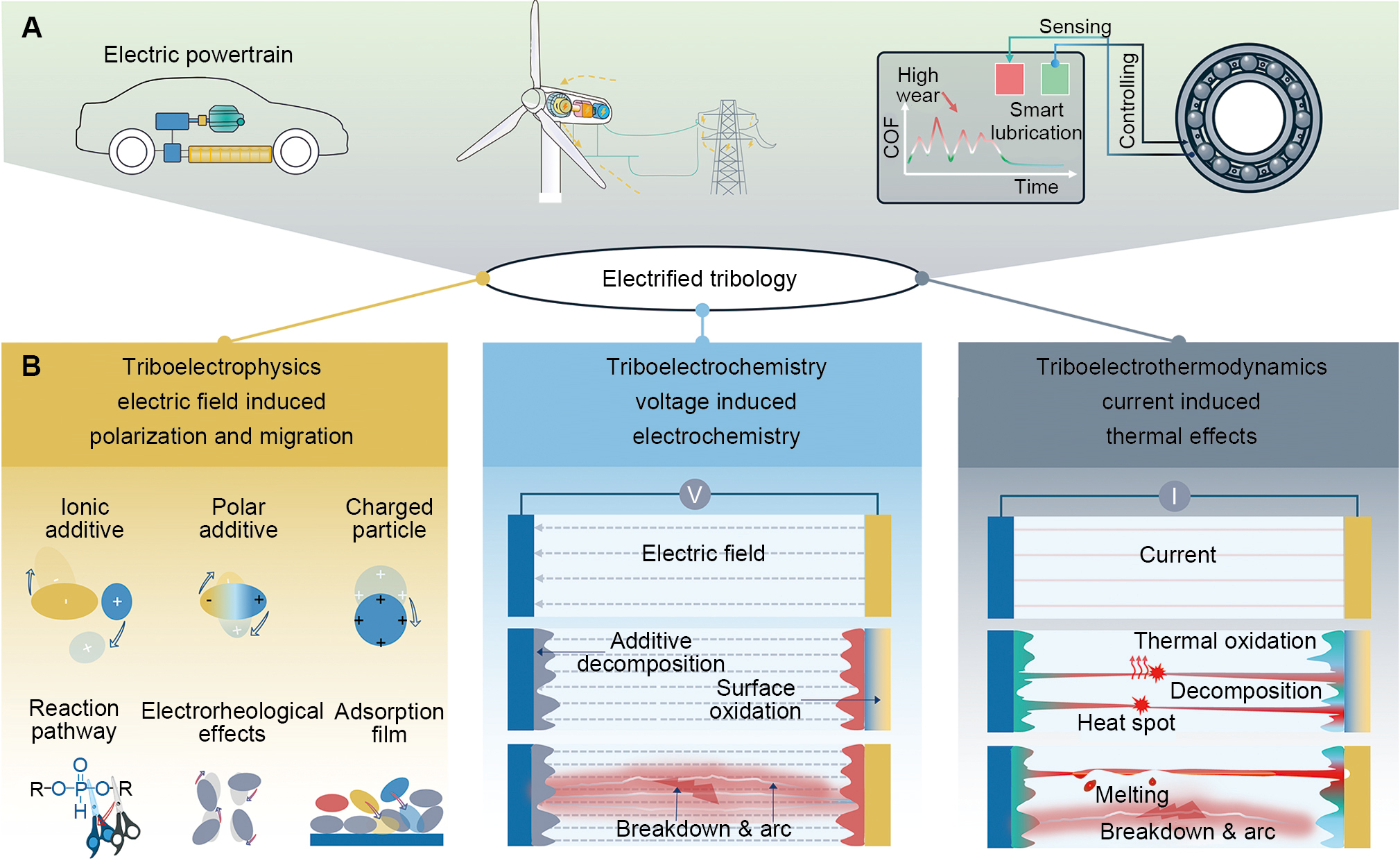
Electrified tribology has developed intermittently over more than 150 years [3]. In the past decade, this field has gained substantial attention and evolved into a rapidly expanding research area. Early studies focused primarily on aqueous systems, whereas recent work has broadened to include non-aqueous lubricants, advanced additives, greases, electrically assisted superlubricity and dry sliding contacts [4]. Correspondingly, research has shifted from largely phenomenological observations to more mechanistic investigations of interfacial behaviour, electrochemical reactions, tribofilm formation and current-induced Joule heating (Figure 1B) [5]. Despite these advances, the field remains fragmented, and a unified framework linking lubricant chemistry, interfacial response, and the distinct roles of voltage and current is still lacking, limiting our understanding of modern electrified lubrication systems and the design of high-performance lubricants. To advance the understanding of electrified tribology, a systematic framework is required.
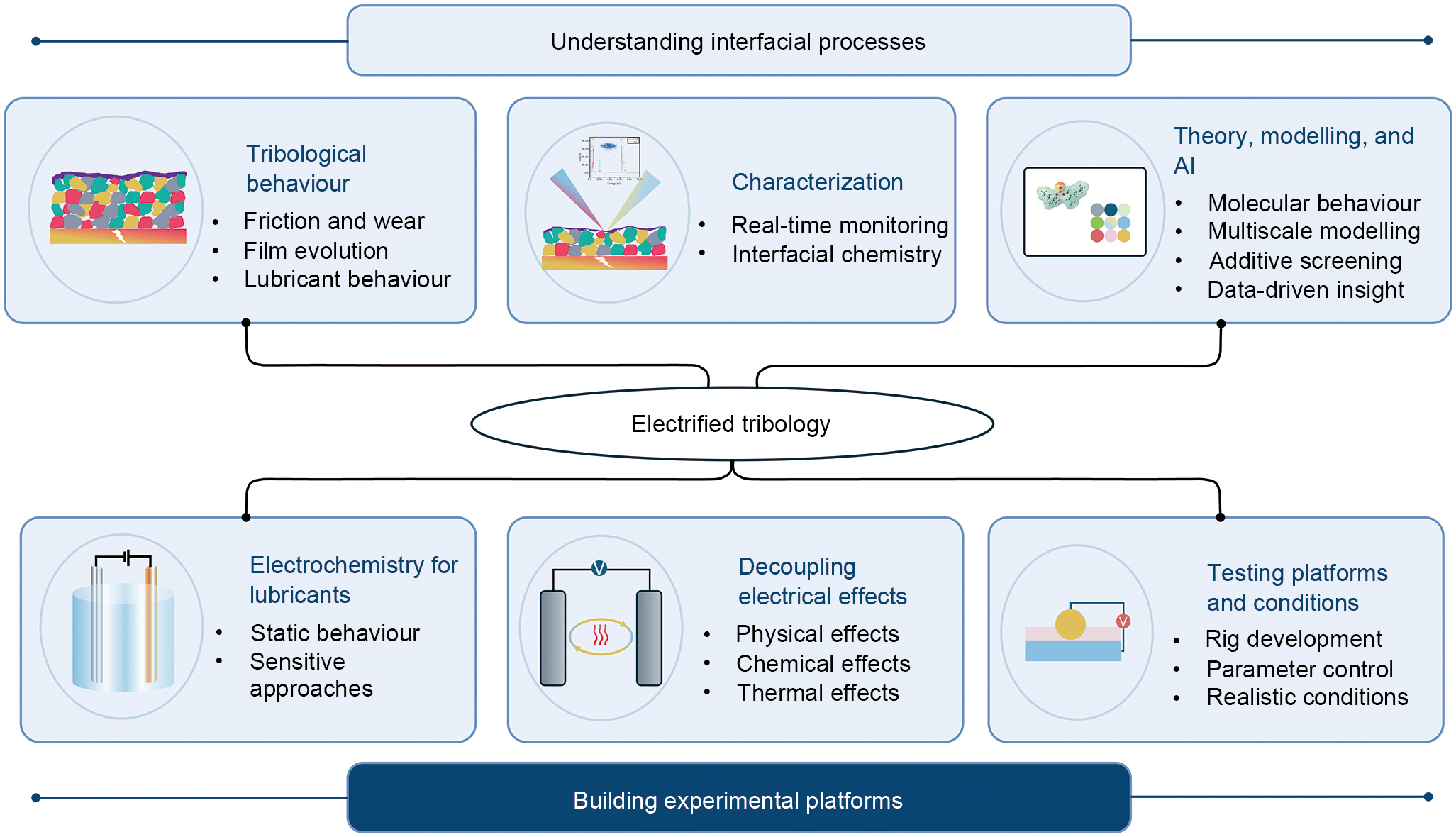
To guide future developments in electrified tribology, a conceptual framework is proposed (Figure 2). It is divided into two complementary components: building experimental platforms, which focuses on establishing reliable methodologies; and understanding interfacial processes, which aims to reveal the underlying mechanisms. Each component and its associated elements are discussed in detail in the following sections.
Establishing the fundamental electrochemical properties of lubricants under well-defined, static conditions provides a baseline for interpreting their behaviour. However, this remains challenging because commercial lubricants differ substantially from conventional electrochemical electrolytes, typically exhibiting ultra-low conductivity and high viscosity. For hydrocarbon-based lubricants, conductivity can be as low as 1 to 10 pS cm−1, making electrochemical reactions at the interface difficult to control or even detect [6]. This limitation calls for the development of more sensitive electrochemical approaches, such as nano-electrochemistry, to better capture interfacial processes under realistic tribological conditions.
From an electrical perspective, electrified rubbing contacts, which experience applied voltage and current, can be broadly categorized into three regimes: triboelectrophysics [4], triboelectrochemistry [3], and triboelectrothermodynamics (Figure 1B) [5]. Triboelectrophysics refers to physical effects, including molecular polarization, reorientation and migration, which can modify interfacial adsorption, structure and tribochemical pathways. Triboelectrochemistry governs electrochemical reactions once the stability window is exceeded, leading to oxidation, reduction and tribofilm evolution. Triboelectrothermodynamics, more often encountered in high current conditions, mainly originates through Joule heating, particularly at asperity contacts, resulting in localized temperature rise, accelerated lubricant degradation and surface damage such as micropitting. Under extreme conditions, high voltage and current may induce dielectric breakdown and electrical arcing, causing severe deterioration of lubrication performance.
Distinguishing the individual and coupled effects of voltage and current, and how they lead to the three triboelectric effects stated above, is essential as different engineering systems generate these conditions in distinct ways. The underlying mechanisms of triboelectric phenomena such as accelerated wear, asymmetric tribofilm formation between anodic and cathodic surfaces, and surface damage are not well understood due to the possible coupling effect between voltage and current. In practical rubbing contacts, electrical phenomena coexist. A key challenge is to identify the governing factors that determine which mechanism dominates under given conditions, as well as how transitions between triboelectrophysical, triboelectrochemical and triboelectrothermal regimes occur (Figure 3). Establishing quantitative criteria, potentially in the form of dimensionless parameters, to describe these transitions would provide a more unified framework for electrified tribology and enable predictive control of lubrication performance. Further attention is also needed to clarify the differences and connections between tribocorrosion, current-carrying wear, and electrochemical wear.
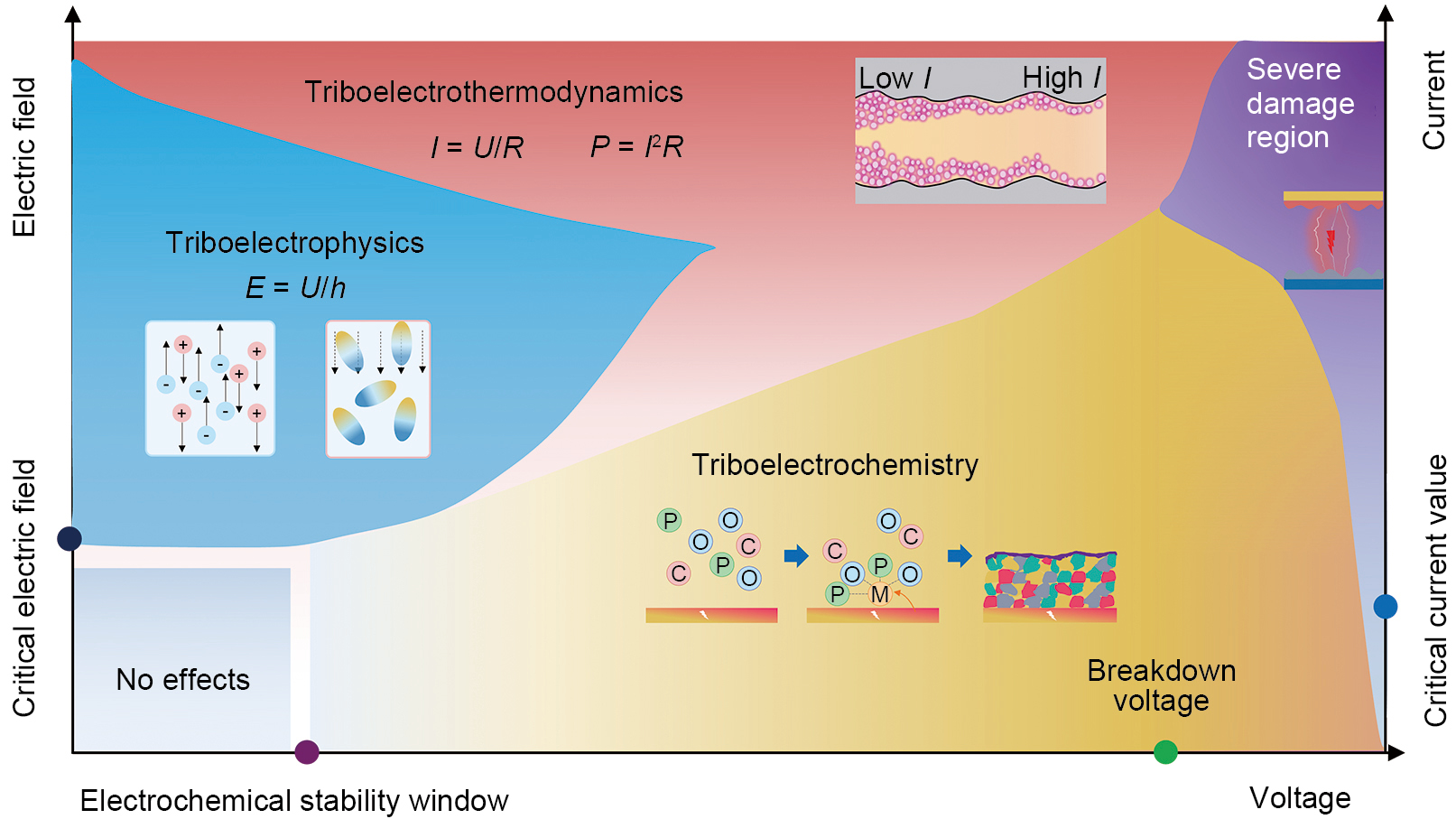
Additional factors, including alternating versus direct current, voltage polarity, and symmetric versus asymmetric tribofilm formation, further complicate system behaviour [7]. Moreover, in practical applications, electrical inputs are often transient or intermittent, introducing time-dependent effects on interfacial processes and tribofilm evolution. These complexities highlight the need for systematic experimental strategies and advanced testing platforms to decouple electrical effects and enable the rational design of next-generation lubricants and electrified lubrication systems.
Electrified tribology introduces dynamic mechanochemical processes on top of static electrochemical principles. This necessitates the development of advanced tribometers capable of operating under controlled electrical conditions. Such testing platforms should aim to replicate realistic engineering environments. With the increasing complexity of modern technologies and the emergence of extreme and application-specific conditions, tribometers should be designed with enhanced flexibility and precision to accommodate diverse lubricating systems and electrical functionalities. These advances would further enable the study of electrified tribology under a wider range of lubrication regimes, including full-film lubrication, as well as under different environmental conditions, such as controlled atmospheres and vacuum.
Given that lubricant chemistry largely governs interfacial behaviour, insights from state-of-the-art electrochemistry can be leveraged to guide the understanding and design of electrically responsive lubrication. At the fundamental level, studies can begin with simplified systems, such as a single additive in a base oil, before extending to multi-component formulations. Understanding single-molecule behaviour at interfaces provides a necessary foundation for interpreting more complex systems, where lubrication arises from intricate interactions rather than simple additive effects. Under electrified conditions, evaluating lubricant behaviour requires going beyond conventional bulk properties, such as conductivity, electrochemical stability window, dielectric constant and viscosity. Instead, it is essential to consider molecular structure, aggregation state, interfacial adsorption, electrochemical reactivity and tribochemical processes.
In mild electrified conditions, lubricant behaviour is primarily governed by electrostatic interactions. In many systems, additives in lubricants exist as aggregates or solvated structures rather than fully dispersed molecules. These structures contribute to lubricant stability; however, electric fields can disrupt such assemblies.
At the interface, adsorption layers often resemble electric double layer (EDL)-like structures, consisting of the inner Helmholtz plane (IHP), outer Helmholtz plane (OHP) and diffuse layer [5]. Species located in the IHP are closest to the surface and are most likely to participate in interfacial reactions. Changes in surface potential can modify both the composition and concentration of species in this region, depending on the functional groups of the additives. In multi-additive systems, competitive adsorption becomes particularly important, as electric fields can selectively enrich specific species at the interface, thereby modifying tribofilm composition and frictional behaviour [8].
In some cases, field-induced redistribution of ions dominates lubrication performance. For example, in ionic liquid systems, cations may preferentially accumulate near negatively biased surfaces, governing interfacial layer structure and frictional response. Electric fields can also influence the orientation and charge distribution of functional groups, leading to distinct products with different effects on tribofilm formation. For example, phosphite decomposes through C–O and P–O bond cleavage, forming alkanes and alcohols, respectively [9]. Even trace amounts of reaction products can significantly affect interfacial behaviour by modifying adsorption or inducing secondary tribochemical interactions.
When the applied voltage lies beyond the electrochemical stability window, electrochemical reactions occur at the rubbing interface. Traditional electrochemical phenomena can be observed in rubbing contacts and their impact on tribological performances should be verified. The mechanical action of a rubbing contact however may lead to reactions that cannot occur under traditional electrochemical conditions [10]. This highlights an emerging direction in electrified tribology: the coupling of applied voltage and mechanical rubbing, referred to as mechanoelectrochemistry, where electrical and mechanical stimuli act simultaneously to drive tribochemical reactions. A key challenge lies in distinguishing such coupled processes from those in which electrochemical and mechanical effects occur sequentially. Future studies should also focus on clarifying how friction and shear affect electrochemical processes at rubbing interfaces, including charge transfer, ion transport, adsorption/desorption, activation barriers, and interfacial reaction pathways and kinetics.
During the use of lubricants, aging, impurity formation, and changes in the lubrication interface lead to new adsorption interfaces, which may involve new molecules. This makes new electrochemical reactions more likely, especially with the induction of highly active molecules such as water, acids, and alcohols during the lubrication process.
In addition to lubricant decomposition, the electrically-promoted interface evolution should also be considered. Metal rubbing surfaces undergo redox reactions under electrochemical conditions, especially in the presence of oxygen, while the tribofilm also evolves gradually during the electrochemical process [11]. These changes can impact on lubricant performance. Some formulated lubricants show different behaviour in additive adsorption on steel interfaces and on oxidized interfaces, leading to drastically different friction coefficients and wear behaviours.
The formation of tribofilms is a multi-step process that may continue to be influenced by electrical conditions. The initial tribofilm formation is related to the rubbing interface and the adsorption layer, which plays a key role in the subsequent tribofilm formation. At a steady state, the structure and composition of the tribofilm vary across its thickness. The inner layer may determine the stability of the tribofilm, while the outer layer governs the frictional performance. We need to clarify the role of electrochemistry at each stage of the tribofilm formation process and how these steps influence subsequent lubricant adsorption and tribochemical reactions.
Real surfaces are rough. This results in a highly heterogeneous current distribution where electrical current is concentrated at micro-asperity contacts, leading to highly localized Joule heating and extreme thermal gradients. These local temperature rises govern lubricant degradation, tribofilm stability, and surface reactions, including oxidation and even melting under severe conditions. However, how such localized, transient processes scale up to influence macroscopic tribological performance remains largely unknown.
Future research should therefore focus on resolving current pathways and quantifying local thermal effects within rubbing interfaces. In particular, establishing a clear relationship between current density, temperature evolution and tribological performance is essential. While excessive current generally degrades lubrication, controlled thermal effects may in some cases enhance lubricant reactivity or tribofilm formation. This raises the possibility of using electrical current as a design parameter to actively tune lubrication performance, rather than treating it solely as a detrimental factor.
Advancing the understanding of lubricant behaviour at interfaces requires a more integrated and interdisciplinary approach. Progress in electrified tribology increasingly depends on the convergence of expertise from chemistry, electrochemistry, materials science, interfacial science and advanced characterization. In particular, the development of in-situ and in-operando techniques is essential for capturing the dynamic formation and chemical evolution of tribofilms under realistic conditions. Real-time observation of interfacial processes enables the identification of transient species and reaction pathways, providing critical insights into tribochemical mechanisms.
Beyond experimental advances, theoretical modelling and simulations play a key role in interpreting complex interfacial phenomena and predicting system behaviour under electrical stimuli. These approaches can bridge length and time scales that are difficult to access experimentally, linking molecular-level interactions to macroscopic tribological performance. In parallel, data-driven methods, including machine learning and artificial intelligence, offer new opportunities to analyse high-dimensional datasets, identify hidden correlations and accelerate the discovery of functional lubricant systems. Such a framework will enable not only the rational design of advanced lubricants but also the optimization of tribological systems under increasingly complex and dynamic operating conditions.
In summary, electrified tribology represents a complex interplay of electrical, mechanical and chemical processes that extends beyond the scope of conventional electrochemistry. This Perspective highlights the need for a systematic framework that integrates the development of experimental platforms with an understanding of interfacial processes. Future progress will depend on the integration of controlled experiments, advanced in situ characterization and predictive modelling, enabling a transition from phenomenological observations to mechanism-driven understanding. Such advances will provide a foundation for the rational design of next-generation lubricants and the development of electrified lubrication systems with tunable and optimized performance. To support this field, the establishment of standardized evaluation frameworks, together with stronger interdisciplinary and academia-industry integration, will be essential to translate fundamental insights into practical electrified lubrication systems.
Yun Zhao: Conceptualization; data curation; writing. Jie Zhang: Conceptualization; review & editing. Hugh A. Spikes: Conceptualization; review & editing. Janet S.S. Wong: Conceptualization; review & editing.
This research was financially supported by the Shell University Technology Centre (UTC) for Mobility and Lubricants and the EPSRC InFUSE Prosperity Partnership (Grant No. EP/V038044/1). Yun Zhao is funded by Shell and UKRI via IDLA studentship.
The data that support the findings of this study are available from the corresponding author upon reasonable request.
G. Xie, D. Guo, and J. Luo, "Lubrication under charged conditions," Tribology International 84 (2015): 22–35, https://doi.org/10.1016/j.triboint.2014.11.018.
B. Fernando, A. A. Kornyshev, S. Perkin, and M. Urbakh, "Electrotunable friction with ionic liquid lubricants," Nature Materials 21 (2022): 848–858, https://doi.org/10.1038/s41563-022-01273-7.
H. A. Spikes, "Triboelectrochemistry: Influence of applied electrical potentials on friction and wear of lubricated contacts," Tribology Letters 68 (2020): 90, https://doi.org/10.1007/s11249-020-01328-3.
S. Li, C. Liu, W. He, J. Zhang, X. Qiao, J. Li, D. Xiang, G. Qian, P. Bai, Y. Meng, and Y. Tian, "A review of electric potential-controlled boundary lubrication," Lubricants 11, no. 11 (2023): 467, https://doi.org/10.3390/lubricants11110467.
Y. Zhao, Z. Zhu, J. Zhang, E. Weiand, C. Wang, J. P. Ewen, D. Dini, H. A. Spikes, and J. S. S. Wong, "Electrically tunable friction through surface adsorption layer restructuring," ACS Applied Materials & Interfaces 17, no. 52 (2025): 70994–71007, https://doi.org/10.1021/acsami.5c20376.
Y. Zhu, S. Ogano, G. Kelsall, and H.A. Spikes, "The study of lubricant additive reactions using non-aqueous electrochemistry," Tribology Transactions 43, no. 2 (2000): 175–186, https://doi.org/10.1080/10402000008982327.
Z. Peng, A. Nassif, F. Georgi, P. Montmitonnet, and I. Lahouij, "Electric polarity: A key factor in lubricated wear of bearing steel," Tribology International 209 (2025): 110748, https://doi.org/10.1016/j.triboint.2025.110748.
J. Wu, Z. Gao, Z. Fu, L. Lin, X. Wang, Y. Zhao, L. Peng, F. Kang, Z. Guo, M. M. Titirici, Y. Zhao, X. Fan, and B. Li, "Regulation of the cathode inner helmholtz plane in dilute ether electrolytes using an electric-field-responsive solvent for high-voltage lithium metal batteries," Energy & Environmental Science 18, no. 10 (2025): 4677–4689, https://doi.org/10.1039/D4EE05818F.
Z. Zhu, J. P. Ewen, E. M. Kritikos, A. Giusti, and D. Dini, "Effect of electric fields on the decomposition of phosphate esters," The Journal of Physical Chemistry C 128, no. 38 (2024): 15959–15973, https://doi.org/10.1021/acs.jpcc.4c04412.
C. Liu, Z. Zhu, W. Ouyang, H. Pan, Z. Shi, X. Chen, J. P. Ewen, J. Zhang, D. Dini, M. Ma, H. Zeng, Y. Tian, and Y. Meng, "Friction-induced electrochemical activation of platinum group metals via electromechanical coupling," Materials Today 96 (2026): 103323, https://doi.org/10.1016/j.mattod.2026.103323.
Y. Zhao, J. Zhang, H. A. Spikes, and J. S. S. Wong, "Voltage-driven growth of phosphorus tribofilms," Tribology Letters 74, no. 3 (2026), https://doi.org/10.1007/s11249-026-02173-6.
 Top
Top