ContentsFigures & Tables
Against the backdrop of the global energy transition and pursuit of sustainable development, lithium-ion batteries (LIBs) have become a ubiquitous energy storage solution. Due to their significant advantages, such as lightweight, long cycle life, and low self-discharge rate, they have been widely used in electric vehicles (EVs), smart grids, and aerospace [1, 2]. As the cornerstone of clean energy storage systems, the reliability of LIB performance is inextricably linked to the advancement of these pivotal industries. With the continuous expansion of application scenarios and the increasing complexity of energy storage systems, the aging and degradation of LIBs are becoming increasingly apparent [3, 4]. State of health (SOH) estimation has become a core technological challenge to ensure system safety [5]. As a crucial metric for quantifying battery performance degradation, SOH not only reflects the current operational status of batteries but also provides a foundation for predictive maintenance and optimizing battery management strategies.
During long-term operation, LIBs experience complex electrochemical aging [6], which is reflected mainly in continuous capacity fade and gradual increase in internal resistance (IR) [7]. These changes indicate irreversible degradation of internal materials. The associated mechanisms include continuous growth of the solid electrolyte interphase (SEI) layer, phase transition, deactivation of active materials, and continuous loss of lithium inventory (LLI). Accurate SOH assessment optimizes battery operation strategies. Real-time monitoring and reasonable charge-discharge planning effectively extend service life. It improves operational safety by providing early warning of potential faults and reducing aging-related risks. It also lowers operation and maintenance costs through targeted maintenance and fewer unnecessary replacements [8].
Traditional electrochemical model-based estimation methods offer unique advantages in mechanism analysis [9, 10]. However, they still suffer from limitations in practical engineering. Accurate physicochemical modeling requires comprehensive material parameters and boundary conditions that are difficult to obtain experimentally. Battery aging involves complex multi-scale, multi-physics coupling, making high-precision mathematical models extremely challenging to establish. Additionally, considerable cell-to-cell inconsistency across batches and operating conditions renders unified mechanistic models ineffective in real practice.
These industrial pain points are particularly acute in real-world applications. In onboard battery management systems (BMS), accurate estimation must be achieved under severe computational constraints, as automotive-grade microcontrollers offer limited memory and processing power compared to academic platforms. In echelon utilization of retired batteries, rapid and reliable sorting of large-volume packs with diverse aging histories is required, yet traditional full-cycle testing is economically prohibitive, and standardized protocols are lacking. At the system level, cell-to-cell inconsistency complicates health management, as pack-level estimates cannot be readily derived from individual cell models, and most existing algorithms focus on single-cell analysis without addressing pack heterogeneity. These challenges highlight a critical gap between academic research and engineering practice.
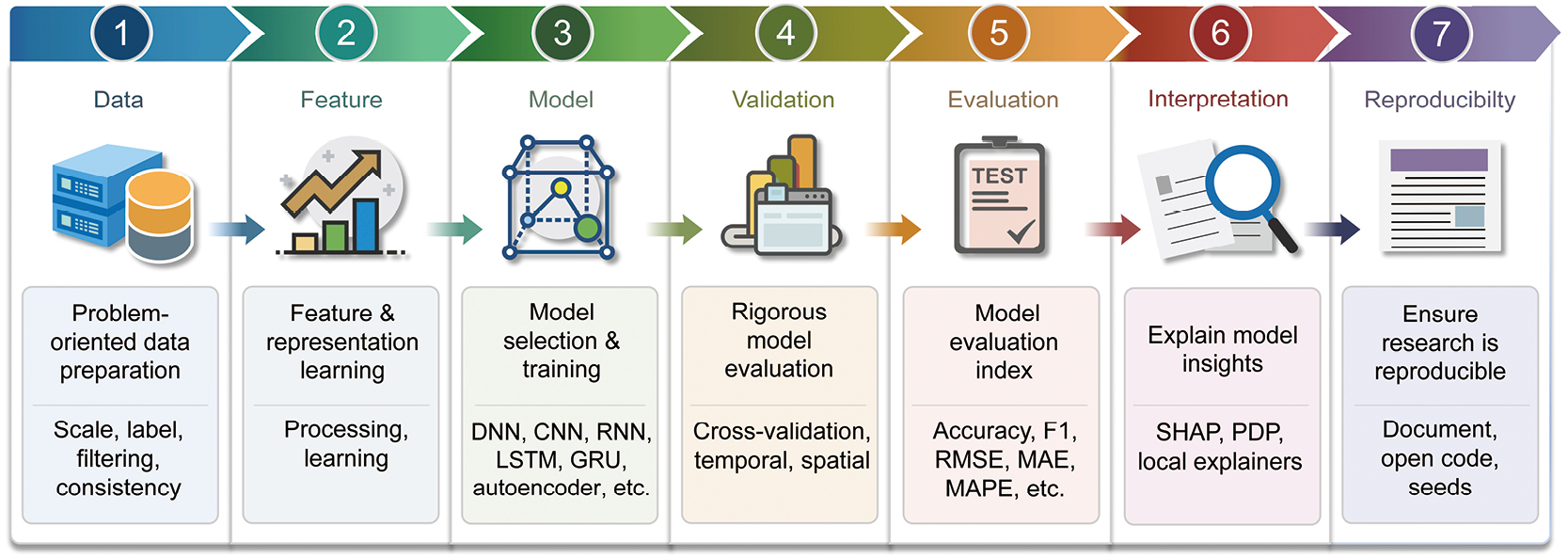
In contrast, data-driven machine learning (ML) methods [11] provide a new technical route to address the above challenges. ML approaches can directly learn battery degradation rules from historical operating data without constructing complex electrochemical mechanistic models. ML models achieve accurate SOH estimation by utilizing the intrinsic correlation among monitored voltage, current, temperature, and SOH. Notably, advances in Internet of Things (IoT) technology and edge computing have made it easier to collect operational data from battery systems, thereby creating favorable conditions for applying ML methods. A typical ML experimental procedure includes data collection, preprocessing, feature extraction, feature selection, and model training and evaluation.
Currently, ML techniques for SOH estimation are primarily categorized into two core paradigms. ML methods based on statistical learning theory demonstrate high modeling efficiency and strong interpretability on small and medium-sized datasets [12]. They use handcrafted extracted features to achieve stable SOH estimation. Deep learning (DL) methods [13] enable adaptive feature extraction through deep network architectures. They provide superior estimation accuracy and generalization under complex operating conditions and large-scale datasets. These two categories of methods constitute a complementary technical system. Considerable progress has been made in both laboratory research and engineering applications. Meanwhile, reinforcement learning (RL) [14, 15] is not directly applied to SOH prediction. It takes estimated SOH as input and interacts dynamically with the battery operating environment, serving as a key decision-making technology for full-lifecycle battery health management.
This review systematically summarises feature extraction strategies from electrical, thermal, and mechanical multiphysics signals. It outlines the research progress of traditional ML and DL for SOH estimation. It also presents the application patterns of RL in realizing optimized battery health management based on SOH estimation results. These three components form a logical chain of progressive interdependency: feature extraction provides the physical foundation for estimation; SOH estimation supplies the state inputs for RL-based health management; and the engineering requirements for model lightweighting and online adaptation serve as the underlying constraints throughout all stages. It follows a systematic literature review methodology, covering Web of Science, IEEE Xplore, ScienceDirect, and Google Scholar from 2020 to 2026. Search keywords included "lithium-ion battery", "SOH", "feature engineering", "health feature", "machine learning", "deep learning", and "reinforcement learning", combined with Boolean operators. Inclusion criteria were: (1) peer-reviewed English publications; (2) research on LIB SOH estimation or health management; (3) complete experimental validation. Exclusion criteria were: (1) studies lacking evaluation metrics; (2) non-battery-domain ML studies; (3) short papers without sufficient methodological description. A total of 177 core publications were ultimately included, covering feature engineering, traditional ML, DL, and RL-based health management, corresponding to Sections 2–4.
Compared with existing reviews, this review offers two main innovations. First, it constructs a unified analytical framework of "multiphysics features–SOH estimation–health management." While numerous reviews have addressed these topics individually, most lack a systematic examination of their intrinsic logical relationships. This review emphasizes their interconnections and, on this basis, traces the developmental trajectory of artificial intelligence (AI) in battery health management. Second, it complements the systematic classification and comprehensive evaluation of AI methods from multiple dimensions. Drawing on the relevant literature, it synthesizes findings from perspectives such as improvement approaches, application paradigms, and model fusion, and comprehensively discusses the developmental trajectories and technical characteristics of representative algorithms.
The remainder of this article is structured into six sections: Section 2 systematically elaborates on health feature engineering derived from multiphysics signals, including electrical, thermal, and mechanical fields. Section 3 analyzes the application advantages, limitations and typical research progress of traditional ML. It further presents the technical breakthroughs and application status of DL in complex feature learning and end-to-end SOH estimation. Section 4 introduces the application patterns and technical potential of RL in battery health optimization management based on SOH estimation. Section 5 summarises the main challenges and future development trends of current technologies. Section 6 outlines the conclusions of this review.
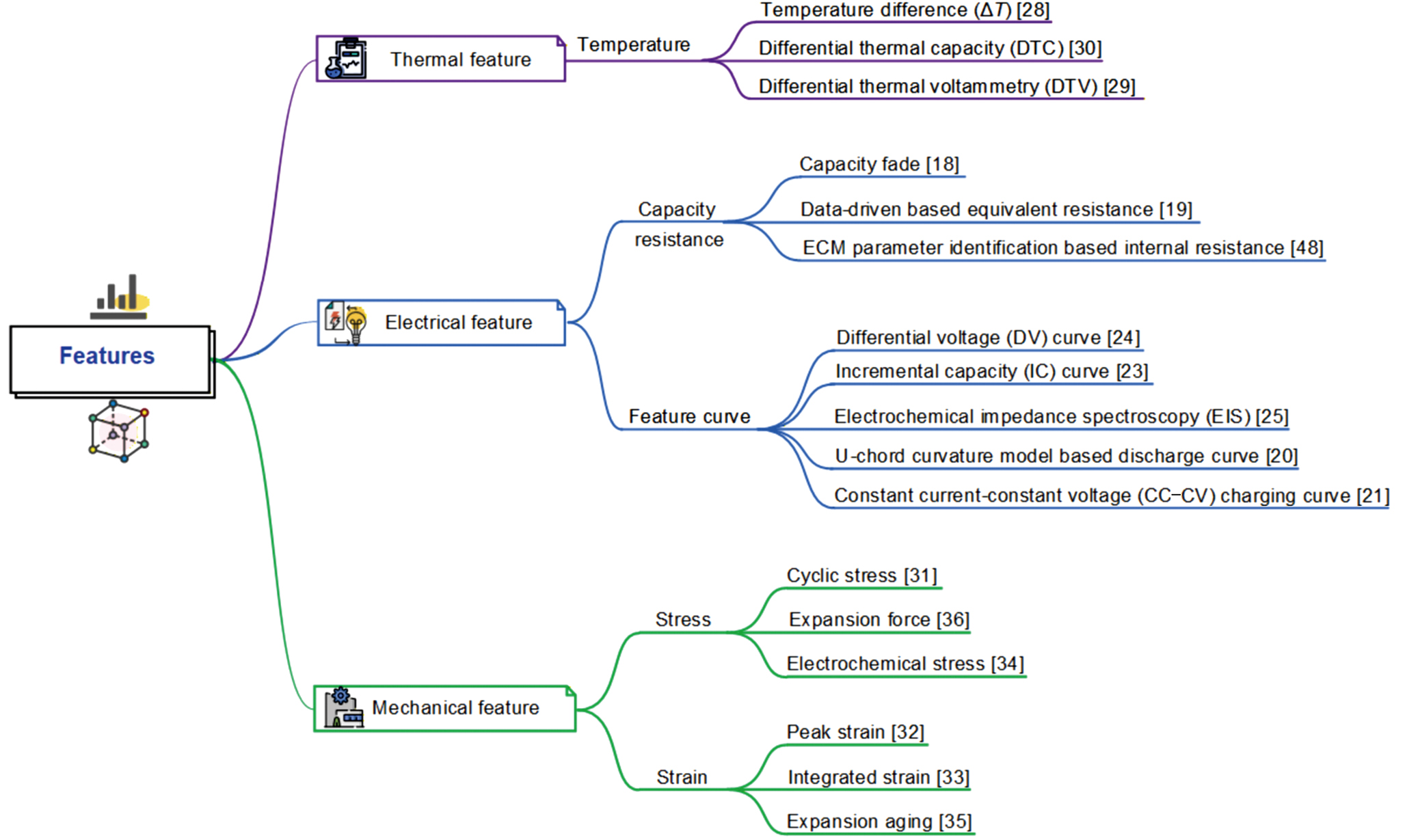
Battery degradation is a complex electrochemical process accompanied by dynamic variations in internal and external parameters, including voltage, current, temperature, impedance, and even mechanical properties. In data-driven SOH estimation methods, researchers do not directly feed massive redundant raw observation data into the model. Instead, they screen and extract key attributes that are highly correlated with aging mechanisms such as capacity fade and IR increase, namely health features (HFs), as model inputs [16]. The first step is to select the most sensitive and representative subset of features from numerous parameters. Subsequently, ML models are adopted to establish an accurate spatial mapping between these features and battery health status. However, multicollinearity or information redundancy often exists among features. Direct input will not only increase the computational burden but also introduce noise, potentially leading to model overfitting. Therefore, feature dimension reduction is necessary to enhance the quality and efficiency of the input data while retaining the most effective information, thereby significantly improving state estimation accuracy and model robustness [17]. With a focus on the critical procedures in HF engineering, this section sequentially discusses feature selection, extraction methods, and dimensionality reduction, aiming to provide a robust data foundation for subsequent ML models. Figure 1 shows the overall framework of feature engineering.
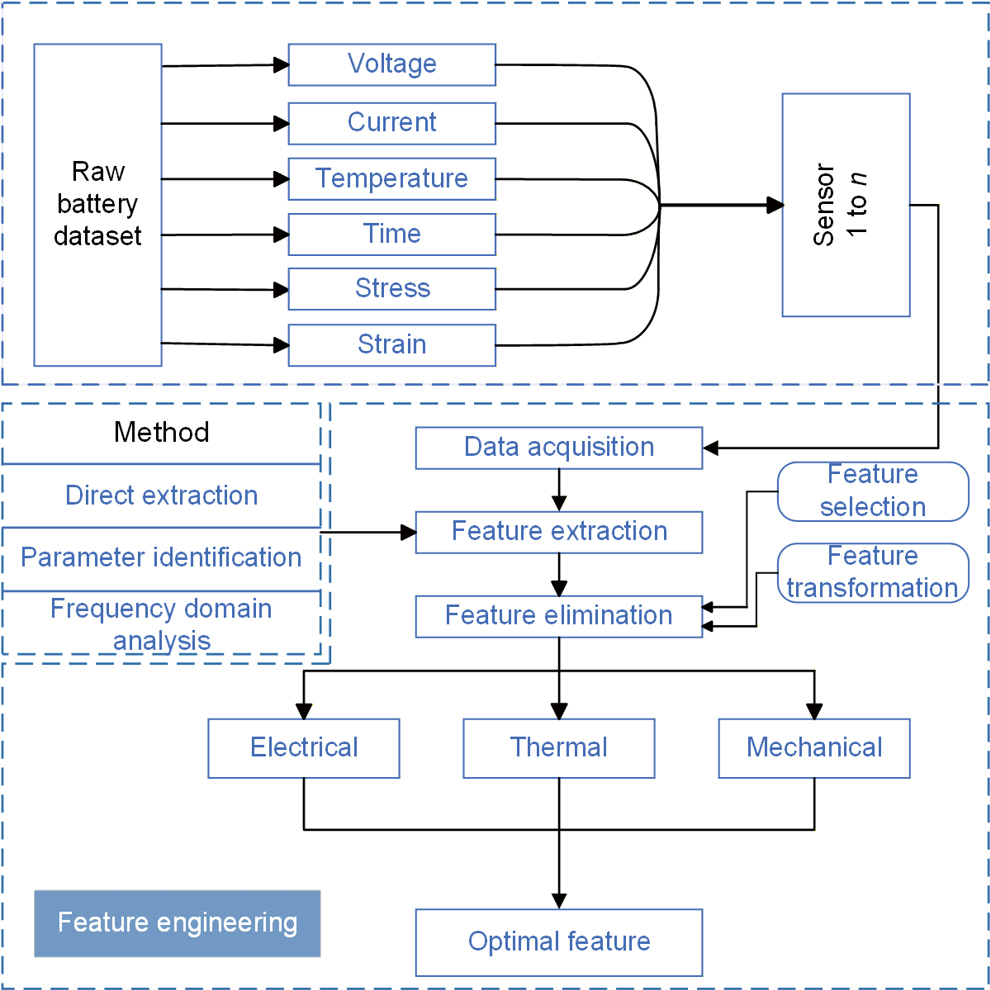
Battery SOH degradation is primarily caused by the continuous accumulation of irreversible internal electrochemical side reactions. Through multiphysics coupling effects, this intrinsic process is externally reflected in the systematic evolution of macroscopic thermal, mechanical, and electrical properties. In recent years, researchers have utilized these evolutionary laws to extract sensitive HFs from multiphysics fields and to build more comprehensive and accurate SOH evaluation models.
At the electrical level, degradation manifests most directly as fading of available capacity [18], increased IR [19], and distorted charge–discharge curves [20, 21]. Dynamic changes in these electrical parameters have been well verified to strongly correlate with battery SOH. Therefore, SOH estimation methods based on electrical features have developed the most mature theoretical framework and have become the mainstream technical route in this field. In the literature, SOH is commonly defined in various ways depending on the application scenario and evaluation objective, such as definitions based on remaining cycle life and energy fade. Among these, indicators derived from capacity degradation and IR increase remain the most representative ones for characterizing SOH evolution. Lin et al. [22] proposed a data-driven lithium-ion battery SOH prediction method based on capacity fade and IR growth. They identified IR under constant-current (CC) charging using a simplified equivalent circuit model (ECM) and adopted thermoelectric coupling features as model inputs. In addition to using monotonic changes in macroscopic performance parameters as validation criteria for SOH estimation, rich health information is extracted from subtle evolutions in curve morphology through differential processing. For example, the peak voltage, peak magnitude, and shape of incremental capacity (IC) curves [23] exhibit systematic shifts and decays due to the loss of active lithium inventory and active electrode materials. Similarly, the characteristic valley shift in differential voltage (DV) curves [24] is strongly correlated with the severity of side reactions within the battery. These differential curve features [25] provide powerful tools for accurate SOH diagnosis and analysis of the aging mechanism.
At the thermal level, battery aging increases IR and ohmic heat generation. Meanwhile, degradation mechanisms such as lithium plating, SEI layer growth, and electrolyte decomposition alter the internal material structure and disrupt heat-conduction pathways, thereby reducing thermal conductivity. Together, these effects cause a significant increase in operating temperature and the rate of temperature rise [26, 27]. Therefore, tracking the dynamic evolution of these thermal features is essential for accurate SOH evaluation. Tian et al. [28] investigated the strong correlation between battery surface temperature and aging mechanisms. To address the limitation that most studies rely heavily on voltage characteristics while neglecting other information sources, they developed a novel SOH estimation method that combines temperature difference (ΔT) with incremental capacity analysis (ICA) to improve both accuracy and robustness. However, it is difficult to distinguish the contributions of joule heating and entropy change to the temperature rise by directly monitoring the surface temperature difference. It is easily affected by environmental temperature fluctuations and has low sensitivity to early aging. To overcome these issues, Wang et al. [29] proposed differential thermal voltammetry (DTV). The method analyzes entropy changes from external voltage and temperature data during CC charge–discharge cycles and extracts DTV curve features as model inputs. In this way, it effectively addresses the aforementioned drawbacks. ICA characterizes electrochemical reactions by calculating the rate of change of capacity per unit change in voltage. Differential thermal capacity (DTC) combines the electrochemical properties of ICA with the entropy thermal characteristics of DTV. It integrates thermal and electrical characteristics, which effectively represent battery degradation information. Feng et al. [30] established a Sigmoid model with exponential and Lorentz rational functions to characterize DTC curves. This model effectively suppresses high noise in DTC signals and improves the efficiency of HF mining.
At the mechanical level, side-reaction products cause irreversible volume expansion of the electrode, increasing overall battery thickness and internal mechanical stress, forming a positive feedback loop that accelerates aging. Traditional methods based on electrical features struggle to capture battery inconsistencies. These methods are susceptible to electromagnetic interference, which reduces estimation accuracy. Therefore, some researchers have explored other signals to overcome the limitations of electrical signals, such as pressure [31], strain [32], and temperature. Among these, mechanical signals exhibit high stability and sensitivity to aging, making them promising health indicators that have attracted extensive academic attention. Hou et al. [33] proposed a strain-assisted SOH estimation framework that integrates electrical and strain features with Gaussian process regression (GPR) to improve estimation accuracy. The results showed that the hybrid method reduced the average root mean square error (RMSE) by 25.34% compared with using only electrical features. Zhang et al. [34] established a mapping relationship between battery capacity and mechanical stress characteristics. Based on the stress curve derived from CC charging, the model enables real-time capacity updates and delivers enhanced estimation accuracy. Experimental validation confirms that the SOH estimation error remains below 2.05% across diverse aging levels and dynamic operating conditions. Meanwhile, batteries exhibit regular expansion and contraction behavior during charging and discharging. A correlation exists between SOH and battery shell expansion [35]. The temperature and five expansion features, including irreversible expansion, irreversible increment, reversible rise, reversible recovery, and reversible peak, are used to construct the HF set. A hybrid architecture, the polarisation self-attention ResNet50-gated recurrent unit, was adopted for SOH estimation. When tested on a public dataset, this approach achieved an RMSE of approximately 1%, a mean absolute error (MAE) of around 0.5%, and a mean squared error (MSE) of about 1%. Given that the application of expansion force in SOH estimation has not been fully explored, Xu et al. [36] developed a pioneering method that uses expansion force curves and extracts key aging features from their inflection points. Through a series of tests, they first validated a strong and comprehensive correlation between battery expansion force and SOH. The results showed that the method achieved an RMSE of 0.058%, representing an order-of-magnitude improvement over conventional approaches. A comprehensive classification of multi-physical field features for LIB SOH estimation is illustrated in Figure 2.
The accuracy metrics reported in this section and throughout the following sections, such as RMSE, MAE, and mean absolute percentage error (MAPE), are taken from the optimal results obtained by each study under its respective experimental conditions. These values should not be used for direct cross-literature comparisons. The datasets employed vary across studies, with public datasets such as National Aeronautics and Space Administration (NASA), Center for Advanced Life Cycle Engineering (CALCE), and Massachusetts Institute of Technology (MIT) differing significantly in sample size and number of cycles. Test conditions also vary, ranging from laboratory constant-current constant-temperature protocols to real-world dynamic driving cycles. The definitions of error metrics are inherently distinct, as RMSE is sensitive to outliers, MAE reflects average deviation, and MAPE represents relative percentage error. In addition, the train-test split ratios and feature set selections are inconsistent across studies. These accuracy figures are presented in this review to provide a performance reference baseline for each method under its specific conditions, thereby facilitating subsequent research. The accuracy results reported in the following sections adhere to the same positioning.
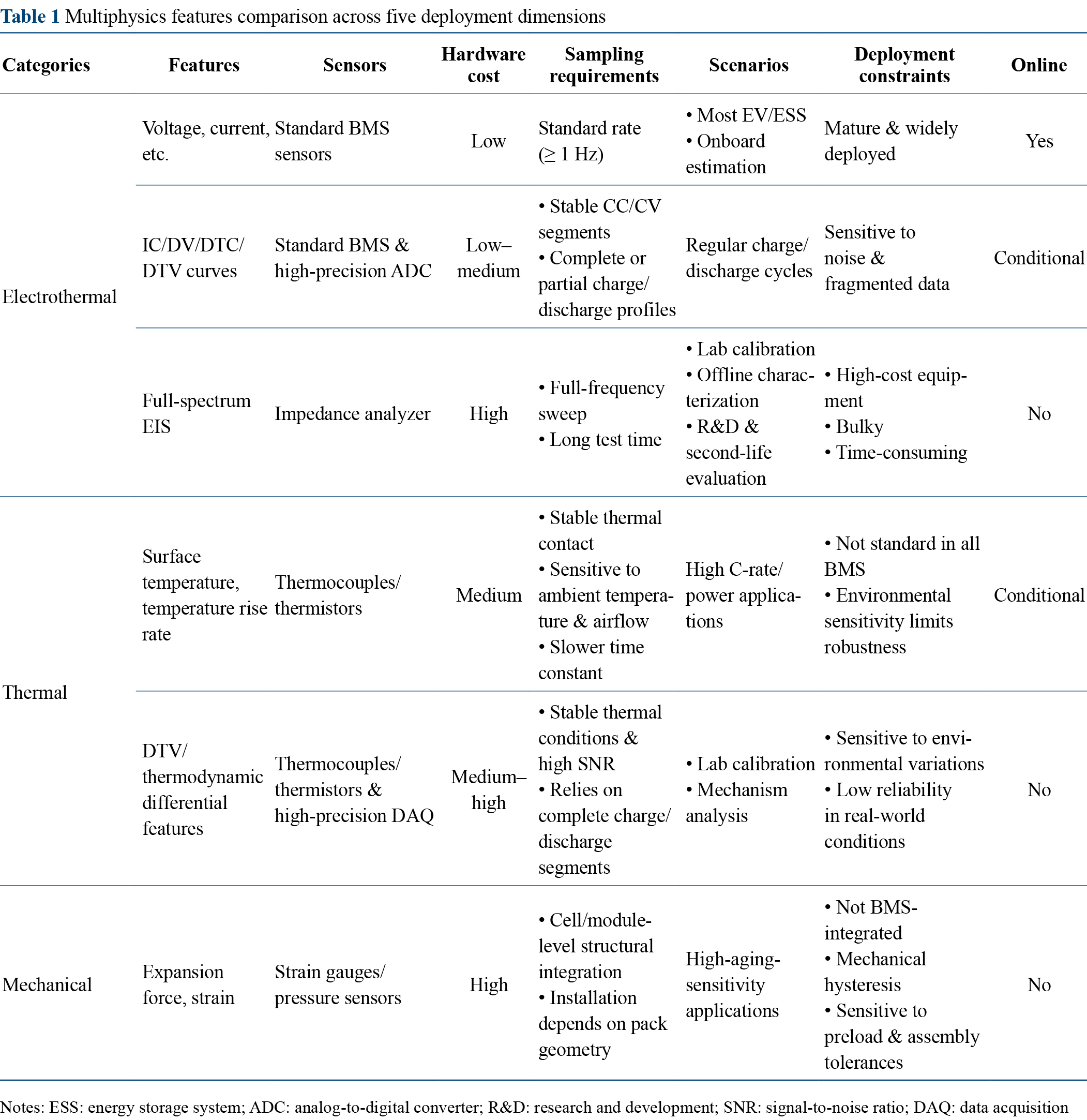
It should be noted that the three categories of multiphysics features exhibit significant differences in engineering deployment feasibility. Table 1 provides a qualitative comparison across five dimensions: sensor hardware cost, sampling requirements, applicable scenarios, deployment constraints, and online acquisition feasibility. In brief, electrical features are the most accessible for onboard deployment. Raw voltage and current signals are continuously available via standard BMS sensors, while differential features such as IC/DV/DTC/DTV are conditional on specific charging segments. Full-spectrum electrochemical impedance spectroscopy (EIS) provides rich electrochemical insight but remains largely lab-confined. Thermal features offer complementary aging information under high-power operation, yet their reliability is affected by thermal contact and ambient conditions. Mechanical features show strong sensitivity to aging but are constrained by sensor availability, installation complexity, and cell-to-cell variability. These distinctions are summarised in Table 1 to guide feature selection according to practical operating conditions.
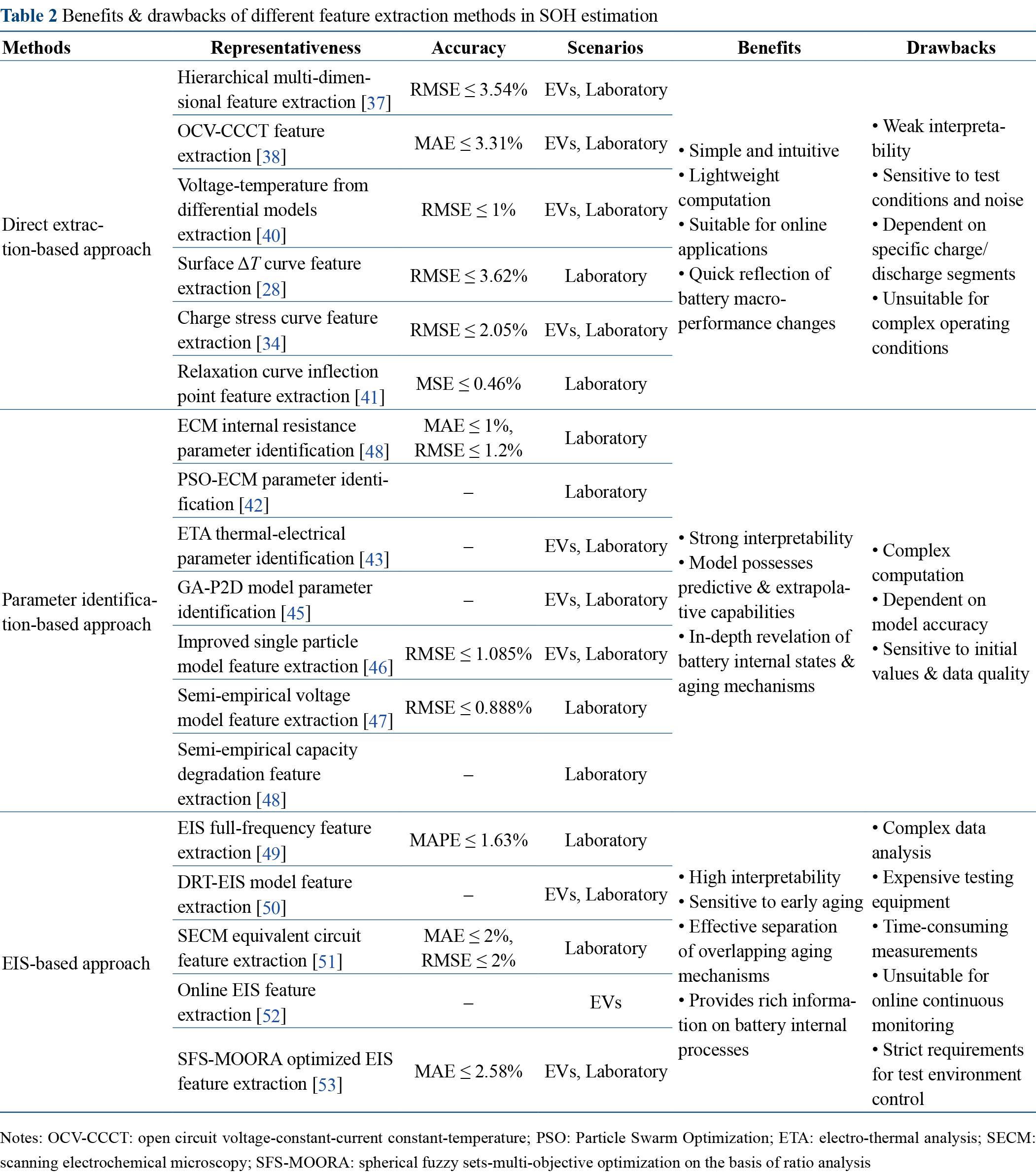
Once the electrical, thermal, and mechanical parameters strongly correlated with battery SOH have been identified, the next core step in building an evaluation model is accurately and quantitatively extracting these features from measurable battery system signals. The literature on current LIB SOH prediction indicates that researchers are increasingly concerned about the effectiveness of HF extraction. Because the efficiency of feature extraction methods directly determines the sensitivity and robustness of HF, as well as the accuracy of the final SOH estimation. Based on core principles and technical pathways, existing feature extraction methods can be categorized into three types: direct extraction, parameter identification, and frequency-domain feature analysis. These methods are systematically reviewed in the following sections.
Direct extraction-based: these approaches focus on directly calculating or observing macro features related to the SOH from raw time-series data, such as voltage, current, temperature, and pressure, during battery operation [37]. These methods do not rely on complex models and typically feature simple calculations and clear physical meaning. However, they require subjective theoretical analysis and have limited applicability across different batteries. Voltage-based features are among the most commonly used. Since voltage is the external manifestation of a battery's internal reaction mechanism, it can reflect the aging status of LIBs. Compared to fresh batteries, aged batteries reach the maximum charging voltage more quickly. Therefore, the time taken for the charging voltage to reach its maximum value [38], as well as the voltage amplitude within a fixed charging duration, can be selected as HFs for SOH estimation. Beyond raw voltage signals, the constant current–constant voltage (CC–CV) charging mode [39], a common charging strategy in EVs, contains abundant dynamic and steady-state information. SOH evaluation based on CC charging time and capacity is generally more straightforward and effective. Furthermore, differential processing of CC charging voltage curves enables the extraction of peak features from IC curves and valley features from DV curves [40], both of which are highly sensitive to aging mechanisms and are current research hotspots. Other directly measurable features include IR, thermal characteristics [41], and mechanical signals. IR can be calculated as the ratio of the instantaneous voltage drop to the current before and after the pulse discharge. Meanwhile, directly measuring thermal features such as maximum surface temperature, temperature rise rate [28], and average temperature, as well as mechanical features such as pressure [34] and thickness expansion, helps further improve the accuracy of SOH estimation for LIBs.
Parameter identification-based: the feature extraction offers an indirect yet insightful technical approach [42]. The core idea is that a battery's external characteristic response is determined by its internal physical and chemical state. This internal state change can be reflected by changes in mathematical model parameters. Therefore, this method establishes a mathematical model to describe the dynamic behavior of the battery [43]. The key model parameters are estimated from voltage and current measurements. Then, these aging-related parameters are used as HFs to quantitatively evaluate the battery's internal degradation [44]. The first step is to select an appropriate battery model that balances computational complexity and accuracy. Common choices include ECMs, such as first-order and second-order resistance-capacity (RC) models. The selected electrochemical models include Pseudo-Two-Dimensional (P2D) models [45], Single-Particle models [46], and Shepherd models [47]. Consider the most widely used ECM, which utilizes resistors and capacitors to represent the battery's ohmic behavior, polarisation dynamics, and diffusion process. Its first-order RC variant effectively captures short-term battery dynamics, with key parameters to be identified typically including ohmic IR, polarisation resistance, and polarisation capacitance [48]. Once the model is determined, measured input-output data and estimation algorithms, such as recursive least squares (RLS) or Kalman Filter-based methods, are used to perform online or offline identification of unknown model parameters. Because these parameters exhibit systematic and predictable variation with battery aging, they can serve as HFs. It is possible to successfully achieve SOH estimation based on parameter recognition by establishing a mapping relationship between these features and battery SOH.
Frequency-domain analysis-based: methods have become an important branch of battery SOH evaluation. Through EIS, this approach reveals the relationship between internal kinetic parameters and battery aging. Its core principle is transforming the time-domain response of a battery under external excitation into the frequency domain, thereby separating electrochemical processes with different time constants. In practice, EIS applies a small-amplitude sinusoidal alternating signal to the battery and measures its voltage response to obtain the impedance spectrum, typically presented as Nyquist or Bode plots. This method effectively decouples complex time-domain coupled processes, opening a new avenue for diagnosing aging mechanisms. Three key types of frequency-domain features can be systematically extracted from the impedance spectrum [49]. First, ohmic IR in the high-frequency region, whose increase is directly related to SEI film thickening and electrolyte degradation. Second, charge-transfer resistance in the middle-frequency region, where an enlarged capacitive arc diameter reflects the attenuation of electrode interface reaction activity. Third, the Warburg impedance slope in the low-frequency region, whose change indicates a decline in lithium-ion diffusion ability in solid-phase materials. These characteristic parameters jointly form a multi-dimensional indicator system for evaluating battery health status. In recent years, researchers have further improved the physical interpretation and the accuracy of parameter quantification through ECM fitting and distribution of relaxation time (DRT) analysis [50, 51]. Although traditional EIS measurements have limitations, such as complex equipment and long testing times, the existing literature has proposed innovative solutions. These include online EIS technology [52] based on wide-frequency pulsed excitation, time-frequency conversion algorithms, and impedance feature prediction models combined with ML [53]. These advances are driving frequency-domain feature analysis from laboratory settings to engineering applications, providing new technical support for accurate battery SOH estimation. A comparison of the performance, advantages, and limitations of the aforementioned HF extraction methods is presented in Table 2.
| Methods | Representativeness | Accuracy | Scenarios | Benefits | Drawbacks |
|---|---|---|---|---|---|
| Direct extraction-based approach | Hierarchical multi-dimensional feature extraction [37] | RMSE ≤ 3.54% | EVs, Laboratory | • Simple and intuitive • Lightweight computation • Suitable for online applications • Quick reflection of battery macro-performance changes |
• Weak interpretability • Sensitive to test conditions and noise • Dependent on specific charge/discharge segments • Unsuitable for complex operating conditions |
| OCV-CCCT feature extraction [38] | MAE ≤ 3.31% | EVs, Laboratory | |||
| Voltage-temperature from differential models extraction [40] | RMSE ≤ 1% | EVs, Laboratory | |||
| Surface ΔT curve feature extraction [28] | RMSE ≤ 3.62% | Laboratory | |||
| Charge stress curve feature extraction [34] | RMSE ≤ 2.05% | EVs, Laboratory | |||
| Relaxation curve inflection point feature extraction [41] | MSE ≤ 0.46% | Laboratory | |||
| Parameter identification-based approach | ECM internal resistance parameter identification [48] | MAE ≤ 1%, RMSE ≤ 1.2% |
Laboratory | • Strong interpretability • Model possesses predictive & extrapolative capabilities • In-depth revelation of battery internal states & aging mechanisms |
• Complex computation • Dependent on model accuracy • Sensitive to initial values & data quality |
| PSO-ECM parameter identification [42] | – | Laboratory | |||
| ETA thermal-electrical parameter identification [43] | – | EVs, Laboratory | |||
| GA-P2D model parameter identification [45] | – | EVs, Laboratory | |||
| Improved single particle model feature extraction [46] | RMSE ≤ 1.085% | EVs, Laboratory | |||
| Semi-empirical voltage model feature extraction [47] | RMSE ≤ 0.888% | Laboratory | |||
| Semi-empirical capacity degradation feature extraction [48] | – | Laboratory | |||
| EIS-based approach | EIS full-frequency feature extraction [49] | MAPE ≤ 1.63% | Laboratory | • High interpretability • Sensitive to early aging • Effective separation of overlapping aging mechanisms • Provides rich information on battery internal processes |
• Complex data analysis • Expensive testing equipment • Time-consuming measurements • Unsuitable for online continuous monitoring • Strict requirements for test environment control |
| DRT-EIS model feature extraction [50] | – | EVs, Laboratory | |||
| SECM equivalent circuit feature extraction [51] | MAE ≤ 2%, RMSE ≤ 2% | Laboratory | |||
| Online EIS feature extraction [52] | – | EVs | |||
| SFS-MOORA optimized EIS feature extraction [53] | MAE ≤ 2.58% | EVs, Laboratory |
With the widespread adoption of multi-physical field feature extraction, the resulting high-dimensional feature [54] sets have exacerbated issues such as computational complexity and model overfitting. Feature dimensionality reduction mitigates these problems [55] by projecting original high-dimensional features into a lower-dimensional space. This transformation streamlines the data while preserving critical health information. Hence, dimensionality reduction has become indispensable [56] for enhancing battery SOH assessment models. Existing approaches to feature dimensionality reduction are broadly classified into two types: feature selection and feature extraction [57].
Feature selection: these methods are relatively str-aightforward, mainly selecting the optimal feature subset through filter and wrapper methods. Filter methods evaluate features based on their divergence or correlation and select features by setting a threshold or a fixed number of features. Common methods include the Pearson correlation coefficient (PCC) [58], the Spearman correlation coefficient (SCC) [59], the gray relational analysis (GRA) [60], and the mutual information (MI) [61]. Among these, the PCC-based filter method is widely adopted due to its high computational efficiency and clear physical meaning. Wrapper methods iteratively evaluate feature subsets using an objective function to determine the optimal combination. Common wrapper methods include recursive feature elimination (RFE) [62], bidirectional search [63], and genetic algorithms (GA) [64].
Feature extraction: the approach maps the original feature space into a new low-dimensional space and can be further divided into linear and nonlinear methods. Linear methods achieve dimensionality compression through matrix transformation. Common examples include principal component analysis (PCA) [65], linear discriminant analysis (LDA) [66], and singular value decomposition (SVD) [67]. Among these, PCA, as a typical unsupervised method, uses orthogonal transformation to convert potentially correlated original features into a set of linearly uncorrelated principal components, thereby balancing data compression and information retention. Nonlinear methods rely on kernel functions or manifold learning to perform dimensionality reduction by embedding local structure. Examples include isometric mapping (ISOMAP) [68], locally linear embedding (LLE) [69], Laplacian eigenmap [70], and t-distributed stochastic neighbor embedding (t-SNE) [71]. Studies have shown that optimized feature subsets can not only significantly improve the training efficiency and generalization ability of data-driven models such as support vector machines and neural networks but also enhance model interpretability.
With the development of battery big data technology, the integration of feature dimensionality reduction and DL has become a research hotspot, providing important technical support for constructing efficient and reliable battery SOH assessment systems. Table 3 lists and compares the main ideas, advantages, and disadvantages of various feature extraction methods.
| Methods | Representativeness | Core idea | Scenarios | Benefits | Drawbacks |
|---|---|---|---|---|---|
| Filter methods | Pearson correlation coefficient analysis [58] | Linear correlation measurement | Continuous variable relationship analysis | • Simple computation • Strong interpretability |
• Captures only linear relationships |
| Spearman correlation coefficient analysis [59] | Rank correlation measurement | Monotonic relationship analysis | • Robust to outliers • Does not require linearity |
• Ignores nonlinear relationships | |
| Grey relational analysis [60] | Sequence similarity comparison | Small samples, poor information systems | • Low sample requirement • Simple calculation |
• Relatively subjective | |
| Mutual information [61] | Measurement of information sharing degree | Arbitrary statistical dependency relationships | • Captures nonlinear relationships | • High computational complexity | |
| Wrapper methods | Recursive feature elimination [62] | Backward iterative feature removal | High-dimensional feature selection | • Considers feature correlations • Good stability |
• High computational cost |
| Bidirectional search [63] | Combines forward selection and backward elimination | Medium-dimensional feature selection | • Avoids local optima • Comprehensive search |
• High implementation complexity | |
| Genetic algorithm [64] | Simulates the natural evolution process | Complex combinatorial optimization problems | • Strong global search capability | • Complex parameter tuning | |
| Linear feature extraction methods | PCA [65] | Orthogonal transformation for dimensionality reduction | Data compression and visualization | • Decorrelates • Retains main variance |
• Limited by linear assumption |
| LDA [66] | Maximizes separation between classes | Supervised classification problems | • Utilizes class labels • Improves classification performance |
• Requires labeled data | |
| SVD [67] | Matrix factorization for dimensionality reduction | Recommendation systems, text analysis | • Solid mathematical foundation • Good stability |
• High computational resource demand | |
| Nonlinear feature extraction methods | ISOMAP [68] | Preserves geodesic distance | Manifold learning, nonlinear dimensionality reduction | • Preserves global structure | • Sensitive to noise |
| LLE [69] | Local linear reconstruction | Data visualization, feature learning | • Preserves local structure • Relatively efficient computation |
• Difficulties with new samples | |
| Laplacian eigenmaps [70] | Laplacian eigendecomposition | Cluster analysis, community detection | • Effective for sparse data | • Sensitive to parameter selection | |
| t-SNE [71] | Probability distribution matching | High-dimensional data visualization | • Excellent visualization • Preserves local structure |
• High computational complexity, stochastic results |
As introduced in Section 1, traditional ML follows a "feature engineering + shallow model" paradigm, where feature quality determines the upper performance bound, while model fitting sets the lower bound [9, 10]. Representative methods are detailed below.
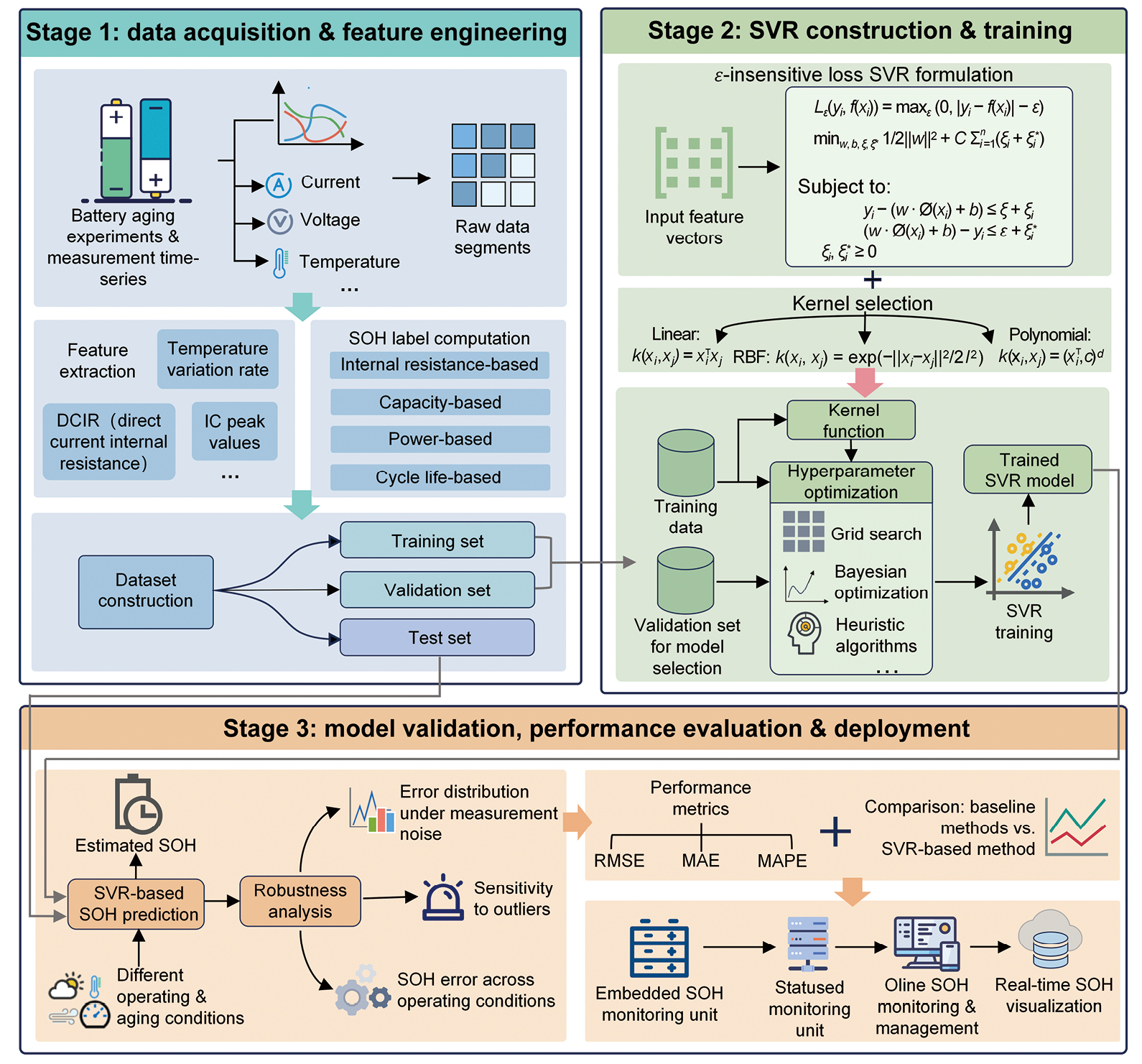
SVM exhibits excellent generalization capabilities for small sample sizes, nonlinearities, and high-dimensional data. Its introduction to battery SOH assessment dates back to the early 2000s [59]. Using kernel functions, SVM projects data into a high-dimensional feature space. Subsequently, it constructs either an optimal separating hyperplane for classification or a regression function, designated as support vector regression (SVR), for SOH estimation [72]. In recent years, ever-increasing requirements for estimation accuracy, robustness, and engineering practicality have become the primary drivers of SVM research. These requirements have propelled the field beyond single-model applications. Instead, the current trend is toward deep integration of SVM with optimization algorithms, electrochemical mechanisms, and DL. The field thus continues its forward progress [73]. The overall framework of the SVR-based LIB SOH estimation method is illustrated in Figure 3.
To improve SVR performance using optimization algorithms, research has focused on intelligent strategies for automatically tuning two key SVR parameters: the penalty factor ϲ and the kernel function parameter γ. This line of research aims to overcome the limitations of traditional grid search methods, including low efficiency and a tendency to fall into local optima. Several representative studies illustrate this progress. Zhi et al. [74] developed a GA-Particle Swarm Optimization (PSO)-SVR hybrid optimization algorithm. This algorithm combines the strengths of the GA and PSO to optimize SVR parameters. On the NASA dataset, their method achieved higher estimation accuracy and faster convergence. In a similar vein, Li et al. [73] introduced the Ant Lion Optimizer (ALO). Comparative experiments showed that the ALO outperformed both grid search and GA-optimized benchmark models. Furthermore, Xing et al. [75] proposed an Improved Aquila Optimizer (IAO) to avoid local optima. This improvement enhanced the generalization capability and prediction accuracy of the SVR model when handling complex battery degradation patterns.
In the domain of model structure innovation and multi-model fusion, modifications to the SVM structure have been made to improve estimation stability and to address practical challenges such as battery pack inconsistency. A representative approach is the ensemble SVR model proposed by Guo et al. [76]. The outputs of multiple SVR submodels are integrated, effectively smoothing the estimation error of a single submodel. As a result, both overall accuracy and robustness are significantly enhanced. This ensemble strategy suggests that structural design aimed at greater model fault tolerance and adaptive capability represents an important direction for the engineering application of SVM.
In the context of combining battery-mechanism features for enhanced interpretability, research efforts have focused on integrating SVM with the physical characterization of battery aging. For instance, ICA-derived peak and area features were employed as SVM inputs in [77, 72], effectively combining physical interpretability with data-driven modeling. An effective connection is established between data-driven methods and electrochemical mechanisms.
Furthermore, with the rise of DL, SVM has been combined with Deep Neural Network (DNN) architectures to form complementary hybrid models. A Residual Network-SVR (ResNet-SVR) model was constructed in [78]. This model uses ResNet to extract high-dimensional temporal features and then feeds them to SVR for regression, combining the advantages of deep feature extraction with the generalization capability of shallow models on small samples. A comprehensive solution was developed that combines a Diffusion Convolutional Recurrent Neural Network (DCRNN) with SVM-RFE for feature selection and SOH prediction [79]. These fusion models indicate that SVM serves as a core component within more complex intelligent estimation frameworks, continuously expanding its application boundaries.
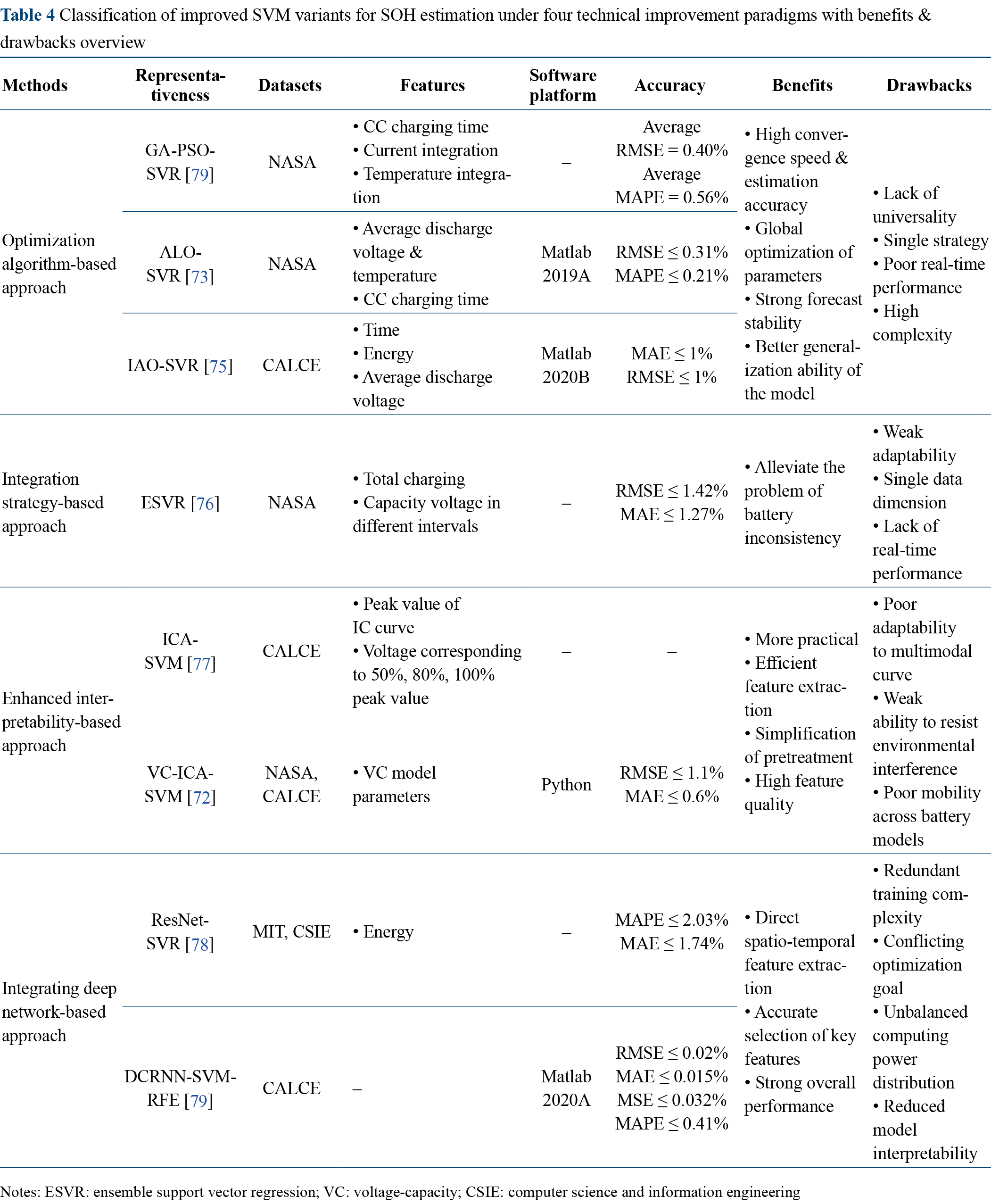
In summary, SVM for battery SOH estimation has evolved from early direct applications into a diverse system centered on optimization, fusion, and mechanism integration. Its advantages in handling small-sample and nonlinear problems enable continuous renewal by integrating it with optimization algorithms, ensemble strategies, and deep networks. Future directions include lightweight hybrid models, online updates, and embedding into onboard BMS for reliable real-time health management, paving the way for large-scale engineering applications. A systematic comparison of the above methods is presented in Table 4.
| Methods | Representativeness | Datasets | Features | Software platform | Accuracy | Benefits | Drawbacks |
|---|---|---|---|---|---|---|---|
| Optimization algorithm-based approach | GA-PSO-SVR [79] | NASA | • CC charging time • Current integration • Temperature integration |
– | Average RMSE = 0.40% Average MAPE = 0.56% |
• High convergence speed & estimation accuracy • Global optimization of parameters • Strong forecast stability • Better generalization ability of the model |
• Lack of universality • Single strategy • Poor real-time performance • High complexity |
| ALO-SVR [73] | NASA | • Average discharge voltage & temperature • CC charging time |
Matlab 2019A | RMSE ≤ 0.31% MAPE ≤ 0.21% |
|||
| IAO-SVR [75] | CALCE | • Time • Energy • Average discharge voltage |
Matlab 2020B | MAE ≤ 1% RMSE ≤ 1% |
|||
| Integration strategy-based approach | ESVR [76] | NASA | • Total charging • Capacity voltage in different intervals |
– | RMSE ≤ 1.42% MAE ≤ 1.27% |
• Alleviate the problem of battery inconsistency | • Weak adaptability • Single data dimension • Lack of real-time performance |
| Enhanced interpretability-based approach | ICA-SVM [77] | CALCE | • Peak value of IC curve • Voltage corresponding to 50%, 80%, 100% peak value |
– | – | • More practical • Efficient feature extraction • Simplification of pretreatment • High feature quality |
• Poor adaptability to multimodal curve • Weak ability to resist environmental interference • Poor mobility across battery models |
| VC-ICA-SVM [72] | NASA, CALCE | • VC model parameters | Python | RMSE ≤ 1.1% MAE ≤ 0.6% |
|||
| Integrating deep network-based approach | ResNet-SVR [78] | MIT, CSIE | • Energy | – | MAPE ≤ 2.03% MAE ≤ 1.74% |
• Direct spatio-temporal feature extraction • Accurate selection of key features • Strong overall performance |
• Redundant training complexity • Conflicting optimization goal • Unbalanced computing power distribution • Reduced model interpretability |
| DCRNN-SVM-RFE [79] | CALCE | – | Matlab 2020A | RMSE ≤ 0.02% MAE ≤ 0.015% MSE ≤ 0.032% MAPE ≤ 0.41% |
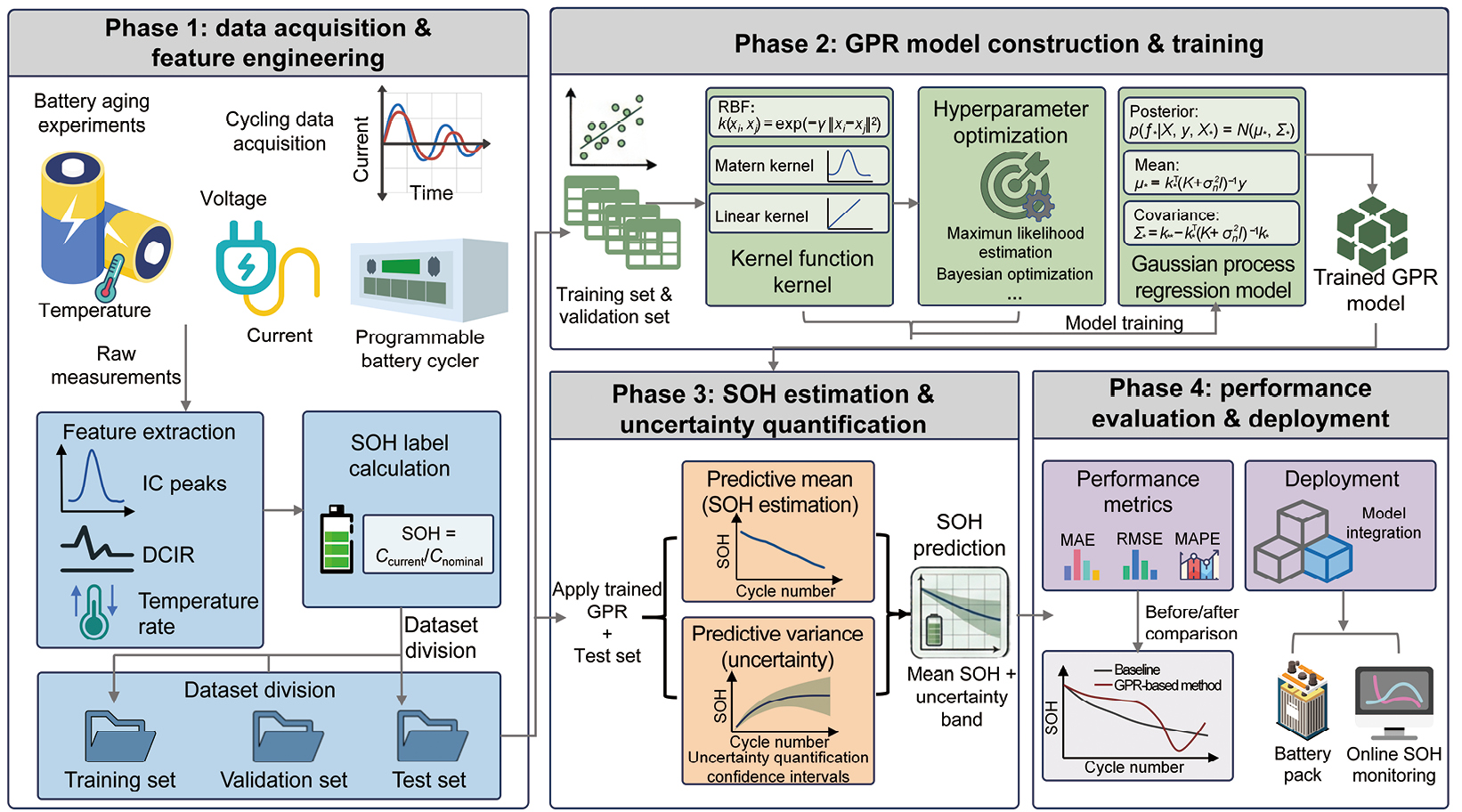
GPR is a nonparametric Bayesian model widely used for battery SOH estimation. It provides both point predictions and full probability distributions, which are essential for uncertainty assessment and risk management. The performance of GPR is determined by its mean function and covariance function, where the kernel defines the similarity between data points and thus shapes the capacity degradation curve. Efforts to improve the performance of GPR for estimation focus on three aspects: feature engineering, model structure improvements, and optimization strategies. The overall technical workflow is depicted in Figure 4.
At the feature engineering level, research focuses on extracting features that are strongly correlated with battery aging and readily obtainable online. Traditional methods directly extract HFs from charge-discharge curves. However, these approaches suffer from high dimensionality and redundancy. To address these limitations, various feature selection and dimensionality reduction techniques have been introduced. To illustrate, Qian et al. [80] reported a strategy where features were first extracted from DTV curves under CC–CV charging conditions, followed by the application of canonical correlation analysis (CCA) to remove redundant information and improve feature quality. Reddy et al. [81] extracted a larger set of 26 features from charge-discharge curves, and PCA was then employed to reduce this set to three key dimensions for a GPR model. Furthermore, Chen et al. [82] accounted for the complexity of real-world applications. Multiple indirect health factors were jointly extracted from the stages of CC charging, CV charging, and CC discharging, while also considering the effect of temperature on aging. Dimensionality reduction was performed with SCC and PCC, resulting in a more robust input set for the model. Beyond these efforts, more advanced work has explored novel feature sources. The DRT method was adopted in [83] to extract effective features from EIS. Another notable contribution comes from Zhou et al. [84], who innovatively derived HFs from the geometric shape of mid- to high-frequency EIS Nyquist plots. This approach circumvents the time-consuming and unstable nature of traditional low-frequency EIS testing.
At the model structure improvement level, research aims to enhance GPR's ability to model complex degradation patterns, such as long-term trends and local regeneration. To address the limitations of a single kernel in capturing mixed patterns, Wang et al. [85] proposed a composite kernel. This kernel combines a linear kernel with a square-exponential kernel to capture long-term decay and fluctuations. Furthermore, to overcome the limitations of a single GPR model, Yang et al. [86] developed a hybrid framework integrating a DNN with GPR. In this framework, the DNN leverages its powerful nonlinear mapping capabilities to learn deep representations from heterogeneous, multi-source features, such as IC curves, IR, and discharge energy. These representations are then fed into GPR for probabilistic estimation, enabling a more comprehensive characterization of the aging mechanisms.
At the optimization strategy level, research focuses on automated model configuration to improve performance and efficiency. The choice of kernel functions and hyperparameters critically determines GPR performance, yet manual tuning is time-consuming and experience-dependent. To address this issue, Chen et al. [87] proposed an evolutionary framework based on encoding strategies and GA to automatically discover optimal combinations and configurations of the GPR kernel. Zhao et al. [88] introduced a chaos-enhanced metaheuristic algorithm to optimize GPR hyperparameters. Binary variables are used for feature selection. The proposed solution effectively avoids the local-optimal trap of traditional optimization algorithms while achieving joint optimization of feature subsets and model parameters.
Despite significant progress, GPR-based methods still face several common challenges. For example, the robustness of most models needs further validation in complex scenarios, such as varying temperature conditions, missing early-cycle data, or weak correlations between early-cycle features and SOH. In addition, the generalization of models trained on specific battery data to other battery types remains an area for improvement. A detailed comparison of the methods is shown in Table 5. Future research trends may focus on developing more adaptive online learning GPR frameworks, exploring physics-informed semi-physical GPR models, and leveraging transfer learning to enhance cross-battery generalization, thereby promoting more reliable application of GPR in onboard BMS.
| Methods | Representativeness | Datasets | Features | Software platform | Accuracy | Benefits | Drawbacks |
|---|---|---|---|---|---|---|---|
| Feature engineering-based approach | GPR based on DTV (DTV-GPR) [80] | Oxford, NASA | • High-frequency sampling data points of DTV curve | – | MAE ≤ 2.09% RMSE ≤ 2.19% |
• Strong correlation of features • Excellent generalization performance • Comprehensive health characterization • Accurate trend tracking • Efficient dimension reduction ability • Efficiency of calculation |
• Lack of universality • Weak online deployment capability • Imperfect feature system • Poor robust-ness under complex working conditions; limited long-term prediction accuracy • Relatively simple model framework |
| GPR based on indirect features [81] | NASA | • Voltage difference • Time difference |
– | RMSE ≤ 0.74% | |||
| GPFR based on indirect features [82] | NASA | • Time • Average temperature |
– | MAPE ≤ 1.40% RMSE ≤ 1.20% |
|||
| ARD-GPR based on DRT [83] | Dataset from Cavendish Laboratory | • Partition characteristics of DRT decoding curve | Matlab | – | |||
| Model structure-based approach | R-GPR based on EIS [84] | Self-built dataset | • Radius • Center coordinate |
Matlab | MAE ≤ 1.50% RMSE ≤ 1.50% |
• Excellent characterization ability • Robust model generalization performance • Innovative model architecture design • Efficient computing power |
• Insufficient early prediction ability • Limited environmental adaptability • Poor fault tolerance of data • Lack of system engineering verification |
| GPR based on compound kernel function [85] | NASA | • Charging & discharging voltage interval time • Discharging temperature rise time |
– | MAE ≤ 1.8% RMSE ≤ 2.5% |
|||
| GPR based on DNN (DGPR) [86] | CALCE, NASA | • Time • Energy • Maximum value of IC curve … |
– | MAE < 0.8% RMSE < 1.2% |
|||
| Optimization strategy-based approach | GPR based on evolutionary framework [87] | Oxford, NASA, dataset from the University of Maryland | • CC charging time • Key voltage sampling point |
Python | MSE ≤ 0.3435% | • High degree of automation and intelligence • Excellent global optimization ability • Strong generalization and robustness • In-depth interpretable analysis |
• High compu-tational complexity • Insufficient modeling of temperature effects • Rough fusion mechanism of the algorithm |
| GPR based on CBHGS (CBHGS-GPR) [88] | NASA | • Time • Voltage • Current • Temperature |
Matlab | MAPE ≤ 0.1667% RMSE ≤ 0.271% |
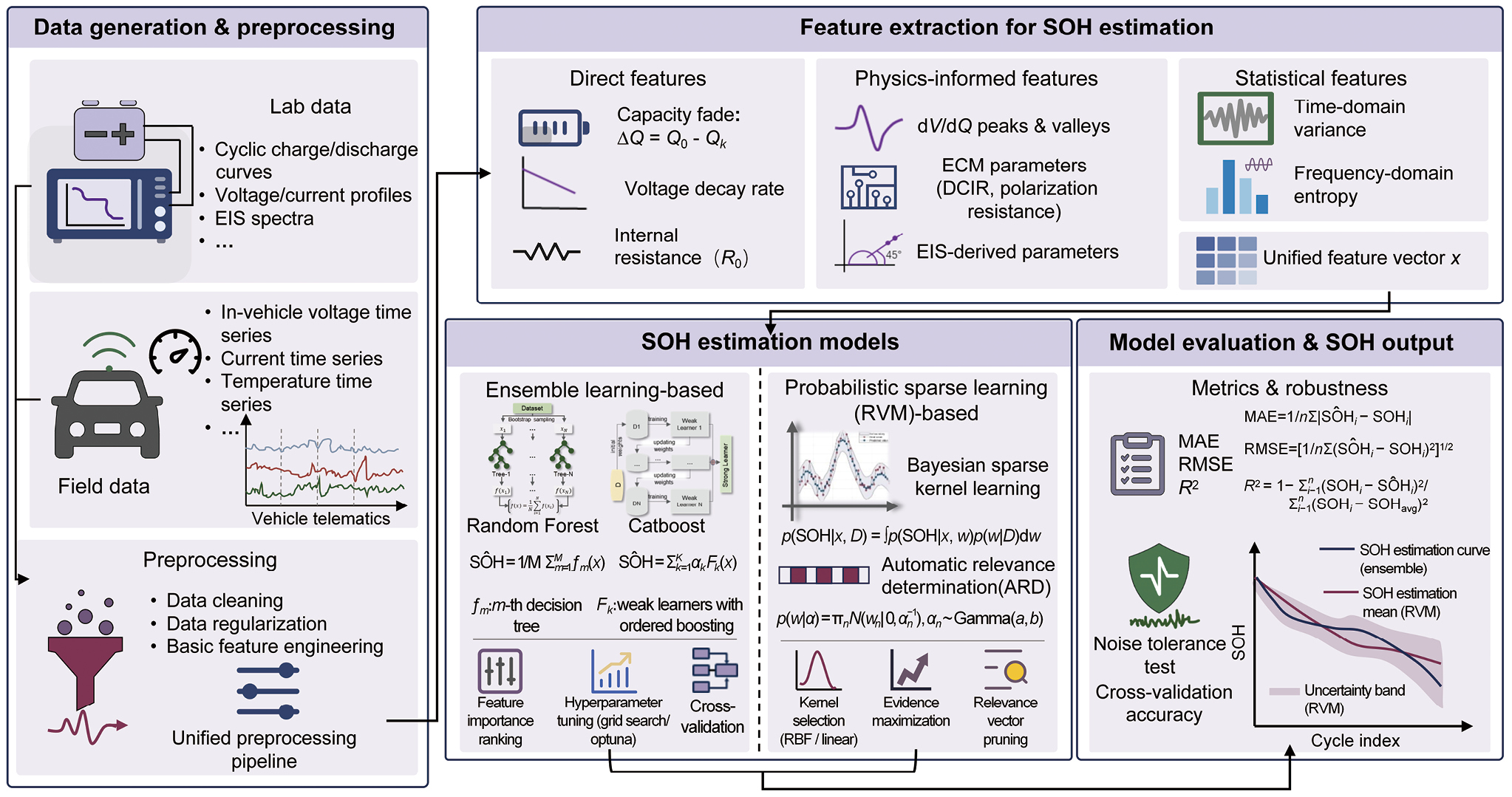
Beyond SVM and GPR, other ML paradigms have been explored, among which ensemble learning and sparse probabilistic models demonstrate unique value. Ensemble methods combine multiple weak learners to enhance prediction robustness and nonlinear fitting capability, while sparse probabilistic models seek model sparsity and probabilistic output within a Bayesian framework. Although fewer in number than mainstream approaches, they provide useful supplements for addressing specific challenges in data-driven SOH or remaining useful life (RUL) prediction. The complete technical framework is shown in Figure 5.
Ensemble learning methods, such as random forest (RF) and gradient boosting machine (GBM), have attracted widespread attention for their excellent ability to handle high-dimensional features and nonlinear relationships. A key advantage of these methods is their ability to automatically evaluate feature importance while maintaining good tolerance to data noise. CatBoost is an effective implementation of a gradient-enhanced decision tree framework, which uses techniques such as ordered enhancement and symmetric tree structure to effectively alleviate gradient bias and overfitting. It demonstrates strong performance on multi-dimensional datasets. For example, Yin et al. [89] proposed a complete pipeline that includes feature compression, interpolation, and regularisation. They fed the processed health factor sequences into a CatBoost model. This approach achieved excellent predictive accuracy (R2 > 0.98) on public datasets and demonstrated robustness in noisy environments. Zhang et al. [90] made a further advancement in feature engineering. They integrated multi-domain features, including time-domain, frequency-domain, and entropy features. They then applied discriminant correlation analysis (DCA) for dimensionality reduction. Furthermore, the CatBoost hyperparameters are optimized with the Sparrow Search Algorithm (SSA). This strategy significantly improved the generalization of cross-battery SOH prediction. RFs have been applied in real-world scenarios due to three factors: ease of implementation, ability to handle heterogeneous data, and a certain degree of interpretability. Mawonou et al. [91] utilized seven years of real-world electric vehicle operating data to build an RF-based data-driven aging predictor, which achieved an average error of 1.27%. The model mechanisms were also used to rank and analyze key factors affecting aging. However, ensemble learning methods are black-box models that cannot quantify uncertainty in their predictions. This limitation restricts their direct application in battery safety management scenarios that require risk assessment.
In contrast to GPR, the relevance vector machine (RVM) offers a sparser Bayesian solution: it retains only a small subset of relevance vectors, enabling faster online inference for embedded deployments—at the cost of higher training complexity and kernel sensitivity. However, RVM performance heavily depends on the choice of kernel functions and hyperparameters, and its training is computationally expensive. To optimize its performance, Chen et al. [92] introduced the Bat Algorithm (BA) to automatically optimize the RVM kernel parameters and constructed a dynamic ensemble framework comprising multiple RVMs with wavelet kernels as sub-models. The framework fuses sub-models by dynamically updating their weights, improving the accuracy and generalization of online SOH estimation. To address the complex degradation patterns caused by cell inconsistency within battery packs and the burden of separately estimating SOH and RUL, Lyu et al. [93] proposed a unified RVM-based framework. They constructed a hybrid kernel RVM (HKRVM) that integrates global and local kernels and employed a Genetic Gray Wolf Optimizer (GGWO) to determine optimal kernel parameters and weights. In addition, the metabolic extreme learning machine (MELM) was introduced to synergistically predict SOH and RUL probabilities. Despite the theoretical advantages of RVM in sparsity and probabilistic output, its complex training and tuning process, along with uncertainty regarding its performance advantage on real-world battery data. This is the main reason it has not been as widely adopted as GPR.
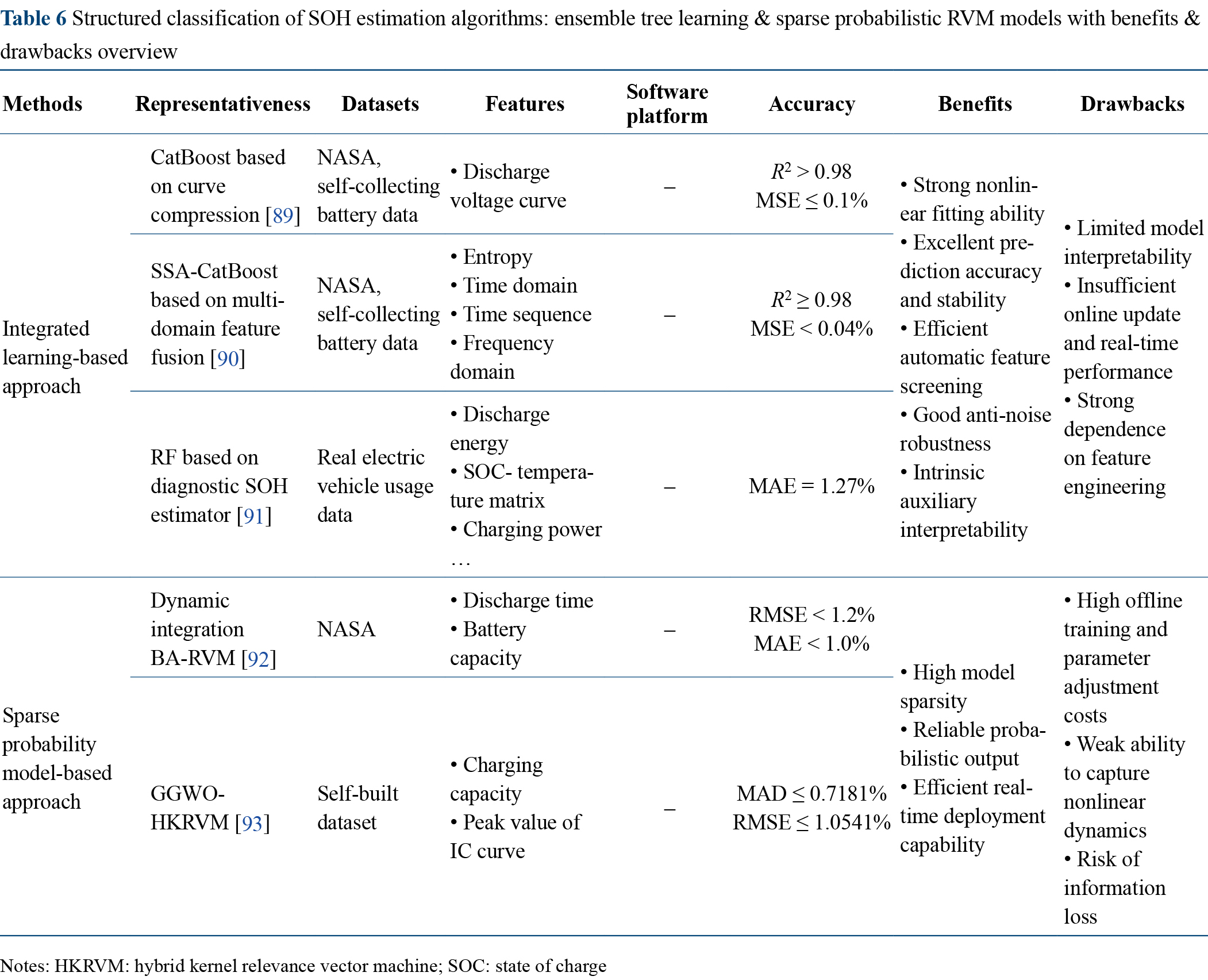
In summary, ensemble learning methods such as CatBoost and RF perform strongly at mining complex feature interactions and handling noisy real-world data, but their black-box nature and lack of uncertainty quantification are major drawbacks. Sparse probabilistic models such as RVMs offer uncertainty quantification and fast inference, making them suitable for embedded scenarios, yet their application is limited by high training costs and complex hyperparameter tuning. In the future, key directions for advancing these two types of methods in battery health management may include exploring hybrid architectures that combine the predictive power of ensemble learning with the uncertainty quantification advantages of probabilistic models, or developing more efficient adaptive RVM training algorithms. A detailed comparison of the two types of methods is presented in Table 6.
| Methods | Representativeness | Datasets | Features | Software platform | Accuracy | Benefits | Drawbacks |
|---|---|---|---|---|---|---|---|
| Integrated learning-based approach | CatBoost based on curve compression [89] | NASA, self-collecting battery data | • Discharge voltage curve | – | R2 > 0.98 MSE ≤ 0.1% |
• Strong nonlinear fitting ability • Excellent prediction accuracy and stability • Efficient automatic feature screening • Good anti-noise robustness • Intrinsic auxiliary interpretability |
• Limited model interpretability • Insufficient online update and real-time performance • Strong dependence on feature engineering |
| SSA‑CatBoost based on multi-domain feature fusion [90] | NASA, self-collecting battery data | • Entropy • Time domain • Time sequence • Frequency domain |
– | R2 ≥ 0.98 MSE < 0.04% |
|||
| RF based on diagnostic SOH estimator [91] | Real electric vehicle usage data | • Discharge energy • SOC- temperature matrix • Charging power … |
– | MAE = 1.27% | |||
| Sparse probability model-based approach | Dynamic integration BA-RVM [92] | NASA | • Discharge time • Battery capacity |
– | RMSE < 1.2% MAE < 1.0% |
• High model sparsity • Reliable probabilistic output • Efficient real-time deployment capability |
• High offline training and parameter adjustment costs • Weak ability to capture nonlinear dynamics • Risk of information loss |
| GGWO-HKRVM [93] | Self-built dataset | • Charging capacity • Peak value of IC curve |
– | MAD ≤ 0.7181% RMSE ≤ 1.0541% |
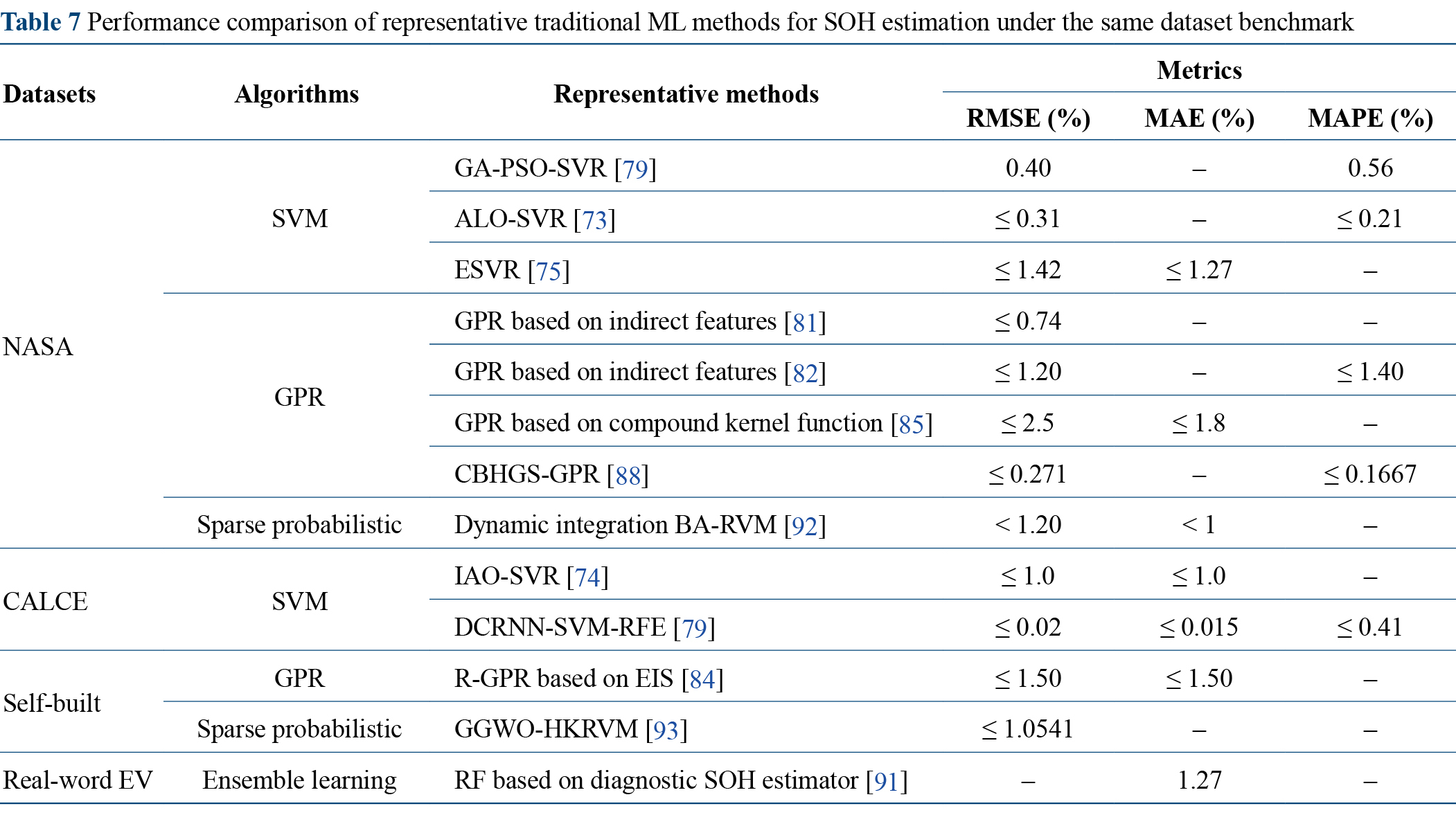
To present an intuitive comparison, Table 7 groups the aforementioned representative traditional ML methods by dataset and error metric.
| Datasets | Algorithms | Representative methods | Metrics | ||
|---|---|---|---|---|---|
| RMSE (%) | MAE (%) | MAPE (%) | |||
| NASA | SVM | GA-PSO-SVR [79] | 0.40 | – | 0.56 |
| ALO-SVR [73] | ≤ 0.31 | – | ≤ 0.21 | ||
| ESVR [75] | ≤ 1.42 | ≤ 1.27 | – | ||
| GPR | GPR based on indirect features [81] | ≤ 0.74 | – | – | |
| GPR based on indirect features [82] | ≤ 1.20 | – | ≤ 1.40 | ||
| GPR based on compound kernel function [85] | ≤ 2.5 | ≤ 1.8 | – | ||
| CBHGS‑GPR [88] | ≤ 0.271 | – | ≤ 0.1667 | ||
| Sparse probabilistic | Dynamic integration BA‑RVM [92] | < 1.20 | < 1 | – | |
| CALCE | SVM | IAO‑SVR [74] | ≤ 1.0 | ≤ 1.0 | – |
| DCRNN‑SVM‑RFE [79] | ≤ 0.02 | ≤ 0.015 | ≤ 0.41 | ||
| Self-built | GPR | R‑GPR based on EIS [84] | ≤ 1.50 | ≤ 1.50 | – |
| Sparse probabilistic | GGWO‑HKRVM [93] | ≤ 1.0541 | – | – | |
| Real-word EV | Ensemble learning | RF based on diagnostic SOH estimator [91] | – | 1.27 | – |
Traditional ML methods remain effective when data are scarce. SVM and GPR are preferred in small-sample settings due to their simple architecture and strong regularisation, but they extrapolate poorly beyond the training range. For cross-battery transfer, GPR learns generic degradation patterns via automatic relevance determination kernels. SVM, in contrast, overfits to battery-specific features and transfers poorly. Random forest handles cell-to-cell variability moderately well through its feature importance mechanism. Extreme conditions like low temperature, fast charging, or deep discharge are problematic for all traditional ML methods, as such data are rarely available for training, and the feature-SOH relationships change substantially. Overall, traditional ML suits stable operating profiles with well-understood degradation. For dynamic or extreme conditions, physical priors or transfer learning are necessary to improve performance.
As discussed in the previous chapter, traditional machine learning methods have made significant progress in estimating battery SOH. However, they rely on manual feature engineering and suffer from limited model capacity when capturing complex nonlinear aging dynamics, particularly in handling high-dimensional raw time-series data and long-range temporal dependencies. Shallow neural networks, such as Radial Basis Function Neural Networks (RBFNN) [94], also exhibit limited representational power due to their shallow architectures. In contrast, DNNs [95] can automatically extract hierarchical features from raw data in an end-to-end manner. Their strong nonlinear approximation capability enables more accurate characterization of the mapping between internal battery states and external signals, positioning DNNs as a research frontier in SOH estimation. Current research explores various DNN architectures to address key challenges. For example, an end-to-end framework [96] addresses battery pack inconsistency, while DNN-based transfer learning [97, 98] mitigates data scarcity across different batteries and operating conditions. A systematic classification of mainstream DNN architectures and their key components for SOH estimation is presented in Figure 6. This section elaborates on the applications of these architectures to SOH estimation, drawing on representative literature.
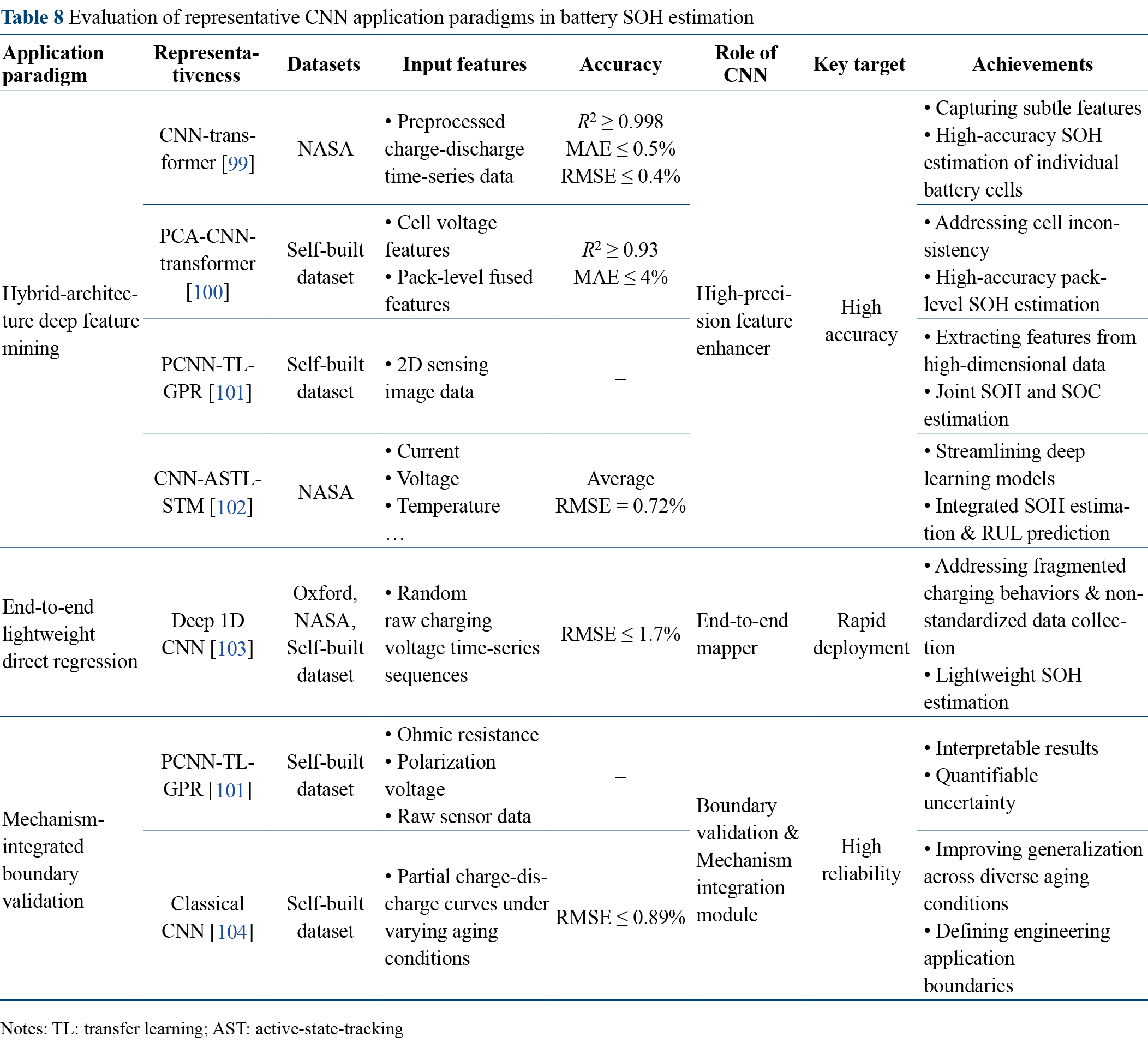
CNNs are built on three principles: local connectivity, weight sharing, and hierarchical stacking. With inherent strengths in local feature extraction, temporal information mining, and parameter-efficient learning, CNNs have become a core component of data-driven methods for battery SOH estimation. Based on six representative studies, CNN-based SOH estimation has evolved into three paradigms: hybrid architectures for deep feature mining, end-to-end lightweight modeling, and mechanism integration with engineering validation. These paradigms cover high-accuracy estimation, practical deployment, and reliability assurance.
The hybrid architecture paradigm for deep feature mining centers on integrating local feature extraction with global dependency modeling. Within this paradigm, CNNs typically function as front-end modules in hybrid networks, working in conjunction with models such as transformers and Long Short-Term Memory (LSTM) networks to achieve high-accuracy SOH estimation across multi-scale data. When processing raw time-series data from a single unit, one-dimensional (1D) convolution captures local features, including voltage fluctuations and current ripples, thereby providing structured input to the transformer [99]. In battery pack scenarios, CNNs are combined with PCA for dimensionality reduction and feature aggregation, enabling the extraction of spatiotemporal correlations from multi-source features that serve as branched inputs to enhance the model's representation [100]. For high-precision tasks involving fused sensor data, CNNs convert multi-physical images into high-dimensional feature representations and collaborate with GPR to jointly estimate SOH and state of charge (SOC) [101]. Finally, within systematic automated modeling frameworks, CNNs are cascaded with improved LSTM networks to extract both local spatial features and long-term temporal dependencies, thereby enabling the joint prediction of SOH and RUL [102].
The end-to-end lightweight modeling paradigm prioritizes engineering practicality by establishing a direct mapping from raw data to SOH via lightweight networks. In this way, it avoids both manual feature engineering and complex preprocessing. A representative example comes from Tian et al. [103], who employed a CNN that directly takes raw charging-voltage sequences of arbitrary duration and starting point as input. Using deep 1D convolutions, the network autonomously learns hierarchical features and simultaneously outputs core indicators, such as maximum and remaining capacity. When compared with hybrid architectures, this paradigm requires less data and adapts well to fragmented charging profiles and non-standardized collection scenarios. Therefore, it offers a lightweight solution that is well-suited for large-scale SOH estimation deployment.
The mechanism integration and engineering bou-ndary validation paradigm addresses the blind decision-making that often accompanies data-driven models and places particular emphasis on the reliability of CNNs. In this paradigm, CNNs function as classic health feature extractors. Through tests that involve various fast-charging aging strategies and deep aging stages, researchers have clarified where CNNs offer generalization advantages, specifically in mild aging stages, and where their limitations emerge, namely in deep aging scenarios. These findings establish guidelines for the application of data-driven methods [104]. In a related effort, Li et al. [101] integrated a CNN with a traditional machine learning model, namely GPR. The integration not only improves estimation accuracy but also quantifies the associated uncertainty, thereby striking a balance between performance and reliability.
The application of CNNs in battery SOH estimation has evolved into a diverse technical system. The hybrid architecture paradigm for deep feature extraction prioritizes accuracy, enabling precise estimation in complex scenarios. The end-to-end lightweight modeling paradigm focuses on practicality, adapting to real-world operating conditions. The mechanism integration and engineering boundary validation paradigm targets reliability, enhancing controllable management of technical applications. As summarised in Table 8, the three paradigms evolve synergistically to advance CNN-based SOH estimation from the laboratory to industrialization. Future trends will center on lightweight, automation, and physics-informed fusion, achieving deep integration of data and mechanism-driven methods.
| Application paradigm | Representativeness | Datasets | Input features | Accuracy | Role of CNN | Key target | Achievements |
|---|---|---|---|---|---|---|---|
| Hybrid-architecture deep feature mining | CNN-transformer [99] | NASA | • Preprocessed charge-discharge time-series data | R2 ≥ 0.998 MAE ≤ 0.5% RMSE ≤ 0.4% |
High-precision feature enhancer | High accuracy | • Capturing subtle features • High-accuracy SOH estimation of individual battery cells |
| PCA-CNN-transformer [100] | Self-built dataset | • Cell voltage features • Pack-level fused features |
R2 ≥ 0.93 MAE ≤ 4% |
• Addressing cell inconsistency • High-accuracy pack-level SOH estimation |
|||
| PCNN-TL-GPR [101] | Self-built dataset | • 2D sensing image data | – | • Extracting features from high-dimensional data • Joint SOH and SOC estimation |
|||
| CNN-ASTLSTM [102] | NASA | • Current • Voltage • Temperature … |
Average RMSE = 0.72% | • Streamlining deep learning models • Integrated SOH estimation & RUL prediction |
|||
| End-to-end lightweight direct regression | Deep 1D CNN [103] | Oxford, NASA, Self-built dataset | • Random raw charging voltage time-series sequences | RMSE ≤ 1.7% | End-to-end mapper | Rapid deployment | • Addressing fragmented charging behaviors & non-standardized data collection • Lightweight SOH estimation |
| Mechanism-integrated boundary validation | PCNN-TL-GPR [101] | Self-built dataset | • Ohmic resistance • Polarization voltage • Raw sensor data |
– | Boundary validation & Mechanism integration module | High reliability | • Interpretable results • Quantifiable uncertainty |
| Classical CNN [104] | Self-built dataset | • Partial charge-discharge curves under varying aging conditions | RMSE ≤ 0.89% | • Improving generalization across diverse aging conditions • Defining engineering application boundaries |
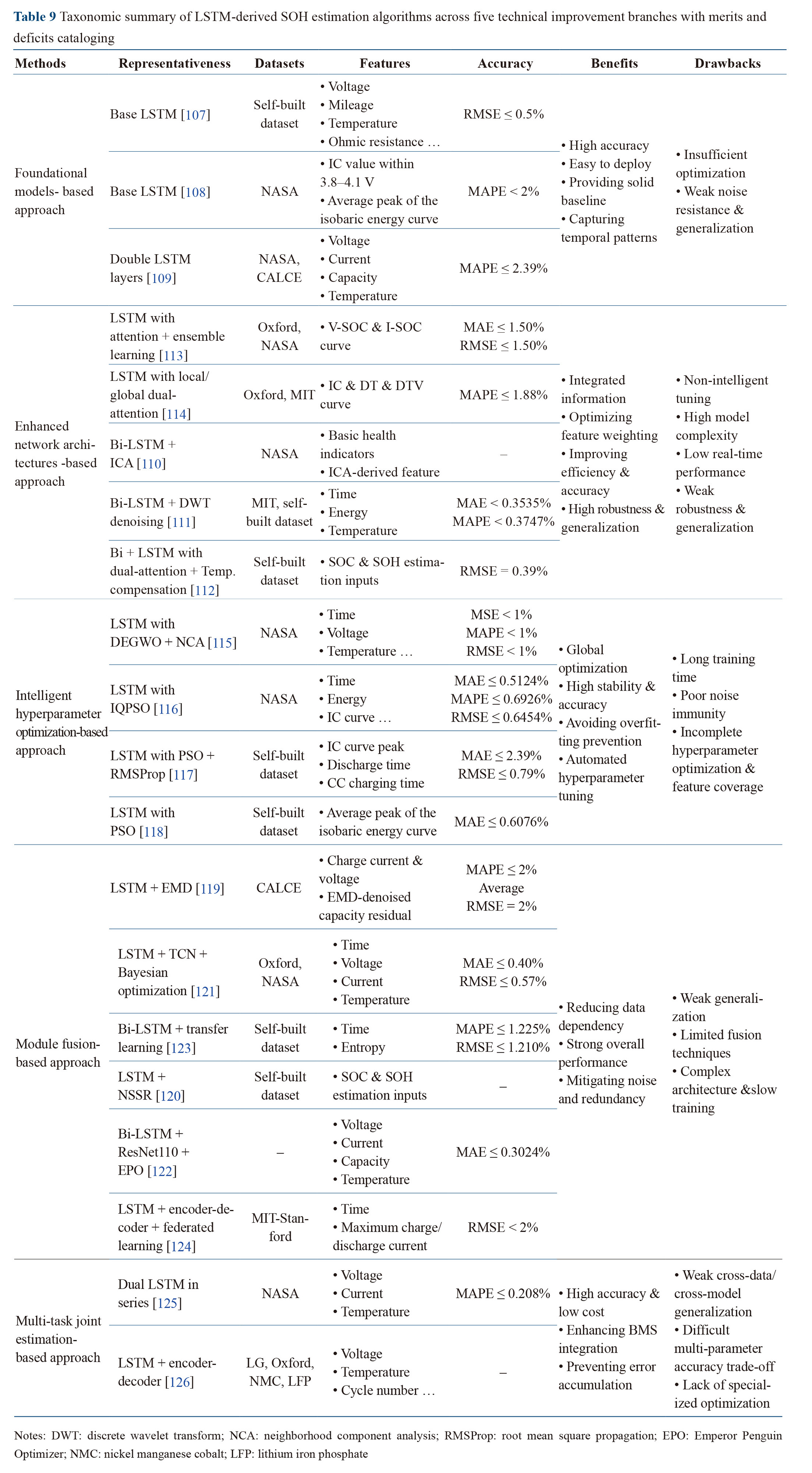
Battery aging is a continuous dynamic process with strong historical dependency. Specifically, the current SOH is the cumulative result of electrochemical stress, side reactions, and microstructure degradation over all previous cycles. The long-term dependency limits static estimation methods. To address this issue, Recurrent Neural Networks (RNNs) and their variants [105, 106], which process sequential data and memorize historical information via internal states, have become key technologies for characterizing battery aging and bridging health diagnosis to life prediction. In practice, RNNs formulate SOH estimation as the dynamic modeling of capacity-fading sequences or multivariate time series, thereby opening new pathways for understanding long-term degradation. However, due to the vanishing and exploding gradient problems in standard RNNs, LSTMs and gated recurrent units (GRUs) have become core solutions. In recent years, RNN research for SOH estimation has shown a trend toward integration and engineering applications. The following discussion focuses on LSTM and GRU.
LSTM-based: LSTM addresses the vanishing gradient problem of traditional RNNs through its input, forget, and output gates. It captures nonlinear, time-varying patterns in battery aging, achieving higher accuracy and generalization. Thus, LSTM is widely used for LIB SOH estimation, providing effective solutions across basic applications, structural optimization, parameter tuning, hybrid models, and multi-task expansion.
Early studies focused on basic LSTM architectures. Researchers combined the native temporal feature extraction capability of LSTMs with simple feature engineering and data preprocessing to validate the feasibility and superiority of LSTMs for SOH estimation. These works [107–109] typically used real-world full-lifecycle data or public datasets, adopting features such as ohmic resistance and IC curve characteristics. The results showed that LSTMs outperform traditional ML methods with low deployment barriers, thereby establishing a solid benchmark for subsequent model improvements. Nevertheless, this line of approaches struggled to adapt to complex and dynamic real-world scenarios.
With the advancement of research, addressing inherent limitations of native LSTM, such as missing unidirectional temporal information, equal weighting of input features, and low computational efficiency on long sequences, researchers have improved single-network models by restructuring network architectures or integrating attention mechanisms. Bidirectional LSTM (Bi-LSTM) [110–112] traverses time steps in both forward and backward directions, effectively avoiding unidirectional information loss and significantly improving stability in small-sample and complex temporal scenarios. The introduction of attention mechanisms [113] enables focus on key stages of the charging curve and critical aging time steps. In particular, local-global dual attention [114] captures global temporal dependencies while reducing computational complexity for long sequences, achieving substantial gains in SOH estimation accuracy. However, increased model complexity reduces real-time performance, and most models rely on manual or fixed parameter tuning, leaving considerable room for improvement in extreme-condition adaptation and cross-scenario generalization.
Alongside network structure optimization, intelligent hyperparameter optimization has emerged as an important complementary direction. It addresses several issues inherent in native LSTM, including the need for subjective manual tuning, susceptibility to local optima, and the risk of overfitting or underfitting. Researchers have employed SOH estimation error as the fitness function when combining LSTM with a variety of optimization algorithms, including the Differential Evolution Grey Wolf Optimizer (DEGWO), the Improved Quantum Particle Swarm Optimization (IQPSO), and the classical PSO. This integration achieves global hyperparameter optimization, thereby improving SOH estimation performance. The optimized models reported in [115, 116] achieved estimation errors below 1% on public datasets from NASA and MIT. Furthermore, the models demonstrated an accuracy improvement of at least 5% compared with traditional LSTM [117, 118]. Despite these advances, several limitations remain. Most methods focus primarily on core hyperparameters, such as the number of neurons in the hidden layer and the learning rate, which reflects a lack of comprehensive optimization. In addition, the iterative optimization process is time-consuming, and the stability of optimization when applied to noisy data requires further improvement.
To overcome the limitations of a single LSTM and reduce noise, feature redundancy, and data dependence in SOH estimation, researchers have developed various fusion models that leverage complementary advantages. Studies [119, 120] combined signal processing methods such as empirical mode decomposition (EMD) and nonlinear state space reconstruction (NSSR) with LSTM, effectively separating noise from the true aging trend in capacity sequences, stabilizing temporal data, and addressing estimation deviations caused by capacity regeneration and cell inconsistency. Li et al. [121] and Kumari et al. [122] respectively integrate DL models, namely Temporal Convolutional Networks (TCN) and the Residual Network with 110 layers (ResNet110), to achieve collaborative extraction of local temporal features and global temporal correlations. Specifically, the method proposed by Li et al. [121] improves estimation accuracy by over 14% compared with the single LSTM model on public datasets. Integration with transfer learning [123] and federated learning [124] has addressed data dependency and battery data privacy issues, respectively. However, these approaches significantly increase model complexity and prolong training and inference times, while some fusion methods suffer from mode mixing and reconstruction complexity.
Researchers have exploited the inherent coupling relationships between battery SOH and other state parameters, such as SOC, RUL, and IR, to design LSTM-based architectures that leverage the temporal modeling advantage of this network. Examples include dual LSTMs in series [125] and an encoder-decoder structure with LSTM [126]. These architectures enable the joint estimation of multiple parameters, a capability that effectively avoids the error accumulation commonly observed in single-task estimation. Moreover, they require no additional dedicated measurement equipment. As a result, this approach offers strong engineering feasibility and enhances both the integration and real-time performance of BMS. Nevertheless, several limitations persist. These methods suffer from weak generalization across different data sources and battery types. In addition, the trade-off in accuracy among multiple parameters remains a challenge, making it difficult for these methods to fully adapt to complex and dynamic real-world operating conditions.
In summary, LSTM and its improved models for LIB SOH estimation have evolved from basic feasibility validation to multi-dimensional optimization, addressing core issues such as temporal modeling, parameter optimization, feature extraction, and engineering adaptation. This has improved accuracy, generalization, and engineering feasibility, providing technical pathways and theoretical support for accurate LIB SOH estimation. A detailed comparison of the aforementioned LSTM-based methods is shown in Table 9. However, existing methods still have limitations. Future research should focus on extreme-condition adaptability, cross-scenario generalization, balancing model complexity with real-time performance, and ease of engineering deployment to promote the large-scale application of LSTM models in LIB SOH estimation.
| Methods | Representativeness | Datasets | Features | Accuracy | Benefits | Drawbacks |
|---|---|---|---|---|---|---|
| Foundational models- based approach | Base LSTM [107] | Self-built dataset | • Voltage • Mileage • Temperature • Ohmic resistance … |
RMSE ≤ 0.5% | • High accuracy • Easy to deploy • Providing solid baseline • Capturing temporal patterns |
• Insufficient optimization • Weak noise resistance & generalization |
| Base LSTM [108] | NASA | • IC value within 3.8–4.1 V • Average peak of the isobaric energy curve |
MAPE < 2% | |||
| Double LSTM layers [109] | NASA, CALCE | • Voltage • Current • Capacity • Temperature |
MAPE ≤ 2.39% | |||
| Enhanced network architectures -based approach | LSTM with attention + ensemble learning [113] | Oxford, NASA | • V-SOC & I-SOC curve | MAE ≤ 1.50% RMSE ≤ 1.50% |
• Integrated information • Optimizing feature weighting • Improving efficiency & accuracy • High robustness & generalization |
• Non-intelligent tuning • High model complexity • Low real-time performance • Weak robustness & generalization |
| LSTM with local/global dual-attention [114] | Oxford, MIT | • IC & DT & DTV curve | MAPE ≤ 1.88% | |||
| Bi-LSTM + ICA [110] | NASA | • Basic health indicators • ICA-derived feature |
– | |||
| Bi-LSTM + DWT denoising [111] | MIT, self-built dataset | • Time • Energy • Temperature |
MAE < 0.3535% MAPE < 0.3747% |
|||
| Bi + LSTM with dual-attention + Temp.compensation [112] | Self-built dataset | • SOC & SOH estimation inputs | RMSE = 0.39% | |||
| Intelligent hyperparameter optimization-based approach | LSTM with DEGWO + NCA [115] | NASA | • Time • Voltage • Temperature … |
MSE < 1% MAPE < 1% RMSE < 1% |
• Global optimization • High stability & accuracy • Avoiding overfitting prevention • Automated hyperparameter tuning |
• Long training time • Poor noise immunity • Incomplete hyperparameter optimization & feature coverage |
| LSTM with IQPSO [116] | NASA | • Time • Energy • IC curve … |
MAE ≤ 0.5124% MAPE ≤ 0.6926% RMSE ≤ 0.6454% |
|||
| LSTM with PSO + RMSProp [117] | Self-built dataset | • IC curve peak • Discharge time • CC charging time |
MAE ≤ 2.39% RMSE ≤ 0.79% |
|||
| LSTM with PSO [118] | Self-built dataset | • Average peak of the isobaric energy curve | MAE ≤ 0.6076% | |||
| Module fusion-based approach | LSTM + EMD [119] | CALCE | • Charge current & voltage • EMD-denoised capacity residual |
MAPE ≤ 2% Average RMSE = 2% |
• Reducing data dependency • Strong overall performance • Mitigating noise and redundancy |
• Weak generalization • Limited fusion techniques • Complex architecture &slow training |
| LSTM + TCN + Bayesian optimization [121] | Oxford, NASA | • Time • Voltage • Current • Temperature |
MAE ≤ 0.40% RMSE ≤ 0.57% |
|||
| Bi-LSTM + transfer learning [123] | Self-built dataset | • Time • Entropy |
MAPE ≤ 1.225% RMSE ≤ 1.210% |
|||
| LSTM + NSSR [120] | Self-built dataset | • SOC & SOH estimation inputs | – | |||
| Bi-LSTM + ResNet110 + EPO [122] | – | • Voltage • Current • Capacity • Temperature |
MAE ≤ 0.3024% | |||
| LSTM + encoder-decoder + federated learning [124] | MIT-Stanford | • Time • Maximum charge/discharge current |
RMSE < 2% | |||
| Multi-task joint estimation-based approach | Dual LSTM in series [125] | NASA | • Voltage • Current • Temperature |
MAPE ≤ 0.208% | • High accuracy & low cost • Enhancing BMS integration • Preventing error accumulation |
• Weak cross-data/cross-model generalization • Difficult multi-parameter accuracy trade-off • Lack of specialized optimization |
| LSTM + encoder-decoder [126] | LG, Oxford, NMC, LFP | • Voltage • Temperature • Cycle number … |
– |
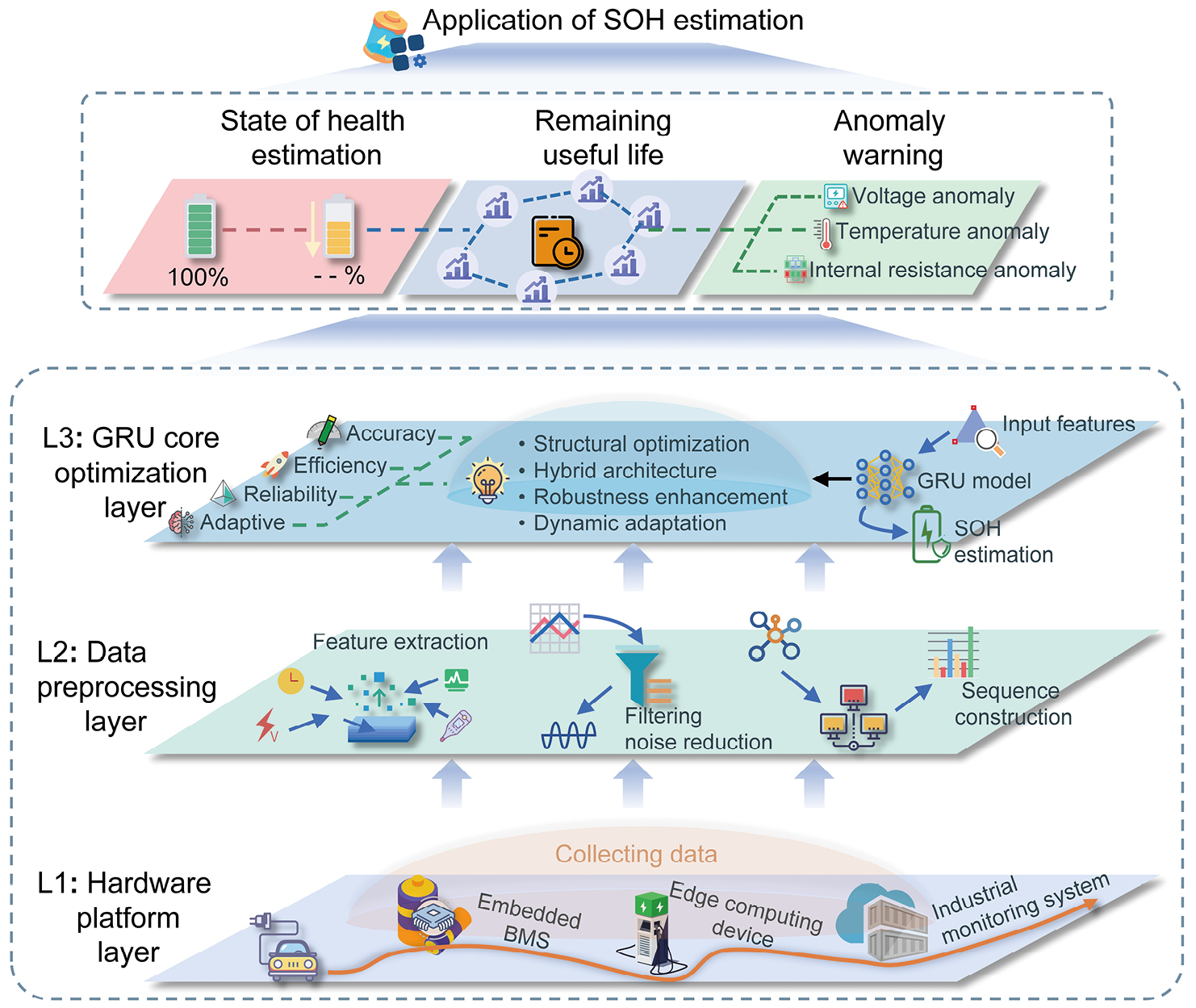
Gated recurrent unit-based: the GRU is a simplified variant of LSTM that reduces parameter count and computational complexity while retaining the ability to capture temporal dependencies, making it more suitable for real-time applications such as embedded BMS and industrial online monitoring. Recent research shows that GRU follows a development trajectory similar to LSTM's in SOH, but with greater emphasis on efficiency. The complete technical framework is illustrated in Figure 7.
Early work primarily validated the effectiveness of GRU as a basic regressor for processing HF sequences extracted from voltage and current data [127, 128]. Later research focused on structural optimization and efficiency improvement. For example, a bidirectional GRU (Bi-GRU) was adopted to better utilize the sequential context [129], and comparative experiments [130, 131] consistently confirmed that GRU typically reduces training time by 20%–30% and parameter count by over 25% while maintaining prediction accuracy comparable to LSTM, highlighting its superior efficiency advantage. Regarding the evolution from a single model to a hybrid architecture, GRU has been combined with Savitzky-Golay filters to improve input data quality [132]. It is cascaded with transformers to achieve local-global complementarity and combined with EMD to adapt to the deterministic trend of capacity degradation [99, 130]. To meet the stringent reliability requirements of BMS, GRU research has also advanced to enhance robustness and reduce prediction volatility. This has been achieved by integrating attention mechanisms (AMs) to dynamically focus on key features and time steps [128], or by using robust loss functions, such as mixture correntropy loss, to suppress noise and outliers [127]. Meanwhile, the transition of GRU from static modeling to dynamic adaptation is also a frontier research focus. For example, Shi et al. [133] used intelligent algorithms to optimize its hyperparameters.
In summary, the development of GRU is driven by the core principles of efficiency priority, hybrid innovation, and practical reliability. Although GRU theoretically offers lower state-space complexity and less refined control over information flow than LSTM, it holds irreplaceable value in engineering-oriented deployment research. Together with LSTM, they form a complete technical spectrum that covers from algorithm research to industrial applications.
The CNN and RNN models described earlier in this chapter primarily follow the supervised learning paradigm, aiming to establish an accurate end-to-end mapping from battery measurements to SOH labels. In contrast, autoencoders (AEs) and their variants employ unsupervised or semi-supervised learning to extract intrinsic aging-related health features from data, addressing key challenges in SOH estimation, such as label scarcity, variable operating conditions, and cell-to-cell variability. The technical development framework of autoencoder-based SOH estimation is illustrated in Figure 8.
From a technological evolution perspective, the application of AEs in SOH estimation has advanced from feature extraction to the integration of mechanisms. Early research primarily utilized AEs as unsupervised feature extractors, automatically learning low-dimensional dense representations of data through encoder-decoder pre-training. For instance, sparse autoencoders (SpAEs) extract critical aging features via L1 regularisation, while denoising autoencoders (DAEs) enhance feature robustness in noisy environments by recovering clean signals. These more discriminative features can significantly simplify the complexity of subsequent regression models, effectively improving the stability of SOH estimation in scenarios with inconsistent data quality and significant cell-to-cell variability [134].
As the demand for model interpretability grows, research has embedded electrochemical knowledge into AE frameworks to construct physics-informed hybrid models. By simultaneously optimizing the data reconstruction loss and the residuals of the physical equations, physics-informed AEs guide networks to learn HFs that fit the data while adhering to physical laws. For example, Xu et al. [135] incorporated ECM equations as soft constraints into the loss function, thereby ensuring the monotonicity and rationality of capacity-decay trajectories. This enables high-precision predictions with limited data and robust resistance to sudden shifts in operating conditions. More advanced work has developed disentangled autoencoders (DisAEs), in which distinct latent variable dimensions correspond to specific aging mechanisms, such as SEI growth and lithium plating, thereby achieving mechanistic interpretability.
To mitigate the challenges posed by dynamic operating conditions and cross-battery generalization, the AE paradigm has been extended to extract domain-invariant HFs. The encoder-decoder architecture helps to quickly adapt to new scenarios. It either integrates physical priors from online parameter identification or uses adversarial training to align latent-space distributions across different conditions. Consequently, precise estimation is achievable through fine-tuning only a subset of network layers, providing a unified framework for online adaptation and transfer learning [136]. Furthermore, variational autoencoders (VAEs) characterize the probabilistic distribution of latent variables, enabling both synthetic data generation to address data scarcity and uncertainty quantification to support risk-aware battery management.
For industrial deployment, AE-based methods face engineering challenges, including lightweight edge implementations, online adaptation, and safety certification. Researchers have proposed various solutions to address these issues. Model compression techniques such as knowledge distillation and neural architecture search reduce the computational burden on edge devices. Incremental learning strategies that handle concept drift during long-term battery operation enable the model to adapt over time. Meanwhile, deterministic inference schemes have been developed to comply with functional safety standards. Although challenges remain in network design, training complexity, and integration with complex aging mechanisms, AEs serve as a critical bridge between data-driven approaches and battery physics. By fulfilling this bridging role, they represent a core technical route toward an interpretable, adaptive, and reliable BMS. Future research should establish more comprehensive evaluation protocols that systematically compare accuracy, efficiency, generalization, and uncertainty quantification on public benchmarks. Such efforts would promote standardization and engineering maturity across the field, a goal essential for widespread industrial adoption.
In the field of battery SOH estimation, single DL models such as CNNs, LSTMs, GRUs, and AEs have demonstrated superior feature extraction and temporal modeling capabilities compared to traditional ML methods. However, single models have inherent limitations. To address this, hybrid neural networks integrate complementary network architectures, achieving a transition from manual feature engineering to automatic feature extraction and from simple temporal modeling to refined spatiotemporal feature fusion. This effectively improves the accuracy and robustness of estimation under practical scenarios such as complex operating conditions, fragmented data, and cell inconsistency, making hybrid neural networks a mainstream research direction in LIB SOH estimation.
Feature extraction is a prerequisite for LIB SOH estimation. By combining AEs and temporal networks, hybrid neural networks drive the evolution from manual design to unsupervised automatic extraction, enabling end-to-end model training. Zhu et al. [137] proposed the convolutional autoencoder-Bi-LSTM (CAE-Bi-LSTM) fusion architecture, which achieves unsupervised feature extraction and bidirectional temporal modeling of charging data, maintaining high estimation accuracy even under capacity-fluctuation scenarios. Obregon et al. [138] fused convolutional autoencoder (CAE) and DNN to autonomously extract high-dimensional features from EIS data, thereby adapting to temperature-varying conditions. In contrast, Wu et al. [139] employed a dual-autoencoder architecture that combines a CAE and a representation autoencoder (RAE) , thereby achieving complementary extraction of local and long-range temporal features. Excellent performance is obtained in small-sample scenarios.
LIB charge-discharge data exhibits both spatial local and temporal features. The hybrid architecture that combines CNNs with temporal networks has become the fundamental paradigm for spatiotemporal feature mining, evolving from simple serial fusion to multi-scale, multi-channel, and bidirectional designs to adapt to fragmented real-world data and varied operating conditions. In the basic architecture, local spatial features are first extracted by CNNs and are then passed into temporal networks, where long-term capacity degradation is captured. In this way, the limitations inherent in single models are compensated. For deep networks, skip connections were introduced by Xu et al. [140] to optimize the gradient flow, thereby mitigating feature degradation. To enhance spatial feature extraction, researchers have developed CNN variants. Multi-scale CNNs use kernels of different sizes to simultaneously extract fine- and coarse-grained features, thereby avoiding information loss [141]. Dilated CNNs use different dilation rates to expand the receptive field without increasing parameters or relying on pooling operations, thereby preserving feature information [142]. Multi-channel CNNs integrate health information from incomplete data segments via multiple input channels for fragmented real-world data [143]. Parallel CNNs extract independent features from voltage, current, and temperature data, thereby improving feature comprehensiveness [144, 145]. For temporal modeling, Bao et al. [142] replaced unidirectional LSTMs and GRUs with Bi-GRUs to capture both forward and backward temporal dependencies, enabling more accurate characterization of full-cycle battery degradation.
The introduction of AM adds a feature enhancement layer to hybrid architectures, enabling refined spatiotemporal feature fusion. After AM is incorporated into the basic spatiotemporal fusion framework, adaptive weighting is applied to the hidden states of temporal networks, the channel features of CNNs, or the time steps. Consequently, the model is enabled to focus on core aging features. For example, Zhao et al. [146] weighted the hidden states of temporal networks to highlight the contributions of key cycle stages, thereby improving robustness to cell inconsistency. Tian et al. [147] enhanced the feature interval that is highly correlated with SOH, thereby further reducing estimation errors by weighting bidirectional temporal features. Through attention-weighted data reconstruction, Liu et al. [148] effectively suppressed noise interference in raw data. In addition, a self-attention mechanism was adopted by Wang et al. [149] and Yang et al. [150] to enable global feature correlation analysis, compensating for incomplete local data.
Hybrid neural networks achieve high estimation accuracy but are complex, making them unsuitable for real-time online LIB SOH estimation. To address this issue, a complementary fusion of pure temporal networks was employed, thereby reducing model parameters while preserving accuracy and enabling lightweight network design. This architecture integrates multiple temporal networks to complementarily model long- and short-term features. LSTM typically serves as the primary network. Its gating mechanism overcomes the vanishing gradient problem of traditional RNNs, enabling accurate capture of long-term dependencies and capacity degradation over multiple cycles. Meanwhile, RNN or secondary LSTM/GRU networks serve as auxiliaries, modeling short-term temporal features within a single charge-discharge cycle to compensate for the limitations of LSTM. For example, the basic LSTM-RNN architecture proposed by Liu et al. [151] can be directly adapted for real-world online estimation. The improved LSTM-RNN architecture by Li et al. [152] integrates a parameter optimization algorithm that enhances the model's adaptability to nonlinear and non-Gaussian aging data. While maintaining a lightweight structure, the estimation accuracy is further optimized.
To overcome the limited generalization of single-stream hybrid neural networks, the hierarchical multi-stream feature fusion architecture uses a Hierarchical Feature Coupling Module (HFCM) as its core. It extracts features in parallel through shallow and deep streams at different dimensions, then adaptively fuses them. This preserves raw data information while integrating deep multi-scale contextual features, enabling comprehensive mining of aging characteristics. The fused features are fed into an LSTM for temporal dependency modeling, thereby enabling effective adaptation to different battery types and complex operating conditions. This architecture achieves stable estimation accuracy across multiple datasets with higher training efficiency than traditional temporal networks [153].
In summary, as summarised in Table 10, hybrid neural networks have achieved high accuracy and adaptability in LIB SOH estimation, but still face poor interpretability, limited adaptability under extreme conditions, and a trade-off between lightweight design and accuracy. Future research may focus on few-shot and cross-battery transfer learning, interpretability enhancement, and adaptability optimization to promote engineering applications.
| Fusion types | Representativeness | Datasets | Features | Accuracy | Benefits | Drawbacks |
|---|---|---|---|---|---|---|
| Autoencoder-temporal network fusion | CAE-Bi-LSTM [137] | Oxford, NASA | • Voltage & current & temperature curve | MAE ≤ 1.14% RMSE ≤ 3.76% |
• Simple training • Multi-scenario adaptability • Automatic feature extraction |
• High data requirements • Weak interpretability |
| CAE & RAE-GRU [139] | NASA | • Charge voltage & temperature curve | MAE ≤ 0.77% RMSE ≤ 1.04% |
|||
| CAE-DNN [138] | Public EIS dataset | • EIS data | MAE ≤ 1.18% RMSE ≤ 1.12% |
|||
| CNN-temporal network fusion | CNN-LSTM-Skip [140] | Oxford, NASA | • IC curve | RMSE ≤ 0.4% R2 ≥ 0.9 |
• Strong generalizability • Spatiotemporal feature synergy • Adaptability to diverse data characteristics |
• Numerous parameters • Sensitive to noise in fragmented data |
| Dilated CNN-BiGRU [142] | Oxford, NASA | • Discharge curve voltage distribution & capacity variation | MAE ≤ 1.83% RMSE ≤ 3.21% |
|||
| Multi-channel CNN-LSTM [143] | MIT | • Charge capacity difference | MAE ≤ 2.03% RMSE ≤ 2.31% |
|||
| Multi-scale CNN-LSTM [141] | NASA | • CC & CV time • Cycle number |
MAE ≤ 0.194% RMSE ≤ 0.277% |
|||
| CNN-GRU [144] | NASA | • Voltage • Current • Temperature |
MAE ≤ 0.901% MAPE ≤ 1.36% |
|||
| CNN-GRU [145] | NASA | • Voltage • Current • Capacity • Temperature |
MAE ≤ 4.1% MSE ≤ 0.2% MAPE ≤ 2.6% RMSE ≤ 4.8% |
|||
| CNN-temporal network-attention fusion | CNN-GRU-AM [146] | Oxford | • DT curve | Average MAE = 0.365% Average RMSE = 0.448% R2 ≥ 0.9867 |
• High precision • Enhanced key feature reinforcement • Suppression of noise & redundancy • Adaptability to complex operating conditions |
• High computational cost • Limited interpretability |
| CNN-GRU-AM [148] | Oxford | • Raw voltage & temperature • Reconstructed features |
Average MAE = 0.524% Average RMSE = 0.582% |
|||
| CNN-GRU-AM [149] | NASA, NEDC | • Temperature • Cycle number • Discharge current & voltage & time |
MAE ≤ 0.50% RMSE ≤ 0.80% |
|||
| CNN-Bi-LSTM-AM [147] | NASA | • Time • Discharge voltage & power |
MAE ≤ 0.70% MAPE ≤ 0.90% RMSE ≤ 1.20% |
|||
| CNN-Self-Attention [150] | Self-built dataset | • Voltage • Current • Temperature … |
MAE ≤ 0.02% RMSE ≤ 0.03% |
|||
| Temporal network complementary fusion | LSTM-RNN [151] | CALCE, NASA | • Voltage & current integration | RMSE ≤ 0.9311% | • Fast inference speed • Lightweight architecture • Suitable for online estimation • Few parameters & easy deployment |
• Sensitive to feature quality • Lack of independent feature extraction layers • Limited modeling accuracy for long time series |
| LSTM-Improved RNN [152] | NASA | • Time • Voltage • Current • Temperature |
MAE ≤ 1.4% RMSE ≤ 1.8% |
|||
| Hierarchical feature extraction-temporal network fusion | HFCM-LSTM [153] | Oxford, NASA | • Voltage • Current • Temperature |
MAE ≤ 1.04% RMSE ≤ 1.76% |
• Comprehensive feature mining • Strong generalization capability |
• Long training time • Complex module design |
To present an intuitive comparison, Table 11 groups the aforementioned representative DL methods by dataset and error metric.
| Datasets | Algorithms | Representative methods | Metrics | ||
|---|---|---|---|---|---|
| RMSE (%) | MAE (%) | MAPE (%) | |||
| NASA | CNN | CNN-Transformer [99] | ≤ 0.4 | ≤ 0.5 | – |
| CNN-ASTLSTM [102] | 0.72 | – | – | ||
| LSTM | Base LSTM [108] | – | – | < 2 | |
| Bi-LSTM + ICA [110] | – | – | – | ||
| LSTM with DEGWO + NCA [115] | < 1 | – | < 1 | ||
| LSTM with IQPSO [116] | ≤ 0.6454 | ≤ 0.5124 | ≤ 0.6926 | ||
| LSTM-Improved RNN [152] | ≤ 1.8 | – | ≤ 1.4 | ||
| Hybrid NN | CNN-GRU [144] | – | ≤ 0.901 | ≤ 1.36 | |
| CNN-GRU [145] | ≤ 4.8 | – | ≤ 2.6 | ||
| Multi-scale CNN-LSTM [141] | ≤ 0.277 | ≤ 0.194 | – | ||
| CNN-GRU-AM [149] | ≤ 0.80 | ≤ 0.50 | – | ||
| CNN-Bi-LSTM-AM [147] | ≤ 1.20 | ≤ 0.70 | ≤ 0.90 | ||
| CALCE | LSTM | LSTM + EMD [119] | 2 | – | ≤ 2 |
| Oxford | LSTM | LSTM with attention + ensemble learning [113] | ≤ 1.50 | ≤ 1.50 | – |
| LSTM with local/global dual-attention [114] | – | – | ≤ 1.88 | ||
| LSTM + TCN + Bayesian optimization [121] | ≤ 0.57 | ≤ 0.40 | – | ||
| Hybrid NN | CNN-GRU-AM [146] | 0.448 | – | – | |
| CNN-GRU-AM [148] | 0.382 | 0.524 | – | ||
| Dilated CNN-BiGRU [142] | ≤ 3.21 | ≤ 1.83 | – | ||
| CNN-LSTM-Skip [140] | ≤ 0.4 | – | – | ||
| HFCM-LSTM [153] | ≤ 1.76 | ≤ 1.04 | – | ||
| CAE-BiLSTM [137] | ≤ 3.76 | ≤ 1.14 | – | ||
| Self-built | LSTM | Base LSTM [107] | ≤ 0.5 | – | – |
| Bi-LSTM with dual-attention + temperature compensation [112] | 0.39 | – | – | ||
| LSTM with PSO + RMSProp [117] | ≤ 0.79 | – | ≤ 2.39 | ||
| LSTM with PSO [118] | – | ≤ 0.6076 | – | ||
| LSTM + NSSR [120] | – | – | – | ||
| Hybrid NN | CNN-self-attention [150] | ≤ 0.03 | ≤ 0.02 | – | |
| MIT-Stanford | LSTM | Bi-LSTM + DWT denoising [111] | – | < 0.3535 | < 0.3747 |
| LSTM + encoder-decoder + federated learning [124] | < 2 | – | – | ||
| Public EIS dataset | Hybrid NN | CAE-DNN [138] | ≤ 1.12 | ≤ 1.18 | – |
When data are scarce, deep models overfit easily. Their training requires large-scale cycle tests that are costly and time-consuming, making DL difficult in battery research. Transfer learning and fine-tuning help, but rely on sufficiently large pre-training datasets. For cross-battery generalization, hierarchical feature extraction can potentially learn domain-invariant representations. However, without physical constraints, models tend to use dataset-specific shortcuts that fail when battery chemistry or form factor changes. Domain adaptation and adversarial training improve generalization, but add complexity and training overhead. Under extreme operating conditions, data distribution shifts cause significant performance degradation, especially for RNNs. These models rely on patterns of benign aging, which differ from the nonlinear dynamics induced by low temperature or ultra-fast charging. Furthermore, deep models impose high computational demands that exceed the capacity of automotive-grade microcontroller units (MCUs), limiting onboard deployment. DL methods suit scenarios with diverse training data, sufficient cloud or edge resources, and relaxed latency constraints. For onboard use, techniques like pruning, quantization, and knowledge distillation are essential.
Traditional ML and DL, as discussed earlier, primarily focus on accurate battery SOH estimation. In contrast, RL operates within an observation-decision-feedback loop. It dynamically adjusts charge-discharge strategies according to real-time health status. This enables optimal trade-offs among multiple objectives, including lifespan, efficiency, and safety. The resulting optimized battery health management is illustrated in Figure 9. Within this framework, the estimated SOH serves as a key state variable. It can take the form of a scalar value, such as a capacity fade percentage, or a probabilistic distribution. Together with other operational variables, including SOC and temperature, it constitutes the state space of the reinforcement learning agent. Based on this state representation, the RL agent generates optimal control actions. These actions include charging current adjustment and power allocation. They are executed on the battery system, which in turn produces new measurement data. These data then feed into the next cycle of SOH estimation. However, overestimating SOH may lead to overly aggressive charging strategies that accelerate aging, while underestimation may cause unnecessary power derating. In this sense, this bidirectional coupling requires that policy optimization be built on a solid foundation of estimation accuracy. This chapter reviews RL literature and elaborates on representative algorithms for strategy optimization, including Q-learning, Deep Q-Network (DQN), and actor-critic methods.
Q-learning is a trial-and-error RL algorithm that does not require a pre-built model of the battery system. Through continuous implementation of various charge-discharge actions, real-time observation of system feedback, and acquisition of reward signals, the model can iteratively obtain the optimal control strategy. It is suitable for scenarios requiring real-time optimization in response to SOH changes, such as personalized charging strategies, power management in hybrid energy storage systems, and maximizing battery life under multiple constraints. Yalçın and Herdem [154] integrated Q-learning into the actor–critic framework based on the DQN, with SOH treated as a critical state variable. In this framework, the agent receives the SOH estimate from the BMS as an environmental state input. Based on this input, the agent outputs charging/discharging C-rate and duration control commands, which are applied to the battery cells. After the battery operating conditions change, the SOH is recalculated and updated, then fed back to the network, completing one closed-loop iteration. When combined with the battery degradation model, the proposed method enables quantitative characterization of SOH variation. Furthermore, an SOH protection term is embedded into the reward function to constrain undesirable behaviors that accelerate battery aging. This design effectively reduces the relative SOC error and suppresses the continuous degradation of battery SOH. Yiming Ye [155] applied Q-learning to a battery-supercapacitor hybrid energy storage system, dynamically adjusting the power distribution ratio based on SOH. In this study, the policy optimization of Q-learning follows a similar closed-loop path. The algorithm reads the real-time SOH estimate and sends control commands to adjust the power split between the battery and the supercapacitor, thereby altering the energy storage system's operating conditions. The battery degradation level is updated synchronously, generating new SOH data that is fed back to the agent, thereby forming a closed decision-making loop. During this process, Q-learning dynamically adjusts the power distribution ratio according to SOH variations. When SOH decreases, the load on the supercapacitor is increased to reduce battery stress, and imitation learning is integrated to enable rapid adaptation to scenarios with varying SOH levels.
In summary, the closed-loop coupling between Q-learning and SOH estimation has been realized through various technical approaches in the studies above. The algorithm adapts to variations in SOH, balances SOH maintenance, energy efficiency, and safety constraints, and has low dependence on prior knowledge.
Traditional Q-learning is constrained by inherent drawbacks: excessive training iterations, high computational overhead, the discrete nature that impedes precise control of continuous SOH decay, and poor real-time performance in complex scenarios. DL shows outstanding capacity for feature extraction, and RL possesses remarkable superiority in decision regulation. Their effective integration enables DQN to gain overall optimization in SOH-oriented applications.
Given the training efficiency and resource consumption, DQN replaces the Q-table with a DNN to systematically store historical charge-discharge strategies and associated SOH degradation data. Random sampling breaks correlations in state sequences, enabling the network to learn uniformly from distinct aging patterns across the battery's full lifecycle and reducing the number of iterations. Meanwhile, a dual-network structure is further adopted, in which the target network provides a stable Q-value estimation baseline with fixed parameters, effectively alleviating temporal-difference target fluctuations induced by SOH estimation delay and accelerating convergence. Baccari et al. [156] demonstrated that with a 5,000-capacity replay buffer and 64-sample batch training, only 20,000 pre-training and fine-tuning iterations are required for stable decision-making, significantly outperforming traditional Q-learning in iteration efficiency.
To overcome the state-space discretization limitation of traditional Q-learning, DQN approximates the Q-value function using neural networks, enabling direct processing of continuous state variables such as voltage, current, and temperature. This eliminates the need to discretize continuous state spaces and store large state-action tables, effectively avoiding the curse of dimensionality and information loss. Given the continuous degradation of SOH, a temporal memory module, such as an LSTM, can be integrated into the network to capture long-term trends in parameters like SOH and SOC, enabling more adaptive decisions for the aging process [157]. At the action execution level, although DQN outputs discrete actions, it can first generate fine-grained continuous control signals and then map them to executable discrete actions. This allows deep optimization of internal battery electrochemical processes while respecting hardware constraints [158]. These approaches enable DQN to overcome the discretization dependency of traditional Q-learning, providing more refined and adaptive control strategies for battery health management.
To enhance real-time performance in complex scenarios, DQN requires substantial computation during training but only neural network forward propagation during deployment, resulting in low decision latency. Baccari et al. [156] configured the DQN agent with a 10-second decision interval, enabling real-time responses to dynamic driving-cycle events such as acceleration and braking. Chen et al. [159] applied DQN to the outer-loop capacity configuration of a microgrid. By cooperating with inner-loop mixed integer linear programming (MILP), it met real-time scheduling requirements even under complex constraints such as electric-thermal coupling and power balance.
In SOH-optimized control, the actor-critic framework offers superior expressiveness and stability for continuous action control. Proximal Policy Optimization (PPO) and Deep Deterministic Policy Gradient (DDPG), two representative algorithms of this framework, provide more powerful solutions for dynamic SOH management through stochastic policy optimization and deterministic policy learning, respectively.
Compared with Q-learning and DQN, PPO offers advantages in continuous action-space adaptation, policy-update stability, and multi-objective optimization efficiency, making it better suited to the demanding requirements of nonlinearity, dynamics, and SOH protection in battery systems. PPO supports decision-making in continuous action spaces without discretization. For example, it can directly output continuous power distribution ratios [160] or dynamically adjust switch-combination strategies [161], thereby avoiding precision loss and operating-condition fluctuations caused by discretization and reducing irreversible damage to SOH. It strictly limits the amplitude of policy updates via a clipped objective function and combines generalised advantage estimation (GAE) to reduce training variance, thereby avoiding battery stress responses such as overheating and high-current charge-discharge caused by abrupt parameter changes, and improving the stability of SOH optimization. At the same time, it can efficiently integrate multi-objective rewards such as SOH attenuation, balance effect, and energy consumption, directly maximizing the cumulative reward through policy gradient optimization without the need to design a complex multi-objective coordination mechanism, thus meeting the comprehensive needs of SOH optimization. In the passive balancing SOH optimization of the LIB pack [161], DQN needs to discretize the 5 switches' on/off actions into 32 combinations. Even after filtering out invalid actions, its decisions are still not precise enough, leading to more switching than PPO does, which further damages battery health. As a policy gradient algorithm, PPO can adjust the switching strategy more smoothly, reducing switching costs while achieving an 83.1% reduction in SOC variance, thereby indirectly reducing SOH degradation caused by imbalance. It can also adapt to battery packs with different SOH states without fine-tuning, with robustness superior to DQN. In the power allocation of hybrid energy storage systems [160], the SOH optimization needs to dynamically output continuous power allocation ratios. The DQN's discretization process cannot accurately capture load fluctuations and battery aging patterns, whereas PPO directly outputs continuous actions through the actor-critic framework. By incorporating the aging loss into the reward function and using the electro-thermal coupling model, the battery aging loss is reduced by 0.3%–9.4% compared with traditional methods, and training time is shortened by 97%. Meanwhile, PPO's stable update mechanism avoids the common reward-oscillation problem in DQN training, ensuring the consistency of SOH protection strategies. When combined with the predictive safety filter (PSF), it further prevents battery health degradation caused by decision fluctuations, whereas DQN struggles to consistently maintain the effectiveness of SOH optimization in complex load scenarios due to training instability.
DDPG shares the actor-critic framework with PPO, which is also applicable to decision-making problems in complex dynamic systems such as battery health optimization. Both algorithms aim to learn optimal policies through interaction with the environment. However, DDPG adopts a deterministic policy and ensures stability through soft updates of target networks, placing greater emphasis on the smoothness and temporal correlation of action outputs. In contrast, PPO employs a stochastic policy and constrains the magnitude of policy updates via trust-region clipping, without requiring a soft-update mechanism, thereby achieving higher sample efficiency and placing greater emphasis on training robustness and efficiency. Given this difference, DDPG offers unique advantages for SOH optimization. SOH degradation is directly related to continuous variables such as motor torque distribution and battery charge-discharge rates, and is a long-term cumulative process dependent on historical operating states. DDPG deterministic continuous action output enables fine-grained smooth adjustments, avoiding health state fluctuations. It can also flexibly integrate temporal modules such as GRU to capture historical dependencies, and its reward function can be directly linked to SOH degradation indicators, making it better suited to health optimization requirements. PPO, however, requires additional temporal modeling; its stochastic policy can introduce parameter uncertainty, and it is less effective at optimizing a single health indicator. Relevant literature provides strong support for this. Wu et al. [162] implemented DDPG embedded with a GRU and self-attention mechanism for SOH optimization of dual-motor electric vehicles, to achieve health-coordinated optimization of the dual motors and the battery through continuous torque distribution. Experimental results showed that the final SOH of the two motors reached 99.99929% and 99.99978%, respectively, while battery SOH performance achieved 96.83% of the globally optimal Dynamic Programming (DP) algorithm, with a significantly reduced SOH decay rate. Yin et al. [163] adopted DDPG to precisely optimize adaptive unscented Kalman filter (AUKF) parameters through continuous actions for LIB SOH estimation, reducing the MSE to 0.050, a 33% reduction compared with the traditional unscented Kalman filter (UKF). In contrast, the stochastic policy of PPO introduces uncertainty in parameter adjustment, making it difficult to achieve the stable accuracy required for SOH estimation under high-noise conditions. The evaluation of representative RL algorithms for battery SOH optimization management is presented in Table 12.
| Algorithms | Representativeness | Policy type | State & action space | Core mechanism | SOH scenarios | Limitations |
|---|---|---|---|---|---|---|
| Value-based algorithm | Traditional Q-Learning [154, 155] | Implicit policy | Discrete state-action table | Bellman equation update | Simple discrete scenarios | • Curse of dimensionality • Unable to fit continuous SOH degradation |
| DQN [156–159] | Implicit policy | Continuous state & discrete action | Experience replay & target network | Discrete control scenarios | • Training oscillation • Precision loss due to discrete actions |
|
| Policy-based algorithm | PPO [160, 161] | Stochastic policy | Continuous state & continuous/discrete action | Clipping objective & GAE | Multi-objective trade-off scenarios | • Uncertainty of stochastic policy in fine-grained control |
| DDPG [162, 163] | Deterministic policy | Continuous state & continuous action | Target network soft update & experience replay | Continuous fine control scenarios | • Prone to local optima • High exploration requirement |
The primary bottleneck of RL in health management is sample efficiency. Q-learning and DQN require tens of thousands of training episodes to converge, each corresponding to a real charge-discharge cycle that cannot be physically repeated. This forces researchers to use degradation models for generating virtual data, and the model-reality discrepancy introduces bias that undermines policy reliability. Imitation learning and offline RL reduce the need for online interaction but depend heavily on the availability of high-quality expert demonstrations. For cross-battery transfer, degradation dynamics and state transitions differ significantly across chemistries. Policies are tightly coupled to specific batteries, making retraining or fine-tuning necessary for new types. Under extreme conditions, nominally trained policies may not have explored the extreme regions of the state space, and extrapolation errors during deployment can lead to unsafe actions. For instance, at low temperatures, the agent may overestimate battery tolerance and issue excessive power commands, risking thermal runaway. Computationally, RL inference is far cheaper than training, but still burdens automotive-grade controllers, especially when deep networks are used as function approximators. In summary, RL-based health management currently suits only scenarios with high-fidelity degradation models, well-defined operating conditions, and sufficient computational resources. For onboard deployment, improvements in sample efficiency, lightweight inference, and safety assurance are essential, with formal verification or conservative exploration needed before real-world use.
With the large-scale deployment of new energy vehicles and electrochemical energy storage technologies, accurate SOH estimation and intelligent optimization of LIB management have become critical to ensuring safe and reliable system operation. In recent years, data-driven methods based on ML, DL, and RL have achieved substantial progress in battery HF mining, SOH estimation model construction, and life optimization strategy design, effectively improving estimation accuracy and management efficiency. However, practical engineering applications still face multi-dimensional challenges, while clear future development directions have also emerged, as illustrated in Figure 10.
At the HF level, the multi-physical signals of batteries, including electrical, thermal, and mechanical signals, in real-world vehicle and energy storage scenarios exhibit strong coupling, noise, nonlinearity, and time-varying characteristics [164]. Existing feature extraction methods are mostly based on lab-ideal-environment data [165], resulting in poor adaptability to complex operating conditions such as dynamic current fluctuations, temperature variations, and uneven aging. Consequently, they struggle to achieve simultaneous accurate decoupling and robust extraction of multi-physical features. Meanwhile, feature dimensionality-reduction algorithms struggle to strike an effective balance between preserving key health information and reducing dimensionality redundancy. At the SOH estimation model level [166], traditional ML methods heavily rely on manual feature engineering, resulting in limited adaptability and generalization performance. DL and hybrid neural networks can improve estimation accuracy [167]. However, they generally suffer from complex model structures and limited physical interpretability [168]. They also incur high training costs and substantial computational demands, and their cross-battery and cross-condition transferability remains weak. Consequently, lightweight design and online application remain challenging. At the model evaluation level [169], existing studies lack unified standards for datasets, test conditions, accuracy metrics, and validation procedures. Evaluation criteria such as MAPE, MAE, and RMSE are applied inconsistently, making fair and reliable cross-algorithm comparisons difficult. At the health optimization level, RL [170] for battery SOH management faces several challenges: high-dimensional state spaces, complex action space design, reward functions that are difficult to align with battery aging mechanisms, difficulty in coordinating multi-objective optimization, such as lifespan and power [171, 172], and constraints on real-time performance and computational resources. Consequently, its online optimization and real-time decision-making capabilities struggle to meet engineering requirements. At the industrial deployment level, most algorithms remain in the offline simulation and lab validation stage [173]. Key engineering issues such as model lightweighting for edge computing platforms, online adaptive updating during long-term operation, functional safety certification of battery systems, and consistency management of large-scale battery clusters have not yet been systematically addressed. As a result, a significant gap remains between theoretical research achievements and practical engineering applications.
To address these multi-dimensional and multi-level challenges, future research on LIB SOH estimation and health optimization should focus on the following directions for greater depth and engineering practicality. First, build a multiphysics-coupled HF system for dynamic, complex conditions; develop adaptive extraction, decoupling, and reduction algorithms under strong interference; and improve feature stability and generality throughout the full lifecycle. In this process, full consideration should be given to engineering constraints such as limited sampling frequency of onboard sensors and the higher noise levels in real-world driving conditions compared to laboratory environments. In addition, AI-driven design of novel electrode materials is gaining increasing attention. Emerging materials such as high-entropy oxides and disordered rocksalt structures show different degradation pathways [174–177], so conventional feature-SOH correlations may no longer hold. Future efforts should revisit the selection criteria for health features by incorporating the intrinsic properties of these materials and establishing correlations from the microstructure to macroscopic aging. Second, develop SOH estimation models that fuse electrochemical mechanisms with data-driven methods, enhance the interpretability and reliability of deep and hybrid networks, and pursue lightweight, low-power designs. Particular attention should be paid to the computational limits of automotive-grade microcontrollers, as the parameter counts of high-performance models often exceed the storage and computing capacity of onboard BMS chips, necessitating model pruning, quantization, and knowledge distillation to balance accuracy and efficiency. This will improve cross-battery, cross-condition, and cross-platform generalization and transferability for online embedded applications. Third, establish industry-wide public datasets, standard test conditions, and a unified evaluation system with clear accuracy metrics, validation procedures, and comparison benchmarks to support algorithm development, performance evaluation, and technical iteration. Fourth, develop lightweight RL optimization algorithms tailored to battery characteristics; optimize the state space, action space, and multi-objective rewards; and enhance the real-time performance, robustness, and practicality of health-optimization strategies, thereby enabling full-lifecycle health regulation through coordinated charging, power allocation, and thermal management. Fifth, integrate emerging technologies, such as cloud-edge collaboration, digital twins, and federated learning, into battery health management. Within the cloud-edge collaboration framework, the division of tasks between cloud-based training and edge-based inference should be clearly defined—with the cloud handling complex model training and iteration, and the edge executing lightweight inference and online adaptation—to resolve onboard computational bottlenecks and reduce communication bandwidth pressure. Within the federated learning framework, privacy-preserving cross-platform SOH collaborative estimation methods should be developed to enable multi-party joint modeling via encrypted exchange of model parameters or gradients, without directly uploading raw operational data, thereby balancing estimation accuracy and data security. Meanwhile, to address the risks of model drift and safety certification during online updates, robust version rollback mechanisms and formal verification processes should be established to ensure compliance with automotive functional safety standards such as ISO 26262. Tackle engineering challenges like edge deployment, online updating, safety certification, and cluster consistency, and translate theoretical research into practical applications for onboard powertrains and energy storage stations, thus building an intelligent battery health management system with high accuracy, reliability, and full-lifecycle coverage.
Accurate estimation and intelligent management of the SOH of LIBs are core technologies for ensuring the safe, efficient, and long‑service operation of new EVs and energy storage systems. Based on a systematic review of relevant literature, this article summarises high-frequency selection strategies from multiple physical perspectives, including electrical, thermal, and mechanical aspects. Feature extraction methods and dimensionality reduction techniques have been classified and reviewed. In addition, the technological evolution and optimization path of traditional ML and DL for SOH estimation were elaborated, and the progress in the application of RL to battery health optimization regulation was discussed. To date, data‑driven methods have achieved remarkable performance in battery SOH research. Nevertheless, several prominent challenges remain for engineering implementation, including strong coupling in multi‑physics features, insufficient model generalization and interpretability, the absence of unified evaluation criteria, unsatisfactory real‑time performance of reinforcement learning algorithms, and considerable difficulties in industrial application. Future research should concentrate on constructing a multi-physics-coupled feature system, deeply integrating electrochemical mechanisms with data‑driven approaches, establishing unified evaluation standards, and realizing lightweight, online algorithm deployment, thereby advancing the development and practical implementation of a full‑life‑cycle health monitoring and intelligent management system for LIBs.
Yao Cheng: Investigation; conceptualization; data curation; writing & editing. Jiaqiang Tian: Investigation; conceptualization; review & editing; language polishing; project administration; funding acquisition. Mince Li, Xiang Dong, Tianhong Pan, Duo Yang, Kuijie Li, and Jilei Liu: Review & editing.
This work was supported by the National Natural Science Foundation of China (Grant No. 62203352).
The data that support the findings of this study are available from the corresponding author upon reasonable request.
J. Q. Tian, Y. Fan, T. H. Pan, X. Zhang, J. N. Yin, and Q. P. Zhang, "A Critical Review on Inconsistency Mechanism, Evaluation Methods and Improvement Measures for Lithium-Ion Battery Energy Storage Systems," Renewable and Sustainable Energy Reviews 189, Part B (2024): 113978, https://doi.org/10.1016/j.rser.2023.113978.
Z. Ren and C. Q. Du, "A Review of Machine Learning State-of-Charge and State-of-Health Estimation Algorithms for Lithium-Ion Batteries," Energy Reports 9 (2023): 2993–3021, https://doi.org/10.1016/j.egy.2023.01.108.
X. Sui, S. He, S. B. Vilsen, J. H. Meng, R. Teodorescu, and D. I. Stroe, "A Review of Non-Probabilistic Machine Learning-Based State of Health Estimation Techniques for Lithium-Ion Battery," Applied Energy 300 (2021): 117346, https://doi.org/10.1016/j.apenergy.2021.117346.
K. Das and R. Kumar, "Electric Vehicle Battery Capacity Degradation and Health Estimation Using Machine-Learning Techniques: A Review," Clean Energy 7, no. 6 (2023): 1268–1281, https://doi.org/10.1093/ce/zkad054.
X. Shu, S. Q. Shen, J. W. Shen, et al., "State of Health Prediction of Lthium-Ion Batteries Based on Machine Learning: Advances and Perspectives," iScience 24, no. 11 (2021): 103265, https://doi.org/10.1016/j.isci.2021.103265.
A. Haraz, K. Abualsaud, and A. M. Massoud, "State-of-Health and State-of-Charge Estimation in Electric Vehicles Batteries: A Survey on Machine Learning Approaches," IEEE Access 12 (2024): 158110–158139, https://doi.org/10.1109/ACCESS.2024.3486989.
P. Eleftheriadis, M. Gangi, S. Leva, A. V. Rey, E. Groppo, and L. Grande, "Comparative Study of Machine Learning Techniques for the State of Health Estimation of Li-Ion Batteries," Electric Power Systems Research 235 (2024): 110889, https://doi.org/10.1016/j.epsr.2024.110889.
U. Saleem, W. L. Li, H. U. Lateef, et al., "Investigation of Deep Learning Based Techniques for Prognostic and Health Management of Lithium-Ion Battery," paper presented at the European Conference on Artificial Intelligence, June 29, 2023, https://doi.org/10.1109/ECAI58194.2023.10194122.
C. F. Li, L. Yang, Q. Li, et al., "SOH Estimation Method for Lithium-Ion Batteries Based on an Improved Equivalent Circuit Model via Electrochemical Impedance Spectroscopy," Journal of Energy Storage 86, Part A (2024): 111167, https://doi.org/10.1016/j.est.2024.111167.
K. K. Sadabadi, X. Jin, and G. Rizzoni, "Prediction of Remaining Useful Life for a Composite Electrode Lithium Ion Battery Cell Using an Electrochemical Model to Estimate the State of Health," Journal of Power Sources 481 (2021): 228861, https://doi.org/10.1016/j.jpowsour.2020.228861.
G. Molina-Abril, L. Calvet, A. A. Juan, and D. Riera, "Strategic Decision-Making in SMEs: A Review of Heuristics and Machine Learning for Multi-Objective Optimization," Computation 13, no. 7 (2025): 173, https://doi.org/10.3390/computation13070173.
I. Marri, E. Petkovski, L. Cristaldi, and M. Faifer, "Comparing Machine Learning Strategies for SOH Estimation of Lithium-Ion Batteries Using a Feature-Based Approach," Energies 16, no. 11 (2023): 4423, https://doi.org/10.3390/en16114423.
M. Massaoudi, H. Abu-Rub, and A. Ghrayeb, "Advancing Lithium-Ion Battery Health Prognostics with Deep Learning: A Review and Case Study," IEEE Open Journal of Industry Applications 5 (2024): 43–62, https://doi.org/10.1109/ojia.2024.3354899.
W. H. Li, H. Cui, T. Nemeth, et al., "Deep Reinforcement Learning-Based Energy Management of Hybrid Battery Systems in Electric Vehicles," Journal of Energy Storage 36 (2021): 102355, https://doi.org/10.1016/j.est.2021.102355.
K. B. Kwon and H. Zhu, "Reinforcement Learning-Based Optimal Battery Control under Cycle-Based Degradation Cost," IEEE Transactions on Smart Grid 13, no. 6 (2022): 4909–4917, https://doi.org/10.1109/TSG.2022.3180674.
Z. Chen, H. Q. Zhao, Y. J. Zhang, S. Q. Shen, J. W. Shen, and Y. G. Liu, "State of Health Estimation for Lithium-Ion Batteries Based on Temperature Prediction and Gated Recurrent Unit Neural Network," Journal of Power Sources 521 (2022): 230892, https://doi.org/10.1016/j.jpowsour.2021.230892.
J. Y. Wang, C. P. Zhang, L. J. Zhang, et al., "A Novel Aging Characteristics-Based Feature Engineering for Battery State of Health Estimation," Energy 273 (2023): 127169, https://doi.org/10.1016/j.energy.2023.127169.
J. L. Liu, Q. L. Duan, K. X. Qi, et al., "Capacity Fading Mechanisms and State of Health Prediction of Commercial Lithium-Ion Battery in Total Lifespan," Journal of Energy Storage 46 (2022): 103910, https://doi.org/10.1016/j.est.2021.103910.
X. J. Tan, Y. Q. Tan, D. Zhan, et al., "Real-Time State-of-Health Estimation of Lithium-Ion Batteries Based on the Equivalent Internal Resistance," IEEE Access 8 (2020): 56811–56822, https://doi.org/10.1109/ACCESS.2020.2979570.
H. H. Goh, Z. T. Lan, D. D. Zhang, W. Dai, T. A. Kurniawan, and K. C. Goh, "Estimation of the State of Health (SOH) of Batteries Using Discrete Curvature Feature Extraction," Journal of Energy Storage 50 (2022): 104646, https://doi.org/10.1016/j.est.2022.104646.
J. Sun, C. Q. Fan, and H. Y. Yan, "SOH Estimation of Lithium-Ion Batteries Based on Multi-Feature Deep Fusion and XGBoost," Energy 306 (2024): 132429, https://doi.org/10.1016/j.energy.2024.132429.
M. Q. Lin, C. H. Yan, W. Wang, G. Z. Dong, J. H. Meng, and J. Wu, "A Data-Driven Approach for Estimating State-of-Health of Lithium-Ion Batteries Considering Internal Resistance," Energy 277 (2023): 127675, https://doi.org/10.1016/j.energy.2023.127675.
A. Gismero, K. Nørregaard, B. Johnsen, L. Stenhøj, D. I. Stroe, and E. Schaltz, "Electric Vehicle Battery State of Health Estimation Using Incremental Capacity Analysis," Journal of Energy Storage 64 (2023): 107110, https://doi.org/10.1016/j.est.2023.107110.
F. Xia, K. G. Wang, and J. J. Chen, "State of Health and Remaining Useful Life Prediction of Lithium-Ion Batteries Based on a Disturbance-Free Incremental Capacity and Differential Voltage Analysis Method," Journal of Energy Storage 64 (2023): 107161, https://doi.org/10.1016/j.est.2023.107161.
B. Jiang, J. G. Zhu, X. Y. Wang, X. Z. Wei, W. L. Shang, and H. F. Dai, "A Comparative Study of Different Features Extracted from Electrochemical Impedance Spectroscopy in State of Health Estimation for Lithium-Ion Batteries," Applied Energy 322 (2022): 119502, https://doi.org/10.1016/j.apenergy.2022.119502.
L. Wang, J. Liu, G. B. Liu, Y. Q. Huang, X. L. Yu, and L. W. Fan, "Anisotropic Thermal Conductivity of Lithium-Ion Batteries at the Full-Cell Level: A Review of Methodology Advances, Data Analytics, and Future Applications," Advanced Materials 38, no. 5 (2026): e11928, https://doi.org/10.1002/adma.202511928.
L. Tendera, D. Wycisk, C. Gonzalez, J. Stadler, and K. P. Birke, "Influence of State of Health and Individual Aging Mechanisms on the Thermal Conductivity of Lithium-Ion Cells," Journal of Energy Storage 62 (2023): 106940, https://doi.org/10.1016/j.est.2023.106940.
J. P. Tian, R. Xiong, and W. X. Shen, "State-of-Health Estimation Based on Differential Temperature for Lithium Ion Batteries," IEEE Transactions on Power Electronics 35, no. 10 (2020): 10363–10373, https://doi.org/10.1109/TPEL.2020.2978493.
Z. P. Wang, C. G. Yuan, and X. Y. Li, "Lithium Battery State-of-Health Estimation via Differential Thermal Voltammetry with Gaussian Process Regression," IEEE Transactions on Transportation Electrification 7, no. 1 (2021): 16–25, https://doi.org/10.1109/TTE.2020.3028784.
H. L. Feng and N. J. Li, "A Multi-Feature Fusion Model Based on Differential Thermal Capacity for Prediction of the Health Status of Lithium-Ion Batteries," Journal of Energy Storage 72, Part C (2023): 108419, https://doi.org/10.1016/j.est.2023.108419.
M. A. P. Estevez, F. V. Conte, C. Tremonti, and M. Renzi, "Aging Estimation of Lithium Ion Cells under Real-World Conditions through Mechanical Stress Measurements," Journal of Energy Storage 64 (2023): 107186, https://doi.org/10.1016/j.est.2023.107186.
J. Peng, S. H. Jia, S. M. Yang, X. L. Kang, H. Q. Yu, and Y. W. Yang, "State Estimation of Lithium-Ion Batteries Based on Strain Parameter Monitored by Fiber Bragg Grating Sensors," Journal of Energy Storage 52, Part B (2022): 104950, https://doi.org/10.1016/j.est.2022.104950.
S. J. Hou, Y. Fan, B. W. Dou, H. Li, Q. Zhang, and H. S. Chen, "Strain Feature-Assisted State of Health Estimation for Lithium-Ion Batteries," Energy 326 (2025): 136058, https://doi.org/10.1016/j.energy.2025.136058.
Y. C. Zhang, X. Lai, X. Zhang, et al., "Fusion of Stress and Electrical Signals for High-Accuracy Joint Estimation of SOC and SOH in Lithium-Ion Batteries," Energy 331 (2025): 137063, https://doi.org/10.1016/j.energy.2025.137063.
Q. H. Wu, W. H. Ye, R. J. Liang, R. Pan, T. T. Ma, and X. Quan, "A New State-of-Health Estimation Method for Retired Lithium-Ion Battery Based on Expansion," Journal of The Electrochemical Society 172, no. 6 (2025): 060511, https://doi.org/10.1149/1945-7111/add0d52.
Q. Xu, X. Y. Wang, H. Ye, L. L. Gong, P. Tan, and T. R. Pan, "An Accurate State of Health Estimation Method for Lithium-Ion Batteries Based on Expansion Force Analysis," Energy 325 (2025): 136155, https://doi.org/10.1016/j.energy.2025.136155.
K. Zhong, Z. H. Liu, P. Wang, et al., "Simultaneous Prediction of SOH and RUL for Lithium-Ion Batteries Using Transferable Knowledge Sharing Network," IEEE Transactions on Power Electronics 40, no. 9 (2025): 13741–13751, https://doi.org/10.1109/tpel.2025.3565730.
Z. Chen, H. Q. Zhao, Y. J. Zhang, S. Q. Shen, J. W. Shen, and Y. G. Liu, "State of Health Estimation for Lithium-Ion Batteries Based on Temperature Prediction and Gated Recurrent Unit Neural Network," Journal of Power Sources 521 (2022): 230892, https://doi.org/10.1016/j.jpowsour.2021.230892.
Q. W. Li and W. L. Xue, "A Review of Feature Extraction Toward Health State Estimation of Lithium-Ion Batteries," Journal of Energy Storage 112 (2025): 115453, https://doi.org/10.1016/j.est.2025.115453.
J. Z. Kong, F. F. Yang, X. Zhang, E. S. Pan, Z. K. Peng, and D. Wang, "Voltage-Temperature Health Feature Extraction to Improve Prognostics and Health Management of Lithium-Ion Batteries," Energy 223 (2021): 120114, https://doi.org/10.1016/j.energy.2021.120114.
C. Lei, J. H. Meng, D. I. Stroe, et al., "Multiobjective Optimization of Data-Driven Model for Lithium-Ion Battery SOH Estimation with Short-Term Feature," IEEE Transactions on Power Electronics 35, no. 11 (2020): 11855–11864, https://doi.org/10.1109/TPEL.2020.2987383.
L. P. Chen, S. Q. Xie, A. M. Lopes, et al., "A New SOH Estimation Method for Lithium-Ion Batteries Based on Model-Data-Fusion," Energy 286 (2024): 129597, https://doi.org/10.1016/j.energy.2023.129597.
G. Vennam and A. Sahoo, "A Dynamic SOH-Coupled Lithium-Ion Cell Model for State and Parameter Estimation," IEEE Transactions on Energy Conversion 38, no. 2 (2023): 1186–1196, https://doi.org/10.1109/TEC.2022.3218344.
W. W. Xu, H. Y. Cao, X. Y. Lin, et al., "Data-Driven Semi-Empirical Model Approximation Method for Capacity Degradation of Retired Lithium-Ion Battery Considering SOC Range," Applied Sciences 13, no. 21 (2023): 11943, https://doi.org/10.3390/app132111943.
J. Q. Tian, X. H. Liu, S. Q. Li, et al., "Lithium-Ion Battery Health Estimation with Real-World Data for Electric Vehicles," Energy 270 (2023): 126855, https://doi.org/10.1016/j.energy.2023.126855.
D. Zhou, J. L. Liang, F. X. Li, et al., "SOH Prediction of Lithium-Ion Batteries Using a Hybrid Model Approach Integrating Single Particle Model and Neural Networks," Journal of Energy Storage 104, Part B (2024): 114579, https://doi.org/10.1016/j.est.2024.114579.
J. C. Hong, H. X. Yang, F. W. Liang, et al., "State of Health Prediction for Proton Exchange Membrane Fuel Cells Combining Semi-Empirical Model and Machine Learning," Energy 291 (2024): 130364, https://doi.org/10.1016/j.energy.2024.130364.
M. Q. Lin, C. H. Yan, W. Wang, G. Z. Dong, J. H. Meng, and J. Wu, "A Data-Driven Approach for Estimating State-of-Health of Lithium-Ion Batteries Considering Internal Resistance," Energy 277 (2023): 127675, https://doi.org/10.1016/j.energy.2023.127675.
K. Luo, H. R. Zheng, and Z. C. Shi, "A Simple Feature Extraction Method for Estimating the Whole Life Cycle State of Health of Lithium-Ion Batteries Using Transformer-Based Neural Network," Journal of Power Sources 576 (2023): 233139, https://doi.org/10.1016/j.jpowsour.2023.233139.
T. Etem, "Interpretable Machine Learning for Battery Health Insights: A LIME and SHAP-Based Study on EIS-Derived Features," Bulletin of the Polish Academy of Sciences, Technical Sciences 73, no. 5 (2025): e155033, https://doi.org/10.24425/bpasts.2025.155033.
W. C. Zhang, T. T. Li, W. X. Wu, et al., "Data-Driven State of Health Estimation in Retired Battery Based on Low and Medium-Frequency Electrochemical Impedance Spectroscopy," Measurement 211 (2023): 112597, https://doi.org/10.1016/j.measurement.2023.112597.
Y. X. Li, L. H. Jiang, N. J. Zhang, et al., "Early Warning Method for Thermal Runaway of Lithium-Ion Batteries under Thermal Abuse Condition Based on Online Electrochemical Impedance Monitoring," Journal of Energy Chemistry 92 (2024): 74–86, https://doi.org/10.1016/j.jechem.2023.12.049.
X. L. Xia, Y. Chen, J. W. Shen, et al., "State of Health Estimation for Lithium-Ion Batteries Based on Impedance Feature Selection and Improved Support Vector Regression," Energy 326 (2025): 136135, https://doi.org/10.1016/j.energy.2025.136135.
J. P. Wen, X. Chen, X. H. Li, and Y. K. Li, "SOH Prediction of Lithium Battery Based on IC Curve Feature and BP Neural Network," Energy 261, Part A (2022): 125234, https://doi.org/10.1016/j.energy.2022.125234.
Y. M. Li, X. J. Qin, M. Chai, et al., "SOH Evaluation and RUL Estimation of Lithium-Ion Batteries Based on MC-CNN-TimesNet Model," Reliability Engineering & System Safety 261 (2025): 111125, https://doi.org/10.1016/j.ress.2025.111125.
R. Quan, Y. L. Zhou, W. Li, and H. Wan, "A Hybrid Data-Driven Approach for SOH Estimation of Lithium-Ion Batteries Based on Health Index Extraction and QHDBO-BiTCN-BiGRU," Journal of Energy Storage 125 (2025): 116788, https://doi.org/10.1016/j.est.2025.116788.
X. Shu, J. W. Shen, F. X. Guo, et al., "Towards Real-World Battery Health Intelligence: A Review of Machine Learning Advances and Challenges in SOH Estimation," eTransportation 26 (2025): 100509, https://doi.org/10.1016/j.etan.2025.100509.
H. F. Guo, L. B. Yu, Y. P. Ren, A. W. Sun, and J. Yang, "A Dual Dimensionality Reduction and Feature Weighting Integration Transfer Learning Method for Lithium-Ion Battery State of Health Estimation," Journal of Energy Storage 130 (2025): 117475, https://doi.org/10.1016/j.est.2025.117475.
S. M. Peng, J. C. Zhu, T. Z. Wu, A. H. Tang, J. R. Kan, and M. Pecht, "SOH Early Prediction of Lithium-Ion Batteries Based on Voltage Interval Selection and Features Fusion," Energy 308 (2024): 132993, https://doi.org/10.1016/j.energy.2024.132993.
W. W. Qu, W. X. Shen, and J. Liu, "A Joint Grey Relational Analysis Based State of Health Estimation for Lithium Ion Batteries Considering Temperature Effects," Journal of Energy Storage 42 (2021): 103102, https://doi.org/10.1016/j.est.2021.103102.
Y. Y. Li, H. M. Sheng, Y. H. Cheng, D. I. Stroe, and R. Teodorescu, "State-of-Health Estimation of Lithium-Ion Batteries Based on Semi-Supervised Transfer Component Analysis," Applied Energy 277 (2020): 115504, https://doi.org/10.1016/j.apenergy.2020.115504.
S. Y. Li, Y. H. Liu, C. L. Liu, G. J. Chen, and S. C. Wang, "Enhanced State of Health Estimation for Lithium-Ion Batteries Using Statistical Feature Extraction and Feature Selection," International Journal of Electrochemical Science 20, no.6 (2025): 101012, https://doi.org/10.1016/j.ijoes.2025.101012.
Y. He, W. Y. Bai, L. L. Wang, H. B. Wu, and M. Ding, "SOH Estimation for Lithium-Ion Batteries: An Improved GPR Optimization Method Based on the Developed Feature Extraction," Journal of Energy Storage 83 (2024): 110678, https://doi.org/10.1016/j.est.2024.110678.
S. S. Su, D. Guo, Vandana, et al., "Enhancing Battery Health Estimation Using Model Selection Criteria-Based Genetic Programming," Journal of Energy Storage 102, Part A (2024): 114077, https://doi.org/10.1016/j.est.2024.114077.
P. Y. Lee, S. Kwon, D. Kang, I. Cho, and J. Kim, "Principle Component Analysis-Based Optimized Feature Extraction Merged with Nonlinear Regression Model for Improved State-of-Health Prediction," Journal of Energy Storage 48 (2022): 104026, https://doi.org/10.1016/j.est.2022.104026.
I. Marri, E. Petkovski, L. Cristaldi, and M. Faifer, "Comparing Machine Learning Strategies for SOH Estimation of Lithium-Ion Batteries Using a Feature-Based Approach," Energies 16, no.11 (2023): 4423, https://doi.org/10.3390/en16114423.
T. Chen, S. H. Zheng, L. J. Xie, et al., "Energy Storage Battery State of Health Estimation Based on Singular Value Decomposition for Noise Reduction and Improved LSTM Neural Network," AIP Advances 14, no. 9 (2024): 095003, https://doi.org/10.1063/5.0217697.
X. Zhang, B. Chen, Y. Li, et al., "Mining and Analysis of Electric Vehicles Charging Behavior Based on the t-SNE-AP Algorithm," Journal of Electrical Engineering & Technology 21 (2026): 2343–2368, https://doi.org/10.1007/s42835-026-02596-0.
W. T. Wang, G. Y. Yang, M. X. Li, et al., "State-of-Health Estimation for Lithium-Ion Batteries Based on Bi-LSTM-AM and LLE Feature Extraction," Frontiers in Energy Research 11 (2023): 1205165, https://doi.org/10.3389/fenrg.2023.1205165.
Y. Tian, Q. Y. Dong, J. D. Tian, and X. Y. Li, "Capacity Estimation of Lithium-Ion Batteries Based on Multiple Small Voltage Sections and BP Neural Networks," Energies 16, no. 2 (2023): 674, https://doi.org/10.3390/en16020674.
Q. Q. Wang, M. Xie, R. Wang, and H. D. Mo, "FESD: Feature-Enhanced Structured-State-Space Diffusion Model for Battery SOH Prediction and Imputation," IEEE Transactions on Instrumentation and Measurement 74 (2025): 3600722, https://doi.org/10.1109/TIM.2025.3600722.
Y. J. Zhang, Y. J. Liu, J. Wang, and T. Zhang, "State-of-Health Estimation for Lithium-Ion Batteries by Combining Model-Based Incremental Capacity Analysis with Support Vector Regression," Energy 239, Part B (2022): 121986, https://doi.org/10.1016/j.energy.2021.121986.
Q. L. Li, D. Z. Li, K. Zhao, L. C. Wang, and K. Wang, "State of Health Estimation of Lithium-Ion Battery Based on Improved Ant Lion Optimization and Support Vector Regression," Journal of Energy Storage 50 (2022): 104215, https://doi.org/10.1016/j.est.2022.104215.
Y. Zhi, H. Q. Wang, and L. Wang, "A State of Health Estimation Method for Electric Vehicle Li-Ion Batteries Using GA-PSO-SVR," Complex & Intelligent Systems 8, no. 3 (2022): 2167–2182, https://doi.org/10.1007/s40747-021-00639-9.
L. K. Xing, X. Liu, W. F. Luo, and L. Wu, "State of Health Estimation for Lithium-Ion Batteries Using IAO–SVR," World Electric Vehicle Journal 14, no. 5 (2023): 122, https://doi.org/10.3390/wevj14050122.
Y. F. Guo, K. Huang, X. Y. Yu, et al., "State-of-Health Estimation for Lithium-Ion Batteries Based on Historical Dependency of Charging Data and Ensemble SVR," Electrochimica Acta 428 (2022): 140940, https://doi.org/10.1016/j.electacta.2022.140940.
J. Q. Tian, R. L. Xu, Y. J. Wang, and Z. H. Chen, "Capacity Attenuation Mechanism Modeling and Health Assessment of Lithium-Ion Batteries," Energy 221 (2021): 119682, https://doi.org/10.1016/j.energy.2020.119682.
Y. Y. Xiao, Z. F. Lu, and F. F. Yang, "A Resnet-SVR Model for Lithium-Ion Battery State of Health Estimation," in 2023 5th International Conference on System Reliability and Safety Engineering (SRSE), 310–315, IEEE, 2023, https://doi.org/10.1109/SRSE59585.2023.10336069.
R. M. Alhazmi, "State of Health Prediction in Electric Vehicle Batteries Using a Deep Learning Model," World Electric Vehicle Journal 15, no. 9 (2024): 385, https://doi.org/10.3390/wevj15090385.
G. J. Qian, Y. J. Zheng, X. Y. Li, Y. D. Sun, X. B. Han, and M. G. Ouyang, "State of Health Estimation for Lithium-Ion Batteries Using Impedance-Based Simplified Timescale Information," Applied Energy 382 (2025): 125272, https://doi.org/10.1016/j.apenergy.2025.125272.
Y. Reddy, B. Routh, A. Patra, and S. Mukhopadhyay, "Gaussian Process Regression Based State of Health Estimation of Lithium-Ion Batteries Using Indirect Battery Health Indicators," in 2021 IEEE International Conference on Prognostics and Health Management (ICPHM), 1–7, IEEE, 2021, https://doi.org/10.1109/ICPHM51084.2021.9486519.
Z. Chen, H. Q. Zhao, Y. J. Zhang, S. Q. Shen, J. W. Shen, and Y. G. Liu, "State of Health Estimation for Lithium-Ion Batteries Based on Temperature Prediction and Gated Recurrent Unit Neural Network," Journal of Power Sources 521 (2022): 230892, https://doi.org/10.1016/j.jpowsour.2021.230892.
J. Wang, R. Zhao, Q. A. Huang, et al., "High-Efficient Prediction of State of Health for Lithium-Ion Battery Based on AC Impedance Feature Tuned with Gaussian Process Regression," Journal of Power Sources 561 (2023): 232737, https://doi.org/10.1016/j.jpowsour.2023.232737.
Y. Zhou, G. Z. Dong, Q. Q. Tan, X. Y. Han, C. L. Chen, and J. W. Wei, "State of Health Estimation for Lithium-Ion Batteries Using Geometric Impedance Spectrum Features and Recurrent Gaussian Process Regression," Energy 262, Part B (2023): 125514, https://doi.org/10.1016/j.energy.2022.125514.
J. W. Wang, Z. W. Deng, T. Yu, et al., "State of Health Estimation Based on Modified Gaussian Process Regression for Lithium-Ion Batteries," Journal of Energy Storage 51 (2022): 104512, https://doi.org/10.1016/j.est.2022.104512.
Y. L. Yang, S. Y. Chen, T. Chen, and L. S. Huang, "State of Health Assessment of Lithium-Ion Batteries Based on Deep Gaussian Process Regression Considering Heterogeneous Features," Journal of Energy Storage 61 (2023): 106797, https://doi.org/10.1016/j.est.2023.106797.
Z. Chen, H. Q. Zhao, Y. J. Zhang, S. Q. Shen, J. W. Shen, and Y. G. Liu, "State of Health Estimation for Lithium-Ion Batteries Based on Temperature Prediction and Gated Recurrent Unit Neural Network," Journal of Power Sources 521 (2022): 230892, https://doi.org/10.1016/j.jpowsour.2021.230892.
J. Zhao, X. B. Liang, W. J. Zhang, et al., "Lithium-Ion Battery State of Health Estimation Using Meta-Heuristic Optimization and Gaussian Process Regression," Journal of Energy Storage 58 (2023): 106319, https://doi.org/10.1016/j.est.2022.106319.
J. Yin, M. Zhang, and T. Feng, "State of Health Prediction for Lithium-Ion Batteries through Curve Compression and CatBoost," World Electric Vehicle Journal 14, no. 7 (2023): 180, https://doi.org/10.3390/wevj14070180.
M. Zhang, J. Yin, and W. L. Chen, "SOH Estimation and RUL Prediction of Lithium Batteries Based on Multidomain Feature Fusion and CatBoost Model," Energy Science & Engineering 11, no. 9 (2023): 3082–3101, https://doi.org/10.1002/ese3.1506.
K. S. R. Mawonou, A. Eddahech, D. Dumur, D. Beauvois, and E. Godoy, "State-of-Health Estimators Coupled to a Random Forest Approach for Lithium-Ion Battery Aging Factor Ranking," Journal of Power Sources 484 (2021): 229154, https://doi.org/10.1016/j.jpowsour.2020.229154.
Z. W. Chen, S. Y. Zhang, N. Shi, F. S. Li, Y. R. Wang, and J. Cui, "Online State-of-Health Estimation of Lithium-Ion Battery Based on Relevance Vector Machine with Dynamic Integration," Applied Soft Computing 129 (2022): 109615, https://doi.org/10.1016/j.asoc.2022.109615.
Z. Q. Lyu, G. Wang, and R. J. Gao, "Synchronous State of Health Estimation and Remaining Useful Lifetime Prediction of Li-Ion Battery through Optimized Relevance Vector Machine Framework," Energy 251 (2022): 123852, https://doi.org/10.1016/j.energy.2022.123852.
J. Wu, L. C. Fang, G. Z. Dong, and M. Q. Lin, "State of Health Estimation of Lithium-Ion Battery with Improved Radial Basis Function Neural Network," Energy 262, Part B (2023): 125380, https://doi.org/10.1016/j.energy.2022.125380.
Z. X. Sun, W. L. He, J. L. Wang, and X. He, "State of Health Estimation for Lithium-Ion Batteries with Deep Learning Approach and Direct Current Internal Resistance," Energies 17, no. 11 (2024): 2487, https://doi.org/10.3390/en17112487.
T. Nguyen-Thoi, X. J. Cui, A. Garg, L. Gao, and T. T. Truong, "An Effective Deep Neural Network Method for Prediction of Battery State at Cell and Module Level," Energy Technology 9, no. 7 (2021): 2100048, https://doi.org/10.1002/ente.202100048.
J. H. Lu, R. Xiong, J. P. Tian, C. X. Wang, and F. C. Sun, "Deep Learning to Estimate Lithium-Ion Battery State of Health without Additional Degradation Experiments," Nature Communications 14 (2023): 2760, https://doi.org/10.1038/s41467-023-38458-w.
S. Maleki, A. Mahmoudi, and A. Yazdani, "Knowledge Transfer-Oriented Deep Neural Network Framework for Estimation and Forecasting the State of Health of the Lithium-Ion Batteries," Journal of Energy Storage 53 (2022): 105183, https://doi.org/10.1016/j.est.2022.105183.
X. Y. Gu, K. W. See, P. H. Li, et al., "A Novel State-of-Health Estimation for the Lithium-Ion Battery Using a Convolutional Neural Network and Transformer Model," Energy 262, Part B (2023): 125501, https://doi.org/10.1016/j.energy.2022.125501.
Y. Y. Soo, Y. J. Wang, H. X. Xiang, and Z. H. Chen, "Machine Learning Based Battery Pack Health Prediction Using Real-World Data," Energy 308 (2024): 132856, https://doi.org/10.1016/j.energy.2024.132856.
Y. H. Li, K. Li, X. Liu, et al., "A Hybrid Machine Learning Framework for Joint SOC and SOH Estimation of Lithium-Ion Batteries Assisted with Fiber Sensor Measurements," Applied Energy 325 (2022): 119787, https://doi.org/10.1016/j.apenergy.2022.119787.
P. H. Li, Z. J. Zhang, R. Grosu, et al., "An End-to-End Neural Network Framework for State-of-Health Estimation and Remaining Useful Life Prediction of Electric Vehicle Lithium Batteries," Renewable and Sustainable Energy Reviews 156 (2022): 111843, https://doi.org/10.1016/j.rser.2021.111843.
J. P. Tian, R. Xiong, W. X. Shen, J. H. Lu, and F. C. Sun, "Flexible Battery State of Health and State of Charge Estimation Using Partial Charging Data and Deep Learning," Energy Storage Materials 51 (2022): 372–381, https://doi.org/10.1016/j.ensm.2022.06.053.
J. R. Chen, M. Manivanan, J. Duque, P. Kollmeyer, S. Panchal, and O. Gross, "A Convolutional Neural Network for Estimation of Lithium-Ion Battery State-of-Health during Constant Current Operation," in 2023 IEEE Transportation Electrification Conference & Expo (ITEC), 1–6, IEEE, 2023, https://doi.org/10.1109/ITEC55900.2023.10186914.
M. Raman, V. Champa, and V. Prema, "State of Health Estimation of Lithium Ion Batteries Using Recurrent Neural Network and Its Variants," paper presented at the 2021 IEEE International Conference on Electronics, Computing and Communication Technologies (CONECCT), Bangalore, India, July 9–11, 2021, https://doi.org/10.1109/CONECCT52877.2021.9622557.
S. Pepe, J. P. Liu, E. Quattrocchi, and F. Ciucci, "Neural Ordinary Differential Equations and Recurrent Neural Networks for Predicting the State of Health of Batteries," ChemRxiv, February 15, 2022, https://doi.org/10.26434/chemrxiv-2022-rd73z-v2.
J. G. Wang, H. X. Yang, Z. P. Wang, Y. J. Zhou, P. Liu, and J. C. Hong, "State of Health Analysis of Batteries at Different Stages Based on Real-World Vehicle Data and Machine Learning," Journal of Energy Storage 88 (2024): 111616, https://doi.org/10.1016/j.est.2024.111616.
Z. P. Zhang, H. T. Min, H. G. Guo, et al., "State of Health Estimation Method for Lithium-Ion Batteries Using Incremental Capacity and Long Short-Term Memory Network," Journal of Energy Storage 64 (2023): 107063, https://doi.org/10.1016/j.est.2023.107063.
L. J. Zhang, T. Ji, S. H. Yu, and G. C. Liu, "Accurate Prediction Approach of SOH for Lithium-Ion Batteries Based on LSTM Method," Batteries 9, no. 3 (2023): 177, https://doi.org/10.3390/batteries9030177.
H. L. Sun, J. R. Sun, K. Zhao, L. C. Wang, and K. Wang, "Data-Driven ICA-Bi-LSTM-Combined Lithium Battery SOH Estimation," Mathematical Problems in Engineering (2022): 9645892, https://doi.org/10.1155/2022/9645892.
T. T. Tao, C. Ji, J. D. Dai, et al., "Data-Based Health Indicator Extraction for Battery SOH Estimation via Deep Learning," Journal of Energy Storage 78 (2024): 109982, https://doi.org/10.1016/j.est.2023.109982.
P. H. Xu, C. C. Wang, J. L. Ye, and T. C. Ouyang, "State-of-Charge Estimation and Health Prognosis for Lithium-Ion Batteries Based on Temperature-Compensated Bi-LSTM Network and Integrated Attention Mechanism," IEEE Transactions on Industrial Electronics 71, no. 6 (2024): 5586–5596, https://doi.org/10.1109/TIE.2023.3292865.
L. Zhang, J. Y. Zhang, T. Gao, et al., "Improved LSTM Based State of Health Estimation Using Random Segments of the Charging Curves for Lithium-Ion Batteries," Journal of Energy Storage 74, Part B (2023): 109370, https://doi.org/10.1016/j.est.2023.109370.
M. Q. Lin, J. Wu, J. H. Meng, W. Wang, and J. Wu, "State of Health Estimation with Attentional Long Short-Term Memory Network for Lithium-Ion Batteries," Energy 268 (2023): 126706, https://doi.org/10.1016/j.energy.2023.126706.
Y. Ma, C. Shan, J. W. Gao, and H. Chen, "A Novel Method for State of Health Estimation of Lithium-Ion Batteries Based on Improved LSTM and Health Indicators Extraction," Energy 251 (2022): 123973, https://doi.org/10.1016/j.energy.2022.123973.
S. M. Peng, Y. X. Sun, D. D. Liu, Q. Q. Yu, J. R. Kan, and M. Pecht, "State of Health Estimation of Lithium-Ion Batteries Based on Multi-Health Features Extraction and Improved Long Short-Term Memory Neural Network," Energy 282 (2023): 128956, https://doi.org/10.1016/j.energy.2023.128956.
Y. D. Gong, X. Y. Zhang, D. Z. Gao, et al., "State-of-Health Estimation of Lithium-Ion Batteries Based on Improved Long Short-Term Memory Algorithm," Journal of Energy Storage 53 (2022): 105046, https://doi.org/10.1016/j.est.2022.105046.
S. S. Zhao, L. J. Luo, S. H. Jiang, and C. L. Zhang, "Lithium-Ion Battery State-of-Health Estimation Method Using Isobaric Energy Analysis and PSO-LSTM," Journal of Electrical and Computer Engineering (2023): 5566965, https://doi.org/10.1155/2023/5566965.
G. Cheng, X. Z. Wang, and Y. R. He, "Remaining Useful Life and State of Health Prediction for Lithium Batteries Based on Empirical Mode Decomposition and A Long and Short Memory Neural Network," Energy 232 (2021): 121022, https://doi.org/10.1016/j.energy.2021.121022.
P. P. Hu, W. F. Tang, C. H. Li, S. L. Mak, C. Y. Li, and C. C. Lee, "Joint State of Charge (SOC) and State of Health (SOH) Estimation for Lithium-Ion Batteries Packs of Electric Vehicles Based on NSSR-LSTM Neural Network," Energies 16, no. 14 (2023): 5313, https://doi.org/10.3390/en16145313.
C. R. Li, X. J. Han, Q. Zhang, et al., "State-of-health and Remaining-Useful-Life Estimations of Lithium-Ion Battery Based on Temporal Convolutional Network-Long Short-Term Memory," Journal of Energy Storage 74, Part B (2023): 109498, https://doi.org/10.1016/j.est.2023.109498.
P. Kumari and N. Kumar, "Hybrid Optimized Deep Learning Approach for Prediction of Battery State of Charge, State of Health and State of Temperature," Electrical Engineering 106, no. 3 (2024): 1283–1290, https://doi.org/10.1007/s00202-023-02105-w.
R. Z. Wang, J. F. Li, X. Y. Wang, S. Y. Wang, and M. Pecht, "Deep Learning Model for State of Health Estimation of Lithium Batteries Based on Relaxation Voltage," Journal of Energy Storage 79 (2024): 110189, https://doi.org/10.1016/j.est.2023.110189.
K. L. Wong, R. Tse, S. K. Tang, and G. Pau, "Decentralized Deep-Learning Approach for Lithium-Ion Batteries State of Health Forecasting Using Federated Learning," IEEE Transactions on Transportation Electrification 10, no. 4 (2024): 8199–8212, https://doi.org/10.1109/TTE.2024.3354551.
C. N. Van and D. T. Quang, "Estimation of SOH and Internal Resistances of Lithium Ion Battery Based on LSTM Network," International Journal of Electrochemical Science 18, no. 6 (2023): 100166, https://doi.org/10.1016/j.ijoes.2023.100166.
S. Singh and P. R. Budarapu, "Deep Machine Learning Approaches for Battery Health Monitoring," Energy 300 (2024): 131540, https://doi.org/10.1016/j.energy.2024.131540.
J. S. Xue, W. T. Ma, X. Y. Feng, et al., "Stacking Integrated Learning Model via ELM and GRU with Mixture Correntropy Loss for Robust State of Health Estimation of Lithium-Ion Batteries," Energy 284 (2023): 129279, https://doi.org/10.1016/j.energy.2023.129279.
S. M. Cui and I. Joe, "A Dynamic Spatial-Temporal Attention-Based GRU Model With Healthy Features for State-of-Health Estimation of Lithium-Ion Batteries," IEEE Access 9 (2021): 27374–27388, https://doi.org/10.1109/ACCESS.2021.3058018.
C. Y. Jia, Y. K. Tian, Y. H. Shi, J. F. Jia, J. Wen, and J. C. Zeng, "State of Health Prediction of Lithium-Ion Batteries Based on Bidirectional Gated Recurrent Unit and Transformer," Energy 285 (2023): 129401, https://doi.org/10.1016/j.energy.2023.129401.
M. Q. Lin, Y. Q. You, W. Wang, and J. Wu, "Battery Health Prognosis with Gated Recurrent Unit Neural Networks and Hidden Markov Model Considering Uncertainty Quantification," Reliability Engineering & System Safety 230 (2023): 108978, https://doi.org/10.1016/j.ress.2022.108978.
R. R. Ardeshiri and C. B. Ma, "Multivariate Gated Recurrent Unit for Battery Remaining Useful Life Prediction: A Deep Learning Approach," International Journal of Energy Research 45, no. 11 (2021): 16633–16648, https://doi.org/10.1002/er.6910.
X. L. Bian, Z. B. Wei, W. H. Li, J. Pou, D. U. Sauer, and L. C. Liu, "State-of-Health Estimation of Lithium-Ion Batteries by Fusing an Open Circuit Voltage Model and Incremental Capacity Analysis," IEEE Transactions on Power Electronics 37, no. 2 (2022): 2226–2236, https://doi.org/10.1109/TPEL.2021.3104723.
Y. S. Shi, Y. J. Hu, and X. R. Zhai, "Estimation of State of Health and Knee Point Identification in Lithium-Ion Batteries Using BES-GRU," paper presented at the 5th International Conference on Wireless Communications and Smart Grid, Journal of Physics: Conference Series, Xishuangbanna, China, June 30 to July 2, 2023, https://doi.org/10.1088/1742-6596/2615/1/012016.
Y. N. Sun, J. L. Zhang, K. F. Zhang, H. H. Qi, and C. J. Zhang, "Battery State of Health Estimation Method Based on Sparse Auto-Encoder and Backward Propagation Fading Diversity Among Battery Cells," International Journal of Energy Research 45, no. 5 (2021): 7651–1662, https://doi.org/10.1002/er.6346.
Z. Xu, Y. Guo, and J. H. Saleh, "A Physics-Informed Dynamic Deep Autoencoder for Accurate State-of-Health Prediction of Lithium-Ion Battery," Neural Computing and Applications 34 (2022): 15997–16017, https://doi.org/10.1007/s00521-022-07291-5.
A. H. Tang, Y. C. Xu, Y. Z. Hu, et al., "Battery State of Health Estimation under Dynamic Operations with Physics-Driven Deep Learning," Applied Energy 370 (2024): 123632, https://doi.org/10.1016/j.apenergy.2024.123632.
C. X. Zhu, M. Y. Gao, Z. W. He, et al., "State of Health Prediction for Li-Ion Batteries with End-to-End Deep Learning," Journal of Energy Storage 65 (2023): 107218, https://doi.org/10.1016/j.est.2023.107218.
J. Obregon, Y. R. Han, C. W. Ho, D. Mouraliraman, C. W. Lee, and J. Y. Jung, "Convolutional Autoencoder-Based SOH Estimation of Lithium-Ion Batteries Using Electrochemical Impedance Spectroscopy," Journal of Energy Storage 60 (2023): 106680, https://doi.org/10.1016/j.est.2023.106680.
J. Wu, J. X. Chen, X. Feng, H. T. Xiang, and Q. Zhu, "State of Health Estimation of Lithium-Ion Batteries Using Autoencoders and Ensemble Learning," Journal of Energy Storage 55, Part C (2022): 105708, https://doi.org/10.1016/j.est.2022.105708.
H. W. Xu, L. F. Wu, S. Z. Xiong, W. Li, A. Garg, and L. Gao, "An Improved CNN-LSTM Model-Based State-of-Health Estimation Approach for Lithium-Ion Batteries," Energy 276 (2023): 127585, https://doi.org/10.1016/j.energy.2023.127585.
E. Rajasekaran and S. Venkatanarayanan, "State-of-Health (SOH) Prediction for Electric Vehicle Battery Systems Using GAN-based Models with Triple Attention Mechanisms," Journal of Energy Storage 134, Part B (2025): 118143, https://doi.org/10.1016/j.est.2025.118143.
Z. Y. Bao, J. H. Jiang, C. X. Zhu, and M. Y. Gao, "A New Hybrid Neural Network Method for State-of-Health Estimation of Lithium-Ion Battery," Energies 15, no. 12 (2022): 4399, https://doi.org/10.3390/en15124399.
X. Xiong, Y. J. Wang, C. Jiang, X. C. Zhang, H. X. Xiang, and Z. H. Chen, "End-to-End Deep Learning Powered Battery State of Health Estimation Considering Multi-Neighboring Incomplete Charging Data," Energy 292 (2024): 130495, https://doi.org/10.1016/j.energy.2024.130495.
Y. Zheng, J. Hu, J. Chen, H. Deng, and W. Hu, "State of health estimation for lithium battery random charging process based on CNN‑GRU method," paper presented at the 2022 3rd International Conference on Power, Energy and Electrical Engineering (PEEE 2022), Virtual, November 18–20, 2022, https://doi.org/10.1016/j.egyr.2022.12.093.
S. Jafari and Y. C. Byun, "A CNN-GRU Approach to the Accurate Prediction of Batteries' Remaining Useful Life from Charging Profiles," Computers 12, no. 11 (2023): 219, https://doi.org/10.3390/computers12110219.
H. Q. Zhao, Z. Chen, X. Shu, J. W. Shen, Z. Z. Lei, and Y. J. Zhang, "State of Health Estimation for Lithium-Ion Batteries Based on Hybrid Attention and Deep Learning," Reliability Engineering & System Safety 230 (2023): 109066, https://doi.org/10.1016/j.ress.2022.109066.
Y. K. Tian, J. Wen, Y. R. Yang, Y. H. Shi, and J. C. Zeng, "State-of-Health Prediction of Lithium-Ion Batteries Based on CNN-BiLSTM-AM," Batteries 8, no. 10 (2022): 155, https://doi.org/10.3390/batteries8100155.
B. L. Liu, J. L. Xu, and W. Xia, "State-of-Health Estimation for Lithium-Ion Battery Based on an Attention-Based CNN-GRU Model with Reconstructed Feature Series," International Journal of Energy Research (2023): 8569161, https://doi.org/10.1155/2023/8569161.
S. Q. Wang, K. Ou, and Y. X. Wang, "A State-of-Charge and State-of-Health Joint Estimation Method of Lithium-Ion Battery Based on Temperature-Dependent Extended Kalman Filter and Deep Learning," IEEE Transactions on Industrial Electronics 72, no. 1 (2025): 570–580, https://doi.org/10.1109/TIE.2024.3409912.
Y. S. Yang, Y. C. Xu, Y. W. Nie, et al., "Deep Transfer Learning Enables Battery State of Charge and State of Health Estimation," Energy 294 (2024): 130779, https://doi.org/10.1016/j.energy.2024.130779.
K. Liu, L. Y. Kang, and D. Xie, "Online State of Health Estimation of Lithium-Ion Batteries Based on Charging Process and Long Short-Term Memory Recurrent Neural Network," Batteries 9, no. 2 (2023): 94, https://doi.org/10.3390/batteries9020094.
J. X. Li, B. Jin, J. D. Chang, T. Zhang, and Z. Y. Liu, "Predicting the State of Health of Lithium Battery Based on Improved LSTM-RNN," paper presented at the 2023 International Symposium on Intelligent Robotics and Systems (ISOIRS), Changsha, China, May 26–28, 2023, https://doi.org/10.1109/ISOIRS59890.2023.00020.
M. Y. Gao, Z. Y. Bao, C. X. Zhu, et al., "HFCM-LSTM: A Novel Hybrid Framework for State-of-Health Estimation of Lithium-Ion Battery," Energy Reports 9 (2023): 2577–2590, https://doi.org/10.1016/j.egyr.2023.01.109.
S. Yalçın and M. S. Herdem, "Optimizing EV Battery Management: Advanced Hybrid Reinforcement Learning Models for Efficient Charging and Discharging," Energies 17, no. 12 (2024): 2883, https://doi.org/10.3390/en17122883.
Y. M. Ye, "Reinforcement Learning-Based Energy Management for Electric Vehicle Application" (PhD diss., Clemson University, 2024), https://tigerprints.clemson.edu/all_dissertations/3567.
S. Baccari, M. Tipaldi, and V. Mariani, "Deep Reinforcement Learning for Cell Balancing in Electric Vehicles with Dynamic Reconfigurable Batteries," IEEE Transactions on Intelligent Vehicles 9, no. 10 (2024): 6450–6461, https://doi.org/10.1109/TIV.2024.3369107.
N. Q. Doan, S. M. Shahid, S. J. Choi, and S. Kwon, "Deep Reinforcement Learning-Based Battery Management Algorithm for Retired Electric Vehicle Batteries with a Heterogeneous State of Health in BESSs," Energies 17, no. 1 (2024): 79, https://doi.org/10.3390/en17010079.
H. Y. Chun and S. H. Han, "Maximizing the Performance of a Lithium-Ion Battery Aging Estimator Using Reinforcement Learning," IEEE Transactions on Industrial Informatics 20, no. 4 (2024): 7019–7029, https://doi.org/10.1109/TII.2024.3353861.
S. Chen, J. L. Li, C. P. Jiang, and W. D. Xiao, "Optimal Energy-Storage Configuration for Microgrids Based on SOH Estimation and Deep Q-Network," Entropy 24, no. 5 (2022): 630, https://doi.org/10.3390/e24050630.
X. T. Xu, L. J. Zhang, J. G. Lai, L. Z. Yang, and J. W. Xiao, "Safe Reinforcement Learning for Power Allocation of Hybrid Energy Storage Systems in Electric Vehicles Using PPO and Predictive Safety Filter," IEEE Transactions on Transportation Electrification 11, no. 1 (2025): 4024–4034, https://doi.org/10.1109/TTE.2024.3450731.
Y. Tavakol-Moghaddam, M. Boroushaki, and M. Astaneh, "Reinforcement Learning for Battery Energy Management: A New Balancing Approach for Li-Ion Battery Packs," Results in Engineering 23 (2024): 102532, https://doi.org/10.1016/j.rineng.2024.102532.
C. C. Wu, J. K. Peng, H. W. He, et al., "Health-Awareness Energy Management Strategy for Battery Electric Vehicles Based on Self-Attention Deep Reinforcement Learning," Journal of Power Sources 623 (2024): 235463, https://doi.org/10.1016/j.jpowsour.2024.235463.
Y. X. Yin, X. M. Zhu, and X. Zhao, "A Deep Reinforcement Learning Approach for State of Charge and State of Health Estimation in Lithium-Ion Batteries," AIP Advances 13, no. 10 (2023): 105207, https://doi.org/10.1063/5.0172683.
M. Q. Lin, Y. Q. You, J. H. Meng, W. Wang, J. Wu, and D. I. Stroe, "Lithium-Ion Batteries SOH Estimation with Multimodal Multilinear Feature Fusion," IEEE Transactions on Energy Conversion 38, no. 4 (2023): 2959–2968, https://doi.org/10.1109/TEC.2023.3282017.
J. P. Wen, X. Chen, X. H. Li, and Y. K. Li, "SOH Prediction of Lithium Battery Based on IC Curve Feature and BP Neural Network," Energy 261, Part A (2022): 125234, https://doi.org/10.1016/j.energy.2022.125234.
M. Zhang, D. F. Yang, J. X. Du, et al., "A Review of SOH Prediction of Li-Ion Batteries Based on Data-Driven Algorithms," Energies 16, no. 7 (2023): 3167, https://doi.org/10.3390/en16073167.
S. Q. Shen, B. C. Liu, K. Zhang, and S. Ci, "Toward Fast and Accurate SOH Prediction for Lithium-Ion Batteries," IEEE Transactions on Energy Conversion 36, no. 3 (2021): 2036–2046, https://doi.org/10.1109/TEC.2021.3052504.
F. J. Wang, Z. B. Zhao, Z. Zhai, et al., "Explainability-Driven Model Improvement for SOH Estimation of Lithium-Ion Battery," Reliability Engineering & System Safety 232 (2023): 109046, https://doi.org/10.1016/j.ress.2022.109046.
D. Kumar, R. Nasimov, A. Singh, et al., "Artificial Intelligence Approaches for SOH Estimation in Lithium-Ion Batteries: A Comprehensive Review of Progress, Critical Evaluations, Challenges, and Toward Future Outlooks," Applied Computational Intelligence and Soft Computing (2025): 5516151, https://doi.org/10.1155/acis/5516151.
R. Subramanya, S. A. Sierla, and V. Vyatkin, "Exploiting Battery Storages with Reinforcement Learning: A Review for Energy Professionals," IEEE Access 10 (2022): 54484–54506, https://doi.org/10.1109/ACCESS.2022.3176446.
W. H. Li, H. Cui, T. Nemeth, et al., "Cloud-Based Health-Conscious Energy Management of Hybrid Battery Systems in Electric Vehicles with Deep Reinforcement Learning," Applied Energy 293 (2021): 116977, https://doi.org/10.1016/j.apenergy.2021.116977.
H. Kang, S. Jung, H. Kim, et al., "Multi-Objective Sizing and Real-Time Scheduling of Battery Energy Storage in Energy-Sharing Community Based on Reinforcement Learning," Renewable and Sustainable Energy Reviews 185 (2023): 113655, https://doi.org/10.1016/j.rser.2023.113655.
L. Vichard, A. Ravey, P. Venet, F. Harel, S. Pelissier, and D. Hissel, "A Method to Estimate Battery SOH Indicators Based on Vehicle Operating Data Only," Energy 225 (2021): 120235, https://doi.org/10.1016/j.energy.2021.120235.
S. Li, X. Du, Y. Gao, A. Fan, Y. Zhao, and H. Du, "Enhanced Energy Storage Performance by Stabilizing Antiferroelectric Phase through High-Entropy Engineering of NaNbO3," Journal of Materials Science: Materials in Electronics 37, no. 1 (2026): 888, https://doi.org/10.1007/s10854-026-17285-x.
L. H. Wang, J. Lu, Z. Li, et al., "Lattice Matching of Zn2V2O7/NaV8O20 Cathode Enhances Built-in Electric Field for Durable Zinc-Ion Batteries," Journal of Electroanalytical Chemistry 1015 (2026): 120228, https://doi.org/10.1016/j.jelechem.2026.120228.
Y. Gao, X. Du, Z. Li, et al., "Enhanced VOCs Degradation Performance of TiO2-OV/NH2-MIL-125 by Synergistic Modulation of Oxygen Vacancy and Heterojunction," Colloids and Surfaces A: Physicochemical and Engineering Aspects 741 (2026): 140318, https://doi.org/10.1016/j.colsurfa.2026.140318.
M. F. Lei, M. Zhang, and K. Wang, "Research on Bidding Optimization Strategy for Virtual Power Plants with Wind–Solar–Storage Systems Based on IGDT–DRO," Electrical Engineering 108 (2026): 208, https://doi.org/10.1007/s00202-026-03544-x.
 Top
Top