ContentsFigures & Tables
With accelerating global urbanization and the continued growth of vehicle ownership, traffic congestion, energy consumption, and environmental pollution have become increasingly severe, posing major challenges to modern transportation systems. In recent years, connected and automated vehicles (CAVs), enabled by Vehicle-to-Everything (V2X) communication, have been regarded as a promising technological pathway for mitigating these challenges [1]. Through real-time information exchange and cooperative control, CAVs are expected to significantly improve road capacity, traffic safety, and fuel economy. As a representative CAV application, vehicle platooning allows vehicles to travel closely with very small time headways, thereby effectively reducing fuel consumption and substantially increasing road capacity [2]. However, these system-level benefits have yet to be fully realized in large-scale real-world traffic scenarios.
The EU-funded ENSEMBLE project report, released in 2020, noted that realizing the intended functionality of CAV platooning under real-world road conditions requires satisfying multiple constraints [3]. Moreover, several on-road vehicle tests have shown that the system-level benefits of CAV platooning in open-road environments remain limited. The cooperative truck platooning systems (CTPS) trial conducted on public roads in Canada showed that, in real mixed traffic, the trailing vehicle achieved only approximately 1.6% fuel savings on flat road segments, far below earlier predictions based on idealized conditions [4]. In a three-truck semi-automated field test conducted by the Norwegian Public Roads Administration (NPRA), no fuel-saving benefit was observed on road segments involving mountain tunnels, sharp curves, and grades [5]. The immediate causes of these results include the difficulty of maintaining close following distances within the platoon and differences in gear-shifting behavior induced by road conditions. More fundamentally, current road traffic is not an ideal all-CAV environment, but is instead expected to remain for an extended period in a transitional stage where CAVs coexist with human-driven vehicles (HDVs). Therefore, the research focus urgently needs to be extended from all-CAV platooning to platoon control under mixed traffic conditions.
Mixed traffic refers to a traffic environment in which CAVs and HDVs coexist and interact [6]. In such an environment, traffic flow exhibits inherent heterogeneity [7]. On the one hand, CAVs possess perception, communication, and cooperative control capabilities, enabling predictable and coordinated behavior. On the other hand, HDV driving behavior is influenced by human cognition, reaction time, and driving style, leading to pronounced randomness and uncertainty. Accordingly, although CAV platoon control under mixed traffic follows the same perception-decision-control three-layer architecture as in ideal all-CAV scenarios, its implementation paradigms, operating modes, and performance characteristics differ significantly [8]. At the perception layer, the system shifts from homogeneous CAVs with stable V2X communication to heterogeneous multi-source information fusion among CAVs, HDVs, and traffic infrastructure. At the decision layer, cooperative optimization is no longer based on predictable and predefined topology, but must explicitly handle human-machine interaction under incomplete information [9]. At the control layer, the problem evolves from homogeneous dynamics with near-ideal communication to a robust safety control problem involving heterogeneous dynamics, subject to communication delay, packet loss, and bandwidth constraints [10]. Meanwhile, frequent platoon joining and exiting lead to continuous topology changes, further increasing system complexity [11].
Meanwhile, It is necessary to distinguish general platoon-control challenges from mixed-traffic-specific challenges. Issues such as communication delay, packet loss, actuator saturation, and string stability are common to both pure CAV platoons and mixed platoons. In contrast, mixed traffic introduces additional challenges arising from non-communicating and non-cooperative HDVs. These include unobservable human intentions, stochastic reaction delays, heterogeneous car-following parameters, aggressive or forced cut-in maneuvers, and the loss or degradation of predefined communication topology when an HDV inserts between CAVs. These mixed-traffic-specific factors directly affect platoon stability by amplifying disturbance propagation, safety by reducing the reliability of spacing constraints, and robustness by invalidating assumptions on homogeneous dynamics and predictable information flow.
The aforementioned differences inevitably give rise to system-level challenges related to the stability, safety, and robustness of CAV platooning under mixed traffic. To address these challenges, existing studies have primarily focused on three interrelated core dimensions. First, the control architecture determines the allocation of decision authority, information flow, and the deployment of computational resources, thereby directly affecting overall system performance, real-time performance, and scalability. Second, the capability of HDV behavior modeling and prediction determines whether CAVs can accurately perceive and interpret the mixed traffic environment while maintaining adequate safety margins, which is essential for handling the uncertainty inherent in human driving behavior. Third, the algorithmic paradigm determines the real-time computation of the control law and the associated robustness assurance mechanisms, reflecting the evolution of platoon control from traditional analytical models toward intelligent computational approaches. However, existing studies typically review these three aspects in isolation, making it difficult to establish a comprehensive, control-oriented survey.
Although several surveys have reviewed CAV platooning from the perspectives of control algorithms, communication topology, application scenarios, or cooperative maneuvers, most existing studies treat system architecture, HDV behavior representation, and control-law synthesis as relatively independent topics. This separation is insufficient for mixed-traffic platoon control because the architecture determines the information available to the controller, HDV interaction modeling determines the form and uncertainty of predicted external disturbances, and the control algorithm paradigm determines how such information is transformed into safe and stable control inputs. Therefore, the main gap addressed by this review is the lack of a control-oriented synthesis that links information availability, HDV uncertainty representation, and controller design requirements within a unified framework.
To fill this gap, this paper develops a three-dimensional review framework consisting of control architecture, HDV interaction mechanisms, and control methods. This framework provides a new understanding by revealing how architecture selection constrains prediction outputs and controller feasibility, how HDV modeling outputs determine safety constraints and robustness margins, and how different control methods trade off theoretical guarantees, real-time implementation, and adaptability in mixed traffic. It first outlines the basic structure of mixed platoon systems and subsequently constructs a three-dimensional classification framework with control architecture, HDV interaction mechanisms, and algorithmic paradigms. Based on this framework, it provides an in-depth comparison of various methods in terms of their technical mechanisms, implementation requirements, and performance characteristics, clarifies their respective advantages and limitations across different scenarios, and summarizes quantitative results of key performance metrics, thereby offering a detailed and systematic reference for control strategy selection. Finally, it presents a comprehensive outlook on future research directions, including human driving behavior modeling and analysis, edge intelligence-enabled computing architectures, resilient cooperative strategies, expansion of application scenarios, and optimization of resource scheduling.
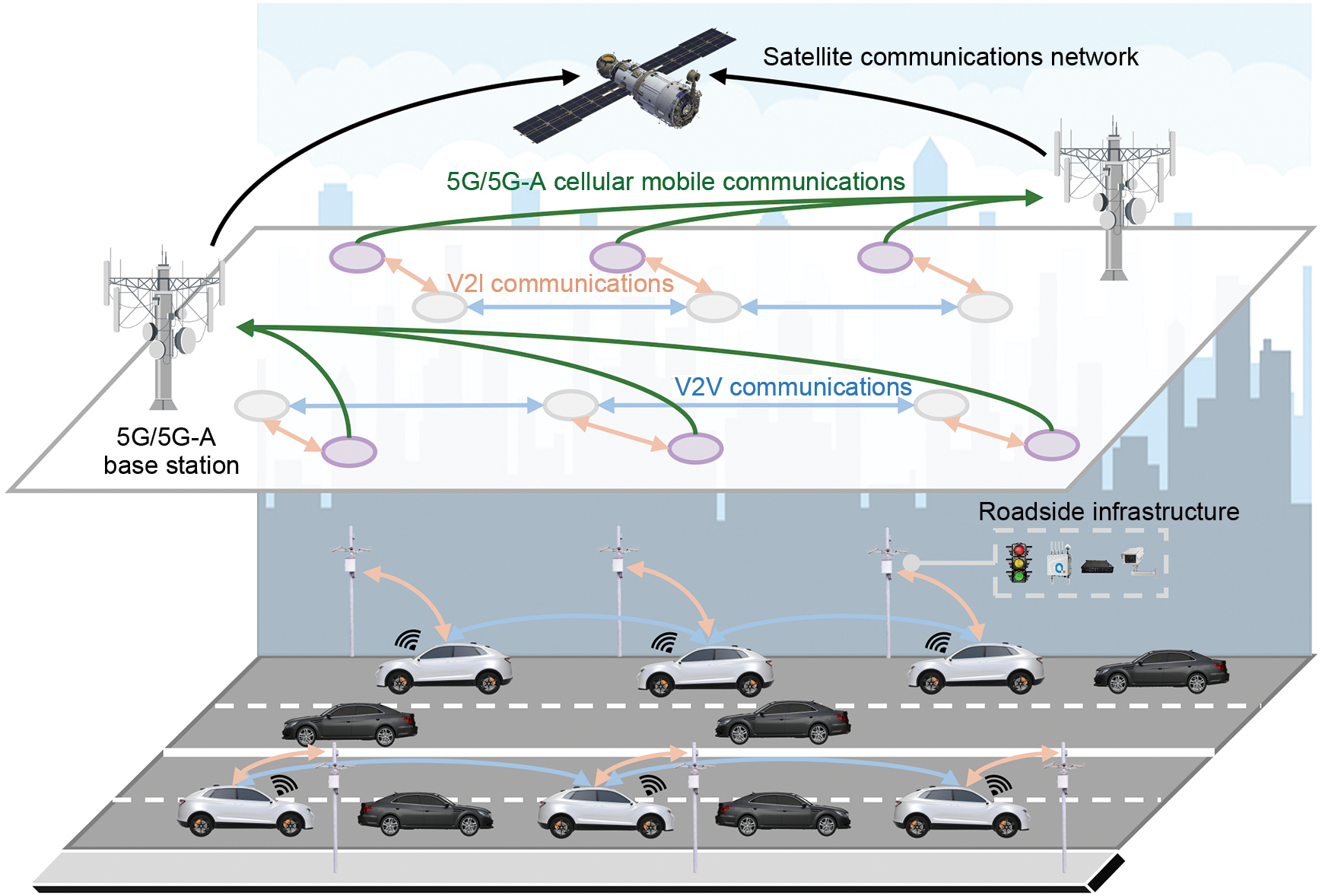
The CAV platoon control system under mixed traffic conditions consists of four core components, including the vehicle side, the communication and network layer, roadside units (RSUs), and the cloud control center, forming an integrated vehicle-road-cloud cooperative control architecture. The overall structure is illustrated in Figure 1. Within this architecture, the vehicle side performs proximal closed-loop control within the perception-decision-execution loop. CAVs utilize multi-source sensors, including radar, light detection and ranging (LiDAR), and cameras, together with onboard computing platforms, to accomplish environment perception and modeling, state estimation, and trajectory tracking. Meanwhile, they broadcast key state information, such as position, velocity, acceleration, and driving intention, via V2X terminals to enable efficient information exchange with neighboring vehicles and infrastructure [12]. For HDVs without communication capabilities, their state information is obtained through onboard perception fusion and infrastructure-assisted perception, followed by behavior estimation and prediction, thereby maintaining necessary safety margins and control robustness at the platoon level.
The communication and network layer supporting data exchange across entities comprises direct communication and cellular backhaul [13]. Direct communication, represented by the PC5 interface, provides low-delay links for Vehicle-to-Vehicle (V2V) and Vehicle-to-Infrastructure (V2I) communication, making it suitable for transmitting high-priority control-related messages. The cellular backhaul, based on 5G/5G-A and edge computing infrastructure, leverages network slicing and time-sensitive transmission mechanisms to deliver differentiated service for diverse application requirements, effectively mitigating the impact of communication delay, packet loss, and delay jitter on cooperative control performance.
RSUs deployed at key road nodes provide multiple functionalities [14]. On the one hand, leveraging roadside cameras and millimeter-wave radar, they enable blind-spot perception enhancement for occluded scenarios, long-distance targets, and non-line-of-sight targets. On the other hand, RSUs can perform local (edge-level) computational tasks, including target association, trajectory prediction, and conflict detection, thereby improving the accuracy and real-time performance of local traffic situational awareness. In addition, RSUs can disseminate signal phase information, right-of-way priority, and local coordination strategies to nearby vehicles, supporting coordinated maneuvers such as organized merging, lane changing, and lane resource sharing [15]. The cloud control center at the system-wide level focuses on resource orchestration and strategy management from a global perspective [16], including macroscopic optimization tasks such as cross-segment routing for platoons, platoon formation and density scheduling, speed limit control, and coordination with traffic signal timing. Meanwhile, the cloud center ensures operational safety, regulatory compliance, and maintainability through mechanisms such as online model and parameter updates, anomaly detection, and strategy rollback.
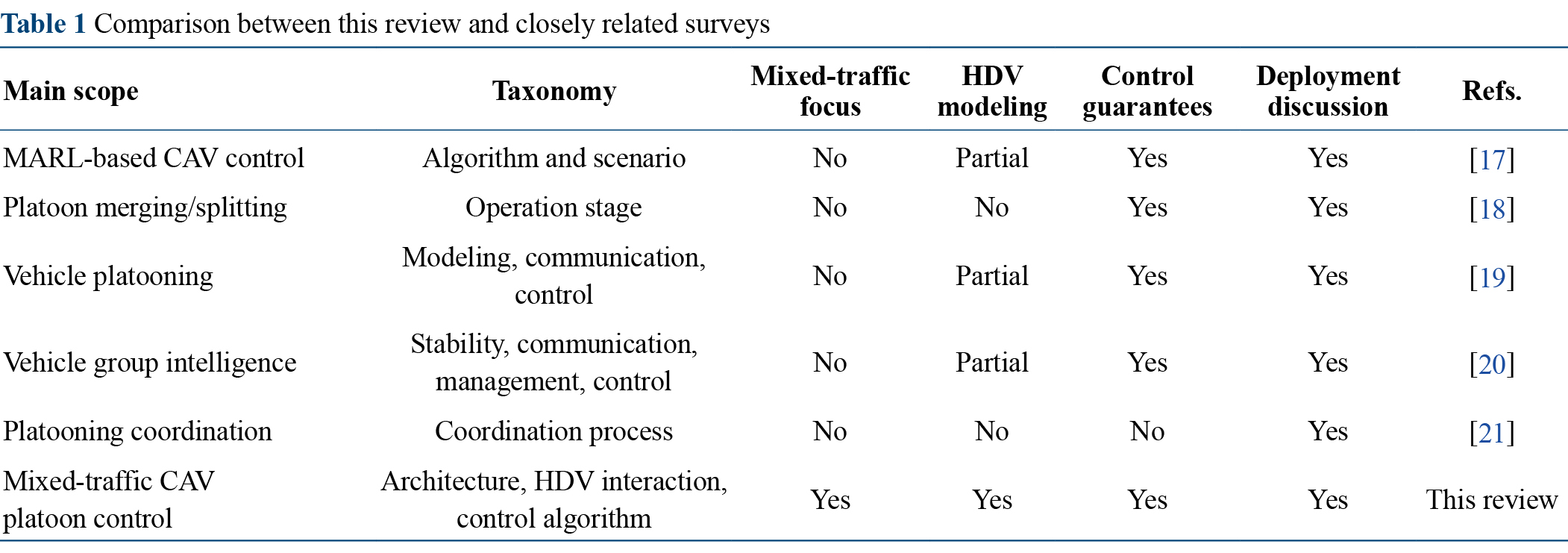
To systematically characterize the mechanisms of platoon control in mixed traffic environments, existing surveys have developed classification frameworks from different perspectives. Hua et al. [17] adopts control algorithm types as the primary organizing dimension, facilitating the presentation of underlying mechanisms and methodological taxonomy. Li et al. [18] and Li et al. [19] organize their frameworks around application scenarios, thereby facilitating alignment with engineering requirements and deployment conditions. Wu et al. [20] and Lesch et al. [21] focus on communication topology and cooperative mechanisms, highlighting system architecture and coordination characteristics. Table 1 shows the comparison between this review and closely related surveys. These classification frameworks provide valuable references for understanding mixed platoon control. However, further integration is still needed for a unified characterization of multi-dimensional factors.
| Main scope | Taxonomy | Mixed-traffic focus | HDV modeling | Control guarantees | Deployment discussion | Refs. |
|---|---|---|---|---|---|---|
| MARL-based CAV control | Algorithm and scenario | No | Partial | Yes | Yes | [17] |
| Platoon merging/splitting | Operation stage | No | No | Yes | Yes | [18] |
| Vehicle platooning | Modeling, communication, control | No | Partial | Yes | Yes | [19] |
| Vehicle group intelligence | Stability, communication, management, control | No | Partial | Yes | Yes | [20] |
| Platooning coordination | Coordination process | No | No | No | Yes | [21] |
| Mixed-traffic CAV platoon control | Architecture, HDV interaction, control algorithm | Yes | Yes | Yes | Yes | This review |
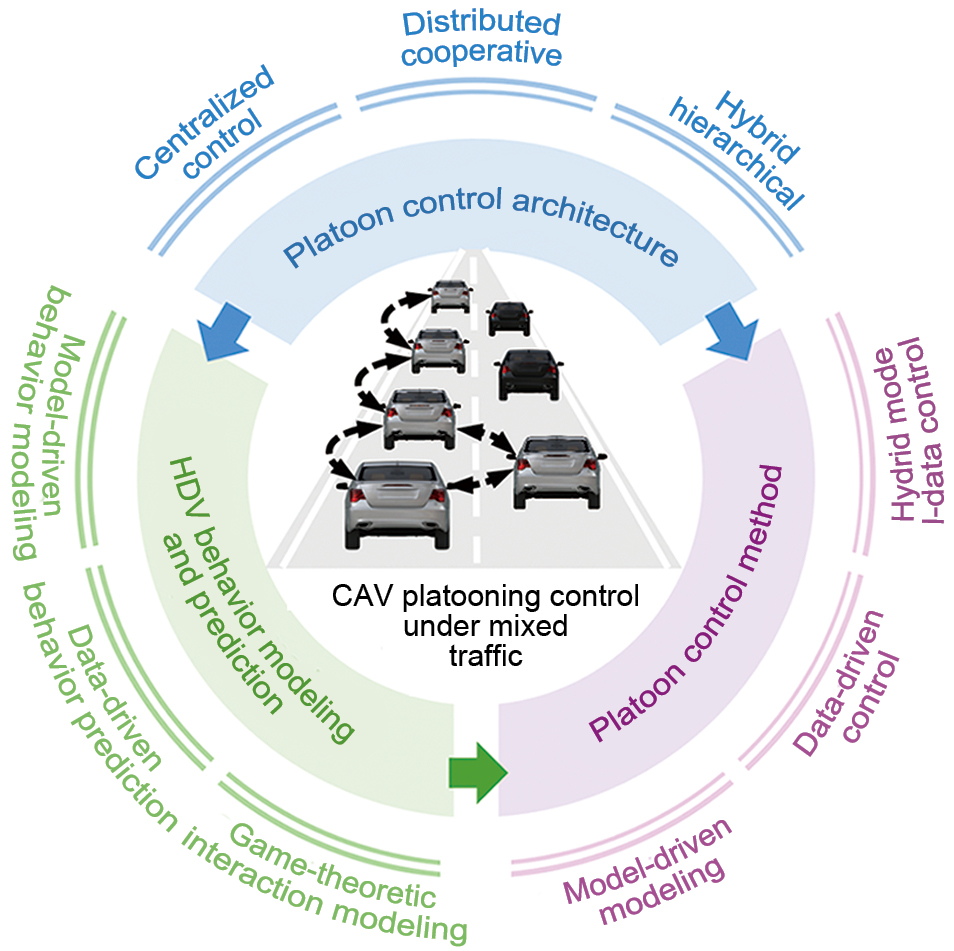
It is important to note that CAV platoon control under mixed traffic is not limited to narrowly defined control law design, but constitutes a closed-loop problem involving information acquisition, interaction-aware prediction, decision optimization, and execution control. The control architecture determines the information available to the controller, communication topology, computational nodes, and decision authority, forming the foundation for real-time and stable execution of the control law. HDV behavior modeling and prediction provide the controller with future states, intention probabilities, and uncertainty bounds of uncontrollable traffic participants, which underpin the design of safety constraints, robustness margins, and prediction horizons. The control algorithm paradigm further determines how control inputs, such as vehicle acceleration, velocity, spacing, or trajectory, are generated under such information and constraint conditions. Therefore, this paper incorporates control architecture, HDV interaction modeling, and control methods into a unified survey framework for mixed platoon control.
(i) Classification of control architectures. The control architecture determines the physical deployment, information flow, and allocation of decision authority in mixed platoon systems, thereby directly affecting global optimality, real-time performance, and scalability of platoon control. Platoon control relies on V2V and V2I communication and information exchange. The architectural design not only governs how multi-source information is aggregated and transmitted, but also defines the distribution of decision authority among the cloud, roadside, and vehicle side. Different architecture types significantly influence computational load allocation, communication dependency, fault tolerance, and dependence on global information. Accordingly, based on the deployment of decision nodes and the direction of information flow, existing approaches can be classified into centralized management architecture, distributed cooperative architecture, and hybrid hierarchical architecture.
(ii) Classification of HDV behavior modeling and prediction. Accurately identifying and predicting HDV behavior is essential for CAVs to understand mixed traffic environments, handle human-driving uncertainty, and maintain safety margins. In mixed traffic, CAV cooperative control depends on capturing HDV longitudinal car-following dynamics, lateral lane-changing intentions, and interaction responses. Existing approaches differ in representation accuracy, uncertainty quantification, and computational complexity, which directly affect the prediction robustness and control performance of CAVs. Accordingly, related studies can be classified into model-driven behavior modeling, data-driven behavior prediction, and game-theoretic interaction intention modeling. Specifically, HDV behavior modeling characterizes intrinsic car-following and lane-changing dynamics, behavior prediction estimates future states or intentions from historical observations, and interaction modeling captures strategic responses between CAVs and HDVs.
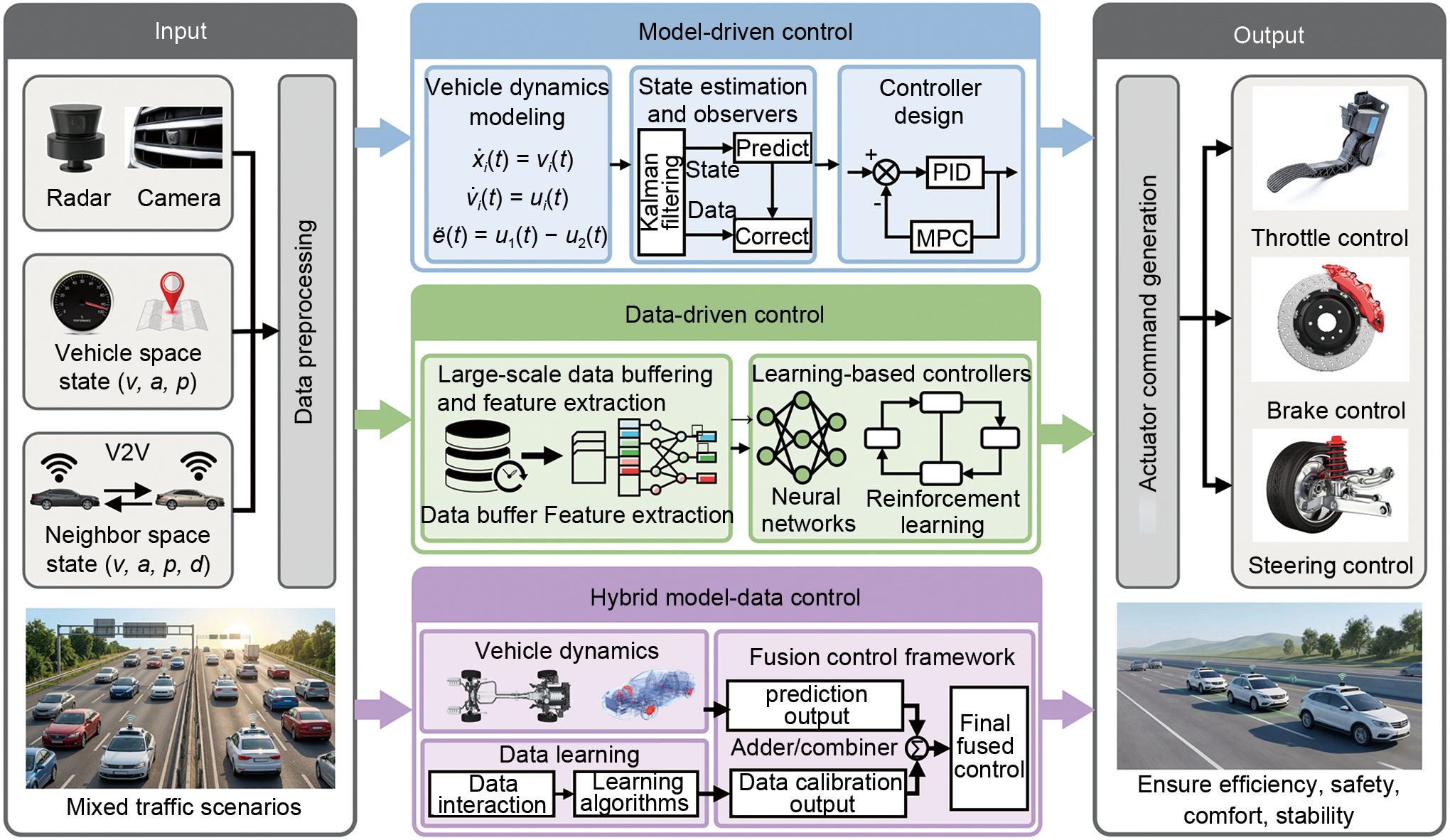
(iii) Classification of control methods. The control algorithm paradigm determines the real-time computation of the control law and serves as a key foundation for ensuring real-time performance and robustness. The design of control methods reflects the evolution of platoon control from traditional analytical models toward intelligent computational approaches. With the hierarchical deployment of computational resources in vehicle-road-cloud cooperative architectures, different control methods exhibit distinct trade-offs among model accuracy, computational complexity, and real-time performance. Therefore, based on the computational characteristics of control algorithms, existing approaches can be classified into model-driven, data-driven, and hybrid model-data-driven methods.
The three dimensions in the proposed framework are not independent. Instead, they form a control-oriented information chain from system deployment to behavior representation and then to control-law synthesis. First, the control architecture determines the sensing range, communication topology, computational node, and decision authority. These factors directly constrain what HDV-related information can be obtained and how frequently it can be updated. For example, roadside-edge architectures can provide regional HDV trajectory observations and occlusion compensation, whereas distributed vehicle-side architectures usually rely on local perception and neighboring V2V information. Second, HDV behavior modeling and prediction determine the form of uncertainty delivered to the controller. Point predictions are naturally compatible with deterministic model predictive sontrol (MPC), interval predictions support robust MPC, probabilistic predictions enable chance-constrained or risk-aware control, and intention probabilities can be used for proactive yielding or gap-regulation strategies. Third, the control algorithm paradigm determines how these prediction outputs are transformed into acceleration, velocity, spacing, or trajectory commands. Model-driven controllers require mathematically explicit constraints and uncertainty bounds, learning-based controllers require representative interaction data and safety filters, and hybrid model-data-driven controllers require consistent interfaces between physical models and learned prediction modules. Therefore, practical mixed-platoon control should be designed by jointly considering architecture, HDV interaction modeling, and control algorithm paradigm rather than optimizing each dimension separately.
To avoid taxonomic overlap, this review distinguishes control architecture from control algorithm paradigm according to their primary design objects. Control architecture describes where information is sensed, communicated, computed, and authorized, whereas control algorithm paradigm describes how the available information, prediction outputs, and constraints are converted into vehicle-level acceleration, spacing, velocity, or trajectory commands. Therefore, a hybrid hierarchical architecture denotes a deployment and decision-allocation scheme, while hierarchical or fusion control denotes an algorithmic strategy implemented within such an architecture. Similarly, game-theoretic approaches may serve either as interaction prediction tools or as direct decision/control methods. In this review, they are classified under HDV interaction mechanisms because the reviewed studies mainly use games to infer HDV response functions, yielding probabilities or interaction intentions as inputs to downstream controllers, rather than to directly synthesize platoon control commands.
In summary, this paper establishes a three-dimensional classification framework centered on control architecture, interaction mechanisms, and control methods, providing a theoretical basis and logical foundation for the systematic analysis and performance comparison of mixed platoon control methods. Figure 2 summarizes the proposed framework, and the subsequent sections elaborate on each dimension in detail.
The literature reviewed in this paper was collected from Web of Science, Scopus, IEEE Xplore, ScienceDirect, SpringerLink, TRID, and Google Scholar. The search covered studies published from 2010 to 2026, with emphasis on recent developments after 2018. The search terms included combinations of "mixed traffic," "connected and automated vehicle," "CAV platoon," "mixed platoon," "HDV behavior prediction," "HDV interaction modeling," "distributed control," "model predictive control," "robust control," "reinforcement learning," "data-driven control," "vehicle-road-cloud coordination," and "infrastructure-supported platoon control." The inclusion criteria were as follows: studies were retained if they focused on CAV or automated vehicle (AV) control in mixed traffic, platoon control under HDV interaction, HDV behavior modeling or prediction for downstream control, communication topology or architecture design for platoons, or vehicle-road-cloud cooperative control relevant to mixed platoons. Studies were excluded if they only addressed pure traffic-flow modeling without control design, purely mechanical vehicle dynamics without interaction or platooning relevance, perception-only tasks without control implications, or general autonomous driving studies that did not involve mixed-traffic interaction. The screening process consisted of keyword search, duplicate removal, title and abstract screening, full-text assessment, and backward/forward citation checking. The final synthesis retained the studies cited in the reference list, which were grouped according to the proposed three-dimensional framework.
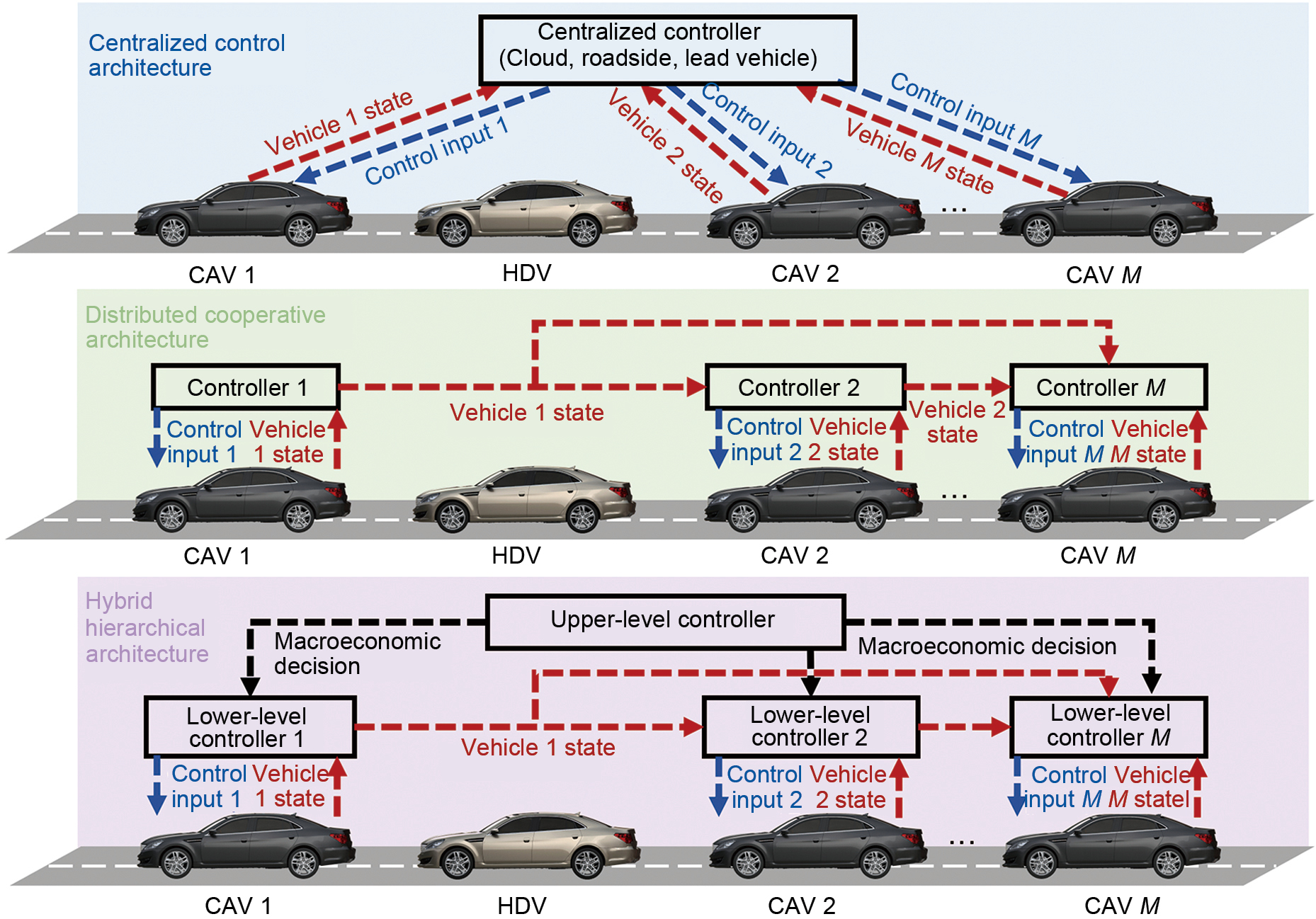
A centralized control architecture assigns decision authority to a single central node and generates platoon-wide coordination commands within a unified optimization framework by aggregating multi-source information from vehicles, roadside infrastructure, and the cloud [22]. Through centralized computation, this architecture can obtain a globally optimal solution while jointly considering multiple objectives, including safety, efficiency, energy consumption, and comfort [23]. Therefore, it was widely adopted in early studies on mixed platoon control. According to the physical deployment location and functional role of the central node, centralized control can be implemented through cloud-based global scheduling and roadside edge coordination.
Cloud-based global scheduling assigns decision authority to the cloud control center and aggregates cross-regional traffic information via cellular backhaul, thereby supporting macroscopic orchestration from a wide-area perspective. Typical tasks include global optimization problems such as cross-segment platoon routing, formation-density regulation, speed-limit control, and coordinated signal timing [24, 25]. The main advantage of this mode is that it avoids the local optimum induced by a single-segment perspective and enables system-level resource allocation across multiple platoons and intersections. The CARMA project is a representative application [16]. It aims to develop and test cooperative automated driving technologies based on a distributed control system, supported by ultra-low-delay and highly reliable cloud infrastructure with 5G access. In addition, the model-free multi-objective optimization controller proposed by Mahbub and Malikopoulos [26] performs centralized computation in the cloud and jointly optimizes safety margins, traffic efficiency, and energy consumption during platoon formation, thereby providing a globally optimal strategy for formation construction in mixed traffic. However, cloud-based scheduling faces three major constraints. First, the end-to-end delay of cellular networks is typically on the order of tens to hundreds of milliseconds, making it difficult to satisfy millisecond-level control-cycle requirements. Second, cross-regional information aggregation relies on base-station coverage and network-slicing quality, making data integrity difficult to guarantee in weak-coverage areas such as tunnels and mountainous regions. Third, the planning-execution mismatch caused by state desynchronization between the cloud and vehicles may be amplified by HDV disturbances. Therefore, cloud-based global scheduling is more suitable as a long-time-scale strategy generation layer than as a real-time control execution layer, and its effectiveness depends on co-design with vehicle-side local control.
From a deployment perspective, cloud-based global scheduling requires continuous wide-area cellular coverage, reliable uplink and downlink transmission of platoon states, unified cloud-edge data interfaces, and sufficient backhaul capacity. Since HDV states are usually obtained indirectly from onboard perception or roadside sensing, blind areas caused by tunnels, ramps, occlusions, or sparse RSU deployment should be compensated for by vehicle-side fallback perception and short-horizon prediction. Packet loss, delay jitter, and cellular handover may desynchronize cloud decisions and vehicle states; therefore, cloud commands should be limited to low-frequency tasks such as route guidance, speed advisory, formation management, and multi-platoon scheduling, while safety-critical spacing control and emergency braking should remain on the vehicle side. In large-scale road networks, computational scalability also becomes a major constraint, requiring regional decomposition, edge pre-processing, and hierarchical scheduling to avoid centralized overload as platoon number and HDV density increase.
Roadside edge coordination relocates the decision-making center to RSUs or edge computing nodes, where information aggregation, conflict coordination, and command issuance are performed within a regional scope. Compared with cloud-based scheduling, the physical proximity of roadside nodes reduces communication delay to the order of tens of milliseconds, making it better aligned with vehicle control cycles. Meanwhile, roadside multimodal perception systems enable blind-spot perception enhancement for occluded scenarios, non-line-of-sight targets, and distant HDVs, thereby compensating for the limited sensing capability of onboard perception [13]. In mixed traffic environments, roadside nodes fuse CAV state information obtained via V2I communication with HDV trajectories acquired through roadside perception, enabling local operations such as merging coordination, priority assignment, and platoon reconfiguration [27]. Gao et al. [28] proposed a coordination strategy between CAV platoons and RSUs to prevent potential collisions under abnormal traffic conditions. Zhang et al. [29] developed a centralized optimization framework for vehicle-signal coupling at intersections via roadside nodes, significantly improving traffic efficiency in mixed traffic. Zhao et al. [30] proposed a key-point matrix based on image processing and V2I technologies to manage infrastructure components associated with each key point.
However, the effectiveness of roadside coordination is constrained by three major factors. First, the coverage radius of a single RSU is limited, requiring state synchronization and authority handover among multiple RSUs for cross-regional platoons. Second, when roadside nodes fail, the platoon must revert to a fallback mode based on V2V communication or onboard perception, and inadequate switching mechanisms may lead to transient performance degradation. Third, roadside perception strongly depends on calibration accuracy and target association algorithms, and false positives and missed detections remain challenging in dense and highly interactive traffic scenarios. Overall, roadside edge coordination exhibits dual advantages in reduced communication delay and enhanced perception for medium-scale platoon control on structured roads. However, it should be co-designed with vehicle-side autonomous control to establish redundancy mechanisms and ensure system resilience.
Practical roadside-edge coordination depends strongly on RSU density, sensor placement, calibration accuracy, time synchronization, and edge computing capacity. To support stable platoon control, roadside sensors must provide sufficient longitudinal and lateral coverage for HDV detection, cut-in recognition, and conflict prediction. However, occlusion, adverse weather, dense traffic, and sensor misalignment may lead to missed detection or target association errors, which directly affect safety constraints used by downstream controllers. Communication reliability between vehicles and RSUs is also critical because packet loss or unstable V2I links may interrupt local coordination commands during merging, lane changing, or platoon reconfiguration. In addition, the edge node must process multi-target perception, trajectory prediction, and local optimization within a limited control window. When the number of vehicles increases, multi-RSU coordination, authority handover, and load balancing become necessary to maintain scalability across connected road segments.
A distributed cooperative architecture decentralizes decision authority to individual vehicles and forms a distributed local network through V2V communication among neighboring vehicles, enabling each CAV to independently compute control actions based on neighboring vehicle states while achieving global coordination. In mixed traffic, the random cut-in and exit of HDVs can be more effectively accommodated through local distributed mechanisms, thereby alleviating the computational and coordination burden on central nodes. According to differences in information-flow organization and interaction mechanisms, distributed cooperation can be categorized into communication-topology coordination and information-interaction coordination.
Communication topology defines inter-vehicle communication links and directly determines information propagation paths, coordination efficiency, and system scalability. In pure CAV platoons, topologies such as predecessor-following (PF), bidirectional (BD), and predecessor-leader following (PLF) have been extensively studied. However, in mixed traffic, the random cut-in of HDVs may disrupt the predefined topology. When an HDV cuts in between two CAVs, the following vehicle loses its direct communication link with the preceding vehicle, and the topology degrades from PF to perception-based single-predecessor following, leading to increased information transmission delay and reduced disturbance suppression capability [31].
To address sudden topology changes, existing studies have evolved along three main directions. The multi-predecessor topology enables CAVs to obtain the states of multiple preceding vehicles via perception or multi-hop communication, thereby enhancing disturbance suppression capability [32, 33]. Wang et al. [34] proposed a bidirectional spacing balance strategy for CAV platoons, in which vehicles maintain a balanced position between the preceding and following vehicles using bidirectional multi-hop spacing information. Zhan et al. [35] partitioned a mixed vehicle platoon into multiple interrelated sub-platoons, where each CAV simultaneously acts as the tail vehicle of the preceding sub-platoon and the lead vehicle of the following sub-platoon. The virtual leader topology employs RSUs or cloud infrastructure to broadcast a virtual reference trajectory, allowing all CAVs to track a unified target rather than relying on inter-vehicle communication links, but it imposes stringent requirements on infrastructure communication quality [36]. Adaptive topology reconfiguration dynamically adjusts communication links following HDV insertion, such as splitting the platoon into multiple sub-platoons or establishing communication links that bypass the HDV. Nevertheless, transient performance degradation during topology switching and the design of switching conditions still lack rigorous theoretical guarantees [37, 38].
In terms of applicability, the multi-predecessor topology can significantly improve robustness when communication bandwidth permits. The virtual leader topology is well-suited for structured roads with mature infrastructure support, and adaptive topology reconfiguration demonstrates strong potential in scenarios with frequent topology changes. However, all three approaches require a careful trade-off between information redundancy and communication overhead.
The information-interaction mechanism determines when and what to communicate, directly affecting communication load, information timeliness, and coordination consistency. In mixed traffic, V2X communication faces bandwidth constraints and channel contention. As platoon size increases or the density of surrounding HDVs rises, high-frequency periodic broadcasting can lead to channel congestion, increased packet loss, and delay jitter, thereby degrading cooperative control performance. To alleviate communication pressure, the event-triggered mechanism triggers information transmission and control updates only when local state errors exceed predefined thresholds. Wakasa et al. [39] designed an event-triggered switching strategy for platoon merging and splitting scenarios, which balances communication savings and control accuracy by dynamically adjusting triggering thresholds. Chen et al. [40] proposed a hierarchical event-triggered algorithm to enable optimal control implementation when adjacent mixed platoons approach intersections. However, event-triggered mechanisms face an intrinsic trade-off. Excessively small thresholds lead to frequent triggering and limited communication savings. Conversely, overly large thresholds result in delayed control updates and insufficient responsiveness in fast transient scenarios, such as sudden HDV cut-ins. The self-triggered mechanism predicts the next triggering instant at each trigger, thereby avoiding the computational burden of continuous real-time error monitoring [41], but its prediction accuracy depends on system models and the estimation of disturbance bounds, limiting its reliability in highly uncertain environments. The asynchronous update mechanism allows different vehicles to update control actions at different frequencies and time instants, reducing reliance on global clock synchronization [42, 43]. However, under asynchronous conditions, more stringent conditions are required to guarantee consensus convergence, and the associated analysis complexity increases significantly.
From an engineering perspective, periodic communication remains a baseline solution in low-density scenarios with reliable communication quality. Event-triggered mechanisms are well-suited for medium-density scenarios with limited computational resources. Asynchronous update mechanisms offer a promising theoretical framework for high-density scenarios with dynamically changing topologies; however, several key challenges, such as triggering condition design, consensus verification, and anomaly handling, must still be addressed before large-scale real-world deployment.
Compared with infrastructure-supported architectures, distributed cooperative control reduces dependence on cloud or roadside facilities, but it imposes stronger requirements on vehicle-side communication, perception, and computation. Reliable deployment requires stable V2V neighbor discovery, robust topology reconfiguration protocols, and onboard fallback strategies when communication with the predecessor, leader, or adjacent CAVs is interrupted. As platoon size increases or HDVs frequently cut in, the number of communication links and local consistency constraints may grow rapidly, causing channel congestion and increasing the difficulty of maintaining string stability. Although computation is distributed among vehicles, the burden is not always uniform: CAVs adjacent to HDVs or topology-changing regions usually need to perform additional prediction, safety checking, and control adaptation. Therefore, practical distributed platoon control should jointly consider communication-load reduction, local computational load balancing, and fail-safe operation under topology degradation.
The hybrid hierarchical architecture combines the advantages of centralized and distributed architectures by decomposing decision-making tasks across multiple spatial and temporal scales. In mixed traffic scenarios, this architecture shifts computationally intensive tasks, such as HDV behavior prediction and platoon formation scheduling, to the roadside or cloud, while preserving vehicle-side rapid response to unexpected events. In doing so, it achieves a balance between global performance and local real-time performance [44, 45]. According to different decomposition dimensions, the hybrid architecture can be structured along functional hierarchical coordination and spatiotemporal multi-scale coordination.
Functional hierarchical coordination divides the system into a planning layer and an execution layer according to task functions. The upper layer undertakes global or regional resource allocation, including trajectory planning and platoon formation scheduling, whereas the lower layer is responsible for trajectory tracking, local collision avoidance, and real-time control [46]. In mixed traffic scenarios, closed-loop information exchange between layers is achieved through well-defined input-output interfaces [47]. The upper layer can leverage cloud or roadside computing resources to address HDV behavior prediction and multi-vehicle coordination, generating macroscopic strategies that satisfy platoon integrity and efficiency objectives [48, 49]. The lower layer performs trajectory tracking based on onboard perception and V2V communication, and triggers safety protection mechanisms under abnormal conditions such as forced cut-in by HDVs and communication interruption [50]. Li et al. [51] proposed a two-layer control optimization scheme, in which the upper layer optimizes tracking performance, while the lower layer adopts a controller matching technique to guarantee the asymptotic stability of the vehicle platoon and achieve traffic wave dissipation. Ma et al. [52] proposed a hierarchical intersection management model. In this framework, the upper and middle layers handle signal optimization and phase scheduling, respectively. Meanwhile, the bottom layer implements CAV platoon control in the buffer zone and trajectory planning in the passing zone. Zhang and Du [53] proposed a hierarchical framework in which the upper layer generates platoon reference trajectories through virtual leader coordination, while the lower layer adopts model predictive control to achieve decoupled longitudinal and lateral tracking.
The key design issues of functional hierarchical coordination include the following. First, the representation of inter-layer outputs directly affects the degrees of freedom available to the lower-layer controller and the computational burden on the upper layer. Second, the bandwidth and delay of the feedback channel determine how rapidly the upper layer can perceive execution deviations, so excessively slow feedback may lead to planning-execution mismatch. Third, the constraint transfer mechanism must ensure the feasibility of upper-layer planning results subject to vehicle dynamics and safety constraints at the lower layer. Otherwise, inter-layer conflicts may arise. Overall, functional hierarchical coordination exhibits stable performance in scenarios with clear task division and predictable communication delay. However, under complex conditions involving rapidly changing HDV behavior and frequent topology switching, fixed inter-layer interface designs may become a performance bottleneck, requiring adaptive authority switching and emergency fallback mechanisms.
Spatiotemporal multi-scale coordination decomposes the system along two dimensions, temporal update period and spatial coverage, thereby enabling appropriate allocation of computational load and tiered satisfaction of real-time requirements. In an integrated vehicle-road-cloud architecture for mixed traffic, the cloud, roadside, and onboard layers exhibit inherent differences in spatiotemporal scales. The cloud typically updates on the order of seconds to minutes and spans multiple road segments, making it suitable for macroscopic route optimization and cross-regional resource scheduling [54]. Roadside nodes update on the order of hundreds of milliseconds to seconds and cover a single intersection or road segment, making them responsible for local coordination and conflict detection [55]. Onboard control cycles are on the order of tens to hundreds of milliseconds, rely only on local neighborhood information, and focus on trajectory tracking and emergency avoidance [56]. This spatiotemporal separation decouples slow-timescale decision-making from fast-timescale control, preventing high-frequency control from being blocked by low-frequency tasks. Coppola et al. [57] designed a three-layer architecture for heterogeneous nonlinear electric vehicle platoons. In this architecture, the cloud generates energy-optimal speed profiles at second-level intervals, the roadside layer adjusts platoon spacing at hundred-millisecond-level intervals, and the onboard layer executes motor torque control at ten-millisecond-level intervals. Through time-scale separation, this architecture achieves coordinated optimization of energy consumption and safety. Yang et al. [58] proposed a hierarchical and deployable cooperative driving framework. At the vehicle level, a state transition graph was designed for different operating modes of CAVs. At the intersection level, a mixed-integer linear programming problem was formulated to optimize signal timing schemes and the arrival times of CAVs. At the corridor level, link performance functions were used to calculate the total delay of each coordinated phase at each intersection, and a linear programming problem was formulated to optimize the offset in each cycle, which was then transferred to the intersection level.
However, multi-scale coordination faces two types of coupling problems. First, in strong transient scenarios such as sudden HDV cut-in, the disturbance time scale approaches the control cycle, causing conventional scale separation to fail. Second, the delay and uncertainty of cross-scale information transmission may lead to state inconsistency, such that the traffic situational awareness used for upper-layer decision-making may already lag behind actual onboard conditions. Therefore, the effectiveness of spatiotemporal multi-scale coordination depends on appropriate delay budgeting, state prediction compensation, and cross-layer fault isolation mechanisms. At the design stage, the coupling intensity across different scales should be verified through simulation, and sufficient safety margins should be reserved for the fast-timescale layer to accommodate upper-layer decision deviations.
For real-world deployment, hybrid hierarchical architectures require clearly defined interfaces among the cloud, roadside edge, and vehicle-side controllers. Cross-layer communication must provide reliable timestamps, state synchronization, and quality-of-service guarantees; otherwise, inconsistencies between upper-layer planning and lower-layer execution may lead to infeasible or delayed control commands. Task allocation is another key constraint. HDV prediction, local conflict detection, and platoon reconfiguration can be assigned to the edge, whereas emergency braking and tracking control must remain onboard due to strict latency requirements. When multiple road segments or intersections are involved, scalability depends on regional decomposition, inter-RSU coordination, and smooth authority handover between control zones. Therefore, hybrid architectures offer strong engineering potential, but their deployment requires careful co-design of communication reliability, computational load allocation, cross-layer fallback, and safety redundancy.
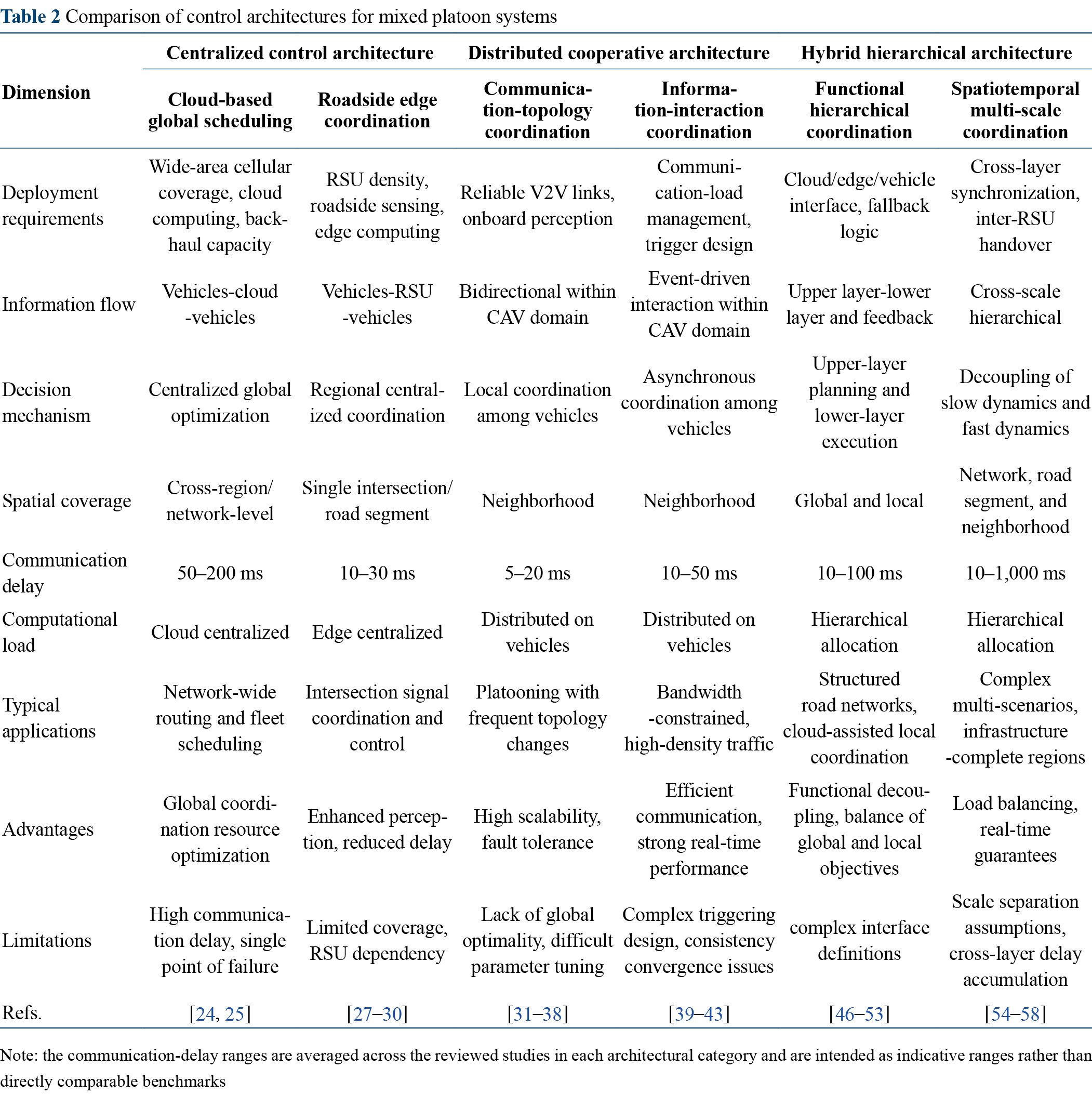
In summary, Table 2 compares mixed-platoon control architectures in terms of physical deployment, decision mechanism, communication delay, computational load, and applicable conditions. The technical trend has shifted from single-layer centralized coordination toward edge-assisted, distributed, and vehicle-road-cloud hierarchical architectures, shown in Figure 3. This evolution reflects the need to balance global coordination with local real-time response under HDV disturbances. However, several unresolved conflicts remain. Centralized architectures improve global optimality but suffer from latency, scalability, and single-point failure risks. Distributed architectures enhance fault tolerance and adaptability to local cut-ins, but their global performance and string-stability guarantees become difficult to maintain under incomplete information. Hybrid hierarchical architectures provide a promising compromise, yet they introduce cross-layer inconsistency, authority allocation, and delay-budgeting problems. Therefore, future architectural design should move from static topology selection to adaptive architecture-control co-design, in which decision authority, communication topology, and fallback modes are dynamically adjusted according to traffic state, HDV uncertainty, and communication quality.
| Dimension | Centralized control architecture | Distributed cooperative architecture | Hybrid hierarchical architecture | |||
|---|---|---|---|---|---|---|
| Cloud-based global scheduling | Roadside edge coordination | Communication-topology coordination | Information-interaction coordination | Functional hierarchical coordination | Spatiotemporal multi-scale coordination | |
| Deployment requirements | Wide-area cellular coverage, cloud computing, backhaul capacity | RSU density, roadside sensing, edge computing | Reliable V2V links, onboard perception | Communication-load management, trigger design | Cloud/edge/vehicle interface, fallback logic | Cross-layer synchronization, inter-RSU handover |
| Information flow | Vehicles-cloud-vehicles | Vehicles-RSU-vehicles | Bidirectional within CAV domain | Event-driven interaction within CAV domain | Upper layer-lower layer and feedback | Cross-scale hierarchical |
| Decision mechanism | Centralized global optimization | Regional centralized coordination | Local coordination among vehicles | Asynchronous coordination among vehicles | Upper-layer planning and lower-layer execution | Decoupling of slow dynamics and fast dynamics |
| Spatial coverage | Cross-region/network-level | Single intersection/road segment | Neighborhood | Neighborhood | Global and local | Network, road segment, and neighborhood |
| Communication delay | 50–200 ms | 10–30 ms | 5–20 ms | 10–50 ms | 10–100 ms | 10–1,000 ms |
| Computational load | Cloud centralized | Edge centralized | Distributed on vehicles | Distributed on vehicles | Hierarchical allocation | Hierarchical allocation |
| Typical applications | Network-wide routing and fleet scheduling | Intersection signal coordination and control | Platooning with frequent topology changes | Bandwidth-constrained, high-density traffic | Structured road networks, cloud-assisted local coordination | Complex multi-scenarios, infrastructure-complete regions |
| Advantages | Global coordination resource optimization | Enhanced perception, reduced delay | High scalability, fault tolerance | Efficient communication, strong real-time performance | Functional decoupling, balance of global and local objectives | Load balancing, real-time guarantees |
| Limitations | High communication delay, single point of failure | Limited coverage, RSU dependency | Lack of global optimality, difficult parameter tuning | Complex triggering design, consistency convergence issues | complex interface definitions | Scale separation assumptions, cross-layer delay accumulation |
| Refs. | [24, 25] | [27–30] | [31–38] | [39–43] | [46–53] | [54–58] |
From the perspective of control design, architecture selection is essentially a three-way trade-off among information availability, computational resource allocation, and fault-tolerant redundancy. It directly constrains the state variables available to downstream control laws, the solution time window, and the allowable uncertainty margin. The limiting effects of these three architectures on control performance should therefore be jointly incorporated at the controller design stage. Future research should leverage larger-scale road-test data and integrated vehicle-road-cloud experimental platforms to systematically validate different topological architectures in terms of cross-scenario stability, degree of communication dependence, and deployment cost. Meanwhile, adaptive and data-driven methods should be integrated to develop coordinated topology-control mechanisms that can adaptively reconfigure according to traffic states and communication conditions, thereby providing more engineering-deployable architectural choices for platoon control under mixed traffic conditions.
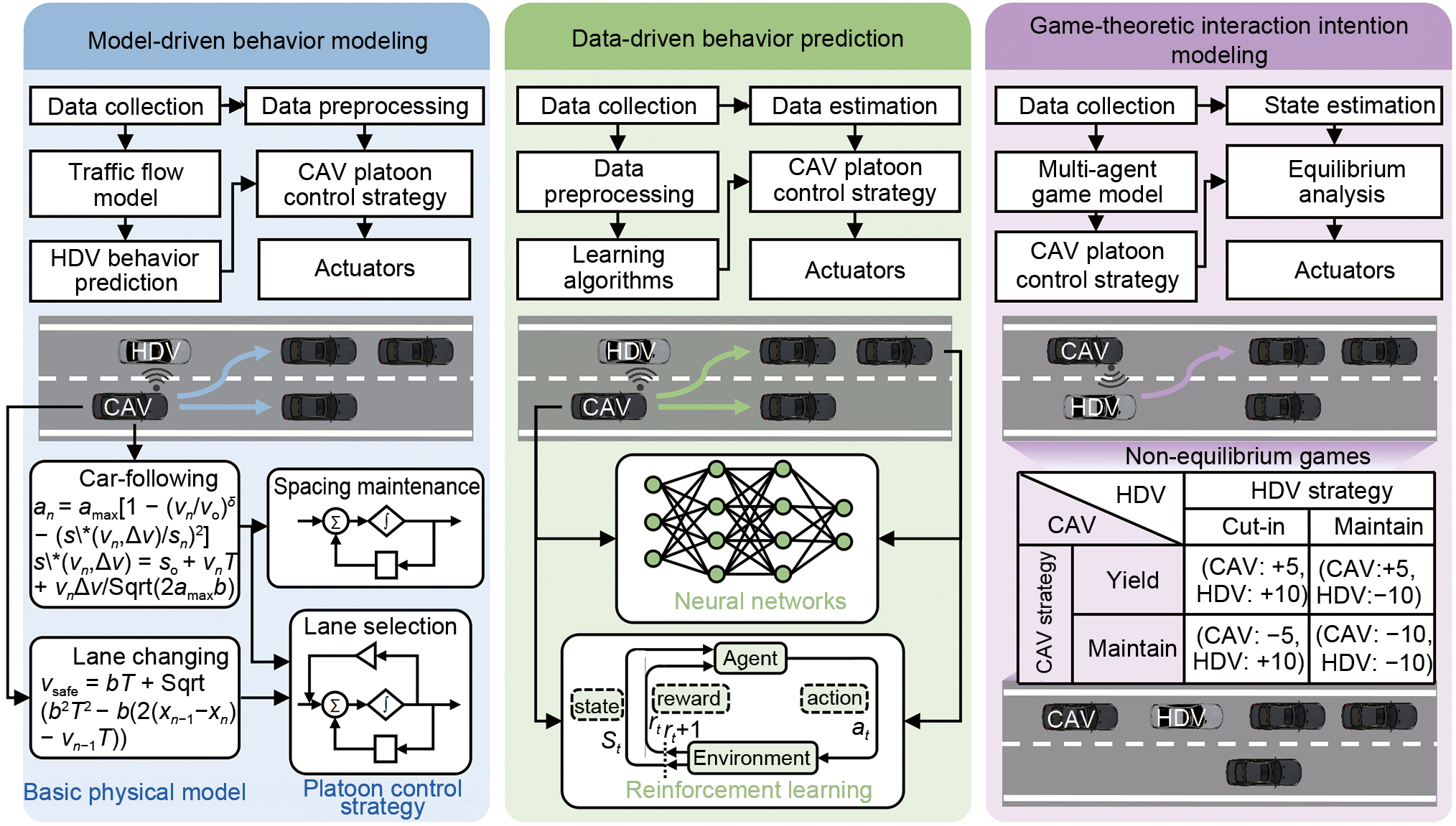
Model-driven behavior modeling explicitly characterizes HDV motion dynamics using mathematical formulations grounded in traffic flow theory and the mechanisms underlying driving behavior [59]. These methods are primarily advantageous because of their transparent model structures and physically interpretable parameters, which facilitate stability analysis and safety margin design. In mixed traffic scenarios, driver heterogeneity can be incorporated into a unified framework through parameter identification or assumptions on parameter distributions. Based on the longitudinal and lateral characteristics of interaction scenarios, model-driven modeling can be classified into heterogeneous car-following mechanism modeling and lane-changing and cut-in decision modeling.
Heterogeneous car-following mechanism modeling is typically built upon classical car-following models, such as the intelligent driver model [60] and the optimal velocity model (OVM) [61]. In mixed traffic scenarios, it characterizes the longitudinal response characteristics of different driving styles by introducing parameter heterogeneity and structural heterogeneity. Parameter heterogeneity modeling treats key parameters, such as desired time headway and maximum acceleration, as driver-dependent random variables. Parameter distribution methods estimate parameter probability densities via population-level distribution fitting and compute confidence intervals of HDV trajectories [62]. Parameter clustering methods group drivers into discrete categories, such as conservative, normal, and aggressive drivers, assign each category a representative parameter set [63, 64], and yield category labels and corresponding deterministic parameter sets. Online identification methods update parameters in real time based on historical trajectories, producing time-varying parameters and their covariance [65]. Structural heterogeneity modeling explicitly incorporates human factors into the model equations. Reaction delay is introduced as fixed or time-varying delays to capture throttle-brake response lag [66]. Perception error is modeled by superimposing noise on leading-vehicle state observations to simulate inaccuracies in visual distance and speed estimation [67, 68]. Attention models capture drivers' selective attention mechanisms by introducing weighted combinations of leading-vehicle states or multi-predecessor information fusion schemes [53, 69].
Regarding output representation, heterogeneous car-following models typically provide point predictions, parameter intervals, or probability distributions of HDV longitudinal acceleration or position over a 1–3 s horizon, which can be leveraged by CAV controllers for feedforward compensation or robust constraint design. However, these models face three primary limitations. First, parameter identification requires an observation window of several to tens of seconds, hindering timely convergence in scenarios with frequent topology changes. Second, deterministic model structures are inadequate for capturing deeper factors such as drivers' cognitive blind spots, emotional fluctuations, and subjective preferences. Third, their extrapolation capability is limited, leading to a significant degradation in prediction reliability under extreme scenarios outside the training distribution.
Lane-changing and cut-in decision modeling aims to characterize the triggering conditions, execution constraints, and sources of stochasticity in HDV lateral motion, thereby providing decision support for CAVs to proactively adjust inter-vehicle spacing or trigger yielding strategies. Existing methods mainly follow two modeling paradigms. Safe-gap-based rule models abstract lane-changing decisions into a set of explicit constraints. Specifically, longitudinal safety gap constraints require that the relative distance and velocity relative to target-lane vehicles satisfy minimum time headway or time-to-collision (TTC) thresholds [70]. Meanwhile, lateral execution constraints bound the peak lateral velocity and acceleration during the lane-change maneuver. The decision logic typically triggers a lane change when all constraints are satisfied simultaneously [71]. Such models feature simple structures and high computational efficiency, and can be directly formulated as safety constraints for CAVs. However, they fail to adequately capture drivers' subjective preferences and risk tolerance, making it difficult to explain variations in lane-changing timing across different driving styles. Utility-based rational choice models, in contrast, assume that drivers decide whether to change lanes by comparing the overall utility of the current and target lanes [72]. Deterministic utility models trigger lane changes when the utility difference exceeds a threshold, yielding binary decisions [73]. Random utility models treat the threshold as a random variable following a Gumbel distribution, yielding lane-changing probabilities [74, 75], which can be used in a Monte Carlo simulation to generate multiple possible trajectories. These models can capture drivers' trade-offs among different factors through parameter calibration, but the functional form of the utility function and the specification of weighting coefficients lack a unified standard, and both interpretability and prediction accuracy heavily depend on prior design.
In terms of uncertainty representation, lane-changing models typically output lane-changing probabilities, confidence intervals of triggering times, or feasible trajectory sets, enabling CAVs to allocate safety margins probabilistically or adopt conservative decisions under worst-case scenarios. However, most existing models are developed under regular driving assumptions and exhibit limited capability in capturing irrational behaviors such as forced lane changes and aggressive gap insertion, resulting in high prediction failure rates in high-density and high-conflict scenarios.
Data-driven behavior prediction removes the reliance on explicit mechanistic models and directly learns HDV behavior patterns from historical trajectories and interaction-scenario data. The primary advantage of these methods lies in their ability to capture highly nonlinear, multimodal interaction patterns without manually designing features or utility functions. Depending on the time scale and abstraction level of the prediction target, data-driven methods can be classified into short-term trajectory prediction and driving intention recognition.
Short-term trajectory prediction aims to infer future sequences of position, velocity, and acceleration based on the historical motion states of HDVs and the surrounding traffic context. Existing methods mainly adopt three types of neural network architectures. Long Short-Term Memory (LSTM) networks capture temporal dependencies in trajectories through gating mechanisms. For highway ramp merging scenarios, Wang et al. [76] used LSTM to encode historical HDV trajectories and predict the speed and lateral position at the merging time, providing inputs for higher-level CAV decision-making. Liu et al. [77] used LSTM to infer HDV trajectories over the next 3 s and lane-changing intentions, enabling CAVs to initiate yielding 1–2 s in advance and attenuate cut-in disturbances. LSTM input features typically include the kinematic state of the target vehicle, the relative states of neighboring vehicles, and road geometry information. LSTM outputs can be formulated as either point predictions or distributional predictions, with the latter achieving multimodal representation through mixture density networks or conditional variational autoencoders [78]. Transformer architectures mine behavioral patterns over longer time windows through self-attention mechanisms [79]. Liu et al. [80] used a Transformer to predict lane-changing intention and trigger CAV yielding-assistance control, thereby conveying cooperative intentions to HDVs through explicit actions such as deceleration and improving interaction predictability. Transformers are advantageous in that they can process long sequences in parallel without manually specifying the attention range. However, their inference delay may approach the upper bound of typical control periods in long-sequence and multi-target scenarios. Graph Neural Networks (GNNs) model multi-vehicle interactions as spatiotemporal graphs, where nodes represent vehicle states and edges represent interaction relationships. Through message passing mechanisms, GNNs aggregate local neighborhood information and update node representations. GNNs can naturally handle scenarios with dynamically changing topologies and variable numbers of vehicles, but graph construction strategies have a significant impact on prediction performance, and unified design guidelines remain lacking.
In terms of performance evaluation, the average displacement error of short-term trajectory prediction within a 1–3 s horizon is typically on the order of 0.5–1.5 m, but the error accumulates exponentially as the prediction horizon increases. Multimodal prediction can cover more than 90% of real trajectories, but it requires a tradeoff between the number of modes and inference efficiency. These methods are suitable as upstream modules for CAV controllers, providing rich prior information that still requires downstream processing for model predictive control or robust optimization.
Driving intention recognition infers the discrete decision-making states of HDVs at a higher level of abstraction, rather than continuous sequences of trajectory points. Its primary value lies in providing early warnings for CAVs. Unlike trajectory prediction that relies on explicit lateral displacement, intention recognition infers driver intentions 1–3 s prior to the actual maneuver [81]. Existing methods mainly adopt two modeling frameworks. Discrete classification models formulate intention recognition as a multi-class classification problem, taking kinematic, environmental, and interaction features within a fixed time window as inputs and outputting posterior probabilities for each intention class [76]. These methods usually achieve high recognition accuracy, but they are sensitive to class imbalance and distribution shift. Sequence labeling models formulate intention recognition as a temporal labeling task, model intention transition probabilities in the state space, and learn feature representations and transition patterns automatically. Lu et al. [82] proposed a joint prediction system combining long-term and short-term prediction algorithms to predict drivers' cut-in intentions into vehicle platoons. Guo et al. [83] used LSTM to implicitly learn traffic patterns and driver behavior, thereby estimating and predicting partially observable microscopic traffic states. Such methods can output the timing and duration of intention transitions, providing CAVs with finer-grained temporal information, but training requires complete sequence annotations and thus incurs high data costs.
In terms of feature design, intention recognition often incorporates multimodal information in addition to kinematic inputs. Specifically, in-vehicle sensors can increase the recognition lead time, whereas external interaction features enhance the distinguishability of lane-changing intentions. It should be emphasized that driving style and driving intention are fundamentally distinct. Driving style is a long-term characteristic that remains stable across scenarios and can be extracted through clustering or transfer learning; whereas driving intention is a short-term state associated with a specific scenario and must be inferred in real time. In terms of real-time performance, the inference delay of intention recognition is typically on the order of tens of milliseconds, satisfying control-cycle requirements. However, long observation windows reduce the response speed to sudden intentions, requiring a tradeoff between recognition reliability and recognition lead time.
Game-theoretic interaction-based control methods abstract the interactions between CAV platoons and HDVs as strategic games among multiple rational agents. These methods aim to characterize the behavioral choices of each participant under different constraints and payoff functions through equilibrium analysis, and on this basis construct platoon control frameworks with strategy consistency. Compared with model-driven and data-driven methods, game-theoretic approaches can explicitly represent conflicts of interest and cooperation potential among participants, thereby providing theoretical tools for cooperative mechanism design and fairness analysis. Depending on the game structure and participant roles, existing studies mainly adopt leader-follower games and cooperative game frameworks to model mixed-vehicle interactions.
Leader-follower games characterize hierarchical interaction processes by distinguishing between leaders and followers. In mixed traffic scenarios, this framework is commonly used to model the conditional responses of HDVs to CAV actions. One representative approach treats traffic signals or upper-level control authorities as leaders and platoons or individual vehicles as followers, focusing on the optimization of vehicle-signal coordination strategies. Zhang et al. [29] proposed an ID3QN framework that solves a Stackelberg game via multi-agent reinforcement learning, thereby improving overall intersection traffic efficiency. Another approach considers HDVs involved in potential conflicts as leaders and CAV platoons as followers. Huang et al. [84] resolved conflicts by analyzing variations in HDV payoffs under different CAV acceleration strategies. Li et al. [85] modeled HDV yielding or competitive merging decisions as a Stackelberg game, where CAVs influenced the HDV utility function by selecting merging timing and lateral velocity, and HDVs chose optimal responses based on their own safety constraints and time costs. Chen et al. [86] employed a Stackelberg game to characterize the asymmetric interaction between CAVs and HDVs, enabling CAVs to make safe decisions based on predicted optimal HDV responses.
In terms of outputs, leader-follower game models typically provide HDV reaction functions or response probabilities, which can be used by CAVs for scenario simulation, strategy evaluation, or counterfactual reasoning. A key issue of such models lies in the validity of leader assignment. In vehicle-signal coupling scenarios, signal control naturally serves as the upper-level decision-maker, making the leader designation reasonable. In vehicle-vehicle games, treating HDVs as followers aligns with the proactive coordination paradigm of CAVs. However, HDVs observe CAV intentions with delays and noise in practice, making the complete information assumption difficult to strictly satisfy. Furthermore, the presence of multiple equilibria increases prediction uncertainty. Since multiple optimal HDV responses may exist under the same CAV strategy, it is necessary to introduce equilibrium selection criteria or data-driven calibration approaches to identify the most likely outcome.
Cooperative interaction games emphasize improving overall payoffs through cooperation and focus on coalitional stability and payoff allocation mechanisms. In mixed traffic scenarios, this framework is used to characterize the interaction patterns of subgroups of cooperative HDVs. Existing methods mainly follow two modeling paradigms. Coalition formation mechanisms model HDV-CAV cooperation as coalition games, where each coalition corresponds to the cooperative driving state of a group of vehicles, and the coalitional value function quantifies the benefits of cooperation, such as fuel savings and travel-time reduction. Using solution concepts such as the core or the Shapley value, these methods identify HDVs with incentives to join CAV platoons and determine payoff allocation schemes. Zhu et al. [87] considered platoon formation in mixed traffic as a coalition game process, selected vehicles suitable for leadership through leader eligibility assessment, and developed an obstacle-aware coalition formation algorithm to obtain an approximately optimal coalition structure. The outputs of such methods include cooperative HDV sets, coalition stability indicators, and payoff allocation schemes, which can support the design of CAV platoon recruitment strategies. However, the combinatorial complexity of coalition formation grows exponentially with the number of vehicles, making real-time solutions still difficult in medium- and high-density traffic.
Nash bargaining mechanisms are primarily concerned with localized cooperation scenarios. Jin et al. [88] investigated the mixed traffic merging problem on variable-curvature roads by modeling lane-changing negotiation between CAVs and HDVs as a Nash bargaining problem. By constructing a joint utility function and solving for the bargaining solution, they predicted mutually beneficial strategies for both parties. The outputs of such methods include cooperative propensity, yielding probabilities, or negotiated trajectory pairs, which can be directly used for CAV decision planning. The advantage of Nash bargaining lies in its ability to explicitly characterize mutually beneficial conditions; however, it relies on strong assumptions regarding participant rationality, information transparency, and commitment to protocol adherence. In practice, the willingness of HDV drivers to cooperate is difficult to predict, and protocol execution lacks enforcement mechanisms, which may lead to deviations between model predictions and actual behavior. Overall, cooperative games provide a clear analytical framework for mutually beneficial coordination, but their direct application in open mixed traffic still requires stronger incentive design as well as protocol enforcement and assurance mechanisms.
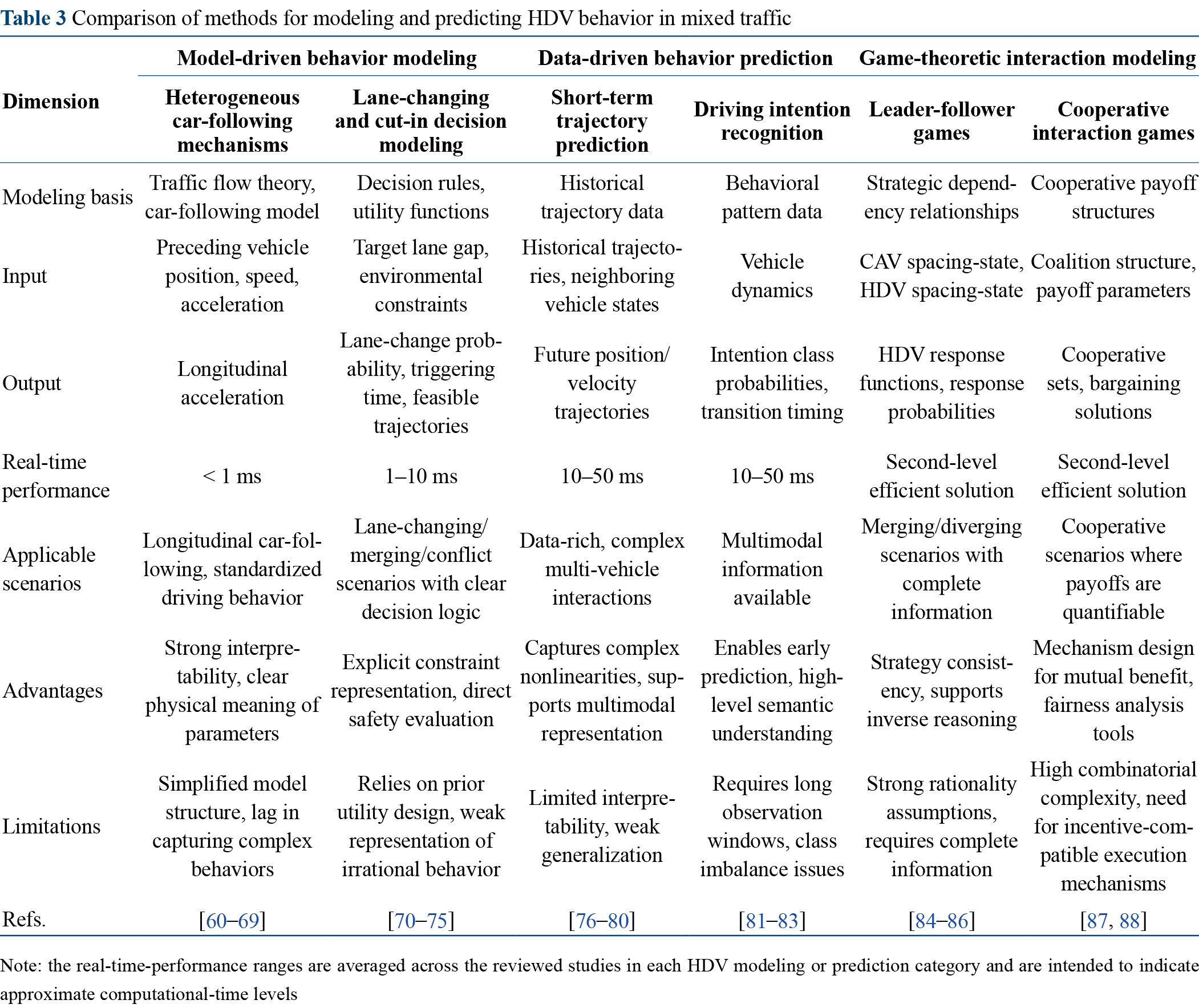
Based on the above analysis, Table 3 compares HDV behavior modeling and prediction methods from the perspectives of modeling basis, input-output form, real-time performance, applicable scenarios, and limitations. The technical trend is moving from deterministic car-following and rule-based lane-changing models toward interaction-aware, multimodal, and uncertainty-aware prediction, as shown in Figure 4. Model-driven methods remain valuable because they provide interpretability and physically meaningful parameters, but they are limited in representing abrupt, irrational, or aggressive HDV behaviors. Data-driven methods improve nonlinear representation and multimodal prediction, yet their black-box nature, out-of-distribution sensitivity, and weak uncertainty calibration limit their direct use in safety-critical control. Game-theoretic models explicitly describe strategic interaction, but their rationality and complete-information assumptions are often inconsistent with real HDV behavior. A central unresolved conflict is that prediction accuracy alone does not guarantee control usefulness: trajectory prediction provides continuous constraints but may increase latency and accumulated error, whereas intention recognition offers earlier warnings but may suffer from misclassification risk. Future research should therefore develop control-oriented HDV prediction, where point, interval, probabilistic, and intention outputs are explicitly matched with deterministic MPC, robust MPC, stochastic MPC, or risk-aware control. More attention should also be paid to uncertainty calibration, online adaptation, and benchmark evaluation under cut-in, forced merging, and topology-changing scenarios.
| Dimension | Model-driven behavior modeling | Data-driven behavior prediction | Game-theoretic interaction modeling | |||
|---|---|---|---|---|---|---|
| Heterogeneous car-following mechanisms | Lane-changing and cut-in decision modeling | Short-term trajectory prediction | Driving intention recognition | Leader-follower games | Cooperative interaction games | |
| Modeling basis | Traffic flow theory, car-following model | Decision rules, utility functions | Historical trajectory data | Behavioral pattern data | Strategic dependency relationships | Cooperative payoff structures |
| Input | Preceding vehicle position, speed, acceleration | Target lane gap, environmental constraints | Historical trajectories, neighboring vehicle states | Vehicle dynamics | CAV spacing-state, HDV spacing-state | Coalition structure, payoff parameters |
| Output | Longitudinal acceleration | Lane-change probability, triggering time, feasible trajectories | Future position/velocity trajectories | Intention class probabilities, transition timing | HDV response functions, response probabilities | Cooperative sets, bargaining solutions |
| Real-time performance | < 1 ms | 1–10 ms | 10–50 ms | 10–50 ms | Second-level efficient solution | Second-level efficient solution |
| Applicable scenarios | Longitudinal car-following, standardized driving behavior | Lane-changing/merging/conflict scenarios with clear decision logic | Data-rich, complex multi-vehicle interactions | Multimodal information available | Merging/diverging scenarios with complete information | Cooperative scenarios where payoffs are quantifiable |
| Advantages | Strong interpretability, clear physical meaning of parameters | Explicit constraint representation, direct safety evaluation | Captures complex nonlinearities, supports multimodal representation | Enables early prediction, high-level semantic understanding | Strategy consistency, supports inverse reasoning | Mechanism design for mutual benefit, fairness analysis tools |
| Limitations | Simplified model structure, lag in capturing complex behaviors | Relies on prior utility design, weak representation of irrational behavior | Limited interpretability, weak generalization | Requires long observation windows, class imbalance issues | Strong rationality assumptions, requires complete information | High combinatorial complexity, need for incentive-compatible execution mechanisms |
| Refs. | [60–69] | [70–75] | [76–80] | [81–83] | [84–86] | [87, 88] |
From the perspective of control-oriented applicability, the output form of HDV behavior prediction directly determines whether downstream controllers can construct robust constraints. Specifically, point predictions naturally align with deterministic MPC, interval-based predictions facilitate robust MPC, and distributional predictions enable stochastic MPC and risk-aware optimization. Therefore, prediction methods should be selected based on control-oriented applicability rather than prediction accuracy alone. Future research should establish tighter integration pathways among the three categories of methods. On the one hand, the structural priors of model-driven methods and the rationality constraints of game-theoretic frameworks can be leveraged to improve the interpretability, sample efficiency, and generalization capability of data-driven models. On the other hand, data-driven approaches can be used to refine and extend the parameter distributions of mechanistic models and game-theoretic assumptions. Building on this basis, verifiable safety constraints and multi-scenario evaluation benchmarks should be introduced to systematically enhance the reliability and engineering deployability of mixed platoon control in real-world road environments.
Model-driven control relies on vehicle dynamics models and HDV behavior prediction to design control laws that satisfy stability, tracking accuracy, and safety constraints through analytical or numerical optimization. Its primary advantages are a solid theoretical foundation and provable stability. According to the design principles of the control law, model-driven control can be broadly categorized into classical model-driven control and robust control.
Classical model-driven control is built upon vehicle dynamics and HDV behavior models, and designs control laws through feedback regulation or receding-horizon optimization. In mixed platoons, representative approaches mainly include proportional-integral-derivative (PID) control, MPC, and adaptive control. PID control regulates tracking errors through proportional, integral, and derivative actions, exhibits relatively low dependence on model accuracy, and can serve as a baseline solution for longitudinal control [89]. Bandapally et al. [90] implemented CAV platoon control using PID and addressed HDV cut-in and crossing maneuvers by distinguishing between priority and non-priority external vehicles. MPC jointly optimizes multiple objectives, including safe spacing, fuel economy, and ride comfort, over a receding horizon, and enables anticipatory decision-making by predicting trajectories over the moving horizon [59, 91]. To cope with HDV uncertainty, stochastic MPC handles random disturbances through chance constraints [32, 50], whereas robust MPC accounts for worst-case scenarios using uncertainty sets [92]. For diverse scenarios such as curved-road driving [93], urban congested road segments [94], and urban intersections [95, 96], scenario-based MPC further customizes constraint sets for complex traffic environments [97]. Adaptive control compensates for model mismatch and external disturbances through online parameter estimation, allowing the controller to adapt to variations in HDV driving styles [98, 99]. These three classes of methods exhibit different tradeoffs between performance and complexity. PID incurs the lowest computational overhead, but typically produces larger tracking errors under strong disturbances. MPC achieves superior tracking accuracy and multi-objective optimization performance, but each optimization can require tens to hundreds of milliseconds [100]. Adaptive control has a computational burden between those of PID and MPC, but generally requires a parameter convergence window ranging from several seconds to tens of seconds. Fundamentally, classical model-driven control is limited by the tension between model mismatch and real-time performance, while the stochasticity and strong nonlinearity of HDV behavior are difficult to fully characterize using finite-dimensional analytical models. Therefore, such methods are currently more suitable for highway platooning scenarios with relatively stable traffic states and regular HDV driving styles. Incorporating data-driven identification and online model correction while preserving provable stability remains a critical research direction for extending these methods to complex mixed traffic.
Robust control (RC) explicitly models system uncertainties during controller design by treating factors such as HDV behavior and communication delay as bounded disturbances or parameter perturbations, and accordingly constructs control laws that guarantee robust stability [101, 102]. Existing approaches can be broadly categorized into four classes. H∞ robust control suppresses disturbance effects by minimizing the system H∞ norm [103]. The Mousavi group has developed a systematic H∞ control framework [104–107], including gain-scheduled H∞ control to handle time-varying vehicle speeds and communication delay, output-feedback H∞ control for disturbance attenuation and global stability, and mixed H2/H∞ control to balance robustness and energy optimization. Zhou et al. [108] designed an H∞ controller that minimizes the worst-case damping ratio by considering the frequency characteristics of HDV acceleration disturbances. Min-Max MPC focuses on worst-case optimization. Chen et al. [109] proposed a leader-centered centralized Min-Max longitudinal control scheme, Hu et al. [110] drove the system toward desired states under worst-case disturbances within a disturbance set, and Li et al. [111] further developed a robust fuzzy MPC framework. Tube MPC mitigates disturbances in real time via error tube constraints [112]. Zhang et al. [113] employed tube MPC to ensure trajectory constraint feasibility, while Chen et al. [23] constrained the actual state within an error tube centered on the nominal trajectory and guaranteed asymptotic convergence. Safety-function-based RC provides formal safety guarantees using control barrier functions (CBF) [114], or reformulates time-varying HDV behavior into linear matrix inequality (LMI) problems for tractable solutions [115, 116]. These four classes exhibit different tradeoffs between conservatism and performance. H∞ control offers high computational efficiency and guarantees worst-case performance, but requires predefined disturbance bounds, often leading to conservative control inputs and reduced fuel economy under nominal conditions. Min-Max MPC achieves moderate conservatism but incurs high computational cost and depends on convexity assumptions for convergence. Tube MPC reduces computational complexity by decoupling nominal trajectories and error tubes, although the tube width increases linearly with uncertainty bounds. Safety-function-based methods provide formal guarantees, but the intrinsic conservatism of LMI-based approaches may degrade performance.
The fundamental limitation of RC lies in the fact that simple bounded-disturbance models cannot adequately capture the heavy-tailed distribution and strong asymmetry of HDV behavior. Overly tight uncertainty bounds may lead to constraint violations, whereas overly loose bounds result in excessive conservatism. Therefore, RC is more suitable for safety-critical scenarios with relatively well-defined uncertainty bounds and tolerable conservatism. Future research necessitates establishing a tighter integration between data-driven uncertainty modeling and provable robustness.
Data-driven control avoids reliance on exact first-principles modeling and directly learns CAV control strategies from historical data or online interaction data, providing a new pathway for addressing HDV behavior uncertainty and time-varying traffic environments in mixed platoons. Unlike Section 3, which focuses on HDV behavior prediction, this section centers on the data-driven synthesis of CAV control laws. According to different learning paradigms, existing studies can be broadly categorized into data-driven predictive control, reinforcement learning control, and data-driven adaptive control.
Data-driven predictive control (DDPC) uses historical input-output data to construct prediction models, thereby replacing the mechanistic models of vehicle dynamics and HDV behavior used in conventional MPC. According to the data modeling strategy, DDPC methods can be divided into three categories. Reachable-set-based DDPC characterizes system uncertainty using reachable sets represented by matrix zonotopes. Based on this representation, Lan et al. [117] designed a robust MPC method that requires neither explicit HDV models nor delay parameters and can handle measurement noise. Although an effective reachable set can be constructed from only hundreds of trajectories, the method is relatively conservative. Koopman-operator-based DDPC transforms nonlinear mixed platoon systems into high-dimensional linear systems through lifting-based linearization [118]. Li et al. [119] combined Koopman-based extended dynamic mode decomposition with reachable sets and proposed a robust nonlinear DDPC method. This class of methods offers high online optimization efficiency, but offline training requires thousands to tens of thousands of high-quality trajectories. Willems-lemma-based DDPC is tailored to scenarios involving the coexistence of CAVs and HDVs. Wang et al. [120] proposed DeeP-LCC to realize model-free predictive control, and Li et al. [121] further developed RDeeP-LCC to enhance robustness. This class of methods requires maintaining high-dimensional Hankel matrices, which imposes a heavy burden on online optimization. Furthermore, when deep neural networks are used as prediction models, their coupling with MPC leads to nonconvex optimization problems, and the solution time may be several times longer than the control period. Overall, DDPC still faces challenges, including data scarcity in long-tail extreme scenarios, insufficient model interpretability, and difficulty in ensuring real-time online optimization. At present, DDPC is more suitable as a complementary module for model-driven control or as an offline benchmarking tool. Future research should further investigate the interpretability of black-box models, the efficient utilization of structured data, and approximate solution algorithms.
Reinforcement learning (RL) control treats CAVs as agents that interact with the environment. By designing the state space, action space, and reward function, RL enables agents to balance platoon stability with responsiveness to uncertain HDV behaviors through trial-and-error learning [122]. Existing RL-based control architectures can be broadly categorized into three classes. Multi-agent reinforcement learning (MARL) relies on independent decision-making by multiple agents and local information exchange, making it suitable for mixed platoon scenarios. Li et al. [123] proposed a dense-communication RL framework that mitigates traffic oscillations by enhancing inter-vehicle information exchange. Shi et al. [124] developed a longitudinal control strategy based on distributed deep reinforcement learning (DRL), embedding stochasticity in car-following behavior into the training environment. Wang et al. [125] designed a multi-agent DRL controller to address communication delay. Shi et al. [126] proposed MARL-based methods for platoon control and platoon formation. For the coordination of heterogeneous vehicle fleets, Gao et al. [127] proposed a hub-and-spoke graph RL framework for spatiotemporal cooperative decision-making, while Dai et al. [128] constructed a cooperative multi-agent DRL system. MARL methods can handle local observations and communication constraints, but they commonly suffer from low sample efficiency and unstable training [129]. Safe reinforcement learning (SRL) has attracted considerable attention because it can directly address safety constraints such as collision avoidance and formation keeping. Pan et al. [130] proposed a safety-supervised decentralized Proximal Policy Optimization (PPO) algorithm, which significantly improves fuel economy while ensuring safety and stability. Zhou et al. [131] embedded CBF into DRL as a differentiable network layer to provide system-level safety assurance. Yang et al. [132] integrated CBF into agents as a differentiable quadratic programming layer, mapping RL outputs into actions that satisfy safety constraints and enabling optimal speed advisory during green phases at signalized intersections. SRL provides formal safety guarantees through constraints such as CBFs, but it substantially narrows the exploration space, making the learned policies conservative. Moreover, designing safety constraints remains challenging in complex mixed traffic scenarios. Robust reinforcement learning (RRL) aims to improve policy adaptability to model uncertainty and anomalous behaviors. Bejarbaneh et al. [133] proposed an RRL framework that employs distributed observers and hybrid controllers to address uncertainties in heterogeneous vehicle dynamics. Chen et al. [134] proposed guided deep deterministic policy gradient (GuidDDPG), which combines the advantages of RL and conventional adaptive cruise control (ACC) through a goal-oriented reward function, thereby guiding the policy to converge toward safer and more efficient acceleration and deceleration patterns. RRL has made progress in reducing training costs and enhancing deployment practicality, but it still needs to trade off model generalization against computational efficiency.
These three classes of RL-based control architectures differ in their performance emphases. MARL enables distributed cooperative decision-making, but has relatively low sample efficiency and is sensitive to communication quality. SRL provides safety guarantees but restricts the exploration space, resulting in conservative policies. Robust and hybrid methods balance safety and deployment practicality, but their robustness remains insufficient under extreme anomalous scenarios. Overall, RL-based control still faces challenges, including high trial-and-error costs, difficulty in obtaining formal safety certification for black-box policies, and insufficient validation in real-world mixed traffic. At present, it is more suitable for offline policy mining and prior policy generation, or for hybrid use with model-driven methods to improve engineering deployability.
Data-driven adaptive control replaces explicit mechanistic models with real-time operational data and constructs adaptive laws through online learning algorithms, enabling controllers to dynamically adjust their parameters in response to changes in HDV driving styles and evolving traffic states. Existing studies can be broadly divided into two categories. Neural-network adaptive control uses neural networks to approximate the complex nonlinear and time-varying characteristics of mixed traffic, among which Radial Basis Function Neural Networks (RBFNNs) are widely adopted because of their simple structure and strong approximation capability [135]. Dong et al. [116] addressed mixed-order nonlinear heterogeneous platoons by designing an RBFNN-based adaptive law to simultaneously approximate uncertain and nonlinear terms. Adaptive optimal control enables each CAV to independently adjust its control parameters based on local information within an optimization framework and to achieve near-global optimality through interactions with neighboring vehicles [136]. For example, Lan et al. [137] developed a data-driven control policy learning method based on adaptive dynamic programming. Jiang et al. [138] proposed a random-search-based adaptive policy learning method for mixed platoons at signalized intersections.
These two classes of methods exhibit a tradeoff between convergence speed and stability. Neural-network adaptive control has strong approximation capability and can handle pronounced nonlinearities, but its convergence may require tens of seconds to several minutes and is sensitive to measurement noise. Adaptive optimal control converges relatively faster and offers a degree of global optimality, but it is relatively dependent on V2V communication quality. When HDV behavior changes rapidly, adaptive laws often lag behind disturbances. To guarantee Lyapunov stability, the learning rate usually needs to be reduced, which further slows convergence. Therefore, data-driven adaptive control is currently more suitable for scenarios with slowly varying disturbances and stable communication conditions. Future research should establish systematic design principles that balance fast adaptation, noise suppression, and performance guarantees under safety constraints, while exploring coordination mechanisms with model-driven control.
Model-driven and data-driven control each offer distinct advantages in mixed traffic scenarios. To overcome the limitations of either paradigm alone, hybrid model-data control integrates reliable physical models, such as vehicle dynamics, with data-driven representations of HDV behavior within a unified framework. Physical models provide safety margins and stability guarantees, whereas data-driven learning enhances adaptability to complex scenarios and heterogeneous driving styles. According to the degree of integration and the implementation mechanism, representative paradigms include embedded fusion control, hierarchical fusion control, and joint optimization fusion control.
Embedded fusion control uses physical models to describe deterministic system dynamics and data-driven models to approximate uncertain or unmodeled components that are difficult to characterize accurately. In other words, it embeds one mechanism into a dominant algorithmic framework as a module or constraint. According to the fusion mode, embedded fusion control can be divided into three categories. Model-enhanced RL explicitly incorporates vehicle dynamics and safety constraints into agent training to improve physical consistency. For example, the DDPG-OVM method proposed by Qi et al. [139] design a deep reinforcement learning controller by using the optimal velocity model as a prior. Data-enhanced MPC embeds data-driven prediction into the MPC framework. Hu et al. [140] combined vehicle dynamics equations with an empirical database of queue dissipation, and estimated terminal conditions and energy consumption bounds through receding-horizon optimization. Long et al. [141] proposed a predictive control method based on physics-enhanced residual learning, which combines MPC with deep learning techniques to accurately predict the behavior of the preceding vehicle. Koopman-operator-based hybrid control maps nonlinear mixed platoon systems into a high-dimensional linear space through lifting-based linearization. Lyu et al. [142] proposed KoopLCC, which uses deep Koopman networks to extract driving styles and perform modeling in a high-dimensional linear space. They further developed a deep variational Koopman network, DVKoN [143], and combined it with a variational autoencoder to form a two-layer robust predictive controller, DVKoRPC.
These three categories exhibit different tradeoffs among physical consistency, data requirements, and training complexity. Model-enhanced RL reduces data requirements compared with pure RL by introducing strong physical priors, but physical constraints may impede gradient propagation through the policy network and prolong training. Data-enhanced MPC can flexibly adjust the relative weights of model-based and data-driven components and achieves relatively high online optimization efficiency, but it is more sensitive to the accuracy of the underlying model. Koopman-based control methods offer high online efficiency after training, but lifting and network training substantially increase offline computational complexity. Overall, embedded fusion control faces the challenge of quantitatively balancing the strength of physical priors, and physical constraints may render the optimization problem nonconvex. Therefore, embedded fusion control is more suitable for subsystems with well-understood physical mechanisms and certain requirements for safety and interpretability.
Hierarchical fusion control constructs a multi-layer control architecture in which model-driven and data-driven methods are deployed at different layers. The output of an upstream algorithm serves as the input to a downstream algorithm, and each layer is dedicated to specific time scales or functionalities. According to the architectural design, it can be broadly divided into two categories. The decision-planning-execution three-layer architecture typically employs data-driven methods at the decision-making layer for high-level decision-making, model-driven methods at the planning layer to generate reference trajectories, and classical control at the execution layer for trajectory tracking [144, 145]. This structure enables clear task decomposition. Typically, the decision layer operates on a timescale of seconds, whereas the execution layer functions within tens of milliseconds. However, inter-layer coordination and time-scale alignment remain challenging, placing stringent requirements on the rapid response capability of lower layers. The feedforward-feedback two-layer architecture integrates data-driven predictive compensation with model-driven error correction [146]. The feedforward layer predicts future HDV trajectories based on historical data and generates anticipatory control inputs, while the feedback layer compensates for real-time tracking errors based on vehicle dynamics models. This architecture is simpler to coordinate and offers superior real-time performance, but it relies more heavily on the accuracy of feedforward prediction and the robustness of the feedback model.
Overall, the core challenge of hierarchical fusion control lies in the tension between inter-layer coupling and the hierarchical decoupling assumption. In mixed traffic, abrupt HDV behaviors tend to diminish time-scale separation across layers, thereby challenging the conventional fast-slow separation paradigm. In addition, global objectives may be partially localized during inter-layer propagation, which can degrade overall system performance. Therefore, hierarchical fusion control is more suitable for scenarios with well-defined hierarchical structures and clear time-scale separations. Future research requires the development of systematic design principles to resolve inter-layer conflicts and ensure objective consistency.
Joint optimization fusion control, in contrast to explicitly layered hierarchical fusion control, integrates model-driven and data-driven modules within a unified optimization framework. Rather than forming a simple cascaded input-output relationship, the constituent algorithms are tightly coupled through shared objective functions or constraint sets. According to the fusion strategy, it can be broadly categorized into three classes. The integration of MPC and RL leverages MPC to solve constrained optimization problems over a short prediction horizon to ensure short-term performance, while RL learns policy parameters or objective weights over longer time scales, enabling the receding-horizon objective function to adapt to long-term cumulative returns [147]. This approach allows RL to optimize control parameters under the safety guarantees provided by MPC, but inconsistencies between their objective functions may arise, necessitating careful design of a unified reward function. Physics-data-driven joint modeling embeds the ego-vehicle dynamics model together with data-driven models of preceding and surrounding HDVs into a single optimization problem, where they jointly function as constraints or objectives [148]. This approach tightly couples model-driven and data-driven components, but incurs high computational complexity. Moreover, the nonconvexity of data-driven models may undermine the convex structure of MPC, making global optimality difficult to guarantee. The integration of uncertainty quantification and robust optimization incorporates uncertainty estimates obtained from data-driven models into a robust optimization framework, enabling explicit consideration of uncertainty effects on top of physical models. For example, Zhang et al. [149] proposed a coordinated control strategy that combines offline robust MPC with online data-driven control input mapping. This approach achieves a balance between coupling strength and computational complexity, but is highly sensitive to the accuracy of uncertainty representation.
Overall, as the degree of integration increases, the computational burden of joint optimization fusion control grows superlinearly, significantly exceeding that of hierarchical fusion approaches. Therefore, it is currently more suitable as a tool for theoretical exploration. Future research necessitates leveraging structured learning, distributed optimization, and approximate verification techniques to alleviate computational burden and enhance formal guarantees.
Overall, Table 4 summarizes the application scenarios and quantitative performance of different control methods, while Figure 5 illustrates their general control structure. The technical trend has evolved from analytically tractable model-driven control toward learning-enhanced and hybrid model-data-driven control. Model-driven methods provide explicit stability, safety, or robustness guarantees, but their performance depends on model fidelity and predefined uncertainty bounds. Data-driven methods, especially reinforcement learning and adaptive learning, improve adaptability to nonlinear HDV behavior and complex mixed-traffic interactions, but they still face weak interpretability, limited formal certification, and sim-to-real generalization problems. Hybrid model-data-driven methods attempt to combine physical constraints with learned prediction or policy modules, making them a promising direction for deployable mixed-platoon control. However, deeper integration also brings new conflicts: safety guarantees may be weakened by nonconvex learning modules, robust constraints may become overly conservative, and joint optimization may exceed real-time computational limits. Future research should focus on safety-certified learning control, uncertainty-aware robust optimization, lightweight distributed computation, and hardware-in-the-loop or field-test validation, so that adaptability, real-time feasibility, and formal control guarantees can be jointly achieved.
| Method | Scenario | Data source | Input | Output | Delay | Efficiency | Safety | Comfort | Stability | Refs. |
|---|---|---|---|---|---|---|---|---|---|---|
| Classical model-driven control | Intersection | MATLAB simulation | Speed, spacing, phase | Speed | 0 s | Throughput improves 44% | Acceleration-constrained | |jerk| ≤ 3 m s−3 | String stability | [91] |
| Urban roads | MATLAB simulation | Lead vehicle trajectory | Acceleration | 0 s | Handles centralized uncertainty | Safe distance constraint | Acceleration ≤ 5 m s−2 | String stability | [92] | |
| Robust control | Loop/open road | MATLAB simulation | Speed, spacing | Control command | 0 s | Reduced spacing error | Safe distance constraint | Acceleration ≤ 2 m s−2 | Exponentially stability | [105] |
| Open road | MATLAB simulation | Neighbor positions, speeds | Acceleration | 0 s | – | Safe distance constraint | – | String stability | [107] | |
| Highway | NGSIM dataset | Spacing error, acceleration | Acceleration | 0.1/0.45 s | Effective disturbance rejection | No collision | Acceleration ≤ 3 m s−2 | Local/string stability | [108] | |
| Open road | MATLAB simulation | Speed, spacing, and preceding vehicle predicted speed | Driving torque | 0 s | Overshoot reduces 68%–82% | Minimum safe spacing ≥ 6.5 m | – | Locally asymptotically stability | [110] | |
| Data-driven predictive control | Open road | MATLAB simulation | Speed, spacing, disturbance set | Acceleration | 0 s | Reduced tracking error | Minimum safe spacing ≥ 5 m | Acceleration ≤ 3 m s−2 | String stability | [117] |
| Open road | PreScan simulation | Position, speed, potential attack | Acceleration | 0–0.1 s | Speed/spacing error reduces 8%–40% | Minimum safe spacing ≥ 7 m | Acceleration ≤ 5 m s−2 | String stability | [121] | |
| Reinforcement learning control | Highway | NGSIM dataset | Neighbor spacing states | Acceleration | 0 s | Average speed improves 13% | Minimum safe spacing ≥ 2.3 m | Acceleration ≤ 4 m s−2 | String stability | [123] |
| Open road | Python simulation | Spacing, speed | Acceleration | 0 s | Throughput improvement | Safety constraints satisfied 60% | Acceleration ≤ 0.8 m s−2 | String stability | [131] | |
| Data-driven adaptive control | Open road | Python simulation | Position, speed, spacing | Acceleration | 0.1 s | Effective vibration suppression | Minimum safe spacing ≥ 2.3 m | Acceleration ≤ 3 m s−2 | String stability | [135] |
| Highway | NGSIM dataset | Multi-vehicle spacing, speeds | Acceleration | 0.2 s | Average speed improvement | Minimum safe spacing ≥ 5 m | – | Asymptotically stability | [136] | |
| Embedded fusion control | Open road | Python simulation | Position, speed, acceleration | Desired spacing | 0 s | Fast convergence | Minimum safe spacing ≥ 5 m | Acceleration ≤ 2.5 m s−2 | String stability | [139] |
| Urban arterial | Python simulation | Preceding vehicle spacing, speed | Acceleration | 1 s | Energy saving improves 13%–60% | Minimum safe spacing ≥ 1 m | Acceleration ≤ 3 m s−2 | String stability | [140] | |
| Hierarchical fusion control | Urban road network | SUMO simulation | Position, speed, road density | Acceleration | 0.1 s | Delay reduces 5%–25% | Minimum safe spacing ≥ 3 m | Acceleration ≤ 5 m s−2 | Platoon stability | [144] |
| Urban roads lane-change | NGSIM I-80 | Neighbor spacing, speed | Acceleration | Random delay | Improved stability under disturbances | Collision-free | |jerk| ≤ 0.4 m s−3 | Locally stable | [145] | |
| Joint optimization fusion control | Highway merging | NGSIM I-80 | Position, speed, acceleration | Acceleration/lane-change decision | 0 s | Stop delay reduces 48.7% | TIT reduces 72.2% | Acceleration ≤ 1 m s−2 | String stability | [148] |
| HDV lane-change merging | MATLAB simulation | Spacing, speed | Acceleration | 0 s | Mitigates interference-induced fluctuations | Minimum safe spacing ≥ 2 m | Acceleration ≤ 3 m s−2 | Asymptotically stability | [149] |
Future research should focus on systematically validating existing methods in scenarios that closely reflect real-world constraints, developing a unified, interpretable, and provably safe fusion control framework, and designing lightweight control strategies with capabilities for online learning, adaptive weight adjustment, and cross-scenario generalization. These advances are critical to ensuring the robust performance of mixed platoons under out-of-distribution (OOD) conditions and complex traffic disturbances, thereby providing reliable support for engineering deployment.
The above literature review indicates that research on CAV platoon control under mixed traffic has developed a relatively well-established theoretical framework. From the perspective of control architecture, centralized control, distributed cooperative control, and hybrid hierarchical architectures provide differentiated coordination solutions for diverse scenarios. From the perspective of interaction mechanisms, HDV behavior modeling and prediction methods based on model-driven, data-driven, and game-theoretic approaches characterize the complex interaction patterns between CAVs and HDVs from multiple viewpoints. From the perspective of control paradigms, model-driven, data-driven, and hybrid approaches collectively establish an end-to-end technical framework spanning from theoretical modeling to intelligent decision-making. These advances not only provide a rich set of methodological tools for mixed platoon control but also demonstrate distinct advantages in traffic efficiency, safety, comfort, stability, and robustness, thereby laying a solid foundation for the engineering deployment of intelligent connected transportation systems.
However, several challenges remain in the existing studies:
(i) Limited accuracy and robustness in modeling human driving behavior uncertainty. Existing studies on HDV driving behavior modeling are predominantly based on simplified car-following models or assumptions on probability distributions, which are insufficient to fully capture the time-varying, heterogeneous, and non-rational characteristics of real-world driving behavior. Analytical modeling approaches are constrained by their reliance on historical data for parameter identification, resulting in limited generalization capability when encountering emerging driving styles or extreme or anomalous behaviors. Although learning-based methods can uncover latent patterns from data, their black-box nature leads to a lack of interpretability, making it difficult to extract explicit interaction rules for safety verification. Game-theoretic approaches rely on rationality assumptions and complete information, which are often violated in real-world scenarios such as aggressive driving and forced cut-in, thereby restricting their applicability.
(ii) The tradeoff between control performance and real-time performance remains inadequately addressed. MPC is widely adopted due to its optimization capability, but a fundamental tradeoff exists between the high computational complexity of online receding-horizon optimization and the limited onboard computational resources, making real-time implementation challenging to ensure. Although distributed architectures alleviate the per-vehicle computational burden through task decomposition, the communication overhead and convergence delays introduced by iterative coordination mechanisms may offset these advantages. Furthermore, when neural network models from data-driven approaches are integrated into the MPC framework, the resulting optimization problem becomes nonconvex and computationally intractable. In addition, existing simplification strategies, such as shortening the prediction horizon and employing reduced-order models, often come at the expense of control accuracy or safety margins, making it difficult to achieve an optimal tradeoff among performance, real-time capability, and safety.
(iii) Limited capability to address dynamic communication topology changes and network uncertainties. In mixed traffic, V2X communication exhibits strong time-varying characteristics due to factors such as signal occlusion and network congestion. When vehicles enter or exit tunnels, operate in dense urban areas, or when platoon size increases, communication quality may deteriorate sharply, leading to prominent issues such as communication delay, packet loss, and bandwidth constraints. Existing studies often design controllers under ideal communication assumptions, with insufficient robustness to dynamic scenarios such as communication failures and topology reconfiguration. Although distributed architectures enhance fault tolerance against single-point failures, they lack systematic mechanisms for handling extreme scenarios. Event-triggered and adaptive control strategies can reduce communication frequency, but the design of triggering thresholds and gain adaptation lacks solid theoretical guidance, and their effectiveness in complex scenarios remains to be validated.
(iv) Limited cross-scenario generalization capability and a significant sim-to-real gap. Existing studies are typically conducted under specific road scenarios or single platoon configurations, and their applicability across varying penetration rates, traffic densities, weather conditions, and road geometries remains unclear. Data-driven methods are prone to overfitting to training scenarios and may exhibit catastrophic failures under out-of-distribution conditions. Moreover, most approaches remain at the simulation stage, with limited real-vehicle testing data and insufficient scenario diversity. The discrepancy between idealized simulation assumptions and real-world traffic conditions makes it difficult to reproduce simulation performance in practical deployment, highlighting the need for more robust reliability and safety assurance mechanisms.
(v) Underdeveloped task allocation and resource scheduling mechanisms in vehicle-road-cloud collaborative architectures. Mixed platoon control relies on integrated vehicle-road-cloud systems, but existing studies lack systematic designs for allocating computational tasks across layers and optimizing communication resources. The heterogeneity among onboard, edge, and cloud platforms in terms of computational capability, delay, and data accessibility necessitates task offloading strategies that balance real-time performance and global optimality. Current hierarchical control approaches often rely on predefined layer-wise task allocation, which lacks adaptability to dynamic traffic and network conditions. Furthermore, macroscopic optimization problems, such as multi-platoon coordination and inter-segment coordination, require a global perspective from the cloud, yet their coupling with real-time vehicle-side control remains insufficiently developed, leading to suboptimal overall system performance.
Overall, current research on mixed platoon control still exhibits systemic limitations in model accuracy, real-time performance, communication robustness, safety verification, and cross-scenario generalization, making it difficult to satisfy the comprehensive requirements of reliability, adaptability, and engineering deployability in complex road environments. To address these challenges, this paper outlines the following research directions:
(i) Further advancing human driving behavior modeling and intention inference to improve the accuracy of interaction mechanism characterization. By integrating multimodal data, including social norms, driving actions, and traffic environments, comprehensive representations of human driving behavior can be constructed to capture the influence of driving styles, attention states, and emotional dynamics on control decisions. Interpretable driving intention inference methods should be developed by leveraging techniques such as attention mechanisms and game-theoretic reasoning, enabling a transition from black-box prediction to interpretable reasoning and providing CAVs with trustworthy HDV behavior prediction and risk assessment. In addition, abnormal driving behavior detection and online adaptive mechanisms should be established to identify high-risk patterns, such as aggressive overtaking and fatigued driving, in real time, thereby triggering conservative control strategies or coordinated warning mechanisms to enhance platoon robustness under extreme disturbances.
(ii) Advancing edge intelligence and vehicle-road-cloud collaborative computing architectures to better trade off real-time performance and control performance requirements. Lightweight MPC approaches should be explored to reduce onboard computational burden, for example, through explicit MPC and approximate dynamic programming. Hierarchical control strategies enabled by edge intelligence should be developed to handle low-delay tasks such as local coordination, trajectory optimization, and conflict detection, thereby enabling effective coordination between fast vehicle-side responses and high-quality edge-side decision-making. Furthermore, adaptive task offloading and resource scheduling mechanisms should be designed to dynamically allocate computational resources across vehicle, edge, and cloud layers according to network conditions, computational load, and task priorities. By incorporating techniques such as federated learning, collaborative training and knowledge sharing among multiple platoons can be achieved while preserving data privacy, thereby enhancing model generalization capability.
(iii) Exploring resilient cooperative control strategies under communication constraints and dynamic topology variations. Communication-efficient cooperative control based on event-triggered and self-triggered mechanisms should be developed, where communication instants are adaptively determined using Lyapunov-based criteria to reduce network load while preserving control performance. Topology-aware distributed controllers should be designed to analyze the effects of different communication topologies on system stability and consensus, and to establish Lyapunov-based stability conditions under topology switching, thereby enabling adaptive tuning of controller gains. For scenarios involving communication failures and network partitioning, degraded control and platoon reconfiguration strategies based on local information should be investigated to maintain basic safety and formation integrity under partial communication disruptions.
(iv) Expanding the scenario scope and evaluation framework of mixed platoon control to facilitate large-scale deployment. In terms of scenario coverage, research should extend from single-platoon settings to multi-platoon coordination, heterogeneous platoon interactions, and coexistence with non-platoon vehicles. Platoon control under complex road conditions, such as variable-curvature roads, grades, and adverse weather, should be incorporated, along with infrastructure-assisted strategies such as dynamic lane management. Regarding evaluation frameworks, comprehensive multi-dimensional metrics encompassing safety, stability, efficiency, and comfort should be established, together with differentiated performance benchmarks under varying penetration rates. In addition, large-scale and standardized real-vehicle testing should be promoted, and benchmark and failure-case databases should be constructed to support iterative improvement of control strategies.
(v) Establishing intelligent task orchestration and resource optimization scheduling frameworks under vehicle-road-cloud collaboration to enhance overall system efficiency. A joint computation-communication optimization model tailored to mixed platoon control tasks should be developed to derive task allocation and resource scheduling strategies across multiple time scales. For multi-platoon and cross-segment coordination scenarios, a bidirectional coupling interface between a cloud-level macroscopic optimization layer and a vehicle-level microscopic control layer should be designed. Specifically, the cloud performs platoon route planning and speed coordination based on global traffic situational awareness and delivers optimization outputs, such as reference trajectories or constraint sets, to vehicles via edge nodes. At the vehicle level, these cloud-generated commands are incorporated as soft constraints or reference signals within a local MPC framework, where they are refined using real-time perception to ensure safety. Meanwhile, execution deviations and local traffic states are fed back to the cloud for rolling updates, forming a closed-loop vehicle-road-cloud collaborative control mechanism.
Jianhong Liang: Conceptualization; methodology; validation; visualization; data curation; writing-original draft; writing-review & editing. Xuting Duan: Conceptualization; formal analysis; supervision; funding acquisition; writing-review & editing. Shuyi Wang: Formal analysis; investigation; methodology; validation; writing-review & editing. Yuanwen Lai: Visualization; formal analysis; writing-review & editing. Jianshan Zhou: Methodology; software; validation; writing-review & editing. Daxin Tian: Conceptualization; formal analysis; funding acquisition; writing-review & editing.
This work was supported partially by the Fundamental and Interdisciplinary Disciplines Breakthrough Plan of the Ministry of Education of China (Grant No. JYB2025XDXM123), the National Natural Science Foundation of China (Grant Nos. T2588101 and 62432002), the Fundamental Research Funds for the Central Universities (Beihang Ganwei Action Plan Key Program, Grant No. JK2024-19), and the Beijing Municipal Science and Technology Program (Grant No. Z251100003925004).
The data that support the findings of this study are available from the corresponding author upon reasonable request.
J. Qiu and L. Du, "Cooperative Trajectory Control for Synchronizing the Movement of Two Connected and Autonomous Vehicles Separated in a Mixed Traffic Flow," Transportation Research Part B: Methodological 174 (2023): 102769, https://doi.org/10.1016/j.trb.2023.05.006.
Z. Yao, Y. Wu, Y. Wang, B. Zhan, and Y. Jiang, "Analysis of The Impact of Maximum Platoon Size of Cavs on Mixed Traffic Flow: An Analytical and Simulation Method," Transportation Research Part C: Emerging Technologies 147 (2020): 103989, https://doi.org/10.1016/j.trc.2022.103989.
F. Daems, "Platooning Value and Benefit Analysis," European commission, D14.8 of H2020 project ENSEMBLE, https://www.platooningensemble.eu.
L. Jiang, J. Kheyrollahi, C. R. Koch, and M. Shahbakhti, "Cooperative Truck Platooning Trial on Canadian Public Highway under Commercial Operation in Winter Driving Conditions," Proceedings of the Institution of Mechanical Engineers, Part D: Journal of Automobile Engineering 239, no. 7 (2025): 2272–2284, https://doi.org/10.1177/09544070241245477.
T. C. Botelho, S. P. Duarte, M. C. Ferreira, S. Ferreira, and A. Lobo, "Simulator and On-Road Testing of Truck Platooning: A Systematic Review," European Transport Research Review 17 (2025): 4, https://doi.org/10.1186/s12544-024-00705-6.
Y. Zhang, M. Hu, Y. Chen, and C. Shi, "Cooperative Platoon Forming Strategy for Connected Autonomous Vehicles in Mixed Traffic Flow," Physica A: Statistical Mechanics and its Applications 623 (2023): 128828, https://doi.org/10.1016/j.physa.2023.128828.
M. R. Hidayatullah and J. C. Juang, "String Stability Criterion for Mixed Vehicular Platoons," in Proceedings of the 2020 International Automatic Control Conference (CACS), 1–6, IEEE, 2020, https://doi.org/10.1109/CACS50047.2020.9289821.
Y. Qin, Q. Luo, and H. Wang, "Stability Analysis and Connected Vehicles Management for Mixed Traffic Flow with Platoons of Connected Automated Vehicles," Transportation Research Part C: Emerging Technologies 157 (2023): 104370, https://doi.org/10.1016/j.trc.2023.104370.
J. Liang, C. Tan, L. Yan, J. Zhou, G. Yin, and K. Yang, "Interaction-Aware Trajectory Prediction for Safe Motion Planning in Autonomous Driving: A Transformer-Transfer Learning Approach," IEEE Transactions on Intelligent Transportation Systems 26, no. 10 (2025): 17080–17095, https://doi.org/10.1109/TITS.2025.3588228.
J. Liang, K. Yang, C. Tan, J. Wang, and G. Yin, "Enhancing High-Speed Cruising Performance of Autonomous Vehicles Through Integrated Deep Reinforcement Learning Framework," IEEE Transactions on Intelligent Transportation Systems 26, no. 1 (2025): 835–848, https://doi.org/10.1109/TITS.2024.3488519.
Y. Ma, Q. Liu, J. Fu, K. Liufu, and Q. Li, "Collision-Avoidance Lane Change Control Method for Enhancing Safety for Connected Vehicle Platoon in Mixed Traffic Environment," Accident Analysis & Prevention 184 (2023): 106999, https://doi.org/10.1016/j.aap.2023.106999.
E. Moradi-Pari, D. Tian, M. Bahramgiri, S. Rajab, and S. Bai, "DSRC Versus LTE-V2X: Empirical Performance Analysis of Direct Vehicular Communication Technologies," IEEE Transactions on Intelligent Transportation Systems 24, no. 5 (2023): 4889–4903, https://doi.org/10.1109/TITS.2023.3247339.
G. Xiao, Y. Wu, Y. Jiang, B. Ran, and Z. Yao, "Cooperative Eco-Driving for Mixed Platoons with Heterogeneous Energy at a Signalized Intersection Based on a Mixed Space-Time-State Network," IEEE Transactions on Vehicular Technology 74, no. 8 (2025): 11715–11731, https://doi.org/10.1109/TVT.2025.3552781.
Y. Zou, F. Zheng, Z. Fan, and Y. Tang, "Integrated Control of Traffic Signal and Automated Vehicles for Mixed Traffic: Platoon-Based Bi-Level Optimization Approach," in Proceedings of the 2022 IEEE 25th International Conference on Intelligent Transportation Systems (ITSC), 2107–2113, IEEE, 2022, https://doi.org/10.1109/ITSC55140.2022.9922535.
M. Faris, M. Zanon, and P. Falcone, "CAVs Coordination at Intersections in Mixed Traffic via Feasibility-Enforcing ADMM," in Proceedings of the 2024 IEEE 27th International Conference on Intelligent Transportation Systems (ITSC), 882–888, IEEE, 2024, https://doi.org/10.1109/ITSC58415.2024.10919611.
U. Montanaro, S. Fallah, M. Dianati, D. Oxtoby, T. Mizutani, and A. Mouzakitis, "Cloud-Assisted Distributed Control System Architecture for Platooning," in Proceedings of the 2018 21st International Conference on Intelligent Transportation Systems (ITSC), 1258–1265, IEEE, 2018, https://doi.org/10.1109/ITSC.2018.8569295.
M. Hua, X. Qi, D. Chen, K. Jiang, Z. Liu, and H. Sun, "Multi-Agent Reinforcement Learning for Connected and Automated Vehicles Control: Recent Advancements and Future Prospects," IEEE Transactions on Automation Science and Engineering 22 (2025): 16266–16286, https://doi.org/10.1109/TASE.2025.3574280.
Q. Li, Z. Chen, and X. Li, "A Review of Connected and Automated Vehicle Platoon Merging and Splitting Operations," IEEE Transactions on Intelligent Transportation Systems 23, no. 12 (2022): 22790–22806, https://doi.org/10.1109/TITS.2022.3193278.
H. Li, W. Meng, Z. Han, Z. Zhang, and Y. Yang, "Vehicle Platoon in Road Traffic: A Survey of Modeling, Communication, Controlling and Perspectives," Physica A: Statistical Mechanics and its Applications 674 (2025): 130757, https://doi.org/10.1016/j.physa.2025.130757.
C. Wu, Z. Cai, Y. He, and X. Lu, "A Review of Vehicle Group Intelligence in a Connected Environment," IEEE Transactions on Intelligent Vehicles 9, no. 1 (2023): 1865–1889, https://doi.org/10.1109/TIV.2023.3321891.
V. Lesch, M. Breitbach, M. Segata, C. Becker, S. Kounev, and C. Krupitzer, "An Overview on Approaches for Coordination of Platoons," IEEE Transactions on Intelligent Transportation Systems 23, no. 8 (2021): 10049–10065, https://doi.org/10.1109/TITS.2021.3115908.
X. Zheng, F. Soriguera, C. Xie, and S. Moode, "An Interaction-Aware Predictive Control Framework with Adaptive Gap Regulation in Connected and Automated Vehicle Platoon," in Proceedings of the 2025 IEEE Intelligent Vehicles Symposium (IV), 1674–1680, IEEE, 2025, https://doi.org/10.1109/IV64158.2025.11097812.
L. Chen, J. Zhan, and L. Zhang, "Data-Driven Modeling and Robust Control of Mixed Vehicle Platoons Based on Tube Model Predictive Control," in Proceedings of the 2023 42nd Chinese Control Conference (CCC), 6527–6532, IEEE, 2023, https://doi.org/10.23919/CCC58697.2023.10239870.
D. Tian, P. Zhang, J. Zhou, X. Duan, Z. Sheng, and D. Zhao, "Optimal Control of Mixed Platoons with Autonomous and Human-Driven Vehicles," in Proceedings of the 2021 IEEE International Conference on Unmanned Systems (ICUS), 122–127, IEEE, 2021, https://doi.org/10.1109/ICUS52573.2021.9641328.
Y. Han, S. Esmaeili, H. Ahn, Y. H. Kim, and K. Kim, "Vehicle-Specific Virtual Traffic Control Strategy to Reduce the Start-Up Delay for Autonomous Heavy Trucks," IEEE Transactions on Intelligent Vehicles 10, no. 10 (2024): 4758–4769, https://doi.org/10.1109/TIV.2024.3494873.
A. M. I. Mahbub and A. A. Malikopoulos, "Platoon Formation in a Mixed Traffic Environment: A Model-Agnostic Optimal Control Approach," in Proceedings of the 2022 American Control Conference (ACC), 4746–4751, IEEE, 2022, https://doi.org/10.23919/ACC53348.2022.9867168.
R. A. Shet and S. Yao, "Cooperative Driving in Mixed Traffic: An Infrastructure-Assisted Approach," IEEE Open Journal of Intelligent Transportation Systems 2 (2021): 429–447, https://doi.org/10.1109/OJITS.2021.3125740.
F. Gao, B. Yang, C. Chen, and X. Guan, "Edge-Assisted Flexible Platooning of Connected and Automated Vehicles Under Traffic Anomaly," IEEE Transactions on Vehicular Technology 74, no. 7 (2025): 10198–10208, https://doi.org/10.1109/TVT.2025.3548915.
X. Zhang, Z. He, Y. Zhu, and W. Huang, "Coupled Vehicle-Signal Control Based on Stackelberg Game Enabled Multi-Agent Reinforcement Learning in Mixed Traffic Environment," Physica A: Statistical Mechanics and its Applications 658 (2025): 130289, https://doi.org/10.1016/j.physa.2024.130289.
H. Zhao, D. Sun, M. Zhao, Q. Pu, and C. Tang, "Combined Longitudinal and Lateral Control for Heterogeneous Nodes in Mixed Vehicle Platoon Under V2I Communication," IEEE Transactions on Intelligent Transportation Systems 23, no. 7 (2021): 6751–6765, https://doi.org/10.1109/TITS.2021.3061413.
Z. Zhan, S. Wang, T. Pan, P. Chen, W. H. K. Lam, and R. Zhong, "Stabilizing Vehicular Platoons Mixed with Regular Human-Piloted Vehicles: An Input-To-State String Stability Approach," Transportmetrica B: Transport Dynamics 9, no. 1 (2021): 569–594, https://doi.org/10.1080/21680566.2021.1916647.
Y. Hu, C. Chen, J. He, and B. Yang, "Eco-Platooning for Cooperative Automated Vehicles Under Mixed Traffic Flow," IEEE Transactions on Intelligent Transportation Systems 22, no. 4 (2021): 2023–2034, https://doi.org/10.1109/TITS.2021.3056122.
W. Kong, W. Zhu, K. Li, Y. Zhang, Y. Luo, and M. Xu, "Robust Distributed Model Predictive Control of Multi-Platoon Leader in Mixed Traffic," IEEE Transactions on Intelligent Transportation Systems 26, no. 1 (2025): 169–181, https://doi.org/10.1109/TITS.2024.3482725.
Y. Wang, Z. Xu, Y. Wu, C. Jiang, Y. Zheng, and Y. Jiang, "A Bidirectional Distance-Balancing Strategy for Connected Automated Vehicles Platoon in Mixed Traffic Flow," IEEE Internet of Things Journal 12, no. 17 (2025): 36525–36535, https://doi.org/10.1109/JIOT.2025.3582857.
J. Zhan, Z. Hua, and L. Zhang, "Cooperative Predictive Control for Arbitrarily Mixed Vehicle Platoons with Guaranteed Global Optimality," IET Intelligent Transport Systems 17, no. 8 (2023): 1702–1714, https://doi.org/10.1049/itr2.12363.
Z. Liu, D. Sun, M. Zhao, S. Huang, and X. Wu, "A Freeway On-Ramps BLVD-Based Virtual Platoon Control for Mixed Traffic: A Cyber-Physical Perspective," in Proceedings of the 2022 IEEE 25th International Conference on Intelligent Transportation Systems (ITSC), 1516–1521, IEEE, 2022, https://doi.org/10.1109/ITSC55140.2022.9921874.
S. Wang, J. Zhan, H. Deng, and L. Zhang, "Cooperative Control for Multiple Mixed Vehicle Platoons Based on Reset Strategy," in Proceedings of the 2024 14th Asian Control Conference (ASCC), 309–314, IEEE, 2024, https://ieeexplore.ieee.org/document/10665681.
S. Wang, Z. Wu, and Y. Su, "A Cooperative Longitudinal-Lateral Platoon Control Framework with Dynamic Lane Management for Unmanned Ground Vehicles Based on a Dual-Stage Multi-Objective MPC Approach," Drones 9, no. 10 (2025): 711, https://doi.org/10.3390/drones9100711.
T. Wakasa, K. Sawada, and S. Shin, "Event-Triggered Switched Pinning Control for Merging or Splitting Vehicle Platoons," IFAC-PapersOnLine 53, no. 2 (2020): 15134–15139, https://doi.org/10.1016/j.ifacol.2020.12.2038.
C. Chen, J. Wang, Q. Xu, J. Wang, and K. Li, "Mixed Platoon Control of Automated and Human-Driven Vehicles at A Signalized Intersection: Dynamical Analysis and Optimal Control," Transportation Research Part C: Emerging Technologies 127 (2021): 103138, https://doi.org/10.1016/j.trc.2021.103138.
W. Du, C. Ma, and J. Zhang, "Cooperative Control of Mixed Vehicle Platoon Based on Pinning Consensus of Heterogeneous Multi-Agent System," IET Intelligent Transport Systems 18, no. 12 (2024): 2485–2501, https://doi.org/10.1049/itr2.12585.
J. Chen, H. Liang, J. Li, and Z. Xu, "A Novel Distributed Cooperative Approach for Mixed Platoon Consisting of Connected and Automated Vehicles and Human-Driven Vehicles," Physica A: Statistical Mechanics and its Applications 573 (2021): 125939, https://doi.org/10.1016/j.physa.2021.125939.
H. Dong, Y. Li, X. Wang, Z. Yang, H. Qin, and L. Zhu, "Adaptive Spacing Policy for Smooth Cooperative Cut-In Control in Mixed Traffic Flow," in Proceedings of the 2024 IEEE 22nd International Conference on Industrial Informatics (INDIN), 1–6, IEEE, 2024, https://doi.org/10.1109/INDIN58382.2024.10774505.
K. Yi, L. Tang, W. Hao, Z. Zhang, R. Hu, and K. Luo, "A Mixed Equilibrium Model and Optimal Path Platooning Method for CAV Platoons in Heterogeneous Traffic Flow," Journal of Advanced Transportation 2023, no. 1 (2023): 9370609, https://doi.org/10.1155/2023/9370609.
R. Wu, H. Jia, Q. Huang, J. Tian, H. Gao, and G. Wang, "Multi-Lane Unsignalized Intersection Cooperation Strategy Considering Platoons Formation in a Mixed Connected Automated Vehicles and Connected Human-Driven Vehicles Environment," IEEE Transactions on Intelligent Transportation Systems 25, no. 2 (2024): 1569–1585, https://doi.org/10.1109/TITS.2023.3310481.
J. Yang, D. Zhao, J. Lan, S. Xue, W. Zhao, and D. Tian, "Eco-Driving of General Mixed Platoons with CAVs and HDVs," IEEE Transactions on Intelligent Vehicles 8, no. 2 (2023): 1190–1203, https://doi.org/10.1109/TIV.2022.3224679.
M. Faris, P. Falcone, and J. Sjöberg, "Optimization-Based Coordination of Mixed Traffic at Unsignalized Intersections Based on Platooning Strategy," in Proceedings of the 2022 IEEE Intelligent Vehicles Symposium (IV), 977–983, IEEE, 2022, https://doi.org/10.1109/IV51971.2022.9827149.
Z. Mu, Z. Chen, S. Ryu, S. S. Avedisov, R. Guo, and B. B. Park, "Cooperative Platooning with Mixed Traffic on Urban Arterial Roads," in Proceedings of the 2022 IEEE Intelligent Vehicles Symposium (IV), 1578–1583, IEEE, 2022, https://doi.org/10.1109/IV51971.2022.9827105.
M. Li, Z. Li, Y. Zhou, and J. Wu, "A Cooperative Energy Efficient Truck Platoon Lane-Changing Model Preventing Platoon Decoupling in A Mixed Traffic Environment," Journal of Intelligent Transportation Systems 28, no. 2 (2024): 174–188, https://doi.org/10.1080/15472450.2022.2119386.
S. Mosharafian and J. M. Velni, "Cooperative Adaptive Cruise Control in a Mixed-Autonomy Traffic System: A Hybrid Stochastic Predictive Approach Incorporating Lane Change," IEEE Transactions on Vehicular Technology 72, no. 1 (2023): 136–148, https://doi.org/10.1109/TVT.2022.3202084.
P. Li, X. Mao, C. Huang, and P. Li, "Dissipating Traffic Waves in Mixed Vehicle Platoons: A Controller-Matching-Based Double-Layer Distributed Model Predictive Control Approach," IEEE Transactions on Intelligent Transportation Systems 26, no. 7 (2025): 9326–9340, https://doi.org/10.1109/TITS.2025.3575540.
W. Ma, J. Li, and C. Yu, "Shared-Phase-Dedicated-Lane Based Intersection Control with Mixed Traffic of Human-Driven Vehicles and Connected and Automated Vehicles," Transportation Research Part C: Emerging Technologies 135 (2022): 103509, https://doi.org/10.1016/j.trc.2021.103509.
H. Zhang and L. Du, "Real-Time Executable Platoon Formation Approach Using Hierarchical Cooperative Motion Planning Framework," Transportation Research Part C: Emerging Technologies 171 (2025): 104942, https://doi.org/10.1016/j.trc.2024.104942.
Y. Zheng, M. Xu, S. Wu, and S. Wang, "Maximum Platoon Size for Platoon-Based Cooperative Signal-Free Control at Intersections," IEEE Transactions on Intelligent Transportation Systems 25, no. 12 (2024): 20854–20871, https://doi.org/10.1109/TITS.2024.3467213.
J. Guo, K. Li, and C. Mu, "Multi-Vehicle Platooning Strategy for Ramp Merging in Mixed Traffic Environments," in Proceedings of the 20th International Conference on Mobility, Sensing and Networking (MSN), 1041–1046, IEEE, 2024, https://doi.org/10.1109/MSN63567.2024.00143.
R Hao, S Gao, X Wang, W. Ma, B. V. Arem, and M. Wnag, "A Platoon Formation Algorithm for Intersections with Blue Phase Control in Mixed Traffic," Journal of Intelligent Transportation Systems 29, no. 6 (2025): 593–611, https://doi.org/10.1080/15472450.2024.2352390.
A. Coppola, D. G. Lui, A. Petrillo, and S. Santini, "Eco-Driving Control Architecture for Platoons of Uncertain Heterogeneous Nonlinear Connected Autonomous Electric Vehicles," IEEE Transactions on Intelligent Transportation Systems 23, no. 12 (2022): 24220–24234, https://doi.org/10.1109/TITS.2022.3200284.
Z. Yang, Y. Feng, and H. Liu, "A Cooperative Driving Framework for Urban Arterials in Mixed Traffic Conditions," Transportation Research Part C: Emerging Technologies 124 (2021): 102918, https://doi.org/10.1016/j.trc.2020.102918.
S. Gong and L. Du, "Cooperative Platoon Control for A Mixed Traffic Flow Including Human Drive Vehicles and Connected and Autonomous Vehicles," Transportation Research Part B: Methodological 116 (2021): 25–61, https://doi.org/10.1016/j.trb.2018.07.005.
V. M. Fernando, M. U. Miguel, J. S. Manuel, L. B. Beatriz, and J. L. B. María, "Key Influencing Factors in Vehicle Platoons: A Systematic Study and Review," Evolving Systems 16, no. 4 (2025): 1–13, https://doi.org/10.1007/s12530-025-09746-1.
M. Narasimhan, L. Du, and S. Washburn, "Sequential Truck Platoon Formation in Mixed Traffic Using Multiple Spring Mass Damper Systems," in Proceedings of the 2024 American Control Conference (ACC), 2260–2265, IEEE, 2024, https://doi.org/10.23919/ACC60939.2024.10644487.
F. Ouyang, L. Liu, and Y. Li, "A Mixed-Traffic Car-Following Model Considering Acceleration and Memory Mechanism," in Proceedings of the 2022 China Automation Congress (CAC), 2073–2078, IEEE, 2022, https://doi.org/10.1109/CAC57257.2022.10054795.
B. Wang, R. Su, L. Huang, Y. Lu, and N. Zhao, "Distributed Cooperative Control and Optimization of Connected Automated Vehicles Platoon Against Cut-In Behaviors of Social Drivers," IEEE Transactions on Automatic Control 69, no. 11 (2024): 7785–7792, https://doi.org/10.1109/TAC.2024.3401082.
A. Zhou, Y. Liu, E. Tenenboim, S. Agrawal, and S. Peeta, "Car-Following Behavior of Human-Driven Vehicles in Mixed-Flow Traffic: A Driving Simulator Study," IEEE Transactions on Intelligent Vehicles 8, no. 4 (2023): 2661–2673, https://doi.org/10.1109/TIV.2023.3257962.
S. H. Wang, M. Zhao, D. H. Sun, and L. P. Wang, "Improved Virtual Vehicles Design for On-Ramp Cooperative Merging," IEEE Transactions on Intelligent Transportation Systems 26, no. 5 (2025): 5872–5887, https://doi.org/10.1109/TITS.2025.3554556.
R. Cheng, H. Lyu, Y. Zheng, and H. Ge, "Modeling and Stability Analysis of Cyberattack Effects on Heterogeneous Intelligent Traffic Flow," Physica A: Statistical Mechanics and its Applications 604 (2022): 127941, https://doi.org/10.1016/j.physa.2022.127941.
O. Laura, M. D. Margarita, N. M. Seshadri, S. Marcel, and S. Francesc, "Platooning of Connected Automated Vehicles on Freeways: A Microsimulation Approach," Transportmetrica B: Transport Dynamics 12, no. 1 (2024): 2360543, https://doi.org/10.1080/21680566.2024.2360543.
V. Milanés and S. E. Shladover, "Modeling Cooperative and Autonomous Adaptive Cruise Control Dynamic Responses Using Experimental Data," Transportation Research Part C: Emerging Technologies 48 (2014): 285–300, https://doi.org/10.1016/j.trc.2014.09.001.
Y. Li, W. Zhang, S. Zhang, et al., "An Improved Eco-Driving Strategy for Mixed Platoons of Autonomous and Human-Driven Vehicles," Physica A: Statistical Mechanics and its Applications 641 (2024): 129733, https://doi.org/10.1016/j.physa.2024.129733.
Y. Lu, L. Huang, J. Yao, and R. Su, "Intention Prediction-Based Control for Vehicle Platoon to Handle Driver Cut-In," IEEE Transactions on Intelligent Transportation Systems 24, no. 5 (2023): 5489–5501, https://doi.org/10.1109/TITS.2023.3239606.
Y. Jiang, L. Tan, G. Xiao, Y. Wu, and Z. Yao, "Platoon-Aware Cooperative Lane-Changing Strategy for Connected Automated Vehicles in Mixed Traffic Flow," Physica A: Statistical Mechanics and its Applications 640 (2024): 129689, https://doi.org/10.1016/j.physa.2024.129689.
K. Hou, F. Zheng, X. Liu, and Z. Fan, "Cooperative Vehicle Platoon Control Considering Longitudinal and Lane-Changing Dynamics," Transportmetrica A: Transport Science 20, no. 3 (2024): 2182143, https://doi.org/10.1080/23249935.2023.2182143.
G. Hu, F. Wang, W. Lu, T. A. Kwembe, and R. W. Whalin, "Cooperative Bypassing Algorithm for Connected and Autonomous Vehicles in Mixed Traffic," IET Intelligent Transport Systems 14, no. 8 (2020): 915–923, https://doi.org/10.1049/iet-its.2019.0707.
C. Liu, Z. Xu, Z. Liu, X. Li, and Y. Zhang, "Decentralized Multi-Vehicle Motion Planning for Platoon Forming in Mixed Traffic Using Monte Carlo Tree Search," IEEE Transactions on Intelligent Transportation Systems 25, no. 12 (2024): 20872–20888, https://doi.org/10.1109/TITS.2024.3467091.
Q. Li and F. Chen, "Revealing the Lateral Interference of Lateral Organization of Automated Truck Platoon on Surrounding Manual Vehicles," Accident Analysis & Prevention 222 (2025): 108244, https://doi.org/10.1016/j.aap.2025.108244.
A. Wang, L. Qi, W. Luan, and T. Lu, "Highway on-Ramp Truck Platooning Based on Deep Reinforcement Learning," Transportation Research Record 2679, no. 4 (2025): 815–832, https://doi.org/10.1177/03611981241297977.
Y. Liu, A. Zhou, Y. Wang, and S. Peeta, "Proactive Longitudinal Control of Connected and Autonomous Vehicles with Lane-Change Assistance for Human-Driven Vehicles," in Proceedings of the 2021 IEEE International Intelligent Transportation Systems Conference (ITSC), 776–781, IEEE, 2021, https://doi.org/10.1109/ITSC48978.2021.9564458.
D. Zhou, P. Hang, and J. Sun, "Reasoning Graph-Based Reinforcement Learning to Cooperate Mixed Connected and Autonomous Traffic at Unsignalized Intersections," Transportation Research Part C: Emerging Technologies 167 (2024): 104807, https://doi.org/10.1016/j.trc.2024.104807.
L. Li, H. Lyu, T. Wang, and R. Cheng, "STdi4DMPC: Distributed Model Predictive Control for Connected and Automated Truck Platoon with Mixed Traffic Flow Based on Spatiotemporal Trajectory Prediction," IEEE Transactions on Vehicular Technology 73, no. 10 (2024): 14563–14579, https://doi.org/10.1109/TVT.2024.3412992.
Y. Liu, A. Zhou, Y. Wang, and S. Peeta, "Proactive Longitudinal Control to Assist Lane Changes of Human-Driven Vehicles in Mixed Traffic: Human-Emulation Approach," Automotive Innovation 9 (2025): 48–64, https://doi.org/10.1007/s42154-025-00357-9.
C. Wu, A. Kreidieh, E. Vinitsky, and A. M. Bayen, "Emergent Behaviors in Mixed-Autonomy Traffic," in Proceedings of the 1st Annual Conference on Robot Learning, 398–407, Proceedings of Machine Learning Research, 2017, https://proceedings.mlr.press/v78/wu17a.html.
Y. Lu, R. Su, Y. L. Guan, and Y. Li, "Combined Long-Term and Short-Term Predictions of Cut-In Intention Towards Vehicle Platoons," IEEE Transactions on Vehicular Technology 74, no. 12 (2025): 18673–18685, https://doi.org/10.1109/TVT.2025.3602183.
Y. Guo and J. Ma, "DRL-TP3: A learning and Control Framework for Signalized Intersections with Mixed Connected Automated Traffic," Transportation Research Part C: Emerging Technologies 132 (2021): 103416, https://doi.org/10.1016/j.trc.2021.103416.
L. Huang, B. Wang, Y. Lu, and R. Su, "Mixed Traffic Optimization with Platooning Technology Based on Stackelberg Game Theory," in Proceedings of the 2023 IEEE International Conference on Cybernetics and Intelligent Systems (CIS) and IEEE Conference on Robotics, Automation and Mechatronics (RAM), 140–145, IEEE, 2023, https://doi.org/10.1109/CIS-RAM55796.2023.10370760.
Y. Li, L. Wang, Z. Xuan, and W. Shen, "Game-Theory Based Truck Platoon Avoidance Modes Selection Near the Highway off-Ramp in Mixed Traffic Environment," Frontiers in Physics 12 (2024): 1371233, https://doi.org/10.3389/fphy.2024.1371233.
M. Chen, B. Li, S. Zhang, et al., "A Game-Theoretical Framework for Safe Decision Making and Control of Mixed Autonomy Vehicles," IEEE Transactions on Intelligent Transportation Systems 27, no. 1 (2025): 1338–1351, https://doi.org/10.1109/TITS.2025.3623584.
S. Zhu, D. Li, and M. Liu, "Hindrance-Aware Platoon Formation for Connected Vehicles in Mixed Traffic," IEEE Transactions on Intelligent Transportation Systems 23, no. 12 (2022): 24876–24890, https://doi.org/10.1109/TITS.2022.3204700.
S. Jin, L. Luo, Q. Zhu, and A. Liu, "Vehicle Platoon Formation Control Method Under Mixed Traffic Scenarios with Complex Road Conditions of Variable Curvature," IEEE Transactions on Intelligent Transportation Systems 26, no. 10 (2025): 16947–16962, https://doi.org/10.1109/TITS.2025.3578825.
Y. Peng, D. Liu, S. Wu, X. Yang, Y. Wang, and Y. Zou, "Enhancing Mixed Traffic Flow with Platoon Control and Lane Management for Connected and Autonomous Vehicles," Sensors 25, no. 3 (2025): 644, https://doi.org/10.3390/s25030644.
S. Bandapally, B. Vaidya, and H. T. Mouftah, "Impact of Non-Platooning Vehicles in Connected Autonomous Vehicle Platooning," in Proceedings of the 2022 International Wireless Communications and Mobile Computing (IWCMC), 431–436, IEEE, 2022, https://doi.org/10.3390/s25030644.
W. Zhao, D. Ngoduy, S. Shepherd, R. Liu, and M. Papageorgiou, "A Platoon Based Cooperative Eco-Driving Model for Mixed Automated and Human-Driven Vehicles at A Signalised Intersection," Transportation Research Part C: Emerging Technologies 95 (2018): 802–821, https://doi.org/10.1016/j.trc.2018.05.025.
S. Feng, Z. Song, Z. Li, Y. Zhang, and L. Li, "Robust Platoon Control in Mixed Traffic Flow Based on Tube Model Predictive Control," IEEE Transactions on Intelligent Vehicles 6, no. 4 (2021): 711–722, https://doi.org/10.1109/TIV.2021.3060626.
X. Wang, J. Zhan, and L. Zhang, "Cooperative Predictive Control for Mixed Vehicle Platoons on Curved Roads," in Proceedings of the 2024 36th Chinese Control and Decision Conference (CCDC), 304–310, IEEE, 2024, https://doi.org/10.1109/CCDC62350.2024.10587498.
R. Cheng, H. Lou, and Q. Wei, "Analysis of the Impact for Mixed Traffic Flow Based on the Time-Varying Model Predictive Control," Systems 13, no. 6 (2025): 481, https://doi.org/10.3390/systems13060481.
M. Liu, K. Jin, and R. Hao, "Distributed Model Predictive Control Considering Delay-Compensating Strategy for Urban Vehicle Platooning in A Mixed Autonomy Traffic," in Proceedings of the 2023 IEEE 26th International Conference on Intelligent Transportation Systems (ITSC), 5168–5173, IEEE, 2023, https://doi.org/10.1109/ITSC57777.2023.10422427.
S. Huang, D. Sun, and M. Zhao, "Distributed MPC-Based Hierarchical Cooperative Control for Mixed Vehicle Groups with T-CPS in the Vicinity of Traffic Signal Light," IEEE Transactions on Intelligent Transportation Systems 25, no. 7 (2024): 8003–8016, https://doi.org/10.1109/TITS.2024.3390763.
S. Mosharafian, Y. Bao, and J. M. Velni, "Scenario-Based Hybrid Model Predictive Design for Cooperative Adaptive Cruise Control in Mixed-Autonomy Environments," in Proceedings of the 2023 62nd IEEE Conference on Decision and Control (CDC), 6104–6109, IEEE, 2023, https://doi.org/10.1109/CDC49753.2023.10383460.
C. Liu, F. Zheng, R. Li, X. Liu, and Q. Xu, "An Anti-Disturbance Adaptive Control Approach for Automated Vehicles in Mixed Connected Traffic Environment," IEEE Transactions on Intelligent Transportation Systems 24, no. 12 (2023): 15274–15287, https://doi.org/10.1109/TITS.2023.3308724.
S. T. Wang, W. X. Zhu, and X. L. Ma, "Mixed Traffic System with Multiple Vehicle Types and Autonomous Vehicle Platoon: Modeling, Stability Analysis and Control Strategy," Physica A: Statistical Mechanics and its Applications 632 (2023): 129293, https://doi.org/10.1016/j.physa.2023.129293.
A. K. Ghanavati and A. A. Safavi, "Mixed HDVs and CAVs Platooning Formation Problem Using Distributed Model Predictive Control Structure," in Proceedings of the 2024 10th International Conference on Control, Instrumentation and Automation (ICCIA), 1–6, IEEE, 2024, https://doi.org/10.1109/ICCIA65044.2024.10768169.
X. Ge, D. G. Lui, C. Motta, A. Petrillo, and S. Santini, "SOTIF-Oriented Distributed Control for Connected Autonomous Vehicles Platoons," IEEE Transactions on Systems, Man, and Cybernetics: Systems 55, no. 4 (2025): 3049–3063, https://doi.org/10.1109/TSMC.2025.3538043.
D. Tian, J. Zhou, X. Han, and P. Lang, "Robust Platoon Control of Mixed Autonomous and Human-Driven Vehicles for Obstacle Collision Avoidance: A Cooperative Sensing-Based Adaptive Model Predictive Control Approach," Engineering 42 (2024): 244–266, https://doi.org/10.1016/j.eng.2024.08.015.
Y. Wang, S. Lin, Y. Wang, B. De Schutter, and J. Xu, "Robustness Analysis of Platoon Control for Mixed Types of Vehicles," IEEE Transactions on Intelligent Transportation Systems 24, no. 1 (2022): 331–340, https://doi.org/10.1109/TITS.2022.3213413.
S. S. Mousavi, S. Bahrami, and A. Kouvelas, "Output Feedback Controller Design for a Mixed Traffic Flow System Moving in a Loop," in Proceedings of the 2021 American Control Conference (ACC), 192–197, IEEE, 2021, https://doi.org/10.23919/ACC50511.2021.9482943.
S. S. Mousavi, S. Bahrami, and A. Kouvelas, "A Gain-Scheduled Robust H∞ Control for a Mixed Traffic System Travelling at Different Desired Speeds in the Presence of Delay," in Proceedings of the 2022 IEEE 61st Conference on Decision and Control (CDC), 1156–1161, IEEE, 2022, https://doi.org/10.1109/CDC51059.2022.9992449.
S. S. Mousavi, S. Bahrami, and A. Kouvelas, "Synthesis of Output-Feedback Controllers for Mixed Traffic Systems in Presence of Disturbances and Uncertainties," IEEE Transactions on Intelligent Transportation Systems 24, no. 6 (2022): 6450–6462, https://doi.org/10.1109/TITS.2022.3185155.
S. S. Mousavi, S. Bahrami, and A. Kouvelas, "A Mixed H2/H∞ Controller Design for a Platoon with Multiple Human-Driven and Connected and Automated Vehicles," in Proceedings of the 2023 European Control Conference (ECC), 1–6, IEEE, 2023, https://doi.org/10.23919/ECC57647.2023.10178195.
Y. Zhou, S. Ahn, M. Wang, and S. Hoogendoorn, "Stabilizing Mixed Vehicular Platoons with Connected Automated Vehicles: An H-Infinity Approach," Transportation Research Part B: Methodological 132 (2020): 152–170, https://doi.org/10.1016/j.trb.2019.06.005.
N. Chen, M. Wang, T. Alkim, and B. van Arem, "A Robust Longitudinal Control Strategy of Platoons Under Model Uncertainties and Time Delays," Journal of Advanced Transportation 2018 (2018): 9852721, https://doi.org/10.1155/2018/9852721.
X. Hu, L. Xie, L. Xie, S. Lu, W. Xu, and H. Su, "Distributed Model Predictive Control for Vehicle Platoon with Mixed Disturbances and Model Uncertainties," IEEE Transactions on Intelligent Transportation Systems 23, no. 10 (2022): 17354–17365, https://doi.org/10.1109/TITS.2022.3153307.
Y. Li, C. Liu, and F. Zheng, "Robust Fuzzy Model Predictive Control for Connected and Automated Vehicles in Mixed Platoons Using A Bidirectional Vehicle Dynamics Strategy," Expert Systems with Applications 267 (2025): 126057, https://doi.org/10.1016/j.eswa.2024.126057.
Z. Hua, J. Zhan, and L. Zhang, "Decentralized Tube Model Predictive Control for Arbitrarily Mixed Vehicle Platoons with HDV Uncertainties," in Proceedings of the 2022 41st Chinese Control Conference (CCC), 5429–5434, IEEE, 2022, https://doi.org/10.23919/CCC55666.2022.9902487.
P. Zhang, D. Tian, J. Zhou, and D. Cao, "Efficient Robust Control of Mixed Platoon for Improving Fuel Economy and Ride Comfort," IEEE Transactions on Vehicular Technology 73, no. 9 (2024): 12542–12555, https://doi.org/10.1109/TVT.2024.3390224.
J. Zhou and H. Yu, "Safety Critical Control of Mixed-autonomy Traffic via a Single Autonomous Vehicle," in Proceedings of the 2022 IEEE 25th International Conference on Intelligent Transportation Systems (ITSC), 3089–3094, IEEE, 2022, https://doi.org/10.1109/ITSC55140.2022.9921901.
D. Zhou, M. Lu, G. Peng, T. Wang, H. Zhao, and X. Zhou, "H∞ Feedback Control for Mixed Vehicle Platoons in Curve Scenarios Under A V2I Environment," Nonlinear Dynamics 113 (2025): 1–18, https://doi.org/10.1007/s11071-025-11211-2.
H. Dong, Y. Wang, and X. Li, "Distributed Cooperative Synchronization and Tracking for Heterogeneous Platoons with Mixed-Order Nonlinear Vehicle Dynamics," IEEE Access 12 (2024): 110131–110145, https://doi.org/10.1109/ACCESS.2024.3440655.
J. Lan, D. Zhao, and D. Tian, "Data-Driven Robust Predictive Control for Mixed Vehicle Platoons Using Noisy Measurement," IEEE Transactions on Intelligent Transportation Systems 24, no. 6 (2021): 6586–6596, https://doi.org/10.1109/TITS.2021.3128406.
J. Zhan, Z. Ma, and L. Zhang, "Data-Driven Modeling and Distributed Predictive Control of Mixed Vehicle Platoons," IEEE Transactions on Intelligent Vehicles 8, no. 1 (2022): 572–582, https://doi.org/10.1109/TIV.2022.3168591.
S. Li, J. Wang, K. Yang, Q. Xu, J. Wang, and K. Li, "Robust Nonlinear Data-Driven Predictive Control for Mixed Vehicle Platoons via Koopman Operator and Reachability Analysis," Transportation Research Part C: Emerging Technologies 182 (2026): 105410, https://doi.org/10.1016/j.trc.2025.105410.
J. Wang, Y. Lian, Y. Jiang, Q. Xu, K. Li, and C. N. Jones, "Distributed Data-Driven Predictive Control for Cooperatively Smoothing Mixed Traffic Flow," Transportation Research Part C: Emerging Technologies 155 (2023): 104274, https://doi.org/10.1016/j.trc.2023.104274.
S. Li, J. Zhou, J. Wang, K. Yang, Q. Xing, and J. Wang, "Robust Explicit Data-Driven Predictive Control for Mixed Vehicle Platoons," IEEE Internet of Things Journal 12, no. 19 (2025): 41046–41060, https://doi.org/10.1109/JIOT.2025.3591815.
Y. Xu, Y. Shi, X. Tong, S. Chen, and Y. Ge, "A Multi-Agent Reinforcement Learning Based Control Method for CAVs in a Mixed Platoon," IEEE Transactions on Vehicular Technology 73, no. 11 (2024): 16160–16172, https://doi.org/10.1109/TVT.2024.3415660.
M. Li, Z. Cao, and Z. Li, "Augmented Mixed Vehicular Platoon Control with Dense Communication Reinforcement Learning for Traffic Oscillation Alleviation," IEEE Internet of Things Journal 11, no. 22 (2024): 35989–36001, https://doi.org/10.1109/JIOT.2024.3409618.
H. Shi, D. Chen, and N. Zheng, "A Deep Reinforcement Learning Based Distributed Control Strategy for Connected Automated Vehicles in Mixed Traffic Platoon," Transportation Research Part C: Emerging Technologies 148 (2023): 104019, https://doi.org/10.1016/j.trc.2023.104019.
Z. Wang, Y. Xue, L. Liu, H. Zhang, C. Qu, and C. Fang, "Multi-Agent DRL-Controlled Connected and Automated Vehicles in Mixed Traffic with Time Delays," IEEE Transactions on Intelligent Transportation Systems 25, no. 11 (2024): 17676–17688, https://doi.org/10.1109/TITS.2024.3435036.
Y. Shi, H. Dong, C. R. He, Y. Chen, and Z. Song, "Mixed Vehicle Platoon Forming: A Multiagent Reinforcement Learning Approach," IEEE Internet of Things Journal 12, no. 11 (2025): 16886–16898, https://doi.org/10.1109/JIOT.2025.3535732.
X. Gao, X. Li, H. Liu, A. Li, Y. Zhu, and Z. Ma, "Spatiotemporal Coordinated Decision-Making in Heterogeneous Platooning via Interflow Hub-and-Spoke Graph Reinforcement Learning," IEEE Internet of Things Journal 12, no. 20 (2025): 43403–43421, https://doi.org/10.1109/JIOT.2025.3595955.
S. Dai, S. Li, H. Tang, X. Ning, F. Fang, and Y. Fu, "MARP: A Cooperative Multiagent DRL System for Connected Autonomous Vehicle Platooning," IEEE Internet of Things Journal 11, no. 20 (2024): 32454–32463, https://doi.org/10.1109/JIOT.2024.3432119.
H. Gao, C. C. Yen, and M. Zhang, "DRL Based Platooning Control with Traffic Signal Synchronization for Delay and Fuel Optimization," Transportation Research Part C: Emerging Technologies 163 (2024): 104655, https://doi.org/10.1016/j.trc.2024.104655.
X. Pan, X. Yuan, Z. Ling, Z. Li, K. Liu, and Y. Wang, "A Reinforcement Learning-Based Decentralized Control Strategy for Eco-Safe Mixed Platooning with CAVs and HDVs," IEEE Transactions on Intelligent Transportation Systems 27, no. 1 (2025): 609–622, https://doi.org/10.1109/TITS.2025.3631474.
J. Zhou, L. Yan, and K. Yang, "Enforcing Cooperative Safety for Reinforcement Learning-Based Mixed-Autonomy Platoon Control," IEEE Transactions on Intelligent Transportation Systems 27, no. 1 (2026): 1592–1605, https://doi.org/10.1109/TITS.2025.3627592.
R. Yang, J. Zhou, Q. Wang, J. Liang, and K. Yang, "Platoon-Centric Green Light Optimal Speed Advisory Using Safe Reinforcement Learning," IEEE Transactions on Vehicular Technology 75, no. 3 (2026): 3711–3724, https://doi.org/10.1109/TVT.2025.3610106.
E. Y. Bejarbaneh, H. Du, and J. Shen, "A Robust Reinforcement Learning Framework for Platoon Control of Heterogeneous Vehicles Under Uncertain Dynamics," IEEE Transactions on Intelligent Transportation Systems 26, no. 12 (2025): 22031–22044, https://doi.org/10.1109/TITS.2025.3613589.
J. Chen, X. Wu, Z. Lv, Z. Xu, and W. Wang, "Collaborative Control of Vehicle Platoon Based on Deep Reinforcement Learning," IEEE Transactions on Vehicular Technology 73, no. 10 (2024): 14399–14414, https://doi.org/10.1109/TVT.2024.3404403.
X. Li, Y. Zhu, Y. Wen, and Y. Li, "Delay-Based Spacing Policy for Platoon Control of Mixed Vehicles Under External Disturbances," in Proceedings of the 2025 Joint International Conference on Automation-Intelligence-Safety (ICAIS) & International Symposium on Autonomous Systems (ISAS), 1–6, IEEE, 2025, https://doi.org/10.1109/ICAISISAS64483.2025.11052156.
M. Huang, Z. P. Jiang, and K. Ozbay, "Learning-Based Adaptive Optimal Control for Connected Vehicles in Mixed Traffic: Robustness to Driver Reaction Time," IEEE Transactions on Cybernetics 52, no. 6 (2020): 5267–5277, https://doi.org/10.1109/TCYB.2020.3029077.
J. Lan, D. Zhao, and D. Tian, "Safe and Robust Data-Driven Cooperative Control Policy for Mixed Vehicle Platoons," International Journal of Robust and Nonlinear Control 33, no. 7 (2023): 4171–4190, https://doi.org/10.1002/rnc.6412.
X. Jiang, J. Zhang, X. Shi, and J. Cheng, "Learning the Policy for Mixed Electric Platoon Control of Automated and Human-Driven Vehicles at Signalized Intersection: A Random Search Approach," IEEE Transactions on Intelligent Transportation Systems 24, no. 5 (2023): 5131–5143, https://doi.org/10.1109/TITS.2023.3242678.
L. Qi, J. Zhang, and X. Jiao, "Predecessor Speed Prediction-Based Predictive Cruise Control of Connected Autonomous Vehicle in Platoon with Multiple-Human-Driven-Vehicles," Control Engineering Practice 158 (2025): 106286, https://doi.org/10.1016/j.conengprac.2025.106286.
Y. Hu, P. Yang, M. Zhao, D. Li, L. Zhang, and S. Hu, "A Generic Approach to Eco-Driving of Connected Automated Vehicles in Mixed Urban Traffic and Heterogeneous Power Conditions," IEEE Transactions on Intelligent Transportation Systems 24, no. 11 (2023) 11963–11980, https://doi.org/10.1109/TITS.2023.3286441.
K. Long, Z. Liang, H. Shi, L. Shi, S. Chen, and X. Li, "Traffic Oscillation Mitigation with Physics-Enhanced Residual Learning (PERL)-Based Predictive Control," Communications in Transportation Research 4 (2024): 100154, https://doi.org/10.1016/j.commtr.2024.100154.
H. Lyu, Y. Guo, P. Liu, Y. Wu, Q. Yue, and T. Wang, "KoopLCC: The Koopman Operator-Based Predictive Leading Cruise Control for Mixed Vehicle Platoons Considering the Driving Styles," in Proceedings of the 2024 IEEE 27th International Conference on Intelligent Transportation Systems (ITSC), 1–6, IEEE, 2024, https://doi.org/10.1109/ITSC58415.2024.10919930.
H. Lyu, Y. Guo, P. Liu, and T. Wang, "Uncertainty-Aware Dynamics Modeling and Data-Driven Robust Predictive Control for Mixed Vehicle Platoon," IEEE Internet of Things Journal 12, no. 11 (2025): 17948–17963, https://doi.org/10.1109/JIOT.2025.3540215.
L. D'Alfonso, F. Giannini, G. Franzè, G. Fedele, F. Pupo, and G. Fortino, "Autonomous Vehicle Platoons in Urban Road Networks: A Joint Distributed Reinforcement Learning and Model Predictive Control Approach," IEEE/CAA Journal of Automatica Sinica 11, no. 1 (2024): 141–156, https://doi.org/10.1109/JAS.2023.123705.
J. Wang, H. Wang, J. Song, et al., "Knowledge-Guided Self-Learning Control Strategy for Mixed Vehicle Platoons with Delays," Nature Communications 16, no. 1 (2025): 7705, https://doi.org/10.1038/s41467-025-62597-x.
H. Zhao, D. Sun, M. Zhao, B. Li, C. He, and X. Chen, "Long Short-Term Memory-Assisted Mixed Vehicle Platoon Control Strategy Considering Message Recovery Under Nonideal Information Environment," IEEE Intelligent Transportation Systems Magazine 15, no. 6 (2023): 109–130, https://doi.org/10.1109/MITS.2023.3264028.
J. Yang, D. Chu, L. Lu, Z. Meng, and K. Deng, "Model-Data-Driven Control for Human-Leading Vehicle Platoon," Proceedings of the Institution of Mechanical Engineers, Part D: Journal of Automobile Engineering 239, no. 7 (2025): 2616–2636, https://doi.org/10.1177/09544070241240037.
L. Zhang, H. Ding, Z. Cheng, X. Zheng, and W. Zhang, "A Traffic Control Strategy for Freeway Merging Zones Cooperating Safety and Efficiency in the Intelligent Connected Environment of Mixed Vehicles," Transportation Research Part C: Emerging Technologies 179 (2025): 105298, https://doi.org/10.1016/j.trc.2025.105298.
C. Zhang, Y. Xu, D. Li, S. He, and A. Ma, "Online Data-Driven Input Mapping Mixed Platoon Control with Variable Order Model," IEEE Transactions on Intelligent Vehicles 10, no. 8 (2025): 4127–4140, https://doi.org/10.1109/TIV.2024.3394952.
 Top
Top