ContentsFigures & Tables
Lithium-ion batteries (LIBs), as a core pillar for carbon emission reduction in transportation and energy infrastructure [1, 2], are playing an irreplaceable and critical role. In the transportation sector, LIBs accelerate the transition from internal combustion engine vehicles to electric vehicles (EVs), thereby directly reducing carbon emissions from travel. In the energy sector, LIBs effectively smooth out the intermittent fluctuations of wind and solar power generation, significantly increasing the proportion of renewable energy consumption and providing strong support for grid decarbonization. By serving dual functions as both energy storage and power sources, LIBs become key technological equipment for building a clean and low-carbon modern energy system. Accordingly, LIBs play an indispensable role in both power and energy storage applications.
In virtually all application scenarios, the use of LIBs requires a long cycle life and high safety. Achieving these goals necessitates not only the iterative optimization of key materials such as battery electrodes, separators, and electrolytes [3], as well as manufacturing processes [4] and system design upgrades [5, 6], but also relies heavily on advanced battery management systems (BMSs). Whether in electric vehicles or energy storage applications, the BMS is key to ensuring the high safety, long service life, and reliable operation of the battery system. This shared pursuit drives the evolution of BMS across different application scenarios toward a common goal, albeit with slight variations in specific technical aspects. The BMS is a relatively complex electronic control system characterized by the integration of multiple technologies, including sensing, circuitry, information processing, and control. Its composition primarily consists of hardware and software components [7]. In recent years, the key technologies for both hardware and software have continuously updated during the production and use of power and energy storage products [8–10], yet certain shortcomings remain.
Since the ultimate objectives are similar, the hardware of BMS across different application scenarios is largely comparable. However, current BMS hardware faces three core challenges: limited measurement dimensions and coarse granularity, redundant communication wiring with restricted bandwidth, and slow processing speeds coupled with high power consumption [11, 12]. In terms of the signal measurement, the voltage measurement error for individual cells is relatively large, typically around ±0.8 mV [13]. The sampling frequency is relatively low at about a few hundred Hz. And the synchronization between current and voltage is limited, with a delay of approximately 64 μs on the same chip [14]. The number of temperature measurement points on an individual cell is limited, and significant errors result from installation methods such as attaching sensors to the surface of the bar. In terms of the communication architecture, the controller area network (CAN) bus relies on twisted-pair transmission, requires isolation drivers, and operates at a relatively low data rate, about 500 kbps [15]. The daisy-chain topology involves long wiring paths and a large number of nodes, resulting in a limited communication speed of no more than 2 Mbps [16]. In terms of the computing platform, Microcontroller Unit (MCU) is limited by relatively low processing speed and comparatively high power consumption, while traditional MCU architectures struggle to meet the computational and power-efficiency demands of artificial intelligence (AI) algorithms [17, 18], thus calling for innovation in computing architecture.
Beyond the general low-level foundational software of BMS, the application-layer software in existing BMS still faces the challenge of balancing model accuracy and complexity, while exhibiting insufficient capability for state estimation and fault diagnosis under short-term, low-resolution data conditions. Regarding battery models, the equivalent circuit models (ECM) have a simple structure, but their range of applicability across wide temperature ranges, high-rate operating conditions, and different material systems is limited [19]. Mechanistic models, while offering higher accuracy, are structurally and computationally complex, rely on finite element methods for solution, making it difficult to deploy in embedded systems [20]. Conventional data-driven models, meanwhile, face challenges such as high training costs and difficulties in cross-scenario transfer [21]. Regarding state estimation, it becomes a growing consensus that over-reliance on single parameters such as voltage, current, and temperature makes it difficult to effectively utilize historical data over long time scales and to integrate data from multiple battery cells across spatial scales. Regarding fault diagnosis, faults are highly latent, and fusion-based localization remains challenging [22]. Simultaneously, fault characteristics are diverse and complex, making it difficult to achieve comprehensive coverage through online diagnosis alone.
A growing number of practical application requirements indicate that current BMS cannot meet the demands for high-safety and long- lifetime battery management in both power and energy storage battery scenarios. Consequently, there is an urgent need for innovation in the underlying technical logic and application paradigms of BMS. Some organizations have already outlined plans for the future development of BMS, and several review papers have provided insights into its future trajectory. The European "Battery 2030" development plan outlines future novel technologies, including BMS, and this pioneering initiative has garnered attention from scholars worldwide [23]. In recent years, numerous review papers have been published on these topics. For instance, Dai et al. [24] systematically reviewed the current state of BMS development and described potential future directions. These directions include new parameter measurements, new application algorithms, and new system architectures. Nyamathulla et al. [25] and Kumar et al. [26] conducted comprehensive analyses of various battery energy storage technologies and advanced BMS, covering core functions, such as state of charge (SOC) and state of health (SOH) estimation, thermal management, and battery balancing. Some reviews summarize measurement technologies used in BMS. Zhang et al. [27] focused on the application of fiber-optic measurement in batteries, while Yang et al. [28] introduced implantable nano-sensing for temperature, strain, pressure, and gas measurement. Xie et al. [29] discussed sensors used to address thermal safety issues, which are of significant concern in BMS. Most of these reviews focus on multi-dimensional parameter measurement. However, parameter measurement is only a critical function of BMS. To achieve the full functionality of a battery BMS, including high safety and long service life, it must be supported by algorithms and computational platforms. Regarding BMS algorithms, Xiong et al. [30] summarized the advantages and disadvantages of different SOH estimation methods and evaluated promising future approaches. Similarly, Lipu et al. [31] provided an overview of common state estimation and management algorithms in BMS in 2021, while also addressing issues related to algorithm deployment. Kurucan et al. [32] summarized Artificial Neural Network (ANN) - based state estimation and fault diagnosis methods in BMS. Hu et al. [33] summarized the latest methods for thermal runaway early warning in LIBs, mentioning various signals. These reviews focus on a centralized review of algorithms and do not address innovative BMS architectures. Liu et al. [34] in 2022 briefly introduced some of the then-cutting-edge measurement sensors and new battery system configurations, but did not cover the state-of-the-art measurement, computational, and management methods for BMS. Overall, the aforementioned reviews still lack an in-depth analysis of BMS from a systematic and engineering perspective to address the current needs for battery management focused on lifetime and safety.
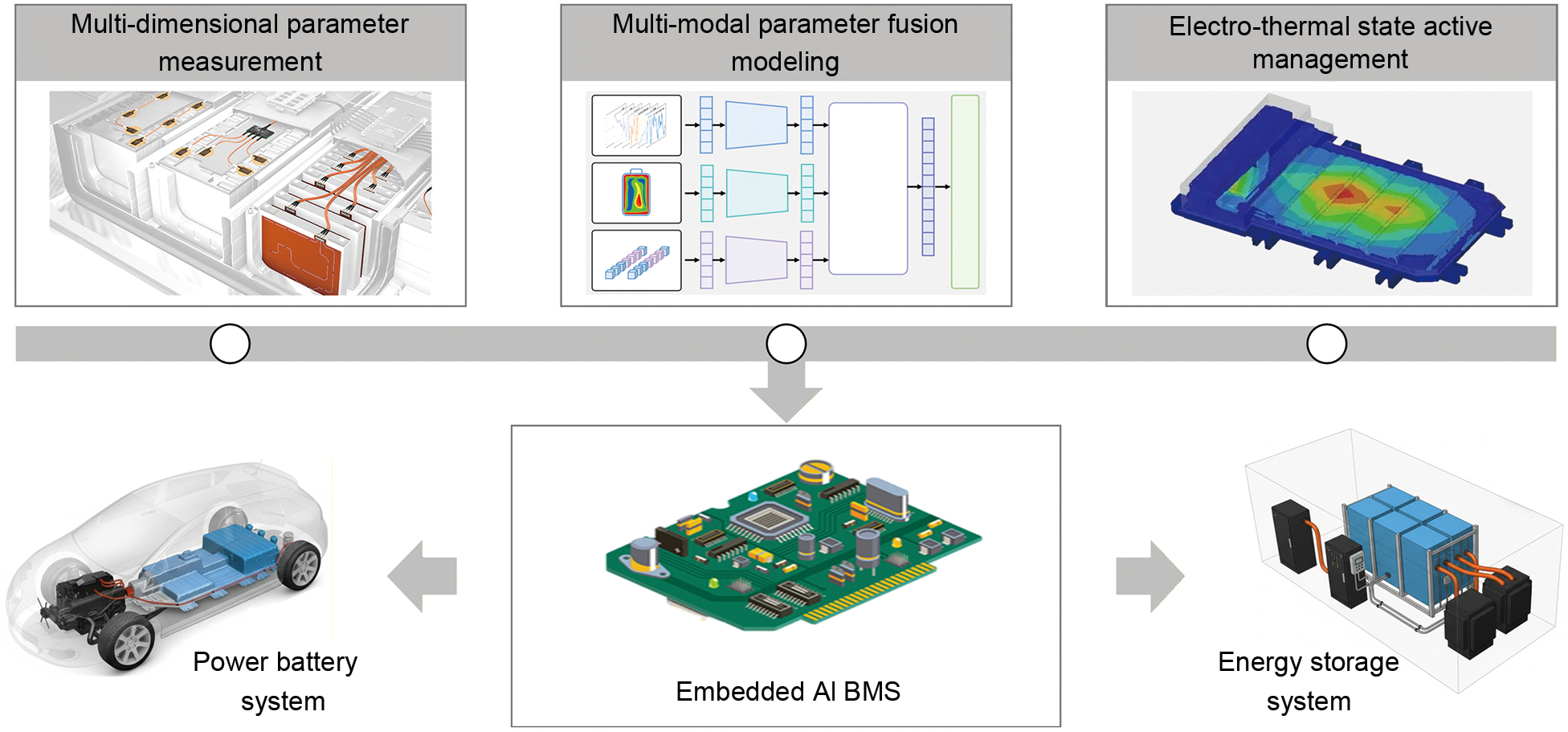
To address future BMS development trends and address the shortcomings of current review papers, this paper argues that multi-dimensional parameter measurement, multi-modal information fusion, active electrothermal management, and edge-based autonomous intelligence are key elements for realizing a new-generation BMS technology framework, as illustrated in Figure 1. This technological upgrade is an inevitable outcome driven by both external demands and internal technological advancements, and it represents the ultimate goal of BMS evolution. Only through such an upgrade can the organic integration of measurement, modeling, and algorithms be effectively achieved, thereby supporting next-generation battery management characterized by high safety and long service life. The systematic innovations and contributions of this paper are as follows:
The paper systematically discusses the technical implications and latest advancements in BMS regarding multi-dimensional parameter measurement, multi-modal parameter fusion modeling, electro-thermal active management, and edge-embedded intelligence. It organizes these technologies based on the overall requirements of BMS and proposes a future development path for BMS.
It introduces the concept of AI BMS, which closely integrates existing AI technologies and breaks away from conventional BMS paradigms, effectively enhancing the BMS's capabilities in lifetime and safety management, and proposes implementation schemes for AI BMS in both power and energy storage battery scenarios.
The remainder of this paper is organized as follows: Section 2 introduces multi-dimensional parameter measurement. Section 3 covers multi-modal parameter fusion modeling. Section 4 discusses research progress in active electro-thermal management. Section 5 introduces edge-embedded AI BMS. Section 6 elaborates on application and deployment scenarios in power or energy storage systems. And Section 7 provides a summary and outlook.
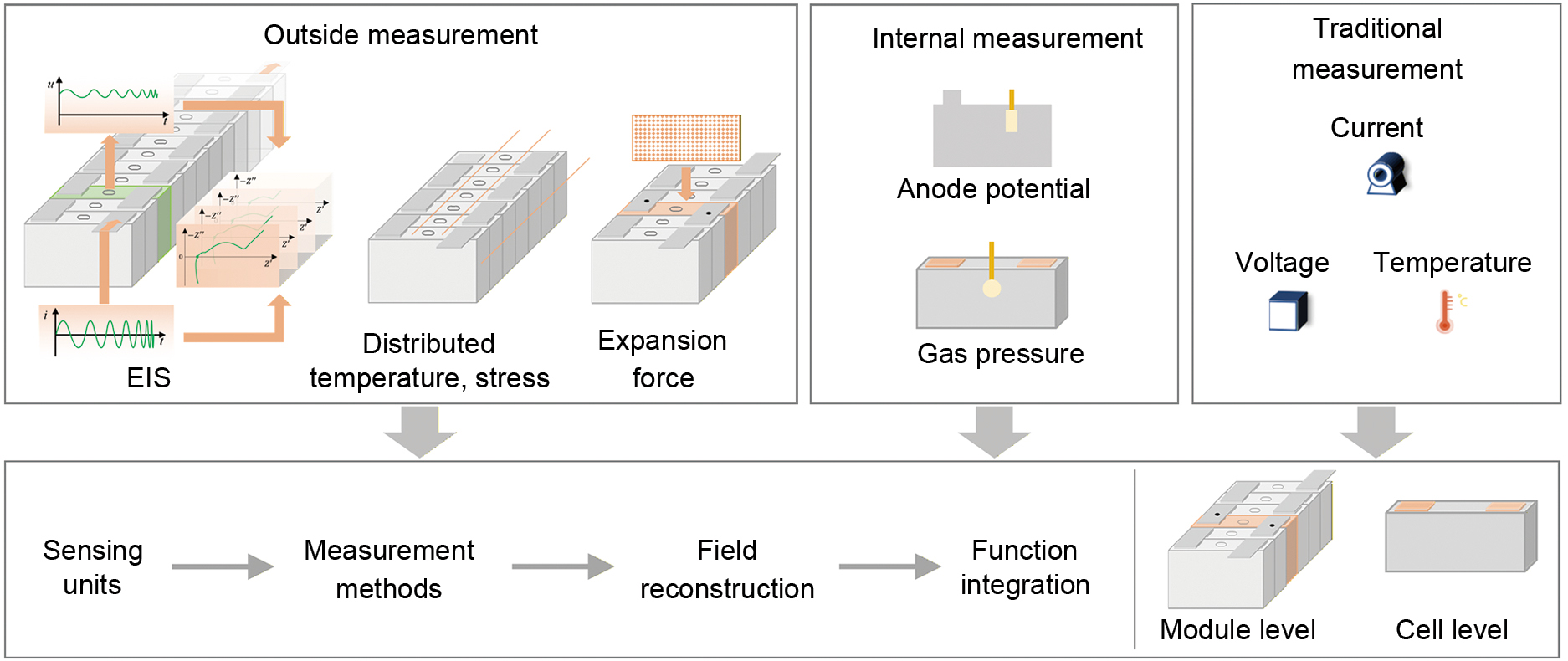
Traditional BMSs rely solely on measurements of voltage, current, and temperature. They cannot fully capture the evolution of a battery's internal electrochemical and physical characteristics, nor can they accurately reflect the battery's response under external operating conditions. This often leads to issues such as estimation errors and missed fault detection. Therefore, as shown in Figure 2, the measurement of multi-dimensional parameters provides the data foundation for BMS to achieve accurate state estimation, fault diagnosis, and early warning, and is widely recognized as the key support for next-generation BMS to break through the limitations of traditional technology. New parameters are multi-dimensional, including impedance, distributed temperature, strain, expansion force, anode potential, and gas pressure. The measurement of these multi-dimensional parameters can be performed either inside or outside the battery cell. Currently, there are numerous research reports on both types of measurement, with significant differences in technical difficulty and application maturity.
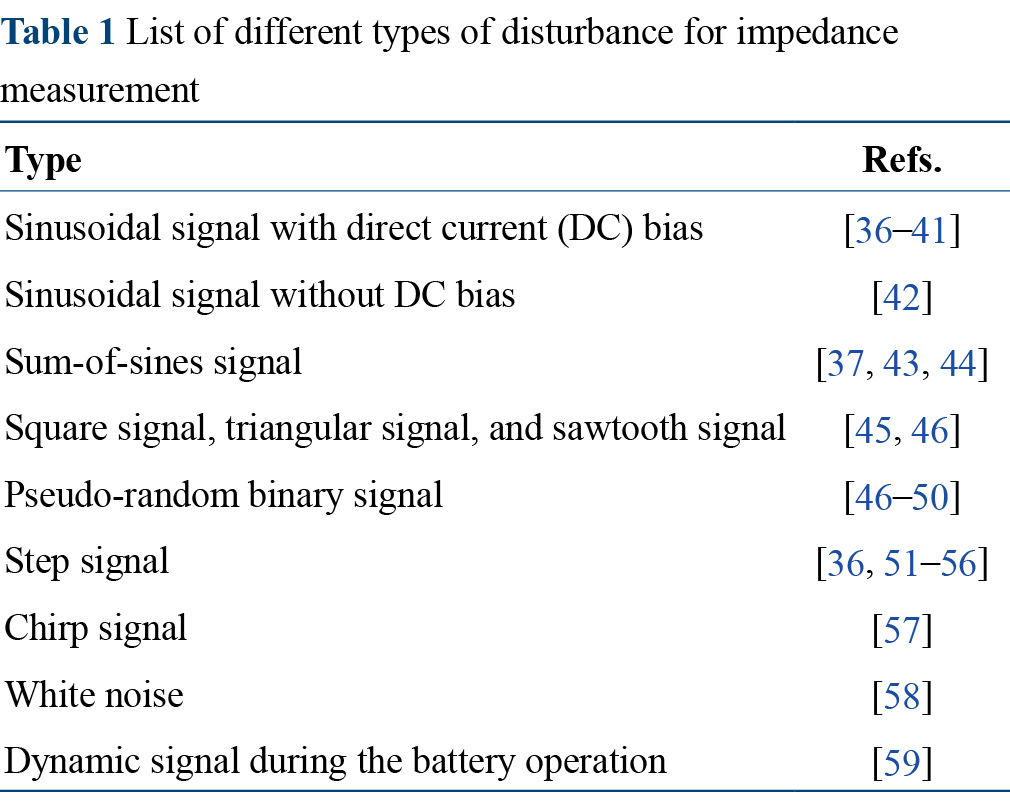
By measuring electrochemical impedance at different frequencies to construct an electrochemical impedance spectrum (EIS), it is possible to accurately capture internal characteristics such as the evolution of the electrode-electrolyte interface, charge transfer processes, lithium-ion conduction, and diffusion [35]. From the perspective of the evolution of measurement methods, the focus has shifted from traditional offline laboratory measurement to onboard real-time online measurement, giving rise to two major technical routes: active and passive measurement. Active measurement determines impedance by actively applying excitation signals, whereas passive measurement calculates impedance based on actual charge and discharge currents. In terms of active measurement, many kinds of signals are used as the disturbance to measure the impedance, which are listed in Table 1. These signals can be divided into two categories depending on whether they contain harmonics of multiple frequencies. A signal containing a single frequency, i.e., a sinusoidal signal [36–42], can easily guarantee the signal-to-noise ratio (SNR) of the response signal at the specific frequency. However, it may take a long time to measure the battery impedance in a wide frequency range, especially for the measurement of the impedance in the low-frequency range. To quickly measure and calculate the impedance, signals containing the harmonics of multiple frequencies can be used as the disturbance [37, 43, 44]. Compared to the single-frequency disturbance, the magnitude spectra of most signals are not optimized [45–59]. The magnitude of the harmonic is always inversely proportional to its order, causing a low SNR at high frequencies [36, 37]. It is seen that the kind of disturbance to choose is a compromise between the accuracy and the speed of the impedance measurement.
| Type | Refs. |
|---|---|
| Sinusoidal signal with direct current (DC) bias | [36–41] |
| Sinusoidal signal without DC bias | [42] |
| Sum-of-sines signal | [37, 43, 44] |
| Square signal, triangular signal, and sawtooth signal | [45, 46] |
| Pseudo-random binary signal | [46–50] |
| Step signal | [36, 51–56] |
| Chirp signal | [57] |
| White noise | [58] |
| Dynamic signal during the battery operation | [59] |
Another key component in an EIS measurement system is the excitation source. Excitation sources can be categorized into two types: centralized excitation and distributed excitation. Huang et al. and Qahouq et al. [36, 60, 61] designed a direct current–direct current (DC–DC) converter based on the Buck-Boost topology to control the discharge current of a 2.6 Ah 18650-type battery cell, as shown in Figure 3A. A sinusoidal disturbance with a frequency of 100 Hz to 10 kHz was superimposed on the DC discharge current. Koch et al. [38] designed and verified an impedance measurement system based on a half-bridge DC–DC converter, as shown in Figure 3B. Dam et al. [39] designed a high-power battery impedance measurement system, as shown in Figure 3C, which could superimpose the small disturbance of 0.1 to 100 Hz during charging or discharging. Nguyen et al. [40] designed a charger as shown in Figure 3D to measure the impedance from 0.1 Hz to 1 kHz when the battery was charged. Lee et al. [41] designed a battery impedance measurement system based on a phase-shifted full-bridge converter, as shown in Figure 3E. It superimposed a small disturbance of 0.1–100 Hz on the charging current to measure the impedance. Wei et al. [42] and Wang et al. [62] used the dual-active-bridge converter and the existing battery signal detection units in BMS to realize the impedance measurement of the series-connected battery cells, as shown in Figure 3F.
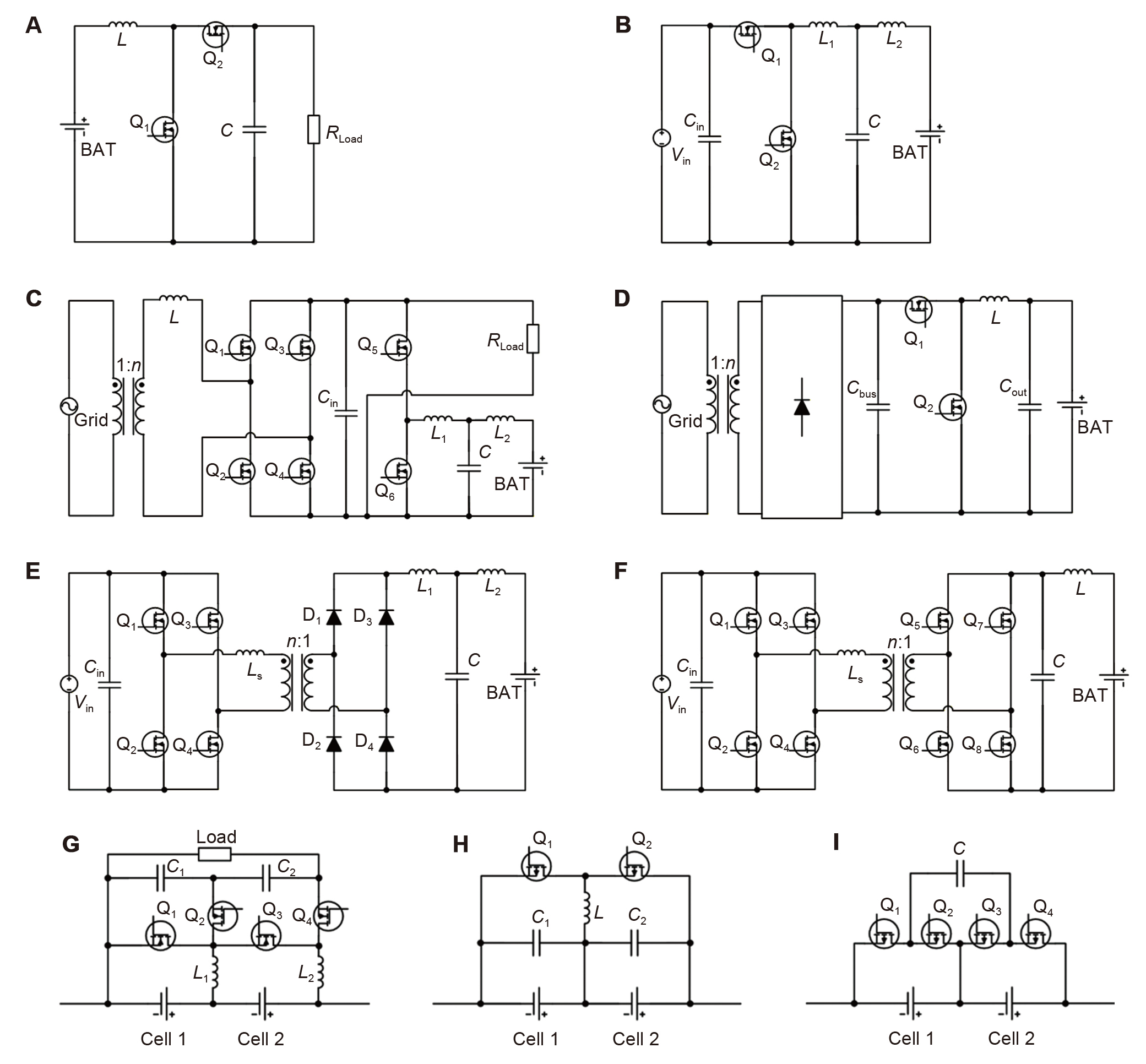
In addition to designing the high-power centralized disturbing devices to measure the impedance, the distributed disturbing devices are also widely studied [63]. Qahouq et al. [36] proposed the use of the distributed DC–DC converters to measure the impedance of the series-connected batteries in Figure 3G. Din et al. [64] proposed a disturbance generation device based on the switching inductor balancing circuit to implement the impedance measurement, as shown in Figure 3H. Varnosfaderani et al. [65] realized the impedance measurement based on the switching capacitor balancing circuit in Figure 3I. There are also other EIS measurement methods based on balancing resistors [66].
Besides, some single-chip solutions are also reported. Chip-based solutions can further promote the integration and application of EIS measurement technology in practical systems. NXP Semiconductors provided a single-board solution to achieve impedance measurements on each battery cell [67]. Panasonic designed a system based on an application-specific integrated circuit (ASIC) and acquired the battery impedance from 0.1 Hz to 5 kHz [68]. EIS measurement can be a standard feature of power batteries, and related chip solutions are evolving toward higher integration and lower power consumption.
Temperature is a core parameter that affects the charging and discharging efficiency, cycle life, and safety performance of battery systems. Accurate, rapid, and comprehensive temperature measurement is essential for ensuring efficient system operation and providing safety alerts. Current temperature measurement technologies are also showing new trends in terms of measurement coverage and sensor types.
Negative temperature coefficient (NTC) thermistors, the most commonly used type, are widely adopted in most battery systems due to their low cost, fast response time, and moderate accuracy. When measuring temperature externally, sensors are primarily placed at critical locations such as the cell surface, terminals, modules, and cooling plates. This approach faces challenges related to internal and external thermal conditions, resulting in measured temperatures that do not accurately reflect the battery's actual temperature, particularly during fast charging or thermal runaway caused by internal short circuits [69]. Sensor solutions with single-point or sparse arrangements struggle to detect local hotspots within the battery system, resulting in significant delays in thermal runaway warnings. To address this issue, one approach involves optimizing the placement of temperature sensors to achieve more accurate and reliable measurements; in some cases, sensors can even be embedded within the battery itself, which is currently a hot research topic [70–72]. Additionally, novel fiber optic sensors can be employed to resolve the problem of insufficient temperature monitoring coverage. Krause et al. [73] highlighted the advantages of fiber optic sensors (FOS), including their minimal footprint and integration flexibility within battery modules, compared to traditional thermal monitoring methods and their placement. Wang et al. [74] developed a non-destructive technique, a commercial miniature measurement device involving optical sensors, in which the optical sensor is implanted inside the battery with an integrated functional electrode design, as shown in Figure 4A.
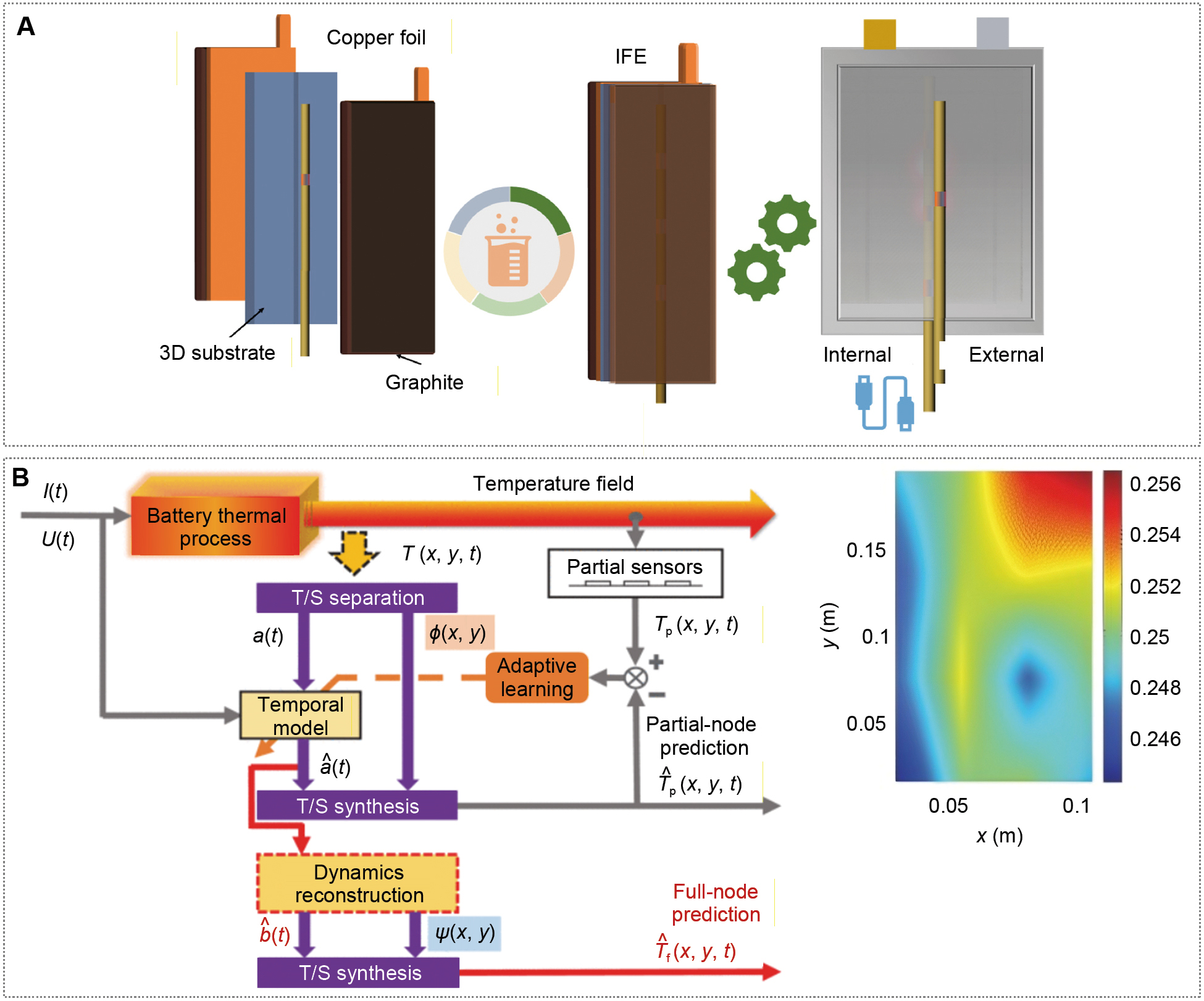
In addition to directly deploying more sensors, some studies have employed methods to reconstruct the temperature field to achieve a more dense temperature estimate. Zhao et al. [75] utilized distributed fiber-optic sensors deployed inside and outside a cylindrical battery and combined them with a distributed thermal model to accurately predict electrothermal behavior. Zhang et al. [76] established a temperature response spatiotemporal correlation model for the battery, in which the transient temperature field inside the battery is directly reconstructed according to the surface temperature of the battery. Tian et al. [77] utilized a distributed Kalman filter method to reconstruct the three-dimensional temperature field of a lithium-ion battery pack. Zhou et al. [78] adopted a data-driven approach, extracting empirical spatial basis functions to achieve real-time prediction of the temperature field in a pouch battery under minimal sensor conditions, as shown in Figure 4B. Additionally, Chen et al. [79] proposed a method based on mapping feature vectors and correlation matrices to directly reconstruct the internal transient temperature field online using only a few temperature measurement points on the battery surface. Zhang et al. [80] utilized deep learning methods, such as sparse stochastic sensor-masked autoencoders, to further reduce the required number of sensors to just two, enabling the reconstruction of a complete pixel-level temperature field.
In summary, temperature measurement technology for power batteries is undergoing a critical evolution from single-point, passive, surface monitoring to comprehensive, active, and internal sensing. The core development goals focus on higher measurement accuracy, faster response times, more comprehensive spatial coverage, and smarter safety warning capabilities.
Expansion force reflects the coupled evolution of electrochemical and physical processes with mechanical behavior within the battery. Its variation is closely related to lithium-ion insertion/extraction, phase transitions in electrode materials, solid electrolyte interface (SEI) film growth, and lithium dendrite deposition, and holds significant application potential in BMS.
Measuring expansion force using thin-film sensors is one of the most common methods, including piezoresistive, capacitive, piezoelectric, and triboelectric types. These sensors utilize flexible thin-film substrates, such as polyimide and polyvinyl chloride, with pressure-sensitive elements coated onto the film surface. They can conform to the curved surfaces of batteries and are relatively easy to integrate into pouch, cylindrical, and prismatic batteries [81, 82], as shown in Figure 5A. Common thin-film pressure sensors include piezoresistive types [83], capacitive types [84], piezoelectric/triboelectric types, and triboelectric types [85]. The development of the pressure-sensitive elements themselves is also a hot research focus. Cheng et al. [86] developed a flexible multi-parameter sensor (FMS) by integrating thermo-, pressure-, and magneto-sensitive films on a flexible printed circuit (FPC), implanting it into lithium batteries for in-situ monitoring of internal temperature, pressure, and current with high accuracy. The FMS only caused slight declines in the battery's capacity retention by 2.06% and coulombic efficiency by 0.62% after 300 charge–discharge cycles, and effectively detected battery safety risks like thermal runaway and short circuits. After 300 cycles, the FMS maintained high linearity for all sensing parameters with minor sensitivity reduction, proving its reliability for full life cycle battery safety monitoring. Sun et al. [87] developed a flexible pressure sensor with a novel composite design integrating carbon nanotube materials with a sponge-microhemisphere structure, and employed a backpropagation neural network to correct for temperature-induced drift. Dang et al. [88] designed an implantable integrated sensor capable of real-time monitoring of the temperature and pressure inside the 6 Ah LIB. It is composed of a PT1000 temperature-sensitive alloy and a polydimethylsiloxane/carbon nanotubes piezoresistive composite. Peng et al. [89] designed a lithium-ion battery pressure/temperature monitoring micro thin-film sensor based on a flexible printed circuit anode current collector. It is formed by using a piezoelectric/pyroelectric poly (vinylidene fluoride-trifluoroethylene) material. Drift issues in these sensors remain particularly prominent during long-term use. Another trend is the integrated measurement of pressure and temperature. Challenges regarding the battery's long-term sealing and the sensor's long-term operational stability need to be addressed [90].
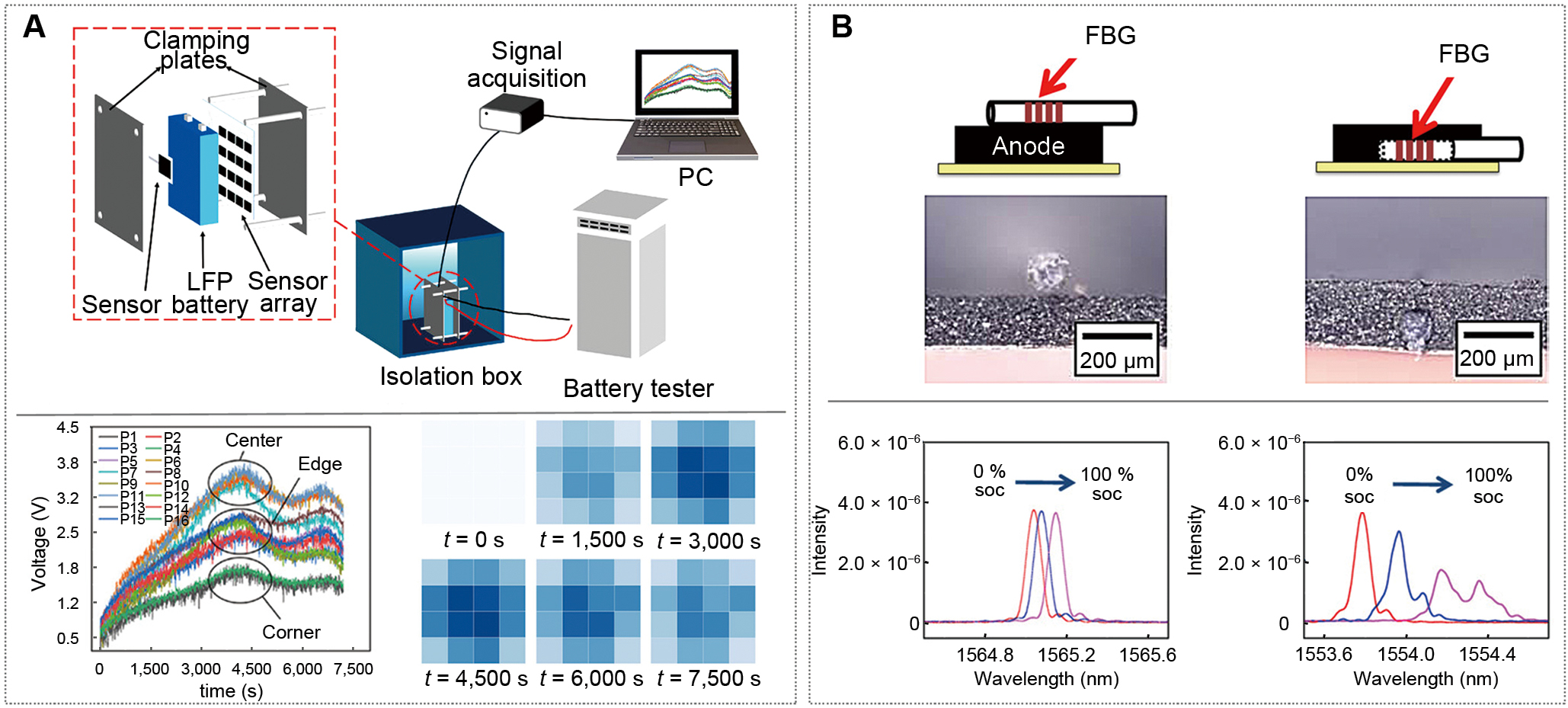
The expansion force of batteries can also be measured using load-sensing devices; this technique is generally employed under laboratory conditions to obtain accurate experimental data or reliable experimental patterns [91]. However, load-sensing devices are relatively bulky, limiting their application in highly integrated systems. The pioneering work by Bae et al. [92] involved embedding fiber Bragg grating (FBG) sensors directly inside the soft-pack cells of lithium-ion batteries and attaching them to individual electrodes, thereby enabling in-situ monitoring of electrode strain evolution, as shown in Figure 5B. This research demonstrated the feasibility and practicality of FBG sensors as diagnostic tools for the development of new battery materials and structures. Fortier et al. [93] further explored schemes for integrating FBG sensors into coin cells. This study provided practical guidelines for the safe integration of FBG sensors into sealed batteries. The physical quantities directly measured by fiber optic sensors are strain and temperature, rather than force itself. It is necessary to combine mechanical parameters such as the elastic modulus of the electrode material with the structural constraints of the battery, and use mechanical modeling to convert strain into expansion force.
In summary, using thin-film sensors and FBG optical fiber sensors to measure expansion force are two promising approaches. Thin-film sensors need to address the issue of parameter drift over time and with temperature, while optical fiber sensors are not yet capable of directly measuring force.
Obtaining the true potential of the anode is beneficial for monitoring lithium plating risks, developing fast-charging strategies, and diagnosing capacity decay. In addition to model-based estimation methods, the reference electrode implantation method has attracted widespread attention in anode potential measurement.
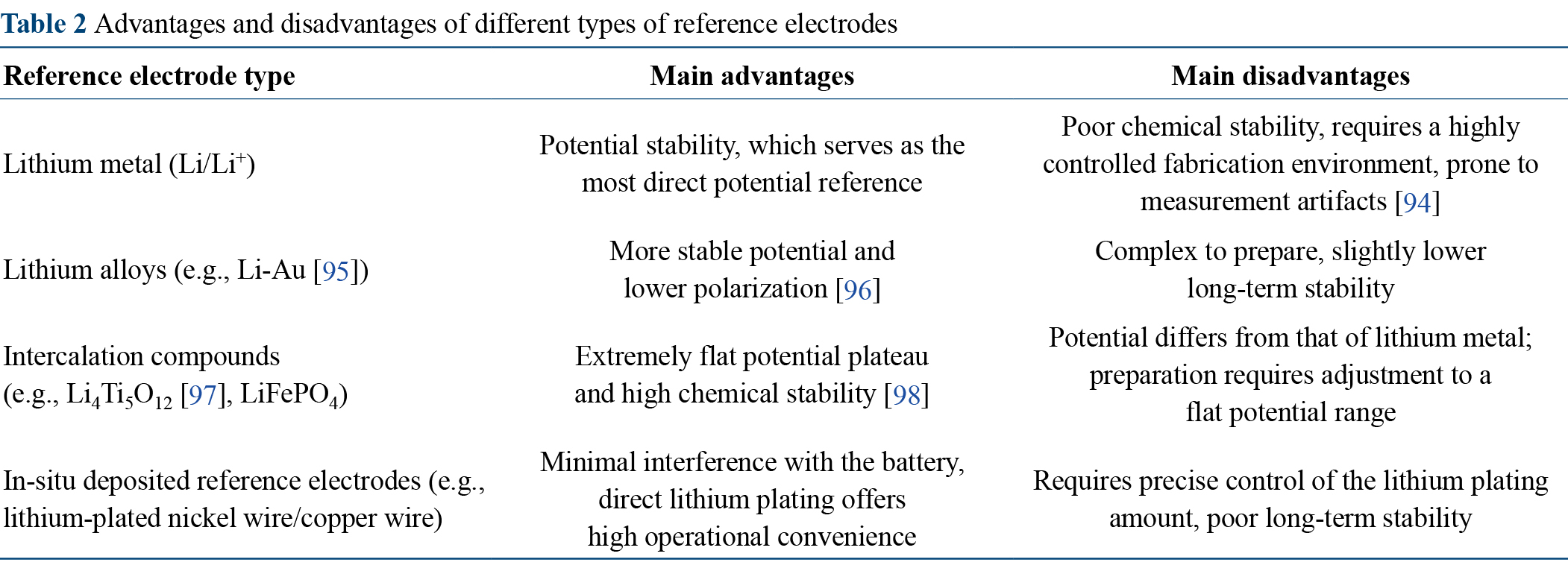
Currently, commonly used reference electrodes include lithium metal [94], lithium alloys [95, 96], Li4Ti5O12 reference electrodes [97, 98], Ag/AgCl reference electrodes, and other reference electrodes. The ease of preparation, accuracy of potential measurement, and long-term stability vary among these different reference electrode systems, as shown in Table 2.
| Reference electrode type | Main advantages | Main disadvantages |
|---|---|---|
| Lithium metal (Li/Li+) | Potential stability, which serves as the most direct potential reference | Poor chemical stability, requires a highly controlled fabrication environment, prone to measurement artifacts [94] |
| Lithium alloys (e.g., Li-Au [95]) | More stable potential and lower polarization [96] | Complex to prepare, slightly lower long-term stability |
| Intercalation compounds (e.g., Li4Ti5O12 [97], LiFePO4) | Extremely flat potential plateau and high chemical stability [98] | Potential differs from that of lithium metal; preparation requires adjustment to a flat potential range |
| In-situ deposited reference electrodes (e.g., lithium-plated nickel wire/copper wire) | Minimal interference with the battery, direct lithium plating offers high operational convenience | Requires precise control of the lithium plating amount, poor long-term stability |
The blocking effect is a significant issue in the application of reference electrodes [99]. Systematic studies by Li et al. [100, 101] indicate that the blocking effect causes a local increase in the liquid-phase potential at the reference electrode location, leading to a deviation of the measured anode potential from the true value. This may ultimately lead to the erroneous conclusion that the anode potential has not fallen below zero and therefore lithium plating has not occurred, while post-experimental verification shows that lithium plating actually did occur. Ender et al. [102] systematically compared the impedance responses of point-shaped and mesh-shaped reference electrodes using finite element modeling, revealing the significant impact of reference electrode geometry on the accuracy of half-cell impedance spectra. The size and placement of the reference electrode have a decisive influence on the magnitude of the error: a larger reference electrode and a shorter distance to the working electrode intensify the blocking effect [97].
The placement of the reference electrode exerts a considerable influence on measurement outcomes. In pouch cells, commonly adopted measurement locations include the interlayer region of the electrode stack, where a porous active reference layer is coated on the separator [103], as well as positions along the side edges of the electrode sheets, and opposite the anode overhang region [104, 105]. Moreover, a multi‑reference‑electrode array layout can be employed to characterize the spatial heterogeneity of anode potential distribution [106]. For the interlayer configuration, the distance between the reference electrode and the anode sheet must be controlled to avoid blocking ion channels, while configurations along the side edge and in the overhang region are prone to potential deviation. In prismatic and cylindrical batteries, measurement locations are primarily concentrated within the electrode assembly, on the inner surface of the casing, and at the center of the core, requiring a balance between sealing performance and ion transport stability. Additionally, in-situ deposited reference electrodes often adopt a membrane-integrated layout, where the reference electrode material is directly deposited onto the membrane surface, eliminating the need for additional implantation space and minimizing interference with the battery structure. This has become an important research direction for optimizing measurement locations in recent years [107]. The reference electrode implantation process can easily compromise battery sealing, and long-term stability is significantly affected by electrolyte corrosion and temperature fluctuations. Therefore, sealing protection and temperature calibration are required. Furthermore, the optimization of measurement locations still necessitates the use of methods such as finite element simulation to further balance measurement accuracy with battery electrochemical performance.
It is evident that anode potential measurement based on the reference electrode method currently faces challenges such as measurement artifacts and operational stability. Moreover, in large‑scale cells, an issue arises where the implantation location may not accurately reflect the true anode potential. Future research should focus on reference electrode materials, structures, and implantation locations.
Internal gas pressure measurement in power batteries is a key technology for assessing battery health and safety performance [108]. Current research advances include both contact and non-contact measurement methods.
In contact gas pressure measurement, channels must be created in the battery casing to allow pressure sensors to be directly connected to the interior of the battery for measurement. Thin-film piezoresistive and optical fiber sensing are the current mainstream technological approaches. Thin-film piezoresistive sensors, such as the Infineon SP40 series, utilize micro-electro-mechanical systems (MEMS) processes to fabricate pressure-sensitive films. They generate electrical signals based on resistance changes caused by gas pressure, offering the advantages of miniaturization and temperature compensation. These sensors can be integrated near the battery's top vent valve to directly monitor the pressure in the top gas chamber. Hemmerling et al. [109] were the first to systematically measure the relationship between internal gas pressure and internal temperature and SOC in cylindrical lithium-ion batteries. García et al. [110] further developed methods for measuring internal pressure in cylindrical batteries by inserting a pressure sensor into the cavity at the center of the core to record pressure evolution under abuse conditions.
Fiber-optic-based gas pressure monitoring is primarily represented by the Fabry-Pérot interferometer, which measures gas pressure by detecting shifts in the interference spectrum of light [111]. This approach enables simultaneous measurement of both temperature and gas pressure using a single fiber and can effectively monitor gas pressure changes under thermal runaway conditions. Tan et al. [112] developed a fiber-optic sensor based on the Fabry-Pérot interference principle for in-situ monitoring of internal gas pressure in lithium-ion batteries; this compact sensor is capable of real-time tracking of gas pressure changes during thermal runaway events triggered by overheating. Zeng et al. [113] further applied a membrane-type FBG sensor to in-situ internal gas pressure monitoring during lithium-ion battery cycling and overcharging up to thermal runaway.
In non-contact pressure measurement, the approach primarily relies on the equivalent mechanical properties between the battery's internal core or laminate and the casing, estimating internal pressure based on the degree of deformation of the battery casing [114]. The distributed measurement study using thin-film sensors by Liu et al. [115] directly addresses the theoretical expectation of non-uniformity in the gas-generating space. The work by Mier et al. [116] systematically demonstrates this methodology: by measuring the casing strain and temperature of 18650-type cylindrical batteries during thermal abuse, internal pressure is calculated using the relationship between hoop and axial stresses. Lei et al. [117] also developed an external pressure measurement procedure, using an airtight cylinder within the calorimeter chamber to measure changes in external pressure. This method assumes that the casing remains within the elastic deformation range and that material properties are known. During thermal runaway, casing temperatures may exceed the material's yield point, rendering the elasticity assumption invalid. Furthermore, casing strain is the result of the superposition of internal gas pressure and the expansion forces of the core and electrodes; decoupling these requires additional model assumptions or independent measurements.
In terms of sensor integration, there are two approaches: embedded integration and external integration. The embedded sensors directly contact the internal gas environment of the battery, offering high signal fidelity [118], but there remain issues regarding the long-term compatibility of the sensors with the internal battery environment [119]. For external integration, applications face challenges such as signal transmission distortion caused by the complex internal structure of the battery [120], significant errors in internal pressure estimation using simple mechanical models [121], and the coupled effects of temperature and mechanical pressure. Despite continuous technological advancements, gas pressure measurement still faces challenges in achieving non-destructive sensor integration into the battery and reliable signal transmission, addressing long-term stability issues such as electrolyte corrosion and high-temperature aging, and decoupling multi-parameter coupled signals.
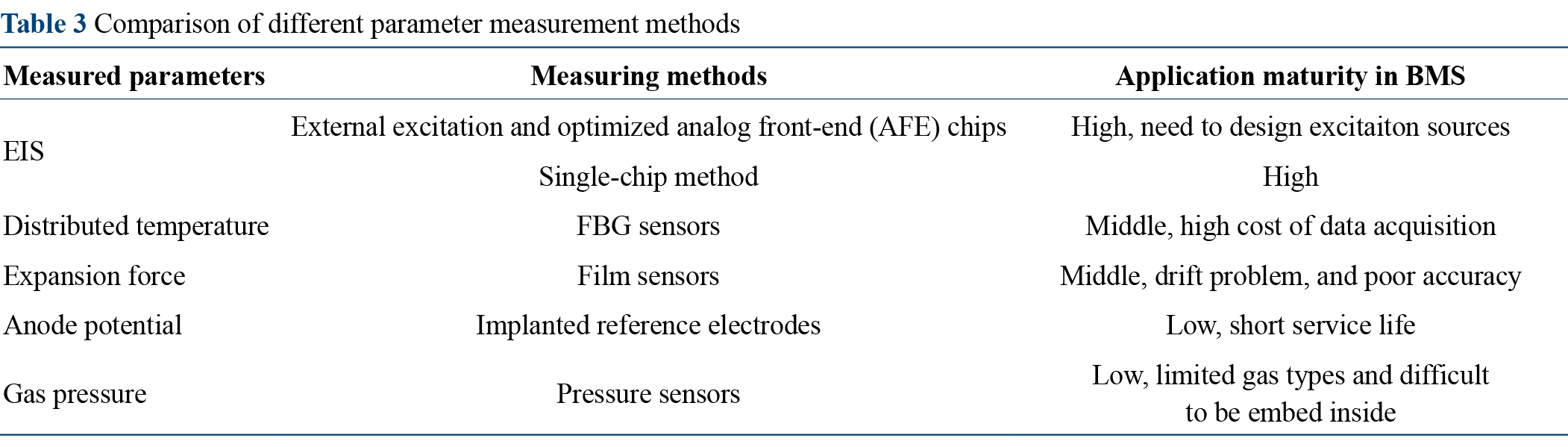
A summary of the different parameter measurement methods is shown in Table 3. The technological maturity of these sensors varies, especially for sensors such as reference electrodes implanted inside batteries, which face significant challenges in terms of durability. Cost is also a very important factor; however, thanks to the emergence of integrated chips and modules, there is considerable potential for improving system integration and reducing costs. Overall, internal battery sensor and measurement remains a frontier research direction and still requires further advances in compatibility, whereas external multi-parameter measurement can be readily implemented to expand the available information dimensions, forming the fundamental basis of next-generation BMS.
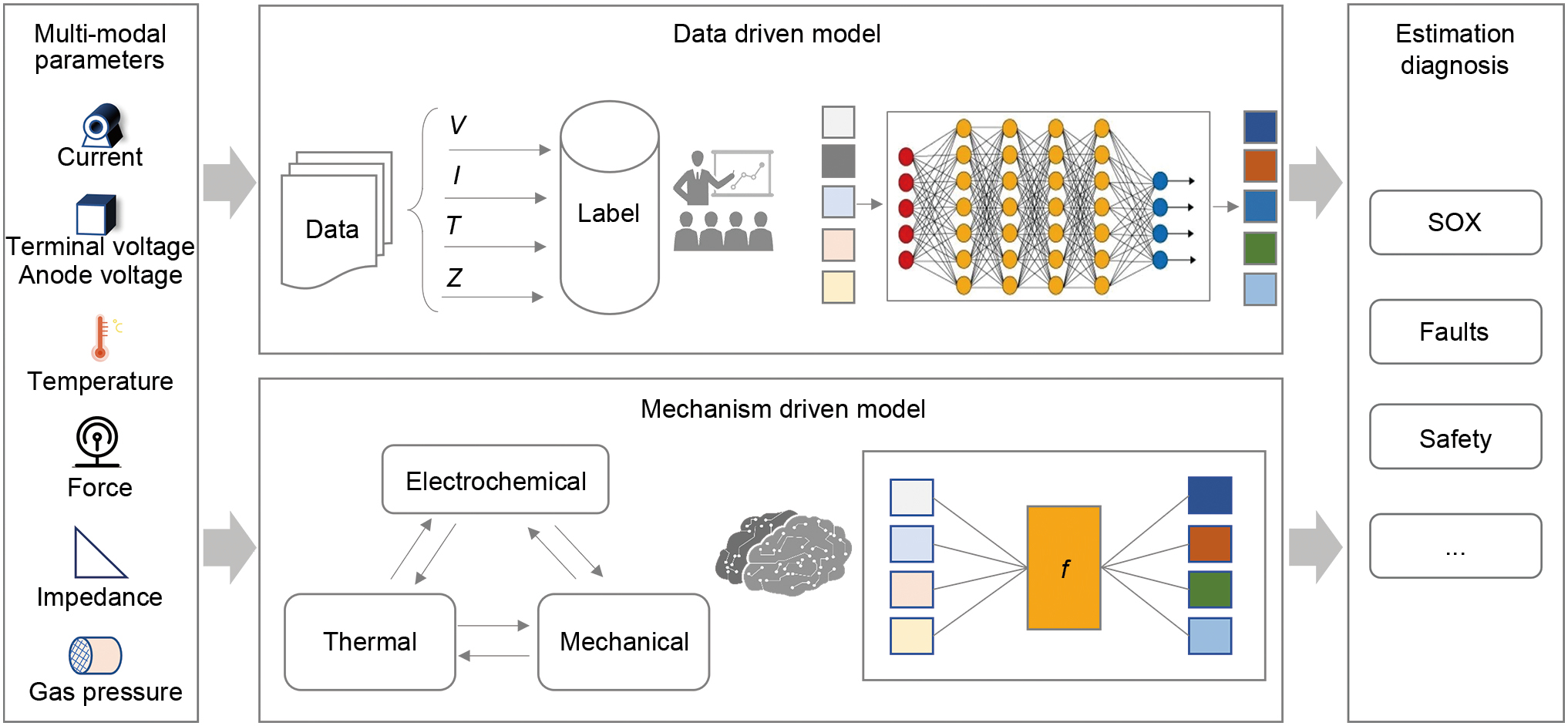
Both battery cells and modules generate a vast amount of physical data, which is closely related to the battery's internal state and potential faults. To enable battery state estimation, fault diagnosis, and thermal runaway early warning based on the measured internal and external multi-dimensional parameters, multi-modal fusion modeling techniques are required. As shown in Figure 6, the purpose of modeling is not merely to establish relationships between multiple parameters, but to correlate different parameters with the battery's internal state, faults, and safety risks, thereby supporting battery management for long service life and high safety performance. Multi-modal fusion modeling serves as the decision-making core and central brain of next-generation BMS.
SOC is one of the most critical state variables in BMS, defined as the ratio of the battery's remaining capacity to its rated capacity [122]. Due to the complex electrochemical reactions within the battery and its high sensitivity to external operating conditions such as temperature and load, SOC cannot be measured directly [123]. It must be estimated indirectly using measurable signals such as voltage, current, and temperature in combination with advanced algorithms [124]. Over the past decade, three major categories of estimation methods have gradually emerged to address this issue: model-driven, data-driven, and hybrid approaches [125–127].
In model-driven approaches, the ECM is widely used due to its simple structure and high computational efficiency [126]. To improve modeling accuracy, fractional-order ECMs can be introduced to more accurately characterize diffusion processes. When combined with observers such as adaptive untraceable Kalman filters, this approach can achieve fast convergence and high-precision estimates under highly dynamic conditions [128]. Furthermore, methods such as adaptive extended Kalman filtering and dual Kalman filtering effectively mitigate errors caused by model mismatch and noise uncertainty by updating the noise covariance and model parameters online [129, 130].
Data-driven methods bypass complex physical modeling processes by treating battery state estimation as a regression or prediction problem [125]. By extracting features strongly correlated with SOC or SOH from massive amounts of historical operational data, such as voltage, current, and temperature curves, these methods directly utilize machine learning or deep learning algorithms to construct an end-to-end mapping model from input features to target states [124–126]. The key advantages of this type of method lie in its strong nonlinear fitting capability and adaptability to complex dynamic operating conditions; however, its performance depends heavily on the quality and quantity of the training data, and the model's black-box nature leads to poor physical interpretability [131].
Meanwhile, Physical Information Neural Networks (PINNs) enhance data efficiency and generalization by embedding electrochemical equations into the neural network training process, thereby maintaining good extrapolation capabilities even under sparse data conditions [127, 132], marking a new phase of hybrid methods that deeply integrate physical models with data intelligence [133].
In recent years, with the application of lithium iron phosphate batteries and silicon–carbon anode batteries, SOC estimation has also faced some key challenges. These two types of batteries have special SOC–OCV (open circuit voltage) curves, and the SOC–OCV curves of batteries with silicon–carbon anodes undergo significant changes with aging, posing challenges for conventional SOC estimation methods.
SOH is a critical metric for assessing battery aging, typically defined as the ratio of the current maximum available capacity to the initial rated capacity [134], or evaluated based on the increase in internal resistance [135, 136]. Accurate SOH estimation is crucial for remaining useful life (RUL) prediction, system performance evaluation, and planning for secondary use [135, 137, 138]. Since the aging process is slow and irreversible, modeling and estimating SOH is more challenging than SOC estimation.
At the methodological level, health feature engineering serves as the key foundation for SOH estimation, mapping unobservable internal aging mechanisms to externally measurable health indicators to provide effective inputs for machine learning models [139, 140]. Regarding data-driven methods, models such as support vector regression (SVR) and Gaussian process pegression (GPR) are widely applied [141], with a gradual shift toward Long Short-Term Memory (LSTM) and transfer learning approaches that integrate calendar aging and cycle aging data [142]. Meanwhile, the strong coupling between SOC and SOH has given rise to joint estimation frameworks, such as the dual Kalman filter architecture, which enables the simultaneous tracking of fast-changing and slow-changing states [130]. In recent years, the introduction of technologies such as physical information, machine learning and digital twins has also provided new research avenues for improving the generalization capability and reliability of SOH estimation [133, 143].
SOP of a lithium-ion battery corresponds to the safe power usage limits. Conventional methods can be implemented using offline-established map diagrams relating SOP to temperature, SOC, and SOH. Numerous estimation methods have also been reported in the literature, widely employing ECM or electrochemical models to integrate real-time SOC as well as resistance/impedance models, coupled with voltage and current limits for SOP estimation. Model-based observers, such as dual extended Kalman filters and moving horizon estimation, dominate in achieving high accuracy [144]. Methods like model predictive control (MPC) have also been used for SOP estimation, which can consider future power demands and optimize battery charge/discharge strategies [145]. SOP estimation faces challenges such as parameter uncertainties caused by temperature and aging, as well as the trade-off between computational efficiency and estimation accuracy. To overcome these challenges, emerging techniques, including hybrid modeling, online parameter adaptation, and physics-informed neural networks, are being explored to enhance the robustness and generalization capability of SOP estimation [146, 147].
Unlike SOP, which focuses on instantaneous power output, SOE emphasizes the total energy that a battery can provide, which is decisive for predicting range or energy storage system runtime. Current SOE estimation methods are mainly divided into three categories: model-based methods, data-driven methods, and hybrid methods. Model-based methods rely on OCV models and equivalent circuit models, combined with Kalman filtering and its variants, to achieve online SOE estimation. The forgetting factor recursive least squares (FFRLS)-unscented Kalman filter (UKF) joint algorithm proposed by Lai et al. [148] can still control the SOE estimation error within 3% under low-temperature conditions of −10℃. An et al. [149] combined a thermo-electric coupling model with Markov chain prediction to improve estimation accuracy under dynamic operating conditions. Data-driven methods have developed rapidly in recent years, mainly employing techniques such as LSTM neural networks, Deep Neural Networks (DNN), and SVR. The Convolutional Neural Network–Gated Recurrent Unit–Adaptive Savitzky Golay Filter (CNN–GRU–ASG) hybrid network proposed by Chen et al. [150] achieves joint high-precision estimation of SOC and SOE. Hybrid methods combine the advantages of model-driven and data-driven approaches. For example, Zhou et al. [151] coupled an Elman neural network [152] with a model-based method, achieving an estimation error within 3% while enhancing algorithm robustness. Current research trends focus on adaptability to wide temperature ranges, coupled estimation with aging state, and optimization of computational efficiency to meet the demands of practical system applications.
Battery cell failures are the primary cause of system safety incidents and reduced service life. Traditional BMS passive protection is achieved by setting voltage, current, and temperature thresholds, whereas current fault diagnosis is evolving toward a proactive prognostics and health management paradigm. The core objective is to achieve early and precise identification of minute internal abnormalities in the battery, thereby providing sufficient warning time and enabling intervention before potential faults escalate into irreversible safety incidents. Internal short circuits (ISCs), lithium plating, and cell mismatch are the most common and potentially hazardous failure types in lithium-ion batteries during cycling. Fault diagnosis through multi-modal information fusion in the time domain, frequency domain, or across different dimensions has become a research hotspot in recent years. Traditional signals such as voltage, current, and temperature, as well as novel indicators like impedance, pressure, and deformation, have attracted increasing attention, thereby enriching the connotation of multi-modal fusion modeling.
ISC is among the most direct and dangerous faults that can trigger thermal runaway. They are typically caused by lithium dendrite growth, separator failure, or manufacturing defects. Micro-internal short circuits (MSC) represent the early stage of ISC, typically manifesting as high-resistance short circuits; their signals are extremely weak, posing a core challenge for early warning [153].
ISC leads to abnormal SOC depletion rates in the faulty cell. By calculating the cumulative correlation coefficient between estimated SOC values of individual cells, cells exhibiting abnormal behavior can be effectively identified. Similarly, MSC is diagnosed by utilizing the voltage drop, additional energy consumption, and abnormal SOC depletion it causes as direct indicators of the fault. Zhu et al. [154] identified ISC by monitoring deviations in the voltage of a faulty cell relative to the average voltage of the battery pack to reflect SOC discrepancies, as shown in Figure 7A. Vieira et al. [155] and Ghosh et al. [156] utilized state estimation algorithms, such as machine learning, to monitor SOC in real time and diagnose ISC based on changes in SOC discrepancies. Qiao et al. [157, 158] utilized plateaus or specific decay patterns during the voltage relaxation process after charge termination to diagnose ISC. Severe ISCs can also cause changes in battery temperature. For example, Ghosh et al. [156] employed a three-dimensional thermal model to locate faulty batteries by monitoring the additional heat generation caused by ISCs. In recent years, with the application of impedance techniques, researchers such as Kong et al. [159] and Cui et al. [160] utilized battery impedance characteristics at specific frequencies to reflect ISC phenomena and employed deep learning methods for ISC fault diagnosis.
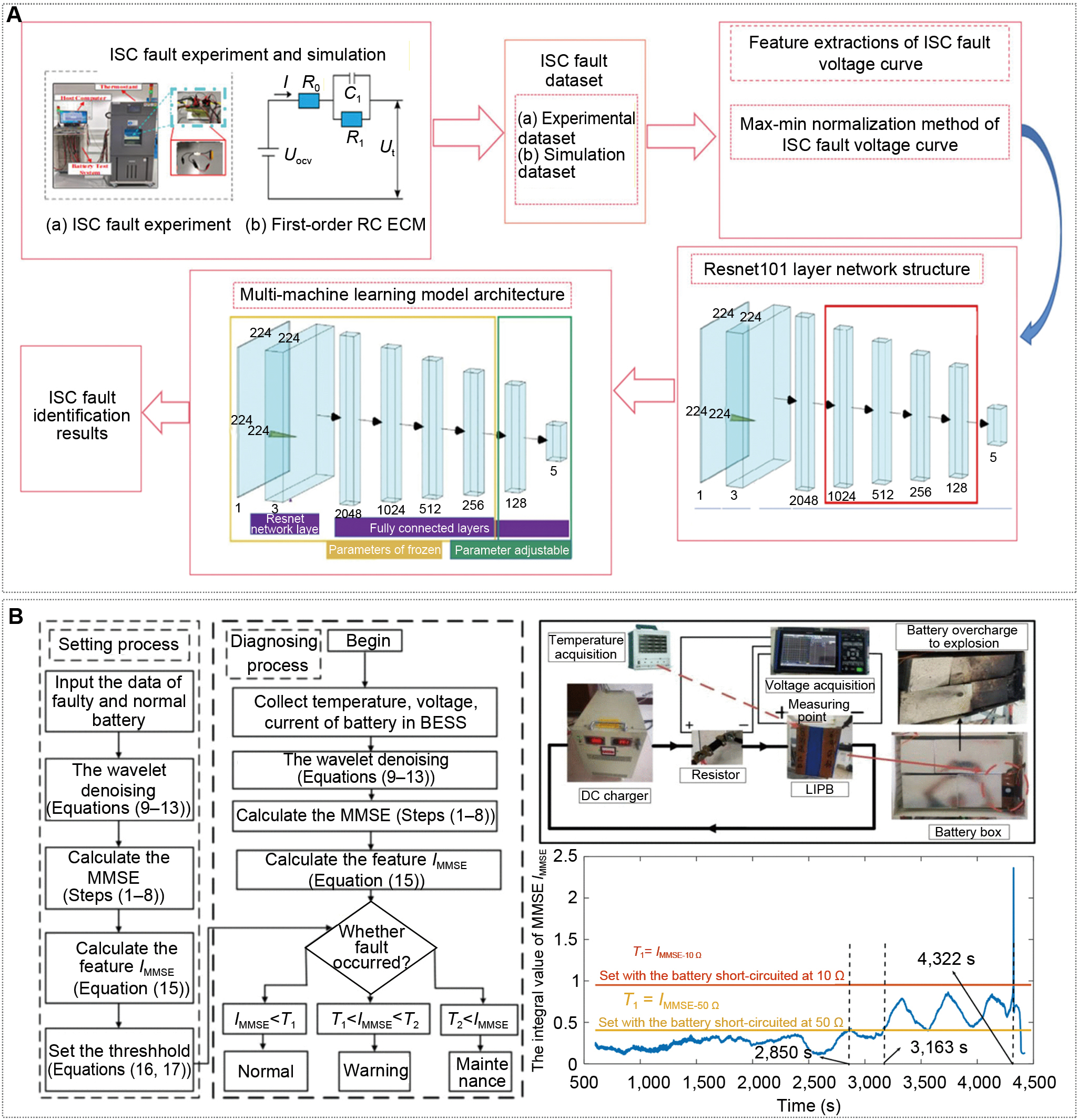
While these methods theoretically facilitate battery ISC diagnosis, most current studies simulate internal short circuits using external resistors. In reality, internal short circuits often exhibit subtle characteristics, such as "soft short circuits." To address this issue, Li et al. [161] developed an early-stage ISC fault diagnosis method based on multivariate multiscale sample entropy, utilizing battery voltage, current, and temperature to extract fault features for early ISC diagnosis, as shown in Figure 7B. Mao et al. [162] proposed a method based on extreme sample entropy to quantitatively evaluate ISC resistance, enabling the diagnosis of minor short-circuit faults in automotive LIBs. Qiu et al. [163] developed a multi-level Shannon entropy algorithm that can effectively detect subtle changes in gradual faults, including ISCs, by comparing cells within a module.
The subtle nature of internal short-circuit diagnosis and the lack of distinct features pose challenges for accurate diagnosis. Current diagnostic methods are primarily effective under strictly controlled laboratory conditions and when short-circuit currents are relatively high. For complex scenarios in actual vehicles or energy storage systems, it is necessary to integrate multi-source information and eliminate the influence of battery electrothermal states on diagnostic features to achieve a more precise diagnosis.
Lithium plating is driven by both thermodynamics and kinetics. When the rate at which lithium ions are inserted into graphite cannot meet the demand of the external charging current, the local potential of the anode is forced below the Li/Li+ potential, thereby triggering the lithium plating reaction [164]. The essence of lithium plating is an imbalance between the supply and consumption of lithium ions. Low temperature, high-rate charging, and high SOC are the three key factors that induce this imbalance [165]. The deposition of metallic lithium leads to irreversible capacity loss, while dendrite growth can easily cause ISCs, posing a serious threat to battery safety. Accurate lithium plating diagnosis is one of the core technologies for future BMS.
Since the battery interior cannot be directly observed, researchers developed a series of non-destructive diagnostic techniques based on external electrical signals such as voltage and current. Abbas et al. [164] characterized lithium plating by analyzing the voltage relaxation plateau (VRP) after charging to capture the hump generated by the voltage plateau during standstill, which corresponds to the stripping of lithium ions from the anode surface. Yunusoglu et al. [166] used the differential voltage analysis (DVA) method to capture characteristic peaks of lithium plating in the discharge initiation phase in the high state-of-charge region and found that the peak area is proportional to the amount of reversible lithium plating. The methods mentioned above are typically suitable for diagnosing lithium plating after fast charging. However, an online diagnostic method for lithium plating is highly necessary. Generally, an anode potential below 0 V vs. Li/Li+ is the direct cause of lithium plating [167]. Based on this, Matadi et al. [168], Waldmann et al. [169], and Wang et al. [107] introduced a lithium reference electrode to measure the anode potential for diagnosing whether lithium plating has occurred. Although the reference electrode serves as an important research tool, its implementation in vehicles poses significant challenges due to considerations of technological maturity, cost, and high reliability. Therefore, some non-destructive diagnostic methods have been proposed. The decrease in the real part of impedance in the high-frequency region or the contraction/deformation of the semicircle in the mid-frequency region of EIS provides rich information on the interfacial kinetics induced by lithium plating. Li et al. [170], Ishigaki et al. [171], and Wang et al. [172] revealed the dynamic impedance variation patterns during high-rate charging. Building on this foundation, impedance-based online diagnostic methods for lithium plating during constant-current or variable-current charging have been proposed [173], as shown in Figure 8A. Additionally, in works such as those by Shen et al. [174] and Chen et al. [175], the phenomenon of increased swelling is used to characterize lithium plating during charging and irreversible lithium plating during long-term cycling, as shown in Figure 8B.
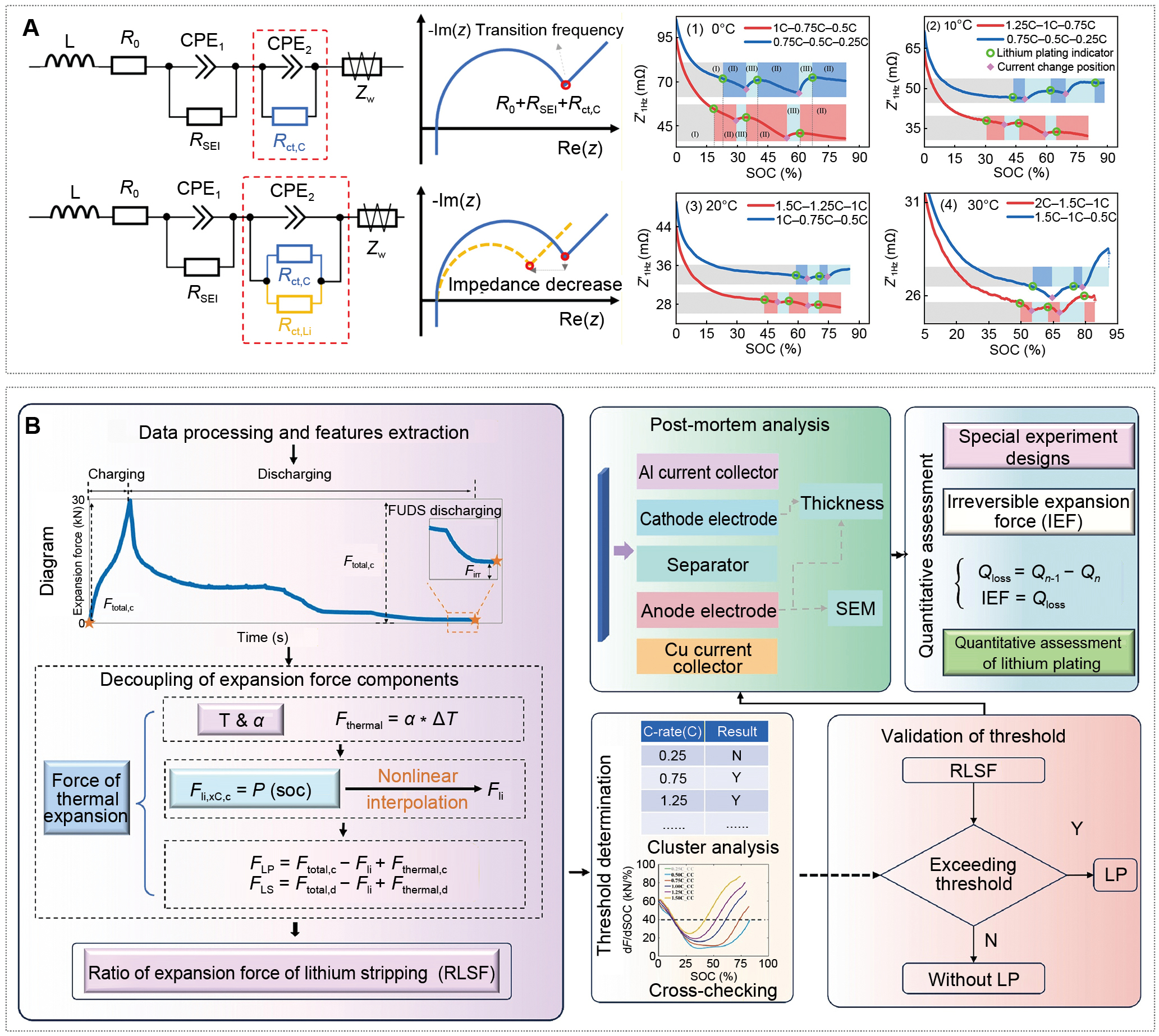
Diagnosis relying solely on signal analysis often faces limitations in terms of sensitivity and robustness. Integrating lithium plating mechanisms with data-driven models is a key trend in developing high-precision, interpretable early-warning frameworks. Li et al. [176] established a model of electro-thermo-mechanical coupling behavior during lithium plating of batteries and analyzed the changes in various parameters during the process. Lin et al. [177] reviewed the lithium plating mechanism from the perspectives of electrochemistry, thermodynamics, and kinetics, and systematically proposed a diagnostic framework that integrates mechanism and data, emphasizing that data compensates for errors in mechanism modeling while the mechanism constrains the physical plausibility of data models. Based on a Pseudo-Two-Dimensional (P2D) electrochemical model, Ren et al. [178] introduced the kinetics of lithium plating and delithiation side reactions to establish a quantitative relationship between lithium plating capacity and polarization voltage. You et al. [179] generated a large amount of lithium plating simulation data using a P2D model, adapted the model to experimental data via transfer learning, and achieved quantitative detection of irreversible lithium plating throughout the full life cycle, with a simulation accuracy rate exceeding 99%. Wei et al. [180] constructed a reduced-order electrochemical–thermal model in the cloud to monitor the microstructure of LIBs, and conducted hardware-in-the-loop testing and experiments using actual LIBs, demonstrating that the proposed method can effectively mitigate lithium plating issues.
Overall, the use of dynamic impedance and expansion force for lithium plating diagnosis is promising; however, the impact of variables such as rate and temperature during charging on the diagnosis algorithm must be addressed. Furthermore, quantitative non-destructive diagnosis of lithium battery plating remains an unsolved problem.
Battery pack inconsistency is not a static defect, but a positive-feedback process that dynamically deteriorates over the battery's full life cycle and continuously amplifies the risk of individual cell failure. The core task of inconsistency diagnosis is to accurately identify and quantify this evolutionary trend from collective behavior [181]. Utilizing real-time BMS data to rapidly and accurately identify abnormal cells with significantly deviating performance parameters or behavioral patterns within the battery pack is the first step toward implementing precise balancing and preventing failures.
The technical approaches are primarily divided into outlier detection based on statistical features and pattern recognition based on curve similarity. Ma et al. [182] treated battery packs as statistical samples and employed reconstruction-based parallel principal component analysis (PCA)–kernel principal component analysis (KPCA) to estimate fault waveforms for online fault monitoring. Wu et al. [183] proposed a temporal clustering algorithm that uses adaptive clustering to identify faulty batteries while effectively improving the speed of fault diagnosis. Wu et al. [184] also used clustering analysis algorithms to automatically cluster the voltage curves of all cells, identifying cells that do not belong to any major cluster or fall in sparse regions as abnormal. Elkhafif et al. [185] calculated the local density deviation for each data point, effectively identifying cells exhibiting abnormal behavior within a local range.
After achieving precise detection of early inconsistencies, it is necessary to go beyond real-time monitoring to quantify the root causes of inconsistencies, such as the dispersion of capacity and internal resistance, and predict their evolution trends throughout the full life cycle, thereby providing a basis for decision-making in predictive health management of battery packs. Song et al. [186] obtained key health parameters such as capacity, internal resistance, and self-discharge rate for each cell within the battery pack, then calculated their standard deviation, range, or coefficient of variation as quantitative indicators of inconsistency. Xie et al. [187] proposed an incremental capacity analysis and differential voltage analysis (ICA, DVA) method to reflect internal battery phenomena such as loss of lithium inventory (LLI) and loss of active materials (LAM) through shifts and changes in the height of characteristic peaks on the curve, thereby quantifying the causes of inconsistency at a mechanistic level. Ma et al. [182] used ECM combined with state estimation algorithms to identify the internal parameters of each cell in real time, thereby dynamically quantifying and interpreting internal battery inconsistency. Yao et al. [188] mapped different frequency band features of EIS to various causes of inconsistency to achieve inconsistency diagnosis. Data-driven inconsistency monitoring can also reflect trends in internal battery mechanisms to some extent. Yang et al. [189] built time-series models such as LSTM to predict future capacity decay trajectories or parameter dispersion in battery packs. Zhang et al. [190] used GNNs to learn the mutual interactions between cells, thereby more accurately predicting the evolution of system-wide inconsistencies and end-of-life behavior.
Thermal runaway is the most severe safety accident in lithium-ion batteries, and its occurrence is a complex multistage process. Different stages release different characteristic signals, and external characteristics such as temperature, voltage, impedance, gas, and mechanical responses change accordingly. These time-varying external features form a so-called "early warning chain" in the time series. Building a thermal runaway early warning model for batteries is therefore essentially about establishing a mapping between thermal runaway and multiple external characteristics, and developing timely and effective warning methods.
Thermal parameters, such as surface temperature and temperature gradient, and electrical parameters, such as voltage, internal resistance, and impedance spectra, are among the earliest signal types used for thermal runaway early warning [191]. As mentioned above, current battery systems have only a small number of temperature sensors, and their placement is often suboptimal. Therefore, relying solely on surface temperature sensors for thermal runaway early warning is insufficient. It is of great significance to estimate internal battery temperatures or reconstruct the evolution of the battery temperature field with higher density to achieve thermal runaway early warning. In battery temperature estimation, impedance features, including magnitude, phase angle, real part, imaginary part, and characteristic frequency, can all be utilized for temperature estimation [192]. However, impedance is easily influenced by the coupled effects of other factors such as current, standstill time, SOC, and SOH. Research on decoupling these characteristics to achieve more reliable and accurate temperature estimation under actual operating conditions is a current research focus, as demonstrated in the studies by Wang et al. [193], Liu et al. [194], and Ouyang et al. [195]. The estimated battery temperature can be directly used to provide early warnings of thermal runaway. Hu et al. [196] utilized impedance for over-temperature warnings during the thermal runaway process. Pérez et al. [197] proposed an impedance-based thermal runaway early detection methodology for Lithium-ion batteries, as shown in Figure 9A.
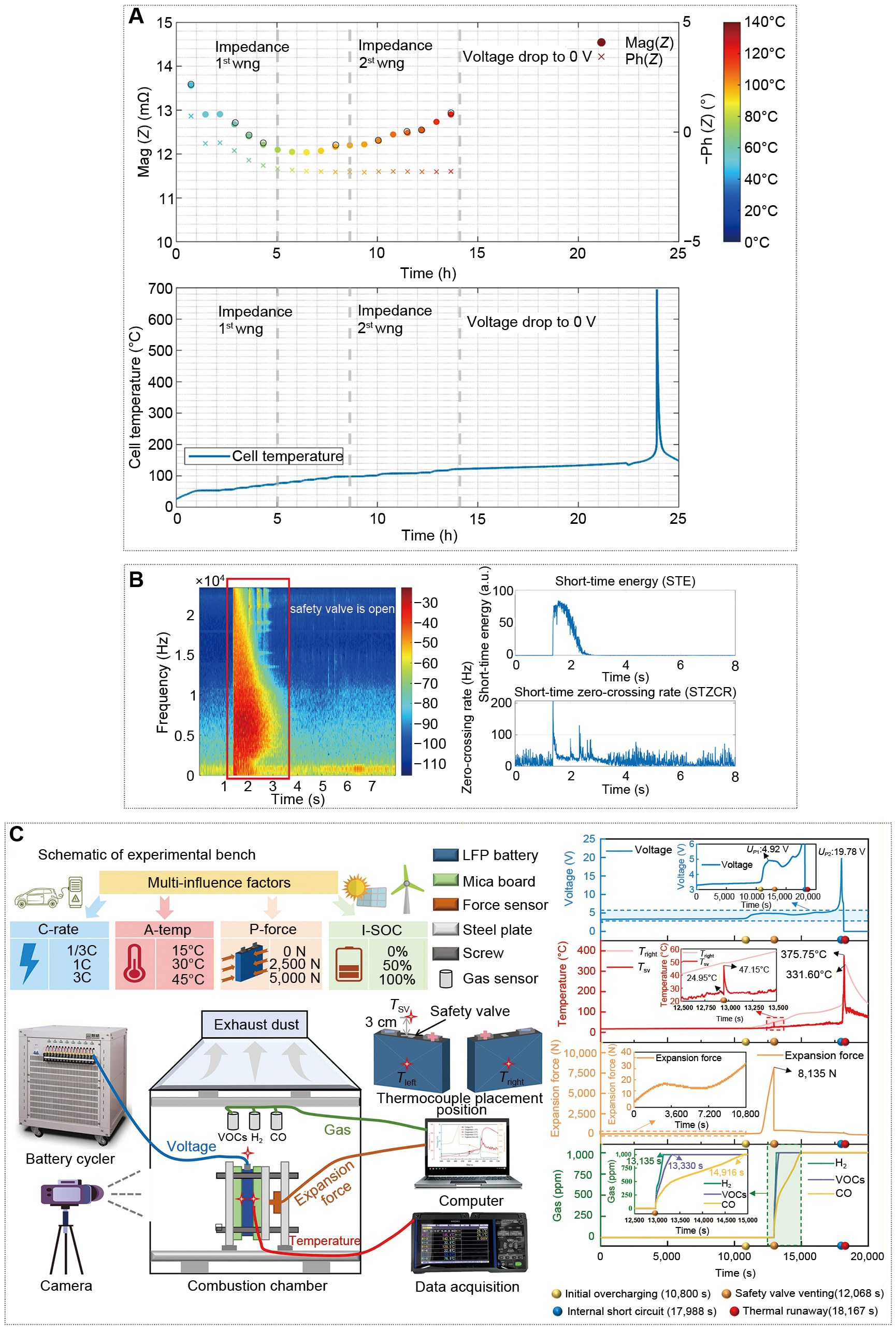
Gas, acoustic, and mechanical signals represent an early-warning route that complements electrical and thermal signals. Chemical reactions inside batteries, such as electrolyte decomposition and oxygen release from the cathode, generate gas, leading to battery swelling and a rise in internal pressure. Meanwhile, acoustic signals, for example, changes in ultrasonic propagation characteristics, can reflect variations in the internal structural state of batteries [198]. Zhao et al. [199] and Wang et al. [200] used acoustic signals to identify whether venting occurs during battery thermal runaway, as shown in Figure 9B. As shown in Figure 9C, Chen et al. [201] and Jin et al. [202] used typical force signals for thermal runaway early warning, achieving earlier detection than temperature or voltage-based methods.
Using multi-modal signals to characterize thermal runaway behavior requires addressing the issue of multi-modal parameter fusion modeling, thereby integrating more signals to achieve more accurate and reliable thermal runaway early warning. Furthermore, batteries exhibit varying thermal safety tolerance at different aging stages [203], necessitating the establishment of warning thresholds for each stage to construct a tiered warning mechanism. Additionally, thermal runaway warning models can be integrated with battery thermal management systems; when abnormal temperature rises are detected, the system automatically triggers the cooling system to enhance heat dissipation, thereby halting the progression of thermal runaway at its source and achieving more proactive closed-loop thermal safety management.
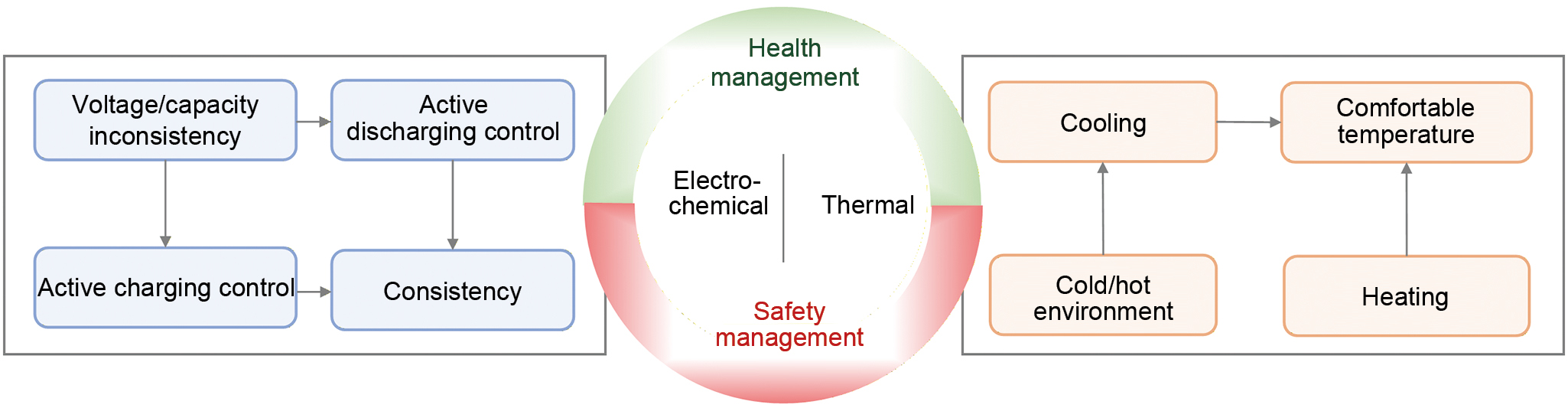
Once the battery's internal state is accurately determined and its key behavioral evolution can be predicted, active regulation of the electro-thermal state can be performed with the goals of high safety and long lifetime. This active regulation mechanism will be the most critical feature distinguishing it from traditional BMS. Basic concept of active electro-thermal state management is shown in Figure 10.
Unreasonable settings for charging/discharging current, SOC operating range, cut-off voltages, and temperature can exacerbate failure mechanisms such as electrode phase transitions, lithium dendrite formation, and irreversible growth of the SEI film, thereby accelerating capacity degradation and safety deterioration [204]. Actively adjusting the aforementioned key parameters to adapt to battery states and operating conditions, thereby establishing refined control strategies, constitutes a core technological pathway for mitigating battery life degradation and preventing safety deterioration.
Active adjustment of charge and discharge currents is the foundation for delaying life degradation, with the core approach being the dynamic optimization of current rates based on battery SOH, temperature, and SOC to prevent irreversible damage caused by high-rate charging and discharging. During a single charging cycle, the charging current can be adjusted in real-time based on SOC and temperature to prevent side reactions [205, 206]. Meanwhile, closed-loop control based on an electrochemical model can be implemented to regulate parameters such as the negative electrode potential inside the battery to avoid lithium plating [207]. However, electrochemical models suffer from high computational complexity, insufficient state estimation accuracy due to multiphysics coupling, and limited generalization capability of strategies under different operating conditions. Future development will focus on lightweight models, digital twin integration, and cloud-edge collaborative optimization.
Over the course of long-term cycling, the charging current can be adjusted according to battery lifetime to delay or modify the path of lifetime degradation. For example, Zhu et al. [208] dynamically adjusted the charge and discharge currents according to the battery capacity fade threshold. When the battery capacity declined to 80% of its initial value, the charging current was reduced from 1C to 0.6C, and the discharging current from 1.2C to 0.8C. This strategy effectively mitigated cathode structural collapse and lithium dendrite growth on the anode, thereby extending the cycle life of the battery by 16.7% to 38.1%.
Active optimization of the SOC operating range avoids the extremely high-SOC and low-SOC regions, thereby reducing irreversible damage to electrode materials. Wikner et al. [209] conducted cycling tests on 26 Ah commercial pouch lithium-ion batteries over a period of 28 months. The results showed that, compared with operation over the full SOC range of 0% to 100%, the use of an optimized SOC window of 20% to 80% could extend cycle life by more than threefold. In addition, high SOC levels above 80%, when combined with high-rate charge and discharge, aggravated LLI and the degradation of cathode active materials, which were identified as the main causes of lifetime loss. Moreover, by exploiting the inconsistency in degradation rates at different SOC levels, the operating window of the battery can also be adjusted to achieve more balanced lifetime degradation [181].
Toward the end of charge, structural instability can occur in cathode materials such as layered oxides, including ternary materials [210]. Toward the end of discharge, appropriately raising the lower cut-off voltage (LCV) also helps improve lifetime [211]. Active adjustment of charge and discharge cut-off voltages is a key method for precisely controlling electrode reaction boundaries and delaying lifetime degradation. Navidi et al. [212] dynamically adjusted the charge cut-off voltage based on coulombic efficiency. When the battery coulombic efficiency dropped below 99.5%, the charge cut-off voltage was gradually reduced by 0.02 to 0.05 V, which effectively suppressed lithium deposition and extended the battery cycle life to 11.5 times that under a 3C constant-current constant-voltage charging mode. Wang et al. [211] increased the LCV from 2.8 to 3.0 V, resulting in a 3.32% improvement in the lifetime of ternary batteries after 500 cycles.
Active thermal management is another core technology for delaying battery degradation and ensuring long-term stable operation. By actively regulating the battery's thermal environment, it mitigates electrochemical failures caused by high- and low-temperature, working in concert with charge-discharge parameter control to optimize battery lifetime throughout its full life cycle. Currently, research on active thermal management has established two major technical frameworks: advanced heat dissipation at high temperatures and efficient heating at low temperatures. Related studies focus on improving control efficiency and reducing energy consumption while adapting to actual battery operating conditions, resulting in diversified technical approaches and mature research outcomes.
Under high-temperature conditions, advanced thermal management methods focus on rapidly dissipating heat generated by batteries and maintaining temperature uniformity. Overcoming the limitations of traditional air cooling and conventional liquid cooling, refrigerant cooling and immersion cooling have emerged as hot research topics in recent years. Alma'asfa et al. [213] systematically evaluated various high-temperature cooling technologies and demonstrated that immersive refrigerant cooling can control battery temperature fluctuations within ±2℃. Compared to traditional liquid cooling, this approach improves cooling efficiency and effectively suppresses local hotspots during high-rate charging and discharging, thereby reducing SEI film rupture and electrode material degradation. Piggott et al. [214] proposed an efficient heat-dissipating battery design incorporating an integrated in-plane heat transfer structure. By optimizing the battery geometry and reducing interfacial thermal resistance, the heat dissipation rate was enhanced by a factor of 20 compared with that of conventional designs, thereby meeting the high-temperature heat dissipation requirements of ultra-high-rate charge and discharge applications above 8C.
Under low-temperature conditions, efficient heating methods are primarily aimed at rapidly raising the battery temperature to a suitable range from 20℃ to 30℃ while reducing heating energy consumption and lifetime degradation. Internal self-heating and electromagnetic induction heating have become the main research directions. Cai et al. [215] proposed a bidirectional pulsed-current self-heating strategy without an external power supply. By optimizing the pulse parameters and circuit design, a temperature rise rate of 6.38℃ per minute was achieved at an ambient temperature of minus 15℃, with a heating efficiency of 31.9%. In addition, after 30 consecutive heating cycles, the battery capacity faded by only 0.23%, effectively balancing heating rate and battery health. Huang et al. [216] proposed a combined strategy of alternating-current (AC) battery heating and fast charging to avoid lithium plating. Wang et al. [217] developed a novel electromagnetic induction heating system that utilizes an alternating magnetic field generated by copper coils to achieve uniform heating inside the battery, capable of heating the battery from –20℃ to 0℃ at a temperature rise rate of 9.1℃ min−1. This type of internal battery heating method requires an excitation device capable of generating appropriate frequency and amplitude; typically, low-frequency heating yields better results [218], but the difficulty and cost of implementing the required excitation system must also be considered.
As shown in Figure 11A, integrating AC heating with a motor drive system enables internal heating by generating charge and discharge currents through energy exchange [219, 220]. Another approach involves modifying wireless charging systems, as illustrated in Figure 11B, to heat the battery using high-frequency alternating current [221]. Furthermore, reconfigurable battery systems can also achieve self-heating through integrated switch arrays, as shown in Figure 11C, and utilize high-frequency AC heating currents to further mitigate damage to the battery [222].
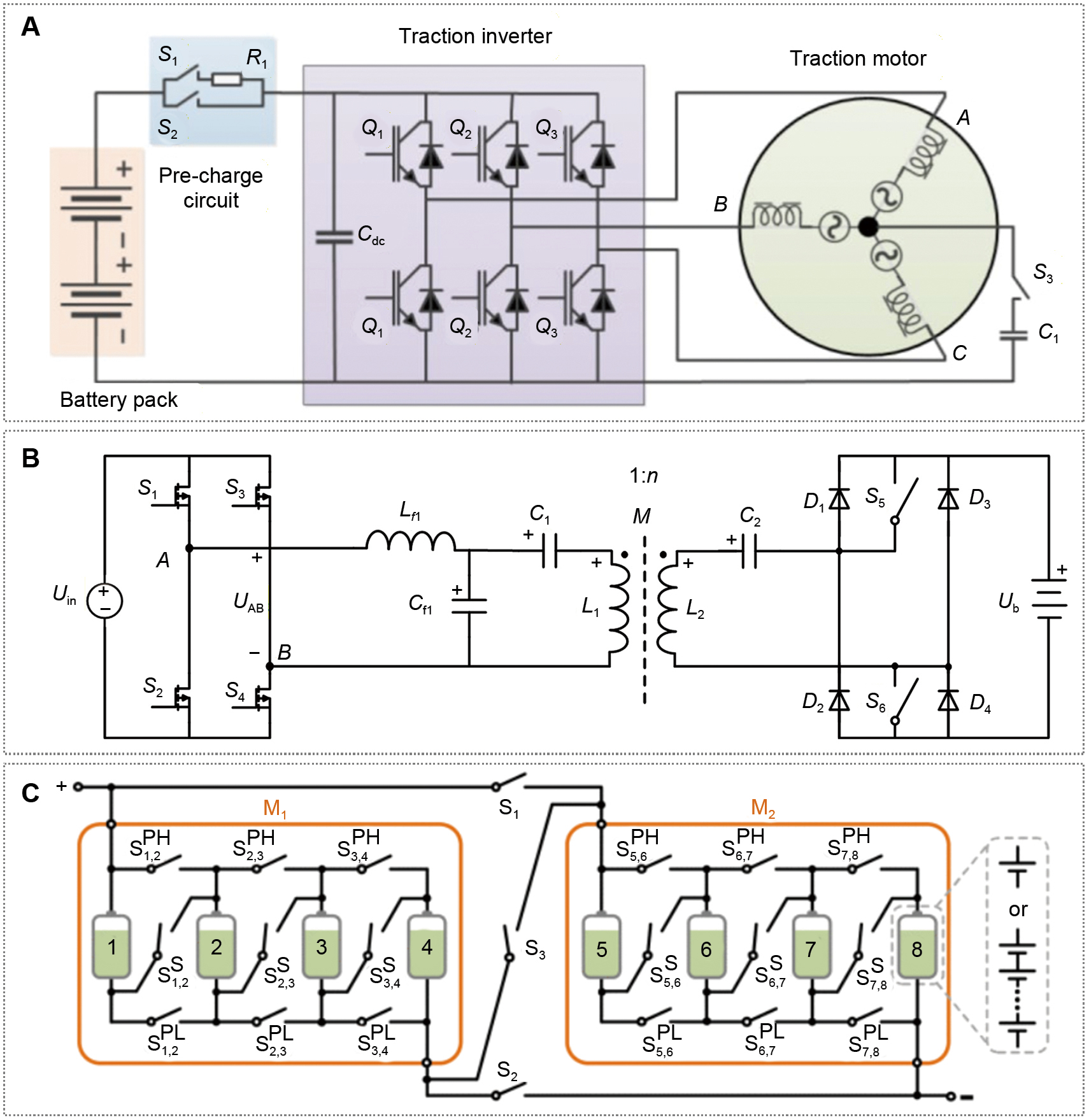
In summary, regarding research on active control of high and low temperatures, rapid low-temperature heating technology for batteries has been extensively studied. This involves lithium-free heating strategies and the implementation of highly integrated heating systems, making it a current research hotspot.
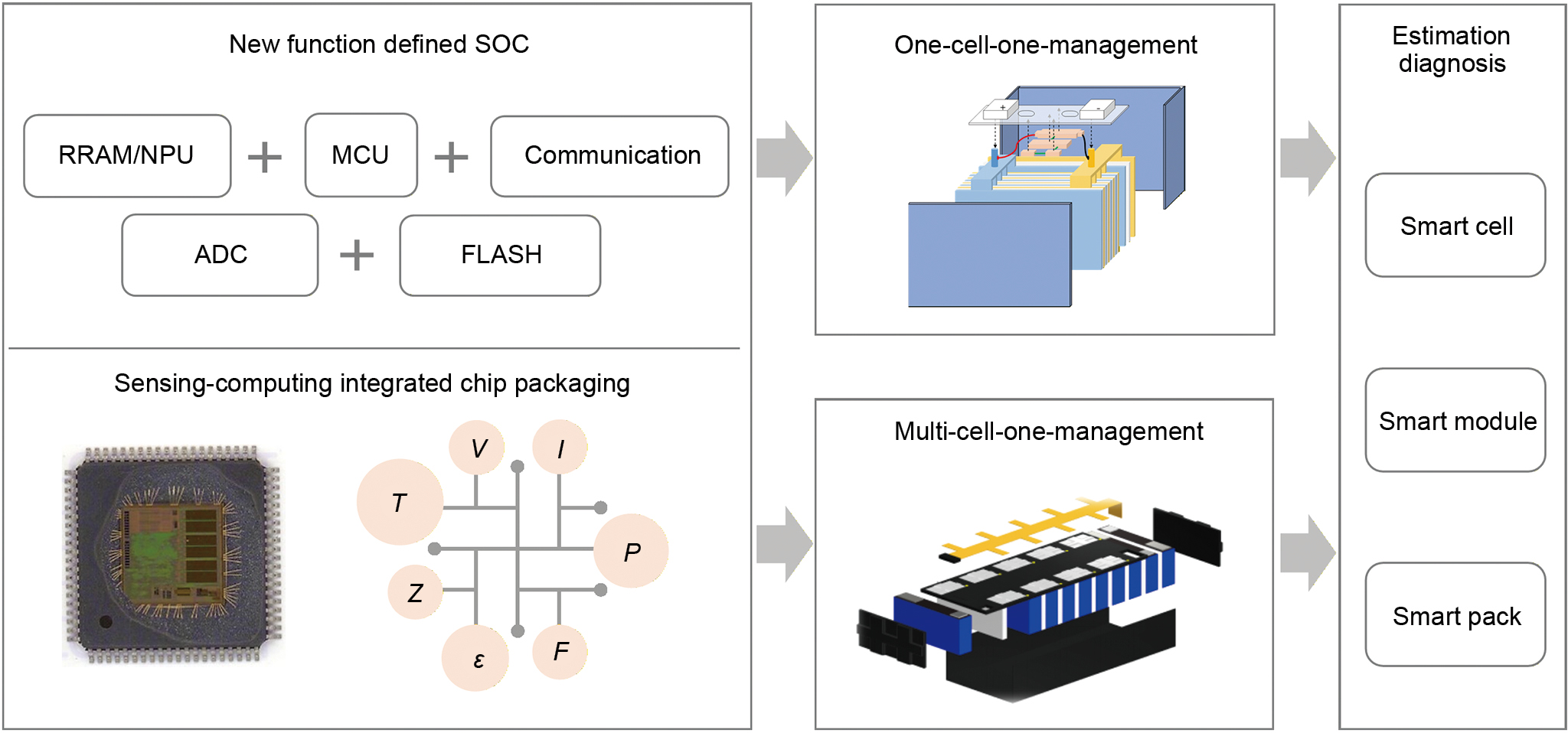
The increasing volume of battery data and the growing complexity of algorithms have rendered conventional BMS hardware inadequate, making technological innovation imperative. Hardware-integrated deployment serves as the execution platform and practical foundation of next-generation BMS. As shown in Figure 12, an important direction in the evolution of BMS hardware architecture is to provide stronger computational capability and enable the execution of embedded AI, ultimately leading to different system-level implementation schemes, such as multi-cell-one-management and one-cell-one- management. These systems of different scales all share similar architectures and operating principles, namely, achieving self-perception, self-diagnosis, and self-management, forming systems of different scales according to their respective applications.
The architecture of a multi-cell-one-management chip is the mainstream design for traditional BMS, with a multi-channel AFE serving as its core component. It enables direct measurement of cell voltage and temperature at the module level, performs passive balancing, and communicates with the battery pack's main controller. Leading global manufacturers such as Texas Instruments (TI), Analog Devices (ADI), Infineon, and NXP Semiconductors are driving the market with their system-level solutions for AFE chips, which offer high precision with measurement error below 2.2 mV and high functional safety level of Automotive Safety Integrity Level D (ASIL-D). Meanwhile, domestic manufacturers such as BYD Semiconductor and SRP (SRP Microelectronics Technology (Suzhou) Co., Ltd.) have achieved breakthroughs in the high-end automotive-grade AFE sector.
Under the AI BMS framework, the BMS main controller has evolved from a single controller to a computing core with AI acceleration capabilities, such as the Infineon AURIXTM TC4x family, NXP S32K3 family, and Renesas RA8 series, enabling more precise state estimation, thermal runaway early warning, and other functions [127]. However, deploying AI in BMS currently faces challenges related to model compression, quantization, and low-power design, requiring dedicated toolchains, such as ST's X-Cube-AI, to successfully deploy models onto resource-constrained embedded systems.
At the same time, the AFE must break away from traditional approaches to enable the simultaneous acquisition of multi-dimensional parameters such as voltage, current, temperature, EIS, and expansion force. The chip incorporates a simple AI inference model capable of performing preliminary analysis on the acquired multi-dimensional data, enabling estimates of battery SOC and SOH as well as preliminary fault identification. The analysis results are then uploaded to the upper-layer edge computing system to support global decision-making. Furthermore, the core of battery passports lies in ensuring data tamper-resistance and source credibility, which relies on hardware-level security mechanisms, with the Hardware Security Module (HSM) serving as a key technology [223].
The architecture of a one-cell-one-management chip represents a frontier architecture for AI BMS, in which a dedicated chip is deeply integrated with an individual battery cell to enable cell-level multi-dimensional parameter acquisition, local computation, and autonomous management, thereby serving as the core hardware for building intelligent battery cells. NXP Semiconductors has announced the industry's first EIS battery management chipset with hardware-based nanosecond-level synchronisation of all devices [224]. DUKOSI has introduced a near-field communication-based battery monitoring chip, which is the first commercially available one-chip-on-cell near field contactless solution for automotive cell monitoring [225]. Such chips support highly integrated multi-parameter sensing, enabling real-time acquisition of multi-dimensional parameters from individual cells. They also provide strong on-chip computing capability by integrating a micro neural processing unit (NPU), and are therefore capable of locally running lightweight AI models [226]. As a result, the chips can independently perform accurate estimation of the SOC and SOH of individual cells [227, 228], as well as early diagnosis of incipient faults such as lithium plating and internal short circuits, thereby enabling cell-level autonomous management. In addition, self-organizing communication networks can be realized through integrated wireless communication modules [229], enabling highly flexible, low-latency, and reliable data interaction, establishing distributed communication networks, and overcoming the problems of excessive wiring harnesses and limited bandwidth in traditional daisy-chain communication architectures.
The highly integrated smart cells are the smallest functional unit of the AI BMS, enabling the cells to achieve self-sensing, self-computing, self-diagnosis, and self-communication. The smart cells overcome the limitation of traditional battery cells serving merely as energy storage units, transforming them into smart nodes with intelligent sensing and decision-making capabilities.
The core structural feature of smart battery cells is the embedded integration of sensors with a one-cell-one-management chip. Depending on measurement requirements, micro-temperature sensors, flexible film stress sensors, and micro-barometric pressure sensors are implanted inside the battery cell or attached to its surface and connected to the one-cell-one-management chip via micro-wires, enabling seamless collection of multi-dimensional parameters both inside and outside the cell, as demonstrated in the research by Fan et al. [230]. When chips and sensors are deeply integrated inside batteries, issues related to signal transmission and resistance to electrolyte corrosion must be addressed. Wireless and leadless power supply and communication approaches, such as near-field coupling or energy harvesting [231], can reduce the impact on battery integrity and simplify sensor integration. The sensor lifetime issue can be addressed by using corrosion-resistant materials and encapsulation [232], solid-state or quasi-solid-state packaging [233], and electrochemically compatible interfaces, thereby allowing the sensors to achieve a service life comparable to that of the battery.
The emergence of intelligent cells has enabled battery management to shift from the module level to the cell level, greatly enhancing the granularity of battery management. At the same time, it provides a foundation for the modular design and flexible networking of battery modules, making it a core developmental form for next-generation power batteries and energy storage batteries.
Smart modules differ from traditional battery modules in that they integrate battery cells, multi-parameter measurement units, and edge controllers to enable sensing and decision-making for individual cells within the module. The core functions of smart modules include: module-level data fusion, which integrates multi-modal data to construct a global state model; module-level collaborative computing, which runs AI models for state estimation and fault diagnosis; module-level active management, which executes strategies such as balancing and thermal management; module-level intelligent protection, which detects risks, triggers protective measures, and uploads fault information; and modular networking and communication, which enable flexible networking and efficient data exchange through standardized interfaces.
The hardware architecture of the smart module adopts a distributed sensing-centralized management model. Distributed sensing is performed by electrical, thermal, and mechanical sensors distributed throughout the module, enabling the collection of multi-dimensional parameters at the cell level. Centralized management is handled by a module-level edge controller, which integrates a high-performance MCU/NPU, high-speed communication interfaces, a balancing control module, and a thermal management module. The high degree of autonomy of the smart module enables modular applications, which is significant for enhancing the reliability of battery systems and addressing the secondary utilization of retired batteries [234].
Intelligent modules are designed to balance integration, maintainability, and scalability, following a modular design philosophy in which each intelligent cell can be rapidly replaced and maintained. In addition, the communication, control, and thermal management systems of the module all adopt standardized interfaces, thereby meeting the diverse demands of power and energy storage systems.
The highly integrated smart battery pack serves as the system-level carrier for edge-embedded intelligent BMS. It is composed of multiple highly integrated smart modules, a pack-level edge computing controller, a pack-level sensor network, a comprehensive protection system, and an energy management system. As a complete smart battery energy storage unit designed for practical applications, it can be directly deployed in scenarios such as electric vehicles and energy storage power stations to achieve intelligent management of the battery pack throughout its full life cycle. The smart battery pack features three core functions: system-level global optimization, which optimizes energy management based on specific application scenarios to improve utilization efficiency; full life cycle management, which predicts battery lifetime through operational data logging and AI analysis to support maintenance, secondary use, and recycling; and comprehensive intelligent protection, which integrates multiple protection systems and monitors risks in real time to achieve closed-loop management from early warning to protection, ensuring safe operation.
The core characteristics of the smart battery pack are hierarchical, intelligent, and integrated. Data exchange and command transmission between levels are achieved through standardized communication networks, forming an intelligent management system featuring distributed sensing, hierarchical computing, and centralized management. The pack-level edge computing controller serves as the "central brain" of the smart battery pack. It integrates high-performance NPUs/CPUs, large-capacity storage, and high-speed Ethernet/fiber optic communication interfaces, offering robust local computing and data processing capabilities. It can run complex multi-modal fusion modeling AI models to perform overall state estimation, fault diagnosis, safety alerts, and energy optimization management for the battery pack.
Leveraging core technological advantages such as multi-dimensional parameter measurement, multi-modal fusion modeling, and embedded edge intelligence, the next-generation AI BMS overcomes the performance limitations of traditional BMS and meets the core requirements for high safety and long battery life in both power and energy storage battery scenarios.
In the power battery sector, the core value of AI BMS lies in mitigating safety risks and performance degradation caused by dynamic, variable, and unpredictable operating conditions through real-time, high-precision state sensing and prediction. Its applications have expanded from civilian electric vehicles to the aerospace sector, where reliability requirements are extremely stringent.
EVs will be the most mature application scenario for AI BMS technology [235]. Traditional BMS rely on equivalent circuit models, which struggle to accurately estimate battery state under dynamic operating conditions, whereas AI BMS leverage their powerful nonlinear fitting capabilities to significantly enhance the accuracy and robustness of key state estimations [236]. For example, SOC estimation algorithms based on LSTM or Transformer networks can effectively process complex time-series data such as vehicle start-stop cycles, acceleration, and energy recovery [237], providing drivers with accurate predictions of the remaining driving range. Meanwhile, by fusing multi-modal sensor data, AI-enabled BMS achieves a transition from passive protection to proactive early warning. By analyzing subtle abnormal changes in parameters such as voltage, temperature, and expansion force, AI models can identify early faults such as internal short circuits and lithium plating in advance, thereby providing valuable warning time for extreme safety events such as thermal runaway [238, 239].
Unmanned aerial vehicles (UAVs), including electric vertical take-off and landing (eVTOL) vehicles, require a BMS capable of accurate state estimation, fault diagnosis, and risk warning [240]. AI BMS, particularly when combined with Tiny Machine Learning technology, provides embedded, low-power intelligent management solutions for unmanned aerial vehicles. Research on UAV lithium-polymer batteries has successfully deployed an optimized Feedforward Neural Network (FFNN) model on an ARM Cortex-M0+ microcontroller, enabling real-time estimation of RUL [241]. Sierra et al. [242] explicitly framed this issue as a battery health management problem on a resource-constrained computing platform. To address it, they developed a simplified battery model, adopted an artificial evolution concept for parameter estimation, and introduced a novel outer feedback correction loop to mitigate bias in Bayesian state estimation.
Space power applications, including satellites, place exceptionally stringent reliability requirements on AI BMS technologies. In these scenarios, batteries are exposed to periodic energy constraints, extreme thermal conditions, and radiation damage [243, 244]. The core mission of AI BMS in space power applications is to ensure absolute safety and performance stability under extreme environments and throughout the full life cycle, which differs from the requirements for BMS in aircraft [245]. By introducing digital twin technology to construct a virtual model on the ground that is fully synchronized with the in-orbit battery system, and by analyzing massive amounts of simulation and telemetry data using AI algorithms, it is possible to predict the performance degradation trajectory of the battery during long-term missions and plan in-orbit maintenance strategies, ensuring mission success.
In the stationary energy storage sector, the focus of AI BMS applications shifts from mere performance and safety maintenance to the in-depth exploitation of asset value and the maximization of economic benefits. Its core task is to collaboratively optimize battery health and the revenue generated from participation in electricity market services, thereby addressing the traditional trade-off between preserving battery lifetime and creating economic value.
Grid-scale battery energy storage systems (BESS) constitute the primary arena for the large-scale application of AI BMS technologies. BESS generates economic value by participating in ancillary services such as grid frequency regulation, peak-valley arbitrage, and voltage support. By constructing high-fidelity digital twin models of batteries, AI BMS can accurately predict the lifetime degradation cost of batteries under different dispatch commands and incorporate it into the optimization objectives of the energy management system (EMS) [246]. For example, when participating in the frequency regulation market, AI models can predict the impact of high-frequency, shallow charge-discharge cycles on the increase in battery internal resistance; when participating in peak-valley arbitrage, AI models can evaluate the capacity fade induced by deep cycling. Through this coordinated optimization of battery health and market revenue, AI BMS can formulate globally optimal charge-discharge strategies, maximizing battery asset utilization while ensuring the economic viability of the project throughout its full life cycle.
As the core carrier for both power and energy storage batteries, the safe and long-life operation of LIBs is crucial for achieving carbon emission reductions in transportation and energy infrastructure. However, traditional BMS, due to limitations such as low measurement dimensions, poor model accuracy, and insufficient computing power, can no longer meet the application requirements of current energy storage scenarios. Addressing the shortcomings of traditional BMS, this paper proposes a next-generation AI BMS based on multi-dimensional parameter measurement, multi-modal parameter fusion modeling, and edge-embedded intelligence. It systematically elaborates on its technical framework, architectural design, and application deployment. The main research conclusions are as follows:
(i) Multi-dimensional parameter measurement is the perception foundation of AI BMS. By overcoming the technical bottlenecks in measuring multiple physical quantities of both inside and outside batteries, such as electricity, heat, force, gas, and impedance, it achieves a leap from the conventional three-parameter measurement paradigm of voltage, current, and temperature to full-dimensional parameter measurement, thereby providing comprehensive and accurate data support for battery state perception. External measurements have enabled onboard real-time acquisition of EIS, distributed temperature, and expansion force, while internal measurements have achieved breakthroughs in embedded sensing technologies for anode potential and gas pressure, thereby addressing the limitations of conventional measurements in terms of coarse granularity and poor real-time performance.
(ii) Multi-modal parameter fusion modeling is the decision-making core of AI BMS. By integrating multi-dimensional measurement data from inside and outside batteries across multiple spatial, temporal, and frequency domains, black-box and grey-box models can be established to achieve accurate estimation of battery SOX, including SOC, SOH, SOP, and SOE, early diagnosis of faults such as internal short circuits, lithium plating, and inconsistency, and graded safety warning of thermal runaway. This overcomes the limitations of conventional single-parameter modeling in terms of low accuracy and poor generalization capability, and provides a scientific basis for battery management decision-making.
(iii) Edge-embedded intelligence is the execution carrier of AI BMS. It establishes a hierarchical hardware architecture consisting of highly integrated sensing chips, highly integrated intelligent cells, highly integrated intelligent modules, highly integrated intelligent battery packs, and edge-computing intelligent systems, thereby enabling local real-time acquisition, processing, analysis, and decision-making of battery data. At the same time, through end-cloud collaboration, complex model optimization and full life cycle management can be achieved, which overcomes the deficiencies of traditional BMS in computing capability, integration level, and communication bandwidth, and ensures the practical implementation of the core functions of AI BMS.
Next-generation AI BMS has significant application value in both power batteries (e.g., electric vehicles) and stationary energy storage (e.g., energy storage power stations), and can comprehensively improve battery safety, service life, and energy utilization efficiency. The core innovation of this paper lies in responding to the development trend of AI technology by systematically proposing a complete technical framework for AI BMS. The framework identifies three core technological directions, namely multi-dimensional parameter measurement, multi-modal parameter fusion modeling, and edge-embedded intelligence, and clarifies their technical connotation and development pathways. This work provides theoretical and technical references for the research, development, and engineering application of next-generation BMS.
Looking ahead, further efforts are still needed to advance battery digital twin technology, establish real-time mapping between physical batteries and digital models, and realize digital management and virtual simulation testing throughout the full battery life cycle. The development of next-generation AI BMS not only drives a revolutionary upgrade in lithium-ion battery management technology but also provides essential support for the high-quality development of the new energy industry, contributes to the achievement of carbon peaking and carbon neutrality goals, and promotes the transition of transportation and energy infrastructure toward cleaner, smarter, and more efficient systems.
Xueyuan Wang: Investigation; conceptualization; data curation; writing. Yuguang Li: Data curation; writing. Zihan Jia: Data curation; writing; review & editing. Cenyu Wang: Writing. Yaqi Wang: Writing. Bo Jiang: Review & editing. Jiangong Zhu: Writing. Xuezhe Wei: Conceptualization; resources; supervision. Haifeng Dai: Resources; supervision.
This work was supported by the National Natural Science Foundation of China (Grant No. 52577240).
The data that support the findings of this study are available from the corresponding author upon reasonable request.
M. Li, J. Lu, Z. W. Chen, and K. Amine, "30 Years of Lithium-Ion Batteries," Advanced Materials 30, no. 33 (2018): 1800561, https://doi.org/10.1002/adma.201800561.
N. Liu, D. Liu, Y. Q. Zhan, Q. Q. Chen, Y. T. Qiao, and R. Tan, "From Innovation to Integration: The Evolving Role of Carbon Capture and Storage in Global Decarbonization," cScience 1, no. 1 (2025): e70008, https://doi.org/10.1002/csc3.70008.
N. Nasajpour-Esfahani, H. Garmestani, M. Bagheritabar, et al., "Comprehensive Review of Lithium-Ion Battery Materials and Development Challenges," Renewable & Sustainable Energy Reviews 203 (2024): 114783, https://doi.org/10.1016/j.rser.2024.114783.
F. Duffner, N. Kronemeyer, J. Tübke, J. Leker, M. Winter, and R. Schmuch, "Post-Lithium-Ion Battery Cell Production and Its Compatibility with Lithium-Ion Cell Production Infrastructure," Nature Energy 6, no. 2 (2021): 123–134, https://doi.org/10.1038/s41560-020-00748-8.
Y. Li, J. Song, and J. Yang, "A Review on Structure Model and Energy System Design of Lithium-Ion Battery in Renewable Energy Vehicle," Renewable and Sustainable Energy Reviews 37 (2014): 627–633, https://doi.org/10.1016/j.rser.2014.05.059.
Z. C. Wang and C. Q. Du, "A Comprehensive Review on Thermal Management Systems for Power Lithium-Ion Batteries," Renewable & Sustainable Energy Reviews 139 (2021): 110685, https://doi.org/10.1016/j.rser.2020.110685.
L. Lu, X. Han, J. Li, J. Hua, and M. Ouyang, "A Review on the Key Issues for Lithium-Ion Battery Management in Electric Vehicles," Journal of Power Sources 226, no. 3 (2013): 272–288, https://doi.org/10.1016/j.jpowsour.2012.10.060.
S. S. Madani, Y. Shabeer, M. Fowler, et al., "Artificial Intelligence and Digital Twin Technologies for Intelligent Lithium-Ion Battery Management Systems: A Comprehensive Review of State Estimation, Lifecycle Optimization, and Cloud-Edge Integration," Batteries 11, no. 8 (2025): 298, https://doi.org/10.3390/batteries11080298.
A. K. Habib, M. K. Hasan, G. F. Issa, D. Singh, S. Islam, and T. M. Ghazal, "Lithium-Ion Battery Management System for Electric Vehicles: Constraints, Challenges, and Recommendations," Batteries 9, no. 3 (2023): 152, https://doi.org/10.3390/batteries9030152.
R. Suganya, L. M. Joseph, and S. Kollem, "Understanding Lithium-Ion Battery Management Systems in Electric Vehicles: Environmental and Health Impacts, Comparative Study, and Future Trends: A Review," Results in Engineering 24 (2024): 103047, https://doi.org/10.1016/j.rineng.2024.103047.
Q. Wang, X. Wei, and H. Dai, "Hardware-in-Loop Test Platform for Electric Vehicle Cell Battery Management System," Applied Mechanics and Materials 29–32 (2010): 2398–2403, https://doi.org/10.4028/www.scientific.net/amm.29-32.2398.
A. Verani, R. D. Rienzo, N. Nicodemo, F. Baronti, R. Roncella, and R. Saletti, "Modular Battery Emulator for Development and Functional Testing of Battery Management Systems: Hardware Design and Characterization," Electronics 12, no. 5 (2023): 1232, https://doi.org/10.3390/electronics12051232.
NXP, n.d., "14-Channel Li-Ion Battery Cell Controller IC," accessed May 25, 2025, https://www.nxp.com/products/MC33771C.
TI, n.d., "12-S Battery Monitor and Balancer with Integrated Protector and DC-DC Converter," accessed May 25, 2025, https://www.ti.com.cn/product/cn/BQ79712PB-Q1#tech-docs.
M. Turgut, R. Bayir, and F. Duran, "CAN Communication Based Modular Type Battery Management System for Electric Vehicles," Electronics & Electrical Engineering 24, no. 3 (2018): 53–60, https://doi.org/10.5755/j01.eie.24.3.20975.
Z. Zheng, Y. Chen, J. Ding, et al., "Design and Implementation of an EMI-Immune Daisy Chain Interface with a PID-Based CDR Algorithm for Battery Management System Communication," IEEE Access 12 (2024): 126438–126445, https://doi.org/10.1109/ACCESS.2024.3429548.
T. Zhang, B. Huang, X. Liu, et al., "MCU Intelligent Upgrades: An Overview of AI-Enabled Low-Power Technologies," Journal of Low Power Electronics and Applications 15, no. 4 (2025): 60, https://www.mdpi.com/2079-9268/15/4/60.
A. Fanariotis, T. Orphanoudakis, and V. Fotopoulos, "Evaluating the Energy Efficiency of NPU-Accelerated Machine Learning Inference on Embedded Microcontrollers," arXiv preprint, arXiv: 2509.17533, September 22, 2025, https://doi.org/10.48550/arXiv.2509.17533.
S. Nejad, D. T. Gladwin, and D. A. Stone, "A Systematic Review of Lumped-Parameter Equivalent Circuit Models for Real-Time Estimation of Lithium-Ion Battery States," Journal of Power Sources 316 (2016): 183–196, https://doi.org/10.1016/j.jpowsour.2016.03.042.
A. Jokar, B. Rajabloo, M. Désilets, and M. Lacroix, "Review of Simplified Pseudo-Two-Dimensional Models of Lithium-Ion Batteries," Journal of Power Sources 327 (2016): 44–55, https://doi.org/10.1016/j.jpowsour.2016.07.036.
M. F. Ng, J. Zhao, Q. Y. Yan, G. J. Conduit, and Z. W. Seh, "Predicting the State of Charge and Health of Batteries Using Data-Driven Machine Learning," Nature Machine Intelligence 2, no. 3 (2020): 161–170, https://doi.org/10.1038/s42256-020-0156-7.
X. Hu, K. Zhang, K. Liu, X. Lin, S. Dey, and S. Onori, "Advanced Fault Diagnosis for Lithium-Ion Battery Systems: A Review of Fault Mechanisms, Fault Features, and Diagnosis Procedures," IEEE Industrial Electronics Magazine 14, no. 3 (2020): 65–91, https://doi.org/10.1109/MIE.2020.2964814.
J. Amici, P. Asinari, E. Ayerbe, et al., "A Roadmap for Transforming Research to Invent the Batteries of the Future Designed within the European Large Scale Research Initiative Battery 2030+," Advanced Energy Materials 12, no. 17 (2022): 2102785, https://doi.org/10.1002/aenm.202102785.
H. Dai, B. Jiang, X. Hu, X. Lin, X. Wei, and M. Pecht, "Advanced Battery Management Strategies for a Sustainable Energy Future: Multilayer Design Concepts and Research Trends," Renewable and Sustainable Energy Reviews 138 (2021): 110480, https://doi.org/10.1016/j.rser.2020.110480.
S. Nyamathulla and C. Dhanamjayulu, "A Review of Battery Energy Storage Systems and Advanced Battery Management System for Different Applications: Challenges and Recommendations," Journal of Energy Storage 86 (2024): 111179, https://doi.org/10.1016/j.est.2024.111179.
R. R. Kumar, C. Bharatiraja, K. Udhayakumar, S. Devakirubakaran, K. S. Sekar, and L. Mihet-Popa, "Advances in Batteries, Battery Modeling, Battery Management System, Battery Thermal Management, SOC, SOH, and Charge/Discharge Characteristics in EV Applications," IEEE Access 11 (2023): 105761–105809, https://doi.org/10.1109/ACCESS.2023.3318121.
Y. Zhang, Y. Li, Z. Guo, et al., "Health Monitoring by Optical Fiber Sensing Technology for Rechargeable Batteries," Escience 4, no. 1 (2024): 100174, https://doi.org/10.1016/j.esci.2023.100174.
Y. Yang, K. Hu, J. Zhang, and G. Lv, "Recent Advanced Implantable Nano-Micro Sensing Methods for Lithium-Ion Batteries Condition Monitoring: A Focus Review," Journal of Energy Storage 137 (2025): 118694, https://doi.org/10.1016/j.est.2025.118694.
S. Xie, Z. Wang, J. Fu, P. Lv, and Y. He, "A Review of Sensing Technology for Monitoring the Key Thermal Safety Characteristic Parameters of Lithium-Ion Batteries," Journal of Power Sources 624 (2024): 235598, https://doi.org/10.1016/j.jpowsour.2024.235598.
R. Xiong, L. Li, and J. Tian, "Towards a Smarter Battery Management System: A Critical Review on Battery State of Health Monitoring Methods," Journal of Power Sources 405 (2018): 18–29, https://doi.org/10.1016/j.jpowsour.2018.10.019.
M. Lipu, M. Hannan, T. Karim, et al., "Intelligent Algorithms and Control Strategies for Battery Management System in Electric Vehicles: Progress, Challenges and Future Outlook," Journal of Cleaner Production 292 (2021): 126044, https://doi.org/10.1016/j.jclepro.2021.126044.
M. Kurucan, M. Özbaltan, Z. Yetgin, and A. Alkaya, "Applications of Artificial Neural Network Based Battery Management Systems: A Literature Review," Renewable & Sustainable Energy Reviews 192 (2024): 114262, https://doi.org/10.1016/j.rser.2023.114262.
D. Hu, S. Huang, Z. Wen, X. Gu, and J. Lu, "A Review on Thermal Runaway Warning Technology for Lithium-Ion Batteries," Renewable and Sustainable Energy Reviews 206 (2024): 114882, https://doi.org/10.1016/j.rser.2024.114882.
K. Liu, Z. Wei, C. Zhang, Y. Shang, R. Teodorescu, and Q. Han, "Towards Long Lifetime Battery: AI-Based Manufacturing and Management," IEEE-CAA Journal of Automatica Sinica 9, no. 7 (2022): 1139–1165, https://doi.org/10.1109/jas.2022.105599.
X. Wang, X. Wei, J. Zhu, et al., "A Review of Modeling, Acquisition, and Application of Lithium-Ion Battery Impedance for Onboard Battery Management," eTransportation 7 (2021): 100093, https://doi.org/10.1016/j.etran.2020.100093.
J. A. A. Qahouq and Z. Xia, "Single-Perturbation-Cycle Online Battery Impedance Spectrum Measurement Method with Closed-Loop Control of Power Converter," IEEE Transactions on Industrial Electronics 64, no. 9 (2017): 7019–7029, https://doi.org/10.1109/TIE.2017.2686324.
A. Waligo and P. Barendse, "A Comparison of the Different Broadband Impedance Measurement Techniques for Lithium-Ion Batteries," paper presented at the 2016 IEEE Energy Conversion Congress and Exposition (ECCE), Piscataway, NJ, USA, September 18–22, 2016, https://doi.org/10.1109/ECCE.2016.7854661.
R. Koch, R. Kuhn, I. Zilberman, and A. Jossen, "Electrochemical Impedance Spectroscopy for Online Battery Monitoring - Power Electronics Control," paper presented at the 2014 16th European Conference on Power Electronics and Applications (EPE'14-ECCE Europe), Piscataway, NJ, USA, August 26–28, 2014, https://dx.doi.org/10.1109/EPE.2014.6910907.
S. K. Dam and V. John, "High-Resolution Converter for Battery Impedance Spectroscopy," IEEE Transactions on Industry Applications 54, no. 2 (2018): 1502–1512, https://dx.doi.org/10.1109/TIA.2017.2771498.
T. Nguyen, V. Tran, and W. Choi, "Development of the Intelligent Charger with Battery State-of-Health Estimation Using Online Impedance Spectroscopy," paper presented at the 2014 IEEE 23rd International Symposium on Industrial Electronics (ISIE), Piscataway, NJ, USA, June 1–4, 2014, http://dx.doi.org/10.1109/ISIE.2014.6864656.
Y. D. Lee, S. Y. Park, and S. B. Han, "Online Embedded Impedance Measurement Using High-Power Battery Charger," IEEE Transactions on Industry Applications 51, no. 1 (2015): 498–508, https://doi.org/10.1109/tia.2014.2336979.
X. Wei, X. Wang, and H. Dai, "Practical on-Board Measurement of Lithium Ion Battery Impedance Based on Distributed Voltage and Current Sampling," Energies 11, no. 1 (2018): 1–15, https://doi.org/10.3390/en11010064.
J. P. Christophersen, J. Morrison, W. Morrison, and C. Motloch, "Rapid Impedance Spectrum Measurements for State-of-Health Assessment of Energy Storage Devices," paper presented at the SAE 2012 World Congress and Exhibition, Detroit, MI, United states, April 24, 2012, http://dx.doi.org/10.4271/2012-01-0657.
Z. Hao, X. Wang, X. Wei, and H. Dai, "Fast and Highly Accurate Measurement of Electrochemical Impedance Spectra of Power Batteries Based on Optimized Multi-Sine Signals," Measurement (2025): 117355, https://doi.org/10.1016/j.measurement.2025.117355.
T. Yokoshima, D. Mukoyama, H. Nara, et al., "Impedance Measurements of Kilowatt-Class Lithium Ion Battery Modules/Cubicles in Energy Storage Systems by Square-Current Electrochemical Impedance Spectroscopy," Electrochimica Acta 246 (2017): 800–811, https://doi.org/10.1016/j.electacta.2017.05.076.
R. Al Nazer, V. Cattin, P. Granjon, M. Montaru, and M. Ranieri, "Broadband Identification of Battery Electrical Impedance for HEVs," IEEE transactions on vehicular technology 62, no. 7 (2013): 2896–2905, https://doi.org/10.1109/TVT.2013.2254140.
H. Piret, P. Granjon, N. Guillet, and V. Cattin, "Tracking of Electrochemical Impedance of Batteries," Journal of Power Sources 312 (2016): 60–69, https://doi.org/10.1016/j.jpowsour.2016.02.006.
Z. Geng and C. Savvidis, "On-Board Impedance Diagnostics Method of Li-Ion Traction Batteries Using Pseudo-Random Binary Sequences" (Master of science thesis, Chalmers University of Technology, 2015).
J. Sihvo, D. Stroe, T. Messo, and T. Roinila, "Fast Approach for Battery Impedance Identification Using Pseudo-Random Sequence Signals," IEEE Transactions on Power Electronics 35, no. 3 (2020): 2548–2557, https://doi.org/10.1109/TPEL.2019.2924286.
E. Locorotondo, L. Pugi, L. Berzi, et al., "Electrochemical Impedance Spectroscopy of Li-Ion Battery on-Board the Electric Vehicles Based on Fast Nonparametric Identification Method," paper presented at the 2019 IEEE International Conference on Environment and Electrical Engineering and 2019 IEEE Industrial and Commercial Power Systems Europe (EEEIC / I&CPS Europe), Piscataway, NJ, USA, June 11–14, 2019, http://dx.doi.org/10.1109/EEEIC.2019.8783625.
X. Wang, X. Wei, Q. Chen, J. Zhu, and H. Dai, "Lithium-Ion Battery Temperature on-Line Estimation Based on Fast Impedance Calculation," Journal of Energy Storage 26, no. 12 (2019): 1–12, https://doi.org/10.1016/j.est.2019.100952.
M. Nakayama, K. Fukuda, Y. Ohmori, K. Wakahara, T. Araki, and K. Onda, "Battery Impedance Measurement by Laplace Transformation of Charge or Discharge Current/Voltage," IEEE Transactions on Power & Energy 125, no. 12 (2005): 1279–1286, https://doi.org/10.1541/ieejpes.125.1279.
A. Rahmoun, M. Loske, and A. Rosin, "Determination of the Impedance of Lithium-Ion Batteries Using Methods of Digital Signal Processing," Energy Procedia 46 (2014): 204–213, https://doi.org/10.1016/j.egypro.2014.01.174.
D. Klotz, M. Schönleber, J. P. Schmidt, and E. Ivers-Tiffée, "New Approach for the Calculation of Impedance Spectra out of Time Domain Data," Electrochimica Acta 56, no. 24 (2011): 8763–8769, https://doi.org/10.1016/j.electacta.2011.07.096.
Y. Hoshi, N. Yakabe, K. Isobe, T. Saito, I. Shitanda, and M. Itagaki, "Wavelet Transformation to Determine Impedance Spectra of Lithium-Ion Rechargeable Battery," Journal of Power Sources 315 (2016): 351–358, https://doi.org/10.1016/j.jpowsour.2016.03.048.
M. Itagaki, M. Ueno, Y. Hoshi, and I. Shitanda, "Simultaneous Determination of Electrochemical Impedance of Lithium-Ion Rechargeable Batteries with Measurement of Charge-Discharge Curves by Wavelet Transformation," Electrochimica Acta 235 (2017): 384–389, https://doi.org/10.1016/j.electacta.2017.03.077.
B. Bullecks, R. Suresh, and R. Rengaswamy, "Rapid Impedance Measurement Using Chirp Signals for Electrochemical System Analysis," Computers & Chemical Engineering 106 (2017): 421–436, https://doi.org/10.1016/j.compchemeng.2017.05.018.
C. Gabrielli, F. Huet, M. Keddam, and J. Lizee, "Measurement Time Versus Accuracy Trade-off Analyzed for Electrochemical Impedance Measurements by Means of Sine, White Noise and Step Signals," Journal of Electroanalytical Chemistry and Interfacial Electrochemistry 138, no. 1 (1982): 201–208, https://doi.org/10.1016/0022-0728(82)87141-6.
B. Liebhart, L. Komsiyska, and C. Endisch, "Passive Impedance Spectroscopy for Monitoring Lithium-Ion Battery Cells during Vehicle Operation," Journal of Power Sources 449 (2020): 227297, https://doi.org/10.1016/j.jpowsour.2019.227297.
W. X. Huang and J. A. Abu Qahouq, "An Online Battery Impedance Measurement Method Using DC–DC Power Converter Control," IEEE Transactions on Industrial Electronics 61, no. 11 (2014): 5987–5995, https://doi.org/10.1109/tie.2014.2311389.
J. A. A. Qahouq, "Online Battery Impedance Spectrum Measurement Method," paper presented at the 2016 IEEE Applied Power Electronics Conference and Exposition (APEC), Piscataway, NJ, USA, March 20–24, 2016, http://dx.doi.org/10.1109/APEC.2016.7468388.
X. Wang, X. Wei, Q. Chen, and H. Dai, "A Novel System for Measuring Alternating Current Impedance Spectra of Series-Connected Lithium-Ion Batteries with a High-Power Dual Active Bridge Converter and Distributed Sampling Units," IEEE Transactions on Industrial Electronics 68, no. 8 (2021): 7380–7390, https://doi.org/10.1109/TIE.2020.3001841.
X. Wang, X. Wei, J. Zhu, et al., "A Review of Modeling, Acquisition, and Application of Lithium-Ion Battery Impedance for Onboard Battery Management," eTransportation 7, no. 2 (2021): 1–21, https://doi.org/10.1016/j.etran.2020.100093.
E. Din, C. Schaef, K. Moffat, and J. T. Stauth, "A Scalable Active Battery Management System with Embedded Real-Time Electrochemical Impedance Spectroscopy," IEEE Transactions on Power Electronics 32, no. 7 (2017): 5688–5698, https://doi.org/10.1109/TPEL.2016.2607519.
M. A. Varnosfaderani and D. Strickland, "Online Impedance Spectroscopy Estimation of a DC–DC Converter Connected Battery Using a Switched Capacitor-Based Balancing Circuit," The Journal of Engineering 2019, no. 7 (2019): 4681–4685, https://doi.org/10.1049/joe.2018.8069.
A. Blömeke, H. Zappen, F. Ringbeck, F. Frie, D. Wasylowski, and D. U. Sauer, "Balancing Resistor-Based Online Electrochemical Impedance Spectroscopy in Battery Systems: Opportunities and Limitations," Communications Engineering 3, no. 1 (2024): 62, https://doi.org/10.1038/s44172-024-00203-6.
L. H. J. Raijmakers, K. M. Shivakumar, M. C. F. Donkers, M. J. G. Lammers, and H. J. Bergveld, "Crosstalk Interferences on Impedance Measurements in Battery Packs," IFAC-PapersOnLine 49, no. 11 (2016): 42–47, https://doi.org/10.1016/j.ifacol.2016.08.007.
Y. Nishimura, H. Ito, L. Lin, et al., "Development and Evaluation of High-accuracy AC Impedance Measurement System Using Dedicated LSI," paper presented at the 60th Battery Symposium, Tokyo, Japan, November 14, 2019, https://pub.confit.atlas.jp/en/event/denchi60/presentation/2A13.
B. Evyapan and B. Oral, "Thermal Management and Performance Optimization in Battery Packs via NTC Sensor Positioning," Applied Thermal Engineering 280 (2025): 128272, https://doi.org/10.1016/j.applthermaleng.2025.128272.
A. Saeed, A. Alawi, M. H. Sharqawy, and M. Al Janaideh, "Advancements in Temperature-Sensing Technologies for Lithium-Ion Batteries in Electric Vehicle Thermal Management Systems: A Comprehensive Review," IEEE Sensors Journal 25 (2025): 42442–42461, https://doi.org/10.1109/JSEN.2025.3616085.
S. Chen, Y. Shen, D. Li, et al., "Advances in Internal Temperature Measurement and Estimation for Lithium-Ion Batteries," Journal of Energy Storage 140 (2025): 118950, https://doi.org/10.1016/j.est.2025.118950.
B. Gulsoy, T. A. Vincent, J. E. H. Sansom, and J. Marco, "In-Situ Temperature Monitoring of a Lithium-Ion Battery Using an Embedded Thermocouple for Smart Battery Applications," Journal of Energy Storage 54 (2022): 105260, https://doi.org/10.1016/j.est.2022.105260.
F. Krause, M. Schütte, D. M. Nguyen, F. Schweizer, M. Junker, and D. U. Sauer, "Novel Optical Fiber-Based Method for Spatially Resolved Temperature Measurement and Thermal Anomaly Detection in Battery Modules," Journal of Energy Storage 131 (2025): 117347, https://doi.org/10.1016/j.est.2025.117347.
X. Wang, J. Zhu, D. Liu, et al., "Internal Temperature Evolution of Lithium-Ion Battery over Long-Term Cycling via Advanced Fiber Sensing," Journal of Power Sources 652 (2025): 237604, https://doi.org/10.1016/j.jpowsour.2025.237604.
X. Zhao, H. He, Z. Wei, R. Huang, H. Yue, and X. Guo, "Embedded Fiber Sensing-Enabled Multi State Joint Observation of Smart Lithium-Ion Battery Based on Distributed Thermal Modeling," Journal of Energy Storage 118 (2025): 116085, https://doi.org/10.1016/j.est.2025.116085.
T. Zhang, G. Wang, H. Chen, Z. Mao, and Y. Ji, "Temperature Response Spatiotemporal Correlation Model of Lithium-Ion Battery and Temperature Field Reconstruction during Charging and Discharging Processes," Energy 324 (2025): 135902, https://doi.org/10.1016/j.energy.2025.135902.
N. Tian, H. Fang, and Y. Wang, "3-D Temperature Field Reconstruction for a Lithium-Ion Battery Pack: A Distributed Kalman Filtering Approach," IEEE Transactions on Control Systems Technology 27, no. 2 (2019): 847–854, https://doi.org/10.1109/TCST.2017.2779434.
Y. Zhou, H. Deng, H. X. Li, and S. L. Xie, "Data-Driven Real-Time Prediction of Pouch Cell Temperature Field under Minimal Sensing," IEEE Transactions on Transportation Electrification 9, no. 1 (2023): 1034–1041, https://doi.org/10.1109/TTE.2022.3200729.
H. Chen, Y. Hu, Z. Chen, and G. Wang, "Direct Reconstruction of the Temperature Field of Lithium-Ion Battery Based on Mapping Characteristics," Measurement 234 (2024): 114850, https://doi.org/10.1016/j.measurement.2024.114850.
M. Zhang, K. Li, F. Feng, Y. Xie, and N. Cui, "A Data-Driven SRS-MAE Model for Pixel-Level Prismatic Lithium-Ion Batteries Temperature Field Reconstruction," IEEE Transactions on Transportation Electrification 11, no. 5 (2025): 12463–12471, https://doi.org/10.1109/TTE.2025.3590862.
Y. Lei, J. Zhao, Y. Wang, C. Xue, and L. Gao, "Flexible Sensing for Precise Lithium-Ion Battery Swelling Monitoring: Mechanisms, Integration Strategies, and Outlook," Sensors 25, no. 24 (2025): 7677, https://doi.org/10.3390/s25247677.
R. Sun, P. Xiao, L. Sun, D. Guo, Y. Wang, and J. Wu, "Thixotropic Ink-Engineered Flexible Sensors for Real-Time Swelling Force Monitoring in LFP Batteries," Advanced Materials Technologies (2025): e01566, https://doi.org/10.1002/admt.202501566.
Y. Jiajie, Z. Ke, and D. Yuan, "Recent Progress in Pressure and Temperature Tactile Sensors: Principle, Classification, Integration and Outlook," Soft Science 1, no. 1 (2021): 6, http://dx.doi.org/10.20517/ss.2021.05.
L. Lv, T. Liu, T. Jiang, et al., "A Highly Sensitive Flexible Capacitive Pressure Sensor with Hierarchical Pyramid Micro-Structured PDMS-Based Dielectric Layer for Health Monitoring," Frontiers in Bioengineering and Biotechnology 11 (2023): 1303142, https://doi.org/10.3389/fbioe.2023.1303142.
F. Zhuo, Z. Ding, X. Yang, et al., "Advanced Morphological and Material Engineering for High-Performance Interfacial Iontronic Pressure Sensors," Advanced Science 12, no. 8 (2025): 2413141, https://doi.org/10.1002/advs.202413141.
F. Cheng, X. Zhang, Z. Li, et al., "In Situ and Real-Time Monitoring of the Internal Temperature, Pressure, and Current of Lithium-Ion Batteries for Long Cycle Life Safety Using a Flexible Multi-Parameter Sensor Array," Journal of Materials Chemistry A 14, no. 19 (2026): 11663–11675, https://doi.org/10.1039/D5TA09703G.
B. Sun, G. Xu, Z. Yang, et al., "A Flexible Bimodal Pressure–Temperature Sensor with 3-D Sandwich Structure and Thermal Drift Mitigation," IEEE Sensors Journal 25, no. 10 (2025): 18123–18135, https://doi.org/10.1109/JSEN.2025.3556426.
Q. Dang, X. Ling, Q. Zhang, S. Song, and X. Hu, "Flexible Integrated Sensor Array with Long Cyclic Life and High Measuring Accuracy for Real-Time Monitoring of Internal Temperature and Pressure of Lithium Battery," Advanced Materials Technologies 10, no. 13 (2025): 2500152, https://doi.org/10.1002/admt.202500152.
X. Peng, J. Han, Q. Zhang, Y. Xiang, and X. Hu, "Real-Time Mechanical and Thermal Monitoring of Lithium Batteries with PVDF-TrEE Thin Films Integrated within the Battery," Sensors and Actuators A: Physical 338 (2022): 113484, https://doi.org/10.1016/j.sna.2022.113484.
X. Wang, H. Zhang, X. Qi, et al., "Flexible Sensors for Battery Health Monitoring," Nano-Micro Letters 18, no. 1 (2026): 154, https://doi.org/10.1007/s40820-025-01999-4.
T. Krause, D. Nusko, L. Pitta Bauermann, M. Vetter, M. Schäfer, and C. Holly, "Methods for Quantifying Expansion in Lithium-Ion Battery Cells Resulting from Cycling: A Review," Energies 17, no. 7 (2024): 1566, https://doi.org/10.3390/en17071566.
C. J. Bae, A. Manandhar, P. Kiesel, and A. Raghavan, "Monitoring the Strain Evolution of Lithium‐Ion Battery Electrodes Using an Optical Fiber Bragg Grating Sensor," Energy Technology 4, no. 7 (2016): 851–855, https://doi.org/10.1002/ente.201500514.
A. Fortier, M. Tsao, N. Williard, Y. Xing, and M. Pecht, "Preliminary Study on Integration of Fiber Optic Bragg Grating Sensors in Li-Ion Batteries and in Situ Strain and Temperature Monitoring of Battery Cells," Energies 10, no. 7 (2017): 838, https://doi.org/10.3390/en10070838.
J. Wang, J. Liu, L. Wang, et al., "The Significance of Imperceptible Current Flowing through the Lithium Reference Electrode in Lithium Ion Batteries," Journal of Power Sources 546 (2022): 231953, https://doi.org/10.1016/j.jpowsour.2022.231953.
S. Solchenbach, D. Pritzl, E. J. Y. Kong, J. Landesfeind, and H. A. Gasteiger, "A Gold Micro-Reference Electrode for Impedance and Potential Measurements in Lithium Ion Batteries," Journal of The Electrochemical Society 163, no. 10 (2016): A2265, https://doi.org/10.1149/2.0581610jes.
J. L. Gómez-Cámer and P. Novák, "Electrochemical Impedance Spectroscopy: Understanding the Role of the Reference Electrode," Electrochemistry Communications 34 (2013): 208–210, https://doi.org/10.1016/j.elecom.2013.06.016.
R. Drees, J. Herdegen, F. Lienesch, and M. Kurrat, "Investigation of Different Locations for Reference Electrodes inside Lithium-Ion Pouch Cells," Journal of Power Sources 594 (2024): 233986, https://doi.org/10.1016/j.jpowsour.2023.233986.
S. Genies, P. Balfet, E. Villemin, et al., "Why Li(1-X)FePO4/ LiFePO4 Is a Good Candidate to Be Used as Reference Electrode," ECS Meeting Abstracts MA2023, no. 2 (2023): 330, https://doi.org/10.1149/MA2023-022330mtgabs.
Z. Chu, X. Feng, B. Liaw, et al., "Testing Lithium-Ion Battery with the Internal Reference Electrode: An Insight into the Blocking Effect," Journal of The Electrochemical Society 165, no. 14 (2018): A3240, https://doi.org/10.1149/2.0141814jes.
Y. Li, X. Han, X. Feng, et al., "Errors in the Reference Electrode Measurements in Real Lithium-Ion Batteries," Journal of Power Sources 481 (2021): 228933, https://doi.org/10.1016/j.jpowsour.2020.228933.
Y. Li, X. Gao, X. Feng, et al., "Parameter-Independent Error Correction for Potential Measurements by Reference Electrode in Lithium-Ion Batteries," Journal of Energy Chemistry 67 (2022): 34–45, https://doi.org/10.1016/j.jechem.2021.09.006.
M. Ender, J. Illig, and E. Ivers-Tiffée, "Three-Electrode Setups for Lithium-Ion Batteries," Journal of the Electrochemical Society 164, no. 2 (2017): A71–A79, https://doi.org/10.1149/2.0231702jes.
B. Koch, J. Gao, A. Zhang, R. Taha, and T. Garrick, "A Versatile Reference Electrode for Lithium Ion Battery Use," Journal of the Electrochemical Society 172, no. 1 (2025): 013507, https://doi.org/10.1149/1945-7111/ada7a4.
Á. Doñoro, O. Leonet, A. Fernández-Barquín, et al., "Progress and Perspectives on Reference Electrodes for Li-Ion Batteries," Journal of Power Sources Advances 39 (2026): 100209, https://doi.org/10.1016/j.powera.2026.100209.
A. OBrien, S. Trask, D. Salpekar, et al., "Inactive Overhang in Silicon Anodes," Journal of the Electrochemical Society 171, no. 7 (2024): 070519, https://doi.org/10.1149/1945-7111/ad5d22.
F. Oehler, A. Graule, S. Kücher, et al., "Multi-Reference Electrode Lithium-Ion Pouch Cell Design for Spatially Resolved Half-Cell Potential and Impedance Measurements," Journal of the Electrochemical Society 170, no. 11 (2023): 110522, https://doi.org/10.1149/1945-7111/ad048d.
Z. Wang, S. Mao, X. Han, et al., "Distributed Reference Electrode for Lithium Plating Detection and Fast Charging Optimization in Lithium-Ion Batteries," Chemical Engineering Journal 513 (2025): 162990, https://doi.org/10.1016/j.cej.2025.162990.
M. Gaddipati, K. Prasad, and J. Kilby, "Simulation of Chirped FBG and EFPI-Based EC-PCF Sensor for Multi-Parameter Monitoring in Lithium Ion Batteries," Sensors 25, no. 19 (2025): 6092, https://doi.org/10.3390/s25196092.
J. Hemmerling, J. Schäfer, T. Jung, et al., "Investigation of Internal Gas Pressure and Internal Temperature of Cylindrical Li-Ion Cells to Study Thermodynamical and Mechanical Properties of Hard Case Battery Cells," Journal of Energy Storage 59 (2023): 106444, https://doi.org/10.1016/j.est.2022.106444.
A. García, J. Monsalve-Serrano, J. Marco Gimeno, and J. M. Hernández Egea, "Experimental Measurement and Modeling of the Internal Pressure in Cylindrical Lithium-Ion Battery Cells under Abuse Conditions," Journal of Energy Storage 103 (2024): 114288, https://doi.org/10.1016/j.est.2024.114288.
Z. Ma, Q. Liu, Y. Li, H. Li, and H. Zheng, "Simultaneous Measurement of Internal Temperature and Pressure Fluctuations in Batteries via a Fabry-Pérot," Measurement Science and Technology 36, no. 10 (2025): 105120, https://doi.org/10.1088/1361-6501/ae149a.
K. Tan, S. Wang, J. Jiang, et al., "Operando Monitoring Gas Pressure for Accurate Early Warning of Thermal Runaway in Lithium-Ion Batteries Induced by Overheating Based on an Optical Fiber Fabry-Perot Interferometer," Journal of Power Sources 615 (2024): 235096, https://doi.org/10.1016/j.jpowsour.2024.235096.
F. Zeng, X. Tong, C. Xu, Z. Li, C. Zeng, and Y. Jia, "Diaphragm Fiber Bragg Grating Sensors for in Situ Monitoring of Internal Gas Pressure in Lithium-Ion Batteries during Cycling and Overcharge to Thermal Runaway," Sensors and Actuators A: Physical 396 (2025): 117184, https://doi.org/10.1016/j.sna.2025.117184.
A. Giudici, J. Chapman, and C. Please, "Gas-Induced Bulging in Pouch-Cell Batteries: A Mechanical Model," Journal of Power Sources 640 (2025): 236553, https://doi.org/10.1016/j.jpowsour.2025.236553.
Q. Liu, X. Wang, J. Zhu, G. Jiang, X. Wei, and H. Dai, "Experimental Study on Distributed Measurement of Internal Pressure in Lithium-Ion Batteries Using Thin-Film Sensors," World Electric Vehicle Journal 16, no. 5 (2025): 270, https://doi.org/10.3390/wevj16050270.
F. A. Mier, S. M. M. Hill, J. Lamb, and M. J. Hargather, "Non-Invasive Internal Pressure Measurement of 18650 Format Lithium Ion Batteries during Thermal Runaway," Journal of Energy Storage 51 (2022): 104322, https://doi.org/10.1016/j.est.2022.104322.
B. Lei, W. Zhao, C. Ziebert, N. Uhlmann, M. Rohde, and H. Seifert, "Experimental Analysis of Thermal Runaway in 18650 Cylindrical Li-Ion Cells Using an Accelerating Rate Calorimeter," Batteries 3, no. 2 (2017): 14, https://doi.org/10.3390/batteries3020014.
W. Mei, Z. Liu, C. Wang, et al., "Operando Monitoring of Thermal Runaway in Commercial Lithium-Ion Cells via Advanced Lab-on-Fiber Technologies," Nature Communications 14, no. 1 (2023): 5251, https://doi.org/10.1038/s41467-023-40995-3.
A. Olgo, S. Genies, R. Franchi, et al., "Revealing How Internal Sensors in a Smart Battery Impact the Local Graphite Lithiation Mechanism," Nature Communications 15, no. 1 (2024): 10258, https://doi.org/10.1038/s41467-024-54656-6.
J. Schmitt, B. Kraft, J. P. Schmidt, et al., "Measurement of Gas Pressure inside Large-Format Prismatic Lithium-Ion Cells during Operation and Cycle Aging," Journal of Power Sources 478 (2020): 228661, https://doi.org/10.1016/j.jpowsour.2020.228661.
G. Wang, J. Wu, Z. Zheng, L. Niu, L. Pan, and B. Wang, "Effect of Deformation on Safety and Capacity of Li-Ion Batteries," Batteries 8, no. 11 (2022): 235, https://doi.org/10.3390/batteries8110235.
D. N. T. How, M. A. Hannan, M. S. H. Lipu, and P. J. Ker, "State of Charge Estimation for Lithium-Ion Batteries Using Model-Based and Data-Driven Methods: A Review," IEEE Access 7 (2019): 136116–136136, https://doi.org/10.1109/ACCESS.2019.2942213.
M. Martí-Florences, A. Cecilia, and R. Costa-Castelló, "Modelling and Estimation in Lithium-Ion Batteries: A Literature Review," Energies 16, no. 19 (2023): 6846, https://doi.org/10.3390/en16196846.
C. Vidal, P. Malysz, P. Kollmeyer, and A. Emadi, "Machine Learning Applied to Electrified Vehicle Battery State of Charge and State of Health Estimation: State-of-the-Art," IEEE Access 8 (2020): 52796–52814, https://doi.org/10.1109/ACCESS.2020.2980961.
Y. Zhang, A. Wang, C. Zhang, et al., "State-of-Health Estimation for Lithium-Ion Batteries via Incremental Energy Analysis and Hybrid Deep Learning Model," Batteries 11, no. 6 (2025): 217, https://doi.org/10.3390/batteries11060217.
Y. Zhang, T. Wik, J. Bergström, and C. Zou, "State of Health Estimation for Lithium-Ion Batteries under Arbitrary Usage Using Data-Driven Multimodel Fusion," IEEE Transactions on Transportation Electrification 10, no. 1 (2024): 1494–1507, https://doi.org/10.1109/TTE.2023.3267124.
S. Madani, Y. Shabeer, M. Fowler, et al., "Artificial Intelligence and Digital Twin Technologies for Intelligent Lithium-Ion Battery Management Systems: A Comprehensive Review of State Estimation, Lifecycle Optimization, and Cloud-Edge Integration," Batteries-Basel 11, no. 8 (2025): 298, https://doi.org/10.3390/batteries11080298.
X. Yang, Y. Luo, Z. Lv, and L. Zheng, "Fractional-Order Modeling and State of Charge Estimation of Lithium-Ion Batteries for Electric Vehicles," paper presented at the 6th International Conference on Electrical, Electronic Information and Communication Engineering (EEICE), Shenzhen, China, April 18, 2025, http://dx.doi.org/10.1109/EEICE65049.2025.11034103.
X. Zhang, L. Duan, Q. Gong, Y. Wang, and H. Song, "State of Charge Estimation for Lithium-Ion Battery Based on Adaptive Extended Kalman Filter with Improved Residual Covariance Matrix Estimator," Journal of Power Sources 589 (2024): 233758, https://doi.org/10.1016/j.jpowsour.2023.233758.
J. Li, M. Ye, K. Gao, X. Xu, M. Wei, and S. Jiao, "Joint Estimation of State of Charge and State of Health for Lithium-Ion Battery Based on Dual Adaptive Extended Kalman Filter," International Journal of Energy Research 45, no. 9 (2021): 13307–13322, https://doi.org/10.1002/er.6658.
A. Kulkarni and R. Teodorescu, "Computationally Efficient Machine-Learning-Based Online Battery State of Health Estimation," arXiv preprint, arXiv: 2406.06151, June 10, 2024, http://dx.doi.org/10.48550/arXiv.2406.06151.
U. M. ShriMangalesh, S. Yugesh, and N. Jeya Prakash, "Physics Informed Deep Neural Network for SOC Prediction for Lithium-Ion Batteries," paper presented at the 5th International Conference on Trends in Material Science and Inventive Materials (ICTMIM), Kanyakumari, India, April 7, 2025, http://dx.doi.org/10.1109/ICTMIM65579.2025.10988252.
X. Gu, M. Liu, and J. Tian, "State of Health Estimation for Batteries Based on a Dynamic Graph Pruning Neural Network with a Self-Attention Mechanism," Energies 18, no. 20 (2025): 5333, https://doi.org/10.3390/en18205333.
Z. Zhang, X. Liu, R. Zhang, et al., "Lithium-Ion Battery SOH Estimation Method Based on Multi-Feature and CNN-KAN," Frontiers in Energy Research 12 (2024): 1494473, https://doi.org/10.3389/fenrg.2024.1494473.
T. Rahman and T. Alharbi, "Exploring Lithium-Ion Battery Degradation: A Concise Review of Critical Factors, Impacts, Data-Driven Degradation Estimation Techniques, and Sustainable Directions for Energy Storage Systems," Batteries 10, no. 7 (2024): 220, https://doi.org/10.3390/batteries10070220.
N. Noura, L. Boulon, and S. Jemeï, "A Review of Battery State of Health Estimation Methods: Hybrid Electric Vehicle Challenges," World Electric Vehicle Journal 11, no. 4 (2020): 66, https://doi.org/10.3390/wevj11040066.
Y. Zhang, X. Lai, X. Zhang, et al., "Fusion of Stress and Electrical Signals for High-Accuracy Joint Estimation of SOC and SOH in Lithium-Ion Batteries," Energy 331 (2025): 137063, https://doi.org/10.1016/j.energy.2025.137063.
E. Kim and S. Jung, "Battery State of Health Estimation Methods: Implementation and Comparison of 11 Algorithms," IEEE Access 13 (2025): 55599–55615, https://doi.org/10.1109/ACCESS.2025.3541631.
Y. Deng, H. Ying, J. E, et al., "Feature Parameter Extraction and Intelligent Estimation of the State-of-Health of Lithium-Ion Batteries," Energy 176 (2019): 91–102, https://doi.org/10.1016/j.energy.2019.03.177.
Y. Fan, J. Qiu, S. Wang, X. Yang, D. Liu, and C. Fernandez, "Incremental Capacity Curve Health-Indicator Extraction Based on Gaussian Filter and Improved Relevance Vector Machine for Lithium-Ion Battery Remaining Useful Life Estimation," Metals 12, no. 8 (2022): 1331, https://doi.org/10.3390/met12081331.
M. Ye, M. Wei, Q. Wang, G. Lian, and Y. Ma, "State of Health Estimation for Lithium-Ion Batteries Based on Incremental Capacity Analysis under Slight Overcharge Voltage," Frontiers in Energy Research 10 (2022): 1001505, https://doi.org/10.3389/fenrg.2022.1001505.
M. El-Dalahmeh, S. Ayyapureddi, M. V. Morganti, et al., "Combining Calendar and Cycle Aging for State of Health Estimation of Lithium-Ion Batteries Using Long Short-Term Memory Networks and Transfer Learning," SSRN, ssrn: 5272629, January, 2025, https://doi:10.2139/ssrn.5272629.
K. Zhao, Y. Liu, Y. Zhou, W. Ming, and J. Wu, "A Hierarchical and Self-Evolving Digital Twin (HSE-DT) Method for Multi-Faceted Battery Situation Awareness Realisation," Machines 13, no. 3 (2025): 175, https://doi.org/10.3390/machines13030175.
Y. Hu, D. Huang, J. Fang, C. Zhang, and L. Li, "A Joint Estimation of State-of-Charge and State-of-Power for Series Battery Packs Based on Differential Model," Journal of Energy Storage 141 (2026): 119409, https://doi.org/10.1016/j.est.2025.119409.
Q. Dang, S. Wang, K. Shi, Z. Gao, C. Fernandez, and M. Yu, "Critical Review on Adaptive Modeling and Parameter Identification for State of Power Estimation in Lithium-Ion Batteries," Journal of Power Sources 663 (2026): 238937, https://doi.org/10.1016/j.jpowsour.2025.238937.
G. Gao, G. Dong, Y. Lou, L. Sun, and J. Wei, "Physics-Informed Data-Driven Power Capacity Prediction of Lithium-Ion Battery against Various Temperatures," IEEE Transactions on Intelligent Transportation Systems 26, no. 6 (2025): 8670–8681, https://doi.org/10.1109/tits.2025.3549458.
A. Najafi and M. Masih-Tehrani, "Adaptive State of Power Estimation Using Fuzzy Logic Real Driving Patterns Recognition Based on Error-Effort Tradeoff," IEEE Transactions on Transportation Electrification 11, no. 5 (2025): 11866–11877, https://doi.org/10.1109/tte.2025.3582631.
X. Lai, J. Weng, Y. Huang, et al., "A Joint State-of-Health and State-of-Energy Estimation Method for Lithium-Ion Batteries through Combining the Forgetting Factor Recursive Least Squares and Unscented Kalman Filter," Measurement 205 (2022): 112187, https://doi.org/10.1016/j.measurement.2022.112187.
F. An, J. Jiang, W. Zhang, C. Zhang, and X. Fan, "State of Energy Estimation for Lithium-Ion Battery Pack via Prediction in Electric Vehicle Applications," IEEE Transactions on Vehicular Technology 71, no. 1 (2022): 184–195, https://doi.org/10.1109/TVT.2021.3125194.
L. Chen, Y. Song, A. M. Lopes, X. Bao, Z. Zhang, and Y. Lin, "Joint Estimation of State of Charge and State of Energy of Lithium-Ion Batteries Based on Optimized Bidirectional Gated Recurrent Neural Network," IEEE Transactions on Transportation Electrification 10, no. 1 (2024): 1605–1616, https://doi.org/10.1109/TTE.2023.3291501.
S. Zhou, X. Zhou, T. Ma, S. Liu, F. Chen, and S. Yang, "Coupling Model-Data Driven Method for Adaptive State-of-Energy Estimation of Lithium-Ion Batteries," paper presented at the 6th CAA International Conference on Vehicular Control and Intelligence (CVCI), Nanjing, China, October 28, 2022, http://dx.doi.org/10.1109/CVCI56766.2022.9965179.
P. Kumar, Y. Rafat, P. Cicconi, and M. S. Alam, "State of Energy Estimation of Li-Ion Batteries Using Deep Neural Network and Support Vector Regression," in Computational Modelling in Industry 4.0: A Sustainable Resource Management Perspective, edited by Irfan Ali, Prasenjit Chatterjee, Ali Akbar Shaikh, Neha Gupta, and Ali AlArjani (Springer Nature Singapore, 2022), 299–324, https://doi.org/10.1007/978-981-16-7723-6_16.
H. Yuan, C. Li, Z. Cui, Y. Shang, and N. Cui, "Quantitative Diagnosis of Micro-Short-Circuit Fault for Lithium-Ion Batteries Based on Correlation-Reconstructed Voltages," IEEE Transactions on Transportation Electrification 11, no. 1 (2025): 2356–2367, https://doi.org/10.1109/TTE.2024.3421557.
G. Zhu, T. Sun, Y. Xu, Y. Zheng, and L. Zhou, "Identification of Internal Short-Circuit Faults in Lithium-Ion Batteries Based on a Multi-Machine Learning Fusion," Batteries 9, no. 3 (2023): 154, https://doi.org/10.3390/batteries9030154.
R. Vieira, P. Kollmeyer, L. Pitault, and A. Emadi, "Comprehensive Comparison of Machine Learning and Kalman Filter Battery State of Charge Estimators," IEEE Access 13 (2025): 36321–36338, https://doi.org/10.1109/ACCESS.2025.3545380.
S. Ghosh, S. Mallick, and T. Roy, "Koopman Mode-Based Detection of Internal Short Circuits in Lithium-Ion Battery Pack," paper presented at the 2025 American Control Conference (ACC), Denver, CO, United states, July 8, 2025, http://dx.doi.org/10.23919/ACC63710.2025.11108086.
D. Qiao, X. Wei, B. Jiang, et al., "Quantitative Diagnosis of Internal Short Circuit for Lithium-Ion Batteries Using Relaxation Voltage," IEEE Transactions on Industrial Electronics 71, no. 10 (2024): 13201–13210, https://doi.org/10.1109/TIE.2023.3342289.
D. Qiao, X. Wang, X. Lai, Y. Zheng, X. Wei, and H. Dai, "Online Quantitative Diagnosis of Internal Short Circuit for Lithium-Ion Batteries Using Incremental Capacity Method," Energy (2021): 123082, https://doi.org/https://doi.org/10.1016/j.energy.2021.123082.
X. Kong, G. L. Plett, M. Scott Trimboli, et al., "Pseudo-Two-Dimensional Model and Impedance Diagnosis of Micro Internal Short Circuit in Lithium-Ion Cells," Journal of Energy Storage 27 (2020): 101085, https://doi.org/10.1016/j.est.2019.101085.
B. Cui, H. Wang, R. Li, et al., "Internal Short Circuit Early Detection of Lithium-Ion Batteries from Impedance Spectroscopy Using Deep Learning," Journal of Power Sources 563 (2023): 232824, https://doi.org/10.1016/j.jpowsour.2023.232824.
C. Li, K. Zeng, B. Li, G. Li, H. Yang, and S. Li, "Internal Short-Circuit Fault Diagnosis for Batteries of Energy Storage Stations Based on Multivariate Multiscale Sample Entropy," IEEE Transactions on Industrial Electronics 72, no. 2 (2025): 2068–2077, https://doi.org/10.1109/TIE.2024.3406856.
Z. Mao, X. Gu, J. Li, K. Liu, T. Wang, and Y. Shang, "An Applicable Minor Short-Circuit Fault Diagnosis Method for Automotive Lithium-Ion Batteries Based on Extremum Sample Entropy," IEEE Transactions on Power Electronics 39, no. 4 (2024): 4636–4644, https://doi.org/10.1109/TPEL.2023.3342412.
Y. Qiu, W. Cao, P. Peng, and F. Jiang, "A Novel Entropy-Based Fault Diagnosis and Inconsistency Evaluation Approach for Lithium-Ion Battery Energy Storage Systems," Journal of Energy Storage 41 (2021): 102852, https://doi.org/10.1016/j.est.2021.102852.
S. Abbas, C. Drießen, M. Sprenger, C. Ellersdorfer, I. Hanzu, and G. Gstrein, "Nondestructive Electrochemical Identification of Lithium Plating in High-Energy Automotive Batteries," ACS Omega 10, no. 13 (2025): 13209–13217, https://doi.org/10.1021/acsomega.4c10805.
X. Lu, M. Lagnoni, A. Bertei, et al., "Multiscale Dynamics of Charging and Plating in Graphite Electrodes Coupling Operando Microscopy and Phase-Field Modelling," Nature Communications 14, no. 1 (2023): 5127, https://doi.org/10.1038/s41467-023-40574-6.
A. Yunusoglu, D. Le, M. Isik, K. Tiwari, I. C. Dikmen, and T. Karadag, "Battery State of Health Estimation Using Llm Framework," paper presented at the 26th International Symposium on Quality Electronic Design (ISQED), San Francisco, CA, United states, April 23, 2025, http://dx.doi.org/10.1109/ISQED65160.2025.11014446.
Z. Jiang, J. Wang, H. Li, et al., "Revealing Relationship between in Situ Impedance and Lithium Plating Onset Based on Lithium-Graphite Half-Cells," Batteries 10, no. 12 (2024): 410, https://doi.org/10.3390/batteries10120410.
B. P. Matadi, S. Geniès, A. Delaille, et al., "Irreversible Capacity Loss of Li-Ion Batteries Cycled at Low Temperature Due to an Untypical Layer Hindering Li Diffusion into Graphite Electrode," Journal of The Electrochemical Society 164, no. 12 (2017): A2374–A2389, https://doi.org/10.1149/2.0491712jes.
T. Waldmann, B. I. Hogg, M. Kasper, et al., "Interplay of Operational Parameters on Lithium Deposition in Lithium-Ion Cells: Systematic Measurements with Reconstructed 3-Electrode Pouch Full Cells," Journal of The Electrochemical Society 163, no. 7 (2016): A1232–A1238, https://doi.org/10.1149/2.0591607jes.
L. Li, Y. Wang, D. Guo, et al., "Pulse-Driven Internal Resistance Dynamics Enable Dual-Function Lithium-Plating Diagnosis and Longevity Enhancement in V2G-Optimized Lithium-Ion Batteries," Batteries 11, no. 5 (2025): 200, https://doi.org/10.3390/batteries11050200.
M. Ishigaki, K. Ishikawa, T. Usuki, H. Kondo, S. Komagata, and T. Sasaki, "Operando Li Metal Plating Diagnostics via MHz Band Electromagnetics," Nature Communications 14, no. 1 (2023): 7275, https://doi.org/10.1038/s41467-023-43138-w.
X. Wang, J. Li, S. Chen, et al., "Online Detection of Lithium Plating Onset for Lithium-Ion Batteries Based on Impedance Changing Trend Identification during Charging Processes," IEEE Transactions on Transportation Electrification 9, no. 2 (2023): 3487–3497, https://doi.org/10.1109/TTE.2022.3224965.
Y. Shen, X. Wang, Z. Jiang, et al., "Online Detection of Lithium Plating Onset during Constant and Multistage Constant Current Fast Charging for Lithium-Ion Batteries," Applied Energy 370 (2024): 123631, https://doi.org/10.1016/j.apenergy.2024.123631.
Y. Shen, X. Wang, Y. Li, et al., "Expansion Force-Based Adaptive Multistage Constant Current Fast Charging with Lithium Plating Detection for Lithium-Ion Batteries," Advanced Science 12, no. 30 (2025): e04580, https://doi.org/10.1002/advs.202504580.
Z. Chen, C. Zhang, X. Cai, et al., "Operando Detection for Lithium Plating in Lithium-Ion Batteries via Expansion Force Signal Decoupling," Journal of Power Sources 661 (2026): 238644, https://doi.org/10.1016/j.jpowsour.2025.238644.
Y. Li, Y. Shen, X. Wang, X. Wei, and H. Dai, "Electrochemical-Thermal-Mechanical Coupling Model Considering Lithium Plating for Multi-Stage Constant Current Fast Charging of Lithium-Ion Batteries," CHAIN 2, no. 2 (2025): 1–16, https://doi.org/10.23919/CHAIN.2025.000004.
X. Lin, K. Khosravinia, X. Hu, J. Li, and W. Lu, "Lithium Plating Mechanism, Detection, and Mitigation in Lithium-Ion Batteries," Progress in Energy and Combustion Science 87 (2021): 100953, https://doi.org/10.1016/j.pecs.2021.100953.
D. S. Ren, K. Smith, D. X. Guo, et al., "Investigation of Lithium Plating-Stripping Process in Li-Ion Batteries at Low Temperature Using an Electrochemical Model," Journal of the Electrochemical Society 165, no. 10 (2018): A2167–A2178, https://doi.org/10.1149/2.0661810jes.
H. You, B. Jiang, J. Zhu, et al., "In-Situ Quantitative Detection of Irreversible Lithium Plating within Full-Lifespan of Lithium-Ion Batteries," Journal of Power Sources 564 (2023): 232892, https://doi.org/10.1016/j.jpowsour.2023.232892.
Z. Wei, X. Yang, Y. Li, H. He, W. Li, and D. U. Sauer, "Machine Learning-Based Fast Charging of Lithium-Ion Battery by Perceiving and Regulating Internal Microscopic States," Energy Storage Materials 56 (2023): 62–75, https://doi.org/10.1016/j.ensm.2022.12.034.
X. Wang, Q. Fang, H. Dai, Q. Chen, and X. Wei, "Investigation on Cell Performance and Inconsistency Evolution of Series and Parallel Lithium-Ion Battery Modules," Energy Technology 9, no. 7 (2021): 1–10, https://doi.org/10.1002/ente.202100072.
M. Ma, X. Li, W. Gao, J. Sun, Q. Wang, and C. Mi, "Multi-Fault Diagnosis for Series-Connected Lithium-Ion Battery Pack with Reconstruction-Based Contribution Based on Parallel PCA-KPCA," Applied Energy 324 (2022): 119678, https://doi.org/10.1016/j.apenergy.2022.119678.
F. Wu, H. Chai, Z. Zhang, et al., "An Inconsistency Assessment Method for Power Battery Pack Based on Adaptive LTTB and DTW-DBA-Means," Acta Metrologica Sinica 45, no. 6 (2024): 890–898, https://doi.org/10.3969/j.issn.1000-1158.2024.06.15.
M. Wu, W. Du, F. Zhang, et al., "Fault Diagnosis Method for Lithium-Ion Battery Packs in Real-World Electric Vehicles Based on K-Means and the Fréchet Algorithm," ACS Omega 7, no. 44 (2022): 40145–40162, https://doi.org/10.1021/acsomega.2c04991.
O. W. Elkhafif, Y. Zhao, Z. Guo, M. M. Titirici, T. Jacob, and H. K. Hassan, "Dendrite Formation and Self-Healing Mechanism in Ionic Liquid-Based Magnesium Batteries," Advanced Energy Materials 16, no. 11 (2026): e05315, https://doi.org/10.1002/aenm.202505315.
Y. Song, D. Liu, and Y. Peng, "Series-Connected Lithium-Ion Battery Pack Health Modeling with Cell Inconsistency Evaluation," paper presented at the 2019 IEEE International Instrumentation and Measurement Technology Conference (I2MTC), May 20–23, 2019, https://doi.org/10.1109/I2MTC.2019.8827097.
Z. Xie, Z. Wang, J. Liu, T. Gao, and W. Yan, "Influence of State of Charge Inconsistency on Electrical Performance and Thermal Runaway Characteristics in 2 Serials 1 Parallel Lithium-Ion Battery Pack," Fire and Materials 48, no. 4 (2024): 439–455, https://doi.org/10.1002/fam.3194.
H. X. Yao, X. Y. Wang, Y. J. Yuan, H. F. Dai, and X. Z. Wei, "Diagnosis for Battery Module Inconsistencies Based on Electrochemical Impedance Spectroscopy," Automotive Engineering 46, no. 7 (2024): 1167–1176, https://doi.org/10.19562/j.chinasae.qcgc.2024.07.004.
J. Yang, W. Liu, H. Zhao, and Q. Zhang, "Experimental Investigation of Lithium-Ion Batteries Thermal Runaway Propagation Consequences under Different Triggering Modes," Aerospace 11, no. 6 (2024): 438, https://doi.org/10.3390/aerospace11060438.
T. Zhang, R. Li, and Y. Zhou, "Battery Fault Diagnosis Method Based on Online Least Squares Support Vector Machine," Energies 16, no. 21 (2023): 7273, https://doi.org/10.3390/en16217273.
Z. Chen, J. Zhang, C. Liu, C. Yang, and S. Chen, "Thermal Runaway in Lithium-Ion Batteries: A Review of Mechanisms, Prediction Approaches, and Mitigation Strategies," Batteries 12, no. 3 (2026): 88, https://doi.org/10.3390/batteries12030088.
H. P. Beelen, L. H. Raijmakers, M. C. Donkers, P. H. Notten, and H. J. Bergveld, "A Comparison and Accuracy Analysis of Impedance-Based Temperature Estimation Methods for Li-Ion Batteries," Applied Energy 175 (2016): 128–140, http://dx.doi.org/10.1016/j.apenergy.2016.04.103.
X. Y. Wang, X. Z. Wei, Q. J. Chen, J. G. Zhu, and H. F. Dai, "Lithium-Ion Battery Temperature on-Line Estimation Based on Fast Impedance Calculation," Journal of Energy Storage 26, no. 12 (2019): 100952, https://doi.org/10.1016/j.est.2019.100952.
Y. Liu, L. Yang, R. Liao, et al., "Data-Driven Internal Temperature Estimation Methods for Sodium-Ion Battery Using Electrochemical Impedance Spectroscopy," Journal of Energy Storage 87 (2024): 111426, https://doi.org/10.1016/j.est.2024.111426.
K. Ouyang, Y. Fan, M. Yazdi, and W. Peng, "Data-Driven-Based Internal Temperature Estimation for Lithium-Ion Battery under Variant State-of-Charge via Electrochemical Impedance Spectroscopy," Energy Technology 10, no. 3 (2022): 2100910, https://doi.org/10.1002/ente.202100910.
B. Hu, Q. Zhang, D. Wang, et al., "Early Warning Strategy for Overheating-Induced Thermal Runaway in Lithium-Ion Batteries Based on Fast Impedance Measurement," eTransportation 26 (2025): 100498, https://doi.org/10.1016/j.etran.2025.100498.
J. G. Pérez, E. Garayalde, J. Lorente, et al., "Impedance-Based Thermal Runaway Early Detection Methodology for Lithium-Ion Batteries," International Journal of Electrical Power & Energy Systems 171 (2025): 111053, https://doi.org/10.1016/j.ijepes.2025.111053.
D. Han, J. Wang, C. Yin, and Y. Zhao, "Advances in Early Warning of Thermal Runaway in Lithium-Ion Battery Energy Storage Systems," Advanced Sensor Research 4, no. 5 (2025): 2400165, https://doi.org/10.1002/adsr.202400165.
T. Zhao, Z. Lu, Z. Wang, et al., "Time-Frequency Recognition of Venting Acoustic Signal for Lithium-Ion Battery Safety Warning," Journal of Energy Storage 147 (2026): 120259, https://doi.org/10.1016/j.est.2025.120259.
X. Wang, J. Xiang, F. Tu, et al., "Detection and Localization of Early-Stage Abnormal Sounds in Lithium-Ion Battery Thermal Runaway," Journal of Energy Storage 139 (2025): 118517, https://doi.org/10.1016/j.est.2025.118517.
L. Chen, K. Li, Y. C. Cao, X. Feng, and W. Wu, "Multidimensional Signal Fusion Strategy for Battery Thermal Runaway Warning Towards Multiple Application Scenarios," Applied Energy 377 (2025): 124512, https://doi.org/10.1016/j.apenergy.2024.124512.
C. Jin, J. Xu, Z. Jia, Y. Xie, X. Zhang, and X. Mei, "Expansion Force Signal Based Rapid Detection of Early Thermal Runaway for Pouch Batteries," Energy 312 (2024): 133685, https://doi.org/10.1016/j.energy.2024.133685.
G. Zhang, X. Wei, X. Wang, S. Chen, J. Zhu, and H. Dai, "Evolution Mechanism and Non-Destructive Assessment of Thermal Safety for Lithium-Ion Batteries during the Whole Lifecycle," Nano Energy 126 (2024): 109621, https://doi.org/10.1016/j.nanoen.2024.109621.
Y. Liu, X. Lai, Y. Zheng, E. Cheng, J. Zhu, and L. Qian, "Recent Advancements and Perspectives in Lithium-Ion Battery Aging: Mechanism, Characterization, and Prediction," Journal of Energy Storage 122 (2025): 116670, https://doi.org/10.1016/j.est.2025.116670.
Y. Shen, X. Wang, H. Wu, X. Wei, and H. Dai, "Investigation of Impedance Evolution for Lithium Plating Detection during Multi-Stage Constant Current Fast Charging of Lithium-Ion Batteries," paper presented at the 2025 SAE World Congress Experience (WCX), Detroit, MI, United states, April 8, 2025, https://doi.org/10.4271/2025-01-8124.
W. Zhao, N. Wang, Y. Shang, S. Li, and B. Duan, "A Closed-Loop Fast Charging Strategy Based on Core Temperature Control for Lithium-Ion Battery," paper presented at the 34th Chinese Control and Decision Conference (CCDC), Hefei, China, August 15, 2022, http://dx.doi.org/10.1109/CCDC55256.2022.10033498.
T. Qiu, L. Hou, Z. Mao, S. Wang, and Y. Shang, "A Multi-Closed-Loop Constant-Current Constant-Strain Fast Charging Strategy for Lithium-Ion Batteries," Journal of Energy Storage 102 (2024): 114031, https://doi.org/10.1016/j.est.2024.114031.
J. Zhu, W. Xu, M. Knapp, et al., "A Method to Prolong Lithium-Ion Battery Life during the Full Life Cycle," Cell Reports Physical Science 4, no. 7 (2023): 101464, https://doi.org/10.1016/j.xcrp.2023.101464.
E. Wikner, E. Björklund, J. Fridner, D. Brandell, and T. Thiringer, "How the Utilised SOC Window in Commercial Li-Ion Pouch Cells Influence Battery Ageing," Journal of Power Sources Advances 8 (2021): 100054, https://doi.org/10.1016/j.powera.2021.100054.
S. S. Zhang, "Challenges and Strategies for Fast Charge of Li-Ion Batteries," ChemElectroChem 7, no. 17 (2020): 3569–3577, https://doi.org/10.1002/celc.202000650.
L. Wang, B. Zhang, Y. Hu, Z. Su, T. Zhao, and A. Li, "Effect of Lower Cut-Off Voltage on Lini0.8Co0.1Mn0.1O2/Graphite-SiOx Pouch Battery," Journal of Solid State Electrochemistry 25, no. 6 (2021): 1743–1751, https://doi.org/10.1007/s10008-021-04948-4.
S. Navidi, S. Das, B. Nowacki, P. Shrotriya, J. Xu, and C. Hu, "Coulombic Efficiency-Driven Optimization of Health-Aware Charging Protocols: An Experimental Investigation on LCO/Graphite Lithium-Ion Cells," Journal of Materials Chemistry A 14, no. 14 (2026): 8100–8119, https://doi.org/10.1039/D5TA09520D.
S. I. Alma’asfa, M. S. Abdul Aziz, C. Y. Khor, and F. Y. Fraige, "Thermal Management of Cylindrical Lithium-Ion Batteries with Different Fin Configurations and Phase Change Material: A Numerical Analysis," Journal of Thermal Analysis and Calorimetry 150, no. 16 (2025): 12643–12662, https://doi.org/10.1007/s10973-025-14515-y.
A. J. Piggott, J. S. Allen, and A. A. Pesaran, "High-Heat Transfer Lithium-Ion Batteries: A New Era in Battery Thermal Management," Applied Thermal Engineering 272 (2025): 126347, https://doi.org/10.1016/j.applthermaleng.2025.126347.
F. Cai, H. Chang, Z. Yang, and Z. Tu, "Experimental Study on Self-Heating Strategy of Lithium-Ion Battery at Low Temperatures Based on Bidirectional Pulse Current," Applied Energy 354 (2024): 122232, https://doi.org/10.1016/j.apenergy.2023.122232.
R. Huang, G. Wei, X. Wang, et al., "A Novel Framework for Low-Temperature Fast Charging of Lithium-Ion Batteries without Lithium Plating," Chemical Engineering Journal 497 (2024): 154729, https://doi.org/10.1016/j.cej.2024.154729.
Y. Wang, Y. Shang, L. Mao, S. Wang, X. Li, and C. Zhang, "A Compound Self-Heater for Lithium-Ion Batteries at Low Temperature Based on Electromagnetic Induction," IEEE Transactions on Industrial Electronics 72, no. 6 (2025): 5982–5992, https://doi.org/10.1109/TIE.2024.3488365.
J. Zhu, Z. Sun, X. Wei, H. Dai, and W. Gu, "Experimental Investigations of an AC Pulse Heating Method for Vehicular High Power Lithium-Ion Batteries at Subzero Temperatures," Journal of Power Sources 367 (2017): 145–157, https://doi.org/10.1016/j.jpowsour.2017.09.063.
S. Wang, X. Wang, C. Liu, and Y. Zhou, "Research on Integrated System of PMSM Drive and Battery Heating," paper presented at the 2025 IEEE International Conference on Electrical Energy Conversion Systems and Control (IEECSC), May 23–25, 2025, https://doi.org/10.1109/IEECSC64206.2025.11099924.
R. Huang, X. Wang, and H. Dai, "Simplified Modeling of an Innovative Heating Circuit for Battery Pack Based on Traction Motor Drive System," paper presented at the 2025 SAE World Congress Experience (WCX), Detroit, MI, United states, April 18, 2023, https://doi.org/10.4271/2023-01-0515.
R. Xiong, K. Zhang, S. Qu, J. Tian, and W. Shen, "A Fast Pre-Heating Method for Lithium-Ion Batteries by Wireless Energy Transfer at Low Temperatures," eTransportation 16 (2023): 100227, https://doi.org/10.1016/j.etran.2023.100227.
Z. Zhao, J. Xu, Z. Liu, Z. Zou, and X. Mei, "An Automotive Onboard Self-Heating Method Based on Reconfigurable Battery System in Cold Climates," IEEE Transactions on Industrial Informatics 21, no. 9 (2025): 6799–6810, https://doi.org/10.1109/TII.2025.3567399.
M. Hassini, E. Redondo-Iglesias, and P. Venet, "Battery Passports for Second-Life Batteries: An Experimental Assessment of Suitability for Mobile Applications," Batteries 10, no. 5 (2024): 153, https://doi.org/10.3390/batteries10050153.
E. New, 2025, "NXP Develops EIS-Capable Battery Management Chipset to Improve Cell Monitoring," accessed May 25, 2025, https://www.newelectronics.co.uk/content/news/nxp-develops-eis-capable-battery-management-chipset-to-improve-cell-monitoring.
D. McMitchell, S. Foster, S. Block, M. Manson, S. Quinn, and J. Sylvester, "An on-Cell Monitoring and Balancing System with near-Field Communicationsfor EV Batteries," paper presented at the 72nd IEEE International Solid-State Circuits Conference (ISSCC), San Francisco, CA, United states, February 16, 2025, http://dx.doi.org/10.1109/ISSCC49661.2025.10904765.
M. T. Shiue, Y. C. Ou, C. F. Wu, Y. F. Wang, and B. J. Liu, "Design and Implementation of a Decentralized Node-Level Battery Management System Chip Based on Deep Neural Network Algorithms," Electronics 15, no. 2 (2026): 296, https://doi.org/10.3390/electronics15020296.
M. Kim and J. So, "VLSI Design and FPGA Implementation of State-of-Charge and State-of-Health Estimation for Electric Vehicle Battery Management Systems," Journal of Energy Storage 73 (2023): 108876, https://doi.org/10.1016/j.est.2023.108876.
S. Cho, D. Han, J. Kim, and J. Kim, "State of Health Estimation Embedded with Hardware Accelerator Based on Long Short-Term Memory Combined with Bayesian Optimization Considering Extracted Health Indicator in Charging Conditions," Journal of Energy Storage 90 (2024): 111897, https://doi.org/10.1016/j.est.2024.111897.
S. J. Na, J. U. Sim, B. J. Kim, D. H. Kwon, and I. H. Cho, "Design of Bluetooth Communication-Based Wireless Battery Management System for Electric Vehicles," IEEE Access 12 (2024): 185946–185957, https://doi.org/10.1109/ACCESS.2024.3512669.
J. Fan, C. Liu, N. Li, et al., "Wireless Transmission of Internal Hazard Signals in Li-Ion Batteries," Nature 641, no. 8063 (2025): 639–645, https://doi.org/10.1038/s41586-025-08785-7.
A. C. Barros Garcia, A. A. Vilar, A. M. Cao, et al., "Wireless System-on-Cell for Smart Battery Management in Electric Vehicles," paper presented at the 2024 Third International Conference on Sustainable Mobility Applications, Renewables and Technology (SMART), Piscataway, NJ, USA, November 22–24, 2024, http://dx.doi.org/10.1109/SMART63170.2024.10815567.
W. Han, M. Ma, Y. Guo, et al., "Integrated Sensors Based on Low-Temperature Co-Fired Ceramic Technology for the inside Pressure and Temperature Monitoring of Lithium-Ion Batteries," Sensors 25, no. 7 (2025): 2095, https://doi.org/10.3390/s25072095.
N. I. Kim, J. Lee, A. Ali, et al., "Flexible III-N Thin-Film Piezoelectric Sensor for Smart Lithium-Ion Battery Management System," ACS Applied Electronic Materials 7, no. 24 (2025): 10853–10859, https://doi.org/10.1021/acsaelm.5c02184.
Y. Ou, J. Zhu, S. Chen, H. Wu, H. Dai, and X. Wei, "Prospect and Critical Technologies for "Fast Charging + Re-Modulization" Roadmap of the Power Battery System in Electric Vehicles," Renewable and Sustainable Energy Reviews 225 (2026): 116146, https://doi.org/10.1016/j.rser.2025.116146.
K. Sudhapriya and S. Jaisiva, "Implementation of Artificial Intelligence Techniques in Electric Vehicles for Battery Management System," International Journal of Low-Carbon Technologies 20 (2025): 590–604, https://doi.org/10.1093/ijlct/ctaf022.
Vijay and S. Singh, "Enhancing Battery Management System in Electric Vehicles Using Deep Learning," Universal Research Reports 12 (2025): 130–141, https://doi.org/10.36676/urr.v12.i2.1534.
M. Poliak, D. Frej, P. Łagowski, and J. Jaśkiewicz, "A Systematic Review of Computational and Data-Driven Approaches for Energy-Efficient Battery Management in Electrified Vehicles," Applied Sciences 16, no. 2 (2026): 618, https://doi.org/10.3390/app16020618.
M. A. Hannan, M. M. Hoque, A. Hussain, Y. Yusof, and P. J. Ker, "State-of-the-Art and Energy Management System of Lithium-Ion Batteries in Electric Vehicle Applications: Issues and Recommendations," IEEE Access 6 (2018): 19362–19378, https://doi.org/10.1109/ACCESS.2018.2817655.
M. Ghalkhani, and S. Habibi, "Review of the Li-Ion Battery, Thermal Management, and AI-Based Battery Management System for EV Application," Energies 16, no. 1 (2023): 185, https://doi.org/10.3390/en16010185.
A. Osman, A. Al Tahhan, T. Younes, M. Ramadan, M. Ghazal, and M. Alkhedher, "Battery Management in Electric Aviation: A Bibliometric Review of Technologies, Regulations, and International Collaborations," Journal of Energy Storage 142 (2026): 119523, https://doi.org/10.1016/j.est.2025.119523.
J. Chaoraingern and A. Numsomran, "Embedded Sensor Data Fusion and TinyML for Real-Time Remaining Useful Life Estimation of UAV Li Polymer Batteries," Sensors 25, no. 12 (2025): 3810, https://doi.org/10.3390/s25123810.
G. Sierra, M. Orchard, K. Goebel, and C. Kulkarni, "Battery Health Management for Small-Size Rotary-Wing Electric Unmanned Aerial Vehicles: An Efficient Approach for Constrained Computing Platforms," Reliability Engineering & System Safety 182 (2019): 166–178, https://doi.org/10.1016/j.ress.2018.04.030.
E. H. Bensikaddour and A. Boutte, "Proposal of Battery Management Strategy for Small Geostationary Satellite Power System Development," Revue Roumaine des Sciences Techniques-Serie Electrotechnique et Energetique 67, no. 2 (2022): 151–156, https://journal.iem.pub.ro/rrst-ee/article/view/87.
M. Dev Anand, R. Sasidharakurup, T. D. Mercy, T. M. Jacob, and S. Athula Devi, "Lithium-Ion Cells for Space Applications: Aspects of Durability," Advances in Space Research 72, no. 7 (2023): 2948–2958, https://doi.org/10.1016/j.asr.2023.01.038.
H. Ali, H. Beltran, N. J. Lindsey, and M. Pecht, "Assessment of the Calendar Aging of Lithium-Ion Batteries for a Long-Term-Space Missions," Frontiers in Energy Research 11 (2023): 1108269, https://doi.org/10.3389/fenrg.2023.1108269.
S. Jang, S. Bhela, and N. Xue, "A Robust Multi-Market Scheduling Strategy for Battery Energy Storage Systems," paper presented at the 2024 IEEE Power and Energy Society General Meeting (PESGM), Seattle, WA, United states, July 21, 2024, http://dx.doi.org/10.1109/PESGM51994.2024.10688554.
 Top
Top