ContentsFigures & Tables
The rapid expansion of the electric car industry has led to an increase in demand for high-energy-density batteries, making lithium metal batteries (LMBs) a prime contender for next-generation energy storage [1–3]. This prominence is mostly due to the remarkable characteristics of the lithium metal anode, which include an extraordinarily low reduction potential (−3.045 V vs. standard hydrogen electrode (SHE)) and an ultra-high theoretical specific capacity (3,860 mAh g−1) [4–6]. However, the inherent high reactivity of lithium metal leads to detrimental parasitic reactions with the electrolyte, forming an unstable solid electrolyte interphase (SEI). Both the electrolyte and active lithium are continuously consumed by the constant fracture and reformation of SEI during cycling, which causes lithium dendrite growth and volume expansion, ultimately resulting in continued performance degradation [7–10]. Therefore, the development of a stable electrode-electrolyte interface is essential for high-performance LMBs.
A variety of strategies have been investigated to stabilize the interface, including the design of functional separators [11–15], the construction of artificial SEI layers [16–20], and the implementation of solid-state electrolytes (SSEs) [21–25]. Among these strategies, covalent organic frameworks (COFs) have emerged as a particularly promising class of materials for interface engineering, owing to their highly ordered pores, tunable chemical functionalities, and exceptional structural stability. Firstly, the abundant lithiophilic functional groups within COFs can effectively coordinate with Li⁺ ions, promoting salt dissociation and thereby accelerating Li⁺ transport [26, 27]. Secondly, the guiding homogeneous Li⁺ flux and deposition are made possible by the well-defined nanochannels, which is essential for stabilizing the lithium metal interface [28, 29]. Thirdly, the exceptional structural tunability of COFs allows for exact customization for the integration of multiple functions, which is a significant benefit for regulating stable electrode-electrolyte interfaces [30–32].
This review provides an in-depth exploration of the distinct advantages of COFs in regulating interface chemistry for LMBs. It begins with a detailed presentation of the types, structures, and synthesis methods of COFs, establishing the fundamental structure-property relationships that enable their rational design. Subsequently, the research progress on COFs applied as separators, artificial SEI layers, and SSEs for interface stabilization is systematically reviewed. Finally, the review discusses the prevailing challenges in COF-based interface engineering and proposes potential strategies to overcome current limitations, outlining promising avenues for future research.
COFs were first pioneered by Omar M. Yaghi's group in 2005 [33]. These materials are constructed from light elements (H, B, C, N, O) linked by covalent bonds into typically two-dimensional layered structures, featuring high specific surface area, low density, exceptional stability, and precisely tunable pore sizes. Subsequent exploration has yielded a vast array of COF structures, significantly broadening their research scope and application potential in materials science and chemistry [34–36]. Accordingly, this section aims to systematically delineate the structure, bonding types, and synthesis methodologies of COFs.
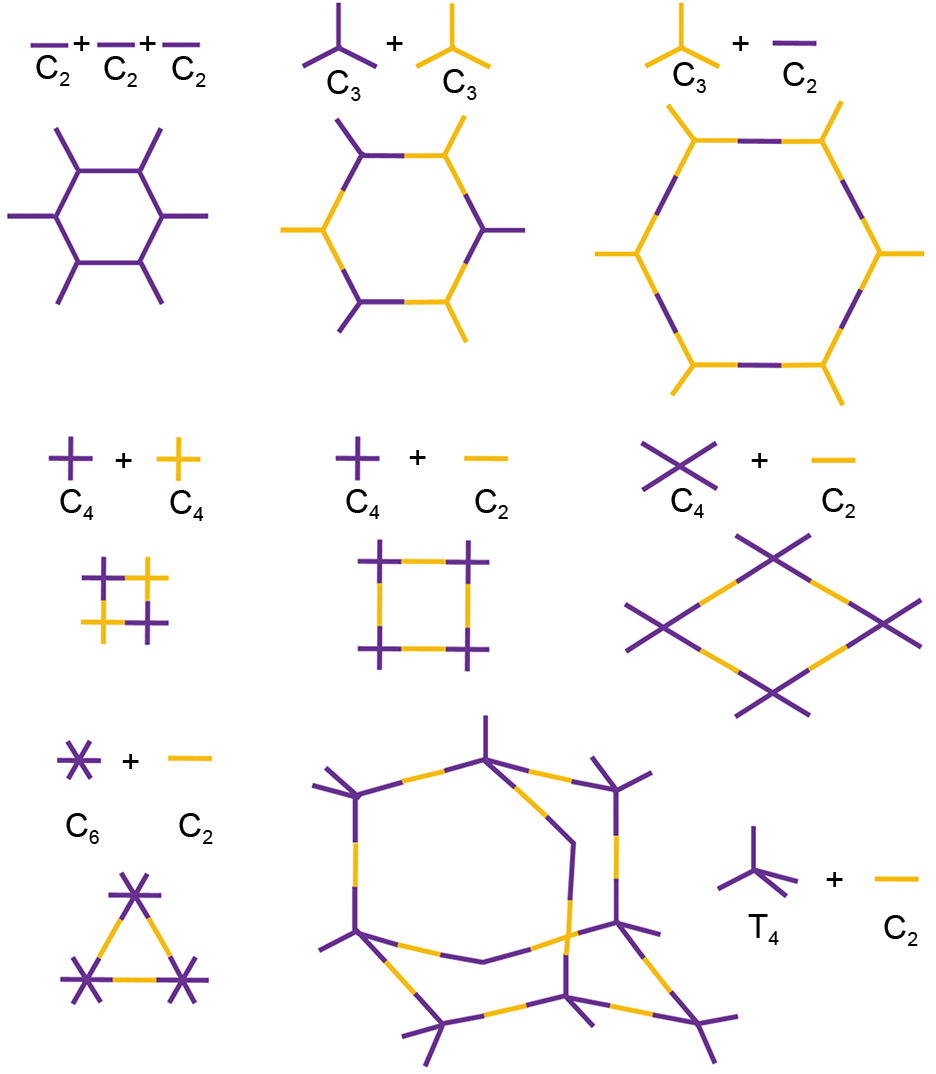
The architectural diversity of COFs is dictated by the geometric symmetry of building blocks, primarily manifesting as two-dimensional (2D) or three-dimensional (3D) frameworks (Figure 1). For 2D COFs, common topological designs are primarily based on combinations such as C2 + C2, C2 + C3, C3 + C3, and C2 + C4 symmetries. Extending the polymeric framework into a 3D network to construct 3D COFs generally requires the use of building blocks with orthogonal geometries, such as T4 or C2 units. Thus, by strategically selecting molecular components with specific geometric shapes and connectivity, it is feasible to design porous materials that possess both structural and functional diversity. 2D COF structures typically display hexagonal, rhombic, square, and triangular [37]. In contrast, the development of 3D COFs remains comparatively limited, primarily due to challenges in synthesis and the scarcity of suitable molecular building blocks capable of forming 3D networks.
The structural integrity and functional properties of COFs are fundamentally governed by their linkage chemistry [38]. The early connection methods mainly include reversible borate esters and imines, but these connection methods have poor chemical stability. This spurred the development of irreversible linkages, including covalent triazine frameworks (CTFs), keto-enamines (via imine tautomerization), and carbon-carbon bonds. Particularly, reactions like Knoevenagel condensation or Aldol condensation form sp2 carbon-carbon bonds, resulting in COFs with exceptional stability against harsh chemical environments. More recently, the highly polar and stable linkage bonds, such as amides, have attracted much attention for their potential applications (such as ion transport). Consequently, the strategic choice of monomers and links is essential to the rational design of COFs since it allows for accurate modification of the framework's symmetry, topology, and porosity to satisfy particular application requirements.
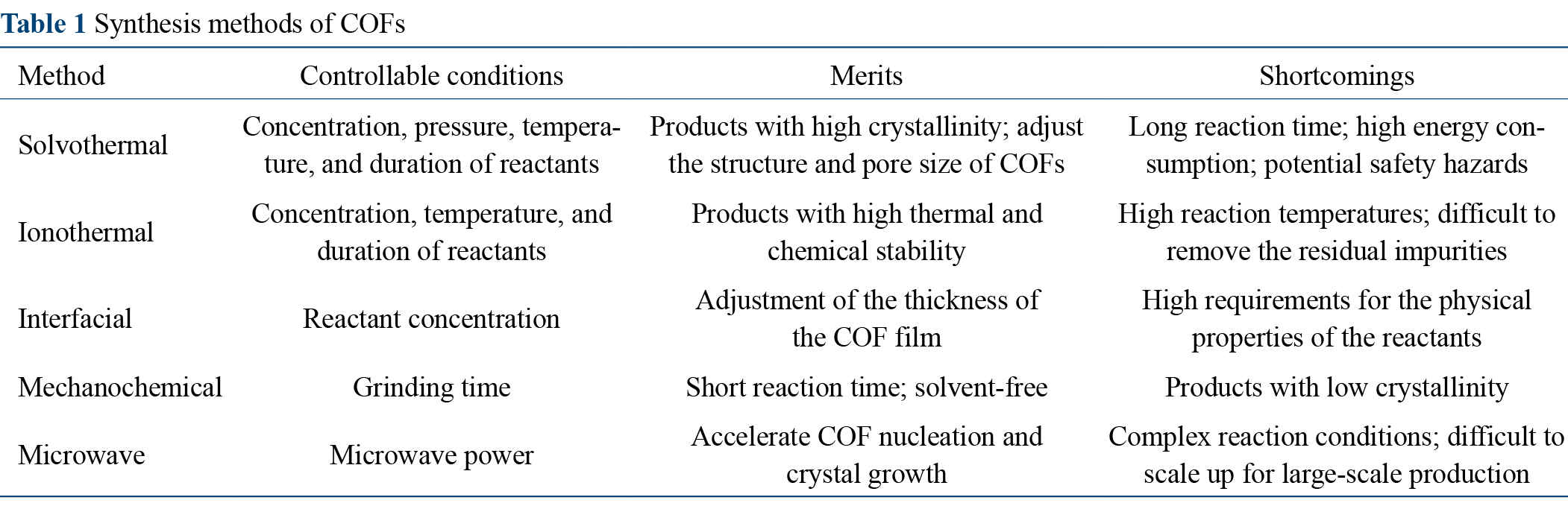
The selection of a synthetic pathway is dictated by the targeted linkage, the desired morphology (e.g., powders and thin films), and the specific application requirements, driving continuous innovation in synthetic methodologies. Currently, the primary synthetic methodologies for COFs can be categorized into solvothermal, ionothermal, interfacial polymerization, mechanochemical, and microwave-assisted approaches [39–41] (Table 1).
Solvothermal synthesis stands as a pioneering methodology in the field of COFs [33]. This technique is typically conducted in a sealed vessel at temperatures above the normal boiling point of the solvent, generating autogenous pressure. Its key advantage lies in the thermal energy provided, which facilitates the reversible reactions characteristic of dynamic covalent chemistry. Seminal examples, such as the boroxine-linked COF-1 and the imine-linked COF-300, were successfully synthesized via this route. However, the method is also associated with notable limitations, including prolonged reaction times (typically 3–7 days), high energy consumption, and potential safety hazards arising from the high-pressure conditions.
Ionothermal synthesis is primarily employed for the fabrication of CTFs [42]. This method utilizes molten inorganic salts, such as zinc chloride, which function simultaneously as both solvent and catalyst. The Lewis acidity of ZnCl2 efficiently catalyzes the cyclotrimerization of nitrile-based monomers, leading to the formation of stable triazine linkages. A notable advantage of the ionothermal approach is its capability to produce CTF materials with exceptionally high thermal and chemical stability. However, this method also presents significant drawbacks, including extremely high reaction temperatures (typically exceeding 400°C), a strongly acidic reaction medium that may degrade acid-labile functional groups, and considerable difficulty in the complete removal of metal salt residues post-synthesis.
Interfacial polymerization has emerged as a pivotal strategy to address the challenge of processing COF into continuous thin films [43]. This approach confines the polymerization reaction at the interface between two immiscible phases. Typically, one contains an amine-based monomer and the other an aldehyde-based monomer. By restricting the reaction to a narrow liquid–liquid or liquid–gas interfacial region, it enables the bottom-up growth of continuous, large-area, and thickness-tunable COF films. Nevertheless, challenges remain in precisely controlling interfacial stability and reaction kinetics, as well as in ensuring film uniformity during scale-up.
Mechanochemical synthesis significantly reduces reaction time and eliminates solvent waste generation [44]. The microwave-assisted synthesis leverages efficient, volumetric microwave heating to dramatically accelerate COF nucleation and crystal growth. This method serves as a highly effective approach for rapid parameter optimization and powder production, although its scalability remains a challenge.
The growing utilization of COFs for modulating interfacial chemistry in LMBs stems from their highly customizable crystalline structures and finely tunable chemical compositions [45]. The regular 1D nanochannels inherent to COFs serve as exclusive transport pathways for Li+, effectively homogenizing the interfacial ion flux and thereby suppressing the nucleation and growth of lithium dendrites. Concurrently, lithiophilic functional groups within the pores (such as carbonyl, imine, and nitrogen-rich triazine groups) can weaken the solvation sheath of Li+ via strong Lewis acid-base interactions, significantly reducing the desolvation energy barrier to accelerate interfacial reaction kinetics. Furthermore, these functional groups act as efficient nucleation sites, promoting the formation of a uniform lithium deposition layer and reducing the nucleation overpotential. Therefore, the applications of COFs in LMBs as functional separators, artificial SEI layers, and solid-state electrolytes are reviewed in this section.
To design a separator capable of sustaining stable cycling in challenging conditions for LMBs, it is crucial to ensure superior ion conduction for efficient Li deposition/stripping and the ability to foster a stable electrode-electrolyte interface that can protect the electrodes under extreme operational circumstances. As a key component in direct contact with electrodes, the separator's properties are decisive for interfacial stability in LMBs. Consequently, functional modification of the separator has evolved from merely fulfilling the basic requirement of physical isolation into an effective strategy for actively regulating interfacial chemistry and guiding uniform lithium deposition. By designing functional separators to induce a stable electrode-electrolyte interface, it is possible to simultaneously optimize Li-ion transport kinetics and deposition homogeneity, thereby enhancing overall battery performance. Nevertheless, the precise design and selection of modification materials capable of achieving a highly stable interface remains a core challenge in this field.
The COFs possess significant structural tunability, enabling the rational design of frameworks with tailored physical and chemical properties to satisfy specific application demands by strategies such as monomer selection and post-synthetic ionic exchange. On this basis, Hu et al. fabricated a SnF2 and NO3−-rich composite separator (PCS) by coating a polypropylene (PP) substrate with a functional EB-COF:NO3@SnF2 material, aiming to establish a stable SEI for effective dendrite suppression [12]. First, the EB-COF:Br@SnF2 precursor was prepared using ethidium bromide (EB), 1,3,5-triformylphloroglucinol (TFP), and nano SnF2. Then the obtained precursor was subjected to ion exchange by dispersing it in 15 mL of a saturated lithium nitrate solution in methanol, yielding the target product EB-COF:NO3@SnF2. The synthesized COF and polyvinylidene difluoride (PVDF) were dispersed in N-Methylpyrrolidone for forming a slurry to prepare the PCS (Figure 2A). The interaction between the EB-COF:NO3 framework and Li+ not only facilitated Li+ desolvation, thereby promoting its migration, but also enabled the release of NO3− anions to participate in the formation of a stable SEI on the Li anode (Figure 2B). Furthermore, the positively charged frameworks immobilize anions and polar solvent molecules, which can effectively decrease their decomposition at the electrode surface and enhance overall electrolyte stability. The SnF2 provided F-containing species to form a robust SEI, while the in-situ formed Li–Sn alloy concurrently reduced the energy barrier for Li+ transport. Thus, the application of the PCS facilitated the in-situ formation of a reinforced SEI, containing beneficial species such as Li3N, LiNxOy, LiF, and Li5Sn2 alloy, which collectively contributed to the significantly enhanced electrochemical performance of the LMBs. The Li||NCM811 cell, configured with a high loading of 3.9 mAh cm−2 and a lean electrolyte (6 μL mAh−1), demonstrated the enhanced capacity retention of 95.9% after 150 cycles (Figure 2C).
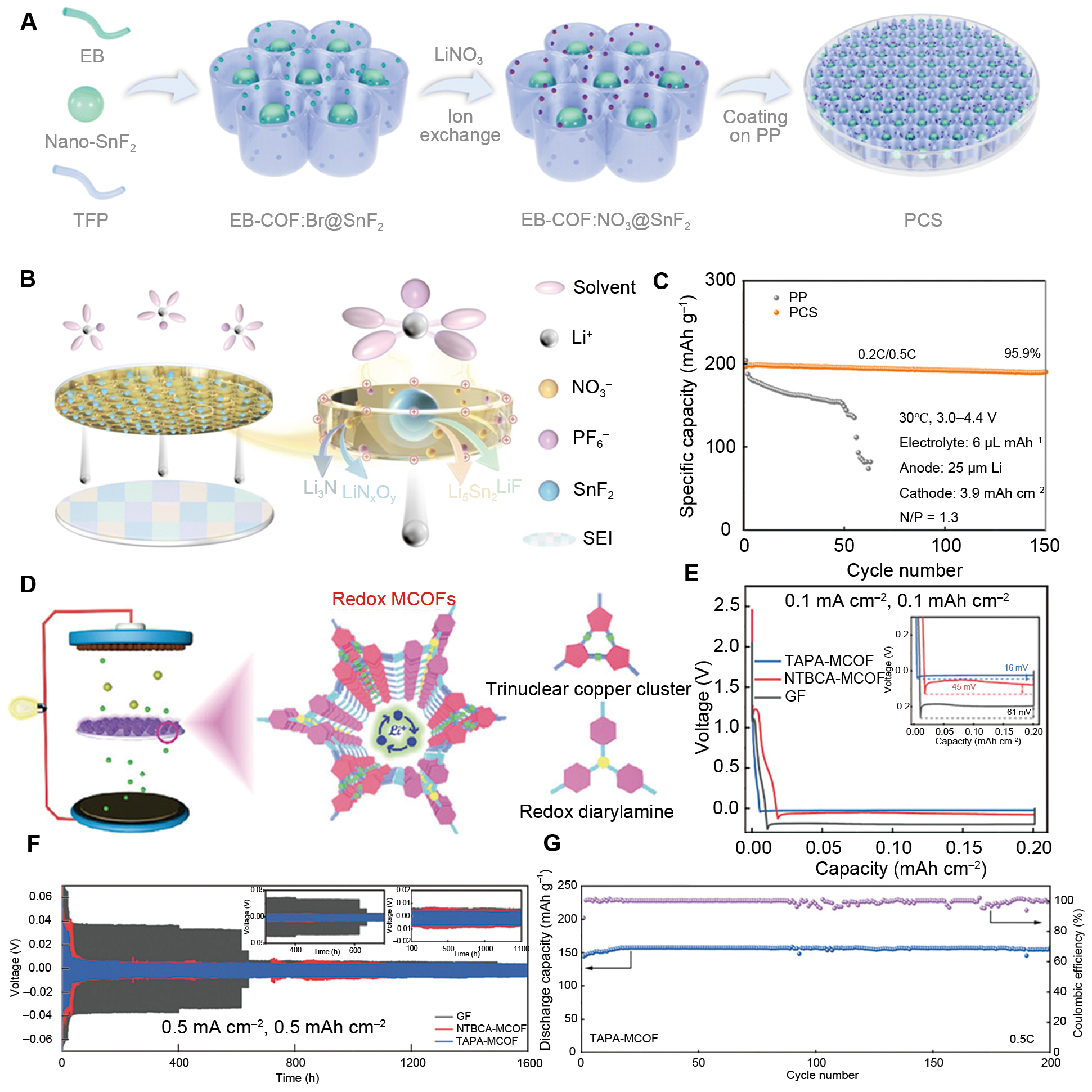
The introduction of dual electron-rich groups into COFs provides an effective strategy for optimizing their electronic structure. This molecular engineering approach homogenizes the local charge distribution at active sites and refines the coordination microenvironment for lithium ions, thereby enhancing electrochemical performance. Based on the aforementioned strategy, Zhai and colleagues designed and synthesized two types of redox-active metal-covalent organic frameworks (TAPA-MCOF and NTBCA-MCOF) [13]. These materials structurally integrated an electron-rich trinuclear copper cluster and redox-active diarylamine units with differentiated electron-donating capabilities (Figure 2D). When coated onto separator surfaces, these MCOFs functioned as interfacial layers to cooperatively regulate lithium nucleation behavior and lithium-ion transport kinetics. Experimental evidence confirms that the active sites in the Cu3Py3 and the diarylamine units act synergistically to optimize the local lithium-ion coordination microenvironment, thereby guiding uniform lithium nucleation. The optimized electrode interface delivered multifaceted performance enhancements. The Li||Cu cell exhibited a low Li nucleation overpotential of only 16 mV (Figure 2E), and the Li||Li symmetric cell sustained stable cycling for over 1,600 hours at 0.5 mA cm−2 (Figure 2F). The LiFePO4-based battery achieved a remarkable capacity retention of approximately 98% (Figure 2G), underscoring its practical potential.
Constructing an artificial SEI on lithium metal anodes represents a promising approach to enhance interfacial stability and curtail detrimental side reactions with electrolytes, thereby mitigating dendrite formation. An ideal artificial SEI should demonstrate exceptional electrochemical, chemical, and mechanical robustness. Furthermore, its architecture should be both uniform and compact to enable homogeneous Li+ flux and provide high lithium-ion conductivity (σLi+). A fundamental limitation of conventional liquid electrolytes is their low Li⁺ transference number, wherein the dominant contribution of anions to the total ionic conductivity (σ) leads directly to Li⁺ depletion during cycling [46, 47]. Thus, engineering an electrolyte-derived interphase capable of facilitating selective and high-rate Li+ transport to address the critical issue of Li+ depletion, effectively inhibiting dendrites without compromising overall cell performance.
COFs functionalized with ion-conducting groups are excellent electrolyte-based interphasial materials because of their strong Li+ conductivities and stabilities. Kim et al. designed a COF with redox-active and ionic groups integrated into its backbone, enabling simultaneous Li+ and electron transport and its successful deployment as an SEI in LMBs [18]. The redox-active molecule 2,3,6,7-tetrahydroxy-9,10-anthraquinone (THAQ) served as the building block for AQ-Si-COF, which featured a three-fold symmetric structure formed by hypervalent silicate linkages (Figure 3A). The AQ-Si-COF-based SEI functioned to selectively adsorb and store Li+ ions from the electrolyte during cycling (Figure 3B). This unique capability contributed to an enhanced specific capacity and improved cycling stability. When paired with a LiCoO2 cathode and operated at high voltage, the cells delivered a maximum reversible capacity of 188 mAh g−1 at 0.25C (Figure 3C). The cell also exhibited excellent cycling stability, with a capacity fade of less than 3% over 100 cycles, along with suppressed Li dendrite growth (Figure 3D).
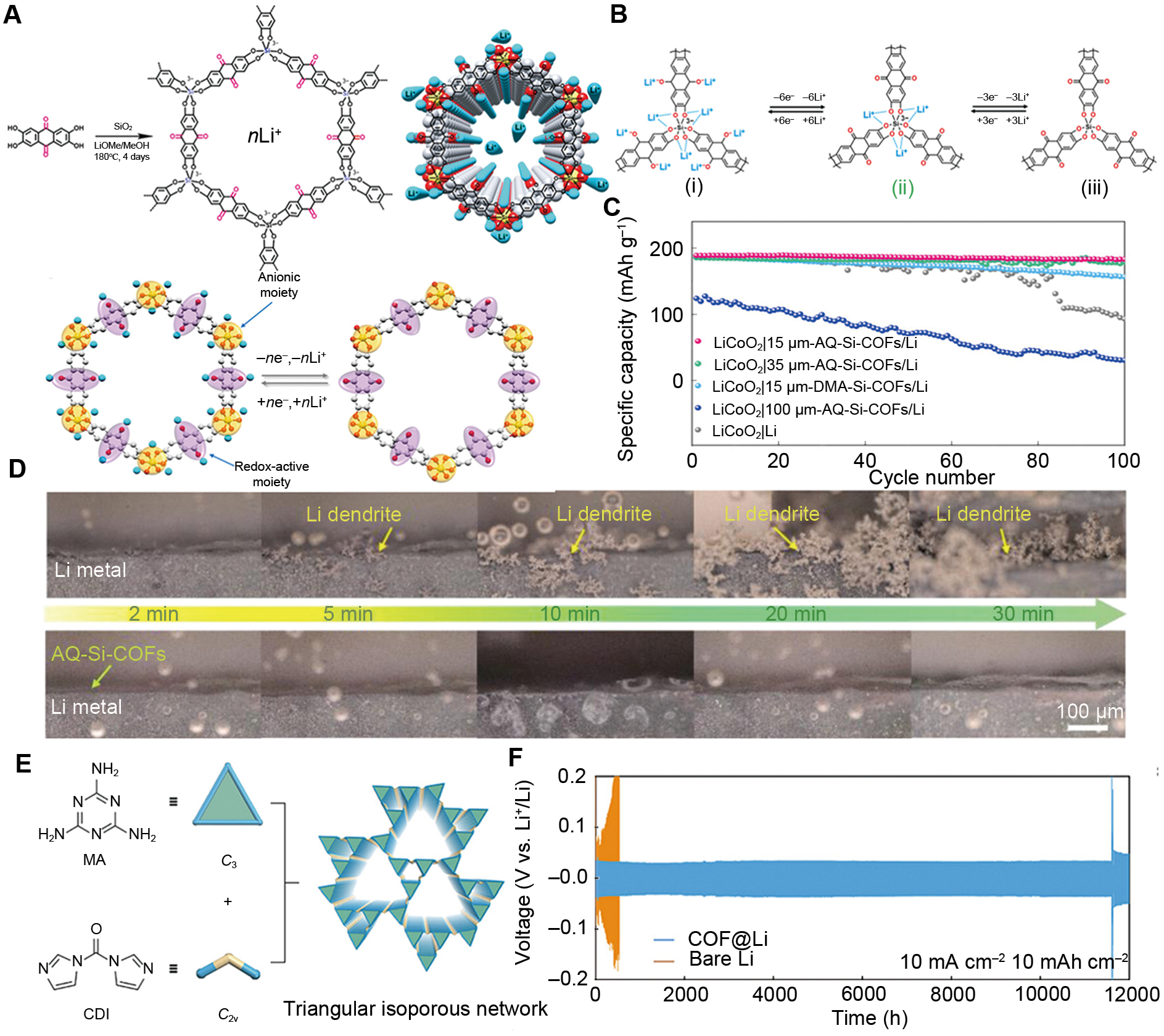
The artificial SEI with high Li+ conductivity (> 10−4 S cm−1) can be constructed by incorporating abundant Li─N bond species [48, 49]. These bonds have been demonstrated to effectively lower the energy barrier for Li+ migration and boost Li+ flux [50]. Accordingly, increasing the amount of nitrogen within artificial SEI is a direct and effective strategy to enhance LMBs' performance. A central challenge in designing Li─N-rich artificial SEIs is overcoming their inherent structural disorder to achieve uniform Li+ transport. COFs, with their intrinsic ordered pores, offer a promising platform, yet their practical application is constrained by a trade-off between high nitrogen content and crystallinity [51]. The low reactivity of N-rich building blocks like melamine often results in poorly crystalline materials, making the integration of chaotic nitrogen-rich units into periodic crystalline networks a pivotal and demanding goal in the field [52–55]. A strategy reported by Ke et al. utilized the high dynamicity of N,N'-Carbonyldiimidazole (CDI)-derived urea linkages to overcome the low reactivity of nitrogen-rich melamine, achieving the synthesis of a novel urea-linked COF (COF-531) to construct high-performance artificial SEI [16] (Figure 3E). The COF-531, featuring regularly ordered pore structures and an exceptionally high nitrogen content of 50.9 wt%, provided abundant lithiophilic sites. When deployed as an interfacial layer on lithium metal anodes, it served as a Li+-guided channel that enhanced desolvation kinetics, facilitated rapid transport, and promoted uniform Li deposition, thereby effectively suppressing dendrite growth. The efficacy of this approach was underscored by the outstanding performance of COF@Li symmetric cells, which achieved ultra-stable cycling for over 11,500 hours at 10 mA cm−2 in a carbonate-based electrolyte (Figure 3F).
The solid-state LMBs based on solid polymer electrolytes (SPEs) represent a promising technological direction, owing to their intrinsic safety and favorable interfacial properties. Within this context, poly(vinylidene fluoride co-hexafluoropropylene) (PVDF-HFP) has garnered significant attention as a matrix for advanced SPEs, primarily due to its remarkable electrochemical stability, interfacial compatibility, and film-forming processability [56, 57].
However, the high rigidity of PVDF-HFP induces poor interfacial contact, severely limiting practical battery performance by fostering unstable Li deposition. To mitigate this, a strategy focused on optimizing the electron density of the PVDF-HFP-based SPE has been developed. This strategy concurrently enhances Li+ transport kinetics and promotes the formation of a LiF-rich SEI from TFSI- decomposition, leading to uniform lithium deposition and dendrite suppression. It's worth noting that the topologically ordered columnar π-arrays within COFs facilitate rapid charge carrier transport [58], making them exceptional materials for precisely modulating the electron density of PVDF-HFP-based SPEs. Thus, Liu and co-workers designed and synthesized donor-acceptor (D-A) COFs to modulate the electron density of PVDF-HFP-based SPEs, thereby achieving high-performance solid-state LMBs [23]. The D-A COF (Br-COF) was synthesized from tetra(p-aminophenyl)porphyrin (TAPP) and 2,5-dibromo-terephthalaldehyde (TA-Br). The D-A structure enabled rapid electron transfer via a push-pull effect, creating an electron-rich environment that promoted TFSI− decomposition to yield a LiF-rich SEI (Figure 4A). Concurrently, the lithophilic sites weaken TFSI−–Li+ interaction for accelerating Li+ migration. Therefore, the Li||Li symmetric cells with the Br-COF@PVDF-HFP electrolyte demonstrated an extended cycling stability of 3,000 hours (Figure 4B). Furthermore, Li|Br-COF@PVDF-HFP|LFP cell exhibited remarkable long-term cyclability, maintaining 71.4% capacity retention over 2,000 cycles (Figure 4C).
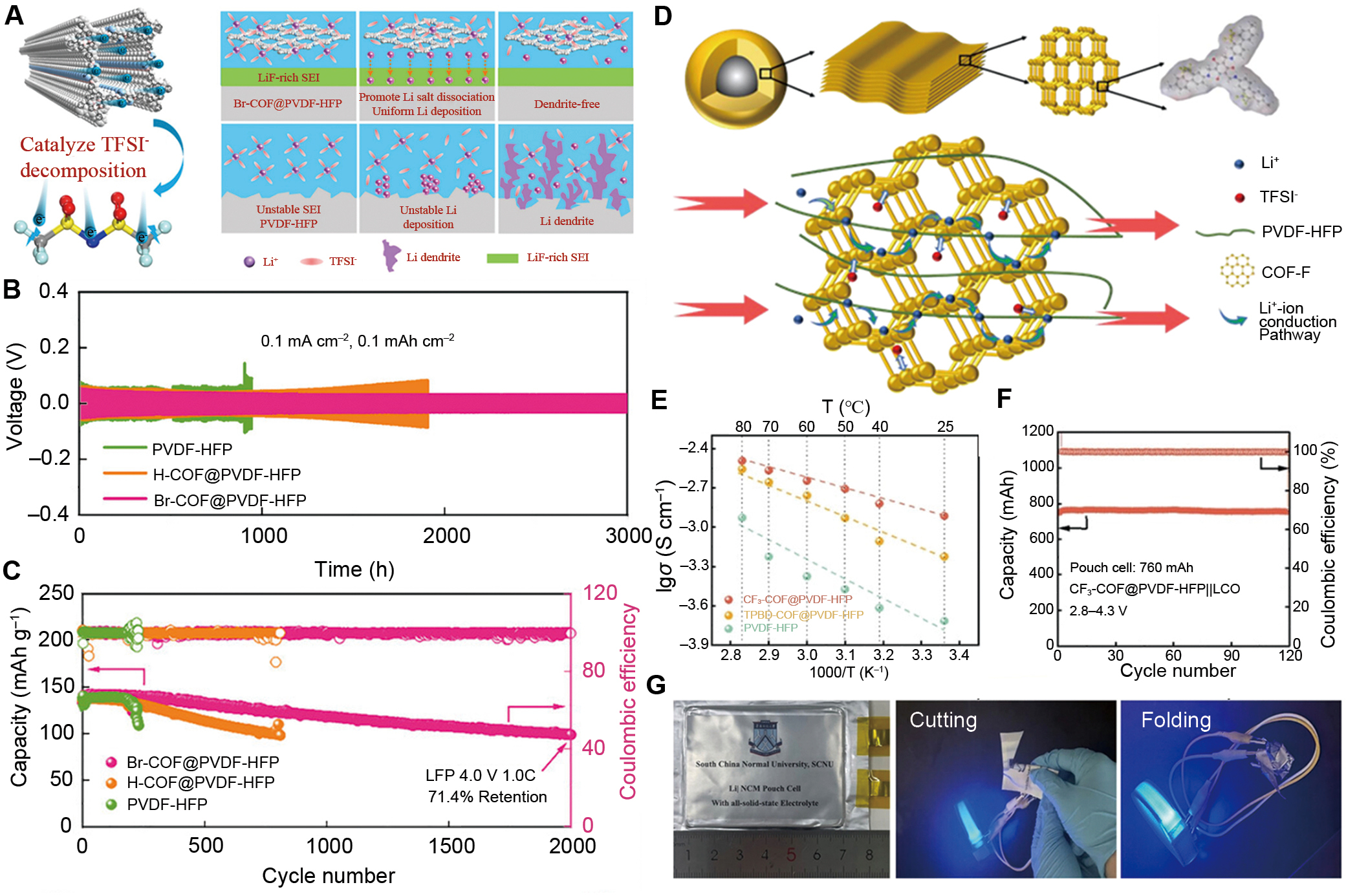
Furthermore, there is an urgent need for designing efficient ion transport pathways within PVDF-HFP based SPEs to concurrently boost ionic conductivity, structural robustness, and interfacial stability for the practical application of LMBs. Chen and his colleagues added a fluorinated COF (CF3-COF) as a functional filler into the PVDF-HFP matrix to build efficient ion transport channel [21] (Figure 4D). The uniform incorporation of PVDF-HFP into the CF₃-COF pores generated a nanoconfined environment that disrupts polymer crystallinity and selectively enhances Li+ mobility [54]. This configuration established a continuous conductive pathway along the COF-polymer interface, capitalizing on the strengths of both materials. A synergistic effect between the −CF3 groups of both components further created stable transport sites, reducing the polymer's affinity for Li+ and thereby facilitating ion-pair dissociation to yield a stable network for efficient ion conduction. Consequently, the ultra-thin SPE showed a remarkably high ionic conductivity of 1.21 × 10⁻³ S cm−1 (Figure 4E), endowing the symmetric cells with outstanding cycling stability. Moreover, a corresponding LCO/Li pouch cell delivered a high specific capacity of 760 mAh and retained 96% of its capacity after cycling (Figure 4F, G).
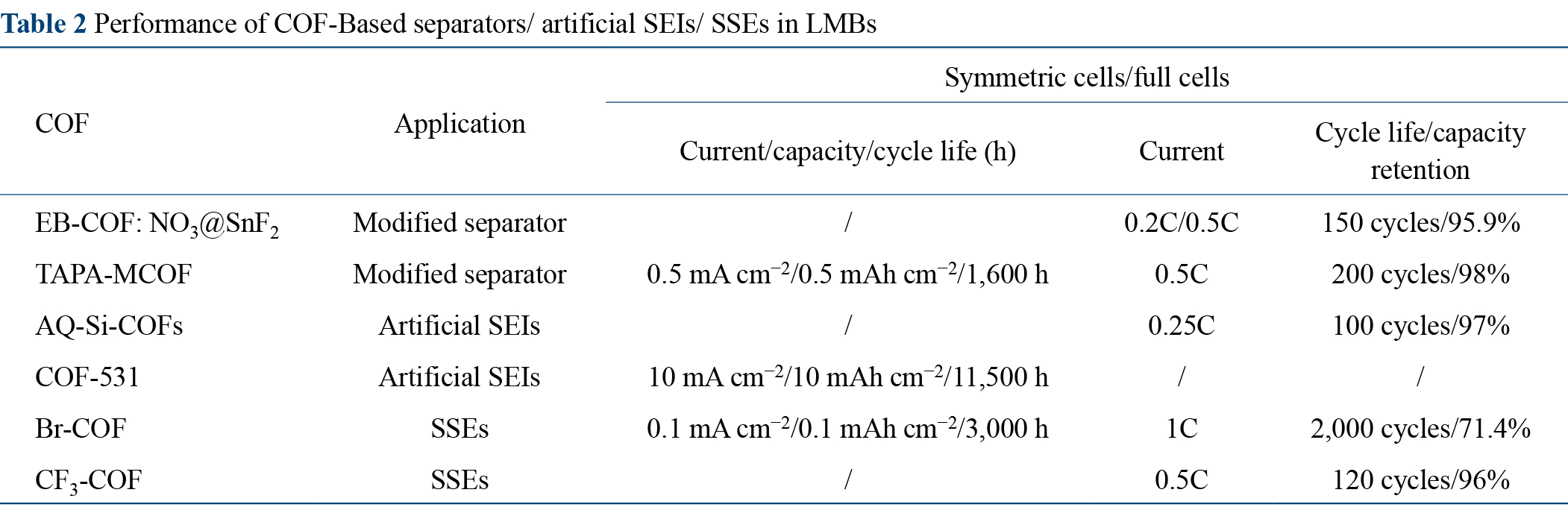
Owing to a combination of high surface area, precisely engineered porous structures, and superior chemical stability, COFs have demonstrated significant potential for improving the performance of LMBs. This review has focused on the application of COFs as interfacial regulators in key components, including SSE, separators, and SEI modifiers. Their ability to precisely control interfacial chemistry not only addresses critical challenges in battery performance but also pioneers a new paradigm for the design of next-generation energy storage devices (Table 2).
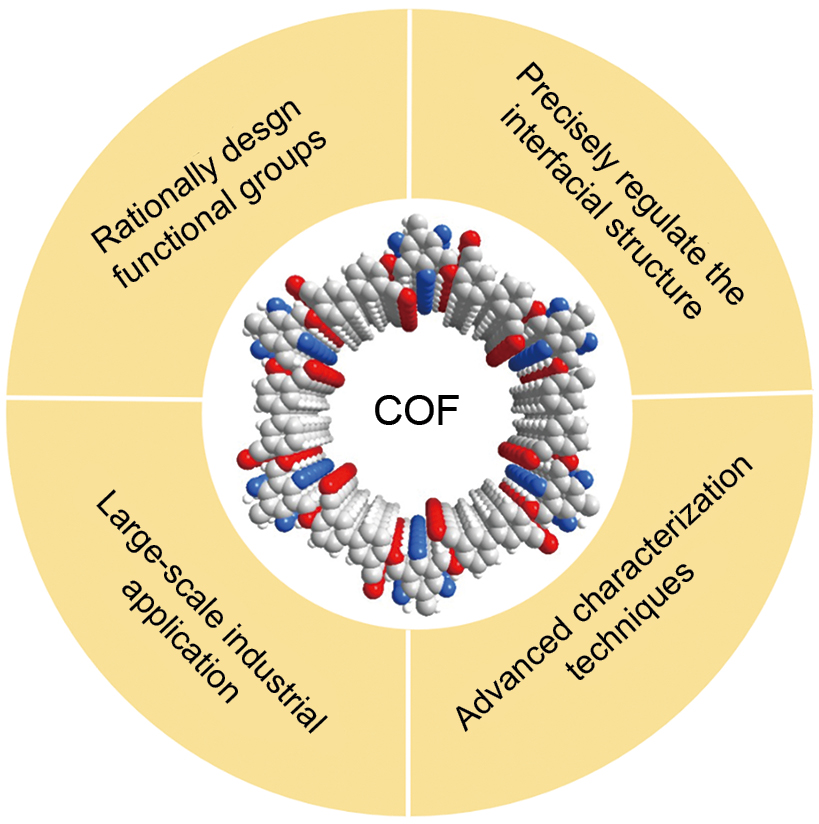
Looking forward, the application of COFs in LMBs remains in its early stages. To further optimize the interfacial chemistry between the electrode and electrolyte, it is imperative to rationally design functional groups and precisely regulate the interfacial structure. This will not only enhance ion transport kinetics and interfacial stability but also establish a fundamental basis for extending these strategies to other battery systems. Moreover, the development of green and efficient synthesis strategies is important for advancing COF materials from laboratory research toward large-scale industrial applications. Coordinated efforts are necessary to gain a thorough understanding of the mechanism of COFs in LMBs and to realistically assess their potential. This includes determining the dynamic interfacial evolution and ion transport kinetics using in situ techniques (such as Raman, X-ray photoelectron spectroscopy, X-ray diffraction, and Fourier-transform infrared spectroscopy) and thoroughly assessing cycling stability in commercial pouch and cylindrical cells to confirm performance improvements and practical applicability (Figure 5).
Qi An: Writing-original draft; conceptualization. Lu Liu: Resources. Panpan Mao: Formal analysis. Fanyu Xie: Writing–review & editing. Yufeng Fan: Writing–review & editing. Huaiyu Shao: Writing–review & editing. Hong Cuo: Writing–review & editing; conceptualization.
This work was supported by the National Natural Science Foundation of China (Grant No. 52372232), the Major Science and Technology Projects of Yunnan Province (Grant No. 202302AB080019-3), the National Natural Science Foundation of Yunnan Province (Grant Nos. 202301AS070040 and 202301AU070209), the Scientific Research Fund Project of Yunnan Provincial Department of Education (Grant No. 2024Y040), and the Science and Technology Project for Universities of Yunnan Province to Serve Key Industries—Doctoral Students Project for Cultivating Industrial Scientific Research Innovation (Grant No. FWCY-BSPY2024030).
The data that support the findings of this study are available from the corresponding author upon reasonable request.
B. Liu, J. G. Zhang, and W. Xu, "Advancing Lithium Metal Batteries," Joule 2, no. 5 (2018): 833–845, https://doi.org/10.1016/j.joule.2018.03.008.
L. C. Kong, Y. Li, C. Peng, et al., "Achieving Burst Li+ Channels via Quasi-Two-Dimensional Fluorinated Metal-Organic Framework Modulating Functionalized Interface," Nature Communications 16 (2025): 1885, https://doi.org/10.1038/s41467-025-57106-z.
C. Zhang, J. M. Yu, Y. Y. Cui, et al., "An Electron-Blocking Interface for Garnet-Based Quasi-Solid-State Lithium-Metal Batteries to Improve Lifespan," Nature Communications 15 (2024): 5325, https://doi.org/10.1038/s41467-024-49715-x.
Y. J. Lei, L. F. Zhao, W. H. Lai, et al., "Electrochemical Coupling in Subnanometer Pores/Channels for Rechargeable Batteries," Chemical Society Reviews 53, no. 8 (2024): 3829–3895, https://doi.org/10.1039/D3CS01043K.
Y. J. Lei, X. X. Lu, H. Yoshikawa, et al., "Understanding the Charge Transfer Effects of Single Atoms for Boosting the Performance of Na-S Batteries," Nature Communications 15 (2024): 3325, https://doi.org/10.1038/s41467-024-47628-3.
L. F. Zhao, Y. Tao, Y. Y. Zhang, et al., "A Critical Review on Room-Temperature Sodium-Sulfur Batteries: from Research Advances to Practical Perspectives," Advanced Materials 36, no. 25 (2024): 2402337, https://doi.org/10.1002/adma.202402337.
Q. An, Q. Liu, P. P. Mao, et al., "Developing the Tandem Structure to Regulate Interfacial Chemistry and Promote Ion Transport Kinetics toward High-Voltage Lithium Metal Batteries," Angewandte Chemie International Edition 64, no. 19 (2025): e202422539, https://doi.org/10.1002/anie.202422539.
M. S. Kim, Z. W. Zhang, P. E. Rudnicki, et al., "Suspension Electrolyte with Modified Li+ Solvation Environment for Lithium Metal Batteries," Nature Materials 21 (2022): 445–454, https://doi.org/10.1038/s41563-021-01172-3.
Z. W. Zhang, Y. Z. Li, R. Xu, et al., "Capturing the Swelling of Solid-Electrolyte Interphase in Lithium Metal Batteries," Science 375 (2022): 66–70, https://doi.org/10.1126/science.abi8703.
Y. Zhao, T. H. Zhou, T. Ashirov, et al., "Fluorinated Ether Electrolyte with Controlled Solvation Structure for High Voltage Lithium Metal Batteries," Nature Communications 13 (2022): 2575, https://doi.org/10.1038/s41467-022-29199-3.
Q. An, H. E. Wang, G. F. Zhao, et al., "Understanding Dual-Polar Group Functionalized COFs for Accelerating Li-ion Transport and Dendrite-Free Deposition in Lithium Metal Anodes," Energy Environmental Materials 6, no. 2 (2023): e12345, https://doi.org/10.1002/eem2.12345.
Y. C. Wen, J. Y. Ding, J. Liu, M. Zhu, and R. Z. Hu, "A Separator Rich in SnF2 and NO3- Directs an Ultra-Stable Interface toward High Performance Li Metal Batteries," Energy Environmental Science 16, no. 7 (2023): 2957–2967, https://doi.org/10.1039/D3EE00664F.
W. L. Qin, D. D. Han, X. W. Zhang, et al., "Redox-Active Metal-Covalent Organic Frameworks for Dendrite-Free Lithium Metal Batteries," Advanced Materials 37, no. 14 (2025): 2418638, https://doi.org/10.1002/adma.202418638.
Q. An, L. L. Wang, G. F. Zhao, et al., "Constructing Cooperative Interface via Bi-Functional COF for Facilitating the Sulfur Conversion and Li+ Dynamics," Advanced Materials 36, no. 4 (2024): 2305818, https://doi.org/10.1002/adma.202305818.
Y. Yang, Z. Y. Sun, Y. W. Wu, et al., "Porous Organic Framework Materials (MOF, COF, and HOF) as the Multifunctional Separator for Rechargeable Lithium Metal Batteries," Small 20, no. 37 (2024): 2401457, https://doi.org/10.1002/smll.202401457.
C. H. Zhang, Z. Luo, K. A. Chen, et al., "Urea-Linked Covalent Organic Framework as a Li-Ion Guided Channel Enabling Ultra-Stable Lithium Metal Anode in Carbonate-Based Electrolyte," Angewandte Chemie International Edition 64, no. 22 (2025): e202500314, https://doi.org/10.1002/anie.202500314.
Y. X. Yang, C. H. Zhang, G. F. Zhao, et al., "Regulating the Electron Structure of Covalent Organic Frameworks by Strong Electron-Withdrawing Nitro to Construct Specific Li+ Oriented Channel," Advanced Energy Materials 13, no. 26 (2023): 2300725, https://doi.org/10.1002/aenm.202300725.
C. Li, D. D. Wang, G. S. Ho, et al., "Anthraquinone-Based Silicate Covalent Organic Frameworks as Solid Electrolyte Interphase for High-Performance Lithium-Metal Batteries," Journal of the American Chemical Society 145, no. 45 (2023): 24603–24614, https://doi.org/10.1021/jacs.3c06723.
C. H. Zhang, J. Y. Xie, C. T. Zhao, et al., "Regulating the Lithium Ions’ Local Coordination Environment through Designing a COF with Single Atomic Co Site to Achieve Dendrite-Free Lithium-Metal Batteries," Advanced Materials 35, no. 40 (2023): 2304511, https://doi.org/10.1002/adma.202304511.
L. G. Yue, X. Y. Wang, L. Chen, et al., "In Situ Interface Engineering of Highly Nitrogen Rich Triazine-Based Covalent Organic Frameworks for an Ultra-Stable, Dendrite-Free Lithium-Metal Anode," Energy Environmental Science 17, no. 3 (2024): 1117–1131, https://doi.org/10.1039/D3EE02803H.
G. Feng, Q. Y. Ma, D. Luo, et al., "Designing Cooperative Ion Transport Pathway in Ultra-Thin Solid-State Electrolytes toward Practical Lithium Metal Batteries," Angewandte Chemie International Edition 64, no. 1 (2025): e202413306, https://doi.org/10.1002/anie.202413306.
S. Y. Yu, G. F. Zhao, H. Y. Zhu, et al., "Constructing Donor-Acceptor Li+ Transfer Channels Based on Covalent Organic Frameworks for Quasi-Solid-State Li Batteries," Science China Chemistry 68 (2025): 6073–6082, https://doi.org/10.1007/s11426-025-2882-7.
C. H. Zhang, L. W. Zhao, F. K. Li, et al., "Optimizing the Electron Density of PVDF-HFP-Based Solid Polymer Electrolyte by Donor-Acceptor COF toward High-Performance Solid-State Lithium Metal Batteries," Advanced Materials 37, no. 44 (2025): e13427, https://doi.org/10.1002/adma.202513427.
G. F. Zhao, H. Ma, C. H. Zhang, et al., "Constructing Donor–Acceptor‑Linked COFs Electrolytes to Regulate Electron Density and Accelerate the Li+ Migration in Quasi‑Solid‑State Battery," Nano-Micro Letters 17 (2025): 21, https://doi.org/10.1007/s40820-024-01509-y.
W. Z. Liang, X. Y. Zhou, B. Zhang, et al., "The Versatile Establishment of Charge Storage in Polymer Solid Electrolyte with Enhanced Charge Transfer for LiF-Rich SEI Generation in Lithium Metal Batteries," Angewandte Chemie International Edition 63, no. 18 (2024): e202320149, https://doi.org/10.1002/anie.202320149.
X. Y. Xu, S. Q. Zhang, K. Xu, H. Z. Chen, X. L. Fan, and N. Huang, "Janus Dione-Based Conjugated Covalent Organic Frameworks with High Conductivity as Superior Cathode Materials," Journal of the American Chemical Society 145, no. 2 (2023): 1022–1030, https://doi.org/10.1021/jacs.2c10509.
Z. D. Zhao, W. J. Chen, S. Impeng, et al., "Covalent Organic Framework-Based Ultrathin Crystalline Porous Film: Manipulating Uniformity of Fluoride Distribution for Stabilizing Lithium Metal Anode," Journal of Materials Chemistry A 8, no. 6 (2020): 3459–3467, https://doi.org/10.1039/C9TA13384D.
Y. F. Yuan, Z. Y. Zhang, Z. Y. Zhang, et al., "Highly Conductive Imidazolate Covalent Organic Frameworks with Ether Chains as Solid Electrolytes for Lithium Metal Batteries," Angewandte Chemie International Edition 63, no. 18 (2024): e202402202, https://doi.org/10.1002/anie.202402202.
C. Q. Li, A. Yu, W. K. Zhao, et al., "Extending the π-Conjugation of a Donor-Acceptor Covalent Organic Framework for High-Rate and High-Capacity Lithium-Ion Batteries," Angewandte Chemie International Edition 63, no. 48 (2024): e202409421, https://doi.org/10.1002/anie.202409421.
S. Zheng, Y. B. Fu, C. Song, et al., "Anode-Protective Covalent Organic Framework Layer with Synergistic Cation–Anion Regulation for Dendrite-Free Lithium Metal Batteries," Journal of the American Chemical Society 147, no. 34 (2025): 31249–31259, https://doi.org/10.1021/jacs.5c10386.
Y. X. Chen, J. He, M. J. Li, et al., "Regulation of Interfacial Ion Transport via Honeycomb-Architected Covalent Organic Frameworks for Lithium Metal Batteries," Advanced Materials 38, no. 4 (2026): e12997, https://doi.org/10.1002/adma.202512997.
M. H. Gu, J. X. Wu, C. Li, et al., "Mechanically Assisted Li+-Conduction in Crown Ether-Covalent Organic Frameworks for Lithium Metal Batteries," Advanced Materials 38, no. 5 (2026): e11473, https://doi.org/10.1002/adma.202511473.
A. P. Coˆt́e, A. I. Benin, N. W. Ockwig, M. O’Keeffe, A. J. Matzger, and O. M. Yaghi, "Porous, Crystalline, Covalent Organic Frameworks," Science 310, no. 5751 (2005): 1166–1170, https://doi.org/10.1126/science.1120411.
Z. W. Yang, J. J. Li, Y. H. Wang, et al., "Metal/Covalent-Organic Framework-Based Biosensors for Nucleic Acid Detection," Coordination Chemistry Reviews 491, no. 15 (2023): 215249, https://doi.org/10.1016/j.ccr.2023.215249.
H. H. Pan, Y. F. Ren, and Q. Wang, "New Vitality of Covalent Organic Frameworks Endued by Phthalocyanine: Yesterday, Today, and Tomorrow," Coordination Chemistry Reviews 527, no. 15 (2025): 216404, https://doi.org/10.1016/j.ccr.2024.216404.
L. Goswami, A. Kushwaha, M. Shabbir, P. K. Dikshit, S. Oh, and U. Bhan, "Covalent Organic Frameworks (COFs) and COFs-Based Hybrid Architectonics: A Promising Material Platform for Organic Micropollutants Detection and Removal from Wastewater," Coordination Chemistry Reviews 527, no. 15 (2025): 216398, https://doi.org/10.1016/j.ccr.2024.216398.
K. Y. Geng, T. He, R. Y. Liu, et al., "Covalent Organic Frameworks: Design, Synthesis, and Functions," Chemical Reviews 120, no. 16 (2020): 8814–8933, https://doi.org/10.1021/acs.chemrev.9b00550.
X. J. Sun, M. T. Di, J. Liu, L. Gao, X. M. Yan, and G. H. He, "Continuous Covalent Organic Frameworks Membranes: from Preparation Strategies to Applications," Small 19, no. 44 (2023): 2303757, https://doi.org/10.1002/smll.202303757.
T. Li, Y. Pan, B. B. Shao, et al., "Covalent–Organic Framework (COF)-Core–Shell Composites: Classification, Synthesis, Properties, and Applications," Advanced Functional Materials 33, no. 45 (2023): 2304990, https://doi.org/10.1002/adfm.202304990.
M. Chafiq, A. Chaouiki, and Y. G. Ko, "Advances in COFs for Energy Storage Devices: Harnessing the Potential of Covalent Organic Framework Materials," Energy Storage Materials 63 (2023): 103014, https://doi.org/10.1016/j.ensm.2023.103014.
S. Y. Ding and W. Wang, "Covalent Organic Frameworks (COFs): from Design to Applications," Chemical Society Reviews 42, no. 45 (2013): 548–568, https://doi.org/10.1039/C2CS35072F.
P. Kuhn, M. Antonietti, and A. Thomas, "Porous, Covalent Triazine-Based Frameworks Prepared by Ionothermal Synthesis," Angewandte Chemie International Edition 47, no. 18 (2008): 3450–3453, https://doi.org/10.1002/anie.200705710.
L. Fang, H. Xu, S. Y. Qiu, et al., "Autocatalytic Interfacial Synthesis of Self-Standing Amide-Linked Covalent Organic Framework Membranes," Angewandte Chemie International Edition 64, no. 13 (2025): e202423220, https://doi.org/10.1002/anie.202423220.
S. Chandra, S. Kandambeth, B. P. Biswal, et al., "Chemically Stable Multilayered Covalent Organic Nanosheets from Covalent Organic Frameworks via Mechanical Delamination," Journal of the American Chemical Society 135, no. 47 (2013): 17853–17861, https://doi.org/10.1021/ja408121p.
C. H. Zhang, F. K. Li, T. T. Gu, et al., "Covalent Organic Frameworks for High-Performance Rechargeable Lithium Metal Batteries: Strategy, Mechanism, and Application," Progress in Materials Science 152 (2025): 101455, https://doi.org/10.1016/j.pmatsci.2025.101455.
K. M. Diederichsen, E. J. McShane, and B. D. McCloskey, "Promising Routes to a High Li+ Transference Number Electrolyte for Lithium Ion Batteries," ACS Energy Letters 2, no. 11 (2017): 2563–2575, https://doi.org/10.1021/acsenergylett.7b00792.
Y. M. Hu, L. J. Wayment, C. Haslam, et al., "Covalent Organic Framework Based Lithium-Ion Battery: Fundamental, Design and Characterization," EnergyChem 3, no. 1 (2021): 100048, https://doi.org/10.1016/j.enchem.2020.100048.
B. Q. Xiong, X. W. Zhou, G. L. Xu, et al., "In Situ Construction of an Ultrarobust and Lithiophilic Li-Enriched Li–N Nanoshield for High-Performance Ge-Based Anode Materials," ACS Energy Letters 5, no. 11 (2020): 3490–3497, https://doi.org/10.1021/acsenergylett.0c02121.
Y. Wang, Z. T. Qu, S. T. Geng, et al., "Anode-Free Lithium Metal Batteries Based on an Ultrathin and Respirable Interphase Layer," Angewandte Chemie International Edition 62, no. 27 (2023): e202304978, https://doi.org/10.1002/anie.202304978.
A. J. Hu, W. Chen, X. C. Du, et al., "An Artificial Hybrid Interphase for an Ultrahigh-Rate and Practical Lithium Metal Anode," Energy Environmental Science 14, no. 7 (2021): 4115–4124, https://doi.org/10.1039/D1EE00508A.
Z. H. Li, W. Y. Ji, T.-X. Wang, et al., "Guiding Uniformly Distributed Li–Ion Flux by Lithiophilic Covalent Organic Framework Interlayers for High-Performance Lithium Metal Anodes," ACS Applied Materials & Interfaces 13, no. 19 (2021): 22586–22596, https://doi.org/10.1021/acsami.1c04517.
S. Y. Zhou, S. Yang, D. Cai, et al., "Cofactor-Assisted Artificial Enzyme with Multiple Li-Bond Networks for Sustainable Polysulfide Conversion in Lithium–Sulfur Batteries," Advanced Science 9, no. 3 (2022): 2104205, https://doi.org/10.1002/advs.202104205.
N. Sahiner, S. Demirci, and K. Sel, "Covalent Organic Framework Based on Melamine and Dibromoalkanes for Versatile Use," Journal of Porous Materials 23 (2016): 1025–1035, https://doi.org/10.1007/s10934-016-0160-9.
H. Y. Duan, K. Li, M. Xie, et al., "Scalable Synthesis of Ultrathin Polyimide Covalent Organic Framework Nanosheets for High-Performance Lithium–Sulfur Batteries," Journal of the American Chemical Society 143, no. 46 (2021): 19446–19453, https://doi.org/10.1021/jacs.1c08675.
J. Xie, J. L. Ye, F. Pan, et al., "Incorporating Flexibility into Stiffness: Self-Grown Carbon Nanotubes in Melamine Sponges Enable a Lithium-Metal-Anode Capacity of 15 mAh cm−2 Cyclable at 15 mA cm−2," Advanced Materials 31, no. 7 (2019): 1805654, https://doi.org/10.1002/adma.201805654.
Q. Wu, M. D. Fang, S. Z. Jiao, et al., "Phase Regulation Enabling Dense Polymer-Based Composite Electrolytes for Solid-State Lithium Metal Batteries," Nature Communications 14 (2023): 6296, https://doi.org/10.1038/s41467-023-41808-3.
D. C. Zhang, Y. X. Liu, D. D. Li, et al., "Salt Dissociation and Localized High-Concentration Solvation at the Interface of a Fluorinated Gel and Polymer Solid Electrolyte," Energy Environmental Science 18, no. 1 (2025): 227–235, https://doi.org/10.1039/D4EE04078C.
H. N. Chen, D. H. Li, M. Lin, et al., "Regulating the Isomerization Geometry and Energy State of Covalent Organic Frameworks for Enhanced Oxygen Reduction Activity," Advanced Materials 37, no. 13 (2025): 2500063, https://doi.org/10.1002/adma.202500063.
 Top
Top