ContentsFigures & Tables
Robotics has evolved rapidly over the past decades, transitioning from isolated, pre-programmed industrial manipulators to intelligent, adaptive systems capable of interacting safely and effectively with humans and unstructured environments [1, 2, 3]. This transformation is driven by advances in sensing, computation, networking, and artificial intelligence (AI) [3], resulting in robots that are more autonomous, versatile, and capable of complex decision-making. The existing literature shows that recent trends in service robotics, autonomous mobile robots, and collaborative robots (cobots) demand not only physical precision and reliability but also the ability to continuously adapt to dynamic conditions across their entire lifecycle [4].
To meet these demands, the concept of the robotic digital twin (RDT) has emerged. An RDT is a high-fidelity, real-time synchronized, and bidirectionally interactive virtual counterpart of a physical robot [5], which enables advanced prognostics and health management (PHM) by using predictive simulation for early fault diagnosis, remaining useful life (RUL) forecasting, and real-time operational optimization without interfering with actual operations [6–9].
Traditional static models often fail to capture changes due to mechanical wear, environmental variation, or dynamic task conditions. RDTs address these limitations through continuous data integration, multi-domain coupling, and remote optimization, ensuring model fidelity across the robot's lifecycle.
By embedding digital twins across all stages from virtual prototyping to predictive maintenance, RDTs support rapid development, minimize downtime, and enable continual system improvement. These capabilities are summarized in Table 1, which highlights the key advantages that distinguish RDTs from traditional simulation-based tools.
| Capability | Description |
|---|---|
| Cognitive sandbox | AI models learn policies grounded in realistic physical and operational constraints [13]. |
| Perception–decision– action link | Enables safe hypothesis testing and validation before real-world deployment. |
| Lifelong learning | Continuous adaptation to evolving tasks, environments, and operational contexts [14]. |
Current RDT research and applications reveal a trend of "three accelerations and one convergence". This evolution is marked by rapid advancements across several fronts. The first acceleration is in modeling accuracy, where models have evolved from simple geometric representations to complex multi-physics-coupled twins [10]. The second is in synchronization speed: real-time data exchange performance has been significantly boosted by 5G/time-senstitive networking (TSN), enabling interaction cycles of approximately 10 ms. The third acceleration is seen in application scale, with the market expanding from USD 19.80 billion in 2024 to a projected USD 471.11 billion by 2034 [11]. Currently, "one convergence" refers to the fusion of technologies such as AI, blockchain, and digital twins, which promotes more trusted and adaptive decision-making processes [12].
Digital twins are also increasingly converging with embodied intelligence, where the twin is no longer a passive mirror but an interactive "cognitive sandbox" that supports policy learning, safe hypothesis testing, and continual adaptation under realistic physical constraints [13, 14]. In this paradigm, RDTs can serve as high-fidelity training environments for data-hungry learning algorithms and as cognitive cores that maintain a persistent, updatable world-and-robot model to guide perception–decision–action loops across the lifecycle. This synergy not only reduces the reality gap during deployment but also enables more principled lifelong learning and human-centered autonomy, foreshadowing an emerging artificial intelligence-digital twin (AI-DT) symbiosis that will shape the next stage of RDT research and industrial adoption [10, 12].
In recent years, numerous surveys have summarized the progress of digital twin research across different domains. For instance, Dihan et al. [15] emphasized data lifecycle, storage structures, and horizontal field comparisons. Gong et al. [16] reviewed geometric modeling methods for underground spaces, while Ismail et al. [17] and Faliagka et al. [18] focused on energy systems and urban mobility, respectively. Jin et al. [19] explored digital twins in additive manufacturing, whereas He et al. [20] and Lin et al. [21] discussed the emerging field of human digital twins.
Despite their contributions, these surveys exhibit several notable limitations. Many are domain-specific, targeting smart cities [18], energy systems [17], underground infrastructure [16], or manufacturing processes [19], and thus provide limited insight into RDTs. Others emphasize either the data-centric aspects [15] or individual technologies (e.g., geometry simplification [16]), while overlooking critical topics such as real-time synchronization, multi-domain coupling, and AI-enabled decision-making, which are essential in robotics. Moreover, while human digital twin studies [20, 21] consider interaction and feedback, they often lack a focus on robotics-specific elements such as closed-loop control, actuation, and predictive operation.
Overall, the recent progress of RDTs suggests a clear shift from isolated, simulation-centric tools toward lifecycle-aware, closed-loop systems that tightly integrate multi-domain modeling, real-time data pipelines, and AI-driven decision-making.
Based on this synthesis, we outline a forward research pathway that prioritizes modular MLMD modeling, latency-bounded and secure synchronization, hybrid physics–AI model evolution, and human-centric evaluation standards to enable scalable and trustworthy robotic digital twin ecosystems.
The architecture of digital twin systems is fundamentally built upon a closed-loop integration of physical and virtual spaces, underpinned by real-time data exchange, intelligent service modules, and cumulative knowledge evolution [22, 23]. This architecture is typically composed of five interdependent layers: physical entities, virtual replicas, data interactions, application services, and knowledge repositories, together forming a dynamic "physical–virtual–data–service–knowledge" feedback loop that distinguishes digital twins from conventional simulation systems [23, 24].
In the context of complex mechatronic systems such as industrial robots, this generic framework is further refined into a multi-level multi-domain (MLMD) structure [24], as illustrated in Figure 1. The MLMD framework decomposes the robotic system hierarchically into four levels: part, assembly unit, function module, and platform, and spans three core domains: mechanical, electrical, and control. For example, a robot's digital twin may model:
Part level: linkages, gears, or housing structures;
Assembly unit level: actuators and sensors;
Function module level: modules that implement certain functions;
Platform level: coordinated robot motion with closed-loop feedback.
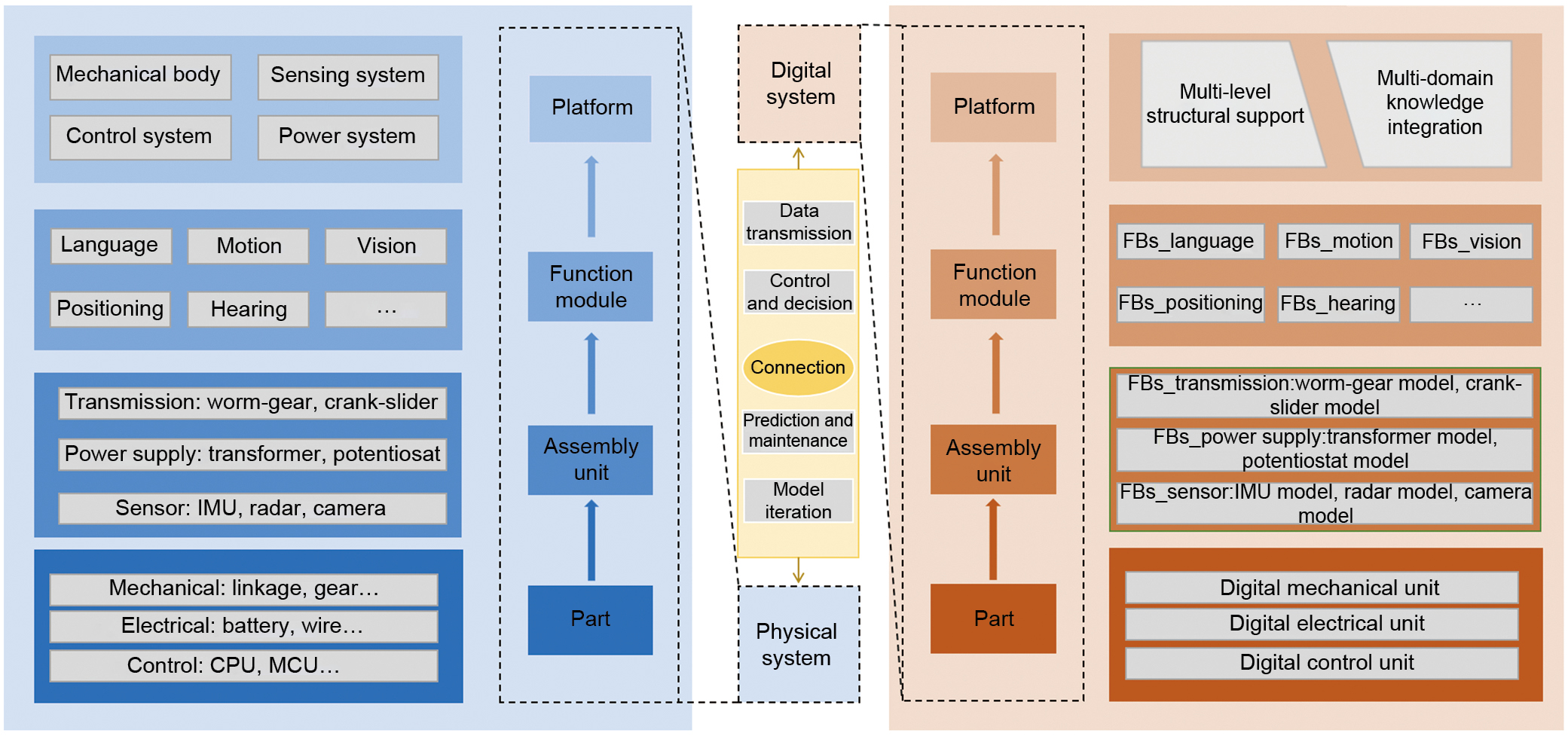
Each layer and domain is encapsulated using standardized function blocks (FBs), enabling modular modeling and integration across heterogeneous systems.
Bidirectional connectivity between the physical and digital spaces is established via communication protocols such as transmission control protocol (TCP), automation device specification (ADS), or open platform communications unified architecture (OPC UA) [25]. These ensure real-time data streaming from physical robots (e.g., sensor feedback, actuator states) and the delivery of control instructions from virtual models. Optimization results or diagnostic insights generated in the digital environment are transmitted back to the physical system, thereby closing the feedback loop and enabling real-time adaptive operation.
RDTs exhibit dynamic properties that differentiate them fundamentally from traditional static or offline simulation approaches. These characteristics enable robust, real-time, and lifecycle-spanning interaction between the physical and digital domains.
Digital twins continuously track the physical robot's states, such as joint angles, force signals, and velocities, with millisecond-level latency. Supported by edge computing and high-efficiency communication protocols, virtual replicas dynamically mirror physical operations with minimal delay. For instance, real-time synchronization can enable the resolution of complex vibration issues in machining processes, overcoming the limitations of offline simulation [26].
RDTs integrate simulations across mechanical, electrical, and control domains to reflect the complex interdependencies of mechatronic systems [24]. This allows accurate modeling of phenomena such as the impact of current fluctuations on motion precision or the effect of control logic on power regulation, which are capabilities unattainable with single-domain simulations.
RDTs are inherently adaptive, evolving in parallel with their physical counterparts throughout the robot's lifecycle. From virtual commissioning during the design phase to wear compensation in long-term maintenance, the digital twin model is continuously updated based on sensor feedback and operational data. For example, frictional parameter changes due to mechanical degradation can be reflected in real time to sustain simulation fidelity [27], aligning with the digital twin's objective of full-lifecycle support.
Together, these architectural and dynamic characteristics form the foundation for implementing RDTs. In the next section, we examine the key enabling technologies that support real-time synchronization, high-fidelity modeling, and intelligent optimization.
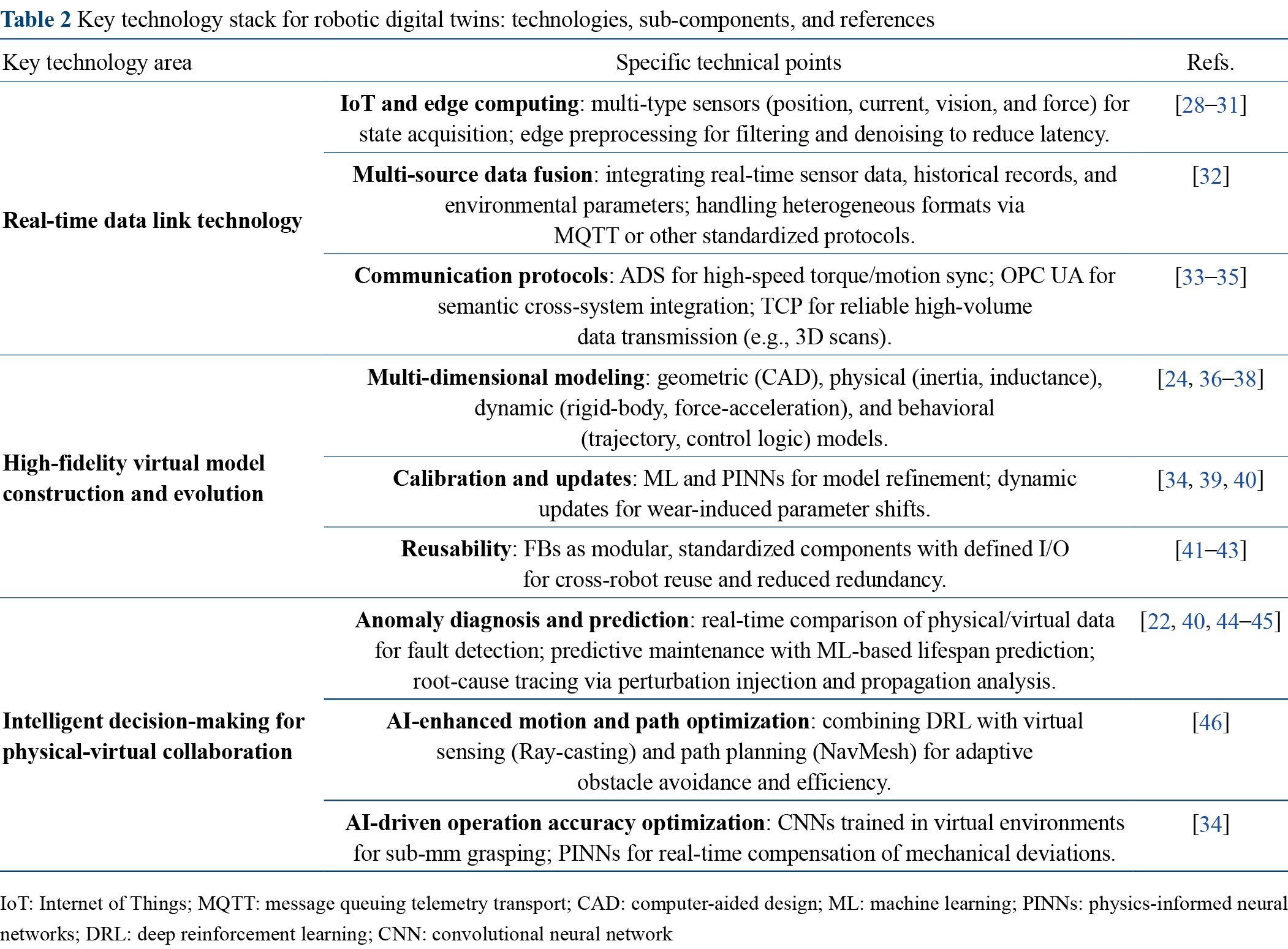
The functionality of robotic digital twin hinges on a synergistic integration of core technologies, spanning data handling, model engineering, simulation, intelligent services, and platform integration. Model construction and management stand as the pivotal pillar, bridging physical entities and virtual replicas [24]. Table 2 shows the key technology stack for robotic digital twins, including technologies, sub-components, and references.
| Key technology area | Specific technical points | Refs. |
|---|---|---|
| Real-time data link technology | IoT and edge computing: multi-type sensors (position, current, vision, and force) for state acquisition;
edge preprocessing for filtering and denoising to reduce latency. |
[28–31] |
| Multi-source data fusion: integrating real-time sensor data, historical records, and environmental parameters;
handling heterogeneous formats via MQTT or other standardized protocols. |
[32] |
|
| Communication protocols: ADS for high-speed torque/motion sync; OPC UA for semantic cross-system integration; TCP for reliable high-volume data transmission (e.g., 3D scans). | [33–35] | |
| High-fidelity virtual model construction and evolution | Multi-dimensional modeling: geometric (CAD), physical (inertia, inductance), dynamic (rigid-body, force-acceleration),
and behavioral (trajectory, control logic) models. |
[24, 36–38] |
| Calibration and updates: ML and PINNs for model refinement; dynamic updates for wear-induced parameter shifts. |
[34, 39, 40] |
|
| Reusability: FBs as modular, standardized components with defined I/O for cross-robot reuse and reduced redundancy. | [41–43] | |
| Intelligent decision-making for physical-virtual collaboration | Anomaly diagnosis and prediction: real-time comparison of physical/virtual data for fault detection; predictive maintenance
with ML-based lifespan prediction; root-cause tracing via perturbation injection and
propagation analysis. |
[22, 40, 44–45] |
| AI-enhanced motion and path optimization: combining DRL with virtual sensing (Ray-casting) and path planning (NavMesh) for
adaptive obstacle avoidance and efficiency. |
[46] |
|
| AI-driven operation accuracy optimization: CNNs trained in virtual environments for sub-mm grasping; PINNs for real-time compensation of mechanical deviations. | [34] |
Real-time, high-quality data forms the foundation of digital twin operations, relying on three core technologies:
Internet of Things (IoT) and edge computing: sensors (e.g., position, current sensors) capture real-time machine states (joint angles, electrical signals) [28–30], with edge nodes preprocessing data (filtering, denoising) to ensure low-latency transmission [31].
Multi-source data fusion: it integrates real-time sensor data, historical records, and environmental parameters, resolving format heterogeneity via standardized protocols (e.g., MQTT) to support model calibration. Different devices and systems often use varied data formats and communication protocols, adding complexity to data integration. Digital twin models are expected to handle multiple data sources and formats while ensuring consistency and accuracy [32].
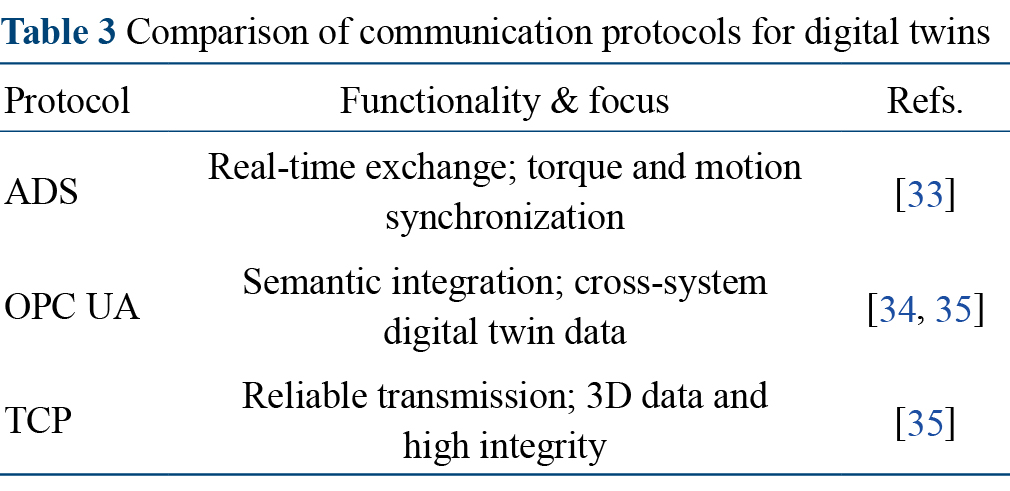
Communication protocols: protocols serve as critical bridges for data interoperability between physical robots and virtual twins. ADS enables high-speed real-time data exchange between controllers and sensors in industrial robot systems, optimizing synchronous transmission of joint torque and motion status [33]. OPC UA facilitates cross-system data integration through semantic modeling, standardizing heterogeneous data for consistent processing [34–35]. TCP ensures reliable delivery of large-volume data (e.g., 3D point cloud scans) via retransmission mechanisms, though its connection-oriented nature requires trade-offs between latency and data integrity in dynamic scenarios [35]. Table 3 shows the comparison of communication protocols for digital twins.
Models are the "virtual core" of digital twins, with key technologies including:
Multi-dimensional modeling: encompasses geometric models (3D CAD replicas of components like robot links), physical models (mechanical inertia, electrical inductance), dynamic models (e.g., rigid body motion equations, joint force-acceleration relationships), and behavioral models (kinematic trajectories, and servo control logic) [24, 36–38].
Calibration and updates: machine learning (e.g., physics-informed neural networks) refines models using real-time data, with dynamic updates to account for wear-induced parameter shifts [34, 39–40]. This closed-loop adjustment ensures the digital twin retains predictive accuracy even as the robot's mechanical properties evolve over operation cycles [40].
Reusability: FBs enable modular model reuse, reducing redundancy in cross-machine applications [41]. These function blocks, as standardized, self-contained units with defined input/output interfaces, encapsulate specific functionalities that can be directly repurposed across different robot types by adjusting only context-specific parameters (e.g., workspace limits, actuation range), thus avoiding redundant coding or modeling for identical functions [42–43].
The value of digital twins lies in guiding the physical end through "trial-and-error and optimization" in the virtual space. Anomaly diagnosis and prediction form a critical part of this closed-loop decision-making system of "virtual analysis–physical execution".
Real-time status monitoring: quickly locate anomalies by comparing simulation data from virtual models with physical sensor data. For example, collaborative robotic arms use kinematic control-based digital twins to compare real-time joint angle data with virtual models, detecting gear backlash-induced deviations [40]; industrial milling robots validate digital twins through high-precision measurements, correcting joint parameter errors to reduce motion point discrepancies; humanoid service robots employ "safe-by-design" digital twins to monitor velocities against biomechanical thresholds, identifying over-speed risks during interactions [22].
Predictive maintenance: simulate component aging processes based on virtual models, and combine machine learning to predict remaining lifespans, generating optimal maintenance plans. Examples include ML-based lifespan forecasts with virtual simulations optimizing maintenance schedules [22, 35], avoiding sudden shutdowns of physical robots.
Fault root-cause localization: inject controlled perturbations into the virtual twin to replay and isolate the exact physical variables, such as joint torque spikes, motor current harmonics, or thermal gradients, which propagate into observed anomalies. This turns the digital twin into an explainable diagnostic engine, as demonstrated by injection–backtracking frameworks [44, 45].
Table 4 shows the comparison of anomaly diagnosis techniques discussed above.
| Technique | Implementation | Use cases | Advantages |
|---|---|---|---|
| Anomaly detection | Real-time comparison between virtual and physical data | Robot backlash [29] | Fast localization |
| Predictive maintenance | Simulate wear + ML lifespan prediction | Service robot failure [9] | Avoids downtime |
| Root cause diagnosis | Inject perturbations into twin and trace propagation | Wind turbine [35] | Explainable faults |
Autonomous optimization uses AI-driven techniques to enhance robot performance in virtual–physical collaboration, whose architecture is illustrated in Figure 2.
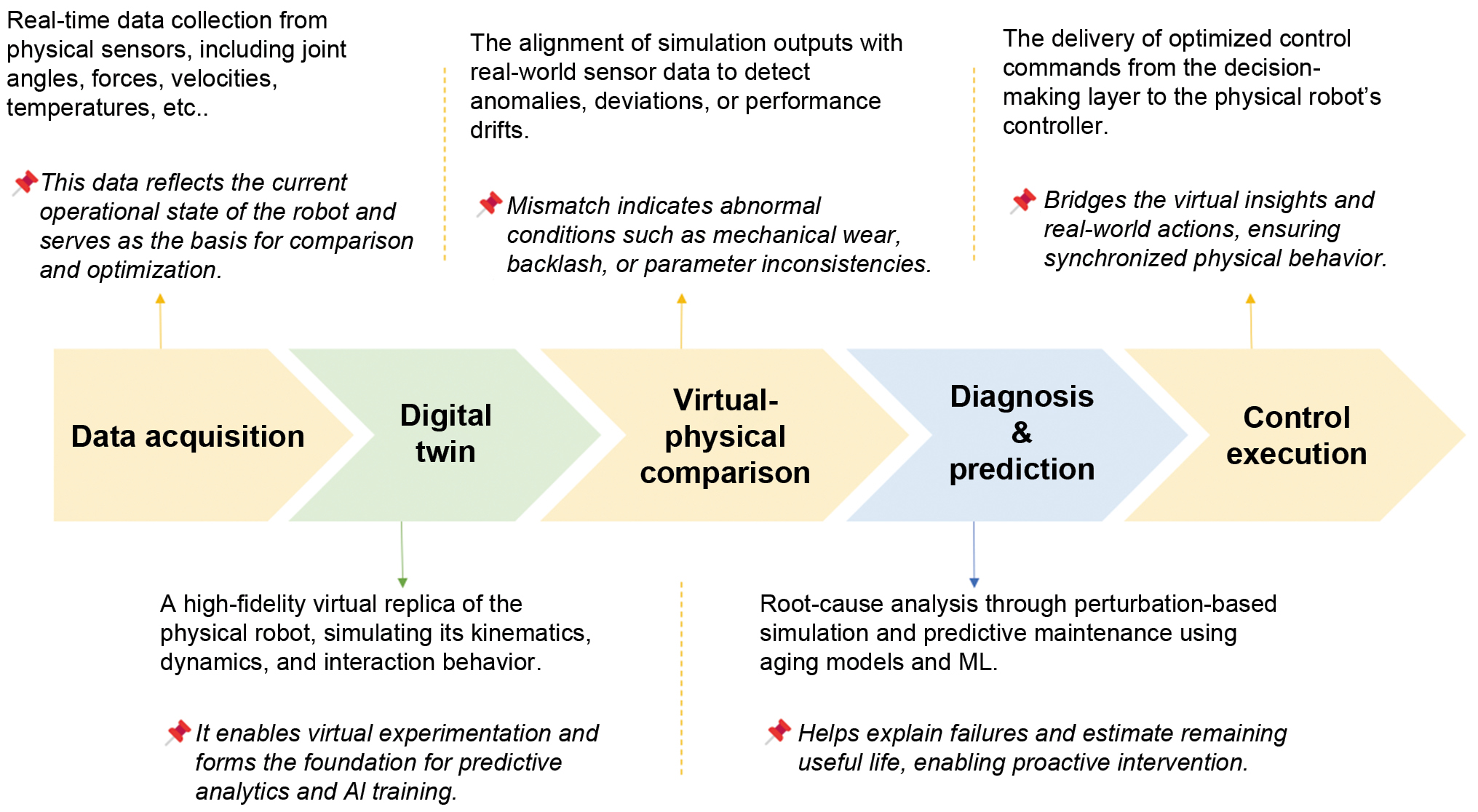
AI-enhanced motion and path optimization: virtual environments empowered by AI algorithms enable efficient exploration of optimal motion strategies. For quadruped robots, Ray-casting (dynamic obstacle detection via virtual sensors) and NavMesh (global path generation) are combined with DRL to balance obstacle avoidance and efficiency, allowing dynamic trajectory adaptation to sudden changes [46].
AI-driven operation accuracy optimization: virtual models act as high-fidelity training grounds for AI models, which are then deployed to physical robots for precision improvement. In assembly robot grasping systems, CNNs trained on large-scale virtual datasets (simulating varying lighting, material textures, and grasping angles) achieve sub-millimeter grasping accuracy when transferred to real scenarios, with synchronization errors controlled within 0.1 mm via OPC UA protocol [34]. Additionally, PINNs integrate mechanical constraints (e.g., friction, inertia) into training to predict and compensate for deviations, reducing industrial robot motion errors from 1.69 to 0.33 mm.
The practical value of RDTs is manifested through scenario-specific implementations, where those core technologies are tailored to address domain-specific challenges. This section elaborates on three application domains, highlighting technology-service synergies and real-world deployments. Figure 3 shows the primary application domains of RDTs.
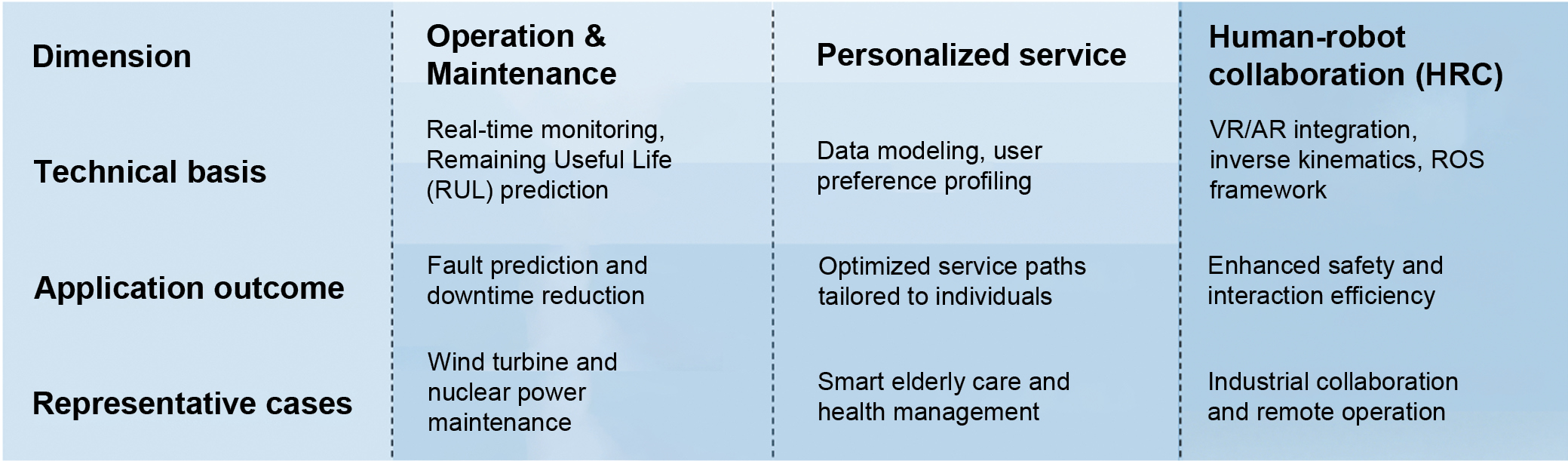
This scenario centers on realizing full-life cycle management of equipment and personalized service delivery through real-time monitoring and predictive simulation. Building on existing studies, RDT-enabled operation and maintenance (O & M) can be summarized around three major methodological paradigms.
The RDT establishes a synchronous virtual replica of the physical equipment. Through continuous collection of operating data, it monitors the equipment status in real time [47]. When abnormal signals (e.g., sudden vibration or temperature rise) are detected, the virtual model can simulate fault evolution trends to support rapid fault localization and risk assessment [33, 35]. Representative implementations, such as the digital twin approach for nuclear power operation and maintenance in [33], highlight the practical value of early warning and failure avoidance enabled by predictive simulation.
Leveraging high-fidelity evolution models, the RDT continuously fuses real-time operating conditions, historical degradation data, and environmental disturbances to deliver rolling probabilistic forecasts of RUL for critical components [48]. Expressing RUL as a probability distribution provides transparent quantification of future failure risk and supports risk-aware decision-making [35]. Field tests on wind-turbine gearboxes and aero-engines have shown more than a 30% reduction in unplanned downtime and a marked decrease in resource waste from over-maintenance [49]. In robotics, joint-level studies further demonstrate this paradigm through physics-based wear and fatigue modeling for reducers and bearings [50–53], data-driven calibration using PINNs to maintain physical plausibility under evolving operational conditions [54], and hybrid frameworks that improve prediction robustness compared with purely model-based or purely data-driven baselines [55]. Feng et al. [50] achieves accurate gear wear prediction, with only 9.05% mean prediction error, which is lower than 11.07% obtained by the previous model, using a developed digital twin methodology. The mean absolute error of the hybrid model significantly decreases compared to the previous particle filter method and data-driven method, with that of the particle filter method and the data-driven method being 295.22% and 305.79% higher, respectively [55].
With probabilistic RUL as input, maintenance engineers can schedule interventions "before the fault occurs" by extending inspection intervals for healthy parts, pre-allocating spares and technicians for high-risk parts, and using the twin to "pre-play" alternative maintenance strategies to select cost–risk-minimizing plans [35]. Field tests on wind-turbine gearboxes and aero-engines report notable reductions in unplanned downtime and resource waste from over-maintenance, illustrating the broader industrial relevance of RDT-driven scheduling logic [49]. Key challenges include sustaining long-horizon multi-physics fidelity for wear-prone robot joints, improving the robustness of probabilistic RUL under non-stationary tasks and environments, and developing reusable O & M-oriented twin modules that can scale from single robots to heterogeneous fleets. Addressing these challenges will not only enhance reliability and availability in industrial settings but also provide a robust technical foundation for the user-centric and context-adaptive capabilities discussed in the following section on personalized service.
Future outlook: the most pressing challenges include ensuring long-horizon fidelity of multi-physics degradation models at the joint level, improving robustness of probabilistic RUL under non-stationary tasks and environments, and establishing reusable O & M-oriented twin modules that can scale from single robots to heterogeneous fleets.
In addition to industrial applications, RDTs are increasingly pivotal in enabling personalized services, particularly in domains such as healthcare, smart homes, and retail. This paradigm focuses on creating robots that can adapt their behavior in real-time to the specific needs, preferences, and context of individual users. The digital twin acts as a "cognitive core" that models not just the robot, but also the user and the environment, often conceptualized as a human digital twin (HDT) [23]. This approach moves beyond one-size-fits-all programming to deliver truly bespoke and adaptive assistance.
Key functionalities in this domain include:
User preference and intent modeling: the digital twin can build and continuously update a dynamic model of a user's habits, preferences, and even infer their intentions. For example, an aged care robot's digital twin could learn an individual's daily routine, mobility patterns, and emotional states by fusing data from ambient sensors and direct interaction [56]. A few accuracy numbers of the physiological signal monitoring studies, 95.38% in real-time vital sign monitoring in the elderly, 97.20% in real-time insights for diagnosis and treatment, and 99% in continuous health monitoring [56], prove that digital twin is an effective way. By simulating different assistance strategies in the virtual space, it can determine the most opportune moment to offer help (e.g., fetching items, providing medication reminders) in a proactive yet non-intrusive manner, a core concept explored in HDT research [20, 21].
Safe and empathetic interaction: for service robots that share personal space with humans, the digital twin serves as a critical sandbox to test, validate, and personalize interaction strategies. It can simulate thousands of interaction scenarios to refine social behaviors, such as adjusting tones of voice, gestures, and approach speeds to match a specific user's comfort level. This "safe-by-design" approach, which models biomechanical and psychological thresholds, is essential for fostering a greater sense of trust, safety, and empathy, especially in sensitive applications like assistive robotics [22]. The generalized safe motion unit within the proposed digital twin approach in [22] is capable of dramatically slowing down the robot's velocity from 2 m s−1 to nearly 0, within about 1 second, ensuring interaction safety.
Personalized task and skill learning: beyond adapting to context, the digital twin can enable a robot to learn and execute tasks according to a user's unique standards. For instance, a household robotic twin can learn the specific way a user prefers their coffee made or their room tidied by observing them or through virtual demonstration. This user-specific skill model is then stored and refined within the twin, allowing the physical robot to replicate the task with a high degree of personalization, transforming it from a generic tool into a true assistant.
Structured environment understanding and adaptive execution: in complex household, healthcare, or facility scenarios, the RDT can extend beyond user modeling to explicitly represent structured environments (rooms, objects, affordances, and constraints) and maintain environment-state synchronization in real-time. This enables hierarchical task decomposition (from high-level goals to executable sub-skills), virtual pre-validation of multi-step workflows, and adaptive replanning when the environment or user context changes. By coupling environment-state updates with personalized intent models, the twin supports more reliable long-horizon assistance—such as safe object retrieval, multi-room service routines, or context-aware care workflows—while reducing the cost of trial and error on physical platforms.
Through these advanced capabilities, digital twins are transforming service robots from generic, pre-programmed machines into truly intelligent and personalized companions that can anticipate needs and adapt to the nuances of human life.
In the context of Industry 4.0/5.0 and beyond, digital twin technology is increasingly being integrated into human–robot collaboration (HRC). This integration aims to alleviate three persistent bottlenecks in conventional HRC: (1) the heavy reliance on specialized programming and operation skills, (2) the difficulty of managing highly coupled human–machine–environment processes, and (3) the non-negligible safety risks that arise when humans and robots share close workspaces [12, 57, 58]. By establishing a high-fidelity and continuously synchronized virtual mirror of the physical world, robotic digital twins offer a safe, efficient, and iterative platform for task rehearsal, interaction design, risk evaluation, and deployment optimization, thus enabling more adaptive and human-centric collaborative systems. Two high-impact application directions have become particularly representative.
In smart manufacturing, digital twins can significantly lower the threshold of robot programming through intuitive VR-based teaching and demonstration, while simultaneously supporting real-time monitoring, closed-loop control, and predictive maintenance for collaborative cells [59–62]. The exoskeleton-assisted collaboration framework in [59], which couples an exoskeleton-type robotic system with the digital twin of a collaborative robot, achieved a 100% success rate in guiding trajectory modification during pick-and-place tasks, demonstrating how an RDT can translate human intent into robust physical execution. Beyond on-site collaboration, RDT-enabled remote operation paradigms such as "telecobot" further allow distributed experts to supervise, adjust, and validate complex processes in the virtual space before physical rollout, improving both efficiency and safety under dynamic production constraints [63, 64].
For missions in extreme, uncertain, or inaccessible scenarios—such as deep-sea, nuclear, or space operations—digital twins provide end-to-end virtual rehearsals for path planning, emergency strategy evaluation, and system-level risk reduction. During live missions, the twin can continuously assess equipment health, anticipate failures, and recommend preventive actions to avoid catastrophic outcomes [65]. This capability positions RDTs as a critical technical foundation for human–robot teaming in environments where direct human presence is costly or dangerous and where rapid situation changes demand reliable physical–virtual co-adaptation.
Though they are comparatively secondary to the two directions above. In healthcare and consumer-facing contexts, the combination of digital twins and metaverse-like platforms enables risk-free pre-operative rehearsals, supports remote consultation, and bridges personalized user requirements with downstream manufacturing and service delivery [66, 67]. In education, RDTs offer low-cost, bidirectionally linked training environments; the robot operating system (ROS)-based twin system in [60] reported a 99.91% synchronization rate between physical and virtual robots while reducing the cost of industrial robotics talent training. In addition, ergonomics-oriented human–machine digital twin frameworks (HMDT) and broader human-centric efficiency studies continue to enrich the methodological landscape of HRC under digital twin ecosystems [68, 69], as illustrated in Figure 3.
From a technical perspective, effective DT-enabled HRC typically leverages inverse kinematics and motion-mapping mechanisms to align human demonstrations with robot execution [61, 66, 67], "safe-by-design" strategies that enforce biomechanical constraints for collision-risk mitigation [22], deep learning-enhanced perception and decision modules for adaptive autonomy [62], and model-based system engineering (MBSE)-inspired approaches for system-level architecture organization and verification [70]. Nevertheless, key challenges remain: reducing dependence on specialized training [12, 59], improving real-time synchronization fidelity in complex collaborative scenes [63, 64], and enhancing the modeling of rich human factors (e.g., intent, cognitive states, social interaction dynamics) to support truly predictive and trustworthy collaboration [12, 64]. Collectively, these advances and open problems suggest that robotic digital twins will continue to shape a more scalable, safer, and human-centered future for HRC across both industrial and frontier operational contexts.
In summary, digital twin technology has demonstrated broad applicability across industrial, medical, and collaborative domains. Its capacity for real-time synchronization, predictive modeling, and virtual testing enables safer, more efficient, and more adaptive robotic systems in diverse environments.
Digital twin technology offers substantial potential for advancing HRC via real-time simulation, process optimization, and predictive maintenance. However, large-scale industrial adoption remains hindered by intertwined technical, organizational, and economic barriers, which simultaneously indicate the focus areas for future development.
Digital twin implementations often rely on custom, scenario-specific designs and lack plug-and-play modularity and cross-industry standards [28, 71, 72]. This limits scalability and reusability, slowing technology diffusion. Beyond limiting the scalability of individual twins, this lack of standardization severely hinders "composability". Future smart factories will be a "society of twins" composed of multiple digital twins from various vendors (robots, automated guided vehicles (VGAs), and production lines). Enabling a robot twin from vendor A to seamlessly interact, negotiate, and co-optimize with a conveyor belt twin from vendor B requires unified semantic models and open interface standards. Currently, we are far from achieving such a plug-and-play digital twin ecosystem.
The interdisciplinary expertise required, which spans robotics, AI, data science, and system engineering, remains scarce [73]. Limited curriculum coverage and insufficient hands-on training exacerbate this shortage.
Significant investments in hardware, software, and labor, coupled with unpredictable return on investment (ROI), deter especially small and medium-sized enterprises [40, 46]. Complex DT-HRC scenarios amplify resource demands and integration risks.
Multi-sensor, multi-protocol environments face latency (2–3 s) and synchronization bottlenecks [74, 75], while heterogeneous communication protocols hinder interoperability. Real-time data exchange also increases cybersecurity vulnerabilities [76–78]. Beyond cybersecurity threats, an emerging challenge is data sovereignty and ethics. In HRC, a digital twin inevitably captures not just machine data but also operator behaviors, efficiency, and potentially physiological data. This raises critical ethical questions: who owns this "human data"? How should it be used for performance evaluation? Does creating a "worker digital twin" pose risks to privacy invasion or algorithmic bias? These non-technical issues are crucial for the societal acceptance of the technology.
The "reality gap" persists because current RDTs still struggle to systematically capture accuracy-limiting factors across kinematics, dynamics, and electromechanical coupling. First, kinematic parameter calibration remains nontrivial under long-term wear, thermal drift, and task-dependent load variations; small errors in joint offsets, link parameters, or sensor alignment can accumulate into noticeable endpoint deviations in collaborative tasks. Second, dynamic model uncertainties—such as unmodeled frictional changes, contact nonlinearity, and payload-dependent inertial shifts—reduce the reliability of predictive simulation and hinder robust control transfer from virtual to physical systems. Third, electromechanical coupling effects, including the interaction between motor current fluctuations, drive dynamics, and motion precision, are often simplified or partially ignored, further constraining the achievable synchronization and control accuracy. These gaps collectively weaken the predictive power of RDTs in safety-critical HRC settings, especially when human factors and soft-body/contact physics must be co-simulated [76, 79–82]. Moreover, beyond physical fidelity, a deeper "cognitive gap" remains: while existing twins can replicate mechanical laws with increasing sophistication, they still lack robust mechanisms for modeling and forecasting human cognitive states (e.g., intent, fatigue, and distraction) and the resulting non-linear, sub-optimal behaviors in real collaboration scenarios, which limits their capability to proactively prevent human-uncertainty-driven incidents.
To address these barriers, future DT-HRC development should focus on:
Deep AI-DT synergy: integrate advanced AI techniques, such as PINNs and generative AI, for continuous model calibration, adaptive control, and virtual lifecycle simulation before physical deployment [10].
System-level and cross-domain integration: transition from isolated device-level twins to interconnected, multi-layered digital twin ecosystems spanning entire production lines, factories, and even cross-industry infrastructures (e.g., integration with smart grids and transport systems).
Scenario diversification: expand applications beyond manufacturing to domains such as healthcare [66], energy systems, and extreme environments (e.g., nuclear power, deep-sea, and space) [65].
Technical breakthroughs: establish standardized digital twin model interfaces and protocols, improve real-time performance with edge and quantum computing, and enhance trustworthiness via blockchain-based data protection [76, 77].
Ecosystem and talent development: foster interdisciplinary education programs, formal certification systems, and open-source digital twin toolchains to reduce entry barriers and accelerate innovation [73].
By simultaneously mitigating these challenges and pursuing these trends, a digital twin for HRC can evolve into a foundational enabler of intelligent, interconnected, and human-centric industrial systems.
This review positions robotic digital twins as a lifecycle-oriented paradigm that extends traditional simulation into closed-loop, data- and AI-augmented cyber–physical systems. The emerging MLMD architectural trend and the physical–virtual–data–service–knowledge loop jointly indicate that the long-term value of RDTs lies in their ability to continuously co-evolve with physical robots rather than merely mirror them.
Across the literature, the most consequential bottlenecks are tightly coupled: insufficient multi-physics fidelity amplifies the reality gap; imperfect real-time synchronization limits actionable decision-making; and fragmented standards obstruct cross-vendor composability and large-scale deployment. These technical constraints are further reinforced by non-technical factors, including high development costs, skill shortages, and growing concerns over data security and governance in human-in-the-loop settings.
Looking forward, progress is likely to depend on four priorities: (1) standardized, modular RDT building blocks enabling plug-and-play composability; (2) hybrid physics–AI mechanisms for continuous calibration under wear, drift, and task shifts; (3) edge-native, latency-bounded synchronization with security-by-design; and (4) human-centric benchmarks that evaluate safety, trustworthiness, and shared autonomy in realistic HRC and field environments. Advancing these directions can move RDTs from promising prototypes to scalable, trustworthy ecosystems that reshape how robots are designed, operated, and improved throughout their lifetimes.
Yuxin Sun: Investigation; conceptualization; writing. Zhengqing Fu: Investigation; conceptualization; writing. Peiyi Li: Review; editing; language polishing. Yadong Xu: Conceptualization; language polishing. Zhenhua Xiong: Project administration; review & editing. Jinchen Ji: Review & editing.
This work was supported in part by Shanghai Municipal Education Commission (Grant No. 2024AIYB009), "Research, Development and Industrialization Project for Key Technologies of Multi-Station, High-Precision Computer Numerical Control Combined Machine Tools", and Shanghai Municipal Basic Research Program Natural Science Foundation Project (Grant No. 25ZR1402246).
The data that support the findings of this study are available from the corresponding author upon reasonable request.
N. Robinson, B. Tidd, D. Campbell, D. Kulic, and P. Corke, "Robotic Vision for Human-Robot Interaction and Collaboration: A Survey and Systematic Review," ACM Transactions On Human-robot Interaction 12, no. 1 (2023): 1–66, https://doi.org/10.1145/3570731.
S. Rescsanski, R. Hebert, A. Haghighi, J. Tang, and F. Imani, "Towards Intelligent Cooperative Robotics in Additive Manufacturing: Past, Present, and Future," Robotics And Computer-intergrated Manufacturing 93 (2025): 102925, https://doi.org/10.1016/j.rcim.2024.102925.
J. T. Licardo, M. Domjan, and T. Orehovacki, "Intelligent Robotics-A Systematic Review of Emerging Technologies and Trends," Electronics 13, no. 3 (2024): 542, https://doi.org/10.3390/electronics13030542.
P. Goel, N. Kaushik, B. Sivathanu, R. Pillai, and J. Vikas, "Consumers’ Adoption of Artificial Intelligence and Robotics in Hospitality and Tourism Sector: Literature Review and Future Research Agenda," Tourism Review 77, no. 4 (2022): 1081–1096, https://doi.org/10.1108/TR-03-2021-0138.
F. Tao, H. Zhang, and C. Zhang, "Advancements and Challenges of Digital Twins in Industry," Nature Computational Science 4, no. 3 (2024): 169–177, https://doi.org/10.1038/s43588-024-00603-w.
T. Goodwin, J. Xu, N. Celik, and C. H. Chen, "Real-Time Digital Twin-Based Optimization with Predictive Simulation Learning," Journal of Simulation 18, no. 1 (2024): 47–64, https://doi.org/10.1080/17477778.2022.2046520.
C. Semeraro, M. Lezoche, H. Panetto, and M. Dassisti, "Digital Twin Paradigm: A Systematic Literature Review," Computers in Industry 130 (2021): 103469, https://doi.org/10.1016/j.compind.2021.103469.
I. Onaji, D. Tiwari, P. Soulatiantork, B. Song, and A. Tiwari, "Digital Twin in Manufacturing: Conceptual Framework and Case Studies," International Journal of Computer Integrated Manufacturing 35, no. 8 (2022): 831–858, https://doi.org/10.1080/0951192X.2022.2027014.
A. Raheem, M. De Marchi, and P. Dallasega, "Digital Twin Driven Factory and Production Planning (FPP)," Production and Manufacturing Research-an Open Access Journal 13, no. 1 (2025): 2507954, https://doi.org/10.1080/21693277.2025.2507954.
S. Y. Park, C. Lee, H. Kim, and S. H. Ahn, "Enhancement of Control Cerformance for Degraded Robot Manipulators Using Digital Twin and Proximal Policy Optimization," IEEE Access 12 (2024): 19569–19583, https://doi.org/10.1109/ACCESS.2024.3359268.
A. K. Ramasubramanian, R. Mathew, M. Kelly, V. Hargaden, and N. Pa- pakostas, "Digital Twin for Human-Robot Collaboration in Manufacturing: Review and Outlook," Applied Sciences-Basel 12, no. 10 (2022): 4811, https://doi.org/10.3390/app12104811.
H. Tong, M. Chen, J. Zhao, et al., "Continual Reinforcement Learning for Digital Twin Synchronization Optimization," IEEE Transactions On Mobile Computing 24, no. 8 (2025): 6843–6857, https://doi.org/10.1109/TMC.2025.3546507.
M. Ohenoja, A. Koistinen, M. Hultgren, et al., "Continuous Adaptation of a Digital Twin Model for a Pilot Flotation Plant," Minerals Engineering 198 (2023): 108081, https://doi.org/10.1016/j.mineng.2023.108081.
M. S. Dihan, A. I. Akash, Z. Tasneem, et al., "Digital Twin: Data Exploration, Architecture, Implementation and Future," Heliyon 10, no. 5 (2024): e26503, https://doi.org/10.3390/app12104811.
H. Gong, D. Su, S. Zeng, and X. Chen, "Advancements in Digital Twin Modeling for Underground Spaces and Lightweight Geometric Modeling Technologies," Automation in Construction 165 (2024): 105578, https://doi.org/10.1016/j.autcon.2024.105578.
F. B. Ismail, H. Al-Faiz, H. Hasini, A. Al-Bazi, and H. A. Kazem, "A Comprehensive Review of the Dynamic Applications of the Digital Twin Technology Across Diverse Energy Sectors," Energy Strategy Reviews 52 (2024): 101334, https://doi.org/10.1016/j.esr.2024.101334.
E. Faliagka, E. Christopoulou, D. Ringas, et al., "Trends in Digital Twin Framework Architectures for Smart Cities: A Case Study in Smart Mobility," Sensors 24, no. 5 (2024): 1665, https://doi.org/10.3390/s24051665.
L. Jin, X. Zhai, K. Wang, et al., "Big Data, Machine Learning, and Digital Twin Assisted Additive Manufacturing: A Review," Materials & Design 244 (2024): 113086, https://doi.org/10.1016/j.matdes.2024.113086.
Q. He, L. Li, D. Li, et al., "From Digital Human Modeling to Human Digital Twin: Framework and Perspectives in Human Factors," Chinese Journal of Mechanical Engineering 37, no. 1 (2024): 19, https://doi.org/10.1186/s10033-024-00998-7.
Y. Lin, L. Chen, A. Ali, et al., "Human Digital Twin: a Survey," Journal of Cloud Computing: Advances, Systems and Applications 13, no. 1 (2024): 24, https://doi.org/10.1186/s13677-024-00691-z.
J. Skerlj, M. Hamad, J. Elsner, A. Naceri, and S. Haddadin, "Safe-by-Design Digital Twins for Human-Robot Interaction: A Use Case for Humanoid Service Robots," in Proceedings of the IEEE International Conference on Robotics and Automation (ICRA), 13369–13375, 2024, https://doi.org/10.1109/ICRA57147.2024.10611178.
B. Wang, H. Zhou, X. Li, et al., "Human Digital Twin in the Context of Industry 5.0," Robotics and Computer-Integrated Manufacturing 85 (2024): 102626, https://doi.org/10.1016/j.rcim.2023.102626.
K. Yang, Y. Liu, B. Tuo, et al., "A Multi-Level Multi-Domain Digital Twin Modeling Method for Industrial Robots," Robotics and Computer-Integrated Manufacturing 95 (2025): 103023, https://doi.org/10.1016/j.rcim.2025.103023.
M. Liu, S. Fang, H. Dong, and C. Xu, "Review of Digital Twin about Concepts, Technologies, and Industrial Applications," Journal of Manufacturing Systems 58 (2021): 346–361, https://doi.org/10.1016/j.jmsy.2020.06.017.
Z. Liang, S. Wang, Y. Peng, et al., "The Process Correlation Interaction Construction of Digital Twin for Dynamic Characteristics of Machine Tool Structures with Multi-Dimensional Variables," Journal of Manufacturing Systems 63 (2022): 78–94, https://doi.org/10.1016/j.jmsy.2022.03.002.
J. A. Erkoyuncu, I. F. del Amo, D. Ariansyah, D. Bulka, R. Vrabič, and R. Roy, "A Design Framework for Adaptive Digital Twins," CIRP Annals 69, no. 1 (2020): 145–148, https://doi.org/10.1016/j.cirp.2020.04.086.
A. L. Hananto, A. Tirta, S. G. Herawan, et al., "Digital Twin and 3d Digital Twin: Concepts, Applications, and Challenges in Industry 4.0 for Digital Twin," Computers 13, no. 4 (2024): 100, https://doi.org/10.3390/computers13040100.
D. E. A. Mansour, M. Numair, A. S. Zalhaf, et al., "Applications of Iot and Digital Twin in Electrical Power Systems: A Comprehensive Survey," Iet Generation Transmission Distribution 17, no. 20 (2023): 4457–4479, https://doi.org/10.1049/gtd2.12940.
T. Ooka, "The Era of Preemptive Medicine: Developing Medical Digital Twins Through Omics, Iot, and Ai Integration," Jma Journal 8, no. 1 (2025): 1–10, https://doi.org/10.31662/jmaj.2024-0213.
F. Knebel, R. Trevisan, G. do Nascimento, M. Abel, and J. Wickboldt, "A Study on Cloud and Edge Computing for the Implementation of Digital Twins in the Oil Gas Industries," Computers Industrial Engineering 182 (2023): 109363, https://doi.org/10.1016/j.cie.2023.109363.
X. Fu, H. Song, S. Li, and Y. Lu, "Digital Twin Technology in Modern Machining: A Comprehensive Review of Research on Machining Errors," Journal of Manufacturing Systems 79 (2025): 134–161, https://doi.org/10.1016/j.jmsy.2025.01.005.
W. Wang, M. Liu, and J. Li, "Research and Realization of Virtual-Real Control of Robot System for Off-Heap Detector Assisted Installation Based on Digital Twin," IEEE Journal of Radio Frequency Identification 6 (2022): 810–814, https://doi.org/10.1109/JRFID.2022.3209715.
J. Xu, G. Liu, Y. Zhao, Z. Zheng, and H. Yan, "The Synchronous Grasping Method of Virtual-Real Assembly Robot Based on Digital Twin," Journal of System Simulation 36, no. 9 (2024): 2181–2192, https://doi.org/10.16182/j.issn1004731x.joss.23-0575.
W. Ye, X. Liu, X. Zhao, H. Fu, Y. Cai, and H. Li, "A Data-Driven Digital Twin Architecture for Failure Prediction of Customized Automatic Transverse Robot," IEEE Access 12 (2024): 59222–59235, https://doi.org/10.1109/ACCESS.2024.3393027.
Y. Yanfang, H. Huan, S. Liang, Y. Miao, and W. Ziran, "Digital Twin Robot and Its Motion Control for Flexible Assembly of Circuit Breaker," Computer Integrated Manufacturing Systems 26, no. 11 (2020): 2915–2926, https://doi.org/10.13196/j.cims.2020.11.002.
H. Yang, F. Cheng, H. Li, and Z. Zuo, "Design and Control of Digital Twin Systems Based on a Unit Level Wheeled Mobile Robot," IEEE Transactions on Vehicular Technology 73, no. 1 (2024): 323–332, https://doi.org/10.1109/TVT.2023.3309029..
J. Yun, Y. Liu, and X. Liu, "Model Construction of Multi-Target Grasping Robot Based on Digital Twin," in Proceedings of the 15th International Conference on Intelligent Robotics and Applications (ICIRA), edited by H. H. Liu, Z. P. Yin, L. Q. Liu, et al., 88–97, Springer, 2022, https://doi.org/10.1007/978-3-031-13822-5_9.
X. Y. Duan, Z. Q. Qin, X. W. Tang, and F. Xiang, "Update Method of Digital Twin Model of Industrial Robot Based on Deep Reinforcement Learning," Aeronautical Manufacturing Technology 67, no. 11 (2024): 48–55, https://doi.org/10.16080/j.issn1671-833x.2024.11.048.
F. H. N. Nascimento, S. A. Cardoso, A. M. N. Lima, and D. F. S. Santos, "Synchronizing a Collaborative Arm's Digital Twin in Real-Time," paper presented at the 20th Latin American Robotics Symposium (LARS) / 15th Brazilian Symposium on Robotics (SBR) / 14th Workshop on Robotics in Education (WRE), Salvador, Brazil, 2023, https://doi.org/10.1109/LARS/SBR/WRE59448.2023.10333055.
L. Wang, H. Feng, C. Song, and W. Jin, "Function Block Design for Adaptive Execution Control of Job Shop Machining Operations," Interna- tional Journal of Production Research 47, no. 12 (2009): 3413–3434, https://doi.org/10.1080/00207540701666212.
S. Liu, L. Wang, and X. Wang, "Function Block-Based Multimodal Control for Symbiotic Human-Robot Collaborative Assembly," Journal of Manufacturing Science and Engineering-Transactions of the Asme 143, no. 9 (2021): 091001, https://doi.org/10.1115/1.4050187.
X. Zhang, L. Zheng, W. Fan, W. Ji, L. Mao, and L. Wang, "Knowledge Graph and Function Block Based Digital Twin Modeling for Robotic Machining of Large-Scale Components," Robotics and Computer-Integrated Manufacturing 85 (2024): 102609, https://doi.org/10.1016/j.rcim.2023.102609.
R. Gupta, B. Tian, Y. Wang, and K. Nahrstedt, "Twin-Adapt: Continuous Learning for Digital Twin-Enabled Online Anomaly Classification in Iot- Driven Smart Labs," Future Internet 16, no. 7 (2024): 239, https://doi.org/10.3390/fi16070239.
C. Feng, C. Liu, and D. Jiang, "Root Cause Localization for Wind Turbines Using Physics Guided Multivariate Graphical Modeling and Fault Propagation Analysis," Knowledge-Based Systems 295 (2024): 111838, https://doi.org/10.1016/j.knosys.2024.111838.
A. Naskar, P. Pothapragada, and P. Vivekananda Shanmuganathan, "Digital Twin-Based Path Planning and Obstacle Avoidance for a Quadruped Robot" in Proceedings of the Recent Advances in Machines, Mechanisms, Materials and Design, iNaCoMM 2023, edited by R. S. Kumar, S. Sanyal, and P. M. Pathak, 673–684, Springer, 2023, https://doi.org/10.1007/978-981-97-5423-6_54.
Y. Zhang, P. Gao, Z. Wang, and Q. He, "Research on Status Monitoring and Positioning Compensation System for Digital Twin of Parallel Robots," Scientific Reports 15, no. 1 (2025): 7432, https://doi.org/10.1038/s41598-025-91892-2.
D. He, J. Zhao, Z. Jin, C. Huang, F. Zhang, and J. Wu, "Prediction of Bearing Remaining Useful Life Based on a Two-Stage Updated Digital Twin," Advanced Engineering Informatics 65 (2025): 103123, https://doi.org/10.1016/j.aei.2025.103123.
I. Abdullahi, S. Longo, and M. Samie, "Towards a Distributed Digital Twin Framework for Predictive Maintenance in Industrial Internet of Things (Iiot)," Sensors 24, no. 8 (2024): 2663, https://doi.org/10.3390/s24082663.
K. Feng, H. Xiao, J. Zhang, and Q. Ni, "A Digital Twin Methodology for Vibration-Based Monitoring and Prediction of Gear Wear," Wear 571 (2025): 205806, https://doi.org/10.1016/j.wear.2025.205806.
B. He, L. Liu, and D. Zhang, "Digital Twin-Driven Remaining Useful Life Prediction for Gear Performance Degradation: A Review," Journal of Computing and Information Science in Engineering 21, no. 3 (2021): 030801, https://doi.org/10.1115/1.4049537.
L. Cui, Y. Xiao, D. Liu, and H. Han, "Digital Twin-Driven Graph Domain Adaptation Neural Network for Remaining Useful Life Prediction of Rolling Bearing," Reliability Engineering & System Safety 245 (2024): 109991, https://doi.org/10.1016/j.ress.2024.109991.
Q. Lu and M. Li, "Digital Twin-Driven Remaining Useful Life Prediction for Rolling Element Bearing," Machines 11, no. 7 (2023): 678, https://doi.org/10.3390/machines11070678.
Z. K. Lawal, H. Yassin, D. T. C. Lai, and A. Che Idris, "Physics- Informed Neural Network (Pinn) Evolution and Beyond: A Systematic Literature Review and Bibliometric Analysis," Big Data and Cognitive Computing 6, no. 4 (2022): 140, https://doi.org/10.3390/bdcc6040140.
L. Liao and F. Köttig, "A Hybrid Framework Combining Data-Driven and Model-Based Methods for System Remaining Useful Life Prediction," Applied Soft Computing 44 (2016): 191–199, https://doi.org/10.1016/j.asoc.2016.03.013.
R. O. Zafar, Y. Rybarczyk, and J. Borg, "A Systematic Review of Digital Twin Technology for Home Care," ACM Transactions on Computing for Healthcare 5, no. 4 (2024): 1–24, https://doi.org/10.1145/3681797.
A. E. Cosgun, "Smart and Digital World: The Technologies Needed for Digital Twins and Human Digital Twins," Asce-Asme Journal of Risk and Uncertainty in Engineering Systems Part B-Mechanical Engineering 10, no. 3 (2024): 031105, https://doi.org/10.1115/1.4065643.
G. E. Modoni and M. Sacco, "A Human Digital-Twin-Based Framework Driving Human Centricity Towards Industry 5.0," Sensors 23, no. 13 (2023): 6054, https://doi.org/10.3390/s23136054.
H. Park, M. Shin, G. Choi, et al., "Integration of an Exoskeleton Robotic System into a Digital Twin for Industrial Manufacturing Applications," Robotics and Computer-Integrated Manufacturing 89 (2024): 102746, https://doi.org/10.1016/j.rcim.2024.102746.
Z. Wang, Y. OuYang, and O. Kochan, "Bidirectional Linkage Robot Digital Twin System Based on Ros," paper presented at the IEEE 17th International Conference on the Experience of Designing and Application of CAD Systems (CADSM), Jaroslaw, Poland, 2023, https://doi.org/10.1109/CADSM58174.2023.10076497.
M. Vu, T. Nguyen, and C. My, "Design and Implementation of a Digital Twin to Control the Industrial Robot Mitsubishi Rv-12sd," in Proceedings of Advances in Asian Mechanism and Machine Science, ASIAN MMS 2021, edited by N. V. Khang, N. Q. Hoang, and M. Ceccarelli, 422–432, Springer, 2022, https://doi.org/10.1007/978-3-030-91892-7_40.
S. Wang, J. Zhang, P. Wang, J. Law, R. Calinescu, and L. Mihaylova, "A Deep Learning-Enhanced Digital Twin Framework for Improving Safety and Reliability in Human-Robot Collaborative Manufacturing," Robotics and Computer-Integrated Manufacturing 85 (2024): 102608, https://doi.org/10.1016/j.rcim.2023.102608.
S. Yoshioka, S. Fukushige, K. Seki, and M. Kawakami, "An Immersive Interface for Remote Collaboration with Multiple Telepresence Robots through Digital Twin Spaces," paper presented at the SIGGRAPH Asia 2024 Posters (SA '24), New York, NY, USA, 2024, https://doi.org/10.1145/3681756.3697940.
Z. Zhou, X. Yang, H. Wang, and X. Zhang, "Digital Twin with Integrated Robot-Human/Environment Interaction Dynamics for an Industrial Mobile Manipulator," paper presented at the 2022 International Conference on Robotics and Automation (ICRA), Philadelphia, PA, USA, 2022, https://doi.org/10.1109/ICRA46639.2022.9812004.
L. J. Lu, R. X. Dai, X. Song, et al., "Method for Constructing System for Evaluating and Analyzing Systems in Nuclear Power Plant Based on Digital Twins," China Patent. 2025.
S. Sai, M. Prasad, A. Garg, and V. Chamola, "Synergizing Digital Twins and Metaverse for Consumer Health: A Case Study Approach," IEEE Transactions on Consumer Electronics 70, no. 1 (2024): 2137–2144, https://doi.org/10.1109/TCE.2024.3367929.
S. Sai, M. Prasad, A. Upadhyay, V. Chamola, and N. Herencsar, "Confluence of Digital Twins and Metaverse for Consumer Electronics: Real World Case Studies," IEEE Transactions on Consumer Electronics 70, no. 1 (2024): 3194–3203, https://doi.org/10.1109/TCE.2024.3351441.
J. Tao, N. Nor, and F. Yiting, "Application of Human-Machine Interaction in Digital Twin System of Industrial Robot," AIP Conference Proceedings 2959, no. 1 (2023): 070002, https://doi.org/10.1063/5.0179179.
M. Shaaban, A. Carfi, and F. Mastrogiovanni, "Digital Twins for Human-Robot Collaboration: A Future Perspective," in Proceedings of the 18th International Conference on Intelligent Autonomous Systems (IAS), edited by SG. Lee, J. An, N. Y. Chong, et al., 429–441, Springer, 2024, https://doi.org/10.1007/978-3-031-44851-5_33.
X. Zhang, H. Wang, Y. Hu, X. Zhang, F. Zhao, and C. Wan, "Applying Model-Based System Architecture Process Method for a Human-Robot Digital Twin System," paper presented at the 2021 International Conference on Cyber-Physical Social Intelligence (ICCSI), Beijing, China, 2021, https://doi.org/10.1109/ICCSI53130.2021.9736210.
P. Aivaliotis, K. Georgoulias, and K. Alexopoulos, "Using Digital Twin for Maintenance Applications in Manufacturing: State of the Art and Gap Analysis," in Proceedings of the 2019 IEEE International Conference on Engineering, Technology and Innovation (ICE/ITMC), Valbonne Sophia-Antipolis, France, 2019, https://doi.org/10.1109/ICE.2019.8792613.
J. Um, S. Weyer, and F. Quint, "Plug-and-Simulate within Modular Assembly Line Enabled by Digital Twins and the Use of Automationml," IFAC-PapersOnLine 50, no. 1 (2017): 15904–15909, https://doi.org/10.1016/j.ifacol.2017.08.2360.
T. D. West and M. Blackburn, "Is Digital Thread/Digital Twin Affordable? A Systemic Assessment of the Cost of Dod's Latest Manhattan Project," Procedia computer science 114 (2017): 47–56, https://doi.org/10.1016/j.procs.2017.09.003.
P. Zheng and A. S. Sivabalan, "A Generic Tri-Model-Based Approach for Product-Level Digital Twin Development in a Smart Manufacturing Environment," Robotics and Computer-Integrated Manufacturing 64 (2020): 101958, https://doi.org/10.1016/j.rcim.2020.101958.
A. Cerrone, J. Hochhalter, G. Heber, and A. Ingraffea, "On the Effects of Modeling As-Manufactured Geometry: Toward Digital Twin," International Journal of Aerospace Engineering 2014, no. 1 (2014): 439278, https://doi.org/10.1155/2014/439278.
L. F. C. Durao, S. Haag, R. Anderl, K. Schützer, and E. Zancul, "Digital Twin Requirements in the Context of Industry 4.0," in IFIP international conference on product lifecycle management, edited by P. Chiabert, A. Bouras, F. Noël, and J. Ríos, 204–214, Springer, 2018, https://doi.org/10.1007/978-3-030-01614-2_19.
A. Tsuchiya, F. Fraile, I. Koshijima, A. Ortiz, and R. Poler, "Software Defined Networking Firewall for Industry 4.0 Manufacturing Systems," Journal of Industrial Engineering and Management (JIEM) 11, no. 2 (2018): 318–333, https://doi.org/10.3926/jiem.2534.
K. Zhou, T. Liu, and L. Zhou, "Industry 4.0: Towards Future Industrial Opportunities and Challenges," paper presented at the 2015 12th International conference on fuzzy systems and knowledge discovery (FSKD), Zhangjiajie, China, 2015, https://doi.org/10.1109/FSKD.2015.7382284.
J. Collins, D. Howard, and J. Leitner, "Quantifying the Reality Gap in Robotic Manipulation Tasks," in 2019 International Conference on Robotics and Automation (ICRA), Montreal, QC, Canada, 2019, https://doi.org/10.1109/ICRA.2019.8793591.
J. Collins, S. Chand, A. Vanderkop, and D. Howard, "A Review of Physics Simulators for Robotic Applications," IEEE Access 9 (2021): 51416–51431, https://doi.org/10.1109/ACCESS.2021.3068769.
S. J. Chung and N. Pollard, "Predictable Behavior During Contact Simulation: A Comparison of Selected Physics Engines," Computer Animation and Virtual Worlds 27, no. 3–4 (2016): 262–270, https://doi.org/10.1002/cav.1712.
M. Grieves and J. Vickers, "Digital Twin: Mitigating Unpredictable, Undesirable Emergent Behavior in Complex Systems," in Transdisciplinary perspectives on complex systems: New findings and approaches, edited by J. Kahlen, S. Flumerfelt, and A. Alves, 85–113, Springer, 2017, https://doi.org/10.1007/978-3-319-38756-7_4.
F. Pires, A. Cachada, J. Barbosa, A. P. Moreira, and P. Leitão, "Digital Twin in Industry 4.0: Technologies, Applications and Challenges," paper presented at the 2019 IEEE 17th international conference on industrial informatics (INDIN), Helsinki, Finland, 2019, https://doi.org/10.1109/INDIN41052.2019.8972134.
B. Rodič, "Industry 4.0 and the New Simulation Modelling Paradigm," Organizacija 50, no. 3 (2017): 193, https://doi.org/10.1515/ORGA-2017-0017.
 Top
Top