ContentsFigures & Tables
Solid-state batteries (SSBs) are regarded as one of the most promising next-generation energy storage technologies due to their high safety, wide electrochemical stability window, and potential to enable the use of high-capacity electrode materials such as lithium metal and high-voltage cathodes [1–3]. By replacing conventional flammable liquid electrolytes with non-volatile solid-state electrolytes (SSEs), SSBs can effectively address the safety issues commonly associated with lithium-ion batteries (LIBs), such as electrolyte leakage, thermal runaway, and combustion [4–6]. Moreover, the use of SSEs can suppress the growth of lithium dendrites, allowing for the safe operation of lithium metal anodes and thus increasing the theoretical energy density of batteries beyond 400 Wh∙kg−1, making them particularly attractive for applications in electric transportation [7–9].
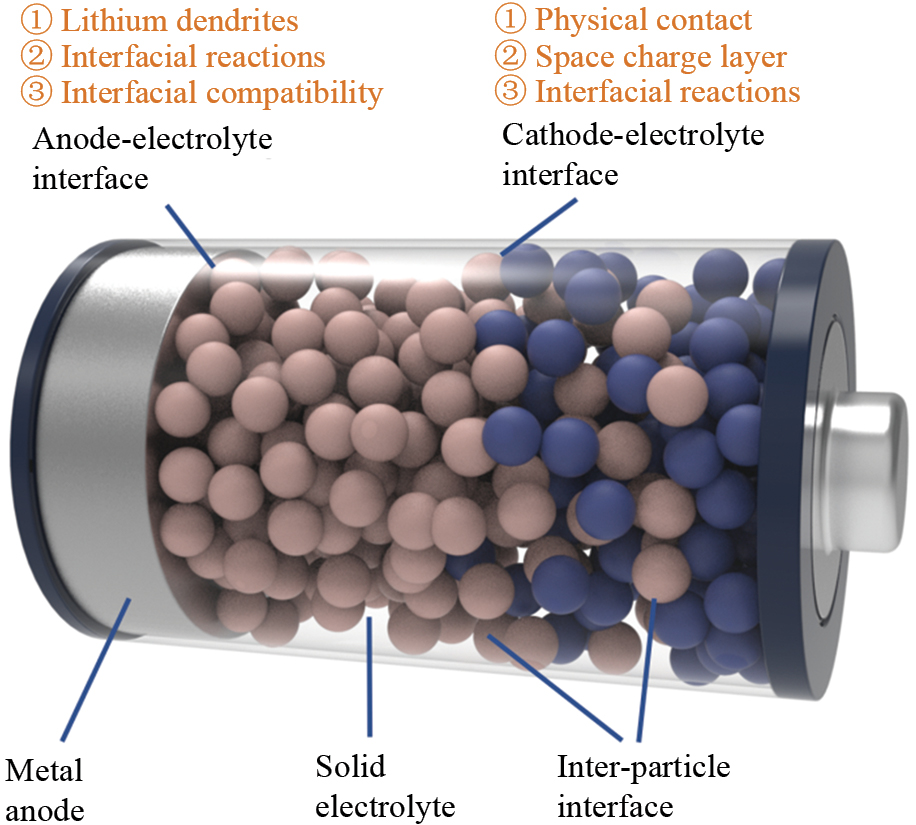
However, as shown in Fig. 1, the practical application of SSBs remains challenging due to poor solid-solid interfacial contact between electrodes and solid electrolytes [10–12]. In contrast to the fluidic nature of liquid electrolytes, which can easily wet the surface of active materials and fill interparticle voids, SSEs often suffer from interfacial voids, mechanical mismatch, and chemical instability due to limited conformal contact and rigid lattice structures [13–15]. Consequently, these issues lead to high interfacial resistance, sluggish lithium-ion transport, and severe capacity fading during cycling, especially under low stack pressure or large-area configurations [16, 17].
The SSE-electrode interface presents three major challenges. (1) Poor physical contact, particularly in thick electrodes or large-format pouch cells, promotes interfacial delamination and increases impedance [18]. (2) Electrochemically, the limited electrochemical stability of some SSEs (e.g., sulfides and oxides) triggers parasitic reactions, interfacial phase formation, and gas evolution under high voltages or reducing conditions [19, 20]. (3) Mechanically, repeated cycling-induced volume variations generate microcracks, localized stress, and progressive interfacial failure [21].
To address these interfacial challenges, several advanced engineering strategies have been developed, such as introducing interfacial buffer layers [22], constructing artificial solid electrolyte interphases (SEI) [23–25], employing soft polymer–inorganic hybrid interlayers [26], or applying external stack pressure to maintain intimate contact during cycling [27]. Collectively, these approaches effectively mitigate interfacial resistance, enhance electrochemical stability, and improve both mechanical tolerance and chemical robustness [28, 29].
In this review, we critically examine the key interfacial challenges impeding the performance and commercialization of SSBs. Specifically, section 2.1 addresses the SSEs–cathode interface, where interfacial chemical degradation, increasing impedance, and inadequate physical contact collectively undermine high-voltage cycling stability. Section 2.2 focuses on the SSE–lithium metal anode interface, which suffers from electrochemical instability, lithium dendrite penetration, and mechanical failure during repeated plating/stripping. Section 2.3 extends the discussion to intra-particle interfaces in composite electrodes and solid electrolytes, emphasizing the roles of microstructural heterogeneities, grain boundary resistance, and dynamic evolution in dictating ion transport and cyclability. By systematically dissecting these interfacial issues, this review not only elucidates their underlying mechanisms but also provides actionable design principles for achieving robust, high-energy-density SSBs.
In SSBs, the preparation of cathode composites typically resembles that in liquid electrolyte systems, with the inclusion of ion-conductive additives such as polymeric or inorganic SSEs [18, 30]. Nevertheless, the inherent rigidity and cyclic volume fluctuations of oxide cathodes degrade interfacial contact with SSEs, impeding ion transport kinetics [31]. Moreover, lattice mismatch between oxide cathodes and SSEs induces Li+ depletion at the interface, generating detrimental space charge region (SCR) [32]. Critically, incompatibility in electrochemical stability windows between the SSEs and the cathode may trigger electrolyte decomposition [33].
Physical contact at the SSEs/cathode interface plays a pivotal role in determining Li+ transport kinetics, where inadequate interfacial contact significantly hinders Li+ transfer, resulting in compromised electrochemical performance and shortened cycle life in SSBs employing untreated cathode materials. To address this challenge, co-sintering of cathode materials with inorganic SSEs has emerged as an effective strategy. As shown in Fig. 2(a), Wang et al. developed an all-ceramic cathode/electrolyte solid-state battery with ultra-low interfacial resistance by co-sintering LiCoO2 with Li7La3Zr2O12 (LLZO), where the Li2.3-xC0.7+xB0.3-xO3 solid electrolyte interphase was formed in situ through reaction with Li2CO3 present on both LLZO and LiCoO2 surfaces [34]. Similarly, Zhang et al. developed an innovative two-step sintering process that repurposed residual Li2CO3 on LLZO surfaces. During the first sintering stage, LLZO@Li2CO3 was transformed into LLZO@LiCoO2, with Li2CO3 serving as the lithium source, while lithium loss concurrently generated a Li-deficient La2Zr2O7 phase within LLZO (Fig. 2(b)) [35]. The subsequent sintering step with additional Li2O successfully restored the lithium content, converting La2Zr2O7 back to LLZO. This methodology not only established superior interfacial contact between cathode and electrolyte components but also enhanced Li+ transport pathways through both bulk and surface regions of the Li6.4La3Zr1.4Ta0.6O12 (LLZTO) @LiCoO2 composite. Figure 2(c) demonstrates an innovative asymmetric interfacial modification strategy, combining an ultrathin in-situ polymerized cathode interlayer with a lithiophilic liquid metal coating on the Li-metal anode [36]. Owing to enhanced electrode-electrolyte interfacial contact and improved wettability, the interfacial impedance on both sides was significantly reduced, with the cathode and anode interfacial impedances decreasing to 214 Ω∙cm2 and 7.45 Ω∙cm2, respectively. Guo et al. demonstrated an effective blade-casting approach for fabricating composite cathodes by directly depositing a uniform LiFePO4/PVDF/LiTFSI/carbon black slurry onto LLZO solid electrolytes [37]. The resulting architecture achieved efficient ionic transport through the ceramic electrolyte while maintaining continuous electron conduction pathways and excellent cathode-electrolyte interfacial contact, enabling 93% capacity retention after 100 cycles at 0.05C (Fig. 2(d)). Achieving ideal solid-solid interfacial contact between battery components ideally involves integrating electrodes with electrolytes to form monolithic cells. While employing molten lithium as the anode is feasible, the cathode side presents greater challenges due to interdiffusion of detrimental elements during high-temperature processing. Herein, Wen et al. developed an simple and cost-effective strategy involving liquid-phase-sintering-assisted in situ interfacial growth [38] . This approach enables the formation of a monolithic structure between a LiCoO2 cathode and a LLZTO electrolyte, interconnected via a unique decrystallizing interlayer. Notably, this interlayer comprises Co-doped LLZTO nanocrystals dispersed within an amorphous matrix (termed the NAM region), wherein the amorphous matrix effectively prevents interdiffusion of detrimental elements, while the nanocrystals facilitate Li+ transport. Benefiting from this distinctive NAM architecture, the fabricated all-in-one all-solid-state battery exhibits remarkable long-term cyclability (exceeding 500 cycles at 0.2C with > 80% capacity retention).
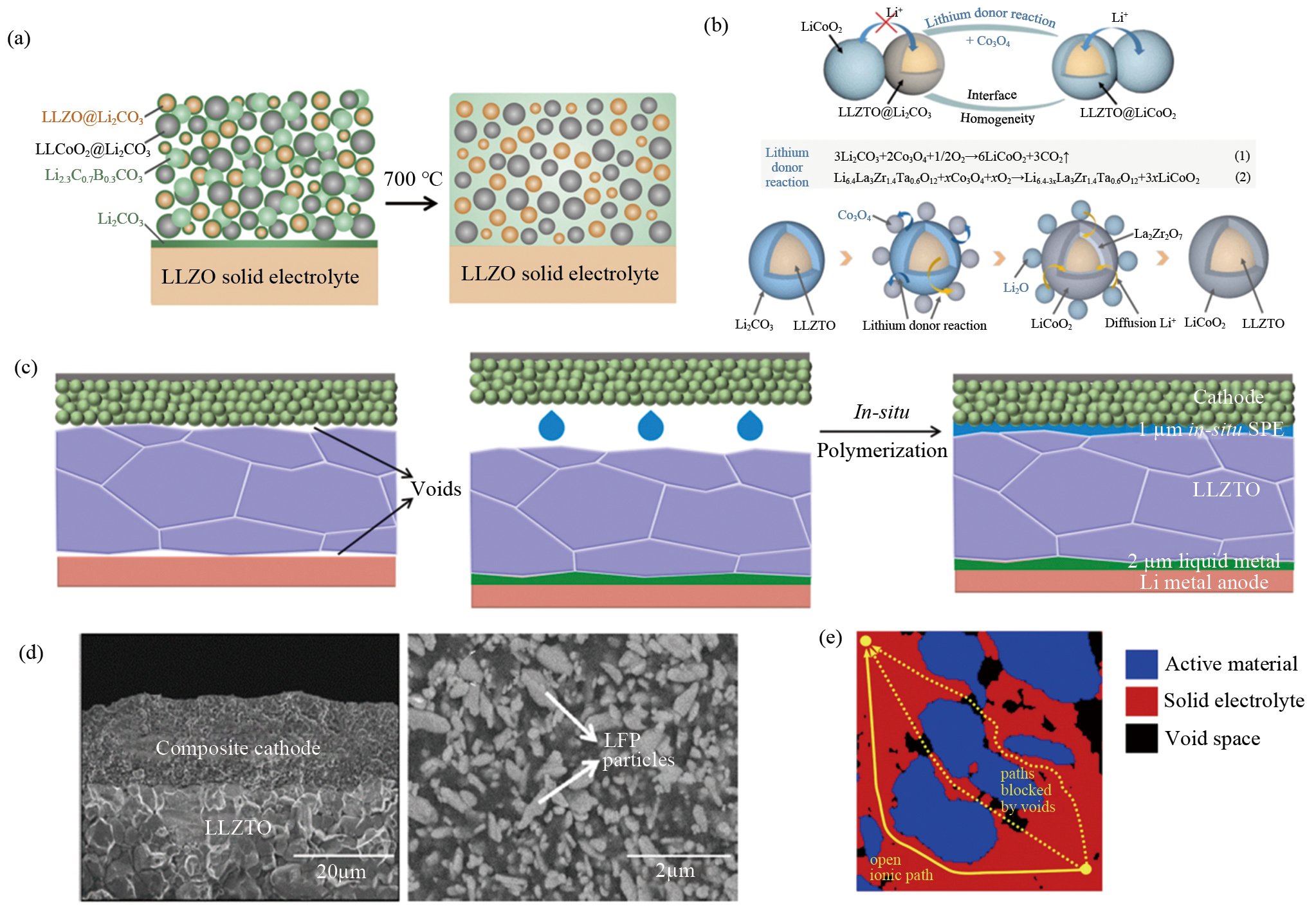
Volume changes during repeated lithiation/delithiation exacerbate interfacial stress between the electrode material and SSEs [39]. The rigid mechanical coupling in SSBs amplifies contact issues caused by this stress. Tallarek et al. revealed that interfacial voids between LiCoO2 and SSEs significantly increase Li+ transport path tortuosity, resulting in high interfacial impedance (Fig. 2(e)) [40]. Wagemaker et al. employed 2D Li+ exchange Nuclear Magnetic Resonance (NMR) spectroscopy to monitor interfacial impedance evolution, where chemical shift variations indicated severe contact degradation at Li2S/Li6PS5Br interfaces caused by cathode volume changes and interfacial side reactions [41] . These findings highlight the necessity for interface optimization considering volume change effects in inorganic SSEs systems. In contrast, organic or composite SSEs maintain better contact with cathodes due to their inherent flexibility [42, 43].
The "space charge layer" (SCL) theory, originally developed by Wagner et al. in 1972 [44], gained recognition for explaining cathode/SSEs interfacial issues only in 2006 [45]. At mixed ionic/electronic conductor (MIEC) cathode/SSEs interfaces, electrochemical potential differences induce charge redistribution, forming an SCL where carrier concentrations vary significantly. The LiCoO2/Li10GeP2S12 (LGPS) system exemplifies this phenomenon: Differences in chemical potential between the oxide cathode and sulfide electrolyte, coupled with Coulombic forces from O2-, drive Li+ migration from the sulfide electrolyte across the interface to the LiCoO2 surface until electrochemical equilibrium is reached. This creates a Li+-depleted SCL within LGPS, exhibiting low ionic conductivity due to compositional imbalance. Simultaneously, as LiCoO2 is an MIEC, its electrons migrate to the surface to balance the excess Li+, initiating a vicious cycle: more Li+ migrates from LGPS to the interface, thickening the SCL and increasing interfacial resistance. Electron probe microanalysis provides direct evidence of this mechanism, revealing substantial sulfur enrichment within LiCoO2 fracture surfaces (Fig. 3(a)) [46]. These findings demonstrate how SCL formation not only increases interfacial resistance but also promotes mechanical degradation in cathode materials.
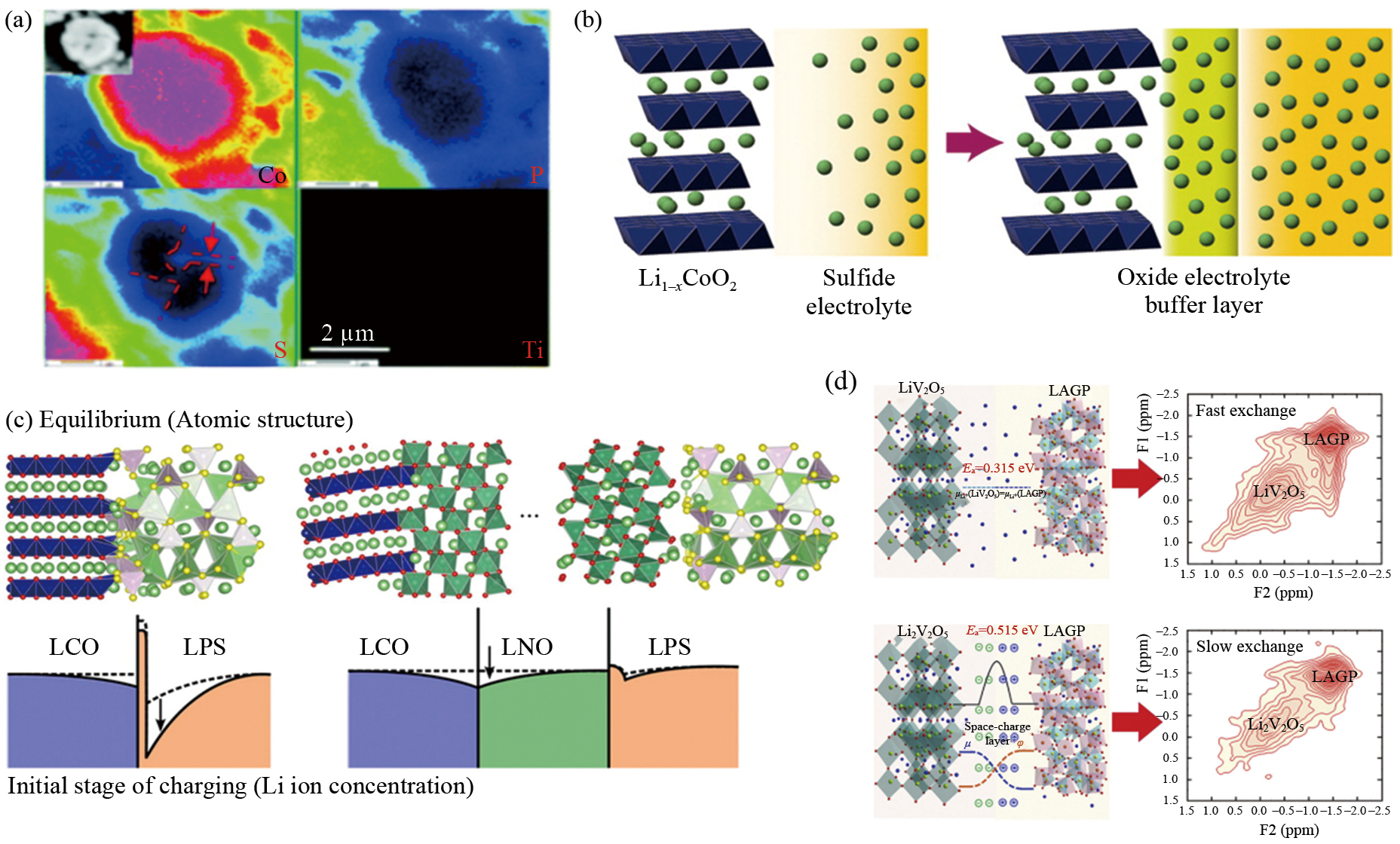
Inserting an ion-conductive but electronically insulating oxide interlayer between the cathode and the SSE is an effective strategy to mitigate the SCL effect, transforming the cathode/SSEs interface into a cathode/interlayer/SSEs interface [47]. The interlayer effectively mitigates the chemical potential difference at the cathode interface while its electronic insulating nature suppresses space charge layer formation at the electrolyte interface. The pioneering work by Takada et al. demonstrated that introducing a Li4Ti5O12 interlayer could effectively suppress SCL formation in LiCoO2/sulfide electrolyte systems (Fig. 3(b)) [45]. This seminal study sparked extensive research into alternative interlayer materials, with LiNbO3 [47], LiTaO3 [48], Li3PO4 [49], LiAlO2 [50] emerging as promising candidates. Yoshitaka et al. provided fundamental understanding through density functional theory (DFT) calculations, revealing that the LiNbO3 interlayer not only promotes favorable Li+ adsorption on CoO6 octahedra but also facilitates efficient Li+ transport through available sites in the Li layer [51]. More significantly, this buffer layer creates an atomically coherent interface that eliminates spatial heterogeneity in Li+ adsorption, thus preventing non-uniform Li+ distribution (Fig. 3(c)). During initial charging, SCL formation leads to increased interfacial resistance. Cheng et al. [52] quantified this effect using NMR spectroscopy to probe Li+ transport across LixV2O5/Li1.5Al0.5Ge1.5(PO4)3 (LAGP) interfaces. Their results (Fig. 3(d)) show that SCL formation elevates the Li+ exchange activation energy from 0.315 eV to 0.515 eV, representing a 63% enhancement that substantially reduces exchange current density and elevates interfacial resistance. These findings provide compelling experimental evidence for the adverse effects of SCL on interfacial charge transfer kinetics.
The mismatched electrochemical stability windows between SSEs and cathode materials can induce interfacial side reactions, occurring either at open circuit or under applied voltage [53]. The electrochemical window, defined as the voltage range between oxidation and reduction potentials, where wider windows indicate better stability, can be determined via linear sweep voltammetry (LSV) or DFT calculations. Goodenough et al. [54] elucidated the essence of the electrochemical window using molecular frontier orbital theory (Fig. 4(a)). In this framework, the electrolyte's lowest unoccupied molecular orbital (LUMO), corresponding to the conduction band (C.B.) in semiconductors, represents the energy level where it can accept electrons. If the anode chemical potential (μA) is higher than the LUMO, electrons transfer from the anode to the electrolyte, driving reduction. Conversely, the highest occupied molecular orbital (HOMO), corresponding to the valence band (V.B.), represents the level where it can donate electrons. If the cathode chemical potential (uC) is lower than the HOMO, electrons migrate from the electrolyte to the cathode, resulting in oxidation. Thus, a stable electrolyte should possess a LUMO lower than the anode lithiation potential and a HOMO higher than the cathode delithiation potential.
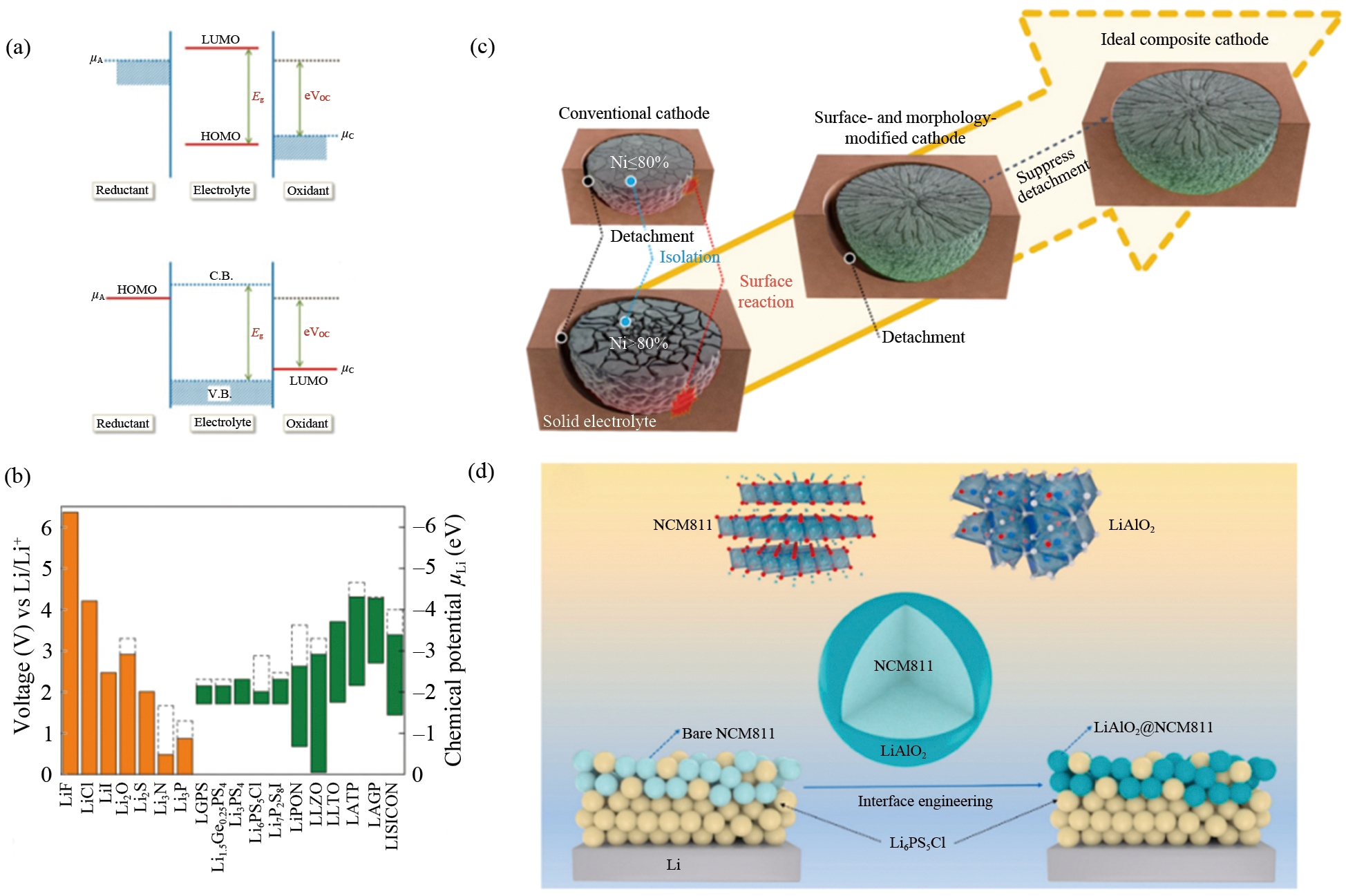
The conventional assumption regarding the high-voltage stability of inorganic SSEs may require reconsideration. As shown in Fig. 4(b), theoretical calculations indicate that many inorganic SSEs (e.g., LLZO, LISICON, LLTO) possess intrinsic oxidation limits below 4 V versus Li+/Li [55]. However, experimentally measured oxidation potentials obtained through cyclic voltammetry (CV) often appear higher due to kinetic limitations. The restricted interfacial contact area with blocking electrodes significantly retards decomposition rates, thereby obscuring the materials' true thermodynamic instability under high-voltage conditions. To address this measurement challenge, Wang et al. developed an innovative Li/LLZO/LLZO-C/Pt configuration, replacing the conventional Li/LLZO/Pt structure for stability window determination [56]. By incorporating carbon into LLZO to form a composite electrode, the researchers enhanced electron transport and increased the active area for charge transfer, which accelerated decomposition kinetics. This approach revealed a distinct oxidation current for LLZO at 4 V, substantially lower than the previously reported 6 V. The discrepancy between measured and theoretical values can be attributed to the oxidation overpotential of LLZO. Interface stability remains a critical challenge in SSBs systems. Banerjee et al. [57] systematically investigated the interface between Li6PS5Cl and LiNixCoyAl1-x-yO2 (NCA) cathodes using advanced characterization techniques combined with first-principles calculations. Their work identified spontaneous chemical reactions generating side products including Ni3S4, LiCl, and Li3PO4. For polymer-based SSEs such as polyethylene oxide (PEO), the typical electrochemical window ranges from 0–4 V. Notably, transition metal oxides in the cathode can catalyze irreversible oxidative decomposition of PEO, as evidenced by NMR monitoring of fluorine element distribution. Common strategies to mitigate window mismatch include cathode surface coating and incorporation of ionic conductive additives, which have shown promise in improving interfacial stability [58–60]. Park et al. [61] conducted a comprehensive study on capacity fading mechanisms in Ni-rich NCA cathodes within SSBs. Their work identified three primary degradation pathways: (1) surface reactions at the cathode-electrolyte interface, (2) inner-particle isolation caused by microcracks, and (3) detachment of cathode particles from the SSEs (Fig. 4(c)). Through surface modification (boron coating) and morphology engineering (Nb doping), the researchers demonstrated that surface reactions dominate in cathodes with 80% Ni content, while mechanical degradation (isolation and detachment) becomes predominant in Ni-rich cathodes (≥ 85% Ni). The optimized cathode (SM-Ni90) achieved 80.2% capacity retention after 300 cycles in high-loading pouch cells, though further improvements are needed to address particle detachment for long-life SSBs. Interfacial engineering has emerged as a promising approach to address these challenges. As illustrated in Fig. 4(d), Wang et al. developed a nanoscale LiAlO2 coating (~5 nm thick) for LiNi0.8Co0.1Mn0.1O2 (NCM811) cathodes to improve interface stability in SSBs [62]. This coating effectively functioned as a buffer layer, suppressing both SCL formation and electrolyte decomposition at the cathode/sulfide electrolyte (Li5.5PS4.5Cl1.5) interface. Electrochemical characterization demonstrated that the coating enhanced Li+ migration kinetics while reducing interfacial resistance and polarization. Consequently, the LiAlO2@NCM811 cathode delivered an initial discharge capacity of 139.46 mAh∙g−1 at 0.05C with 82.4% capacity retention after 60 cycles, significantly outperforming uncoated NCM811. X-ray photoelectron spectroscopy (XPS) and Transmission Electron Microscope (TEM) analyses confirmed the coating's effectiveness in stabilizing the interface by minimizing oxidative degradation of the solid electrolyte, highlighting the importance of tailored interfacial design for optimizing Ni-rich cathode performance in SSBs.
Employing lithium metal as the anode can significantly enhance the energy density of SSBs. However, its highly negative electrochemical potential drives electron transfer upon contact with the SSEs, forming a new interface. Thus, coupling Li metal with SSEs requires a chemically, electrochemically, and mechanically stable interface with sufficiently fast charge transfer kinetics to support rapid Li stripping/deposition during cycling. This section outlines Li dendrite growth, interfacial reactions, and compatibility issues at the SSEs/Li anode interface.
The commercialization of lithium metal batteries has faced persistent challenges since their earliest implementation in Moli Energy's liquid Li-MoS2 system (1980) [63]. Safety concerns stemming from lithium dendrite penetration, leading to internal short circuits and thermal runaway, ultimately forced the discontinuation of this battery. Beyond safety risks, dendritic growth triggers multiple failure mechanisms: (1) continuous consumption of lithium and electrolyte through repetitive SEI formation on newly exposed lithium surfaces, (2) progressive deterioration of Coulombic efficiency, and (3) substantial volumetric fluctuations that disrupt electrode-electrolyte interfaces. These fundamental challenges underscore why dendrite mitigation remains a critical requirement for practical lithium metal batteries [64–66].
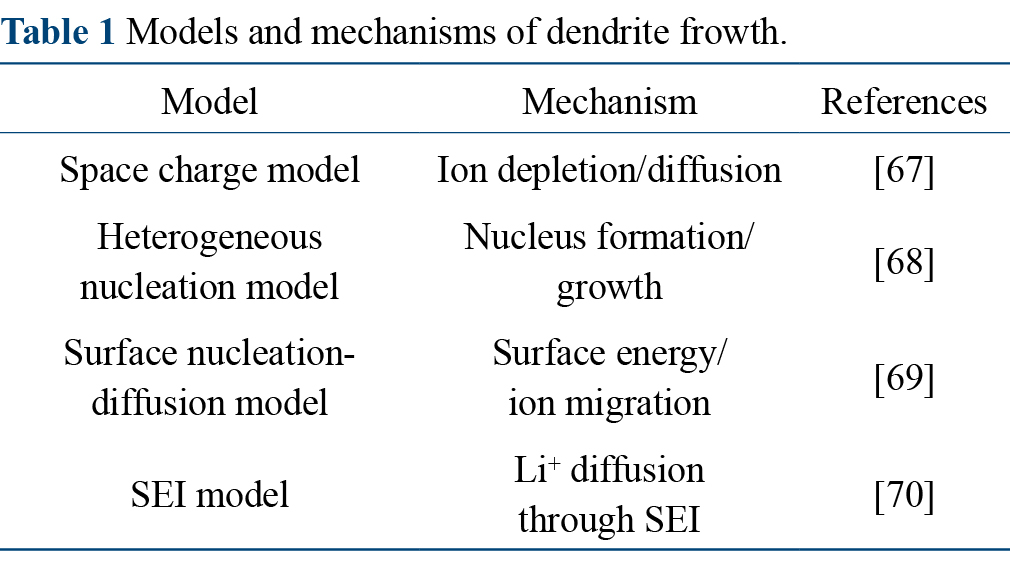
Investigating dendrite formation in solid-state systems presents unique experimental hurdles. The inherent opacity of most solid electrolytes and the confined nature of buried interfaces complicate direct observation. Consequently, researchers often draw upon mechanistic insights from liquid electrolyte systems, where characterization is more accessible. Table 1 systematically compares established dendrite growth models and their underlying physical principles across different battery configurations.
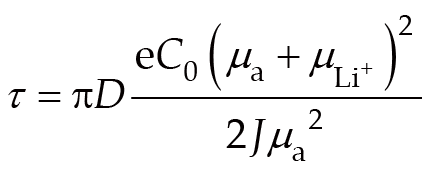
The space charge model proposed by Chazalviel [67], derived from Sand's time model for Cu2+ deposition [71], remains the most widely accepted framework for explaining dendrite initiation. This model attributes dendritic growth to the formation of space charge layers in dilute electrolytes, where dendrites nucleate when the Li+ concentration at the electrode surface is depleted under high current density conditions. The initiation time τ, called Sand time, is given by Eq. (1), where D is the cation diffusion coefficient, e is the elementary charge, C0 is the initial electrolyte concentration, J is the effective current density, μa and are the anion and Li+ mobilities, respectively. Sand time τ depends empirically on the transference numbers of electrons and Li+. Increasing τ (delaying dendrites) can be achieved by reducing J, increasing , or raising C0. Strategies like high-surface-area anode structures and electrolytes with high Li+ transference numbers () can suppress dendrites.(1)
The heterogeneous nucleation model offers fundamental understanding of the initial lithium deposition process that governs the final morphology of Li metal deposits. Ely et al. [68] identified five nucleation states: nucleation suppression regime, long incubation time regime, short incubation time regime, early growth regime, and late growth regime. Thermodynamically unstable nuclei dissolve in the nucleation suppression regime. Long incubation time regime allows stable growth, whereas short incubation time limits nucleus size distribution beyond a critical potential, after which nuclei exceeding a critical size grow with increasing overpotential. Smoothing the Li surface, improving Li wettability, and controlling deposition overpotential can inhibit dendrites growth.
The surface nucleation-diffusion model elucidates dendrite formation through the interplay of surface energetics and ion transport kinetics. Comparative analysis reveals lithium's inherent dendrite propensity stems from its materials-specific characteristics: While exhibiting diffusion barriers comparable to magnesium (Mg), lithium's weaker single-bond strength results in a diminished free energy difference between bulk and low-dimensional phases [69]. This thermodynamic predisposition, coupled with sluggish surface diffusion, promotes dendritic growth. In contrast, Mg2+'s enhanced surface mobility facilitates preferential deposition at existing sites, naturally suppressing dendrite formation. Detailed investigations of common SEI components (LiOH, Li2O, Li2CO3, and LiX) by Arias et al. demonstrate how interfacial chemistry governs deposition morphology [72]. Li2CO3, characterized by high Li+ diffusion barriers and low surface energy, creates unfavorable conditions for uniform deposition. Conversely, lithium halides (LiX) exhibit more favorable properties: their higher surface energies and reduced diffusion barriers promote two-dimensional growth. These fundamental insights have driven the strategic use of halide additives, particularly fluorides, which have been shown to enhance Coulombic efficiency while significantly suppressing dendritic growth [73, 74].
The formation of the SEI is an inherent consequence of lithium metal's spontaneous reaction with organic electrolytes. This interfacial layer plays a pivotal role in determining deposition morphology, as its mechanical integrity and transport properties govern lithium plating behavior. During repeated cycling, substantial volume changes induce mechanical stress within the SEI, leading to fracture and subsequent formation of localized high-current-density regions that serve as preferential sites for dendritic nucleation [70]. Advanced in-situ TEM characterization by Sacci et al. [75] has provided direct visualization of the dynamic interplay between SEI evolution and lithium deposition. These observations reveal a complex, self-adjusting interface where SEI growth and lithium plating occur concomitantly. Complementary studies by Li et al. demonstrate the critical influence of deposition kinetics on morphological development [76]. Under high overpotential conditions, accelerated SEI formation creates a constrictive environment that accumulates mechanical stress, ultimately leading to root-initiated dendritic growth. In this regime, the increased polarization renders lithium ion diffusion through the SEI as the rate-determining step, promoting one-dimensional dendrite formation. Conversely, more moderate deposition conditions facilitate a balanced growth process. The slower SEI formation kinetics under low overpotentials permit enhanced lithium ion mobility, enabling the cooperative deposition of metallic lithium and SEI components. This synergistic growth mechanism results in denser, more homogeneous lithium morphologies with improved electrochemical performance. These findings collectively highlight the importance of optimizing both SEI properties and deposition conditions to achieve stable lithium metal anodes.
The growth mechanisms of lithium dendrites in SSBs exhibit fundamental differences between polymer and inorganic SSEs systems, necessitating distinct analysis approaches. In polymer-based SSEs systems, dendrite propagation manifests through several characteristic pathways (Fig. 5(a)) [77]. (1) Tip growth through soft polymer domains: Surface protrusions on electrodes generate localized electric field enhancement at their tips, which preferentially directs lithium deposition. Theoretical analysis by Monroe and Newman based on linear elasticity principles indicates that dendritic growth can be effectively inhibited when the polymer electrolyte's shear modulus surpasses double that of metallic lithium [78]. (2) Lateral growth along the Li/Polymer interface: Lateral Li+ deposition through the SEI induces interfacial delamination [79]. (3) Substrate-induced growth: Dendritic nucleation initiates at substrate structural defects, ultimately propagating through the polymer electrolyte (Fig. 5(b)) [80]. (4) Charge redistribution-induced growth: At the Li/polymer interface, a low Li+ transference number () induces rapid anion depletion, resulting in the formation of an electrical double layer that facilitates dendrite nucleation [81]. Dendrite suppression can be achieved through enhanced mechanical strength or improved ionic transport properties. Notably, Lodge et al. developed polymer electrolytes with exceptional mechanical properties (1 GPa modulus) and high ionic conductivity (1 mS∙cm−1) using polymerization-induced phase separation [82]. Zhang et al. fabricated a PEO/PEG-LGPS composite SSEs exhibiting both high room-temperature conductivity (9.83×10⁻⁴ S∙cm−1) and elevated (0.68), which substantially improved the cycling stability of Li symmetric cells [83].
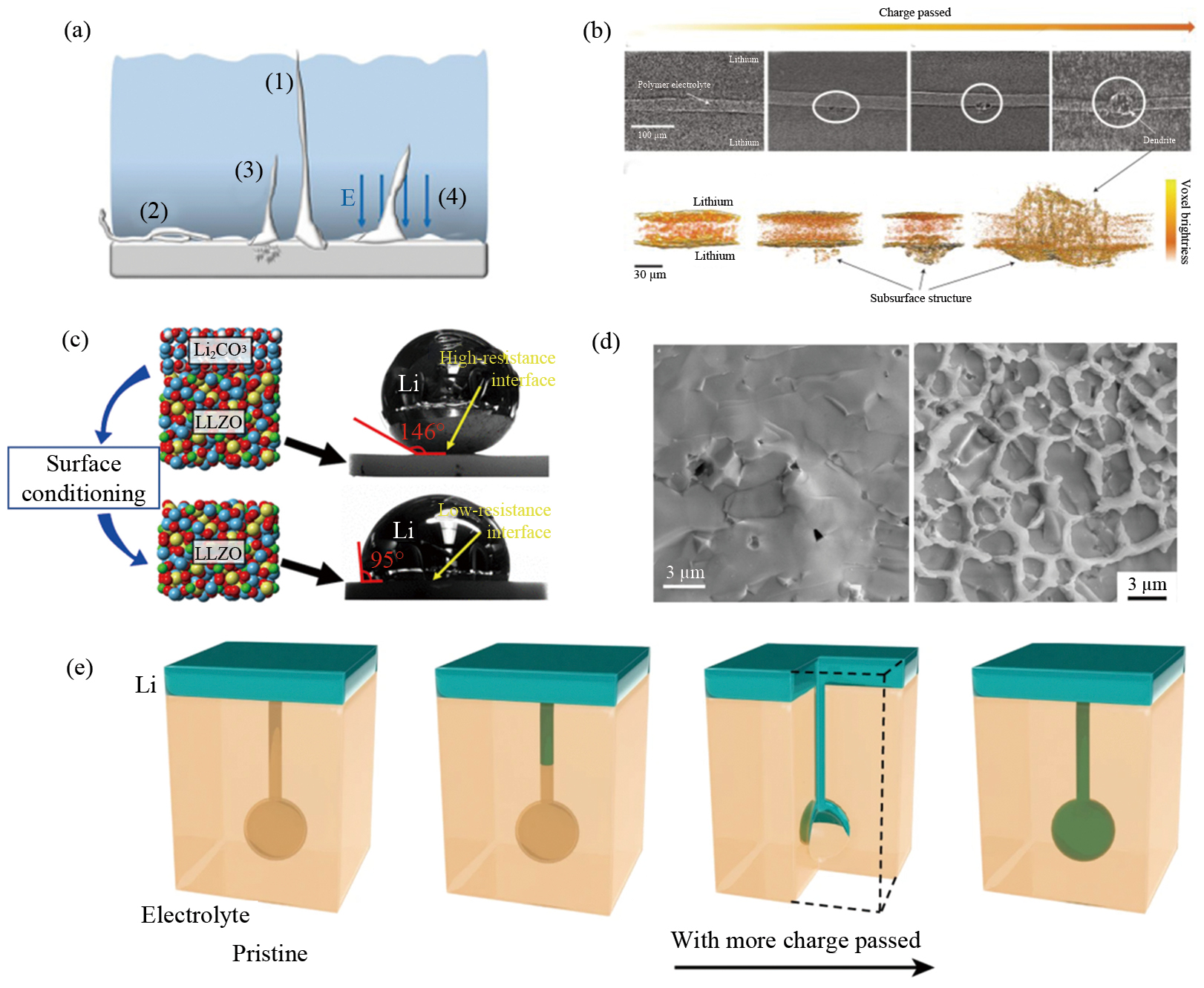
In inorganic SSEs systems, the growth of lithium dendrites can be categorized into the following four types. (1) Dendrite growth induced by discontinuous interfacial contact. Insufficient contact between the lithium metal anode and the inorganic SSEs leads to high interfacial resistance, significantly lowering the electrolyte's critical current density (CCD). In addition, the poor wettability between the SSEs and lithium metal anode further deteriorates interfacial contact. As shown in Fig. 5(c), Sakamoto et al. demonstrated through first-principles calculations that Li2CO3 on LLZO surface increases the contact angle with lithium, reducing its lithiophilicity [84]. (2) Dendrite penetration along grain boundaries. The presence of grain boundaries in polycrystalline SSEs critically governs lithium deposition dynamics. Through meticulous microstructure engineering and scanning electron microscopy (SEM) characterization, Sakamoto et al. provided direct experimental evidence of lithium's preferential deposition along LLZO grain boundaries (Fig. 5(d)), indicating that grain boundaries play a critical role in dendrite formation during lithium deposition [85]. (3) Dendrite growth induced by the microstructure (pores and defects) within the SSEs. The microstructure of inorganic SSEs critically governs their mechanical integrity and ionic transport properties. Ning et al. [86] employed operando X-ray tomography to elucidate a two-phase dendrite formation process, where initial nucleation occurs through lithium infiltration into microcracks and pore junctions, followed by propagation via lithium's viscoplastic deformation that extends these defects (Fig. 5(e)). These findings underscore the importance of microstructural engineering in developing dendrite-resistant inorganic SSEs. (4) Dendrite growth inside the bulk of the inorganic SSEs. While inorganic SSEs exhibit high mechanical modulus that should theoretically prevent dendrite penetration, their experimentally measured CCD consistently fall below theoretical predictions. This apparent contradiction was resolved by Wang et al. through operando neutron depth profiling studies of LLZO and Li3PS4 systems [87]. Their work revealed that residual electronic conductivity (10−9–10−7 S∙cm−1) in these materials enables lithium ion reduction within the electrolyte bulk, facilitating intragranular dendrite formation despite the materials' mechanical robustness.
(1) Inorganic SSEs/Li anode interface
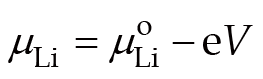
The chemical stability of SSEs at open circuit is determined by the relative positions of the lithium anode's chemical potential (μLi) and the electrolyte's LUMO level. When μLi exceeds the SSEs's LUMO energy, spontaneous reduction of the electrolyte occurs. Under electrochemical polarization, the anode's electrochemical potential (μLi) follows Eq. (2):(2)where V represents the applied voltage and e denotes the elementary charge [88]. This electrochemical potential difference determines the reduction stability window of the SSEs. For inorganic SSEs, contact with Li metal anode leads to reduction of surface high-valence cations, forming resistive interphases. As shown in Fig. 6(a) [89], SSEs/Li interfaces fall into three types: (1) Thermodynamically stable (non-reactive): no reaction occurs. (2) Mixed conductor interphase (MCI): the mixed conductor interphase (MCI), which is both electronically and ionically conductive, grows into the SSEs, leading to severe self-discharge. This phenomenon is common in SSEs containing multivalent cations and necessitates the use of protective layers for prevention. (3) Passivating interphase: electronically insulating but ionically conductive; protects the SSEs if sufficiently thin and electronically blocking.
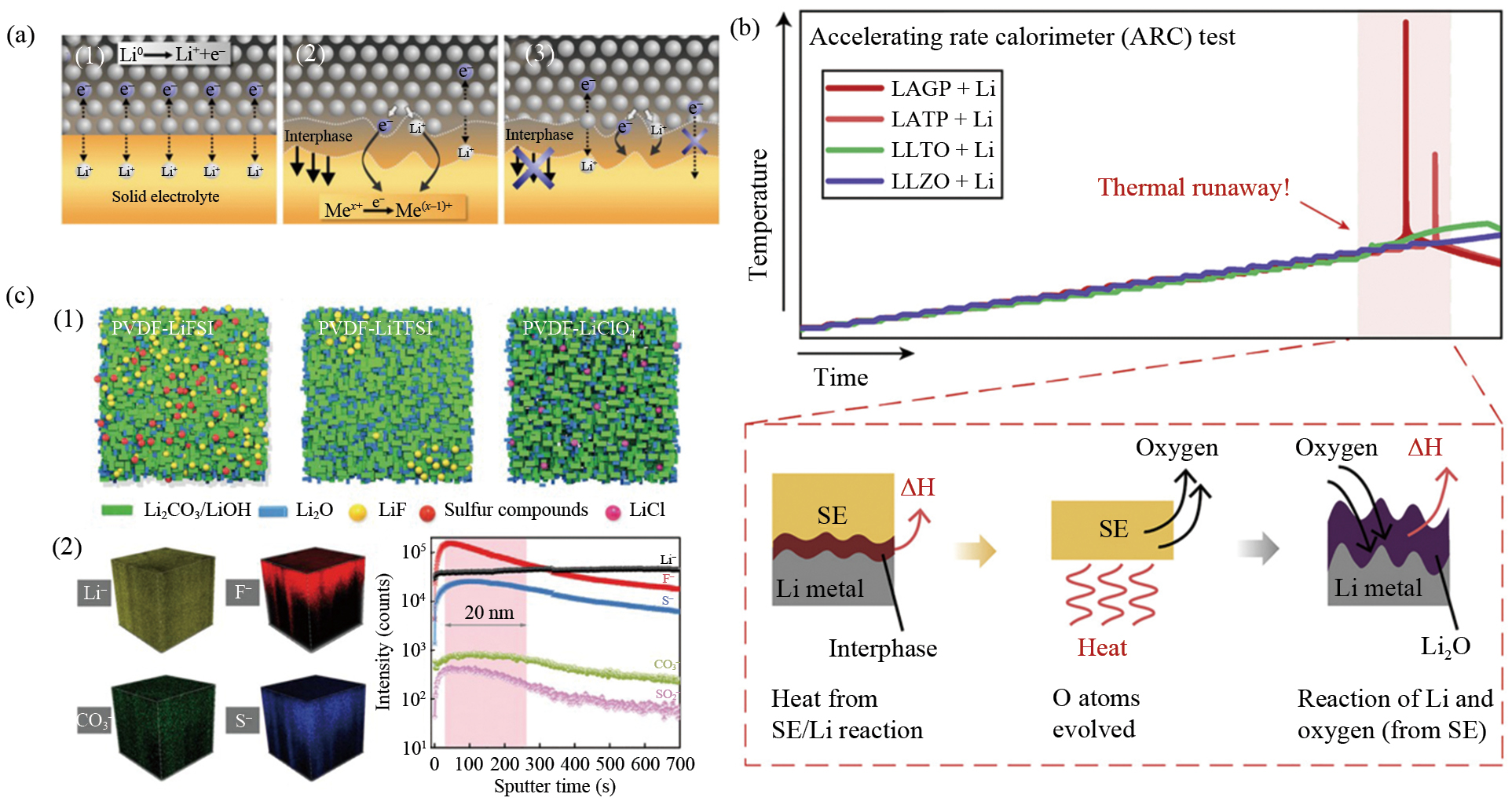
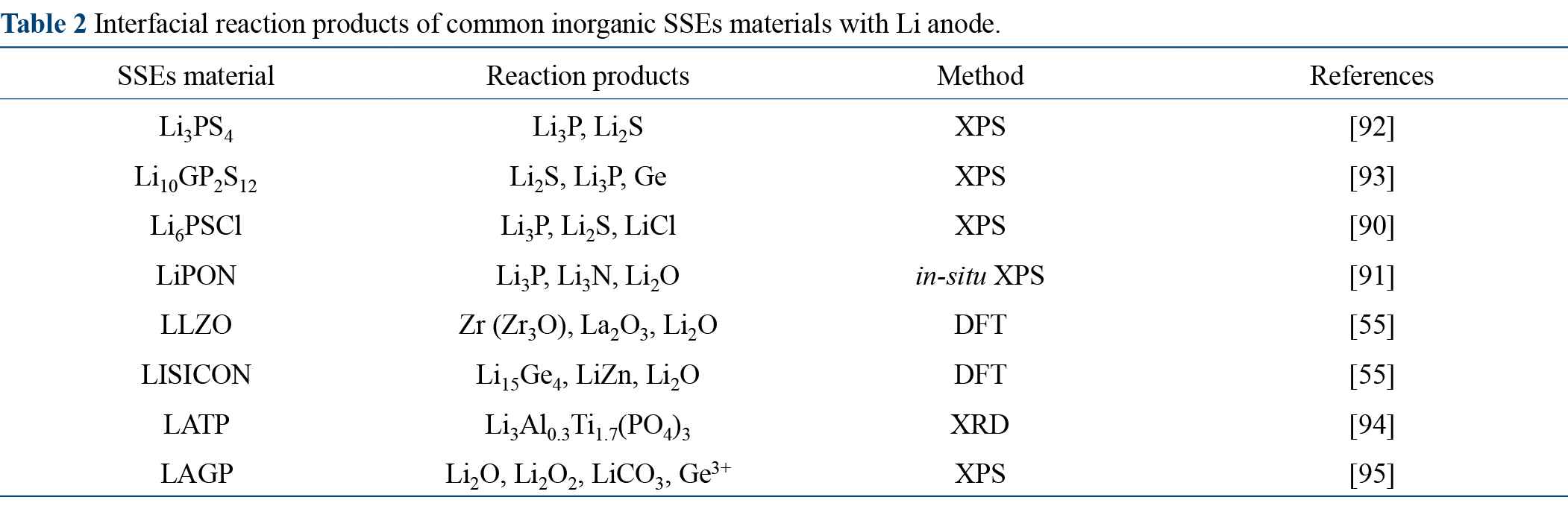
Most inorganic SSEs exhibit thermodynamic instability against Li metal. The resulting decomposition products are summarized in Table 2. SSEs without transition metals (e.g., Li3PS4, Li6PS5Cl, LiPON) typically form passivating interphases rich in Li3P, Li3N, LiCl, or Li2S, which effectively terminate further reduction [90, 91]. In contrast, SSEs containing reducible cations such as Ge4+ or Ti4+ (e.g., Li10GeP2S12, LATP, LAGP) generate MCI containing metallic Ge or Ti, facilitating continuous electrolyte reduction and battery failure [92–95]. The reduction process frequently involves lithiation reactions. Cheng et al. [94] identified lithiated Li3Al0.3Ti1.7(PO4)3 in the MCI of LATP via XRD, suggesting that indirect decomposition contributes to a broader apparent electrochemical stability window. Similarly, Kang et al. found that LAGP reacts with Li, forming Li2O, Li2O2, Li2CO3, and reduced Ge3+ [95]. The MCI enables Li+ reduction at the SSEs interface, triggering local volume expansion, crack formation, and LAGP fragmentation.
| SSEs material | Reaction products | Method | References |
|---|---|---|---|
| Li3PS4 | Li3P, Li2S | XPS | [92] |
| Li10GP2S12 | Li2S, Li3P, Ge | XPS | [93] |
| Li6PSCl | Li3P, Li2S, LiCl | XPS | [90] |
| LiPON | Li3P, Li3N, Li2O | in-situ XPS | [91] |
| LLZO | Zr (Zr3O), La2O3, Li2O | DFT | [55] |
| LISICON | Li15Ge4, LiZn, Li2O | DFT | [55] |
| LATP | Li3Al0.3Ti1.7(PO4)3 | XRD | [94] |
| LAGP | Li2O, Li2O2, LiCO3, Ge3+ | XPS | [95] |
The replacement of flammable liquid electrolytes with non-flammable SSEs represents a promising approach for enhancing battery safety. However, Li et al. conducted accelerated rate calorimetry (ARC) studies that revealed significant variations in thermal stability among common oxide SSEs (LATP, LAGP, LLTO, and LLZO) when in contact with Li metal (Fig. 6(b)) [96]. While LLZO maintained stability, LATP, LAGP, and LLTO exhibited thermal runaway upon lithium contact. The thermal runaway mechanism stems from coupled physicochemical processes. Li metal melting enhances interfacial contact area, promoting faster reaction rates. Concurrently, elevated temperatures induce oxygen evolution from oxide SSEs, which reacts exothermically with molten lithium. This oxygen-mediated pathway dominates thermal runaway initiation in oxide electrolytes. Sulfide SSEs, though structurally different, possess similarly labile bonds that could engender comparable safety issues. These results highlight essential research directions requiring parallel investigation of degradation pathways and thermal stabilization methods for SSEs systems.
(2) Organic SSEs/Li anode interface
The spontaneous reaction between highly reactive Li metal anode and polymer electrolytes leads to the formation of an interphase layer whose characteristics are dictated by the polymer's functional groups and molecular structure. Hydroxyl (-OH) and carboxyl (-COOH) functional groups have been shown to adversely affect interphase stability, whereas (R-(CH2CH2O)-H) facilitates the formation of a well-ordered continuous layer that effectively suppresses side reactions [97]. In conventional PEO/LiTFSI systems, interfacial reactions involve CF3 radical-induced hydrogen abstraction from the polymer backbone or Li-mediated C-O bond cleavage, yielding Li-O-R compounds that contribute to passivation resistance [98]. Advanced characterization techniques including Auger electron spectroscopy (AES) and time-of-flight secondary ion mass spectrometry (TOF-SIMS) have revealed the nanoscale architecture of in-situ formed interphases between PVDF-based solid-state electrolytes and Li metal anodes [99]. Notably, PVDF-LiFSI systems develop a composite interphase comprising LiF-sulfide-LiOH-Li2CO3-Li2O, which demonstrates exceptional stability combined with desirable ionic conductivity, electronic insulating properties, and mechanical robustness (Fig. 6(c)). These findings underscore the critical influence of lithium salt selection on interfacial characteristics. Systematic investigations of various lithium salts in PEO matrices have yielded important insights. While LiTFSI, LiBOB, and LiNO3 individually induce negligible interfacial chemical modifications during cycling, their combination generates reactive species including SO2 and CF3 [100]. Innovative approaches to interface stabilization have been demonstrated, Wan et al. added Mg3N2 to PEO, forming a Li3N/Mg mixed interface that stabilized the interface and promoted uniform Li deposition [101]. Other strategies to suppress interfacial reactions include polymer surface modification with LiPON [102] and photopolymerized interpenetrating network electrolytes [103].
In addition to dendrite formation and parasitic side reactions, the development of high-rate SSBs faces critical challenges in interfacial compatibility, including poor electrode-electrolyte contact/wettability and detrimental morphological changes at the anode interface. As previously discussed, the presence of Li2CO3 on LLZO surfaces severely degrades Li metal anode wettability. To address this, Han et al. [104] employed atomic layer deposition (ALD) to coat LLZO with an ultrathin Al2O3 layer, dramatically enhancing Li wettability (Fig. 7(a)) and slashing interfacial resistance from 1710 to 1 Ω∙cm2. Advanced characterization techniques, including electron energy-loss spectroscopy (EELS) and selected-area electron diffraction (SAED), confirmed the in-situ formation of a highly Li+-conductive Li-Al-O phase, identified as Li2Al4O7. Alternative strategies have also demonstrated promise. Huang et al. developed a Li-C composite anode by blending graphite into molten lithium and casting it onto LLZO, achieving a low interfacial resistance of 11 Ω∙cm2 [105]. Other effective approaches include metallic Al interlayers [106], Li-Mg alloy anodes [107], and polymer-based interfacial modifications [108]. Beyond interfacial wettability, anode morphology evolution during cycling, driven by substantial volume fluctuations, poses another major challenge, often leading to void formation and interfacial delamination. Sakamoto et al. systematically investigated the effects of stack pressure and current density on interfacial stability during galvanostatic cycling of LLZO-based cells (Fig. 7(b)) [109]. Their work revealed that below a critical pressure threshold, the cell voltage exhibits a sharp increase, with this critical pressure scaling with applied current density. This phenomenon arises when the Li stripping rate outpaces the mechanical replenishment of interfacial contact at low pressures, resulting in void-induced impedance growth. These findings highlight the necessity of co-optimizing both interfacial wettability and mechanical contact integrity in SSBs design, particularly to mitigate degradation from void formation and cyclic volume changes.
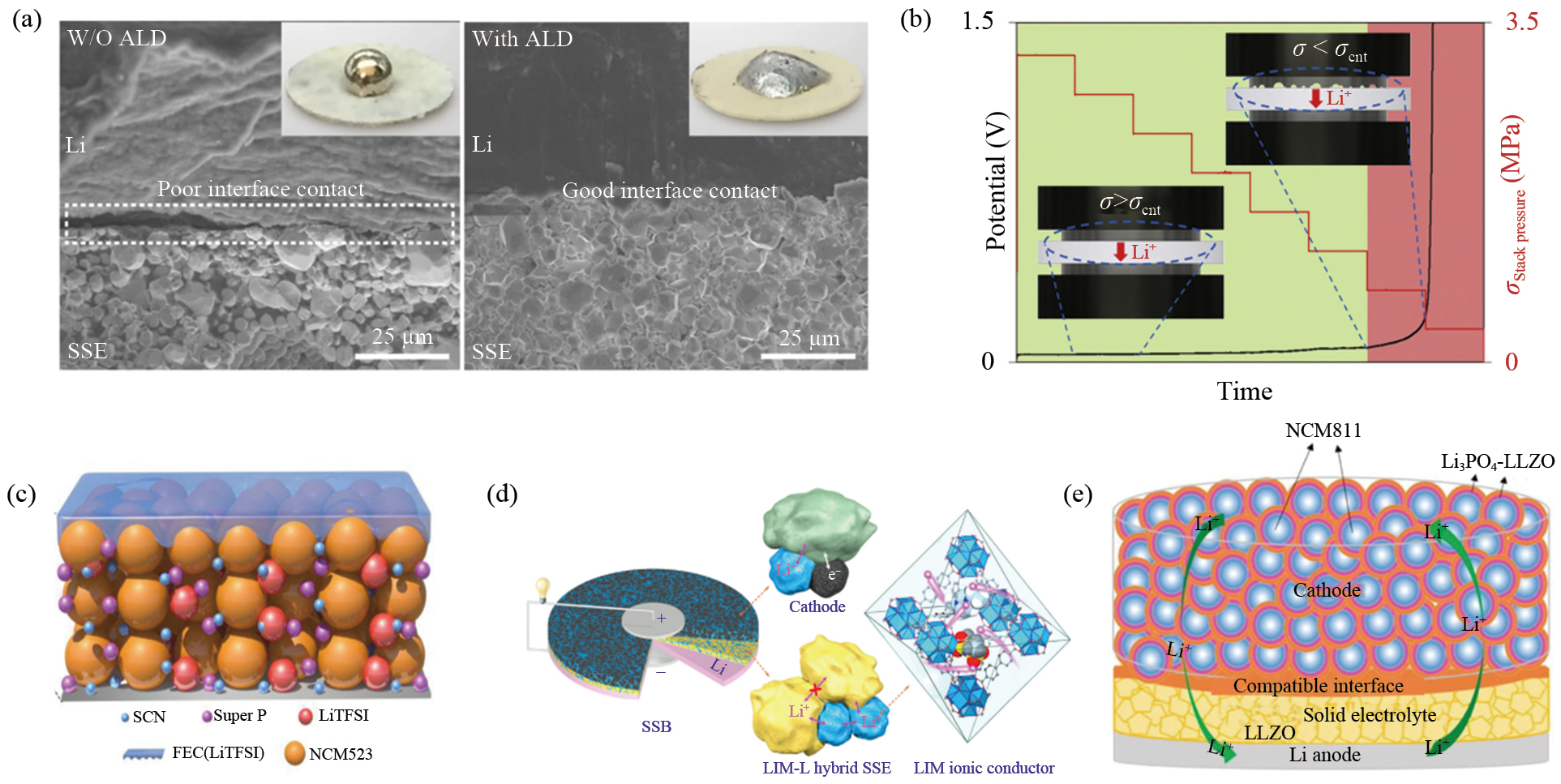
In Li metal anode-based SSBs, conductive additives become indispensable when active materials exhibit insufficient ionic or electronic conductivity. Consequently, interfacial properties within composite cathodes, both between active material particles and between active materials and additives, play a pivotal role in battery performance. The nature of these interfaces varies significantly between organic/hybrid and purely inorganic SSBs systems. The inherent flexibility of organic components in hybrid SSBs facilitates superior intra-particle contact. For instance, Wan et al. [110] demonstrated enhanced inter-particle ion transport and rate capability by employing a PEO-LiTFSI binder with LiFePO4 and Super P. Similarly, Fan et al. developed a high-performance composite cathode (NCM523:PVDF:Super P:LiTFSI:SN=84:5:5:1:5 wt%) where the SN-LiTFSI system improved ionic conduction through cathode pores, enabling both high active material loading and excellent rate performance (Fig. 7(c)) [111]. In contrast, inorganic SSBs face greater challenges due to the rigid nature of their constituent particles, which often results in poor inter-particle contact and substantial polarization. Figure 7(d) illustrates the critical transition from conventional solid-solid contacts to advanced nanowetted interfaces. Pan et al. pioneered a breakthrough "nanowetting" approach by confining Li+-conducting ionic liquid within a metal-organic framework (MOF) matrix, successfully reducing interfacial resistance in LLZO-based systems while maintaining 97% capacity retention over 150 cycles [112]. Particle size effects have also been systematically investigated. Brezesinski et al. reported that active materials with particle sizes below 10 µm achieved capacities approaching theoretical values, owing to reduced ionic transport impedance [113]. In another innovative approach. Mu et al. created a Li3PO4 "binder" through in-situ calcination, forming a conductive Li3PO4-LLZO interfacial layer on NCM811 particles that simultaneously enhanced Li+ transport and improved compatibility with LLZO electrolytes (Fig. 7(e)) [114] . These advances collectively emphasize the importance of engineering optimized ionic and electronic conduction pathways within composite cathodes to minimize interfacial resistance and polarization effects. The development of such rationally designed conductive networks represents a critical frontier in SSBs technology.
SSBs have emerged as a transformative energy storage technology, offering unparalleled advantages in energy density and safety for next-generation applications. Despite their tremendous potential, the path to commercialization remains hindered by persistent interfacial challenges that critically impact battery performance and reliability. This review systematically examines recent advances in understanding and engineering three critical interfaces: SSEs/cathode, SSEs/Li anode, and intra-particle interfaces, while outlining remaining challenges and future research directions. These accumulated and often interlinked challenges underscore the necessity of adopting multidisciplinary approaches to bridge fundamental understanding and practical applications.
(1) SSEs/Cathode interface engineering
The inherent rigidity of ceramic SSBs leads to fundamental compatibility issues with cathode materials, resulting in poor interfacial contact, detrimental space charge effects, and electrochemical instability. Recent advances in interface engineering have yielded promising solutions, including the development of ion-conductive interlayers that effectively bridge dissimilar materials. Optimized sintering processes have also demonstrated improved lattice matching and reduced interfacial resistance, while advanced cathode coatings and ionic additives show potential in mitigating side reactions caused by mismatched electrochemical windows.
(2) SSEs/Li anode interface challenges
Li metal anodes offer exceptional energy density but face significant hurdles in practical applications, particularly concerning dendrite formation, interfacial reactions, and thermal stability. Dendrite growth occurs through complex mechanisms involving space charge effects, heterogeneous nucleation, and diffusion-limited processes, while parasitic reactions accelerate capacity degradation. Elevated temperatures further exacerbate these issues, increasing the risk of thermal runaway. Current research focuses on mechanically reinforced SSEs architectures, surface modification techniques to enhance Li wettability, and the design of nanoscale protective interphases with superior stability.
(3) Intra-particle interfaces optimization
The performance of composite cathodes is heavily influenced by the intricate network of interfaces between active materials, conductive additives, and SSEs. Incorporating ionic additives has proven effective in establishing efficient percolation pathways for lithium-ion transport, while optimizing particle size and distribution minimizes polarization losses. For inorganic SSBs, novel processing methods are being explored to address the challenges posed by rigid particles, aiming to improve inter-particle contact and overall electrode performance.
(4) Future outlook
Advancing SSBs toward widespread commercialization requires a multidisciplinary approach addressing fundamental and applied challenges across multiple fronts:
(i) Multifunctional interphase engineering. Future research should prioritize developing smart interphase layers with multifunctional capabilities. These advanced materials must simultaneously address ionic/electronic transport modulation, electrochemical stability across wide voltage windows, and mechanical compliance to accommodate volume changes. Promising directions include gradient interphases with compositionally tuned properties, self-healing polymers that autonomously repair cycle-induced cracks, and electro-adaptive interfaces that dynamically respond to potential changes. Particular attention should be paid to establishing standardized evaluation protocols for interface stability under realistic operating conditions.
(ii) Dendrite dynamics and suppression strategies. A fundamental understanding of dendrite nucleation and growth mechanisms remains imperative. Future work should combine advanced in situ characterization (such as synchrotron X-ray tomography and cryo-electron microscopy) with multiscale modeling to elucidate the roles of surface defects, electrochemical polarization, and mechanical stress in dendrite initiation. This knowledge should guide the design of spatially heterogeneous SSEs with locally reinforced architectures, anisotropic conductivity, and targeted defect engineering to eliminate preferential dendrite propagation paths.
(iii) Thermally stable interface chemistries. Developing interfaces resistant to thermal degradation requires urgent attention. Research should explore refractory ceramic coatings, thermally stable polymer-ceramic hybrids, and phase-change materials that can absorb excess heat during thermal events. Understanding the coupling between thermal effects and electrochemical degradation through accelerated calorimetry tests and multiphysics modeling will be crucial for designing batteries capable of withstanding extreme operating conditions.
(iv) Advanced manufacturing and scalability. Bridging the lab-to-fab gap necessitates innovation in manufacturing technologies. Future efforts should focus on solvent-free processing methods, atomic layer deposition for conformal interface engineering, and roll-to-roll compatible techniques for large-area SSBs production. Developing standardized protocols for interface quality control and non-destructive evaluation will be equally important for ensuring batch-to-batch consistency.
(v) AI-accelerated interface design. Leveraging machine learning and computational screening approaches will accelerate the discovery of optimal interface compositions and architectures. Creating extensive databases of interface properties (ionic conductivity, mechanical modulus, electrochemical stability) combined with predictive models will enable rational design of next-generation interfaces. This approach should be integrated with high-throughput experimentation to rapidly validate computational predictions.
(vi) Integration strategies for full cells. Future research must address interface challenges from a full-cell perspective. Developing symmetric interface designs and compromise strategies that balance competing requirements at both electrodes will be essential. This includes optimizing stack pressure management, current collection configurations, and thermal management systems specifically for SSBs architectures.
The successful resolution of these interfacial challenges will require unprecedented collaboration between academia, industry, and national laboratories. By addressing these fundamental questions and technological barriers, we can accelerate the development of SSBs that meet the demanding requirements of electric vehicles, grid storage, and consumer electronics, ultimately enabling a new era of energy storage technology.
This work was supported by funding from the National Natural Science Foundation of China (No. 22508347), the Natural Science Foundation of Zhejiang Province (No. LD25E020002), and the Science and Technology Plan Projects of Zhejiang University Quzhou Research Institute (No. IZQ2024RCZX002).
Zijian Wang led the literature review and manuscript drafting. All other authors (Dongqing Xu, Chenyun Wu, Ziyi Zhan, Congcong Li, Panqi Xu, Ziwei Chen, Yingshuang Sun, Justice Delali Akoto, Nadeen S. B. M. Alotaibi) participated in specific discussions, literature collection, and critical revision of the manuscript. Qinghua Zhang and Zijian Zhang supervised the project and finalized the manuscript. All authors reviewed and approved the final version.
T. Li, Q. Zheng, J. Li, Z. Zhao, W. Huang, B. Zhang, G. Zhao, T. Wu, D.-L. Peng et al., "Molecular-level regulation of PEO-based electrolytes with CaF2 nanoparticles for advanced solid-state lithium metal batteries," ACS Energy Letters, vol. 10, no. 5, pp. 2228–2235, 2025.
J. Sung, J. Heo, D.-H. Kim, S. Jo, Y.-C. Ha, D. Kim, S. Ahn, and J.-W. Park, "Recent advances in all-solid-state batteries for commercialization," Materials Chemistry Frontiers, vol. 8, no. 8, pp. 1861–1887, 2024.
J. Pan, P. Zhao, N. Wang, F. Huang, and S. Dou, "Research progress in stable interfacial constructions between composite polymer electrolytes and electrodes," Energy & Environmental Science, vol. 15, no. 7, pp. 2753–2775, 2022.
M. Liu, S. Zhang, E. R. H. van Eck, C. Wang, S. Ganapathy, and M. Wagemaker, "Improving Li-ion interfacial transport in hybrid solid electrolytes," Nature Nanotechnology, vol. 17, no. 9, pp. 959–967, 2022.
Q. Wang, H. Xu, Y. Fan, S.-S. Chi, B. Han, R. Ke, R. Wang, J. Wang, C. Wang et al., "Insight into multiple intermolecular coordination of composite solid electrolytes via cryo-electron microscopy for high-voltage all-solid-state lithium metal batteries," Advanced Materials, vol. 36, no. 23, art. no. 2314063, 2024.
J. Zhu, Y.-F. Wu, H.-Y. Zhang, X.- J. Xie, Y. Yang, H.-Y. Peng, X.-C. Liang, Q.-Q. Qi, W.-B. Lin et al., "Impact of compaction pressure on formation and performance of garnet-based solid-state lithium batteries," Energy Materials, vol. 5, art. no. 500034, 2025.
W. Ji, B. Luo, Q. Wang, G. Yu, Z. Zhang, Y. Tian, Z. Zhao, R. Zhao, S. Wang et al., "Interface engineering enabling thin lithium metal electrodes down to 0.78 μm for garnet-type solid-state batteries," Nature Communications, vol. 15, no. 1, art. no. 9920, 2024.
S. Liu, L. Zhou, T. Zhong, X. Wu, and K. Neyts, "Sulfide/polymer composite solid-state electrolytes for all-solid-state lithium batteries," Advanced Energy Materials, vol. 14, no. 48, art. no. 2403602, 2024.
H.-H. Sun, H.-L. Dai, G.-X. Zhang, and S.-H. Sun, "Interface engineering of inorganic solid-state lithium batteries via atomic and molecular layer deposition," InfoMat, vol. 7, no. 4, art. no. e12650, 2025.
Z. Zhang and W.-Q. Han, "From liquid to solid-state lithium metal batteries: Fundamental issues and recent developments," Nano-Micro Letters, vol. 16, no. 1, art. no. 24, 2023.
H.-G. He, L.-T. Wang, M. Al-Abbasi, C.-Y. Cao, H.-Li, Z. Xu, S. Chen, W. Zhang, R.-Q. Li et al., "Interface engineering on constructing physical and chemical stable solid-state electrolyte toward practical lithium batteries," Energy & Environmental Materials, vol. 7, no. 4, art. no. e12699, 2024.
D.-Y. Wang, B.-Y. Jin, X.-Y. Yao, J. Huang, Y.-Y. Ren, X. Xu, X. Han, F.-Q. Li, F. Gao et al., "Bio-inspired polydopamine-modified ZIF-90-supported gel polymer electrolyte for high-safety lithium metal batteries," ACS Applied Energy Materials, vol. 6, no. 21, pp. 11146–11156, 2023.
D. Wu, L. Chen, H. Li, and F. Wu, "Solid-state lithium batteries-from fundamental research to industrial progress," Progress in Materials Science, vol. 139, art. no. 101182, 2023.
G.-H. Chen, X. Liu, Z.-W. Liu, Y. Zheng, T.-Z. Zhang, F. Rahmati, S. Yan, L.-T. Qian, J. Dong et al., "Novel 'sandwich' configuration with ALD-coating layers on electrode/electrolyte interfaces for durable all-solid-state lithium metal batteries with high-voltage cathodes," Energy Materials, vol. 5, art. no. 500064, 2025.
D.-Y. Wang, B.-Y. Jin, Y.-Y. Ren, X. Han, F.-Q. Li, Y.-Y. Li, X.-L. Zhan, and Q.-H. Zhang, "Bifunctional solid-state copolymer electrolyte with stabilized interphase for high-performance lithium metal battery in a wide temperature range," Chemsuschem, vol. 15, art. no. e202200993, 2022.
L. Xu, S. Tang, Y. Cheng, K. Wang, J. Liang, C. Liu, Y.-C. Cao, F. Wei, and L. Mai, "Interfaces in solid-state lithium batteries," Joule, vol. 2, no. 10, pp. 1991–2015, 2018.
L.-K. Chen, P.-R. Shi, T. Gu, J.-S. Mi, K. Yang, L. Zhao, J.-S. Lv, M. Liu, Y.-B. He and F.-Y. Kang, "Strategies of constructing highly stable interfaces with low resistance in inorganic oxide-based solid-state lithium batteries," eScience, vol. 5, no. 2, art. no. 100277, 2025.
A. Jena, Y. Meesala, S.-F. Hu, H. Chang, and R.-S. Liu, "Ameliorating interfacial ionic transportation in all-solid-state Li-Ion batteries with interlayer modifications," ACS Energy Letters, vol. 3, no. 11, pp. 2775–2795, 2018.
Z. Zhu and X. Chen, "Artificial interphase engineering of electrode materials to improve the overall performance of lithium-ion batteries," Nano Research, vol. 10, no. 12, pp. 4115–4138, 2017.
X. Zhou, B. Zhang, P. Lyu, L. Xi, F. Li, Z. Ma, M. Zhu, and J. Liu, "Chemo-mechanical stable cathode interphase via interface in situ catalytic-conversion integrated design for all solid-state batteries," Energy & Environmental Science, vol. 17, no. 21, pp. 8174–8188, 2024.
U. Nisar, N. Muralidharan, R. Essehli, R. Amin, and I. Belharouak, "Valuation of surface coatings in high-energy density lithium-ion battery cathode materials," Energy Storage Materials, vol. 38, pp. 309–328, 2021.
H. Xu, Y. Li, A. Zhou, N. Wu, S. Xin, Z. Li, and J. B. Goodenough, "Li3N-modified garnet electrolyte for all-solid-state lithium metal batteries operated at 40 ℃," Nano Letters, vol. 18, no. 11, pp. 7414–7418, 2018.
T. Shan, Z. Ju, D. Xiao, K. Yue, Z. Cui, Y. Zhang, X. Chi, X. Fan, G. Li et al., "Molecularly woven artificial solid electrolyte interphase," Angewandte Chemie International Edition, vol. 64, no. 30, art. no. e202505056, 2025.
K. Jang, H.-J. Song, J.-B. Park, S.-W. Jung, and D.-W. Kim, "Magnesium fluoride-engineered UiO-66 artificial protection layers for dendrite-free lithium metal batteries," Energy & Environmental Science, vol. 17, no. 13, pp. 4622–4633, 2024.
Z.-Y. Wu, S.-F. Li, and Y.-F. Huang, "Stabilizing poly(vinylidene fluoride) solid-state electrolytes/lithium metal interface by constructing an ultrathin interface layer to inhibit the electron transfer," Energy Storage Materials, vol. 68, art. no. 103330, 2024.
Y. Gao, Z. Yan, J. L. Gray, X. He, D. Wang, T. Chen, Q. Huang, Y.-C. Li, H. Wang et al., "Polymer-inorganic solid-electrolyte interphase for stable lithium metal batteries under lean electrolyte conditions," Nature Materials, vol. 18, no. 4, pp. 384–389, 2019.
S. Sarkar and V. Thangadurai, "Critical current densities for high-performance all-solid-state Li-metal batteries: Fundamentals, mechanisms, interfaces, materials, and applications," ACS Energy Letters, vol. 7, no. 4, pp. 1492–1527, 2022.
P. Xu, Z.-Y. Shuang, C.-Z. Zhao, X. Li, L.-Z. Fan, A. Chen, H. Chen, E. Kuzmina, E. Karaseva et al., "A review of solid-state lithium metal batteries through in-situ solidification," Science China Chemistry, vol. 67, no. 1, pp. 67–86, 2024.
S. Zhou, S. Zhong, Y. Dong, Z. Liu, L. Dong, B. Yuan, H. Xie, Y. Liu, L. Qiao et al., "Composition and structure design of poly(vinylidene fluoride)-based solid polymer electrolytes for lithium batteries," Advanced Functional Materials, vol. 33, no. 20, art. no. 2214432, 2023.
J. Liang, J. Luo, Q. Sun, X. Yang, R. Li, and X. Sun, "Recent progress on solid-state hybrid electrolytes for solid-state lithium batteries," Energy Storage Materials, vol. 21, pp. 308–334, 2019.
J. van den Broek, S. Afyon, and J. L. M. Rupp, "Interface-engineered all-solid-state Li-ion batteries based on garnet-type fast Li+ conductors," Advanced Energy Materials, vol. 6, no. 19, art. no. 1600736, 2016.
Z. Zhang, Y. Shao, B. Lotsch, Y.-S. Hu, H. Li, J. Janek, L. F. Nazar, C.-W. Nan, J. Maier, M. Armand, and L. Chen, "New horizons for inorganic solid state ion conductors," Energy & Environmental Science, vol. 11, no. 8, pp. 1945–1976, 2018.
H. Xu, H. Zhang, J. Ma, G. Xu, T. Dong, J. Chen, and G. Cui, "Overcoming the challenges of 5 V spinel LiNi0.5Mn1.5O4 cathodes with solid polymer electrolytes," ACS Energy Letters, vol. 4, no. 12, pp. 2871–2886, 2019.
F. Han, J. Yue, C. Chen, N. Zhao, X. Fan, Z. Ma, T. Gao, F. Wang, X. Guo, and C. Wang, "Interphase engineering enabled all-ceramic lithium battery," Joule, vol. 2, no. 3, pp. 497–508, 2018.
Y.-N. Yang, Y.-X. Li, Y.-Q. Li, and T. Zhang, "On-surface lithium donor reaction enables decarbonated lithium garnets and compatible interfaces within cathodes," Nature Communications, vol. 11, no. 1, art. no. 5519, 2020.
Y. Jiang, J. Ma, A. Lai, W. Huang, C. Wang, S.-S. Chi, J. Wang, and Y. Deng, "Asymmetrical interface modification between electrodes and garnet-type electrolyte enabling all-solid-state lithium batteries," Journal of Power Sources, vol. 554, art. no. 232335, 2023.
F. Du, N. Zhao, Y. Li, C. Chen, Z. Liu, and X. Guo, "All solid state lithium batteries based on lamellar garnet-type ceramic electrolytes," Journal of Power Sources, vol. 300, pp. 24–28, 2015.
H. Dong, J. Jin, M. Wu, Y. Lu, and Z. Wen, "In-situ formed decrystallized interphase enabled high performance all-in-one all-solid-state batteries," Chemical Engineering Journal, vol. 488, art. no. 150438, 2024.
M. Du, K. Liao, Q. Lu, and Z. Shao, "Recent advances in the interface engineering of solid-state Li-ion batteries with artificial buffer layers: challenges, materials, construction, and characterization," Energy & Environmental Science, vol. 12, no. 6, pp. 1780–1804, 2019.
D. Hlushkou, A. E. Reising, N. Kaiser, S. Spannenberger, S. Schlabach, Y. Kato, B. Roling and U. Tallarek, "The influence of void space on ion transport in a composite cathode for all-solid-state batteries," Journal of Power Sources, vol. 396, pp. 363–370, 2018.
C. Yu, S. Ganapathy, E. Eck, H. Wang, S. Basak, Z. Li, and M. Wagemaker, "Accessing the bottleneck in all-solid state batteries, lithium-ion transport over the solid-electrolyte-electrode interface," Nature Communications, vol. 8, no. 1, art. no. 1086, 2017.
J. Peng, D. Lu, S. Wu, N. Yang, Y. Cui, Z. Ma, M. Liu, Y. Shi, Y. Sun et al., "Lithium superionic conductive nanofiber-reinforcing high-performance polymer electrolytes for solid-state batteries," Journal of the American Chemical Society, vol. 146, no. 12, pp. 11897–11905, 2024.
X. Liu, B. Wen, G. Zhong, X. Cheng, C. Jian, Y. Guo, Y. Huang, J. Ma, P. Shi et al., "Dielectric LiNbO3 electrolyte regulating internal electric field in composite solid-state electrolyte to fundamentally boost Li-ion transport," Science China Materials, vol. 67, no. 6, pp. 1947–1955, 2024.
C. Wagner, "The electrical conductivity of semi-conductors involving inclusions of another phase," Journal of Physics and Chemistry of Solids, vol. 33, no. 5, pp. 1051–1059, 1972.
N. Ohta, K. Takada, L. Zhang, R. Ma, M. Osada, and T. Sasaki, "Enhancement of the high-rate capability of solid-state lithium batteries by nanoscale interfacial modification," Advanced Materials, vol. 18, no. 17, pp. 2226–2229, 2006.
C.-W. Wang, F.-C. Ren, Y. Zhou, P.-F. Yan, X.-D. Zhou, S.-J. Zhang, W. Liu, W.-D. Zhang, M.-H. Zou et al., "Engineering the interface between LiCoO2 and Li10GeP2S12 solid electrolytes with an ultrathin Li2CoTi3O8 interlayer to boost the performance of all-solid-state batteries," Energy & Environmental Science, vol. 14, no. 1, pp. 437–450, 2021.
K. Takada, "Interfacial nanoarchitectonics for solid-state lithium batteries," Langmuir, vol. 29, no. 24, pp. 7538–7541, 2013.
W. Zhang, D. A. Weber, H. Weigand, T. Arlt, I. Manke, D. Schröder, R. Koerver, T. Leichtweiss, P. Hartmann et al., "Interfacial processes and influence of composite cathode microstructure controlling the performance of all-solid-state lithium batteries," ACS Applied Materials & Interfaces, vol. 9, no. 21, pp. 17835–17845, 2017.
K. Chen, K. Yamamoto, Y. Orikasa, T. Uchiyama, and Y. Uchimoto, "Effect of introducing interlayers into electrode/electrolyte interface in all-solid-state battery using sulfide electrolyte," Solid State Ionics, vol. 327, pp. 150–156, 2018.
K. Okada, N. Machida, M. Naito, T. Shigematsu, S. Tto, S. fujiki, M. Nakano, and Y. Aihara, "Preparation and electrochemical properties of LiAlO2-coated Li(Ni1/3Mn1/3Co1/3)O2 for all-solid-state batteries," Solid State Ionics, vol. 255, pp. 120–127, 2014.
J. Haruyama, K. Sodeyama, L. Han, K. Takada, and Y. Tateyama, "Space–charge layer effect at interface between oxide cathode and sulfide electrolyte in all-solid-state lithium-ion battery," Chemistry of Materials, vol. 26, no. 14, pp. 4248–4255, 2014.
Z. Cheng, M. Liu, S. Ganapathy, C. Li, Z. Li, X. Zhang, P. He, H. Zhou, and M. Wagemaker, "Revealing the impact of space-charge layers on the Li-ion transport in all-solid-state batteries," Joule, vol. 4, no. 6, pp. 1311–1323, 2020.
Y. Mu, Y. Chu, Y. Shi, C. Huang, L. Yang, Q. Zhang, C. Li, Y. Feng, Y. Zhou et al., "Constructing robust LiF-enriched interfaces in high-voltage solid-state lithium batteries utilizing tailored oriented ceramic fiber electrolytes," Advanced Energy Materials, vol. 14, no. 25, art. no. 2400725, 2024.
J. B. Goodenough and K.-S. Park, "The Li-ion rechargeable battery: A perspective," Journal of the American Chemical Society, vol. 135, no. 4, pp. 1167–1176, 2013.
Y. Zhu, X. He, and Y. Mo, "Origin of outstanding stability in the lithium solid electrolyte materials: Insights from thermodynamic analyses based on first-principles calculations," ACS Applied Materials & Interfaces, vol. 7, no. 42, pp. 23685–23693, 2015.
F. Han, Y. Zhu, X. He, Y. Mo, and C. Wang, "Electrochemical stability of Li10GeP2S12 and Li7La3Zr2O12 solid electrolytes," Advanced Energy Materials, vol. 6, no. 8, art. no. 1501590, 2016.
A. Banerjee, H. Tang, X. Wang, J.-H. Cheng, H. Nguyen, M. Zhang, D.-H.-S. Tan, T. A. Wynn, E.-A. Wu et al., "Revealing nanoscale solid-solid interfacial phenomena for long-life and high-energy all-solid-state batteries," ACS Applied Materials & Interfaces, vol. 11, no. 46, pp. 43138–43145, 2019.
Y. Seino, T. Ota and K. Takada, "High rate capabilities of all-solid-state lithium secondary batteries using Li4Ti5O12-coated LiNi0.8Co0.15Al0.05O2 and a sulfide-based solid electrolyte," Journal of Power Sources, vol. 196, no. 15, pp. 6488–6492, 2011.
X. Li, L.-B. Jin, D.-W. Song, H.-Z. Zhang, X.-X. Shi, Z.-Y. Wang, L.-Q. Zhang, and L.-Y. Zhu, "LiNbO3-coated LiNi0.8Co0.1Mn0.1O2 cathode with high discharge capacity and rate performance for all-solid-state lithium battery," Journal of Energy Chemistry, vol. 40, pp. 39–45, 2020.
W. Zhang, T. Leichtweiß, S. P. Culver, R. Koerver, D. Das, D. A. Weber, W. G. Zeier, and J. Janek, "The detrimental effects of carbon additives in Li10GeP2S12-based solid-state batteries," ACS Applied Materials & Interfaces, vol. 9, no. 41, pp. 35888–35896, 2017.
N.-Y. Park, H.-U. Lee, T.-Y. Yu, I.-S. Lee, H. Kim, S.-M. Park, H.-G. Jung, Y-C. Jung, and Y.-K. Sun, "High-energy, long-life Ni-rich cathode materials with columnar structures for all-solid-state batteries," Nature Energy, vol. 10, no. 4, pp. 479–489, 2025.
C. Zou, L. Yang, Z. Zang, X. Tao, L. Yi, X. Chen, X. Liu, X. Zhang, and X. Wang, "LiAlO2-coated LiNi0.8Co0.1Mn0.1O2 and chlorine-rich argyrodite enabling high-performance all-solid-state lithium batteries at suitable stack pressure," Ceramics International, vol. 49, no. 1, pp. 443–449, 2023.
M. S. Whittingham, "Lithium batteries and cathode materials," Chemical Reviews, vol. 104, no. 10, pp. 4271–4302, 2004.
K. Hatzell, W. Chang, W. Bao, M. Cai, T. Glossmann, S. Kalnaus, B. Liaw, Y.-S. Meng, R. Mohtadi, and Y. Wang, "Aligning lithium metal battery research and development across academia and industry," Joule, vol. 8, no. 6, pp. 1550–1555, 2024.
X. Zhang, A. Wang, X. Liu, and J. Luo, "Dendrites in lithium metal anodes: Suppression, regulation, and elimination," Accounts of Chemical Research, vol. 52, no. 11, pp. 3223–3232, 2019.
H. Wang, Y. Liu, Y. Li, and Y. Cui, "Lithium metal anode materials design: Interphase and host," Electrochemical Energy Reviews, vol. 2, no. 4, pp. 509–517, 2019.
J. N. Chazalviel, "Electrochemical aspects of the generation of ramified metallic electrodeposits," Physical Review A, vol. 42, no. 12, pp. 7355–7367, 1990.
D. R. Ely and R. E. García, "Heterogeneous nucleation and growth of lithium electrodeposits on negative electrodes," Journal of The Electrochemical Society, vol. 160, no. 4, pp. A662–A668, 2013.
C. Ling, D. Banerjee, and M. Matsui, "Study of the electrochemical deposition of Mg in the atomic level: Why it prefers the non-dendritic morphology," Electrochimica Acta, vol. 76, pp. 270–274, 2012.
X.-B. Cheng, R. Zhang, C.-Z. Zhao, F. Wei, J.-G. Zhang, and Q. Zhang, "A review of solid electrolyte interphases on lithium metal anode," Advanced Science, vol. 3, no. 3, art. no. 1500213, 2016.
J. S. S. Henry, "On the concentration at the electrodes in a solution, with special reference to the liberation of hydrogen by electrolysis of a mixture of copper sulphate and sulphuric acid," Proceedings of the Physical Society of London, vol. 17, no. 1, art. no. 496, 1899.
Y. Ozhabes, D. Gunceler, and T. A. Arias, "Stability and surface diffusion at lithium-electrolyte interphases with connections to dendrite suppression," arXiv, 2015.
Y. Lu, S. Xu, J. Shu, W. I. A. Aladat, and L. A. Archer, "High voltage LIB cathodes enabled by salt-reinforced liquid electrolytes," Electrochemistry Communications, vol. 51, pp. 23–26, 2015.
Y. Lu, Z. Tu, and L. A. Archer, "Stable lithium electrodeposition in liquid and nanoporous solid electrolytes," Nature Materials, vol. 13, no. 10, pp. 961–969, 2014.
R. L. Sacci, N. J. Dudney, K. L. More, L. R. Parent, I. Arslan, N. D. Browning, and R. R. Unocic, "Direct visualization of initial SEI morphology and growth kinetics during lithium deposition by in situ electrochemical transmission electron microscopy," Chemical Communications, vol. 50, no. 17, pp. 2104–2107, 2014.
A. Kushima, K. P. So, C. Su, P. Bai, N. Kuriyama, T. Maebashi, Y. Fujiwara, M. Z. Bazant, and J. Li, "Liquid cell transmission electron microscopy observation of lithium metal growth and dissolution: Root growth, dead lithium and lithium flotsams," Nano Energy, vol. 32, pp. 271–279, 2017.
D. Cao, X. Sun, Q. Li, A. Natan, P. Xiang, and H. Zhu, "Lithium dendrite in all-solid-state batteries: Growth mechanisms, suppression strategies, and characterizations," Matter, vol. 3, no. 1, pp. 57–94, 2020.
C. Monroe and J. Newman, "The impact of elastic deformation on deposition kinetics at lithium/polymer interfaces," Journal of The Electrochemical Society, vol. 152, no. 2, art. no. A396, 2005.
M. Dolle, L. Sannier, B. Beaudoin, M. Trentin, and J. M. Tarascon, "Live scanning electron microscope observations of dendritic growth in lithium/polymer cells," The Electrochemical Society, vol. 5, no. 12, art. no. A286, 2002.
K. J. Harry, D. T. Hallinan, D. Y. Parkinson, A. A. MacDowell, and N. P. Balsara, "Detection of subsurface structures underneath dendrites formed on cycled lithium metal electrodes," Nature Materials, vol. 13, no. 1, pp. 69–73, 2014.
W. Zhou, S. Wang, Y. Li, S. Xin, A. Manthiram, and J. B. Goodenough, "Plating a dendrite-free lithium anode with a polymer/ceramic/polymer sandwich electrolyte," Journal of the American Chemical Society, vol. 138, no. 30, pp. 9385–9388, 2016.
M. W. Schulze, L. D. McIntosh, M. A. Hillmyer, and T. P. Lodge, "High-modulus, high-conductivity nanostructured polymer electrolyte membranes via polymerization-induced phase separation," Nano Letters, vol. 14, no. 1, pp. 122–126, 2014.
K. Pan, L. Zhang, W. Qian, X. Wu, K. Dong, H. Zhang, and S. Zhang, "A flexible ceramic/polymer hybrid solid electrolyte for solid-state lithium metal batteries," Advanced Materials, vol. 32, no. 17, art. no. 2000399, 2020.
A. Sharafi, E. Kazyak, A. L. Davis, S. Yu, T. Thompson, D. J. Siegel, N. P. Dasgupta, and J. Sakamoto, "Surface chemistry mechanism of ultra-low interfacial resistance in the solid-state electrolyte Li7La3Zr2O12," Chemistry of Materials, vol. 29, no. 18, pp. 7961–7968, 2017.
E.-J. Cheng, A. Sharafi, and J. Sakamoto, "Intergranular Li metal propagation through polycrystalline Li6.25Al0.25La3Zr2O12 ceramic electrolyte," Electrochimica Acta, vol. 223, pp. 85–91, 2017.
Z. Ning, G. Li, D. L. R. Melvin, Y. Chen, J. Bu, D. S. Jolly, J. Liu, B. Hu, X. Gao et al., "Dendrite initiation and propagation in lithium metal solid-state batteries," Nature, vol. 618, no. 7964, pp. 287–293, 2023.
F. Han, A. S. Westover, J. Yue, X. Fan, F. Wang, M. Chi, D. N. Leonard, N. J. Dudney, H. Wang, and C. Wang, "High electronic conductivity as the origin of lithium dendrite formation within solid electrolytes," Nature Energy, vol. 4, no. 3, pp. 187–196, 2019.
Y. Xiao, Y. Wang, S. H. Bo, J. C. Kim, L. J. Miara, and G. Ceder, "Understanding interface stability in solid-state batteries," Nature Reviews Materials, vol. 5, no. 2, pp. 105–126, 2020.
S. Wenzel, T. Leichtweiss, D. Krüger, J. Sann, and J. Janek, "Interphase formation on lithium solid electrolytes—An in situ approach to study interfacial reactions by photoelectron spectroscopy," Solid State Ionics, vol. 278, pp. 98–105, 2015.
S. Wenzel, S. J. Sedlmaier, C. Dietrich, W. G. Zeier, and J. Janek, "Interfacial reactivity and interphase growth of argyrodite solid electrolytes at lithium metal electrodes," Solid State Ionics, vol. 318, pp. 102–112, 2018.
A. Schwöbel, R. Hausbrand, and W. Jaegermann, "Interface reactions between LiPON and lithium studied by in-situ X-ray photoemission," Solid State Ionics, vol. 273, pp. 51–54, 2015.
A. Kato, H. Kowada, M. Deguchi, C. Hotehama, A. Hayashi, and M. Tatsumisago, "XPS and SEM analysis between Li/Li3PS4 interface with Au thin film for all-solid-state lithium batteries," Solid State Ionics, vol. 322, pp. 1–4, 2018.
S. Wenzel, S. Randau, T. Leichtweiß, D. A. Weber, J. Sann, W. G. Zeier, and J. Janek, "Direct observation of the interfacial instability of the fast ionic conductor Li10GeP2S12 at the lithium metal anode," Chemistry of Materials, vol. 28, no. 7, pp. 2400–2407, 2016.
Q. Cheng, A. Li, N. Li, S. Li, A. Zangiabadi, T.-D. Li, W. Huang, A.-C. Li, T. Jin et al., "Stabilizing solid electrolyte-anode interface in Li-metal batteries by boron nitride-based nanocomposite coating," Joule, vol. 3, no. 6, pp. 1510–1522, 2019.
H. Chung and B. Kang, "Mechanical and thermal failure induced by contact between a Li1.5Al0.5Ge1.5(PO4)3 solid electrolyte and Li metal in an all-solid-state Li Cell," Chemistry of Materials, vol. 29, no. 20, pp. 8611–8619, 2017.
R. Chen, A. M. Nolan, J. Lu, J. Wang, X. Yu, Y. Mo, L. Chen, X. Huang, and H. Li, "The thermal stability of lithium solid electrolytes with metallic lithium," Joule, vol. 4, no. 4, pp. 812–821, 2020.
X. Yu and A. Manthiram, "Electrode–electrolyte interfaces in lithium-based batteries," Energy & Environmental Science, vol. 11, no. 3, pp. 527–543, 2018.
M. L. Mancini, T. Hanrath, and D. Teeters, "Characterization of the passivation layer at the polymer electrolyte/lithium electrode interface," Solid State Ionics, vol. 135, pp. 283–290, 2000.
X. Zhang, S. Wang, C. Xue, C. Xin, Y. Lin, Y. Shen, L. Li, and C.-W. Nan, "Self-suppression of lithium dendrite in all-solid-state lithium metal batteries with poly(vinylidene difluoride)-based solid electrolytes," Advanced Materials, vol. 31, no. 11, art. no. 1806082, 2019.
Q. Zhao, P. Chen, S. Li, X. Liu, and L. A. Archer, "Solid-state polymer electrolytes stabilized by task-specific salt additives," Journal of Materials Chemistry A, vol. 7, no. 13, pp. 7823–7830, 2019.
M. Yan, J.-Y. Liang, T.-T. Zuo, Y.-X. Yin, S. Xin, S.-J. Tan, Y.-G. Guo, and L.-J. Wan, "Stabilizing polymer–lithium interface in a rechargeable solid battery," Advanced Functional Materials, vol. 30, no. 6, art. no. 1908047, 2020.
J. LaCoste, Z. Li, Y. Xu, Z. He, D. Matherne, A. Zakutayev, and L. Fei, "Investigating the effects of lithium phosphorous oxynitride coating on blended solid polymer electrolytes," ACS Applied Materials & Interfaces, vol. 12, no. 36, pp. 40749–40758, 2020.
X.-X. Zeng, Y.-X. Yin, N.-W. Li, W.-C. Du, Y.-G. Guo, and L.-J. Wan, "Reshaping lithium plating/stripping behavior via bifunctional polymer electrolyte for room-temperature solid Li metal batteries," Journal of The American Chemical Society, vol. 138, no. 49, pp. 15825–15828, 2016.
X. Han, Y. Gong, K.-K. Fu, X. He, G. T. Hitz, J. Dai, A. Pearse, B. Liu, H. Wang et al., "Negating interfacial impedance in garnet-based solid-state Li metal batteries," Nature Materials, vol. 16, no. 5, pp. 572–579, 2016.
J. Duan, W. Wu, A. M. Nolan, T. Wang, J. Wen, C. Hu, Y. Mo, W. Luo, and Y. Huang, "Lithium–graphite paste: An interface compatible anode for solid-state batteries," Advanced Materials, vol. 31, no. 10, art. no. 1807243, 2019.
K. Fu, Y. Gong, B. Liu, Y. Zhu, S. Xu, Y. Yao, W. Luo, C. Wang, S. D. Lacey et al., "Toward garnet electrolyte–based Li metal batteries: An ultrathin, highly effective, artificial solid-state electrolyte/metallic Li interface," Science Advances, vol. 3, no. 4, art. no. e1601659, 2017.
C. Yang, H. Xie, W. Ping, K. Fu, B. Liu, J. Rao, J. Dai, C. Wang, G. Pastel, and L. Hu, "An electron/ion dual-conductive alloy framework for high-rate and high-capacity solid-state lithium-metal batteries," Advanced Materials, vol. 31, no. 3, art. no. 1804815, 2019.
Y. Li, B. Xu, H. Xu, H. Duan, X. Lu, S. Xin, W. Zhou, L. Xue, G. Fu et al., "Hybrid polymer/garnet electrolyte with a small interfacial resistance for lithium-ion batteries," Angewandte Chemie International Edition, vol. 56, no. 3, pp. 753–756, 2017.
M.-J. Wang, R. Choudhury, and J. Sakamoto, "Characterizing the Li-solid-electrolyte interface dynamics as a function of stack pressure and current density," Joule, vol. 3, no. 9, pp. 2165–2178, 2019.
Z. Wan, D. Lei, W. Yang, C. Liu, K. Shi, X. Hao, L. Shen, W. Lv, B. Li et al., "Low resistance–integrated all-solid-state battery achieved by Li7La3Zr2O12 nanowire upgrading polyethylene oxide (PEO) composite electrolyte and PEO cathode binder," Advanced Functional Materials, vol. 29, no. 1, art. no. 1805301, 2019.
B. Zhang, L. Chen, J. Hu, Y. Liu, Y. Liu, Q. Feng, G. Zhu, and L.-Z. Fan, "Solid-state lithium metal batteries enabled with high loading composite cathode materials and ceramic-based composite electrolytes," Journal of Power Sources, vol. 442, art. no. 227230, 2019.
Z. Wang, Z. Wang, L. Yang, H. Wang, Y. Song, L. Han, K. Yang, J. Hu, H. Chen, and F. Pan, "Boosting interfacial Li+ transport with a MOF-based ionic conductor for solid-state batteries," Nano Energy, vol. 49, pp. 580–587, 2018.
F. Strauss, T. Bartsch, L. de Biasi, A. Y. Kim, J. Janek, P. Hartmann, and T. Brezesinski, "Impact of cathode material particle size on the capacity of bulk-type all-solid-state batteries," ACS Energy Letters, vol. 3, no. 4, pp. 992–996, 2018.
 Top
Top