ContentsFigures & Tables
Aqueous zinc-ion batteries (AZIBs) have emerged as one of the most promising next-generation energy storage systems due to their inherent safety, environmental friendliness, and cost-effectiveness [1]. However, their large-scale deployment remains constrained by persistent challenges such as limited cycling stability, capacity degradation, and insufficient energy density [2, 3]. A critical bottleneck lies in the lack of advanced cathode materials that simultaneously deliver high energy density, structural robustness, and long-term reversibility during Zn2+ insertion/extraction [4]. Organic compounds containing abundant redox-active sites have attracted growing interest for use as high-capacity cathodes, owing to their molecular tunability and potential for multi-electron reactions [1, 5–7]. Nevertheless, small organic molecules often suffer from dissolution in aqueous electrolytes, leading to severe capacity fading and poor cyclability [8, 9].
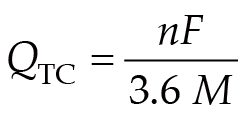
Covalent organic frameworks (COFs) have recently emerged as promising alternatives due to their designable skeletons, high porosity, long-range order, and ability to incorporate diverse redox-active functionalities. Notably, COFs allow for the integration of multiple redox-active units, such as carbonyl (C=O), imine (C=N), or quinone moieties within a single extended framework, offering a molecular-level platform to realize multi-electron transfer reactions [10–14]. The theoretical specific capacity (QTC, mAh·g−1) of a COF-based material can be estimated using the following equation [15]:(1)where, n is the number of electrons transferred per redox-active unit, F is the Faraday constant (96,485 C·mol−1), and M is the molecular weight (g·mol−1). This equation highlights that increasing n by incorporating multiple active sites is essential for enhancing theoretical capacity. Therefore, the rational design of COFs with multiple redox-active centers capable of multiple electron transfer is key to developing high-energy-density AZIB cathodes.
Based on this concept, this review focuses on recent advances in multi-electron redox-active COFs for AZIBs, emphasizing understanding redox mechanisms through cyclic voltammetry (CV) and linking structural features to energy storage performance. Firstly, we summarize the commonly employed COF synthesis methods and compare their respective reaction conditions. Subsequently, inspired by the classification of redox-active groups in organic compounds, COFs are categorized into three types according to their redox behavior: n-type (e.g., frameworks containing C=O or C=N groups), p-type (e.g., systems incorporating electron-donating moieties such as triphenylamine derivatives), and bipolar frameworks that integrate both electron-accepting and electron-donating functionalities. Their CV profiles are then analyzed to elucidate the stepwise electron transfer characteristics associated with multiple redox-active centers, including Zn2+, H+, and their co-insertion mechanisms. In particular, C=O-based frameworks are highlighted for their spatially distributed carbonyl units, which often enable one-, two-, or even three-step multi-electron reaction processes. To this end, we present perspectives on the rational molecular design of COFs to maximize redox-site utilization, optimize charge transport pathways, and enhance energy density. These insights are expected to guide the development of next-generation organic cathode materials for AZIBs, with a particular emphasis on multi-electron transfer chemistries.
Figure 1 summarizes the synthetic chemistry of COFs, highlighting the primary linkage types, including imide-based, Schiff-base (imine and related), and triazine-based frameworks, along with representative reactions and monomeric building blocks commonly employed in each category. In COF synthesis, sealed Pyrex tubes under low pressure (~150 mTorr) are widely used, with a freeze-pump-thaw cycle applied to maintain vacuum conditions (Fig. 1(b)). This setup ensures water equilibrium and reversibility in bond formation, both of which are crucial for controlled crystallization. Gradual water diffusion facilitates uniform nucleation and crystal growth, while any disruption to this balance may lead to poor crystallinity.
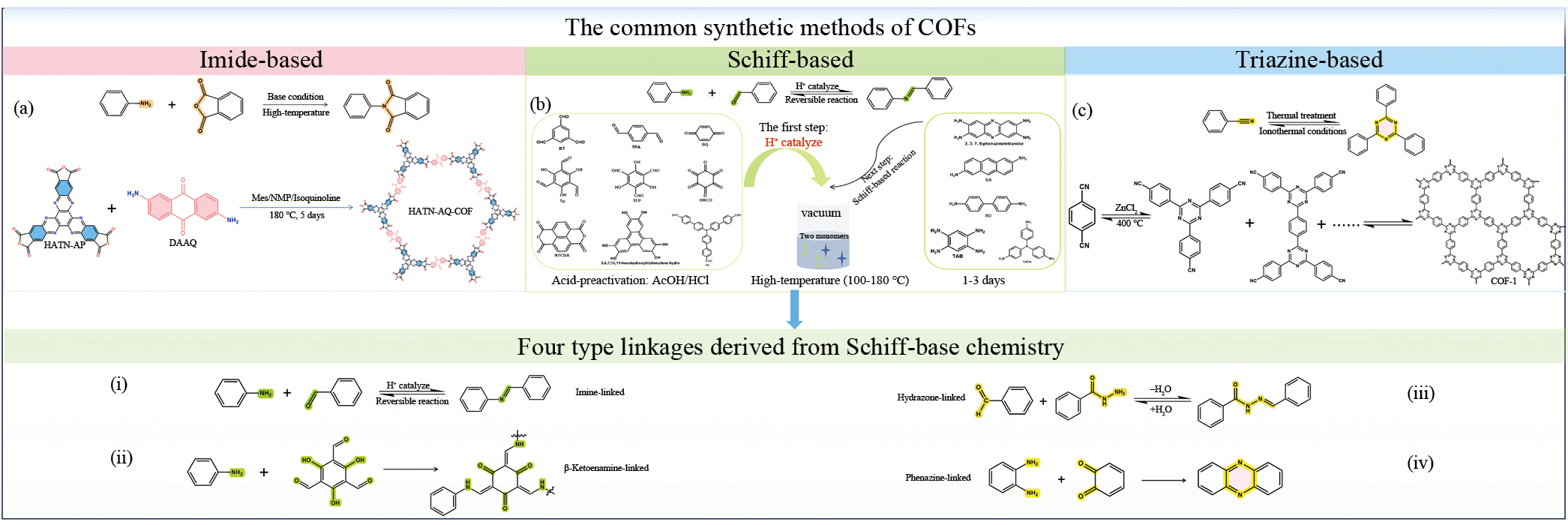
Among the various strategies for constructing COFs, imide linkages represent a class of robust and chemically stable connections. Imide-based COFs are typically synthesized by condensing multi-amine monomers with polyfunctional anhydrides or dianhydrides (Fig. 1(a)). Unlike dynamic covalent approaches, this reaction is generally irreversible under conventional conditions and often requires high-boiling-point solvents and toxic catalysts, which leads to increased synthesis cost and environmental concerns [16].
Bettina V. Lotsch and colleagues [17] introduced an environmentally friendly alcohol-assisted hydrothermal polymerization (aaHTP) method to address these limitations in 2022. Notably, this method enables imide bond formation in reaction systems containing up to 90% water, irrespective of the solubility of the monomers. This represents a green and broadly applicable alternative to conventional solvothermal synthesis for producing imide-linked COFs under milder, more sustainable conditions.
Meanwhile, the application scope of imide-linked COFs has expanded considerably. In particular, polyimide-based COFs (PI-COFs) [18] synthesized from aromatic dianhydrides and amine monomers have attracted increasing attention in energy storage. These frameworks typically exhibit high porosity, which promotes efficient ion diffusion and makes them well-suited for electrochemical devices [19, 20]. Jiang et al. [21] subsequently reported a stable polyimide-linked COF (HATN-AQ-COF) prepared from HATN-AP and DAAQ, with the synthetic route shown in Fig. 1(a). The extended π-conjugation and well-ordered mesoporous structure of this COF endow it with excellent electronic conductivity and ion transport capability. When employed as a cathode in lithium-ion batteries, HATN-AQ-COF demonstrated outstanding electrochemical performance, including a high capacity of 319 mAh·g−1 at 0.5C and a redox site utilization of 89%, compared to its theoretical capacity of 358 mAh·g−1. These structural features effectively address common issues such as dissolution and poor conductivity typically associated with small-molecule organic electrodes. In addition, incorporating catalytically active Pd sites into the COF, coordinated through pyridyl linkers positioned near the imide units, resulted in a high surface area and open pore channels. This structural configuration facilitated mass transport and significantly enhanced electrocatalytic activity for oxygen reduction reaction (ORR) [22].
In contrast to these irreversible strategies, Schiff-base condensation has emerged as one of the most well-established and versatile methods for constructing imine-linked COFs. Its mild reaction conditions and broad monomer compatibility enable the formation of C=N bonds via dynamic covalent chemistry, allowing reversible bond formation and error correction during framework assembly.
The typical reaction mechanism, as illustrated in Fig. 1(b), involves the acid-catalyzed protonation of the carbonyl group (originating from aldehydes or ketones), which increases its electrophilicity and thereby facilitates nucleophilic attack by an aromatic primary amine. An intramolecular proton transfer and dehydration follow this, ultimately forming a C=N imine bond. Common catalytic acids include acetic acid (AcOH) and trifluoroacetic acid (TFA). Reactions are typically performed under solvothermal conditions at a high temperature for several days using ethanol, 1,4-dioxane, or mesitylene/dioxane as solvents. Representative COFs synthesized through this strategy, such as COF-300 [23], exhibit high crystallinity and tailored pore architectures, making them attractive candidates for catalysis and energy storage applications.
The construction of COFs with diverse architectures and adjustable porosity is achieved through the careful selection of organic building units, including carbonyl-based monomers (e.g., BT, Tp, TFP, HKCO, NTCDA, and TA) and amine-functionalized linkers (e.g., DA, TAB, and TAPA), as illustrated in Fig. 1(b) [24, 25]. The reversibility of imine bond formation under reaction conditions facilitates defect correction and promotes the formation of highly crystalline frameworks. Depending on the specific tautomerization behavior or the nature of the linkages, Schiff-base COFs can be further categorized into four representative subcategories: imine-linked, β-ketoenamine-linked, hydrazone-linked, and phenazine-linked COFs [26].
As shown in Fig. 1(b)(i), imine-linked COFs are constructed through the direct condensation of aromatic aldehydes or ketones with primary amines, with the resulting frameworks stabilized by C=N bonds as the primary structural linkage [25]. These reactions typically require elevated temperatures and extended reaction times. As mentioned before, the first imine-linked COF, COF-300, was synthesized by condensing tetra-(4-anilyl)-methane with terephthalaldehyde under the catalysis of a Brønsted acid, specifically AcOH. Owing to the reversible nature of imine bond formation, COF-300 exhibited a high surface area and an ordered three-dimensional porous architecture, facilitated by dynamic covalent exchange during the crystallization process [23]. To further promote cost-effective, environmentally friendly, and rapid synthesis of COFs, a variety of alternative catalysts have been developed, including p-toluenesulfonic acid (p-TsOH) [27], metal triflates such as Sc(OTF)3 [28], and metal halides like PbBr2 [29].
However, despite the ease of synthesis and high structural fidelity of imine linkages, they exhibit poor chemical stability under aqueous or mildly acidic conditions. This vulnerability significantly limits their long-term applicability in aqueous battery systems, due to the susceptibility of the C=N bonds to hydrolysis, which leads to capacity fading and structural decomposition [30].
Various strategies have been employed to enhance the chemical stability of imine-linked COFs. Among these, β-ketoenamine-linked COFs are recognized as one of the most chemically robust subclasses of imine-derived frameworks [31].
In 2012, Rahul Banerjee and co-workers [32] successfully reported the synthesis of two representative β-ketoenamine-linked COFs, TpPa-1 and TpPa-2, via the condensation of Tp with either Pa-1 or Pa-2. The reaction proceeds via a two-step mechanism as shown in Fig. 1(b)(ii). First, a classical reversible Schiff-base condensation forms a C=N imine intermediate, which subsequently undergoes an irreversible enol-to-keto tautomerization to yield the chemically stable β-ketoenamine linkage. This irreversible transformation effectively "locks" the framework into a hydrolytically inert configuration, significantly enhancing its resistance to degradation under acidic, basic, or aqueous conditions. Notably, the fully conjugated π-system formed through the β-ketoenamine backbone not only stabilizes the framework but also enhances electron delocalization, facilitating its broad application in fluorescence sensing, energy storage, photocatalysis, electrocatalysis, batteries, and proton conduction [31, 33].
Hydrazone-linked COFs are typically synthesized via the condensation of aldehyde monomers with hydrazide or hydrazone derivatives, resulting in -C=N-NH- linkages (Fig. 1(b)(iii)). Importantly, this subclass retains the reversible nature of imine bond formation while offering improved hydrolytic stability due to resonance stabilization and intramolecular hydrogen bonding. As a result, hydrazone linkages are generally more resistant to hydrolysis than conventional imine bonds [34].
In 2011, Omar M. Yaghi and co-workers [35] reported the first synthesis of two-dimensional hydrazone-linked COFs COF-42 and COF-43 via the condensation of 2,5-dioxo-1,4-benzenedicarbohydrazide with either 1,3,5-triformylbenzene or 1,3,5-tris(4-formylphenyl)benzene. These frameworks exhibit high crystallinity, well-defined one-dimensional channels, and heteroatom-rich hydrazone backbones, highlighting their great potential in applications such as adsorption/separation, chemical sensing, heterogeneous catalysis, and electrochemical energy storage [36].
In pursuit of new linkages and functionalities in COF synthesis, Jiang et al. [37] (2013) reported the formation of a crystalline phenazine-linked COF (CS-COF) via a topological ring-fusion reaction under solvothermal conditions, using TPHA and PT as building blocks. Phenazine-linked COFs constitute an advanced subclass of Schiff-base frameworks, in which the initially formed C=N imine bonds undergo intramolecular cyclization and subsequent oxidative aromatization to generate an extended phenazine backbone. This transformation not only enhances the π-conjugation throughout the framework but also introduces redox-active N-heteroaromatic units, thereby improving chemical and electrochemical stability (Fig. 1(b)(iv)). This transformation enhances π-conjugation throughout the framework and introduces redox-active N-heteroaromatic moieties, thereby improving both chemical robustness and electrochemical reversibility. For instance, Wang et al. [38] (2020) synthesized a phenanthroline-based COF named PA-COF and demonstrated its viability as a cathode material for aqueous zinc-ion supercapatteries. Due to its high density of redox-active C=N functionalities, PA-COF achieved a reversible capacity of 247 mAh·g−1 at 0.1 A·g−1.
Triazine-linked COFs represent a distinct class of chemically robust frameworks, synthesized via the cyclotrimerization of nitrile (-C≡N) groups to form electron-deficient C3N3 rings, as illustrated in Fig. 1(c). Although this transformation is thermodynamically favorable, it generally requires harsh synthetic conditions. The first example, covalent triazine framework-1 (CTF-1), was reported by Arne Thomas and co-workers [39], who employed an ionothermal strategy using ZnCl2 at 400 ℃ to catalyze the trimerization of 1,4-dicyanobenzene, resulting in the formation of a chemically stable triazine-based network (Fig. 1(c)). Subsequently, structurally extended triazine-based COFs have been developed from monomers such as 2,6-dicyanonaphthalene, [1,1′-biphenyl]-4,4′-dicarbonitrile, and 5′-(4-cyanophenyl)-[1,1′:3′,1″-terphenyl]-4,4″-dicarbonitrile [40, 41].
Although many reported triazine frameworks are amorphous, highly crystalline analogs can be synthesized by in situ generation of aldehyde monomers through controlled alcohol oxidation, exhibiting excellent thermal stability and outstanding photocatalytic performance [42]. Moreover, the exceptional water and acid stability of triazine-based COFs significantly facilitates material synthesis and electrode fabrication, making them attractive for energy storage applications [43]. For instance, Zhao et al. [44] reported a cation-rich pyridinium-based triazine COF (CCTF-TPMB) as a high-efficiency iodine host for zinc-ion batteries. Due to the presence of pyridinium cationic sites, zinc-iodine batteries (ZIBs) assembled with the I2@CCTF-TPMB cathode delivered a high capacity of 243 mAh·g−1 at a current density of 0.2 A·g−1.
In addition to the well-established Schiff base, imide, and triazine linkages, several alternative synthetic strategies have been developed to construct COFs featuring diverse structural motifs and functionalities. Among them, boronate ester- and boroxine-linked COFs are formed via the condensation of boronic acids or their derivatives. These reactions are highly reversible and typically proceed under mild solvothermal conditions; however, their practical application is hindered by the hydrolytic instability of B-O bonds, as exemplified by the seminal COF-1 and COF-5 frameworks reported by Omar M. Yaghi and co-workers [45]. Another strategy involves the condensation of aromatic aldehydes with aromatic nitriles or amines to form sp2 carbon-conjugated frameworks, wherein the COF backbone is constructed through C=C linkages. For example, Jin et al. [46] synthesized a fully π-conjugated COF (sp2c-COF) via the condensation of tetrakis (4-formylphenyl)pyrene and 1,4-phenylenediacetonitrile. In addition, boron-linked COFs (BLPs) have been synthesized through thermal treatment of 1,3,5-tris (p-aminophenyl) benzene-borane in a mixed solvent of mesitylene and toluene, resulting in cyclic borazined-based frameworks [47].
The diversity of COF synthetic strategies, ranging from dynamically reversible Schiff base condensations to more robust imide and triazine cyclizations, provides a structural foundation for constructing redox-active frameworks with tunable crystallinity and chemical stability. These synthetic choices influence the feasibility of forming ordered and porous networks and define the intrinsic electronic environment of the redox-active sites embedded within the framework. Building on this foundation, the following section examines how structural variations in COFs govern distinct charge storage behaviors, particularly with respect to single-step versus stepwise electron transfer processes, as revealed by CV analysis. Furthermore, these electrochemical characteristics are discussed in relation to the classification of COFs as p-type, n-type, or bipolar systems.
Designing electrode materials capable of multi-electron transfer is a key strategy for improving the energy density of electrochemical energy storage systems. Organic compounds that contain multiple redox-active functional groups, such as carbonyl (C=O), imine (C=N), and amine (-NH-), can undergo stepwise and reversible redox reactions. This mechanism allows for transferring two or more electrons per molecular unit, thereby significantly enhancing the overall charge storage capacity [7]. COFs, with their periodic porous structures and extended π-conjugation, offer unique advantages for constructing such redox-active systems [10, 11, 48–50]. Their long-range ordered nanopores and tunable chemical environments facilitate rapid electron/ion transport and maintain structural integrity during redox cycling [25]. Most importantly, COFs enable the spatially controlled incorporation of multiple redox-active units within the framework, allowing high-density, uniformly distributed active centers to work cooperatively. This synergistic architecture is especially suitable for realizing multi-electron storage behavior, thereby improving both gravimetric and volumetric energy density in battery applications.
Classification based on the redox mechanism is critical to decoding the structure-function relationship in redox-active COFs. According to the predominant direction of electron transfer during charge-discharge processes, COFs can be broadly categorized into n-type, p-type, and bipolar types [51]. Each type exhibits distinct electrochemical characteristics and CV signatures, depending on the nature and distribution of its redox-active sites.
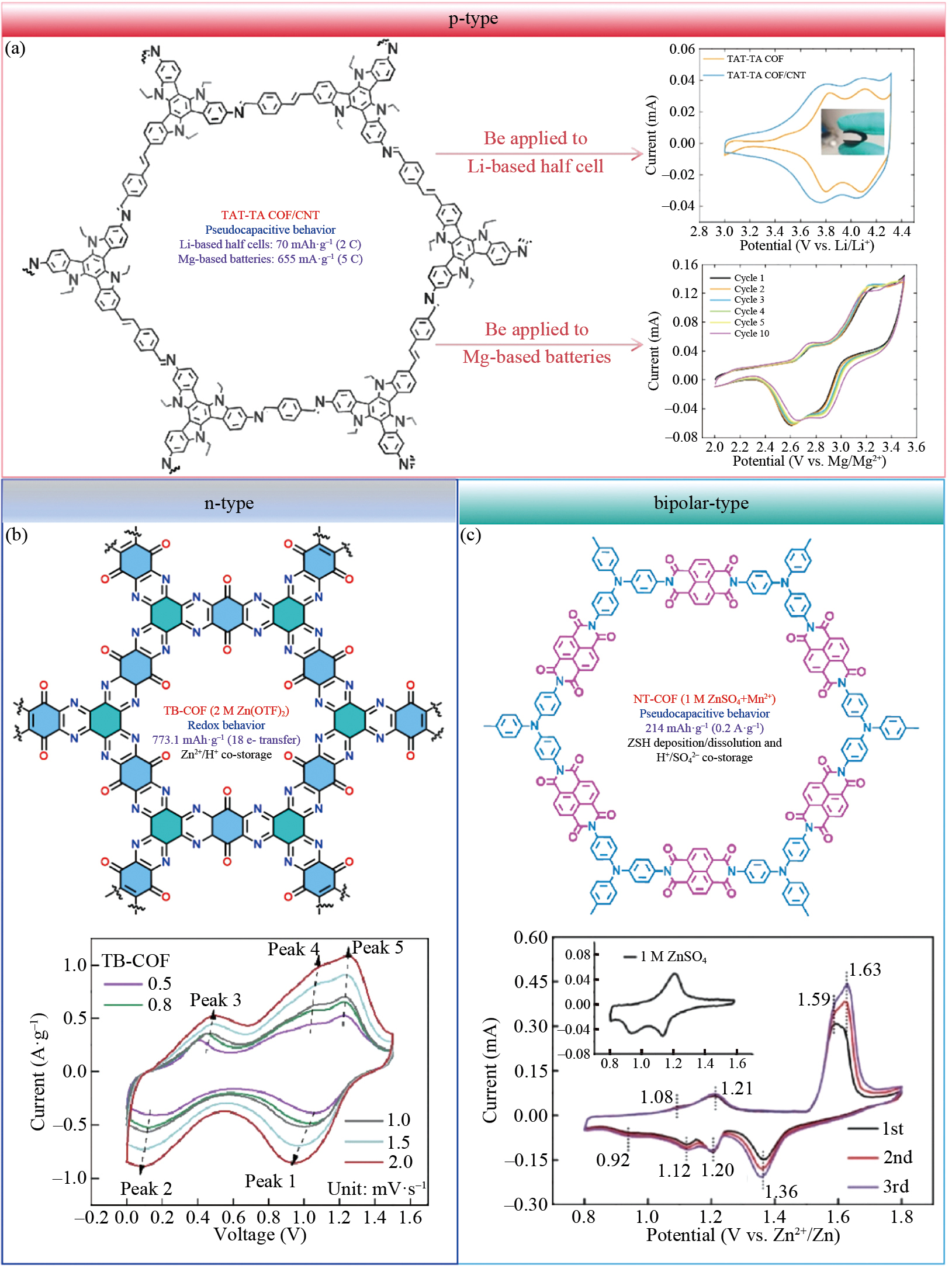
Cyclic voltammetry (CV) is an essential tool for probing the redox mechanism of multi-site COFs. Key indicators such as the number and symmetry of redox peaks, peak potential separation, and current response under varying scan rates offer direct insights into whether the framework supports single- or stepwise electron transfer. Additionally, CV can distinguish between battery-type and pseudocapacitive behavior, helping elucidate whether the electron transfer is confined to specific redox centers or spreads across multiple sites via cooperative interactions [52]. Figure 2 highlights representative COFs from each redox type, along with their corresponding CV profiles in metal-ion battery systems.
p-type COFs are constructed from electron-rich building blocks such as N,N’-substituted phenazines, triphenylamine derivatives, phenothiazines, or arylamines [6]. These frameworks undergo oxidation during charge processes by donating electrons, typically coupled with inserting anions (ClO4−, SO42−, OTF−, or TFSI−) from the electrolyte to maintain charge neutrality [53, 54]. Incorporating multiple redox-active sites into p-type frameworks enables successive electron abstraction per unit, thereby enhancing energy storage capacity.
Although relatively less explored, p-type COFs have demonstrated promising redox versatility. A representative case is TAT-TA COF, developed by Sebastian M. Pallasch et al. [55], which incorporates a nitrogen-rich triphenylmethane core. When composited with conductive CNTs, this COF exhibited two distinct redox couples in its CV profile (Fig. 2(a)), indicative of a stepwise oxidation mechanism. It delivered a high discharge voltage of 3.9 V in Li-ion half cells and showed long-term stability (84% retention over 1,000 cycles) in Mg-ion systems. These results illustrate how p-type COFs with distributed redox-active units can achieve multi-electron transfer, high voltage output, and extended cycling life.
In contrast, n-type COFs undergo reduction during charge processes, acting as electron acceptors. These frameworks typically coordinate with metal cations (e.g., Zn2+, H+, and Li+), forming a negatively charged state [53]. Electron-deficient groups such as carbonyls (C=O), imines (C=N), triazines (C3N3), and quinone-like moieties serve as the primary redox centers. Among these, phenazine-based units have demonstrated reversible two-electron transfer behavior at the C=N sites, providing a model for multi-electron redox activity in n-type COFs [56]. Integration of multiple such units enables sequential electron uptake, supporting a multi-electron storage mechanism with high reversibility.
For example, Li et al. [57] developed a Schiff base-derived TB-COF incorporating both C=N and C=O functional groups. When applied as a cathode material in aqueous Zn-ion batteries, its CV curve exhibited two distinct reduction peaks and three oxidation peaks (Fig. 2(b)), suggesting stepwise redox processes occurring at multiple redox-active sites. This COF delivers a high theoretical capacity of 773.1 mAh·g−1, accompanied by the transfer of 18 electrons, which is attributed to Zn2+/H+ co-insertion and cooperative charge storage mechanisms. With the continuous increase of the scan rate, the b-value approaches 0.5, indicating that the charge storage process is diffusion-controlled. This case illustrates the benefit of integrating uniformly distributed redox centers within an n-type framework to enable fast, surface-confined, redox charge storage. In another example, Peng et al. [58] synthesized COF-TMT-BT via Knoevenagel condensation, forming a network with C=C linkages and multiple benzothiadiazole units containing redox-active N/S atoms. This COF exhibited one-step multi-electron transfer behavior centered on these electron-deficient motifs. Its compatibility with aqueous electrolytes and absence of highly hydrophilic carbonyl groups allowed stable electrochemical performance, demonstrating the broader design space for n-type COFs beyond conventional C=O/C=N platforms.
Bipolar COFs incorporate both electron donor and electron acceptor groups within the same framework, enabling dual redox activity. These materials can accept electrons at one site (n-type behavior) and donate electrons at another (p-type behavior), thereby supporting redox reactions with both cations and anions [59, 60]. Functional groups such as triphenylamine (donor) and carbonyl or imine units (acceptor) often coexist within such frameworks.
NT-COF is a representative bipolar COF (Fig. 2(c)), exhibiting four well-separated redox pairs in ZnSO4/MnSO4 electrolyte. The redox reactions span both high and low potentials, with Mn2+ ions enabling full utilization of redox centers, highlighting the significant influence of electrolyte composition on the electrochemical behavior of bipolar COFs [61]. The CV behavior is predominantly pseudocapacitive, as evidenced by scan-rate-dependent peak evolution. Charge storage involves Zn2+ plating/stripping, H+/SO42− intercalation, and light-assisted electron-hole pair separation. Under solar illumination, the device achieved a discharge capacity of 430 mAh·g−1 at 0.2 A·g−1, underscoring the potential of bipolar COFs in multifunctional, high-capacity applications [62].
In summary, the redox mechanism of COFs is closely governed by the nature and spatial arrangement of redox-active sites. Through CV-based analysis, COFs can be categorized into n-type, p-type, and bipolar systems, each supporting distinct multiple electron transfer behaviors. In aqueous zinc-ion batteries, frameworks composed primarily of electron-deficient sites typically exhibit n-type behavior. To gain deeper insight into the relationship between structure and electrochemical performance, the following sections will focus on n-type COFs and examine how the nature and combination of redox-active sites, including C=O, C=N, or both, influence stepwise electron transfer characteristics and charge storage capability.
Carbonyl (C=O) groups are among the most classical and effective redox-active moieties in organic electrochemistry, widely used in n-type organic materials due to their ability to reversibly coordinate with multivalent cations and participate in high-capacity electron transfer processes [63, 64]. Typically, each pair of carbonyl groups can contribute a two-electron transfer. When such groups are densely and uniformly distributed within a COF, the entire structure can undergo collective redox reactions involving multiple electrons per repeat unit. To maximize redox utilization, COFs are often constructed using phenol-, quinone-, or imine-derived building blocks that provide abundant and accessible C=O sites. Compared to small carbonyl compounds used in lithium-ion batteries, which generally exhibit stepwise redox processes, C=O-based COFs in AZIBs often favor single-step multi-electron transfer. This behavior is attributed to the fast reaction kinetics and coordination interactions of Zn2+ and H+ in aqueous environments [6]. Importantly, these carbonyl-based redox characteristics are preserved and further enhanced when incorporated into conjugated and topologically ordered COF backbones.
A representative example is HqTq-COF, synthesized by Abdul Khayum M et al. [65] from 2,5-diaminohy-droquinone dihydrochloride and 1,3,5-triformylph-loroglucinol. The resulting 2D COF integrates multiple C=O and N-H sites into a crystalline lattice. Its CV curve (Fig. 3(a)) shows a single, well-defined redox couple, indicative of a concerted one-step electron transfer process involving as many as 24 electrons per unit cell. The high density of uniformly distributed carbonyl groups enables this collective redox characteristic, supporting efficient Zn2+ coordination. As a result, the COF delivered a high discharge capacity of 276 mAh·g−1 at 125 mA·g−1, approaching its theoretical limit of 442 mAh·g−1.
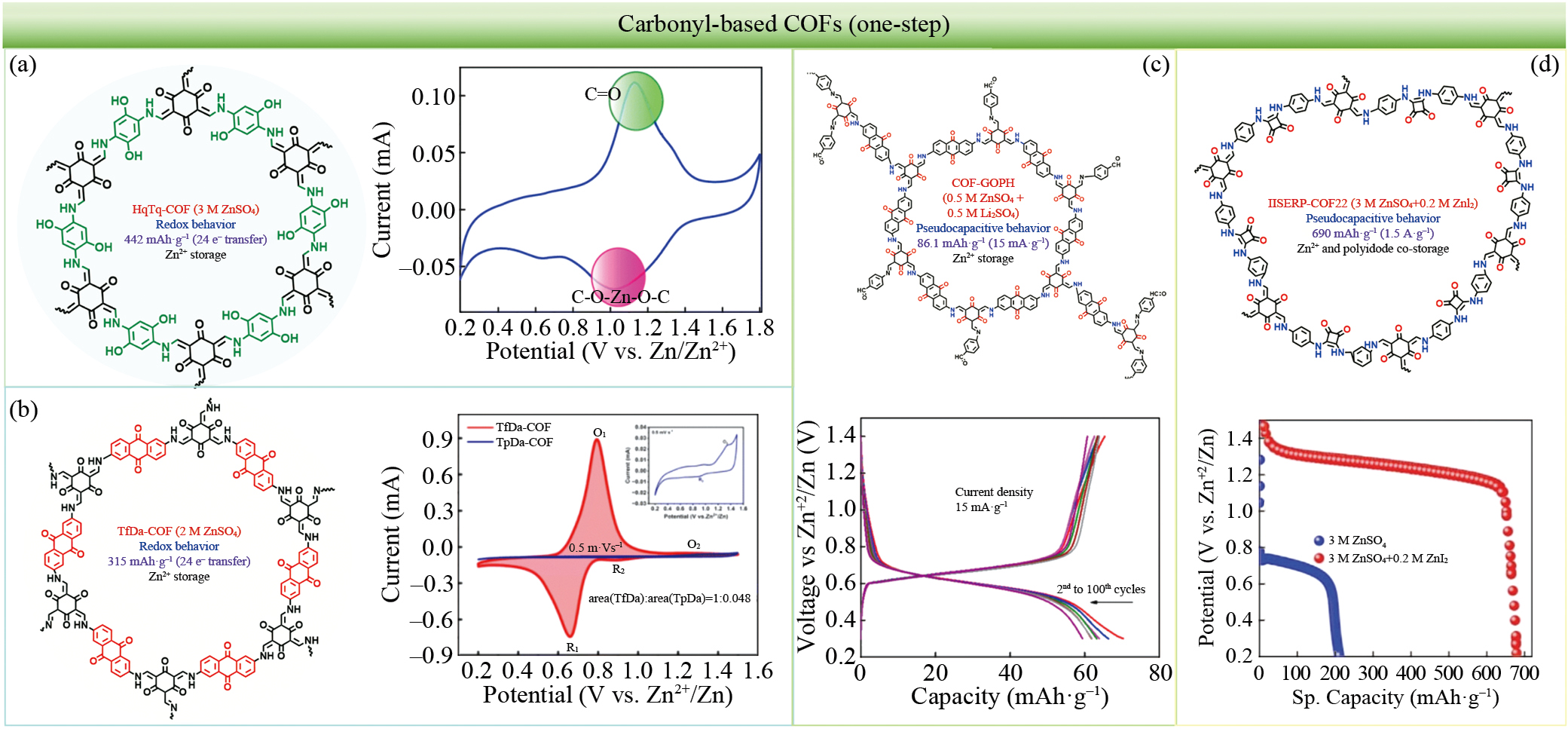
Building upon this concept, TfDa-COF was developed by π-extending the quinone unit by incorporating DAAQ [66]. This structural modification further delocalized π-electrons and improved electronic conductivity, while maintaining a high density of C=O groups. As shown in Fig. 3(b), the CV profile reveals a sharp redox couple, corresponding to a rapid, one-step 24-electron transfer. The COF exhibited a theoretical capacity of 315 mAh·g−1, demonstrating how π-extension and C=O site multiplication synergistically to enhance redox kinetics and charge storage performance.
To explore electrolyte-mediated modulation, the TfDa-COF framework was further composited with GO and tested in a mixed-ion electrolyte (0.5 M ZnSO4 + 0.5 M Li2SO4). The resulting hybrid, designated COF-GOPH [67], displayed broadened CV peaks, reflecting a Li+-assisted pseudocapacitive mechanism. As shown in Fig. 3(c), the GCD curves exhibit well-defined plateaus, corresponding precisely to a one-step redox process associated with the C=O active sites. This process results in a significantly enhanced discharge capacity of 70.2 mAh·g−1, markedly higher than the pristine COF. This experiment highlights how electrolyte engineering, achieved by introducing co-inserting cations, can modulate redox kinetics and improve the reversibility of multi-electron redox processes.
To gain deeper insight into the influence of iodide anion additives on the properties of the COF material, in a more complex redox environment, IISERP-COF22 introduced squaramide units into the COF backbone, enabling simultaneous storage of Zn2+ and polyiodide species (I3−/IO3−) in a ZnI2-containing electrolyte [68]. As shown in Fig. 3(d), the GCD profile, similar to that described previously, exhibits a stable discharge plateau, demonstrating its charge storage characteristics within the selected potential window. This dual-ion redox mechanism, supported by multiple carbonyl-based binding sites, increased the discharge capacity from 208 to 690 mAh·g−1, far exceeding most reported COF-based AZIB cathodes. This case emphasizes the potential of combining multi-site COF architectures with redox-active electrolytes to promote efficient one-step, multi-electron storage and achieve record-high capacities.
These examples demonstrate that COFs with multiple C=O units can effectively support one-step multi-electron storage behavior in aqueous systems. By tuning molecular structure, extending π-conjugation, and engineering the electrolyte environment, the charge-transfer kinetics and capacity output of C=O-functionalized n-type COFs can be significantly enhanced, providing a viable strategy for developing high-performance organic cathodes for AZIBs.
While single-step redox processes dominate many C=O-based systems, carbonyl groups can also undergo stepwise multi-electron transfer, especially when densely and uniformly embedded within extended COF backbones. In such cases, electrochemically distinguishable C=O sites can be sequentially activated, giving rise to multiple redox peaks in CV profiles. This behavior enables fine-tuned charge storage, where electron transfer proceeds through distinct intermediates rather than concerted redox events. The degree of redox separation and the number of electrons involved depend on local electronic environments, π-conjugation, and ion interactions within the COF framework.
A representative example is DAAQ-COF, synthesized via Schiff base condensation between DAAQ and TFP [69]. In Fig. 4(a), the GCD curves of DAAQ-COF under various electrolyte concentrations display two pronounced discharge plateaus, consistent with the two reduction peaks (0.4 and 0.6 V) observed in the CV profiles. This correlation suggests that the same reaction mechanism is operative: a two-step, two-electron transfer per DAAQ unit. This behavior contrasts sharply with its response in ZnSO4 (Fig. 3(b)), which presents more merged peaks, emphasizing the electrolyte-dependent modulation of redox resolution. At a current density of 0.05 A·g−1, DAAQ-COF delivered a capacity of 135 mA·g−1, which is close to its theoretical value of 151 mAh·g−1 and superior to its performance in sulfate-based electrolytes. Importantly, the study also revealed a Zn2+/H+ co-insertion mechanism, highlighting how multi-site ionic coordination can enable cooperative charge storage and enhance utilization of carbonyl functionalities.
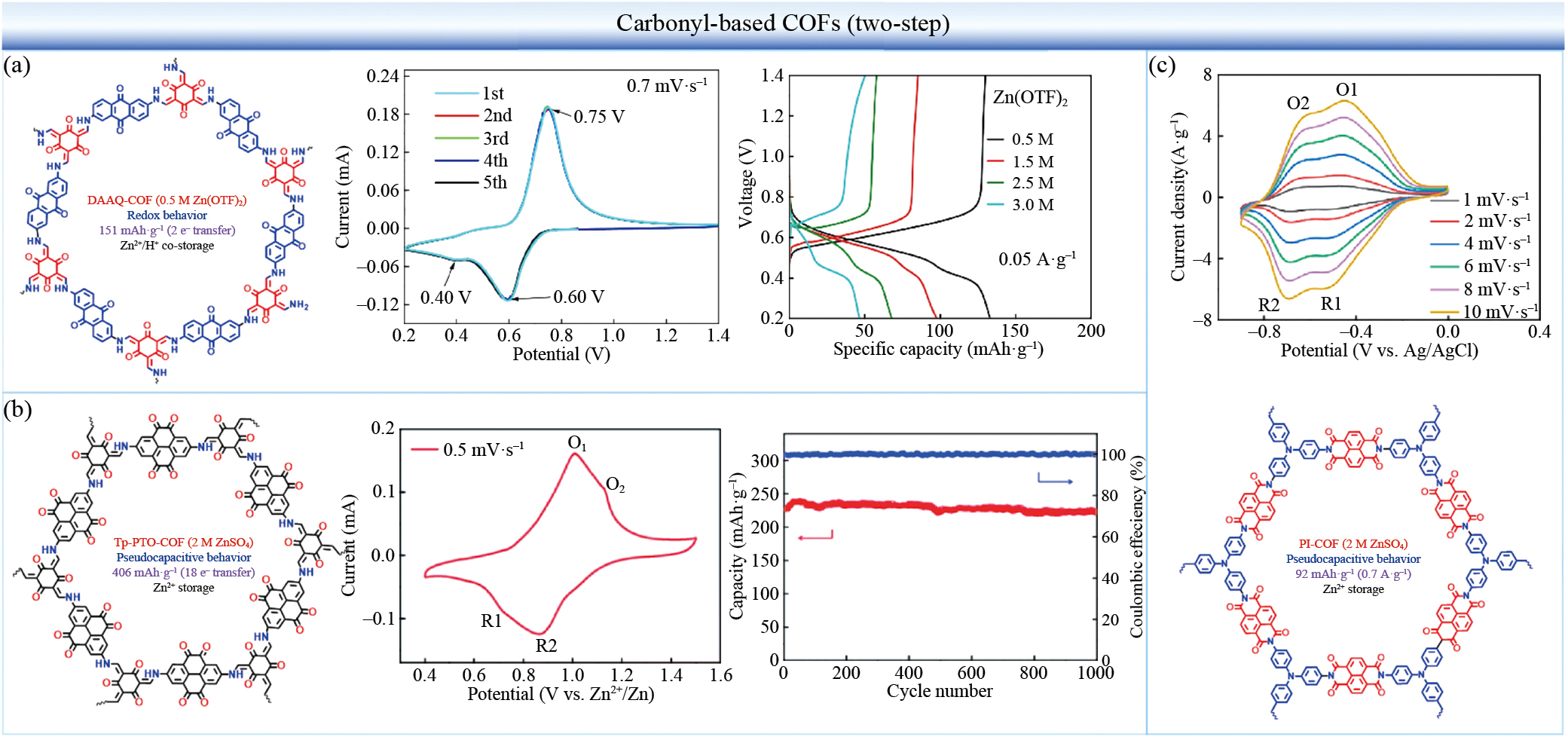
Pursuing higher redox-site density, Tp-PTO-COF was developed by polymerizing DAPTO with TFP [70]. This framework features a large number of closely spaced carbonyl sites and highly ordered porosity. Its CV profile reveals two well-resolved redox couples (R1, R2, O1, O2), positioned near 0.72/1.01 V and 0.86/1.13 V, suggesting a stepwise 18-electron transfer mechanism. As the scan rate increased, its peak current has a linear relationship with the square root of the scan rate, indicating increased pseudocapacitive contribution at high rates due to Zn2+ ion diffusion process. Electrochemically, Tp-PTO-COF delivered a high capacity of 218.5 mAh·g−1 at 2 A·g−1, enabled by its abundant nucleophilic carbonyl sites, ordered diffusion pathways, and chemically stable backbone (Fig. 4(b)).
Another relevant example is PI-COF, a two-dimensional polyarylimide framework constructed from NTCDA and TAPA [71]. In aqueous ZnSO4 electrolyte, PI-COF exhibited two distinct redox couples (Fig. 4(c)), suggesting a well-controlled and reversible two-step transfer process. Although the framework incorporates TAPA, a redox-active arylamine, the absence of corresponding oxidation peaks confirms that charge storage originates exclusively from carbonyl-based n-type behavior, indicating the lack of bipolar character. Interestingly, its redox features changed significantly when tested in electrolytes containing Mn2+ (Fig. 2(c)). This observation further underscores the critical role of electrolyte composition in determining site-specific redox activation and modulating charge storage pathways.
Together, these cases emphasize that CV-derived redox peak resolution offers a powerful electrochemical fingerprint for distinguishing stepwise from concerted or pseudocapacitive processes. For COFs enriched with C=O groups, the spatial distribution of active sites, local microenvironments, and ion-specific coordination effects jointly govern the activation sequence of redox events. Rational control over these parameters is essential to balance energy density with rate capability, paving the way toward high-performance carbonyl-based COFs for aqueous Zn-ion batteries.
As the integration of redox-active carbonyl units into COFs becomes more refined, specific architectures have demonstrated the capacity for three-step electron transfer, offering both high theoretical capacity and redox resolution. These systems typically exhibit three well-defined redox couples in their CV profiles, corresponding to sequential activation of multiple C=O sites under applied potential. Such behavior reflects a high degree of electrochemical organization, wherein electron transfer proceeds through distinct energetic stages enabled by the spatial arrangement and electronic environment of the carbonyl centers. This site-specific resolution not only enhances charge-storage capacity but also improves reversibility and cycling stability.
A representative example is COF-PTO, constructed from PTO-derived building blocks and linked via β-ketoenamine bonds [72]. In 1 mol/L Zn(OTF)2 electrolyte, its CV curve (Fig. 5(a)) reveals three electrochemically distinct redox pairs, characteristic of a stepwise 3-stage Zn2+/H+ co-insertion process. These redox events correspond to successive coordination at carbonyl-rich domains, facilitated by the material's layered stacking and vertically aligned channels. Electrochemically, COF-PTO exhibits exceptional performance, including 98% capacity retention over 18,000 cycles at 10 A·g−1, demonstrating how site multiplicity and diffusion-efficient architecture synergistically enable long-term stability under fast operation.
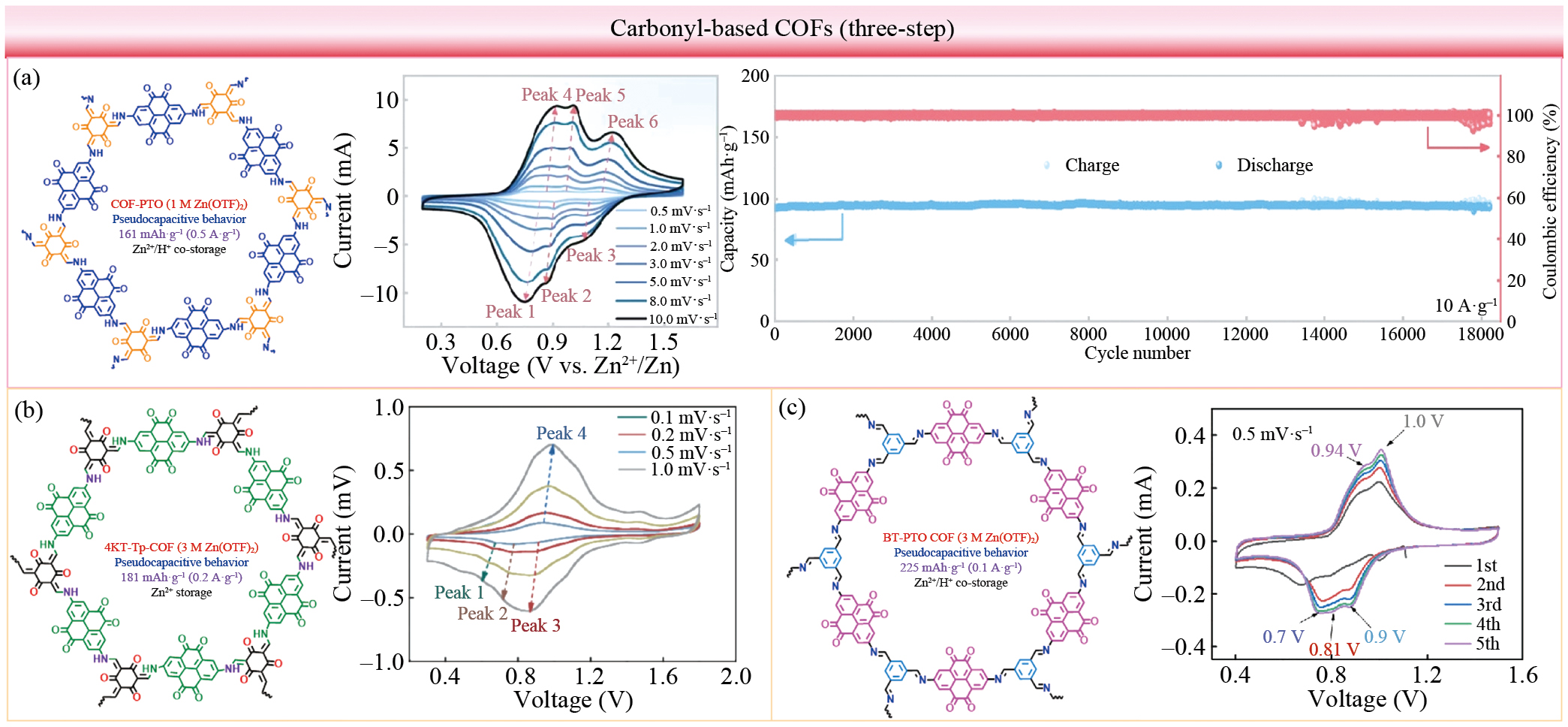
In contrast, 4KT-Tp-COF, despite its structural similarity to COF-PTO, displays markedly different CV behavior in 3 M Zn(OTF)2 electrolyte [73]. Fig. 5(b) shows its profile, which reveals a single broad oxidation peak accompanied by three reduction peaks, suggesting an asymmetric redox mechanism. This behavior likely stems from a one-step 6e− oxidation process followed by a stepwise reduction, potentially due to altered Zn2+ coordination kinetics and interfacial charge-transfer dynamics under high ionic strength. This comparison highlights how electrolyte composition and concentration can significantly modulate redox pathway symmetry and electron-transfer kinetics, even for structurally similar frameworks.
Further insights come from BT-PTO COF, which exhibits two oxidation peaks and three reduction peaks in 3 M Zn(OTF)2 electrolyte (Fig. 5(c)) [74]. Mechanistic studies suggest a 4e− redox process governed by pseudocapacitive kinetics, involving sequential Zn2+ insertion followed by dual H+ co-insertion. Notably, as current density increases, proton transport becomes dominant, shifting the redox behavior toward ultrafast H+-driven storage. This transition from diffusion-limited to surface-confined pseudocapacitance reflects the ion-specific accessibility and reactivity of C=O sites in flexible COF networks.
These studies reveal that three-step redox mechanisms in carbonyl-functionalized COFs arise from deliberate architectural engineering, electrolyte-sensitive activation, and kinetic decoupling of individual redox centers. The use of CV as a diagnostic tool allows precise deconvolution of redox stages, facilitating correlation between redox peak positions and ion insertion sequences. These insights reinforce the design principle that multiplication and spatial differentiation of C=O groups, coupled with tailored porosity and π-conjugation, provide a powerful pathway toward achieving high energy density and long cycle life in aqueous Zn-ion battery cathodes.
Building upon the redox property of single carbonyl-based systems, integrating carbonyl and imine (C=N) functionalities within a single COF framework introduces synergistic effects that expand redox diversity and enhance charge storage performance. These dual-site frameworks host multiple electron-accepting centers, enabling a structurally resolved one- or two-step multi-electron reaction process. The presence of both C=O and C=N units broadens the electrochemical window and improves Zn2+ coordination kinetics and charge delocalization, especially under aqueous conditions.
A representative example is TAQ-BA COF, synthe-sized via condensation of 2,6-diaminoanthraquinone and 1,3,5-benzenetricarboxaldehyde [75]. This framework incorporates both quinone-type carbonyls and imine linkages within a β-ketoenamine backbone. In aqueous Zn2+ electrolytes, the CV profile (Fig. 6(a)) reveals a single redox pair, corresponding to a one-step multi-electron storage mechanism involving both C=O and C=N sites. Compared to carbonyl-only COFs, TAQ-BA exhibits improved specific capacity (208 mAh·g−1 at 0.1 A·g−1) and enhanced cycling stability, attributed to the cooperative participation of imine moieties in Zn2+ binding and electronic delocalization.
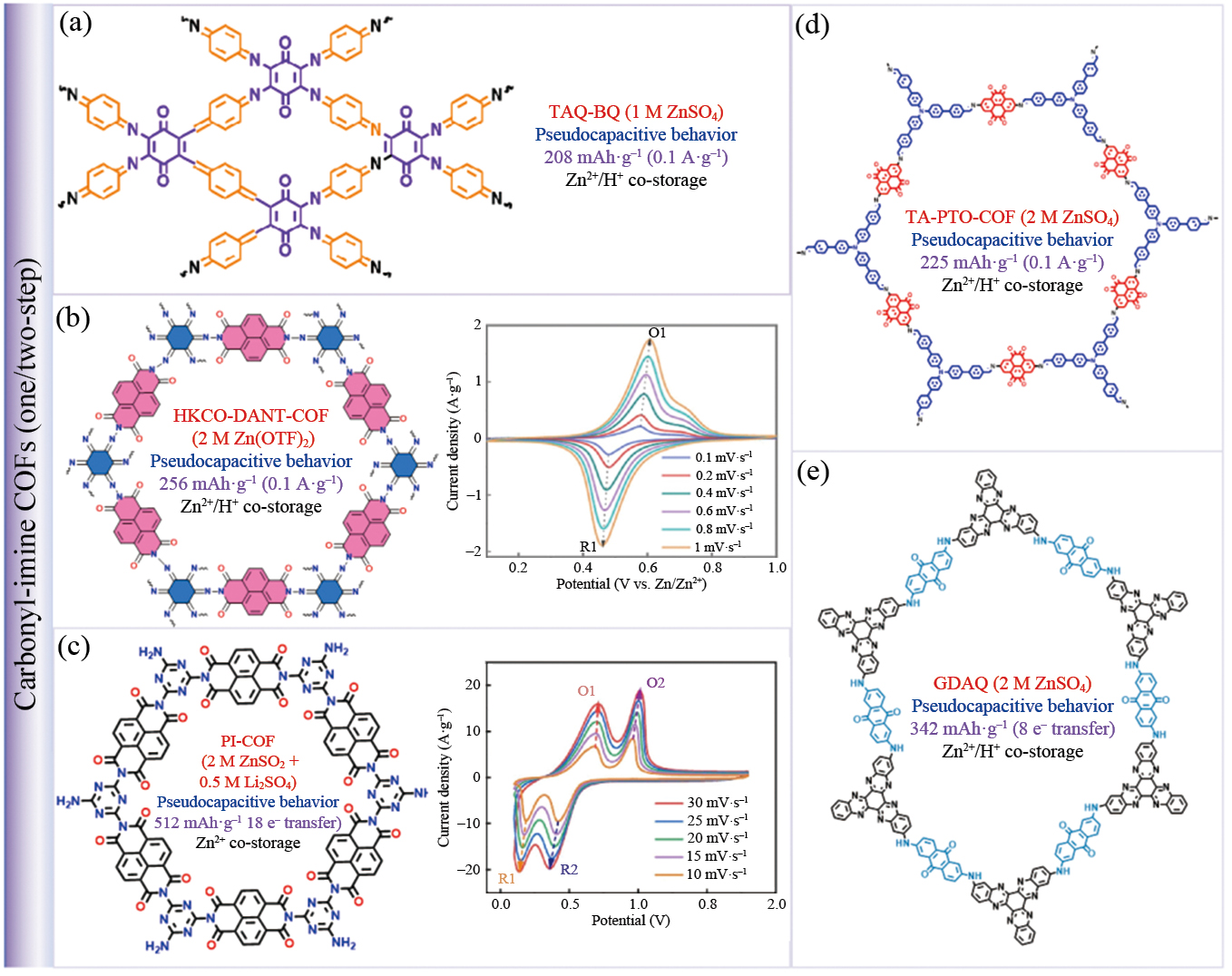
When COFs are constructed from monomers enriched in redox-active groups, the density of C=O and C=N units can be significantly increased. HKCO-DANT-COF exemplifies this strategy, integrating a high concentration of both functionalities into the backbone [76]. Operating in 2 M Zn(OTF)2 electrolyte (Fig. 6(b)), this COF achieves higher capacity while maintaining a similar one-step redox mechanism. Its CV profile shows increasing peak currents and slight potential shifts with scan rate, reflecting pseudocapacitive-dominated, rapid multi-electron processes. This underscores how increasing redox-site density boosts capacity and rate performance without compromising reaction reversibility.
In more complex systems, C=O and C=N redox centers may activate at distinct potentials, giving rise to stepwise multi-electron transfer and enabling finer control over charge-storage behavior. This is exemplified by three frameworks: PI-COF, TA-PTO-COF, and GDAQ, each exhibiting two clearly separated redox couples in their CV curves while differing in structural design and ion-storage pathways.
Three notable examples, namely PI-COF, TA-PTO-COF, and GDAQ, illustrate how the presence of dual redox-active sites can support complex yet controllable redox processes. All three systems exhibit two-step electron transfer characterized by two distinct redox pairs in their CV profiles, although they differ in structural features and underlying mechanisms. PI-COF [77], formed via the condensation of aromatic dianhydrides and triamines into imide linkages, facilitates an 18-electron stepwise transfer at two distinct potentials (Fig. 6(c)). When Li+ is introduced into the Zn2+ electrolyte, synergistic dual-ion storage is realized, leading to a high reversible capacity of 464.2 mAh·g−1 at 1 A·g−1. TA-PTO-COF [78], synthesized from TPO (bearing C=O) and TAQ (bearing C=N), combines a highly conjugated backbone with open channels, enhancing ion diffusion and redox kinetics. Its CV curve features two discrete redox couples, corresponding to reversible carbonyl reduction and proton-coupled C=N redox activity, enabling a Zn2+/H+ co-storage pathway (Fig. 6(d)). GDAQ [79], by integrating COF architecture with a graphene scaffold, forms a symmetric all-carbon COF//graphene device that retains the stepwise C=O redox pattern (Fig. 6(e)). The conductive graphene interface significantly enhances charge transport, rate capability, and long-term cycling stability.
Together, these examples demonstrate that integrating dual C=O and C=N redox centers enables structurally and electrochemically tunable multiple electron transfer behavior in n-type COFs. These frameworks achieve superior capacity, rate performance, and cycling stability through enhanced pseudocapacitive responses or clearly resolved stepwise features in their CV profiles. In addition, CV analysis provides critical insights into the nature of the participating ion species by distinguishing Zn2+-dominated redox reactions from proton-coupled or dual-ion storage mechanisms, particularly in mixed electrolytes such as Zn(OTF)2 or ZnSO4/H2O. Rational design of such dual-functionality systems offers a promising strategy for developing next-generation aqueous Zn-ion battery cathodes with high energy density.
As redox-active COFs evolve toward higher energy densities, integrating both C=O and C=N groups into a single framework enables more complex stepwise multi-electron redox behaviors, particularly three-step electron transfer. These COFs typically exhibit multiple redox couples across a broad potential range in their CV profiles, reflecting distinct redox-active centers' spatial and energetic differentiation. Compared to one- or two-step systems, these frameworks offer higher theoretical and accessible capacities by engaging Zn2+ and/or H+ ions at different electrochemical states. Their charge-storage performance is closely governed by the density and distribution of active sites, framework rigidity, and electrolyte compatibility.
Within n-type COFs, combining C=O and C=N functionalities offers a strategic approach to achieving three-step redox mechanisms, as exemplified in several recent reports. As shown in Fig. 7, representative carbonyl-imine frameworks display CV profiles with three or more well-resolved redox peak pairs, each corresponding to a specific redox-active moiety involved in multi-ion coordination and stepwise electron transfer. To further explore the impact of combining C=O and C=N redox sites on stepwise multi-electron redox behavior, several representative COFs exhibiting three-step redox transitions have been reported.
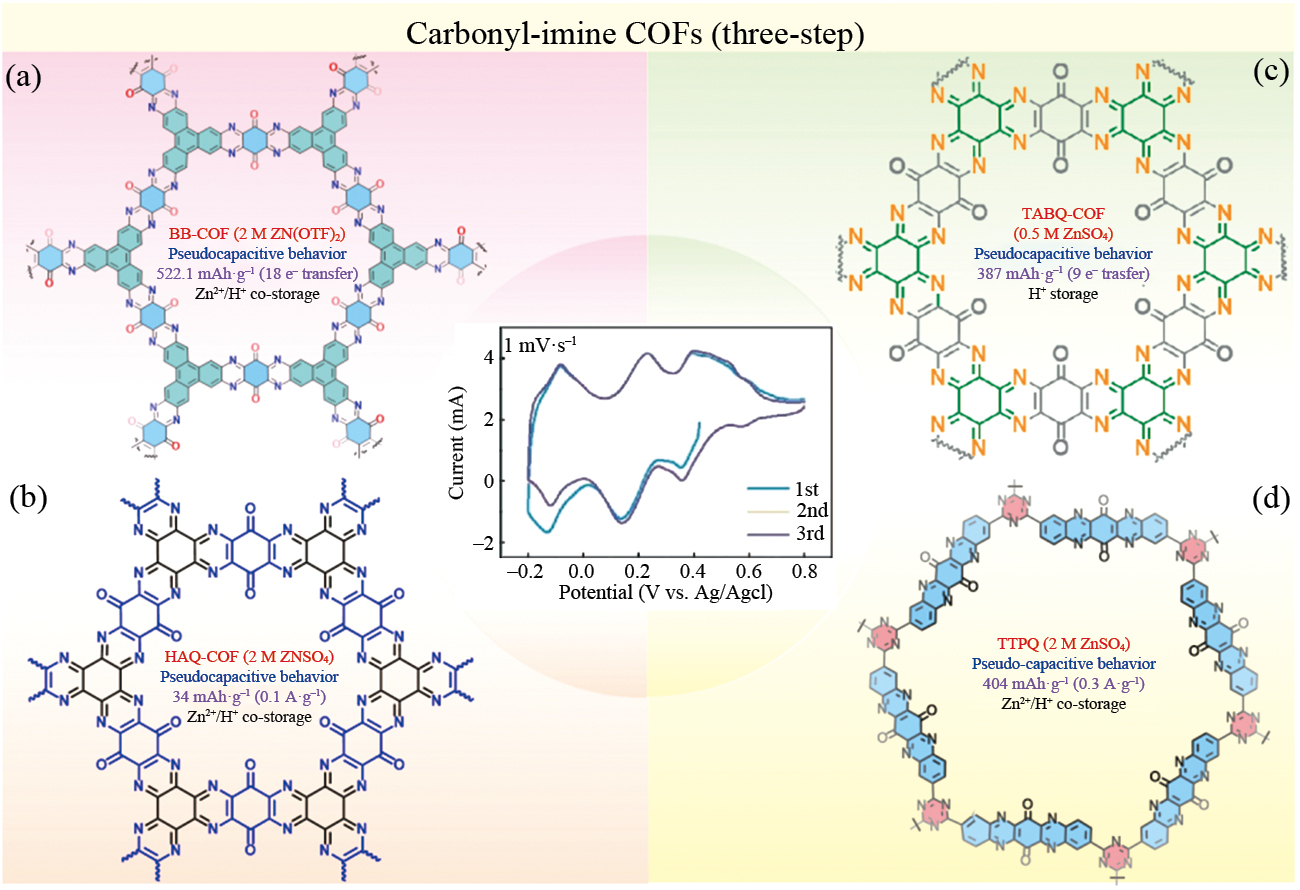
BB-COF [57] serves as a typical example, featuring a highly conjugated framework with densely packed carbonyl and imine units (Fig. 7(a)). The CV profiles obtained from Electrochemical Quartz Crystal Microbalance (EQCM) measurements indicate that the redox peak potentials remain nearly identical in different aqueous electrolytes (H2SO4 and Zn(OTF)2). Furthermore, the charge-to-mass ratio during the charge-discharge process reveals a preferential insertion of H3O+ ions into the BB-COF during the initial discharge stages. As the discharge proceeds, Zn2+ ions begin to insert, whereas the reverse occurs during the charging process. These results demonstrate a co-storage mechanism involving both H+ and Zn2+ ions. The presence of abundant carbonyl groups offers multiple coordination sites for multivalent cations, enabling a high theoretical capacity of 522.1 mAh·g−1 based on an 18-electron transfer mechanism.
Building upon this, HAQ-COF [80] adopts a more symmetric architecture, with evenly distributed C=O and C=N groups anchored within a benzene-core 2D network. While its CV shape appears broader, it still resolves multiple redox events and shows substantial pseudocapacitive behavior. HAQ-COF achieves a balanced electrochemical profile by delivering a reversible capacity of 344 mAh·g−1 at 0.1 A·g−1, benefiting from the interplay between structural rigidity and ion transport kinetics (Fig. 7(b)).
Interestingly, even without Zn2+ participation, TABQ-COF [81] shares the same backbone as HAQ-COF and contains C=N-linked aromatic heterocycles. It demonstrates a nine-electron H+-dominated charge storage process. The observed multimodal CV features and high pseudocapacitive contribution confirm that stepwise multi-electron transfer can still occur in proton-only systems. This highlights the importance of the electronic structure of the linkers and the spatial arrangement of redox-active sites in regulating redox dynamics and ion selectivity, as shown in Fig. 7(c).
Finally, TTPQ-COF [82] constructed around a triazine-core structure, exhibits three well-resolved redox transitions and achieves a specific capacity of 404 mAh·g−1 at 0.3 A·g−1. Its CV response under varying pH conditions reveals a strong pseudocapacitive character and Zn2+/H+ co-insertion mechanism, illustrating how subtle tuning of linker geometry and pore environment can profoundly affect redox accessibility and electrolyte adaptability (Fig. 7(d)).
In summary, these COFs collectively demonstrate that the rational co-integration of C=O and C=N redox centers enables tunable and efficient three-step electron transfer processes. Their high theoretical capacities, well-resolved redox features, and strong pseudocapacitance stem from the number of active sites and their spatial arrangement, electronic structure, and electrolyte sensitivity. Such dual-site frameworks offer a powerful route to achieving high-capacity, fast-rate, and durable aqueous Zn-ion batteries.
To enhance charge storage capacity in aqueous zinc-ion batteries (AZIBs), the design of COFs that incorporate multiple redox-active sites such as carbonyl (C=O), imine (C=N), and quinone groups has emerged as an effective strategy for enabling stepwise multi-electron transfer. By tailoring these redox-active centers within π-conjugated frameworks and analyzing their behavior through cyclic voltammetry (CV) profiles, it becomes possible to precisely control redox potential separation, optimize redox-site utilization, and regulate ion coordination pathways.
COFs, due to their well-defined porous structures, tunable topologies, high surface areas, and flexible structural design, particularly in integrating redox-active sites, have emerged as promising candidates for next-generation organic electrodes. This review systematically summarizes recent progress in COF synthesis, structural classification, and electrochemical behavior, specifically emphasizing multi-electron storage mechanisms enabled by incorporating multiple redox-active units. Based on CV analysis of representative n-type COFs, we elucidate the relationship between redox-site engineering and charge storage performance. We also provide design principles for molecularly tunable, high-capacity electrodes. By analyzing the CV characteristics and redox pathways of frameworks containing C=O and C=N groups, we propose targeted strategies to achieve both high energy density and long-term cycling stability.
Despite these advances, several key challenges remain in developing high-performance, multi-electron COFs for practical applications:
(1) Designing stable COF linkages and scalable morphologies. Most reported COFs are based on imine linkages formed by Schiff-base condensation, which are often hydrolytically unstable under aqueous conditions. To overcome this, employing more robust linkages, such as β-ketoenamine, imide, or triazine, which can greatly enhance structural integrity. Additionally, constructing COFs with hierarchical porosity and tailored nanostructures can improve Zn2+/H+ ion transport, increase redox-site accessibility, and thus enhance both capacity and rate capability. Meanwhile, developing low-cost, environmentally benign, and scalable synthetic strategies remains crucial for translating COF materials into practical energy storage devices.
(2) Achieving full utilization of redox-active sites through rational molecular design. While many COFs offer high theoretical capacities due to abundant redox moieties, fully accessing and activating all redox centers remains a key bottleneck. Future work should optimize the type, electronic nature, and spatial distribution of redox units, including C=O, C=N, triphenylamine, and electron-deficient motifs such as BT. Synergistically integrating these functional groups within π-conjugated skeletons, while minimizing non-redox-active building blocks, can improve charge delocalization and facilitate efficient multi-electron transfer per repeat unit.
(3) Deepening mechanistic understanding of multi-electron processes and redox site dynamics. While CV provides valuable initial insights, advanced techniques, such as in situ EPR, operando Raman, EQCM, and synchrotron-based spectroscopy [83], which are needed to visualize charge distribution, identify transient redox intermediates, and track ion-electron coupling pathways. These tools will help optimize stepwise electron transfer and guide the design of frameworks with maximized redox-site utilization and minimal voltage hysteresis.
Looking ahead, integrating redox-site-rich COF frameworks with robust structures, cost-effective synthesis, and well-defined multi-electron redox mechanisms will be essential to bridge the gap between laboratory performance and practical deployment. By leveraging molecular-level redox engineering and stepwise charge-transfer design, COFs offer a promising path toward high-capacity, long-life, and fast-rate aqueous Zn-ion batteries capable of meeting future energy storage demands. Notably, while substantial progress has been achieved with n-type and bipolar COFs, applying p-type COFs in AZIBs remains an open field. Future efforts dedicated to the rational design of p-type COFs with high redox potential and effective anion storage mechanisms are expected to expand the functional scope of COF-based AZIBs further.
This work was financially supported by the National Natural Science Foundation of China (No. 52403221).
J. Ning: conceptualization; Y. Wen: writing-original draft preparation; Y. Wen, J. Ning, Y. Chen, K. Yao: investigation; J. Ning: methodology; Y. Wen: visualization; J. Ning: writing-review and editing; and J. Ning: funding acquisition and supervision.
Z. Li, J. Tan, Y. Wang, C. Gao, Y. Wang, M. Ye, and J. Shen, "Building better aqueous Zn-organic batteries," Energy & Environmental Science, vol. 16, no. 6, pp. 398–2431, 2023.
P. Ruan, S. Liang, B. Lu, H.-J. Fan, and J. Zhou, "Design strategies for high-energy-density aqueous zinc batteries," Angewandte Chemie International Edition, vol. 61, no. 17, p. e202200598, 2022.
L. E. Blanc, D. Kundu, and L. F. Nazar, "Scientific challenges for the implementation of Zn-ion batteries," Joule, vol. 4, no. 4, pp. 771–799, 2020.
Y. Wang, C. Wang, Z. Ni, Y. Gu, B. Wang, Z. Guo, Z. Wang, D. Bin, J. Ma, and Y. Wang, "Binding zinc ions by carboxyl groups from adjacent molecules toward long-life aqueous zinc-organic batteries," Advanced Materials, vol. 32, no. 16, p. 2000338, 2020.
Z. Tie and Z. Niu, "Design strategies for high-performance aqueous Zn/organic batteries," Angewandte Chemie International Edition, vol. 59, no. 48, pp. 21293–21303, 2020.
J. Ning, "Multi-electron transfer organic cathode for high-performance aqueous zinc-ion batteries," ChemElectroChem, vol. 12, no. 1, p. e202400540, 2025.
J. Ning, X. Zhang, D. Xie, Q. He, J. Hu, J. Tang, R. Li, H. Meng, and K.-X. Yao, "Unveiling phenoxazine's unique reversible two-electron transfer process and stable redox intermediates for high-performance aqueous zinc-ion batteries," Angewandte Chemie International Edition, vol. 63, no. 19, p. e202319796, 2024.
C. Han, J. Zhu, C. Zhi, and H. Li, "The rise of aqueous rechargeable batteries with organic electrode materials," Journal of Materials Chemistry A, vol. 8, no. 1, pp. 15479–15512, 2020.
H. Cui, L. Ma, Z. Huang, Z. Chen, and C. Zhi, "Organic materials-based cathode for zinc ion battery," SmartMat, vol. 3, no. 4, pp. 565–581, 2022.
D. Zhu, G. Xu, M. Barnes, Y. Li, C. P. Tseng, Z. Zhang, J.-J. Zhang, Y. Zhu, S. Khalil.et al, "Covalent organic frameworks for batteries," Advanced Functional Materials, vol. 31, no. 32, p. 2100505, 2021,.
X. Zhao, P. Pachfule, and A. Thomas, "Covalent organic frameworks (COFs) for electrochemical applications," Chemical Society Reviews, vol. 50, no. 12, pp. 6871–6913, 2021.
L. Li, G. Zhang, X. Deng, J. Hao, X. Zhao, H. Li, C. Han, and B. Li, "A covalent organic framework for high-rate aqueous calcium-ion batteries," Journal of Materials Chemistry A, vol. 10, no. 39, pp. 20827–20836, 2022.
J. Chen, Y. Wang, Y. Yu, J. Wang, J. Liu, H. Ihara, and H. Qiu, "Composite materials based on covalent organic frameworks for multiple advanced applications," Exploration, vol. 3, p. 20220144, 2023.
L. Zhou, S. Jo, M. Park, L. Fang, K. Zhang, Y. Fan, Z. Hao, and Y.-M. Kang, "Structural engineering of covalent organic frameworks for rechargeable batteries," Advanced Energy Materials, vol. 11, no. 27. p. 2003054, 2021.
S. Muench, A. Wild, C. Friebe, B. Häupler, T. Janoschka, and U. S. Schubert, "Polymer-based organic batteries," Chemical Reviews, vol. 116, no. 16, pp. 9438–9484, 2016.
M. S. Lohse and T. Bein, "Covalent organic frameworks: Structures, synthesis, and applications," Advanced Functional Materials, vol. 28, no. 33, p. 1705553, 2018.
J. Maschita, T. Banerjee, and B. V. Lotsch, "Direct and linker-exchange alcohol-assisted hydrothermal synthesis of imide-linked covalent organic frameworks," Chemistry of Materials, vol. 34, no. 5, pp. 2249–2258, 2022.
Q. Fang, Z. Zhuang, S. Gu, R. B. Kaspar, J. Zheng, J. Wang, S. Qiu, and Y. Yan, "Designed synthesis of large-pore crystalline polyimide covalent organic frameworks," Nature Communications, vol. 5, no. 1, p. 4503, 2014.
L. Yao, C. Ma, L. Sun, D. Zhang, Y. Chen, E. Jin, X. Song, Z. Liang, and K.-X. Wang, "Highly crystalline polyimide covalent organic framework as dual-active-center cathode for high-performance lithium-ion batteries," Journal of the American Chemical Society, vol. 144, no. 51, pp. 23534–23542, 2022.
J. Lv, Y.-X. Tan, J. Xie, R. Yang, M. Yu, S. Sun, M.-D. Li, D. Yuan, and Y. Wang, "Direct solar-to-electrochemical energy storage in a functionalized covalent organic framework," Angewandte Chemie International Edition, vol. 57, no. 39, pp. 12716–12720, 2018.
X. Yang, L. Gong, X. Liu, P. Zhang, B. Li, D. Qi, K. Wang, F. He, and J. Jiang, "Mesoporous polyimide-linked covalent organic framework with multiple redox-active sites for high-performance cathodic Li storage," Angewandte Chemie International Edition, vol. 61, no. 31, p. e202207043, 2022.
Z. Guo, S. Yang, M. Liu, Q. Xu, and G. Zeng, "Construction of imide-linked covalent organic frameworks with palladium nanoparticles for oxygen reduction reaction," EcoEnergy, vol. 2, no. 1, pp. 192–201, 2024.
F. J. Uribe-Romo, J. R. Hunt, H. Furukawa, C. Klöck, M. O’Keeffe, and O. M. Yaghi, "A crystalline imine-linked 3D porous covalent organic framework," Journal of the American Chemical Society, vol. 131, no. 13, pp. 4570–4571, 2009.
Z. Zhuang, H. Shi, J. Kang, and D. Liu, "An overview on covalent organic frameworks: synthetic reactions and miscellaneous applications," Materials Today Chemistry, vol. 22, p. 100573, 2021.
B. Sun, Z. Sun, Y. Yang, X.-L. Huang, S.-C. Jun, C. Zhao, J. Xue, S. Liu, H.-K. Liu.et al, "Covalent organic frameworks: Their composites and derivatives for rechargeable metal-ion batteries," ACS Nano, vol. 18, no. 1, pp. 28–66, 2024.
H. Lu, S. Meng, T. He, C. Zhang, and J. Yang, "Recent progress in covalent organic frameworks for rechargeable zinc-based batteries," Coordination Chemistry Reviews, vol. 514, p. 215910, 2024.
A. Halder, S. Karak, M. Addicoat, S. Bera, A. Chakraborty, S. H. Kunjattu, P. Pachfule, T. Heine, and R. Banerjee, "Ultrastable imine-based covalent organic frameworks for sulfuric acid recovery: an effect of interlayer hydrogen bonding," Angewandte Chemie International Edition, vol. 57, no. 20, pp. 5797–5802, 2018.
M. Matsumoto, R. R. Dasari, W. Ji, C. H. Feriante, T. C. Parker, S. R. Marder, and W. R. Dichtel, "Rapid, low temperature formation of imine-linked covalent organic frameworks catalyzed by metal triflates," Journal of the American Chemical Society, vol. 139, no. 14, pp. 4999–5002, 2017.
Y. Liu, Y. Zhu, S. B. Alahakoon, and E. Egap, "Synthesis of imine-based covalent organic frameworks catalyzed by metal halides and in situ growth of perovskite@COF composites," ACS Materials Letters, vol. 2, no. 12, pp. 1561–1566, 2020.
Y. Lin, H. Cui, C. Liu, R. Li, S. Wang, G. Qu, Z. Wei, Y. Yang, Y. Wang.et al, "A covalent organic framework as a long-life and high-rate anode suitable for both aqueous acidic and alkaline batteries," Angewandte Chemie International Edition, vol. 62, no. 14, p. e202218745, 2023.
Y. Li, M. Liu, J. Wu, J. Li, X. Yu, and Q. Zhang, "Highly stable β-ketoenamine-based covalent organic frameworks (COFs): Synthesis and optoelectrical applications," Front. Optoelectron, vol. 15, p. 38, 2022.
S. Kandambeth, A. Mallick, B. Lukose, M. V. Mane, T. Heine, and R. Banerjee, "Construction of crystalline 2 D covalent organic frameworks with remarkable chemical (acid/base) stability via a combined reversible and irreversible route," Journal of the American Chemical Society, vol. 134, no. 48, pp. 19524–19527, 2012.
P. Pachfule, A. Acharjya, J. Roeser, T. Langenhahn, M. Schwarze, R. Schomäcker, A. Thomas, and J. Schmidt, "Diacetylene functionalized covalent organic framework (COF) for photocatalytic hydrogen generation," Journal of the American Chemical Society, vol. 140, no. 4, pp. 1423–1427, 2018.
J. L. Segura, M. J. Mancheño, and F. Zamora, "Covalent organic frameworks based on schiff-base chemistry: Synthesis, properties and potential applications," Chemical Society Reviews, vol. 45, no. 20, pp. 5635–5671, 2016.
F. J. Uribe-Romo, C. J. Doonan, H. Furukawa, K. Oisaki, and O. M. Yaghi, "Crystalline covalent organic frameworks with hydrazone linkages," Journal of the American Chemical Society, vol. 133, no. 30, pp. 11478–11481, 2011.
H. Zhuang, C. Guo, J. Huang, L. Wang, Z. Zheng, H.-N. Wang, Y. Chen, and Y.-Q. Lan, "Hydrazone-linked covalent organic frameworks," Angewandte Chemie International Edition, vol. 63, no. 31, p. e202404941, 2024.
J. Guo, Y. Xu, S. Jin, L. Chen, T. Kaji, Y. Honsho, M. A. Addicoat, J. Kim, A. Saeki.et al, "Conjugated organic framework with three-dimensionally ordered stable structure and delocalized π clouds," Nature Communications, vol. 4, no. 1, p. 2736, 2013.
W. Wang, V. S. Kale, Z. Cao, S. Kandambeth, W. Zhang, J. Ming, P. T. Parvatkar, E. Abou-Hamad, O. Shekhah.et al, "Phenanthroline covalent organic framework electrodes for high-performance zinc-ion supercapattery," ACS Energy Letters, vol. 5, no. 7, pp. 2256–2264, 2020.
P. Kuhn, M. Antonietti, and A. Thomas, "Porous, covalent triazine-based frameworks prepared by ionothermal synthesis," Angewandte Chemie International Edition, vol. 47, no. 18, pp. 3450–3453, 2008.
M. J. Bojdys, J. Jeromenok, A. Thomas, and M. Antonietti, "Rational extension of the family of layered, covalent, triazine-based frameworks with regular porosity," Advanced Materials, vol. 22, no. 19, pp. 2202–2205, 2010.
S. Ren, R. Bojdys Mj Fau - Dawson, A. Dawson R Fau Laybourn, Y. Z. Laybourn A Fau Khimyak, D. J. Khimyak Yz Fau Adams, A. I. Adams Dj Fau Cooper and A. I. Cooper, "Porous, fluorescent, covalent triazine-based frameworks via room-temperature and microwave-assisted synthesis," Advanced Materials, vol. 24, no. 17, pp. 2357–2361, 2012.
M. Liu, Q. Huang, S. Wang, Z. Li, B. Li, S. Jin, and B. Tan, "Crystalline covalent triazine frameworks by in situ oxidation of alcohols to aldehyde monomers," Angewandte Chemie International Edition, vol. 57, no. 37, pp. 11968–11972, 2018.
P. Puthiaraj, Y.-R. Lee, S. Zhang, and W. S, "Triazine-based covalent organic polymers: Design, synthesis and applications in heterogeneous catalysis," Journal of Materials Chemistry A, vol. 4, no. 42, pp. 6288–16311, 2016.
Y. Zhao, Y. Wang, W. Xue, R. Cheng, X. Zheng, G. Zhu, D. Hu, H. Huang, C. Hu.et al, "Unveiling the role of cationic pyridine sites in covalent triazine framework for boosting zinc-iodine batteries performance," Advanced Materials, vol. 36, no. 31, p. 2403097, 2024.
A. P. Côté, A. I. Benin, N. W. Ockwig, M. O'Keeffe, A. J. Matzger, and O. M. Yaghi, "Porous, crystalline, covalent organic frameworks," Science, vol. 310, no. 5751, pp. 1166–1170, 2005.
E. Jin, M. Asada, Q. Xu, S. Dalapati, M. A. Addicoat, M. A. Brady, H. Xu, T. Nakamura, T. Heine, Q. Chen.et al, "Two-dimensional sp2 carbon-conjugated covalent organic frameworks," Science, vol. 357, no. 6352, pp. 673–676, 2017.
K. T. Jackson, T. E. Reich, and H. M. El-Kaderi, "Targeted synthesis of a porous borazine-linked covalent organic framewor," Chemical Communications, vol. 48, no. 70, pp. 8823–8825, 2012.
Y. Zhao, C. Yang, and Y. Yu, "A review on covalent organic frameworks for rechargeable zinc-ion batteries," Chinese Chemical Letters, vol. 35, no. 7, p. 108865, 2024.
N. Deng, Y. Liu, W. Yu, J. Kang, Q. Li, H. Gao, L. Zhang, W. Kang, Y. Liu, and B. Cheng, "Rational design and preparation of covalent organic frameworks and their functional mechanism analysis for lithium-ion and lithium sulfur/selenium cells," Energy Storage Materials, vol. 46, pp. 29–67, 2022.
X. Liu, C.-F. Liu, S. Xu, T. Cheng, S. Wang, W.-Y. Lai, and W. Huang, "Porous organic polymers for high-performance supercapacitors," Chemical Society Reviews, vol. 51, no. 8, pp. 3181–3225, 2022.
Y. Lu and J. Chen, "Prospects of organic electrode materials for practical lithium batteries," Nature Reviews Chemistry, vol. 4, no. 3, pp. 127–142, 2020.
N. Elgrishi, K. J. Rountree, B. D. McCarthy, E. S. Rountree, T. T. Eisenhart, and J. L. Dempsey, "A practical beginner's guide to cyclic voltammetry," Journal of Chemical Education, vol. 95, no. 2, pp. 197–206, 2018.
S. Lee, G. Kwon, K. Ku, K. Yoon, S. K. Jung, H. D. Lim, and K. Kang, "Recent progress in organic electrodes for Li and Na rechargeable batteries," Advanced Materials, vol. 30, no. 42, p. 1704682, 2018.
Z. Meng, Y. Zhang, M. Dong, Y. Zhang, F. Cui, T.-P. Loh, Y. Jin, W. Zhang, H. Yang, and Y. Du, "Readily useable bulk phenoxazine-based covalent organic framework cathode materials with superior kinetics and high redox potentials," Journal of Materials Chemistry, A, vol. 9, no. 17, pp. 10661–10665, 2021.
S. M. Pallasch, M. Bhosale, G. J. Smales, C. Schmidt, S. Riedel, Z. Zhao-Karger, B. Esser, and O. Dumele, "Porous azatruxene covalent organic frameworks for anion insertion in battery cells," Journal of the American Chemical Society, vol. 146, no. 25, pp. 17318–17324, 2024.
E. Vitaku, C. N. Gannett, K. L. Carpenter, L. Shen, H. D. Abruña, and W. R. Dichtel, "Phenazine-based covalent organic framework cathode materials with high energy and power densities," Journal of the American Chemical Society, vol. 142, no. 1, pp. 16–20, 2020.
M. Li, F. Zeng, S. Li, S. Hu, Q. Liu, T. Zhang, J. Zhou, and C. Han, "Unlocking high-performance organic cathodes: tailoring active group densities in covalent frameworks for aqueous zinc ion batteries," Energy Materials and Devices, vol. 1, no. 1, p. 9370007, 2023.
H. Peng, S. Huang, V. Montes-García, D. Pakulski, H. Guo, F. Richard, X. Zhuang, P. Samorì, and A. Ciesielski, "Supramolecular engineering of cathode materials for aqueous zinc-ion energy storage devices: Novel benzothiadiazole functionalized two-dimensional olefin-linked COFs," Angewandte Chemie International Edition, vol. 62, no. 10, p. e202216136, 2023.
L. Gong, X. Yang, Y. Gao, G. Yang, Z. Yu, X. Fu, Y. Wang, D. Qi, Y. Bian, K. Wang, and J. Jiang, "Two-dimensional covalent organic frameworks with p- and bipolar-type redox-active centers for organic high-performance Li-ion battery cathodes," Journal of Materials Chemistry A, vol. 10, no. 31, pp. 16595–16601, 2022.
W. Ma, L.-W. Luo, P. Dong, P. Zheng, X. Huang, C. Zhang, J.-X. Jiang, and Y. Cao, "Toward high-performance dihydrophenazine-based conjugated microporous polymer cathodes for dual-ion batteries through donor-acceptor structural design," Advanced Functional Materials, vol. 31, no. 45, p. 2105027, 2021.
M. Wu and Z. Zhou, "Covalent organic frameworks as electrode materials for rechargeable metal-ion batteries," Interdisciplinary Materials, vol. 2, no. 2, pp. 231–259, 2023.
S. Wang, C. Zhu, J. Ji, M. Li, L. Zhao, F. Cai, and Z. Tao, "High-performance aqueous zinc-organic battery with a photo-responsive covalent organic framework cathode," Small Methods, vol. 8, no. 12, p. 2400557, 2024.
H. Yang, J. Lee, J. Y. Cheong, Y. Wang, G. Duan, H. Hou, S. Jiang, and I. D. Kim, "Molecular engineering of carbonyl organic electrodes for rechargeable metal-ion batteries: fundamentals, recent advances, and challenges," Energy & Environmental Science, vol. 14, no. 8, pp. 4228–4267, 2021.
Q. Zhao, Z. Zhu, and J. Chen, "Molecular engineering with organic carbonyl electrode materials for advanced stationary and redox flow rechargeable batteries," Advanced Materials, vol. 29, no. 48, p. 1607007, 2017.
A. Khayum, M. Ghosh, V. Vijayakumar, A. Halder, M. Nurhuda, S. Kumar, M. Addicoat, S. Kurungot, and R. Banerjee, "Zinc ion interactions in a two-dimensional covalent organic framework based aqueous zinc ion battery," Chemical Science, vol. 10, no. 38, pp. 8889–8894, 2019.
L. Li, H. Yang, X. Wang, Y. Ma, W. Ou, H. Peng, and G. Ma, "An anthraquinone-based covalent organic framework for highly reversible aqueous zinc-ion battery cathodes," Journal of Materials Chemistry A, vol. 11, no. 47, pp. 26221–26229, 2023.
A. Venkatesha, R. Gomes, A. S. Nair, S. Mukherjee, B. Bagchi, and A. J. Bhattacharyya, "A redox-active 2D covalent organic framework as a cathode in an aqueous mixed-ion electrolyte Zn-ion battery: experimental and theoretical investigations," ACS Sustainable Chemistry & Engineering, vol. 10, no. 19, pp. 6205–6216, 2022.
R. Kushwaha, C. Jain, P. Shekhar, D. Rase, R. Illathvalappil, D. Mekan, A. Camellus, C. P. Vinod, and R. Vaidhyanathan, "Made to measure squaramide COF cathode for zinc dual-ion battery with enriched storage via redox electrolyte," Advanced Energy Materials, vol. 13, no. 34, p. 2301049, 2023.
Y. Wei, Z. Li, Y. Liu, Z. Ji, S. Zou, Y. Zhou, S. Yan, C. Chen, and M. Wu, "The compatibility of COFs cathode and optimized electrolyte for ultra-long lifetime rechargeable aqueous zinc-ion battery," ChemSusChem, vol. 17, no. 8, p. e202301851, 2024.
D. Ma, H. Zhao, F. Cao, H. Zhao, J. Li, L. Wang, and K. Liu, "A carbonyl-rich covalent organic framework as a high-performance cathode material for aqueous rechargeable zinc-ion batteries," Chemical Science, vol. 13, no. 8, pp. 2385–2390, 2022.
M. Yu, N. Chandrasekhar, R. K. M. Raghupathy, K. H. Ly, H. Zhang, E. Dmitrieva, C. Liang, X. Lu, T. D. Kühne.et al, "A high-rate two-dimensional polyarylimide covalent organic framework anode for aqueous Zn-ion energy storage devices," Journal of the American Chemical Society, vol. 142, no. 46, pp. 19570–19578, 2020.
L. Zhong, C. Wang, J. He, Z. lin, X. Yang, R. Li, S. Zhan, L. Zhao, D. Wu.et al, "Self-charging aqueous Zn//COF battery with ultrahigh self-charging efficiency and rate," Advanced Materials, vol. 36, no. 27, p. 2314050, 2024.
M. Cheng, S. Zheng, T. Sun, D. Li, W. Zhang, Z. Zha, Q. Sun, J. Tian, K. Zhang, and Z. Tao, "A solubility limited pyrene-4,5,9,10-tetraone-based covalent organic framework for high-performance aqueous zinc-organic batteries," Nano Research, vol. 17, no. 6, pp. 5095–5103, 2024.
S. Zheng, D. Shi, D. Yan, Q. Wang, T. Sun, T. Ma, L. Li, D. He, Z. Tao, and J. Chen, "Orthoquinone-based covalent organic frameworks with ordered channel structures for ultrahigh performance aqueous zinc-organic batteries," Angewandte Chemie International Edition, vol. 61, no. 12, p. e202117511, 2022.
Z. Lin, L. Lin, J. Zhu, W. Wu, X. Yang, and X. Sun, "An anti-aromatic covalent organic framework cathode with dual-redox centers for rechargeable aqueous zinc batteries," ACS Applied Materials & Interfaces, vol. 14, no. 34, pp. 38689–38695, 2022.
R. Zhang, D. Luo, H. Xu, J. Wang, H. Dou, and X. Zhang, "A polyarylimide covalent organic frameworks anode with ultralong discharge platform boosts high energy density rocking-chair Zn ion batteries," Chemical Engineering Journal, vol. 476, p. 14674, 2023.
Y. An, H. Zhang, D. Geng, Z. Fu, Z. Liu, J. He, Y. Zhao, M. Shi, and C. Yan, "Double redox-active polyimide-based covalent organic framework induced by lithium ion for boosting high-performance aqueous Zn2+ storage," Chemical Engineering Journal, vol. 477, p. 147275, 2023.
H. Li, M. Cao, Z. Fu, Q. Ma, L. Zhang, R. Wang, F. Liang, T. Zhou, and C. Zhang, "A covalent organic framework as a dual-active-center cathode for a high-performance aqueous zinc-ion battery," Chemical Science, vol. 15, no. 12, pp. 4341–4348, 2024.
P. Yi, Z. Li, L. Ma, B. Feng, Z. Liu, Y. Liu, W. Lu, S. Cao, H. Fang, M. Ye, and J. Shen, "Eco-friendly high-performance symmetric all-COF/graphene aqueous zinc-ion batteries," Advanced Materials, vol. 36, no. 52, p. 2414379, 2024.
W. Wang, V. S. Kale, Z. Cao, Y. Lei, S. Kandambeth, G. Zou, Y. Zhu, E. Abouhamad, O. Shekhah.et al, "Molecular engineering of covalent organic framework cathodes for enhanced zinc-ion batteries," Advanced Materials, vol. 33, no. 39, p. 2103617, 2021.
Q. Zhao, Y. Ni, Y. Lu, W. Xie, H. Li, Z. Yan, K. Zhang, Y. Li, and J. Chen, "Dual active site covalent organic framework anode enables stable aqueous proton batteries," Angewandte Chemie International Edition, vol. 64, no. 14, p. e202424025, 2025.
Y. Wang, X. Wang, J. Tang, and W. Tang, "A quinoxalinophenazinedione covalent triazine framework for boosted high-performance aqueous zinc-ion batteries," Journal of Materials Chemistry A, vol. 10, no. 26, pp. 13868–13875, 2022.
 Top
Top