ContentsFigures & Tables
References
Sensing systems have significantly advanced the development of automotive intelligence over the past decades, such as cameras, millimeter-wave radar, Light Detection and Ranging (LiDAR), and various physical sensors based on rigid substrates [1, 2]. However, rigid sensing devices bring the "physical incompatibility" between complex morphologies of vehicles, dynamic operating environments, and conventional rigid sensing/interaction devices [3]. Different from rigid sensors, flexible sensors conform seamlessly to complex curvilinear vehicle geometries, remove form factor constraints from highly functional systems, and achieve distributed multimodal perception [4]. Rigid sensors are often limited by structural mismatches and stress concentration effects, which can lead to failure under long-term vibration, thermal cycling, or external impacts. In contrast, flexible sensors, owing to their bendability, stretchability, and low modulus, can conformally attach to complex exterior surfaces of vehicles and maintain stable electrical responses under dynamic deformation [5]. For example, flexible sensor networks based on laser-induced graphene (LIG) have been successfully embedded into tire liners for real-time monitoring of contact pressure distribution and tread wear, providing reliable data even during high-speed rolling and repeated deformation [6]. Similarly, flexible graphene/carbon nanotube sensing layers can be integrated onto vehicle body panels to detect subtle vibrations and structural strains in real time, supporting chassis health management. In addition, flexible tactile arrays made of silver nanowire/polyurethane composites are capable of simultaneously detecting grip force, hand position, and sweat humidity, thereby enhancing natural human-vehicle interaction while contributing to driving safety [7]. These representative cases clearly demonstrate that, in applications such as tire monitoring, chassis and body health diagnostics, and human-vehicle interaction systems, flexible sensors exhibit superior adaptability and practicality compared to traditional rigid devices. Consequently, flexible sensors provide promising prospects for developing more intelligent transportation systems [8, 9]. Flexible electronic devices, characterized by bendability, stretchability, lightweight properties, and conformable integration capabilities, accurately acquire multidimensional information and attain efficient human-vehicle interactions within complex automotive environments [10–12]. The ideal integration scheme of flexible sensors eliminates the impacts caused by dynamic vehicle deformation and environmental stresses (Fig. 1). The design requirement of multiresponsive flexible sensors includes integrating material selection, multimodal information fusion, sensor network deployment, and manufacturing strategy for the sensor fabrication. And the integration of flexible electronics with energy harvesting, self-healing, wireless communication, and even display functions has notably facilitated the achievement of vehicle full-state perception, intelligent cabin interaction, and the improvement of long-term reliability [13]. To gain a better understanding of the transformative opportunities brought by rapidly evolving flexible sensors in the field of intelligent driving, this perspective article introduces its core design principles for vehicular applications, outlines recent significant advancements, and discusses promising future research directions.
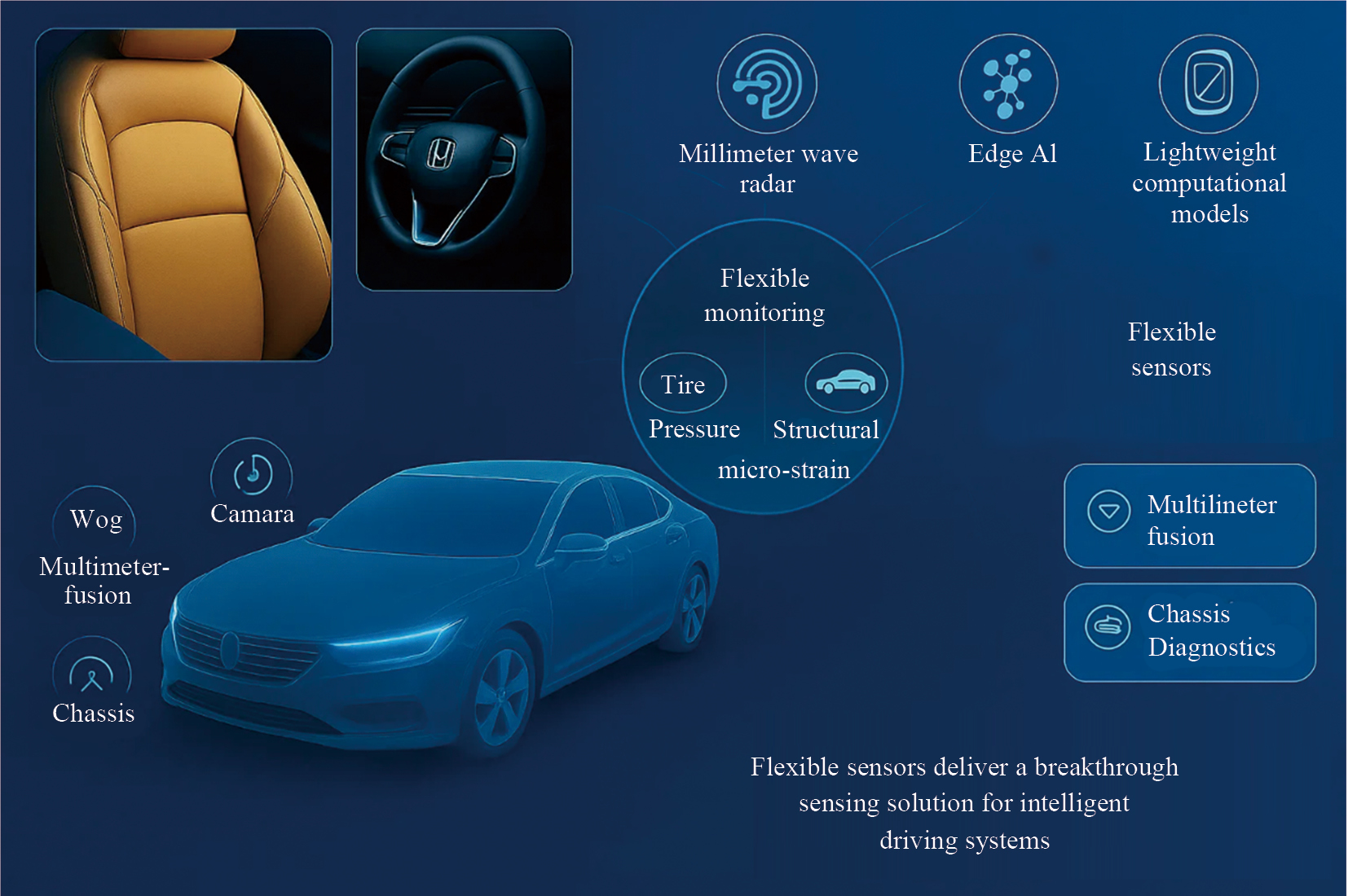
A complete flexible sensor typically consists of perception units, interconnection circuits, and flexible substrate/encapsulation materials [14]. Recently, advancements of flexible conductive materials are becoming a big thrust for the flexible sensing network, which are vital to real-time and all-round intelligent driving monitoring and management. According to the properties of conductive materials, research hotspots primarily focus on three major material categories: conductive polymer composites, carbon-based nanomaterials, and liquid metals [15]. Conductive polymer composites with high conductivity, excellent stretchability, and low Young's modulus can be obtained by dispersing conductive fillers into elastic polymer matrices (e.g., styrene-ethylene-butylene-styrene (SEBS), polyurethane (PU), and Ecoflex). Their electrical properties respond sensitively to mechanical deformation or environmental stimuli [16, 17]. For example, a flexible tactile sensing array based on silver nanowire/polyurethane (silver nanowires (AgNWs)/polydimethylsiloxane (PDMS)) composite material was illustrated in Fig. 2(a) [7]. This material exhibited a low modulus and adhered conformally to curved surfaces. In experiments, it successfully perceived grip force magnitude, position distribution, and even hand sweat humidity in real-time and distributed, delivering comprehensive data for driver state assessment and human-vehicle interaction. Conductive polymers, while offering high stretchability and tunable conductivity, are susceptible to oxidation, UV-induced degradation, and microstructural fatigue during prolonged thermal cycling, which can gradually impair electrical performance [18].
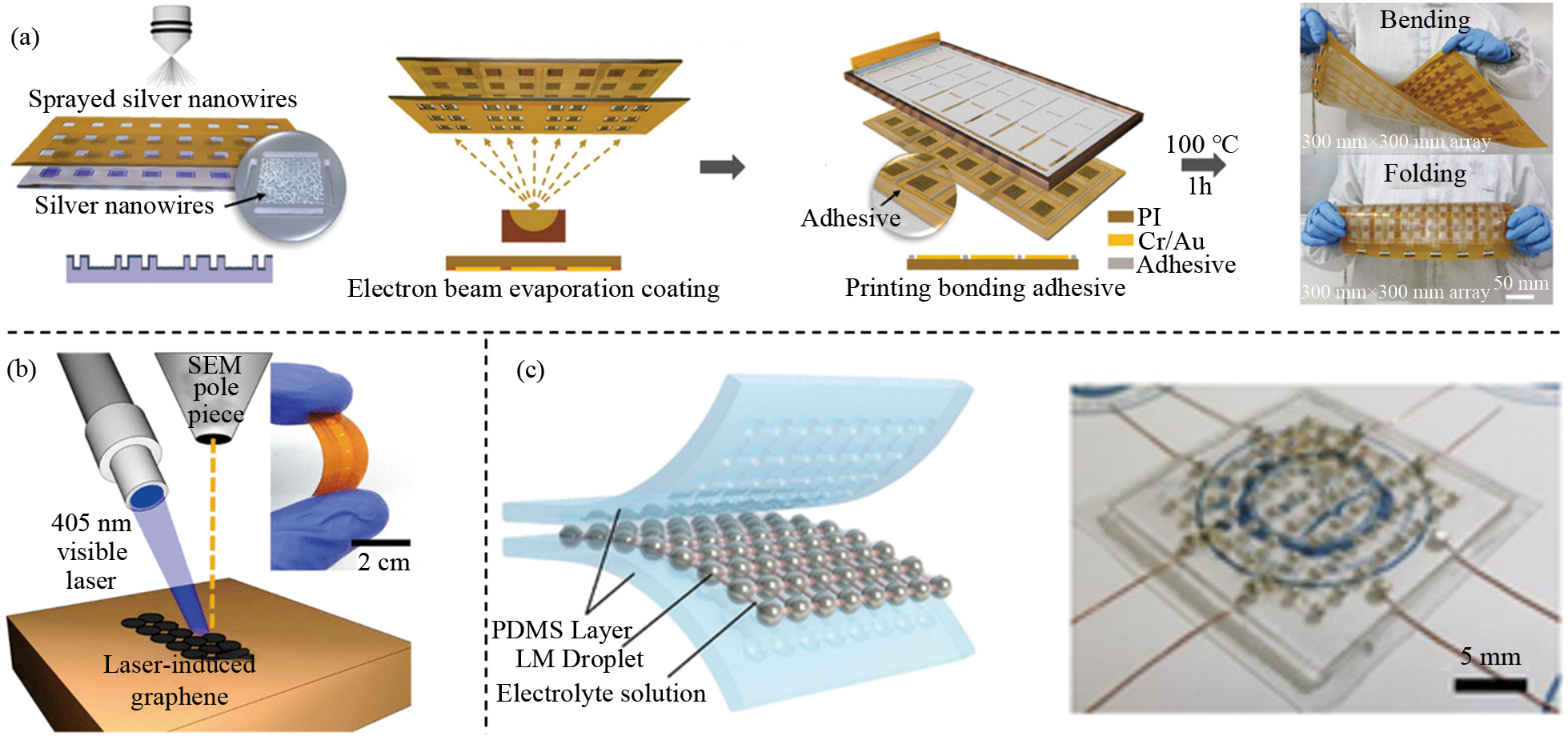
Carbon-based nanomaterials, represented by graphene, carbon nanotubes (CNTs), and their films/fibers, possess intrinsic flexibility, outstanding mechanical strength, high electrical/thermal conductivity, chemical stability, and broad-spectrum response. A micro-structured three-dimensional graphene sensing network was directly "written" onto a polyimide surface through laser-induced graphene (LIG) technology (Fig. 2(b)) [19]. The graphene sensing network was integrated into tire liners or critical structural parts of vehicle bodies. Owing to the inherent flexibility and high sensitivity of LIG, this network could monitor tire contact pressure distribution, tread wear conditions, and micro-strain/vibrations of vehicle body panels, thereby generating critical data for vehicle health diagnostics and active safety control. Carbon-based nanomaterials such as graphene and carbon nanotubes exhibit excellent intrinsic stability, but their interfacial bonding with polymer matrices may weaken under extreme temperature fluctuations, high humidity, or salt-mist environments, leading to delamination or sensitivity loss over time[20]. Gallium-based liquid metals are liquid at room temperature, featuring extremely high ductility, exceptional electrical conductivity, low toxicity, and self-healing properties. Their fluidity and surface tension characteristics allow for the formation of unique interconnects. As shown in Fig. 2(c), each droplet pair was connected via an electrolyte solution within a PDMS microchannel grid [21]. Under applied pressure, liquid metals altered microchannel shapes, inducing measurable resistance changes that achieve distributed pressure/contact perception. This is applicable for occupant posture recognition, seat belt wearing status, and tension force monitoring. The ultra-high deformation tolerance and self-healing potential (addressing local damage) of liquid metals are particularly suitable for scenarios requiring large deformations and long-term use [22]. Future flexible sensors may exploit novel flexible materials with higher electrical conductivity and chemical stability to enhance intelligent driving experiences. However, they face risks of leakage and electrochemical corrosion when exposed to automotive fluids such as lubricants, antifreeze, and cleaning agents[23]. These material-level degradation issues are directly tied to the stringent requirements of automotive-grade integration standards, such as ISO 26262 for functional safety and ISO 21448 for safety of the intended functionality. Therefore, protective encapsulation strategies, chemically resistant substrates, and accelerated aging evaluations will be indispensable to ensure the long-term stability and compliance of flexible sensors in real-world vehicular applications.
Multimodal information fusion endows flexible sensors with the ability to simultaneously collect and integrate various types of data, thus optimizing the perception accuracy [24–26]. For instance, millimeter-wave radar arrays integrated in different parts of the surface unmanned vessel and the distributed cameras coordinated to realize complementary advantages in multi-modal perception (Fig. 3(a)) [27]. The millimeter-wave radar obtained precise distance and speed information, and performs stably in adverse weather. As well as the distributed cameras gained rich scene and texture information by means of multi-angle collaboration. After applying the deep fusion algorithm, the system's recognition accuracy for small objects in complex scenarios (such as rainy and foggy weather, strong light and backlighting) was obviously strengthening. Meanwhile, the misjudgment and missed detection problems caused by the limited viewing angle or environmental interference of traditional single sensors or rigidly fixed sensors was also alleviated.
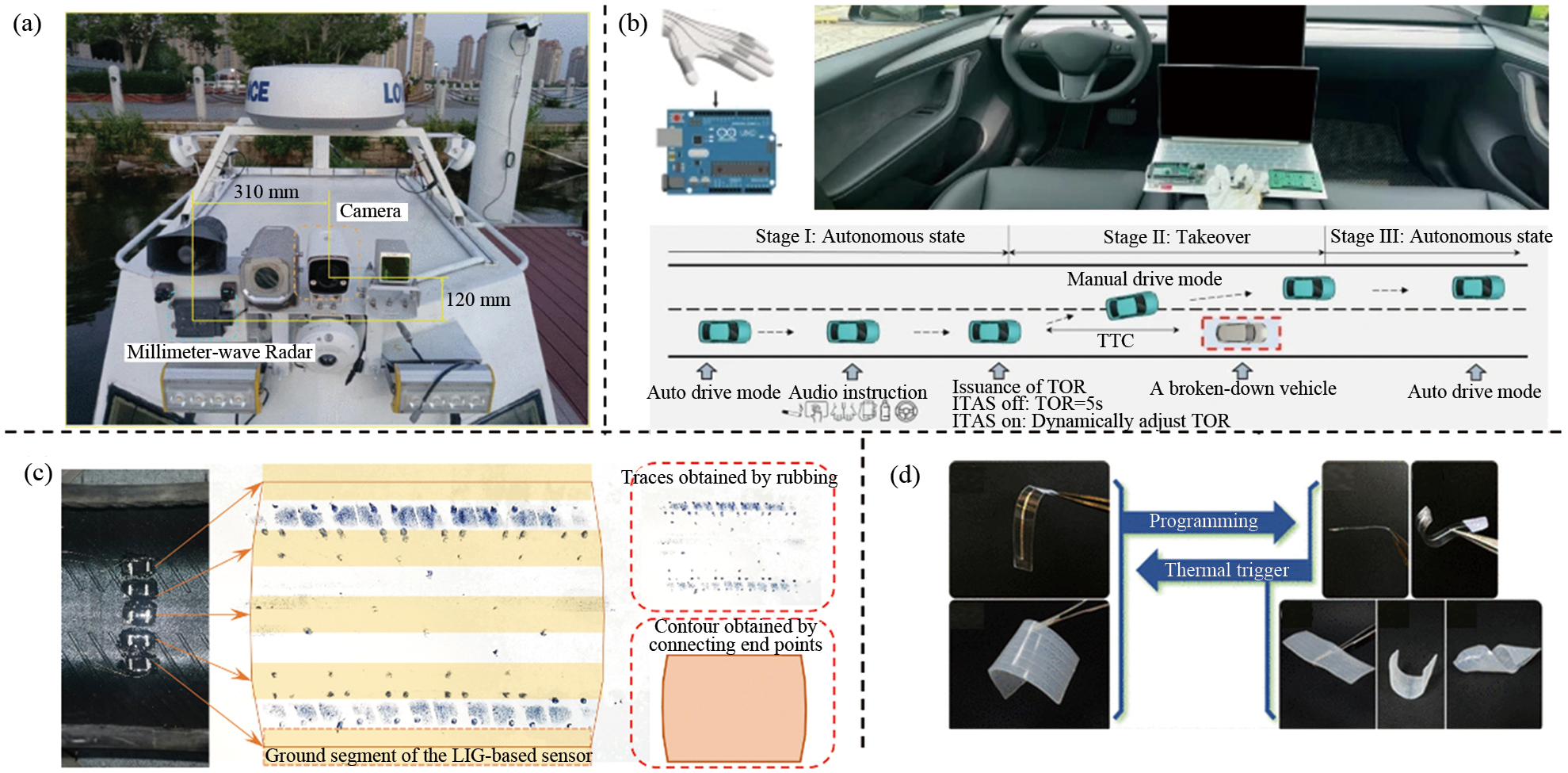
Sensor network deployment refers to an intelligent perception system formed by deploying multiple sensor nodes in a networked manner on a flexible substrate. Through the collaborative work of spatially distributed sensing units, it overcomes the limitations of spatial coverage, achieving continuous and high-precision monitoring of large curved surfaces, while promoting the system's robustness, redundancy, and real-time performance. Robustness emphasizes in the flexible sensors’ inherent tolerance to vibration, impact, and temperature variations; the redundancy manifests that a single node failure does not affect the overall functionality [28, 29]; the real-time performance benefits from the near-source deployment of distributed sensing nodes and the local signal preprocessing (such as the integration of edge computing nodes) by the flexible electronics to significantly reduce data transmission delay. A representative example used a triboelectric-sensor-based omnidirectional perception glove, which seamlessly detected the subtle movements of the hand and the interactions between the hand and other objects, and then transmitted the electrical signals to the non-driving behavior recognition module (Fig. 3(b)) [30]. It is worth noting that the recognition accuracy rate of this module for six types of non-driving behaviors reached 94.72%. The perception glove demonstrated outstanding mechanical and electrical performance, including excellent deformation adaptability, high sensitivity, low power consumption, and ultra-low signal delay (millisecond level). By further integrating advanced algorithms, the system could recognize the driver's state in real time, thereby increasing active safety and driving comfort.
Flexible manufacturing processes (e.g., roll-to-roll printing, laser direct writing) enable large-scale, low-cost addition of perception nodes across diverse vehicle surfaces and internal spaces [31, 32]. A high-density capacitive/piezoresistive sensing networks based on stretchable conductive inks or LIG technology was outlined in Fig. 3(c), which could be directly "printed" inside the automotive tires [6]. This "on-demand growth" perception layer allows effortless expansion of sensing coverage (e.g., monitoring rear passengers or trunk areas) or modalities (e.g., integrating temperature/humidity sensing within the same network) without complex rewiring or structural modifications. Hence, it provided robust support for future personalized upgrades and functional extensions of smart cabins. Despite the advantages of roll-to-roll printing and laser direct writing for fabricating large-area flexible sensing networks, significant challenges remain for scaling these processes to automotive mass production. Yield rates are highly sensitive to defects such as microcracks, misalignment, or non-uniform ink deposition, which can compromise sensor reliability across large substrates. Cost-efficiency is also a critical hurdle: while roll-to-roll processing is inherently high-throughput, the reliance on high-purity conductive inks, precise multi-layer registration, and post-deposition treatments (e.g., sintering, encapsulation) substantially increases production cost [33]. Furthermore, many flexible substrates and conductive materials validated in laboratory-scale demonstrations do not yet meet automotive-grade requirements, including resistance to UV radiation, extreme thermal cycling, and chemical exposure. Recent industrial efforts have begun to address these barriers–for instance, the direct integration of laser-induced graphene (LIG) sensing networks inside tires demonstrates the feasibility of scalable embedding, while hybrid roll-to-roll processes combined with automated defect inspection systems are improving yield and consistency [6]. These developments indicate promising progress, but overcoming the combined challenges of reliability, cost, and material compatibility will be essential for the commercialization of flexible sensor technologies in intelligent vehicles.
Over the past few years, we have witnessed the rapid growth of flexible sensors in the field of intelligent driving. Nevertheless, flexible sensors still face significant challenges in the large-scale mass production of passenger vehicles. The complex system integration and calibration processes for automotive-grade systems, the stringent requirements for functional safety (ISO 26262) and safety of the intended functionality (ISO 21448) requirements, high system costs, and data security are the main obstacles to prevent the widespread adoption of flexible sensing systems at present. Moreover, addressing power supply stability remains essential. Large-scale deployment of distributed sensing nodes imposes stringent requirements on power management modules: miniaturization, high efficiency, environmental adaptability (e.g., wide-temperature-range operation), and sustainability (long-term maintenance-free operation) [34]. Recently developed flexible solid-state thin-film batteries and micro-supercapacitors may solve these problems [35, 36].
The development of flexible sensors will exhibit a multi-dimensional innovation trend: (1) Tight collaboration with edge artificial intelligence (AI) and lightweight deep learning models. The aim is that some data fusion, feature extraction and decision-making tasks are pushed down to distributed perception nodes or regional gateways, thereby diminishing the load on the central computing unit and ensuring the real-time performance of the system [37]. The integration of AI and machine learning (ML) with flexible sensors provides powerful opportunities to enhance the performance of smart vehicle systems beyond conventional sensing. For example, triboelectric-based flexible gloves combined with ML algorithms have been shown to identify non-driving behaviors such as eating or phone use with an accuracy exceeding 94%, enabling real-time driver monitoring and proactive safety interventions [30]. In addition, flexible tactile arrays fabricated from conductive polymer composites, paired with deep learning-based gesture recognition algorithms, allow vehicles to interpret subtle hand gestures or variations in grip force, thereby creating more natural and reliable human–vehicle interaction experiences [7]. These case studies underscore that coupling flexible sensor data with advanced AI/ML analytics significantly improves system-level intelligence in terms of safety, diagnostics, and user interaction, reinforcing the pivotal role of flexible sensing technologies in next-generation intelligent vehicles. (2) Deep integration with intelligent materials for the creation of "intelligent skins" with adaptive, self-healing, and even cognitive capabilities. For example, flexible sensing composite structures incorporating shape memory alloys or liquid metals not only perceived environmental change (e.g., pressure and deformation), but also actively altered their shape or stiffness in response to specific stimuli (e.g., heat and electricity) (Fig. 3(d)) [38]. It is envisioned that after a minor collision occurred in a vehicle, this bionic intelligent skin not only sensed the location and extent of the damage, but also activated the shape memory alloys or liquid metals flow through local heating for the initial self-repair of the shape. At the same time, it could report the damage information in real time, significantly increasing the durability and safety of the vehicle. (3) Collaboratively making breakthroughs across multiple disciplines such as materials science (weather resistance, lightweighting), microelectronics (automotive-grade chips, high computing power), vehicle engineering (integration/packaging, electromagnetic compatibility), and high-precision mapping and positioning. Further enhance the material's weather resistance and lightweight properties, develop vehicle-grade high-performance computing chips, and optimize the system integration and packaging processes.
While flexible sensor technologies hold great promise for advancing intelligent vehicles, their widespread deployment must also contend with several practical limitations. The high cost of advanced conductive materials and encapsulation techniques, the energy demands of large-scale distributed sensing networks, and the integration complexity associated with ensuring long-term stability across thousands of sensor nodes remain key barriers to commercialization. Addressing these challenges will require breakthroughs in low-cost scalable manufacturing, energy-efficient circuit designs, and modular architectures capable of facilitating maintenance and upgrades. At the same time, flexible sensors are expected to play an increasingly central role in future mobility paradigms. Distributed sensor networks deployed on vehicle exteriors could provide critical data streams to support vehicle-to-vehicle (V2V) communication, enabling coordinated driving behaviors such as platooning and cooperative lane changes. Furthermore, real-time sensing of chassis health and road conditions could be shared through road-cloud coordination systems, supporting predictive traffic management and infrastructure maintenance. These opportunities, combined with advances in energy harvesting and AI integration, indicate that despite current hurdles, flexible sensors are well-positioned to become indispensable enablers of next-generation smart mobility ecosystems. In the future, flexible sensors are expected to be applied more extensively in intelligent driving. For instance, integrating flexible ultrasonic sensor arrays beneath vehicle chassis [39, 40] could accomplish high-precision detection of close-range ground obstacles (e.g., curbs, potholes) and parking space features, increasing automated parking capabilities. We believe that the distributed layout and fusion strategies of high-performance flexible sensors (such as lidar, millimeter-wave radar, cameras, and microphone arrays) will be continuously optimized, the robustness in complex lighting/weather/emagnetic environments will be enhanced, and efficient real-time multimodal information fusion algorithms will be developed. Flexible sensing technology will inevitably become the core component for achieving high-level autonomous driving (L4/L5), improving active safety performance, optimizing smart cabin human-machine interaction (e.g., in-cabin monitoring, gesture recognition), and supporting vehicle-road-cloud coordination.
The authors acknowledge the National Natural Science Foundation of China (No. 52525502, No. 52205593, No. 52427809), the Xidian University Specially Funded Project for Interdisciplinary Exploration (No. TZJH2024061), Proof of Concept Foundation of Xidian University Hangzhou Institute of Technology (Grant No. GNYZ2024QC008) and the Special Project of Central Government for Local Science and Technology Development of Hubei Province (No. 2024AFE002).
Supervision and conceptualization: Yongan Huang.
Investigation and writing-original draft: Jiangnan Yuan and Wei Zhao.
Writing-review and editing: Yunlei Zhou.
Y. Qian, M. Yang, J. M. Dolan, "Survey on fish-eye cameras and their applications in intelligent vehicles," IEEE Transactions on Intelligent Transportation Systems, vol. 23, no. 12, pp. 22755–22771, 2022.
Y. Miao, X. Tao, X. Xu, J. Lu, "Joint 3-D shape estimation and landmark localization from monocular cameras of intelligent vehicles," IEEE Internet of Things Journal, vol. 6, no. 1, pp. 15–25, 2019.
W. Lin, H. Wang, R. Wang, Y. Luo, G. Chen, S. Yu, L. Liu, Z. Huang, Y. Lin.et al, "Dielectrically modified polymer and topologically optimized microstructure enabling in-sensor decoupling for multifunctional human–machine interactions," Advanced Functional Materials, vol. 35, no. 32, 2025.
T. Wang, T. Jin, W. Lin, Y. Lin, H. Liu, T. Yue, Y. Tian, L. Li, Q. Zhang, C. Lee, "Multimodal sensors enabled autonomous soft robotic system with self-adaptive manipulation," ACS Nano, vol. 18, no. 14, pp. 9980–9996, 2024.
J.-T. Su, M.-R. Tan, J.-J. Liu, K. He, D. Wu, "Bioarchitectonics-inspired soft grippers with cutaneous slip perception," Sci. Adv., vol. 11, no. 33, p. eadx4206, 2025.
Y. Yue, X.-Y. Li, Z.-F. Zhao, H. Wang, X.-G. Guo, "Stretchable flexible sensors for smart tires based on laser-induced graphene technology," Soft Science, vol. 3, no. 2, p.13, 2023.
X. Chen, Y. Luo, Y. Chen, S. Li, S. Deng, B. Wang, Q. Zhang, X. Li, X. Li.et al, "Biomimetic contact behavior inspired tactile sensing array with programmable microdomes pattern by scalable and consistent fabrication," Advanced Science, vol. 11, no. 43, p.2408082, 2024.
J. Zhang, J. Chen, C. Wang, "Study on energy dissipation in origami-inspired composite structures," Structures, vol. 79, p. 109571, 2025.
Y. Shin, S. Hong, Y. C. Hur, C. Lim, K. Do, J. H. Kim, D.-H. Kim, S. Lee, "Damage-free dry transfer method using stress engineering for high-performance flexible two-and three-dimensional electronics," Nature Materials, vol. 23, no. 10, pp. 1411–1420, 2024.
X. Gong, Z. Zhong, "Vision sensing for intelligent driving: Technical challenges and innovative solutions," Engineering, 2025.
Y. Ma, H. Li, S. Chen, Y. Liu, Y. Meng, J. Cheng, X. Feng, "Skin-like electronics for perception and interaction: Materials, structural designs, and applications," Advanced Intelligent Systems, vol. 3, no. 4, p. 2000108, 2021.
S. Din, W. Xu, L. K. Cheng, S. Dirven, "A stretchable multimodal sensor for soft robotic applications," IEEE Sensors Journal, vol. 17, no. 17, pp. 5678–5686, 2017.
D. Maurya, S. Khaleghian, R. Sriramdas, P. Kumar, R. A. Kishore, M. G. Kang, V. Kumar, H.-C. Song, S.-Y. Lee.et al, "3D printed graphene-based self-powered strain sensors for smart tires in autonomous vehicles," Nature Communications, vol. 11, no. 1, p.5392, 2020.
H. Panetto, P. C. Stadzisz, W. Li, Q.-S. Jia, "Guest editorial: special issue on (industrial) internet-of-things for smart and sensing systems: Issues, trends, and applications," IEEE Internet of Things Journal, vol. 5, no. 6, pp. 4392–4395, 2018.
A. Ehsani, A. A. Heidari, H. M. Shiri, "Electrochemical pseudocapacitors based on ternary nanocomposite of conductive polymer/graphene/metal oxide: An introduction and review to it in recent studies," The Chemical Record, vol. 19, no. 5, pp. 908–926, 2019.
L. F. Gerlein, J. A. Benavides-Guerrero, S. G. Cloutier, "High-performance silver nanowires transparent conductive electrodes fabricated using manufacturing-ready high-speed photonic sinterization solutions," Scientific Reports, vol. 11, no. 1, p. 24156, 2021.
C. Jiang, L. Zhang, Q. Yang, S. Huang, H. Shi, Q. Long, B. Qian, Z. Liu, Q. Guan.et al, "Self-healing polyurethane-elastomer with mechanical tunability for multiple biomedical applications in vivo," Nature Communications, vol. 12, no. 1, p.4395, 2021.
H. T. Tazwar, M. F. Antora, I. Nowroj, A. B. Rashid, "Conductive polymer composites in soft robotics, flexible sensors and energy storage: Fabrication, applications and challenges," Biosensors and Bioelectronics: X, vol. 24, no. 100597, pp. 2590–1370, 2025.
M. G. Stanford, C. Zhang, J. D. Fowlkes, A. Hoffman, I. N. Ivanov, P. D. Rack, J. M. Tour, "High-resolution laser-induced graphene. Flexible electronics beyond the visible limit," ACS Applied Materials & Interfaces, vol. 12, no. 9, pp. 10902–10907, 2020.
X. Su, Z. Yang, R. Cheng, A. Luvnish, S. Han, Q. Meng, N. Stanford, J. Ma, "A comparative study of polycarbonatenanocomposites respectively containing graphene nanoplatelets, carbonnanotubes and carbon nanofibers," Advanced Nanocomposites, vol. 1, no. 1, pp. 77–85, 2024.
S. Dong, G. Ma, Z. Xiong, D.-A. Ge, Y. Guo, W. Li, S. Zhang, "Liquid metal reversible contacts for flexible tactile sensor with high sensitivity and wide detection range," Advanced Intelligent Systems, p. 2401019, 2025.
Y. Li, S. Xu, P. Zhu, S. Zhang, Y. Sun, S. Zhang, P. He, "Recent advances and future prospects of flexible and wearable applications based on liquid metal demands," Journal of Materials Chemistry A, vol. 13, no. 7, pp. 4693–4717, 2025.
S. Zheng, X. Wang, W. Li, et al., "Pressure-stamped stretchable electronics using a nanofibre membrane containing semi-embedded liquid metal particles," Nat Electron, vol. 7, pp. 576–585, 2024.
C. Xiang, C. Feng, X. Xie, B. Shi, H. Lu, Y. Lv, M. Yang, Z. Niu, "Multi-sensor fusion and cooperative perception for autonomous driving: A review," IEEE Intelligent Transportation Systems Magazine, vol. 15, no. 5, pp.36–58, 2023.
L. Zhang, B. Wang, Y. Zhao, Y. Yuan, T. Zhou, Z. Li, "Collaborative multimodal fusion network for multiagent perception," IEEE Transactions on Cybernetics, vol. 55, no. 1, pp. 486–498, 2025.
Y. Han, H. Zhang, H. Li, Y. Jin, C. Lang, Y. Li, "Collaborative perception in autonomous driving: Methods, datasets, and challenges," IEEE Intelligent Transportation Systems Magazine, vol. 15, no. 6, pp. 131–151, 2023.
X. He, D. Wu, D. Wu, Z. You, S. Zhong, Q. Liu, "Millimeter-wave radar and camera fusion for multiscenario object detection on USVs," IEEE Sensors Journal, vol. 24, no. 19, pp. 31562–31572, 2024.
J. Lin, Z. Chen, Q. Zhuang, S. Chen, C. Zhu, Y. Wei, S. Wang, D. Wu, "Temperature-immune, wide-range flexible robust pressure sensors for harsh environments," ACS Applied Materials & Interfaces, vol. 15, no. 42, pp. 49642–49652, 2023.
Z. Long, W. Lin, P. Li, B. Wang, Q. Pan, X. Yang, W.-W. Lee, H.-H. Chung, Z. Yang, "One-wire reconfigurable and damage-tolerant sensor matrix inspired by the auditory tonotopy," Science Advances, vol. 9, no. 48, 2023.
X. Lu, H. Tan, H. Zhang, W. Wang, S. Xie, T. Yue, F. Chen, "Triboelectric sensor gloves for real-time behavior identification and takeover time adjustment in conditionally automated vehicles," Nature Communications, vol. 16, no. 1, p. 1080, 2025.
Y. Sozen, Y. K. Ryu, J. Martinez, A. Castellanos-Gomez, "Direct laser ablation of 2D material films for fabricating multi-functional flexible and transparent devices," Advanced Functional Materials, p.2507458, 2025.
X. Tao, Q. Zheng, C. Zeng, H. Potter, Z. Zhang, J. Ellingford, R. S. Bonilla, E. Bilotti, P. S. Grant, H. E. Assender, "Cu- or Ag-containing Bi-Sb-Te for in-line roll-to-roll patterned thin-film thermoelectrics," Nature Communications, vol. 16, no. 1, p. 196, 2025.
T. C. Jun, K. Koga, Y. Kogo, I. Miyamoto, "Rapid and three-dimensional nanoimprint template fabrication technology using focused ion beam lithography," Microelectron Engineering, vol. 83, no. 4-9, pp. 940–943, 2006.
Y. Lu, X. Wang, S. Mao, D. Wang, D. Sun, Y. Sun, A. Su, C. Zhao, X. Han.et al, "Smart batteries enabled by implanted flexible sensors," Energy & Environmental Science, vol. 16, no. 6, pp. 2448–2463, 2023.
P. Cheng, S. Liu, X. Jia, Y. Jiang, X. Zhang, "Robust MOF-based composite solid-state electrolyte membrane for high-performance lithium–metal batteries," Nano Letters, vol. 25, no. 15, pp.6152–6159, 2025.
X. Xu, T. Li, R. Zhang, Z. Zhang, W. Cao, Y. Wang, Y. Hu, X. Liu, S. Qiao, "Covalent organic framework nanofilm heterojunctions: Lamination effect and suppressed self-discharge in flexible micro-supercapacitors energy storage," Small, p.2412642, 2025.
M. D. Alfikri, R. J. Kaliski, "Real-time pedestrian detection on IoT edge devices: A lightweight deep learning approach," ArXiv-CS-Networking and Internet Architecture, 2024.
P. Bhuyan, Y. Wei, D. Sin, J. Yu, C. Nah, K.-U. Jeong, M. D. Dickey, S. Park, "Soft and stretchable liquid metal composites with shape memory and healable conductivity," ACS Applied Materials & Interfaces, vol. 13, no. 24, pp. 28916–28924, 2021.
C. Sun, X. Sun, Z. Xing, W. Ji, Y. Xia, Z. Lin, H. Wang, L. Chen, S. Si.et al, "Ultrahigh-frequency flexible triboelectric ultrasound transceiver arrays for inspection of complex surfaces," Advanced Functional Materials, p. e08444, 2025.
 Top
Top